
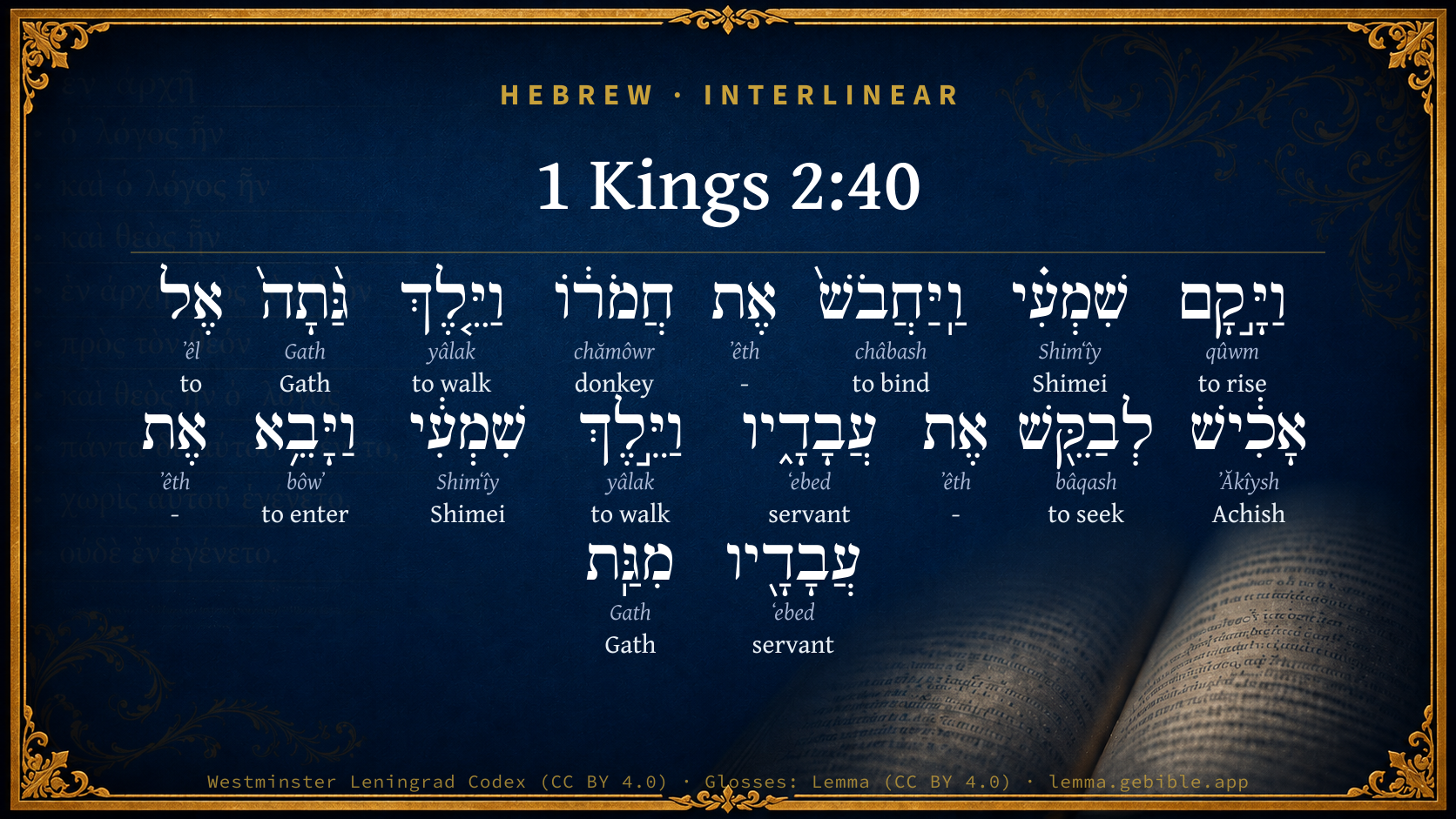
1 Kings 2:40

Hebrew (Westminster Leningrad Codex) 1 Kings 2:40 appears in the Hebrew Old Testament. The text above is from the Westminster Leningrad Codex. Each word links to its Strong’s number, a concise gloss, and parsing drawn from the Open Scriptures Hebrew Bible morphology. Click any word for its full Brown-Driver-Briggs (BDB) entry.
Download image
Cite this verse

1 Kings 2:40 (World English Bible). Public Domain. Lemma interlinear Bible study tool, https://lemma.gebible.app/v/1-kings/2/40.

Show BibTeX & RIS
BibTeX
RIS
English Translation
Shimei arose, and saddled his donkey, and went to Gath to Achish, to seek his servants; and Shimei went, and brought his servants from Gath.
World English Bible · Public Domain
Download a study sheet

One document with this verse’s original text, its word-by-word gloss line, the meaning frame, cross-references with their text, attributed commentary, and full source and license credits — printable, and it pastes into notes with its structure intact.

This verse Autodidact and up

Study sheet (.html) Plain text (.txt)

A passage Seminary Student

Up to 50 verses in one chapter. A passage sheet keeps up to 6 commentary sources and 12 cross-references per verse, in the order this page ranks them, and says so on the sheet whenever that leaves anything out. Ask for a single verse and you get the Autodidact verse sheet above.

Everything on this page stays free to read, with no account — the sheet is a download of what is already on screen, not access to it.

Want to remove ads? Support Godless Engineer
Compare translations 3

The same verse in 3 English versions, stacked beneath the original-language interlinear above. Click any original word for its lexicon entry.

Each is an independent rendering of the whole verse — the interlinear is not word-aligned to these translations.

Highlighted words mark where these versions differ — a whole-verse word diff, not a word-by-word alignment.

  • World English Bible Public Domain
    Shimei arose, and saddled his donkey, and went to Gath to Achish, to seek his servants; and Shimei went, and brought his servants from Gath.
  • King James Version Public Domain
    And Shimei arose, and saddled his ass, and went to Gath to Achish to seek his servants: and Shimei went, and brought his servants from Gath.
  • unfoldingWord Literal Text CC BY-SA 4.0
    So Shimei arose and saddled his donkey and went to Gath, to Achish, to seek his slaves. And Shimei went and brought back his slaves from Gath.

unfoldingWord Literal Text — © unfoldingWord, licensed CC BY-SA 4.0. Word-aligned USFM3 via Door43 (git.door43.org/unfoldingWord/en_ult).

Versions to compare (up to 4)

3 of 4 selected

Show all 18 translations

Every available English version of this verse, each an independent rendering of the whole verse.

  • World English Bible Public Domain
    Shimei arose, and saddled his donkey, and went to Gath to Achish, to seek his servants; and Shimei went, and brought his servants from Gath.
  • Berean Standard Bible Public Domain
    So Shimei saddled his donkey and set out to Achish at Gath in search of his slaves, and he brought them back from Gath.
  • Majority Standard Bible Public Domain
    So Shimei saddled his donkey and set out to Achish at Gath in search of his slaves, and he brought them back from Gath.
  • King James Version Public Domain
    And Shimei arose, and saddled his ass, and went to Gath to Achish to seek his servants: and Shimei went, and brought his servants from Gath.
  • American Standard Version (1901) Public Domain
    And Shimei arose, and saddled his ass, and went to Gath to Achish, to seek his servants; and Shimei went, and brought his servants from Gath.
  • Revised Version (1885) Public Domain
    And Shimei arose, and saddled his ass, and went to Gath to Achish, to seek his servants: and Shimei went, and brought his servants from Gath.
  • Geneva Bible (1599) Public Domain
    And Shimei arose, and sadled his asse, and went to Gath to Achish, to seeke his seruantes: and Shimei went, and brought his seruants from Gath.
  • Douay-Rheims (1899) Public Domain
    And Semei arose, and saddled his ass, and went to Achis to Geth to seek his servants, and he brought them out of Geth.
  • Young's Literal Translation Public Domain
    and Shimei riseth, and saddleth his ass, and goeth to Gath, unto Achish, to seek his servants, and Shimei goeth and bringeth his servants from Gath.
  • Literal Standard Version CC BY-SA 4.0
    and Shimei rises, and saddles his donkey, and goes to Gath, to Achish, to seek his servants, and Shimei goes and brings his servants from Gath.
  • Unlocked Literal Bible CC BY-SA 4.0
    Then Shimei arose, saddled his donkey and went to Achish in Gath to seek his servants. He went and brought his servants back from Gath.
  • unfoldingWord Literal Text CC BY-SA 4.0
    So Shimei arose and saddled his donkey and went to Gath, to Achish, to seek his slaves. And Shimei went and brought back his slaves from Gath.
  • Darby Bible Public Domain
    Then Shimei arose, and saddled his ass, and went to Gath, to Achish, to seek his servants; and Shimei went, and brought his servants from Gath.
  • World Messianic Bible Public Domain
    Shimei arose, saddled his donkey, and went to Gath to Achish to seek his slaves; and Shimei went and brought his slaves from Gath.
  • Webster's Bible Public Domain
    And Shimei arose, and saddled his ass, and went to Gath to Achish to seek his servants: and Shimei went and brought his servants from Gath.
  • Free Bible Version CC BY-SA 4.0
    So Shimei saddled up his donkey and went to Achish in Gath to look for his slaves. He found them and brought them back from Gath.
  • Bible in Basic English Public Domain
    Then Shimei got up, and making ready his ass, he went to Gath, to Achish, in search of his servants; and he sent and got them from Gath.
  • JPS Tanakh (1917) Public Domain
    And Shimei arose, and saddled his ass, and went to Gath to Achish, to seek his servants; and Shimei went, and brought his servants from Gath.

Literal Standard Version (2020), Covenant Press — licensed CC BY-SA 4.0. Text via the HelloAO Bible API (eBible.org). Unlocked Literal Bible (unfoldingWord) — licensed CC BY-SA 4.0. Text via the HelloAO Bible API (eBible.org). unfoldingWord Literal Text — © unfoldingWord, licensed CC BY-SA 4.0. Word-aligned USFM3 via Door43 (git.door43.org/unfoldingWord/en_ult). Free Bible Version, Dr. Jonathan Gallagher — licensed CC BY-SA 4.0. Text via the HelloAO Bible API (eBible.org).

Word by word

More ways to search: Search by grammar → Find every occurrence → Compare this word →

Practice this passage: Drill this verse → Learn its vocabulary →

אָכִ֔ישׁ
ʼĂkîysh
H397
“Achish”
Noun, Proper
Part of Speech
Noun
Type
Proper
Full BDB Definition

Origin: of uncertain derivation

TWOT: None

Achish = "I will blacken (or terrify)" or " only a man" - Philistine king of Gath
  1. וַיָּ֣קָם qûwm H6965 “and · to rise” Conjunction + Verb, Qal, Sequential Imperfect, 3rd Person, Masculine, Singular
  2. שִׁמְעִ֗י Shimʻîy H8096 “Shimei” Noun, Proper
  3. וַֽיַּחֲבֹשׁ֙ châbash H2280 “and · to bind” Conjunction + Verb, Qal, Sequential Imperfect, 3rd Person, Masculine, Singular
  4. אֶת ʼêth H853 “-” Particle, Direct Object
  5. חֲמֹר֔וֹ chămôwr H2543 “donkey · his” Noun, Common, Both, Singular, Construct + Suffix, Personal, 3rd Person, Masculine, Singular
  6. וַיֵּ֤לֶךְ yâlak H3212 “and · to walk” Conjunction + Verb, Qal, Sequential Imperfect, 3rd Person, Masculine, Singular
  7. גַּ֨תָה֙ Gath H1661 “Gath · toward” Noun, Proper + Suffix, Demonstrative
  8. אֶל ʼêl H413 “to” Preposition
  9. לְבַקֵּ֖שׁ bâqash H1245 “to seek” Preposition + Verb, Piel, Infinitive Construct
  10. אֶת ʼêth H853 “-” Particle, Direct Object
  11. עֲבָדָ֑יו ʻebed H5650 “servants · his” Noun, Common, Masculine, Plural, Construct + Suffix, Personal, 3rd Person, Masculine, Singular
  12. וַיֵּ֣לֶךְ yâlak H3212 “and · to walk” Conjunction + Verb, Qal, Sequential Imperfect, 3rd Person, Masculine, Singular
  13. שִׁמְעִ֔י Shimʻîy H8096 “Shimei” Noun, Proper
  14. וַיָּבֵ֥א bôwʼ H935 “and · to enter” Conjunction + Verb, Hiphil, Sequential Imperfect, 3rd Person, Masculine, Singular
  15. אֶת ʼêth H853 “-” Particle, Direct Object
  16. עֲבָדָ֖יו ʻebed H5650 “servants · his” Noun, Common, Masculine, Plural, Construct + Suffix, Personal, 3rd Person, Masculine, Singular
  17. מִגַּֽת Gath H1661 “from · Gath” Preposition + Noun, Proper

About this verse

These counts appear in no published source. They are computed here, from the morphology-tagged text and Lemma’s own curated glosses. What Lemma adds →

18
words
12
distinct lemmas
Historical
section

Notable vocabulary

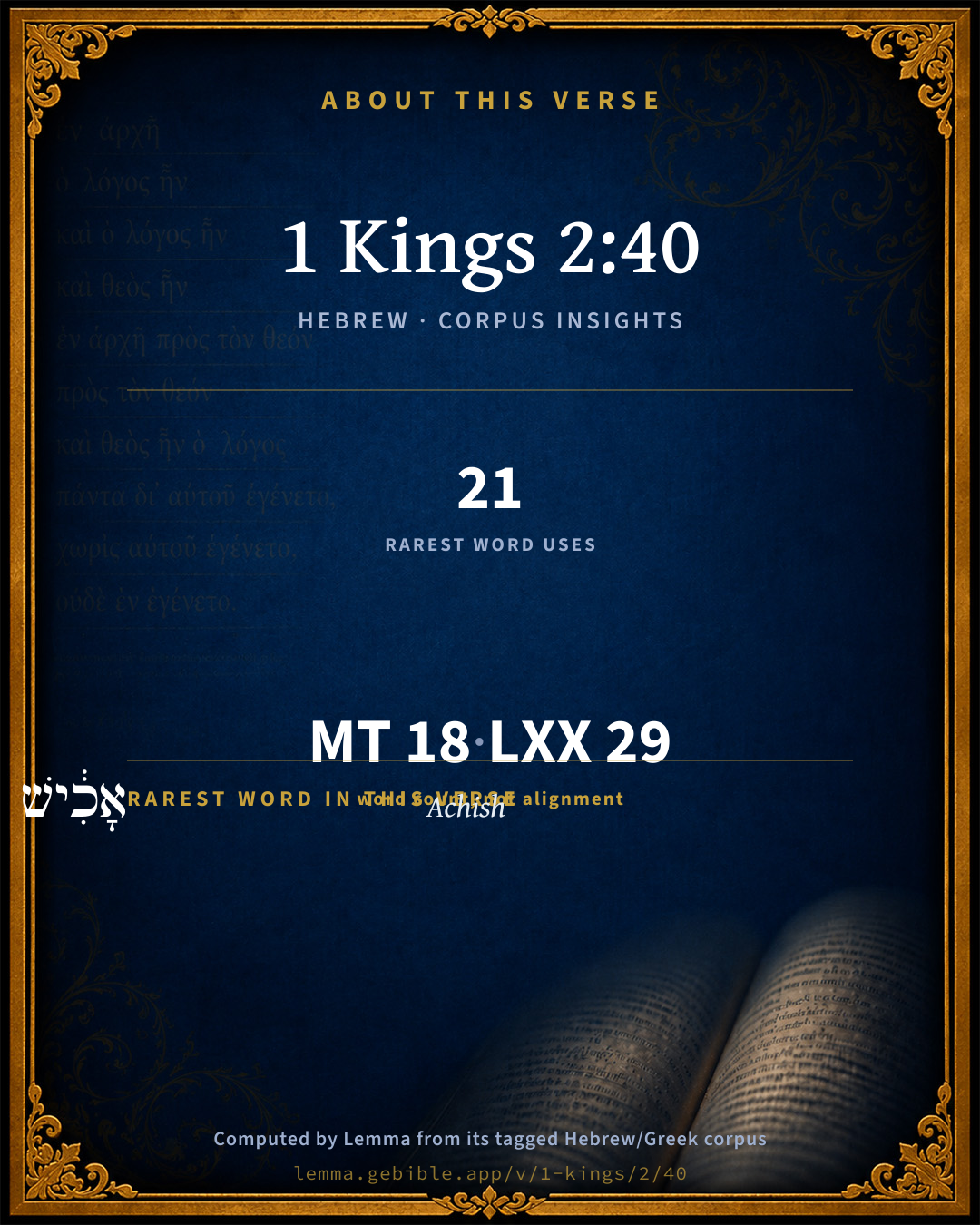
The rarest word here is אָכִ֔ישׁ Achish H397 — appearing just 21 times in the whole Hebrew Bible.

Shared distinctive vocabulary

אָכִ֔ישׁ Achish H397 occurs in 20 verses of the Hebrew Bible. Also found in:

Grammatical profile

  • 6 verbs
  • 8 nouns
  • 1 preposition
  • 3 particles

Verb forms

  • וַיָּ֣קָם Qal · Sequential Imperfect
  • וַֽיַּחֲבֹשׁ֙ Qal · Sequential Imperfect
  • וַיֵּ֤לֶךְ Qal · Sequential Imperfect
  • לְבַקֵּ֖שׁ Piel · Infinitive Construct
  • וַיֵּ֣לֶךְ Qal · Sequential Imperfect
  • וַיָּבֵ֥א Hiphil · Sequential Imperfect

Repetition

Words recur within this verse — often emphatic in Hebrew:

  • שִׁמְעִ֗י Shimei H8096 ×2
  • וַיֵּ֤לֶךְ to walk H3212 ×2
  • גַּ֨תָה֙ Gath H1661 ×2
  • עֲבָדָ֑יו servant H5650 ×2

Hebrew & Septuagint length

In the original languages it is 18 Hebrew tokens and 29 Greek tokens — but the two are counted differently (Hebrew bundles its prefixes and suffixes into one token; the Greek is in lemma form), so that isn’t a like-for-like length.

Cross-references

3

Topical passages linked to 1 Kings 2:40 in the Treasury of Scripture Knowledge — connected by theme and wording, ordered by reader-vote popularity; previews shown in the World English Bible.

  • Proverbs 15:27 He who is greedy for gain troubles his own house, But he who hates bribes will live.
  • Luke 12:15 He said to them, "Beware! Keep yourselves from covetousness, for a man's life doesn't consist of the abundance of the things which he possesses."
  • 1 Timothy 6:10 For the love of money is a root of all kinds of evil. Some have been led astray from the faith in their greed, and have pierced themselves through with many sorrows.

Cross-references courtesy of OpenBible.info (CC BY 4.0).

Hebrew and Greek witnesses Masoretic Hebrew ↔ Greek Septuagint

The same verse in the two great witnesses to the Old Testament, shown verse-for-verse.

These are two independent witnesses, not word-aligned to each other, and the Septuagint is shown in lemma (dictionary) form.

Hebrew 1 Kings 2:40 Masoretic · Westminster Leningrad Codex

וַיָּ֣קָם שִׁמְעִ֗י וַֽיַּחֲבֹשׁ֙ אֶת חֲמֹר֔וֹ וַיֵּ֤לֶךְ גַּ֨תָה֙ אֶל אָכִ֔ישׁ לְבַקֵּ֖שׁ אֶת עֲבָדָ֑יו וַיֵּ֣לֶךְ שִׁמְעִ֔י וַיָּבֵ֥א אֶת עֲבָדָ֖יו מִגַּֽת

Shimei arose, and saddled his donkey, and went to Gath to Achish, to seek his servants; and Shimei went, and brought his servants from Gath.

World English Bible · Public Domain

Greek LXX 1 Kings 2:40 Septuagint · lemma form

καί ἀναἵστημι σεμεϊ καί ἐπισάττω ὁ ὄνος αὐτός καί πορεύομαι εἰς γεθ πρός αγχους ὁ ἐκζητέω ὁ δοῦλος αὐτός καί πορεύομαι σεμεϊ καί ἄγω ὁ δοῦλος αὐτός ἐκ γεθ

No English rendering of this Greek verse — the small residue in the structurally divergent books.

Hebrew: Westminster Leningrad Codex (CC BY 4.0). Greek: Septuagint (public domain); English from a public-domain English Septuagint. How the Septuagint differs from the Hebrew →

Targum (Aramaic paraphrase)

1

The Targum is the ancient Jewish Aramaic paraphrase of the Hebrew Scriptures — an interpretive translation, not the Hebrew text itself. Onkelos (literal) and Pseudo-Jonathan (expansive) render the Torah, and Jonathan the Prophets. Coverage is partial: where no permissively-licensed English translation exists for a verse, only the Aramaic is shown. This is verse-level text, not a word-by-word alignment to the Hebrew.

  1. Targum Jonathan Prophets (Joshua–Malachi)
    וְקָם שִׁמְעִי וְזָרֵיז יַת חֲמָרֵיהּ וְאָזַל לְגַת לְוַת אָכִישׁ לְמִבְעֵי יַת עַבְדוֹהִי וַאֲזַל שִׁמְעִי וְאַיְתִי יַת עַבְדוֹהִי מִגַת:

    (no public-domain English translation for this verse)

    Targum Jonathan — Aramaic: “Mikraot Gedolot” (public domain). English: “Sefaria Community Translation” (CC0 1.0 (public-domain dedication)); “London "Chaldee Paraphrase," 1871” (public domain). Text via Sefaria.

Commentary

Notes on 1 Kings 2:40 from classic Christian and Jewish commentators (each source and its license shown beneath its notes). The classic Christian expositions comment on the surrounding passage and are grouped to its opening verse, so a note may address several verses; the Jewish commentaries on the Tanakh (Rashi and others) are per-verse, so they appear only where the commentator wrote on this verse.

Lemma curates 59 commentaries, every one of them public domain or Creative Commons licensed, each selected and text-cleaned for this edition rather than reprinted as found. About our sources →

Trapp's Complete Commentary

John Trapp

1Ki 2:40 And Shimei arose, and saddled his ass, and went to Gath to Achish to seek his servants: and Shimei went, and brought his servants from Gath.

Ver. 40. And Shimei arose, &c.] The dust of covetousness had blinded him: his passions also miscarried him - as they oft do better men - to his cost.

And brought his servants from Gath.] But to the loss of his life. How many are there who cry out of this folly, and yet imitate it! These earthly things either are our servants, or should be: how commonly do men break the bound set them by God’s law, to hunt after them, though they perish for it!

John Trapp, A Commentary or Exposition upon All the Books of the Old and New Testament (1647–1656) — public domain. Text from a community e-Sword module.

Geneva Bible (1599)

Geneva Bible translators

His covetous mind moved him rather to venture his life, than to lose his worldly profit, which he had by his servants.

Geneva Bible (1599) marginal notes — public domain. Text via Bolls.life.

Adam Clarke's Commentary

Verse 40. And Shimei - went to Gath] It is astonishing that with his eyes wide open he would thus run into the jaws of death.

Adam Clarke's Commentary on the Bible (1810–1826) — public domain. Text from a community e-Sword/MySword module.

John Gill's Exposition

And it was told Solomon,.... By the spies he set to watch and observe his motions, or by some others who had seen him go out and return, and knew that it was contrary to the king's orders:

that Shimei had gone from Jerusalem to Gath, and was come again; which was thirty four miles from Jerusalem (h); whereas his utmost bounds, whither he might go, was the brook Kidron, about half a mile from it.

(h) Bunting's Travels, &c. p. 124.

John Gill's Exposition of the Whole Bible (1746–1763) — public domain (CC PDM 1.0). Text via the HelloAO Bible API.

Matthew Poole's English Annotations

Went to Gath; which, though highly dangerous, he attempted, partly, because he was blinded with covetousness and rage and against his servants, which two lusts have done, daily do, engage men to such courses and actions as are no less dangerous to their lives than this is; partly, because he thought length of time had worn this out of Solomon’s mind, and other men’s thoughts; and that this being done secretly and speedily, would never have come to Solomon’s ears; or that Solomon would not be severe in this case, where it was not wantonness nor contempt of his authority, but the necessity of his household concerns, which put him upon it; and partly, because God withdrew from him the light of common prudence, and wholly left him to his own mistakes, and folly, and lusts; and withal, to the instigation of the devil, whose cunning and powerful artifices and insinuations he could not resist without Divine help.

Matthew Poole's English Annotations on the Holy Bible (1683–1685) — public domain. Text from a community e-Sword/MySword module.

Whedon's Commentary on the Bible

Daniel D. Whedon

40. Went, and brought his servants from Gath — This some might think a slight offence, and not worthy of such bitter punishment as Solomon inflicted. But by this offence he broke his solemn oath, (compare 1Ki_2:43,) and so was guilty of perjury. He also showed a reckless and restless spirit. When his slaves escaped he ought to have informed the king, and received from him permission to bring them back; but his neglect to do even that showed an incorrigible recklessness.

Daniel D. Whedon (gen. ed.), Commentary on the Old and New Testaments (1874–1909) — public domain. Text from a community e-Sword module.

The Pulpit Commentary

And Shimei arose and saddled his ass not necessarily himself. Qui facit per alium, facit per se. Matthew Henry thinks Shimei did it himself for the sake of secresy. Many expositors also think that he went by night. The text rather suggests the idea that both the going and the return were perfectly open and undisguised and went to Gath. It is impossible to avoid the question, What can have led to this infatuated disregard of his oath and life? Now his perversity may of course have been judicialquos Dens vult perdere, prius de-mentat but as to the means which led to this issue, it is enough if we may believe he had been dared to it either by his servants or others. The fierce Benjamite would naturally be galled to the quick by the thought that his slaves could thus openly set him at defiance; he may have heard from those who came from Gath that they were exulting over him; and he may have resolved at all hazards to teach them a lesson. He cannot have forgotten either Solomon"s explicit warning or his own solemn oath (ver. 42); he must have gone to Gath with his eyes open, and nothing but a great provocation, such as mockery and defiance, will account for his going. And Shimei went and brought his servants from Gath.

The Pulpit Commentary (1880–1919), ed. H.D.M. Spence-Jones & Joseph S. Exell — public domain. Text from a community e-Sword module.

John Wesley's Explanatory Notes

To seek his servants - By "seeking his servants, says Bp. Hall, he lost himself. These earthly things either are, or should be our servants. How commonly do we see men run out of the bounds set by God's laws, to hunt after them, till their souls incur a fearful judgment."

John Wesley, Explanatory Notes Upon the Whole Bible (1754–1765) — public domain. Text via the GEBible commentary corpus.

Lesson kit

Teaching starters — assembled from the data on this page, not authored interpretation. Every prompt links to the verse data it draws on. Edit before teaching.

1 Kings, in the Historical, opens this verse with 18 words (12 distinct Hebrew lemmas). Its most distinctive word is ʼĂkîysh (“Achish”). A historical commentator’s framing appears above. Read the whole chapter for the surrounding context.

Discussion questions

  1. The word ʼĂkîysh carries the sense “Achish.” How does it shape the verse?
  2. How does 1 Samuel 21:10, which shares the word «Achish», read alongside this verse?
  3. What does the repetition of “Shimei” (2× in this one verse) do in this verse?
  4. The translations on this page render this verse differently — a whole-verse word diff, not a word-by-word alignment. What might account for the different wordings?
  5. «וַיָּ֣קָם» is a Qal Sequential Imperfect verb. How does that grammatical form shape the action described?
  6. Compare how Trapp's Complete Commentary and Geneva Bible (1599) read this verse. Where do they agree or differ?

Things to notice

Reading settings

Reading text

Shown beneath each verse's original-language words.

Old Testament
Old Testament edition

Read the OT as the Masoretic Hebrew (MT) or the Greek Septuagint (LXX).

English shown for the Greek Septuagint (in the Hebrew ↔ Greek comparison).

Comparing translations? Open the Compare panel on any verse page to stack up to four side by side.