
Song of Solomon 5:6

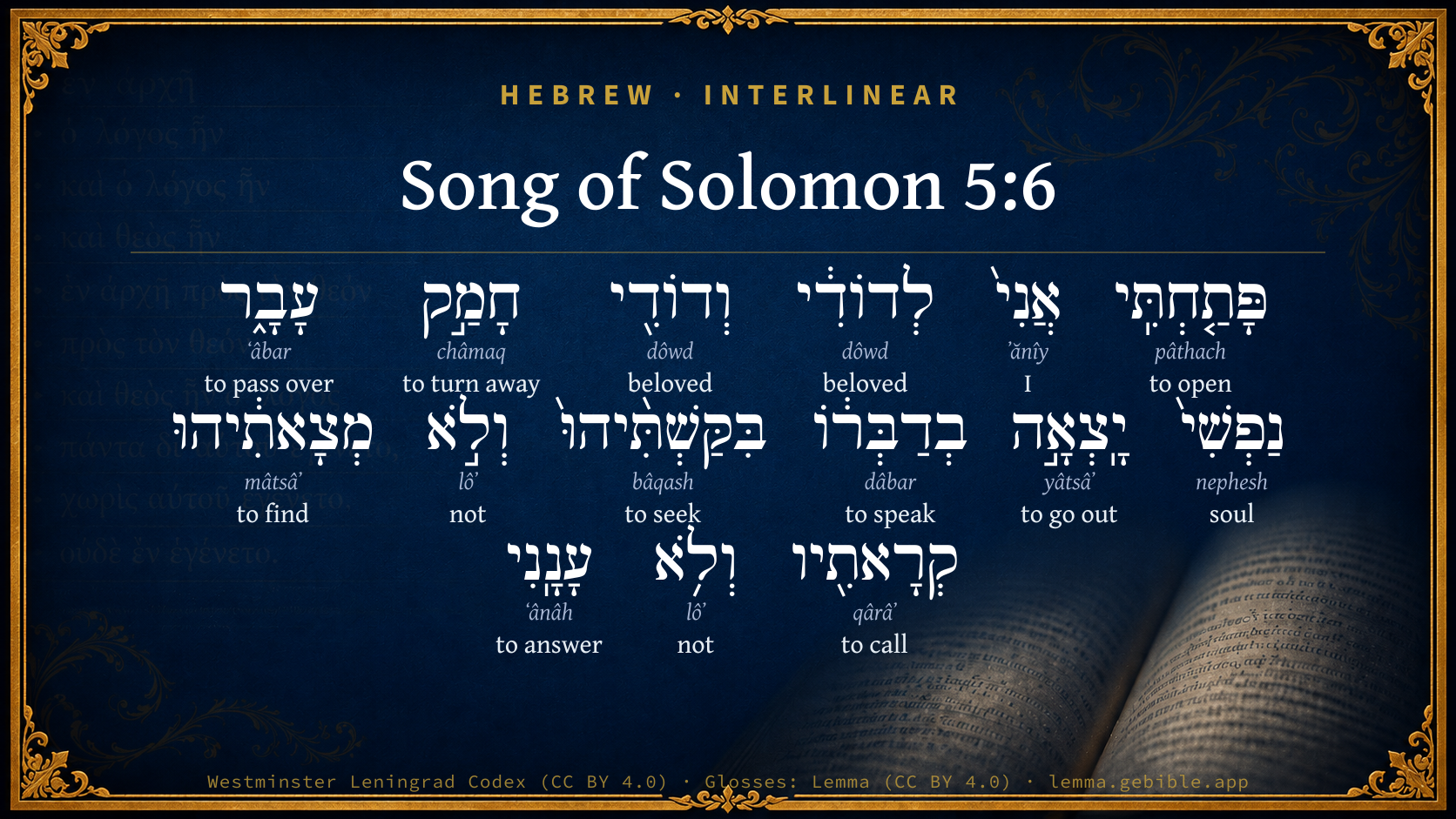
Hebrew (Westminster Leningrad Codex) Song of Solomon 5:6 appears in the Hebrew Old Testament. The text above is from the Westminster Leningrad Codex. Each word links to its Strong’s number, a concise gloss, and parsing drawn from the Open Scriptures Hebrew Bible morphology. Click any word for its full Brown-Driver-Briggs (BDB) entry.
Download image
Cite this verse

Song of Solomon 5:6 (World English Bible). Public Domain. Lemma interlinear Bible study tool, https://lemma.gebible.app/v/song-of-solomon/5/6.

Show BibTeX & RIS
BibTeX
RIS
English Translation
I opened to my beloved; But my beloved left; gone away. My heart went out when he spoke. I looked for him, but I didn't find him. I called him, but he didn't answer.
World English Bible · Public Domain
Highlights
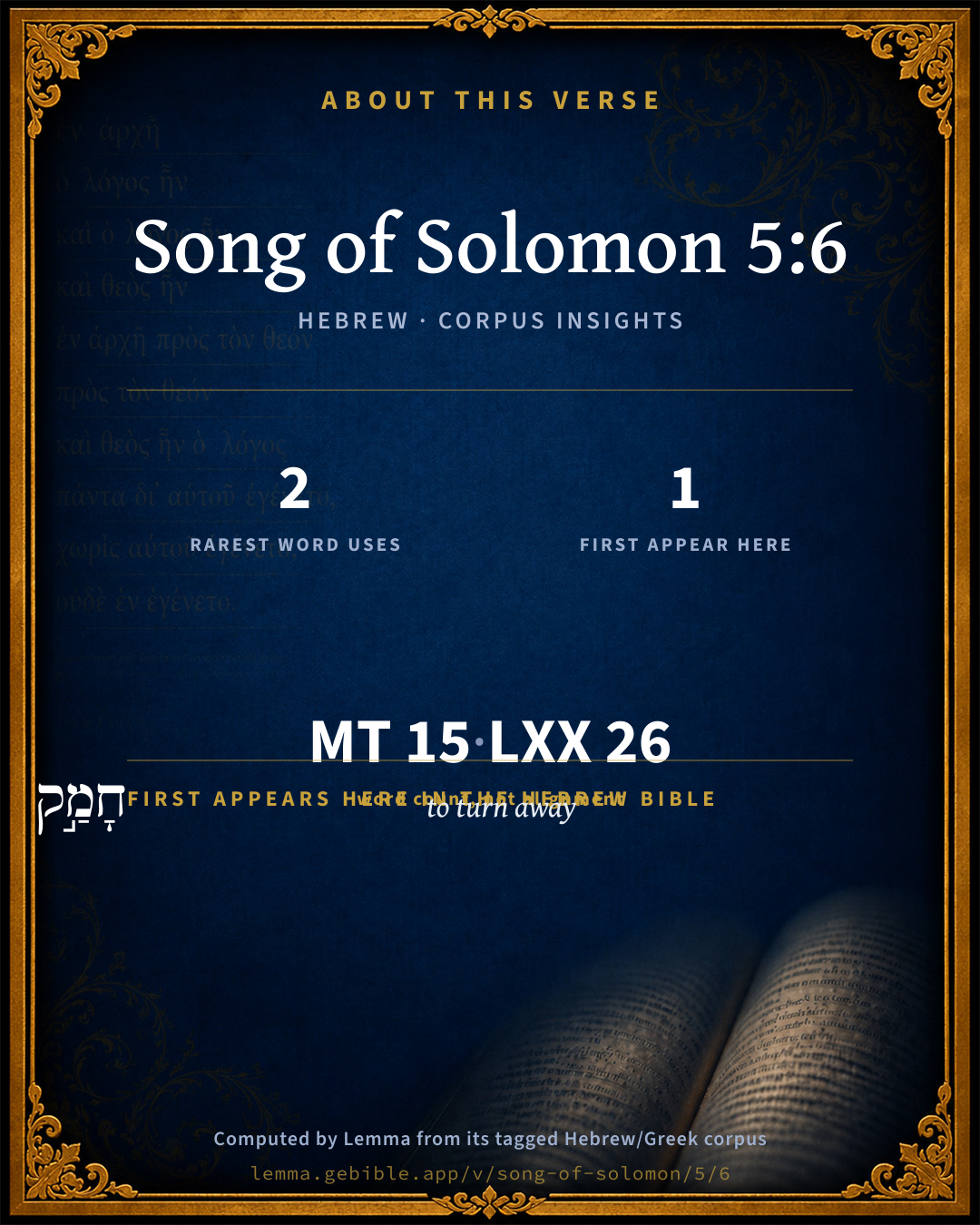
  • 1 first appearance in the Hebrew Bible
Full analysis ↓
Download a study sheet

One document with this verse’s original text, its word-by-word gloss line, the meaning frame, cross-references with their text, attributed commentary, and full source and license credits — printable, and it pastes into notes with its structure intact.

This verse Autodidact and up

Study sheet (.html) Plain text (.txt)

A passage Seminary Student

Up to 50 verses in one chapter. A passage sheet keeps up to 6 commentary sources and 12 cross-references per verse, in the order this page ranks them, and says so on the sheet whenever that leaves anything out. Ask for a single verse and you get the Autodidact verse sheet above.

Everything on this page stays free to read, with no account — the sheet is a download of what is already on screen, not access to it.

Want to remove ads? Support Godless Engineer
Compare translations 3

The same verse in 3 English versions, stacked beneath the original-language interlinear above. Click any original word for its lexicon entry.

Each is an independent rendering of the whole verse — the interlinear is not word-aligned to these translations.

Highlighted words mark where these versions differ — a whole-verse word diff, not a word-by-word alignment.

  • World English Bible Public Domain
    I opened to my beloved; But my beloved left; gone away. My heart went out when he spoke. I looked for him, but I didn't find him. I called him, but he didn't answer.
  • King James Version Public Domain
    I opened to my beloved; but my beloved had withdrawn himself, and was gone: my soul failed when he spake: I sought him, but I could not find him; I called him, but he gave me no answer.
  • unfoldingWord Literal Text CC BY-SA 4.0
    I myself opened to my beloved, but my beloved had turned and gone. My soul went out because he departed. I searched for him, but I did not find him; I called him, but he did not answer me.

unfoldingWord Literal Text — © unfoldingWord, licensed CC BY-SA 4.0. Word-aligned USFM3 via Door43 (git.door43.org/unfoldingWord/en_ult).

Versions to compare (up to 4)

3 of 4 selected

Show all 18 translations

Every available English version of this verse, each an independent rendering of the whole verse.

  • World English Bible Public Domain
    I opened to my beloved; But my beloved left; gone away. My heart went out when he spoke. I looked for him, but I didn't find him. I called him, but he didn't answer.
  • Berean Standard Bible Public Domain
    I opened for my beloved, but he had turned and gone. My heart sank at his departure. I sought him, but did not find him. I called, but he did not answer.
  • Majority Standard Bible Public Domain
    I opened for my beloved, but he had turned and gone. My heart sank at his departure. I sought him but did not find him. I called, but he did not answer.
  • King James Version Public Domain
    I opened to my beloved; but my beloved had withdrawn himself, and was gone: my soul failed when he spake: I sought him, but I could not find him; I called him, but he gave me no answer.
  • American Standard Version (1901) Public Domain
    I opened to my beloved; But my beloved had withdrawn himself, `and' was gone. My soul had failed me when he spake: I sought him, but I could not find him; I called him, but he gave me no answer.
  • Revised Version (1885) Public Domain
    I opened to my beloved; but my beloved had withdrawn himself, and was gone. My soul had failed me when he spake: I sought him, but I could not find him; I called him, but he gave me no answer.
  • Geneva Bible (1599) Public Domain
    I opened to my welbeloued: but my welbeloued was gone, and past: mine heart was gone when hee did speake: I sought him, but I coulde not finde him: I called him, but hee answered mee not.
  • Douay-Rheims (1899) Public Domain
    I opened the bolt of my door to my beloved: but he had turned aside, and was gone. My soul melted when he spoke: I sought him, and found him not: I called, and he did not answer me.
  • Young's Literal Translation Public Domain
    I opened to my beloved, But my beloved withdrew -- he passed on, My soul went forth when he spake, I sought him, and found him not. I called him, and he answered me not.
  • Literal Standard Version CC BY-SA 4.0
    I opened to my beloved, || But my beloved withdrew—he passed on, || My soul went forth when he spoke, I sought him, and did not find him. I called him, and he did not answer me.
  • Unlocked Literal Bible CC BY-SA 4.0
    I opened the door for my beloved, but my beloved had turned and gone. My heart sank when he spoke. I looked for him, but I did not find him; I called him, but he did not answer me.
  • unfoldingWord Literal Text CC BY-SA 4.0
    I myself opened to my beloved, but my beloved had turned and gone. My soul went out because he departed. I searched for him, but I did not find him; I called him, but he did not answer me.
  • Darby Bible Public Domain
    I opened to my beloved; But my beloved had withdrawn himself; he was gone: My soul went forth when he spoke. I sought him, but I found him not; I called him, but he gave me no answer.
  • World Messianic Bible Public Domain
    I opened to my beloved; but my beloved left, and had gone away. My heart went out when he spoke. I looked for him, but I didn’t find him. I called him, but he didn’t answer.
  • Webster's Bible Public Domain
    I opened to my beloved; but my beloved had withdrawn himself, and was gone: my soul failed when he spoke: I sought him, but I could not find him; I called him, but he gave me no answer.
  • Free Bible Version CC BY-SA 4.0
    I opened up to my love, but he had left—he was gone! I was crushed as a result. I looked for him but I couldn't find him. I called him but he didn't answer.
  • Bible in Basic English Public Domain
    I made the door open to my loved one; but my loved one had taken himself away, and was gone, my soul was feeble when his back was turned on me; I went after him, but I did not come near him; I said his name, but he gave me no answer.
  • JPS Tanakh (1917) Public Domain
    I opened to my beloved; but my beloved had turned away, and was gone. My soul failed me when he spoke. I sought him, but I could not find him; I called him, but he gave me no answer.

Literal Standard Version (2020), Covenant Press — licensed CC BY-SA 4.0. Text via the HelloAO Bible API (eBible.org). Unlocked Literal Bible (unfoldingWord) — licensed CC BY-SA 4.0. Text via the HelloAO Bible API (eBible.org). unfoldingWord Literal Text — © unfoldingWord, licensed CC BY-SA 4.0. Word-aligned USFM3 via Door43 (git.door43.org/unfoldingWord/en_ult). Free Bible Version, Dr. Jonathan Gallagher — licensed CC BY-SA 4.0. Text via the HelloAO Bible API (eBible.org).

Word by word

More ways to search: Search by grammar → Find every occurrence → Compare this word →

Practice this passage: Drill this verse → Learn its vocabulary →

חָמַ֣ק
châmaq
H2559
“to turn away”
Verb, Qal, Perfect, 3rd Person, Masculine, Singular
Part of Speech
Verb
Stem
Qal
Form
Perfect
Person
3rd Person
Gender
Masculine
Number
Singular
Full BDB Definition

Origin: a primitive root

TWOT: TWOT- 682

to withdraw, turn around, turn away - (Qal) to turn away - (Hithpael) to turn about, vacillate, turn hither and thither
  1. פָּתַ֤חְתִּֽי pâthach H6605 “to open” Verb, Qal, Perfect, 1st Person, Common, Singular
  2. אֲנִי֙ ʼănîy H589 “I” Pronoun, Personal, 1st Person, Common, Singular
  3. לְדוֹדִ֔י dôwd H1730 “to/for · beloved · my” Preposition + Noun, Common, Masculine, Singular, Construct + Suffix, Personal, 1st Person, Common, Singular
  4. וְדוֹדִ֖י dôwd H1730 “and · beloved · my” Conjunction + Noun, Common, Masculine, Singular, Construct + Suffix, Personal, 1st Person, Common, Singular
  5. עָבָ֑ר ʻâbar H5674 “to pass over” Verb, Qal, Perfect, 3rd Person, Masculine, Singular
  6. נַפְשִׁי֙ nephesh H5315 “soul · my” Noun, Common, Both, Singular, Construct + Suffix, Personal, 1st Person, Common, Singular
  7. יָֽצְאָ֣ה yâtsâʼ H3318 “to go out” Verb, Qal, Perfect, 3rd Person, Feminine, Singular
  8. בְדַבְּר֔וֹ dâbar H1696 “in/at · to speak · him” Preposition + Verb, Piel, Infinitive Construct + Suffix, Personal, 3rd Person, Masculine, Singular
  9. בִּקַּשְׁתִּ֨יהוּ֙ bâqash H1245 “to seek · him” Verb, Piel, Perfect, 1st Person, Common, Singular + Suffix, Personal, 3rd Person, Masculine, Singular
  10. וְלֹ֣א lôʼ H3808 “and · not” Conjunction + Particle, Negative
  11. מְצָאתִ֔יהוּ mâtsâʼ H4672 “to find · him” Verb, Qal, Perfect, 1st Person, Common, Singular + Suffix, Personal, 3rd Person, Masculine, Singular
  12. קְרָאתִ֖יו qârâʼ H7121 “to call · him” Verb, Qal, Perfect, 1st Person, Common, Singular + Suffix, Personal, 3rd Person, Masculine, Singular
  13. וְלֹ֥א lôʼ H3808 “and · not” Conjunction + Particle, Negative
  14. עָנָֽנִי ʻânâh H6030 “to answer · me” Verb, Qal, Perfect, 3rd Person, Masculine, Singular + Suffix, Personal, 1st Person, Common, Singular

About this verse

These counts appear in no published source. They are computed here, from the morphology-tagged text and Lemma’s own curated glosses. What Lemma adds →

15
words
13
distinct lemmas
Wisdom
section

Notable vocabulary

The rarest word here is חָמַ֣ק to turn away H2559 — appearing just 2 times in the whole Hebrew Bible.

First appearance in Scripture

This word makes its first canonical appearance in the Hebrew Bible here:

  • חָמַ֣ק to turn away H2559

Shared distinctive vocabulary

חָמַ֣ק to turn away H2559 occurs in 2 verses of the Hebrew Bible. Also found in:

Grammatical profile

  • 9 verbs
  • 3 nouns
  • 1 pronoun
  • 2 particles

Verb forms

  • פָּתַ֤חְתִּֽי Qal · Perfect
  • חָמַ֣ק Qal · Perfect
  • עָבָ֑ר Qal · Perfect
  • יָֽצְאָ֣ה Qal · Perfect
  • בְדַבְּר֔וֹ Piel · Infinitive Construct
  • בִּקַּשְׁתִּ֨יהוּ֙ Piel · Perfect
  • מְצָאתִ֔יהוּ Qal · Perfect
  • קְרָאתִ֖יו Qal · Perfect
  • עָנָֽנִי Qal · Perfect

Repetition

Words recur within this verse — often emphatic in Hebrew:

  • לְדוֹדִ֔י beloved H1730 ×2
  • וְלֹ֣א not H3808 ×2

Hebrew & Septuagint length

In English translation the verse runs 34 words from the Hebrew and 30 from the Septuagint (LXX English) — closely comparable.

A rough comparison of the two English renderings, which tokenize alike — not a word-level alignment.

Word counts can differ between the Hebrew and the Greek without any difference in meaning — e.g. the Hebrew direct-object marker אֵת has no separate Greek word, and Greek often adds the article ὁ.

In the original languages it is 15 Hebrew tokens and 26 Greek tokens — but the two are counted differently (Hebrew bundles its prefixes and suffixes into one token; the Greek is in lemma form), so that isn’t a like-for-like length.

Cross-references

30

Topical passages linked to Song of Solomon 5:6 in the Treasury of Scripture Knowledge — connected by theme and wording, ordered by reader-vote popularity; previews shown in the World English Bible.

  • Song of Solomon 5:2 I was asleep, but my heart was awake. It is the voice of my beloved who knocks: Open to me, my sister, my love, my dove, my undefiled; For my head is filled with dew, My hair with the dampness of the night.
  • Hosea 5:15 I will go and return to my place, until they acknowledge their offense, And seek my face. In their affliction they will seek me earnestly."
  • Revelation 3:19 As many as I love, I reprove and chasten. Be zealous therefore, and repent.
  • Genesis 42:28 He said to his brothers, "My money is restored! Behold, it is even in my sack." Their hearts failed them, and they turned trembling one to another, saying, "What is this that God has done to us?"
  • 1 Samuel 28:6 When Saul inquired of Yahweh, Yahweh didn't answer him, neither by dreams, nor by Urim, nor by prophets.
  • 2 Samuel 16:10 The king said, What have I to do with you, you sons of Zeruiah? Because he curses, and because Yahweh has said to him, Curse David; who then shall say, Why have you done so?
  • Psalms 22:1–2 My God, my God, why have you forsaken me? Why are you so far from helping me, and from the words of my groaning?
  • Psalms 28:1 To you, Yahweh, I call. My rock, don't be deaf to me; Lest, if you are silent to me, I would become like those who go down into the pit.
  • Psalms 30:7 You, Yahweh, when you favored me, made my mountain to stand strong. But when you hid your face, I was troubled.
  • Psalms 69:3 I am weary with my crying. My throat is dry. My eyes fail, looking for my God.
  • Psalms 77:3 I remember God, and I groan. I complain, and my spirit is overwhelmed. Selah.
  • Psalms 80:4 Yahweh God of hosts, How long will you be angry against the prayer of your people?
  • Psalms 88:9–14 My eyes are dim from grief. I have called on you daily, Yahweh. I have spread out my hands to you.
  • Proverbs 1:28 Then will they call on me, but I will not answer. They will seek me diligently, but they will not find me;
  • Song of Solomon 3:1–2 By night on my bed, I sought him whom my soul loves. I sought him, but I didn't find him.
  • Song of Solomon 5:4 My beloved thrust his hand in through the latch opening. My heart pounded for him.
  • Song of Solomon 6:1 Where has your beloved gone, you fairest among women? Where has your beloved turned, that we may seek him with you? Beloved
  • Isaiah 8:17 I will wait for Yahweh, who hides his face from the house of Jacob, and I will look for him.
  • Isaiah 12:1 In that day you will say, "I will give thanks to you, Yahweh; for though you were angry with me, your anger has turned away and you comfort me.
  • Isaiah 50:2 Why, when I came, was there no man? when I called, was there none to answer? Is my hand shortened at all, that it can't redeem? or have I no power to deliver? Behold, at my rebuke I dry up the sea, I make the rivers a wilderness: their fish stink, because there is no water, and die for thirst.
  • Isaiah 54:6–8 For Yahweh has called you as a wife forsaken and grieved in spirit, even a wife of youth, when she is cast off, says your God.
  • Isaiah 57:16 For I will not contend forever, neither will I be always angry; for the spirit would faint before me, and the souls who I have made.
  • Isaiah 58:2 Yet they seek me daily, and delight to know my ways: as a nation that did righteousness, and didn't forsake the ordinance of their God, they ask of me righteous judgments; they delight to draw near to God.
  • Lamentations 3:8 Yes, when I cry, and call for help, he shuts out my prayer.
  • Hosea 5:6 They will go with their flocks and with their herds to seek Yahweh; But they won't find him. He has withdrawn himself from them.
  • Zechariah 7:13 It has come to pass that, as he called, and they refused to listen, so they will call, and I will not listen," said Yahweh of Hosts;
  • Matthew 15:22–28 Behold, a Canaanite woman came out from those borders, and cried, saying, "Have mercy on me, Lord, you son of David! My daughter is severely demonized!"
  • Matthew 26:75 Peter remembered the word which Jesus had said to him, "Before the rooster crows, you will deny me three times." He went out and wept bitterly.
  • Mark 14:72 The rooster crowed the second time. Peter remembered the word, how that Jesus said to him, "Before the rooster crows twice, you will deny me three times." When he thought about that, he wept.
  • Luke 22:61–62 The Lord turned, and looked at Peter. Then Peter remembered the Lord's word, how he said to him, "Before the rooster crows you will deny me three times."

Cross-references courtesy of OpenBible.info (CC BY 4.0).

Hebrew and Greek witnesses Masoretic Hebrew ↔ Greek Septuagint

The same verse in the two great witnesses to the Old Testament, shown verse-for-verse.

These are two independent witnesses, not word-aligned to each other, and the Septuagint is shown in lemma (dictionary) form.

Hebrew Song of Solomon 5:6 Masoretic · Westminster Leningrad Codex

פָּתַ֤חְתִּֽי אֲנִי֙ לְדוֹדִ֔י וְדוֹדִ֖י חָמַ֣ק עָבָ֑ר נַפְשִׁי֙ יָֽצְאָ֣ה בְדַבְּר֔וֹ בִּקַּשְׁתִּ֨יהוּ֙ וְלֹ֣א מְצָאתִ֔יהוּ קְרָאתִ֖יו וְלֹ֥א עָנָֽנִי

I opened to my beloved; But my beloved left; gone away. My heart went out when he spoke. I looked for him, but I didn't find him. I called him, but he didn't answer.

World English Bible · Public Domain

Greek LXX Song of Solomon 5:6 Septuagint · lemma form

ἀναοἴγω ἐγώ ὁ ἀδελφιδός ἐγώ ἀδελφιδός ἐγώ παραἔρχομαι ψυχή ἐγώ ἐκἔρχομαι ἐν λόγος αὐτός ζητέω αὐτός καί οὐ εὑρίσκω αὐτός καλέω αὐτός καί οὐ ὑποἀκούω ἐγώ

I opened to my kinsman; my kinsman was gone: my soul failed at his speech: I sought him, but found him not; I called him, but he answered me not.

LXX2012 (modern English Septuagint) · Public Domain

On this verse, The Preacher's Complete Homiletical Commentary discusses the Septuagint’s reading. Read the note in Commentary ↓

Hebrew: Westminster Leningrad Codex (CC BY 4.0). Greek: Septuagint (public domain); English from LXX2012 (modern English Septuagint) (Public Domain). How the Septuagint differs from the Hebrew →

Commentary

Notes on Song of Solomon 5:6 from classic Christian and Jewish commentators (each source and its license shown beneath its notes). The classic Christian expositions comment on the surrounding passage and are grouped to its opening verse, so a note may address several verses; the Jewish commentaries on the Tanakh (Rashi and others) are per-verse, so they appear only where the commentator wrote on this verse.

Lemma curates 59 commentaries, every one of them public domain or Creative Commons licensed, each selected and text-cleaned for this edition rather than reprinted as found. About our sources →

Trapp's Complete Commentary

John Trapp

Son 5:6 I opened to my beloved; but my beloved had withdrawn himself, [and] was gone: my soul failed when he spake: I sought him, but I could not find him; I called him, but he gave me no answer.

Ver. 6. I opened to my beloved, but my beloved had withdrawn himself and was gone.] Or, "He was gone, he was gone"; a passionate complaint for his departure, which lay so much the heavier upon her spirit, because, by her unworthy usage of him, she had foolishly occasioned it. "Fools, because of their transgression, and because of their iniquity, are afflicted." And when affliction comes with a sting in the tail, it is very grievous. But then they "cry unto the Lord in their trouble; he saveth them out of their distress; he sendeth his word and healeth them," {Psa 107:17-20} he sendeth for them by his Spirit, and brings them back again into his own bosom, "that his banished be not expelled from him," {2Sa 14:14} though to themselves and others they may for the present seem to be as "water spilled on the ground, that cannot be gathered up again." Those fragrant footsteps and heart attracting stamps of his favour, that sweet smelling myrrh, mentioned in the former verse, had so eneagered and edged her affections, that she could not rest till she had recovered him. She opened unto her beloved, and, presuming upon his patience, was in good hope to have had him at hand; but patientia loesa fit furor, Christ will not always bear with our evil manners, {a} "but hide his face from us, like as we have behaved ourselves evil in our doings." {Mic 3:4} And whereas spiritual desertions are of three sorts, (1.) Cautional, for preventing of sin, as Paul’s seems to be; (2.) Probational, for trial and exercise of grace, as Job’s; (3.) Penal, for chastisement of spiritual sloth and sluggishness, as here in the Church; this last is far the heaviest.

My soul failed when he spake.] Or, Because of his speech, that sweet speech of his when he so passionately wooed her. {Son 5:2} Then he could have no audience nor admittance; now, if he would but offer himself he might be sure of both. The word spoken doth not always presently take effect in the hearers, but lies long as the seed under a clod, till Christ the good husbandman come with some temptation, as with his clotting beetle, and give it room to rise. Then as the water casts up her dead after a time, so do their memories cast up that which seemed buried therein, by the help of the Holy Ghost, their remembrancer. {Joh 14:26 Joh 2:22} The new birth of some, the recovery of others out of their relapses, is like the birth of the elephant, fourteen years after the seed is inserted into the womb. Peter remembered Christ’s words and repented. {Mat 26:75} If we remember not what hath been preached unto us, all is lost. {1Co 15:2} If we leak, {b} and let slip, actum est de nobis. The deed is by us. {Heb 2:1} If we keep the word, the word will keep us. {Pro 6:22}

I sought him.] So soon as recovered out of my swoon, I set to seek him. The Church went not to bed again to sleep as before, neither stays she longer within than to cast her veil or her scarf over her head; without any further dress, abroad she gets to seek him whom her soul loveth. She sought him by serious and set meditation of the word and promises; but after all that toil and travail she took therein she found him not. This is the greatest grief that can befall a good heart in this present world; it is to such little better than hell itself. "Thou didst hide thy face and I was troubled" saith David. {Psa 30:8} Non frustra praedicant mentes hominum nitere liquido die, coacta nube flaccescere, saith Symmachus. Men’s minds are either clear or cloudy, as the weather is; but more truly, good men’s minds are as God’s countenance is. It is with the godly in desertion, as with vapours drawn up by the sun, which, when the extracting force of the sun leaves them, fall down again to the earth. And as in an eclipse of the sun there is a drooping in the whole frame of nature; so it is with the saints, when Christ withdraws himself. Hell itself is said to be a separation from his presence; the pain of loss there is worse than the pain of sense, the tears of hell are not sufficient to bewail the loss of heaven. Laetemur igitur in Domino, sed caveamus a recidivo. {c}

I called him, but he gave me no answer.] And it was but just, for she had dealt so by him. {Son 5:2} Christ loves to retaliate. Such a proportion many times one may see between sins and punishments, that you may say, such a sin brought forth this affliction, it is so like the father. Howbeit, "his ear is not heavy that he cannot hear; but your iniquities have hid his face from you that he will not hear." {Isa 59:1-2} And this the saints take, as well they may, for a sore affliction, {Lam 3:8} when to all other their miseries, he addeth this, that he will not come at them, that he casteth out their prayers, that he deals by them as the lionness doth by her young ones, which she seems sometimes to leave, till they have almost killed themselves with roaring. This is to make them more careful another time. None look at the sun but when it is in the eclipse; neither prize we, for the most part, God’s loving countenance till we have lost it. In this case, the course is to set up a loud cry after him, as Micah did after his gods. {Jdg 18:23} Or rather as the Church here doth after her beloved, in many strong cries and bitter tears, continuing instant in prayer. {Rom 12:12} The Greek word {d} imports a metaphor from hunting dogs, that do not stop pursuing the game till they have got it. For encouragement, see the happy success the Church here had; and further, take that saying of Brentius, Etiamsi fides tua nec lucem hominibus, nec calorem cordi tuo afferat, tamen non abiecit Christus, modo incrementum ores, i.e., Although thy faith, as smoking flax, yield neither light to others nor heat to thine own heart, yet Christ will not cast thee off, so thou pray for more and follow thy work close till thou have gotten it.

{a} Heu rara hora, et parva mora. - Bernard.

{b} μηποτε παραρυωμεν.

{c} Bernard.

{d} προσκαρτερουντες.

John Trapp, A Commentary or Exposition upon All the Books of the Old and New Testament (1647–1656) — public domain. Text from a community e-Sword module.

Joseph Benson's Commentary

Son 5:6. My beloved had withdrawn — Denied me his comfortable presence, as a just punishment for my former neglect. My soul failed — Hebrew, went out of me. I fainted, and was ready to die away; when he spake — Or, for what he spake; for those endearing expressions related Son 5:2, which then I did not heed. I sought him — By diligent inquiry and importunate prayer.

Joseph Benson's Commentary on the Old and New Testaments (1811–1818) — public domain. Text from a community e-Sword module.

The Preacher's Complete Homiletical Commentary

Joseph S. Exell (gen. ed.)

Notes

Son_5:6. ‘My soul failed when He spate.’

‘My soul failed.’ נַפְשִׁי יָצְאָה naphshi yatseah, literally, ‘went forth.’ Failed, or fainted; breath forsook me; my soul almost went out of me. ZÖCKLER, EWALD, DELIZTSCH. Sunk. BURROUGHS. I swooned away, and was like a dead body (Gen_35:18). FRY. I was not in my senses. DE WETTE, NOYES, SANCTIUS. My soul melted with anguish. ROWE. With sweet effusion of love. FROMONDI. Left me and flew away to my Bridegroom. DEL RIO. Was in great terror. COCCEIUS, Was in suspense. THRODORET. There remained no more spirit in her. DAVIDSON. VULGATE: My soul was melted. LUTHER: Went out. MARTIN: Fainted. DIODATI: I was out of myself. COVERDALE and MATTHEWS: My heart could not refrain. TIGURINE: My mind was disturbed. ‘When be spake.’ בְּדַבְּרוֹ bedhabbero, ‘at his speaking;’ from דִּבֵּר dibber, to speak. So GESENIUS. When he spoke. EWALD, DELITZSCH. While he yet spoke. WEISS, MERCER, LE CLERC, &c. When he was speaking, i.e., through the window. ZOCKLER. Had failed as he spoke; a supplementary remark. DOPKE. SEPTUAGINT: At his word. VULGATE: When he spoke. SYMMACHUS: While be spoke. WICKLIFF: As he spake COVERDALE and MATTHEWS: Now like as aforetime when he spake. LUTHER: After his word. DUTCH: On account of his word. MARTIN: From having heard him speak. RASHI: When he spoke this word. JUNIUS: On account of the word with which he addressed me. Assembly’s Annotations: My neglect of his speech troubled me when he was gone. BRIGHTMAN, AINSWORTH. BOOTHROYD: On remembering his words. BURROUGHS: In consequence of what he had said. SCOTT: Either remembering his tender and affectionate apeal or hearing a reproving word as he withdrew. NOYES and DE WETTE: I was not in my senses while he spoke—acted insanely in not admitting my beloved at his request. EWALD proposes to read בְּדָבְרוֹ ‘at his going away. HITZIG views the word as equivalent to אַחֲרָיו ‘after him.’ UMBREIT: ‘In order to follow him; from דִּבֵּר to follow. Some propose בִּדְבָרוֹ ‘on his account.’

THE DISAPPOINTMENT

Son_5:6

I opened to my beloved;

But my beloved had withdrawn himself,

And was gone.

My soul failed when he spake.

I sought him;

But I could not find him.

I called him;

But he gave me no answer.

Shulamite’s delay has disappointment for its fruit. Christ’s call not to be trifled with. Duty may be attempted too late to be immediately successful. God forgives His sinning people, though He may see fit to chasten them. Indulgence of the flesh, even for a short time, may bear bitter fruit. David’s short sin produced long sorrow. Falls, though not fatal, may bring broken bones. Samson, awaking from his sleep in Delilah’s lap, ‘wist not that his strength was departed from him’ Observe, in regard to

Divine Withdrawings,

1. These withdrawings real. A fact stated. ‘My beloved had withdrawn himself.’ Such a thing as God hiding His face.

2. These withdrawings such as to be observed and known. The Bride bears testimony to the fact. She knew it. Believers to know their case.

3. Well for believers and others to know when the Lord withdraws Himself. The saddest case for a man when God withdraws from him, and he either does not know it or pays no attention to it. Israel’s misery that ‘grey hairs were here and there upon him, yet he knoweth it not’ (Hos_7:9). An ill sign for men when God’s anger ‘sets them on fire round about, and they know it not; when it burns them, and they lay it not to heart’ (Isa_42:25).

4. The withdrawings of Christ, in the case of a believer, the result of love. The greatest sign of wrath when men are allowed to sleep and sin on. ‘As many as I love, I rebuke and chasten.’

5. These withdrawings in wisdom, as well as in love. Wise as well as gracious reasons for them.

(1) To teach the sin of neglecting divine calls and invitations. Such sin to be seen and lamented (Jer_2:19; Hos_5:15).

(2) To make His presence more prized. The value of a blessing best known when it has been withdrawn. The misery of Christ’s absence to be sometimes learned by experience. Lamented absence better than slighted presence.

(3) To prove the believer’s love. Love unable to endure absence.

(4) To render more watchful and careful in the future.

6. Divine withdrawings the believer’s greatest distress. My soul failed (or fainted, as Gen_42:28) when He spake (or, at His speaking—at the remembrance of what He had said). So with Peter (Mat_26:75). The Bride’s felt calamity indicated by a double expression: ‘Had withdrawn himself, and was gone.’ The sweeter the past enjoyment of Christ, the greater the pain of His present withdrawal.

7. In the case of a believer, the joy of Christ’s presence withdrawn, but not His love. David mourned the loss of the joy of God’s salvation, but not of the salvation itself (Psa_51:10).

Other lessons from the passage—

1. The remembrance of a Saviour’s slighted calls, one day the bitterest ingredient in the sinner’s cup. ‘My soul failed when he spake.’ Well when the remembrance is here, and not hereafter. An awful word to the rich man in hell: ‘Son, remember’ (Luk_16:25). One element of a true repentance, in the case of hearers of the Gospel, is the remembrance of a slighted Christ. The remembrance of past guilt an aggravation of present trouble.

2. Christ still loved by the believer in the midst of His withdrawing. ‘My beloved,’ &c. True love made more ardent by the withdrawing of its object. One of the lessons of the Song. Realized in the disciples after the Saviour’s resurrection. The proof of a believer that he loves even an absent Christ.

3. Better to follow Christ in sorrow, than to live at case in sin.

4. The more the soul has tasted of Christ’s love, the more deeply it repents its coldness.

5. Means to be diligently employed to recover a missing Christ. ‘I called,’ &c.

6. The prayer of a penitent believer not always immediately answered. ‘He gave me no answer.’

7. A withdrawn Christ not immediately found. ‘I sought Him, but I found Him not.’ The Saviour’s threatening to the Jews: ‘Ye shall seek me but ye shall not find me.’

8. Sin often visited with a corresponding chastisement. The Bridegroom had called, and the Bride had not answered. Now she calls to him, but receives no answer. Observe in regard to

Answers to Prayer.

1. Answers to prayer, and the contrary, to be carefully noted and recorded.

2. Prayers not immediately answered not therefore rejected. Efforts not immediately successful not therefore in vain. The promise of finding made not to search begun, but persevered in. Believers’ prayers often only apparently rejected. Never really unanswered without a greater benefit being bestowed. Moses not permitted to enter Canaan, but taken direct to a better land. Paul’s thorn in the flesh not removed, but more of Christ’s grace imparted to him. Direct answers to prayer often withheld for the best and wisest reasons (Job_30:20; Psa_22:2; Lam_3:8; Lam_3:44). Prayer often answered by terrible things in righteousness (Psa_65:5).

3. Strength and grace given a believer still to pray even when no answer is received. Such grace often an equivalent for a direct answer. The greatest praise bestowed by Christ in the Gospels on one who still prayed earnestly after repeated repulses (Mat_15:21-28).

The Preacher's Complete Homiletical Commentary (gen. ed. Joseph S. Exell; Funk & Wagnalls, c. 1892) — public domain (pre-1929). A full-Bible homiletical/sermon-outline anthology covering 65 of 66 books (2 John is absent from the source module). Text from a community e-Sword module.

Ellicott's Commentary for English Readers

(6) When he spake.—We can suppose an ejaculation of disappointment uttered by the lover as he goes away, which catches the ear of the heroine as she wakes.

A Bible Commentary for English Readers, edited by Charles John Ellicott (1878–1897) — public domain. Text from a community e-Sword module.

The Cambridge Bible for Schools and Colleges

gen. ed. J. J. S. Perowne

6. had withdrawn himself] Lit. had turned away. This disappointment is just such as comes in dreams.

my soul failed when he spake] R.V. My soul had failed me when he spake. This is the explanation of his departure. She had fainted when she heard his voice, and when she came to herself and opened the door he was gone. This seems to be the simple explanation of a clause which has greatly vexed interpreters. Hitzig, Ewald, and Oettli would read for bĕdhabbĕrô = ‘when he spake,’ bĕdhobhrô, in the sense ‘when he turned away.’ But this is an Aramaic meaning, and though, according to the Oxford Heb. Lex. this is probably the root meaning of the word from which all the others are derived, the verb is not found in Heb. in this sense. As the ordinary signification of the verb gives a good meaning here it seems unnecessary to go beyond it.

The Cambridge Bible for Schools and Colleges (gen. ed. J. J. S. Perowne; Cambridge University Press, 1878–1918) — public domain. Text from a community e-Sword module.

Matthew Poole's English Annotations

Withdrawn himself; denied me his gracious and comfortable presence, as a just punishment for my former neglect and folly.

And was gone; either she repeats the same thing to show how deeply she was affected with it; or this is added to imply that he had not only stepped aside, but was quite gone away.

My soul failed, Heb. went out of me. I fainted and was ready to die away through excessive passion, as this phrase is used, Gen 35:18; 42:28, and elsewhere.

When he spake; or, for what he spoke; for those endearing expressions related Son 5:2, which then I did not heed, but this sad occasion brings them to my remembrance; as ofttimes that word which is ineffectual when it is preached, is afterwards brought to a man’s mind, and, produceth blessed effects.

I sought him by diligent inquiry and importunate prayer. He gave me no answer; that so he might both chastise her folly, and quicken her desires, and prepare the way for a more hearty welcome, and his longer abode with her.

Matthew Poole's English Annotations on the Holy Bible (1683–1685) — public domain. Text from a community e-Sword/MySword module.

Whedon's Commentary on the Bible

Daniel D. Whedon

6. My soul failed, etc. — Hebrew, Departed because he had so spoken; had solicited admission and been slighted. She goes out in search of him. In just this way Virgil represents Dido, after her rejection by AEneas, as dreaming of following in vain pursuit of him through desert lands, until her dream turns to sick and weary despair.

Daniel D. Whedon (gen. ed.), Commentary on the Old and New Testaments (1874–1909) — public domain. Text from a community e-Sword module.

The Pulpit Commentary

I opened to my beloved; but my beloved had withdrawn himself, and was gone. My soul had failed me when he spake: I sought him, but I could not find him; I called him, but he gave me no answer. The meaning is this The voice of my beloved struck my heart; but in the consciousness that I had estranged myself from him I could not openly meet him, I could not offer him mere empty excuses. Now I am made sensible of my own deficiency. I call after him. I long for his return, but it is in vain (cf. the two disciples going to Emmaus, Luke 24., "Did not our heart burn within us," etc.?). Similar allusion to the effect of the voice of the beloved is found in Terence, "And.," 1:5, 16, "Oratio haec," etc. The failing or departing of the soul at the sound of the voice must refer to the lack of response at the time, therefore it was that she sought him and cried out after him. When he spake; literally, in his speaking; i.e. when he said, "I will not now come because at first refused;" cf. Pro_1:20-33, the solemn warning against the loss of opportunity. It is a coincidence between the two books of Solomon which cannot be disregarded. If there is any spiritual meaning at all in Solomon"s Song, it certainly is a book which he who wrote the first chapter of Proverbs is likely to have written.

The dream of distress.

No passage in the Canticles is more pathetic than this. Whilst the prevalent tone of the Song of Songs is a tone of joyful love, we meet here with the sentiment of anxious sorrow. We are reminded of the grief of Mary, when, on the resurrection-morn, she exclaimed, "They have taken away my Lord, and I know not where they have laid him." A true transcript of the moods to which experience is subject! And not without spiritual lessons which may be turned to true profit.

I A TRANSIENT ESTRANGEMENT AND BRIEF WITHDRAWAL. There have been periods in the history of the Church of Christ, resembling the captivity of Israel in the East, when the countenance of the Lord has been hidden from the sight of his people. The heart, which knoweth its own bitterness, is now and again conscious of a want of happy fellowship with the best and dearest Friend. But it is not Christ who changes. When the sun is eclipsed, it does not cease to shine, though its beams may not reach the earth. And when Christ is hidden, he remains himself "the same yesterday, and today, and forever." But something has come between the Sun of Righteousness and. the soul which derives all its spiritual light from him, and the vision is obscured. Selfishness, worldliness, unbelief, may hinder the soul from enjoying the Saviour"s presence and grace. The fault is not his, but ours.

II DISTRESSING SYMPTOMS OF SUCH ESTRANGEMENT AND WITHDRAWAL. How simple and how touching is the complaint of the bride! "I sought him, but I could not find him; I called him, but he gave me no answer." Yet it is the nature of Christ to delight in the quest and the cry of those he loves, to reveal himself to such as ever ready to approach and to bless. There may, however, be a reason, and faith cannot question that there is a reason, for the withholding of an immediate response. There may be on the Saviour"s part a perception that a stronger confidence, a more evident desire, a truer love, are needed, and are thus only to be called forth. It may be well that for a season the soul should suffer for its sin, that it may be encouraged to deeper penitence and to more fervent prayer.

III AFFECTIONATE YEARNING THE EARNEST OF SPEEDY RECONCILIATION AND RENEWED HAPPINESS. The parable represents the bride as sad and anxious, as enduring hitter disappointment, as oppressed by the heartless insult and injury of those indifferent to her woes; yet as retaining all her love, and only concerned as soon as may be to find her beloved. A true picture of the devout and affectionate friend of Christ, who is only drawn to him the Closer by the sorrowful experiences and repeated trials of life. When the Christian offends his Lord, it is a good sign that he is not really forsaken, it is an earnest of the restoration of fellowship, if he ardently desires reconciliation, and takes measures to recover the favour which for a season he has lost. The beauty of Christ appears the more inimitable and supreme, the fellowship of Christ appears the mere precious and desirable. And this being so, the hour is surely near when the face of Christ shall appear in unclouded benignity, when the voice of Christ shall be heard uttering Divine assurances and promises in tones of kindliest friendship. T.

The Pulpit Commentary (1880–1919), ed. H.D.M. Spence-Jones & Joseph S. Exell — public domain. Text from a community e-Sword module.

John Wesley's Explanatory Notes

With-drawn - Denied me his comfortable presence, as a just punishment for my former neglect. Faded - Hebrew. went out of me: I fainted and was ready to die away, for those endearing expressions related, ver. 2, which then I did not heed. I sought - By diligent enquiry and importunate prayer.

John Wesley, Explanatory Notes Upon the Whole Bible (1754–1765) — public domain. Text via the GEBible commentary corpus.

Scofield Reference Notes

C. I. Scofield

I sought him

Observe, it is now the Bridegroom Himself who occupies her heart, not His gifts-- myrrh and washed feet Joh 13:2-9.

The Scofield Reference Bible (1917 edition), notes by C. I. Scofield — public domain. Text from a community e-Sword module.

unfoldingWord translationNotes

Door43 World Missions Community

General Information:

The woman continues to describe her dream.

my beloved

See how you translated this in Song of Songs 1:13.

My heart sank

The heart is a metaphor for the person, and sinking, going down, is a metaphor for becoming weak or sad. AT: "I was very sad" (See: Metaphor)

translationWords

beloved

turn

heart

call

unfoldingWord translationNotes — © Distant Shores Media and the Door43 World Missions Community, licensed CC BY-SA 4.0. Source: git.door43.org/Door43/en_tn.

Rashi

Rabbi Shlomo Yitzchaki (Rashi)

but my beloved had hidden and was gone Heb. חָמַק, was hidden and concealed from me, like (below 7:2): “the curves (חֲמוּקֵי) of your thighs,” the hidden places of your thighs, because the thigh is hidden. [Also] (Jer. 31:21): “How long will you hide (תִתְחַמָּקִי),” will you hide and cover yourself because of the shame that you betrayed Me?

my soul went out when he spoke for he said, “I will not come into your house because at first you did not wish to open.”

Rashi on the Tanakh — English translations: “The Judaica Press complete Tanach with Rashi, translated by A. J. Rosenberg” (CC BY 4.0); “Pentateuch with Rashi's commentary by M. Rosenbaum and A.M. Silbermann, 1929-1934” (public domain); “The Metsudah Tanach series, Lakewood, N.J” (CC BY 4.0); and “The Book of Joshua, Metsudah Publications, 1997” (CC BY 4.0). Text via Sefaria.

Lesson kit

Teaching starters — assembled from the data on this page, not authored interpretation. Every prompt links to the verse data it draws on. Edit before teaching.

Song of Solomon, in the Wisdom, opens this verse with 15 words (13 distinct Hebrew lemmas). Its most distinctive word is châmaq (“to turn away”). A historical commentator’s framing appears above. Read the whole chapter for the surrounding context.

Discussion questions

  1. How does “to turn away” (châmaq) shape what this verse is saying?
  2. The word “to turn away” first appears here in Scripture. What is being introduced at this debut?
  3. Jeremiah 31:22 shares the word «to turn away» with this verse. How do the two illuminate each other?
  4. “beloved” occurs 2× in this one verse. What is the effect of the repetition?
  5. The translations on this page render this verse differently — a whole-verse word diff, not a word-by-word alignment. What might account for the different wordings?
  6. The verb «פָּתַ֤חְתִּֽי» is Qal Perfect. How does its form color the action?
  7. Reading how Trapp's Complete Commentary and Joseph Benson's Commentary read this verse, where do the two commentators agree and where do they part?

Things to notice

Reading settings

Reading text

Shown beneath each verse's original-language words.

Old Testament
Old Testament edition

Read the OT as the Masoretic Hebrew (MT) or the Greek Septuagint (LXX).

English shown for the Greek Septuagint (in the Hebrew ↔ Greek comparison).

Comparing translations? Open the Compare panel on any verse page to stack up to four side by side.