
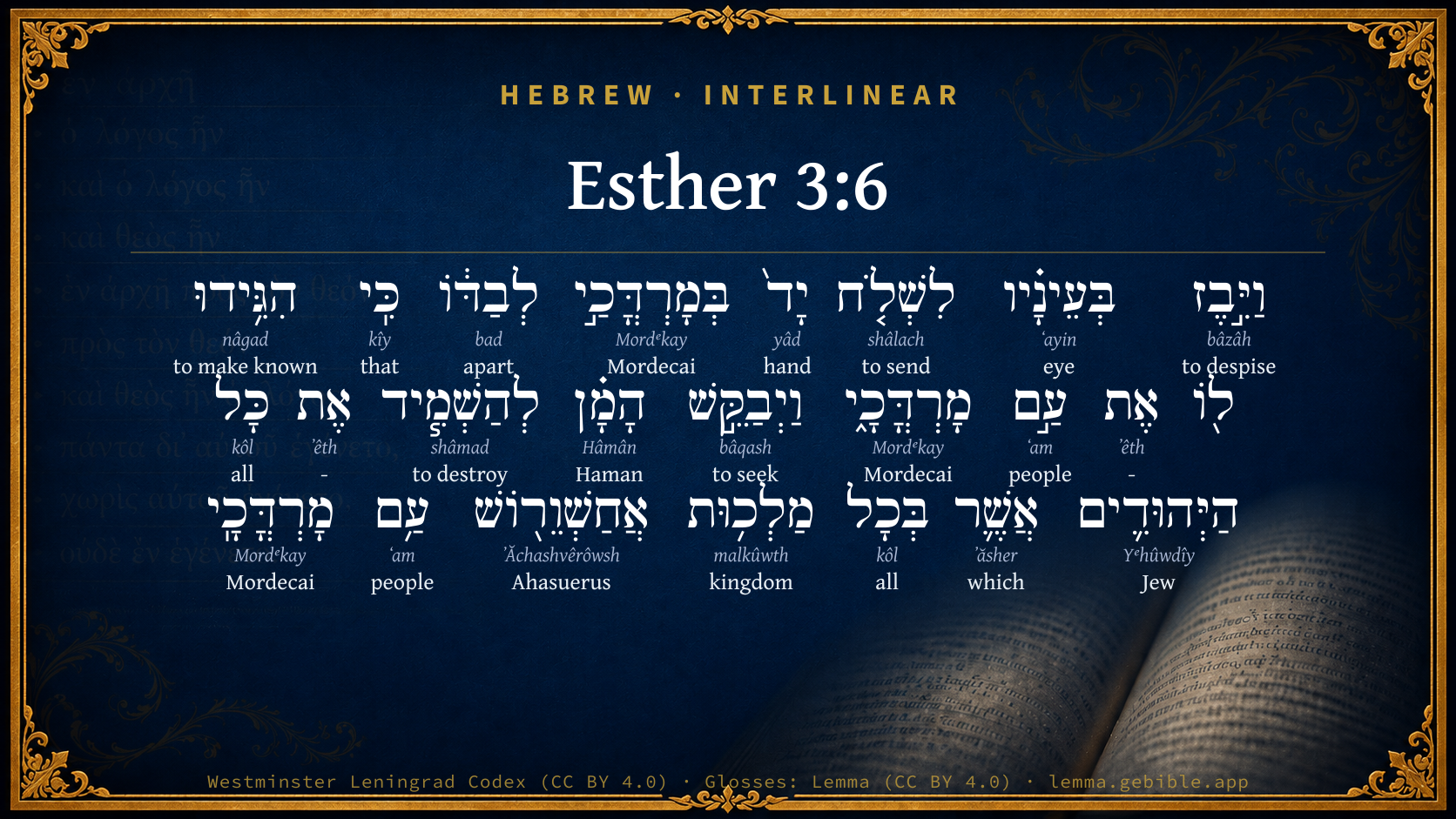
Esther 3:6

Hebrew (Westminster Leningrad Codex) Esther 3:6 appears in the Hebrew Old Testament. The text above is from the Westminster Leningrad Codex. Each word links to its Strong’s number, a concise gloss, and parsing drawn from the Open Scriptures Hebrew Bible morphology. Click any word for its full Brown-Driver-Briggs (BDB) entry.
Download image
Cite this verse

Esther 3:6 (World English Bible). Public Domain. Lemma interlinear Bible study tool, https://lemma.gebible.app/v/esther/3/6.

Show BibTeX & RIS
BibTeX
RIS
English Translation
But he scorned the thought of laying hands on Mordecai alone; for they had made known to him the people of Mordecai: therefore Haman sought to destroy all the Jews who were throughout the whole kingdom of Ahasuerus, even the people of Mordecai.
World English Bible · Public Domain
Download a study sheet

One document with this verse’s original text, its word-by-word gloss line, the meaning frame, cross-references with their text, attributed commentary, and full source and license credits — printable, and it pastes into notes with its structure intact.

This verse Autodidact and up

Study sheet (.html) Plain text (.txt)

A passage Seminary Student

Up to 50 verses in one chapter. A passage sheet keeps up to 6 commentary sources and 12 cross-references per verse, in the order this page ranks them, and says so on the sheet whenever that leaves anything out. Ask for a single verse and you get the Autodidact verse sheet above.

Everything on this page stays free to read, with no account — the sheet is a download of what is already on screen, not access to it.

Want to remove ads? Support Godless Engineer
Compare translations 3

The same verse in 3 English versions, stacked beneath the original-language interlinear above. Click any original word for its lexicon entry.

Each is an independent rendering of the whole verse — the interlinear is not word-aligned to these translations.

Highlighted words mark where these versions differ — a whole-verse word diff, not a word-by-word alignment.

  • World English Bible Public Domain
    But he scorned the thought of laying hands on Mordecai alone; for they had made known to him the people of Mordecai: therefore Haman sought to destroy all the Jews who were throughout the whole kingdom of Ahasuerus, even the people of Mordecai.
  • King James Version Public Domain
    And he thought scorn to lay hands on Mordecai alone; for they had shewed him the people of Mordecai: wherefore Haman sought to destroy all the Jews that were throughout the whole kingdom of Ahasuerus, even the people of Mordecai.
  • unfoldingWord Literal Text CC BY-SA 4.0
    And it was despised in his eyes to stretch out a hand against Mordecai alone, for they had told him the people of Mordecai. And Haman sought to annihilate all the Jews, the people of Mordecai, who were in all the kingdom of Ahasuerus.

unfoldingWord Literal Text — © unfoldingWord, licensed CC BY-SA 4.0. Word-aligned USFM3 via Door43 (git.door43.org/unfoldingWord/en_ult).

Versions to compare (up to 4)

3 of 4 selected

Show all 18 translations

Every available English version of this verse, each an independent rendering of the whole verse.

  • World English Bible Public Domain
    But he scorned the thought of laying hands on Mordecai alone; for they had made known to him the people of Mordecai: therefore Haman sought to destroy all the Jews who were throughout the whole kingdom of Ahasuerus, even the people of Mordecai.
  • Berean Standard Bible Public Domain
    And when he learned the identity of Mordecai’s people, he scorned the notion of laying hands on Mordecai alone. Instead, he sought to destroy all of Mordecai’s people, the Jews, throughout the kingdom of Xerxes.
  • Majority Standard Bible Public Domain
    And when he learned the identity of Mordecai’s people, he scorned the notion of laying hands on Mordecai alone. Instead, he sought to destroy all of Mordecai’s people, the Jews, throughout the kingdom of Xerxes.
  • King James Version Public Domain
    And he thought scorn to lay hands on Mordecai alone; for they had shewed him the people of Mordecai: wherefore Haman sought to destroy all the Jews that were throughout the whole kingdom of Ahasuerus, even the people of Mordecai.
  • American Standard Version (1901) Public Domain
    But he thought scorn to lay hands on Mordecai alone; for they had made known to him the people of Mordecai: wherefore Haman sought to destroy all the Jews that were throughout the whole kingdom of Ahasuerus, even the people of Mordecai.
  • Revised Version (1885) Public Domain
    But he thought scorn to lay hands on Mordecai alone; for they had shewed him the people of Mordecai: wherefore Haman sought to destroy all the Jews that were throughout the whole kingdom of Ahasuerus, even the people of Mordecai.
  • Geneva Bible (1599) Public Domain
    Now he thought it too litle to lay hands onely on Mordecai: and because they had shewed him the people of Mordecai, Haman sought to destroy all the Iewes, that were throughout the whole kingdome of Ahashuerosh, euen the people of Mordecai.
  • Douay-Rheims (1899) Public Domain
    And he counted it nothing to lay his hands upon Mardochai alone: for he had heard that he was of the nation of the Jews, and he chose rather to destroy all the nation of the Jews that were in the kingdom of Assuerus.
  • Young's Literal Translation Public Domain
    and it is contemptible in his eyes to put forth a hand on Mordecai by himself, for they have declared to him the people of Mordecai, and Haman seeketh to destroy all the Jews who `are' in all the kingdom of Ahasuerus -- the people of Mordecai.
  • Literal Standard Version CC BY-SA 4.0
    and it is contemptible in his eyes to put forth a hand on Mordecai by himself, for they have declared to him the people of Mordecai, and Haman seeks to destroy all the Jews who [are] in all the kingdom of Ahasuerus—the people of Mordecai.
  • Unlocked Literal Bible CC BY-SA 4.0
    He had contempt for the idea of killing only Mordecai, for the king's servants had told him who Mordecai's people were. Haman wanted to exterminate all the Jews, the people of Mordecai, who were in the entire kingdom of Ahasuerus.
  • unfoldingWord Literal Text CC BY-SA 4.0
    And it was despised in his eyes to stretch out a hand against Mordecai alone, for they had told him the people of Mordecai. And Haman sought to annihilate all the Jews, the people of Mordecai, who were in all the kingdom of Ahasuerus.
  • Darby Bible Public Domain
    But he scorned to lay hands on Mordecai alone; for they had made known to him the people of Mordecai; therefore Haman sought to destroy all the Jews that were in all the kingdom of Ahasuerus -- the people of Mordecai.
  • World Messianic Bible Public Domain
    But he scorned the thought of laying hands on Mordecai alone, for they had made known to him Mordecai’s people. Therefore Haman sought to destroy all the Jews who were throughout the whole kingdom of Ahasuerus, even Mordecai’s people.
  • Webster's Bible Public Domain
    And he scorned to lay hands on Mordecai alone; for they had shown him the people of Mordecai: wherefore Haman sought to destroy all the Jews that were throughout the whole kingdom of Ahasuerus, even the people of Mordecai.
  • Free Bible Version CC BY-SA 4.0
    Having found out who Mordecai's people were, he dismissed the idea of just killing Mordecai. He decided to kill every Jew in the whole Persian Empire—all of Mordecai's people!
  • Bible in Basic English Public Domain
    But it was not enough for him to make an attack on Mordecai only; for they had made clear to him who Mordecai's people were; so Haman made it his purpose to put an end to all the Jews, even Mordecai's people, through all the kingdom of Ahasuerus.
  • JPS Tanakh (1917) Public Domain
    But it seemed contemptible in his eyes to lay hands on Mordecai alone; for they had made known to him the people of Mordecai; wherefore Haman sought to destroy all the Jews that were throughout the whole kingdom of Ahasuerus, even the people of Mordecai.

Literal Standard Version (2020), Covenant Press — licensed CC BY-SA 4.0. Text via the HelloAO Bible API (eBible.org). Unlocked Literal Bible (unfoldingWord) — licensed CC BY-SA 4.0. Text via the HelloAO Bible API (eBible.org). unfoldingWord Literal Text — © unfoldingWord, licensed CC BY-SA 4.0. Word-aligned USFM3 via Door43 (git.door43.org/unfoldingWord/en_ult). Free Bible Version, Dr. Jonathan Gallagher — licensed CC BY-SA 4.0. Text via the HelloAO Bible API (eBible.org).

Word by word

More ways to search: Search by grammar → Find every occurrence → Compare this word →

Practice this passage: Drill this verse → Learn its vocabulary →

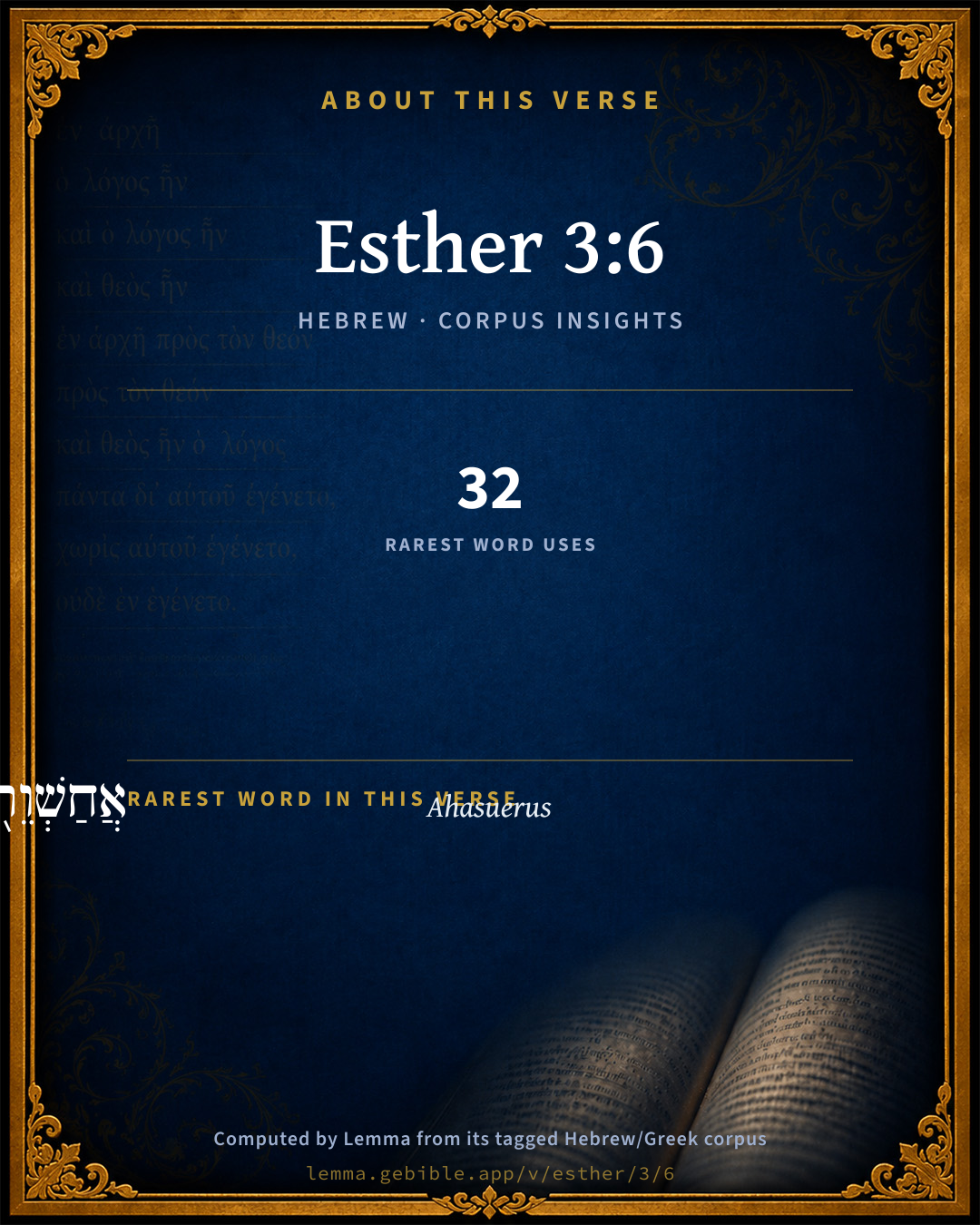
אֲחַשְׁוֵר֖וֹשׁ
ʼĂchashvêrôwsh
H325
“Ahasuerus”
Noun, Proper
Part of Speech
Noun
Type
Proper
Full BDB Definition

Origin: of Persian origin

TWOT: None

Ahasuerus = "I will be silent and poor" - title of the king of Persia, probably Xerxes
  1. וַיִּ֣בֶז bâzâh H959 “and · to despise” Conjunction + Verb, Qal, Sequential Imperfect, 3rd Person, Masculine, Singular
  2. בְּעֵינָ֗יו ʻayin H5869 “in/at · eyes · his” Preposition + Noun, Common, Both, Dual, Construct + Suffix, Personal, 3rd Person, Masculine, Singular
  3. לִשְׁלֹ֤ח shâlach H7971 “to send” Preposition + Verb, Qal, Infinitive Construct
  4. יָד֙ yâd H3027 “hand” Noun, Common, Both, Singular, Absolute
  5. בְּמָרְדֳּכַ֣י Mordᵉkay H4782 “in/at · Mordecai” Preposition + Noun, Proper
  6. לְבַדּ֔וֹ bad H905 “to/for · apart · his” Preposition + Noun, Common, Masculine, Singular, Construct + Suffix, Personal, 3rd Person, Masculine, Singular
  7. כִּֽי kîy H3588 “that” Conjunction
  8. הִגִּ֥ידוּ nâgad H5046 “to make known” Verb, Hiphil, Perfect, 3rd Person, Common, Plural
  9. אֶת ʼêth H853 “-” Particle, Direct Object
  10. עַ֣ם ʻam H5971 “people of” Noun, Common, Masculine, Singular, Construct
  11. מָרְדֳּכָ֑י Mordᵉkay H4782 “Mordecai” Noun, Proper
  12. וַיְבַקֵּ֣שׁ bâqash H1245 “and · to seek” Conjunction + Verb, Piel, Sequential Imperfect, 3rd Person, Masculine, Singular
  13. הָמָ֗ן Hâmân H2001 “Haman” Noun, Proper
  14. לְהַשְׁמִ֧יד shâmad H8045 “to destroy” Preposition + Verb, Hiphil, Infinitive Construct
  15. אֶת ʼêth H853 “-” Particle, Direct Object
  16. כָּל kôl H3605 “all of” Noun, Common, Masculine, Singular, Construct
  17. הַיְּהוּדִ֛ים Yᵉhûwdîy H3064 “the · Jews” Particle, Definite Article + Noun, Gentilic, Masculine, Plural, Absolute
  18. אֲשֶׁ֛ר ʼăsher H834 “which” Particle, Relative
  19. בְּכָל kôl H3605 “in/at · all of” Preposition + Noun, Common, Masculine, Singular, Construct
  20. מַלְכ֥וּת malkûwth H4438 “kingdom of” Noun, Common, Feminine, Singular, Construct
  21. עַ֥ם ʻam H5971 “people of” Noun, Common, Masculine, Singular, Construct
  22. מָרְדֳּכָֽי Mordᵉkay H4782 “Mordecai” Noun, Proper

About this verse

These counts appear in no published source. They are computed here, from the morphology-tagged text and Lemma’s own curated glosses. What Lemma adds →

24
words
18
distinct lemmas
Historical
section

Shared distinctive vocabulary

אֲחַשְׁוֵר֖וֹשׁ Ahasuerus H325 occurs in 30 verses of the Hebrew Bible. Also found in:

Grammatical profile

  • 5 verbs
  • 14 nouns
  • 1 preposition
  • 1 conjunction
  • 3 particles

Verb forms

  • וַיִּ֣בֶז Qal · Sequential Imperfect
  • לִשְׁלֹ֤ח Qal · Infinitive Construct
  • הִגִּ֥ידוּ Hiphil · Perfect
  • וַיְבַקֵּ֣שׁ Piel · Sequential Imperfect
  • לְהַשְׁמִ֧יד Hiphil · Infinitive Construct

Repetition

Words recur within this verse — often emphatic in Hebrew:

  • בְּמָרְדֳּכַ֣י Mordecai H4782 ×3
  • עַ֣ם people H5971 ×2
  • כָּל all H3605 ×2

Hebrew & Septuagint length

In English translation the verse runs 43 words from the Hebrew and 16 from the Septuagint (LXX English) — the Septuagint runs noticeably shorter here. See the side-by-side →

A rough comparison of the two English renderings, which tokenize alike — not a word-level alignment.

Word counts can differ between the Hebrew and the Greek without any difference in meaning — e.g. the Hebrew direct-object marker אֵת has no separate Greek word, and Greek often adds the article ὁ.

Cross-references

2

Topical passages linked to Esther 3:6 in the Treasury of Scripture Knowledge — connected by theme and wording, ordered by reader-vote popularity; previews shown in the World English Bible.

  • Psalms 83:4 "Come," they say, "and let's destroy them as a nation, That the name of Israel may be remembered no more."
  • Revelation 12:12 Therefore rejoice, heavens, and you who dwell in them. Woe to the earth and to the sea, because the devil has gone down to you, having great wrath, knowing that he has but a short time."

Cross-references courtesy of OpenBible.info (CC BY 4.0).

Hebrew and Greek witnesses Masoretic Hebrew ↔ Greek Septuagint

The same verse in the two great witnesses to the Old Testament, shown verse-for-verse.

Here the Septuagint runs noticeably shorter than the Hebrew — LXX2012 (modern English Septuagint) 16 words vs World English Bible 43. A rough length comparison of the two English translations, not a word-level alignment — read both below.

These are two independent witnesses, not word-aligned to each other, and the Septuagint is shown in lemma (dictionary) form.

Hebrew Esther 3:6 Masoretic · Westminster Leningrad Codex

וַיִּ֣בֶז בְּעֵינָ֗יו לִשְׁלֹ֤ח יָד֙ בְּמָרְדֳּכַ֣י לְבַדּ֔וֹ כִּֽי הִגִּ֥ידוּ ל֖וֹ אֶת עַ֣ם מָרְדֳּכָ֑י וַיְבַקֵּ֣שׁ הָמָ֗ן לְהַשְׁמִ֧יד אֶת כָּל הַיְּהוּדִ֛ים אֲשֶׁ֛ר בְּכָל מַלְכ֥וּת אֲחַשְׁוֵר֖וֹשׁ עַ֥ם מָרְדֳּכָֽי

But he scorned the thought of laying hands on Mordecai alone; for they had made known to him the people of Mordecai: therefore Haman sought to destroy all the Jews who were throughout the whole kingdom of Ahasuerus, even the people of Mordecai.

World English Bible · Public Domain

Greek LXX Esther 3:6 Septuagint · lemma form

καί βουλεύω ἀπο ἀναἵζω πᾶς ὁ ὑπό ὁ ἀρταξέρξης βασιλεία ἰουδαῖος

and took counsel to destroy utterly all the Jews who were under the rule of Artaxerxes.

LXX2012 (modern English Septuagint) · Public Domain

On this verse, Haydock's Catholic Bible Commentary discusses the Septuagint’s reading. Read the note in Commentary ↓

Hebrew: Westminster Leningrad Codex (CC BY 4.0). Greek: Septuagint (public domain); English from LXX2012 (modern English Septuagint) (Public Domain). How the Septuagint differs from the Hebrew →

Commentary

Notes on Esther 3:6 from classic Christian and Jewish commentators (each source and its license shown beneath its notes). The classic Christian expositions comment on the surrounding passage and are grouped to its opening verse, so a note may address several verses; the Jewish commentaries on the Tanakh (Rashi and others) are per-verse, so they appear only where the commentator wrote on this verse.

Lemma curates 59 commentaries, every one of them public domain or Creative Commons licensed, each selected and text-cleaned for this edition rather than reprinted as found. About our sources →

Trapp's Complete Commentary

John Trapp

Est 3:6 And he thought scorn to lay hands on Mordecai alone; for they had shewed him the people of Mordecai: wherefore Haman sought to destroy all the Jews that [were] throughout the whole kingdom of Ahasuerus, [even] the people of Mordecai.

Ver. 6. And he thought scorn to lay hands on Mordecai alone] He thought it a small matter, saith Josephus, μικρον ηγησατο, a thing below him, too little for his revenge, which, like fire, burneth all it can lay hold upon, especially when as here it ariseth from ambition, which, like choler adust, if constructed and stopped in its course, is a dangerous passion, and endeth in burning fevers and madness. Haman thought scorn, contempsit in oculis suis, contempt in his eyes, so the Hebrew, to foul his fingers with Mordecai alone, the whole nation must perish, and all the children of God that were scattered abroad, as he once said, Joh 11:50; Joh 11:52. In like manner, nostri temporis Hamanus, saith Merlin upon this text, the Haman of our time (meaning the duke of Guise, as I suppose), when as by the king’s favour he was promoted, and promised himself the crown, there being but one family only that stood in his way, he desired together with it to overturn all the Reformed religion and to root out all the remembrance of the Churches in France. Hence the Parisian Massacre, wherein Merlin had his part, being household chaplain to the admiral, and by a miracle of God’s mercy escaping those hellish cut throats. The first occasion of that bloody massacre, I have somewhere read, was this (Other things I know were pretended, as if the Protestants had plotted and practised against the king, queen mother, and the princes of the blood, and coin stamped with this inscription, Virtus in rebelles, &c. Courage in rebellion). The pope sent to the cardinal of Lorraine, brother to the duke of Guise, a table, wherein was painted our lady with a little child in her arms, by the most excellent painter in Christendom, and consecrated with his own hands, and enclosed it in a case of silk, and a letter with it, giving him high commendation and thanks for his zeal against the Huguenots. The messenger that carried the present fell sick by the way, and finding one going into France, entreated him to deliver the present to the cardinal. The cardinal read the letter, and laid the table on his bed, for he would not open it, till he might do it with greater solemnity. For this purpose he invited the duke of Guise to dinner with many other great personages. In the meanwhile one that liked not the cardinal, found means to change the table, &c. At dinner the letter was read, and the table taken out of the case in the sight of the cardinal and all his guests, wherein was painted in place of our lady and her child, the cardinal of Lorraine stark naked, the queen mother, the young Queen of Scots, and the old duchess of Guise naked also, hanging about the cardinal’s neck, and their legs wrapped between his legs. I cannot say much for the man that did this prank; but that the cardinal and his complices should thereupon design all the French Protestants to destruction, should butcher thirty thousand of them in a month, one hundred thousand of them in one year, some say three hundred thousand; that upon the news of it the pope should proclaim a jubilee for joy, and the cardinal of Lorraine give the messenger a thousand crowns, &c. This was matchless atrocious savagery, this was Haman-like hatred, this was cruelty beyond that of Simeon and Levi, which made good Jacob, in a deep detestation of that dreadfulness, cry out, "O my soul, come not thou into their secret," &c, Gen 49:6.

For they had showed him the people of Mordecai] viz. That he was a Jew. Josephus’s note upon this text is: Haman naturally hated the Jews, as those that had anciently destroyed the Amalekites’ countrymen, he might easily call to mind what Saul had done to them, and David, and, lastly, the tribe of Simeon. God had sentenced them long since to utter destruction; and yet deferred the first execution for about four hundred years’ time; and now again, after more than five hundred years, Haman, the Agagite, is thus exalted, but for a mischief, as the eagle carrieth the tortoise on high in her talons, that she may break it in the fall, and feed upon it.

Patientia laesa fit furor.

Wherefore Haman sought to destroy all the Jews] Ut sanguineam

famem expleret; as a wolf, breaking into the fold, kills all the

flock; as fowlers take away the young and the dams together, putting

both into the bag (which God forbade, Deu 22:6); as Esau, that

rough man, came with four hundred cut-throats at his heels, to

destroy the mother with the children, Gen 32:11; as Uladus,

prince ef Wallachia, was wont, together with the offender, to execute

the whole family, yea, sometimes the whole kindred; as Selilnus, the

Great Turk, in revenge of the loss he received at the battle of

Lepanto, resolved to put to death all the Christians in his

dominions, in number infinite; as Philip of Spain sailed out of the

Low Countries homewards, vowing to root out all the Lutherans there,

and protesting that he had rather have no subjects than such (Hist.

of Count. of Trent, 417); as cruel Dr Story, a great persecutor in

Queen Mary’s reign, and hanged for a traitor in Queen Elizabeth’s,

whose death he had conspired, cursing her daily in his grace at

meals, and greatly repenting that he and others had laboured only

about the young sprigs and twigs, as he phrased it, while they should

have stricken at the root, and clean rooted it out (A.D. 1571, Camd.

Eliz.); lastly, as the gunpowder Papists, who had prepared by

proclamations to further that horrid plot (if it had taken effect)

upon the Puritans, and under that name to have murdered all those

that had but looked toward religion.

That were throughout the whole kingdom] Herein he showed himself

a right Amalekite, Mali corvi malum ovum, dirt kneaded with blood

(Pηλος αιματι πεφυραμενος), as one said of Tiberius, He presumed

he might have what he pleased of the king, and, therefore, made

account to make but a breakfast of his enemies, the Jews, to whom he

said in his heart, as once Caligula did to the Roman consuls,

Rideo, quod uno nutu meo iugulare vos omnes possim, I cannot but

laugh to think that I can nod you all to death.

Even the people of Mordecai] Who were more renowned by him than

Co was by Hippocrates, Thebes by Epaininondas, Stagira by Aristotle,

Hippo by Augustine, &c.

John Trapp, A Commentary or Exposition upon All the Books of the Old and New Testament (1647–1656) — public domain. Text from a community e-Sword module.

The Biblical Illustrator

Joseph S. Exell

Est_3:6

Wherefore Haman thought to destroy all the Jews that were throughout the whole kingdom.

Plotting in vain

We proceed to consider the scheme of destruction which Haman arranged with the utmost craft. It seemed in its arrangement perfectly secure. Its accomplishment appeared certain and beyond resistance.

1. Hamans malice was extreme, equal to any result to which it might lead. There was no reluctance, no holding back in the carrying out his purposes of wickedness to the utmost.

2. Hamans plan was extremely crafty and determined. It involved many successive steps, and he faithfully persevered through them all. But what avails all this plotting against God? How mad and silly seem all the well-arranged plans of this scheme of wickedness when the providence and power of God are brought into the account! The secrecy of the plan is nothing. He that is higher than the highest regardeth it. An infinite power unseen is contending against him. Remember the story of Elisha, and his servant on the hill of Samaria (2Ki_6:15).

3. We see the people whom Haman desired to destroy given entirely into his hands. The king makes him an unlimited grant. The king said unto Haman, The silver is given to thee, the people also, to do with them as it seemeth good to thee. Mordecai rent his clothes, and put on sackcloth with ashes, and went out into the midst of the city, and cried with a loud and bitter cry, etc. Alas, what extended sorrow among men the arbitrary wickedness of man is able to produce! Ambition deluges the earth with blood. The wicked covetousness of a few may doom myriads to misery, with no relief. The pride of this world will not stop to hear; the business of this world will not stop to consider; the prosperity and self-indulgence of this world will not be troubled with the griefs of the absent suffering; the indifference of this world cannot take the trouble to read, or think, or act, concerning them.

4. We see on the side of the Jews no power to resist. The highest human power was irrevocably pledged to their oppressor. Every advantage is on the side of the oppressor. But God has His own plans already laid and fixed.

5. We are ready to ask, in reference to the case before us, How could any one ever present greater difficulties? But God delights in overcoming difficulties, and in causing the faith of His people to endure in the midst of all discouragements. He allows the obstacles in their path to accumulate to the utmost. And God graciously honoured the faith which He imparted by fulfilling all its expectations in a manner the most complete. If you come to serve the Lord, you must endure your part of the trials which His people meet. (S. H. Tyng, D. D.)

Revenge

Justice is said to blindfold herself that she may hold the scales evenly, not knowing what has been put into each; but revenge shuts both eyes that it may see no scales at all. What monstrous disproportion between the offence and the penalty, to avenge a small personal affront received from one Jew by causing to perish in one day all Jews, old and young! To say nothing of Nero or Domitian, nor of Radama in Madagascar--for these, being heathen, had to that extent the same excuse as Haman--let me recall in a few words a well-known story. There were many Protestants in France after the Reformation, some of them nobles, all of them peaceful citizens. Their numbers and their growth vexed the Pope, and especially vexed the Popes niece, Catherine de Medici, queen of France, and mother of three of its kings. Suddenly, while one of her sons, Charles IX., was young, Catherine made peace with the Huguenots, and displayed great zeal in enforcing new laws in favour of her Protestant subjects. After two years, without any warning, on the eve of St. Bartholomews Day, there began a massacre in which six thousand persons perished in Paris alone, and fifty thousand in the provinces of France, within three days. When the joyful tidings reached Rome, public thanks were given in the churches. Haman would have rejoiced in the bloodshed; but he must have owned himself outdone in cunning and blasphemy. Catherine succeeded where Haman failed; her victims were effectually blindfolded, and she took the name of a holy God and a merciful Saviour to justify an act which even those of her own creed now blush to acknowledge. (A. M. Symington, B. A.)

Enmity to Gods people

We see how enmity to Gods truth and His people displays itself with restless activity for the accomplishment of its ends. (A. B. Davidson, D. D.)

The Biblical Illustrator, edited by Joseph S. Exell (c. 1880s–1900s) — public domain. Text from a community e-Sword module.

Joseph Benson's Commentary

Est 3:6. And he thought scorn to lay hands on Mordecai alone — He thought that particular vengeance was unsuitable to his quality, and to the greatness of the injury; wherefore Haman sought to destroy all the Jews — Which he attempted from that implacable hatred which, as an Amalekite, he had against them; from his rage against Mordecai; and from Mordecai’s reason of this contempt, because he was a Jew, which, as he truly judged, extended itself to all the Jews, and would equally engage them all in the same neglect. And doubtless Haman included, those who were returned to their own land; for that was now a province of his kingdom.

Joseph Benson's Commentary on the Old and New Testaments (1811–1818) — public domain. Text from a community e-Sword module.

Tyndale Open Study Notes

Tyndale Open Resources

3:6 Haman was not interested in justice; he wanted revenge. He was determined to do everything in his power to crush Mordecai, including exterminating his entire people—the Jews.

Tyndale Open Study Notes — © Tyndale Open Resources, licensed CC BY-SA 4.0. Text via the HelloAO Bible API.

Geneva Bible (1599)

Geneva Bible translators

Hebrew, despised in his eyes.

Geneva Bible (1599) marginal notes — public domain. Text via Bolls.life.

The Cambridge Bible for Schools and Colleges

gen. ed. J. J. S. Perowne

6. But he thought scorn etc.] Haman’s wrath was so excessive that to punish the man who excited it seemed to him as nothing. The whole nation to which his enemy belonged must perish. A little more than forty years previously, at the accession of Darius Hystaspes, there had been a general massacre of the Magi, when the people “slew every Magus who came in their way” (Herod. iii. 79). This and other instances[67] which might be adduced illustrate the tendency towards passionate and excessive vengeance on the part of the Oriental disposition, which holds human life cheap. Some, however, have seen in Haman’s conduct the operation of a wider principle in the shape of race-hatred, paralleled in later days by anti-semitic outbursts upon the continent, or the persecution of Eastern Christians by the Turks.

[67] For example, when Cyaxares and the Medes invite to a banquet a large number of Scythians, whose depredations had proved troublesome, and massacre them when drunk (Herod. i. 106).

The Cambridge Bible for Schools and Colleges (gen. ed. J. J. S. Perowne; Cambridge University Press, 1878–1918) — public domain. Text from a community e-Sword module.

John Gill's Exposition

And he thought scorn to lay hands on Mordecai alone,.... That would not be a sufficient gratification of his revenge; he was too low and mean a person only to wreak his vengeance on; nothing short of his whole nation would satisfy him:

for they had showed him the people of Mordecai; that they were the Jews; for Mordecai had told the king's servants, that talked with him on the subject, that he was a Jew, and gave that as a reason why he could not and would not reverence Haman:

wherefore Haman sought to destroy all the Jews that were throughout the whole kingdom of Ahasuerus; even the people of Mordecai; and that not merely to be revenged on Mordecai, but because he plainly saw, that both by his example, and upon the same principle with him; they would all to a man refuse to give him reverence; and therefore he was resolved to root them out of the whole empire, that he might not be mortified by them.

John Gill's Exposition of the Whole Bible (1746–1763) — public domain (CC PDM 1.0). Text via the HelloAO Bible API.

Albert Barnes' Notes on the Bible

To destroy all the Jews - In the East massacres of a people, a race, a class, have at all times been among the incidents of history, and would naturally present themselves to the mind of a statesman. The Magophonia, or the great massacre of the Magi at the accession of Darius Hystaspis, was an event not then fifty years old, and was commemorated annually. A massacre of the Scythians had occurred about a century previously.

Albert Barnes' Notes on the Bible (1834–1885) — public domain. Text from a community e-Sword/MySword module.

Haydock's Catholic Bible Commentary

Counted. Septuagint, "consulted how to exterminate all the Jews in the kingdom." --- Assuerus. Hebrew adds, "the people of Mardochai."

George Leo Haydock (1774–1849), Haydock's Catholic Family Bible and Commentary, 1859 edition — public domain. Excludes Psalms (Douay-Rheims chapter numbering differs from Protestant) and Deuterocanonical books (Catholic canon only).

Matthew Poole's English Annotations

He thought scorn; he thought that particular vengeance was unsuitable to his quality, and to the greatness of the injury.

Haman sought to destroy all the Jews; which he attempted, partly, from that implacable hatred which, as an Amalekite, he had against them; partly, from his rage against Mordecai; and partly, from Mordecai’s reason of this contempt, because he was a Jew, which, as he truly judged, extended itself to all the Jews, and would equally engage them all in the same neglect and hatred of his person,

Matthew Poole's English Annotations on the Holy Bible (1683–1685) — public domain. Text from a community e-Sword/MySword module.

Whedon's Commentary on the Bible

Daniel D. Whedon

6. He thought scorn — Literally, it was contemptible in his eyes. To punish Mordecai alone was too little a thing, in his estimation, to reconcile his offended honour. The whole nation or race of Mordecai must perish to make atonement for this his sole offence. Such wholesale massacres were not uncommon in the East. For the offence of the pseudo-Smerdis the Persians sought to destroy all the Magi, and even celebrated the event by a festival called Magophonia — “the slaughter of the Magi.” — Herod., 3:79. Such a tyrant as Xerxes, with such a minister as Haman were just the men to cause such slaughter upon slight provocation.

Daniel D. Whedon (gen. ed.), Commentary on the Old and New Testaments (1874–1909) — public domain. Text from a community e-Sword module.

The Pulpit Commentary

He thought scorn to lay hands on Mordecai alone. If Haman had simply said to Ahasuerus, "There is one of your menials who persistently disobeys a royal edict, and at the same time insults me," Ahasuerus would, as a matter of course, have told him to put the menial to death. But the revengeful temper of the man was such that this seemed to him insufficient. Mordecai had insulted him as a Jew, and the Jews should pay the penalty. Mordecai should be punished not only in person, but in his kindred, if he had any, and in his nation. The nation itself was contumacious and troublesome (ver. 8); it would be well to get rid of it. And it would be a grand thing to wipe out an insult offered by an individual in the blood of a whole people. Haman therefore sought to destroy all the Jews that were throughout the whole kingdom of Ahasuerus. Massacres on a large scale not unknown in the West, witness St. Bartholomew"s are of frequent occurrence in the East, where human life is not held in much regard, and the caprices of absolute monarchs determine the course of history. There had been a general massacre of the Magi upon the accession of Darius Hystaspis, the father of Xerxes (Herod., 3:79), and one of Scythians about a century before (ibid. 1.106). These were examples which might occur to Haman. A later one is the Roman massacre of Mithridates in B.C. 88.

HOMILIES BY W. DINWIDDLE Ver. 6.

The intemperateness of contempt.

he thought scorn to lay hands on Mordecai alone." The projected deed of Haman, if it had been carried to completion, would not have been entirely without precedent and parallels more or less nearly resembling it. Herodotus, in the first book of his history, tells us of a massacre of the Scythians, actually carried into execution, and which preceded by about a hundred years that now proposed by Haman. When Darius Hystaspis ascended the throne, some forty years before the present date, a cruel slaughter of the Magi was ordered, and that slaughter was for a long period commemorated once a year. Five centuries onward bring us to that most memorable date of all, when, in one of the most heartless of massacres, Herod, king of Judaea, schemed to nip in the tender bud the career of the King of all the world, and to stifle in the thought the work of the Saviour of all men! And one can scarcely fail to associate with the present purpose of Haman the transactions of Black Bartholomew day (August 24, 1572), when, through the widespread and fair provinces of France, thousands upon thousands of Protestants were slaughtered! Deterrent though the subject of analysis is, let us consider that which is offered us in this passage.

I IT IS AN UNDISPUTED CASE OF A MAN ANGRY. But there is probably a place for almost every kind, for almost every degree, of anger. "A fool"s wrath is presently known," and a good man"s wrath should be presently known. Anger and sin often go together, but by no means always; the criterion this whether the anger is fed, has the poisonous force of rankling thought, of gloomy brooding in it; whether the sun is permitted to go down upon it, or it bidden to go down upon the down-going of the sun. If we stop here, our analysis conducts us no way, and is not sufficient to determine anything of value for us.

II IT IS AN UNDISPUTED CASE OF RESENTMENT. But resentment is a natural and valuable principle. Analogies come in and conspire to speak in its defence and praise. Physically it is sometimes equivalent to a vital principle. But the physical value of it is the merest shadow of the amount and value of its spiritual use. With all the fullest force of which it is capable it may advantageously come, and welcome in order to fling off some kind of assault, some sorts of arrows, some species of temptings. It is the prime glory of resentment in matters spiritual to be as like as possible to the red-hot iron when the drop of water falls upon it.

III IT IS AN UNDISPUTED CASE OF REVENGE. This passes us at once over the border line. We are no longer on safe ground, nor even on debateable ground. We are trespassing on the property of One who gives us here no right of ownership, but who is as liberal as he is powerful, as wise as he is wealthy, as considerate as he is just. It is he who, if he ever spoke with an impressive emphasis in his tone, has so uttered this one sentence: "Vengeance is mine,! will repay, saith the Lord." Punishment, indeed, is not revenge; but how often does the most undisguised revenge dare to take the name and try to wear the look of the most impartial, temperate, judicial punishment! Perhaps Haman would scarcely feel it necessary to attempt to put this face on it, or to defend himself from an imputation to which he would attach neither guilt nor shame, provided that danger was not in the way. Yet it is manifest that Haman did put a very false face on what was the simple outcome of his own revengeful spirit when he was seeking the requisite powers from King Ahasuerus (ch. 4:8).

IV IT IS AN UNDISPUTED CASE OF THAT PARTICULAR KIND OF ANNOYANCE CALLED AFFRONT. No appreciable harm had been done to the person, or to the business, or to the place, or to the prospects of Haman. Nor had he been injured in the least degree in the person of his wife, or of his family, or of any one clear to him. But affront had been offered him, or he supposed such was intended. That is, harm, though light and fanciful as any butterfly, had alighted upon the finery of his dignity, his vanity, his pride. The abrasion of the polish of self was indeed so slight, so marvellously inconspicuous, that he himself did not at all know it till those envious mischiefmakers, the "king"s servants," told him,(ch, 3:4), in order, forsooth, "to see whether Mordecai"s account of the reason of this infinitesimal deduction from the incense due to Haman (to whom indeed he owed none at all) would hold him absolved. An angry man, a revengeful man, a madman, a "bear robbed of her whelps.", (Pro_17:12) "the lion out of the forest", (Jer_5:6) are surely all safe company to meet compared with the vain man affronted. And this was the lot of Mordecai now.

V IT IS AN INDISPUTABLE CASE OF THE INSATIABLENESS OF CERTAIN COMBINATIONS OF SINFUL ELEMENTS IN A CHARACTER. There is no bottom to pride, there is no height to haughtiness, there is no measure to swelling vanity, there is no temperateness to contempt, there is not "the bit or rein" that can be reckoned safe to hold in the uncertain, nettled temper of scorn and disdain. Approach any one of these with but the appearance of affront, though the reality may be your own principle and religion unfeigned, and there is no longer room for either explanation or even expiation. Revenge alone can meet the case. We have need to fear the first symptoms of such dispositions. They belong to the godless heart. They spread pestilence. They make the lives that own to them resemble volcanoes, which ever and anon throw up and spread all around the torrents of their destroying lava. Those who answer to this type so mournfully exhibited by Haman, miserable and uncertain themselves, are they who make misery all around. They "think scorn" to be patient; they "think scorn" to give to others the liberty they demand for themselves; they "think scorn" to ask or accept an explanation; they "think scorn" to credit any man"s religion and conscience, except their own travesty of the genuine and true; they "think scorn" to show any kindness, or to make only a little misery. The heart of goodness, of justice, of mercy, nay, even the heart of reason, is cankered from within them. They must destroy all who in the slightest degree, real or apprehended, stand in their light, if only they can see their way to do it without present injury to themselves. And among all the worst foes a man can have, none can exceed this disposition, if it dwell in his heart. B.

Revenge.

I THE WRATH OF THE WICKED IS REVENGEFUL. The feeling is natural that prompts to retaliation. All human history is blurred by its activity. A Haman could not be offended without seeking to do the offender hurt. In the light of Christian truth it is mean and contemptible, but it is natural, and therefore almost universal.

II THE SPIRIT OF REVENGE IS NECESSARILY UNJUST. It does not measure the evil it contemplates by the injury that has excited it; its fierce tide flows over, and drowns every thought of balanced equity; it throws away the scales, and only wields the sword.

III THE SPIRIT OF REVENGE IS NECESSARILY UNMERCIFUL. Every feeling of pity is quenched in its fire. Its savage aim is to cause what suffering it can. The extermination of a whole people could only satisfy the vengeful lust of Haman.

IV THE SPIRIT OF REVENGE, WHEN ONCE KINDLED, EASILY FINDS FUEL TO FEED IT. While blind to all considerations that should moderate or slay it, it is sharp-sighted with respect to everything that is fitted to stimulate it. It was bad enough that Mordecai refused to do homage to Haman; but when the favourite learned the real ground of his refusal, then a fiercer fire entered into his soul. All the antipathies of race were stirred into flame. Henceforth "he thought scorn to lay hands on Mordecai alone;" Mordecai"s people shall suffer with himself.

V THE SPIRIT OF REVENGE IS ENCOURAGED BY THE POSSESSION OF POWER. A conscious inability to give it exercise has often a sobering effect; but the power to gratify it only increases its resolution in evil minds. Haman"s pride was inflated by the favour of the king. He could brook no slight. The might of the empire was in his hand, and that might should be exerted to its fullest extent to avenge the affront of the audacious Jew. His sense of power quickened his desire, and enlarged his project of revenge.

VI THE SPIRIT OF REVENGE EXHIBITS ITSELF IN ALL PERIODS, AND IN ALL GRADES OF SOCIETY. Appalling as Haman"s plan of vengeance was, it is not solitary. Under some of the Roman Caesars the Christians were treated as Haman intended to treat the Jews. Later on, and under a so-called Christian authority, whole communities were sacrificed to a vengeance which could not tolerate any sign of independent belief or action, such as the Waldenses, the Albigenses, and the Protestants in France. Our criminal records in the present day also illustrate the lengths to which an uncontrolled passion for revenge is willing to go. Yet the widest field on which this spirit produces suffering and misery is not public. Many families live on, in unknown but utter wretchedness, under the stupid fury of revengeful feeling excited by real or imaginary wrongs. Even in circles where everything like passion is avoided, men and women often cherish supposed slights and fancied insults. Reputations are often very calmly destroyed. The influence of good people is often neutralised, if not turned into evil, by the quiet maliciousness of enemies in the guise of friends. The spirit of revenge works in a myriad ways, and on every existing field of human life.

VII THE SPIRIT OF REVENGE IN MAN IS NOT GODLY, BUT DEMONIACAL. Wherever seen, or however clothed, it is hateful to God, hateful to Christ, hateful to every true man. It is our part not to "return evil for evil," but to "overcome evil with good". (Rom_12:21) The prerogative of judging and punishing belongs not to us, but to God. "Vengeance is mine, I will repay, saith the Lord". (Rom_12:19, Rom_12:20) The Christian law is not "hate," but "love your enemies". (Mat_5:44-48) This law was Divinely illustrated when Jesus on the cross prayed for the forgiveness of those who had in their mad fury of revenge inflicted on him such shame and pain: "Father, forgive them, for they know not what they do". D. (Luk_23:34)

The Pulpit Commentary (1880–1919), ed. H.D.M. Spence-Jones & Joseph S. Exell — public domain. Text from a community e-Sword module.

John Wesley's Explanatory Notes

Scorn - He thought that vengeance was unsuitable to his quality. Destroy - Which he attempted, from that implacable hatred which, as an Amalekite, he had against them; from his rage against Mordecai; and from Mordecai's reason of this contempt, because he was a Jew, which as he truly judged, extended itself to all the Jews, and would equally engage them all in the same neglect. And doubtless Haman included those who were returned to their own land: for that was now a province of his kingdom.

John Wesley, Explanatory Notes Upon the Whole Bible (1754–1765) — public domain. Text via the GEBible commentary corpus.

Lesson kit

Teaching starters — assembled from the data on this page, not authored interpretation. Every prompt links to the verse data it draws on. Edit before teaching.

Esther, in the Historical, opens this verse with 24 words (18 distinct Hebrew lemmas). Its most distinctive word is ʼĂchashvêrôwsh (“Ahasuerus”). The Greek Septuagint runs shorter here. A historical commentator’s framing appears above. Read the whole chapter for the surrounding context.

Discussion questions

  1. What does “Ahasuerus” (ʼĂchashvêrôwsh) contribute to the verse as a whole?
  2. Ezra 4:6 shares the word «Ahasuerus» with this verse. How do the two illuminate each other?
  3. “Mordecai” occurs 3× in this one verse. What is the effect of the repetition?
  4. Compared with the Hebrew, the Septuagint runs shorter here. What questions does that raise?
  5. The translations on this page render this verse differently — a whole-verse word diff, not a word-by-word alignment. What might account for the different wordings?
  6. The verb «וַיִּ֣בֶז» is Qal Sequential Imperfect. How does its form color the action?
  7. Reading how Trapp's Complete Commentary and The Biblical Illustrator read this verse, where do the two commentators agree and where do they part?

Things to notice

Reading settings

Reading text

Shown beneath each verse's original-language words.

Old Testament
Old Testament edition

Read the OT as the Masoretic Hebrew (MT) or the Greek Septuagint (LXX).

English shown for the Greek Septuagint (in the Hebrew ↔ Greek comparison).

Comparing translations? Open the Compare panel on any verse page to stack up to four side by side.