
Psalms 119:176

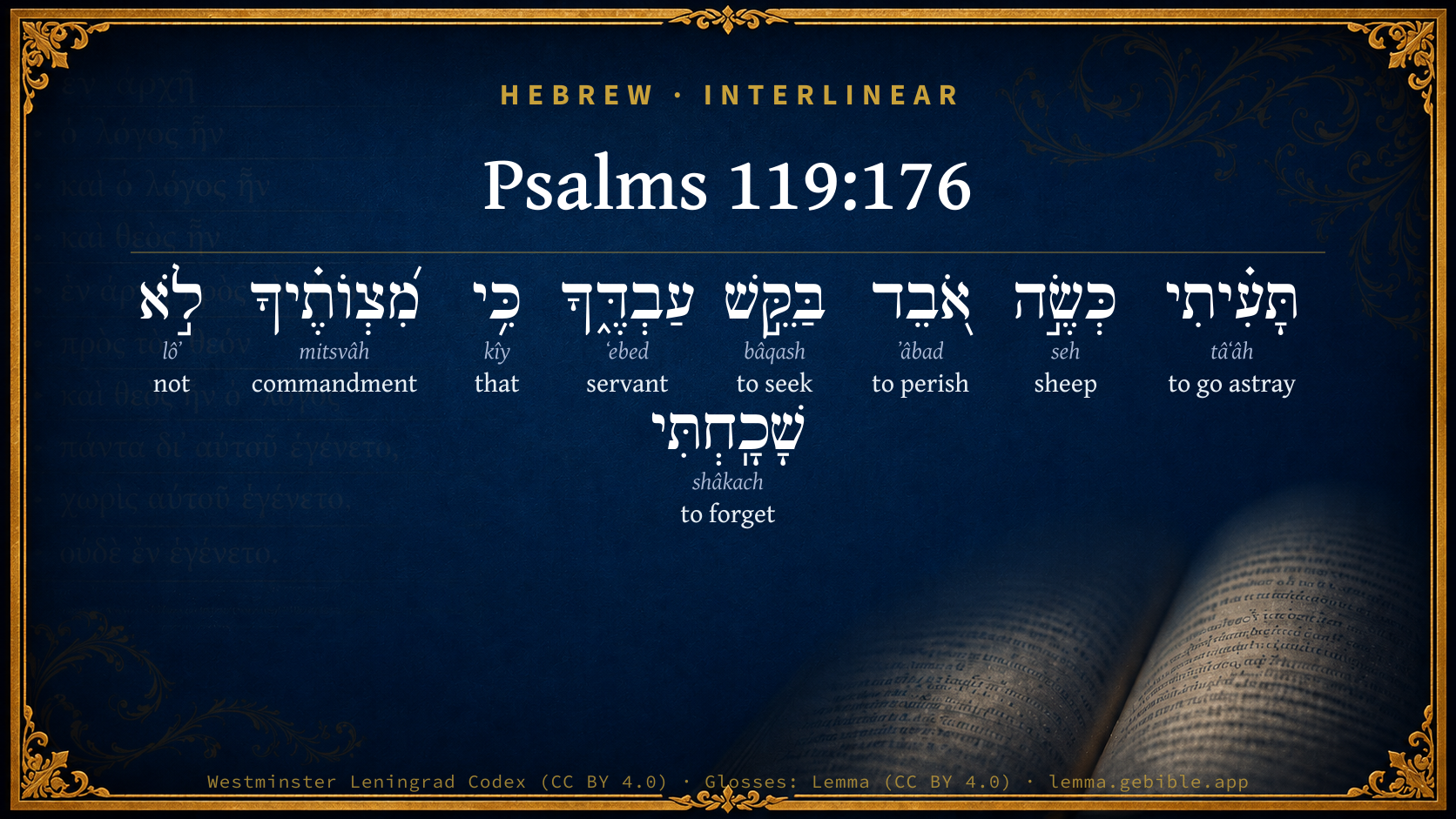
Hebrew (Westminster Leningrad Codex) Psalms 119:176 appears in the Hebrew Old Testament. The text above is from the Westminster Leningrad Codex. Each word links to its Strong’s number, a concise gloss, and parsing drawn from the Open Scriptures Hebrew Bible morphology. Click any word for its full Brown-Driver-Briggs (BDB) entry.
Download image
Cite this verse

Psalms 119:176 (World English Bible). Public Domain. Lemma interlinear Bible study tool, https://lemma.gebible.app/v/psalms/119/176.

Show BibTeX & RIS
BibTeX
RIS
English Translation
I have gone astray like a lost sheep. Seek your servant, for I don't forget your commandments.
World English Bible · Public Domain
Download a study sheet

One document with this verse’s original text, its word-by-word gloss line, the meaning frame, cross-references with their text, attributed commentary, and full source and license credits — printable, and it pastes into notes with its structure intact.

This verse Autodidact and up

Study sheet (.html) Plain text (.txt)

A passage Seminary Student

Up to 50 verses in one chapter. A passage sheet keeps up to 6 commentary sources and 12 cross-references per verse, in the order this page ranks them, and says so on the sheet whenever that leaves anything out. Ask for a single verse and you get the Autodidact verse sheet above.

Everything on this page stays free to read, with no account — the sheet is a download of what is already on screen, not access to it.

Want to remove ads? Support Godless Engineer
Compare translations 3

The same verse in 3 English versions, stacked beneath the original-language interlinear above. Click any original word for its lexicon entry.

Each is an independent rendering of the whole verse — the interlinear is not word-aligned to these translations.

Highlighted words mark where these versions differ — a whole-verse word diff, not a word-by-word alignment.

  • World English Bible Public Domain
    I have gone astray like a lost sheep. Seek your servant, for I don't forget your commandments.
  • King James Version Public Domain
    I have gone astray like a lost sheep; seek thy servant; for I do not forget thy commandments.
  • unfoldingWord Literal Text CC BY-SA 4.0
    I have strayed like a perishing sheep; seek your servant, for I have not forgotten your commandments.

unfoldingWord Literal Text — © unfoldingWord, licensed CC BY-SA 4.0. Word-aligned USFM3 via Door43 (git.door43.org/unfoldingWord/en_ult).

Versions to compare (up to 4)

3 of 4 selected

Show all 17 translations

Every available English version of this verse, each an independent rendering of the whole verse.

  • World English Bible Public Domain
    I have gone astray like a lost sheep. Seek your servant, for I don't forget your commandments.
  • Berean Standard Bible Public Domain
    I have strayed like a lost sheep; seek Your servant, for I have not forgotten Your commandments.
  • Majority Standard Bible Public Domain
    I have strayed like a lost sheep; seek Your servant, for I have not forgotten Your commandments.
  • King James Version Public Domain
    I have gone astray like a lost sheep; seek thy servant; for I do not forget thy commandments.
  • American Standard Version (1901) Public Domain
    I have gone astray like a lost sheep; Seek thy servant; For I do not forget thy commandments. Psalm 120 A Song of Ascents.
  • Revised Version (1885) Public Domain
    I have gone astray like a lost sheep; seek thy servant; for I do not forget thy commandments.
  • Geneva Bible (1599) Public Domain
    I haue gone astraye like a lost sheepe: seeke thy seruant, for I doe not forget thy commandements.
  • Young's Literal Translation Public Domain
    I wandered as a lost sheep, seek Thy servant, For Thy precepts I have not forgotten!
  • Literal Standard Version CC BY-SA 4.0
    I wandered as a lost sheep, [so] seek Your servant, || For I have not forgotten Your precepts!
  • Unlocked Literal Bible CC BY-SA 4.0
    I have wandered off like a lost sheep; seek your servant, for I have not forgotten your commandments.
  • unfoldingWord Literal Text CC BY-SA 4.0
    I have strayed like a perishing sheep; seek your servant, for I have not forgotten your commandments.
  • Darby Bible Public Domain
    I have gone astray like a lost sheep: seek thy servant; for I have not forgotten thy commandments.
  • World Messianic Bible Public Domain
    I have gone astray like a lost sheep. Seek your servant, for I don’t forget your commandments.
  • Webster's Bible Public Domain
    I have gone astray like a lost sheep; seek thy servant; for I do not forget thy commandments.
  • Free Bible Version CC BY-SA 4.0
    I have wandered away like a lost sheep, so please come looking for me, for I have not forgotten your commandments.
  • Bible in Basic English Public Domain
    I have gone out of the way like a wandering sheep; make search for your servant; for I keep your teachings ever in mind.
  • JPS Tanakh (1917) Public Domain
    I have gone astray like a lost sheep; seek Thy servant; for I have not forgotten Thy commandments.

Literal Standard Version (2020), Covenant Press — licensed CC BY-SA 4.0. Text via the HelloAO Bible API (eBible.org). Unlocked Literal Bible (unfoldingWord) — licensed CC BY-SA 4.0. Text via the HelloAO Bible API (eBible.org). unfoldingWord Literal Text — © unfoldingWord, licensed CC BY-SA 4.0. Word-aligned USFM3 via Door43 (git.door43.org/unfoldingWord/en_ult). Free Bible Version, Dr. Jonathan Gallagher — licensed CC BY-SA 4.0. Text via the HelloAO Bible API (eBible.org).

Word by word

More ways to search: Search by grammar → Find every occurrence → Compare this word →

Practice this passage: Drill this verse → Learn its vocabulary →

כְּשֶׂ֣ה
seh
H7716
“like/as · sheep”
Preposition + Noun, Common, Both, Singular, Absolute
Part of Speech
Preposition + Noun
Type
Common
Gender
Both
Number
Singular
State
Absolute
Full BDB Definition

Origin: probably from H7582 through the idea of pushing out to graze

TWOT: 2237

one of a flock, lamb, sheep, goat, young sheep, young goat - sheep, goat - flock (collective)
  1. תָּעִ֗יתִי tâʻâh H8582 “to go astray” Verb, Qal, Perfect, 1st Person, Common, Singular
  2. אֹ֭בֵד ʼâbad H6 “perishing” Verb, Qal, Participle Active, Masculine, Singular, Absolute
  3. בַּקֵּ֣שׁ bâqash H1245 “seek” Verb, Piel, Imperative, 2nd Person, Masculine, Singular
  4. עַבְדֶּ֑ךָ ʻebed H5650 “servant · your” Noun, Common, Masculine, Singular, Construct + Suffix, Personal, 2nd Person, Masculine, Singular
  5. כִּ֥י kîy H3588 “that” Conjunction
  6. מִ֝צְוֺתֶ֗יךָ mitsvâh H4687 “commandments · your” Noun, Common, Feminine, Plural, Construct + Suffix, Personal, 2nd Person, Masculine, Singular
  7. לֹ֣א lôʼ H3808 “not” Particle, Negative
  8. שָׁכָֽחְתִּי shâkach H7911 “to forget” Verb, Qal, Perfect, 1st Person, Common, Singular

About this verse

These counts appear in no published source. They are computed here, from the morphology-tagged text and Lemma’s own curated glosses. What Lemma adds →

9
words
9
distinct lemmas
Wisdom
section

Shared distinctive vocabulary

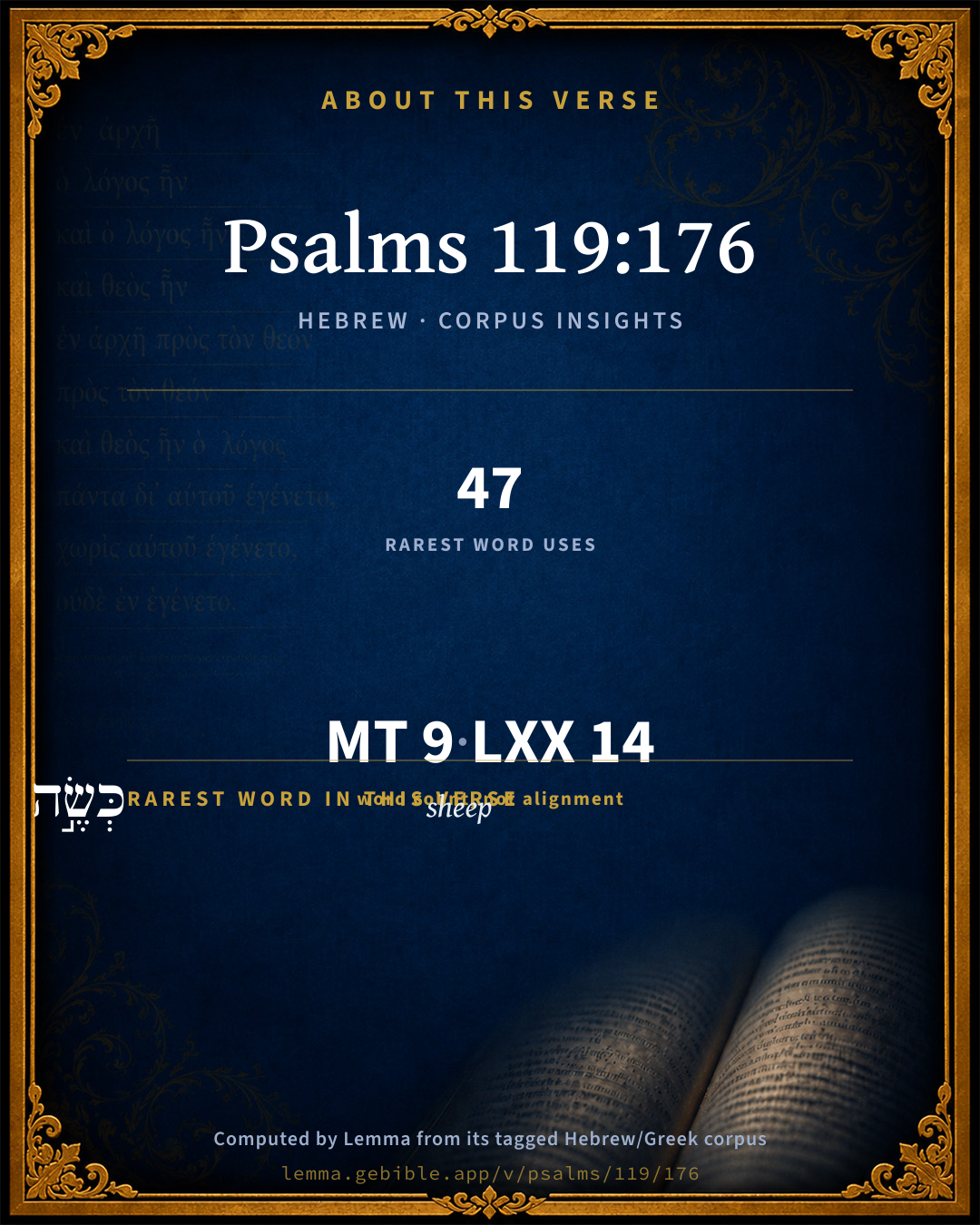
כְּשֶׂ֣ה sheep H7716 occurs in 39 verses of the Hebrew Bible. Also found in:

Grammatical profile

  • 4 verbs
  • 3 nouns
  • 1 conjunction
  • 1 particle

Verb forms

  • תָּעִ֗יתִי Qal · Perfect
  • אֹ֭בֵד Qal · Participle Active
  • בַּקֵּ֣שׁ Piel · Imperative
  • שָׁכָֽחְתִּי Qal · Perfect

Hebrew & Septuagint length

In English translation the verse runs 17 words from the Hebrew and 18 from the Septuagint (LXX English) — closely comparable.

A rough comparison of the two English renderings, which tokenize alike — not a word-level alignment.

Word counts can differ between the Hebrew and the Greek without any difference in meaning — e.g. the Hebrew direct-object marker אֵת has no separate Greek word, and Greek often adds the article ὁ.

In the original languages it is 9 Hebrew tokens and 14 Greek tokens — but the two are counted differently (Hebrew bundles its prefixes and suffixes into one token; the Greek is in lemma form), so that isn’t a like-for-like length.

Cross-references

18

Topical passages linked to Psalms 119:176 in the Treasury of Scripture Knowledge — connected by theme and wording, ordered by reader-vote popularity; previews shown in the World English Bible.

  • Luke 19:10 For the Son of Man came to seek and to save that which was lost."
  • Isaiah 53:6 All we like sheep have gone astray; everyone has turned to his own way; and Yahweh has laid on him the iniquity of us all.
  • Luke 15:4–7 "Which of you men, if you had one hundred sheep, and lost one of them, wouldn't leave the ninety-nine in the wilderness, and go after the one that was lost, until he found it?
  • John 10:16 I have other sheep, which are not of this fold. I must bring them also, and they will hear my voice. They will become one flock with one shepherd.
  • Matthew 15:24 But he answered, "I wasn't sent to anyone but the lost sheep of the house of Israel."
  • 1 Peter 2:25 For you were going astray like sheep; but are now returned to the Shepherd and Overseer of your souls.
  • Psalms 119:93 I will never forget your precepts, For with them, you have revived me.
  • Ezekiel 34:6 My sheep wandered through all the mountains, and on every high hill: yes, my sheep were scattered on all the surface of the earth; and there was none who searched or sought.
  • Matthew 18:12–13 "What do you think? If a man has one hundred sheep, and one of them goes astray, doesn't he leave the ninety-nine, go to the mountains, and seek that which has gone astray?
  • Psalms 119:61 The ropes of the wicked bind me, But I won't forget your law.
  • Song of Solomon 1:4 Take me away with you. Let us hurry. The king has brought me into his chambers. Friends We will be glad and rejoice in you. We will praise your love more than wine! Beloved They are right to love you.
  • Ezekiel 34:16 I will seek that which was lost, and will bring back that which was driven away, and will bind up that which was broken, and will strengthen that which was sick: but the fat and the strong I will destroy; I will feed them in justice.
  • Galatians 4:9 But now that you have come to know God, or rather to be known by God, why do you turn back again to the weak and miserable elements, to which you desire to be in bondage all over again?
  • Philippians 2:13 For it is God who works in you both to will and to work, for his good pleasure.
  • James 1:17 Every good gift and every perfect gift is from above, coming down from the Father of lights, with whom can be no variation, nor turning shadow.
  • Jeremiah 31:18 I have surely heard Ephraim bemoaning himself [thus], You have chastised me, and I was chastised, as a calf unaccustomed [to the yoke]: turn you me, and I shall be turned; for you are Yahweh my God.
  • Hosea 4:6 My people are destroyed for lack of knowledge. Because you have rejected knowledge, I will also reject you, That you may be no priest to me. Because you have your God's law, I will also forget your children.
  • Matthew 10:6 Rather, go to the lost sheep of the house of Israel.

Cross-references courtesy of OpenBible.info (CC BY 4.0).

Hebrew and Greek witnesses Masoretic Hebrew ↔ Greek Septuagint

The same verse in the two great witnesses to the Old Testament, shown verse-for-verse.

You’re reading Greek Psalm 118 (Hebrew Psalm 119). The Septuagint counts the superscription, so verse numbers can differ from the Hebrew — chapter-level alignment, not verse-by-verse. Numbering follows Rahlfs.

These are two independent witnesses, not word-aligned to each other, and the Septuagint is shown in lemma (dictionary) form.

Hebrew Psalms 119:176 Masoretic · Westminster Leningrad Codex

תָּעִ֗יתִי כְּשֶׂ֣ה אֹ֭בֵד בַּקֵּ֣שׁ עַבְדֶּ֑ךָ כִּ֥י מִ֝צְוֺתֶ֗יךָ לֹ֣א שָׁכָֽחְתִּי

I have gone astray like a lost sheep. Seek your servant, for I don't forget your commandments.

World English Bible · Public Domain

Greek LXX Greek Psalm 118:176 Septuagint · lemma form

πλανάω ὡς πρόβατον ἀποὀλλύω ζητέω ὁ δοῦλος σύ ὅτι ὁ ἐντολή σύ οὐ ἐπιλανθάνω

I have gone astray like a lost sheep; seek your servant; for I have not forgotten your commandments.

LXX2012 (modern English Septuagint) · Public Domain

On this verse, Ellicott's Commentary for English Readers discusses the Septuagint’s reading. Read the note in Commentary ↓

Hebrew: Westminster Leningrad Codex (CC BY 4.0). Greek: Septuagint (public domain); English from LXX2012 (modern English Septuagint) (Public Domain). How the Septuagint differs from the Hebrew →

Commentary

Notes on Psalms 119:176 from classic Christian and Jewish commentators (each source and its license shown beneath its notes). The classic Christian expositions comment on the surrounding passage and are grouped to its opening verse, so a note may address several verses; the Jewish commentaries on the Tanakh (Rashi and others) are per-verse, so they appear only where the commentator wrote on this verse.

Lemma curates 59 commentaries, every one of them public domain or Creative Commons licensed, each selected and text-cleaned for this edition rather than reprinted as found. About our sources →

Trapp's Complete Commentary

John Trapp

Psa 119:176 I have gone astray like a lost sheep; seek thy servant; for I do not forget thy commandments.

Ver. 176. I have gone astray, &c.] And of myself shall never return.

Seek thy servant] Do all the offices of a good shepherd for me, Luk 15:4-7

For I do not forget] The root of the matter is still in me, I am recallable, and ready to hear thy voice, Joh 10:3.

John Trapp, A Commentary or Exposition upon All the Books of the Old and New Testament (1647–1656) — public domain. Text from a community e-Sword module.

The Biblical Illustrator

Joseph S. Exell

Psa_119:176

I have gone astray like a lost sheep; seek Thy servant; for I do not forget Thy commandments.

The Christian, conscious of departure from God

We have in this verse the description of a believer--not as he ought to be--not as he would wish to be--but as he is. It is not a fancy picture; it is a picture of life.

I. It is as honest confession. It is upright; and downright. He does not throw the blame upon the worlds seducements, and say--That was too great an enemy for me, it overcame me. He does not throw the blame upon Satan. Neither does he throw the blame upon the flesh that was in him; though we know that was the source of the evil. He takes the whole blame to himself I have gone astray like a lost sheep.

II. The prayer: Seek Thy servant. It implies that he had got so far that he did not know his way back. Quite evidently: I have gone astray, seek Thy servant, I cannot find any way of return.

III. The plea: For I do not forget Thy commandments. There are periods in a believers life in which he not only has one evidence, but he has a hundred evidences of his adoption. But there are periods when it seems almost reduced to the little spark on the ocean. Here is that little spark--I do not forget Thy commandments. Do not think it a mere point of memory. No, it is something more than that. Though I have gone from Thee, though I have left Thy precepts, though I have not followed them as I ought to have followed them, yet I do not forget they are sweet to me; I love them; I wish to have them written out in my heart. Conclusion--

1. The tendency there is in sin. It is not contented with making us miserable; it wants to destroy us, and that for ever.

2. The weakness of the believer. Like a lost sheep.

3. The faithfulness of the Holy Spirit. He puts this plea in the heart.

4. The kind Restorer of this wandering sheep.

5. Beware of whatever leads to going astray. Love of the world, idleness, etc.

6. Seek that which promotes the life of God. Live upon Christ. (J. H. Evans, M. A.)

.

Psa_120:1-7

The Biblical Illustrator, edited by Joseph S. Exell (c. 1880s–1900s) — public domain. Text from a community e-Sword module.

Joseph Benson's Commentary

Psa 119:176. I have gone astray like a lost sheep — I have too often swerved from the path of thy precepts, through my own infirmity, or the power of temptation. Seek thy servant — As the shepherd doth his wandering sheep, and bring me back into thy fold. Or, as some interpret the psalmist’s meaning, I have wandered like a sheep which is lost, driven from place to place during these tedious persecutions; but be thou pleased, like a careful shepherd, to look after me, and to put me in the right way of escaping all the dangers to which I am exposed, and of recovering my liberty, rest, and peace.

Joseph Benson's Commentary on the Old and New Testaments (1811–1818) — public domain. Text from a community e-Sword module.

J. A. Alexander on Psalms

Joseph Addison Alexander

176. (Psa 119:176) I wander like a lost sheep—seek thy servant—for thy commandments I do not forget. The English versions of the first clause (I have gone astray), although they adhere strictly to the form of the original, seem to make the primary idea that of sin, which is really included, but only as the cause of that which is directly intended, namely, misery, represented by the wandering of a lost and helpless sheep. Compare Jer 1:6. Seek thy servant, deliver from this wretched state one who is still thy servant, and as such remembers thy commandments, even in the midst of his worst sufferings. As the preceding verse sums up the petitions of the psalm, so this sums up its complaints in the first clause and its professions in the last, connected by the short prayer (seek thy servant) as by a single link. The predominant use of the past tense, even to the end, shews how deeply the entire psalm is founded upon actual and previous experience. In this last stanza, the only initial word repeated is the verb of existence.

Joseph Addison Alexander, The Psalms Translated and Explained (1850) — public domain. Text from a community e-Sword module.

Tyndale Open Study Notes

Tyndale Open Resources

119:176 God, the Great Shepherd, seeks out his lost sheep (23:1; Luke 15:4-6).

Tyndale Open Study Notes — © Tyndale Open Resources, licensed CC BY-SA 4.0. Text via the HelloAO Bible API.

Geneva Bible (1599)

Geneva Bible translators

Being chased to and fro by mine enemies, and having no place to rest in.

Geneva Bible (1599) marginal notes — public domain. Text via Bolls.life.

Matthew Henry's Commentary

Here is, 1. A penitent confession: I have gone astray, or wander up and down, like a lost sheep. As unconverted sinners are like lost sheep (Luk 15:4), so weak unsteady saints are like lost sheep, Mat 18:12, Mat 18:13. We are apt to wander like sheep, and very unapt, when we have gone astray, to find the way again. By going astray we lose the comfort of the green pastures and expose ourselves to a thousand mischiefs. 2. A believing petition: Seek thy servant, as the good shepherd seeks a wandering sheep to bring it back again, Eze 34:12. "Lord, seek me, as I used to seek my sheep when they went astray;" for David had been himself a tender shepherd. "Lord, own me for one of thine; for, though I am a stray sheep, I have thy mark; concern thyself for me, send after me by the word, and conscience, and providences; bring me back by thy grace." Seek me, that is, find me; for God never seeks in vain. Turn me, and I shall be turned. 3. An obedient plea: "Though I have gone astray, yet I have not wickedly departed, I do not forget thy commandments." Thus he concludes the psalm with a penitent sense of his own sin and believing dependence on God's grace. With these a devout Christian will conclude his duties, will conclude his life; he will live and die repenting and praying. Observe here, (1.) It is the character of good people that they do not forget God's commandments, being well pleased with their convictions and well settled in their resolutions. (2.) Even those who, through grace, are mindful of their duty, cannot but own that they have in many instances wandered from it. (3.) Those that have wandered from their duty, if they continue mindful of it, may with a humble confidence commit themselves to the care of God's grace.

Matthew Henry's Commentary on the Whole Bible (1708–1710) — public domain (CC PDM 1.0). Text via the HelloAO Bible API.

Adam Clarke's Commentary

Verse 176. I have gone astray like a lost sheep] A sheep, when it has once lost the flock, strays in such a manner as to render the prospect of its own return utterly hopeless. I have seen them bleating when they have lost the flock, and when answered by the others, instead of turning to the sound, have gone on in the same direction in which they were straying, their bleatings answered by the rest of the flock, till they were out of hearing! This fact shows the propriety of the next clause.

Seek thy servant] I shall never find thee; come to the wilderness, take me up, and carry me to the flock. See the notes on the parable of the lost sheep, Lu 15:4, c. The psalmist began with "Blessed are the undefiled in the way, who walk in the law of the Lord" and he concludes with "I have gone astray like a lost sheep; seek thy servant." And thus, conscious of the blessedness of those who are in the way or righteousness, he desires to be brought into it, that he may walk in newness of life. Ver. 1: "It is a good way, and they are blessed that walk in it." Verse the last, "Bring me into this way, that I may be blessed." And thus the Psalm, in sentiment, returns into itself; and the latter verse is so connected with the former, as to make the whole a perfect circle, like the serpent biting its own tail.

There is one extraordinary perfection in this Psalm: begin where you will, you seem to be at the commencement of the piece; end where you will, you seem to close with a complete sense. And yet it is not like the Book of Proverbs, a tissue of detached sentences; it is a whole composed of many parts, and all apparently as necessary to the perfection of the Psalm, as the different alphabetical letters under which it is arranged are to the formation of a complete alphabet. Though there be a continual recurrence of the same words, which would of itself prevent it from having a pleasing effect upon the ear, yet these words are so connected with a vast variety of others, which show their force and meaning in still new and impressive points of light, that attention is still excited, and devotion kept alive, during the whole reading. It is constructed with admirable art, and every where breathes the justest and highest encomiums on the revelation of God; shows the glories of the God who gave it, the necessities and dependence of his intelligent creatures, the bounty of the Creator, and the praise and obedience which are his due. It is elegant throughout; it is full of beauties, and I have endeavoured in the preceding notes to mark some of them; but the number might have been greatly multiplied. To no Psalm can its own words be better applied, Ps 119:18: "Open thou mine eyes, that I may behold wondrous things out of thy law."

ANALYSIS OF LETTER TAU. - Twenty-Second Division

In this last section the psalmist seems to sum up all his preceding exercises.

I. He prays.

II. Gives thanks.

III. Confesses his errors.

IV. Craves mercy; and,

V. Promises obedience.

I. In the first two verses he prays for his prayers, begging God to accept them.

1. "Let my cry come near before thee!"

2. "Let my supplication come before thee!" This repetition shows his earnestness, fervency, importunity, and perseverance. See Lu 11:1, c.

That for which he prays is, 1. Understanding 2. Deliverance.

1. "Give me understanding." I want more light.

2. Give me this "according to thy word." In the measure which thou hast promised.

3. And give it to me for this end, that I may know thy law, be obedient to its precepts, and finally, by thy mercy, obtain everlasting life.

4. "Deliver me according to thy word." I want salvation, and that measure of it which thy word promises.

II. He gives thanks.

1. "My lips shall utter praise." I will celebrate thy praises with songs.

2. "My tongue shall speak." I shall set forth thy wondrous deeds.

3. Shall show that all thy commandments are righteousness; just, holy, impartial.

4. But these things I cannot do till "thou hast taught me thy statutes."

III. He proceeds to other parts of prayer: -

1. "Let thy hand help me." My own strength will avail little.

2. "I have chosen thy statutes:" and without thy help I cannot obey them.

3. "I have longed for thy salvation." Thou knowest my heart is right with thee.

4. "And thy law is my delight." A man naturally longs for that which he delights to possess.

Here he notes three things: -

1. I have "chosen thy precepts."

2. I have "longed for thy salvation."

3. "Delighted in thy law;" therefore "let thy hand be with me."

He prays for, -

1. Life: "Let my soul live."

2. "And it shall praise thee." When the soul is dead to God, there is neither gratitude nor obedience.

3. "Let thy judgments help me." Cause the merciful dispensations of thy providence ever to work in my behalf. In this sense the word judgments is frequently taken in this Psalm.

IV. He confesses his errors.

1. "I have gone astray," departed from thee, my Shepherd.

2. "And like a lost sheep too." See the note.

3. My errors, however, have not been wilful and obstinate. I did not sufficiently watch and pray, and my sheep - like simplicity was practised upon by my arch enemy.

4. The consequence, however, has been, I am lost - far from thy fold. But thou didst come to seek and save that which was lost.

5. Therefore, O Lord, seek me. I am in the wilderness; leave the ninety and nine that do not need thee as I do, and seek me; for, by thy grace, I seek thee.

V. I look for thee in the spirit of obedience.

1. Seek thy servant. I am ready to do thy will, though I erred from thy ways.

2. "I do not forget thy commandments," though I have often come short of my duty.

These words may be very suitable to a person who has backslidden, and who is returning to God with a penitent and believing heart.

1. Though he had fallen, the light of God continued to shine into his conscience.

2. He had not forgotten God's way, nor lost sight of his own state. The word of the Lord, applied by his Spirit, 1. When he was slumbering, awakened him. 2. When he was dead, quickened him. 3. When he was in danger, preserved him. 4. When he was wounded, cured him. 5. When he was assailed by his foes, armed and defended him. 6. And by this word he was nourished and supported. It was ever well with the psalmist, and it is ever well with all the followers of God, when they do not forget God's word.

It may be just necessary to note here, that if this Psalm be considered as belonging to the times of the Babylonish captivity, which it most probably does, the psalmist, though speaking in his own person, is ever to be considered as speaking in the persons of all the captives in Babylon.

Adam Clarke's Commentary on the Bible (1810–1826) — public domain. Text from a community e-Sword/MySword module.

John Calvin's Commentaries

176. I have wandered like a lost sheep. He is not to be understood as here confessing his sins, — an opinion erroneously held by many, — as if he had been drawn into the trails of Satan; for this is inconsistent with the second clause, in which he denies that he had forgotten God’s law. It is a poor solution of this difficulty to say, that:, previous to the time of his calling, he was a wandering sheep, but that from the time of his calling he was devoted to godliness — or that in straying he was withheld by some godly affection from utterly casting off the fear of God; for the same time is undoubtedly referred to in both clauses. Again it is easy to gather, that the two clauses of this verse ought to be connected together by although, or notwithstanding, or some other such particle, as the Latins call adversative, “En apres, il est facile de recueillir, que les deux membres de ce propos se doyvent lier ensemble par Combien, ou Ja soit, ou quelque autre telle partieule que les Latins appellent adversative.” — Fr.

“A ce qu’a la fin il cesse de plus tracasser ca et la et estre comme vagabond.” — Fr.

Before leaving this divine poem, to the close of which we halve now arrived, there are a few remarks which may be suggested upon a review of the whole. In the first place, it is worthy of observation, that its alphabetical structure has been so completely preserved, that not one of the initial letters in it has been lost, notwithstanding its length and great antiquity, being older by many ages than any of the celebrated writings of Greece and Rome. In the second place, the wonderful perfection and yet connection of its various parts is also deserving of attention. Wherever we begin we seem to be at the commencement, and wherever we stop the sense is complete; and yet the poem does not consist of detached sentences, but is a whole consisting of many parts, all of which seem necessary to its perfection. In the third place, the numerous apparent repetitions which occur in it ought not to excite the prejudice of the reader. Although the frequent recurrence of the same words may not have an effect altogether agreeable upon fastidious ears, yet these words are so connected with others, as to bring out new meanings and to suggest new trains of thought. Hence the intelligent and pious student, instead of finding the sentences tautological, will discover new sentiments welling out to preserve his attention and to keep alive the flame of devotion. Walford, after observing that some readers may think this poem singularly marked by frequent repetitions, adds — “It is not my intention to write an essay on this theme; and I shall therefore briefly say, that the implicitly of ancient writings is one of their greatest charms. If the repetitions of Psalm 119 create in it a blemish, it is one which the royal author of it shares in common with the most illustrious poet of Pagan antiquity; and that if simplicity and repetition are to be objected against David’s Ode, the author of the Iliad and the Odyssey will hardly escape condemnation.” In fine, the attentive reader must have observed the striking manner in which this composition exhibits the workings of genuine godliness in the regenerated soul. “I know of no part of the Holy Scriptures,” remarks that eminent man, Jonathan Edwards, “where the nature and evidences of true and sincere godliness are so fully and largely insisted on and delineated as in Psalm 119. The Psalmist declares his design in the first verses of the Psalm, keeps his eye on it all along, and pursues it to the end. The excellency of holiness is represented as the immediate object of a spiritual taste and delight. God’s law — that grand expression and emanation of the holiness of God’s nature and prescription of holiness to the creature — is all along represented as the great object of the love, the complacence, and the rejoicing of the gracious nature, which prizes God’s commands ‘above gold, yea, the finest gold,’ and to which they are ‘sweeter than honey and the honey-comb.’” — Edwards on the Religious Affections, part 3 section 3.

John Calvin's Commentaries (1540-1563) — public domain. Text from the Calvin Translation Society English edition (1840s-50s) via the Christian Classics Ethereal Library (ccel.org). Calvin's coverage is partial (roughly two-thirds of the Bible); uncommented books and verses are honest gaps, never fabricated. The 19th-century editor's footnotes and remarks are omitted so the notes are faithfully Calvin's own voice.

Ellicott's Commentary for English Readers

(176) I have gone astray like a lost sheep.—It would be in accordance with a true religious character that even at the end of a long protestation of obedience to the Divine law the psalmist should confess his weakness and sin. But while this may be a legitimate application of the close of this remarkable composition, and while the LXX. suggest a comparison with our Lord’s parable by their rendering (comp. Mat_18:11; Luk_19:10), this could hardly have been the intention of the words of this verse. More likely there is a reference to the condition of the community, for the word rendered “lost” (literally, perishing) is used in Isa_27:13 of the exiled Hebrews, and is rendered “outcasts;” the emphatic “I do not forget Thy commandments,” which is the real close of the psalm, seems to make this view imperative.

A Bible Commentary for English Readers, edited by Charles John Ellicott (1878–1897) — public domain. Text from a community e-Sword module.

The Cambridge Bible for Schools and Colleges

gen. ed. J. J. S. Perowne

176. I have gone astray like a lost sheep] So apparently the Ancient Versions, but the Massoretic accentuation connects like a lost sheep with seek, and suggests the rendering, If I go astray, seek thy servant like a lost sheep; for &c. It need not surprise us if, after all his professions of fidelity and constancy, even including an explicit declaration that in spite of intimidation he had not gone astray from God’s commandments (Psa_119:110), the Psalmist concludes with a confession of weakness and failure, actual or possible, and acknowledges that he has “erred and strayed from God’s ways like a lost sheep”; while at the same moment he pleads as the reason why God should not forsake him that he has not forgotten God’s commandments. The confession of failure is not inconsistent with the profession of devotion. As in Psa_19:12-14, which may have been in the Psalmist’s mind, the thought of the law naturally leads up to the thought of his own frailty and need to be brought back when he wanders. Cp. Isa_53:6; Psa_95:10. If he has erred, it is a temporary and involuntary aberration: his will and purpose to serve God are unchanged, and he prays that God will not abandon him.

It seems however more in accordance with the general spirit of the Psalm to suppose that the Psalmist is describing his outward circumstances rather than his spiritual state, the helplessness of his condition rather than his moral failures. He is a wanderer in the wilderness of the world; like a sheep that has been separated from the flock he is exposed to constant dangers, and therefore he beseeches God not to leave him to wander alone, but in accordance with His promise (Eze_34:11 ff.) to seek for him, for amid all these dangers he does not forget God’s law. So Israel in the Dispersion is compared to a strayed sheep, Jer_50:6; Jer_50:17; cp. Isa_27:13.

lost] The word means ‘strayed and in danger of perishing.’

The Cambridge Bible for Schools and Colleges (gen. ed. J. J. S. Perowne; Cambridge University Press, 1878–1918) — public domain. Text from a community e-Sword module.

Albert Barnes' Notes on the Bible

I have gone astray like a lost sheep - A sheep that has wandered away from its fold, and is without a protector. Compare Isa 53:6; Mat 10:6; Mat 15:24; Mat 18:12; Luk 15:6; 1Pe 2:25. I am a wanderer. I have lost the path to true happiness. I have strayed away from my God. I see this; I confess it; I desire to return. It is remarkable that this is almost the only confession of sin in the psalm. This psalm, more than any other, abounds in confident statements respecting the life of the author, his attachment to the law of God, the obedience which he rendered to that law, and his love for it - as well as with appeals to God, founded on the fact that he did love that law, and that his life was one of obedience. This is not, indeed, spoken in a spirit of self-righteousness, or as constituting a claim on the ground of merit; but it is remarkable that there is so frequent reference to it, and so little intermingling of a confession of sin, of error, of imperfection. The psalm would not have been complete as a record of religious experience, or as illustrating the real state of the human heart, without a distinct acknowledgment of sin, and hence, in its close, and in view of his whole life, upright as in the main it had been, the psalmist confesses that he had wandered; that he was a sinner; that his life had been far from perfection, and that he needed the gracious interposition of God to seek him out, and to bring him back.

Seek thy servant - As the shepherd does the sheep that is lost, Luk 15:4-6. So the Saviour came to seek and to save that which was lost, Luk 19:10. So God seeks the wanderer by his word, by his providence, by his Spirit, to induce him to return and be saved.

For I do not forget thy commandments - In all my wandering; with my consciousness of error; with my sense of guilt, I still do feel that I love thy law - thy service - thy commandments. They are the joy of my heart, and I desire to be recalled from all my wanderings, that I may find perfect happiness in thee and in thy service evermore. Such is the earnest wish of every regenerated heart. Far as such an one may have wandered from God, yet he is conscious of true attachment to him and his service; he desires and earnestly prays that he may be “sought out,” brought back, and kept from wandering anymore.

Albert Barnes' Notes on the Bible (1834–1885) — public domain. Text from a community e-Sword/MySword module.

Matthew Poole's English Annotations

I have gone astray like a lost sheep: this is meant either,

1. Of sinful errors. I have too often swerved from the path of thy precepts through mine own infirmity, or the power of temptation. Or,

2. Of penal errors. I have been banished by the power and tyranny of mine enemies from all my friends and relations, and, which is far worse, from the place of thy worship and presence, and forced to wander hither and thither, hiding myself in mountains, and caves, and woods, exposed to a thousand snares and dangers.

Seek thy servant, as the shepherd doth his wandering sheep, and bring me back into thy fold.

Matthew Poole's English Annotations on the Holy Bible (1683–1685) — public domain. Text from a community e-Sword/MySword module.

The Treasury of David

Charles H. Spurgeon

Ver. 176. This is the finale, the conclusion of the whole matter: I have gone astray like a lost sheep often, wilfully, wantonly, and even hopelessly, but for thine interposing grace. In times gone by, before I was afflicted, and before thou hadst fully taught me thy statutes, I went astray. "I went astray" from the practical precepts, from the instructive doctrines, and from the heavenly experiences which thou hadst set before me. I lost my road, and I lost myself. Even now I am apt to wander, and, in fact, have roamed already; therefore, Lord, restore me.

Seek thy servant. He was not like a dog, that somehow or other can find its way back; but he was like a lost sheep, which goes further and further away from home; yet still he was a sheep, and the Lord's sheep, his property, and precious in his sight, and therefore he hoped to be sought in order to be restored. However far he might have wandered he was still not only a sheep, but God's "servant, "and therefore he desired to be in his Master's house again, and once more honoured with commissions for his Lord. Had he been only a lost sheep he would not have prayed to be sought; but being also a "servant" he had the power to pray. He cries, "See thy servant, "and he hopes to be not only sought, but forgiven, accepted, and taken into work again by his gracious Master.

Notice this confession; many times in the psalm David has defended his own innocence against foul mouthed accusers, but when he comes into the presence of the Lord his God he is ready enough to confess his transgressions. He here sums up, not only his past, but even his present life, under the image of a sheep which has broken from its pasture, forsaken the flock, left the shepherd, and brought itself into the wild wilderness, where it has become as a lost thing. The sheep bleats, and David prays, "Seek thy servant."

His argument is a forcible one, for l do not forget thy commandments. I know the right, I approve and admire the right, what is more, I love the light, and long for it. I cannot be satisfied to continue in sin, I must be restored to the ways Of righteousness. I have a home sickness after my God, I pine after the ways of peace; I do not and I cannot forget thy commandments, nor cease to know that I am always happiest and safest when I scrupulously obey them, and find all my joy in doing so. Now, if the grace of God enables us to maintain in our hearts the loving memory of God's commandments it will surely yet restore us to practical holiness. That man cannot be utterly lost whose heart is still with God. If he be gone astray in many respects, yet still, if he be true in his soul's inmost desires, he will be found again, and fully restored. Yet let the reader remember the first verse of the psalm while he reads the last: the major blessedness lies not in being restored from wandering, but in being upheld in a blameless way even to the end. Be it ours to keep the crown of the causeway, never leaving the King's highway for By path Meadow, or any other flowery path of sin. May the Lord uphold us even to the end. Yet even then we shall not be able to boast with the Pharisee, but shall still pray with the publican, "God be merciful to me a sinner; "and with the Psalmist, "Seek thy servant."

Ver. 176. I have gone astray like a lost sheep. Though a sheep go astray, yet it is soon called back by file voice of the shepherd: "My sheep hear my voice." Thus David when he went against Nabal was called back by the Lord's voice in a woman; and when he had slain Uriah he was brought again by Nathan. And therefore if we will be sheep, then though we sometimes go astray, yet we must be easily reclaimed. Richard Greenhorn.

Ver. 176. I have gone astray like a lost sheep, driven out by storm, or dark day, or by the hunting of the dogs chased out from the rest of the flock. David Dickson.

Ver. 176. I have gone astray like a lost sheep, etc. And this is all the conclusion "a lost sheep!" This long psalm of ascriptions, praises, avowals, resolves, high hopes, ends in this, that he is a perishing sheep. But, stay, there is hope "Seek thy servant." "I have gone astray like a lost sheep." The original is of the most extensive range, comprehending all time past, and also the habitual tendencies of the man. The believer feels that he had gone astray when the grace of God found him; that he had gone astray many times, had not the grace of God prevented it. He feels that he went astray on such and such unhappy occasions. He also feels that he hath gone astray in all that he hath done; and indeed that he is astray now. But the word expresses the habitual tendency likewise I go astray like a lost sheep, and this rendering is in keeping with the prayer, "Seek thy servant." The third member is also properly rendered in keeping with it: "I go astray like a lost sheep; seek thy servant; for I do not forget thy commandments." All this is descriptive of the remaining corruption that is in the believer. He is not unmindful of the Lord; he has the root of the matter in him, the seed of divine life; yet he does go astray; whence the necessity of the prayer: "Seek thy servant." Isaiah's description of men, although conveyed in the same terms, is evidently more sweeping, as the context words show: "All we like sheep have gone astray; we have turned every one to his own way; and the Lord hath laid on him the iniquity of us all." This would seem to apply to the race of man. Rather is the experience of the Psalmist similar to that described by the apostle Paul: "I find a law, that when I would do good, evil is present with me. For I delight in the law of God, after the inward man: But I see another law in my members, warring against the law of my mind, and bringing me into captivity to the law of sin which is in my members." And the Psalmist had the same remedy at the early period, as had the apostle in the later times; for God's salvation is one. The Psalmist's remedy was, "Seek thy servant; "the apostle's, :"O wretched man that I am! Who shall deliver me from the body of this death? I thank God through Jesus Christ our Lord." John Stephen.

Ver. 176. I have gone astray. The original word signifies either the turning of the foot, or the turning of the heart, or both, out of the way. "I have gone astray like a lost sheep; "that is, I have been deceived, and so have gone out of the way of thy holy commandments. Satan is an ill guide, and our hearts are no better: he that follows either, quickly loseth himself; and until God seeketh us (as David prays in the next words), we cannot find our way when we are once out of it. Joseph Caryl.

Ver. 176. I have gone astray. Gotthold one day saw a farmer carefully counting his sheep as they came from the field. Happening at the time to be in an anxious and sorrowful mood, he gave vent to his feelings and said: Why art thou cast down, my soul? and why disquieted with vexing thoughts? Surely thou must be dear to the Most High as his lambs are to this farmer. Art thou not better than many sheep? Is not Jesus Christ thy shepherd? Has not he risked his blood and life for thee? Hast thou no interest in his words: "I give unto my sheep eternal life, and they shall never perish, neither shall any pluck them out of my hand"? Joh 10:28. This man is numbering his flock; and thinkest thou that God does not also count and care for his believing children and elect, especially as his beloved Son has averred, that the very hairs of our head are all numbered? Mt 10:30. During the day, I may perhaps have gone out of the way, and heedlessly followed my own devices; still, at the approach of evening, when the faithful Shepherd counts his lambs, he will mark my absence, and graciously seek and bring me back. Lord Jesus, "I have gone astray like a lost sheep; seek thy servant; for I do not forget thy commandments." Christian Striver (1629-1693), in Gotthold's Emblems.

Ver. 176. I have gone astray, etc. Who is called "the man after God's own heart"? David, the Hebrew king, had fallen into sins enough blackest crimes there was no want of sin. And, therefore, unbelievers sneer, and ask, "Is this your man after God's own heart?" The sneer, it seems to me, is but a shallow one. What are faults, what are the outward details of a life, if the inner secret of it, the remorse, temptations, the often baffled, never ended struggle of it, be forgotten?...David's life and history, as written for us in those psalms of his, I consider to be the truest emblem ever given us of a man's moral progress and warfare here below. All earnest souls will ever discover in it the faithful struggle of an earnest human soul towards what is good and best. Struggle often baffled sore baffled driven as into entire wreck; yet a struggle never ended, ever with tears, repentance, true unconquerable purpose begun anew. Thomas Carlyle, (1795-1881), in "Heroes and Hero Worship."

Ver. 176. For I do not forget thy commandments. In all my wandering; with my consciousness of error; with my sense of guilt; I still do feel that I love thy law, thy service, thy commandments. They are the joy of my heart, and I desire to be recalled from all my wanderings, that I may find perfect happiness in thee and in thy service evermore. Such is the earnest wish of every regenerated heart. For as such a one may have wandered flora God, yet he is conscious of true attachment to him and his service; he desires and earnestly prays that he may be "sought out, "brought back, and kept from wandering any more. Albert Barnes.

Ver. 176. For I do not forget thy commandments. The godly never so fall but there remains in them some grace, which reserves a hope of medicine to cure them: so David here. Albeit he transgressed some of God's commandments, yet he fell not into any full oblivion of them. William Cowper.

Ver. 176. I do not think that there could possibly be a more appropriate conclusion of such a Psalm as this, so full of the varied experience and the ever changing frames and feelings even of a child of God, in the sunshine and the cloud, in the calm and in the storm, than this ever clinging sense of his propensity to wander, and the expression of his utter inability to find his way back without the Lord's guiding hand to restore him; and at the same time with it all, his fixed and abiding determination never to forget the Lord's commandments. What an insight into our poor wayward hearts does this verse give us not merely liable to wander, but ever wandering, ever losing our way, ever stumbling on the dark mountains, even while cleaving to God's commandments! But at the same time what a prayer does it put into our mouths, "Seek thy servant, " "I am thine, save me." Yes, blessed be God! there is One mighty to save. "Kept by the power of God through faith unto salvation." Barton Bouchier.

As far as I have been able, as far as I have been aided by the Lord, I have treated throughout, and expounded, this great Psalm. A task which more able and learned expositors have performed, or will perform better; nevertheless, my services were not to be withheld from it on that account, when my brethren earnestly required it of me. Augustine.

Ver. 176.

1. My confession: "I have gone astray."

2. My profession: "thy servant."

3. My petition: "seek thy servant."

4. My plea: "for I do not forget, "etc.

Ver. 176.

1. The confession: "I have gone astray."

2. The petition: "Seek thy servant."

3. The plea: "For I do not, "etc.

G.R.

Ver. 176. The last verse as such. The closing minor cadence.

1. The highest flights of human devotion must end in confession of sin: "I have gone astray."

2. The sincerest professions of human fidelity must give place to the acknowledgment of helplessness: "seek thy servant."

3. The loftiest human declarations of love to God's law must come down to The mournful acknowledgment that we have only not forgotten it.

C.A.D.

Two and Twentie Sermons of Maister Iohn Caluin. In which Sermons is most religiously handled, the hundredth and nineteenth Psalme of Dauid, by eight verses apart according to the Hebrew Alphabet. Translated out of French into Englishe by Thomas Stocker. Imprinted at London for John Harison and Thomas Man. 1580. 4to

"An Exposition on the 119 Psalme." In "The Workes of...M. RICHARD GREENHAM" pp. 379-608, folio, 1612.

A Holy Alphabet for Sion's Scholars; Full of Spiritval Instrvctions, and Heavenly Consolations, to direct and encourage them in their Progresse towards the New Jerusaleum: Deliuered, by way of Commentary vpon the whole 119 Psalme. By WILLIAM COWPER, Minister of God's Word, and B. of Galloway...4to. London... 1613. Also in Bishop Cowper's Works pp. 359 474, folio, 1629.

"Summary and Holy Observations collected out of the route first Octonaries or parts of the hundred and nineteenth Psalme."

The above will be found in "A Commentarie upon the first and second chapters of Saint Paul to the Colossians...together with divers places of Scripture briefly explained. By Mr. Paul Bayne, B. D. London: 1635." 4to

One Hundred and Ninety Sermons on the Hundred and Nineteenth Psalm. By the Rev. THOMAS MANTON, D.D., Folio. London, 1725. Also 3 vols., 8vo., 1842; 3 vols. (with Life), 1845; and in vols. 7,8, and 9 of Nichol's (now Nisbet's) edition of Manton's Works.

An Hundred, Seventy and Six, SACRED OBSERVATIONS. Upon the Several VERSES of (The Sweetest of PSALMES) the Hundred and Nineteenth PSALM, Stated, Opened, and Applied (as a brief Exposition thereon) to the People of WEST COWES, in the Isle of WIGHT, being the Exercise of my Publick Ministry, in their New Chappel, lately Consecrated by the Right Reverend Father in God, George Lord Bishop of WINTON.

The preceding forms the latter part of a very small 8 vo. entitled "MOSES REVIVED, "on "The Unlawfulness of Eating Blood"; by John Moore, 1669. The exposition is simply worthless, and we notice it merely to save collectors of Psalm literature trouble and expense.

Exposition of Psalm 119 as illustrative of the Character and Exercises of Christian Experience. By the Rev. CHARLES BRIDGES, M.A. 12mo 1827, and many subsequent editions.

Lord's Day Literature: or, Illustrations of the Book of Psalms, from the Hundred and Nineteenth Psalm consecutively. By R. B. SANDERSON, Esq., B.A. 12mo 1842.

The Utterance of the 119. Psalm; expounded in a Series of Lectures. By the Rev. JOHN STEPHEN, A.M. Free John Knox's, Aberdeen... 1861. 2mo

Charles H. Spurgeon's The Treasury of David (1869–1885) — public domain. Psalms only. Text from a community e-Sword/MySword module.

The Pulpit Commentary

I have gone astray like a lost sheep (comp. ver. 67). Some see in this verse nothing but a reference to the outward circumstances of the psalmist"s life. But this is certainly not the idea generally attached in Scripture to the image of the "lost sheep". (see Isa_53:6 Jer_1:6 Luk_15:4-7 1Pe_2:25) Dean Johnson"s exposition is probably correct, "I have wandered far from thee and from home, as a sheep lost and ready to perish in the wilderness." Seek thy servant. "Seek him, lest he be not able of himself to seek thee; and bring him again to thy fold." For I do not forget thy commandments. In my worst wanderings I have not fallen away wholly from thee. Thy Law has been ever in my thoughts. I have not "forgotten" it, but meditated on it and longed for it (vers. 15, 20, 40).

Man helpless as a lost sheep.

Though in the foregoing homily we have spoken of this verse as a confession of sin, yet it is to be much questioned if the meaning of the metaphor in this verse, as in well-nigh all other places where it is found, be not that of helplessness rather than of sin. For in this entire psalm we have no confession of sin, no prayer for its forgiveness, though there be not a few for more of purity and knowledge of God. The prayer of the whole psalm is not that of a penitent returning to God from the paths of sin, but of one who has long known God, but yearns for yet deeper knowledge. We have many declarations of the psalmist"s distress, and of the persecution under which he suffers, and of the extremities to which he has been reduced; and we have protestations many of desire after God, of cleaving to God, of delight in God; but have no confession of sin. This is very noteworthy. Not a few godly men deem it right, whenever they approach God, to make confession of sin and to bewail their wickedness. But there is none of this here in this protracted outpouring of the thoughts and desires of the great saint who wrote this psalm. Before he was afflicted he tells us that he had gone astray (ver. 67); "but now," etc. And the whole tone of the psalm is of one who had done with going astray, and was now faithfully walking in the ways of God. In this very verse he declares, "I do net forget thy commandments." If he had been conscious of sin, he would surely have confessed it ere he came to this last stanza of the psalm. It seems, therefore, impossible to put upon the expression here the meaning of ver. 67, or that of the Lord"s parable of the lost sheep in Luke 15. But the idea of weakness, defenselessness, helplessness, is meant. (cf. Jer_1:6 Mat_9:36 Mat_10:16) And so the psalmist protests that he is lost, as a stray sheep would be, unless the shepherd goes and seeks for him. There is no Pharisaism in all this, no coming under the condemnation of 1Jn_1:8, 1Jn_1:10; but there is, what there ought to be far more of, a simple taking the Lord at his word. He had been sinful (ver. 67), but he had been led to repentance and faith; and now he believed that, according to God"s Word, he was forgiven, even as he knew he was an altered man. God had pardoned him and renewed him. Why, then, should he think or speak of himself as if neither of these blessed facts was true? And for ourselves, if the blood of Jesus Christ is keeping me cleansed from all sin and if I am sincere and walking in the light, I am so cleansed, not once for all, but hour by hour. Then, if I assert this, and confess it, I am not, any more than the psalmist, condemned as a serf-deceiver, and without the truth, because of such confession. And this psalm is a perpetual and precious protestation and assertion of deliverance from sin. This last verse, then, tells of his sad circumstances, and not of sinful character. But it implies these three facts

I MAN"S HELPLESSNESS. We cannot make one hair white or Mack. (Mat_5:36) "We are crushed before the moth.

II GOD"S LOVING, SHEPHERD-LIKE CARE OF US. He will be sure to come after us when in peril, and see that we come to no real harm. "I am the good Shepherd.

III THE INWARD GUARANTEE AND PLEDGE THAT GOD WILL DO THIS FOR US. "I do not forget thy commandments." God has begun a good work in us, or this would not be true. Therefore, etc. (Php_1:6) "His honor is engaged to save The meanest of his sheep. S.C.

The frailties of the sincere.

"I have gone astray like a lost sheep." Perowne says, "According to the accents, the rendering would rather be, "I have gone astray; seek thy servant as a lost sheep." In what sense can one who has so repeatedly declared his love of God"s Word, who has asserted that he has kept God"s precepts, make this confession? The figure cannot be employed here in the same sense, for instance, in which it is employed in our Lord"s parable. He who is the lost sheep here is one who does not forget God"s commandments. The figure, therefore, seems in this place to denote the helpless condition of the psalmist, without protectors, exposed to enemies, in the midst of whom he wanders, not knowing where to find rest and shelter. But in the "I have gone astray," there is doubtless the sense of sin as well as of weakness." The exclamation of the psalmist is at once made clear when we realize the distinction which the good man makes between "frailties" and "sins.

I SINS, AS ABERRATIONS OF SELF-WILL, DO NOT DISTRESS THE SINCERE MAN. "He cannot sin, because he is born of God." The sincere man of the Old Testament is represented by the new man, the man born of God, the man in whom is the Divine life, of the New Testament.

Let that man genuinely express his life, and he will not commit sin. Sin is the act and purpose or" a man"s will; but his will is regenerate, and set on conformity to the will of God. The good man is "clean every whit;" he does not sin with his will.

II FRAILTIES, AS ABERRATIONS DUE TO INFIRMITY, DO DISTRESS THE SINCERE MAN. He knows how he needs to "wash his feet." He cannot help getting them soiled. The man with the renewed will has to make that will work through a biased, enfeebled, physically weak body; and by that body he finds himself led into mistakes, infirmities, negligences, and even into things that look like wilfulness"s. This is the sense in which a sincere man may mourn over himself as "prone to go astray. R.T.

The Pulpit Commentary (1880–1919), ed. H.D.M. Spence-Jones & Joseph S. Exell — public domain. Text from a community e-Sword module.

Lesson kit

Teaching starters — assembled from the data on this page, not authored interpretation. Every prompt links to the verse data it draws on. Edit before teaching.

Psalms, in the Wisdom, opens this verse with 9 words (9 distinct Hebrew lemmas). Its most distinctive word is seh (“sheep”). A historical commentator’s framing appears above. Read the whole chapter for the surrounding context.

Discussion questions

  1. What does “sheep” (seh) contribute to the verse as a whole?
  2. How does Genesis 22:7, which shares the word «sheep», read alongside this verse?
  3. The translations on this page render this verse differently — a whole-verse word diff, not a word-by-word alignment. What might account for the different wordings?
  4. «תָּעִ֗יתִי» is a Qal Perfect verb. How does that grammatical form shape the action described?
  5. Compare how Trapp's Complete Commentary and The Biblical Illustrator read this verse. Where do they agree or differ?

Things to notice

Reading settings

Reading text

Shown beneath each verse's original-language words.

Old Testament
Old Testament edition

Read the OT as the Masoretic Hebrew (MT) or the Greek Septuagint (LXX).

English shown for the Greek Septuagint (in the Hebrew ↔ Greek comparison).

Comparing translations? Open the Compare panel on any verse page to stack up to four side by side.