
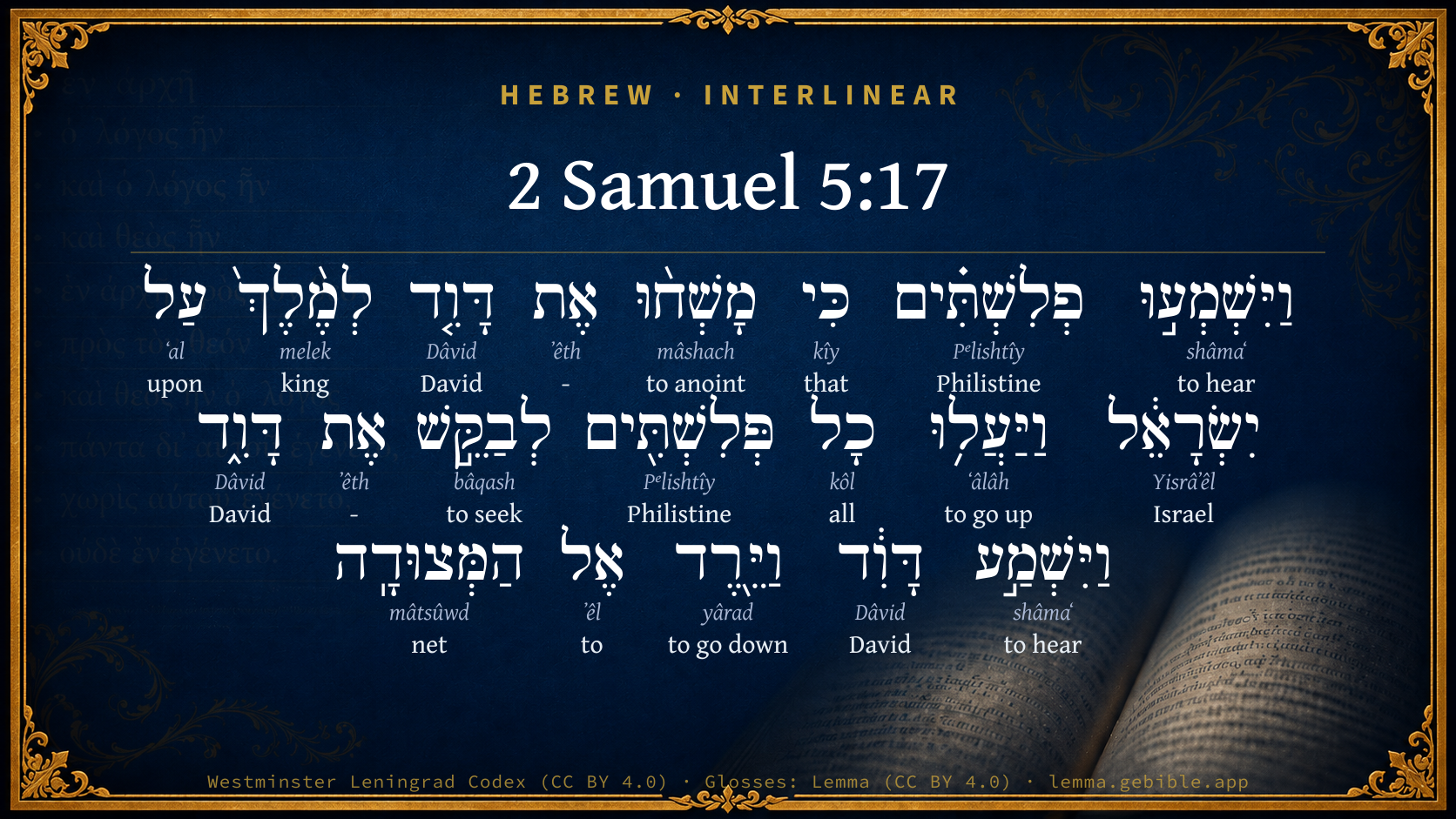
2 Samuel 5:17

Hebrew (Westminster Leningrad Codex) 2 Samuel 5:17 appears in the Hebrew Old Testament. The text above is from the Westminster Leningrad Codex. Each word links to its Strong’s number, a concise gloss, and parsing drawn from the Open Scriptures Hebrew Bible morphology. Click any word for its full Brown-Driver-Briggs (BDB) entry.
Download image
Cite this verse

2 Samuel 5:17 (World English Bible). Public Domain. Lemma interlinear Bible study tool, https://lemma.gebible.app/v/2-samuel/5/17.

Show BibTeX & RIS
BibTeX
RIS
English Translation
When the Philistines heard that they had anointed David king over Israel, all the Philistines went up to seek David; and David heard of it, and went down to the stronghold.
World English Bible · Public Domain
Download a study sheet

One document with this verse’s original text, its word-by-word gloss line, the meaning frame, cross-references with their text, attributed commentary, and full source and license credits — printable, and it pastes into notes with its structure intact.

This verse Autodidact and up

Study sheet (.html) Plain text (.txt)

A passage Seminary Student

Up to 50 verses in one chapter. A passage sheet keeps up to 6 commentary sources and 12 cross-references per verse, in the order this page ranks them, and says so on the sheet whenever that leaves anything out. Ask for a single verse and you get the Autodidact verse sheet above.

Everything on this page stays free to read, with no account — the sheet is a download of what is already on screen, not access to it.

Want to remove ads? Support Godless Engineer
Compare translations 3

The same verse in 3 English versions, stacked beneath the original-language interlinear above. Click any original word for its lexicon entry.

Each is an independent rendering of the whole verse — the interlinear is not word-aligned to these translations.

Highlighted words mark where these versions differ — a whole-verse word diff, not a word-by-word alignment.

  • World English Bible Public Domain
    When the Philistines heard that they had anointed David king over Israel, all the Philistines went up to seek David; and David heard of it, and went down to the stronghold.
  • King James Version Public Domain
    But when the Philistines heard that they had anointed David king over Israel, all the Philistines came up to seek David; and David heard of it, and went down to the hold.
  • unfoldingWord Literal Text CC BY-SA 4.0
    And the Philistines heard that they had anointed David as king over Israel, and all of the Philistines went up to seek David. And David heard, and he went down to the stronghold.

unfoldingWord Literal Text — © unfoldingWord, licensed CC BY-SA 4.0. Word-aligned USFM3 via Door43 (git.door43.org/unfoldingWord/en_ult).

Versions to compare (up to 4)

3 of 4 selected

Show all 18 translations

Every available English version of this verse, each an independent rendering of the whole verse.

  • World English Bible Public Domain
    When the Philistines heard that they had anointed David king over Israel, all the Philistines went up to seek David; and David heard of it, and went down to the stronghold.
  • Berean Standard Bible Public Domain
    When the Philistines heard that David had been anointed king over Israel, they all went in search of him; but David learned of this and went down to the stronghold.
  • Majority Standard Bible Public Domain
    When the Philistines heard that David had been anointed king over Israel, they all went in search of him; but David learned of this and went down to the stronghold.
  • King James Version Public Domain
    But when the Philistines heard that they had anointed David king over Israel, all the Philistines came up to seek David; and David heard of it, and went down to the hold.
  • American Standard Version (1901) Public Domain
    And when the Philistines heard that they had anointed David king over Israel, all the Philistines went up to seek David; and David heard of it, and went down to the stronghold.
  • Revised Version (1885) Public Domain
    And when the Philistines heard that they had anointed David king over Israel, all the Philistines went up to seek David; and David heard of it, and went down to the hold.
  • Geneva Bible (1599) Public Domain
    But when the Philistims hearde that they had anoynted Dauid King ouer Israel, all the Philistims came vp to seeke Dauid: and when Dauid heard, he went downe to a fort.
  • Douay-Rheims (1899) Public Domain
    And Japhia, and Elisama, and Elioda, and Eliphaleth.
  • Young's Literal Translation Public Domain
    And the Philistines hear that they have anointed David for king over Israel, and all the Philistines come up to seek David, and David heareth, and goeth down unto the fortress,
  • Literal Standard Version CC BY-SA 4.0
    And the Philistines hear that they have anointed David for king over Israel, and all the Philistines come up to seek David, and David hears, and goes down to the fortress,
  • Unlocked Literal Bible CC BY-SA 4.0
    Now when the Philistines heard that David had been anointed as king over Israel, they all went out looking for him. But David heard about it and went down to the stronghold.
  • unfoldingWord Literal Text CC BY-SA 4.0
    And the Philistines heard that they had anointed David as king over Israel, and all of the Philistines went up to seek David. And David heard, and he went down to the stronghold.
  • Darby Bible Public Domain
    And the Philistines heard that they had anointed David king over Israel, and all the Philistines went up to seek David; and David heard [of it], and went down to the stronghold.
  • World Messianic Bible Public Domain
    When the Philistines heard that they had anointed David king over Israel, all the Philistines went up to seek David, but David heard about it and went down to the stronghold.
  • Webster's Bible Public Domain
    But when the Philistines heard that they had anointed David king over Israel, all the Philistines came up to seek David; and David heard of it, and went down to the hold.
  • Free Bible Version CC BY-SA 4.0
    When the Philistines heard that David had been anointed king of Israel, the whole Philistine army came out to capture him, but David found out and went inside the stronghold.
  • Bible in Basic English Public Domain
    And when the Philistines had news that David had been made king over Israel, they all went up in search of David; and David, hearing of it, went down to the strong place.
  • JPS Tanakh (1917) Public Domain
    And when the Philistines heard that David was anointed king over Israel, all the Philistines went up to seek David; and David heard of it, and went down to the hold.

Literal Standard Version (2020), Covenant Press — licensed CC BY-SA 4.0. Text via the HelloAO Bible API (eBible.org). Unlocked Literal Bible (unfoldingWord) — licensed CC BY-SA 4.0. Text via the HelloAO Bible API (eBible.org). unfoldingWord Literal Text — © unfoldingWord, licensed CC BY-SA 4.0. Word-aligned USFM3 via Door43 (git.door43.org/unfoldingWord/en_ult). Free Bible Version, Dr. Jonathan Gallagher — licensed CC BY-SA 4.0. Text via the HelloAO Bible API (eBible.org).

Word by word

More ways to search: Search by grammar → Find every occurrence → Compare this word →

Practice this passage: Drill this verse → Learn its vocabulary →

הַמְּצוּדָֽה
mâtsûwd
H4686
“the · net”
Particle, Definite Article + Noun, Common, Both, Singular, Absolute
Part of Speech
Particle + Noun
Type
Common
Gender
Both
Number
Singular
State
Absolute
Full BDB Definition

Origin: for H4685

TWOT: 1885g , 1885i

net, prey, net prey - net - prey - fastness, stronghold
  1. וַיִּשְׁמְע֣וּ shâmaʻ H8085 “and · to hear” Conjunction + Verb, Qal, Sequential Imperfect, 3rd Person, Masculine, Plural
  2. פְלִשְׁתִּ֗ים Pᵉlishtîy H6430 “Philistines” Noun, Gentilic, Masculine, Plural, Absolute
  3. כִּי kîy H3588 “that” Conjunction
  4. מָשְׁח֨וּ mâshach H4886 “to anoint” Verb, Qal, Perfect, 3rd Person, Common, Plural
  5. אֶת ʼêth H853 “-” Particle, Direct Object
  6. דָּוִ֤ד Dâvid H1732 “David” Noun, Proper
  7. לְמֶ֨לֶךְ֙ melek H4428 “to/for · king” Preposition + Noun, Common, Masculine, Singular, Absolute
  8. עַל ʻal H5921 “upon” Preposition
  9. יִשְׂרָאֵ֔ל Yisrâʼêl H3478 “Israel” Noun, Proper
  10. וַיַּעֲל֥וּ ʻâlâh H5927 “and · to go up” Conjunction + Verb, Qal, Sequential Imperfect, 3rd Person, Masculine, Plural
  11. כָל kôl H3605 “all of” Noun, Common, Masculine, Singular, Construct
  12. פְּלִשְׁתִּ֖ים Pᵉlishtîy H6430 “Philistines” Noun, Gentilic, Masculine, Plural, Absolute
  13. לְבַקֵּ֣שׁ bâqash H1245 “to seek” Preposition + Verb, Piel, Infinitive Construct
  14. אֶת ʼêth H853 “-” Particle, Direct Object
  15. דָּוִ֑ד Dâvid H1732 “David” Noun, Proper
  16. וַיִּשְׁמַ֣ע shâmaʻ H8085 “and · to hear” Conjunction + Verb, Qal, Sequential Imperfect, 3rd Person, Masculine, Singular
  17. דָּוִ֔ד Dâvid H1732 “David” Noun, Proper
  18. וַיֵּ֖רֶד yârad H3381 “and · to go down” Conjunction + Verb, Qal, Sequential Imperfect, 3rd Person, Masculine, Singular
  19. אֶל ʼêl H413 “to” Preposition

About this verse

These counts appear in no published source. They are computed here, from the morphology-tagged text and Lemma’s own curated glosses. What Lemma adds →

20
words
15
distinct lemmas
Historical
section

Notable vocabulary

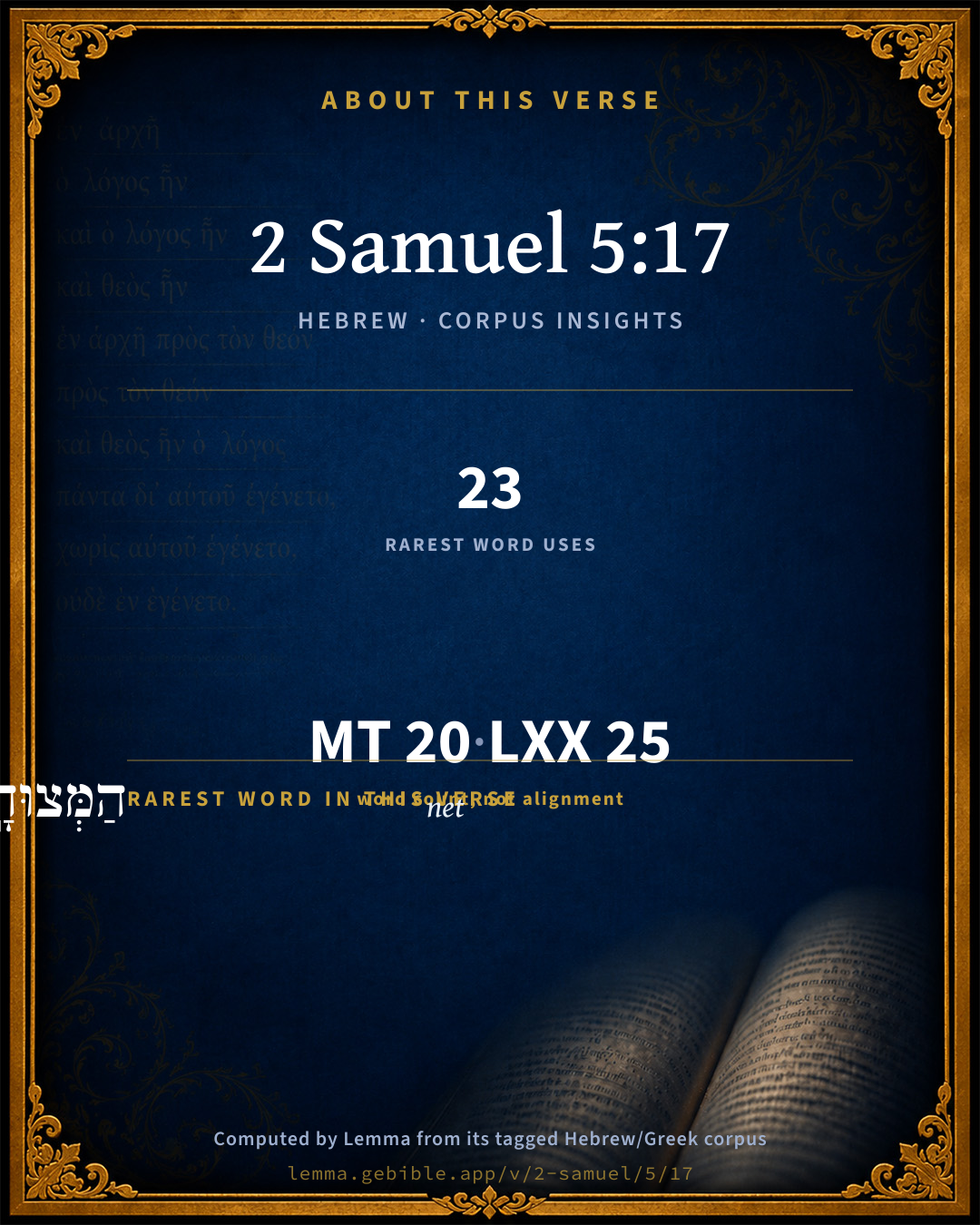
The rarest word here is הַמְּצוּדָֽה net H4686 — appearing just 23 times in the whole Hebrew Bible.

Shared distinctive vocabulary

הַמְּצוּדָֽה net H4686 occurs in 23 verses of the Hebrew Bible. Also found in:

Grammatical profile

  • 6 verbs
  • 9 nouns
  • 2 prepositions
  • 1 conjunction
  • 2 particles

Verb forms

  • וַיִּשְׁמְע֣וּ Qal · Sequential Imperfect
  • מָשְׁח֨וּ Qal · Perfect
  • וַיַּעֲל֥וּ Qal · Sequential Imperfect
  • לְבַקֵּ֣שׁ Piel · Infinitive Construct
  • וַיִּשְׁמַ֣ע Qal · Sequential Imperfect
  • וַיֵּ֖רֶד Qal · Sequential Imperfect

Repetition

Words recur within this verse — often emphatic in Hebrew:

  • דָּוִ֤ד David H1732 ×3
  • וַיִּשְׁמְע֣וּ to hear H8085 ×2
  • פְלִשְׁתִּ֗ים Philistine H6430 ×2

Hebrew & Septuagint length

In English translation the verse runs 31 words from the Hebrew and 32 from the Septuagint (LXX English) — closely comparable.

A rough comparison of the two English renderings, which tokenize alike — not a word-level alignment.

Word counts can differ between the Hebrew and the Greek without any difference in meaning — e.g. the Hebrew direct-object marker אֵת has no separate Greek word, and Greek often adds the article ὁ.

In the original languages it is 20 Hebrew tokens and 25 Greek tokens — but the two are counted differently (Hebrew bundles its prefixes and suffixes into one token; the Greek is in lemma form), so that isn’t a like-for-like length.

Cross-references

5

Topical passages linked to 2 Samuel 5:17 in the Treasury of Scripture Knowledge — connected by theme and wording, ordered by reader-vote popularity; previews shown in the World English Bible.

  • 2 Samuel 23:14 David was then in the stronghold; and the garrison of the Philistines was then in Bethlehem.
  • 1 Chronicles 11:16 David was then in the stronghold, and the garrison of the Philistines was then in Bethlehem.
  • 1 Chronicles 14:8–9 When the Philistines heard that David was anointed king over all Israel, all the Philistines went up to seek David: and David heard of it, and went out against them.
  • Psalms 2:1–5 Why do the nations rage, And the peoples plot a vain thing?
  • Revelation 11:15–18 The seventh angel sounded, and great voices in heaven followed, saying, "The kingdom of the world has become the Kingdom of our Lord, and of his Christ. He will reign forever and ever!"

Cross-references courtesy of OpenBible.info (CC BY 4.0).

Hebrew and Greek witnesses Masoretic Hebrew ↔ Greek Septuagint

The same verse in the two great witnesses to the Old Testament, shown verse-for-verse.

These are two independent witnesses, not word-aligned to each other, and the Septuagint is shown in lemma (dictionary) form.

Hebrew 2 Samuel 5:17 Masoretic · Westminster Leningrad Codex

וַיִּשְׁמְע֣וּ פְלִשְׁתִּ֗ים כִּי מָשְׁח֨וּ אֶת דָּוִ֤ד לְמֶ֨לֶךְ֙ עַל יִשְׂרָאֵ֔ל וַיַּעֲל֥וּ כָל פְּלִשְׁתִּ֖ים לְבַקֵּ֣שׁ אֶת דָּוִ֑ד וַיִּשְׁמַ֣ע דָּוִ֔ד וַיֵּ֖רֶד אֶל הַמְּצוּדָֽה

When the Philistines heard that they had anointed David king over Israel, all the Philistines went up to seek David; and David heard of it, and went down to the stronghold.

World English Bible · Public Domain

Greek LXX 2 Samuel 5:17 Septuagint · lemma form

καί ἀκούω ἀλλόφυλος ὅτι χρίω δαυίδ βασιλεύς ἐπί ἰσραήλ καί ἀναβαίνω πᾶς ὁ ἀλλόφυλος ζητέω ὁ δαυίδ καί ἀκούω δαυίδ καί καταβαίνω εἰς ὁ περιοχή

And the Philistines heard that David was anointed king over Israel; and all the Philistines went up to seek David; and David heard of it, and went down to the strong hold.

LXX2012 (modern English Septuagint) · Public Domain

On this verse, Keil & Delitzsch discusses the Septuagint’s reading. Read the note in Commentary ↓

Hebrew: Westminster Leningrad Codex (CC BY 4.0). Greek: Septuagint (public domain); English from LXX2012 (modern English Septuagint) (Public Domain). How the Septuagint differs from the Hebrew →

Targum (Aramaic paraphrase)

1

The Targum is the ancient Jewish Aramaic paraphrase of the Hebrew Scriptures — an interpretive translation, not the Hebrew text itself. Onkelos (literal) and Pseudo-Jonathan (expansive) render the Torah, and Jonathan the Prophets. Coverage is partial: where no permissively-licensed English translation exists for a verse, only the Aramaic is shown. This is verse-level text, not a word-by-word alignment to the Hebrew.

  1. Targum Jonathan Prophets (Joshua–Malachi)
    וּשְׁמָעוּ פְלִשְׁתָּאֵי אֲרֵי מְשָׁחוּ יַת דָוִד לְמֶהֱוֵי מַלְכָּא עַל יִשְׂרָאֵל וּסְלִיקוּ כָּל פְּלִשְׁתָּאֵי לְמִבְעֵי יַת דָוִד וּשְׁמַע דָוִד וּנְחַת לְחַקְרָא:

    (no public-domain English translation for this verse)

    Targum Jonathan — Aramaic: “Mikraot Gedolot” (public domain). English: “Sefaria Community Translation” (CC0 1.0 (public-domain dedication)); “London "Chaldee Paraphrase," 1871” (public domain). Text via Sefaria.

Commentary

Notes on 2 Samuel 5:17 from classic Christian and Jewish commentators (each source and its license shown beneath its notes). The classic Christian expositions comment on the surrounding passage and are grouped to its opening verse, so a note may address several verses; the Jewish commentaries on the Tanakh (Rashi and others) are per-verse, so they appear only where the commentator wrote on this verse.

Lemma curates 59 commentaries, every one of them public domain or Creative Commons licensed, each selected and text-cleaned for this edition rather than reprinted as found. About our sources →

Matthew Henry's Commentary

The particular service for which David was raised up was to save Israel out of the hand of the Philistines, Sa2 3:18. This therefore divine Providence, in the first place, gives him an opportunity of accomplishing. Two great victories obtained over the Philistines we have here an account of, by which David not only balanced the disgrace and retrieved the loss Israel had sustained in the battle wherein Saul was slain, but went far towards the total subduing of those vexatious neighbours, the last remains of the devoted nations.

I. In both these actions the Philistines were the aggressors, stirred first towards their own destruction, and pulled it on their own heads. 1. In the former they came up to seek David (Sa2 5:17), because they heard that he was anointed king over Israel. He that under Saul had slain his ten thousands, what would he do when he himself came to be king! They therefore thought it was time to look about them, and try to crush his government in its infancy, before it was well settled. Their success against Saul, some years ago, perhaps encouraged them to make this attack upon David; but they considered not that David had that presence of God with him which Saul had forfeited and lost. The kingdom of the Messiah, as soon as ever it was set up in the world, was thus vigorously attacked by the powers of darkness, who, with the combined force both of Jews and Gentiles, made head against it. The heathen raged, and the kings of the earth set themselves to oppose it; but all in vain, Psa 2:1, etc. The destruction will turn, as this did, upon Satan's own kingdom. They took counsel together, but were broken in pieces, Isa 8:9, Isa 8:10. 2. In the latter they came up yet again, hoping to recover what they had lost in the former engagement, and their hearts being hardened to their destruction, Sa2 5:22. 3. In both they spread themselves in the valley of Rephaim, which lay very near Jerusalem. That city they hoped to make themselves masters of before David had completed the fortifications of it. Jerusalem, from its infancy, has been aimed at, and struck at, with a particular enmity. Their spreading themselves intimates that they were very numerous and that they made a very formidable appearance. We read of the church's enemies going up on the breadth of the earth (Rev 20:9), but the further they spread themselves the fairer mark they are to God's arrows.

II. In both, David, though forward enough to go forth against them (for as soon as he heard it he went down to the hold, to secure some important and advantageous post, Sa2 5:17), yet entered not upon action till he had enquired of the Lord by the breast-plate of judgment, Sa2 5:19, and again, Sa2 5:23. His enquiry was twofold: - 1. Concerning his duty: "Shall I go up? Shall I have a commission from heaven to engage them?" One would think he needed not doubt this; what was he made king for, but to fight the battles of the Lord and Israel? But a good man loves to see God going before him in every step he takes. "Shall I go up now?" It is to be done, but is it to be done at this time? In all thy ways acknowledge him. And besides, though the Philistines were public enemies, yet some of them had been his particular friends. Achish had been kind to him in his distress, and had protected him. "Now," says David, "ought not I, in remembrance of that, rather to make peace with them than to make war with them?" "No," says God, "they are Israel's enemies, and are doomed to destruction, and therefore scruple not, but go up." 2. Concerning his success. His conscience asked the former question, Shall I go up? His prudence asked this, Wilt thou deliver them into my hand? Hereby he owns his dependence on God for victory, that he could not conquer them unless God delivered them into his hand, and refers his cause to the good pleasure of God: Wilt thou do it? Yea, says God, I will doubtless do it. If God send us, he will bear us out and stand by us. The assurance God has given us of victory over our spiritual enemies, that he will tread Satan under our feet shortly, should animate us in our spiritual conflicts. We do not fight at uncertainty. David had now a great army at command and in good heart, yet he relied more on God's promise than his own force.

III. In the former of these engagements David routed the army of the Philistines by dint of sword (Sa2 5:20): He smote them; and when he had done, 1. He gave his God the glory; he said, "The Lord has broken forth upon my enemies before me. I could not have done it if he had not done it before me; he opened the breach like the breach of waters in a dam, which when once opened grows wider and wider." The principal part of the work was God's doing; nay, he did all; what David did was not worth speaking of; and therefore, Not unto us, but unto the Lord, give glory. He hoped likewise that this breach, like that of waters, was as the opening of the sluice, to let in a final desolation upon them; and, to perpetuate the remembrance of it, he called the place Baal-perazim, the master of the breaches, because, God having broken in upon their forces, he soon had the mastery of them. Let posterity take notice of it to God's honour. 2. He put their gods to shame. They brought the images of their gods into the field as their protectors, in imitation of the Israelites bringing the ark into their camp; but, being put to flight, they could not stay to carry off their images, for they were a burden to the weary beasts (Isa 46:1), and therefore they left them to fall with the rest of their baggage into the hands of the conqueror. Their images failed them, and gave them no assistance, and therefore they left their images to shift for themselves. God can make men weary of those things that they have been most fond of, and compel them to desert what they dote upon, and cast even the idols of silver and gold to the moles and the bats, Isa 2:20, Isa 2:21. David and his men converted to their own use the rest of the plunder, but the images they burnt, as God had appointed (Deu 7:5): "You shall burn their graven images with fire, in token of your detestation of idolatry, and lest they should be a snare." Bishop Patrick well observes here that when the ark fell into the Philistines' hands it consumed them, but, when these images fell into the hands of Israel, they could not save themselves from being consumed.

IV. In the latter of these engagements God gave David some sensible tokens of his presence with him, bade him not fall upon them directly, as he had done before, but fetch a compass behind them, Sa2 5:23. 1. God appoints him to draw back, as Israel stood still to see the salvation of the Lord. 2. He promised him to charge the enemy himself, by an invisible host of angels, Sa2 5:24. "Thou shalt hear the sound of a going, like the march of an army in the air, upon the tops of the mulberry trees." Angels tread light, and he that can walk upon the clouds can, when he pleases, walk on the tops of trees, or (as bishop Patrick understands it) at the head of the mulberry-trees, that is, of the wood, or hedge-row of those trees. "And, by that sign, thou shalt know that the Lord goes out before thee; though thou see him not, yet thou shalt hear him, and faith shall come and be confirmed by hearing. He goes forth to smite the host of the Philistines." When David had himself smitten them (Sa2 5:20), he ascribed it to God: The Lord has broken forth upon my enemies, to reward him for which thankful acknowledgment the next time God did it himself alone, without putting him to any toil or peril. Those that own God in what he has done for them will find him doing more. But observe, Though God promised to go before him and smite the Philistines, yet David, when he heard the sound of the going must bestir himself and be ready to pursue the victory. Note, God's grace must quicken our endeavours. If God work in us both to will and to do, it does not follow that we must sit still, as those that have nothing to do, but we must therefore, work out our own salvation with all possible care and diligence, Phi 2:12, Phi 2:13. The sound of the going was, (1.) A signal to David when to move; it is comfortable going out when God goes before us. And, (2.) Perhaps it was an alarm to the enemy, and put them into confusion. Hearing the march of an army against their front, they retreated with precipitation, and fell into David's army which lay behind them in their rear. Of those whom God fights against it is said (Lev 26:36), The sound of a shaken leaf shall chase them. (3.) The success of this is briefly set down, Sa2 5:25. David observed his orders, waited till God moved, and stirred them, but not till then. Thus he was trained up in a dependence on God and his providence. God performed his promise, went before him, and routed all the enemies' force, and David failed not to improve his advantages; he smote the Philistines, even to the borders of their own country. When the kingdom of the Messiah was to be set up, the apostles that were to beat down the devil's kingdom must not attempt any thing till they received the promise of the Spirit, who came with a sound from heaven as of a rushing mighty wind (Act 2:2), which was typified by this sound of the going on the tops of the mulberry trees; and, when they heard that, they must bestir themselves, and did so; they went forth conquering and to conquer.

Matthew Henry's Commentary on the Whole Bible (1708–1710) — public domain (CC PDM 1.0). Text via the HelloAO Bible API.

Jamieson, Fausset & Brown

Robert Jamieson, A. R. Fausset & David Brown

HE SMITES THE PHILISTINES. (Sa2 5:17-25)

when the Philistines heard that they had anointed David king over Israel--During the civil war between the house of Saul and David, those restless neighbors had remained quiet spectators of the contest. But now, jealous of David, they resolved to attack him before his government was fully established.

Jamieson, Fausset & Brown — Commentary Critical and Explanatory on the Whole Bible (1871) — public domain (CC PDM 1.0). Text via the HelloAO Bible API.

Trapp's Complete Commentary

John Trapp

2Sa 5:17 But when the Philistines heard that they had anointed David king over Israel, all the Philistines came up to seek David; and David heard [of it], and went down to the hold.

Ver. 17. Came up to seek David,] i.e., To fight with him wheresoever they should find him: as being jealous of his growing greatness, and fearing lest they should lose their tribute. Now also was the time come when God would execute his judgments against them and their gods, {as Exo 12:12} to whom they had sacrilegiously ascribed their recent victories. See 2Sa 5:21. Wicked men are even ambitious of destruction: these men came to seek their bane.

And went down to the hold.] That of Adullam likely, where he so thirsted for the water of the well of Bethlehem: {1Ch 11:15} hither he went, not for fear of the Philistines, but to make preparation. {1Ch 14:8}

John Trapp, A Commentary or Exposition upon All the Books of the Old and New Testament (1647–1656) — public domain. Text from a community e-Sword module.

Joseph Benson's Commentary

2Sa 5:17. All the Philistines came up to seek David — They raised all the forces they were able, to come up to David, and fight him before he was settled in his new kingdom. While the civil war subsisted between the partisans of David and Ish-bosheth, the Philistines contented themselves with being calm spectators of their mutual ravages and conflicts, which naturally tended to their mutual destruction; but when all these were ended in their unanimous election of David to the throne, and that election was succeeded by those beginnings and omens of a prosperous reign which have been mentioned, they began to be alarmed, and thought this the fit season to crush the growing power of this prince before it rose to a greater height. And David heard it, and went down to the hold — To some fortified place, to which his people might conveniently resort from all parts, and where he might intrench his army.

Joseph Benson's Commentary on the Old and New Testaments (1811–1818) — public domain. Text from a community e-Sword module.

Whedon's Commentary on the Bible

Daniel D. Whedon

WARS WITH THE PHILISTINE, 2Sa_5:17-25.

While David reigned, at Hebron, the Philistines, with whom he had so recently been in league, saw no occasion to molest him. They probably considered him as an enemy to the mass of the Israelites, and took no trouble to watch his movements; but when all Israel accepted him as king, and the ancient stronghold of the Jebusites fell into his power, they became alarmed, and gathered their forces for a most determined war against him. Then, doubtless, they deplored that they had not destroyed him when he was in their power.

17. When the Philistines heard… all the Philistines came up — Whether these wars with the Philistines occurred before or after the capture of Zion is somewhat uncertain, but from the course of this history we most naturally suppose that they occurred while David was fortifying Zion, and building, or taking measures to build, his royal palace.

To seek David — For hitherto they had known him as a lawless wanderer, having no certain abode; and, though now anointed king, he had not yet a settled, permanent home.

David… went down to the hold — Not to the citadel on Zion, for its situation, as we have already seen, was so lofty that it would be manifestly improper to speak of going down to it; but to the cave of Adullam, as we may infer from 2Sa_23:13-14, where we have the record of an incident which took place at this time.

Daniel D. Whedon (gen. ed.), Commentary on the Old and New Testaments (1874–1909) — public domain. Text from a community e-Sword module.

Keil & Delitzsch

C. F. Keil & F. Delitzsch

David gains two Victories over the Philistines (compare Ch1 14:8-17). - Both these victories belong in all probability to the interval between the anointing of David at Hebron over all Israel and the conquest of the citadel of Zion. This is very evident, so far as the first is concerned, from the words, "When the Philistines heard that they had anointed David king over Israel" (Sa2 5:17), not when David had conquered the citadel of Zion. Moreover, when the Philistines approached, David "went down to the hold," or mountain fortress, by which we cannot possibly understand the citadel upon Zion, on account of the expression "went down." If David had been living upon Zion at the time, he would hardly have left this fortification when the Philistines encamped in the valley of Rephaim on the west of Jerusalem, but would rather have attacked and routed the enemy from the citadel itself. The second victory followed very soon after the first, and must therefore be assigned to the same period. The Philistines evidently resolved, as soon as the tidings reached them of the union of all the tribes under the sovereignty of David, that they would at once resist the growing power of Israel, and smite David before he had consolidated his government.

Sa2 5:17-18

"The Philistines went up to seek David," i.e., to seek him out and smite him. The expression לבקּשׁ presupposes that David had not yet taken up his abode upon Zion. He had probably already left Hebron to make preparations for his attack upon the Jebusites. When he heard of the approach of the Philistines, he went down into the mountain fortress. "The hold" cannot be the citadel of Zion (as in Sa2 5:7 and Sa2 5:9), because this was so high that they had to go up to it on every side; and it is impossible to sustain the opinion advanced by Bertheau, that the verb ירד (to go down) is used for falling back into a fortification. המּצוּדה (the hold), with the definite article, is probably the mountain stronghold in the desert of Judah, into which David withdrew for a long time to defend himself from Saul (vid., Sa2 23:14 and Ch1 12:8). In Sa2 5:18 the position of the Philistines is more minutely defined. The verse contains a circumstantial clause: "The Philistines had come and spread themselves out in the valley of Rephaim," a valley on the west of Jerusalem, and only separated from the valley of Ben-hinnom by a narrow ridge of land (see at Jos 15:8). Instead of ינּטשׁוּ the Chronicles have יפשׁטוּ, they had invaded, which is perfectly equivalent so far as the sense is concerned.

Sa2 5:19-20

David inquired of the Lord by the Urim whether he should go out against the foe, and whether God would give them into his hand;

(Note: Through the express statement that David inquired of Jehovah (viz., by the Urim) in both these conflicts with the Philistines (Sa2 5:19 and Sa2 5:23), Diestel's assertion, that after the death of Saul we do not read any more about the use of the holy lot, is completely overthrown, as well as the conclusion which he draws from it, namely, that "David probably employed it for the purpose of giving a certain definiteness to his command over his followers, over whom he had naturally but little authority (Sa1 22:2?), rather than because he looked upon it himself with any peculiar reverence.")

and when he had received an answer in the affirmative to both these questions, he went to Baal-perazim (lit. into Baal-perazim), and smote them there, and said (Sa2 5:20), "Jehovah hath broken mine enemies before me like a water-breach," i.e., has smitten them before me, and broken their power as a flood breaks through and carries away whatever opposes it. From these words of David, the place where the battle was fought received the name of Baal-perazim, i.e., "possessor of breaches" (equivalent to Bruch-hausen or Brechendorf, Breach-ham or Break-thorpe). The only other passage in which the place is mentioned is Isa 28:21, where this event is alluded to, but it cannot have been far from the valley of Rephaim.

Sa2 5:21

The Philistines left their idols behind them there. They had probably brought them to the war, as the Israelites once did their ark, as an auxiliary force. "And David took them away." The Chronicles have "their gods" instead of "their idols," and "they were burned with fire" instead of ישּׂאם, "he took them away,"

(Note: This is the marginal reading in the English version, though the text has "he burned them." - Tr.)

took them as booty. The reading in the Chronicles gives the true explanation of the fact, as David would certainly dispose of the idols in the manner prescribed in the law (Deu 7:5, Deu 7:25). The same reading was also most probably to be found in the sources employed by our author, who omitted it merely as being self-evident. In this way David fully avenged the disgrace brought upon Israel by the Philistines, when they carried away the ark in the time of Eli.

Sa2 5:22-25

Although thoroughly beaten, the Philistines soon appeared again to repair the defeat which they had suffered. As David had not followed up the victory, possibly because he was not sufficiently prepared, the Philistines assembled again in the valley of Rephaim.

Sa2 5:23

David inquired once more of the Lord what he was to do, and received this answer: "Thou shalt not go up (i.e., advance to meet the foe, and attack them in front); turn round behind them, and come upon them (attack them) opposite to the Baca-shrubs." בּכאים, a word which only occurs here and in the parallel passage in Ch1 14:14, is rendered ἀπίους, pear-trees, by the lxx, and mulberry-trees by the Rabbins. But these are both of them uncertain conjectures. Baca, according to Abulfadl, is the name given in Arabic to a shrub which grows at Mecca and resembles the balsam, except that it has longer leaves and larger and rounder fruit, and from which, if a leaf be broken off, there flows a white pungent sap, like a white tear, which is all probability gave rise to the name בּכא = בּכה, to weep (vid., Celsii, Hierob. i. pp. 338ff., and Gesenius, Thes. p. 205).

Sa2 5:24

"And when thou hearest the rush of a going in the tops of the baca-shrubs, then bestir thyself," or hasten; "for Jehovah has gone out before thee, to smite the army of the Philistines." "The sound of a going," i.e., of the advance of an army, was a significant sign of the approach of an army of God, which would smite the enemies of Jehovah and of His servant David; like the visions of Jacob (Gen 32:2-3) and Elisha (Kg2 6:17). "Then thou shalt bestir thyself," lit. be sharp, i.e., active, quick: this is paraphrased in the Chronicles by "then thou shalt go out to battle."

Sa2 5:25

David did this, and smote the Philistines from Geba to the neighbourhood of Gezer. In the Chronicles we find "from Gibeon" instead of from Geba. The former is unquestionably the true reading, and Geba an error of the pen: for Geba, the present Jeba, was to the north of Jerusalem, and on the east of Ramah (see at Jos 18:24); so that it is quite unsuitable here. But that is not the case with Gibeon, the present el Jib, on the north-west of Jerusalem (see at Jos 9:3); for this was on the way to Gezer, which was four Roman miles to the north of Amws, and is probably to be sought for on the site of the present el Kubab (see at Jos 10:33).

(Note: There is no force in the objection brought by Bertheau against this view, viz., that "it is a priori improbable that the Philistines who were fighting against David and his forces, whose base of operations was Jerusalem, should have taken possession of the whole line from Gibeon to Gezer," as the improbability is by no means apparent, and has not been pointed out by Bertheau, whilst the assumption that Jerusalem was David's base of operations has no foundation whatever. Moreover, Bertheau's opinion, that Geba was the same as Gibeah in the tribe of Judah (Jos 15:57), is decidedly erroneous: for this Gibeah is not to be identified with the present village of Jeba on the south side of the Wady Musurr, half-way between Shocoh and Jerusalem, but was situated towards the desert of Judah (see at Jos 15:57); and besides, it is impossible to see how the Philistines, who had invaded the plain of Rephaim, could have been beaten from this Gibeah as far as to Gezer.)

Keil & Delitzsch — Biblical Commentary on the Old Testament (1861–1891) — public domain (CC PDM 1.0). Text via the HelloAO Bible API. (Old Testament only.)

Tyndale Open Study Notes

Tyndale Open Resources

5:17-25 For the first time as king, David engaged the Philistines in battle. • David’s life has been portrayed thus far in 2 Samuel with a repeated pattern: He was crowned king in Hebron (2:4), won a battle (2:12-17), became stronger (3:1), and started a large family (3:2-5). Now he was crowned in Jerusalem (5:3), became stronger (5:10), expanded his family (5:13-14), and won a battle (5:17-25). This parallel structure draws attention to both of David’s coronations with signs of divine blessing and prosperity.

Tyndale Open Study Notes — © Tyndale Open Resources, licensed CC BY-SA 4.0. Text via the HelloAO Bible API.

Adam Clarke's Commentary

Verse 17. The Philistines came up to seek David] Ever since the defeat of the Israelites and the fall of Saul and his sons, the Philistines seem to have been in undisturbed possession of the principal places in the land of Israel; now, finding that David was chosen king by the whole nation, they thought best to attack him before his army got too numerous, and the affairs of the kingdom were properly settled.

Adam Clarke's Commentary on the Bible (1810–1826) — public domain. Text from a community e-Sword/MySword module.

Ellicott's Commentary for English Readers

(17) When the Philistines heard.—After this general summary, the narrative goes back to take up detailed events in their order. First comes an attack of the Philistines. Their attention had naturally been hitherto occupied with Abner and Ish-bosheth, who ruled over the far greater part of the land; but when they heard that the old nation was united under their old foe, they saw that no time was to be lost in attacking him before his power should be consolidated. Yet their necessary consultations, and the mustering of their forces, allowed time for the conquest of Jerusalem, which David seems to have accomplished with the forces gathered at his coronation.

Went down to the hold.—As David went “down” to this place, and then “up” (2Sa_5:19) from it to the attack on the Philistines, it is not likely that “the hold” means the citadel of Zion. It must have been some stronghold near the Philistine army. It could not have been, as some have thought, the cave of Adullam. According to the monastic tradition, this was seven or eight miles S.E. of Bethlehem; according to the more ancient view, it was in the plain of Judah, west of the mountains; thus, in either case, quite remote from the scene of the battle.

A Bible Commentary for English Readers, edited by Charles John Ellicott (1878–1897) — public domain. Text from a community e-Sword module.

The Cambridge Bible for Schools and Colleges

gen. ed. J. J. S. Perowne

17–25. Two victories over the Philistines

=1Ch_14:8-16

17. But when the Philistines heard] This Philistine invasion probably followed soon after the capture of Jebus. The Philistines were alarmed by the union of the Israelites under a king of proved vigour, who had inaugurated his reign by a brilliant military achievement. They therefore mustered their whole force (cp. 1Sa_29:1), for a strenuous effort to crush him.

came up] From the plains of Philistia to the highlands of Judah.

went down to the hold] The word translated “hold” is the same as that translated “stronghold” in 2Sa_5:7, and “fort” in 2Sa_5:9. But as David “went down” to it, and “went up” from it into the valley of Rephaim (2Sa_5:19), it cannot here mean the citadel of Zion. Most probably David wished to drive the Philistines back, and prevent them from plundering his country, and marched down with his forces to his old post at Adullam. The term “stronghold” is used of Adullam in ch. 2Sa_23:14, and the incident there related may have happened in this war. It was a strong position in the valley of Elah, one of the most likely routes for an invading army from Philistia to take. See notes on 1Sa_17:1; 1Sa_22:1. This view agrees with the general statement in 1 Chron. that “he went out against them.”

The Cambridge Bible for Schools and Colleges (gen. ed. J. J. S. Perowne; Cambridge University Press, 1878–1918) — public domain. Text from a community e-Sword module.

John Gill's Exposition

The Philistines also came and spread themselves in the valley of Rephaim. Or "of the giants", as Jos 15:8; which lay to the west of Jerusalem; of which; see Gill on Jos 15:8; the Philistines spreading themselves in it, shows that they were very numerous.

; the Philistines spreading themselves in it, shows that they were very numerous.

2 Samuel 5:19

sa2 5:19

sa2 5:19

sa2 5:19And David inquired of the Lord,.... By Abiathar, and the Urim and Thummim, in the ephod he had on:

saying, shall I go up to the Philistines? who by this time were gone from the valley to an higher place, to Mount Perazim, as in Isa 28:21,

wilt thou deliver them into my hand? here two questions are put together, and an answer returned to both, contrary to a notion of the Jews; see Gill on Sa1 23:11,

and the Lord said to David, go up, for I will doubtless deliver the Philistines into thine hand; by which oracle he had both the mind of God that he should go up, and was assured of victory.

John Gill's Exposition of the Whole Bible (1746–1763) — public domain (CC PDM 1.0). Text via the HelloAO Bible API.

Albert Barnes' Notes on the Bible

The hold - Not the same place which is so named in 2Sa 5:7, 2Sa 5:9, but probably the cave (or hold) of Adullam 2Sa 23:13. The invasion most probably took place before David had completed his buildings in the city of David; and is probably referred to in 2Sa 23:8-17.

Albert Barnes' Notes on the Bible (1834–1885) — public domain. Text from a community e-Sword/MySword module.

Haydock's Catholic Bible Commentary

Seek, or attack David. He went out to meet them. (Par.[1 Paralipomenon xiv. 8.?]) But receiving an order not to join battle as yet, retired to Odollam, (chap. xxiii. 13., and 1 Paralipomenon xi. 15.; Calmet) a strong hold, with which he was perfectly acquainted. (Haydock)

George Leo Haydock (1774–1849), Haydock's Catholic Family Bible and Commentary, 1859 edition — public domain. Excludes Psalms (Douay-Rheims chapter numbering differs from Protestant) and Deuterocanonical books (Catholic canon only).

Matthew Poole's English Annotations

Whilst the civil war lasted between the houses of Saul and David, they wisely forbore all hostilities, and left them to tear out one another’s bowels, that afterwards they might make a more easy conquest of both; but that being ended, and all united under David, they bestir themselves.

To seek David; to find him out, and fight against him, and cut him off now in the infancy of his kingdom; whereby they give David a just occasion to fight against them for his own necessary defence, and acquit him from any note of ingratitude, in opposing them who had formerly exercised kindness and hospitality to him; though indeed David’s obligations were in a manner wholly to Achish, who seems to be dead at this time, there being no mention of him.

To the hold; to some fortified place to which his people might conveniently resort from all places, and where he might intrench his army, and which lay towards the Philistines.

Matthew Poole's English Annotations on the Holy Bible (1683–1685) — public domain. Text from a community e-Sword/MySword module.

The Pulpit Commentary

But when the Philistines heard. After the battle of Gilboa the Philistines became the virtual rulers of much of the country west of the Jordan, and probably even David and Judah paid them tribute. On its eastern bank, though Abner kept them from molesting Ishbosheth"s kingdom, yet the rule of Saul"s house in Ephraim and Benjamin must have been nominal only, and the Philistines would have seen him with pleasure wasting his strength in civil war. After Ishbosheth"s death they had tightened their grasp over the central districts of Palestine, though probably content with exacting tribute. They must now have seen with displeasure the consolidation of the tribes under one able ruler. Even in their divided state, the natural strength of the country and the bravery of the people had made it a task too great for the Philistine power entirely to crush Israel"s independence. But if they could destroy David before he had had time to establish himself in his kingdom, they would at least prolong indefinitely that feebleness of Israel which had made it so long subject to their dominion. Of this supremacy the Philistines have handed down a token forever in giving to the whole country the name of Palestine, the Philistines" land. David... went down to the hold. Many commentators identify the hold with the cave of Adullam, and certainly the account of the brave deed of three of David"s heroes, in breaking through the Philistine garrison of Bethlehem to bring him water thence, gives great probability to this view. For we read there that "the Philistines were encamped in the valley of Rephaim, and that David was then in the hold". (2Sa_23:13, 2Sa_23:14, where note that the word "hold" has the definite article) There are, however, many difficulties connected with this view; for the cave of Adullam was in the valley of Elah, on the road from Hebron to Philistia, (1Sa_22:1) but the valley of Rephaim is close to Jerusalem, (Jos_15:8) abutting, in fact, upon the valley of Ben-Hinnom. Baal-Perazim also is in the same neighbourhood, being the rocky height which forms the border of Ben-Hinnom, and bounds the valley of Rephaim on the north. Still, the passage in 2Sa_23:13, 14 seems too precise to be lightly set aside, and we must suppose, therefore, that the Philistines, alarmed by the gathering of half a million of men and women at Hebron, sent messengers throughout their country to assemble their warriors. It was the weakness of ancient warfare that its vast hosts of people melted away as rapidly as they had gathered. For provisions were soon spent, and the men had to return to their farms and their cattle. Thus David, having used some of that large concourse of strong men for the capture of Jerusalem, was left immediately afterwards with no other protection than that of his "mighty men." Saul had endeavoured to have always round him three thousand trained men, (1Sa_13:2) and David subsequently had probably quite as many; (2Sa_15:18) but at this early stage he had probably not many more than he had brought with him from Ziklag to Hebron. He could not, therefore, make head against the Philistines coming with all the militia of their land; but, leaving his wives and the wives of his mighty men in the Jebusite stronghold of Jerusalem, we may well believe that he sped away to gather the warriors of Israel. But what seems strange is that he should have gone to the rear of the Philistines, especially as they had come in such vast numbers as to occupy the whole country a garrison, for instance, being posted at Bethlehem, and doubtless at other fit spots. Still, this country was well known to David, and he could gather there old friends, whose bravery he had often tried before. And while thus waiting for the mustering of such as God would move to help him, in deep distress at so terrible a reversal following so quickly upon his exaltation, a strange longing for water from the well of his native town seized him. He was suffering apparently from fever of body as well as from distress of mind, and soon there was relief from both. For three of his heroes heard the words burst from his parched lips, and, hastening to Bethlehem, broke through the Philistine garrison, and filled a waterskin from the well at the gate of the city. Such an act naturally made a great impression upon David. What room was there for despair when he had such men around him? Pouring out, then, the water as a drink offering to Jehovah, his heart was now filled with hope, and inquiring of the Lord whether he might attack the Philistines, he received the assurance which he had already gathered from the exploit of his heroes, that God would deliver them into his hand.

Vers. 17-20 (THE VALLEY OF REPHAIM.) (1Ch_14:8-11)

Victory over the Philistines.

(References: (2Sa_8:1, 12 21:15, 18, 19 23:9, 11, 13; 1Ki_2:39) "Therefore he called the name of that place Baal-Perazim" (ver. 20). So long as David reigned over a single tribe and was at war with the house of Saul, he was left unmolested by the Philistines, (1Sa_29:1-11) whose suzerainty he, perhaps, acknowledged; but when they heard that he was chosen king over all Israel, that an immense army had gathered around him not far from their own border, and that the Jebusite "stronghold of Zion" had fallen before him, they took alarm, mustered all their forces, marched up "to seek attack David" (the chief object of their suspicion and fear), and "spread themselves in the Valley of Rephaim" (near Jerusalem). In the condition and conduct of David (as representing the servants of God in conflict with their adversaries) we observe

I PERILOUS EMERGENCY, which:

1. Often occurs after unusual success and honour; being adapted to check undue self-confidence and self-security. "Lest I should be exalted above measure," etc.. (2Co_12:7)

2. Clearly manifests the spirit which men possess, whether of faith and courage, or of fear and cowardice. (1Sa_17:11)

3. Makes personal effort indispensable. The conflict was forced upon David. It could not be avoided without disobedience, (2Sa_3:18) dishonour, and destruction. And it is the same in other cases. "Ye approach this day unto battle against your enemies," etc.. (Deu_20:3)

II PRUDENTIAL ACTIVITY. "And David heard of it, and went down to the hold," the stronghold of Zion (ver. 7), from his residence on the highest and safest part of the mountain ridge; or more probably the stronghold in the desert of Judah, where he had formerly found refuge (1Sa_22:5 1Sa_24:22; 2Sa_23:14) It may be sometimes necessary to "sit still" and quietly wait for Divine deliverance; but we should:

1. Not remain inactive through sloth, vain-confidence, or presumption.

2. Nor rush into conflict rashly, or enter upon new courses unadvisedly.

3. But after due consideration adopt those measures which afford the fairest prospects of safety and success. "A prudent man," etc. (Pro_22:3)

III PRAYERFUL INQUIRY. "And David inquired of the Lord," etc. (2Sa_2:1 2Sa_16:23 2Sa_21:1)

1. After the utmost thought and endeavour of our own, we often findourselves in perplexity as to the course we should pursue.

2. Our best resource in perplexity is to seek Divine counsel; and those who have had experience of its efficacy will not fail to do so. (1Sa_14:16-23 1Sa_23:1-12)

3. Nor shall we fail to find adequate directions and encouraging promises if we seek it in a right manner. "Go up," etc. "David did not seek Divine counsel (by consulting the Urim) whether to attack Jebus, apparently, because his mind was clear that the enterprise was advantageous. But when Ziklag had been burned by the Amalekites, and now when a dangerous army is at hand, he is glad of such advice. It would appear that he regarded it as a Divine aid in times of perplexity, but only to be sought for in such times. He had no idea of abdicating his duties as a military leader, and putting the movements of his army into the control of the priest. Hence, perhaps, it is that, as his confidence in his troops and in his own warlike experience increased, he ceased altogether to consult the sacred Urim, for we hear no more of it in his later wars "(F.W. Newman).

IV PRACTICAL OBEDIENCE TO THE WORD OF THE LORD. "And David came," etc. When. the path of duty is made plain, nothing remains but to walk therein with:

1. Humility, simplicity, alacrity; as a soldier at the word of command. The habit of immediate and absolute obedience to the will of God is essential to "a good soldier of Jesus Christ.

2. Dependence on Divine strength and confidence in Divine promises.

3. Courage, concentration of purpose and energy in performance. "Do it with thy might." David"s attack was made with such impetuosity that it was like the breaking forth of water, a torrent or inundation which bursts through, disperses and sweeps away whatever opposes its course.

V PUBLIC THANKSGIVING AND PRAISE. "Jehovah hath broken forth upon mine enemies Therefore he called the name of that place Baal-Perazim." i.e. properly, lord, master, possessor, and, tropically, place (which possesses or is distinguished by something) of breaches, inundations, dispersions, defeats (Gesenius).

1. The spirit in which success is really sought appears in the manner inwhich it is used. When sought by and for God it will be ascribed to him. "Not unto us," etc. "His right hand and his holy arm hath gotten him the victory". (Psa_98:1)

2. The help which is graciously and openly vouchsafed by God should begratefully and openly acknowledged by men. (Psa_50:14, Psa_50:15)

3. Of Divine benefits a record should be made by those who receive them,for the instruction of "the generation to come"; (Psa_78:4) and the place which is distinguished by them should become a permanent memorial of Divine power and goodness. This victory was long remembered. "For Jehovah will rise up as on the mountain of Perazim," etc.. (Isa_28:21) "The military stamp of the first part of David"s reign is the preindication of the military character of the whole of it. In the Psalms of David we hear the echo of this warlike and victorious theocracy. They are mostly songs of conflict and victory in praise of the God who saved his people from their enemies" (Erdmann). D.

The Pulpit Commentary (1880–1919), ed. H.D.M. Spence-Jones & Joseph S. Exell — public domain. Text from a community e-Sword module.

John Wesley's Explanatory Notes

The hold - To some fortified place to which his people might conveniently resort from all places, and where he might intrench his army, which lay towards the Philistines.

John Wesley, Explanatory Notes Upon the Whole Bible (1754–1765) — public domain. Text via the GEBible commentary corpus.

Kretzmann's Popular Commentary

Paul E. Kretzmann

Two Victories of David over the Philistines

v. 17. But when the Philistines heard that they, the people of Israel, had anointed David king over Israel, all the Philistines, all the armies of the confederate city-states, came up to seek David, marching up from the lowlands, where they had mobilized their forces, to the highlands of Judah, to attack and subdue this new king before he had become too strong. And David heard of it, and went down, from his palace, to the hold, the citadel of Mount Zion, where he could make preparations for either an offensive or a defensive campaign.

v. 18. The Philistines also came and spread themselves in, occupied and used for their camp, the Valley of Rephaim, a fruitful plain southwest of Jerusalem, well suited for military maneuvers.

v. 19. And David enquired of the Lord, in the usual manner, by means of the Urim and Thummim, Exo 28:30, saying, Shall I go up to the Philistines, venture to attack them? Wilt Thou deliver them in to mine hand? And the Lord said unto David, Go up; for I will doubtless deliver the Philistines in to thine hand.

v. 20. And David came to Baal-perazim. And David smote them there, in a sudden, violent attack, and said, The Lord hath broken forth upon mine enemies before me as the breach of waters, as when a strong torrent breaks down all obstructions and sweeps everything before it. Therefore he called the name of that place Baal-perazim (plain of breaches).

v. 21. And there they, the Philistines, left their images, the figures of their idols, which they had taken along to assure them the victory. And David and his men burned them. Thus the disgrace of the capture of the Ark of the Covenant by the Philistines was avenged.

v. 22. And the Philistines came up yet again, venturing a second campaign in their anxiety to regain their power over Israel, and spread themselves in the Valley of Rephaim, as upon the first invasion.

v. 23. And when David enquired of the Lord, as before, he said, Thou shalt not go up, not in a direct attack in the front; but fetch a compass behind them, make a wide detour around to their rear, and come upon them over against the mulberry-trees, the baca-trees, small, shrublike trees which exude sap like tears when their twigs or leaves are bruised.

v. 24. And let it be, when thou hearest the sound of a going, as of an advancing army, in the tops of the mulberry-trees, they being moved as by a strong wind, while there was no mind blowing, that then thou shalt bestir thyself, be sharp, rush quickly to the attack; for then shall the Lord go out before thee, with His own invincible army, to smite the host of the Philistines.

v. 25. And David did so, as the Lord had commanded him, and smote the Philistines from Geba, northwest of Jerusalem, until thou come to Gazer, on the northern edge of the Philistine plain. It was the Lord who gave the enemies into the hands of David. Note: David is a type of Christ. Those who accept Him as their King are assured of His blessing. But all the kings and nations that rebel against His rule will not continue. The King of Grace blesses, strengthens, and protects His kingdom on earth.

Paul E. Kretzmann, Popular Commentary of the Bible (1921–1924) — public domain. Text from a community e-Sword module.

unfoldingWord translationNotes

Door43 World Missions Community

David had been anointed as king over Israel

This can be stated in active form. AT: "Israel had anointed David as king" (See: Active or Passive)

they all went out looking for him

Here "all" is a generalization that means the Philistine army. AT: "the Philistine army went looking for him" (See: Hyperbole and Generalization)

Valley of Rephaim

This is the name of a place. (See: How to Translate Names)

translationWords

Philistines

anoint

stronghold

unfoldingWord translationNotes — © Distant Shores Media and the Door43 World Missions Community, licensed CC BY-SA 4.0. Source: git.door43.org/Door43/en_tn.

Lesson kit

Teaching starters — assembled from the data on this page, not authored interpretation. Every prompt links to the verse data it draws on. Edit before teaching.

2 Samuel, in the Historical, opens this verse with 20 words (15 distinct Hebrew lemmas). Its most distinctive word is mâtsûwd (“net”). A historical commentator’s framing appears above. Read the whole chapter for the surrounding context.

Discussion questions

  1. How does “net” (mâtsûwd) shape what this verse is saying?
  2. 1 Samuel 22:4 shares the word «net» with this verse. How do the two illuminate each other?
  3. “David” occurs 3× in this one verse. What is the effect of the repetition?
  4. The translations on this page render this verse differently — a whole-verse word diff, not a word-by-word alignment. What might account for the different wordings?
  5. The verb «וַיִּשְׁמְע֣וּ» is Qal Sequential Imperfect. How does its form color the action?
  6. Reading how Matthew Henry's Commentary and Jamieson, Fausset & Brown read this verse, where do the two commentators agree and where do they part?

Things to notice

Reading settings

Reading text

Shown beneath each verse's original-language words.

Old Testament
Old Testament edition

Read the OT as the Masoretic Hebrew (MT) or the Greek Septuagint (LXX).

English shown for the Greek Septuagint (in the Hebrew ↔ Greek comparison).

Comparing translations? Open the Compare panel on any verse page to stack up to four side by side.