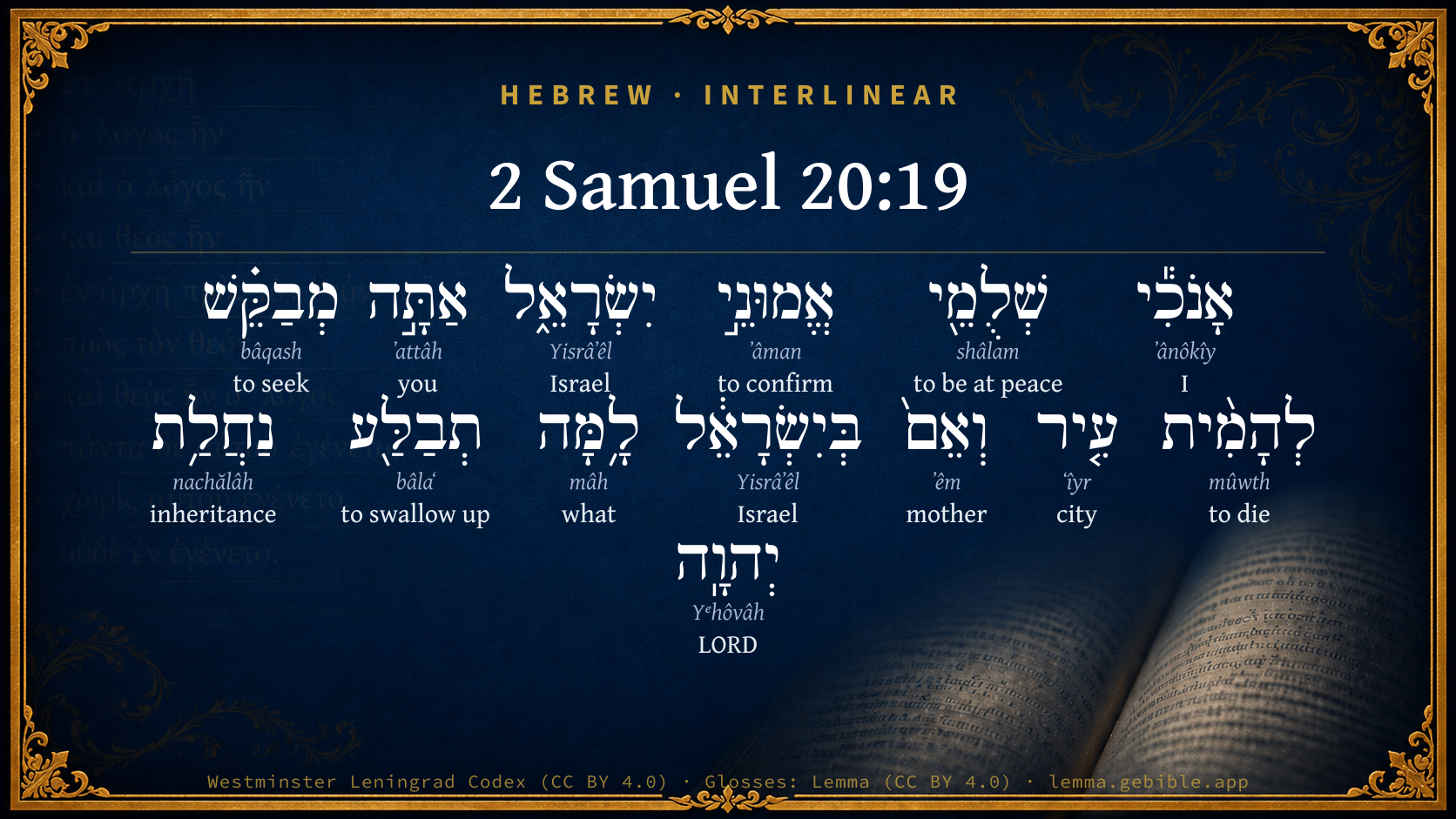
2 Samuel 20:19

Hebrew (Westminster Leningrad Codex) 2 Samuel 20:19 appears in the Hebrew Old Testament. The text above is from the Westminster Leningrad Codex. Each word links to its Strong’s number, a concise gloss, and parsing drawn from the Open Scriptures Hebrew Bible morphology. Click any word for its full Brown-Driver-Briggs (BDB) entry.
Download image
Cite this verse

2 Samuel 20:19 (World English Bible). Public Domain. Lemma interlinear Bible study tool, https://lemma.gebible.app/v/2-samuel/20/19.

Show BibTeX & RIS
BibTeX
RIS
English Translation
I am of those who are peaceable and faithful in Israel: you seek to destroy a city and a mother in Israel: why will you swallow up the inheritance of Yahweh?
World English Bible · Public Domain
Download a study sheet

One document with this verse’s original text, its word-by-word gloss line, the meaning frame, cross-references with their text, attributed commentary, and full source and license credits — printable, and it pastes into notes with its structure intact.

This verse Autodidact and up

Study sheet (.html) Plain text (.txt)

A passage Seminary Student

Up to 50 verses in one chapter. A passage sheet keeps up to 6 commentary sources and 12 cross-references per verse, in the order this page ranks them, and says so on the sheet whenever that leaves anything out. Ask for a single verse and you get the Autodidact verse sheet above.

Everything on this page stays free to read, with no account — the sheet is a download of what is already on screen, not access to it.

Want to remove ads? Support Godless Engineer
Compare translations 3

The same verse in 3 English versions, stacked beneath the original-language interlinear above. Click any original word for its lexicon entry.

Each is an independent rendering of the whole verse — the interlinear is not word-aligned to these translations.

Highlighted words mark where these versions differ — a whole-verse word diff, not a word-by-word alignment.

  • World English Bible Public Domain
    I am of those who are peaceable and faithful in Israel: you seek to destroy a city and a mother in Israel: why will you swallow up the inheritance of Yahweh?
  • King James Version Public Domain
    I am one of them that are peaceable and faithful in Israel: thou seekest to destroy a city and a mother in Israel: why wilt thou swallow up the inheritance of the LORD?
  • unfoldingWord Literal Text CC BY-SA 4.0
    I pacified and faithful of Israel. You are seeking to kill a city and a mother in Israel. Why will you devour the inheritance of Yahweh?”

unfoldingWord Literal Text — © unfoldingWord, licensed CC BY-SA 4.0. Word-aligned USFM3 via Door43 (git.door43.org/unfoldingWord/en_ult).

Versions to compare (up to 4)

3 of 4 selected

Show all 18 translations

Every available English version of this verse, each an independent rendering of the whole verse.

  • World English Bible Public Domain
    I am of those who are peaceable and faithful in Israel: you seek to destroy a city and a mother in Israel: why will you swallow up the inheritance of Yahweh?
  • Berean Standard Bible Public Domain
    I am among the peaceable and faithful in Israel, but you are trying to destroy a city that is a mother in Israel. Why would you swallow up the LORD’s inheritance?”
  • Majority Standard Bible Public Domain
    I am among the peaceable and faithful in Israel, but you are trying to destroy a city that is a mother in Israel. Why would you swallow up the LORD’s inheritance?”
  • King James Version Public Domain
    I am one of them that are peaceable and faithful in Israel: thou seekest to destroy a city and a mother in Israel: why wilt thou swallow up the inheritance of the LORD?
  • American Standard Version (1901) Public Domain
    I am of them that are peaceable and faithful in Israel: thou seekest to destroy a city and a mother in Israel: why wilt thou swallow up the inheritance of Jehovah?
  • Revised Version (1885) Public Domain
    I am of them that are peaceable and faithful in Israel: thou seekest to destroy a city and a mother in Israel: why wilt thou swallow up the inheritance of the LORD?
  • Geneva Bible (1599) Public Domain
    I am one of them, that are peaceable and faithful in Israel: and thou goest about to destroy a citie, and a mother in Israel: why wilt thou deuoure the inheritance of the Lord?
  • Douay-Rheims (1899) Public Domain
    Am not I she that answer truth in Israel, and thou seekest to destroy the city, and to overthrow a mother in Israel? Why wilt thou throw down the inheritance of the Lord?
  • Young's Literal Translation Public Domain
    I `am' of the peaceable -- faithful ones of Israel; thou art seeking to destroy a city, and a mother in Israel; why dost thou swallow up the inheritance of Jehovah?
  • Literal Standard Version CC BY-SA 4.0
    I [am] of the peaceable, faithful ones of Israel; you are seeking to destroy a city and mother in Israel; why do you swallow up the inheritance of YHWH?”
  • Unlocked Literal Bible CC BY-SA 4.0
    We are a city that is one of the most peaceful and faithful in Israel. You are trying to destroy a city that is a mother in Israel. Why do you want to swallow up the inheritance of Yahweh?”
  • unfoldingWord Literal Text CC BY-SA 4.0
    I pacified and faithful of Israel. You are seeking to kill a city and a mother in Israel. Why will you devour the inheritance of Yahweh?”
  • Darby Bible Public Domain
    I am peaceable [and] faithful in Israel: thou seekest to destroy a city and a mother in Israel. Why wilt thou swallow up the inheritance of Jehovah?
  • World Messianic Bible Public Domain
    I am among those who are peaceable and faithful in Israel. You seek to destroy a city and a mother in Israel. Why will you swallow up the LORD’s inheritance?”
  • Webster's Bible Public Domain
    I am one of them that are peaceable and faithful in Israel: thou seekest to destroy a city and a mother in Israel: why wilt thou swallow up the inheritance of the LORD?
  • Free Bible Version CC BY-SA 4.0
    I am one of the peaceful and faithful people of Israel. You're trying to destroy a town that's like a mother in Israel. Why do you want to tear down the Lord's possession?”
  • Bible in Basic English Public Domain
    Your purpose is the destruction of a mother-town in Israel: why would you put an end to the heritage of the Lord?
  • JPS Tanakh (1917) Public Domain
    We are of them that are peaceable and faithful in Israel; seekest thou to destroy a city and a mother in Israel? why wilt thou swallow up the inheritance of the LORD?'

Literal Standard Version (2020), Covenant Press — licensed CC BY-SA 4.0. Text via the HelloAO Bible API (eBible.org). Unlocked Literal Bible (unfoldingWord) — licensed CC BY-SA 4.0. Text via the HelloAO Bible API (eBible.org). unfoldingWord Literal Text — © unfoldingWord, licensed CC BY-SA 4.0. Word-aligned USFM3 via Door43 (git.door43.org/unfoldingWord/en_ult). Free Bible Version, Dr. Jonathan Gallagher — licensed CC BY-SA 4.0. Text via the HelloAO Bible API (eBible.org).

Word by word

More ways to search: Search by grammar → Find every occurrence → Compare this word →

Practice this passage: Drill this verse → Learn its vocabulary →

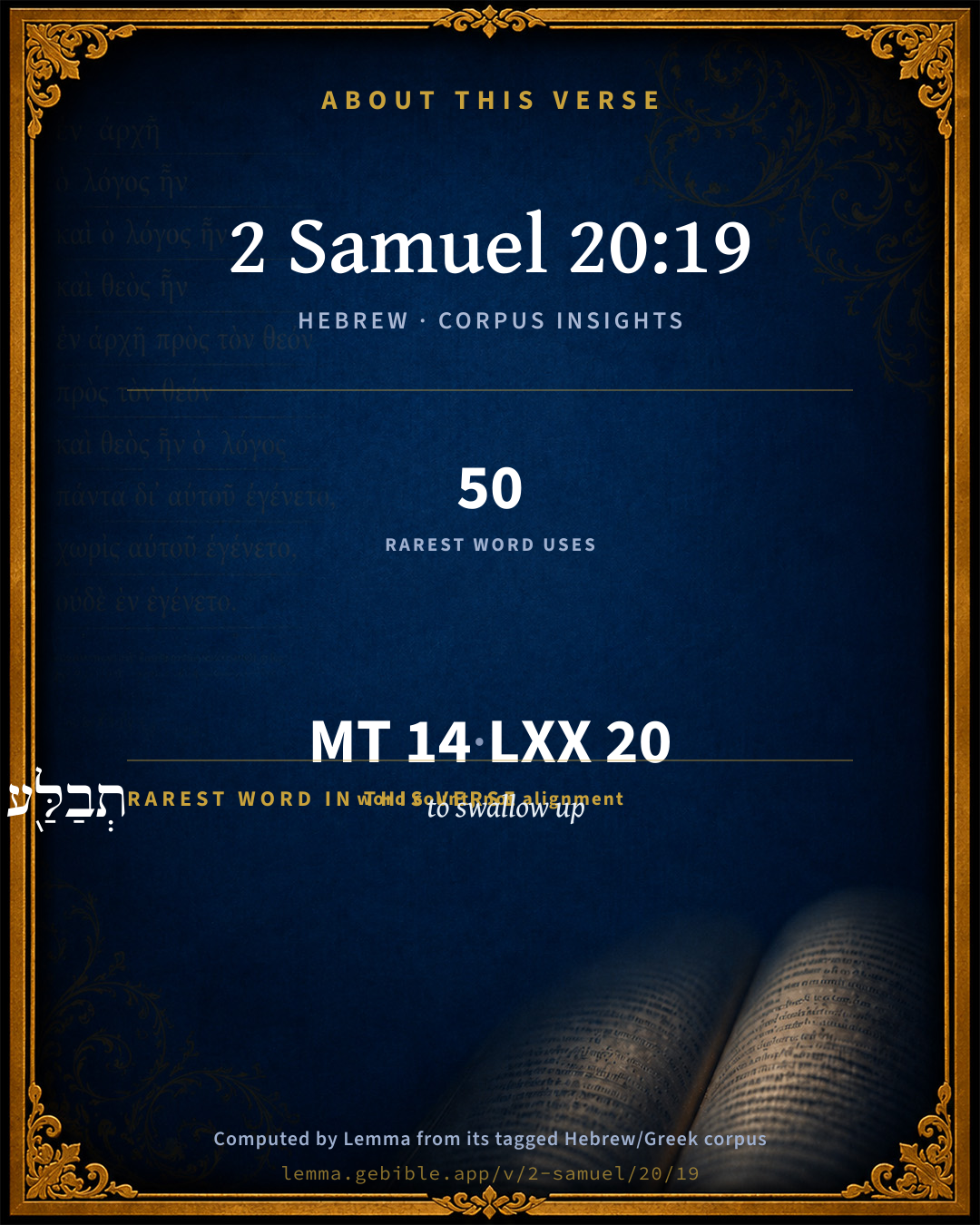
תְבַלַּ֖ע
bâlaʻ
H1104
“to swallow up”
Verb, Piel, Imperfect, 2nd Person, Masculine, Singular
Part of Speech
Verb
Stem
Piel
Form
Imperfect
Person
2nd Person
Gender
Masculine
Number
Singular
Full BDB Definition

Origin: a primitive root

TWOT: 251

to swallow down, swallow up, engulf, eat up - (Qal) - to swallow down - to swallow up, engulf - (Niphal) to be swallowed up - (Piel) - to swallow - to swallow up, engulf - squandering (figuratively) - (Pual) to be swallowed up - (Hithpael) to be ended
  1. אָנֹכִ֕י ʼânôkîy H595 “I” Pronoun, Personal, 1st Person, Common, Singular
  2. שְׁלֻמֵ֖י shâlam H7999 “at peace” Verb, Qal, Participle Passive, Masculine, Plural, Construct
  3. אֱמוּנֵ֣י ʼâman H539 “faithful of” Adjective, Adjective, Masculine, Plural, Construct
  4. יִשְׂרָאֵ֑ל Yisrâʼêl H3478 “Israel” Noun, Proper
  5. אַתָּ֣ה ʼattâh H859 “you” Pronoun, Personal, 2nd Person, Masculine, Singular
  6. מְבַקֵּ֗שׁ bâqash H1245 “seeking” Verb, Piel, Participle Active, Masculine, Singular, Absolute
  7. לְהָמִ֨ית mûwth H4191 “to die” Preposition + Verb, Hiphil, Infinitive Construct
  8. עִ֤יר ʻîyr H5892 “city” Noun, Common, Feminine, Singular, Absolute
  9. וְאֵם֙ ʼêm H517 “and · mother” Conjunction + Noun, Common, Feminine, Singular, Absolute
  10. בְּיִשְׂרָאֵ֔ל Yisrâʼêl H3478 “in/at · Israel” Preposition + Noun, Proper
  11. לָ֥מָּה mâh H4100 “to/for · what” Preposition + Particle, Interrogative
  12. נַחֲלַ֥ת nachălâh H5159 “inheritance of” Noun, Common, Feminine, Singular, Construct
  13. יְהוָֽה Yᵉhôvâh H3068 “LORD” Noun, Proper

About this verse

These counts appear in no published source. They are computed here, from the morphology-tagged text and Lemma’s own curated glosses. What Lemma adds →

14
words
13
distinct lemmas
Historical
section

Shared distinctive vocabulary

תְבַלַּ֖ע to swallow up H1104 occurs in 48 verses of the Hebrew Bible. Also found in:

Grammatical profile

  • 4 verbs
  • 6 nouns
  • 1 adjective
  • 2 pronouns
  • 1 particle

Verb forms

  • שְׁלֻמֵ֖י Qal · Participle Passive
  • מְבַקֵּ֗שׁ Piel · Participle Active
  • לְהָמִ֨ית Hiphil · Infinitive Construct
  • תְבַלַּ֖ע Piel · Imperfect

Repetition

A word recurs within this verse — often emphatic in Hebrew:

  • יִשְׂרָאֵ֑ל Israel H3478 ×2

Hebrew & Septuagint length

In English translation the verse runs 31 words from the Hebrew and 35 from the Septuagint (LXX English) — closely comparable.

A rough comparison of the two English renderings, which tokenize alike — not a word-level alignment.

Word counts can differ between the Hebrew and the Greek without any difference in meaning — e.g. the Hebrew direct-object marker אֵת has no separate Greek word, and Greek often adds the article ὁ.

In the original languages it is 14 Hebrew tokens and 20 Greek tokens — but the two are counted differently (Hebrew bundles its prefixes and suffixes into one token; the Greek is in lemma form), so that isn’t a like-for-like length.

Cross-references

20

Topical passages linked to 2 Samuel 20:19 in the Treasury of Scripture Knowledge — connected by theme and wording, ordered by reader-vote popularity; previews shown in the World English Bible.

  • 1 Samuel 26:19 Now therefore, please let my lord the king hear the words of his servant. If it be Yahweh that has stirred you up against me, let him accept an offering: but if it be the children of men, cursed be they before Yahweh: for they have driven me out this day that I shouldn't cling to Yahweh's inheritance, saying, Go, serve other gods.
  • 2 Samuel 21:3 and David said to the Gibeonites, What shall I do for you? And with what shall I make atonement, that you may bless the inheritance of Yahweh?
  • 2 Samuel 17:16 Now therefore send quickly, and tell David, saying, Don't lodge this night at the fords of the wilderness, but by all means pass over; lest the king be swallowed up, and all the people who are with him.
  • 1 Timothy 2:2 for kings and all who are in high places; that we may lead a tranquil and quiet life in all godliness and reverence.
  • Genesis 18:23 Abraham drew near, and said, "Will you consume the righteous with the wicked?
  • Exodus 19:5–6 Now therefore, if you will indeed obey my voice, and keep my covenant, then you shall be my own possession from among all peoples; for all the earth is mine;
  • Numbers 16:32 and the earth opened its mouth, and swallowed them up, and their households, and all the men who appertained to Korah, and all their goods.
  • Numbers 26:10 and the earth opened its mouth, and swallowed them up together with Korah, when that company died; what time the fire devoured two hundred fifty men, and they became a sign.
  • Deuteronomy 32:9 For Yahweh's portion is his people; Jacob is the lot of his inheritance.
  • Judges 5:7 The rulers ceased in Israel, they ceased, Until that I Deborah arose, That I arose a mother in Israel.
  • Psalms 124:3 Then they would have swallowed us up alive, When their wrath was kindled against us;
  • Jeremiah 51:34 Nebuchadrezzar the king of Babylon has devoured me, he has crushed me, he has made me an empty vessel, he has, like a monster, swallowed me up, he has filled his maw with my delicacies; he has cast me out.
  • Jeremiah 51:44 I will execute judgment on Bel in Babylon, and I will bring forth out of his mouth that which he has swallowed up; and the nations shall not flow any more to him: yes, the wall of Babylon shall fall.
  • Lamentations 2:2 The Lord has swallowed up all the habitations of Jacob, and has not pitied: He has thrown down in his wrath the strongholds of the daughter of Judah; He has brought them down to the ground; he has profaned the kingdom and the princes of it.
  • Lamentations 2:5 The Lord is become as an enemy, he has swallowed up Israel; He has swallowed up all her palaces, he has destroyed his strongholds; He has multiplied in the daughter of Judah mourning and lamentation.
  • Lamentations 2:16 All your enemies have opened their mouth wide against you; They hiss and gnash the teeth; they say, We have swallowed her up; Certainly this is the day that we looked for; we have found, we have seen it.
  • Ezekiel 16:45–49 You are the daughter of your mother, who loathes her husband and her children; and you are the sister of your sisters, who loathed their husbands and their children: your mother was a Hittite, and your father an Amorite.
  • Romans 13:3–4 For rulers are not a terror to the good work, but to the evil. Do you desire to have no fear of the authority? Do that which is good, and you will have praise from the same,
  • 1 Corinthians 15:54 But when this corruptible will have put on incorruption, and this mortal will have put on immortality, then what is written will happen: "Death is swallowed up in victory."
  • 2 Corinthians 5:4 For indeed we who are in this tent do groan, being burdened; not that we desire to be unclothed, but that we desire to be clothed, that what is mortal may be swallowed up by life.

Cross-references courtesy of OpenBible.info (CC BY 4.0).

Hebrew and Greek witnesses Masoretic Hebrew ↔ Greek Septuagint

The same verse in the two great witnesses to the Old Testament, shown verse-for-verse.

These are two independent witnesses, not word-aligned to each other, and the Septuagint is shown in lemma (dictionary) form.

Hebrew 2 Samuel 20:19 Masoretic · Westminster Leningrad Codex

אָנֹכִ֕י שְׁלֻמֵ֖י אֱמוּנֵ֣י יִשְׂרָאֵ֑ל אַתָּ֣ה מְבַקֵּ֗שׁ לְהָמִ֨ית עִ֤יר וְאֵם֙ בְּיִשְׂרָאֵ֔ל לָ֥מָּה תְבַלַּ֖ע נַחֲלַ֥ת יְהוָֽה

I am of those who are peaceable and faithful in Israel: you seek to destroy a city and a mother in Israel: why will you swallow up the inheritance of Yahweh?

World English Bible · Public Domain

Greek LXX 2 Samuel 20:19 Septuagint · lemma form

ἐγώ εἰμί εἰρηνικός ὁ στήριγμα ἰσραήλ σύ δέ ζητέω θανατόω πόλις καί μητρόπολις ἐν ἰσραήλ ἵνα τίς καταποντίζω κληρονομία κύριος

I am a peaceful one of the strong ones in Israel; but you seek to destroy a city and a mother city in Israel: why do you seek to ruin the inheritance of the Lord?

LXX2012 (modern English Septuagint) · Public Domain

Hebrew: Westminster Leningrad Codex (CC BY 4.0). Greek: Septuagint (public domain); English from LXX2012 (modern English Septuagint) (Public Domain). How the Septuagint differs from the Hebrew →

Targum (Aramaic paraphrase)

1

The Targum is the ancient Jewish Aramaic paraphrase of the Hebrew Scriptures — an interpretive translation, not the Hebrew text itself. Onkelos (literal) and Pseudo-Jonathan (expansive) render the Torah, and Jonathan the Prophets. Coverage is partial: where no permissively-licensed English translation exists for a verse, only the Aramaic is shown. This is verse-level text, not a word-by-word alignment to the Hebrew.

  1. Targum Jonathan Prophets (Joshua–Malachi)
    אֲנַחְנָא שַׁלְמִין בְּהֵימָנוּתָא עִם יִשְׂרָאֵל דְאַתְּ בָּעֵי לְחַבָּלָא קִירְוָא דְהִיא כְּרַךְ רַב וְאִמָא בְּיִשְׂרָאֵל לְמָה תְקַלְקֵל אַחֲסָנַת עַמָא דַיָי:

    (no public-domain English translation for this verse)

    Targum Jonathan — Aramaic: “Mikraot Gedolot” (public domain). English: “Sefaria Community Translation” (CC0 1.0 (public-domain dedication)); “London "Chaldee Paraphrase," 1871” (public domain). Text via Sefaria.

Commentary

Notes on 2 Samuel 20:19 from classic Christian and Jewish commentators (each source and its license shown beneath its notes). The classic Christian expositions comment on the surrounding passage and are grouped to its opening verse, so a note may address several verses; the Jewish commentaries on the Tanakh (Rashi and others) are per-verse, so they appear only where the commentator wrote on this verse.

Lemma curates 59 commentaries, every one of them public domain or Creative Commons licensed, each selected and text-cleaned for this edition rather than reprinted as found. About our sources →

Trapp's Complete Commentary

John Trapp

2Sa 20:19 I [am one of them that are] peaceable [and] faithful in Israel: thou seekest to destroy a city and a mother in Israel: why wilt thou swallow up the inheritance of the LORD?

Ver. 19. I am one of them, &c.] See on 2Sa 20:18.

Thou seekest to destroy a city and a mother in Israel,] i.e., A metropolis that hath many towns belonging to it; which sucking in the air of this city, as Plutarch speaketh of Rome in Numa’s days, do breathe peaceableness and faithfulness to their rightful sovereign. Or, A mother in Israel, that is, a city that can give mother-like counsel. Or, A mother, that is, a university, such as was afterwards Athens, spared therefore by Sulla, when as else he had destroyed it. {a}

Why wilt thou swallow up] As a greedy beast doth his prey.

The inheritance of the Lord?] Will not such a murdering morsel be thy bane? Art thou so good at committing of sacrilege, at robbing God of his right?

{a} Plut., Apoph.

John Trapp, A Commentary or Exposition upon All the Books of the Old and New Testament (1647–1656) — public domain. Text from a community e-Sword module.

Joseph Benson's Commentary

2Sa 20:19. I am one of them that are peaceable, &c. — She speaks in the name of the whole city, which was of a peaceable spirit, and had been faithful to David in the time of the late revolt. Thou seekest to destroy a city and a mother in Israel — A great city which had many towns depending upon it. Great cities were commonly called mothers; as lesser towns or villages subject to them were called their daughters. Why wilt thou swallow up the inheritance of the Lord? — By depopulating a city of that country which God hath peculiarly chosen for his people. The destruction which thou art about to bring upon us is an injury to Israel, and to the God of Israel.

Joseph Benson's Commentary on the Old and New Testaments (1811–1818) — public domain. Text from a community e-Sword module.

Geneva Bible (1599)

Geneva Bible translators

She speaketh in the name of the city.

Geneva Bible (1599) marginal notes — public domain. Text via Bolls.life.

Adam Clarke's Commentary

Verse 19. I - peaceable and faithful in Israel] I am for peace, not contention of any kind; I am faithful-I adhere to David, and neither seek nor shall sanction any rebellion or anarchy in the land. Why then dost thou proceed in such a violent manner? Perhaps the woman speaks here in the name and on behalf of the city: "I am a peaceable city, and am faithful to the king."

A mother in Israel] That is, a chief city of a district; for it is very likely that the woman speaks of the city, not of herself.

Adam Clarke's Commentary on the Bible (1810–1826) — public domain. Text from a community e-Sword/MySword module.

The Cambridge Bible for Schools and Colleges

gen. ed. J. J. S. Perowne

19. I am one of them that are peaceable and faithful in Israel] I am peaceable and faithful in Israel. The woman speaks in the name of the city, asserting its peaceableness and loyalty. By an irregularity of construction, hardly reproducible in English, the predicate is in the plural, referring to the inhabitants. Lit. I am peaceable faithful ones of Israel.

to destroy a city and a mother] Lit. to slay: the personification of the city is kept up. On “mother” as applied to a city (metropolis) see note on ch. 2Sa_8:1.

the inheritance of the Lord] Cp. ch. 2Sa_10:12, 2Sa_14:16; 1Sa_26:19.

The Cambridge Bible for Schools and Colleges (gen. ed. J. J. S. Perowne; Cambridge University Press, 1878–1918) — public domain. Text from a community e-Sword module.

John Gill's Exposition

I am one of them that are peaceable and faithful in Israel,.... Her meaning is, that she was of a city which consisted of peaceable and faithful men, that were peaceable among themselves, and faithful to their king, who never were concerned in any insurrection or rebellion, not in the late one under Absalom:

thou seekest to destroy a city, and a mother in Israel; a metropolitan city, which had several towns and villages under its jurisdiction, which were as daughters to it. Some think she means herself, because very old, supposed (c) to be Serah, the daughter of Asher, a son of Jacob, which is improbable:

wilt why thou swallow up the inheritance of the Lord? a city which is a part of the land, that is the Lord's inheritance.

(c) Jarchi & Kimchi in loc. Hieron. Trad. Heb. in 2 Reg. fol. 79. L.

John Gill's Exposition of the Whole Bible (1746–1763) — public domain (CC PDM 1.0). Text via the HelloAO Bible API.

Albert Barnes' Notes on the Bible

I am one ... - The woman speaks in the name of the whole city, which she means to say was peaceable and loyal.

Albert Barnes' Notes on the Bible (1834–1885) — public domain. Text from a community e-Sword/MySword module.

Haydock's Catholic Bible Commentary

Truth. Hebrew, "I am peaceable, faithful in Israel." (Haydock) --- I am one of the cities most inclined to peace, and to the king’s service, noted for lessons of loyalty. (Calmet) --- Probably there was an academy here. (Menochius) --- Mother, city, or metropolis. The Hebrews styled the inferior towns, daughters. (Calmet) --- Lord, a city belonging to Israel. (Haydock)

George Leo Haydock (1774–1849), Haydock's Catholic Family Bible and Commentary, 1859 edition — public domain. Excludes Psalms (Douay-Rheims chapter numbering differs from Protestant) and Deuterocanonical books (Catholic canon only).

Matthew Poole's English Annotations

Or, I (to wit, the city of Abel, in whose name and person she speaks this) am one of the

peaceable and faithful cities of Israel. Whatsoever Sheba may design, whom we have innocently received into our city before we well understood the matter, we of this city abhor the thoughts of warring and rebelling against the king, as having had no hand in Absalom’s late rebellion: which is probable enough, considering both their situation in the utmost borders of the land, very remote from the seat of that civil war; and their open profession of their peaceableness and fidelity or loyalty to the king; which had been impudent if they had been so lately involved in the last war and rebellion.

A city and a mother, i.e. a mother; for great cities are commonly called mothers; as lesser towns or villages subject to them, and depending upon them for direction and defence, are called their daughters, as Eze 16:27,46.

The inheritance of the Lord, i.e. a considerable part of that land which God hath chosen for his peculiar possession. The destruction which thou art about to bring upon us is an injury also to Israel, and to the God of Israel.

Matthew Poole's English Annotations on the Holy Bible (1683–1685) — public domain. Text from a community e-Sword/MySword module.

Whedon's Commentary on the Bible

Daniel D. Whedon

19. I… peaceable… faithful in Israel — She speaks in, the name of the whole city, declaring that they were guilty of nothing that called for war.

A mother in Israel — A designation of Abel as a mother city, having many towns dependent upon her.

Why wilt thou — This question clearly implies that Joab had begun his siege without proper preliminary communication with the inhabitants, and even without making known his purpose or desires.

The inheritance of the Lord — The land of Israel consecrated for his chosen people. See marginal references.

Daniel D. Whedon (gen. ed.), Commentary on the Old and New Testaments (1874–1909) — public domain. Text from a community e-Sword module.

The Pulpit Commentary

I am one of them that are, etc. The Authorized Version translates in this way, because, while "I" is singular, "peaceable" and "faithful" are plural. Really this construction shows that the woman speaks in the name of the city, and consequently the Authorized Version, while preserving the grammar, loses the sense. It should be translated, we are peaceable, faithful people in Israel. A city and a mother; that is, a mother city, a metropolis, the chief town of that district.

Peaceableness and faithfulness.

am one of them that are peaceable and faithful in Israel." The wise woman probably spoke in these words, not so much for herself, as for the inhabitants of her town, which Joab was besieging. Hence the adjectives are plural. She pleads the peacefulness and fidelity of the people as a reason for sparing them. It was no fault of theirs that a traitor had taken refuge amongst them. Joab acknowledges the force of her plea, and promises to depart if Sheba were delivered up to him a promise which he fulfilled when the head of the traitor had been flung to him over the wall. The qualities here mentioned are of inestimable value; in an individual in relation to his neighbours, fellow citizens, and fellow Christians; in a family as between its members, and in relation to other families; in a town, between its inhabitants, and in respect to other towns; in a country, between the various classes of the people, between the people and their rulers, and in relation to other countries; and in a Church, as between its members, and in its relations with other Churches and with the community at large. They are the subject of many Scripture injunctions and promises. They are fruits of the Spirit; essential parts of the character of a Christian; the natural product of the gospel in those who really believe it. "The kingdom of God is righteousness and peace"; (Rom_14:17) "The fruit of the Spirit is love, joy, peace, long suffering, kindness, goodness, faithfulness, meekness"; (Gal_5:22, Revised Version) "Love truth and peace". (Zec_8:19, Revised Version)

I PEACEABLENESS. This Christian virtue is very frequently inculcated in the Scriptures, especially the New Testament.

1. Its nature. It consists in a disposition to live in harmony and friendliness with all. It shows itself by courtesy and kindness; by avoidance of contention and quarrels; by carefulness not to give just or needless provocation to others; by meek endurance of provocation and even injustice from others; by readiness to give and receive explanation and apology; by quiet, unobtrusive performance of one"s own duties, and abstinence from intermeddling with other people"s business; by overlooking small offences, and readiness to forgive greater.

2. Its sources. In some it is a natural disposition. As a Christian virtue it springs from:

(1) Christian love love to Christian brethren as such, and love to all. This prompts those in whom it reigns to seek the happiness of others, and to put the most charitable construction on their conduct. It also subdues the irascible dispositions, and the selfishness which so readily leads to alienation and contention.

(2) Christian humility. "By pride cometh contention". (Pro_13:10) The proud exaggerate their own claims, expect too much from others, resent slight offence, insist on unreasonable reparation. But the humble avoid, without effort, such occasions of strife. Thus love and humility promote peace; and all the influences and motives which produce and foster the former are equally favourable to the latter.

3. Its benefits.

(1) To the peaceable themselves. It is itself happiness. It secures the good will of others, the enjoyment of which is happiness. It is a frame of mind favourable to the cultivation and growth of all Christian virtues; and to all those devout exercises by which these are nourished and the favour of God realized.

(2) To society. The absence of the annoyance and discomfort which the contentious occasion. The enjoyment of quietness and rest. The peaceable are also peacemakers, and promote a pacific disposition in others. If all men were peaceable, wars, small and great alike, would cease.

II FAITHFULNESS. "Faithful," on the lips of the wise woman, probably meant "loyal" to the king. It might well include also uprightness in general. "We are a people not only peaceful, but (as the word is) reliable, trustworthy. We are honest, just, steadily occupied with a faithful discharge of our duties, at once to God, to each other, and to the state." Fidelity must be associated with peaceableness to form a noble Christian character; fidelity to Christ and God, to conscience and conviction, to truth and duty, to promises and engagements; fidelity to those to whom we are variously related in family, social, ecclesiastical, and national life. This gives strength to the character, as gentleness and peacefulness give beauty. The two qualities are not incompatible, but mutually helpful. A peaceful spirit prevents fidelity from becoming harsh, censorious, meddlesome, fierce. Fidelity prevents peacefulness from becoming an immoral weakness, which disregards justice and truth, is ever making unworthy Compromises, and would rather sacrifice the highest principles than run the risk of arousing the passions of men by asserting and defending them. Only "the wisdom that is from above," which "is first pure, then peaceable, gentle, easy to be entreated, full of mercy and good fruits, without variance, without hypocrisy"; (Jam_3:17, Revised Version) in other words, the teaching of the Holy Spirit, can enable us to give to each of these virtues, peacefulness and faithfulness, its due place. G.W. he fruit of the Spirit is love, joy, peace, long19

Seeking to destroy God"s inheritance.

"Why wilt thou swallow up the inheritance of the Lord?" The nation of Israel was called the "inheritance" of God, because specially chosen and set apart for himself, and therefore specially valued and cared for. (see Deu_4:20 Deu_9:26, Deu_9:29) The "wise woman," in remonstrating with Joab against his assault on Abel, applies the term to that part of the people which dwelt there. It was an assertion of their right, as belonging to the chosen people, to be protected, not destroyed. The corresponding word in the New Testament is used of the everlasting possession which Christians will inherit, not of Christians themselves (unless Eph_1:18 be an exception). But the idea is presented in other words, (see 1Pe_2:9, "a people for God"s own possession," Revised Version) and the remonstrance might be appropriately addressed to any who seek to destroy the Church of God.

I CHRISTIANS ARE THE LORD"S INHERITANCE. That part of mankind which is specially his.

1. Which he has peculiarly appropriated. All the world is his; hut, while hehas left the larger portion of it for a time comparatively waste, he has in a special manner claimed and separated this for himself.

2. For which he specially cares, bestowing upon it peculiar culture,watching over it with special interest.

3. From which he expects and receives special returns. Of thought, love,confidence, praise, "fruits of righteousness", (Php_1:11) glory. (Mat_5:16) The words, "inheritance of the Lord," may be applied to the whole Church; or (according to the analogy of the text) to any part of it, any Christian society; or to individual Christians. And it is fitted to awaken in them reflections as to the degree in which they are worthy of the name, and to encourage the sincere to expect the special protection and blessing of God.

II THERE ARE ATTEMPTS TO DESTROY GOD"S INHERITANCE. Some are wrongly charged with such attempts. Joab declared truly that his aim was not to "swallow up or destroy" (ver. 20). He only wished to punish a traitor, by doing which he would serve instead of injuring "the inheritance of the Lord." In like manner, men who endeavour to purify the Church from error and sinful practices may be wrongly charged with seeking to destroy what their desire is to conserve. Reformers are often regarded as destructives. Such, however, do need to be cautioned lest anything in their spirit or measures should injure what is good more than correct what is evil. Some, again, injure God"s inheritance without deliberate intention. Unworthy ministers of religion, hypocrites, and inconsistent Christians are of this class. But others are chargeable with endeavouring to destroy God"s inheritance.

1. Such as attempt to destroy faith in the great Christian verities. Could they succeed, there would be no Christianity, no Church, no "inheritance of the Lord," left in the world.

2. Persecutors of Christians in general, or of particular sections of them. Various bodies of Christians have in turn sought not to convince (which is right), but to root out, their fellow Christians, employing the civil power, if that were at their command, or, if not, using their wealth or social influence to oppress or entice in order to suppress.

III THE EXPOSTULATION OF THE TEXT MAY BE JUSTLY ADDRESSED TO THOSE WHO MAKE SUCH ATTEMPTS. "Why wilt thou swallow up," etc.? The words may be used to urge consideration of:

1. The reasons and motives which prompt the attempts. Such as:

(1) Hatred of piety and holiness. This often impels infidels in their assaults on the faith of Christians; but many who are called Christians, if they examined themselves, would find that it was also the motive of their endeavours to suppress Christians more in earnest than themselves.

(2) Love of domination.

(3) Pride of superiority, real or supposed.

(4) Indignation at faithful testimony or reproof.

(5) Inability to discern the marks of God"s true people. The external being regarded to the exclusion of the internal and spiritual; the essential qualities being overlooked because dissociated from certain overestimated accidentals. A blindness produced by a narrow education, or exclusive intercourse with one kind of Christians.

(6) Unholy zeal, such as actuated St. Paul before his conversion (Php_3:6; comp. Joh_16:2) The assailants of the Church or any part or member of it may well be urged to pause and consider their real spirit and motives; and whether these will bear reflection, or are capable of justification.

2. The impiety and unrighteousness of such attempts. The wise woman suggests to Joab, by the words she uses, that he would be guilty of these sins if he persisted in his assault on the town. So those who assail the Church of God:

(1) Sin against God. Whose inheritance they are invading. So far as they succeed, they lessen God"s part in society and its affairs; they injure those who are precious in his sight ("He that toucheth you toucheth the apple of his eye," (Zec_2:8; comp. Act_9:4; Rom_4:15, Rom_4:20; 1Co_8:12) The friends of God should shrink from any conduct which tends to lessen the testimony for him in the world, and cripple those who are desirous of promoting his kingdom according to their lights.

(2) They violate the rights of Christians. Every part of the Christian community is entitled to liberty of profession and "prophesying" (see Bishop Jeremy Taylor"s treatise on this subject), and to sympathy and all possible help from the rest. All good citizens are entitled to the protection of the state, and cannot be justly persecuted by it on account of their religion.

1. Their futility. "The inheritance of the Lord" cannot be really swallowed up, although certain portions of it may for a time be injured. "Upon this rock I will build my Church; and the gates of Hades shall not prevail against it". (Mat_16:18)

2. The retribution which will surely follow them. Christians who, in their blindness, make them in any degree, receive loss and injury thereby in their own souls and in their influence for good; the enemies of God will find that he is too mighty for them. He will "plead his own cause", (Psa_74:22) and "avenge his elect". G.W. (Luk_18:7)

The Pulpit Commentary (1880–1919), ed. H.D.M. Spence-Jones & Joseph S. Exell — public domain. Text from a community e-Sword module.

John Wesley's Explanatory Notes

A mother - Great cities are commonly called mothers; as lesser towns or villages subject to them, and depending upon them, are called their daughters. Inheritance - That is, a considerable part of, that land which God hath chosen for his particular possession. The destruction which thou art about to bring upon us, is an injury to Israel, and to the God of Israel.

John Wesley, Explanatory Notes Upon the Whole Bible (1754–1765) — public domain. Text via the GEBible commentary corpus.

Rashi

Rabbi Shlomo Yitzchaki (Rashi)

I am [from the people of the city] that are loyal and trustworthy to Yisroel. I am from the people of the city that are loyal and trustworthy to Yisroel and to the king. An Aggadic Midrash [states:] this was Serach, the daughter of Asher. I faithfully rewarded those who faithful [to God]: Through me, the location of Yosef's coffin was revealed to Moshe. I told Yakov that Yosef was alive.

Rashi on the Tanakh — English translations: “The Judaica Press complete Tanach with Rashi, translated by A. J. Rosenberg” (CC BY 4.0); “Pentateuch with Rashi's commentary by M. Rosenbaum and A.M. Silbermann, 1929-1934” (public domain); “The Metsudah Tanach series, Lakewood, N.J” (CC BY 4.0); and “The Book of Joshua, Metsudah Publications, 1997” (CC BY 4.0). Text via Sefaria.

Lesson kit

Teaching starters — assembled from the data on this page, not authored interpretation. Every prompt links to the verse data it draws on. Edit before teaching.

2 Samuel, in the Historical, opens this verse with 14 words (13 distinct Hebrew lemmas). Its most distinctive word is bâlaʻ (“to swallow up”). A historical commentator’s framing appears above. Read the whole chapter for the surrounding context.

Discussion questions

  1. The word bâlaʻ carries the sense “to swallow up.” How does it shape the verse?
  2. How does Genesis 41:7, which shares the word «to swallow up», read alongside this verse?
  3. What does the repetition of “Israel” (2× in this one verse) do in this verse?
  4. These translations render this verse differently; the difference is in the English rendering, not the original. What questions does that raise?
  5. «שְׁלֻמֵ֖י» is a Qal Participle Passive verb. How does that grammatical form shape the action described?
  6. Compare how Trapp's Complete Commentary and Joseph Benson's Commentary read this verse. Where do they agree or differ?

Things to notice

Reading settings

Reading text

Shown beneath each verse's original-language words.

Old Testament
Old Testament edition

Read the OT as the Masoretic Hebrew (MT) or the Greek Septuagint (LXX).

English shown for the Greek Septuagint (in the Hebrew ↔ Greek comparison).

Comparing translations? Open the Compare panel on any verse page to stack up to four side by side.