
Ecclesiastes 12:10

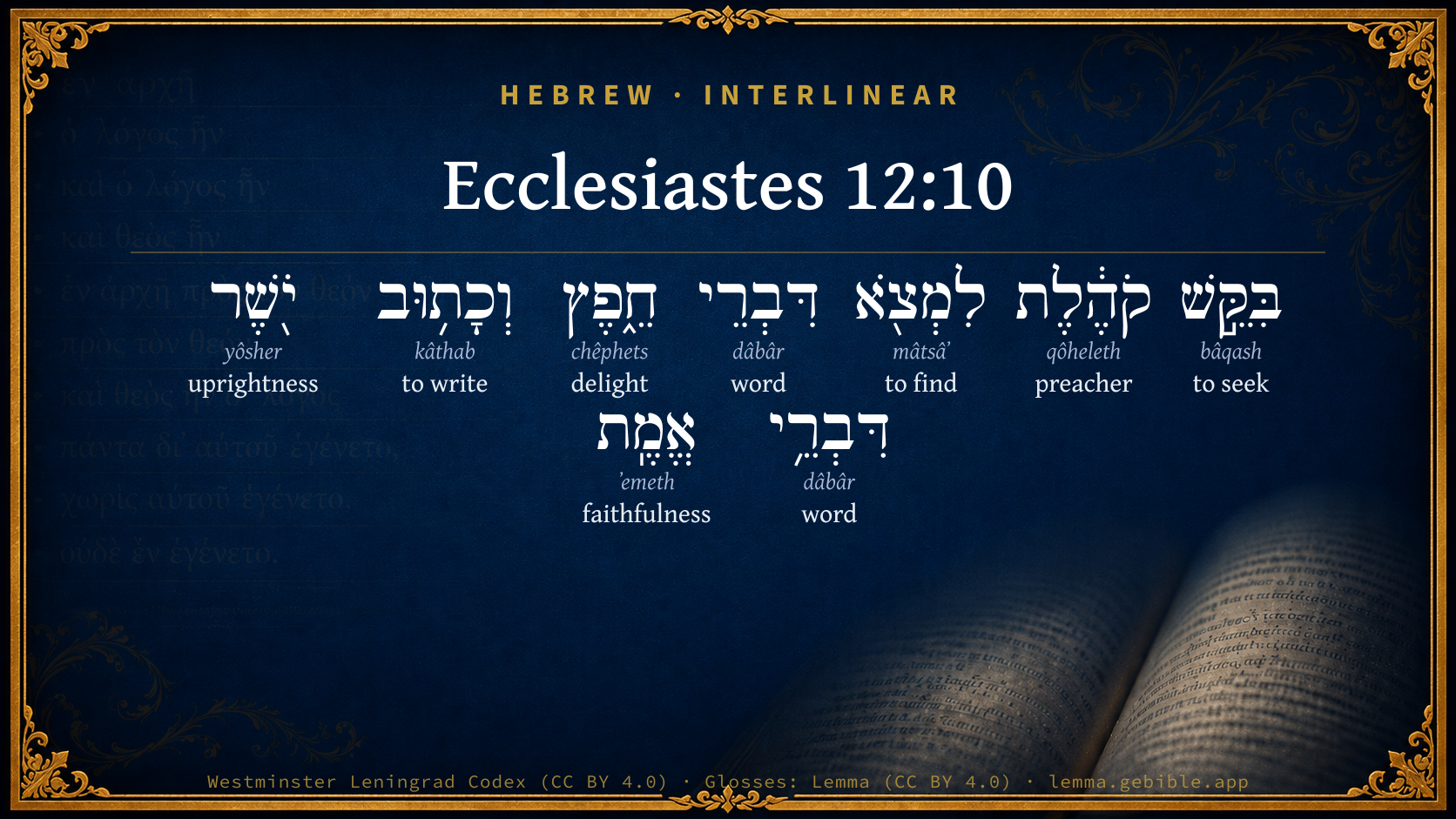
Hebrew (Westminster Leningrad Codex) Ecclesiastes 12:10 appears in the Hebrew Old Testament. The text above is from the Westminster Leningrad Codex. Each word links to its Strong’s number, a concise gloss, and parsing drawn from the Open Scriptures Hebrew Bible morphology. Click any word for its full Brown-Driver-Briggs (BDB) entry.
Download image
Cite this verse

Ecclesiastes 12:10 (World English Bible). Public Domain. Lemma interlinear Bible study tool, https://lemma.gebible.app/v/ecclesiastes/12/10.

Show BibTeX & RIS
BibTeX
RIS
English Translation
The Preacher sought to find out acceptable words, and that which was written blamelessly, words of truth.
World English Bible · Public Domain
Download a study sheet

One document with this verse’s original text, its word-by-word gloss line, the meaning frame, cross-references with their text, attributed commentary, and full source and license credits — printable, and it pastes into notes with its structure intact.

This verse Autodidact and up

Study sheet (.html) Plain text (.txt)

A passage Seminary Student

Up to 50 verses in one chapter. A passage sheet keeps up to 6 commentary sources and 12 cross-references per verse, in the order this page ranks them, and says so on the sheet whenever that leaves anything out. Ask for a single verse and you get the Autodidact verse sheet above.

Everything on this page stays free to read, with no account — the sheet is a download of what is already on screen, not access to it.

Want to remove ads? Support Godless Engineer
Compare translations 3

The same verse in 3 English versions, stacked beneath the original-language interlinear above. Click any original word for its lexicon entry.

Each is an independent rendering of the whole verse — the interlinear is not word-aligned to these translations.

Highlighted words mark where these versions differ — a whole-verse word diff, not a word-by-word alignment.

  • World English Bible Public Domain
    The Preacher sought to find out acceptable words, and that which was written blamelessly, words of truth.
  • King James Version Public Domain
    The preacher sought to find out acceptable words: and that which was written was upright, even words of truth.
  • unfoldingWord Literal Text CC BY-SA 4.0
    Qoheleth sought to find words of pleasure, and words of truth were written rightly.

unfoldingWord Literal Text — © unfoldingWord, licensed CC BY-SA 4.0. Word-aligned USFM3 via Door43 (git.door43.org/unfoldingWord/en_ult).

Versions to compare (up to 4)

3 of 4 selected

Show all 18 translations

Every available English version of this verse, each an independent rendering of the whole verse.

  • World English Bible Public Domain
    The Preacher sought to find out acceptable words, and that which was written blamelessly, words of truth.
  • Berean Standard Bible Public Domain
    The Teacher searched to find delightful sayings and to record accurate words of truth.
  • Majority Standard Bible Public Domain
    The Teacher searched to find delightful sayings and to record accurate words of truth.
  • King James Version Public Domain
    The preacher sought to find out acceptable words: and that which was written was upright, even words of truth.
  • American Standard Version (1901) Public Domain
    The Preacher sought to find out acceptable words, and that which was written uprightly, `even' words of truth.
  • Revised Version (1885) Public Domain
    The Preacher sought to find out acceptable words, and that which was written uprightly, even words of truth.
  • Geneva Bible (1599) Public Domain
    The Preacher sought to finde out pleasant wordes, and an vpright writing, euen the wordes of trueth.
  • Douay-Rheims (1899) Public Domain
    He sought profitable words, and wrote words most right, and full of truth.
  • Young's Literal Translation Public Domain
    The preacher sought to find out pleasing words, and, written `by' the upright, words of truth.
  • Literal Standard Version CC BY-SA 4.0
    The preacher sought to find out pleasing words, and [that] written [by] the upright—words of truth.
  • Unlocked Literal Bible CC BY-SA 4.0
    The Teacher sought to write using vivid, upright words of truth.
  • unfoldingWord Literal Text CC BY-SA 4.0
    Qoheleth sought to find words of pleasure, and words of truth were written rightly.
  • Darby Bible Public Domain
    The Preacher sought to find out acceptable words; and that which was written is upright, words of truth.
  • World Messianic Bible Public Domain
    The Preacher sought to find out acceptable words, and that which was written blamelessly, words of truth.
  • Webster's Bible Public Domain
    The preacher sought to find out acceptable words: and that which was written was upright, even words of truth.
  • Free Bible Version CC BY-SA 4.0
    The Teacher looked for the best way to explain things, writing truthfully and honestly.
  • Bible in Basic English Public Domain
    The Preacher made search for words which were pleasing, but his writing was in words upright and true.
  • JPS Tanakh (1917) Public Domain
    Koheleth sought to find out words of delight, and that which was written uprightly, even words of truth.

Literal Standard Version (2020), Covenant Press — licensed CC BY-SA 4.0. Text via the HelloAO Bible API (eBible.org). Unlocked Literal Bible (unfoldingWord) — licensed CC BY-SA 4.0. Text via the HelloAO Bible API (eBible.org). unfoldingWord Literal Text — © unfoldingWord, licensed CC BY-SA 4.0. Word-aligned USFM3 via Door43 (git.door43.org/unfoldingWord/en_ult). Free Bible Version, Dr. Jonathan Gallagher — licensed CC BY-SA 4.0. Text via the HelloAO Bible API (eBible.org).

Word by word

More ways to search: Search by grammar → Find every occurrence → Compare this word →

Practice this passage: Drill this verse → Learn its vocabulary →

About this verse

These counts appear in no published source. They are computed here, from the morphology-tagged text and Lemma’s own curated glosses. What Lemma adds →

9
words
8
distinct lemmas
Wisdom
section

Notable vocabulary

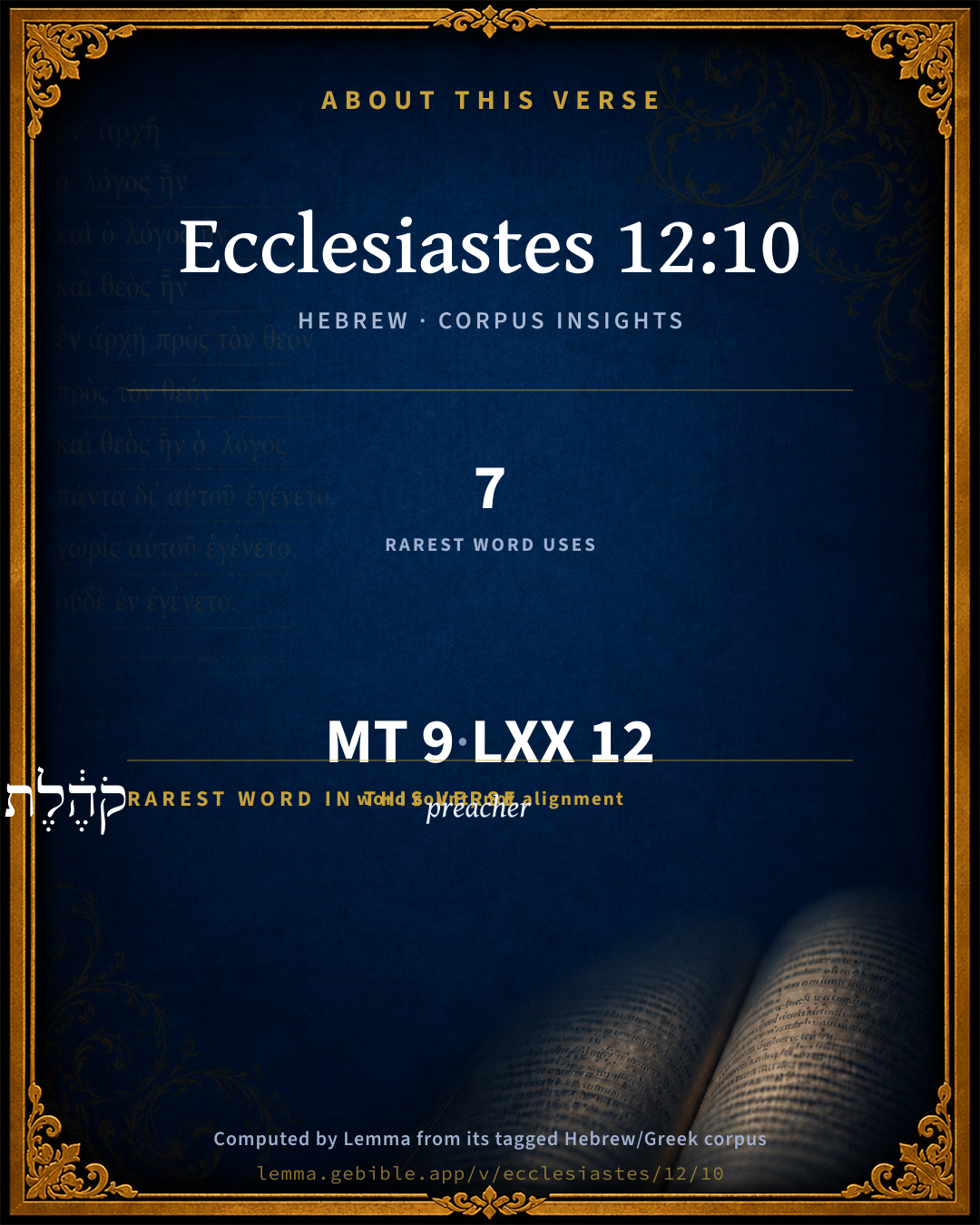
The rarest word here is קֹהֶ֔לֶת preacher H6953 — appearing just 7 times in the whole Hebrew Bible.

Shared distinctive vocabulary

קֹהֶ֔לֶת preacher H6953 occurs in 7 verses of the Hebrew Bible. Also found in:

Grammatical profile

  • 3 verbs
  • 6 nouns

Verb forms

  • בִּקֵּ֣שׁ Piel · Perfect
  • לִמְצֹ֖א Qal · Infinitive Construct
  • וְכָת֥וּב Qal · Participle Passive

Repetition

A word recurs within this verse — often emphatic in Hebrew:

  • דִּבְרֵי word H1697 ×2

Hebrew & Septuagint length

In English translation the verse runs 17 words from the Hebrew and 17 from the Septuagint (LXX English) — the same length.

A rough comparison of the two English renderings, which tokenize alike — not a word-level alignment.

Word counts can differ between the Hebrew and the Greek without any difference in meaning — e.g. the Hebrew direct-object marker אֵת has no separate Greek word, and Greek often adds the article ὁ.

In the original languages it is 9 Hebrew tokens and 12 Greek tokens — but the two are counted differently (Hebrew bundles its prefixes and suffixes into one token; the Greek is in lemma form), so that isn’t a like-for-like length.

Cross-references

9

Topical passages linked to Ecclesiastes 12:10 in the Treasury of Scripture Knowledge — connected by theme and wording, ordered by reader-vote popularity; previews shown in the World English Bible.

  • Colossians 1:5 because of the hope which is laid up for you in the heavens, of which you heard before in the word of the truth of the Gospel,
  • 1 Timothy 1:15 The saying is faithful and worthy of all acceptance, that Christ Jesus came into the world to save sinners; of whom I am chief.
  • Proverbs 16:21–24 The wise in heart shall be called prudent. Pleasantness of the lips promotes instruction.
  • Proverbs 1:1–6 The proverbs of Solomon, the son of David, king of Israel:
  • Proverbs 8:6–10 Hear, for I will speak excellent things. The opening of my lips is for right things.
  • Proverbs 15:26 Yahweh detests the thoughts of the wicked, But the thoughts of the pure are pleasing.
  • Proverbs 22:17–21 Turn your ear, and listen to the words of the wise. Apply your heart to my teaching.
  • Proverbs 25:11–12 A word fitly spoken Is like apples of gold in settings of silver.
  • Ecclesiastes 1:1 The words of the Preacher, the son of David, king in Jerusalem:

Cross-references courtesy of OpenBible.info (CC BY 4.0).

Hebrew and Greek witnesses Masoretic Hebrew ↔ Greek Septuagint

The same verse in the two great witnesses to the Old Testament, shown verse-for-verse.

These are two independent witnesses, not word-aligned to each other, and the Septuagint is shown in lemma (dictionary) form.

Hebrew Ecclesiastes 12:10 Masoretic · Westminster Leningrad Codex

בִּקֵּ֣שׁ קֹהֶ֔לֶת לִמְצֹ֖א דִּבְרֵי חֵ֑פֶץ וְכָת֥וּב יֹ֖שֶׁר דִּבְרֵ֥י אֱמֶֽת

The Preacher sought to find out acceptable words, and that which was written blamelessly, words of truth.

World English Bible · Public Domain

Greek LXX Ecclesiastes 12:10 Septuagint · lemma form

πολύς ζητέω ἐκκλησιαστής ὁ εὑρίσκω λόγος θέλημα καί γράφω εὐθύτης λόγος ἀλήθεια

The Preacher sought diligently to find out acceptable words, and a correct writing, even words of truth.

LXX2012 (modern English Septuagint) · Public Domain

On this verse, The Pulpit Commentary discusses the Septuagint’s reading. Read the note in Commentary ↓

Hebrew: Westminster Leningrad Codex (CC BY 4.0). Greek: Septuagint (public domain); English from LXX2012 (modern English Septuagint) (Public Domain). How the Septuagint differs from the Hebrew →

Commentary

Notes on Ecclesiastes 12:10 from classic Christian and Jewish commentators (each source and its license shown beneath its notes). The classic Christian expositions comment on the surrounding passage and are grouped to its opening verse, so a note may address several verses; the Jewish commentaries on the Tanakh (Rashi and others) are per-verse, so they appear only where the commentator wrote on this verse.

Lemma curates 59 commentaries, every one of them public domain or Creative Commons licensed, each selected and text-cleaned for this edition rather than reprinted as found. About our sources →

Trapp's Complete Commentary

John Trapp

Ecc 12:10 The preacher sought to find out acceptable words: and [that which was] written [was] upright, [even] words of truth.

Ver. 10. The Preacher sought, &c.] He sought and sought, by pains and prayer. He knew the rule, Bene orasse, est bene studuisse, {a} To have prayed well is to have studied well. By prayer and tears St John got the book opened. {Rev 5:4} Luther got much of his insight into God’s matters by the same means.

To find out acceptable words.] Verba desiderata; so Cajetan renders it. Verba delectabilia; so Tremellius. Verba expetibilia; so Vatablus. Delectable and desirable words, dainty expressions, that might both please and profit, tickle the ear, and with it take the heart. Such a master of speech was Paul, {Act 14:12} who thundered and lightened {b} in his discourses like another Pericles. Such a one was Apollos, that eloquent preacher, "mighty in the Scriptures," ειπειν δεινοτατος, like another Phocion, a weighty speaker; such were many of the Greek and Latin fathers. Ambrose for one, whom when Augustine heard preach, Veniebant, saith he, in animum meum simul cum verbis quae deligebam, etiam res quas negligebam, There came into my mind, together with the words which I chiefly looked after, the matter which till then I made no reckoning of. Et res et verba. Both deeds and words. Philip Melanchthon could dress his doctrine in dainty terms, and so slide insensibly into the hearts of his hearers. Egit vir eloquens ut intelligenter ut obedienter audiretur, as Augustine {c} hath it; This eloquent man took pains that he might be heard with understanding, with obedience. The like might be said of Calvin, famous for the purity of his style and the holiness of his matter. Viret, in whose sermons singularem eloquentiam et in commovendis affectibus efficacitatem admirabar, saith Zanchy, {d} greatly admired at his singular eloquence and skill to work upon the affections by his elaborate discourses.

And that which was written was upright.] A corde ad cor, void of all insincerity and falsehood. {Pro 8:8} Seducers come for the most part with pithanology - " by good words and fair speeches they deceive the hearts of the simple." {Rom 16:18} But our Preacher’s words are of another alloy, not more delicious and toothsome, than sound and wholesome, {2Ti 3:16} proceeding from a right heart, and tending to make men upright, transforming them into the same image, and transfusing them into the divine nature.

{a} Luther.

{b} Intonabat. fulgurabat Cicero. - Plutarch.

{c} De Doct. Christ., lib. iv. cap. 14.

{d} Zanch. Miscell., Ep. Dedic.

John Trapp, A Commentary or Exposition upon All the Books of the Old and New Testament (1647–1656) — public domain. Text from a community e-Sword module.

Adam Clarke's Commentary

Verse 10. He sought to find out acceptable words] דברי חפץ dibrey chephets, words of desire, words of will; the best, the most suitable words; those which the people could best understand. But these words were not such as might merely please the people; they were words of truth; such as came from God, and might lead them to him.

Adam Clarke's Commentary on the Bible (1810–1826) — public domain. Text from a community e-Sword/MySword module.

The Cambridge Bible for Schools and Colleges

gen. ed. J. J. S. Perowne

10. The Preacher sought to find out acceptable words] Literally, words of delight, or pleasure, as in chs. Ecc_5:4, Ecc_12:1. The phrase reminds us of “the words of grace” (Luk_4:22) which came from the lips of Him, who, as the Incarnate Wisdom of God, was, in very deed, greater than Solomon. The fact is stated as by way of apologia for the character of the book. The object of the teacher was to attract men by meeting, or seeming to meet, their inclinations, by falling in with the results of their own experience. We are reminded so far of the words of Lucretius:

“Nam veluti pueris absinthia tetra medentes,

Cum dare conantur, prius oras pocula circum

Contingunt mellis dulci, flavoque liquore,

Ut puerorum ætas improvida ludificetur

Labrorum tenus, interea perpotet amarum

Absinthî laticem, deceptaque non capiatur,

Sed potius tali pacto recreata valescat.”

“As those who heal the body, when they seek

To give to children wormwood’s nauseous juice,

First smear the cup’s rim with sweet golden honey,

That infant’s thoughtless age may be beguiled

Just to the margin’s edge, and so may drink

The wormwood’s bitter draught, beguiled, not tricked,

But rather gain thereby in strength and health.”

De Rer. Nat. iv. 11–17.

and that which was written was upright] The italics shew that the sentence is somewhat elliptical, and it is better to take the two sets of phrases in apposition with the “acceptable words” that precede them, even a writing of uprightness (i.e. of subjective sincerity), words of truth (in its objective sense). The words are, thus understood, a full testimony to the character of the book thus commended to the reader’s attention.

The Cambridge Bible for Schools and Colleges (gen. ed. J. J. S. Perowne; Cambridge University Press, 1878–1918) — public domain. Text from a community e-Sword module.

John Gill's Exposition

The preacher sought to find out acceptable words,.... Not mere words, fine and florid ones, the words which man's wisdom teacheth, an elegant style, or eloquent language; not but that it is proper for a preacher to seek out and use words suitable and apt to convey right ideas to the minds of men of what he says; but doctrines are rather here meant, "words of desire", "delight", and "pleasure" (d), as the phrase may be rendered; even of God's good will and pleasure, so Alshech; for the same word is sometimes used of God in this book and elsewhere: see Ecc 3:1; and so may take in the doctrine of God's everlasting love to his people, and his delight and pleasure in them; of his good will towards them in sending Christ to suffer and die for them, and save them; in pardoning their sins through his blood, in which he delights; in regenerating and calling them by his grace, and revealing the things of the Gospel to them, when he hides them from others, which is all of his own will and pleasure, and as it seems good in his sight: or words and doctrines, which are desirable, pleasing, and acceptable unto men; not that Solomon did, or preachers should, seek to please men, or seek to say things merely for the sake of pleasing men, for then they would not be the servants of Christ; nor are the doctrines of the Gospel pleasing to carnal men, but the reverse: they gnash their teeth at them, as Christ's hearers did at him; the preaching of a crucified Christ is foolishness, and the things of the Spirit of God are insipid things, to natural men; they are enemies to the Gospel: but to sensible sinners they are very delightful, such as peace, pardon, righteousness, and salvation, by Christ, Ti1 1:15; for the worth of them, they are more desirable to them than gold and silver, and are more delightful to the ear than the best of music, and more acceptable to the taste than honey or the honeycomb, Psa 19:10;

and that which was written was upright; meaning what was written in this book, or in any other parts of Scripture, which the preacher sought out and inculcated; it was according to the mind and will of God, and to the rest of the sacred word; it was sincere, unmixed, and unadulterated with the doctrines and inventions of men; it showed that man had lost his uprightness, had none of himself, and where it was to be had, even in Christ; and was a means of making men sound, sincere, and upright at heart; and of directing them to walk uprightly, and to live soberly, righteously, and godly, in the world;

even words of truth; which come from the God of truth, that cannot lie, as all Scripture does; of which Christ, who is the truth, is the sum and substance; and which are inspired by the Spirit of truth, and led into by him, and made effectual to saving purposes; and which holds good of the whole Scripture, called the Scripture of truth, Dan 10:1; and of the Gospel, which is the word of truth, and of every doctrine of it, Joh 17:17.

(d) "verba complacentiae vel beneplaciti", Vatablus; "verba desiderii", Amama, Rambachius; "verba delectabilia", Junius & Tremellius, Piscator, Drusius, Mercerus, Gejerus; so Broughton; "verba voluptatis", Cocceius.

John Gill's Exposition of the Whole Bible (1746–1763) — public domain (CC PDM 1.0). Text via the HelloAO Bible API.

Haydock's Catholic Bible Commentary

CHAPTER XII.

Profitable. Hebrew, "pleasing." Utile dulci. (Haydock) --- Perhaps he condemns his attempt to know all things, chap. i. 13. (Calmet)

George Leo Haydock (1774–1849), Haydock's Catholic Family Bible and Commentary, 1859 edition — public domain. Excludes Psalms (Douay-Rheims chapter numbering differs from Protestant) and Deuterocanonical books (Catholic canon only).

Matthew Poole's English Annotations

Acceptable words, Heb. desirable or delightful, worthy of all acceptation, such as would minister comfort and profit so the hearers or readers.

Written by the preacher in this and his other books.

Upright, Heb. right or straight, agreeable to the mind or will of God, which is the rule of right, not crooked or perverse.

Words of truth; not fables cunningly devised to deceive the simple, but true and certain doctrines, which commend themselves to men’s own consciences or reasons; wholesome and edifying counsels.

Matthew Poole's English Annotations on the Holy Bible (1683–1685) — public domain. Text from a community e-Sword/MySword module.

Whedon's Commentary on the Bible

Daniel D. Whedon

10. Acceptable words — Hebrew, Words of consolation. Feeling deeply for the sorrows of his kind, he found that the words that gave them relief were the frank utterances of sincerity and truth. Such are the words of this essay, which states with fearless accuracy, like that of Shakspeare, the aspects of life as actually seen from many and various positions.

Daniel D. Whedon (gen. ed.), Commentary on the Old and New Testaments (1874–1909) — public domain. Text from a community e-Sword module.

The Pulpit Commentary

The Preacher sought to find out acceptable words; literally, words of delight; logouv qelhmatov (Septuagint); verba utilia (Vulgate); so Aquila, logouv creiav. The word chephets, "pleasure," occurs in Ecc_5:4 Ecc_12:1. Thus we have "stones of pleasure". (Isa_54:12) He added the grace of refined diction to the solid sense of his utterances. Plumptre reminds us of the "gracious words", (logoiv thv caritov Luk_4:22) which proceeded from the mouth of him who, being the Incarnate Wisdom of God, was indeed greater than Solomon. On the necessity of a work being attractive as well as conforming to literary rules, Horace long ago wrote ("Ars Poet.," 99)

Non satis est pulchra esse poemata; dulcia sunto, Et quoeunque volent animum auditoris agunto.

"Tis not enough that poems faultless be, And fair; let them be tender too, and draw The hearer by the cord of sympathy.

St. Augustine is copious on this subject in his treatise, "De Doctr. Christ.;" thus (4:26): "Proinde ilia tria, ut intelligant qui audiunt, ut delectentur, ut obediant, etiam in hoc genere agendum est, ubi tenet delectatio principatum .... Sed quis movetur, si nescit quod dicitur? Ant quis tenetur ut audiat, si non delectatur?" And that which was written was upright, even words of truth. The Authorized Version, with its interpolations, does not accurately convey the sense of the original. The sentence is to be regarded as containing phrases in apposition to the "acceptable words" of the first clause; thus: "Koheleth sought to discover words of pleasure, and a writing in sincerity, words of truth. "The Septuagint has, kainon eujquthtov, "a writing of uprightness;" Vulgate, et conscripsit sermones rectissimos. The meaning is that what he wrote had two characteristics it was sincere, that which he really thought and believed, and it was true objectively. If any reader was disposed to cavil, and to depreciate the worth of the treatise because it was not the genuine work of the celebrated Solomon, the writer claims attention to his production on the ground of its intrinsic qualities, as inspired by the same wisdom which animated his great predecessor.

The Pulpit Commentary (1880–1919), ed. H.D.M. Spence-Jones & Joseph S. Exell — public domain. Text from a community e-Sword module.

John Wesley's Explanatory Notes

Acceptable - Such as would comfort and profit the readers.

John Wesley, Explanatory Notes Upon the Whole Bible (1754–1765) — public domain. Text via the GEBible commentary corpus.

Keil & Delitzsch

C. F. Keil & F. Delitzsch

It is further said of Koheleth, that he put forth efforts not only to find words of a pleasant form, but, above all, of exact truth: "Koheleth strove to find words of pleasantness, and, written in sincerity, words of truth." The unconnected beginning biqqesh Koheleth is like dibbarti ani, Ecc 1:16, etc., in the book itself. Three objects follow limtso. But Hitz. reads the inf. absol. וכתוב instead of וכתוּב, and translates: to find pleasing words, and correctly to write words of truth. Such a continuance of the inf. const. by the inf. absol. is possible; Sa1 25:26, Sa1 25:31. But why should וכתוב not be the continuance of the finite (Aq., Syr.), as e.g., at Ecc 8:9, and that in the nearest adverbial sense: et scribendo quidem sincere verba veritatis, i.e., he strove, according to his best knowledge and conscience, to write true words, at the same time also to find out pleasing words; thus sought to connect truth as to the matter with beauty as to the manner? Vechathuv needs no modification in its form. But it is not to be translated: and that which was right was written by him; for the ellipsis is inadmissible, and כתוב מן is not correct Heb. Rightly the lxx, καὶ γεγραμμένον εὐθύτητος. כּתוּב signifies "written," and may also, as the name of the Hagiographa כּתוּבים shows, signify "a writing;" kakathuvah, Ch2 30:5, is = "in accordance with the writing;" and belo kǎkathuv, Ch2 30:18, "contrary to the writing;" in the post-bibl. the phrase אמר הכּתוּב = ἡ γραφὴ λέγει, is used. The objection made by Ginsburg, that kathuv never means, as kethav does, "a writing," is thus nugatory. However, we do not at all here need this subst. meaning, וכתוב is neut. particip., and ישׁר certainly not the genit., as the lxx renders (reading וּכתוּב), but also not the nom. of the subj. (Hoelem.), but, since ישׁר is the designation of a mode of thought and of a relation, the accus. of manner, like veyashar, Psa 119:18; emeth, Psa 132:11; emunah, Psa 119:75. Regarding the common use of such an accus. of the nearer definition in the passive part., vid., Ewald, 284c. The asyndeton vechathuv yosher divre emeth is like that at Ecc 10:1, mehhochmah michvod. That which follows limtso we interpret as its threefold object. Thus it is said that Koheleth directed his effort towards an attractive form (cf. avne-hephets, Isa 54:12); but, before all, towards the truth, both subjectively (ישׁר) and objectively (אמת), of that which was formulated and expressed in writing.

Keil & Delitzsch — Biblical Commentary on the Old Testament (1861–1891) — public domain (CC PDM 1.0). Text via the HelloAO Bible API. (Old Testament only.)

unfoldingWord translationNotes

Door43 World Missions Community

using vivid ... words

The Teacher wanted the words to be pleasurable to the listener. They bring pleasure because they are well written, not because they are comforting.

The words of wise people ... taught by one shepherd

The writer speaks of the teacher who uses his words to instruct people as if the teacher were a shepherd who uses his tools to lead his flock. (See: Metaphor)

The words of wise people are like goads

This is a simile. AT: "Wise people encourage people to act, like a sharp stick encourages an animal to move" (See: Simile)

Like nails driven deeply are the words of the masters in collections of their proverbs

This is a simile. AT: "Like you can depend on a nail that a person drives firmly into a piece of wood, so you can depend on the words of the masters in collections of their proverbs" (See: Simile)

the words of the masters in collections of their proverbs

"the wise words collected in their proverbs" or "the sayings of the wise"

which are taught by one shepherd

This can be stated in active form. AT: "which one shepherd teaches" (See: Active or Passive)

translationWords

righteous

word

true

lord

proverb

shepherd

unfoldingWord translationNotes — © Distant Shores Media and the Door43 World Missions Community, licensed CC BY-SA 4.0. Source: git.door43.org/Door43/en_tn.

Rashi

Rabbi Shlomo Yitzchaki (Rashi)

Koheleth sought He set his heart and sought the matter and found it.

words of delight the halachah for Moses from Sinai.

and properly recorded This refers to the Written Torah and the Prophets.

Rashi on the Tanakh — English translations: “The Judaica Press complete Tanach with Rashi, translated by A. J. Rosenberg” (CC BY 4.0); “Pentateuch with Rashi's commentary by M. Rosenbaum and A.M. Silbermann, 1929-1934” (public domain); “The Metsudah Tanach series, Lakewood, N.J” (CC BY 4.0); and “The Book of Joshua, Metsudah Publications, 1997” (CC BY 4.0). Text via Sefaria.

Lesson kit

Teaching starters — assembled from the data on this page, not authored interpretation. Every prompt links to the verse data it draws on. Edit before teaching.

Ecclesiastes, in the Wisdom, opens this verse with 9 words (8 distinct Hebrew lemmas). Its most distinctive word is qôheleth (“preacher”). A historical commentator’s framing appears above. Read the whole chapter for the surrounding context.

Discussion questions

  1. What does “preacher” (qôheleth) contribute to the verse as a whole?
  2. Ecclesiastes 1:1 shares the word «preacher» with this verse. How do the two illuminate each other?
  3. “word” occurs 2× in this one verse. What is the effect of the repetition?
  4. These translations render this verse differently. What is at stake in choosing one wording over another?
  5. The verb «בִּקֵּ֣שׁ» is Piel Perfect. How does its form color the action?
  6. Reading how Trapp's Complete Commentary and Adam Clarke's Commentary read this verse, where do the two commentators agree and where do they part?

Things to notice

Reading settings

Reading text

Shown beneath each verse's original-language words.

Old Testament
Old Testament edition

Read the OT as the Masoretic Hebrew (MT) or the Greek Septuagint (LXX).

English shown for the Greek Septuagint (in the Hebrew ↔ Greek comparison).

Comparing translations? Open the Compare panel on any verse page to stack up to four side by side.