
Jeremiah 38:16

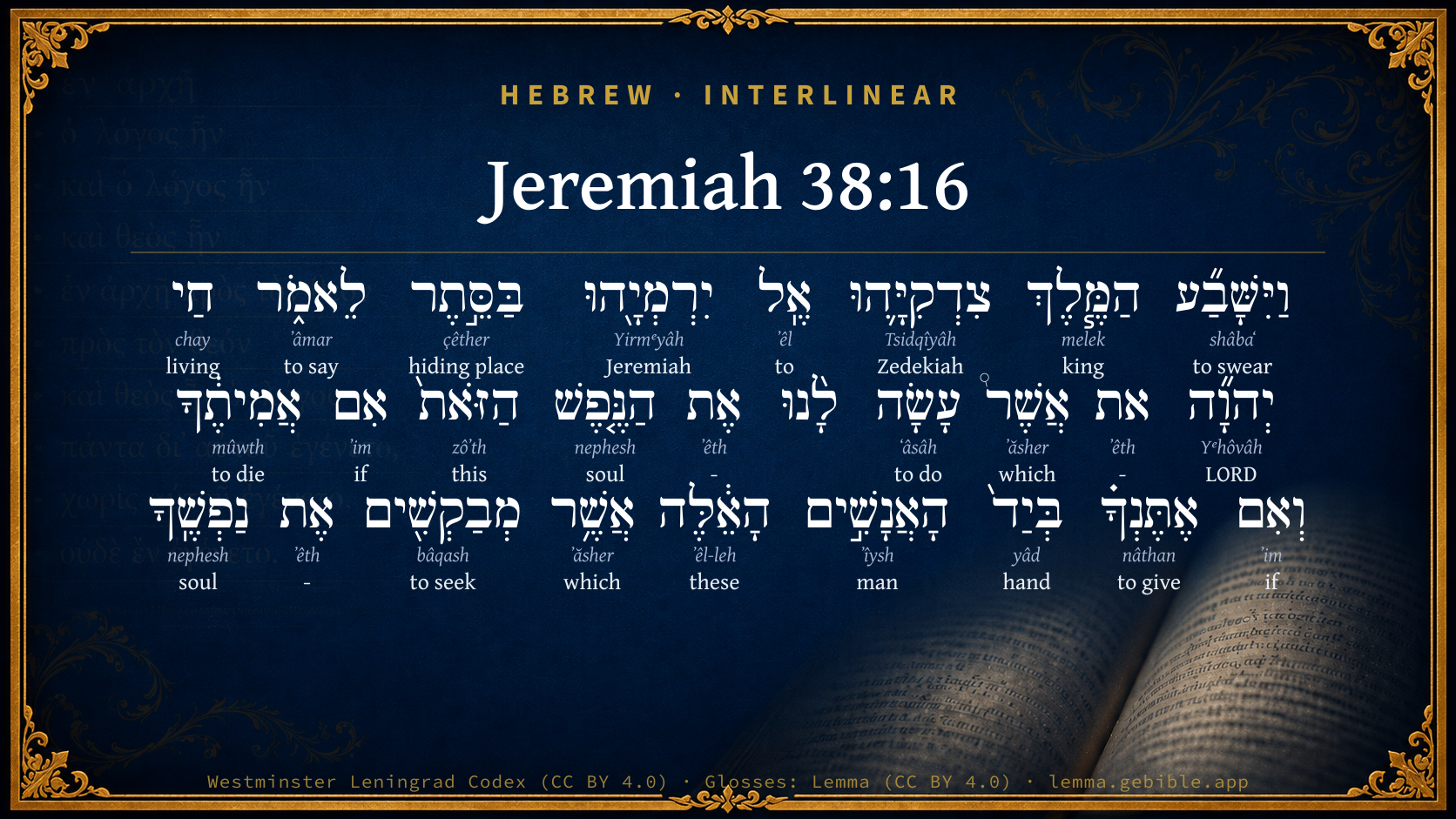
Hebrew (Westminster Leningrad Codex) Jeremiah 38:16 appears in the Hebrew Old Testament. The text above is from the Westminster Leningrad Codex. Each word links to its Strong’s number, a concise gloss, and parsing drawn from the Open Scriptures Hebrew Bible morphology. Click any word for its full Brown-Driver-Briggs (BDB) entry.
Download image
Cite this verse

Jeremiah 38:16 (World English Bible). Public Domain. Lemma interlinear Bible study tool, https://lemma.gebible.app/v/jeremiah/38/16.

Show BibTeX & RIS
BibTeX
RIS
English Translation
So Zedekiah the king swore secretly to Jeremiah, saying, As Yahweh lives, who made us this soul, I will not put you to death, neither will I give you into the hand of these men who seek your life.
World English Bible · Public Domain
Download a study sheet

One document with this verse’s original text, its word-by-word gloss line, the meaning frame, cross-references with their text, attributed commentary, and full source and license credits — printable, and it pastes into notes with its structure intact.

This verse Autodidact and up

Study sheet (.html) Plain text (.txt)

A passage Seminary Student

Up to 50 verses in one chapter. A passage sheet keeps up to 6 commentary sources and 12 cross-references per verse, in the order this page ranks them, and says so on the sheet whenever that leaves anything out. Ask for a single verse and you get the Autodidact verse sheet above.

Everything on this page stays free to read, with no account — the sheet is a download of what is already on screen, not access to it.

Want to remove ads? Support Godless Engineer
Compare translations 3

The same verse in 3 English versions, stacked beneath the original-language interlinear above. Click any original word for its lexicon entry.

Each is an independent rendering of the whole verse — the interlinear is not word-aligned to these translations.

Highlighted words mark where these versions differ — a whole-verse word diff, not a word-by-word alignment.

  • World English Bible Public Domain
    So Zedekiah the king swore secretly to Jeremiah, saying, As Yahweh lives, who made us this soul, I will not put you to death, neither will I give you into the hand of these men who seek your life.
  • King James Version Public Domain
    So Zedekiah the king sware secretly unto Jeremiah, saying, As the LORD liveth, that made us this soul, I will not put thee to death, neither will I give thee into the hand of these men that seek thy life.
  • unfoldingWord Literal Text CC BY-SA 4.0
    But King Zedekiah swore to Jeremiah in private and said, “As Yahweh lives, the one who made us, I will not kill you or give you into the hand of those men who are seeking your life.”

unfoldingWord Literal Text — © unfoldingWord, licensed CC BY-SA 4.0. Word-aligned USFM3 via Door43 (git.door43.org/unfoldingWord/en_ult).

Versions to compare (up to 4)

3 of 4 selected

Show all 18 translations

Every available English version of this verse, each an independent rendering of the whole verse.

  • World English Bible Public Domain
    So Zedekiah the king swore secretly to Jeremiah, saying, As Yahweh lives, who made us this soul, I will not put you to death, neither will I give you into the hand of these men who seek your life.
  • Berean Standard Bible Public Domain
    But King Zedekiah swore secretly to Jeremiah, “As surely as the LORD lives, who has given us this life, I will not kill you, nor will I deliver you into the hands of these men who are seeking your life.”
  • Majority Standard Bible Public Domain
    But King Zedekiah swore secretly to Jeremiah, “As surely as the LORD lives, who has given us this life, I will not kill you, nor will I deliver you into the hands of these men who are seeking your life.”
  • King James Version Public Domain
    So Zedekiah the king sware secretly unto Jeremiah, saying, As the LORD liveth, that made us this soul, I will not put thee to death, neither will I give thee into the hand of these men that seek thy life.
  • American Standard Version (1901) Public Domain
    So Zedekiah the king sware secretly unto Jeremiah, saying, As Jehovah liveth, that made us this soul, I will not put thee to death, neither will I give thee into the hand of these men that seek thy life.
  • Revised Version (1885) Public Domain
    So Zedekiah the king sware secretly unto Jeremiah, saying, As the LORD liveth, that made us this soul, I will not put thee to death, neither will I give thee into the hand of these men that seek thy life.
  • Geneva Bible (1599) Public Domain
    So the King sware secretly vnto Ieremiah, saying, As the Lord liueth that made vs these soules, I will not slay thee, nor giue thee into the hands of those men that seeke thy life.
  • Douay-Rheims (1899) Public Domain
    Then king Sedecias swore to Jeremias, in private, saying: As the Lord liveth, that made us this soul, I will not put thee to death, nor will I deliver thee into the hands of these men that seek thy life.
  • Young's Literal Translation Public Domain
    And the king Zedekiah sweareth unto Jeremiah in secret, saying, `Jehovah liveth, He who made for us this soul, I do not put thee to death, nor give thee unto the hand of these men who are seeking thy soul.'
  • Literal Standard Version CC BY-SA 4.0
    And King Zedekiah swears to Jeremiah in secret, saying, “YHWH lives, He who made this soul for us, I do not put you to death, nor give you into the hand of these men who are seeking your soul.”
  • Unlocked Literal Bible CC BY-SA 4.0
    But King Zedekiah swore to Jeremiah in private and said, “As Yahweh lives, the one who made us, I will not kill you or give you into the hand of those men who are seeking your life.”
  • unfoldingWord Literal Text CC BY-SA 4.0
    But King Zedekiah swore to Jeremiah in private and said, “As Yahweh lives, the one who made us, I will not kill you or give you into the hand of those men who are seeking your life.”
  • Darby Bible Public Domain
    And king Zedekiah swore secretly unto Jeremiah, saying, [As] Jehovah liveth, that made us this soul, I will not put thee to death, neither will I give thee into the hand of these men that seek thy life.
  • World Messianic Bible Public Domain
    So Zedekiah the king swore secretly to Jeremiah, saying, “As the LORD lives, who made our souls, I will not put you to death, neither will I give you into the hand of these men who seek your life.”
  • Webster's Bible Public Domain
    So Zedekiah the king swore secretly to Jeremiah, saying, As the LORD liveth, that made us this soul, I will not put thee to death, neither will I give thee into the hand of these men that seek thy life.
  • Free Bible Version CC BY-SA 4.0
    King Zedekiah solemnly promised Jeremiah in private, “As the Lord lives, who gave us this life, I won't have you killed, and I won't hand you over to those who want to kill you.”
  • Bible in Basic English Public Domain
    So King Zedekiah gave his oath to Jeremiah secretly, saying, By the living Lord, who gave us our life, I will not put you to death, or give you up to these men who are desiring to take your life.
  • JPS Tanakh (1917) Public Domain
    So Zedekiah the king swore secretly unto Jeremiah, saying: 'As the LORD liveth, that made us this soul, I will not put thee to death, neither will I give thee into the hand of these men that seek thy life.'

Literal Standard Version (2020), Covenant Press — licensed CC BY-SA 4.0. Text via the HelloAO Bible API (eBible.org). Unlocked Literal Bible (unfoldingWord) — licensed CC BY-SA 4.0. Text via the HelloAO Bible API (eBible.org). unfoldingWord Literal Text — © unfoldingWord, licensed CC BY-SA 4.0. Word-aligned USFM3 via Door43 (git.door43.org/unfoldingWord/en_ult). Free Bible Version, Dr. Jonathan Gallagher — licensed CC BY-SA 4.0. Text via the HelloAO Bible API (eBible.org).

Word by word

More ways to search: Search by grammar → Find every occurrence → Compare this word →

Practice this passage: Drill this verse → Learn its vocabulary →

בַּסֵּ֣תֶר
çêther
H5643
“in/at the · hiding place”
Preposition, Determined + Noun, Common, Masculine, Singular, Absolute
Part of Speech
Preposition + Noun
Type
Common
Gender
Masculine
Number
Singular
State
Absolute
Full BDB Definition

Origin: from H5641

TWOT: 1551a , 1551b

covering, shelter, hiding place, secrecy (noun masculine) - covering, cover - hiding place, shelter, secret place - secrecy - secrecy (of tongue being slanderous) - shelter, protection (noun feminine)
  1. וַיִּשָּׁבַ֞ע shâbaʻ H7650 “and · to swear” Conjunction + Verb, Niphal, Sequential Imperfect, 3rd Person, Masculine, Singular
  2. הַמֶּ֧לֶךְ melek H4428 “the · king” Particle, Definite Article + Noun, Common, Masculine, Singular, Absolute
  3. צִדְקִיָּ֛הוּ Tsidqîyâh H6667 “Zedekiah” Noun, Proper
  4. אֶֽל ʼêl H413 “to” Preposition
  5. יִרְמְיָ֖הוּ Yirmᵉyâh H3414 “Jeremiah” Noun, Proper
  6. לֵאמֹ֑ר ʼâmar H559 “to say” Preposition + Verb, Qal, Infinitive Construct
  7. חַי chay H2416 “living” Adjective, Adjective, Masculine, Singular, Absolute
  8. יְהוָ֞ה Yᵉhôvâh H3068 “LORD” Noun, Proper
  9. את ʼêth H853 “-” Particle, Direct Object
  10. אֲשֶׁר֩ ʼăsher H834 “which” Particle, Relative
  11. עָשָׂה ʻâsâh H6213 “to do” Verb, Qal, Perfect, 3rd Person, Masculine, Singular
  12. אֶת ʼêth H853 “-” Particle, Direct Object
  13. הַנֶּ֤פֶשׁ nephesh H5315 “the · soul” Particle, Definite Article + Noun, Common, Both, Singular, Absolute
  14. הַזֹּאת֙ zôʼth H2063 “the · this” Particle, Definite Article + Pronoun, Demonstrative, Feminine, Singular
  15. אִם ʼim H518 “if” Conjunction
  16. אֲמִיתֶ֔ךָ mûwth H4191 “to die · you” Verb, Hiphil, Imperfect, 1st Person, Common, Singular + Suffix, Personal, 2nd Person, Masculine, Singular
  17. וְאִם ʼim H518 “and · if” Conjunction + Conjunction
  18. אֶתֶּנְךָ֗ nâthan H5414 “to give · you” Verb, Qal, Imperfect, 1st Person, Common, Singular + Suffix, Personal, 2nd Person, Masculine, Singular
  19. בְּיַד֙ yâd H3027 “in/at · hand of” Preposition + Noun, Common, Both, Singular, Construct
  20. הָאֲנָשִׁ֣ים ʼîysh H376 “the · men” Particle, Definite Article + Noun, Common, Masculine, Plural, Absolute
  21. הָאֵ֔לֶּה ʼêl-leh H428 “the · these” Particle, Definite Article + Pronoun, Demonstrative, Common, Plural
  22. אֲשֶׁ֥ר ʼăsher H834 “which” Particle, Relative
  23. מְבַקְשִׁ֖ים bâqash H1245 “seeking” Verb, Piel, Participle Active, Masculine, Plural, Absolute
  24. אֶת ʼêth H853 “-” Particle, Direct Object
  25. נַפְשֶֽׁךָ nephesh H5315 “soul · your” Noun, Common, Both, Singular, Construct + Suffix, Personal, 2nd Person, Masculine, Singular

About this verse

These counts appear in no published source. They are computed here, from the morphology-tagged text and Lemma’s own curated glosses. What Lemma adds →

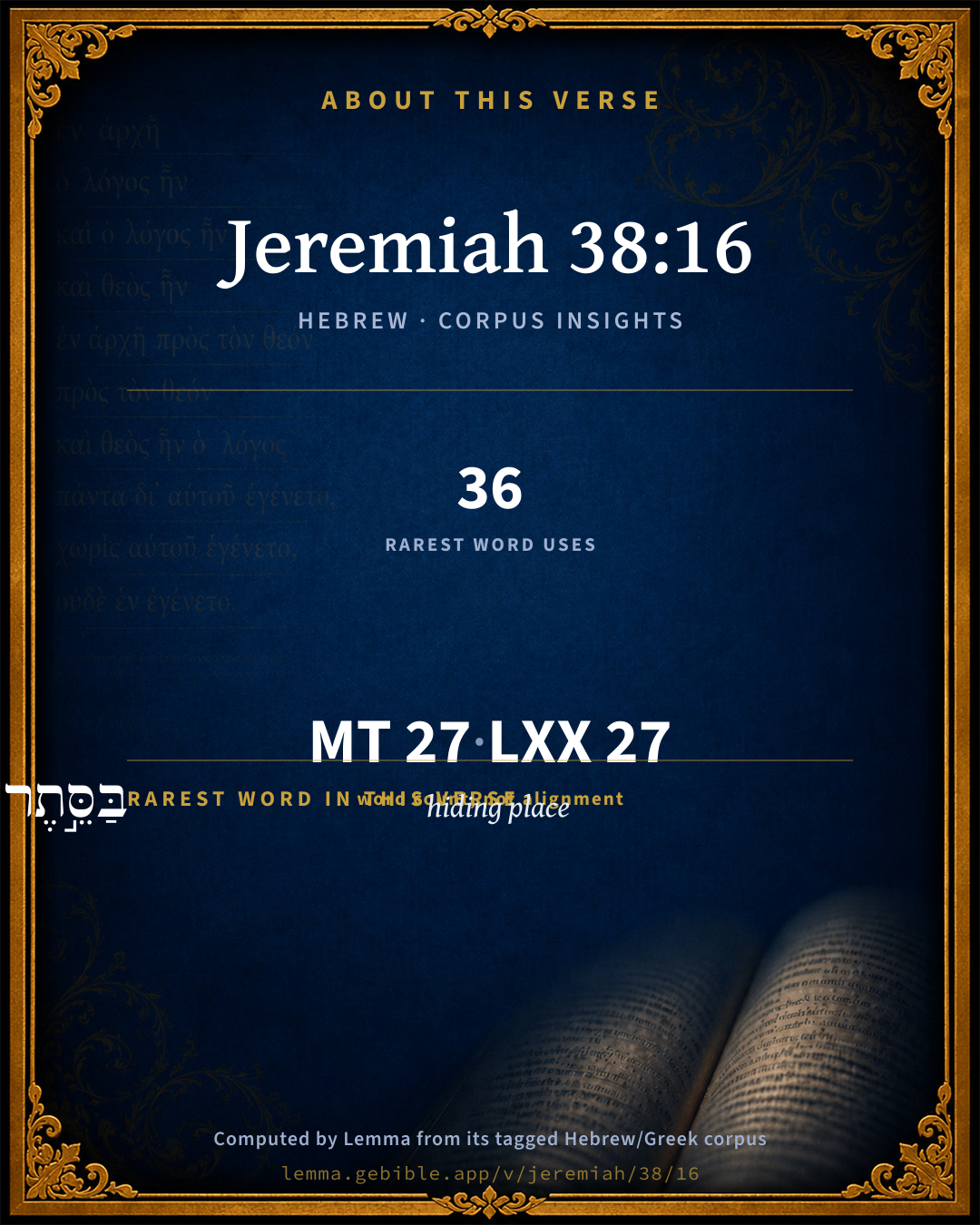
27
words
21
distinct lemmas
Prophets
section

Shared distinctive vocabulary

בַּסֵּ֣תֶר hiding place H5643 occurs in 36 verses of the Hebrew Bible. Also found in:

Grammatical profile

  • 6 verbs
  • 9 nouns
  • 1 adjective
  • 2 pronouns
  • 2 prepositions
  • 2 conjunctions
  • 5 particles

Verb forms

  • וַיִּשָּׁבַ֞ע Niphal · Sequential Imperfect
  • לֵאמֹ֑ר Qal · Infinitive Construct
  • עָשָׂה Qal · Perfect
  • אֲמִיתֶ֔ךָ Hiphil · Imperfect
  • אֶתֶּנְךָ֗ Qal · Imperfect
  • מְבַקְשִׁ֖ים Piel · Participle Active

Repetition

Words recur within this verse — often emphatic in Hebrew:

  • הַנֶּ֤פֶשׁ soul H5315 ×2
  • אֲשֶׁר֩ which H834 ×2
  • אִם if H518 ×2

Hebrew & Septuagint length

In the original languages it is 27 Hebrew tokens and 27 Greek tokens — but the two are counted differently (Hebrew bundles its prefixes and suffixes into one token; the Greek is in lemma form), so that isn’t a like-for-like length.

Cross-references

11

Topical passages linked to Jeremiah 38:16 in the Treasury of Scripture Knowledge — connected by theme and wording, ordered by reader-vote popularity; previews shown in the World English Bible.

  • Jeremiah 37:17 Then Zedekiah the king sent, and fetched him: and the king asked him secretly in his house, and said, Is there any word from Yahweh? Jeremiah said, There is. He said also, You shall be delivered into the hand of the king of Babylon.
  • Jeremiah 38:1–6 Shephatiah the son of Mattan, and Gedaliah the son of Pashhur, and Jucal the son of Shelemiah, and Pashhur the son of Malchijah, heard the words that Jeremiah spoke to all the people, saying,
  • Isaiah 57:16 For I will not contend forever, neither will I be always angry; for the spirit would faint before me, and the souls who I have made.
  • Zechariah 12:1 An oracle. The word of Yahweh concerning Israel. Yahweh, who stretches out the heavens, and lays the foundation of the earth, and forms the spirit of man within him says:
  • John 3:2 The same came to him by night, and said to him, "Rabbi, we know that you are a teacher come from God, for no one can do these signs that you do, unless God is with him."
  • Numbers 16:22 They fell on their faces, and said, God, the God of the spirits of all flesh, shall one man sin, and will you be angry with all the congregation?
  • Numbers 27:16 Let Yahweh, the God of the spirits of all flesh, appoint a man over the congregation,
  • Jeremiah 34:20 I will even give them into the hand of their enemies, and into the hand of those who seek their life; and their dead bodies shall be for food to the birds of the sky, and to the animals of the earth.
  • Ecclesiastes 12:7 And the dust returns to the earth as it was, And the spirit returns to God who gave it.
  • Isaiah 42:5 Thus says God Yahweh, he who created the heavens, and stretched them forth; he who spread abroad the earth and that which comes out of it; he who gives breath to the people on it, and spirit to those who walk therein:
  • Hebrews 12:9 Furthermore, we had the fathers of our flesh to chasten us, and we paid them respect. Shall we not much rather be in subjection to the Father of spirits, and live?

Cross-references courtesy of OpenBible.info (CC BY 4.0).

Hebrew and Greek witnesses Masoretic Hebrew ↔ Greek Septuagint

The same verse in the two great witnesses to the Old Testament, shown verse-for-verse.

These are two independent witnesses, not word-aligned to each other, and the Septuagint is shown in lemma (dictionary) form.

Hebrew Jeremiah 38:16 Masoretic · Westminster Leningrad Codex

וַיִּשָּׁבַ֞ע הַמֶּ֧לֶךְ צִדְקִיָּ֛הוּ אֶֽל יִרְמְיָ֖הוּ בַּסֵּ֣תֶר לֵאמֹ֑ר חַי יְהוָ֞ה את אֲשֶׁר֩ עָשָׂה לָ֨נוּ אֶת הַנֶּ֤פֶשׁ הַזֹּאת֙ אִם אֲמִיתֶ֔ךָ וְאִם אֶתֶּנְךָ֗ בְּיַד֙ הָאֲנָשִׁ֣ים הָאֵ֔לֶּה אֲשֶׁ֥ר מְבַקְשִׁ֖ים אֶת נַפְשֶֽׁךָ

So Zedekiah the king swore secretly to Jeremiah, saying, As Yahweh lives, who made us this soul, I will not put you to death, neither will I give you into the hand of these men who seek your life.

World English Bible · Public Domain

Greek LXX Structure differs

In the Septuagint, Jeremiah is about an eighth shorter than the Hebrew and arranges its material differently — the Oracles Against the Nations (Hebrew chapters 46–51) appear in the middle of the Greek book, after 25:13. Because the chapter and verse boundaries do not line up, a verse-for-verse comparison with the Hebrew is not shown.

A verse-for-verse comparison isn’t shown here because the chapters and verses don’t line up. Switch to the LXX edition with the MT / LXX toggle above to read the Greek directly.

Hebrew: Westminster Leningrad Codex (CC BY 4.0). Greek: Septuagint (public domain); English from a public-domain English Septuagint. How the Septuagint differs from the Hebrew →

Targum (Aramaic paraphrase)

1

The Targum is the ancient Jewish Aramaic paraphrase of the Hebrew Scriptures — an interpretive translation, not the Hebrew text itself. Onkelos (literal) and Pseudo-Jonathan (expansive) render the Torah, and Jonathan the Prophets. Coverage is partial: where no permissively-licensed English translation exists for a verse, only the Aramaic is shown. This is verse-level text, not a word-by-word alignment to the Hebrew.

  1. Targum Jonathan Prophets (Joshua–Malachi)
    וְקַיָם מַלְכָּא צִדְקִיָה לְיִרְמְיָה בְּסִתְרָא לְמֵימָר קַיָם הוּא יְיָ יַת דְקַיֵם לָנָא יַת נַפְשָׁתָא הָאִלֵין אִם אֶקְטְלִינָךְ וְאִם אֶמְסְרִינָךְ בְּיַד גַבְרַיָא הָאִלֵין דְבָעָן לְמִקְטְלָךְ:

    (no public-domain English translation for this verse)

    Targum Jonathan — Aramaic: “Mikraot Gedolot” (public domain). English: “Sefaria Community Translation” (CC0 1.0 (public-domain dedication)); “London "Chaldee Paraphrase," 1871” (public domain). Text via Sefaria.

Commentary

Notes on Jeremiah 38:16 from classic Christian and Jewish commentators (each source and its license shown beneath its notes). The classic Christian expositions comment on the surrounding passage and are grouped to its opening verse, so a note may address several verses; the Jewish commentaries on the Tanakh (Rashi and others) are per-verse, so they appear only where the commentator wrote on this verse.

Lemma curates 59 commentaries, every one of them public domain or Creative Commons licensed, each selected and text-cleaned for this edition rather than reprinted as found. About our sources →

Trapp's Complete Commentary

John Trapp

Jer 38:16 So Zedekiah the king sware secretly unto Jeremiah, saying, [As] the LORD liveth, that made us this soul, I will not put thee to death, neither will I give thee into the hand of these men that seek thy life.

Ver. 16. So the king Zedekiah sware secretly unto Jeremiah.] But what credit was to be given to his oath, who was notoriously known to be a perjured person, as having broken his oath of fidelity to Nebuchadnezzar?

As the Lord liveth, that made us this soul.] Hence the truth of that assertion is cleared up unto us, that men’s souls drop not down from heaven, nor are propagated by their parents, but are created by God, and infused into their bodies.

I will not put thee to death, neither will I, &c.] The former part of the prophet’s condition he sweareth to perform, but saith nothing to the latter, as having no such liking to it. So many come today to hear, who resolve to practise only so far as they see good.

John Trapp, A Commentary or Exposition upon All the Books of the Old and New Testament (1647–1656) — public domain. Text from a community e-Sword module.

Joseph Benson's Commentary

Jer 38:16. The king sware, As the Lord liveth, that made this soul — That is, who gave me my life and thee thine, and who, as he is the author, so he is the preserver, of our life and being: who may uphold or take them away as and when he pleases. I will not put thee to death, &c. — Zedekiah says nothing to the prophet as to obeying his counsel, but he gives him the security of his oath that he would neither himself slay him, by giving an immediate command from himself for his being slain, nor surrender him up into the hands of those princes who, he perceived, sought his life.

Joseph Benson's Commentary on the Old and New Testaments (1811–1818) — public domain. Text from a community e-Sword module.

Jamieson, Fausset & Brown

Robert Jamieson, A. R. Fausset & David Brown

Lord . . . made us this soul-- (Isa 57:16). Implying, "may my life (soul) be forfeited if I deceive thee" [CALVIN].

Jamieson, Fausset & Brown — Commentary Critical and Explanatory on the Whole Bible (1871) — public domain (CC PDM 1.0). Text via the HelloAO Bible API.

Adam Clarke's Commentary

Verse 16. As the Lord liveth, that made us this soul] He is the living God, and he is the Author of that life which each of us possesses; and as sure as he lives, and we live by him, I will not put thee to death, nor give thee into the hands of those men who seek thy life. A very solemn oath; and the first instance on record of the profane custom of swearing by the soul.

Adam Clarke's Commentary on the Bible (1810–1826) — public domain. Text from a community e-Sword/MySword module.

John Calvin's Commentaries

The king, desirous of having a new revelation, promised safety to the Prophet by an oath. He then swore that he would not take revenge, though he might be displeased with the Prophet’s answer he might indeed have conjectured, though Jeremiah had not expressly said anything, that the answer would be unfavorable, and by no means agreeable to his wishes. For if some pleasant and joyful oracle had been given to the Prophet, he would not have made a preface respecting his own danger, and the wrath of the king, and also respecting his obstinacy. Zedekiah then could have concluded, that nothing but what was sad could be expected. For this reason he made an oath, that whatever might be the answer, he would not be so offended as to cause any harm to the Prophet.

He said, I will not kill thee, nor deliver thee into the hand of those who seek thy life, that is, who are enemies to thy life: for to seek life is the same thing as to pursue man to death. It is a way of speaking that often occurs, especially in the Psalms. (Psalm 38:12; Psalm 40:14, 15.) Then he refers to the mortal enemies of Jeremiah: and he promises at the same time that he would, with undisturbed mind, receive whatever he might hear from the Prophet.

Let us notice the form of the oath, Live does Jehovah, who made for us this soul He first made an oath by the life of God, that is, by the immortal God. The word חי, chi, when applied to God, denotes a life different from what is in men or in brute animals; for men live by the will of another, that is, while God gives them life. It belongs then to God alone to live, for we do not live, nor move, nor have any being but in him, as Paul says, in Acts 17:28; and hence he teaches us in another place, that God alone is immortal. (1 Timothy 6:16) At the same time comprehended in this word is everything that peculiarly belongs to God; for God does not live to enjoy ease and indulge in idleness, but to govern the universe, to exercise his power throughout heaven and earth, to judge men, to render to every one his own just reward. Then life in God is not an idle life, as ungodly men imagine, but includes his infinite power, justice, wisdom, and all that peculiarly belongs to him. Whenever then we speak of the life of God, let us know that we do not live but through him, and also that he does not sit idly and carelessly in heaven, but that he governs the whole world, and is the judge of men.

According to this meaning, then, Zedekiah said, Live does Jehovah, and then he added, who made for us this soul. He expresses more clearly what I have already stated, and it is the same as though he had offered his own life before God as a pledge. He then prayed for the punishment of perjury on himself; for when he made an oath by God, the giver of life, it was the same as though he had said, “Let my life be forfeited, if I deceive thee, or turn false.” We hence see what is the end of an oath, even that God’s sacred name may be for us a pledge, that our word may be relied on. It hence follows, that God’s name, whenever we swear, cannot be taken with impunity: for we expose our life to his judgement, that he may revenge the wrong done to him; for his name, as it is sufficiently known, is profaned by perjuries. It now follows —

John Calvin's Commentaries (1540-1563) — public domain. Text from the Calvin Translation Society English edition (1840s-50s) via the Christian Classics Ethereal Library (ccel.org). Calvin's coverage is partial (roughly two-thirds of the Bible); uncommented books and verses are honest gaps, never fabricated. The 19th-century editor's footnotes and remarks are omitted so the notes are faithfully Calvin's own voice.

Ellicott's Commentary for English Readers

(16) As the Lord liveth, that made us this soul.—The formula of the oath was obviously intended to be one of unusual solemnity; more so even than the simpler form of “The Lord liveth” (Jer_16:14-15). The king swears by Jehovah as the living God, author and giver of his own life. The two-fold promise shows that the king felt the implied reproof of Jeremiah’s question. He separates himself from those who sought the prophet’s life, and declares that for the future he will not give them even the sanction of acquiescence. It is characteristic of his weakness that even now the oath is given secretly.

A Bible Commentary for English Readers, edited by Charles John Ellicott (1878–1897) — public domain. Text from a community e-Sword module.

The Cambridge Bible for Schools and Colleges

gen. ed. J. J. S. Perowne

16. that made us this soul] i.e. that gave us our life (cp. Isa_57:16), a form of oath suitable to the occasion when the prophet’s life was in danger.

The Cambridge Bible for Schools and Colleges (gen. ed. J. J. S. Perowne; Cambridge University Press, 1878–1918) — public domain. Text from a community e-Sword module.

John Gill's Exposition

So Zedekiah the king swore secretly unto Jeremiah,.... The king not only gave the prophet his word, but also annexed to it his oath, that his life should be in no danger, either from him or his princes; this oath was made secretly, both for the honour of the king, he swearing to a subject, and that it might not be known by the princes, and for fear of them:

saying, as the Lord liveth, that made us this soul; or "these souls", as the Targum: here a superfluous word, is used; which, as the Jews observe, is one of the eight words which are written, but not read: he swears by the living God, by whom only men should swear, whenever it is necessary; this is the proper form of an oath; the appeal is to be made to the eternal God, that knows all things, the Father of spirits, the Maker of souls, and giver of the lives of all men, and who can take them away when he pleases. The sense is, may the living God, who has made my soul and yours, and given life to us both, may he take away my soul, my life, from me, if ever I make any attempt upon yours;

I will not put thee to death, neither will I give thee into the hand of those that seek thy life; he not only promises and swears to it, that he would not take awake his life with his own hands, or give orders to take it away; but he would not deliver him into the hands of his princes, who he knew were implacable enemies, and sought all opportunities and advantages against him; but then he makes no promise that he will take any counsel or advice that should be given him; as to this, he would lay himself under no obligation to observe, resolving to take his own way; if he liked it, to follow it; if not, to reject it; he would not be bound by it.

John Gill's Exposition of the Whole Bible (1746–1763) — public domain (CC PDM 1.0). Text via the HelloAO Bible API.

Albert Barnes' Notes on the Bible

That made us this soul - This very unusual addition to the formula of an oath 1Sa 20:3 was intended to strengthen it. By acknowledging that his soul was God’s workmanship Zedekiah also implied his belief in God’s power over it.

Albert Barnes' Notes on the Bible (1834–1885) — public domain. Text from a community e-Sword/MySword module.

Matthew Poole's English Annotations

Zedekiah saith nothing to the latter part of Jeremiah’s speech, promising nothing as to his hearing and obeying his counsel: as to the former, he gives him the security of his oath, that he would neither himself slay him, by giving any immediate command from himself, nor surrender him up into the hands of those malicious princes who he perceived sought his life. The form of his oath is what was usual,

As the Lord liveth, with an addition, the Lord that gave me my life: If I put thee to death, and if I deliver thee; which form carrieth with it a concealed imprecation, Let the Lord do so to me, and more also; or, Let the Lord that gave me this soul take it from me, if I do either of these things. Thus he secures Jeremiah, as to any hard measure for his telling him the truth, though it should be what might be interpreted a capital crime to publish.

Matthew Poole's English Annotations on the Holy Bible (1683–1685) — public domain. Text from a community e-Sword/MySword module.

Whedon's Commentary on the Bible

Daniel D. Whedon

16. That made us this soul — An unusual addition to the formula of an oath.

Daniel D. Whedon (gen. ed.), Commentary on the Old and New Testaments (1874–1909) — public domain. Text from a community e-Sword module.

The Pulpit Commentary

That made us this soul. A very unusual formula. (comp. Isa_57:16)

The value of an oath.

The prophet of God evidently attributed such value, or he would not have asked of the king to make oath unto him. On the general subject note

I THE TEMPTATIONS TO GO FROM ONE"S WORD ARE OFTEN VERY NUMEROUS AND VERY STRONG. They were so in this case. Jeremiah knew what strong influence there was against him in the court of the king. He had suffered from this already. And he knew how weak and unstable the king was. Hence there was needed that which would steady and strengthen the wavering will. And there is often the like need now.

II BUT THE VALUE OF AN OATH LIES IN THE FACT THAT IT MEETS THIS NEED. It brings in the thought of God and of his displeasure. And does this in most solemn way. And it has around it human sanctions as well as Divine. And all this tends to strengthen conscience and to resist the temptation to untruth. As a fact, it is found that men who are careless about truth in an ordinary way hesitate much before they will disregard an oath. "An oath for confirmation is an end of all strife.

III IT IS BEST, HOWEVER, NOT TO NEED SUCH AID. Our Saviour has said, "Let your communication be, Yea, yea; Nay, nay; for whatsoever is more than these cometh of evil." The taking of oaths is allowed, as other practices, "for the hardness of men"s hearts." But for the Christian his word ought to be as sacred as his oath. He is no Christian if it be not. C.

The Pulpit Commentary (1880–1919), ed. H.D.M. Spence-Jones & Joseph S. Exell — public domain. Text from a community e-Sword module.

Lesson kit

Teaching starters — assembled from the data on this page, not authored interpretation. Every prompt links to the verse data it draws on. Edit before teaching.

Jeremiah, in the Prophets, opens this verse with 27 words (21 distinct Hebrew lemmas). Its most distinctive word is çêther (“hiding place”). A historical commentator’s framing appears above. Read the whole chapter for the surrounding context.

Discussion questions

  1. What does “hiding place” (çêther) contribute to the verse as a whole?
  2. How does Deuteronomy 13:6, which shares the word «hiding place», read alongside this verse?
  3. What does the repetition of “soul” (2× in this one verse) do in this verse?
  4. These translations render this verse differently. What is at stake in choosing one wording over another?
  5. «וַיִּשָּׁבַ֞ע» is a Niphal Sequential Imperfect verb. How does that grammatical form shape the action described?
  6. Compare how Trapp's Complete Commentary and Joseph Benson's Commentary read this verse. Where do they agree or differ?

Things to notice

Reading settings

Reading text

Shown beneath each verse's original-language words.

Old Testament
Old Testament edition

Read the OT as the Masoretic Hebrew (MT) or the Greek Septuagint (LXX).

English shown for the Greek Septuagint (in the Hebrew ↔ Greek comparison).

Comparing translations? Open the Compare panel on any verse page to stack up to four side by side.