
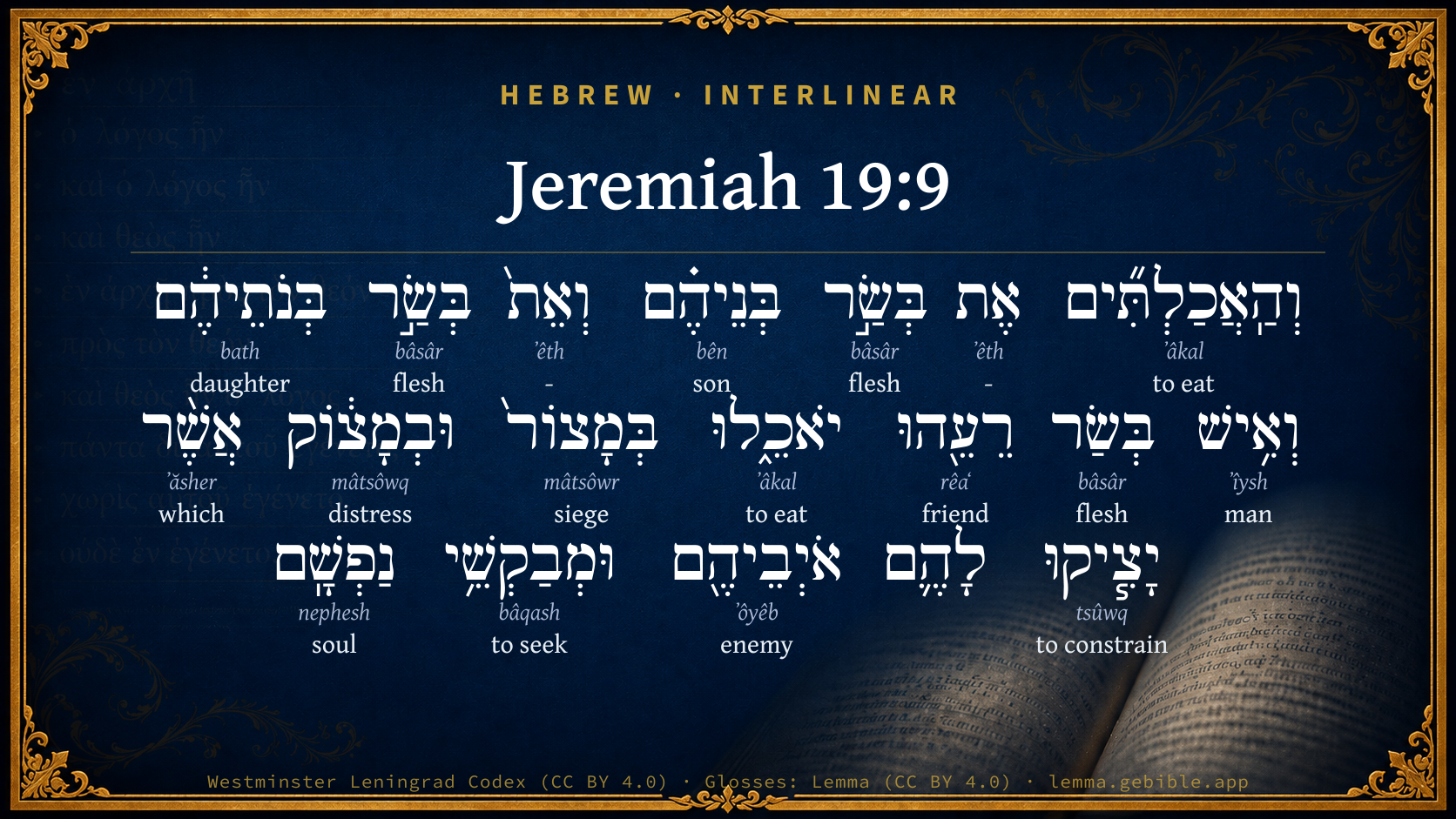
Jeremiah 19:9

Hebrew (Westminster Leningrad Codex) Jeremiah 19:9 appears in the Hebrew Old Testament. The text above is from the Westminster Leningrad Codex. Each word links to its Strong’s number, a concise gloss, and parsing drawn from the Open Scriptures Hebrew Bible morphology. Click any word for its full Brown-Driver-Briggs (BDB) entry.
Download image
Cite this verse

Jeremiah 19:9 (World English Bible). Public Domain. Lemma interlinear Bible study tool, https://lemma.gebible.app/v/jeremiah/19/9.

Show BibTeX & RIS
BibTeX
RIS
English Translation
I will cause them to eat the flesh of their sons and the flesh of their daughters; and they shall eat everyone the flesh of his friend, in the siege and in the distress, with which their enemies, and those who seek their life, shall distress them.
World English Bible · Public Domain
Download a study sheet

One document with this verse’s original text, its word-by-word gloss line, the meaning frame, cross-references with their text, attributed commentary, and full source and license credits — printable, and it pastes into notes with its structure intact.

This verse Autodidact and up

Study sheet (.html) Plain text (.txt)

A passage Seminary Student

Up to 50 verses in one chapter. A passage sheet keeps up to 6 commentary sources and 12 cross-references per verse, in the order this page ranks them, and says so on the sheet whenever that leaves anything out. Ask for a single verse and you get the Autodidact verse sheet above.

Everything on this page stays free to read, with no account — the sheet is a download of what is already on screen, not access to it.

Want to remove ads? Support Godless Engineer
Compare translations 3

The same verse in 3 English versions, stacked beneath the original-language interlinear above. Click any original word for its lexicon entry.

Each is an independent rendering of the whole verse — the interlinear is not word-aligned to these translations.

Highlighted words mark where these versions differ — a whole-verse word diff, not a word-by-word alignment.

  • World English Bible Public Domain
    I will cause them to eat the flesh of their sons and the flesh of their daughters; and they shall eat everyone the flesh of his friend, in the siege and in the distress, with which their enemies, and those who seek their life, shall distress them.
  • King James Version Public Domain
    And I will cause them to eat the flesh of their sons and the flesh of their daughters, and they shall eat every one the flesh of his friend in the siege and straitness, wherewith their enemies, and they that seek their lives, shall straiten them.
  • unfoldingWord Literal Text CC BY-SA 4.0
    And I will cause them to eat the flesh of their sons and the flesh of their daughters, and each man will eat the flesh of his neighbor in the siege and in the distress, with which their enemies and the seekers of their life will impose on them.’

unfoldingWord Literal Text — © unfoldingWord, licensed CC BY-SA 4.0. Word-aligned USFM3 via Door43 (git.door43.org/unfoldingWord/en_ult).

Versions to compare (up to 4)

3 of 4 selected

Show all 18 translations

Every available English version of this verse, each an independent rendering of the whole verse.

  • World English Bible Public Domain
    I will cause them to eat the flesh of their sons and the flesh of their daughters; and they shall eat everyone the flesh of his friend, in the siege and in the distress, with which their enemies, and those who seek their life, shall distress them.
  • Berean Standard Bible Public Domain
    I will make them eat the flesh of their sons and daughters, and they will eat one another’s flesh in the siege and distress inflicted on them by their enemies who seek their lives.’
  • Majority Standard Bible Public Domain
    I will make them eat the flesh of their sons and daughters, and they will eat one another’s flesh in the siege and distress inflicted on them by their enemies who seek their lives.’
  • King James Version Public Domain
    And I will cause them to eat the flesh of their sons and the flesh of their daughters, and they shall eat every one the flesh of his friend in the siege and straitness, wherewith their enemies, and they that seek their lives, shall straiten them.
  • American Standard Version (1901) Public Domain
    And I will cause them to eat the flesh of their sons and the flesh of their daughters; and they shall eat every one the flesh of his friend, in the siege and in the distress, wherewith their enemies, and they that seek their life, shall distress them.
  • Revised Version (1885) Public Domain
    And I will cause them to eat the flesh of their sons and the flesh of their daughters, and they shall eat every one the flesh of his friend, in the siege and in the straitness, wherewith their enemies, and they that seek their life, shall straiten them.
  • Geneva Bible (1599) Public Domain
    And I will feede the with the flesh of their sonnes and with the flesh of their daughters, and euery one shall eate the flesh of his friende in the siege and straitnesse, wherewith their enemies that seeke their liues, shall hold them strait.
  • Douay-Rheims (1899) Public Domain
    And I will feed them with the flesh of their sons, and with the flesh of their daughters: and they shall eat every one the flesh of his friend in the siege, and in the distress wherewith their enemies, and they that seek their lives shall straiten them.
  • Young's Literal Translation Public Domain
    And I have caused them to eat the flesh of their sons, and the flesh of their daughters, and each the flesh of his friend they do eat, in the siege and in the straitness with which straiten them do their enemies, and those seeking their life.
  • Literal Standard Version CC BY-SA 4.0
    And I have caused them to eat the flesh of their sons, and the flesh of their daughters, and they each eat the flesh of his friend, in the siege and in the constriction with which their enemies constrict them, and those seeking their life.”
  • Unlocked Literal Bible CC BY-SA 4.0
    I will make them eat the flesh of their sons and daughters; each man will consume the flesh of his neighbor in the siege and in the anguish brought on them by their enemies and the ones seeking their lives.”'
  • unfoldingWord Literal Text CC BY-SA 4.0
    And I will cause them to eat the flesh of their sons and the flesh of their daughters, and each man will eat the flesh of his neighbor in the siege and in the distress, with which their enemies and the seekers of their life will impose on them.’
  • Darby Bible Public Domain
    And I will cause them to eat the flesh of their sons and the flesh of their daughters, and they shall eat everyone the flesh of his friend, in the siege and in the straitness wherewith their enemies, and they that seek their lives, shall straiten them.
  • World Messianic Bible Public Domain
    I will cause them to eat the flesh of their sons and the flesh of their daughters. They will each eat the flesh of his friend in the siege and in the distress with which their enemies, and those who seek their life, will distress them.”’
  • Webster's Bible Public Domain
    And I will cause them to eat the flesh of their sons and the flesh of their daughters, and they shall eat every one the flesh of his friend in the siege and distress with which their enemies, and they that seek their lives, shall distress them.
  • Free Bible Version CC BY-SA 4.0
    The siege brought by their enemies who want to kill them will be so terrible that I will make them eat each other, even their own sons and daughters.
  • Bible in Basic English Public Domain
    I will make them take the flesh of their sons and the flesh of their daughters for food, they will be making a meal of one another, because of their bitter need and the cruel grip of their haters and those who have made designs against their life.
  • JPS Tanakh (1917) Public Domain
    and I will cause them to eat the flesh of their sons and the flesh of their daughters, and they shall eat every one the flesh of his friend, in the siege and in the straitness, wherewith their enemies, and they that seek their life, shall straiten them.

Literal Standard Version (2020), Covenant Press — licensed CC BY-SA 4.0. Text via the HelloAO Bible API (eBible.org). Unlocked Literal Bible (unfoldingWord) — licensed CC BY-SA 4.0. Text via the HelloAO Bible API (eBible.org). unfoldingWord Literal Text — © unfoldingWord, licensed CC BY-SA 4.0. Word-aligned USFM3 via Door43 (git.door43.org/unfoldingWord/en_ult). Free Bible Version, Dr. Jonathan Gallagher — licensed CC BY-SA 4.0. Text via the HelloAO Bible API (eBible.org).

Word by word

More ways to search: Search by grammar → Find every occurrence → Compare this word →

Practice this passage: Drill this verse → Learn its vocabulary →

וּבְמָצ֔וֹק
mâtsôwq
H4689
“and · in/at · distress”
Conjunction + Preposition + Noun, Common, Masculine, Singular, Absolute
Part of Speech
Conjunction + Preposition + Noun
Type
Common
Gender
Masculine
Number
Singular
State
Absolute
Full BDB Definition

Origin: from H6693

TWOT: 1895d

straitness, straits, distress, stress, anguish
  1. וְהַֽאֲכַלְתִּ֞ים ʼâkal H398 “and · to eat · them” Conjunction + Verb, Hiphil, Sequential Perfect, 1st Person, Common, Singular + Suffix, Personal, 3rd Person, Masculine, Plural
  2. אֶת ʼêth H853 “-” Particle, Direct Object
  3. בְּשַׂ֣ר bâsâr H1320 “flesh of” Noun, Common, Masculine, Singular, Construct
  4. בְּנֵיהֶ֗ם bên H1121 “sons · their” Noun, Common, Masculine, Plural, Construct + Suffix, Personal, 3rd Person, Masculine, Plural
  5. וְאֵת֙ ʼêth H853 “and · -” Conjunction + Particle, Direct Object
  6. בְּשַׂ֣ר bâsâr H1320 “flesh of” Noun, Common, Masculine, Singular, Construct
  7. בְּנֹתֵיהֶ֔ם bath H1323 “daughters · their” Noun, Common, Feminine, Plural, Construct + Suffix, Personal, 3rd Person, Masculine, Plural
  8. וְאִ֥ישׁ ʼîysh H376 “and · man” Conjunction + Noun, Common, Masculine, Singular, Absolute
  9. בְּשַׂר bâsâr H1320 “flesh of” Noun, Common, Masculine, Singular, Construct
  10. רֵעֵ֖הוּ rêaʻ H7453 “friend · his” Noun, Common, Masculine, Singular, Construct + Suffix, Personal, 3rd Person, Masculine, Singular
  11. יֹאכֵ֑לוּ ʼâkal H398 “to eat” Verb, Qal, Imperfect, 3rd Person, Masculine, Plural
  12. בְּמָצוֹר֙ mâtsôwr H4692 “in/at · siege” Preposition + Noun, Common, Masculine, Singular, Absolute
  13. אֲשֶׁ֨ר ʼăsher H834 “which” Particle, Relative
  14. יָצִ֧יקוּ tsûwq H6693 “to constrain” Verb, Hiphil, Imperfect, 3rd Person, Masculine, Plural
  15. אֹיְבֵיהֶ֖ם ʼôyêb H341 “enemy · them” Verb, Qal, Participle Active, Masculine, Plural, Construct + Suffix, Personal, 3rd Person, Masculine, Plural
  16. וּמְבַקְשֵׁ֥י bâqash H1245 “and · seeking” Conjunction + Verb, Piel, Participle Active, Masculine, Plural, Construct
  17. נַפְשָֽׁם nephesh H5315 “soul · their” Noun, Common, Both, Singular, Construct + Suffix, Personal, 3rd Person, Masculine, Plural

About this verse

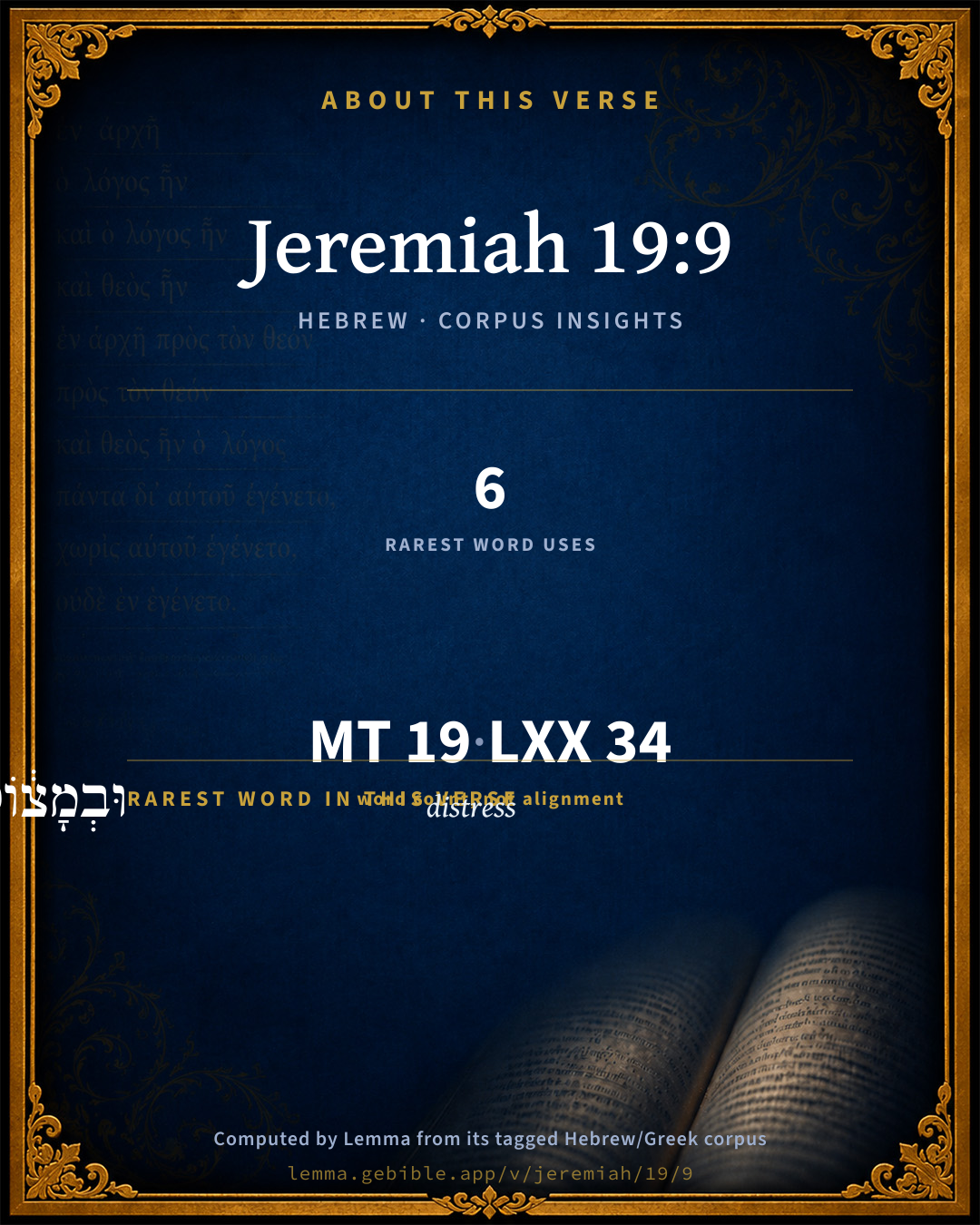
These counts appear in no published source. They are computed here, from the morphology-tagged text and Lemma’s own curated glosses. What Lemma adds →

19
words
14
distinct lemmas
Prophets
section

Notable vocabulary

The rarest word here is וּבְמָצ֔וֹק distress H4689 — appearing just 6 times in the whole Hebrew Bible.

Shared distinctive vocabulary

וּבְמָצ֔וֹק distress H4689 occurs in 6 verses of the Hebrew Bible. Also found in:

Grammatical profile

  • 5 verbs
  • 10 nouns
  • 1 preposition
  • 3 particles

Verb forms

  • וְהַֽאֲכַלְתִּ֞ים Hiphil · Sequential Perfect
  • יֹאכֵ֑לוּ Qal · Imperfect
  • יָצִ֧יקוּ Hiphil · Imperfect
  • אֹיְבֵיהֶ֖ם Qal · Participle Active
  • וּמְבַקְשֵׁ֥י Piel · Participle Active

Repetition

Words recur within this verse — often emphatic in Hebrew:

  • בְּשַׂ֣ר flesh H1320 ×3
  • וְהַֽאֲכַלְתִּ֞ים to eat H398 ×2

Hebrew & Septuagint length

In the original languages it is 19 Hebrew tokens and 34 Greek tokens — but the two are counted differently (Hebrew bundles its prefixes and suffixes into one token; the Greek is in lemma form), so that isn’t a like-for-like length.

Cross-references

7

Topical passages linked to Jeremiah 19:9 in the Treasury of Scripture Knowledge — connected by theme and wording, ordered by reader-vote popularity; previews shown in the World English Bible.

  • Isaiah 9:20 One shall snatch on the right hand, and be hungry; and he shall eat on the left hand, and they shall not be satisfied: they shall eat every man the flesh of his own arm:
  • Leviticus 26:29 You will eat the flesh of your sons, and you will eat the flesh of your daughters.
  • Lamentations 4:10 The hands of the pitiful women have boiled their own children; They were their food in the destruction of the daughter of my people.
  • Deuteronomy 28:53–57 You shall eat the fruit of your own body, the flesh of your sons and of your daughters, whom Yahweh your God has given you, in the siege and in the distress with which your enemies shall distress you.
  • Ezekiel 5:10 Therefore the fathers shall eat the sons in the midst of you, and the sons shall eat their fathers; and I will execute judgments on you; and the whole remnant of you will I scatter to all the winds.
  • 2 Kings 6:26–29 As the king of Israel was passing by on the wall, there cried a woman to him, saying, Help, my lord, O king.
  • Lamentations 2:20 Look, Yahweh, and see to whom you have done thus! Shall the women eat their fruit, the children that are dandled in the hands? Shall the priest and the prophet be killed in the sanctuary of the Lord?

Cross-references courtesy of OpenBible.info (CC BY 4.0).

Hebrew and Greek witnesses Masoretic Hebrew ↔ Greek Septuagint

The same verse in the two great witnesses to the Old Testament, shown verse-for-verse.

These are two independent witnesses, not word-aligned to each other, and the Septuagint is shown in lemma (dictionary) form.

Hebrew Jeremiah 19:9 Masoretic · Westminster Leningrad Codex

וְהַֽאֲכַלְתִּ֞ים אֶת בְּשַׂ֣ר בְּנֵיהֶ֗ם וְאֵת֙ בְּשַׂ֣ר בְּנֹתֵיהֶ֔ם וְאִ֥ישׁ בְּשַׂר רֵעֵ֖הוּ יֹאכֵ֑לוּ בְּמָצוֹר֙ וּבְמָצ֔וֹק אֲשֶׁ֨ר יָצִ֧יקוּ לָהֶ֛ם אֹיְבֵיהֶ֖ם וּמְבַקְשֵׁ֥י נַפְשָֽׁם

I will cause them to eat the flesh of their sons and the flesh of their daughters; and they shall eat everyone the flesh of his friend, in the siege and in the distress, with which their enemies, and those who seek their life, shall distress them.

World English Bible · Public Domain

Greek LXX Structure differs

In the Septuagint, Jeremiah is about an eighth shorter than the Hebrew and arranges its material differently — the Oracles Against the Nations (Hebrew chapters 46–51) appear in the middle of the Greek book, after 25:13. Because the chapter and verse boundaries do not line up, a verse-for-verse comparison with the Hebrew is not shown.

A verse-for-verse comparison isn’t shown here because the chapters and verses don’t line up. Switch to the LXX edition with the MT / LXX toggle above to read the Greek directly.

Hebrew: Westminster Leningrad Codex (CC BY 4.0). Greek: Septuagint (public domain); English from a public-domain English Septuagint. How the Septuagint differs from the Hebrew →

Targum (Aramaic paraphrase)

1

The Targum is the ancient Jewish Aramaic paraphrase of the Hebrew Scriptures — an interpretive translation, not the Hebrew text itself. Onkelos (literal) and Pseudo-Jonathan (expansive) render the Torah, and Jonathan the Prophets. Coverage is partial: where no permissively-licensed English translation exists for a verse, only the Aramaic is shown. This is verse-level text, not a word-by-word alignment to the Hebrew.

  1. Targum Jonathan Prophets (Joshua–Malachi)
    וְאוֹכְלִינוּן יַת בְּשַׂר בְּנֵיהוֹן וְיַת בְּשַׂר בְּנַתְהוֹן וּגְבַר נִכְסֵי קָרִיבֵיהּ יִבְזוּן בִּצְיָרָא וּבְעָקְתָא דִיעִיקוּן לְהוֹן בַּעֲלֵי דְבָבֵיהוֹן וּדְבָעָן לְמִקְטַלְהוֹן:

    (no public-domain English translation for this verse)

    Targum Jonathan — Aramaic: “Mikraot Gedolot” (public domain). English: “Sefaria Community Translation” (CC0 1.0 (public-domain dedication)); “London "Chaldee Paraphrase," 1871” (public domain). Text via Sefaria.

Commentary

Notes on Jeremiah 19:9 from classic Christian and Jewish commentators (each source and its license shown beneath its notes). The classic Christian expositions comment on the surrounding passage and are grouped to its opening verse, so a note may address several verses; the Jewish commentaries on the Tanakh (Rashi and others) are per-verse, so they appear only where the commentator wrote on this verse.

Lemma curates 59 commentaries, every one of them public domain or Creative Commons licensed, each selected and text-cleaned for this edition rather than reprinted as found. About our sources →

Trapp's Complete Commentary

John Trapp

Jer 19:9 And I will cause them to eat the flesh of their sons and the flesh of their daughters, and they shall eat every one the flesh of his friend in the siege and straitness, wherewith their enemies, and they that seek their lives, shall straiten them.

Ver. 9. And I will cause them to eat the flesh.] This, as it was threatened, {Lev 26:29 Deu 28:23} so accordingly accomplished. {Lam 2:20; Lam 4:10} Ptolemy Lathurus, king of Egypt, barbarously slew thirty thousand Jews, and forced the rest to feed upon the flesh of those that were slain.

John Trapp, A Commentary or Exposition upon All the Books of the Old and New Testament (1647–1656) — public domain. Text from a community e-Sword module.

Tyndale Open Study Notes

Tyndale Open Resources

19:9 The siege of Jerusalem lasted for two and a half years, resulting in severe famine and despair (see 2 Kgs 25:1-4). • their own sons and daughters: Cp. Deut 28:53-57.

Tyndale Open Study Notes — © Tyndale Open Resources, licensed CC BY-SA 4.0. Text via the HelloAO Bible API.

Jamieson, Fausset & Brown

Robert Jamieson, A. R. Fausset & David Brown

(Deu 28:53; Lam 4:10).

Jamieson, Fausset & Brown — Commentary Critical and Explanatory on the Whole Bible (1871) — public domain (CC PDM 1.0). Text via the HelloAO Bible API.

Adam Clarke's Commentary

Verse 9. I will cause them to eat the flesh of their sons] This was literally fulfilled when Jerusalem was besieged by the Romans. This also the prophet might have had in view.

Adam Clarke's Commentary on the Bible (1810–1826) — public domain. Text from a community e-Sword/MySword module.

John Calvin's Commentaries

Here the Prophet goes farther — that so atrocious would be the calamity, that even fathers and mothers would not abstain from their children, but would devour their flesh. This was indeed monstrous. It has sometimes happened that husbands, in a state of extreme despondency, have killed their wives and children, (anxious to exempt them from the lust of enemies,) or have kindled a fire in the midst of the forum, to cast their children and wives on the pile, and afterwards to die themselves; but it was more barbarous and brutal for a father to eat the flesh of his son. The Prophet then describes an unusual vengeance of God, which could not be classed among the calamities which usually happen to mankind.

We know that this was also done in the last siege of that city; for Josephus shews at large that mothers in a brutal manner slew their children, and that they so lay in wait for one another that they snatched at anything to eat. This was also an evidence of God’s dreadful vengeance.

But it was no wonder that God visited in such an awful manner the sins of those who had in such various ways, and for so long a time, provoked him; for if we compare the Jews with other nations, we shall find that their impiety, and ingratitude, and perverseness, exceeded the crimes of all nations. Then justly did God inflict such a punishment, which even at this day cannot be referred to without horror. The whole indeed is to be ascribed to his judgment; for it was he who fed the fathers with the flesh of their children; for as they had sacrificed their sons and their daughters to demons, as before stated, so it was necessary that the vengeance of God should be openly pointed out as by the finger. This was done when God imprinted marks on the bodies of children, which even the blind could not but perceive.

He adds, In the tribulation, and straightness with which their enemies shall straiten them. We have said that those who had been long besieged, and were not able to resist, have been often reduced to the necessity to freeing their wives, or their children, or themselves, from dishonor; but to protract life in the manner here mentioned was altogether brutal. It follows —

John Calvin's Commentaries (1540-1563) — public domain. Text from the Calvin Translation Society English edition (1840s-50s) via the Christian Classics Ethereal Library (ccel.org). Calvin's coverage is partial (roughly two-thirds of the Bible); uncommented books and verses are honest gaps, never fabricated. The 19th-century editor's footnotes and remarks are omitted so the notes are faithfully Calvin's own voice.

Ellicott's Commentary for English Readers

(9) I will cause them to eat . . .—Once again an echo, almost a quotation, from Deuteronomy (Deu_28:53). The woes of that memorable chapter had obviously furnished the prophet both with imagery and language. In Lam_2:20; Lam_4:10 we find proof of the fulfilment of the prediction. Thus, by the dread law of retribution, were the people to pay the penalty of their sin in the Melech sacrifices, in which they, sinning at once against natural affection and against the faith of their fathers, had slain their sons and daughters.

A Bible Commentary for English Readers, edited by Charles John Ellicott (1878–1897) — public domain. Text from a community e-Sword module.

The Cambridge Bible for Schools and Colleges

gen. ed. J. J. S. Perowne

9. The v. is taken from Deu_28:53. Cp. Lev_26:29. For the fulfilment see Lam_4:10.

The Cambridge Bible for Schools and Colleges (gen. ed. J. J. S. Perowne; Cambridge University Press, 1878–1918) — public domain. Text from a community e-Sword module.

John Gill's Exposition

And I will cause them to eat the flesh of their sons, and the flesh of their daughters,.... For want of food; the famine should be so great and pressing. Jeremiah, that foretells this, was a witness of it, and has left it on record, Lam 4:10;

and they shall eat everyone the flesh of his friend. The Targum interprets it, the goods or substance of his neighbour; which is sometimes the sense of eating the flesh of another; but as it is to be taken in a literal sense, in the preceding clause, so in this: so it should be,

in the siege and straitness, wherewith their enemies, and they that seek their lives, shall straiten them; the siege of Jerusalem should be so close, that no provision could be got in to the relief of the inhabitants; which obliged them to take the shocking methods before mentioned. Jerom observes, that though this was fulfilled at the Babylonish captivity, yet more fully when Jerusalem was besieged by Vespasian and Titus, and in the times of Hadrian. Josephus (q) gives us a most shocking relation of a woman eating her own son.

(q) De Bello Jud. l. 6. c. 3. sect. 4.

John Gill's Exposition of the Whole Bible (1746–1763) — public domain (CC PDM 1.0). Text via the HelloAO Bible API.

Haydock's Catholic Bible Commentary

Sons, to punish them for their cruel sacrifices. (St. Jerome) --- This was verified under Sedecias, Lamentations ii. 10., and iv. 10., and Ezechiel v. 10.

George Leo Haydock (1774–1849), Haydock's Catholic Family Bible and Commentary, 1859 edition — public domain. Excludes Psalms (Douay-Rheims chapter numbering differs from Protestant) and Deuterocanonical books (Catholic canon only).

Matthew Poole's English Annotations

These were the miserable effects or consequents of the famine with which God had often before threatened them, the just fulfilling of God’s word threatened Lev 26:29; Deu 28:53, and the accomplishment of which our prophet hath recorded, Lam 4:10.

Matthew Poole's English Annotations on the Holy Bible (1683–1685) — public domain. Text from a community e-Sword/MySword module.

Whedon's Commentary on the Bible

Daniel D. Whedon

9. Eat the flesh, etc. — Mainly from Deu_28:53, and Lev_26:29. Famine is added to complete the terrible picture. For the fulfilment, see Lam_2:20; Lam_4:10.

Daniel D. Whedon (gen. ed.), Commentary on the Old and New Testaments (1874–1909) — public domain. Text from a community e-Sword module.

The Pulpit Commentary

The same description, almost verbatim, is given in Deu_28:53; (comp. Lev_26:29 Eze_5:10) For the fulfillment, see Lam_4:10.

The Pulpit Commentary (1880–1919), ed. H.D.M. Spence-Jones & Joseph S. Exell — public domain. Text from a community e-Sword module.

Rashi

Rabbi Shlomo Yitzchaki (Rashi)

the straits An expression of pain, like צוקה.

Rashi on the Tanakh — English translations: “The Judaica Press complete Tanach with Rashi, translated by A. J. Rosenberg” (CC BY 4.0); “Pentateuch with Rashi's commentary by M. Rosenbaum and A.M. Silbermann, 1929-1934” (public domain); “The Metsudah Tanach series, Lakewood, N.J” (CC BY 4.0); and “The Book of Joshua, Metsudah Publications, 1997” (CC BY 4.0). Text via Sefaria.

Lesson kit

Teaching starters — assembled from the data on this page, not authored interpretation. Every prompt links to the verse data it draws on. Edit before teaching.

Jeremiah, in the Prophets, opens this verse with 19 words (14 distinct Hebrew lemmas). Its most distinctive word is mâtsôwq (“distress”). A historical commentator’s framing appears above. Read the whole chapter for the surrounding context.

Discussion questions

  1. What does “distress” (mâtsôwq) contribute to the verse as a whole?
  2. Deuteronomy 28:53 shares the word «distress» with this verse. How do the two illuminate each other?
  3. “flesh” occurs 3× in this one verse. What is the effect of the repetition?
  4. The translations on this page render this verse differently — a whole-verse word diff, not a word-by-word alignment. What might account for the different wordings?
  5. The verb «וְהַֽאֲכַלְתִּ֞ים» is Hiphil Sequential Perfect. How does its form color the action?
  6. Reading how Trapp's Complete Commentary and Tyndale Open Study Notes read this verse, where do the two commentators agree and where do they part?

Things to notice

Reading settings

Reading text

Shown beneath each verse's original-language words.

Old Testament
Old Testament edition

Read the OT as the Masoretic Hebrew (MT) or the Greek Septuagint (LXX).

English shown for the Greek Septuagint (in the Hebrew ↔ Greek comparison).

Comparing translations? Open the Compare panel on any verse page to stack up to four side by side.