

Proverbs 29:26

Hebrew (Westminster Leningrad Codex) Proverbs 29:26 appears in the Hebrew Old Testament. The text above is from the Westminster Leningrad Codex. Each word links to its Strong’s number, a concise gloss, and parsing drawn from the Open Scriptures Hebrew Bible morphology. Click any word for its full Brown-Driver-Briggs (BDB) entry.
Download image
Cite this verse

Proverbs 29:26 (World English Bible). Public Domain. Lemma interlinear Bible study tool, https://lemma.gebible.app/v/proverbs/29/26.

Show BibTeX & RIS
BibTeX
RIS
English Translation
Many seek the ruler's favor, But a man's justice comes from Yahweh.
World English Bible · Public Domain
Download a study sheet

One document with this verse’s original text, its word-by-word gloss line, the meaning frame, cross-references with their text, attributed commentary, and full source and license credits — printable, and it pastes into notes with its structure intact.

This verse Autodidact and up

Study sheet (.html) Plain text (.txt)

A passage Seminary Student

Up to 50 verses in one chapter. A passage sheet keeps up to 6 commentary sources and 12 cross-references per verse, in the order this page ranks them, and says so on the sheet whenever that leaves anything out. Ask for a single verse and you get the Autodidact verse sheet above.

Everything on this page stays free to read, with no account — the sheet is a download of what is already on screen, not access to it.

Want to remove ads? Support Godless Engineer
Compare translations 3

The same verse in 3 English versions, stacked beneath the original-language interlinear above. Click any original word for its lexicon entry.

Each is an independent rendering of the whole verse — the interlinear is not word-aligned to these translations.

Highlighted words mark where these versions differ — a whole-verse word diff, not a word-by-word alignment.

  • World English Bible Public Domain
    Many seek the ruler's favor, But a man's justice comes from Yahweh.
  • King James Version Public Domain
    Many seek the ruler's favour; but every man's judgment cometh from the LORD.
  • unfoldingWord Literal Text CC BY-SA 4.0
    Many those who seek the face of a ruler, but from Yahweh justice of a man.

unfoldingWord Literal Text — © unfoldingWord, licensed CC BY-SA 4.0. Word-aligned USFM3 via Door43 (git.door43.org/unfoldingWord/en_ult).

Versions to compare (up to 4)

3 of 4 selected

Show all 18 translations

Every available English version of this verse, each an independent rendering of the whole verse.

  • World English Bible Public Domain
    Many seek the ruler's favor, But a man's justice comes from Yahweh.
  • Berean Standard Bible Public Domain
    Many seek the ruler’s favor, but a man receives justice from the LORD.
  • Majority Standard Bible Public Domain
    Many seek the ruler’s favor, but a man receives justice from the LORD.
  • King James Version Public Domain
    Many seek the ruler's favour; but every man's judgment cometh from the LORD.
  • American Standard Version (1901) Public Domain
    Many seek the ruler's favor; But a man's judgment `cometh' from Jehovah.
  • Revised Version (1885) Public Domain
    Many seek the ruler’s favour: but a man’s judgment cometh from the LORD.
  • Geneva Bible (1599) Public Domain
    Many doe seeke the face of the ruler: but euery mans iudgement commeth from the Lord.
  • Douay-Rheims (1899) Public Domain
    Many seek the face of the prince: but the judgment of every one cometh forth from the Lord.
  • Young's Literal Translation Public Domain
    Many are seeking the face of a ruler, And from Jehovah `is' the judgment of each.
  • Literal Standard Version CC BY-SA 4.0
    Many are seeking the face of a ruler, || And the judgment of each [is] from YHWH.
  • Unlocked Literal Bible CC BY-SA 4.0
    Many are those who seek the face of the ruler, but from Yahweh is justice for a person.
  • unfoldingWord Literal Text CC BY-SA 4.0
    Many those who seek the face of a ruler, but from Yahweh justice of a man.
  • Darby Bible Public Domain
    Many seek the ruler's face; but a man's right judgment is from Jehovah.
  • World Messianic Bible Public Domain
    Many seek the ruler’s favor, but a man’s justice comes from the LORD.
  • Webster's Bible Public Domain
    Many seek the ruler's favor; but every man's judgment cometh from the LORD.
  • Free Bible Version CC BY-SA 4.0
    Many people look for favors from a ruler, but justice comes from the Lord.
  • Bible in Basic English Public Domain
    The approval of a ruler is desired by great numbers: but the decision in a man's cause comes from the Lord.
  • JPS Tanakh (1917) Public Domain
    Many seek the ruler's favour; but a man's judgment cometh from the LORD.

Literal Standard Version (2020), Covenant Press — licensed CC BY-SA 4.0. Text via the HelloAO Bible API (eBible.org). Unlocked Literal Bible (unfoldingWord) — licensed CC BY-SA 4.0. Text via the HelloAO Bible API (eBible.org). unfoldingWord Literal Text — © unfoldingWord, licensed CC BY-SA 4.0. Word-aligned USFM3 via Door43 (git.door43.org/unfoldingWord/en_ult). Free Bible Version, Dr. Jonathan Gallagher — licensed CC BY-SA 4.0. Text via the HelloAO Bible API (eBible.org).

Word by word

More ways to search: Search by grammar → Find every occurrence → Compare this word →

Practice this passage: Drill this verse → Learn its vocabulary →

About this verse

These counts appear in no published source. They are computed here, from the morphology-tagged text and Lemma’s own curated glosses. What Lemma adds →

7
words
7
distinct lemmas
Wisdom
section

Grammatical profile

  • 2 verbs
  • 4 nouns
  • 1 adjective

Verb forms

  • מְבַקְשִׁ֣ים Piel · Participle Active
  • מוֹשֵׁ֑ל Qal · Participle Active

Hebrew & Septuagint length

In English translation the verse runs 12 words from the Hebrew and 16 from the Septuagint (LXX English) — closely comparable.

A rough comparison of the two English renderings, which tokenize alike — not a word-level alignment.

Word counts can differ between the Hebrew and the Greek without any difference in meaning — e.g. the Hebrew direct-object marker אֵת has no separate Greek word, and Greek often adds the article ὁ.

In the original languages it is 7 Hebrew tokens and 11 Greek tokens — but the two are counted differently (Hebrew bundles its prefixes and suffixes into one token; the Greek is in lemma form), so that isn’t a like-for-like length.

Cross-references

14

Topical passages linked to Proverbs 29:26 in the Treasury of Scripture Knowledge — connected by theme and wording, ordered by reader-vote popularity; previews shown in the World English Bible.

  • Proverbs 19:6 Many will entreat the favor of a ruler, And everyone is a friend to a man who gives gifts.
  • Psalms 20:9 Save, Yahweh; Let the King answer us when we call!
  • Proverbs 19:21 There are many plans in a man's heart, But Yahweh's counsel will prevail.
  • Psalms 62:12 Also to you, Lord, belongs loving kindness, For you reward every man according to his work.
  • Isaiah 46:9–11 Remember the former things of old: for I am God, and there is none else; [I am] God, and there is none like me;
  • Genesis 43:14 May God Almighty give you mercy before the man, that he may release to you your other brother and Benjamin. If I am bereaved of my children, I am bereaved."
  • Ezra 7:27–28 Blessed be Yahweh, the God of our fathers, who has put such a thing as this in the king's heart, to beautify the house of Yahweh which is in Jerusalem;
  • Nehemiah 1:11 Lord, I beg you, let now your ear be attentive to the prayer of your servant, and to the prayer of your servants, who delight to fear your name; and please prosper your servant this day, and grant him mercy in the sight of this man. Now I was cup bearer to the king.
  • Esther 4:16 Go, gather together all the Jews who are present in Shushan, and fast you for me, and neither eat nor drink three days, night or day: I also and my maidens will fast in like manner; and so will I go in to the king, which is not according to the law: and if I perish, I perish.
  • Proverbs 16:7 When a man's ways please Yahweh, He makes even his enemies to be at peace with him.
  • Isaiah 49:4 But I said, I have labored in vain, I have spent my strength for nothing and vanity; yet surely the justice [due] to me is with Yahweh, and my recompense with my God.
  • Daniel 4:35 All the inhabitants of the earth are reputed as nothing; and he does according to his will in the army of heaven, and among the inhabitants of the earth; and none can stay his hand, or tell him, What do you?
  • 1 Corinthians 4:4 For I know nothing against myself. Yet I am not justified by this, but he who judges me is the Lord.
  • Proverbs 21:1 The king's heart is in Yahweh's hand like the watercourses. He turns it wherever he desires.

Cross-references courtesy of OpenBible.info (CC BY 4.0).

Hebrew and Greek witnesses Masoretic Hebrew ↔ Greek Septuagint

The same verse in the two great witnesses to the Old Testament, shown verse-for-verse.

These are two independent witnesses, not word-aligned to each other, and the Septuagint is shown in lemma (dictionary) form.

Hebrew Proverbs 29:26 Masoretic · Westminster Leningrad Codex

רַ֭בִּים מְבַקְשִׁ֣ים פְּנֵי מוֹשֵׁ֑ל וּ֝מֵיְהוָ֗ה מִשְׁפַּט אִֽישׁ

Many seek the ruler's favor, But a man's justice comes from Yahweh.

World English Bible · Public Domain

Greek LXX Proverbs 29:26 Septuagint · lemma form

πολύς θεραπεύω πρόσωπον ἡγέομαι παρά δέ κύριος γίγνομαι ὁ δίκαιος ἀνήρ

Many wait on the favor of rulers; but justice comes to a man from the Lord.

LXX2012 (modern English Septuagint) · Public Domain

On this verse, Keil & Delitzsch discusses the Septuagint’s reading. Read the note in Commentary ↓

Hebrew: Westminster Leningrad Codex (CC BY 4.0). Greek: Septuagint (public domain); English from LXX2012 (modern English Septuagint) (Public Domain). How the Septuagint differs from the Hebrew →

Commentary

Notes on Proverbs 29:26 from classic Christian and Jewish commentators (each source and its license shown beneath its notes). The classic Christian expositions comment on the surrounding passage and are grouped to its opening verse, so a note may address several verses; the Jewish commentaries on the Tanakh (Rashi and others) are per-verse, so they appear only where the commentator wrote on this verse.

Lemma curates 59 commentaries, every one of them public domain or Creative Commons licensed, each selected and text-cleaned for this edition rather than reprinted as found. About our sources →

Trapp's Complete Commentary

John Trapp

Pro 29:26 Many seek the ruler’s favour; but [every] man’s judgment [cometh] from the LORD.

Ver. 26. Many seek the ruler’s favour.] More than the love of God; and so cast themselves into a second "snare," besides that [of] Pro 29:25. But as he that truly trusts in God will easily expel the fear of man: so he that looks upon God as Judge of all, from whose sentence there is no appeal, will rather seek his face than the favour of any earthly judge whatsoever. Especially since, whether the judge clear him or cast him, the judgment he passeth is from the Lord.

John Trapp, A Commentary or Exposition upon All the Books of the Old and New Testament (1647–1656) — public domain. Text from a community e-Sword module.

Joseph Benson's Commentary

Pro 29:26. Many seek the ruler’s favour — Men study to please their rulers, and to ensure their favour, by their obliging behaviour, humble petitions, and various other means, supposing that to be the only way to procure either right or preferment; but every man’s judgment cometh from the Lord — The decision of his cause, and the success of all his endeavours, depend wholly upon God, who rules and inclines the minds and hearts of princes and governors, as well as of other men, as it pleaseth him.

Joseph Benson's Commentary on the Old and New Testaments (1811–1818) — public domain. Text from a community e-Sword module.

Geneva Bible (1599)

Geneva Bible translators

He needeth not to flatter the ruler: for what God hath appointed, that shall come to him.

Geneva Bible (1599) marginal notes — public domain. Text via Bolls.life.

Matthew Henry's Commentary

See here, 1. What is the common course men take to advance and enrich themselves, and make themselves great: they seek the ruler's favour, and, as if all their judgment proceeded from him, to him they make all their court. Solomon was himself a ruler, and knew with what sedulity men made their application to him, some on one errand, others on another, but all for his favour. It is the way of the world to make interest with great men, and expect much from the smiles of second causes, which yet are uncertain, and frequently disappoint them. Many take a great deal of pains in seeking the ruler's favour and yet cannot have it; many have it for a little while, but they cannot keep themselves in it, by some little turn or other they are brought under his displeasure; many have it, and keep it, and yet it does not answer their expectation, they cannot make that hand of it that they promised themselves they should. Haman had the ruler's favour, and yet it availed him nothing. 2. What is the wisest course men can take to be happy. Let them look up to God, and seek the favour of the Ruler of rulers; for every man's judgment proceeds from the Lord. It is not with us as the ruler pleases; his favour cannot make us happy, his frowns cannot make us miserable. But it is as God pleases; every creature is that to us that God makes it to be, no more and no other. He is the first Cause, on which all second causes depend; if he help not, they cannot, Kg2 6:27; Job 34:29.

Matthew Henry's Commentary on the Whole Bible (1708–1710) — public domain (CC PDM 1.0). Text via the HelloAO Bible API.

Jamieson, Fausset & Brown

Robert Jamieson, A. R. Fausset & David Brown

(Compare Margin; Psa 27:8). God alone will and can do exact justice.

Jamieson, Fausset & Brown — Commentary Critical and Explanatory on the Whole Bible (1871) — public domain (CC PDM 1.0). Text via the HelloAO Bible API.

Adam Clarke's Commentary

Verse 26. Many seek the ruler's favour] To be screened from the punishment determined by the law; but should he grant the favour sought, and pardon the criminal, this takes not away his guilt in the sight of God, from whom all just judgment proceeds.

Adam Clarke's Commentary on the Bible (1810–1826) — public domain. Text from a community e-Sword/MySword module.

Ellicott's Commentary for English Readers

(26) Many seek the ruler’s favour.—And to be advanced by him; but his approval is of little value, for “every man’s judgment cometh from the Lord;” it is He who really decides each man’s worth. (Comp. 1Sa_16:7; 1Co_4:5.)

A Bible Commentary for English Readers, edited by Charles John Ellicott (1878–1897) — public domain. Text from a community e-Sword module.

John Gill's Exposition

Many seek the ruler's favour,.... Or "face" (e); are very desirous of being admitted into his presence, and of having his company and conversation; of having an opportunity to ask a favour of him, and of receiving honour from him, and of gaining him on their side, to take their part in a cause depending; see Pro 19:6;

but every man's judgment cometh from the Lord; who has the hearts of kings and rulers in his hand, and directs them in bestowing their favours, and in determining causes; so that all things are ultimately from the Lord; and therefore it is best to seek unto him, and trust in him: or the state and condition and circumstances of men, as to riches and honour, and the like, are all from the Lord, according as he sees fit; who sets up one and pulls down another, according to his pleasure.

(e) "faciem", V. L. Pagninus, Vatablus, Tigurine version, Junius & Tremellius, so Michaelis, Schultens.

John Gill's Exposition of the Whole Bible (1746–1763) — public domain (CC PDM 1.0). Text via the HelloAO Bible API.

Albert Barnes' Notes on the Bible

To trust in the favor of princes is to build upon the sands. The judgment which will set right all wrong will come from the Lord. It is better to wait for that than to run here and there, canvassing, bribing, flattering.

Albert Barnes' Notes on the Bible (1834–1885) — public domain. Text from a community e-Sword/MySword module.

Matthew Poole's English Annotations

Seek the ruler’s favour: men study to please and engage their rulers by their obliging carriage, and humble petitions, and all other means, supposing that to be the only way to procure either right or favour from them, as they need or desire it.

Every man’s judgment, the decision of his cause, and the success of all his endeavours,

cometh from the Lord; dependeth wholly upon God, who ruleth and inclineth their minds and hearts as it pleaseth him, Pro 21:1.

Matthew Poole's English Annotations on the Holy Bible (1683–1685) — public domain. Text from a community e-Sword/MySword module.

Whedon's Commentary on the Bible

Daniel D. Whedon

26. The ruler’s favour — Literally, the face of the ruler. Judgment —His sentence, the decision or determination of his cause. “This proverb may denote that the judicial sentence which the ruler gives depends upon God, who controls the disposition and will of rulers as he pleases; (comp. Pro_16:33; Pro_21:1;) also, that while many repair to rulers in order to obtain their favour by flattery, it is God only who will and can do perfect justice; and, more generally, that every man’s condition and success in life depend more upon the fear of God, than upon the favour of rulers.” — Muenscher. “Look more to Jehovah and less to rulers.” Compare Pro_19:6; 1Ki_10:24.

Daniel D. Whedon (gen. ed.), Commentary on the Old and New Testaments (1874–1909) — public domain. Text from a community e-Sword module.

The Pulpit Commentary

Many seek the ruler"s favour; literally, the countenance of the ruler. A variation of Pro_19:6. There are numbers who are always trying, by means fair or surreptitious, to curry favour with a great man who has anything to bestow. (comp. 1Ki_10:24 Psa_45:12) But every man"s judgment cometh from the Lord. The real and only reliable judgment comes, not from an earthly prince (who may be prejudiced and is certainly fallible), but from the Lord, whose approval or disapproval is final and indisputable. Therefore one should seek to please him rather than any man, however great and powerful. (comp. 1Sa_16:7 Isa_49:4 1Co_4:5)

The supreme Arbiter.

I IT IS A COMMON MISTAKE TO ASCRIBE TO MAN THE INFLUENCE WHICH BELONGS ONLY TO GOD. In the previous verse we have been warned against falling into the snare of the fear of man, and encouraged to find our safety in trust in God. A similar contrast is again presented to us, but from the opposite side. We are tempted to flatter the great in order to win their favour; but we are now reminded that our destiny does not lie in their hands, but in the hands of One who is supreme in judgment, though his rule is too often ignored by us. Helena, in "All"s Well that ends Well," says"It is not so with him that all things knows, As "tis with us that square our guess by shows; But most it is presumption in us when The help of Heaven we count the act of men.

1. This common mistake arises partly from the fact that the human influence is visible, while that of God is unseen. The molehill at our feet thus seems to be more important than the mountain that bounds our horizon but is wrapped in mist.

2. It is also caused by the further fact that much of God"s judgment is postponed. We do not yet experience the full effect of the Divine arbitrament.

II GOD"S JUDGMENT WILL BE EXPERIENCED BY EVERY MAN. He is not only the Arbiter of the fate of those who call in his aid; he is the "Judge of all the earth". (Gen_18:25) Abraham recognized the fact that God was the Judge of Sodom and Gomorrah, though no doubt the wicked cities of the plain utterly repudiated his authority. The godless will be judged by God. Those men who do not choose to put their case in the hands of God will nevertheless receive their sentence from him.

III IT IS GOOD NEWS FOR THE WORLD THAT GOD IS THE SUPREME ARBITER. This is not set before us as a truth of terror. On the contrary, it is declared as a great consolation among the ills of life.

1. God is just. He is perfectly fair, utterly impartial. no Respecter of persons. Rich and poor stand on equal grounds before his judgment seat.

2. God is wise. The most acute human judge may be deceived. But he that searcheth the heart knows all facts about all men. His judgment must be based on truth.

3. God is strong. He is able to execute his sentence. When he declares what is right, he will also establish his judgment.

IV IT IS WELL FOR MEN TO ACKNOWLEDGE GOD AS THEIR ARBITER. We shall all have to submit to his judgment in the end. It would be wise for us to acknowledge his rule throughout life. Surely it is most fatally foolish to labour for the favour even of the most influential men, if this involves disregarding the thoughts and will of God. The verdict of the lower court will be overridden by the judgment of the higher court. Therefore what is most incumbent on all men is to see that they are right and straight in the eyes of the One supreme Judge. By sin, as we must acknowledge, we are all wrong in his eyes. Therefore no human favour can save us till we have been put right and justified through the grace at Christ.

The Pulpit Commentary (1880–1919), ed. H.D.M. Spence-Jones & Joseph S. Exell — public domain. Text from a community e-Sword module.

John Wesley's Explanatory Notes

Judgment - The decision of his cause, and the success of all his endeavours.

John Wesley, Explanatory Notes Upon the Whole Bible (1754–1765) — public domain. Text via the GEBible commentary corpus.

Keil & Delitzsch

C. F. Keil & F. Delitzsch

A similar gen. connection to that between חרדת אדם exists between משׁפט־אישׁ:

Many seek the countenance of the ruler;

Yet from Jahve cometh the judgment of men.

Line first is a variation of Pro 19:6, cf. Kg1 10:24. It lies near to interpret אישׁ as gen. obj.: the judgment regarding any one, i.e., the estimating of the man, the decision regarding him; and it is also possible, for משׁפּטי, Psa 17:2, may be understood of the judgment which I have, as well as of the judgment pronounced regarding me (cf. Lam 3:59). But the usage appears to think of the genit. after משׁפט always as subjective, e.g., Pro 16:33, of the decision which the lot brings, Job 36:6, the right to which the poor have a claim; so that thus in the passage before us משׁפט־אשׁ means the right of a man, as that which is proper or fitting to him, the judgment of a man, as that to which as appropriate he has a claim (lxx τὸ δίκαιον ἀνδρί). Whether the genit. be rendered in the one way or the other, the meaning remains the same: it is not the ruler who finally decides the fate and determines the worth of a man, as they appear to think who with eye-service court his favour and fawn upon him.

Keil & Delitzsch — Biblical Commentary on the Old Testament (1861–1891) — public domain (CC PDM 1.0). Text via the HelloAO Bible API. (Old Testament only.)

Bridges on Proverbs

Charles Bridges

Therefore seek God to be your friend. "In his favor is life." (Psa 30:5 .) Confidence in man is no less sinful†1 and dangerous†2 than the fear of man. Yet with what diligence will men seek earthly advantage! Many seek the ruler’s favor†3 more than God’s, and sacrifice their consciences, and hazard their souls, to obtain it. But when they have bought it at such a price, what is it? — as easily lost, as it was hardly gained. The caprice of an hour may destroy the hard-earned object. (Gen 40:1-2 .) And then what have they to live upon? All this is forgetting, that every man’s judgment cometh from the LORD. Here then is the solid ground of faith. First, begin with God; all judgment is in his hands. "Commit thy way unto the LORD; trust also in him, and he shall bring it to pass."†4 Let him choose and dispose our lot.†5 Consider everything that passes as coming from him. In everything, great and small, deal with him. Ponder with him. His favor, unlike the changing favor of the ruler, "is without variableness, or shadow of turning." And when, through the fickleness of man, earthly prospects are fading, then rest in quiet — "Surely my judgment is with the LORD."†6 ’As thou wilt, what thou wilt, when thou wilt.’†7 This is the shortest, the surest, way of peace — "Only believe."

Footnotes:

†1 Psa 146:3. Isa 2:22 . Jer 17:5-6 .

†2 Isa 30:1-3; Isa 31:1-3 .

†3 Pro 19:6.

†4 Psa 37:5-6. ’He needeth not to flatter the ruler; for what God hath appointed, that shall come to him.’ - Reformer’s Notes. ’The determination concerning a man is from Jehovah.’ - Bp. Lowth’s Prelim. Dissertation to Isaiah.

†5 Psa 47:4. Pro 16:33 .

†6 Isa 49:4. Job 34:29 .

†7 Thomas à Kempis.

Charles Bridges, An Exposition of the Book of Proverbs (1846) — public domain. Text from a community e-Sword module.

Rashi

Rabbi Shlomo Yitzchaki (Rashi)

the countenance of a ruler to litigate before him.

but the judgment of a person Any [judgment], whether he will be adjudged innocent or guilty. Scripture [here] speaks of the gentile kings.

Rashi on the Tanakh — English translations: “The Judaica Press complete Tanach with Rashi, translated by A. J. Rosenberg” (CC BY 4.0); “Pentateuch with Rashi's commentary by M. Rosenbaum and A.M. Silbermann, 1929-1934” (public domain); “The Metsudah Tanach series, Lakewood, N.J” (CC BY 4.0); and “The Book of Joshua, Metsudah Publications, 1997” (CC BY 4.0). Text via Sefaria.

Lesson kit

Teaching starters — assembled from the data on this page, not authored interpretation. Every prompt links to the verse data it draws on. Edit before teaching.

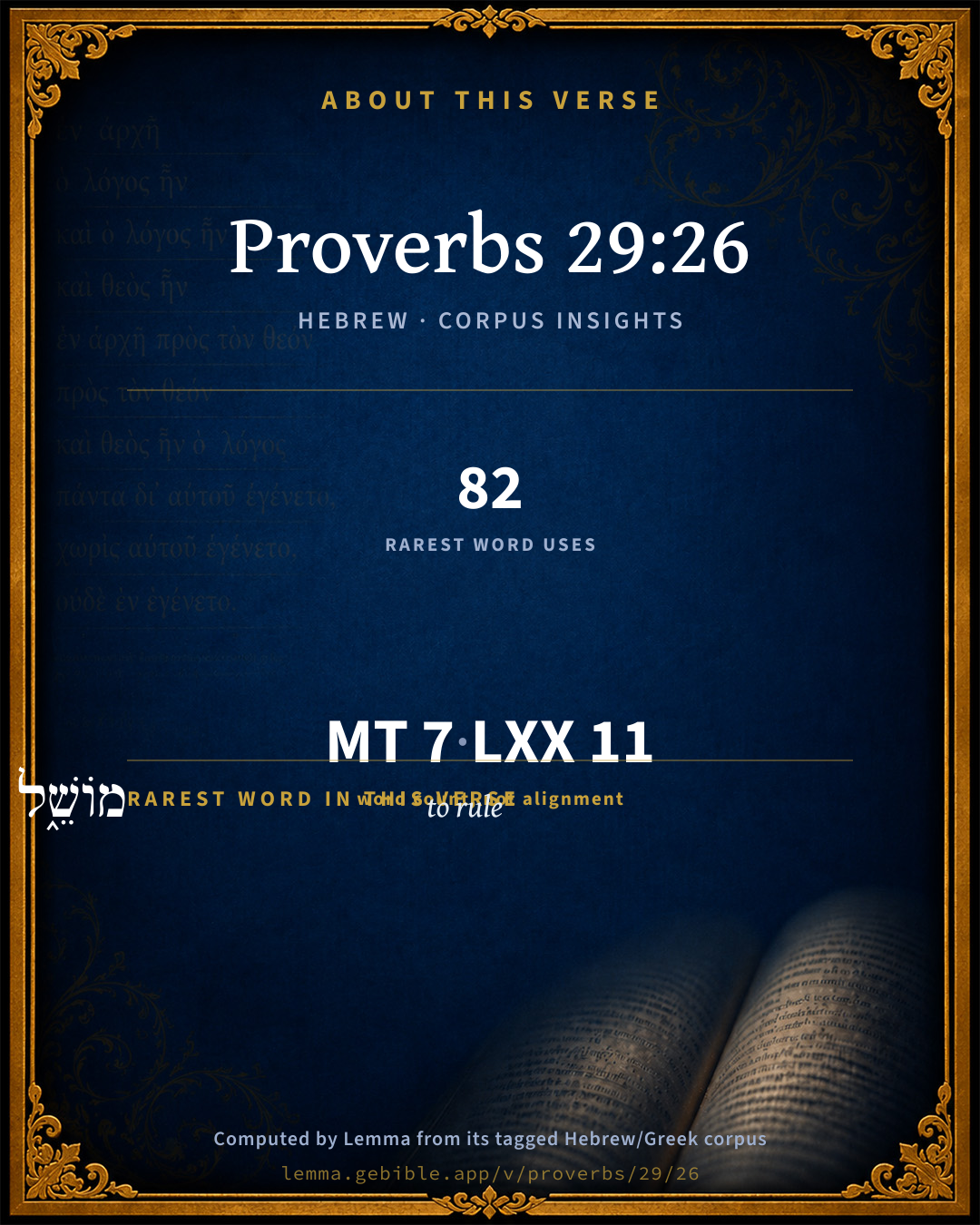
Proverbs, in the Wisdom, opens this verse with 7 words (7 distinct Hebrew lemmas). Its most distinctive word is mâshal (“to rule”). A historical commentator’s framing appears above. Read the whole chapter for the surrounding context.

Discussion questions

  1. How does “to rule” (mâshal) shape what this verse is saying?
  2. Proverbs 19:6 shares this passage’s theme. How do the two illuminate each other?
  3. The translations on this page render this verse differently — a whole-verse word diff, not a word-by-word alignment. What might account for the different wordings?
  4. The verb «מְבַקְשִׁ֣ים» is Piel Participle Active. How does its form color the action?
  5. Reading how Trapp's Complete Commentary and Joseph Benson's Commentary read this verse, where do the two commentators agree and where do they part?

Things to notice

Reading settings

Reading text

Shown beneath each verse's original-language words.

Old Testament
Old Testament edition

Read the OT as the Masoretic Hebrew (MT) or the Greek Septuagint (LXX).

English shown for the Greek Septuagint (in the Hebrew ↔ Greek comparison).

Comparing translations? Open the Compare panel on any verse page to stack up to four side by side.