
Jeremiah 50:20

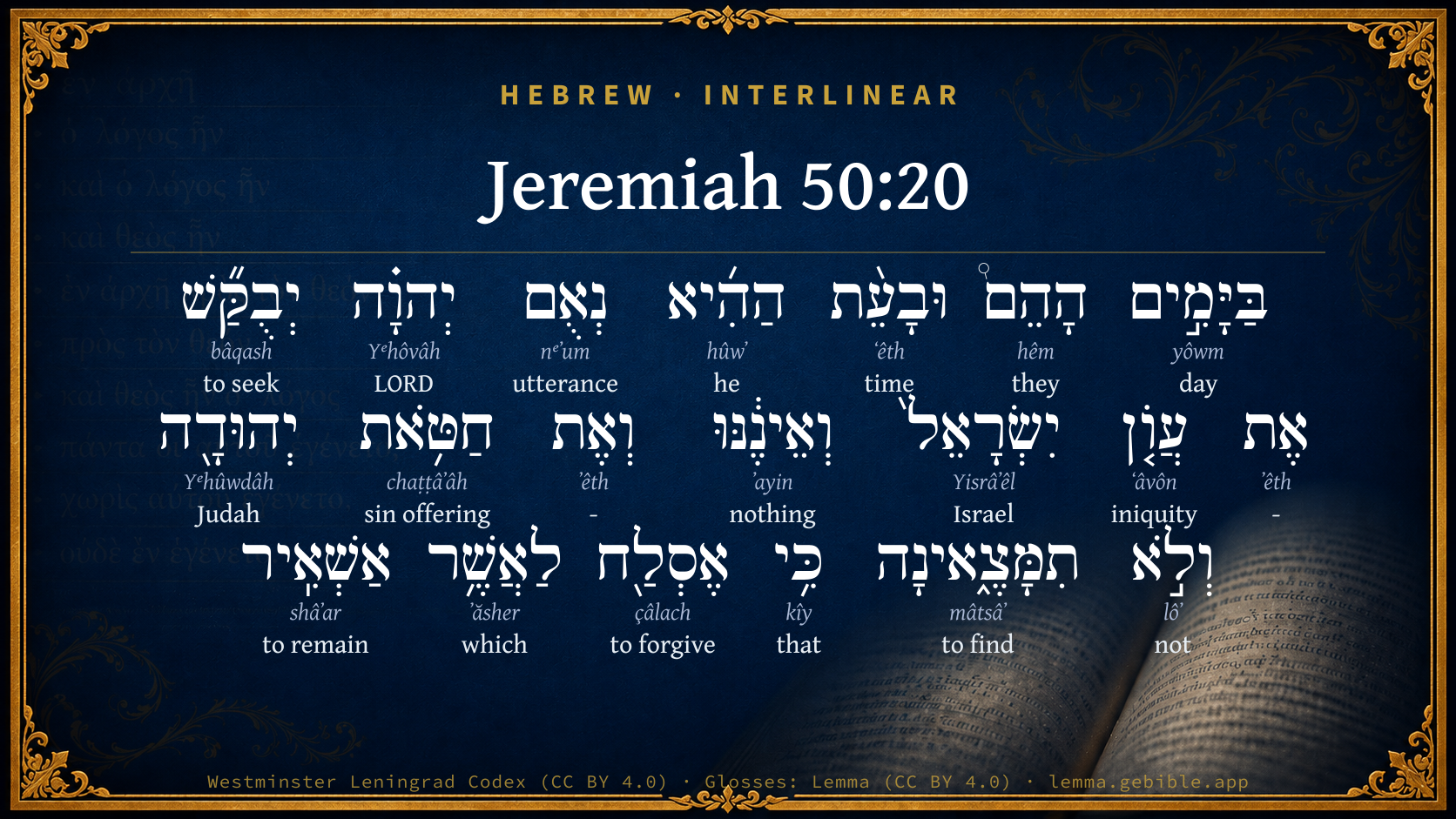
Hebrew (Westminster Leningrad Codex) Jeremiah 50:20 appears in the Hebrew Old Testament. The text above is from the Westminster Leningrad Codex. Each word links to its Strong’s number, a concise gloss, and parsing drawn from the Open Scriptures Hebrew Bible morphology. Click any word for its full Brown-Driver-Briggs (BDB) entry.
Download image
Cite this verse

Jeremiah 50:20 (World English Bible). Public Domain. Lemma interlinear Bible study tool, https://lemma.gebible.app/v/jeremiah/50/20.

Show BibTeX & RIS
BibTeX
RIS
English Translation
In those days, and in that time, says Yahweh, the iniquity of Israel shall be sought for, and there shall be none; and the sins of Judah, and they shall not be found: for I will pardon them whom I leave as a remnant.
World English Bible · Public Domain
Download a study sheet

One document with this verse’s original text, its word-by-word gloss line, the meaning frame, cross-references with their text, attributed commentary, and full source and license credits — printable, and it pastes into notes with its structure intact.

This verse Autodidact and up

Study sheet (.html) Plain text (.txt)

A passage Seminary Student

Up to 50 verses in one chapter. A passage sheet keeps up to 6 commentary sources and 12 cross-references per verse, in the order this page ranks them, and says so on the sheet whenever that leaves anything out. Ask for a single verse and you get the Autodidact verse sheet above.

Everything on this page stays free to read, with no account — the sheet is a download of what is already on screen, not access to it.

Want to remove ads? Support Godless Engineer
Compare translations 3

The same verse in 3 English versions, stacked beneath the original-language interlinear above. Click any original word for its lexicon entry.

Each is an independent rendering of the whole verse — the interlinear is not word-aligned to these translations.

Highlighted words mark where these versions differ — a whole-verse word diff, not a word-by-word alignment.

  • World English Bible Public Domain
    In those days, and in that time, says Yahweh, the iniquity of Israel shall be sought for, and there shall be none; and the sins of Judah, and they shall not be found: for I will pardon them whom I leave as a remnant.
  • King James Version Public Domain
    In those days, and in that time, saith the LORD, the iniquity of Israel shall be sought for, and there shall be none; and the sins of Judah, and they shall not be found: for I will pardon them whom I reserve.
  • unfoldingWord Literal Text CC BY-SA 4.0
    In those days and at that time, says Yahweh, iniquity will be looked for in Israel, but none will be found. I will inquire about the sins of Judah, but none will be found, for I will forgive the remnant that I spare.”

unfoldingWord Literal Text — © unfoldingWord, licensed CC BY-SA 4.0. Word-aligned USFM3 via Door43 (git.door43.org/unfoldingWord/en_ult).

Versions to compare (up to 4)

3 of 4 selected

Show all 18 translations

Every available English version of this verse, each an independent rendering of the whole verse.

  • World English Bible Public Domain
    In those days, and in that time, says Yahweh, the iniquity of Israel shall be sought for, and there shall be none; and the sins of Judah, and they shall not be found: for I will pardon them whom I leave as a remnant.
  • Berean Standard Bible Public Domain
    In those days and at that time, declares the LORD, a search will be made for Israel’s guilt, but there will be none, and for Judah’s sins, but they will not be found; for I will forgive the remnant I preserve.
  • Majority Standard Bible Public Domain
    In those days and at that time, declares the LORD, a search will be made for Israel’s guilt, but there will be none, and for Judah’s sins, but they will not be found; for I will forgive the remnant I preserve.
  • King James Version Public Domain
    In those days, and in that time, saith the LORD, the iniquity of Israel shall be sought for, and there shall be none; and the sins of Judah, and they shall not be found: for I will pardon them whom I reserve.
  • American Standard Version (1901) Public Domain
    In those days, and in that time, saith Jehovah, the iniquity of Israel shall be sought for, and there shall be none; and the sins of Judah, and they shall not be found: for I will pardon them whom I leave as a remnant.
  • Revised Version (1885) Public Domain
    In those days, and in that time, saith the LORD, the iniquity of Israel shall be sought for, and there shall be none; and the sins of Judah, and they shall not be found: for I will pardon them whom I leave as a remnant.
  • Geneva Bible (1599) Public Domain
    In those daies, and at that time, sayeth the Lord, the iniquitie of Israel shall be sought for, and there shall be none: and the sinnes of Iudah, and they shall not be founde: for I will be mercifull vnto them, whome I reserue.
  • Douay-Rheims (1899) Public Domain
    In those days, and at that time, saith the Lord, the iniquity of Israel shall be sought for, and there shall be none: and the sin of Juda, and there shall none be found: for I will be merciful to them, whom I shall leave.
  • Young's Literal Translation Public Domain
    In those days, and at that time, An affirmation of Jehovah, Sought is the iniquity of Israel, and it is not, And the sin of Judah, and it is not found, For I am propitious to those whom I leave!
  • Literal Standard Version CC BY-SA 4.0
    In those days, and at that time,” || A declaration of YHWH, || “The iniquity of Israel is sought, and it is not, || And the sin of Judah, and it is not found, || For I am propitious to those whom I leave!
  • Unlocked Literal Bible CC BY-SA 4.0
    In those days and at that time, says Yahweh, iniquity will be looked for in Israel, but none will be found. I will inquire about the sins of Judah, but none will be found, for I will forgive the remnant that I spare.”
  • unfoldingWord Literal Text CC BY-SA 4.0
    In those days and at that time, says Yahweh, iniquity will be looked for in Israel, but none will be found. I will inquire about the sins of Judah, but none will be found, for I will forgive the remnant that I spare.”
  • Darby Bible Public Domain
    In those days, and at that time, saith Jehovah, the iniquity of Israel shall be sought for, and there shall be none; and the sins of Judah, and they shall not be found: for I will pardon those whom I leave remaining.
  • World Messianic Bible Public Domain
    In those days, and in that time,” says the LORD, “the iniquity of Israel will be sought for, and there will be none, also the sins of Judah, and they won’t be found; for I will pardon them whom I leave as a remnant.
  • Webster's Bible Public Domain
    In those days, and in that time, saith the LORD, the iniquity of Israel shall be sought for, and there shall be none; and the sins of Judah, and they shall not be found: for I will pardon them whom I reserve.
  • Free Bible Version CC BY-SA 4.0
    This will be when the guilt and the sins of Israel and Judah will be looked for, but none will be found, because I will forgive those people who remain that I'm looking after, declares the Lord.
  • Bible in Basic English Public Domain
    In those days and in that time, says the Lord, when the evil-doing of Israel is looked for, there will be nothing; and in Judah no sins will be seen: for I will have forgiveness for those whom I will keep safe.
  • JPS Tanakh (1917) Public Domain
    In those days, and in that time, saith the LORD, the iniquity of Israel shall be sought for, and there shall be none, and the sins of Judah, and they shall not be found; for I will pardon them whom I leave as a remnant.

Literal Standard Version (2020), Covenant Press — licensed CC BY-SA 4.0. Text via the HelloAO Bible API (eBible.org). Unlocked Literal Bible (unfoldingWord) — licensed CC BY-SA 4.0. Text via the HelloAO Bible API (eBible.org). unfoldingWord Literal Text — © unfoldingWord, licensed CC BY-SA 4.0. Word-aligned USFM3 via Door43 (git.door43.org/unfoldingWord/en_ult). Free Bible Version, Dr. Jonathan Gallagher — licensed CC BY-SA 4.0. Text via the HelloAO Bible API (eBible.org).

Word by word

More ways to search: Search by grammar → Find every occurrence → Compare this word →

Practice this passage: Drill this verse → Learn its vocabulary →

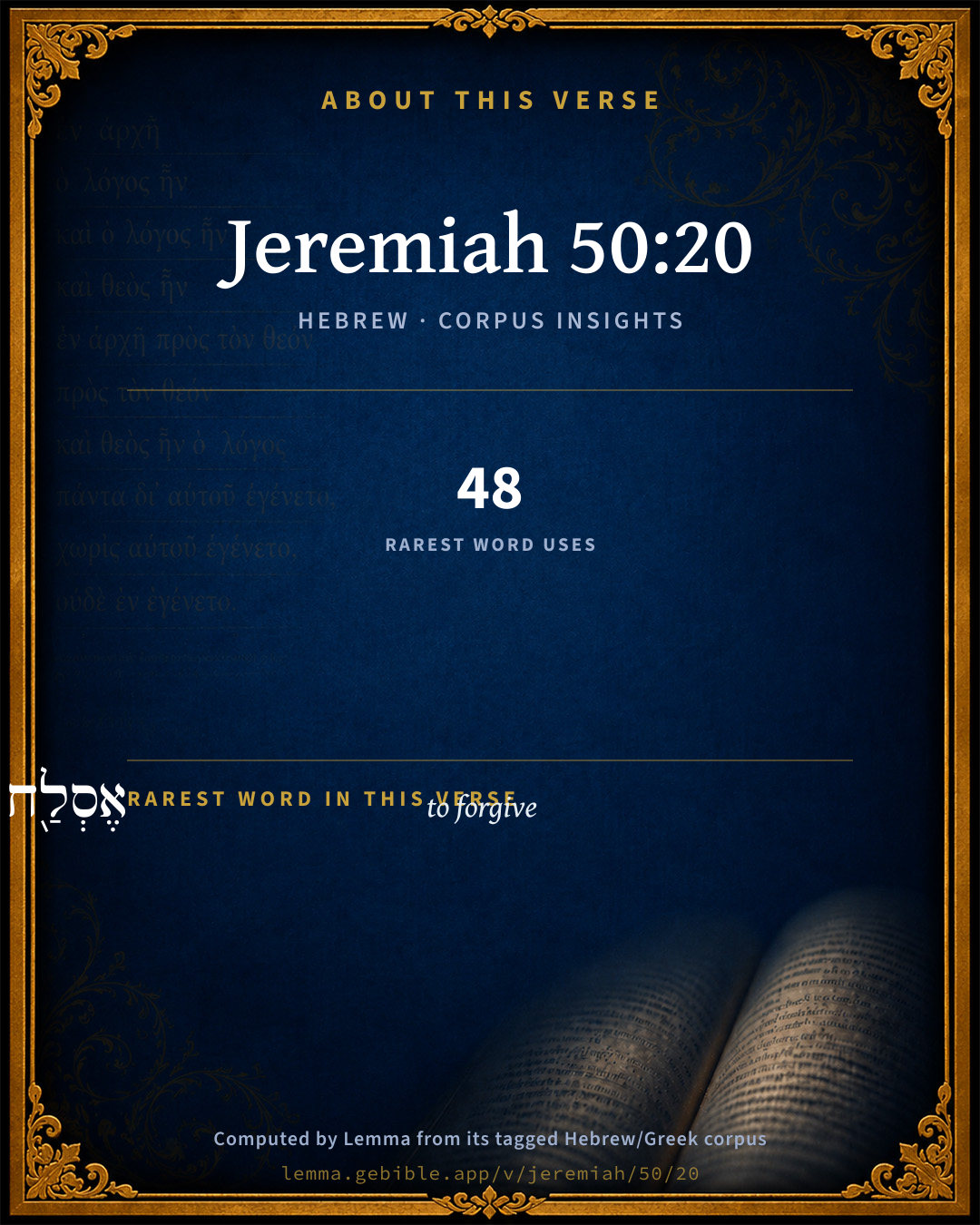
אֶסְלַ֖ח
çâlach
H5545
“to forgive”
Verb, Qal, Imperfect, 1st Person, Common, Singular
Part of Speech
Verb
Stem
Qal
Form
Imperfect
Person
1st Person
Gender
Common
Number
Singular
Full BDB Definition

Origin: a primitive root

TWOT: 1505

to forgive, pardon - (Qal) to forgive, pardon - (Niphal) to be forgiven
  1. בַּיָּמִ֣ים yôwm H3117 “in/at the · days” Preposition, Determined + Noun, Common, Masculine, Plural, Absolute
  2. הָהֵם֩ hêm H1992 “the · they” Particle, Definite Article + Pronoun, Personal, 3rd Person, Masculine, Plural
  3. וּבָעֵ֨ת ʻêth H6256 “and · in/at the · time” Conjunction + Preposition, Determined + Noun, Common, Both, Singular, Absolute
  4. הַהִ֜יא hûwʼ H1931 “the · he” Particle, Definite Article + Pronoun, Personal, 3rd Person, Feminine, Singular
  5. נְאֻם nᵉʼum H5002 “utterance of” Noun, Common, Masculine, Singular, Construct
  6. יְהוָ֗ה Yᵉhôvâh H3068 “LORD” Noun, Proper
  7. יְבֻקַּ֞שׁ bâqash H1245 “to seek” Verb, Pual, Imperfect, 3rd Person, Masculine, Singular
  8. אֶת ʼêth H853 “-” Particle, Direct Object
  9. עֲוֺ֤ן ʻâvôn H5771 “iniquity of” Noun, Common, Both, Singular, Construct
  10. יִשְׂרָאֵל֙ Yisrâʼêl H3478 “Israel” Noun, Proper
  11. וְאֵינֶ֔נּוּ ʼayin H369 “and · nothing · him” Conjunction + Particle, Negative + Suffix, Personal, 3rd Person, Masculine, Singular
  12. וְאֶת ʼêth H853 “and · -” Conjunction + Particle, Direct Object
  13. חַטֹּ֥את chaṭṭâʼâh H2403 “sin offerings of” Noun, Common, Feminine, Plural, Construct
  14. יְהוּדָ֖ה Yᵉhûwdâh H3063 “Judah” Noun, Proper
  15. וְלֹ֣א lôʼ H3808 “and · not” Conjunction + Particle, Negative
  16. תִמָּצֶ֑אינָה mâtsâʼ H4672 “to find” Verb, Niphal, Imperfect, 3rd Person, Feminine, Plural
  17. כִּ֥י kîy H3588 “that” Conjunction
  18. לַאֲשֶׁ֥ר ʼăsher H834 “to/for · which” Preposition + Particle, Relative
  19. אַשְׁאִֽיר shâʼar H7604 “to remain” Verb, Hiphil, Imperfect, 1st Person, Common, Singular

About this verse

These counts appear in no published source. They are computed here, from the morphology-tagged text and Lemma’s own curated glosses. What Lemma adds →

20
words
19
distinct lemmas
Prophets
section

Shared distinctive vocabulary

אֶסְלַ֖ח to forgive H5545 occurs in 45 verses of the Hebrew Bible. Also found in:

Grammatical profile

  • 4 verbs
  • 8 nouns
  • 2 pronouns
  • 1 conjunction
  • 5 particles

Verb forms

  • יְבֻקַּ֞שׁ Pual · Imperfect
  • תִמָּצֶ֑אינָה Niphal · Imperfect
  • אֶסְלַ֖ח Qal · Imperfect
  • אַשְׁאִֽיר Hiphil · Imperfect

Cross-references

21

Topical passages linked to Jeremiah 50:20 in the Treasury of Scripture Knowledge — connected by theme and wording, ordered by reader-vote popularity; previews shown in the World English Bible.

  • Micah 7:19 He will again have compassion on us. He will tread our iniquities under foot; And you will cast all their sins into the depths of the sea.
  • Jeremiah 31:34 and they shall teach no more every man his neighbor, and every man his brother, saying, Know Yahweh; for they shall all know me, from the least of them to the greatest of them, says Yahweh: for I will forgive their iniquity, and their sin will I remember no more.
  • Isaiah 1:9 Unless Yahweh of hosts had left to us a very small remnant, We would have been as Sodom; We would have been like Gomorrah.
  • Isaiah 43:25 I, even I, am he who blots out your transgressions for my own sake; and I will not remember your sins.
  • Psalms 103:12 As far as the east is from the west, So far has he removed our transgressions from us.
  • Romans 8:33–34 Who could bring a charge against God's chosen ones? It is God who justifies.
  • Hebrews 10:17–18 "I will remember their sins and their iniquities no more."
  • Isaiah 44:22 I have blotted out, as a thick cloud, your transgressions, and, as a cloud, your sins: return to me; for I have redeemed you.
  • Numbers 23:21 He has not saw iniquity in Jacob; Neither has he seen perverseness in Israel: Yahweh his God is with him, The shout of a king is among them.
  • Romans 11:26–27 and so all Israel will be saved. Even as it is written, "There will come out of Zion the Deliverer, And he will turn away ungodliness from Jacob.
  • Hebrews 8:10–12 "For this is the covenant that I will make with the house of Israel. After those days," says the Lord; "I will put my laws into their mind, I will also write them on their heart. I will be to them a God, And they will be to me a people.
  • 2 Peter 3:15 Regard the patience of our Lord as salvation; even as our beloved brother Paul also, according to the wisdom given to him, wrote to you;
  • Jeremiah 33:15 In those days, and at that time, will I cause a Branch of righteousness to grow up to David; and he shall execute justice and righteousness in the land.
  • Jeremiah 50:4 In those days, and in that time, says Yahweh, the children of Israel shall come, they and the children of Judah together; they shall go on their way weeping, and shall seek Yahweh their God.
  • Acts 3:19 "Repent therefore, and turn again, that your sins may be blotted out, so that there may come times of refreshing from the presence of the Lord,
  • Isaiah 11:1–2 There shall come forth a shoot out of the stock of Jesse, and a branch out of his roots shall bear fruit.
  • Jeremiah 44:14 so that none of the remnant of Judah, who have gone into the land of Egypt to sojourn there, shall escape or be left, to return into the land of Judah, to which they have a desire to return to dwell there: for none shall return save such as shall escape.
  • Acts 3:26 God, having raised up his servant, Jesus, sent him to you first, to bless you, in turning away everyone of you from your wickedness."
  • Romans 5:16 The gift is not as through one who sinned: for the judgment came by one to condemnation, but the free gift came of many trespasses to justification.
  • Romans 6:13 Neither present your members to sin as instruments of unrighteousness, but present yourselves to God, as alive from the dead, and your members as instruments of righteousness to God.
  • Romans 11:6 And if by grace, then it is no longer of works; otherwise grace is no longer grace. But if it is of works, it is no longer grace; otherwise work is no longer work.

Cross-references courtesy of OpenBible.info (CC BY 4.0).

Hebrew and Greek witnesses Masoretic Hebrew ↔ Greek Septuagint

The same verse in the two great witnesses to the Old Testament, shown verse-for-verse.

These are two independent witnesses, not word-aligned to each other, and the Septuagint is shown in lemma (dictionary) form.

Hebrew Jeremiah 50:20 Masoretic · Westminster Leningrad Codex

בַּיָּמִ֣ים הָהֵם֩ וּבָעֵ֨ת הַהִ֜יא נְאֻם יְהוָ֗ה יְבֻקַּ֞שׁ אֶת עֲוֺ֤ן יִשְׂרָאֵל֙ וְאֵינֶ֔נּוּ וְאֶת חַטֹּ֥את יְהוּדָ֖ה וְלֹ֣א תִמָּצֶ֑אינָה כִּ֥י אֶסְלַ֖ח לַאֲשֶׁ֥ר אַשְׁאִֽיר

In those days, and in that time, says Yahweh, the iniquity of Israel shall be sought for, and there shall be none; and the sins of Judah, and they shall not be found: for I will pardon them whom I leave as a remnant.

World English Bible · Public Domain

Greek LXX Structure differs

In the Septuagint, Jeremiah is about an eighth shorter than the Hebrew and arranges its material differently — the Oracles Against the Nations (Hebrew chapters 46–51) appear in the middle of the Greek book, after 25:13. Because the chapter and verse boundaries do not line up, a verse-for-verse comparison with the Hebrew is not shown.

A verse-for-verse comparison isn’t shown here because the chapters and verses don’t line up. Switch to the LXX edition with the MT / LXX toggle above to read the Greek directly.

Hebrew: Westminster Leningrad Codex (CC BY 4.0). Greek: Septuagint (public domain); English from a public-domain English Septuagint. How the Septuagint differs from the Hebrew →

Targum (Aramaic paraphrase)

1

The Targum is the ancient Jewish Aramaic paraphrase of the Hebrew Scriptures — an interpretive translation, not the Hebrew text itself. Onkelos (literal) and Pseudo-Jonathan (expansive) render the Torah, and Jonathan the Prophets. Coverage is partial: where no permissively-licensed English translation exists for a verse, only the Aramaic is shown. This is verse-level text, not a word-by-word alignment to the Hebrew.

  1. Targum Jonathan Prophets (Joshua–Malachi)
    בְּיוֹמַיָא הָאִינוּן וּבְעִדָנָא הַהִיא אֲמַר יְיָ יִתְבְּעוּן יַת חוֹבֵי יִשְׂרָאֵל וְלֵיתִינוּן וְחֶטְאֵי בֵּית יְהוּדָה וְלָא יִשְׁתַּכְּחוּן אֲרֵי אֶשְׁבּוֹק לִשְׁאָרָא דְאַשְׁאָר:

    (no public-domain English translation for this verse)

    Targum Jonathan — Aramaic: “Mikraot Gedolot” (public domain). English: “Sefaria Community Translation” (CC0 1.0 (public-domain dedication)); “London "Chaldee Paraphrase," 1871” (public domain). Text via Sefaria.

Commentary

Notes on Jeremiah 50:20 from classic Christian and Jewish commentators (each source and its license shown beneath its notes). The classic Christian expositions comment on the surrounding passage and are grouped to its opening verse, so a note may address several verses; the Jewish commentaries on the Tanakh (Rashi and others) are per-verse, so they appear only where the commentator wrote on this verse.

Lemma curates 59 commentaries, every one of them public domain or Creative Commons licensed, each selected and text-cleaned for this edition rather than reprinted as found. About our sources →

Trapp's Complete Commentary

John Trapp

Jer 50:20 In those days, and in that time, saith the LORD, the iniquity of Israel shall be sought for, and [there shall be] none; and the sins of Judah, and they shall not be found: for I will pardon them whom I reserve.

Ver. 20. The iniquity of Jacob shall be sought for, and there shall be none.] Because to the justified no sin is imputed. Nihil oblivisci solet praeter iniurias. He forgetteth nothing but injuries only, said Cicero of Caesar, flatteringly, say we of God truly. This to have known is to feed in those soul fatting pastures. {Jer 50:19}

For I will pardon them whom I reserve.] Tegam quod fuit; quod erit, regam. I will cover what was; which will be, for I will rule.

John Trapp, A Commentary or Exposition upon All the Books of the Old and New Testament (1647–1656) — public domain. Text from a community e-Sword module.

Tyndale Open Study Notes

Tyndale Open Resources

50:20 The Lord would forgive the remnant of people from Israel and Judah; they would seek the Lord as they returned to their homeland (50:4-5; see chs 31, 33).

Tyndale Open Study Notes — © Tyndale Open Resources, licensed CC BY-SA 4.0. Text via the HelloAO Bible API.

Jamieson, Fausset & Brown

Robert Jamieson, A. R. Fausset & David Brown

The specification of "Israel," as well as Judah, shows the reference is to times yet to come.

iniquity . . . none--not merely idolatry, which ceased among the Jews ever since the Babylonian captivity, but chiefly their rejection of Messiah. As in a cancelled debt, it shall be as if it had never been; God, for Christ's sake, shall treat them as innocent (Jer 31:34). Without cleansing away of sin, remission of punishment would be neither to the honor of God nor to the highest interests of the elect.

whom I reserve--the elect "remnant" (Isa 1:9). The "residue" (Zac 14:2; Zac 13:8-9).

Jamieson, Fausset & Brown — Commentary Critical and Explanatory on the Whole Bible (1871) — public domain (CC PDM 1.0). Text via the HelloAO Bible API.

Adam Clarke's Commentary

Verse 20. In those days and in that time] This phrase appears to take in the whole of an epoch, from its commencement to its end. See Jer 50:4.

I will pardon them] So as to deliver them from their captivity, and exact no more punishment from them whom I reserve; namely, the remnant left in the Babylonish captivity.

Adam Clarke's Commentary on the Bible (1810–1826) — public domain. Text from a community e-Sword/MySword module.

John Calvin's Commentaries

As I have already said, the Prophet now shows the primary cause why God purposed to deal so kindly and mercifully with his people, even because he would remit their sins. And doubtless whatever is said of the remission of sins is cold and unmeaning, except we be first convinced that God is reconciled and propitious to us. The unbelieving indeed seek no other thing than to be relieved from their evils, as the sick who require nothing from their physician but that he should immediately remove pain. If the sick man thirsts, “Take away thirst,” he will say. In short, they regard only the symptom, of the disease they do not say a word. Such is the case with the ungodly, they neglect the chief thing, that God should pardon them and receive them into favor. Provided they are exempted from punishment, this is enough for them. But as to the faithful, they can never be satisfied until they feel assured that God is propitious to them. In order, then, to free from disquietude and all misgivings the minds of the godly, our Prophet says that God would be propitious, so that he would bury all the sins of Israel and Judah, so that they might no more be remembered or come to judgment.

This passage is remarkable, and from it we especially learn this valuable truth, that when God severely chastises us, we ought not to stop at the punishment and seek only a relief from our troubles, but on the contrary we ought to look to the very cause of all evils, even our sins. So David, in many places, when he seeks from God a relaxation of evil, does not only say, “Lord, deliver me from mine enemies; Lord, restore to me my health; Lord, deliver me from death;” — he does not simply speak thus, but he earnestly flees to God and implores his mercy. And on the other hand, when God promises deliverance from punishment, he does not simply say, “I will restore you from exile or captivity, I will restore you to your own country;” but he says, “I will forgive you your sins.” For when the disease is removed, the symptoms also which accompany the disease disappear. So also it happens in this case, for when God shows that he is propitious to us, we are then freed from punishment, that is, what we have for a time suffered, or what awaited us, had not God spared us according to his infinite mercy and goodness.

John Calvin's Commentaries (1540-1563) — public domain. Text from the Calvin Translation Society English edition (1840s-50s) via the Christian Classics Ethereal Library (ccel.org). Calvin's coverage is partial (roughly two-thirds of the Bible); uncommented books and verses are honest gaps, never fabricated. The 19th-century editor's footnotes and remarks are omitted so the notes are faithfully Calvin's own voice.

Ellicott's Commentary for English Readers

(20) In those days, and in that time . . .—The formula is that which in prophetic language points to the far-off times of the Christ. Their restoration to their earthly homes was but a small thing. That which was to the prophet the great blessing of the future was that it would bring with it the New Covenant of Jer_31:31, pardon and peace, iniquity and sin remembered no more.

I will pardon them whom I reserve.—The latter verb contains the root of the “remnant” which is so prominent in Isaiah (Isa_1:9; Isa_7:3), and expresses the same thought. “The remnant,” the reserved ones, shall be pardoned.

A Bible Commentary for English Readers, edited by Charles John Ellicott (1878–1897) — public domain. Text from a community e-Sword module.

The Cambridge Bible for Schools and Colleges

gen. ed. J. J. S. Perowne

20. In those days, and in that time, etc.] See on ch. Jer_23:5 and cp. Jer_31:34; Mic_7:18.

whom I leave] those who come forth at the end out of the long tribulation.

The Cambridge Bible for Schools and Colleges (gen. ed. J. J. S. Perowne; Cambridge University Press, 1878–1918) — public domain. Text from a community e-Sword module.

John Gill's Exposition

In those days, and in that time, saith the Lord,.... When mystical Babylon shall be destroyed, and the Jews will be converted and brought into their land, and be in possession of every temporal and spiritual mercy; it will then most clearly appear that they are the favourites of heaven, and all their sins are forgiven them, as follows:

the iniquity of Israel shall be sought for, and there shall be none;

and the sins of Judah, and they shall not be found; not that they will be wholly free from sin; or there will be none in them; or none committed by them; or that their sins are no sins; or that God has no sight or knowledge of them; but that they will not be found upon them, so as to be charged on them in a judicial way; having been removed from them to Christ, and satisfaction made for them by him; who has finished them, and made an end of them, so as that no condemnation or punishment can be inflicted on them for them; wherefore, should they be sought for by Satan, or by the law and justice of God, they will never be found, so as to be brought against them to their condemnation. The reason is,

for I will pardon them whom I reserve; the remnant, according to the election of grace, whom God has chosen in Christ, preserved in him, and reserved for himself, for his own glory, and for eternal happiness; these are pardoned freely for Christ's sake; and being pardoned, no sin is imputed to them; all is removed from them, as far as the east is from the west; covered out of the sight of God; hid from the eye of avenging justice; blotted out as a debt book, which is not legible, or as a cloud which is no more; cast by the Lord behind his back, and into the depths of the sea, and entirely forgotten; never remembered or seen more, but buried in everlasting oblivion and obscurity; see Rom 11:27.

John Gill's Exposition of the Whole Bible (1746–1763) — public domain (CC PDM 1.0). Text via the HelloAO Bible API.

Albert Barnes' Notes on the Bible

Those days - The days of the Messiah.

Reserve - Or, permit to remain: hence, the remnant, a word pregnant with meaning in the language of the prophets. See Isa 8:18 note (2).

Albert Barnes' Notes on the Bible (1834–1885) — public domain. Text from a community e-Sword/MySword module.

Haydock's Catholic Bible Commentary

None. Idolatry shall not be re-established.

George Leo Haydock (1774–1849), Haydock's Catholic Family Bible and Commentary, 1859 edition — public domain. Excludes Psalms (Douay-Rheims chapter numbering differs from Protestant) and Deuterocanonical books (Catholic canon only).

Matthew Poole's English Annotations

Some here restrain the term

iniquity to the idolatry of the Jews, which indeed was their great sin, which God did more especially punish them for; and after the captivity of Babylon we do not read of their offending in that kind, which was according to the prophecy of Isa 27:9, that when God should make the stones of the altar as chalk-stones that are beaten asunder, the groves and the images should not stand up. But the last words seem to guide us to a larger sense of the term

iniquity, and to point us to another sense of the whole former phrase, viz. that God would no longer punish the sins of the Jews; they should be sought for as to punishment, and not found. And those words and none must be understood as if none, they shall be punished no, more than if they had none.

For I will pardon them whom I reserve; for as to those whom I save from the captivity of Babylon,

I will pardon them: not that they were all excused from the obligation their sins laid them under as, to eternal death, but that their temporal punishment was remitted to the whole body of the Jews, and those that were truly penitent also should be discharged from their obligation to eternal death. The obligation that sin layeth the sinner under to eternal death may be remitted, and yet the temporal punishment due to them may remain, 2Sa 12:13,14, &c. And, on the other side, the punishment in this life may be suspended or remitted, and the obligation sin layeth the sinner under to eternal death may remain.

Matthew Poole's English Annotations on the Holy Bible (1683–1685) — public domain. Text from a community e-Sword/MySword module.

Whedon's Commentary on the Bible

Daniel D. Whedon

20. I will pardon — The supreme promise is reserved for the last. Not only shall the penalty be cancelled, but the sin itself shall be removed. The pain has ceased, indeed, but what is more and better, the disease is cured. Great as Israel’s sin is, it is not so great as God’s mercy. Deep as are the depths of evil, they are not so deep as God’s purposes of love.

Daniel D. Whedon (gen. ed.), Commentary on the Old and New Testaments (1874–1909) — public domain. Text from a community e-Sword module.

The Pulpit Commentary

In those days, etc. An evangelical promise, reminding us of Jer_31:34 and Jer_33:8, and of the combination of spiritual with temporal blessings in the latter part of Isaiah.

Perfect forgiveness.

I IN WHAT IT CONSISTS. When God forgives a man he pardons him completely, as Christ thoroughly cured all the sick persons whom he healed in any way. There is no middle course here. Either the forgiveness is total or it is not accorded at all.

1. This is more than the remission of penalties. Some consequences of sin must still remain, though these are no longer indications of God"s anger, but converted into merciful chastisements. But the essence of forgiveness lies deeper than any manipulation of external experience. It is inward, in the relation of God to the soul.

2. This spiritual forgiveness consists in the removal of all estrangement between God and the sinner. It is perfect reconciliation with no shadow cast upon it by old offences, Many men profess to forgive and yet bear a grudge, or say they will forgive but cannot forget, or forgive partially but retain a certain suspicion and coolness. God"s forgiveness goes further. He is said to remove our sin from us "as far as the east is from the west," to "cast it into the sea," to "remember it no more." He treats his guilty but penitent child as if the sin had never been committed. No record of guilt is preserved, none can be found, even if an enemy search for it. The prodigal is not made a hired servant; he is welcomed with joy. The Christian is not grudgingly received into the outer courts of God"s house; he is called to the presence of his Father and blessed with full privileges of sonship. If he is justified he is also glorified. Hence we may learn

(1) that, after genuine repentance and faith, a man need not remain in a state of fear and sadness; he may rejoice with confidence. His sin is not to be found; then he need think no more of it. If God has forgotten it he also may forget it. The typical Christian is not a weeping Magdalene, but a happy, hopeful servant of Christ. We may also learn

(2) to extend more charity and confidence to other men in their penitence. If God has forgiven them, who are we that we should treat them with contempt or anger?

II HOW IT IS OBTAINED.

1. Often after chastisement. The promise to Judah and Israel is forgiveness after the sufferings of the Captivity. This is not invariably the case; for

(1) chastisement may fail in its work upon the soul, and then the forgiveness will not follow; or

(2) God may bring the sinner to penitence by milder means. But it is the design of chastisement to lead us to the blessedness of reconciliation.

2. After repentance. The people are first depicted as "going, weeping as they go." Forgiveness is offered to the worst man who repents, but not to the mildest offender who remains impenitent.

3. Through the mercy of God. This forgiveness is part of the blessedness of the restoration which God promises to effect for his children. It is not earned by future good conduct nor by any sacrifice or penance. We now know that it is not cheap. The price is no less than the life of the Son of God. But to us it is a free gift of God"s love.

Divine forgiveness an absolute oblivion.

The attribute of completeness characterizes God"s work of destruction (vers. 14-16); equally does it pertain to his work of salvation (vers. 19, 20). In both is manifested his righteousness in its elements of wrath and mercy. His forgiveness acts in perfect harmony with his severity.

I HOW IT MANIFESTS ITSELF.

1. Retrospectively. Sins that are past are to be blotted out. A complete severance is to be effected between the era of apostasy and the new one upon which they are to enter. The strictest justice, the most jealous hostility, will fail to make out a valid indictment.

2. Prospectively.

(1) In the character. It will be purified and confirmed in the righteousness of God.

(2) In the conduct. There will be no more lapses or infidelities. Israel will be "a peculiar people, zealous of good works." It is for the sake of this new future that the guilty past has been cancelled; and it is the legitimate fruit of the experience of God"s pardoning grace that the "reserved" ones shall give themselves "with a glad heart and free" to his service and glory.

II TO WHAT IT IS DUE. Not to Divine goodness in conflict with Divine righteousness, but to the satisfaction of Divine righteousness.

1. In atonement. The sacrifice of Christ was anticipated, and for its sake the national tribulation through which Israel had passed was accounted a satisfaction for guilt incurred. In itself that tribulation could never effect such an end, nor in any sense as supplementary of the sufferings of Christ, but only symbolically and representatively, such as the lamb slain on the temple altar. The sinner is identified with the Saviour.

2. In making righteous. "Justice looking at the sinner, not simply as the fit subject of punishment, but as existing in a moral condition of unrighteousness, and so its own opposite, must desire that the sinner should cease to be in that condition; should cease to be unrighteous should become righteous; righteousness in God craving for righteousness in man, with a craving which the realization of righteousness in man alone can satisfy. So of holiness." (Macleod Campbell.) M.

A vain quest.

I IN CONTRAST WITH PREVIOUS QUESTS OF THE SAME KIND. Then hardly anything but iniquity and sin were to be found. The few righteous and godly men only called attention more emphatically to the general wickedness. God is ever seeking in the earth for all that is true and good, and whatever there be of it he is sure to find. He misses nothing, searching into every man according to the fundamental thoughts of his heart. In former days sin and iniquity had been the great burden of prophetic deliverances, and the mention of them a continual exasperation to the people.

II THE REASON WHY THE QUEST HAS BECOME VAIN. All is pardoned. There has been deep and adequate repentance, adequate atonement, and consequently there is full forgiveness. Iniquity and sin cannot be found, because they have vanished as disturbing elements in human consciousness. What an intensely evangelical verse this is, full as it can be of one of the great results of the gospel! God, who sends prophets into the midst of sinful men, calling attention to the universal presence of evil; works remove that evil, so that it shall no longer be possible to find it. This inability to find evil is not the report of man merely; if so, we might suspect the worth of the report as being nothing more than shallow optimism. When God says that evil cannot be found he means that it has ceased to exist.

III THIS VAIN QUEST IMPLIES OTHER GUESTS EQUALLY VAIN. No consequences of sin shall be left. When the roots are gone, clean extirpated, vain will it be to seek for the fruits. There can be no pain where there is no sin. There can be no death. Fulness of life and health will succeed. There will be no seed but good seed, no ground but good ground. And hence there will only be good fruit springing forth abundantly.

IV ANOTHER QUEST THAT WILL BE SUCCESSFUL. The matter must be looked at positively as well as negatively. Iniquity is not to be found, i.e. complete conformity to law is found everywhere; sin is not found, i.e. every man in his own nature is fully glorifying his Maker and his Redeemer. More and more we must seek to see the depth and reality of present iniquity and sin; so shall we better understand the work whereby God will slowly remove slow]y, that is, to our apprehension all these evil things away and cause harmony, holiness, and happiness to rise enduringly in their place. Y.

The Pulpit Commentary (1880–1919), ed. H.D.M. Spence-Jones & Joseph S. Exell — public domain. Text from a community e-Sword module.

John Wesley's Explanatory Notes

Not found - God will no longer punish the sins of the Jews, they should be sought for as to punishment and not found. Reserve - Whom I save from the captivity of Babylon.

John Wesley, Explanatory Notes Upon the Whole Bible (1754–1765) — public domain. Text via the GEBible commentary corpus.

Lesson kit

Teaching starters — assembled from the data on this page, not authored interpretation. Every prompt links to the verse data it draws on. Edit before teaching.

Jeremiah, in the Prophets, opens this verse with 20 words (19 distinct Hebrew lemmas). Its most distinctive word is çâlach (“to forgive”). A historical commentator’s framing appears above. Read the whole chapter for the surrounding context.

Discussion questions

  1. What does “to forgive” (çâlach) contribute to the verse as a whole?
  2. Exodus 34:9 shares the word «to forgive» with this verse. How do the two illuminate each other?
  3. These translations render this verse differently; the difference is in the English rendering, not the original. What questions does that raise?
  4. The verb «יְבֻקַּ֞שׁ» is Pual Imperfect. How does its form color the action?
  5. Reading how Trapp's Complete Commentary and Tyndale Open Study Notes read this verse, where do the two commentators agree and where do they part?

Things to notice

Reading settings

Reading text

Shown beneath each verse's original-language words.

Old Testament
Old Testament edition

Read the OT as the Masoretic Hebrew (MT) or the Greek Septuagint (LXX).

English shown for the Greek Septuagint (in the Hebrew ↔ Greek comparison).

Comparing translations? Open the Compare panel on any verse page to stack up to four side by side.