2 Kings 2:17

Hebrew (Westminster Leningrad Codex) 2 Kings 2:17 appears in the Hebrew Old Testament. The text above is from the Westminster Leningrad Codex. Each word links to its Strong’s number, a concise gloss, and parsing drawn from the Open Scriptures Hebrew Bible morphology. Click any word for its full Brown-Driver-Briggs (BDB) entry.
Download image
Cite this verse

2 Kings 2:17 (World English Bible). Public Domain. Lemma interlinear Bible study tool, https://lemma.gebible.app/v/2-kings/2/17.

Show BibTeX & RIS
BibTeX
RIS
English Translation
When they urged him until he was ashamed, he said, Send. They sent therefore fifty men; and they sought three days, but didn't find him.
World English Bible · Public Domain
Download a study sheet

One document with this verse’s original text, its word-by-word gloss line, the meaning frame, cross-references with their text, attributed commentary, and full source and license credits — printable, and it pastes into notes with its structure intact.

This verse Autodidact and up

Study sheet (.html) Plain text (.txt)

A passage Seminary Student

Up to 50 verses in one chapter. A passage sheet keeps up to 6 commentary sources and 12 cross-references per verse, in the order this page ranks them, and says so on the sheet whenever that leaves anything out. Ask for a single verse and you get the Autodidact verse sheet above.

Everything on this page stays free to read, with no account — the sheet is a download of what is already on screen, not access to it.

Want to remove ads? Support Godless Engineer
Compare translations 3

The same verse in 3 English versions, stacked beneath the original-language interlinear above. Click any original word for its lexicon entry.

Each is an independent rendering of the whole verse — the interlinear is not word-aligned to these translations.

Highlighted words mark where these versions differ — a whole-verse word diff, not a word-by-word alignment.

  • World English Bible Public Domain
    When they urged him until he was ashamed, he said, Send. They sent therefore fifty men; and they sought three days, but didn't find him.
  • King James Version Public Domain
    And when they urged him till he was ashamed, he said, Send. They sent therefore fifty men; and they sought three days, but found him not.
  • unfoldingWord Literal Text CC BY-SA 4.0
    But they urged him until he felt shame, so he said, “Send.” And they sent fifty men, and they searched three days, but they did not find him.

unfoldingWord Literal Text — © unfoldingWord, licensed CC BY-SA 4.0. Word-aligned USFM3 via Door43 (git.door43.org/unfoldingWord/en_ult).

Versions to compare (up to 4)

3 of 4 selected

Show all 18 translations

Every available English version of this verse, each an independent rendering of the whole verse.

  • World English Bible Public Domain
    When they urged him until he was ashamed, he said, Send. They sent therefore fifty men; and they sought three days, but didn't find him.
  • Berean Standard Bible Public Domain
    But when they pressed him to the point of embarrassment, he said, “Send them.” And they sent fifty men, who searched for three days but did not find Elijah.
  • Majority Standard Bible Public Domain
    But when they pressed him to the point of embarrassment, he said, “Send them.” And they sent fifty men, who searched for three days but did not find Elijah.
  • King James Version Public Domain
    And when they urged him till he was ashamed, he said, Send. They sent therefore fifty men; and they sought three days, but found him not.
  • American Standard Version (1901) Public Domain
    And when they urged him till he was ashamed, he said, Send. They sent therefore fifty men; and they sought three days, but found him not.
  • Revised Version (1885) Public Domain
    And when they urged him till he was ashamed, he said, Send. They sent therefore fifty men; and they sought three days, but found him not.
  • Geneva Bible (1599) Public Domain
    Yet they were instant vpon him, til he was ashamed: wherefore he saide, Sende. So they sent fiftie men, which sought three dayes, but founde him not.
  • Douay-Rheims (1899) Public Domain
    But they pressed him, till he consented, and said: Send. And they sent fifty men: and they sought three days but found him not.
  • Young's Literal Translation Public Domain
    And they press upon him, till he is ashamed, and he saith, `Send ye;' and they send fifty men, and they seek three days, and have not found him;
  • Literal Standard Version CC BY-SA 4.0
    And they press on him, until he is ashamed, and he says, “Send”; and they send fifty men, and they seek three days, and have not found him;
  • Unlocked Literal Bible CC BY-SA 4.0
    But when they urged Elisha until he was ashamed, he said, “Send them.” Then they sent fifty men, and they looked for three days, but did not find him.
  • unfoldingWord Literal Text CC BY-SA 4.0
    But they urged him until he felt shame, so he said, “Send.” And they sent fifty men, and they searched three days, but they did not find him.
  • Darby Bible Public Domain
    And they pressed him till he was ashamed, and he said, Send. They sent therefore fifty men, and they sought three days, but did not find him.
  • World Messianic Bible Public Domain
    When they urged him until he was ashamed, he said, “Send them.” Therefore they sent fifty men; and they searched for three days, but didn’t find him.
  • Webster's Bible Public Domain
    And when they urged him till he was ashamed, he said, Send. They sent therefore fifty men; and they sought three days, but found him not.
  • Free Bible Version CC BY-SA 4.0
    But they went on trying to persuade him until he was too embarrassed to say no. “Go ahead and send them,” he told them. So they sent fifty men, who searched for Elijah for three days but couldn't find him.
  • Bible in Basic English Public Domain
    But when they kept on requesting him, he was shamed and said, Send, then. So they sent fifty men; but after searching for three days, they came back without having seen him.
  • JPS Tanakh (1917) Public Domain
    And when they urged him till he was ashamed, he said: 'Send.' They sent therefore fifty men; and they sought three days, but found him not.

Literal Standard Version (2020), Covenant Press — licensed CC BY-SA 4.0. Text via the HelloAO Bible API (eBible.org). Unlocked Literal Bible (unfoldingWord) — licensed CC BY-SA 4.0. Text via the HelloAO Bible API (eBible.org). unfoldingWord Literal Text — © unfoldingWord, licensed CC BY-SA 4.0. Word-aligned USFM3 via Door43 (git.door43.org/unfoldingWord/en_ult). Free Bible Version, Dr. Jonathan Gallagher — licensed CC BY-SA 4.0. Text via the HelloAO Bible API (eBible.org).

Word by word

More ways to search: Search by grammar → Find every occurrence → Compare this word →

Practice this passage: Drill this verse → Learn its vocabulary →

וַיִּפְצְרוּ
pâtsar
H6484
“and · to push”
Conjunction + Verb, Qal, Sequential Imperfect, 3rd Person, Masculine, Plural
Part of Speech
Conjunction + Verb
Stem
Qal
Form
Sequential Imperfect
Person
3rd Person
Gender
Masculine
Number
Plural
Full BDB Definition

Origin: a primitive root

TWOT: 1801

to press, push - (Qal) to push, press - (Hiphil) be insolent, display pushing (arrogance, presumption)
  1. עַד ʻad H5704 “until” Preposition
  2. בֹּ֖שׁ bûwsh H954 “to be ashamed” Verb, Qal, Infinitive Construct
  3. וַיֹּ֣אמֶר ʼâmar H559 “and · to say” Conjunction + Verb, Qal, Sequential Imperfect, 3rd Person, Masculine, Singular
  4. שְׁלָ֑חוּ shâlach H7971 “send” Verb, Qal, Imperative, 2nd Person, Masculine, Plural
  5. וַֽיִּשְׁלְחוּ֙ shâlach H7971 “and · to send” Conjunction + Verb, Qal, Sequential Imperfect, 3rd Person, Masculine, Plural
  6. חֲמִשִּׁ֣ים chămishshîym H2572 “fifty” Adjective, Cardinal number, Both, Plural, Absolute
  7. אִ֔ישׁ ʼîysh H376 “man” Noun, Common, Masculine, Singular, Absolute
  8. וַיְבַקְשׁ֥וּ bâqash H1245 “and · to seek” Conjunction + Verb, Piel, Sequential Imperfect, 3rd Person, Masculine, Plural
  9. שְׁלֹשָֽׁה shâlôwsh H7969 “three” Adjective, Cardinal number, Masculine, Singular, Absolute
  10. יָמִ֖ים yôwm H3117 “days” Noun, Common, Masculine, Plural, Absolute
  11. וְלֹ֥א lôʼ H3808 “and · not” Conjunction + Particle, Negative
  12. מְצָאֻֽהוּ mâtsâʼ H4672 “to find · him” Verb, Qal, Perfect, 3rd Person, Common, Plural + Suffix, Personal, 3rd Person, Masculine, Singular

About this verse

These counts appear in no published source. They are computed here, from the morphology-tagged text and Lemma’s own curated glosses. What Lemma adds →

14
words
12
distinct lemmas
Historical
section

Notable vocabulary

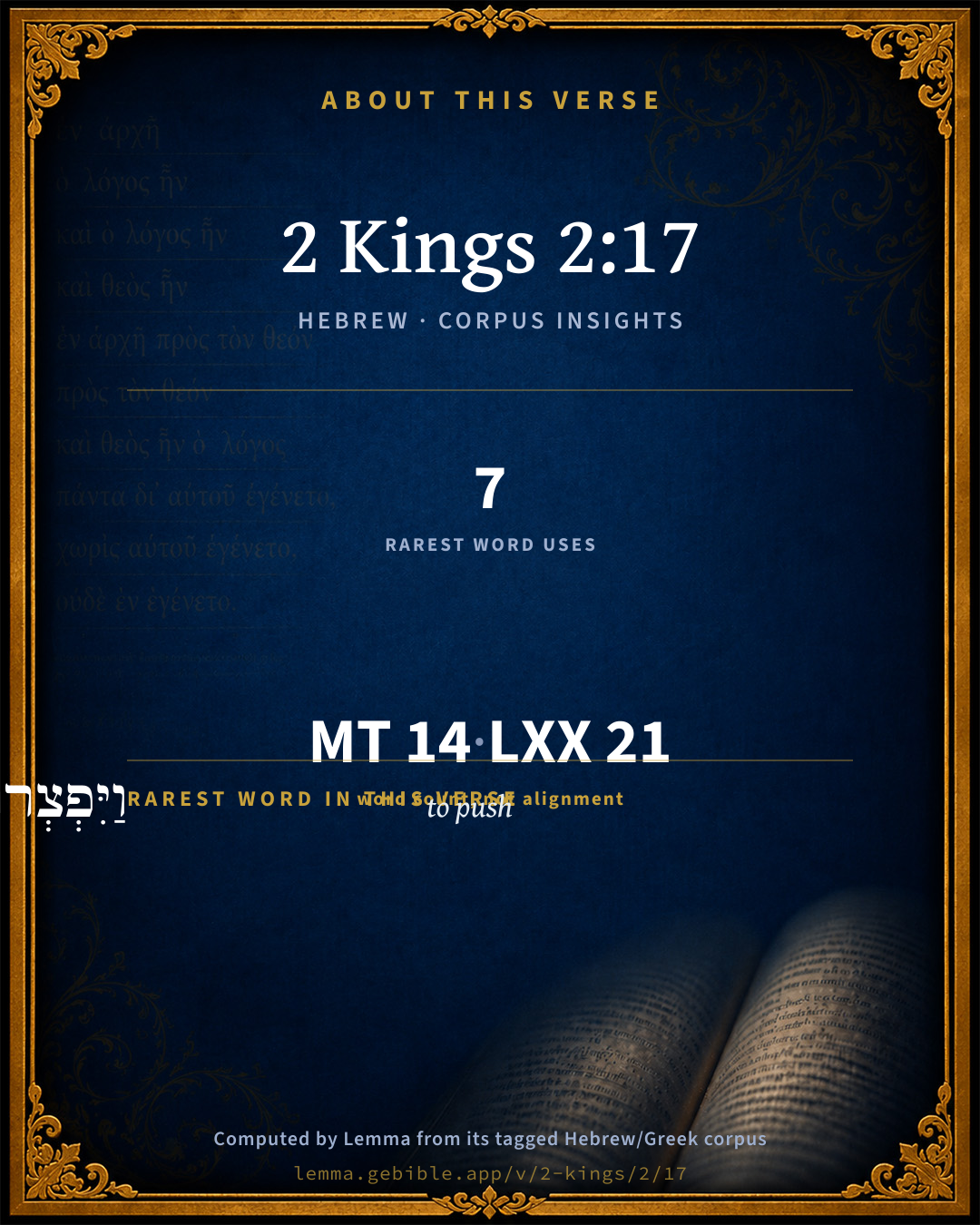
The rarest word here is וַיִּפְצְרוּ to push H6484 — appearing just 7 times in the whole Hebrew Bible.

Shared distinctive vocabulary

וַיִּפְצְרוּ to push H6484 occurs in 7 verses of the Hebrew Bible. Also found in:

Grammatical profile

  • 7 verbs
  • 2 nouns
  • 2 adjectives
  • 2 prepositions
  • 1 particle

Verb forms

  • וַיִּפְצְרוּ Qal · Sequential Imperfect
  • בֹּ֖שׁ Qal · Infinitive Construct
  • וַיֹּ֣אמֶר Qal · Sequential Imperfect
  • שְׁלָ֑חוּ Qal · Imperative
  • וַֽיִּשְׁלְחוּ֙ Qal · Sequential Imperfect
  • וַיְבַקְשׁ֥וּ Piel · Sequential Imperfect
  • מְצָאֻֽהוּ Qal · Perfect

Repetition

A word recurs within this verse — often emphatic in Hebrew:

  • שְׁלָ֑חוּ to send H7971 ×2

Hebrew & Septuagint length

In English translation the verse runs 25 words from the Hebrew and 25 from the Septuagint (LXX English) — the same length.

A rough comparison of the two English renderings, which tokenize alike — not a word-level alignment.

Word counts can differ between the Hebrew and the Greek without any difference in meaning — e.g. the Hebrew direct-object marker אֵת has no separate Greek word, and Greek often adds the article ὁ.

In the original languages it is 14 Hebrew tokens and 21 Greek tokens — but the two are counted differently (Hebrew bundles its prefixes and suffixes into one token; the Greek is in lemma form), so that isn’t a like-for-like length.

Cross-references

5

Topical passages linked to 2 Kings 2:17 in the Treasury of Scripture Knowledge — connected by theme and wording, ordered by reader-vote popularity; previews shown in the World English Bible.

  • 2 Kings 8:11 He settled his gaze steadfastly [on him], until he was ashamed: and the man of God wept.
  • 2 Samuel 18:22–23 Then said Ahimaaz the son of Zadok yet again to Joab, But come what may, Please let me also run after the Cushite. Joab said, Why will you run, my son, seeing that you will have no reward for the news?
  • Luke 11:8 I tell you, although he will not rise and give it to him because he is his friend, yet because of his persistence, he will get up and give him as many as he needs.
  • Romans 10:2 For I testify about them that they have a zeal for God, but not according to knowledge.
  • Hebrews 11:5 By faith, Enoch was taken away, so that he wouldn't see death, and he was not found, because God translated him. For he has had testimony given to him that before his translation he had been well pleasing to God.

Cross-references courtesy of OpenBible.info (CC BY 4.0).

Hebrew and Greek witnesses Masoretic Hebrew ↔ Greek Septuagint

The same verse in the two great witnesses to the Old Testament, shown verse-for-verse.

These are two independent witnesses, not word-aligned to each other, and the Septuagint is shown in lemma (dictionary) form.

Hebrew 2 Kings 2:17 Masoretic · Westminster Leningrad Codex

וַיִּפְצְרוּ ב֥וֹ עַד בֹּ֖שׁ וַיֹּ֣אמֶר שְׁלָ֑חוּ וַֽיִּשְׁלְחוּ֙ חֲמִשִּׁ֣ים אִ֔ישׁ וַיְבַקְשׁ֥וּ שְׁלֹשָֽׁה יָמִ֖ים וְלֹ֥א מְצָאֻֽהוּ

When they urged him until he was ashamed, he said, Send. They sent therefore fifty men; and they sought three days, but didn't find him.

World English Bible · Public Domain

Greek LXX 2 Kings 2:17 Septuagint · lemma form

καί παραβιάζομαι αὐτός ἕως ὅστις αἰσχύνω καί εἶπον ἀποστέλλω καί ἀποστέλλω πεντήκοντα ἀνήρ καί ζητέω τρεῖς ἡμέρα καί οὐ εὑρίσκω αὐτός

And they pressed him until he was ashamed; and he said, Send. And they sent fifty men, and sought three days, and found him not.

LXX2012 (modern English Septuagint) · Public Domain

On this verse, The Pulpit Commentary discusses the Septuagint’s reading. Read the note in Commentary ↓

Hebrew: Westminster Leningrad Codex (CC BY 4.0). Greek: Septuagint (public domain); English from LXX2012 (modern English Septuagint) (Public Domain). How the Septuagint differs from the Hebrew →

Targum (Aramaic paraphrase)

1

The Targum is the ancient Jewish Aramaic paraphrase of the Hebrew Scriptures — an interpretive translation, not the Hebrew text itself. Onkelos (literal) and Pseudo-Jonathan (expansive) render the Torah, and Jonathan the Prophets. Coverage is partial: where no permissively-licensed English translation exists for a verse, only the Aramaic is shown. This is verse-level text, not a word-by-word alignment to the Hebrew.

  1. Targum Jonathan Prophets (Joshua–Malachi)
    וְאַתְקִיפוּ בֵּיהּ עַד סַגְיָא וַאֲמַר שְׁלָחוּ וּשְׁלַחוּ חַמְשִׁין גַבְרָא וּבְעוֹ תְלָתָא יוֹמִין וְלָא אַשְׁכְּחוֹהִי:

    (no public-domain English translation for this verse)

    Targum Jonathan — Aramaic: “Mikraot Gedolot” (public domain). English: “Sefaria Community Translation” (CC0 1.0 (public-domain dedication)); “London "Chaldee Paraphrase," 1871” (public domain). Text via Sefaria.

Commentary

Notes on 2 Kings 2:17 from classic Christian and Jewish commentators (each source and its license shown beneath its notes). The classic Christian expositions comment on the surrounding passage and are grouped to its opening verse, so a note may address several verses; the Jewish commentaries on the Tanakh (Rashi and others) are per-verse, so they appear only where the commentator wrote on this verse.

Lemma curates 59 commentaries, every one of them public domain or Creative Commons licensed, each selected and text-cleaned for this edition rather than reprinted as found. About our sources →

Trapp's Complete Commentary

John Trapp

2Ki 2:17 And when they urged him till he was ashamed, he said, Send. They sent therefore fifty men; and they sought three days, but found him not.

Ver. 17. He said, Send.] Since you have such a mind to it; though you are sure to lose your labour,

But found him not.] Tired with three days’ search, they turn back as wise as they went. Some men are best satisfied when they have wearied themselves in their own ways. Nothing will teach them wit but disappointments.

John Trapp, A Commentary or Exposition upon All the Books of the Old and New Testament (1647–1656) — public domain. Text from a community e-Sword module.

Adam Clarke's Commentary

Verse 17. Till he was ashamed] He saw they would not be satisfied unless they made the proposed search; he felt therefore that he could not, with any good grace, resist their importunity any longer.

Adam Clarke's Commentary on the Bible (1810–1826) — public domain. Text from a community e-Sword/MySword module.

Ellicott's Commentary for English Readers

(17) Urged him.—Gen_33:11.

Till he was ashamed.—Literally, unto being ashamed. The pronoun is not expressed in the Hebrew. “They pressed upon him, ‘ad bôsh,” means “until he was embarrassed, disconcerted, put out of countenance.” (Comp. 2Ki_8:11; Jdg_3:25.) Thenius prefers “they carried their importunity to a shameless length;” Keil and Bähr, “until he was disappointed in the hope of dissuading them.” (Comp. Psa_22:5.)

A Bible Commentary for English Readers, edited by Charles John Ellicott (1878–1897) — public domain. Text from a community e-Sword module.

The Cambridge Bible for Schools and Colleges

gen. ed. J. J. S. Perowne

17. till he was ashamed] i.e. to refuse longer so urgent, though as he knew resultless, a petition. There is no pronoun expressed in the original. Hence some have thought the expression meant ‘to a shameful extent’ and was to be applied to the undue persistence of the petitioners. But the same phrase occurs in Jdg_3:25 of Eglon’s servants who waited till they were ashamed to wait longer. Here it implies that Elisha was at a loss how to refuse them any longer. His narrative was unprecedented in its character, and if they refused to be persuaded by that, he had no more that he could do.

The Cambridge Bible for Schools and Colleges (gen. ed. J. J. S. Perowne; Cambridge University Press, 1878–1918) — public domain. Text from a community e-Sword module.

John Gill's Exposition

And when they came again to him, for he tarried at Jericho,.... Waiting their return to hear the report they made: which when they had:

he said unto them, did I not say unto you, go not? assuring them it would be fruitless, and to no purpose; though this search of theirs served both to confirm the assumption of Elijah, and the truth of Elisha being a prophet of the Lord.

John Gill's Exposition of the Whole Bible (1746–1763) — public domain (CC PDM 1.0). Text via the HelloAO Bible API.

Albert Barnes' Notes on the Bible

Till he was ashamed - i. e. to refuse them any longer.

Albert Barnes' Notes on the Bible (1834–1885) — public domain. Text from a community e-Sword/MySword module.

Haydock's Catholic Bible Commentary

CHAPTER II.

Send. He acquiesces, lest they might think that he was afraid of losing his superiority. (Menochius)

George Leo Haydock (1774–1849), Haydock's Catholic Family Bible and Commentary, 1859 edition — public domain. Excludes Psalms (Douay-Rheims chapter numbering differs from Protestant) and Deuterocanonical books (Catholic canon only).

Matthew Poole's English Annotations

Till he was ashamed, i.e. to wit, to deny them any longer, lest they should think his denial proceeded from a neglect of his master, or a contempt of the sons of the prophets, or a secret content he took in his master’s loss, that he might have his honour and power. Or, till they were ashamed, because he did so oft and so obstinately deny their request.

Matthew Poole's English Annotations on the Holy Bible (1683–1685) — public domain. Text from a community e-Sword/MySword module.

The Pulpit Commentary

And when they urged him, till he was ashamed, he said, Send; literally, when they urged him until shame; which some expound to mean, "until they were ashamed to press him any more" (Gesenius, Winer, Keil); but others, with more reason, "until he was ashamed to persist in his refusal" (eJwneto, LXX). It is always a hard thing for one man to refuse the repeated and earnest request of a multitude. When Elisha said, "Send," he had not in the least changed his mind; he only meant to say, "Send, then, if you insist upon it, to satisfy yourselves, not me. There is no harm in your sending." They sent therefore fifty men; and they sought three days, but found him not. The result bore out the advice and anticipations of the prophet. It was simply nil. No trace was found of the aged seer who had been translated from earth to heaven.

The Pulpit Commentary (1880–1919), ed. H.D.M. Spence-Jones & Joseph S. Exell — public domain. Text from a community e-Sword module.

John Wesley's Explanatory Notes

Was ashamed - That is, to deny them any longer, lest they should think his denial proceeded from a neglect of his master, or a contempt of them.

John Wesley, Explanatory Notes Upon the Whole Bible (1754–1765) — public domain. Text via the GEBible commentary corpus.

unfoldingWord translationNotes

Door43 World Missions Community

But when they urged Elisha until he was ashamed

The sons of the prophets kept asking Elisha until he felt bad about saying "no." AT: "They kept asking Elisha until he felt bad for denying their request, so" (See: Assumed Knowledge and Implicit Information)

Did I not say to you, 'Do not go'?

Elisha uses this rhetorical question to emphasize that he had told them previously what would happen. This can be written as a statement. AT: "I told you that you should not go, because you would not find him!" (See: Rhetorical Question)

translationWords

shame

unfoldingWord translationNotes — © Distant Shores Media and the Door43 World Missions Community, licensed CC BY-SA 4.0. Source: git.door43.org/Door43/en_tn.

Rashi

Rabbi Shlomo Yitzchaki (Rashi)

Until he was ashamed. He was ashamed [on account] of them, lest they say that he does not want to go to meet his teacher. Because he took over his high position, he does not want him to return. All this I saw in Tosefta of [Maseches] Sotah.

Rashi on the Tanakh — English translations: “The Judaica Press complete Tanach with Rashi, translated by A. J. Rosenberg” (CC BY 4.0); “Pentateuch with Rashi's commentary by M. Rosenbaum and A.M. Silbermann, 1929-1934” (public domain); “The Metsudah Tanach series, Lakewood, N.J” (CC BY 4.0); and “The Book of Joshua, Metsudah Publications, 1997” (CC BY 4.0). Text via Sefaria.

Lesson kit

Teaching starters — assembled from the data on this page, not authored interpretation. Every prompt links to the verse data it draws on. Edit before teaching.

2 Kings, in the Historical, opens this verse with 14 words (12 distinct Hebrew lemmas). Its most distinctive word is pâtsar (“to push”). A historical commentator’s framing appears above. Read the whole chapter for the surrounding context.

Discussion questions

  1. The word pâtsar carries the sense “to push.” How does it shape the verse?
  2. Genesis 19:3 shares the word «to push» with this verse. How do the two illuminate each other?
  3. “to send” occurs 2× in this one verse. What is the effect of the repetition?
  4. These translations render this verse differently. What is at stake in choosing one wording over another?
  5. The verb «וַיִּפְצְרוּ» is Qal Sequential Imperfect. How does its form color the action?
  6. Reading how Trapp's Complete Commentary and Adam Clarke's Commentary read this verse, where do the two commentators agree and where do they part?

Things to notice

Reading settings

Reading text

Shown beneath each verse's original-language words.

Old Testament
Old Testament edition

Read the OT as the Masoretic Hebrew (MT) or the Greek Septuagint (LXX).

English shown for the Greek Septuagint (in the Hebrew ↔ Greek comparison).

Comparing translations? Open the Compare panel on any verse page to stack up to four side by side.