Exodus 10:11

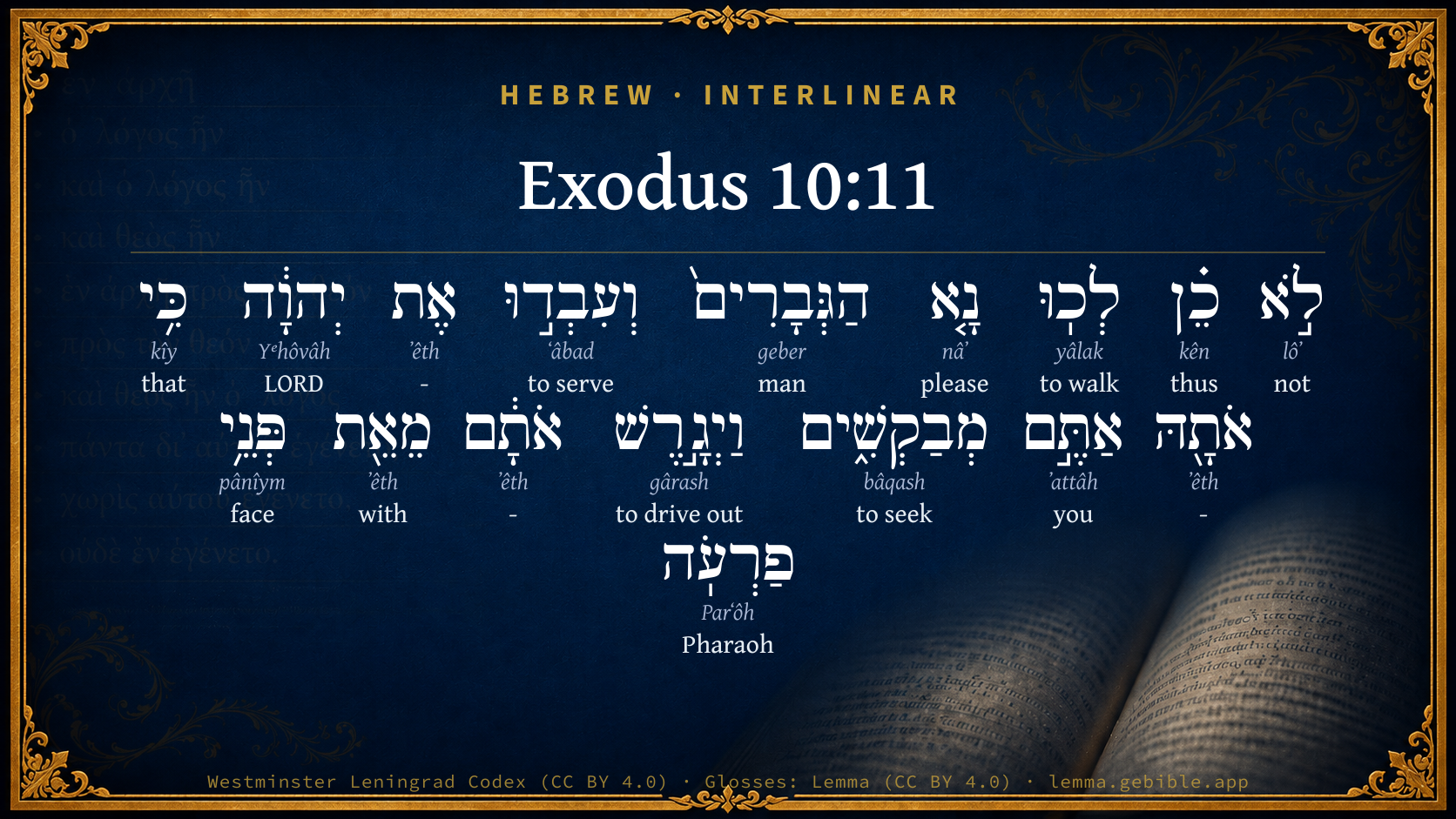
Hebrew (Westminster Leningrad Codex) Exodus 10:11 appears in the Hebrew Old Testament. The text above is from the Westminster Leningrad Codex. Each word links to its Strong’s number, a concise gloss, and parsing drawn from the Open Scriptures Hebrew Bible morphology. Click any word for its full Brown-Driver-Briggs (BDB) entry.
Download image
Cite this verse

Exodus 10:11 (World English Bible). Public Domain. Lemma interlinear Bible study tool, https://lemma.gebible.app/v/exodus/10/11.

Show BibTeX & RIS
BibTeX
RIS
English Translation
Not so! Go now you who are men, and serve Yahweh; for that is what you desire!" They were driven out from Pharaoh's presence.
World English Bible · Public Domain
Highlights
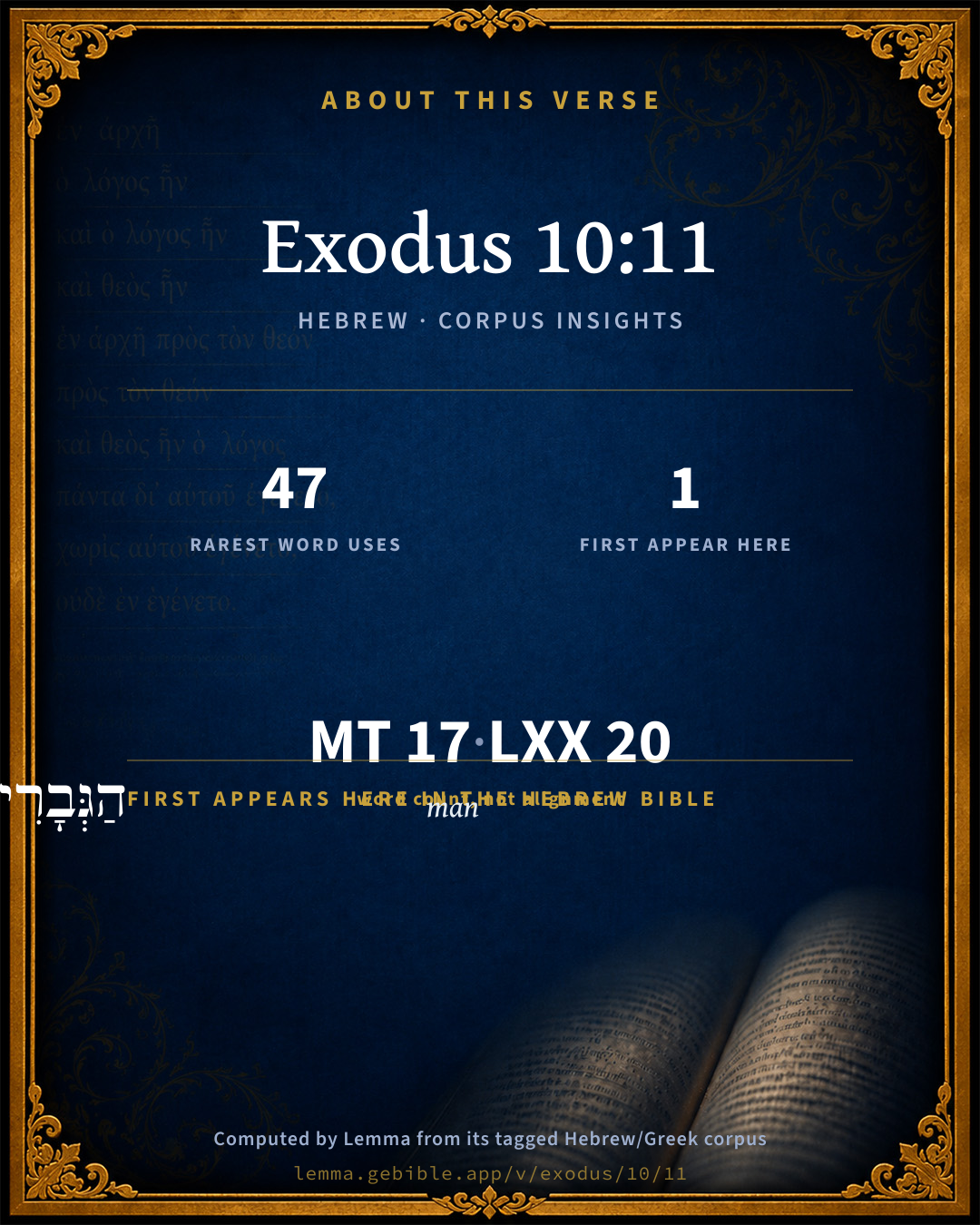
  • 1 first appearance in the Hebrew Bible
Full analysis ↓
Download a study sheet

One document with this verse’s original text, its word-by-word gloss line, the meaning frame, cross-references with their text, attributed commentary, and full source and license credits — printable, and it pastes into notes with its structure intact.

This verse Autodidact and up

Study sheet (.html) Plain text (.txt)

A passage Seminary Student

Up to 50 verses in one chapter. A passage sheet keeps up to 6 commentary sources and 12 cross-references per verse, in the order this page ranks them, and says so on the sheet whenever that leaves anything out. Ask for a single verse and you get the Autodidact verse sheet above.

Everything on this page stays free to read, with no account — the sheet is a download of what is already on screen, not access to it.

Want to remove ads? Support Godless Engineer
Compare translations 3

The same verse in 3 English versions, stacked beneath the original-language interlinear above. Click any original word for its lexicon entry.

Each is an independent rendering of the whole verse — the interlinear is not word-aligned to these translations.

Highlighted words mark where these versions differ — a whole-verse word diff, not a word-by-word alignment.

  • World English Bible Public Domain
    Not so! Go now you who are men, and serve Yahweh; for that is what you desire!" They were driven out from Pharaoh's presence.
  • King James Version Public Domain
    Not so: go now ye that are men, and serve the LORD; for that ye did desire. And they were driven out from Pharaoh's presence.
  • unfoldingWord Literal Text CC BY-SA 4.0
    Not so! You may go, the men, and serve Yahweh, because this is what you are seeking.” And he drove them from the face of Pharaoh.

unfoldingWord Literal Text — © unfoldingWord, licensed CC BY-SA 4.0. Word-aligned USFM3 via Door43 (git.door43.org/unfoldingWord/en_ult).

Versions to compare (up to 4)

3 of 4 selected

Show all 18 translations

Every available English version of this verse, each an independent rendering of the whole verse.

  • World English Bible Public Domain
    Not so! Go now you who are men, and serve Yahweh; for that is what you desire!" They were driven out from Pharaoh's presence.
  • Berean Standard Bible Public Domain
    No, only the men may go and worship the LORD, since that is what you have been requesting.” And Moses and Aaron were driven from Pharaoh’s presence.
  • Majority Standard Bible Public Domain
    No, only the men may go and worship the LORD, since that is what you have been requesting.” And Moses and Aaron were driven from Pharaoh’s presence.
  • King James Version Public Domain
    Not so: go now ye that are men, and serve the LORD; for that ye did desire. And they were driven out from Pharaoh's presence.
  • American Standard Version (1901) Public Domain
    Not so: go now ye that are men, and serve Jehovah; for that is what ye desire. And they were driven out from Pharaoh's presence.
  • Revised Version (1885) Public Domain
    Not so: go now ye that are men, and serve the LORD; for that is what ye desire. And they were driven out from Pharaoh’s presence.
  • Geneva Bible (1599) Public Domain
    It shall not be so: nowe goe ye that are men, and serue the Lord: for that was your desire. Then they were thrust out from Pharaohs presence.
  • Douay-Rheims (1899) Public Domain
    It shall not be so: but go ye men only, and sacrifice to the Lord: for this yourselves also desired. And immediately they were cast out from Pharao's presence.
  • Young's Literal Translation Public Domain
    not so! go now, ye who `are' men, and serve Jehovah, for that ye are seeking;' and `one' casteth them out from the presence of Pharaoh.
  • Literal Standard Version CC BY-SA 4.0
    Not so! Go now, you who [are] men, and serve YHWH, for that you are seeking”; and [one] casts them out from the presence of Pharaoh.
  • Unlocked Literal Bible CC BY-SA 4.0
    No! Go, just the men among you, and worship Yahweh, for that is what you want.” Then Moses and Aaron were driven out from Pharaoh's presence.
  • unfoldingWord Literal Text CC BY-SA 4.0
    Not so! You may go, the men, and serve Yahweh, because this is what you are seeking.” And he drove them from the face of Pharaoh.
  • Darby Bible Public Domain
    Not so: go now, ye [that are] men, and serve Jehovah! for it is that ye have desired. And they were driven out from Pharaoh's presence.
  • World Messianic Bible Public Domain
    Not so! Go now you who are men, and serve the LORD; for that is what you desire!” Then they were driven out from Pharaoh’s presence.
  • Webster's Bible Public Domain
    Not so: go now ye that are men, and serve the LORD; for that you desired. And they were driven out from Pharaoh's presence.
  • Free Bible Version CC BY-SA 4.0
    So no! Only the men can go and worship the Lord, because that's what you've been asking for.” Then he had Moses and Aaron thrown out.
  • Bible in Basic English Public Domain
    Not so; but let your males go and give worship to the Lord, as your desire is. This he said, driving them out from before him.
  • JPS Tanakh (1917) Public Domain
    Not so; go now ye that are men, and serve the LORD; for that is what ye desire.' And they were driven out from Pharaoh's presence.

Literal Standard Version (2020), Covenant Press — licensed CC BY-SA 4.0. Text via the HelloAO Bible API (eBible.org). Unlocked Literal Bible (unfoldingWord) — licensed CC BY-SA 4.0. Text via the HelloAO Bible API (eBible.org). unfoldingWord Literal Text — © unfoldingWord, licensed CC BY-SA 4.0. Word-aligned USFM3 via Door43 (git.door43.org/unfoldingWord/en_ult). Free Bible Version, Dr. Jonathan Gallagher — licensed CC BY-SA 4.0. Text via the HelloAO Bible API (eBible.org).

Word by word

More ways to search: Search by grammar → Find every occurrence → Compare this word →

Practice this passage: Drill this verse → Learn its vocabulary →

וַיְגָ֣רֶשׁ
gârash
H1644
“and · to drive out”
Conjunction + Verb, Piel, Sequential Imperfect, 3rd Person, Masculine, Singular
Part of Speech
Conjunction + Verb
Stem
Piel
Form
Sequential Imperfect
Person
3rd Person
Gender
Masculine
Number
Singular
Full BDB Definition

Origin: a primitive root

TWOT: 388

to drive out, expel, cast out, drive away, divorce, put away, thrust away, trouble, cast up - (Qal) to thrust out, cast out - (Niphal) to be driven away, be tossed - (Piel) to drive out, drive away - (Pual) to be thrust out
  1. לֹ֣א lôʼ H3808 “not” Particle, Negative
  2. כֵ֗ן kên H3651 “thus” Adverb
  3. לְכֽוּ yâlak H3212 “walk” Verb, Qal, Imperative, 2nd Person, Masculine, Plural
  4. נָ֤א nâʼ H4994 “please” Particle, Exhortation
  5. הַגְּבָרִים֙ geber H1397 “the · men” Particle, Definite Article + Noun, Common, Masculine, Plural, Absolute
  6. וְעִבְד֣וּ ʻâbad H5647 “and · serve” Conjunction + Verb, Qal, Imperative, 2nd Person, Masculine, Plural
  7. אֶת ʼêth H853 “-” Particle, Direct Object
  8. יְהוָ֔ה Yᵉhôvâh H3068 “LORD” Noun, Proper
  9. כִּ֥י kîy H3588 “that” Conjunction
  10. אֹתָ֖הּ ʼêth H853 “- · her” Particle, Direct Object + Suffix, Personal, 3rd Person, Feminine, Singular
  11. אַתֶּ֣ם ʼattâh H859 “you” Pronoun, Personal, 2nd Person, Masculine, Plural
  12. מְבַקְשִׁ֑ים bâqash H1245 “seeking” Verb, Piel, Participle Active, Masculine, Plural, Absolute
  13. אֹתָ֔ם ʼêth H853 “- · them” Particle, Direct Object + Suffix, Personal, 3rd Person, Masculine, Plural
  14. מֵאֵ֖ת ʼêth H854 “from · with” Preposition + Preposition
  15. פְּנֵ֥י pânîym H6440 “face(s) of” Noun, Common, Both, Plural, Construct
  16. פַרְעֹֽה Parʻôh H6547 “Pharaoh” Noun, Proper

About this verse

These counts appear in no published source. They are computed here, from the morphology-tagged text and Lemma’s own curated glosses. What Lemma adds →

17
words
15
distinct lemmas
Pentateuch
section

First appearance in Scripture

This word makes its first canonical appearance in the Hebrew Bible here:

  • הַגְּבָרִים֙ man H1397

Shared distinctive vocabulary

וַיְגָ֣רֶשׁ to drive out H1644 occurs in 45 verses of the Hebrew Bible. Also found in:

Grammatical profile

  • 4 verbs
  • 4 nouns
  • 1 pronoun
  • 1 preposition
  • 1 conjunction
  • 1 adverb
  • 5 particles

Verb forms

  • לְכֽוּ Qal · Imperative
  • וְעִבְד֣וּ Qal · Imperative
  • מְבַקְשִׁ֑ים Piel · Participle Active
  • וַיְגָ֣רֶשׁ Piel · Sequential Imperfect

Hebrew & Septuagint length

In English translation the verse runs 24 words from the Hebrew and 25 from the Septuagint (LXX English) — closely comparable.

A rough comparison of the two English renderings, which tokenize alike — not a word-level alignment.

Word counts can differ between the Hebrew and the Greek without any difference in meaning — e.g. the Hebrew direct-object marker אֵת has no separate Greek word, and Greek often adds the article ὁ.

In the original languages it is 17 Hebrew tokens and 20 Greek tokens — but the two are counted differently (Hebrew bundles its prefixes and suffixes into one token; the Greek is in lemma form), so that isn’t a like-for-like length.

Cross-references

4

Topical passages linked to Exodus 10:11 in the Treasury of Scripture Knowledge — connected by theme and wording, ordered by reader-vote popularity; previews shown in the World English Bible.

  • Exodus 10:28 Pharaoh said to him, "Get away from me! Be careful to see my face no more; for in the day you see my face you shall die!"
  • Psalms 119:69 The proud have smeared a lie upon me. With my whole heart, I will keep your precepts.
  • Exodus 5:4 The king of Egypt said to them, "Why do you, Moses and Aaron, take the people from their work? Get back to your burdens!"
  • Psalms 52:3–4 You love evil more than good, Lying rather than speaking the truth. Selah.

Cross-references courtesy of OpenBible.info (CC BY 4.0).

Hebrew and Greek witnesses Masoretic Hebrew ↔ Greek Septuagint

The same verse in the two great witnesses to the Old Testament, shown verse-for-verse.

These are two independent witnesses, not word-aligned to each other, and the Septuagint is shown in lemma (dictionary) form.

Hebrew Exodus 10:11 Masoretic · Westminster Leningrad Codex

לֹ֣א כֵ֗ן לְכֽוּ נָ֤א הַגְּבָרִים֙ וְעִבְד֣וּ אֶת יְהוָ֔ה כִּ֥י אֹתָ֖הּ אַתֶּ֣ם מְבַקְשִׁ֑ים וַיְגָ֣רֶשׁ אֹתָ֔ם מֵאֵ֖ת פְּנֵ֥י פַרְעֹֽה

Not so! Go now you who are men, and serve Yahweh; for that is what you desire!" They were driven out from Pharaoh's presence.

World English Bible · Public Domain

Greek LXX Exodus 10:11 Septuagint · lemma form

μή οὕτως πορεύομαι δέ ὁ ἀνήρ καί λατρεύω ὁ θεός οὗτος γάρ αὐτός ζητέω ἐκβάλλω δέ αὐτός ἀπό πρόσωπον φαραώ

Not so, but let the men go and serve God, for this you⌃ yourselves seek; and they cast them out from the presence of Pharao.

LXX2012 (modern English Septuagint) · Public Domain

Hebrew: Westminster Leningrad Codex (CC BY 4.0). Greek: Septuagint (public domain); English from LXX2012 (modern English Septuagint) (Public Domain). How the Septuagint differs from the Hebrew →

Targum (Aramaic paraphrase)

2

The Targum is the ancient Jewish Aramaic paraphrase of the Hebrew Scriptures — an interpretive translation, not the Hebrew text itself. Onkelos (literal) and Pseudo-Jonathan (expansive) render the Torah, and Jonathan the Prophets. Coverage is partial: where no permissively-licensed English translation exists for a verse, only the Aramaic is shown. This is verse-level text, not a word-by-word alignment to the Hebrew.

  1. Targum Onkelos Torah (Genesis–Deuteronomy)
    לָא כֵן אֱזִילוּ כְעַן גֻבְרַיָא וּפְלָחוּ קֳדָם יְיָ אֲרֵי יָתַהּ אַתּוּן בָּעָן וְתָרִיךְ יָתְהוֹן מִן קֳדָם פַּרְעֹה:

    (no public-domain English translation for this verse)

    Targum Onkelos — Aramaic: “Onkelos Genesis” (public domain); “Onkelos Exodus” (public domain); “Onkelos Leviticus” (public domain); “Onkelos Numbers” (public domain); “Onkelos Deuteronomy” (public domain). English: “Sefaria Community Translation” (CC0 1.0 (public-domain dedication)); “J.W. Etheridge. The Targums of Onkelos and Jonathan Ben Uzziel on the Pentateuch. London: Longmans, Green, 1862” (public domain). Text via Sefaria.

  2. Targum Pseudo-Jonathan Torah (Genesis–Deuteronomy)
    לָא כְמָא דְאַתּוּן סַבְרִין אֱלָהֵן אִיזִילוּ כְּדוֹן גּוּבְרַיָא וּפָלְחוּ קֳדָם יְיָ אֲרוּם יָתֵיהּ אַתּוּן בָּעָן וְתָרִיךְ יַתְהוֹן מִלְוַת אַפֵּי פַּרְעה

    (It shall be) not so as ye devise; but the men only shall go and worship before the Lord; for that it was which ye demanded. And he drave them out from before the face of Pharoh.

    Targum Pseudo-Jonathan — Aramaic: “Targum Jonathan on Genesis” (public domain); “Targum Jonathan on Exodus” (public domain); “Targum Jonathan on Leviticus” (public domain); “Targum Jonathan on Numbers” (public domain); “Targum Jonathan on Deuteronomy” (public domain). English: “The Targum of Jonathan ben Uzziel, trans. J. W. Etheridge, London, 1862” (public domain). Text via Sefaria.

Commentary

Notes on Exodus 10:11 from classic Christian and Jewish commentators (each source and its license shown beneath its notes). The classic Christian expositions comment on the surrounding passage and are grouped to its opening verse, so a note may address several verses; the Jewish commentaries on the Tanakh (Rashi and others) are per-verse, so they appear only where the commentator wrote on this verse.

Lemma curates 59 commentaries, every one of them public domain or Creative Commons licensed, each selected and text-cleaned for this edition rather than reprinted as found. About our sources →

Trapp's Complete Commentary

John Trapp

Exo 10:11 Not so: go now ye [that are] men, and serve the LORD; for that ye did desire. And they were driven out from Pharaoh’s presence.

Ver. 11. Not so,] q.d., I will watch you for that what should children do sacrificing? Them I will retain, as pledges of your return.

John Trapp, A Commentary or Exposition upon All the Books of the Old and New Testament (1647–1656) — public domain. Text from a community e-Sword module.

Jamieson, Fausset & Brown

Robert Jamieson, A. R. Fausset & David Brown

they were driven out from Pharaoh's presence--In the East, when a person of authority and rank feels annoyed by a petition which he is unwilling to grant, he makes a signal to his attendants, who rush forward and, seizing the obnoxious suppliant by the neck, drag him out of the chamber with violent haste. Of such a character was the impassioned scene in the court of Egypt when the king had wrought himself into such a fit of uncontrollable fury as to treat ignominiously the two venerable representatives of the Hebrew people.

Jamieson, Fausset & Brown — Commentary Critical and Explanatory on the Whole Bible (1871) — public domain (CC PDM 1.0). Text via the HelloAO Bible API.

Ellicott's Commentary for English Readers

(11) Ye that are men.—Heb., haggëbarim—i.e., the full-grown males.

That ye did desire.—There was no ground for this reproach. Moses and Aaron had always demanded the release of the entire nation (“let my people go”); and nations are composed of women and children as much and as essentially as they are of adult males.

A Bible Commentary for English Readers, edited by Charles John Ellicott (1878–1897) — public domain. Text from a community e-Sword module.

The Cambridge Bible for Schools and Colleges

gen. ed. J. J. S. Perowne

11. men] Not the word used in v. 7, but one meaning more distinctly men, as opposed to women or children: cf. Deu_22:5 Heb.

for that is what ye desire] viz. to worship Jehovah at a festival, which could be sufficiently observed by men alone (Exo_23:17).

And they were driven, &c.] With this ultimatum, that only the men might go, the interview abruptly terminates.

The Cambridge Bible for Schools and Colleges (gen. ed. J. J. S. Perowne; Cambridge University Press, 1878–1918) — public domain. Text from a community e-Sword module.

John Gill's Exposition

Not so,.... You shall not go with your children as you propose:

go now ye that are men, and serve the Lord, for that you did desire; suggesting that that was all they first required, that their men should, go three days into the wilderness, and sacrifice unto the Lord; whereas the demand was, let my people go, Exo 5:1 which were not the men only, but the women and children also, and all were concerned in the service of God, and in keeping a feast to him:

and they were driven out from Pharaoh's presence; by some of his officers, according to his orders.

John Gill's Exposition of the Whole Bible (1746–1763) — public domain (CC PDM 1.0). Text via the HelloAO Bible API.

Haydock's Catholic Bible Commentary

Desired. Moses had requested that all might go. He had not specified the men only, as the king boldly asserts. (Menochius) --- A partial obedience will not rescue him from the threatened plague. (Haydock)

George Leo Haydock (1774–1849), Haydock's Catholic Family Bible and Commentary, 1859 edition — public domain. Excludes Psalms (Douay-Rheims chapter numbering differs from Protestant) and Deuterocanonical books (Catholic canon only).

Matthew Poole's English Annotations

For that ye did desire; which was not true, but only was gathered by him out of their declared intention of going to sacrifice, wherein he thought the presence of the women and children wholly unnecessary.

Matthew Poole's English Annotations on the Holy Bible (1683–1685) — public domain. Text from a community e-Sword/MySword module.

The Pulpit Commentary

Go now ye that are men. Or, "ye that are adult males." The word is different from that used in ver. 7, which includes women and children. And serve the Lord; for that ye did desire. Pharaoh seems to argue that the request to "serve the Lord" implied the departure of the men only, as if women and children could not offer an acceptable service. But he must have known that women and children attended his own national festivals. (See the comment on ver. 9.) Probably, he knew that his argument was sophistical. And they were driven out. Literally, "One drove them out." Pharaoh"s manifest displeasure was an indication to the court officials that he wished the interview ended, and as the brothers did not at once voluntarily quit the presence, an officer thrust them out. This was an insult not previously offered them, and shows how Pharaoh"s rage increased as he saw more and more clearly that he would have to yield and allow the departure of the entire nation.

The Pulpit Commentary (1880–1919), ed. H.D.M. Spence-Jones & Joseph S. Exell — public domain. Text from a community e-Sword module.

Scofield Reference Notes

C. I. Scofield

ye that are

The third compromise proposed by Pharaoh is, perhaps, as applied to believers, the sublest and most successful of them all. The most godly parents desire worldly prosperity and position for their children. Mat 20:20; Mat 20:21.

The Scofield Reference Bible (1917 edition), notes by C. I. Scofield — public domain. Text from a community e-Sword module.

Rashi

Rabbi Shlomo Yitzchaki (Rashi)

לא כן NOT SO as you have said, to take the children with you, but 'לכו נא הגברים ועבדו את ה GO YE WHO ARE ADULT MEN AND SERVE THE LORD.

כי אתה אתם מבקשים means FOR THAT IS WHAT YE DID SEEK till now: let us sacrifice to our God — and it is not the custom for little children to offer sacrifice.

ויגרש אותם AND HE DROVE THEM OUT — This is an elliptical phrase and it does not expressly state who drove them out (i. e. the subject of the verb is omitted).

Rashi on the Tanakh — English translations: “The Judaica Press complete Tanach with Rashi, translated by A. J. Rosenberg” (CC BY 4.0); “Pentateuch with Rashi's commentary by M. Rosenbaum and A.M. Silbermann, 1929-1934” (public domain); “The Metsudah Tanach series, Lakewood, N.J” (CC BY 4.0); and “The Book of Joshua, Metsudah Publications, 1997” (CC BY 4.0). Text via Sefaria.

Lesson kit

Teaching starters — assembled from the data on this page, not authored interpretation. Every prompt links to the verse data it draws on. Edit before teaching.

Exodus, in the Pentateuch, opens this verse with 17 words (15 distinct Hebrew lemmas). Its most distinctive word is gârash (“to drive out”). A historical commentator’s framing appears above. Read the whole chapter for the surrounding context.

Discussion questions

  1. What does “to drive out” (gârash) contribute to the verse as a whole?
  2. This is the first place “man” appears in Scripture (first appears here). What does its debut here establish?
  3. How does Genesis 3:24, which shares the word «to drive out», read alongside this verse?
  4. The translations on this page render this verse differently — a whole-verse word diff, not a word-by-word alignment. What might account for the different wordings?
  5. «לְכֽוּ» is a Qal Imperative verb. How does that grammatical form shape the action described?
  6. Compare how Trapp's Complete Commentary and Jamieson, Fausset & Brown read this verse. Where do they agree or differ?

Things to notice

Reading settings

Reading text

Shown beneath each verse's original-language words.

Old Testament
Old Testament edition

Read the OT as the Masoretic Hebrew (MT) or the Greek Septuagint (LXX).

English shown for the Greek Septuagint (in the Hebrew ↔ Greek comparison).

Comparing translations? Open the Compare panel on any verse page to stack up to four side by side.