1 Kings 1:3

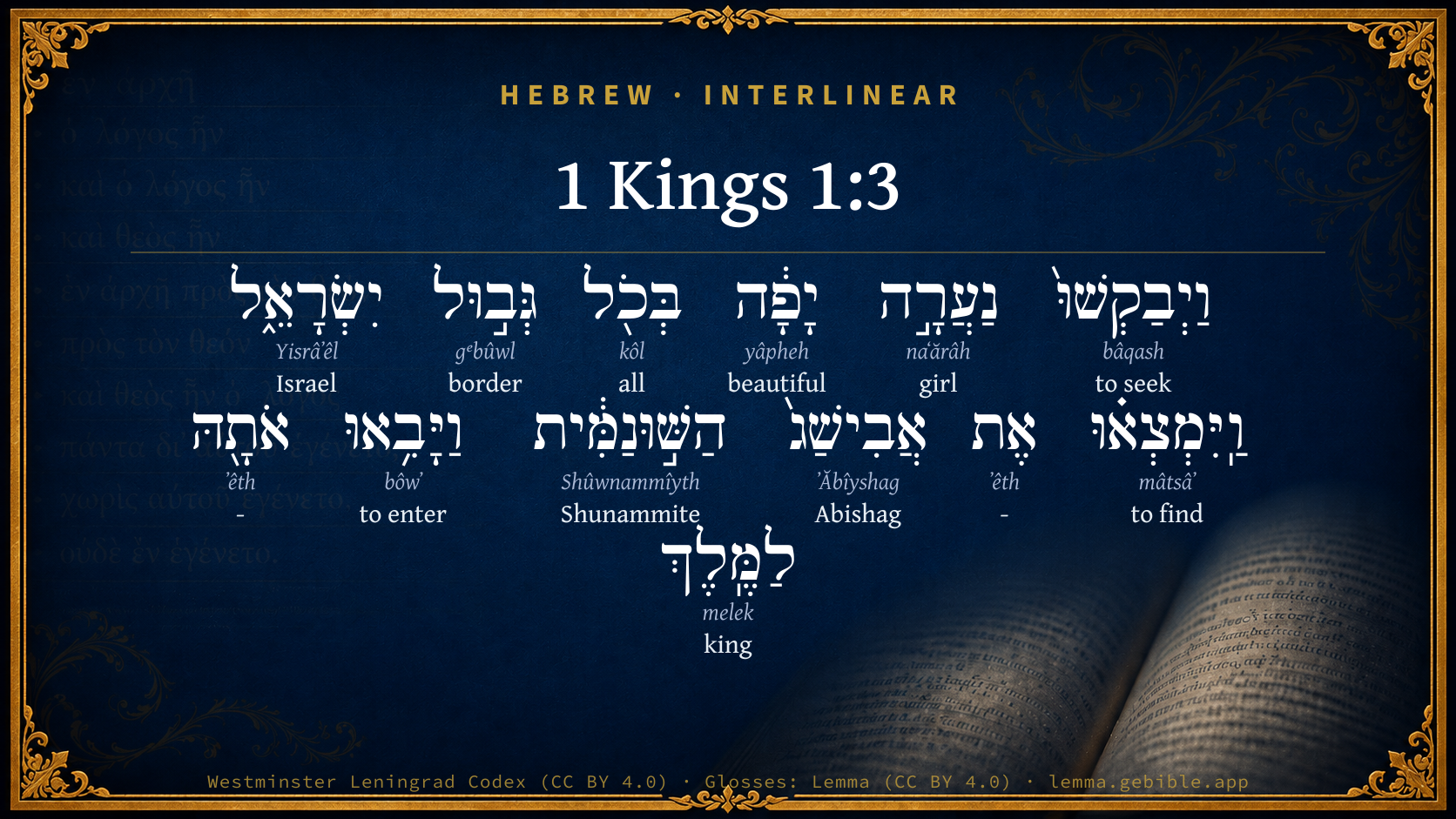
Hebrew (Westminster Leningrad Codex) 1 Kings 1:3 appears in the Hebrew Old Testament. The text above is from the Westminster Leningrad Codex. Each word links to its Strong’s number, a concise gloss, and parsing drawn from the Open Scriptures Hebrew Bible morphology. Click any word for its full Brown-Driver-Briggs (BDB) entry.
Download image
Cite this verse

1 Kings 1:3 (World English Bible). Public Domain. Lemma interlinear Bible study tool, https://lemma.gebible.app/v/1-kings/1/3.

Show BibTeX & RIS
BibTeX
RIS
English Translation
So they sought for a beautiful young lady throughout all the borders of Israel, and found Abishag the Shunammite, and brought her to the king.
World English Bible · Public Domain
Highlights
  • 2 first appearances in the Hebrew Bible
Full analysis ↓
Download a study sheet

One document with this verse’s original text, its word-by-word gloss line, the meaning frame, cross-references with their text, attributed commentary, and full source and license credits — printable, and it pastes into notes with its structure intact.

This verse Autodidact and up

Study sheet (.html) Plain text (.txt)

A passage Seminary Student

Up to 50 verses in one chapter. A passage sheet keeps up to 6 commentary sources and 12 cross-references per verse, in the order this page ranks them, and says so on the sheet whenever that leaves anything out. Ask for a single verse and you get the Autodidact verse sheet above.

Everything on this page stays free to read, with no account — the sheet is a download of what is already on screen, not access to it.

Want to remove ads? Support Godless Engineer
Compare translations 3

The same verse in 3 English versions, stacked beneath the original-language interlinear above. Click any original word for its lexicon entry.

Each is an independent rendering of the whole verse — the interlinear is not word-aligned to these translations.

Highlighted words mark where these versions differ — a whole-verse word diff, not a word-by-word alignment.

  • World English Bible Public Domain
    So they sought for a beautiful young lady throughout all the borders of Israel, and found Abishag the Shunammite, and brought her to the king.
  • King James Version Public Domain
    So they sought for a fair damsel throughout all the coasts of Israel, and found Abishag a Shunammite, and brought her to the king.
  • unfoldingWord Literal Text CC BY-SA 4.0
    And they sought a beautiful young woman in all of the border of Israel, and they found Abishag the Shunammitess, and they brought her to the king.

unfoldingWord Literal Text — © unfoldingWord, licensed CC BY-SA 4.0. Word-aligned USFM3 via Door43 (git.door43.org/unfoldingWord/en_ult).

Versions to compare (up to 4)

3 of 4 selected

Show all 18 translations

Every available English version of this verse, each an independent rendering of the whole verse.

  • World English Bible Public Domain
    So they sought for a beautiful young lady throughout all the borders of Israel, and found Abishag the Shunammite, and brought her to the king.
  • Berean Standard Bible Public Domain
    Then they searched throughout Israel for a beautiful girl, and they found Abishag the Shunammite and brought her to the king.
  • Majority Standard Bible Public Domain
    Then they searched throughout Israel for a beautiful girl, and they found Abishag the Shunammite and brought her to the king.
  • King James Version Public Domain
    So they sought for a fair damsel throughout all the coasts of Israel, and found Abishag a Shunammite, and brought her to the king.
  • American Standard Version (1901) Public Domain
    So they sought for a fair damsel throughout all the borders of Israel, and found Abishag the Shunammite, and brought her to the king.
  • Revised Version (1885) Public Domain
    So they sought for a fair damsel throughout all the coasts of Israel, and found Abishag the Shunammite, and brought her to the king.
  • Geneva Bible (1599) Public Domain
    So they sought for a faire young maide thoroughout all the coastes of Israel, and founde one Abishag a Shunamite, and brought her to the king.
  • Douay-Rheims (1899) Public Domain
    So they sought a beautiful young woman in all the coasts of Israel, and they found Abisag a Sunamitess, and brought her to the king.
  • Young's Literal Translation Public Domain
    And they seek a fair young woman in all the border of Israel, and find Abishag the Shunammite, and bring her in to the king,
  • Literal Standard Version CC BY-SA 4.0
    And they seek [for] a beautiful young woman in all the border of Israel, and find Abishag the Shunammite, and bring her to the king,
  • Unlocked Literal Bible CC BY-SA 4.0
    So they searched for a beautiful girl within all the borders of Israel. They found Abishag the Shunammite and brought her to the king.
  • unfoldingWord Literal Text CC BY-SA 4.0
    And they sought a beautiful young woman in all of the border of Israel, and they found Abishag the Shunammitess, and they brought her to the king.
  • Darby Bible Public Domain
    And they sought for a fair damsel throughout the territory of Israel, and found Abishag a Shunammite, and brought her to the king.
  • World Messianic Bible Public Domain
    So they sought for a beautiful young lady throughout all the borders of Israel, and found Abishag the Shunammite, and brought her to the king.
  • Webster's Bible Public Domain
    So they sought for a fair damsel throughout all the borders of Israel, and found Abishag a Shunamite, and brought her to the king.
  • Free Bible Version CC BY-SA 4.0
    So they searched the whole country of Israel for a beautiful young woman and found Abishag from the town of Shunem and took her to the king.
  • Bible in Basic English Public Domain
    So after searching through all the land of Israel for a fair young girl, they saw Abishag the Shunammite, and took her to the king.
  • JPS Tanakh (1917) Public Domain
    So they sought for a fair damsel throughout all the borders of Israel, and found Abishag the Shunammite, and brought her to the king.

Literal Standard Version (2020), Covenant Press — licensed CC BY-SA 4.0. Text via the HelloAO Bible API (eBible.org). Unlocked Literal Bible (unfoldingWord) — licensed CC BY-SA 4.0. Text via the HelloAO Bible API (eBible.org). unfoldingWord Literal Text — © unfoldingWord, licensed CC BY-SA 4.0. Word-aligned USFM3 via Door43 (git.door43.org/unfoldingWord/en_ult). Free Bible Version, Dr. Jonathan Gallagher — licensed CC BY-SA 4.0. Text via the HelloAO Bible API (eBible.org).

Word by word

More ways to search: Search by grammar → Find every occurrence → Compare this word →

Practice this passage: Drill this verse → Learn its vocabulary →

אֲבִישַׁג֙
ʼĂbîyshag
H49
“Abishag”
Noun, Proper
Part of Speech
Noun
Type
Proper
Full BDB Definition

Origin: from H1 and H7686

TWOT: None

Abishag = "my father is a wanderer" - David's beautiful young nurse
  1. וַיְבַקְשׁוּ֙ bâqash H1245 “and · to seek” Conjunction + Verb, Piel, Sequential Imperfect, 3rd Person, Masculine, Plural
  2. נַעֲרָ֣ה naʻărâh H5291 “girl” Noun, Common, Feminine, Singular, Absolute
  3. יָפָ֔ה yâpheh H3303 “beautiful” Adjective, Adjective, Feminine, Singular, Absolute
  4. בְּכֹ֖ל kôl H3605 “in/at · all of” Preposition + Noun, Common, Masculine, Singular, Construct
  5. גְּב֣וּל gᵉbûwl H1366 “border of” Noun, Common, Masculine, Singular, Construct
  6. יִשְׂרָאֵ֑ל Yisrâʼêl H3478 “Israel” Noun, Proper
  7. וַֽיִּמְצְא֗וּ mâtsâʼ H4672 “and · to find” Conjunction + Verb, Qal, Sequential Imperfect, 3rd Person, Masculine, Plural
  8. אֶת ʼêth H853 “-” Particle, Direct Object
  9. הַשּׁ֣וּנַמִּ֔ית Shûwnammîyth H7767 “the · Shunammite” Particle, Definite Article + Noun, Gentilic, Feminine, Singular, Absolute
  10. וַיָּבִ֥אוּ bôwʼ H935 “and · to enter” Conjunction + Verb, Hiphil, Sequential Imperfect, 3rd Person, Masculine, Plural
  11. אֹתָ֖הּ ʼêth H853 “- · her” Particle, Direct Object + Suffix, Personal, 3rd Person, Feminine, Singular
  12. לַמֶּֽלֶךְ melek H4428 “to/for the · king” Preposition, Determined + Noun, Common, Masculine, Singular, Absolute

About this verse

These counts appear in no published source. They are computed here, from the morphology-tagged text and Lemma’s own curated glosses. What Lemma adds →

13
words
12
distinct lemmas
Historical
section

Notable vocabulary

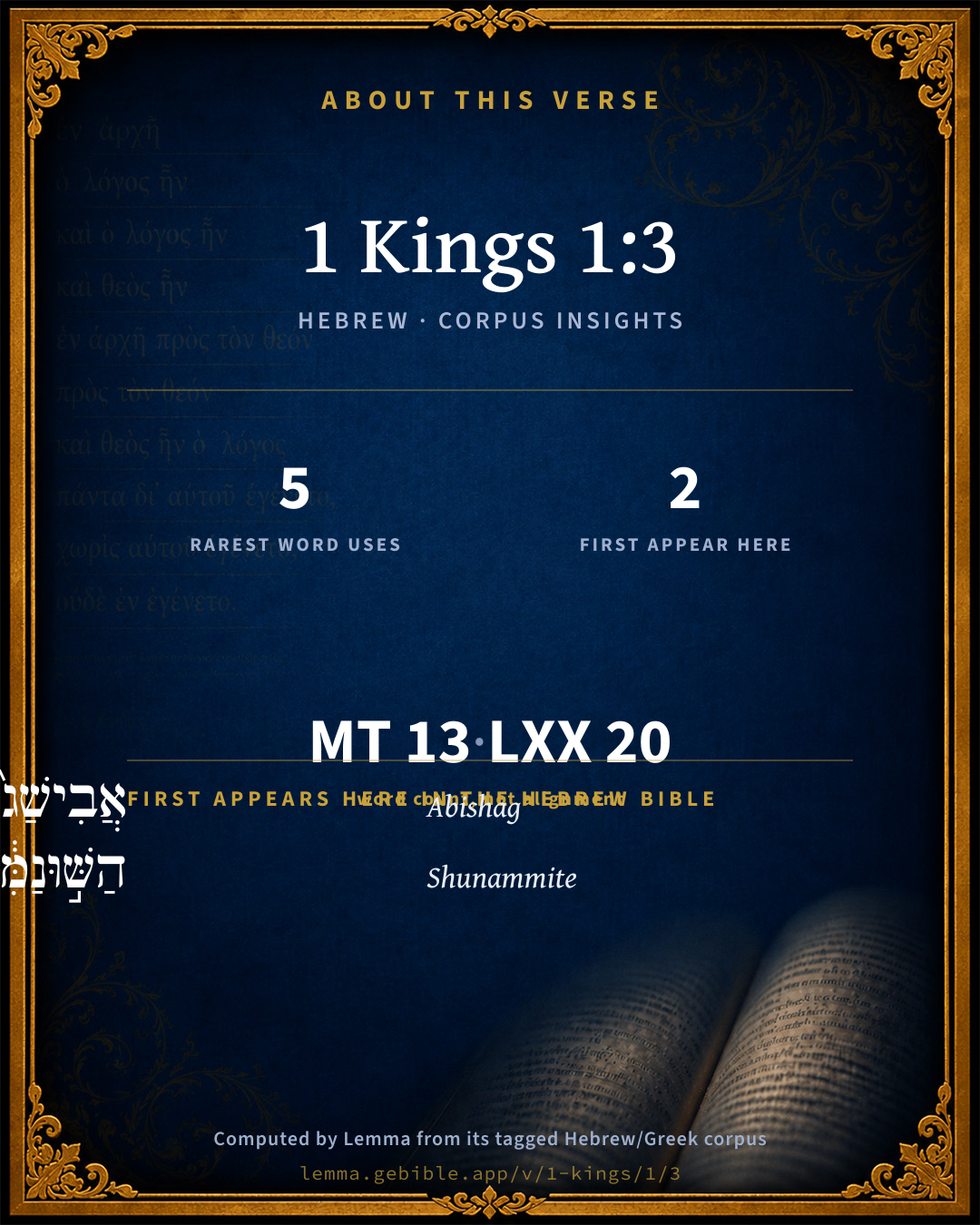
The rarest word here is אֲבִישַׁג֙ Abishag H49 — appearing just 5 times in the whole Hebrew Bible.

First appearance in Scripture

These words make their first canonical appearance in the Hebrew Bible here:

  • אֲבִישַׁג֙ Abishag H49
  • הַשּׁ֣וּנַמִּ֔ית Shunammite H7767

Shared distinctive vocabulary

אֲבִישַׁג֙ Abishag H49 occurs in 5 verses of the Hebrew Bible. Also found in:

Grammatical profile

  • 3 verbs
  • 7 nouns
  • 1 adjective
  • 2 particles

Verb forms

  • וַיְבַקְשׁוּ֙ Piel · Sequential Imperfect
  • וַֽיִּמְצְא֗וּ Qal · Sequential Imperfect
  • וַיָּבִ֥אוּ Hiphil · Sequential Imperfect

Hebrew & Septuagint length

In English translation the verse runs 25 words from the Hebrew and 27 from the Septuagint (LXX English) — closely comparable.

A rough comparison of the two English renderings, which tokenize alike — not a word-level alignment.

Word counts can differ between the Hebrew and the Greek without any difference in meaning — e.g. the Hebrew direct-object marker אֵת has no separate Greek word, and Greek often adds the article ὁ.

In the original languages it is 13 Hebrew tokens and 20 Greek tokens — but the two are counted differently (Hebrew bundles its prefixes and suffixes into one token; the Greek is in lemma form), so that isn’t a like-for-like length.

Cross-references

7

Topical passages linked to 1 Kings 1:3 in the Treasury of Scripture Knowledge — connected by theme and wording, ordered by reader-vote popularity; previews shown in the World English Bible.

  • Joshua 19:18 Their border was to Jezreel, and Chesulloth, and Shunem,
  • Esther 2:4 and let the maiden who pleases the king be queen instead of Vashti. The thing pleased the king; and he did so.
  • Esther 2:2 Then said the king's servants who ministered to him, Let there be beautiful young virgins sought for the king:
  • 2 Kings 4:8 It fell on a day, that Elisha passed to Shunem, where was a great woman; and she constrained him to eat bread. So it was, that as often as he passed by, he turned in there to eat bread.
  • 1 Samuel 28:4 The Philistines gathered themselves together, and came and encamped in Shunem: and Saul gathered all Israel together, and they encamped in Gilboa.
  • 1 Kings 2:17–25 He said, Please speak to Solomon the king (for he will not tell you 'no'), that he give me Abishag the Shunammite as wife.
  • 2 Kings 4:25 So she went, and came to the man of God to Mount Carmel. It happened, when the man of God saw her afar off, that he said to Gehazi his servant, Behold, yonder is the Shunammite:

Cross-references courtesy of OpenBible.info (CC BY 4.0).

Hebrew and Greek witnesses Masoretic Hebrew ↔ Greek Septuagint

The same verse in the two great witnesses to the Old Testament, shown verse-for-verse.

These are two independent witnesses, not word-aligned to each other, and the Septuagint is shown in lemma (dictionary) form.

Hebrew 1 Kings 1:3 Masoretic · Westminster Leningrad Codex

וַיְבַקְשׁוּ֙ נַעֲרָ֣ה יָפָ֔ה בְּכֹ֖ל גְּב֣וּל יִשְׂרָאֵ֑ל וַֽיִּמְצְא֗וּ אֶת אֲבִישַׁג֙ הַשּׁ֣וּנַמִּ֔ית וַיָּבִ֥אוּ אֹתָ֖הּ לַמֶּֽלֶךְ

So they sought for a beautiful young lady throughout all the borders of Israel, and found Abishag the Shunammite, and brought her to the king.

World English Bible · Public Domain

Greek LXX 1 Kings 1:3 Septuagint · lemma form

καί ζητέω νεᾶνις καλός ἐκ πᾶς ὅριον ἰσραήλ καί εὑρίσκω ὁ αβισακ ὁ σωμανῖτις καί φέρω αὐτός πρός ὁ βασιλεύς

So they sought for a fair damsel out of all the coasts of Israel; and they found Abisag the Somanite, and they brought her to the king.

LXX2012 (modern English Septuagint) · Public Domain

Hebrew: Westminster Leningrad Codex (CC BY 4.0). Greek: Septuagint (public domain); English from LXX2012 (modern English Septuagint) (Public Domain). How the Septuagint differs from the Hebrew →

Targum (Aramaic paraphrase)

1

The Targum is the ancient Jewish Aramaic paraphrase of the Hebrew Scriptures — an interpretive translation, not the Hebrew text itself. Onkelos (literal) and Pseudo-Jonathan (expansive) render the Torah, and Jonathan the Prophets. Coverage is partial: where no permissively-licensed English translation exists for a verse, only the Aramaic is shown. This is verse-level text, not a word-by-word alignment to the Hebrew.

  1. Targum Jonathan Prophets (Joshua–Malachi)
    וּבְעוּ עוּלֶמְתָּא שַׁפִּירְתָּא בְּכֹל תְּחוֹם אַרְעָא דְיִשְׂרָאֵל וְאַשְׁכָּחוּ יַת אֲבִישַׁג דְמִן שׁוּנֵם וְאַיְתִיאוּ יָתָהּ לְמַלְכָּא:

    (no public-domain English translation for this verse)

    Targum Jonathan — Aramaic: “Mikraot Gedolot” (public domain). English: “Sefaria Community Translation” (CC0 1.0 (public-domain dedication)); “London "Chaldee Paraphrase," 1871” (public domain). Text via Sefaria.

Commentary

Notes on 1 Kings 1:3 from classic Christian and Jewish commentators (each source and its license shown beneath its notes). The classic Christian expositions comment on the surrounding passage and are grouped to its opening verse, so a note may address several verses; the Jewish commentaries on the Tanakh (Rashi and others) are per-verse, so they appear only where the commentator wrote on this verse.

Lemma curates 59 commentaries, every one of them public domain or Creative Commons licensed, each selected and text-cleaned for this edition rather than reprinted as found. About our sources →

Trapp's Complete Commentary

John Trapp

1Ki 1:3 So they sought for a fair damsel throughout all the coasts of Israel, and found Abishag a Shunammite, and brought her to the king.

Ver. 3. So they sought for a fair damsel.] The natural cause why they went this way to work rather than by wines, furs, &c., was quia ille calor humanus in substantia erat simillimus calori hominis naturali, eiusque gradum non superabat, saith Valesius: {a} because her heat would be likest to his in substance and degree. Virgins also have more natural heat than women who have had children.

{a} Sac. Theol, cap. 29. Gal., lib. 7. Method.

John Trapp, A Commentary or Exposition upon All the Books of the Old and New Testament (1647–1656) — public domain. Text from a community e-Sword module.

Geneva Bible (1599)

Geneva Bible translators

Which city was in the tribe of Issachar, as Josh. 19:18.

Geneva Bible (1599) marginal notes — public domain. Text via Bolls.life.

Jamieson, Fausset & Brown

Robert Jamieson, A. R. Fausset & David Brown

a Shunammite--Shunem, in the tribe of Issachar (Jos 19:18), lay on an eminence in the plain of Esdraelon, five miles south of Tabor. It is now called Sulam.

Jamieson, Fausset & Brown — Commentary Critical and Explanatory on the Whole Bible (1871) — public domain (CC PDM 1.0). Text via the HelloAO Bible API.

Ellicott's Commentary for English Readers

(3) A Shunammite.—Shunem is in the territory of Issachar (Jos_19:18), and in the plain of Jezreel (1Sa_28:4), near Mount Gilboa. As Eusebius, describing its position carefully, calls it “Sulem,” and as this variation of name is confirmed by its ready identification with the modern village of Solam, it has been conjectured (see Smith’s Dictionary of the Bible, SHULAMITE), ingeniously and not improbably, that Abishag is the “fair Shulamite” of the Song of Solomon (1Ki_6:13). The conjecture certainly throws some light on the occurrences of 1Ki_2:13-25. Probably the whole notice of Abishag is only introduced on account of her subsequent connection with the fate of Adonijah.

A Bible Commentary for English Readers, edited by Charles John Ellicott (1878–1897) — public domain. Text from a community e-Sword module.

The Cambridge Bible for Schools and Colleges

gen. ed. J. J. S. Perowne

3. a fair damsel] Such as might be fitted to be one of the royal wives. A similar direction is given when Vashti has been deposed, and a new queen is to be sought for Ahasuerus (Est_2:2).

all the coasts] In the English of the Bible this word has no necessary reference to sea-board land, as it has in our modern use, but often signifies, as here, borders, territories.

Abishag a Shunammite] The Hebrew has ‘the Shunammite’, as though she either was already, or from subsequent events became, well known. She was a native of Shunem, a city belonging to the tribe of Issachar and lying north of Jezreel and south of Mt Gilboa (see Jos_19:18; 1Sa_28:4). The Syriac and Arabic read Sulamite (cf. Son_6:13).

The Cambridge Bible for Schools and Colleges (gen. ed. J. J. S. Perowne; Cambridge University Press, 1878–1918) — public domain. Text from a community e-Sword module.

John Gill's Exposition

So they sought for a fair damsel throughout all the coasts of Israel,.... Not only a damsel, but a beautiful one, that she might be the more acceptable to the king; who otherwise, if deformed and ugly, would not have endured her in his sight, or received at her hands, and much less suffered her to lie in his bosom:

and found Abishag a Shunammite; a native of the city Shunem, a city in the tribe of Issachar, Jos 19:18;

and brought her to the king; for his approbation of her, and to make her his concubine wife, as he did.

John Gill's Exposition of the Whole Bible (1746–1763) — public domain (CC PDM 1.0). Text via the HelloAO Bible API.

Haydock's Catholic Bible Commentary

Sunamitess. Sunam was not far from Thabor, in the tribe of Issachar. (Calmet) --- This history leads us to explain the ambition and death of Adonias. (Haydock)

George Leo Haydock (1774–1849), Haydock's Catholic Family Bible and Commentary, 1859 edition — public domain. Excludes Psalms (Douay-Rheims chapter numbering differs from Protestant) and Deuterocanonical books (Catholic canon only).

Matthew Poole's English Annotations

A fair damsel; whose beauty might engage his affections, and refresh his spirits, and invite him to those embraces which might communicate some of her natural heat to him, as was designed.

A Shunammite, of the city of Shunem in Issachar, Jos 19:18. See 2Ki 4:8.

Matthew Poole's English Annotations on the Holy Bible (1683–1685) — public domain. Text from a community e-Sword/MySword module.

Whedon's Commentary on the Bible

Daniel D. Whedon

3. Abishag a Shunammite — So called from her native city Shunem, in the tribe of Issachar, the modern Solam, at the base of the Little Hermon. See on Jos_19:18. A needless controversy has been raised as to whether Abishag really became the acknowledged wife or concubine of David. In what respects she served the king is here precisely told, and all beyond this is fruitless speculation. The fact, however, that she slept in the king’s bosom placed her virtually in the position of a concubine, so that Adonijah’s subsequent effort to obtain her as his wife was construed by Solomon into an attempt to invade the royal harem, and thus establish a claim to the throne.

Daniel D. Whedon (gen. ed.), Commentary on the Old and New Testaments (1874–1909) — public domain. Text from a community e-Sword module.

The Pulpit Commentary

So Heb. and they sought (cf., Est_2:2) for a fair this word points to the same conclusion as "virgin" in per. 2 damsel throughout all the coasts i.e., borders (costa=rib, side). An old writer speaks of the coasts and quarters of heaven" of Israel, and found Abishag =" Father of error." Names compounded with Ab, "father," were and are very common in the East. We have, e.g. , Ab-salom in Per. 6, and Abi-athar in Per. 7 a Heb. the Shunammite Shunem, a town of Issachar, (Jos_19:18) now called Solam, "a flourishing village encompassed by gardens" (Porter), and "in the midst of the finest cornfields in the,world" (Grove), lies on the lower slope of "Little Hermon," and has before it the wide plain of Esdraelon. Another Shunammite appears in the sacred history (2Ki_4:8) and brought her to the king. And Solomon loved the Lord thus keeping the first and great commandment, the "Shema Israel" (Deu_6:5; cf. 30:16; Mat_22:7; Luk_10:27) walking in the statutes of David his father i.e. , those which David had kept (verses 6, 14) and commanded him to keep (ch. 2:4): only he sacrificed and burnt incense in high places. These words clearly show that the worship of the high places, although condoned, and indeed accepted, by God (ver. 5) was not strictly lawful and right. It was an ignorance that God winked at. The historian, remembering what the worship of the high places became, notices this as an imperfection of Solomon"s early reign, though he does not say that such worship was sinful.

Ver. 3

The Grace and Place of Love.

Solomon loved the Lord, walking in all the statutes of David his father, only sacrificed," etc.

Of how many men, as well as of the wisest of men, may some such words be used. Of some few it may perhaps be averred that they have loved the Lord "with a perfect heart," of fewer still, if any, that they have loved Him with all the heart, and all the mind, and all the soul, and all the strength. But in the case of most, a qualifying clause must be added, an only." Along with sincere piety, with devout love to Him who first loved us, how often are there found imperfections, infirmities, sins. Sometimes, e.g., the loved is tinged with superstition, as in the case of St. Theresa, Lacordaire, and many Romanists; sometimes, as in the case of Calvin and many Protestants, it is marked by harshness and intolerance; sometimes, as in the case of Schleiermacher and Bunsen, it is infected with rationalism. The love, that is to say, is not without alloy; it is not the pure refined gold. In some of the blessed saints we find narrowness and bigotry, in others fanaticism; in others, again, Pharisaism and presumption. Now all these "love the Lord only.... But observe. Solomon was loved of God; blessed, enriched, and prospered of God, despite this "only;" notwithstanding, i.e. , that his sacrifice and service were marked by imperfection. Hence learn

I THAT GOD LOVES THOSE WHO LOVE HIM, DESPITE THEIR IMPERFECTIONS. Of course God loves men who do not love Him. "God commendeth His love towards us in that while we were yet sinners," etc. We often say to children, "God doesn"t love you when you are naughty," but this is vicious theology. If this were so, there had been no hope for our world. But He is good to the unthankful and evil. Yes, the love must begin with God. "We love Him because He first loved us." And the love that bore with our sins, in the days of our impenitence, now bears also with our infirmities and ignorances. Neither superstition nor narrowness nor fanaticism "nor any other creature can separate us from the love of God," etc.

II THAT GOD FORGIVES THOSE WHO LOVE HIM, NOTWITHSTANDING THEIR INFIRMITIES. It is not meant here that our love can make any atonement or reparation for our sins. We know of no merits or mediation but His. "Your sins are forgiven you for His name"s sake. But where there is love, there is forgiveness. (Luk_7:47) Why, love involves penitence and faith, and ensures obedience. (Observe the next words, "Walking in all the statutes," etc.) Thus, the three conditions of forgiveness are all comprehended in love.

III THAT GOD WILL RECEIVE THOSE WHO LOVE HIM, DESPITE THEIR IGNORANCES. The gate of heaven is never shut against love, and only love will open it.

O merchant, at heaven"s gate, for heavenly ware Love is the only coin that passes there.

It must be so, for "love is heaven, and heaven is love

IV THAT WE OUGHT TO LOVE THOSE WHO LOVE GOD, DESPITE THEIR IGNORANCES, INFIRMITIES, AND IMPERFECTIONS. If the Eternal Love overlooks our only," surely we ought to overlook the only" of others. We may regret their views, we may think them unsound in the faith, we may lament their superstition, their lack of "sweetness and light," their vulgarity, or fanaticism, but if God loves them, and receives them notwithstanding, what right have we to do otherwise? If they love our Lord, then they are entitled to our love. "Grace be unto all them that love our Lord Jesus Christ in sincerity." We find, consequently, in the religion both of the Old Testament and of the New

V THAT LOVE IS EVERYTHING. It is

1. The fulfilling of the law (Rom_13:8:10; Mat_22:37-40) We cannot break the law if we love. Habe caritatem et fac quicquid vis, said St. Augustine.

2. The stamp and seal royal of the Christian. "He that loveth, is born of God." "By this shall all men know that ye are my disciples, if ye have love," etc. It has been said, Pectus est quod theologum facit. It is equally true that the heart makes the Christian.

3. The glory of the man. It was the greatest glory of Solomon. The highest praise recorded of him is, not that "he was wiser than all men", (1Ki_4:31) nor yet that he "exceeded all the kings of the earth for riches and wisdom", (1Ki_10:3) but that he loved the Lord. "The best thing that can be said of a man is that he loves God." Solomon in all his glory is not greater than the poorest of the saints.

4. The one thing needful. The one thing God demands is the heart. (Adelaide Proeter"s beautiful poem," Give me thy heart, affords a fine illustration here.) It is the mainspring of the man. The life depends on the heart. In the reign of Queen Elizabeth, when the Roman Catholics were commanded to attend Church under pains and penalties, some of their leaders applied to the Pope for guidance. "Let the Catholics of England," was the astute reply, "give me their hearts, and the Queen may do what she likes with the rest.

HOMILIES BY E. DE PRESSENSE. Vers. Mar_10:51) Before going back to heaven He addressed the same language to His disciples: Whatsoever ye shall ask the Father in my name, He will give it you". (Joh_16:23) Let us then ask all that we need with holy boldness, for it is God Himself who bids us do so. Like the father of the prodigal son, He always comes to meet us. Our hopes and desires can never be so large as His promises. We truly honour Him when we make His love the measure of our trust.

II THE CONDITIONS ON WHICH OUR PRAYERS ARE GRANTED ARE:

(a) Full trust in this infinite love, and grateful remembrance of favours received: "Thou hast showed unto David my father great mercy and hast given him a son to sit on his throne" (ver. 6).

(b) The consciousness of our own helplessness and weakness: I am but as a little child, and know not how to go out or come in (ver. 7).

(c) The precedence given to spiritual over temporal gifts: Give thy servant an understanding heart (ver. 9). Prayer is not intended to bring to us at once all material prosperity. Such an answer to prayer might be often injurious, hardening the heart, and depriving us of the salutary discipline of trial. If the thing we sought beyond all else was material prosperity, we should be mere mercenaries. We are always heard, but not always in the way we desire, so far as our earthly life is concerned. But when we ask of God a new and understanding heart, we are asking that which He is pledged to grant, for it is written: "If any man lack wisdom, let him ask of God, who giveth to all men liberally and upbraideth not.

III THE RESULT OF THE PRAYER OF SOLOMON was not only the spiritual grace he sought, but also the prosperity and glory of his reign. "I have also given thee that which thou hast not asked" (ver. 13). There is a general application both to individuals and nations of the words of Christ: "Seek first the kingdom of God and His righteousness, and all other things shall be added unto you", (Mat_6:33) with the exception of afflictions, which may be necessary as discipline, and on the condition that we walk in the ways of the Lord (ver. 14), for the mercy of God, free as it is, is still bound up with His holiness, and cannot suffer the violation of His laws. E. DE P.

HOMILIES BY J. WAITE Vers. 5-16.

A wise prayer.

Gibeon, the scene of this incident, was one of the "high places" of the land. Worship in high places had been forbidden. Law against it not rigidly enforced until the place was chosen "where the Lord would cause his name to dwell." That Solomon"s act in sacrificing at Gibeon was not condemned is proved by his being favoured with this direct Divine communication. Every scene of real worship may become the scene of special Divine manifestation. "The Lord appeared unto Solomon in a dream of the night." Whatever our theory of these dreams of the olden times, it was evidently an articulate and intelligible Divine communication that Solomon had, and his spirit was intensely active. His choice of wisdom rather than riches, etc., was an act of judgment, a decision of the will, and therefore indicative of moral character. The whole spirit of his prayer most honourable to him. The prayer is, in a sense, answered before it is presented. Every holy yearning of the pious soul contains within itself the pledge of its own fulfilment.

I THE NATURE OF TRUE WISDOM. A power of moral discernment. "An understanding heart to judge," etc. This was the virtue of Solomon"s prayer it craved a moral rather than mere circumstantial, or even intellectual, endowment. He had the wisdom of the man of science, the "minute philosopher" (see chap. 4:33). But higher wisdom was wanted for higher work for guiding and governing the people and this is what he prayed for. Little trace in Solomon of the pure, fervent spirit of devotion that glowed in his father David. The yearning of David"s heart was not so much for wisdom as for holiness. But Solomon has a lofty ideal of kingly rule before him, and this is how he seeks to realize it.

1. Wisdom is a practical quality; not merely theoretical; consists less in true ideas than in the ability to embody them in a real and living form; not knowledge or insight, but power to turn what is known and understood to highest account. In common affairs of life in matters of business, science, art how many clever theoretical men are there whose cleverness never takes a tangible, practical form! You can point to nothing that they have ever done as a worthy expression of their native capacity. Only in a qualified sense are such men "wise." How much more in the higher sphere of moral and religious life. Here also a science and an art, the ideal and the practical. Wisdom is the combination of the two. It is thought and it is life the science of spiritual truth and reality married to the divine art ofliving under the influence of what is real and true.

2. Wisdom deals with those eternal principles that underlie the surfaceappearances of life. The judgment of Solomon in the dispute between the two women about the child (verse 16 to end) is suggestive here. Its peculiarity is, that instead of trusting to appearances to decide the doubt, he leaves the decision to the deep instinct of the mother"s nature, i.e., his wisdom is seen in calling to its aid a principle profounder and less fallible than itself. Apply this to the higher conduct of life. We want something more reliable than our own observation or reason as a guide. "The fear of the Lord is the beginning of wisdom." Lay hold on God. Walk by faith. Let there be a divine element in your life:

There is more wisdom in a whisper"d prayer Than in the ancient lore of all the schools.

How great the wisdom of him whose whole daily life is a heaven ascending prayer!

II THE DIVINE ORIGIN OF WISDOM. "Ask what I shall give thee." God is the infinite Fount of Wisdom, and He "gives" from His exhaustless fulness. "The Father of Lights." What a world of wonders is the book of Nature! What creative thought, constructive skill, wise adaptation are here! A world of profounder wonders is the Book of Truth. "O the depth of the riches," etc. But this is revelation; we have to think of impartation. God will give wisdom, "Ask what I shall give thee." "If any man lack wisdom let him ask of God," etc. All true light that guides man in any right path is His gift. Most of all those right thoughts, high aspirations, holy energies, which are the very life of men. Man can only disclose his mental riches. The philosopher cannot "give" the rustic wisdom, nor the father or teacher the child. God sheds the light of His Spirit into the soul. "If ye being evil," etc.

III THE ABUNDANT REWARD OF WISDOM. "And I have also given thee," etc. (ver. 13). God"s beneficence exceeds the expectations of His children. "Able to do exceeding abundantly," etc.. (Eph_3:20) "Seek ye first the kingdom of God," etc.. W. (Mat_6:33)

The Pulpit Commentary (1880–1919), ed. H.D.M. Spence-Jones & Joseph S. Exell — public domain. Text from a community e-Sword module.

Keil & Delitzsch

C. F. Keil & F. Delitzsch

They then looked about for a beautiful girl for this purpose, and found Abishag of Shunem, the present Sulem or Solam, at the south-eastern foot of the Duhy of Little Hermon (see at Jos 19:18), who became the king's nurse and waited upon him. The further remark, "and the king knew her not," is not introduced either to indicate the impotence of David or to show that she did not become David's concubine, but simply to explain how it was that it could possibly occur to Adonijah (Kg1 2:17) to ask for her as his wife. Moreover, the whole affair is to be judged according to the circumstances of the times, when there was nothing offensive in polygamy.

Keil & Delitzsch — Biblical Commentary on the Old Testament (1861–1891) — public domain (CC PDM 1.0). Text via the HelloAO Bible API. (Old Testament only.)

unfoldingWord translationNotes

Door43 World Missions Community

So they searched

"So the king's servants searched"

within all the borders of Israel

This is a generalization. AT: "all over the land of Israel" (See: Hyperbole and Generalization)

Abishag

This is a woman's name. (See: How to Translate Names)

Shunammite

a person from the city of Shunem (See: How to Translate Names)

the king

"King David"

translationWords

Israel

had relations with

unfoldingWord translationNotes — © Distant Shores Media and the Door43 World Missions Community, licensed CC BY-SA 4.0. Source: git.door43.org/Door43/en_tn.

Lesson kit

Teaching starters — assembled from the data on this page, not authored interpretation. Every prompt links to the verse data it draws on. Edit before teaching.

1 Kings, in the Historical, opens this verse with 13 words (12 distinct Hebrew lemmas). Its most distinctive word is ʼĂbîyshag (“Abishag”). A historical commentator’s framing appears above. Read the whole chapter for the surrounding context.

Discussion questions

  1. The word ʼĂbîyshag carries the sense “Abishag.” How does it shape the verse?
  2. 2 words make their first appearance in Scripture here. What does this debut establish?
  3. How does 1 Kings 1:15, which shares the word «Abishag», read alongside this verse?
  4. These translations render this verse differently. What is at stake in choosing one wording over another?
  5. «וַיְבַקְשׁוּ֙» is a Piel Sequential Imperfect verb. How does that grammatical form shape the action described?
  6. Compare how Trapp's Complete Commentary and Geneva Bible (1599) read this verse. Where do they agree or differ?

Things to notice

Reading settings

Reading text

Shown beneath each verse's original-language words.

Old Testament
Old Testament edition

Read the OT as the Masoretic Hebrew (MT) or the Greek Septuagint (LXX).

English shown for the Greek Septuagint (in the Hebrew ↔ Greek comparison).

Comparing translations? Open the Compare panel on any verse page to stack up to four side by side.