Psalms 38:12

Hebrew (Westminster Leningrad Codex) Psalms 38:12 appears in the Hebrew Old Testament. The text above is from the Westminster Leningrad Codex. Each word links to its Strong’s number, a concise gloss, and parsing drawn from the Open Scriptures Hebrew Bible morphology. Click any word for its full Brown-Driver-Briggs (BDB) entry.
Download image
Cite this verse

Psalms 38:12 (World English Bible). Public Domain. Lemma interlinear Bible study tool, https://lemma.gebible.app/v/psalms/38/12.

Show BibTeX & RIS
BibTeX
RIS
English Translation
They also who seek after my life lay snares. Those who seek my hurt speak mischievous things, And meditate deceits all day long.
World English Bible · Public Domain
Download a study sheet

One document with this verse’s original text, its word-by-word gloss line, the meaning frame, cross-references with their text, attributed commentary, and full source and license credits — printable, and it pastes into notes with its structure intact.

This verse Autodidact and up

Study sheet (.html) Plain text (.txt)

A passage Seminary Student

Up to 50 verses in one chapter. A passage sheet keeps up to 6 commentary sources and 12 cross-references per verse, in the order this page ranks them, and says so on the sheet whenever that leaves anything out. Ask for a single verse and you get the Autodidact verse sheet above.

Everything on this page stays free to read, with no account — the sheet is a download of what is already on screen, not access to it.

Want to remove ads? Support Godless Engineer
Compare translations 3

The same verse in 3 English versions, stacked beneath the original-language interlinear above. Click any original word for its lexicon entry.

Each is an independent rendering of the whole verse — the interlinear is not word-aligned to these translations.

Highlighted words mark where these versions differ — a whole-verse word diff, not a word-by-word alignment.

  • World English Bible Public Domain
    They also who seek after my life lay snares. Those who seek my hurt speak mischievous things, And meditate deceits all day long.
  • King James Version Public Domain
    They also that seek after my life lay snares for me: and they that seek my hurt speak mischievous things, and imagine deceits all the day long.
  • unfoldingWord Literal Text CC BY-SA 4.0
    And the seekers of my life lay snares, and the pursuers of my harm speak destructions and mutter treacheries all the day.

unfoldingWord Literal Text — © unfoldingWord, licensed CC BY-SA 4.0. Word-aligned USFM3 via Door43 (git.door43.org/unfoldingWord/en_ult).

Versions to compare (up to 4)

3 of 4 selected

Show all 18 translations

Every available English version of this verse, each an independent rendering of the whole verse.

  • World English Bible Public Domain
    They also who seek after my life lay snares. Those who seek my hurt speak mischievous things, And meditate deceits all day long.
  • Berean Standard Bible Public Domain
    Those who seek my life lay snares; those who wish me harm speak destruction, plotting deceit all day long.
  • Majority Standard Bible Public Domain
    Those who seek my life lay snares; those who wish me harm speak destruction, plotting deceit all day long.
  • King James Version Public Domain
    They also that seek after my life lay snares for me: and they that seek my hurt speak mischievous things, and imagine deceits all the day long.
  • American Standard Version (1901) Public Domain
    They also that seek after my life lay snares `for me'; And they that seek my hurt speak mischievous things, And meditate deceits all the day long.
  • Revised Version (1885) Public Domain
    They also that seek after my life lay snares for me; and they that seek my hurt speak mischievous things, and imagine deceits all the day long.
  • Geneva Bible (1599) Public Domain
    They also, that seeke after my life, laye snares, and they that go about to do me euil, talke wicked things and imagine deceite continually.
  • Douay-Rheims (1899) Public Domain
    My friends and my neighbours have drawn near, and stood against me. And they that were near me stood afar off:
  • Young's Literal Translation Public Domain
    And those seeking my soul lay a snare, And those seeking my evil Have spoken mischievous things, And they do deceits meditate all the day.
  • Literal Standard Version CC BY-SA 4.0
    And those seeking my soul lay a snare, || And those seeking my evil || Have spoken mischievous things, || And they meditate [on] deceits all the day.
  • Unlocked Literal Bible CC BY-SA 4.0
    Those who seek my life lay snares for me. They who seek my harm speak destructive words and say deceitful words all day long.
  • unfoldingWord Literal Text CC BY-SA 4.0
    And the seekers of my life lay snares, and the pursuers of my harm speak destructions and mutter treacheries all the day.
  • Darby Bible Public Domain
    And they that seek after my life lay snares [for me]; and they that seek my hurt speak mischievous things, and meditate deceits all the day long.
  • World Messianic Bible Public Domain
    They also who seek after my life lay snares. Those who seek my hurt speak mischievous things, and meditate deceits all day long.
  • Webster's Bible Public Domain
    \\38:11\\My lovers and my friends stand aloof from my affliction; and my kinsmen stand afar off.
  • Free Bible Version CC BY-SA 4.0
    Those who are trying to kill me set traps for me; those who want to hurt me make threats against me, working on their deceitful schemes all day long.
  • Bible in Basic English Public Domain
    Those who have a desire to take my life put nets for me; those who are designing my destruction say evil things against me, all the day their minds are full of deceit.
  • JPS Tanakh (1917) Public Domain
    (38-13) They also that seek after my life lay snares for me; and they that seek my hurt speak crafty devices, and utter deceits all the day.

Literal Standard Version (2020), Covenant Press — licensed CC BY-SA 4.0. Text via the HelloAO Bible API (eBible.org). Unlocked Literal Bible (unfoldingWord) — licensed CC BY-SA 4.0. Text via the HelloAO Bible API (eBible.org). unfoldingWord Literal Text — © unfoldingWord, licensed CC BY-SA 4.0. Word-aligned USFM3 via Door43 (git.door43.org/unfoldingWord/en_ult). Free Bible Version, Dr. Jonathan Gallagher — licensed CC BY-SA 4.0. Text via the HelloAO Bible API (eBible.org).

Word by word

More ways to search: Search by grammar → Find every occurrence → Compare this word →

Practice this passage: Drill this verse → Learn its vocabulary →

וַיְנַקְשׁ֤וּ
nâqash
H5367
“and · to strike”
Conjunction + Verb, Piel, Sequential Imperfect, 3rd Person, Masculine, Plural
Part of Speech
Conjunction + Verb
Stem
Piel
Form
Sequential Imperfect
Person
3rd Person
Gender
Masculine
Number
Plural
Full BDB Definition

Origin: a primitive root

TWOT: 1419

to knock, strike, bring down - (Qal) to strike down - (Niphal) to be thrust after, be impelled - (Piel) to strike at, take aim at - (Hithpael) to be struck - (CLBL) to ensnare - (Qal) to ensnare - (Niphal) to be ensnared - (Piel) to lay snares - (Hithpael) to lay snares
  1. מְבַקְשֵׁ֬י bâqash H1245 “seeking” Verb, Piel, Participle Active, Masculine, Plural, Construct
  2. נַפְשִׁ֗י nephesh H5315 “soul · my” Noun, Common, Both, Singular, Construct + Suffix, Personal, 1st Person, Common, Singular
  3. וְדֹרְשֵׁ֣י dârash H1875 “and · seeking” Conjunction + Verb, Qal, Participle Active, Masculine, Plural, Construct
  4. רָ֭עָתִי raʻ H7451 “evil · my” Noun, Common, Feminine, Singular, Construct + Suffix, Personal, 1st Person, Common, Singular
  5. דִּבְּר֣וּ dâbar H1696 “to speak” Verb, Piel, Perfect, 3rd Person, Common, Plural
  6. הַוּ֑וֹת havvâh H1942 “destruction” Noun, Common, Feminine, Plural, Absolute
  7. וּ֝מִרְמ֗וֹת mirmâh H4820 “and · deceits” Conjunction + Noun, Common, Feminine, Plural, Absolute
  8. כָּל kôl H3605 “all of” Noun, Common, Masculine, Singular, Construct
  9. הַיּ֥וֹם yôwm H3117 “the · day” Particle, Definite Article + Noun, Common, Masculine, Singular, Absolute
  10. יֶהְגּֽוּ hâgâh H1897 “to moan” Verb, Qal, Imperfect, 3rd Person, Masculine, Plural

About this verse

These counts appear in no published source. They are computed here, from the morphology-tagged text and Lemma’s own curated glosses. What Lemma adds →

11
words
11
distinct lemmas
Wisdom
section

Notable vocabulary

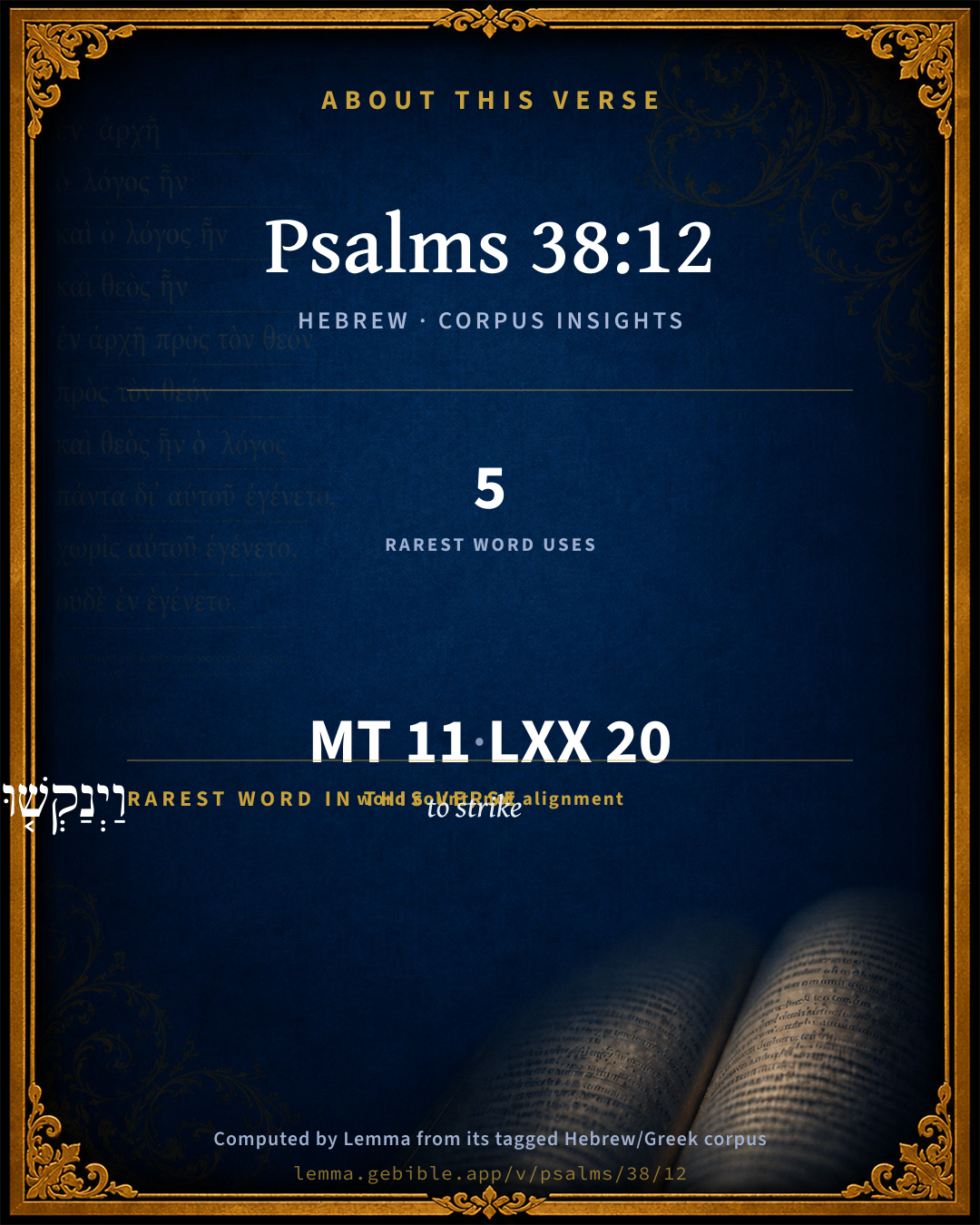
The rarest word here is וַיְנַקְשׁ֤וּ to strike H5367 — appearing just 5 times in the whole Hebrew Bible.

Shared distinctive vocabulary

וַיְנַקְשׁ֤וּ to strike H5367 occurs in 5 verses of the Hebrew Bible. Also found in:

Grammatical profile

  • 5 verbs
  • 6 nouns

Verb forms

  • וַיְנַקְשׁ֤וּ Piel · Sequential Imperfect
  • מְבַקְשֵׁ֬י Piel · Participle Active
  • וְדֹרְשֵׁ֣י Qal · Participle Active
  • דִּבְּר֣וּ Piel · Perfect
  • יֶהְגּֽוּ Qal · Imperfect

Hebrew & Septuagint length

In English translation the verse runs 23 words from the Hebrew and 24 from the Septuagint (LXX English) — closely comparable.

A rough comparison of the two English renderings, which tokenize alike — not a word-level alignment.

Word counts can differ between the Hebrew and the Greek without any difference in meaning — e.g. the Hebrew direct-object marker אֵת has no separate Greek word, and Greek often adds the article ὁ.

In the original languages it is 11 Hebrew tokens and 20 Greek tokens — but the two are counted differently (Hebrew bundles its prefixes and suffixes into one token; the Greek is in lemma form), so that isn’t a like-for-like length.

Cross-references

12

Topical passages linked to Psalms 38:12 in the Treasury of Scripture Knowledge — connected by theme and wording, ordered by reader-vote popularity; previews shown in the World English Bible.

  • 2 Samuel 17:1–3 Moreover Ahithophel said to Absalom, Let me now choose out twelve thousand men, and I will arise and pursue after David this night:
  • Psalms 35:20 For they don't speak peace, But they devise deceitful words against those who are quiet in the land.
  • Psalms 140:5 The proud have hidden a snare for me, They have spread the cords of a net by the path. They have set traps for me. Selah.
  • 2 Samuel 16:7–8 Thus said Shimei when he cursed, Be gone, be gone, you man of blood, and base fellow:
  • Psalms 35:4 Let those who seek after my soul be disappointed and brought to dishonor. Let those who plot my ruin be turned back and confounded.
  • Psalms 54:3 For strangers have risen up against me. Violent men have sought after my soul. They haven't set God before them. Selah.
  • Psalms 64:2–5 Hide me from the conspiracy of the wicked, From the noisy crowd of the ones doing evil;
  • Psalms 119:110 The wicked have laid a snare for me, Yet I haven't gone astray from your precepts.
  • Psalms 141:9 Keep me from the snare which they have laid for me, From the traps of the workers of iniquity.
  • Luke 20:19–22 The chief priests and the scribes sought to lay hands on Him that very hour, but they feared the people--for they knew He had spoken this parable against them.
  • Psalms 10:9 He lurks in secret as a lion in his ambush. He lies in wait to catch the helpless. He catches the helpless, when he draws him in his net.
  • Psalms 62:3–4 How long will you assault a man, Would all of you throw him down, Like a leaning wall, like a tottering fence?

Cross-references courtesy of OpenBible.info (CC BY 4.0).

Hebrew and Greek witnesses Masoretic Hebrew ↔ Greek Septuagint

The same verse in the two great witnesses to the Old Testament, shown verse-for-verse.

You’re reading Greek Psalm 37 (Hebrew Psalm 38). The Septuagint counts the superscription, so verse numbers can differ from the Hebrew — chapter-level alignment, not verse-by-verse. Numbering follows Rahlfs.

These are two independent witnesses, not word-aligned to each other, and the Septuagint is shown in lemma (dictionary) form.

Hebrew Psalms 38:12 Masoretic · Westminster Leningrad Codex

וַיְנַקְשׁ֤וּ מְבַקְשֵׁ֬י נַפְשִׁ֗י וְדֹרְשֵׁ֣י רָ֭עָתִי דִּבְּר֣וּ הַוּ֑וֹת וּ֝מִרְמ֗וֹת כָּל הַיּ֥וֹם יֶהְגּֽוּ

They also who seek after my life lay snares. Those who seek my hurt speak mischievous things, And meditate deceits all day long.

World English Bible · Public Domain

Greek LXX Greek Psalm 37:12 Septuagint · lemma form

ὁ φίλος ἐγώ καί ὁ πλησίον ἐγώ ἐκ ἐναντίος ἐγώ ἐγγίζω καί ἵστημι καί ὁ ἔγγιστα ἐγώ ἀπό μακρόθεν ἵστημι

While they pressed hard upon me that sought my soul: and they that sought my hurt spoke vanities, and devised deceits all the day.

LXX2012 (modern English Septuagint) · Public Domain

Hebrew: Westminster Leningrad Codex (CC BY 4.0). Greek: Septuagint (public domain); English from LXX2012 (modern English Septuagint) (Public Domain). How the Septuagint differs from the Hebrew →

Commentary

Notes on Psalms 38:12 from classic Christian and Jewish commentators (each source and its license shown beneath its notes). The classic Christian expositions comment on the surrounding passage and are grouped to its opening verse, so a note may address several verses; the Jewish commentaries on the Tanakh (Rashi and others) are per-verse, so they appear only where the commentator wrote on this verse.

Lemma curates 59 commentaries, every one of them public domain or Creative Commons licensed, each selected and text-cleaned for this edition rather than reprinted as found. About our sources →

Matthew Henry's Commentary

In these verses,

I. David complains of the power and malice of his enemies, who, it should seem, not only took occasion from the weakness of his body and the trouble of his mind to insult over him, but took advantage thence to do him a mischief. He has a great deal to say against them, which he humbly offers as a reason why God should appear for him, as Psa 25:19, Consider my enemies. 1. "They are very spiteful and cruel: They seek my hurt; nay, they seek after my life," Psa 38:12. That life which was so precious in the sight of the Lord and all good men was aimed at, as if it had been forfeited, or a public nuisance. Such is the enmity of the serpent's seed against the seed of the woman; it would wound the head, though it can but reach the heel. It is the blood of the saints that is thirsted after. 2. "They are very subtle and politic. They lay snares, they imagine deceits, and herein they are restless and unwearied: they do it all the day long. They speak mischievous things one to another; every one has something or other to propose that may be a mischief to me." Mischief, covered and carried on by deceit, may well be called a snare. 3. "They are very insolent and abusive: When my foot slips, when I fall into any trouble, or when I make any mistake, misplace a word, or take a false step, they magnify themselves against me; they are pleased with it, and promise themselves that it will ruin my interest, and that if I slip I shall certainly fall and be undone." 4. "They are not only unjust, but very ungrateful: They hate me wrongfully, Psa 38:19. I never did them any ill turn, nor so much as bore them any ill-will, nor ever gave them any provocation; nay, they render evil for good, Psa 38:20. Many a kindness I have done them, for which I might have expected a return of kindness; but for my love they are my adversaries," Psa 109:4. Such a rooted enmity there is in the hearts of wicked men to goodness for its own sake that they hate it, even when they themselves have the benefit of it; they hate prayer even in those that pray for them, and hate peace even in those that would be at peace with them. Very ill-natured indeed those are whom no courtesy will oblige, but who are rather exasperated by it. 5. "They are very impious and devilish: They are my adversaries merely because I follow the thing that good is." They hated him, not only for his kindness to them, but for his devotion and obedience to God; they hated him because they hated God and all that bear his image. If we suffer ill for doing well, we must not think it strange; from the beginning it was so (Cain slew Abel, because his works were righteous); nor must we think it hard, because it will not be always so; for so much the greater will our reward be. 6. "They are many and mighty: They are lively; they are strong; they are multiplied, Psa 38:19. Lord, how are those increased that trouble me?" Psa 3:1. Holy David was weak and faint; his heart panted, and his strength failed; he was melancholy and of a sorrowful spirit, and persecuted by his friends; but at the same time his wicked enemies were strong and lively, and their number increased. Let us not therefore pretend to judge of men's characters by their outward condition; none knows love or hatred by all that is before him. It should seem that David in this, as in other complaints he makes of his enemies, has an eye to Christ, whose persecutors were such as are here described, perfectly lost to all honour and virtue. None hate Christianity but such as have first divested themselves of the first principles of humanity and broken through its most sacred bonds.

II. He reflects, with comfort, upon his own peaceable and pious behaviour under all the injuries and indignities that were done him. It is then only that our enemies do us a real mischief when they provoke us to sin (Neh 6:13), when they prevail to put us out of the possession of our own souls, and drive us from God and our duty. If by divine grace we are enabled to prevent this mischief, we quench their fiery darts, and are saved from harm. If still we hold fast our integrity and our peace, who can hurt us? This David did here. 1. He kept his temper, and was not ruffled nor discomposed by any of the slights that were put upon him or the mischievous things that were said or done against him (Psa 38:13, Psa 38:14): "I, as a deaf man, heard not; I took no notice of the affronts put upon me, did not resent them, nor was put into disorder by them, much less did I meditate revenge, or study to return the injury." Note, The less notice we take of the unkindness and injuries that are done us the more we consult the quiet of our own minds. Being deaf, he was dumb, as a man in whose mouth there are no reproofs; he was as silent as if he had nothing to say for himself, for fear of putting himself into a heat and incensing his enemies yet more against him; he would not only not recriminate upon them, but not so much as vindicate himself, lest his necessary defence should be construed his offence. Though they sought after his life, and his silence might be taken for a confession of his guilt, yet he was as a dumb man that opens not his mouth. Note, When our enemies are most clamorous it is generally our prudence to be silent, or to say little, lest we make bad worse. David could not hope by his mildness to win upon his enemies, nor by his soft answers to turn away their wrath; for they were men of such base spirits that they rendered him evil for good; and yet he conducted himself thus meekly towards them, that he might prevent his own sin and might have the comfort of it in the reflection. Herein David was a type of Christ, who was as a sheep dumb before the shearer, and, when he was reviled, reviled not again; and both are examples to us not to render railing for railing. 2. He kept close to his God by faith and prayer, and so both supported himself under these injuries and silenced his own resentments of them. (1.) He trusted in God (Psa 38:15): "I was as a man that opens not his mouth, for in thee, O Lord! do I hope. I depend upon thee to plead my cause and clear my innocency, and, some way or other, to put my enemies to silence and shame." His lovers and friends, that should have owned him, and stood by him, and appeared as witnesses for him, withdrew from him, Psa 38:10. but God is a friend that will never fail us if we hope in him. "I was as a man that heareth not, for thou wilt hear. Why need I hear, and God hear too?" He careth for you (Pe1 5:7), and why need you care and God care too? "Thou wilt answer" (so some) "and therefore I will say nothing." Note, It is a good reason why we should bear reproach and calumny with silence and patience, because God is a witness to all the wrong that is done us, and, in due time, will be a witness for us and against those that do us wrong; therefore let us be silent, because, if we be, then we may expect that God will appear for us, for this is an evidence that we trust in him; but, if we undertake to manage for ourselves, we take God's work out of his hands and forfeit the benefit of his appearing for us. Our Lord Jesus, when he suffered, threatened not, because he committed himself to him that judges righteously (Pe1 2:23); and we shall lose nothing, at last, by doing so. Thou shalt answer, Lord, for me. (2.) He called upon God (Psa 38:16): For I said, Hear me (that is supplied); "I said so" (as Psa 38:15); "in thee do I hope, for thou wilt hear, lest they should rejoice over me. I comforted myself with that when I was apprehensive that they would overwhelm me." It is a great support to us, when men are false and unkind, that we have a God to go to whom we may be free with and who will be faithful to us.

III. He here bewails his own follies and infirmities. 1. He was very sensible of the present workings of corruption in him, and that he was now ready to repine at the providence of God and to be put into a passion by the injuries men did him: I am ready to halt, Psa 38:17. This will best be explained by a reflection like this which the psalmist made upon himself in a similar case (Psa 73:2): My feet were almost gone, when I saw the prosperity of the wicked. So here: I was ready to halt, ready to say, I have cleansed my hands in vain. His sorrow was continual: All the day long have I been plagued. (Psa 73:13, Psa 73:14), and it was continually before him; he could not forbear poring upon it, and that made him almost ready to halt between religion and irreligion. The fear of this drove him to his God: "In thee do I hope, not only that thou wilt plead my cause, but that thou wilt prevent my falling into sin." Good men, by setting their sorrow continually before them, have been ready to halt, who, by setting God always before them, have kept their standing. 2. He remembered against himself his former transgressions, acknowledging that by them he had brought these troubles upon himself and forfeited the divine protection. Though before men he could justify himself, before God he will judge and condemn himself (Psa 38:18): "I will declare my iniquity, and not cover it; I will be sorry for my sin, and not make a light matter of it;" and this helped to make him silent under the rebukes of Providence and the reproaches of men. Note, If we be truly penitent for sin, that will make us patient under affliction, and particularly under unjust censures. Two things are required in repentance: - (1.) Confession of sin: "I will declare my iniquity; I will not only in general own myself a sinner, but I will make a particular acknowledgment of what I have done amiss." We must declare our sins before God freely and fully, and with their aggravating circumstances, that we may give glory to God and take shame to ourselves. (2.) Contrition for sin: I will be sorry for it. Sin will have sorrow; every true penitent grieves for the dishonour he has done to God and the wrong he has done to himself. "I will be in care or fear about my sin" (so some), "in fear lest it ruin me and in care to get it pardoned."

IV. He concludes with very earnest prayers to God for his gracious presence with him and seasonable powerful succour in his distress (Psa 38:21, Psa 38:11): "Forsake me not, O Lord! though my friends forsake me, and though I deserve to be forsaken by thee. Be not far from me, as my unbelieving heart is ready to fear thou art." Nothing goes nearer to the heart of a good man in affliction than to be under the apprehension of God's deserting him in wrath; nor does any thing therefore come more feelingly from his heart than this prayer: "Lord, be not thou far from me; make haste for my help; for I am ready to perish, and in danger of being lost if relief do not come quickly." God gives us leave, not only to call upon him when we are in trouble, but to hasten him. He pleads, "Thou art my God, whom I serve, and on whom I depend to bear me out; and my salvation, who alone art able to save me, who hast engaged thyself by promise to save me, and from whom alone I expect salvation." Is any afflicted? let him thus pray, let him thus plead, let him thus hope, in singing this psalm.

Matthew Henry's Commentary on the Whole Bible (1708–1710) — public domain (CC PDM 1.0). Text via the HelloAO Bible API.

Trapp's Complete Commentary

John Trapp

Psa 38:12 They also that seek after my life lay snares [for me]: and they that seek my hurt speak mischievous things, and imagine deceits all the day long.

Ver. 12. They also that seek after my life] That seek and would suck my blood. As his friends were slack to help him, so his foes were active to hurt him. This David relateth before the Lord, that he may pity him, and be so much the more engaged to him; for he knew that where human help faileth divine beginneth.

Speak mischievous things] Exitialia, such things as wring from me that lamentable voice, Woe and Alas, woeful evils, הוות from הוי, voce σχετλιαστικη.

And imagine deceits] Or, Murmur.

John Trapp, A Commentary or Exposition upon All the Books of the Old and New Testament (1647–1656) — public domain. Text from a community e-Sword module.

The Biblical Illustrator

Joseph S. Exell

Psa_38:12

They also that seek after my life lay snares for me.

When friends are slow in helping, foes are most busy

Our friends should blush, that the wicked are more instant against us, than they are to maintain us. But it is no wonder, since by nature men are more bent and prone to evil than to do good things. By constraint they do good, but willingly they commit evil.

1. Their profit and pastime was to undo me. The order is here inverted; for meditating properly precedeth speaking, and speaking doing; but in the words of the text it is otherways; their malice extendeth to the highest degree, they will not be contented to banish him, prison him, and revile him, nothing can satisfy their thirst but his blood. This is the envy of the serpent against the seed of the woman. The devil is a murderer, and so are his children.

2. The means which they used against him: their purposes, their words, and their actions. They meditated, they consulted; for wrongs done rashly are less dangerous, and more excusable, out of a spleen and choler; but advised evils are more fearful, and more hardly to be eschewed, laying the grounds and pillars of their proceedings upon some sure hold. But we have one advantage, that God is present in all their counsels, and cannot only reveal them, but also disappoint them.

3. Finally, those their meditations and communications, which proceeded from cruel hearts, burst forth in actions which were mixed with craft, and so much the more perilous, for they are said to lay snares for him: taking the metaphor from hunters, fowlers or fishers, whose trade is only to catch birds, beasts and fishes by their engines and policy, seeing hardly they can be taken otherways. (A. Symson.)

The Biblical Illustrator, edited by Joseph S. Exell (c. 1880s–1900s) — public domain. Text from a community e-Sword module.

J. A. Alexander on Psalms

Joseph Addison Alexander

13. (Psa 38:12). And those seeking my soul (or life) have laid wait (or laid a snare) for me, and those seeking my hurt have spoken mischiefs, and deceits all the day will they utter (or devise). While his friends and neighbours stand aloof, his enemies are busy in attempting to destroy him. Seeking my life, as in Psa 35:4, and Exo 4:19. This phrase is particularly frequent in the history of David's persecutions. See 1Sa 20:1; 1Sa 22:23; 1Sa 23:15, 2Sa 4:8; 2Sa 16:11. The idea of seeking is expressed by two entirely different verbs in Hebrew. With the first clause compare Psa 37:32.—Mischiefs, or still more strongly, crimes. See above, on Psa 5:10 (9). The reference may be either to malicious consultation, or to slander, or to both. The last verb may be taken in either of its senses (see above, on Psa 1:2; Psa 2:1; Psa 37:30), both which are appropriate in this connection. All the day (long), continually. See above, on Psa 37:26.

Joseph Addison Alexander, The Psalms Translated and Explained (1850) — public domain. Text from a community e-Sword module.

Jamieson, Fausset & Brown

Robert Jamieson, A. R. Fausset & David Brown

seek after my life-- (Sa1 20:1; Sa1 22:23).

Jamieson, Fausset & Brown — Commentary Critical and Explanatory on the Whole Bible (1871) — public domain (CC PDM 1.0). Text via the HelloAO Bible API.

Adam Clarke's Commentary

Verse 12. They also that seek after my life] They act towards me as huntsmen after their prey; they lay snares to take away my life. Perhaps this means only that they wished for his death, and would have been glad to have had it in their power to end his days. Others spoke all manner of evil of him, and told falsities against him all the day long.

Adam Clarke's Commentary on the Bible (1810–1826) — public domain. Text from a community e-Sword/MySword module.

John Calvin's Commentaries

12 They also that sought for my life have laid snares for me, etc.. Here another circumstance is added, that the enemies of David laid snares for him, and talked about his destruction, and framed deceits among themselves. The purport of what is stated is, that while his friends cowardly sit still and will do nothing to aid him, his enemies vigorously bestir themselves, and seek by every means to destroy him. He says that they seek his life, for as they were his deadly enemies and blood-thirsty men, they were not content with doing him some common injury, but furiously sought his destruction. He, however, here complains not so much that they assailed him by force of arms and with violence, as he accuses them of guileful conspiracy, which he designates in the first place metaphorically by the term snares, and afterwards adds in plain terms, that they talk about his destruction, and secretly consult among themselves how they might do him hurt. Now, as it is certain that David borrows not an artificial rhetoric from the bar, (as profane orators do when they plead their cause,) in order to win the favor of God, but rather draws his arguments from the Word of God, the sentences which he here brings together for the confirmation of his faith we ought to appropriate to our own use. If we are altogether destitute of human aid and assistance, if our friends fail us in the time of need, and if others seek our ruin, and breathe out nothing but destruction against us, let us remember that it is not in vain for us to lay these things in prayer before God, whose province it is to succor those who are in misery, to take under his protection those who are perfidiously forsaken and betrayed, to restrain the wicked, and not only to withstand their violence, but also to anticipate their deceitful counsels and to frustrate their designs.

John Calvin's Commentaries (1540-1563) — public domain. Text from the Calvin Translation Society English edition (1840s-50s) via the Christian Classics Ethereal Library (ccel.org). Calvin's coverage is partial (roughly two-thirds of the Bible); uncommented books and verses are honest gaps, never fabricated. The 19th-century editor's footnotes and remarks are omitted so the notes are faithfully Calvin's own voice.

The Cambridge Bible for Schools and Colleges

gen. ed. J. J. S. Perowne

12. Pitiless enemies beset him. Comp. Psa_35:4; Psa_35:26.

mischievous things] Lit. destructions. See note on Psa_5:9.

imagine] Lit. meditate. Contrast Psa_37:26; Psa_37:30.

The Cambridge Bible for Schools and Colleges (gen. ed. J. J. S. Perowne; Cambridge University Press, 1878–1918) — public domain. Text from a community e-Sword module.

John Gill's Exposition

But I, as a deaf man, heard not,.... He acted the part of a deaf man, and made as if he did not hear the mischievous things his enemies spoke; as Saul, when the sons of Belial spoke against him and despised him, Sa1 10:27; and as our Lord when his enemies accused him, Mat 27:12;

and I was as a dumb man, that openeth not his mouth; made no reply to what they said, and did not render railing for railing; in which Christ was the antitype of him, Isa 53:7.

John Gill's Exposition of the Whole Bible (1746–1763) — public domain (CC PDM 1.0). Text via the HelloAO Bible API.

Albert Barnes' Notes on the Bible

They also that seek after my life - This was a new aggravation of his affliction, that those who were his enemies now sought to accomplish their purposes against him with better hopes of success, by taking advantage of his sickness.

Lay snares for me - On the meaning of this phrase, see the notes at Psa 9:15. The idea here is that they sought this opportunity of ensnaring or entrapping him so as to ruin him. They took advantage of the fact that he was weak and helpless, and of the fact that he was forsaken or abandoned by his friends, to accomplish his ruin. how this was done is not stated. It might have been by their coming on him when he was thus helpless; or it might have been by endeavoring in his weak condition to extort confessions or promises from him that might be turned to his ruin. An enemy may hope to succeed much better when the one opposed is sick than when he is well, and may take advantage of his weak state of body and mind, and of the fact that he seems to be forsaken by all, to accomplish what could not be done if he were in the enjoyment of health, or sustained by powerful friends, or by a public opinion in his favor.

And they that seek my hurt - They who seek to injure me.

Speak mischievous things - Slanderous words. They charge on me things that are false, and that tend to injure me. The very fact that he was thus afflicted, they might urge (in accordance with a prevailing belief, and with the conviction of the psalmist also, Psa 38:3-5) as a proof of guilt. This was done by the three friends of Job; and the enemies of the psalmist may thus have taken advantage of his sickness to circulate false reports about him which he could not then well meet.

And imagine deceits - Imagine or feign deceitful things; things which they know to be false or unfounded.

All the day long - Constantly. They seem to have no other employment. See Psa 35:20.

Albert Barnes' Notes on the Bible (1834–1885) — public domain. Text from a community e-Sword/MySword module.

Matthew Poole's English Annotations

Lay snares for me; that if my disease do not kill me, they may destroy me some other way.

Imagine deceits; they design mischief, but cover it with fair pretences.

Matthew Poole's English Annotations on the Holy Bible (1683–1685) — public domain. Text from a community e-Sword/MySword module.

The Treasury of David

Charles H. Spurgeon

Ver. 12. They also that seek after my life lay snares for me. Alas! for us when in addition to inward griefs, we are beset by outward temptations. David's foes endeavoured basely to ensnare him. If fair means would not overthrow him, foul should be tried. This snaring business is a vile one, the devil's own poachers alone condescend to it; but prayer to God will deliver us, for the craft of the entire college of tempters can be met and overcome by those who are led of the Spirit. They that seek my hurt speak mischievous things. Lies and slanders poured from them like water from the town pump. Their tongue was for ever going, and their heart fore ever inventing lies. And imagine deceit all the day long. They were never done, their forge was going from morning to night. When they could not act they talked, and when they could not talk they imagined, and schemed, and plotted. Restless is the activity of malice. Bad men never have enough of evil. They compass sea and land to injure a saint; no labour is too severe, no cost too great if they may utterly destroy the innocent. Our comfort is, that our glorious Head knows the pertinacious malignity of our foes, and will in due season put an end to it, as he even now sets a bound about it.

None.

None.

Psalms 38:13*

Charles H. Spurgeon's The Treasury of David (1869–1885) — public domain. Psalms only. Text from a community e-Sword/MySword module.

Whedon's Commentary on the Bible

Daniel D. Whedon

12. They… that seek… my life—This is David’s first allusion to his enemies.

Speak… imagine—They circulated evil reports and meditated— secretly concocted—evil designs against the government. See 2Sa_14:25-33; 2Sa_15:1-6; Psa_41:5-9. The fact that David’s sickness was considered as a judgment of God, and an evidence that God had forsaken him, gave them boldness and their slanders plausibility.

Daniel D. Whedon (gen. ed.), Commentary on the Old and New Testaments (1874–1909) — public domain. Text from a community e-Sword module.

The Pulpit Commentary

They also that seek after my life lay snares for me. To the desertion of friends is added the persecution of enemies, who take advantage of the debility and prostration caused by sickness to plot against the writer"s life, to "lay snares for him," and devise evil against him. Those who assign the psalm to David suppose the devices described in 2Sa_15:1-6 to he referred to. And they that seek my hurt speak mischievous things, and imagine deceits all the day long; literally, speak malignity; i.e. calumniate me bring false accusations against me. (comp. 2Sa_16:7, 2Sa_16:8)

The Pulpit Commentary (1880–1919), ed. H.D.M. Spence-Jones & Joseph S. Exell — public domain. Text from a community e-Sword module.

John Wesley's Explanatory Notes

Deceit - They design mischief, but cover it with fair pretenses.

John Wesley, Explanatory Notes Upon the Whole Bible (1754–1765) — public domain. Text via the GEBible commentary corpus.

Rashi

Rabbi Shlomo Yitzchaki (Rashi)

stand aloof from my affliction Those who appear to me as lovers in time of their pleasure, and when they see that the affliction comes upon me, they do not stand up for me in the time of my strait, but stand aloof and do not aid me.

and those close to me who showed themselves to be close to me.

Rashi on the Tanakh — English translations: “The Judaica Press complete Tanach with Rashi, translated by A. J. Rosenberg” (CC BY 4.0); “Pentateuch with Rashi's commentary by M. Rosenbaum and A.M. Silbermann, 1929-1934” (public domain); “The Metsudah Tanach series, Lakewood, N.J” (CC BY 4.0); and “The Book of Joshua, Metsudah Publications, 1997” (CC BY 4.0). Text via Sefaria.

Lesson kit

Teaching starters — assembled from the data on this page, not authored interpretation. Every prompt links to the verse data it draws on. Edit before teaching.

Psalms, in the Wisdom, opens this verse with 11 words (11 distinct Hebrew lemmas). Its most distinctive word is nâqash (“to strike”). A historical commentator’s framing appears above. Read the whole chapter for the surrounding context.

Discussion questions

  1. What does “to strike” (nâqash) contribute to the verse as a whole?
  2. Deuteronomy 12:30 shares the word «to strike» with this verse. How do the two illuminate each other?
  3. The translations on this page render this verse differently — a whole-verse word diff, not a word-by-word alignment. What might account for the different wordings?
  4. The verb «וַיְנַקְשׁ֤וּ» is Piel Sequential Imperfect. How does its form color the action?
  5. Reading how Matthew Henry's Commentary and Trapp's Complete Commentary read this verse, where do the two commentators agree and where do they part?

Things to notice

Reading settings

Reading text

Shown beneath each verse's original-language words.

Old Testament
Old Testament edition

Read the OT as the Masoretic Hebrew (MT) or the Greek Septuagint (LXX).

English shown for the Greek Septuagint (in the Hebrew ↔ Greek comparison).

Comparing translations? Open the Compare panel on any verse page to stack up to four side by side.