1 Samuel 23:15

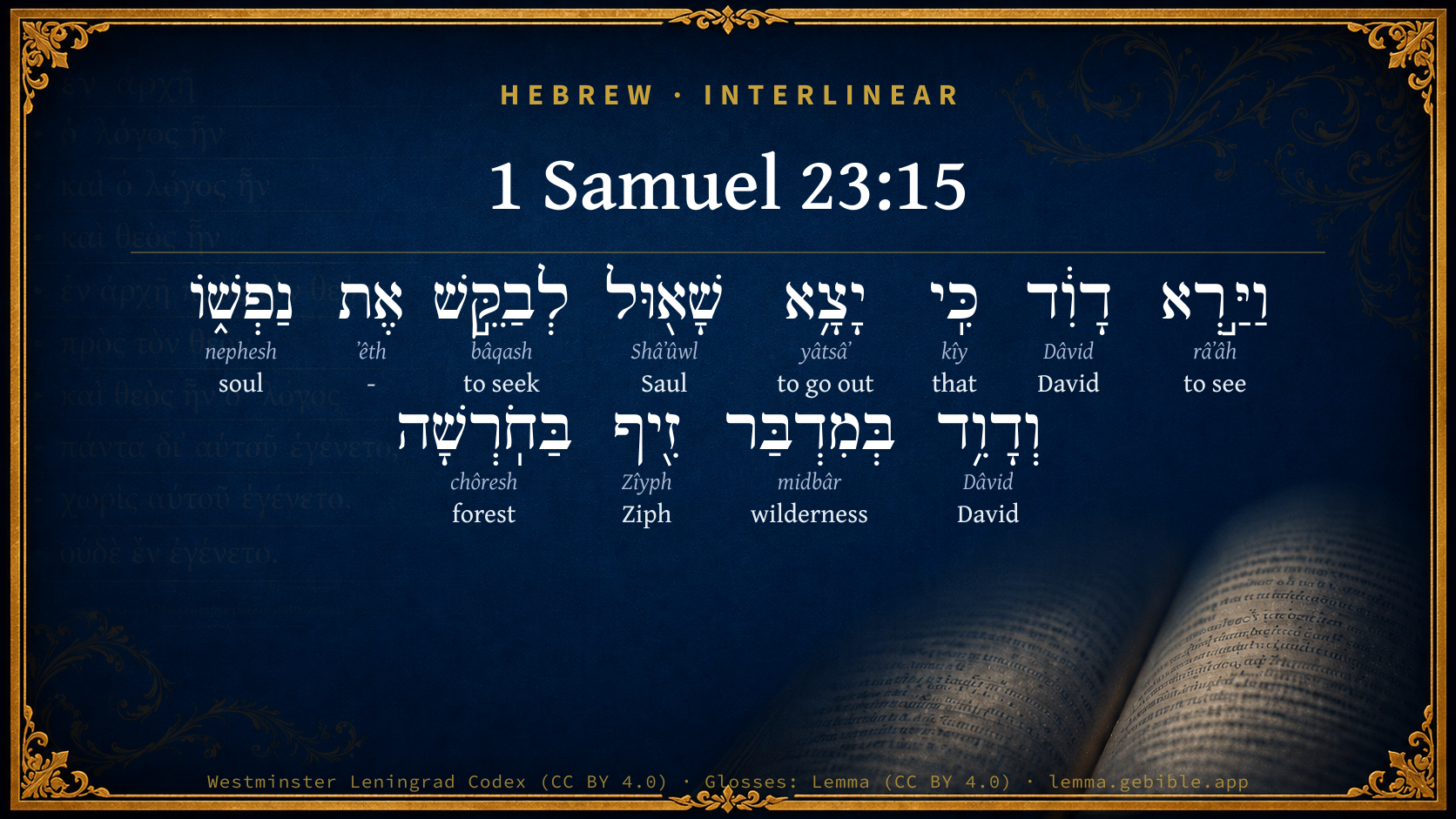
Hebrew (Westminster Leningrad Codex) 1 Samuel 23:15 appears in the Hebrew Old Testament. The text above is from the Westminster Leningrad Codex. Each word links to its Strong’s number, a concise gloss, and parsing drawn from the Open Scriptures Hebrew Bible morphology. Click any word for its full Brown-Driver-Briggs (BDB) entry.
Download image
Cite this verse

1 Samuel 23:15 (World English Bible). Public Domain. Lemma interlinear Bible study tool, https://lemma.gebible.app/v/1-samuel/23/15.

Show BibTeX & RIS
BibTeX
RIS
English Translation
David saw that Saul had come out to seek his life: and David was in the wilderness of Ziph in the wood.
World English Bible · Public Domain
Highlights
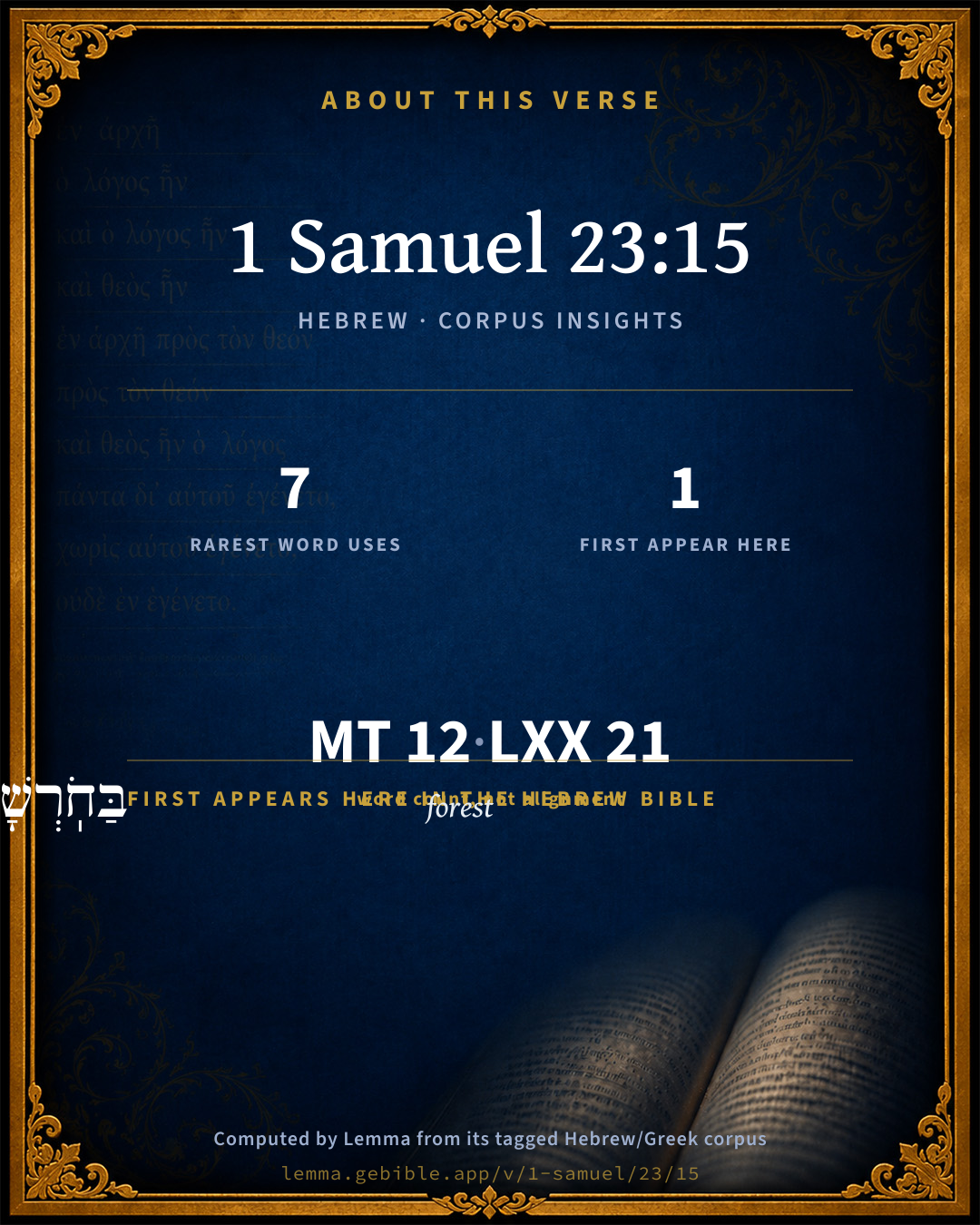
  • 1 first appearance in the Hebrew Bible
Full analysis ↓
Download a study sheet

One document with this verse’s original text, its word-by-word gloss line, the meaning frame, cross-references with their text, attributed commentary, and full source and license credits — printable, and it pastes into notes with its structure intact.

This verse Autodidact and up

Study sheet (.html) Plain text (.txt)

A passage Seminary Student

Up to 50 verses in one chapter. A passage sheet keeps up to 6 commentary sources and 12 cross-references per verse, in the order this page ranks them, and says so on the sheet whenever that leaves anything out. Ask for a single verse and you get the Autodidact verse sheet above.

Everything on this page stays free to read, with no account — the sheet is a download of what is already on screen, not access to it.

Want to remove ads? Support Godless Engineer
Compare translations 3

The same verse in 3 English versions, stacked beneath the original-language interlinear above. Click any original word for its lexicon entry.

Each is an independent rendering of the whole verse — the interlinear is not word-aligned to these translations.

Highlighted words mark where these versions differ — a whole-verse word diff, not a word-by-word alignment.

  • World English Bible Public Domain
    David saw that Saul had come out to seek his life: and David was in the wilderness of Ziph in the wood.
  • King James Version Public Domain
    And David saw that Saul was come out to seek his life: and David was in the wilderness of Ziph in a wood.
  • unfoldingWord Literal Text CC BY-SA 4.0
    And David saw that Saul had come out to seek his life. Now David in the wilderness of Ziph, in the forest.

unfoldingWord Literal Text — © unfoldingWord, licensed CC BY-SA 4.0. Word-aligned USFM3 via Door43 (git.door43.org/unfoldingWord/en_ult).

Versions to compare (up to 4)

3 of 4 selected

Show all 18 translations

Every available English version of this verse, each an independent rendering of the whole verse.

  • World English Bible Public Domain
    David saw that Saul had come out to seek his life: and David was in the wilderness of Ziph in the wood.
  • Berean Standard Bible Public Domain
    While David was in Horesh in the Wilderness of Ziph, he saw that Saul had come out to take his life.
  • Majority Standard Bible Public Domain
    While David was in Horesh in the Wilderness of Ziph, he saw that Saul had come out to take his life.
  • King James Version Public Domain
    And David saw that Saul was come out to seek his life: and David was in the wilderness of Ziph in a wood.
  • American Standard Version (1901) Public Domain
    And David saw that Saul was come out to seek his life: and David was in the wilderness of Ziph in the wood.
  • Revised Version (1885) Public Domain
    And David saw that Saul was come out to seek his life: and David was in the wilderness of Ziph in the wood.
  • Geneva Bible (1599) Public Domain
    And Dauid sawe that Saul was come out for to seeke his life: and Dauid was in the wildernes of Ziph in the wood.
  • Douay-Rheims (1899) Public Domain
    And David saw that Saul was come out to seek his life. And David was in the desert of Ziph, in a wood.
  • Young's Literal Translation Public Domain
    And David seeth that Saul hath come out to seek his life, and David `is' in the wilderness of Ziph, in a forest.
  • Literal Standard Version CC BY-SA 4.0
    And David sees that Saul has come out to seek his life, and David [is] in the wilderness of Ziph, in a forest.
  • Unlocked Literal Bible CC BY-SA 4.0
    David saw that Saul had come out to seek his life; now David was in the wilderness of Ziph at Horesh.
  • unfoldingWord Literal Text CC BY-SA 4.0
    And David saw that Saul had come out to seek his life. Now David in the wilderness of Ziph, in the forest.
  • Darby Bible Public Domain
    And David saw that Saul had come out to seek his life; and David was in the wilderness of Ziph in a wood.
  • World Messianic Bible Public Domain
    David saw that Saul had come out to seek his life. David was in the wilderness of Ziph in the woods.
  • Webster's Bible Public Domain
    And David saw that Saul had come out to seek his life: and David was in the wilderness of Ziph in a wood.
  • Free Bible Version CC BY-SA 4.0
    While David was staying at Horesh in the Desert of Ziph, he found out that Saul was on his way to murder him.
  • Bible in Basic English Public Domain
    And David was full of fear, in the knowledge that Saul had come out to take his life; and David was in the waste land of Ziph, in Horesh.
  • JPS Tanakh (1917) Public Domain
    And David saw that Saul was come out to seek his life; and David was in the wilderness of Ziph in the wood.

Literal Standard Version (2020), Covenant Press — licensed CC BY-SA 4.0. Text via the HelloAO Bible API (eBible.org). Unlocked Literal Bible (unfoldingWord) — licensed CC BY-SA 4.0. Text via the HelloAO Bible API (eBible.org). unfoldingWord Literal Text — © unfoldingWord, licensed CC BY-SA 4.0. Word-aligned USFM3 via Door43 (git.door43.org/unfoldingWord/en_ult). Free Bible Version, Dr. Jonathan Gallagher — licensed CC BY-SA 4.0. Text via the HelloAO Bible API (eBible.org).

Word by word

More ways to search: Search by grammar → Find every occurrence → Compare this word →

Practice this passage: Drill this verse → Learn its vocabulary →

בַּחֹֽרְשָׁה
chôresh
H2793
“in/at the · forest”
Preposition, Determined + Noun, Proper
Part of Speech
Preposition + Noun
Type
Proper
Full BDB Definition

Origin: from H2790

TWOT: 762a

wood, wooded height, forest, wooded area
  1. וַיַּ֣רְא râʼâh H7200 “and · to see” Conjunction + Verb, Qal, Sequential Imperfect, 3rd Person, Masculine, Singular
  2. דָוִ֔ד Dâvid H1732 “David” Noun, Proper
  3. כִּֽי kîy H3588 “that” Conjunction
  4. יָצָ֥א yâtsâʼ H3318 “to go out” Verb, Qal, Perfect, 3rd Person, Masculine, Singular
  5. שָׁא֖וּל Shâʼûwl H7586 “Saul” Noun, Proper
  6. לְבַקֵּ֣שׁ bâqash H1245 “to seek” Preposition + Verb, Piel, Infinitive Construct
  7. אֶת ʼêth H853 “-” Particle, Direct Object
  8. נַפְשׁ֑וֹ nephesh H5315 “soul · his” Noun, Common, Both, Singular, Construct + Suffix, Personal, 3rd Person, Masculine, Singular
  9. וְדָוִ֥ד Dâvid H1732 “and · David” Conjunction + Noun, Proper
  10. בְּמִדְבַּר midbâr H4057 “in/at · wilderness of” Preposition + Noun, Common, Masculine, Singular, Construct
  11. זִ֖יף Zîyph H2128 “Ziph” Noun, Proper

About this verse

These counts appear in no published source. They are computed here, from the morphology-tagged text and Lemma’s own curated glosses. What Lemma adds →

12
words
11
distinct lemmas
Historical
section

Notable vocabulary

The rarest word here is בַּחֹֽרְשָׁה forest H2793 — appearing just 7 times in the whole Hebrew Bible.

First appearance in Scripture

This word makes its first canonical appearance in the Hebrew Bible here:

  • בַּחֹֽרְשָׁה forest H2793

Shared distinctive vocabulary

בַּחֹֽרְשָׁה forest H2793 occurs in 7 verses of the Hebrew Bible. Also found in:

Grammatical profile

  • 3 verbs
  • 7 nouns
  • 1 conjunction
  • 1 particle

Verb forms

  • וַיַּ֣רְא Qal · Sequential Imperfect
  • יָצָ֥א Qal · Perfect
  • לְבַקֵּ֣שׁ Piel · Infinitive Construct

Repetition

A word recurs within this verse — often emphatic in Hebrew:

  • דָוִ֔ד David H1732 ×2

Hebrew & Septuagint length

In English translation the verse runs 22 words from the Hebrew and 21 from the Septuagint (LXX English) — closely comparable.

A rough comparison of the two English renderings, which tokenize alike — not a word-level alignment.

Word counts can differ between the Hebrew and the Greek without any difference in meaning — e.g. the Hebrew direct-object marker אֵת has no separate Greek word, and Greek often adds the article ὁ.

In the original languages it is 12 Hebrew tokens and 21 Greek tokens — but the two are counted differently (Hebrew bundles its prefixes and suffixes into one token; the Greek is in lemma form), so that isn’t a like-for-like length.

Hebrew and Greek witnesses Masoretic Hebrew ↔ Greek Septuagint

The same verse in the two great witnesses to the Old Testament, shown verse-for-verse.

These are two independent witnesses, not word-aligned to each other, and the Septuagint is shown in lemma (dictionary) form.

Hebrew 1 Samuel 23:15 Masoretic · Westminster Leningrad Codex

וַיַּ֣רְא דָוִ֔ד כִּֽי יָצָ֥א שָׁא֖וּל לְבַקֵּ֣שׁ אֶת נַפְשׁ֑וֹ וְדָוִ֥ד בְּמִדְבַּר זִ֖יף בַּחֹֽרְשָׁה

David saw that Saul had come out to seek his life: and David was in the wilderness of Ziph in the wood.

World English Bible · Public Domain

Greek LXX 1 Samuel 23:15 Septuagint · lemma form

καί ὁράω δαυίδ ὅτι ἐκἔρχομαι σαούλ ὁ ζητέω ὁ δαυίδ καί δαυίδ ἐν ὁ ὄρος ὁ αὐχμώδης ἐν ὁ καινή ζιφ

And David perceived that Saul went forth to seek David; and David was in the dry mountain in the New Ziph.

LXX2012 (modern English Septuagint) · Public Domain

Hebrew: Westminster Leningrad Codex (CC BY 4.0). Greek: Septuagint (public domain); English from LXX2012 (modern English Septuagint) (Public Domain). How the Septuagint differs from the Hebrew →

Targum (Aramaic paraphrase)

1

The Targum is the ancient Jewish Aramaic paraphrase of the Hebrew Scriptures — an interpretive translation, not the Hebrew text itself. Onkelos (literal) and Pseudo-Jonathan (expansive) render the Torah, and Jonathan the Prophets. Coverage is partial: where no permissively-licensed English translation exists for a verse, only the Aramaic is shown. This is verse-level text, not a word-by-word alignment to the Hebrew.

  1. Targum Jonathan Prophets (Joshua–Malachi)
    וַחֲזָא דָוִד אֲרֵי נְפַק שָׁאוּל לְמִקְטְלֵיהּ וְדָוִד בְּמַדְבְּרָא דְזִיף בְּחוּרְשָׁא:

    (no public-domain English translation for this verse)

    Targum Jonathan — Aramaic: “Mikraot Gedolot” (public domain). English: “Sefaria Community Translation” (CC0 1.0 (public-domain dedication)); “London "Chaldee Paraphrase," 1871” (public domain). Text via Sefaria.

Commentary

Notes on 1 Samuel 23:15 from classic Christian and Jewish commentators (each source and its license shown beneath its notes). The classic Christian expositions comment on the surrounding passage and are grouped to its opening verse, so a note may address several verses; the Jewish commentaries on the Tanakh (Rashi and others) are per-verse, so they appear only where the commentator wrote on this verse.

Lemma curates 59 commentaries, every one of them public domain or Creative Commons licensed, each selected and text-cleaned for this edition rather than reprinted as found. About our sources →

The Cambridge Bible for Schools and Colleges

gen. ed. J. J. S. Perowne

15. in a wood] The word chôresh translated “wood” in 1Sa_23:15-16; 1Sa_23:18-19 does not occur again in Samuel. Lieut. Conder argues from the dry unwatered character of the district that no wood of trees can ever have flourished there, and conjectures that Chôresh was a proper name with a different signification. He found the ruin of Khoreisa and the Valley of Hiresh in the neighbourhood of Ziph. It is perhaps too bold to assert that no wood can ever have existed, and it seems best to understand Chôresh as a quasi-proper name for a district overgrown with brushwood.

The Cambridge Bible for Schools and Colleges (gen. ed. J. J. S. Perowne; Cambridge University Press, 1878–1918) — public domain. Text from a community e-Sword module.

Trapp's Complete Commentary

John Trapp

1Sa 23:15 And David saw that Saul was come out to seek his life: and David [was] in the wilderness of Ziph in a wood.

Ver. 15. And David saw.] By his scouts and intelligence, he well perceived his present danger.

John Trapp, A Commentary or Exposition upon All the Books of the Old and New Testament (1647–1656) — public domain. Text from a community e-Sword module.

Keil & Delitzsch

C. F. Keil & F. Delitzsch

David in the Deserts of Ziph and Maon. - The history of David's persecution by Saul is introduced in Sa1 23:15-18, with the account of an attempt made by the noble-minded prince Jonathan, in a private interview with his friend David, to renew his bond of friendship with him, and strengthen David by his friendly words for the sufferings that yet awaited him. Sa1 23:15, Sa1 23:16 are to be connected together so as to form one period: "When David saw that Saul was come out ... and David was in the desert of Ziph, Jonathan rose up and went to David into the wood." חרשׁה, from חרשׁ, with ה paragogic, signifies a wood or thicket; here, however, it is probably a proper name for a district in the desert of Ziph that was overgrown with wood or bushes, and where David was stopping at that time. "There is no trace of this wood now. The land lost its ornament of trees centuries ago through the desolating hand of man" (v. de Velde). "And strengthened his hand in God," i.e., strengthened his heart, not by supplies, or by money, or any subsidy of that kind, but by consolation drawn from his innocence, and the promises of God (vid., Jdg 9:24; Jer 23:14). "Fear not," said Jonathan to him, "for the hand of Saul my father will not reach thee; and thou wilt become king over Israel, and I will be the second to thee; and Saul my father also knows that it is so." Even though Jonathan had heard nothing from David about his anointing, he could learn from David's course thus far, and from his own father's conduct, that David would not be overcome, but would possess the sovereignty after the death of Saul. Jonathan expresses here, as his firm conviction, what he has intimated once before, in Sa1 20:13.; and with the most loving self-denial entreats David, when he shall be king, to let him occupy the second place in the kingdom. It by no means follows from the last words ("Saul my father knoweth"), that Saul had received distinct information concerning the anointing of David, and his divine calling to be king. The words merely contain the thought, he also sees that it will come. The assurance of this must have forced itself involuntarily upon the mind of Saul, both from his own rejection, as foretold by Samuel, and also from the marvellous success of David in all his undertakings.

Keil & Delitzsch — Biblical Commentary on the Old Testament (1861–1891) — public domain (CC PDM 1.0). Text via the HelloAO Bible API. (Old Testament only.)

Ellicott's Commentary for English Readers

(15) In a wood.—Some have understood this as a proper name, Horesh. There is no trace of the wood now. The land lost its ornament of trees centuries ago, through the desolating hand of man.—Van der Velde.

A Bible Commentary for English Readers, edited by Charles John Ellicott (1878–1897) — public domain. Text from a community e-Sword module.

John Gill's Exposition

And David saw that Saul was come out to seek his life,.... Either he saw him with his bodily eyes from the top of the mountain where he was, Sa1 23:14; or he perceived, he understood by information given him by his friends, it may be by Jonathan, or by spies he sent to observe his motions:

and David was in the wilderness of Ziph in a wood; where he and his men could hide themselves among the trees in it; sometimes he was in a mountain in this wilderness, and sometimes in a wood, where he thought himself the safest; thus was this great man obliged to shift about for his safety.

John Gill's Exposition of the Whole Bible (1746–1763) — public domain (CC PDM 1.0). Text via the HelloAO Bible API.

Matthew Poole's English Annotations

David saw; either by information from his spies, or by prospect from the top of the mountain where he was.

Matthew Poole's English Annotations on the Holy Bible (1683–1685) — public domain. Text from a community e-Sword/MySword module.

The Pulpit Commentary

Vers. 15-18. (HORESH, in the wilderness, of. Ziph.)

The benefit of true friendship.

Jonathan strengthened his hand in God (ver. 16). The friendship of Jonathan for David hero stands in contrast not only to the hatred of Saul, but also to the ingratitude of the citizens of Keilah, and the treachery of the Ziphites (ver. 19). The benefit of it, which had been long enjoyed by David, was even more fully than ever experienced by him now, when he left Keilah with his 600 men, wandered hither and thither, and "abode in a mountain (Hachilah) in the wilderness of Ziph." He was exposed to the persecution of Saul, who sought to destroy him by every means in his power (ver. 14), driven from one stronghold to another, able to procure only a precarious subsistence, anxious, fearful, and sometimes ready to sink in doubt and despondency. "Just at this moment Jonathan, as though led by God made his way to him in the thickets of the forest (literally, Horesh), and consoled him as if with words and promises from God himself" (Ewald). He did not accompany the force in pursuit of David (ver. 15), but came from Gibeah. His peculiar and trying position made it impossible for him to do more for his friend than hold this secret interview with him, without altogether breaking with his royal father, and openly incurring the charge of disobedience and rebellion. Never was friendship more faithfully shown; never did it render more valuable service. Well might the blind man, when asked what he thought the sun was like, reply, "Like friendship." Its benefit, as received by David, was

I OPPORTUNE. "A friend loveth at all times;" but his kindly offices are peculiarly grateful and beneficial in a time of need; as, e.g. , in

1. Physical distress, affliction, homelessness, privation, peril of liberty orlife.

2. Mental anxiety, loneliness, discouragement, depression, when the

Light is low, When the blood creeps, and the nerves prick And tingle; and the heart is sick, And all the wheels of Being slow.

3. Spiritual trial, temptation, failing faith hope and patience; in view of the prosperity of the wicked, the patience of Heaven, the delay of promised good. At such a time how unspeakably precious is a true friend! His countenance is like sunshine breaking through thick clouds. "Friendship is the only point in human affairs concerning the benefit of which all with one voice agree. There is nothing so suited to our nature, so well adapted to prosperity or adversity. I am not aware whether, with the exception of wisdom, anything better has been bestowed on man by the immortal gods. And they seem to take away the sun from the world who withdraw friendship from life" (Cicero). "Refuge failed," etc. (Psa_142:4; Mat_26:40, Mat_26:56)

II ADAPTED to the most pressing need. "And strengthened his hand in God, i.e. strengthened his heart not by supplies, or by money, or any subsidy of that kind, but by consolation drawn from his innocence and the promises of God" (Keil). "Exhorted him to put confidence in God" (Dathe). He strengthened him by

1. His genial presence, especially since his visit was expressive of his fidelity, confidence, and sympathy, and made with much effort, self-denial, and risk. "They that fear thee will be glad when they see me" (Psa_119:74; Pro_27:17) "Whom when Paul saw," etc.. (2Co_7:7) "When I ask myself whence it is that I feel this joy, this ease, this serenity when I see him it is because it is he, it is because it is I, I answer; and that is all that I can say" (Montaigne).

2. His encouraging words. "Fear not" ("the keynote of Jonathan"s address"), etc., in which he assured him of

(1) Preservation from threatening danger, doubtless pointing him to the Divine protection.

(2) Exaltation to the highest dignity: "Thou wilt be king over Israel;" pointing him to the Divine purpose, which had been plainly declared, and could not fail to be fulfilled. He had already intimated, (1Sa_20:15) and now explicitly asserted, his faith in that purpose. What ground was there for David s fear?

(3) His anticipation of continued and intimate association with him when he should sit on the throne, all claim to which he willingly renounced for his sake, and in obedience to the will of God.

(4) The conviction of Saul himself that he would prevail. If Saul believed it, why should David doubt? What more he said is not recorded. But this was admirably adapted to strengthen his heart and hand. "It is difficult to form an adequate conception of the courage, the spiritual faith, and the moral grandeur of this act. Never did man more completely clear himself from all complicity in guilt than Jonathan from that of his father. And yet not an undutiful word escaped the lips of this brave man" (Edersheim).

3. His renewed covenant with him, (1Sa_18:3 1Sa_20:16, 1Sa_20:17, 1Sa_20:42) in which, whilst he pledged his own faithful love and service, he drew forth the expression of his faith in his future destiny as well as of his fidelity to himself and his house: and both appealed to God as witness. The intercourse of friends is peculiarly beneficial when it is sanctified by their common recognition of the presence of God, and their common devotion to his will. "Next to the immediate guidance of God by his Spirit, the counsel and encouragement of virtuous and enlightened friends afford the most powerful aid in the encounter of temptation and in the career of duty." It was the last time David and Jonathan met.

O heart of fire! misjudged by wilful man, Thou flower of Jesse"s race! What woe was thine, when thou and Jonathan Last greeted face to face! He doomed to die, thou on us to impress The portent of a bloodstained holiness". ("Lyra Apostolica")

III ENDURING. The influence of their meeting continued long afterwards, and produced abundant fruit. (1Sa_24:7 1Sa_26:9) "The pleasures resulting from the mutual attachment of kindred spirits are by no means confined to the moments of personal intercourse; they diffuse their odours, though more faintly, through the seasons of absence, refreshing and exhilarating the mind by the remembrance of the past and the anticipation of the future. It is a treasure possessed when it is not employed; a reserve of strength, ready to be called into action when most needed; a fountain of sweets, to which we may continually repair, whose waters are inexhaustible" (R. Hall). "If the converse of one friend, at one interview, gives comfort and strengthens our hearts, what may not be expected from the continual supports, daily visits, and powerful love of the Saviour of sinners, the covenanted Friend of believers!" (Scott). D.

The Pulpit Commentary (1880–1919), ed. H.D.M. Spence-Jones & Joseph S. Exell — public domain. Text from a community e-Sword module.

unfoldingWord translationNotes

Door43 World Missions Community

seek his life

This is an idiom. AT: "try to kill him" (See: Idiom)

Horesh

This is the name of city near Ziph. (See: How to Translate Names)

strengthened his hand in God

This is an idiom. AT "encouraged him to trust in God" (See: Idiom)

translationWords

David

Saul (OT)

life

desert

Jonathan

God

unfoldingWord translationNotes — © Distant Shores Media and the Door43 World Missions Community, licensed CC BY-SA 4.0. Source: git.door43.org/Door43/en_tn.

Lesson kit

Teaching starters — assembled from the data on this page, not authored interpretation. Every prompt links to the verse data it draws on. Edit before teaching.

1 Samuel, in the Historical, opens this verse with 12 words (11 distinct Hebrew lemmas). Its most distinctive word is chôresh (“forest”). A historical commentator’s framing appears above. Read the whole chapter for the surrounding context.

Discussion questions

  1. How does “forest” (chôresh) shape what this verse is saying?
  2. This is the first place “forest” appears in Scripture (first appears here). What does its debut here establish?
  3. How does 1 Samuel 23:16, which shares the word «forest», read alongside this verse?
  4. What does the repetition of “David” (2× in this one verse) do in this verse?
  5. The translations on this page render this verse differently — a whole-verse word diff, not a word-by-word alignment. What might account for the different wordings?
  6. «וַיַּ֣רְא» is a Qal Sequential Imperfect verb. How does that grammatical form shape the action described?
  7. Compare how The Cambridge Bible for Schools and Colleges and Trapp's Complete Commentary read this verse. Where do they agree or differ?

Things to notice

Reading settings

Reading text

Shown beneath each verse's original-language words.

Old Testament
Old Testament edition

Read the OT as the Masoretic Hebrew (MT) or the Greek Septuagint (LXX).

English shown for the Greek Septuagint (in the Hebrew ↔ Greek comparison).

Comparing translations? Open the Compare panel on any verse page to stack up to four side by side.