
2 Chronicles 22:9

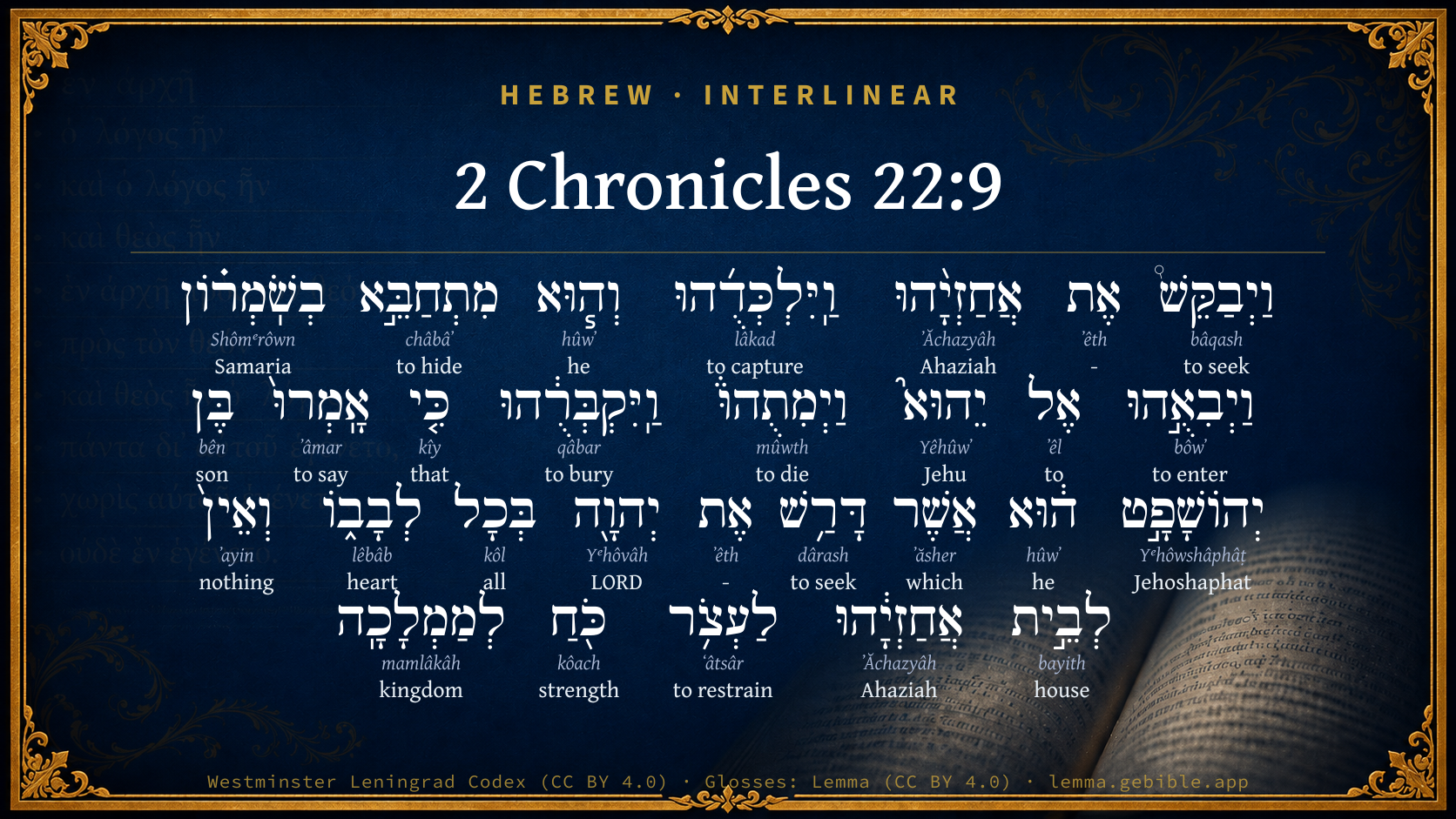
Hebrew (Westminster Leningrad Codex) 2 Chronicles 22:9 appears in the Hebrew Old Testament. The text above is from the Westminster Leningrad Codex. Each word links to its Strong’s number, a concise gloss, and parsing drawn from the Open Scriptures Hebrew Bible morphology. Click any word for its full Brown-Driver-Briggs (BDB) entry.
Download image
Cite this verse

2 Chronicles 22:9 (World English Bible). Public Domain. Lemma interlinear Bible study tool, https://lemma.gebible.app/v/2-chronicles/22/9.

Show BibTeX & RIS
BibTeX
RIS
English Translation
He sought Ahaziah, and they caught him (now he was hiding in Samaria), and they brought him to Jehu, and killed him; and they buried him, for they said, He is the son of Jehoshaphat, who sought Yahweh with all his heart. The house of Ahaziah had no power to hold the kingdom.
World English Bible · Public Domain
Download a study sheet

One document with this verse’s original text, its word-by-word gloss line, the meaning frame, cross-references with their text, attributed commentary, and full source and license credits — printable, and it pastes into notes with its structure intact.

This verse Autodidact and up

Study sheet (.html) Plain text (.txt)

A passage Seminary Student

Up to 50 verses in one chapter. A passage sheet keeps up to 6 commentary sources and 12 cross-references per verse, in the order this page ranks them, and says so on the sheet whenever that leaves anything out. Ask for a single verse and you get the Autodidact verse sheet above.

Everything on this page stays free to read, with no account — the sheet is a download of what is already on screen, not access to it.

Want to remove ads? Support Godless Engineer
Compare translations 3

The same verse in 3 English versions, stacked beneath the original-language interlinear above. Click any original word for its lexicon entry.

Each is an independent rendering of the whole verse — the interlinear is not word-aligned to these translations.

Highlighted words mark where these versions differ — a whole-verse word diff, not a word-by-word alignment.

  • World English Bible Public Domain
    He sought Ahaziah, and they caught him (now he was hiding in Samaria), and they brought him to Jehu, and killed him; and they buried him, for they said, He is the son of Jehoshaphat, who sought Yahweh with all his heart. The house of Ahaziah had no power to hold the kingdom.
  • King James Version Public Domain
    And he sought Ahaziah: and they caught him, (for he was hid in Samaria,) and brought him to Jehu: and when they had slain him, they buried him: Because, said they, he is the son of Jehoshaphat, who sought the LORD with all his heart. So the house of Ahaziah had no power to keep still the kingdom.
  • unfoldingWord Literal Text CC BY-SA 4.0
    And he sought Ahaziah; and they captured him, and he was hiding himself in Samaria. And they brought him to Jehu, and they killed him. And they buried him, for they said, “The son of Jehoshaphat is he, who sought Yahweh with all his heart.” And there was none belonging to the house of Ahaziah to retain power for the kingdom.

unfoldingWord Literal Text — © unfoldingWord, licensed CC BY-SA 4.0. Word-aligned USFM3 via Door43 (git.door43.org/unfoldingWord/en_ult).

Versions to compare (up to 4)

3 of 4 selected

Show all 18 translations

Every available English version of this verse, each an independent rendering of the whole verse.

  • World English Bible Public Domain
    He sought Ahaziah, and they caught him (now he was hiding in Samaria), and they brought him to Jehu, and killed him; and they buried him, for they said, He is the son of Jehoshaphat, who sought Yahweh with all his heart. The house of Ahaziah had no power to hold the kingdom.
  • Berean Standard Bible Public Domain
    Then Jehu looked for Ahaziah, and Jehu’s soldiers captured him while he was hiding in Samaria. So Ahaziah was brought to Jehu and put to death. They buried him, for they said, “He is the grandson of Jehoshaphat, who sought the LORD with all his heart.” So no one was left from the house of Ahaziah with the strength to rule the kingdom.
  • Majority Standard Bible Public Domain
    Then Jehu looked for Ahaziah, and Jehu’s soldiers captured him while he was hiding in Samaria. So Ahaziah was brought to Jehu and put to death. They buried him, for they said, “He is the grandson of Jehoshaphat, who sought the LORD with all his heart.” So no one was left from the house of Ahaziah with the strength to rule the kingdom.
  • King James Version Public Domain
    And he sought Ahaziah: and they caught him, (for he was hid in Samaria,) and brought him to Jehu: and when they had slain him, they buried him: Because, said they, he is the son of Jehoshaphat, who sought the LORD with all his heart. So the house of Ahaziah had no power to keep still the kingdom.
  • American Standard Version (1901) Public Domain
    And he sought Ahaziah, and they caught him (now he was hiding in Samaria), and they brought him to Jehu, and slew him; and they buried him, for they said, He is the son of Jehoshaphat, who sought Jehovah with all his heart. And the house of Ahaziah had no power to hold the kingdom.
  • Revised Version (1885) Public Domain
    And he sought Ahaziah, and they caught him, (now he was hiding in Samaria,) and they brought him to Jehu, and slew him; and they buried him, for they said; He is the son of Jehoshaphat, who sought the LORD with all his heart. And the house of Ahaziah had no power to hold the kingdom.
  • Geneva Bible (1599) Public Domain
    And he sought Ahaziah, and they caught him where he was hid in Samaria, and brought him to Iehu, and slewe him, and buryed him, because, sayd they, he is the sonne of Iehoshaphat, which sought the Lord with all his heart. So the house of Ahaziah was not able to reteine the kingdome.
  • Douay-Rheims (1899) Public Domain
    And he sought for Ochozias himself, and took him lying hid in Samaria: and when he was brought to him, he killed him, and they buried him: because he was the son of Josaphat, who had sought the Lord with all his heart. And there was no more hope that any one should reign of the race of Ochozias.
  • Young's Literal Translation Public Domain
    And he seeketh Ahaziah, and they capture him, (and he is hiding himself in Samaria), and bring him in unto Jehu, and put him to death, and bury him, for they said, `He `is' son of Jehoshaphat, who sought Jehovah with all his heart;' and there is none to the house of Ahaziah to retain power for the kingdom.
  • Literal Standard Version CC BY-SA 4.0
    And he seeks Ahaziah, and they capture him (and he is hiding himself in Samaria), and bring him to Jehu, and put him to death, and bury him, for they said, “He [is] son of Jehoshaphat, who sought YHWH with all his heart”; and there is none of the house of Ahaziah to retain power for the kingdom.
  • Unlocked Literal Bible CC BY-SA 4.0
    Jehu looked for Ahaziah; they caught him hiding in Samaria, brought him to Jehu, and killed him. Then they buried him, for they said, “He is a son of Jehoshaphat, who sought Yahweh with all his heart.” So the house of Ahaziah had no more power to rule the kingdom.
  • unfoldingWord Literal Text CC BY-SA 4.0
    And he sought Ahaziah; and they captured him, and he was hiding himself in Samaria. And they brought him to Jehu, and they killed him. And they buried him, for they said, “The son of Jehoshaphat is he, who sought Yahweh with all his heart.” And there was none belonging to the house of Ahaziah to retain power for the kingdom.
  • Darby Bible Public Domain
    And he sought Ahaziah; and they caught him (for he had hid himself in Samaria), and brought him to Jehu, and slew him; and they buried him, for they said, He is a son of Jehoshaphat, who sought Jehovah with all his heart. And in the house of Ahaziah there was no one who was able to [hold] the kingdom.
  • World Messianic Bible Public Domain
    He sought Ahaziah, and they caught him (now he was hiding in Samaria), and they brought him to Jehu and killed him; and they buried him, for they said, “He is the son of Jehoshaphat, who sought the LORD with all his heart.” The house of Ahaziah had no power to hold the kingdom.
  • Webster's Bible Public Domain
    And he sought Ahaziah: and they caught him, (for he was hid in Samaria,) and brought him to Jehu: and when they had slain him, they buried him: Because, said they, he is the son of Jehoshaphat, who sought the LORD with all his heart. So the house of Ahaziah had no power to retain the kingdom.
  • Free Bible Version CC BY-SA 4.0
    Then Jehu went looking for Ahaziah. His men found him in Samaria and captured him, and took him to Jehu where they killed him. They buried him, for they said, “He is the grandson of Jehoshaphat, who was completely committed to following the Lord.” There was no one left from Ahaziah's family to rule the kingdom.
  • Bible in Basic English Public Domain
    And he went in search of Ahaziah; and when they came where he was, (for he was in a secret place in Samaria,) they took him to Jehu and put him to death; then they put his body to rest in the earth, for they said, He is the son of Jehoshaphat, whose heart was true to the Lord. So the family of Ahaziah had no power to keep the kingdom.
  • JPS Tanakh (1917) Public Domain
    And he sought Ahaziah, and they caught him — now he was hiding in Samaria — and they brought him to Jehu, and slew him; and they buried him, for they said: 'He is the son of Jehoshaphat, who sought the LORD with all his heart.' And there was none of the house of Ahaziah that had power to hold the kingdom.

Literal Standard Version (2020), Covenant Press — licensed CC BY-SA 4.0. Text via the HelloAO Bible API (eBible.org). Unlocked Literal Bible (unfoldingWord) — licensed CC BY-SA 4.0. Text via the HelloAO Bible API (eBible.org). unfoldingWord Literal Text — © unfoldingWord, licensed CC BY-SA 4.0. Word-aligned USFM3 via Door43 (git.door43.org/unfoldingWord/en_ult). Free Bible Version, Dr. Jonathan Gallagher — licensed CC BY-SA 4.0. Text via the HelloAO Bible API (eBible.org).

Word by word

More ways to search: Search by grammar → Find every occurrence → Compare this word →

Practice this passage: Drill this verse → Learn its vocabulary →

מִתְחַבֵּ֣א
châbâʼ
H2244
“hiding”
Verb, Hithpael, Participle Active, Masculine, Singular, Absolute
Part of Speech
Verb
Stem
Hithpael
Form
Participle Active
Gender
Masculine
Number
Singular
State
Absolute
Full BDB Definition

Origin: a primitive root [compare H2245 ]

TWOT: 588

to withdraw, hide - (Niphal) to hide oneself - (Pual) to be forced into hiding - (Hiphil) to hide - (Hophal) to be hidden - (Hithpael) - to hide oneself, draw back - to draw together, thicken, harden
  1. וַיְבַקֵּשׁ֩ bâqash H1245 “and · to seek” Conjunction + Verb, Piel, Sequential Imperfect, 3rd Person, Masculine, Singular
  2. אֶת ʼêth H853 “-” Particle, Direct Object
  3. אֲחַזְיָ֨הוּ ʼĂchazyâh H274 “Ahaziah” Noun, Proper
  4. וַֽיִּלְכְּדֻ֜הוּ lâkad H3920 “and · to capture · him” Conjunction + Verb, Qal, Sequential Imperfect, 3rd Person, Masculine, Plural + Suffix, Personal, 3rd Person, Masculine, Singular
  5. וְה֧וּא hûwʼ H1931 “and · he” Conjunction + Pronoun, Personal, 3rd Person, Masculine, Singular
  6. בְשֹֽׁמְר֗וֹן Shômᵉrôwn H8111 “in/at · Samaria” Preposition + Noun, Proper
  7. וַיְבִאֻ֣הוּ bôwʼ H935 “and · to enter · him” Conjunction + Verb, Hiphil, Sequential Imperfect, 3rd Person, Masculine, Plural + Suffix, Personal, 3rd Person, Masculine, Singular
  8. אֶל ʼêl H413 “to” Preposition
  9. יֵהוּא֮ Yêhûwʼ H3058 “Jehu” Noun, Proper
  10. וַיְמִתֻהוּ֒ mûwth H4191 “and · to die · him” Conjunction + Verb, Hiphil, Sequential Imperfect, 3rd Person, Masculine, Plural + Suffix, Personal, 3rd Person, Masculine, Singular
  11. וַֽיִּקְבְּרֻ֔הוּ qâbar H6912 “and · to bury · him” Conjunction + Verb, Qal, Sequential Imperfect, 3rd Person, Masculine, Plural + Suffix, Personal, 3rd Person, Masculine, Singular
  12. כִּ֤י kîy H3588 “that” Conjunction
  13. אָֽמְרוּ֙ ʼâmar H559 “to say” Verb, Qal, Perfect, 3rd Person, Common, Plural
  14. בֶּן bên H1121 “son of” Noun, Common, Masculine, Singular, Construct
  15. יְהוֹשָׁפָ֣ט Yᵉhôwshâphâṭ H3092 “Jehoshaphat” Noun, Proper
  16. ה֔וּא hûwʼ H1931 “he” Pronoun, Personal, 3rd Person, Masculine, Singular
  17. אֲשֶׁר ʼăsher H834 “which” Particle, Relative
  18. דָּרַ֥שׁ dârash H1875 “to seek” Verb, Qal, Perfect, 3rd Person, Masculine, Singular
  19. אֶת ʼêth H853 “-” Particle, Direct Object
  20. יְהוָ֖ה Yᵉhôvâh H3068 “LORD” Noun, Proper
  21. בְּכָל kôl H3605 “in/at · all of” Preposition + Noun, Common, Masculine, Singular, Construct
  22. לְבָב֑וֹ lêbâb H3824 “heart · his” Noun, Common, Masculine, Singular, Construct + Suffix, Personal, 3rd Person, Masculine, Singular
  23. וְאֵין֙ ʼayin H369 “and · nothing” Conjunction + Particle, Negative
  24. לְבֵ֣ית bayith H1004 “to/for · house of” Preposition + Noun, Common, Masculine, Singular, Construct
  25. אֲחַזְיָ֔הוּ ʼĂchazyâh H274 “Ahaziah” Noun, Proper
  26. לַעְצֹ֥ר ʻâtsâr H6113 “to restrain” Preposition + Verb, Qal, Infinitive Construct
  27. כֹּ֖חַ kôach H3581 “strength” Noun, Common, Masculine, Singular, Absolute
  28. לְמַמְלָכָֽה mamlâkâh H4467 “to/for · kingdom” Preposition + Noun, Common, Feminine, Singular, Absolute

About this verse

These counts appear in no published source. They are computed here, from the morphology-tagged text and Lemma’s own curated glosses. What Lemma adds →

29
words
26
distinct lemmas
Historical
section

Shared distinctive vocabulary

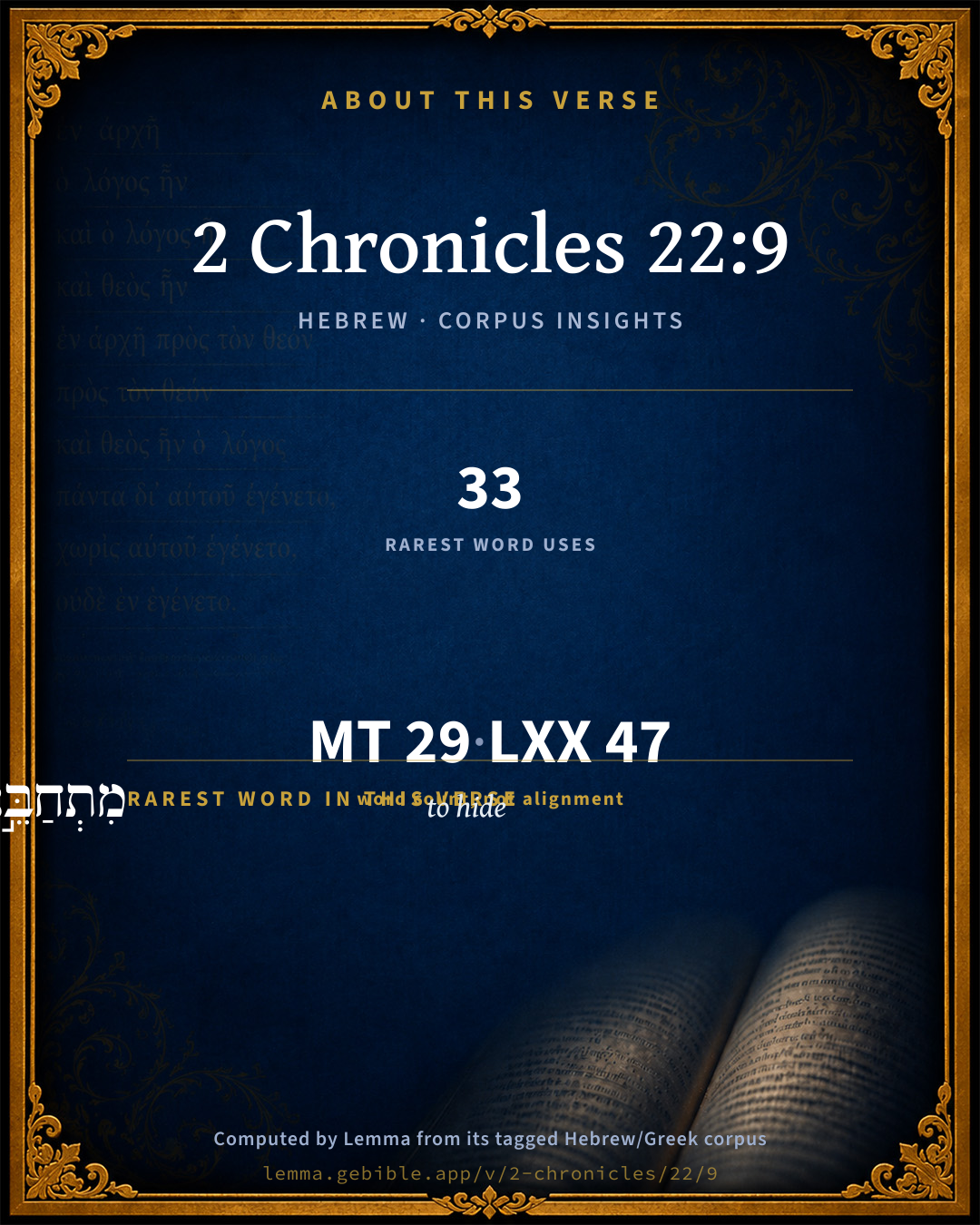
מִתְחַבֵּ֣א to hide H2244 occurs in 33 verses of the Hebrew Bible. Also found in:

Grammatical profile

  • 9 verbs
  • 12 nouns
  • 2 pronouns
  • 1 preposition
  • 1 conjunction
  • 4 particles

Verb forms

  • וַיְבַקֵּשׁ֩ Piel · Sequential Imperfect
  • וַֽיִּלְכְּדֻ֜הוּ Qal · Sequential Imperfect
  • מִתְחַבֵּ֣א Hithpael · Participle Active
  • וַיְבִאֻ֣הוּ Hiphil · Sequential Imperfect
  • וַיְמִתֻהוּ֒ Hiphil · Sequential Imperfect
  • וַֽיִּקְבְּרֻ֔הוּ Qal · Sequential Imperfect
  • אָֽמְרוּ֙ Qal · Perfect
  • דָּרַ֥שׁ Qal · Perfect
  • לַעְצֹ֥ר Qal · Infinitive Construct

Repetition

Words recur within this verse — often emphatic in Hebrew:

  • אֲחַזְיָ֨הוּ Ahaziah H274 ×2
  • וְה֧וּא he H1931 ×2

Hebrew & Septuagint length

In English translation the verse runs 53 words from the Hebrew and 66 from the Septuagint (LXX English) — closely comparable.

A rough comparison of the two English renderings, which tokenize alike — not a word-level alignment.

Word counts can differ between the Hebrew and the Greek without any difference in meaning — e.g. the Hebrew direct-object marker אֵת has no separate Greek word, and Greek often adds the article ὁ.

In the original languages it is 29 Hebrew tokens and 47 Greek tokens — but the two are counted differently (Hebrew bundles its prefixes and suffixes into one token; the Greek is in lemma form), so that isn’t a like-for-like length.

Cross-references

9

Topical passages linked to 2 Chronicles 22:9 in the Treasury of Scripture Knowledge — connected by theme and wording, ordered by reader-vote popularity; previews shown in the World English Bible.

  • 1 Kings 13:21 and he cried to the man of God who came from Judah, saying, Thus says Yahweh, Because you have been disobedient to the mouth of Yahweh, and have not kept the commandment which Yahweh your God commanded you,
  • 1 Kings 14:13 All Israel shall mourn for him, and bury him; for he only of Jeroboam shall come to the grave, because in him there is found some good thing toward Yahweh, the God of Israel, in the house of Jeroboam.
  • 2 Kings 9:27–28 But when Ahaziah the king of Judah saw this, he fled by the way of the garden-house. Jehu followed after him, and said, Smite him also in the chariot: [and they struck him] at the ascent of Gur, which is by Ibleam. He fled to Megiddo, and died there.
  • 2 Chronicles 17:3–4 Yahweh was with Jehoshaphat, because he walked in the first ways of his father David, and didn't seek the Baals,
  • 2 Chronicles 21:4 Now when Jehoram was risen up over the kingdom of his father, and had strengthened himself, he killed all his brothers with the sword, and various also of the princes of Israel.
  • 2 Chronicles 21:17 and they came up against Judah, and broke into it, and carried away all the substance that was found in the king's house, and his sons also, and his wives; so that there was never a son left him, save Jehoahaz, the youngest of his sons.
  • 2 Chronicles 21:20–22:1 Thirty-two years old was he when he began to reign, and he reigned in Jerusalem eight years: and he departed without being desired; and they buried him in the city of David, but not in the tombs of the kings.
  • 2 Chronicles 22:8 It happened, when Jehu was executing judgment on the house of Ahab, that he found the princes of Judah, and the sons of the brothers of Ahaziah, ministering to Ahaziah, and killed them.
  • 2 Kings 9:34 When he was come in, he ate and drink; and he said, See now to this cursed woman, and bury her; for she is a king's daughter.

Cross-references courtesy of OpenBible.info (CC BY 4.0).

Hebrew and Greek witnesses Masoretic Hebrew ↔ Greek Septuagint

The same verse in the two great witnesses to the Old Testament, shown verse-for-verse.

These are two independent witnesses, not word-aligned to each other, and the Septuagint is shown in lemma (dictionary) form.

Hebrew 2 Chronicles 22:9 Masoretic · Westminster Leningrad Codex

וַיְבַקֵּשׁ֩ אֶת אֲחַזְיָ֨הוּ וַֽיִּלְכְּדֻ֜הוּ וְה֧וּא מִתְחַבֵּ֣א בְשֹֽׁמְר֗וֹן וַיְבִאֻ֣הוּ אֶל יֵהוּא֮ וַיְמִתֻהוּ֒ וַֽיִּקְבְּרֻ֔הוּ כִּ֤י אָֽמְרוּ֙ בֶּן יְהוֹשָׁפָ֣ט ה֔וּא אֲשֶׁר דָּרַ֥שׁ אֶת יְהוָ֖ה בְּכָל לְבָב֑וֹ וְאֵין֙ לְבֵ֣ית אֲחַזְיָ֔הוּ לַעְצֹ֥ר כֹּ֖חַ לְמַמְלָכָֽה

He sought Ahaziah, and they caught him (now he was hiding in Samaria), and they brought him to Jehu, and killed him; and they buried him, for they said, He is the son of Jehoshaphat, who sought Yahweh with all his heart. The house of Ahaziah had no power to hold the kingdom.

World English Bible · Public Domain

Greek LXX 2 Chronicles 22:9 Septuagint · lemma form

καί εἶπον ὁ ζητέω ὁ οχοζιας καί καταλαμβάνω αὐτός ἰατρεύω ἐν σαμαρεία καί ἄγω αὐτός πρός ιου καί ἀποκτείνω αὐτός καί θάπτω αὐτός ὅτι εἶπον υἱός ιωσαφατ εἰμί ὅς ζητέω ὁ κύριος ἐν ὅλος καρδία αὐτός καί οὐ εἰμί ἐν οἶκος οχοζιας καταἰσχύω δύναμις περί ὁ βασιλεία

And he gave orders to seek Ochozias: and they took him while he was healing his wounds in Samaria, and they brought him to Jeu, and he killed him; and they buried him, for they said, He is the son of Josaphat, who sought the Lord with all his heart. So there was none in the house of Ochozias to secure their power in the kingdom.

LXX2012 (modern English Septuagint) · Public Domain

Hebrew: Westminster Leningrad Codex (CC BY 4.0). Greek: Septuagint (public domain); English from LXX2012 (modern English Septuagint) (Public Domain). How the Septuagint differs from the Hebrew →

Commentary

Notes on 2 Chronicles 22:9 from classic Christian and Jewish commentators (each source and its license shown beneath its notes). The classic Christian expositions comment on the surrounding passage and are grouped to its opening verse, so a note may address several verses; the Jewish commentaries on the Tanakh (Rashi and others) are per-verse, so they appear only where the commentator wrote on this verse.

Lemma curates 59 commentaries, every one of them public domain or Creative Commons licensed, each selected and text-cleaned for this edition rather than reprinted as found. About our sources →

Trapp's Complete Commentary

John Trapp

2Ch 22:9 And he sought Ahaziah: and they caught him, (for he was hid in Samaria,) and brought him to Jehu: and when they had slain him, they buried him: Because, said they, he [is] the son of Jehoshaphat, who sought the LORD with all his heart. So the house of Ahaziah had no power to keep still the kingdom.

Ver. 9. And he sought Ahaziah.] 2Ki 9:27.

Because, said they, he is the son of Jehoshaphat:] Holiness hath its honour in the worst hearts. Here also Ahaziah receiveth courtesy from Jehoshaphat’s dust.

So the house of Ahaziah had no power to keep still the kingdom.] Either by reason of their tender age, or for want of partakers, or by reason of Athaliah’s might.

John Trapp, A Commentary or Exposition upon All the Books of the Old and New Testament (1647–1656) — public domain. Text from a community e-Sword module.

Joseph Benson's Commentary

2Ch 22:9. They sought Ahaziah — Who, though wounded, had made his escape. They caught him, for he was hid in Samaria — He fled first to Megiddo, but not thinking himself safe there, he fled to Samaria, where he was taken, and sent thence, by Jehu’s order, to Megiddo, where he received the sentence of death. See note on 2Ki 9:27.

Joseph Benson's Commentary on the Old and New Testaments (1811–1818) — public domain. Text from a community e-Sword module.

Geneva Bible (1599)

Geneva Bible translators

This was the just plague of God, because he joined himself with God’s enemies: yet God to declare the worthiness of Jehoshaphat his grandfather, moved them to give him the honor of burial.

Geneva Bible (1599) marginal notes — public domain. Text via Bolls.life.

Jamieson, Fausset & Brown

Robert Jamieson, A. R. Fausset & David Brown

he sought Ahaziah, and they caught him (for he was hid in Samaria)--(compare Kg2 9:27-29). The two accounts are easily reconciled. "Ahaziah fled first to the garden house and escaped to Samaria; but was here, where he had hid himself, taken by Jehu's men who pursued him, brought to Jehu, who was still near or in Jezreel, and at his command slain at the hill Gur, beside Ibleam, in his chariot; that is, mortally wounded with an arrow, so that he, again fleeing, expired at Megiddo" [KEIL]. Jehu left the corpse at the disposal of the king of Judah's attendants, who conveyed it to Jerusalem, and out of respect to his grandfather Jehoshaphat's memory, gave him an honorable interment in the tombs of the kings.

So the house of Ahaziah had no power to keep still the kingdom--His children were too young to assume the reins of government, and all the other royal princes had been massacred by Jehu (Ch2 22:8).

Jamieson, Fausset & Brown — Commentary Critical and Explanatory on the Whole Bible (1871) — public domain (CC PDM 1.0). Text via the HelloAO Bible API.

Adam Clarke's Commentary

Verse 9. He sought Ahaziah] See a different account 2Kg 9:27, and the note there, where the accounts are reconciled.

Adam Clarke's Commentary on the Bible (1810–1826) — public domain. Text from a community e-Sword/MySword module.

Ellicott's Commentary for English Readers

(9) And he sought Ahaziah.—In 2Ki_9:27-28 we find a different tradition concerning the death of Ahaziah. That passage, literally rendered, runs as follows: “And Ahaziah king of Judah had seen it (i.e., the death of Jehoram, 2Ki_9:24), and he fled by the way of the garden palace, and Jehu pursued after him, and said, Him, too, smite (shoot) ye him in the chariot!—on the ascent of Gûr, beside Ibleam; and he fled to Megiddo, and died there.” (Perhaps and they smote him has fallen out before the words on the ascent of Gûr.) “And his servants brought him in the chariot to Jerusalem, and buried him in his own grave, with his fathers, in the city of David.” Such divergences are valuable, because they help to establish the independence of the two accounts.

For he was hid.—Now he was hiding.

And when they had slain him.—And they put him to death, and buried him; for they said, &c.

He is the son of Jehoshaphat, who sought the Lord.—A didactic remark in the usual manner of the chronicler.

So the house of Ahaziah had no power to keep still the kingdom.—Literally, And the house of Ahaziah had none to retain strength for kingship (= capable of assuming the sovereignty). Another sentence marked throughout by the chronicler’s own style. (Comp. 2Ch_13:20, “retained strength.”) It forms the transition to the account of Athaliah’s usurpation of the throne.

A Bible Commentary for English Readers, edited by Charles John Ellicott (1878–1897) — public domain. Text from a community e-Sword module.

The Cambridge Bible for Schools and Colleges

gen. ed. J. J. S. Perowne

9. for he was hid in Samaria] R.V. now he was hiding in Samaria. Thus according to Chron. Ahaziah fled southward from Jezreel; while according to 2 Kin. his flight was westward to Megiddo (perhaps to be identified with Khan el-Lejjun, Bädeker, p. 227). The statement in Kings is more probably correct.

and brought him to Jehu: and when they had slain him, they buried him: Because, said they] R.V. and they brought him to Jehu, and slew him; and they buried him, for they said. Again the account given in Kings is to be preferred, viz. that Ahaziah fled wounded to Megiddo (which had not yet transferred its allegiance to Jehu) and died there (of his wounds). His body may have been brought to Jehu.

had no power to keep still] R.V. had no power to hold.

The Cambridge Bible for Schools and Colleges (gen. ed. J. J. S. Perowne; Cambridge University Press, 1878–1918) — public domain. Text from a community e-Sword module.

Albert Barnes' Notes on the Bible

Compare the marginal reference. Ahaziah after remaining a while at Megiddo, removed to Samaria, where his wounds could be better cared for and concealment might be easier; Jehu’s emissaries discovered him there; they took him to Jehu, who happened at the time to be at Megiddo; and then and there Jehu put him to death. The narrative here is therefore supplementary to that of 2 Kings, and finds its proper place between the clause,” He fled to Megiddo,” and the words “and died there.”

And when they had slain him, they buried him - Jehu’s emissaries killed him but allowed his servants to bury him (see 2Ki 9:28).

No power ... - As Ahaziah was but twenty-three at his death (2Ch 22:2 note), he had no grown-up son to take the crown.

Albert Barnes' Notes on the Bible (1834–1885) — public domain. Text from a community e-Sword/MySword module.

Haydock's Catholic Bible Commentary

Hid in the kingdom of Samaria, (Malvenda) at Mageddo, where he was wounded; though he was perhaps put to death at Jezrahel, 4 K. ix. 27. --- Buried him, at Jerusalem. --- Reign. Heb. "the house of Ochozias had no one to bear the weight of the kingdom." The children of the deceased were too young, particularly as most of the princes were slain. C. --- Human hope failed, but God’s providence kept David’s issue on the throne, till Christ appeared. W.

George Leo Haydock (1774–1849), Haydock's Catholic Family Bible and Commentary, 1859 edition — public domain. Excludes Psalms (Douay-Rheims chapter numbering differs from Protestant) and Deuterocanonical books (Catholic canon only).

Matthew Poole's English Annotations

He sought Ahaziah; who, though wounded, had made an escape, 2Ki 9:27.

He was hid in Samaria; either,

1. In the kingdom of Samaria, to wit, in Megiddo; or,

2. In the city of Samaria: and so he fled first to Megiddo; and not thinking himself safe there, he fled to Samaria; where he was taken, and sent thence by Jehu’s order to Megiddo, where he received the sentence of death. See more of this matter upon 2Ki 9:27.

They buried him; they gave his servants leave to carry him away to Jerusalem, and bury him there, 2Ki 9:28. Both God and men are ofttimes said to do what they and others do by their permission, when they could hinder them.

The house of Ahaziah, i.e. his posterity, because they were young and feeble, being ground between two millstones, the great and growing power of Jehu, and the craft and tyranny of Athaliah.

Matthew Poole's English Annotations on the Holy Bible (1683–1685) — public domain. Text from a community e-Sword/MySword module.

The Pulpit Commentary

And he sought Ahaziah: and they caught him brought him buried him. This verse, which at the first sight seems at variance 2Ki_9:27, 2Ki_9:28, is perhaps a simply surprising instance of undesigned corroboration of history by the treatment of different historians. The verse, e.g. , corrects the italics of 2Ki_9:27; expunging them throws their proper force into the words, "at the going up to Gur," showing that Jehu reckoned on that steep kill to enable his pursuing warriors to overtake Ahaziah; makes a sufficiently possible harmony, to say the least, in respect of the remaining incidents narrated of his life that he made for the time a successful flight to Megiddo, afterwards sought to hide in deeper retirement in Samaria, was thence brought to Jehu at Megiddo, there eventually slain before his eyes, and by his own servants, who must be supposed to have had some attachment to him, but probably with the sanction of Jehu himself, conveyed "in a chariot to Jerusalem" for sepulture "in the sepulchre of his fathers in the city of David". (2Ki_9:28) The fact that he received decent burial being due to the God-fearing character of his grandfather, and that this should find its record on the page of the book that will last while the world lasts, that very page already two thousand five hundred years old, is a most touching consideration. Megiddo was on the Esdraelon or Jezreel plain, that stretched between the hills of Galilee and those of Mount Ephraim or Samaria. Had no power to keep still the kingdom. The undoubted meaning of this clause is that there was no one of the house of Ahaziah who could succeed him. The Hebrew text does not say, "no one left," etc. But the allusion can scarcely be to anything but the fact that transpires in our ver. 11 (where only Joash is mentioned as a son, and with him a nurse), viz. that his only surviving son was an infant, The king"s sons (presumably sons of Ahaziah and grandsons of her own) were among the "seed royal," whom the wicked Athaliah had "destroyed." Gesenius says that the words that wrap in them the slight ambiguity, jko rx; are a phrase peculiar to the later Hebrew, and he instances nine examples, all of which come from Daniel or Chronicles, the virtue of the phrase amounting to the ports ease of the Latin. Translate, And there was no one of the house of Ahaziah able for the kingdom, the exacter conditions of the case not being recorded.

The Pulpit Commentary (1880–1919), ed. H.D.M. Spence-Jones & Joseph S. Exell — public domain. Text from a community e-Sword module.

John Wesley's Explanatory Notes

Ahaziah - Who, tho' wounded, had made an escape, 2 Kings ix, 27.

John Wesley, Explanatory Notes Upon the Whole Bible (1754–1765) — public domain. Text via the GEBible commentary corpus.

unfoldingWord translationNotes

Door43 World Missions Community

they caught him ... killed him

"they caught Ahaziah ... killed Ahaziah"

they buried him, for they said, "He is a son of Jehoshaphat, who sought Yahweh with all his heart."

They honored him enough to bury his body because he was the descendant of Jehoshaphat, who was a good king. This can be stated explicitly. AT: they buried his corpse, because they said, "He deserves to be buried, because he was a descendant of Jehoshaphat, who tried hard to please Yahweh." (See: Assumed Knowledge and Implicit Information)

the house of Ahaziah had no more power to rule the kingdom

Here "house of Ahaziah" is a metonym that refers to Ahaziah's descendants. Here "power to rule" is a metonym for a king. Since all the adult descendants of Ahaziah were dead, there was no one left to rule Judah. (See: Metonymy)

translationWords

Samaria

bury

Jehoshaphat

heart

kingdom

unfoldingWord translationNotes — © Distant Shores Media and the Door43 World Missions Community, licensed CC BY-SA 4.0. Source: git.door43.org/Door43/en_tn.

Lesson kit

Teaching starters — assembled from the data on this page, not authored interpretation. Every prompt links to the verse data it draws on. Edit before teaching.

2 Chronicles, in the Historical, opens this verse with 29 words (26 distinct Hebrew lemmas). Its most distinctive word is châbâʼ (“to hide”). A historical commentator’s framing appears above. Read the whole chapter for the surrounding context.

Discussion questions

  1. The word châbâʼ carries the sense “to hide.” How does it shape the verse?
  2. How does Genesis 3:8, which shares the word «to hide», read alongside this verse?
  3. What does the repetition of “Ahaziah” (2× in this one verse) do in this verse?
  4. The translations on this page render this verse differently — a whole-verse word diff, not a word-by-word alignment. What might account for the different wordings?
  5. «וַיְבַקֵּשׁ֩» is a Piel Sequential Imperfect verb. How does that grammatical form shape the action described?
  6. Compare how Trapp's Complete Commentary and Joseph Benson's Commentary read this verse. Where do they agree or differ?

Things to notice

Reading settings

Reading text

Shown beneath each verse's original-language words.

Old Testament
Old Testament edition

Read the OT as the Masoretic Hebrew (MT) or the Greek Septuagint (LXX).

English shown for the Greek Septuagint (in the Hebrew ↔ Greek comparison).

Comparing translations? Open the Compare panel on any verse page to stack up to four side by side.