
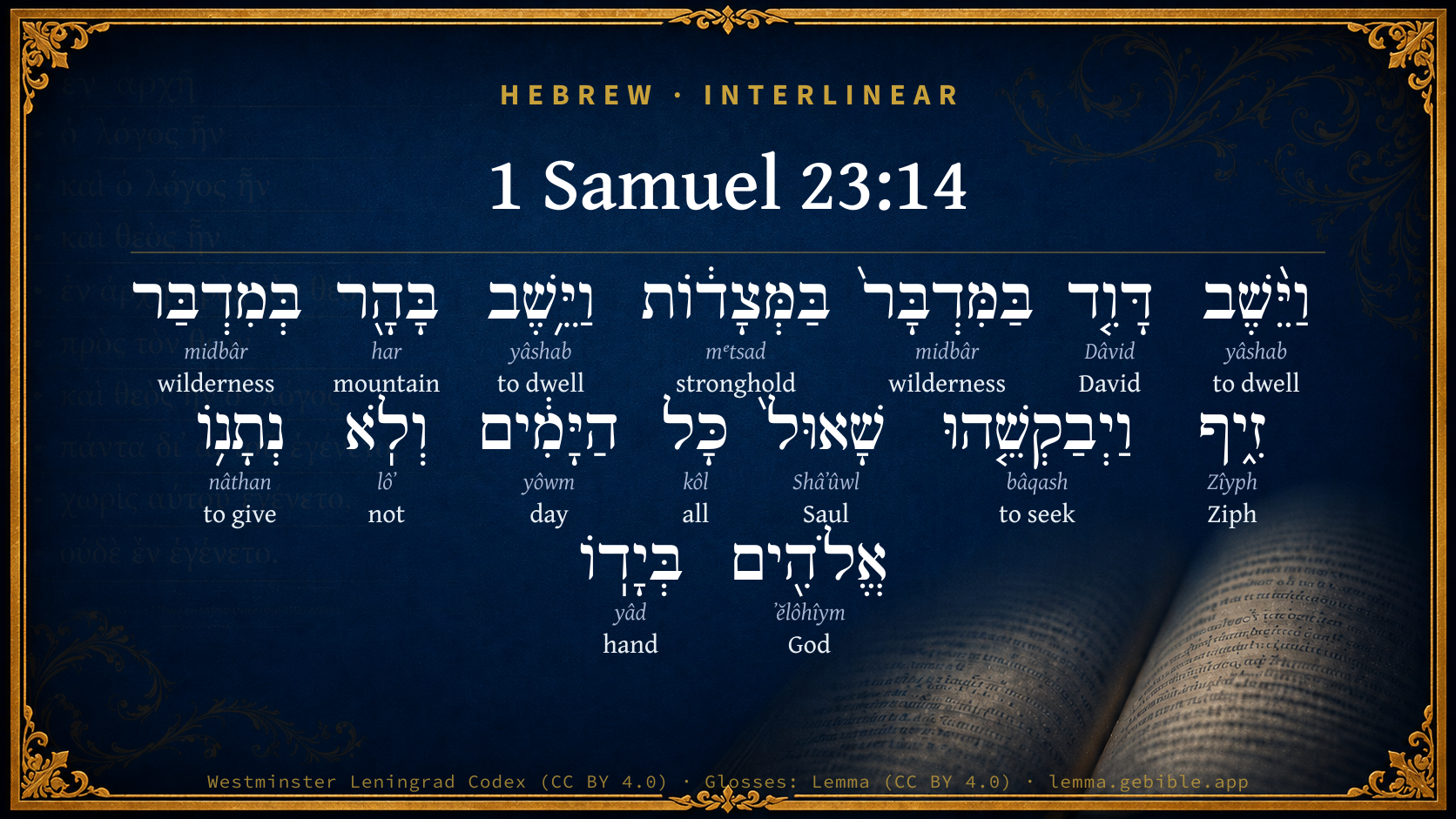
1 Samuel 23:14

Hebrew (Westminster Leningrad Codex) 1 Samuel 23:14 appears in the Hebrew Old Testament. The text above is from the Westminster Leningrad Codex. Each word links to its Strong’s number, a concise gloss, and parsing drawn from the Open Scriptures Hebrew Bible morphology. Click any word for its full Brown-Driver-Briggs (BDB) entry.
Download image
Cite this verse

1 Samuel 23:14 (World English Bible). Public Domain. Lemma interlinear Bible study tool, https://lemma.gebible.app/v/1-samuel/23/14.

Show BibTeX & RIS
BibTeX
RIS
English Translation
David abode in the wilderness in the strongholds, and remained in the hill-country in the wilderness of Ziph. Saul sought him every day, but God didn't deliver him into his hand.
World English Bible · Public Domain
Download a study sheet

One document with this verse’s original text, its word-by-word gloss line, the meaning frame, cross-references with their text, attributed commentary, and full source and license credits — printable, and it pastes into notes with its structure intact.

This verse Autodidact and up

Study sheet (.html) Plain text (.txt)

A passage Seminary Student

Up to 50 verses in one chapter. A passage sheet keeps up to 6 commentary sources and 12 cross-references per verse, in the order this page ranks them, and says so on the sheet whenever that leaves anything out. Ask for a single verse and you get the Autodidact verse sheet above.

Everything on this page stays free to read, with no account — the sheet is a download of what is already on screen, not access to it.

Want to remove ads? Support Godless Engineer
Compare translations 3

The same verse in 3 English versions, stacked beneath the original-language interlinear above. Click any original word for its lexicon entry.

Each is an independent rendering of the whole verse — the interlinear is not word-aligned to these translations.

Highlighted words mark where these versions differ — a whole-verse word diff, not a word-by-word alignment.

  • World English Bible Public Domain
    David abode in the wilderness in the strongholds, and remained in the hill-country in the wilderness of Ziph. Saul sought him every day, but God didn't deliver him into his hand.
  • King James Version Public Domain
    And David abode in the wilderness in strong holds, and remained in a mountain in the wilderness of Ziph. And Saul sought him every day, but God delivered him not into his hand.
  • unfoldingWord Literal Text CC BY-SA 4.0
    And David stayed in the wilderness, in the strongholds, and he stayed in the hill country in the wilderness of Ziph. And Saul sought him all of the days, but God did not give him into his hand.

unfoldingWord Literal Text — © unfoldingWord, licensed CC BY-SA 4.0. Word-aligned USFM3 via Door43 (git.door43.org/unfoldingWord/en_ult).

Versions to compare (up to 4)

3 of 4 selected

Show all 18 translations

Every available English version of this verse, each an independent rendering of the whole verse.

  • World English Bible Public Domain
    David abode in the wilderness in the strongholds, and remained in the hill-country in the wilderness of Ziph. Saul sought him every day, but God didn't deliver him into his hand.
  • Berean Standard Bible Public Domain
    And David stayed in the wilderness strongholds and in the hill country of the Wilderness of Ziph. Day after day Saul searched for him, but God would not deliver David into his hand.
  • Majority Standard Bible Public Domain
    And David stayed in the wilderness strongholds and in the hill country of the Wilderness of Ziph. Day after day Saul searched for him, but God would not deliver David into his hand.
  • King James Version Public Domain
    And David abode in the wilderness in strong holds, and remained in a mountain in the wilderness of Ziph. And Saul sought him every day, but God delivered him not into his hand.
  • American Standard Version (1901) Public Domain
    And David abode in the wilderness in the strongholds, and remained in the hill-country in the wilderness of Ziph. And Saul sought him every day, but God delivered him not into his hand.
  • Revised Version (1885) Public Domain
    And David abode in the wilderness in the strong holds, and remained in the hill country in the wilderness of Ziph. And Saul sought him every day, but God delivered him not into his hand.
  • Geneva Bible (1599) Public Domain
    And Dauid abode in the wildernesse in holdes, and remayned in a mountaine in the wildernes of Ziph. And Saul sought him euery day, but God deliuered him not into his hand.
  • Douay-Rheims (1899) Public Domain
    But David abode in the desert in strong holds, and he remained in a mountain of the desert of Ziph, in a woody hill. And Saul sought him always: but the Lord delivered him not into his hands.
  • Young's Literal Translation Public Domain
    And David abideth in the wilderness, in fortresses, and abideth in the hill-country, in the wilderness of Ziph; and Saul seeketh him all the days, and God hath not given him into his hand.
  • Literal Standard Version CC BY-SA 4.0
    And David abides in the wilderness, in fortresses, and abides in the hill-country, in the wilderness of Ziph; and Saul seeks him [for] all the days, and God has not given him into his hand.
  • Unlocked Literal Bible CC BY-SA 4.0
    David stayed in the strongholds in the wilderness, in the hill country in the wilderness of Ziph. Saul looked for him every day, but God did not give him into his hand.
  • unfoldingWord Literal Text CC BY-SA 4.0
    And David stayed in the wilderness, in the strongholds, and he stayed in the hill country in the wilderness of Ziph. And Saul sought him all of the days, but God did not give him into his hand.
  • Darby Bible Public Domain
    And David abode in the wilderness in strongholds, and abode in the mountain in the wilderness of Ziph. And Saul sought him every day, but God did not give him into his hand.
  • World Messianic Bible Public Domain
    David stayed in the wilderness in the strongholds, and remained in the hill country in the wilderness of Ziph. Saul sought him every day, but God didn’t deliver him into his hand.
  • Webster's Bible Public Domain
    And David abode in the wilderness in strong holds, and remained in a mountain in the wilderness of Ziph. And Saul sought him every day, but God delivered him not into his hand.
  • Free Bible Version CC BY-SA 4.0
    David set up camp in the wilderness strongholds, staying in the mountains of the Desert of Ziph. Saul searched for him continually, but God did not let David be captured.
  • Bible in Basic English Public Domain
    And David kept in the waste land, in safe places, waiting in the hill-country in the waste land of Ziph. And Saul was searching for him every day, but God did not give him up into his hands.
  • JPS Tanakh (1917) Public Domain
    And David abode in the wilderness in the strongholds, and remained in the hill-country in the wilderness of Ziph. And Saul sought him every day, but God delivered him not into his hand.

Literal Standard Version (2020), Covenant Press — licensed CC BY-SA 4.0. Text via the HelloAO Bible API (eBible.org). Unlocked Literal Bible (unfoldingWord) — licensed CC BY-SA 4.0. Text via the HelloAO Bible API (eBible.org). unfoldingWord Literal Text — © unfoldingWord, licensed CC BY-SA 4.0. Word-aligned USFM3 via Door43 (git.door43.org/unfoldingWord/en_ult). Free Bible Version, Dr. Jonathan Gallagher — licensed CC BY-SA 4.0. Text via the HelloAO Bible API (eBible.org).

Word by word

More ways to search: Search by grammar → Find every occurrence → Compare this word →

Practice this passage: Drill this verse → Learn its vocabulary →

בַּמְּצָד֔וֹת
mᵉtsad
H4679
“in/at the · strongholds”
Preposition, Determined + Noun, Common, Feminine, Plural, Absolute
Part of Speech
Preposition + Noun
Type
Common
Gender
Feminine
Number
Plural
State
Absolute
Full BDB Definition

Origin: from H6679

TWOT: 1885c

fort, stronghold, fastness - mountain-fastness - stronghold
  1. וַיֵּ֨שֶׁב yâshab H3427 “and · to dwell” Conjunction + Verb, Qal, Sequential Imperfect, 3rd Person, Masculine, Singular
  2. דָּוִ֤ד Dâvid H1732 “David” Noun, Proper
  3. בַּמִּדְבָּר֙ midbâr H4057 “in/at the · wilderness” Preposition, Determined + Noun, Common, Masculine, Singular, Absolute
  4. וַיֵּ֥שֶׁב yâshab H3427 “and · to dwell” Conjunction + Verb, Qal, Sequential Imperfect, 3rd Person, Masculine, Singular
  5. בָּהָ֖ר har H2022 “in/at the · mountain” Preposition, Determined + Noun, Common, Masculine, Singular, Absolute
  6. בְּמִדְבַּר midbâr H4057 “in/at · wilderness of” Preposition + Noun, Common, Masculine, Singular, Construct
  7. זִ֑יף Zîyph H2128 “Ziph” Noun, Proper
  8. וַיְבַקְשֵׁ֤הוּ bâqash H1245 “and · to seek · him” Conjunction + Verb, Piel, Sequential Imperfect, 3rd Person, Masculine, Singular + Suffix, Personal, 3rd Person, Masculine, Singular
  9. שָׁאוּל֙ Shâʼûwl H7586 “Saul” Noun, Proper
  10. כָּל kôl H3605 “all of” Noun, Common, Masculine, Singular, Construct
  11. הַיָּמִ֔ים yôwm H3117 “the · days” Particle, Definite Article + Noun, Common, Masculine, Plural, Absolute
  12. וְלֹֽא lôʼ H3808 “and · not” Conjunction + Particle, Negative
  13. נְתָנ֥וֹ nâthan H5414 “to give · him” Verb, Qal, Perfect, 3rd Person, Masculine, Singular + Suffix, Personal, 3rd Person, Masculine, Singular
  14. אֱלֹהִ֖ים ʼĕlôhîym H430 “God(s)” Noun, Common, Masculine, Plural, Absolute
  15. בְּיָדֽוֹ yâd H3027 “in/at · hand · his” Preposition + Noun, Common, Both, Singular, Construct + Suffix, Personal, 3rd Person, Masculine, Singular

About this verse

These counts appear in no published source. They are computed here, from the morphology-tagged text and Lemma’s own curated glosses. What Lemma adds →

16
words
14
distinct lemmas
Historical
section

Notable vocabulary

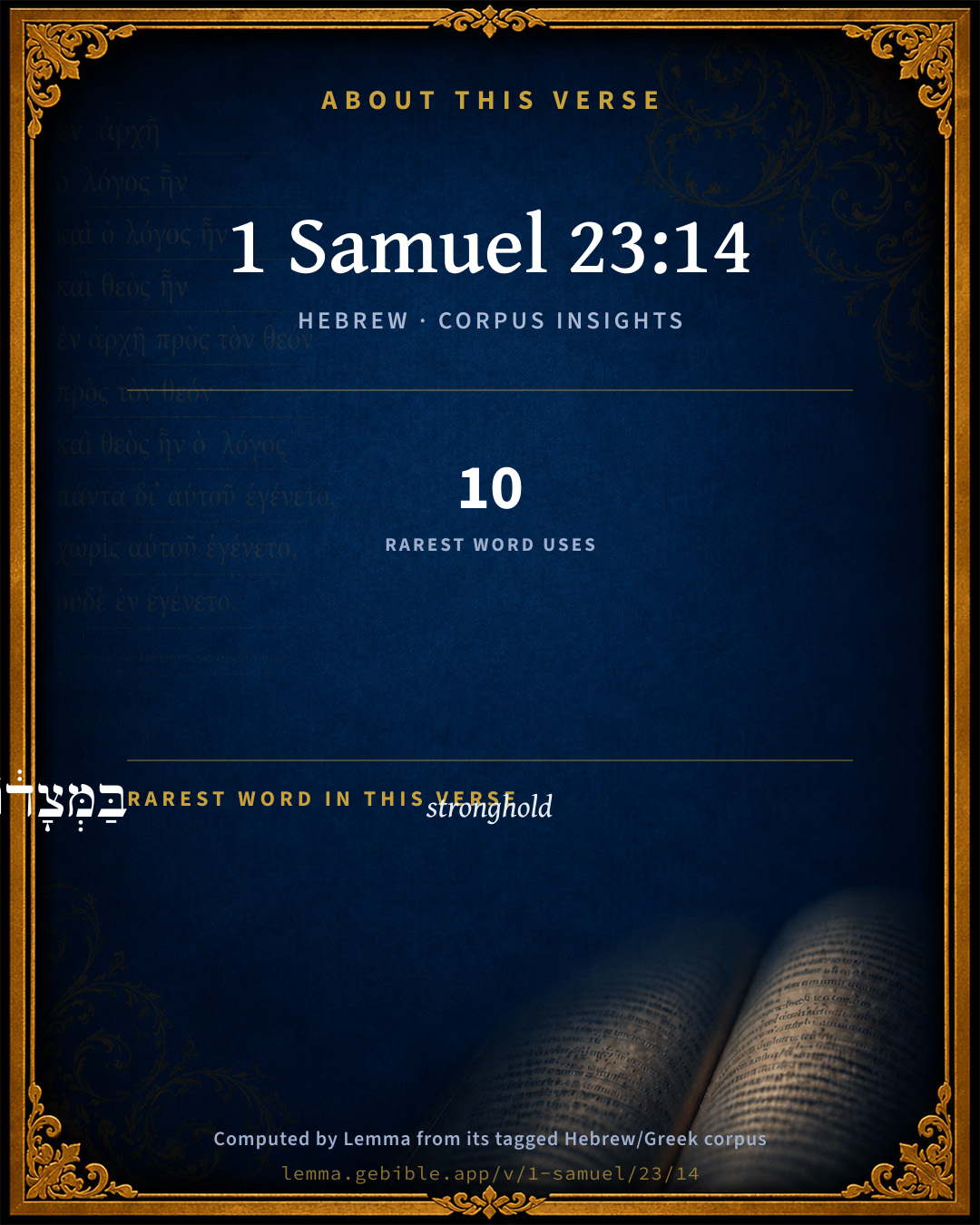
The rarest word here is בַּמְּצָד֔וֹת stronghold H4679 — appearing just 10 times in the whole Hebrew Bible.

Shared distinctive vocabulary

בַּמְּצָד֔וֹת stronghold H4679 occurs in 10 verses of the Hebrew Bible. Also found in:

Grammatical profile

  • 4 verbs
  • 11 nouns
  • 1 particle

Verb forms

  • וַיֵּ֨שֶׁב Qal · Sequential Imperfect
  • וַיֵּ֥שֶׁב Qal · Sequential Imperfect
  • וַיְבַקְשֵׁ֤הוּ Piel · Sequential Imperfect
  • נְתָנ֥וֹ Qal · Perfect

Repetition

Words recur within this verse — often emphatic in Hebrew:

  • וַיֵּ֨שֶׁב to dwell H3427 ×2
  • בַּמִּדְבָּר֙ wilderness H4057 ×2

Hebrew & Septuagint length

In English translation the verse runs 31 words from the Hebrew and 38 from the Septuagint (LXX English) — closely comparable.

A rough comparison of the two English renderings, which tokenize alike — not a word-level alignment.

Word counts can differ between the Hebrew and the Greek without any difference in meaning — e.g. the Hebrew direct-object marker אֵת has no separate Greek word, and Greek often adds the article ὁ.

Cross-references

15

Topical passages linked to 1 Samuel 23:14 in the Treasury of Scripture Knowledge — connected by theme and wording, ordered by reader-vote popularity; previews shown in the World English Bible.

  • Psalms 54:3–4 For strangers have risen up against me. Violent men have sought after my soul. They haven't set God before them. Selah.
  • Psalms 32:7 You are my hiding place. You will preserve me from trouble. You will surround me with songs of deliverance. Selah.
  • Joshua 15:24 Ziph, and Telem, and Bealoth,
  • Joshua 15:55 Maon, Carmel, and Ziph, and Jutah,
  • Romans 8:31 What then shall we say about these things? If God is for us, who can be against us?
  • 2 Timothy 3:11 persecutions, and sufferings: those things that happened to me at Antioch, Iconium, and Lystra. I endured those persecutions. Out of them all the Lord delivered me.
  • 1 Samuel 23:7 It was told Saul that David was come to Keilah. Saul said, God has delivered him into my hand; for he is shut in, by entering into a town that has gates and bars.
  • 1 Samuel 27:1 David said in his heart, I shall now perish one day by the hand of Saul: there is nothing better for me than that I should escape into the land of the Philistines; and Saul will despair of me, to seek me any more in all the borders of Israel: so shall I escape out of his hand.
  • Psalms 11:1–3 In Yahweh, I take refuge. How can you say to my soul, "Flee as a bird to your mountain!"
  • Psalms 37:32–33 The wicked watches the righteous, And seeks to kill him.
  • Proverbs 1:16 For their feet run to evil. They hurry to shed blood.
  • Proverbs 4:16 For they don't sleep, unless they do evil. Their sleep is taken away, unless they make someone fall.
  • Proverbs 21:30 There is no wisdom nor understanding Nor counsel against Yahweh.
  • Jeremiah 36:26 The king commanded Jerahmeel the king's son, and Seraiah the son of Azriel, and Shelemiah the son of Abdeel, to take Baruch the scribe and Jeremiah the prophet; but Yahweh hid them.
  • 2 Timothy 4:17–18 But the Lord stood by me, and strengthened me, that through me the message might be fully proclaimed, and that all the Gentiles might hear; and I was delivered out of the mouth of the lion.

Cross-references courtesy of OpenBible.info (CC BY 4.0).

Hebrew and Greek witnesses Masoretic Hebrew ↔ Greek Septuagint

The same verse in the two great witnesses to the Old Testament, shown verse-for-verse.

These are two independent witnesses, not word-aligned to each other, and the Septuagint is shown in lemma (dictionary) form.

Hebrew 1 Samuel 23:14 Masoretic · Westminster Leningrad Codex

וַיֵּ֨שֶׁב דָּוִ֤ד בַּמִּדְבָּר֙ בַּמְּצָד֔וֹת וַיֵּ֥שֶׁב בָּהָ֖ר בְּמִדְבַּר זִ֑יף וַיְבַקְשֵׁ֤הוּ שָׁאוּל֙ כָּל הַיָּמִ֔ים וְלֹֽא נְתָנ֥וֹ אֱלֹהִ֖ים בְּיָדֽוֹ

David abode in the wilderness in the strongholds, and remained in the hill-country in the wilderness of Ziph. Saul sought him every day, but God didn't deliver him into his hand.

World English Bible · Public Domain

Greek LXX 1 Samuel 23:14 Septuagint · lemma form

καί καταἵζω δαυίδ ἐν ὁ ἔρημος ἐν μασερεμ ἐν ὁ στενός καί καταἧμαι ἐν ὁ ἔρημος ἐν ὁ ὄρος ζιφ ἐν ὁ γῆ ὁ αὐχμώδης καί ζητέω αὐτός σαούλ πᾶς ὁ ἡμέρα καί οὐ παραδίδωμι αὐτός κύριος εἰς ὁ χείρ αὐτός

And he lived in Maserem in the wilderness, in the narrow passes; and lived in the wilderness in mount Ziph, in the dry country. And Saul sought him continually, but the Lord delivered him not into his hands.

LXX2012 (modern English Septuagint) · Public Domain

Hebrew: Westminster Leningrad Codex (CC BY 4.0). Greek: Septuagint (public domain); English from LXX2012 (modern English Septuagint) (Public Domain). How the Septuagint differs from the Hebrew →

Targum (Aramaic paraphrase)

1

The Targum is the ancient Jewish Aramaic paraphrase of the Hebrew Scriptures — an interpretive translation, not the Hebrew text itself. Onkelos (literal) and Pseudo-Jonathan (expansive) render the Torah, and Jonathan the Prophets. Coverage is partial: where no permissively-licensed English translation exists for a verse, only the Aramaic is shown. This is verse-level text, not a word-by-word alignment to the Hebrew.

  1. Targum Jonathan Prophets (Joshua–Malachi)
    וִיתֵיב דָוִד בְּמַדְבְּרָא בִּמְצַדְתָּא וִיתֵיב בְּטוּרָא בְּמַדְבְּרָא דְזִיף וּבְעוֹהִי שָׁאוּל כָּל יוֹמַיָא וְלָא מַסְרֵיהּ יְיָ בִּידֵיהּ:

    (no public-domain English translation for this verse)

    Targum Jonathan — Aramaic: “Mikraot Gedolot” (public domain). English: “Sefaria Community Translation” (CC0 1.0 (public-domain dedication)); “London "Chaldee Paraphrase," 1871” (public domain). Text via Sefaria.

Commentary

Notes on 1 Samuel 23:14 from classic Christian and Jewish commentators (each source and its license shown beneath its notes). The classic Christian expositions comment on the surrounding passage and are grouped to its opening verse, so a note may address several verses; the Jewish commentaries on the Tanakh (Rashi and others) are per-verse, so they appear only where the commentator wrote on this verse.

Lemma curates 59 commentaries, every one of them public domain or Creative Commons licensed, each selected and text-cleaned for this edition rather than reprinted as found. About our sources →

Matthew Henry's Commentary

Here is, I. David absconding. He abode in a wilderness, in a mountain (Sa1 23:14), in a wood, Sa1 23:15. We must here, 1. Commend his eminent virtues, his humility, modesty, fidelity to his prince, and patient attendance on the providence of his God, that he did not draw up his forces against Saul, fight him in the field, or surprise him by some stratagem or other, and so avenge his own quarrel and that of the Lord's priests upon him, and put an end to his own troubles and the calamities of the country under Saul's tyrannical government. No, he makes no such attempt; he keeps God's way, waits God's time, and is content to secure himself in woods and wildernesses, though with some it might seem a reproach to that courage for which he had been famous. But, 2. We must also lament his hard fate, that an innocent man should be thus terrified and put in fear of his life, that a man of honour should be thus disgraced, a man of merit thus recompensed for his services, and a man that delighted in the service both of God and his country should be debarred from both and wrapped up in obscurity. What shall we say to this? Let it make us think the worse of this world, which often gives such bad treatment to its best men; let it reconcile even great and active men to privacy and restraint, if Providence make these their lot, for they were David's; and let it make us long for that kingdom where goodness shall for ever be in glory and holiness in honour, and the righteous shall shine as the sun, which cannot be put under a bushel.

II. Saul hunting him, as his implacable enemy. He sought him every day, so restless was his malice, Sa1 23:14. He sought no less than his life, so cruel was his malice, Sa1 23:15. As it had been from the beginning, so it was now, and will be, he that is born after the flesh persecuteth him that is born after the spirit, Gal 4:29.

III. God defending him, as his powerful protector. God delivered him not into Saul's hand, as Saul hoped (Sa1 23:7); and, unless God delivered him into his hand, he could not prevail against him, Joh 19:11.

IV. Jonathan comforting him as his faithful and constant friend. True friends will find out means to get together. David, it is likely, appointed time and place for this interview, and Jonathan observed the appointment, though he exposed himself thereby to his father's displeasure, and, had it been discovered, it might have cost him his life. True friendship will not shrink from danger, but can easily venture, will not shrink from condescension, but can easily stoop, and exchange a palace for a wood, to serve a friend. The very sight of Jonathan was reviving to David; but, besides this, he said that to him which was very encouraging. 1. As a pious friend, he directed him to God, the foundation of his confidence and the fountain of his comfort: He strengthened his hand in God. David, though a strong believer, needed the help of his friends for the perfecting of what was lacking in his faith; and herein Jonathan was helpful to him, by reminding him of the promise of God, the holy oil wherewith he was anointed, the presence of God with him hitherto, and the many experiences he had had of God's goodness to him. Thus he strengthened his hands for action, by encouraging his heart, not in the creature, but in God. Jonathan was not in a capacity of doing any thing to strengthen him, but he assured him God would. 2. As a self-denying friend, he took a pleasure in the prospect of David's advancement to that honour which was his own birthright, Sa1 23:17. "Thou shalt live to be king, and I shall think it preferment enough to be next thee, near thee, though under thee, and will never pretend to be a rival with thee." This resignation which Jonathan made to David of his title would be a great satisfaction to him, and make his way much the more clear. This, he tells him, Saul knew very well, Jonathan having sometimes heard him say as much, whence it appears what a wicked man Saul was, to persecute one whom God favoured, and what a foolish man he was, in thinking to prevent that which God had determined and which would certainly come to pass. How could he disannul what God had purposed? 3. As a constant friend, he renewed his league of friendship with him. They made a covenant now, this third time, before the Lord, calling him to witness to it, Sa1 23:18. True love takes delight in repeating its engagements, giving and receiving fresh assurances of the firmness of the friendship. Our covenant with God should be often renewed, and therein our communion with him kept up. David and Jonathan now parted, and never came together again, that we find, in this world; for Jonathan said what he wished, not what he had ground to expect, when he promised himself that he should be next to David in his kingdom.

Matthew Henry's Commentary on the Whole Bible (1708–1710) — public domain (CC PDM 1.0). Text via the HelloAO Bible API.

Jamieson, Fausset & Brown

Robert Jamieson, A. R. Fausset & David Brown

DAVID ESCAPES TO ZIPH. (Sa1 23:14-18)

David abode in the wilderness . . . of Ziph--A mountainous and sequestered region was generally called a wilderness, and took its name from some large town in the district. Two miles southeast of Hebron, and in the midst of a level plain, is Tell-ziph, an isolated and conical hillock, about a hundred feet high, probably the acropolis [VAN DE VELDE], or the ruins [ROBINSON] of the ancient city of Ziph, from which the surrounding wilderness was called. It seems, anciently, to have been covered by an extensive woods. The country has for centuries lost its woods and forests, owing to the devastations caused by man.

Jamieson, Fausset & Brown — Commentary Critical and Explanatory on the Whole Bible (1871) — public domain (CC PDM 1.0). Text via the HelloAO Bible API.

Trapp's Complete Commentary

John Trapp

1Sa 23:14 And David abode in the wilderness in strong holds, and remained in a mountain in the wilderness of Ziph. And Saul sought him every day, but God delivered him not into his hand.

Ver. 14. In the wilderness of Ziph.] Which was the name of a city: so called, belike, from the plenty of pitch there. Zepheth signifieth pitch. {Exo 2:3 Isa 34:9}

And Saul sought him every day.] So desperately bent was he to destroy him: being herein like the scorpion, whereof Pliny saith that there is not one minute of time wherein it doth not put forth the sting desirous to do harm. Or rather like the devil, whose malice to mankind is incessant and unsatisfiable.

John Trapp, A Commentary or Exposition upon All the Books of the Old and New Testament (1647–1656) — public domain. Text from a community e-Sword module.

Whedon's Commentary on the Bible

Daniel D. Whedon

DAVID IN THE DESERTS OF ZIPH AND MAON, 1Sa_23:14-29.

14. A mountain in the wilderness of Ziph — Perhaps the same eminence, about three miles southeast of Hebron, that still bears the name Tell Zif; at all events, some mountain in this vicinity is meant. Compare Jos_15:55.

Saul sought him every day — He probably supposed that David was gathering troops around him for hostile purposes against himself, and that when adequately strong he would not hesitate to make an attempt upon the throne. He may have feared also that David would issue a call to the tribes of Israel for help, for he well knew how popular the young hero was wherever he was known.

Daniel D. Whedon (gen. ed.), Commentary on the Old and New Testaments (1874–1909) — public domain. Text from a community e-Sword module.

The Pulpit Commentary

CHAPTER 23:14-29

SAUL"S PURSUIT OF DAVID IN THE WILDERNESS OF ZIPH (vers. 14-28).

Vers. 14, 15. Strong holds. Natural fortresses in the woods and mountains are meant, and places difficult of access. The wilderness of Ziph. This lay to the south of Hebron, upon the edge of the great desert of. (Jos_15:55) Saul sought him every day. The pursuit was maintained constantly, with men always spying David"s movements, and ready to report to Saul any opportunity of seizing him; but apparently there was no body of men at present perpetually in quest of him. In a wood. Many rightly regard this as a proper name, Horesh, and as the same place as the mountain mentioned in ver. 14; for, as Conder remarks ("Tent Work," 2:89), "a moment"s reflection will convince any traveller that, as the dry, porous formation of the plateau must be unchanged since David"s time, no wood of trees can then have flourished over this unwatered and sun-scorched region."

The Pulpit Commentary (1880–1919), ed. H.D.M. Spence-Jones & Joseph S. Exell — public domain. Text from a community e-Sword module.

Tyndale Open Study Notes

Tyndale Open Resources

23:14 The strongholds of the wilderness were not man-made structures but natural rock formations that provided refuge. • Ziph was approximately ten miles southeast of Keilah (23:1).

Tyndale Open Study Notes — © Tyndale Open Resources, licensed CC BY-SA 4.0. Text via the HelloAO Bible API.

Geneva Bible (1599)

Geneva Bible translators

Or, strong places.

No power nor policy can prevail against God’s children, but when he appointeth the time.

Geneva Bible (1599) marginal notes — public domain. Text via Bolls.life.

Adam Clarke's Commentary

Verse 14. Wilderness of Ziph] Ziph was a city in the southern part of Judea, not far from Carmel.

Adam Clarke's Commentary on the Bible (1810–1826) — public domain. Text from a community e-Sword/MySword module.

Ellicott's Commentary for English Readers

(14) The wilderness of Ziph.—This wilderness probably lies between Hebron and En-gedi. Some of these “stations” in the wanderings of the future king are only doubtfully identified. Cowper’s musical—though perhaps, according to our recent canons of taste, old-fashioned—lines well describe the Psalmist-king’s weary wanderings during this portion of his chequered career:—

“See Judah’s promised king bereft of all,

Driven out an exile from the face of Saul.

To distant caves the lonely wanderer flies,

To seek that peace a tyrant’s frown denies.

His soul exults; hope animates his lays;

The sense of mercy kindles into praise;

And wilds familiar with the lion s roar

Ring with ecstatic sounds unheard before.”

COWPER.

Saul sought him every day, but God delivered him.—This is merely a general remark, and intended to cover a long period of time, including the remaining portion of Saul’s reign, during which David was perpetually exposed to Saul’s attempts to destroy him. It quietly mentions also that though Saul was armed with all the power of the king in Israel, he was powerless, for the invisible King of Israel declined to give this hated David into his hand.

A Bible Commentary for English Readers, edited by Charles John Ellicott (1878–1897) — public domain. Text from a community e-Sword module.

The Cambridge Bible for Schools and Colleges

gen. ed. J. J. S. Perowne

14. And David abode in the wilderness] David’s next resort was “the wilderness of Judah,” the wild uncultivated tract lying between the mountains of Judah and the Dead Sea. His chief abode was “the mountain (perhaps the hill of Hachilah, 1Sa_23:19) in the wilderness of Ziph,” a district S. E. of Hebron, where a rounded hill half way between Hebron and Carmel still bears the name Tell Zîf. Ziph is mentioned in Jos_15:55, and was fortified by Rehoboam (2Ch_11:8).

every day] Continually: not that he literally spent all his time in the pursuit of David.

The Cambridge Bible for Schools and Colleges (gen. ed. J. J. S. Perowne; Cambridge University Press, 1878–1918) — public domain. Text from a community e-Sword module.

John Gill's Exposition

And David abode in the wilderness in strong holds,.... In the wilderness of Ziph, in high and strong rocks there, as it seems to be explained by what follows:

and remained in a mountain in the wilderness of Ziph; which had its name from a city in the tribe of Judah, of which See Gill on Jos 15:55,

and Saul sought him every day; for though he did not go forth from the place where he was to Keilah, yet hearing which way he went, and whereabout he lurked, he sought after him continually, if haply he might find him:

but God delivered him not into his hand: which suggests, that it was only the providence of God that secured him, or, in all probability, such was the diligence of Saul, that he would have found him out, and he must have fallen into his hands, as he expected.

John Gill's Exposition of the Whole Bible (1746–1763) — public domain (CC PDM 1.0). Text via the HelloAO Bible API.

Albert Barnes' Notes on the Bible

Ziph is placed between Hebron and En-gedi (marginal references). (The “wood” 1Sa 23:15 is by Conder taken as a proper name, “Cheresh,” and identified with Khoreisa.)

Albert Barnes' Notes on the Bible (1834–1885) — public domain. Text from a community e-Sword/MySword module.

Haydock's Catholic Bible Commentary

Ziph, eight miles east of Hebron, (St. Jerome) towards the southern Carmel. (Eusebius) --- Abdias (ver. 3) takes notice of the clefts of the rocks of Edom. St. Jerome says, this mountain was "dark and cloudy." (Menochius)

George Leo Haydock (1774–1849), Haydock's Catholic Family Bible and Commentary, 1859 edition — public domain. Excludes Psalms (Douay-Rheims chapter numbering differs from Protestant) and Deuterocanonical books (Catholic canon only).

Matthew Poole's English Annotations

As Saul fondly persuaded himself he intended, 1Sa 23:7.

Matthew Poole's English Annotations on the Holy Bible (1683–1685) — public domain. Text from a community e-Sword/MySword module.

Kretzmann's Popular Commentary

Paul E. Kretzmann

In the Wilderness of Ziph

v. 14. And David abode in the wilderness in strongholds, on sheltering heights in the great semiarid region of Southern Judah, whose several parts were named after the cities in the neighborhood, and remained in a mountain in the Wilderness of Ziph, establishing his camp there for some time. And Saul sought him every day, all the days of his life, continually, but God delivered him not into his hand. This remark serves as an introduction to the entire next section.

v. 15. And David saw that Saul was come out to seek his life, he received information to that effect, it was impressed upon his consciousness more and more; and David was in the Wilderness of Ziph in a wood, a thick forest, which offered him the best form of concealment.

v. 16. And Jonathan, Saul’s son, arose, and went to David into the wood, in proof of the continued faithfulness of his friendship, and strengthened his hand in God, encouraged him by reminding him of God’s promises of His divine presence and protection.

v. 17. And he said unto him, Fear not; for the hand of Saul, my father, shall not find thee, he was convinced that David was sheltered by God’s special protection; and thou shalt be king over Israel, a conviction which had been forced upon him by the trend of events, and I shall be next unto thee, he was perfectly willing to resign all claim to the throne; and that also Saul, my father, knoweth, he was aware that David was to be his successor.

v. 18. And they two made a covenant before the Lord, renewing the covenant which united their hearts, 1Sa 20:16-42; and David abode in the wood, remaining in concealment with his men, and Jonathan went to his house.

v. 19. Then came up the Ziphites, whose behavior furnishes a most glaring contrast to that of Jonathan, to Saul to Gibeah, saying, Doth not David hide himself with us, in our neighborhood, in strongholds in the wood, where they could note his every movement, in the hill of Hachilah, which is on the south side of Jeshimon? This wooded, rocky mountain lay on the south side of a waste region which stretched out on the west side of the Dead Sea, within the steppes of Judah.

v. 20. Now, therefore, O king, come down according to all the desire of thy soul to come down; and our part shall be to deliver him into the king’s hand. So passionate were they in their adherence to Saul that they would do all in their power to deliver David into his hand.

v. 21. And Saul said, with the blindness of an evil conscience, Blessed be ye of the Lord; for ye have compassion on me, praising them in this respect, just as he had rebuked his servants for their lack of sympathy for him, 1Sa 22:8.

v. 22. Go, I pray you, prepare yet, and know and see his place where his haunt is, where his foot will be, every retreat of David in his constant shifting about; for it is told me that he dealeth very subtilly, that was a prominent trait in David’s character.

v. 23. See, therefore, and take knowledge of all the lurking-places where he hideth himself, and come ye again to me with the certainty, literally, "what is certain," that is with sure information, and I will go with you; and it shall come to pass, if he be in the land, that I will search him out throughout all the thousands of Judah, the larger division of the tribe, Num 1:16, that is, in their territory. Thus Saul still showed his fixed idea that David was attempting to take his throne and life, and thus committing a great crime against God.

v. 24. And they arose and went to Ziph before Saul, who was soon to follow with his men; but David and his men were in the Wilderness of Maon, south of the mountain of Hachilah, in the plain on the south of Jeshimon, on or near a conical hill which still bears a very similar name.

v. 25. Saul also and his men went to seek him. And they told David; wherefore he came down into a rock, descended the rock, the mountain where he had been, in order to reach the lowland and a new hiding-place, and abode in the Wilderness of Maon. And when Saul heard that, he pursued after David in the Wilderness of Maon.

v. 26. And Saul went on this side of the mountain, and David and his men on that side of the mountain, the mountain thus separating the two armies; and David made haste to get away for fear of Saul, he was very anxious to escape; for Saul and his men compassed David and his men round about to take them, they were at the point of surrounding them.

v. 27. But there came a messenger unto Saul, saying, Haste thee and come; for the Philistines have invaded the land, they had undertaken a raid on a large scale, their object being to obtain booty.

v. 28. Wherefore Saul returned from pursuing after David, and went against the Philistines; therefore they called that place Sela-hammahlekoth (rock of divisions, rock of escapes), because it was undoubtedly due to its upthrust that David escaped with his men.

v. 29. And David went up from thence, and dwelt in strongholds at En-gedi, about the middle of the western shore of, the Dead Sea. The Lord, who governs all things, protected His servant in this extremity. And the same God has ways and means to help us in all our troubles and difficulties. if we but commit our way to Him.

Paul E. Kretzmann, Popular Commentary of the Bible (1921–1924) — public domain. Text from a community e-Sword module.

Lesson kit

Teaching starters — assembled from the data on this page, not authored interpretation. Every prompt links to the verse data it draws on. Edit before teaching.

1 Samuel, in the Historical, opens this verse with 16 words (14 distinct Hebrew lemmas). Its most distinctive word is mᵉtsad (“stronghold”). A historical commentator’s framing appears above. Read the whole chapter for the surrounding context.

Discussion questions

  1. How does “stronghold” (mᵉtsad) shape what this verse is saying?
  2. Judges 6:2 shares the word «stronghold» with this verse. How do the two illuminate each other?
  3. “to dwell” occurs 2× in this one verse. What is the effect of the repetition?
  4. The translations on this page render this verse differently — a whole-verse word diff, not a word-by-word alignment. What might account for the different wordings?
  5. The verb «וַיֵּ֨שֶׁב» is Qal Sequential Imperfect. How does its form color the action?
  6. Reading how Matthew Henry's Commentary and Jamieson, Fausset & Brown read this verse, where do the two commentators agree and where do they part?

Things to notice

Reading settings

Reading text

Shown beneath each verse's original-language words.

Old Testament
Old Testament edition

Read the OT as the Masoretic Hebrew (MT) or the Greek Septuagint (LXX).

English shown for the Greek Septuagint (in the Hebrew ↔ Greek comparison).

Comparing translations? Open the Compare panel on any verse page to stack up to four side by side.