Ezekiel 26:21

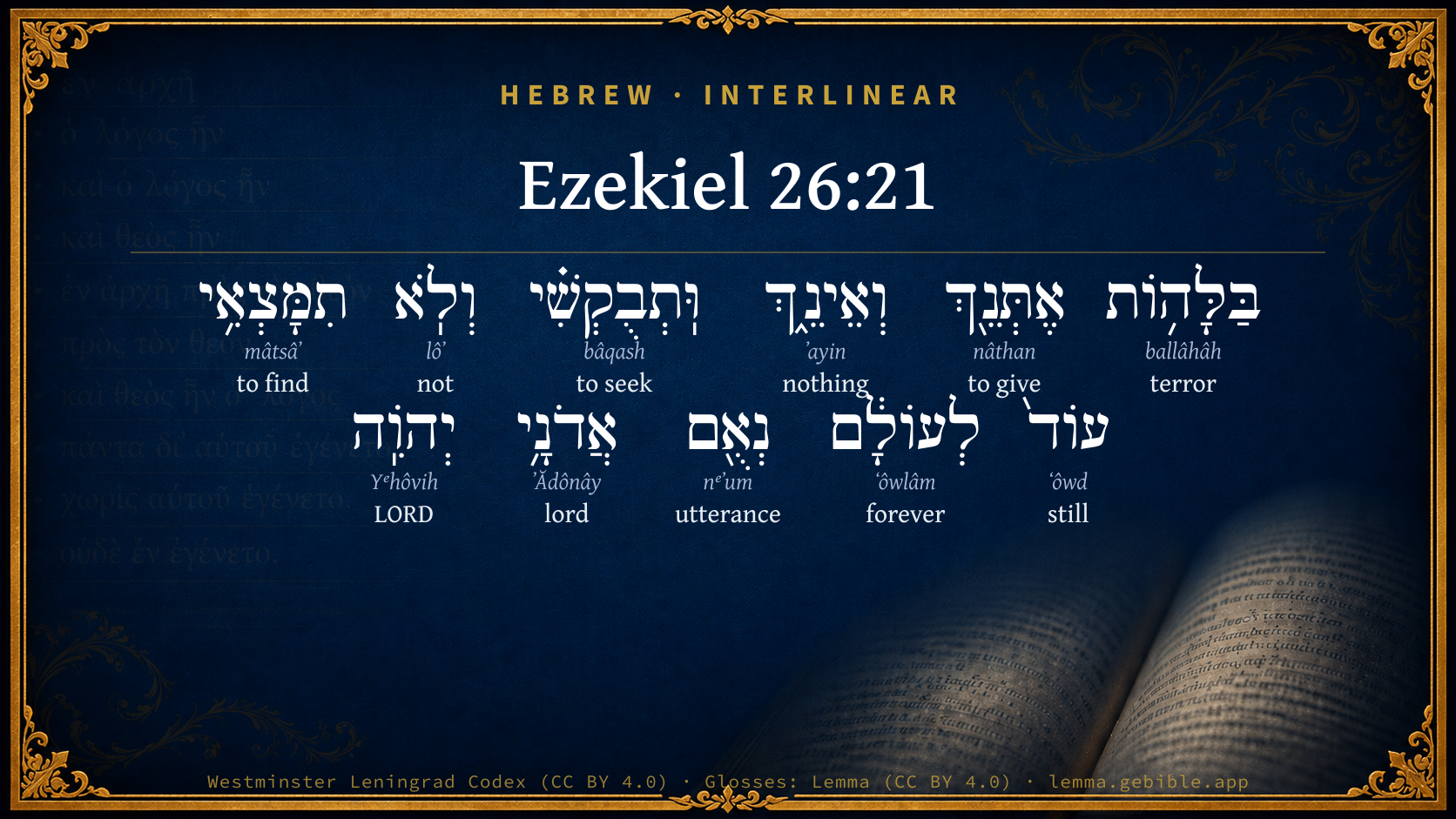
Hebrew (Westminster Leningrad Codex) Ezekiel 26:21 appears in the Hebrew Old Testament. The text above is from the Westminster Leningrad Codex. Each word links to its Strong’s number, a concise gloss, and parsing drawn from the Open Scriptures Hebrew Bible morphology. Click any word for its full Brown-Driver-Briggs (BDB) entry.
Download image
Cite this verse

Ezekiel 26:21 (World English Bible). Public Domain. Lemma interlinear Bible study tool, https://lemma.gebible.app/v/ezekiel/26/21.

Show BibTeX & RIS
BibTeX
RIS
English Translation
I will make you a terror, and you shall no more have any being; though you are sought for, yet shall you never be found again, says the Lord Yahweh.
World English Bible · Public Domain
Download a study sheet

One document with this verse’s original text, its word-by-word gloss line, the meaning frame, cross-references with their text, attributed commentary, and full source and license credits — printable, and it pastes into notes with its structure intact.

This verse Autodidact and up

Study sheet (.html) Plain text (.txt)

A passage Seminary Student

Up to 50 verses in one chapter. A passage sheet keeps up to 6 commentary sources and 12 cross-references per verse, in the order this page ranks them, and says so on the sheet whenever that leaves anything out. Ask for a single verse and you get the Autodidact verse sheet above.

Everything on this page stays free to read, with no account — the sheet is a download of what is already on screen, not access to it.

Want to remove ads? Support Godless Engineer
Compare translations 3

The same verse in 3 English versions, stacked beneath the original-language interlinear above. Click any original word for its lexicon entry.

Each is an independent rendering of the whole verse — the interlinear is not word-aligned to these translations.

Highlighted words mark where these versions differ — a whole-verse word diff, not a word-by-word alignment.

  • World English Bible Public Domain
    I will make you a terror, and you shall no more have any being; though you are sought for, yet shall you never be found again, says the Lord Yahweh.
  • King James Version Public Domain
    I will make thee a terror, and thou shalt be no more: though thou be sought for, yet shalt thou never be found again, saith the Lord GOD.
  • unfoldingWord Literal Text CC BY-SA 4.0
    I will place disaster on you, and you will be no more forever. Then you will be sought, but you will never be found ever again—this is the Lord Yahweh’s declaration.”

unfoldingWord Literal Text — © unfoldingWord, licensed CC BY-SA 4.0. Word-aligned USFM3 via Door43 (git.door43.org/unfoldingWord/en_ult).

Versions to compare (up to 4)

3 of 4 selected

Show all 18 translations

Every available English version of this verse, each an independent rendering of the whole verse.

  • World English Bible Public Domain
    I will make you a terror, and you shall no more have any being; though you are sought for, yet shall you never be found again, says the Lord Yahweh.
  • Berean Standard Bible Public Domain
    I will make you an object of horror, and you will be no more. You will be sought, but will never be found,’ declares the Lord GOD.”
  • Majority Standard Bible Public Domain
    I will make you an object of horror, and you will be no more. You will be sought, but will never be found,’ declares the Lord GOD.”
  • King James Version Public Domain
    I will make thee a terror, and thou shalt be no more: though thou be sought for, yet shalt thou never be found again, saith the Lord GOD.
  • American Standard Version (1901) Public Domain
    I will make thee a terror, and thou shalt no more have any being; though thou be sought for, yet shalt thou never be found again, saith the Lord Jehovah.
  • Revised Version (1885) Public Domain
    I will make thee a terror, and thou shalt be no more: though thou be sought for, yet shalt thou never be found again, saith the Lord GOD.
  • Geneva Bible (1599) Public Domain
    I will bring thee to nothing, and thou shalt be no more: though thou be sought for, yet shalt thou neuer be found againe, sayth the Lord God.
  • Douay-Rheims (1899) Public Domain
    I will bring thee to nothing, and thou shalt not be, and if thou be sought for, thou shalt not be found any more for ever, saith the Lord God.
  • Young's Literal Translation Public Domain
    Wastes I do make thee, and thou art not, And thou art sought, and art not found any more -- to the age, An affirmation of the Lord Jehovah!'
  • Literal Standard Version CC BY-SA 4.0
    I make you a terror, and you are not, || And you are sought, and are not found anymore—for all time,” || A declaration of Lord YHWH!
  • Unlocked Literal Bible CC BY-SA 4.0
    I will place disaster on you, and you will be no more forever. Then you will be sought, but you will never be found ever again—this is the Lord Yahweh's declaration.”
  • unfoldingWord Literal Text CC BY-SA 4.0
    I will place disaster on you, and you will be no more forever. Then you will be sought, but you will never be found ever again—this is the Lord Yahweh’s declaration.”
  • Darby Bible Public Domain
    And I will make thee a terror, and thou shalt be no [more]; and thou shalt be sought for, and shalt never be found again, for ever, saith the Lord Jehovah.
  • World Messianic Bible Public Domain
    I will make you a terror, and you will no more have any being. Though you are sought for, yet you will never be found again,’ says the Lord GOD.”
  • Webster's Bible Public Domain
    I will make thee a terror, and thou shalt be no more: though thou shalt be sought for, yet shalt thou never be found again, saith the Lord GOD.
  • Free Bible Version CC BY-SA 4.0
    I will turn you into something horrific, and you won't exist any longer. People will look for you, but won't ever find you, declares the Lord God.”
  • Bible in Basic English Public Domain
    I will make you a thing of fear, and you will come to an end: even if you are looked for, you will not be seen again for ever, says the Lord.
  • JPS Tanakh (1917) Public Domain
    I will make thee a terror, and thou shalt be no more; though thou be sought for, yet shalt thou never be found again, saith the Lord GOD.'

Literal Standard Version (2020), Covenant Press — licensed CC BY-SA 4.0. Text via the HelloAO Bible API (eBible.org). Unlocked Literal Bible (unfoldingWord) — licensed CC BY-SA 4.0. Text via the HelloAO Bible API (eBible.org). unfoldingWord Literal Text — © unfoldingWord, licensed CC BY-SA 4.0. Word-aligned USFM3 via Door43 (git.door43.org/unfoldingWord/en_ult). Free Bible Version, Dr. Jonathan Gallagher — licensed CC BY-SA 4.0. Text via the HelloAO Bible API (eBible.org).

Word by word

More ways to search: Search by grammar → Find every occurrence → Compare this word →

Practice this passage: Drill this verse → Learn its vocabulary →

בַּלָּה֥וֹת
ballâhâh
H1091
“terrors”
Noun, Common, Feminine, Plural, Absolute
Part of Speech
Noun
Type
Common
Gender
Feminine
Number
Plural
State
Absolute
Full BDB Definition

Origin: from H1089

TWOT: 247a

terror, destruction, calamity, dreadful event
  1. אֶתְּנֵ֖ךְ nâthan H5414 “to give · you” Verb, Qal, Imperfect, 1st Person, Common, Singular + Suffix, Personal, 2nd Person, Feminine, Singular
  2. וְאֵינֵ֑ךְ ʼayin H369 “and · nothing · you” Conjunction + Particle, Negative + Suffix, Personal, 2nd Person, Feminine, Singular
  3. וּֽתְבֻקְשִׁ֗י bâqash H1245 “and · to seek” Conjunction + Verb, Pual, Imperfect, 2nd Person, Feminine, Singular
  4. וְלֹֽא lôʼ H3808 “and · not” Conjunction + Particle, Negative
  5. תִמָּצְאִ֥י mâtsâʼ H4672 “to find” Verb, Niphal, Imperfect, 2nd Person, Feminine, Singular
  6. עוֹד֙ ʻôwd H5750 “still” Adverb
  7. לְעוֹלָ֔ם ʻôwlâm H5769 “to/for · forever” Preposition + Noun, Common, Masculine, Singular, Absolute
  8. נְאֻ֖ם nᵉʼum H5002 “utterance of” Noun, Common, Masculine, Singular, Construct
  9. אֲדֹנָ֥י ʼĂdônây H136 “Lord · my” Noun, Common, Masculine, Plural, Construct + Suffix, Personal, 1st Person, Common, Singular
  10. יְהֹוִֽה Yᵉhôvih H3069 “LORD” Noun, Proper

About this verse

These counts appear in no published source. They are computed here, from the morphology-tagged text and Lemma’s own curated glosses. What Lemma adds →

11
words
11
distinct lemmas
Prophets
section

Notable vocabulary

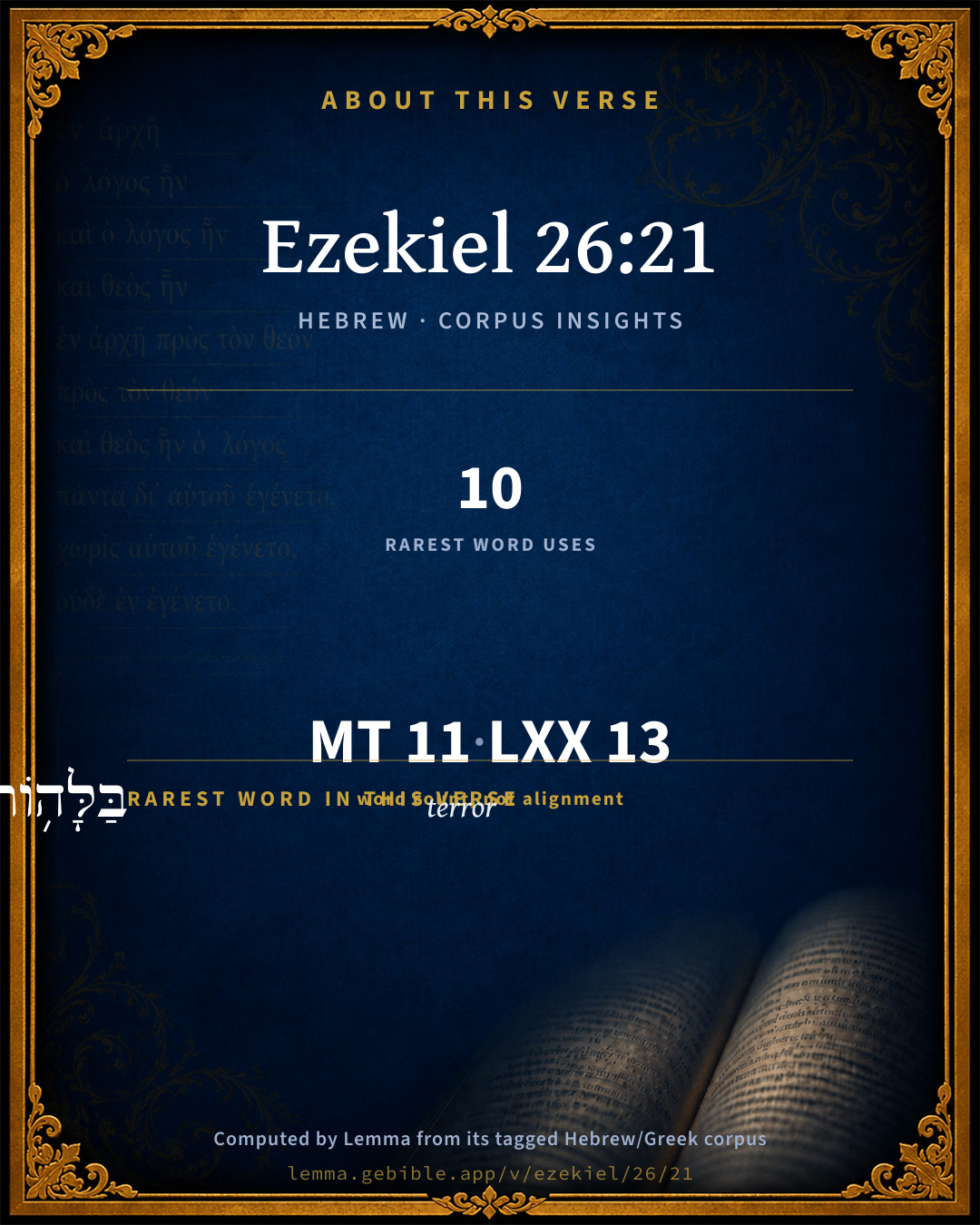
The rarest word here is בַּלָּה֥וֹת terror H1091 — appearing just 10 times in the whole Hebrew Bible.

Shared distinctive vocabulary

בַּלָּה֥וֹת terror H1091 occurs in 10 verses of the Hebrew Bible. Also found in:

Grammatical profile

  • 3 verbs
  • 5 nouns
  • 1 adverb
  • 2 particles

Verb forms

  • אֶתְּנֵ֖ךְ Qal · Imperfect
  • וּֽתְבֻקְשִׁ֗י Pual · Imperfect
  • תִמָּצְאִ֥י Niphal · Imperfect

Hebrew & Septuagint length

In English translation the verse runs 30 words from the Hebrew and 18 from the Septuagint (LXX English) — the Septuagint runs noticeably shorter here. See the side-by-side →

A rough comparison of the two English renderings, which tokenize alike — not a word-level alignment.

Word counts can differ between the Hebrew and the Greek without any difference in meaning — e.g. the Hebrew direct-object marker אֵת has no separate Greek word, and Greek often adds the article ὁ.

In the original languages it is 11 Hebrew tokens and 13 Greek tokens — but the two are counted differently (Hebrew bundles its prefixes and suffixes into one token; the Greek is in lemma form), so that isn’t a like-for-like length.

Cross-references

6

Topical passages linked to Ezekiel 26:21 in the Treasury of Scripture Knowledge — connected by theme and wording, ordered by reader-vote popularity; previews shown in the World English Bible.

  • Ezekiel 27:36 The merchants among the peoples hiss at you; you are become a terror, and you shall nevermore have any being.
  • Ezekiel 28:19 All those who know you among the peoples shall be astonished at you: you are become a terror, and you shall nevermore have any being.
  • Revelation 18:21 A mighty angel took up a stone like a great millstone and cast it into the sea, saying, "Thus with violence will Babylon, the great city, be thrown down, and will be found no more at all.
  • Psalms 37:36 But he passed away, and, behold, he was not. Yes, I sought him, but he could not be found.
  • Jeremiah 51:64 and you shall say, Thus shall Babylon sink, and shall not rise again because of the evil that I will bring on her; and they shall be weary. Thus far are the words of Jeremiah.
  • Ezekiel 26:14–16 I will make you a bare rock; you shall be a place for the spreading of nets; you shall be built no more: for I Yahweh have spoken it, says the Lord Yahweh.

Cross-references courtesy of OpenBible.info (CC BY 4.0).

Hebrew and Greek witnesses Masoretic Hebrew ↔ Greek Septuagint

The same verse in the two great witnesses to the Old Testament, shown verse-for-verse.

Here the Septuagint runs noticeably shorter than the Hebrew — LXX2012 (modern English Septuagint) 18 words vs World English Bible 30. A rough length comparison of the two English translations, not a word-level alignment — read both below.

These are two independent witnesses, not word-aligned to each other, and the Septuagint is shown in lemma (dictionary) form.

Hebrew Ezekiel 26:21 Masoretic · Westminster Leningrad Codex

בַּלָּה֥וֹת אֶתְּנֵ֖ךְ וְאֵינֵ֑ךְ וּֽתְבֻקְשִׁ֗י וְלֹֽא תִמָּצְאִ֥י עוֹד֙ לְעוֹלָ֔ם נְאֻ֖ם אֲדֹנָ֥י יְהֹוִֽה

I will make you a terror, and you shall no more have any being; though you are sought for, yet shall you never be found again, says the Lord Yahweh.

World English Bible · Public Domain

Greek LXX Ezekiel 26:21 Septuagint · lemma form

ἀπώλεια σύ δίδωμι καί οὐ ὑποἄρχω ἔτι εἰς ὁ αἰών λέγω κύριος κύριος

I will make you a destruction, and you shall be no more for ever, says the Lord God.

LXX2012 (modern English Septuagint) · Public Domain

Hebrew: Westminster Leningrad Codex (CC BY 4.0). Greek: Septuagint (public domain); English from LXX2012 (modern English Septuagint) (Public Domain). How the Septuagint differs from the Hebrew →

Targum (Aramaic paraphrase)

1

The Targum is the ancient Jewish Aramaic paraphrase of the Hebrew Scriptures — an interpretive translation, not the Hebrew text itself. Onkelos (literal) and Pseudo-Jonathan (expansive) render the Torah, and Jonathan the Prophets. Coverage is partial: where no permissively-licensed English translation exists for a verse, only the Aramaic is shown. This is verse-level text, not a word-by-word alignment to the Hebrew.

  1. Targum Jonathan Prophets (Joshua–Malachi)
    כִּדְלָא הֲוֵית אֶתְּנִנָךְ וְכֵן תְּהֵי וְתִתְבְּעִין וְלָא תִשְׁכְּחִין עוֹד לַעֲלָם אֲמַר יְיָ אֱלֹהִים:

    (no public-domain English translation for this verse)

    Targum Jonathan — Aramaic: “Mikraot Gedolot” (public domain). English: “Sefaria Community Translation” (CC0 1.0 (public-domain dedication)); “London "Chaldee Paraphrase," 1871” (public domain). Text via Sefaria.

Commentary

Notes on Ezekiel 26:21 from classic Christian and Jewish commentators (each source and its license shown beneath its notes). The classic Christian expositions comment on the surrounding passage and are grouped to its opening verse, so a note may address several verses; the Jewish commentaries on the Tanakh (Rashi and others) are per-verse, so they appear only where the commentator wrote on this verse.

Lemma curates 59 commentaries, every one of them public domain or Creative Commons licensed, each selected and text-cleaned for this edition rather than reprinted as found. About our sources →

Trapp's Complete Commentary

John Trapp

Eze 26:21 I will make thee a terror, and thou [shalt be] no [more]: though thou be sought for, yet shalt thou never be found again, saith the Lord GOD.

Ver. 21. Yet shalt thou never be found again.] See on Eze 26:14.

John Trapp, A Commentary or Exposition upon All the Books of the Old and New Testament (1647–1656) — public domain. Text from a community e-Sword module.

The Biblical Illustrator

Joseph S. Exell

Eze_26:21

I will make thee a terror, and thou shalt be no more.

The humiliation of Tyre

All prophecy is moral, is based on moral considerations. What the prophet aims his threats against is not the prosperity of Tyre, but its pride of heart, which was rebellion against Jehovah--God over all. The humiliation of Tyre was morally as good as its ruins, in so far as it showed that there were higher forces in the world than itself. (A. B. Davidson.)

.

The Biblical Illustrator, edited by Joseph S. Exell (c. 1880s–1900s) — public domain. Text from a community e-Sword module.

Geneva Bible (1599)

Geneva Bible translators

Or, make thee a terror.

Geneva Bible (1599) marginal notes — public domain. Text via Bolls.life.

Jamieson, Fausset & Brown

Robert Jamieson, A. R. Fausset & David Brown

terror--an example of judgment calculated to terrify all evildoers.

thou shall be no more--Not that there was to be no more a Tyre, but she was no more to be the Tyre that once was: her glory and name were to be no more. As, to Old Tyre, the prophecy was literally fulfilled, not a vestige of it being left.

Next: Ezekiel Chapter 27

Jamieson, Fausset & Brown — Commentary Critical and Explanatory on the Whole Bible (1871) — public domain (CC PDM 1.0). Text via the HelloAO Bible API.

Adam Clarke's Commentary

Verse 21. Yet shalt thou never be found again] This is literally true; there is not the smallest vestige of the ancient Tyre, that which was erected on the main land. Even the ground seems to have been washed away; and the new Tyre is in nearly a similar state. I think this prophecy must be extended to the whole duration of Tyre. If it now be found to be in the state here described, it is sufficient to show the truth of the prophecy. And now it is found precisely in the state which the above prophetic declarations, taken according to the letter, point out! No word of God can ever fall to the ground.

Notwithstanding the former destructions, Tyre was a place of some consequence in the time of St. Paul. There was a Church there, (see Ac 21:3-4, &c.,) which afterwards became famous. Calmet observes, it afforded a great number of martyrs for the Christian Church.

Adam Clarke's Commentary on the Bible (1810–1826) — public domain. Text from a community e-Sword/MySword module.

The Cambridge Bible for Schools and Colleges

gen. ed. J. J. S. Perowne

21. make thee a terror] lit., terrors or destructions—I will utterly destroy thee, Eze_27:36, Eze_28:19; cf. Psa_73:19. On “make” cf. Eze_16:38.

The passage Eze_29:17-21 states that Nebuchadnezzar received no adequate reward for the service against Tyre which he served for Jehovah. History records his thirteen years’ siege of Tyre, but is silent as to the issue of it. It is not known (1) whether he took the city, or (2) whether it capitulated, or (3) whether he retired from it. On the whole the second supposition may be most probable. At any rate neither the king nor his army received wages for his service. The prophecy was not literally fulfilled. Now

The Cambridge Bible for Schools and Colleges (gen. ed. J. J. S. Perowne; Cambridge University Press, 1878–1918) — public domain. Text from a community e-Sword module.

Haydock's Catholic Bible Commentary

For ever: for a long time, (Theodoret) not at all in thy ancient glory. (Haydock) --- The city subsisted after the days of Nabuchodonosor and of Alexander [the Great], (Calmet) ver. 14. --- But the ancient city was reduced to a mere nothing. (Haydock)

George Leo Haydock (1774–1849), Haydock's Catholic Family Bible and Commentary, 1859 edition — public domain. Excludes Psalms (Douay-Rheims chapter numbering differs from Protestant) and Deuterocanonical books (Catholic canon only).

Matthew Poole's English Annotations

A terror, or consumption; I will utterly consume thee; with more than one kind of destruction will I destroy thee, and make thee thereby a terror to all that hear the bruit of thee.

Thou shalt be no more: see Eze 26:14. If any will be so curious as to inquire, if they come to seek out the footsteps of this ancient Tyre, they shall lose their labour, no signs of it On the rock where once it stood. Rich, populous, potent, wise, renowned Tyre, as once thou wast, shalt never more be found; and, alas, that which is now on the continent is not fit to bear its name, much less to be counted the same city.

Matthew Poole's English Annotations on the Holy Bible (1683–1685) — public domain. Text from a community e-Sword/MySword module.

Whedon's Commentary on the Bible

Daniel D. Whedon

21. Terror — Literally, destruction. I will entirely destroy thee (Eze_27:36; Eze_28:19).

Daniel D. Whedon (gen. ed.), Commentary on the Old and New Testaments (1874–1909) — public domain. Text from a community e-Sword module.

The Pulpit Commentary

I will make thee a terror. Ewald translates, "To sudden death will I bring thee," which corresponds with the margin of the Revised Version, I will make thee a destruction.

The Pulpit Commentary (1880–1919), ed. H.D.M. Spence-Jones & Joseph S. Exell — public domain. Text from a community e-Sword module.

John Wesley's Explanatory Notes

A terror - To all that hear of thee.

John Wesley, Explanatory Notes Upon the Whole Bible (1754–1765) — public domain. Text via the GEBible commentary corpus.

Rashi

Rabbi Shlomo Yitzchaki (Rashi)

a nonentity [Heb. בַּלָהוֹת.] Jonathan explained בַּלָהוֹת [as] as if you did not exist, and the exegetes explain it as a word for a place where the satyrs and demons dance.

Rashi on the Tanakh — English translations: “The Judaica Press complete Tanach with Rashi, translated by A. J. Rosenberg” (CC BY 4.0); “Pentateuch with Rashi's commentary by M. Rosenbaum and A.M. Silbermann, 1929-1934” (public domain); “The Metsudah Tanach series, Lakewood, N.J” (CC BY 4.0); and “The Book of Joshua, Metsudah Publications, 1997” (CC BY 4.0). Text via Sefaria.

Lesson kit

Teaching starters — assembled from the data on this page, not authored interpretation. Every prompt links to the verse data it draws on. Edit before teaching.

Ezekiel, in the Prophets, opens this verse with 11 words (11 distinct Hebrew lemmas). Its most distinctive word is ballâhâh (“terror”). The Greek Septuagint runs shorter here. A historical commentator’s framing appears above. Read the whole chapter for the surrounding context.

Discussion questions

  1. The word ballâhâh carries the sense “terror.” How does it shape the verse?
  2. Job 18:11 shares the word «terror» with this verse. How do the two illuminate each other?
  3. Compared with the Hebrew, the Septuagint runs shorter here. What questions does that raise?
  4. The translations on this page render this verse differently — a whole-verse word diff, not a word-by-word alignment. What might account for the different wordings?
  5. The verb «אֶתְּנֵ֖ךְ» is Qal Imperfect. How does its form color the action?
  6. Reading how Trapp's Complete Commentary and The Biblical Illustrator read this verse, where do the two commentators agree and where do they part?

Things to notice

Reading settings

Reading text

Shown beneath each verse's original-language words.

Old Testament
Old Testament edition

Read the OT as the Masoretic Hebrew (MT) or the Greek Septuagint (LXX).

English shown for the Greek Septuagint (in the Hebrew ↔ Greek comparison).

Comparing translations? Open the Compare panel on any verse page to stack up to four side by side.