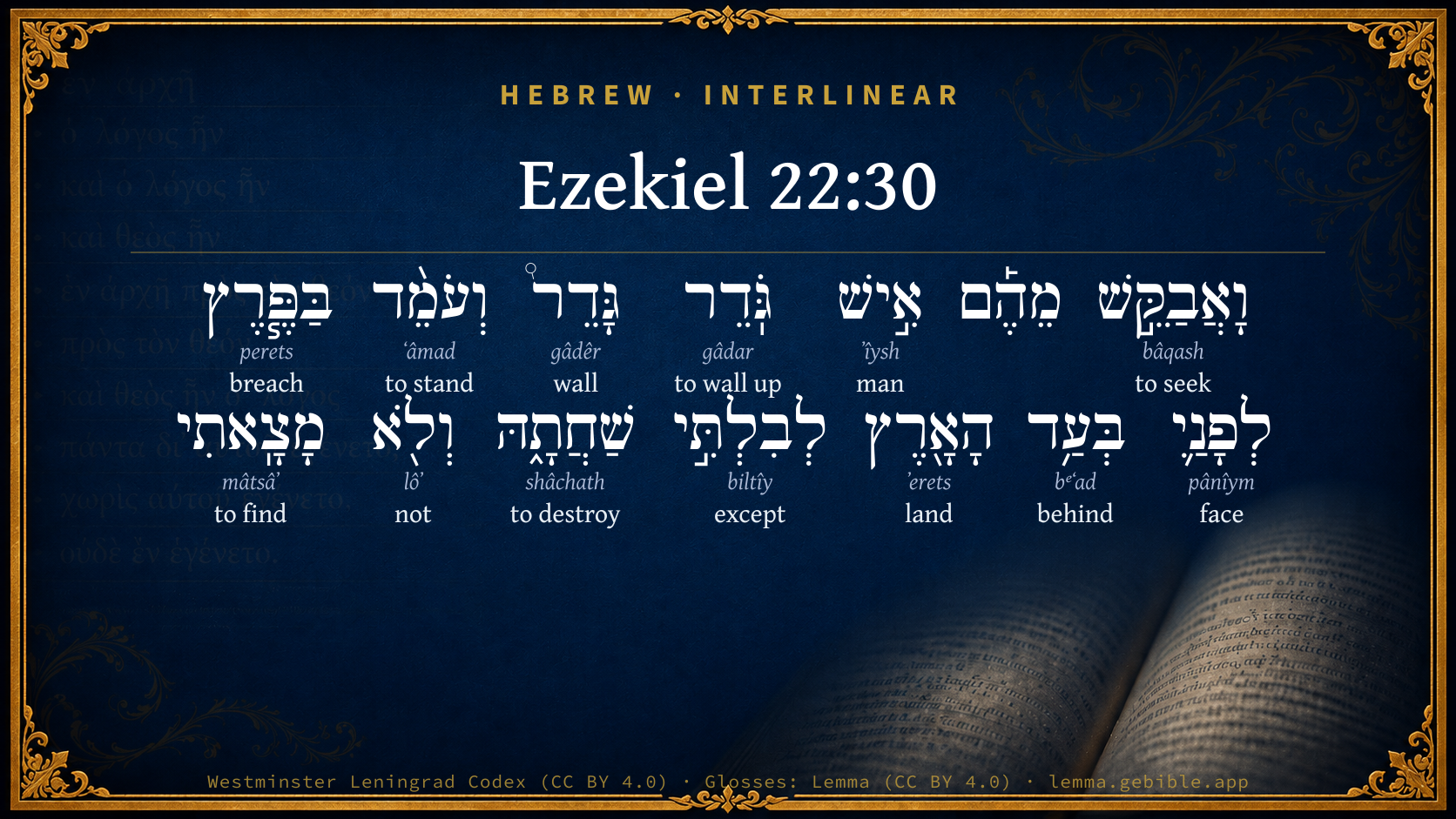
Ezekiel 22:30

Hebrew (Westminster Leningrad Codex) Ezekiel 22:30 appears in the Hebrew Old Testament. The text above is from the Westminster Leningrad Codex. Each word links to its Strong’s number, a concise gloss, and parsing drawn from the Open Scriptures Hebrew Bible morphology. Click any word for its full Brown-Driver-Briggs (BDB) entry.
Download image
Cite this verse

Ezekiel 22:30 (World English Bible). Public Domain. Lemma interlinear Bible study tool, https://lemma.gebible.app/v/ezekiel/22/30.

Show BibTeX & RIS
BibTeX
RIS
English Translation
I sought for a man among them, who should build up the wall, and stand in the gap before me for the land, that I should not destroy it; but I found none.
World English Bible · Public Domain
Download a study sheet

One document with this verse’s original text, its word-by-word gloss line, the meaning frame, cross-references with their text, attributed commentary, and full source and license credits — printable, and it pastes into notes with its structure intact.

This verse Autodidact and up

Study sheet (.html) Plain text (.txt)

A passage Seminary Student

Up to 50 verses in one chapter. A passage sheet keeps up to 6 commentary sources and 12 cross-references per verse, in the order this page ranks them, and says so on the sheet whenever that leaves anything out. Ask for a single verse and you get the Autodidact verse sheet above.

Everything on this page stays free to read, with no account — the sheet is a download of what is already on screen, not access to it.

Want to remove ads? Support Godless Engineer
Compare translations 3

The same verse in 3 English versions, stacked beneath the original-language interlinear above. Click any original word for its lexicon entry.

Each is an independent rendering of the whole verse — the interlinear is not word-aligned to these translations.

Highlighted words mark where these versions differ — a whole-verse word diff, not a word-by-word alignment.

  • World English Bible Public Domain
    I sought for a man among them, who should build up the wall, and stand in the gap before me for the land, that I should not destroy it; but I found none.
  • King James Version Public Domain
    And I sought for a man among them, that should make up the hedge, and stand in the gap before me for the land, that I should not destroy it: but I found none.
  • unfoldingWord Literal Text CC BY-SA 4.0
    So I searched for a man from them who would build up a wall and who would stand before me in its breach for the land so I would not destroy it, but I found no one.

unfoldingWord Literal Text — © unfoldingWord, licensed CC BY-SA 4.0. Word-aligned USFM3 via Door43 (git.door43.org/unfoldingWord/en_ult).

Versions to compare (up to 4)

3 of 4 selected

Show all 18 translations

Every available English version of this verse, each an independent rendering of the whole verse.

  • World English Bible Public Domain
    I sought for a man among them, who should build up the wall, and stand in the gap before me for the land, that I should not destroy it; but I found none.
  • Berean Standard Bible Public Domain
    I searched for a man among them to repair the wall and stand in the gap before Me on behalf of the land, so that I should not destroy it. But I found no one.
  • Majority Standard Bible Public Domain
    I searched for a man among them to repair the wall and stand in the gap before Me on behalf of the land, so that I should not destroy it. But I found no one.
  • King James Version Public Domain
    And I sought for a man among them, that should make up the hedge, and stand in the gap before me for the land, that I should not destroy it: but I found none.
  • American Standard Version (1901) Public Domain
    And I sought for a man among them, that should build up the wall, and stand in the gap before me for the land, that I should not destroy it; but I found none.
  • Revised Version (1885) Public Domain
    And I sought for a man among them, that should make up the fence, and stand in the gap before me for the land, that I should not destroy it: but I found none.
  • Geneva Bible (1599) Public Domain
    And I sought for a man among them, that should make vp the hedge, and stand in the gap before me for the land, that I should not destroy it, but I found none.
  • Douay-Rheims (1899) Public Domain
    And I sought among them for a man that might set up a hedge, and stand in the gap before me in favour of the land, that I might not destroy it: and I found none.
  • Young's Literal Translation Public Domain
    And I seek of them a man making a fence, And standing in the breach before Me, In behalf of the land -- not to destroy it, And I have not found.
  • Literal Standard Version CC BY-SA 4.0
    And I seek from them a man making a wall, || And standing in the breach before Me, || In behalf of the land—not to destroy it, || And I have found none.
  • Unlocked Literal Bible CC BY-SA 4.0
    So I searched for a man from them who would build up a wall and who would stand before me in its breach for the land so I would not destroy it, but I found no one.
  • unfoldingWord Literal Text CC BY-SA 4.0
    So I searched for a man from them who would build up a wall and who would stand before me in its breach for the land so I would not destroy it, but I found no one.
  • Darby Bible Public Domain
    And I sought for a man among them, that should make up the fence, and stand in the breach before me for the land, that I should not destroy it; but I found none.
  • World Messianic Bible Public Domain
    “I sought for a man among them who would build up the wall and stand in the gap before me for the land, that I would not destroy it; but I found no one.
  • Webster's Bible Public Domain
    And I sought for a man among them, that should make up the hedge, and stand in the gap before me for the land, that I should not destroy it: but I found none.
  • Free Bible Version CC BY-SA 4.0
    I tried to find one of them to repair the wall and to defend the gap so when I came I wouldn't destroy it—but I couldn't find anyone.
  • Bible in Basic English Public Domain
    And I was looking for a man among them who would make up the wall and take his station in the broken place before me for the land, so that I might not send destruction on it: but there was no one.
  • JPS Tanakh (1917) Public Domain
    And I sought for a man among them, that should make up the hedge, and stand in the breach before Me for the land, that I should not destroy it; but I found none.

Literal Standard Version (2020), Covenant Press — licensed CC BY-SA 4.0. Text via the HelloAO Bible API (eBible.org). Unlocked Literal Bible (unfoldingWord) — licensed CC BY-SA 4.0. Text via the HelloAO Bible API (eBible.org). unfoldingWord Literal Text — © unfoldingWord, licensed CC BY-SA 4.0. Word-aligned USFM3 via Door43 (git.door43.org/unfoldingWord/en_ult). Free Bible Version, Dr. Jonathan Gallagher — licensed CC BY-SA 4.0. Text via the HelloAO Bible API (eBible.org).

Word by word

More ways to search: Search by grammar → Find every occurrence → Compare this word →

Practice this passage: Drill this verse → Learn its vocabulary →

גֹּֽדֵר
gâdar
H1443
“walling up”
Verb, Qal, Participle Active, Masculine, Singular, Absolute
Part of Speech
Verb
Stem
Qal
Form
Participle Active
Gender
Masculine
Number
Singular
State
Absolute
Full BDB Definition

Origin: a primitive root

TWOT: 318

to wall up, wall off, close off, build a wall - (Qal) - to wall up, shut off - masons (participle)
  1. וָאֲבַקֵּ֣שׁ bâqash H1245 “and · to seek” Conjunction + Verb, Piel, Sequential Imperfect, 1st Person, Common, Singular
  2. אִ֣ישׁ ʼîysh H376 “man” Noun, Common, Masculine, Singular, Absolute
  3. גָּדֵר֩ gâdêr H1447 “wall” Noun, Common, Masculine, Singular, Absolute
  4. וְעֹמֵ֨ד ʻâmad H5975 “and · standing” Conjunction + Verb, Qal, Participle Active, Masculine, Singular, Absolute
  5. בַּפֶּ֧רֶץ perets H6556 “in/at the · breach” Preposition, Determined + Noun, Common, Masculine, Singular, Absolute
  6. לְפָנַ֛י pânîym H6440 “to/for · face(s) · my” Preposition + Noun, Common, Both, Plural, Construct + Suffix, Personal, 1st Person, Common, Singular
  7. בְּעַ֥ד bᵉʻad H1157 “behind” Preposition
  8. הָאָ֖רֶץ ʼerets H776 “the · land” Particle, Definite Article + Noun, Common, Both, Singular, Absolute
  9. לְבִלְתִּ֣י biltîy H1115 “to/for · except” Preposition + Conjunction
  10. שַׁחֲתָ֑הּ shâchath H7843 “to destroy · her” Verb, Piel, Infinitive Construct + Suffix, Personal, 3rd Person, Feminine, Singular
  11. וְלֹ֖א lôʼ H3808 “and · not” Conjunction + Particle, Negative
  12. מָצָֽאתִי mâtsâʼ H4672 “to find” Verb, Qal, Perfect, 1st Person, Common, Singular

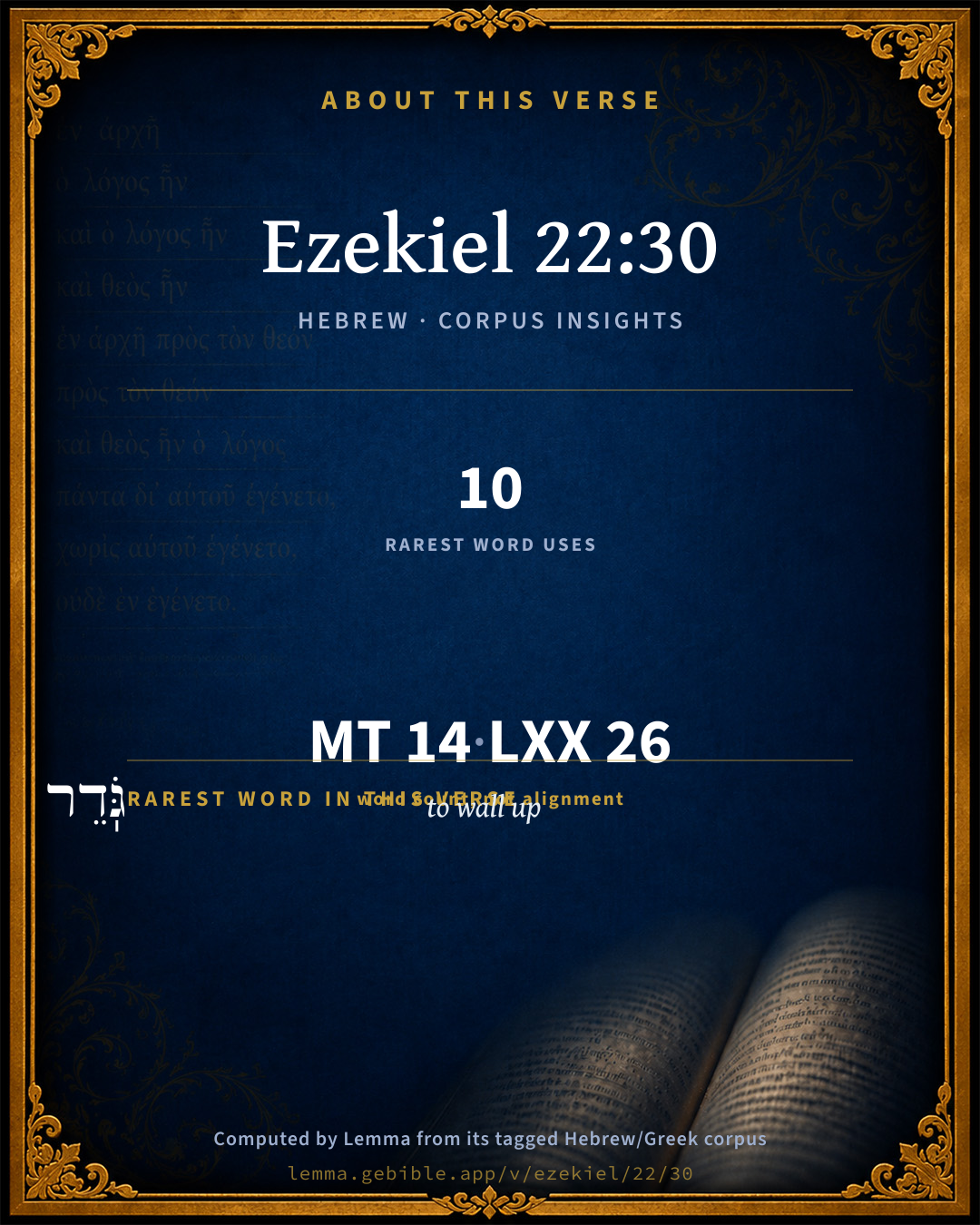
About this verse

These counts appear in no published source. They are computed here, from the morphology-tagged text and Lemma’s own curated glosses. What Lemma adds →

14
words
13
distinct lemmas
Prophets
section

Notable vocabulary

The rarest word here is גֹּֽדֵר to wall up H1443 — appearing just 10 times in the whole Hebrew Bible.

Shared distinctive vocabulary

גֹּֽדֵר to wall up H1443 occurs in 10 verses of the Hebrew Bible. Also found in:

Grammatical profile

  • 5 verbs
  • 5 nouns
  • 2 prepositions
  • 1 conjunction
  • 1 particle

Verb forms

  • וָאֲבַקֵּ֣שׁ Piel · Sequential Imperfect
  • גֹּֽדֵר Qal · Participle Active
  • וְעֹמֵ֨ד Qal · Participle Active
  • שַׁחֲתָ֑הּ Piel · Infinitive Construct
  • מָצָֽאתִי Qal · Perfect

Hebrew & Septuagint length

In English translation the verse runs 33 words from the Hebrew and 33 from the Septuagint (LXX English) — the same length.

A rough comparison of the two English renderings, which tokenize alike — not a word-level alignment.

Word counts can differ between the Hebrew and the Greek without any difference in meaning — e.g. the Hebrew direct-object marker אֵת has no separate Greek word, and Greek often adds the article ὁ.

In the original languages it is 14 Hebrew tokens and 26 Greek tokens — but the two are counted differently (Hebrew bundles its prefixes and suffixes into one token; the Greek is in lemma form), so that isn’t a like-for-like length.

Cross-references

8

Topical passages linked to Ezekiel 22:30 in the Treasury of Scripture Knowledge — connected by theme and wording, ordered by reader-vote popularity; previews shown in the World English Bible.

  • Isaiah 59:16 He saw that there was no man, and wondered that there was no intercessor: therefore his own arm brought salvation to him; and his righteousness, it upheld him.
  • Jeremiah 5:1 Run you back and forth through the streets of Jerusalem, and see now, and know, and seek in the broad places of it, if you can find a man, if there are any who does justly, who seeks truth; and I will pardon her.
  • Psalms 106:23 Therefore he said that he would destroy them, Had Moses, his chosen, not stood before him in the breach, To turn away his wrath, so that he wouldn't destroy them.
  • Genesis 18:23–32 Abraham drew near, and said, "Will you consume the righteous with the wicked?
  • Isaiah 63:5 I looked, and there was none to help; and I wondered that there was none to uphold: therefore my own arm brought salvation to me; and my wrath, it upheld me.
  • Ezekiel 13:5 You have not gone up into the gaps, neither built up the wall for the house of Israel, to stand in the battle in the day of Yahweh.
  • Exodus 32:10–14 Now therefore leave me alone, that my wrath may burn hot against them, and that I may consume them; and I will make of you a great nation."
  • Jeremiah 15:1 Then said Yahweh to me, Though Moses and Samuel stood before me, yet my mind would not be toward this people: cast them out of my sight, and let them go forth.

Cross-references courtesy of OpenBible.info (CC BY 4.0).

Hebrew and Greek witnesses Masoretic Hebrew ↔ Greek Septuagint

The same verse in the two great witnesses to the Old Testament, shown verse-for-verse.

These are two independent witnesses, not word-aligned to each other, and the Septuagint is shown in lemma (dictionary) form.

Hebrew Ezekiel 22:30 Masoretic · Westminster Leningrad Codex

וָאֲבַקֵּ֣שׁ מֵהֶ֡ם אִ֣ישׁ גֹּֽדֵר גָּדֵר֩ וְעֹמֵ֨ד בַּפֶּ֧רֶץ לְפָנַ֛י בְּעַ֥ד הָאָ֖רֶץ לְבִלְתִּ֣י שַׁחֲתָ֑הּ וְלֹ֖א מָצָֽאתִי

I sought for a man among them, who should build up the wall, and stand in the gap before me for the land, that I should not destroy it; but I found none.

World English Bible · Public Domain

Greek LXX Ezekiel 22:30 Septuagint · lemma form

καί ζητέω ἐκ αὐτός ἀνήρ ἀναστρέφω ὀρθῶς καί ἵστημι πρό πρόσωπον ἐγώ ὁλοσχερῶς ἐν καιρός ὁ γῆ ὁ μή εἰς τέλος ἐκἀλείφω αὐτός καί οὐ εὑρίσκω

And I sought from among them a man behaving uprightly, and standing before me perfectly in the time of wrath, so that I should not utterly destroy her: but I found him not.

LXX2012 (modern English Septuagint) · Public Domain

Hebrew: Westminster Leningrad Codex (CC BY 4.0). Greek: Septuagint (public domain); English from LXX2012 (modern English Septuagint) (Public Domain). How the Septuagint differs from the Hebrew →

Targum (Aramaic paraphrase)

1

The Targum is the ancient Jewish Aramaic paraphrase of the Hebrew Scriptures — an interpretive translation, not the Hebrew text itself. Onkelos (literal) and Pseudo-Jonathan (expansive) render the Torah, and Jonathan the Prophets. Coverage is partial: where no permissively-licensed English translation exists for a verse, only the Aramaic is shown. This is verse-level text, not a word-by-word alignment to the Hebrew.

  1. Targum Jonathan Prophets (Joshua–Malachi)
    וְאֶתְבַּע מִנְהוֹן קֳדָמַי גְבַר דְלֵיהּ עוֹבָדִין טָבִין דִיקוּם בְּתִרְעֲתָא קֳדָמַי וְיִבְעֵי רַחֲמִין עַל עַמָא דְאַרְעָא בְּדִיל דְלָא לְחַבָּלוּתָא וְלָא אַשְׁכְּחֵית:

    (no public-domain English translation for this verse)

    Targum Jonathan — Aramaic: “Mikraot Gedolot” (public domain). English: “Sefaria Community Translation” (CC0 1.0 (public-domain dedication)); “London "Chaldee Paraphrase," 1871” (public domain). Text via Sefaria.

Commentary

Notes on Ezekiel 22:30 from classic Christian and Jewish commentators (each source and its license shown beneath its notes). The classic Christian expositions comment on the surrounding passage and are grouped to its opening verse, so a note may address several verses; the Jewish commentaries on the Tanakh (Rashi and others) are per-verse, so they appear only where the commentator wrote on this verse.

Lemma curates 59 commentaries, every one of them public domain or Creative Commons licensed, each selected and text-cleaned for this edition rather than reprinted as found. About our sources →

Trapp's Complete Commentary

John Trapp

Eze 22:30 And I sought for a man among them, that should make up the hedge, and stand in the gap before me for the land, that I should not destroy it: but I found none.

Ver. 30. And I sought for a man among them,] i.e., A competent company of holy men, as once at Sodom; {Gen 18:23-32} at Jerusalem. {Jer 5:1}

That should make up the hedge.] Which sin had thrown down.

And stand in the gap.] By his piety and prayers. The Primum Mobile, say astronomers, turneth about with such swiftness, that but for the counter motion of the planets and other spheres all would be fired; so would this wicked world but for the saints, who keep a constant counter motion to the corrupt practices thereof.

John Trapp, A Commentary or Exposition upon All the Books of the Old and New Testament (1647–1656) — public domain. Text from a community e-Sword module.

Tyndale Open Study Notes

Tyndale Open Resources

22:30-31 In response to the sins of these former community leaders, the Lord sought someone who would rebuild the wall and stand in the gap as a true prophet (see 13:5), someone who would intercede for the people, as Moses did after the people sinned with the gold calf (Exod 32). The Lord found no one to deflect his wrath, so his fury would now be poured out upon them in full measure (cp. Ezek 11:21).

Tyndale Open Study Notes — © Tyndale Open Resources, licensed CC BY-SA 4.0. Text via the HelloAO Bible API.

Geneva Bible (1599)

Geneva Bible translators

Which would show himself zealous in my cause by resisting vice, Isa. 59:16 and 63:5, and also pray unto me to withhold my plagues, Ps. 106:23.

Geneva Bible (1599) marginal notes — public domain. Text via Bolls.life.

Jamieson, Fausset & Brown

Robert Jamieson, A. R. Fausset & David Brown

the hedge--the wall (see on Eze 13:5); image for leading the people to repentance.

the gap--the breach (Psa 106:23); image for interceding between the people and God (Gen 20:7; Exo 32:11; Num 16:48).

I found none-- (Jer 5:1) --not that literally there was not a righteous man in the city. For Jeremiah, Baruch, &c., were still there; but Jeremiah had been forbidden to pray for the people (Jer 11:14), as being doomed to wrath. None now, of the godly, knowing the desperate state of the people, and God's purpose as to them, was willing longer to interpose between God's wrath and them. And none "among them," that is, among those just enumerated as guilty of such sins (Eze 22:25-29), was morally able for such an office.

Jamieson, Fausset & Brown — Commentary Critical and Explanatory on the Whole Bible (1871) — public domain (CC PDM 1.0). Text via the HelloAO Bible API.

Adam Clarke's Commentary

Verse 30. I sought for a man] I saw that there was a grievous breach made in the moral state and feeling of the people, and I sought for a man that would stand in the gap; that would faithfully exhort, reprove and counsel, with all long-suffering and doctrine. But none was to be found!

Adam Clarke's Commentary on the Bible (1810–1826) — public domain. Text from a community e-Sword/MySword module.

Ellicott's Commentary for English Readers

(30) Make up the hedge, is only another form of “stand in the gap,” added for the sake of emphasis. Both refer to intercession for the people (see Psa_106:23). It is not meant that there was not a single godly man, but not one of such a pure, strong, and commanding character that his intercessions might avert the threatened doom.

A Bible Commentary for English Readers, edited by Charles John Ellicott (1878–1897) — public domain. Text from a community e-Sword module.

The Cambridge Bible for Schools and Colleges

gen. ed. J. J. S. Perowne

30. All classes (Eze_22:25-29) are alike corrupt; a man to stand in the breach in behalf of the people is looked for in vain, cf. Jer_5:1.

For “hedge” better fence, cf. on Eze_13:5. A “man” here is not a man to intercede, but a man to interpose, to stem the tide of ruin and turn the fortunes of the people. The moral energies of the nation were wholly exhausted; it could no more put forth out of itself a saviour to retrieve its fortunes. Cf. Isa_59:16, “and he saw that there was no man, and wondered that there was none to interpose” (Isa_63:5).

The Cambridge Bible for Schools and Colleges (gen. ed. J. J. S. Perowne; Cambridge University Press, 1878–1918) — public domain. Text from a community e-Sword module.

John Gill's Exposition

And I sought for a man among them,.... among the princes, priests, prophets, and people of the land, who acted the part as above described; for otherwise, no doubt, there were good people in the land, as Jeremiah, Baruch, and others, but not among these:

that should make up the hedge; that was broken down by the transgressions of the people, who exceeded all bounds of law and justice; one that would restrain them from sinning, and reform them, and set them a good example; one, as the Targum has it,

"whose works were good;''

a good man, that would endeavour by his influence to stop the breaking in of sin, and the consequences of it:

and stand in the gap before me for the land, that I should not destroy it; in the gap that sin had made, at which the Lord was entering as a man of war to destroy the transgressors; one that should present himself to the Lord on the behalf of the people; seek mercy for them, as the Targum; interpose between God and them, and act the part of an intercessor; pray for them, as Moses did for the people of Israel, that he would not destroy them; see Psa 106:23,

but I found none; no reformer of them, no repairer of the breach, nor restorer of paths, to dwell in; no intercessor for them, as Abraham for Sodom, Moses for Israel; or any, like Aaron, that stood between the living and the dead to stay the plague.

John Gill's Exposition of the Whole Bible (1746–1763) — public domain (CC PDM 1.0). Text via the HelloAO Bible API.

Haydock's Catholic Bible Commentary

None like Abraham, Moses, &c. (Calmet) --- The prayers of the just are very powerful; and God wishes them to exert themselves for sinners. (St. Jerome) (Worthington)

George Leo Haydock (1774–1849), Haydock's Catholic Family Bible and Commentary, 1859 edition — public domain. Excludes Psalms (Douay-Rheims chapter numbering differs from Protestant) and Deuterocanonical books (Catholic canon only).

Matthew Poole's English Annotations

I sought, very earnestly and diligently; spoken of God after the manner of man.

A man; any one.

Amongst them; among princes, prophets, priests, or people.

That should make up the hedge; to repair the breach, and prevent further mischief.

Stand in the gap; that might interpose between a sinful, suffering people and their offended God, and entreat for mercy, that the land might not be destroyed.

But I found none; all were corrupted, not one but obstinately went on to sin and provoke me.

Matthew Poole's English Annotations on the Holy Bible (1683–1685) — public domain. Text from a community e-Sword/MySword module.

Whedon's Commentary on the Bible

Daniel D. Whedon

30. There is universal apostasy. There is not left in the city even one man who can plead for it as Abraham for the Sodomites, or as Moses for the people in the wilderness (<19A623>Psa_106:23). If only one such man could be found Jehovah would listen. (See notes Eze_13:5, and compare Jer_5:1; Isa_58:12; Isa_59:16.)

Daniel D. Whedon (gen. ed.), Commentary on the Old and New Testaments (1874–1909) — public domain. Text from a community e-Sword module.

The Pulpit Commentary

And I sought for a man, etc. (For the imagery that follows, (Eze_13:5; Psa_106:23) The fact stated, as in Jer_5:1, is that there was no one in all Jerusalem righteous enough to be either a defender or an intercessor, none to be a "repairer of the breach". (Isa_58:12) Nothing was left but the righteous punishment proclaimed in Ver. 31.

A man to stand in the gap.

The nation of the Jews is in a desperate condition. Their defense is broken down, and God is ready to rush in through the breach with devastating vengeance. But he is loath to do so, and, though his is the threatening power, yet in a wonderful clemency God looks for some one to fill the gap and so to save the devoted nation. Unhappily, no such man is to be found.

I THE REACH IS MADE. The Jews have been already beaten in the war with Babylon. In the corresponding experience of souls the same lamentable condition is observable. The sinner sets himself against God with a brazen face, and makes the stoutest fence of worldly precautions wherewith to protect himself. But alas! this is a feeble structure. We have not to wait long before we discover that it has been broken through. Trouble has come. Misfortune has fallen on the self-complacent sinner. Or it may be he has suffered from severe sickness, that has weakened the energies of his body. Possibly his mental faculties have begun to fail. He receives unpleasant warning of his mortality. There is a breach in his hedge.

II GOD IS PREPARING TO COME THROUGH THE BREACH. He cannot disregard the sins of his people, for he is their King, and he must act justly. He might even make a breach at any moment, and in the awful crash of judgment sweep away the strongest fortifications of the soul as so much dust and rubbish. Much more, then, must the enfeebled soul, with ruined fences, stand open to the irresistible wrath of God! So long as we live in sin we are inviting God to come in vengeance through the ever-widening breaches in our paltry defenses.

III GOD WISHES THE BREACH TO BE FILLED. Here is the wonderful part of our subject. Though we deserve God"s vengeance, he is reluctant to wreak it upon us. While he is necessarily preparing to smite the sinner, he longs to spare him. When the soul is indifferent to its own danger, God grieves over it and looks out for a way of escape. God now longs to save us before we think of seeking for our deliverance.

IV A MAN IS NEEDED TO FILL THE BREACH. The Jews cannot do this for themselves. They do not see their danger, or they are too busily engaged upon the walls, or no one among them is strong and brave enough to take so perilous a position. We cannot mend the breach in our own lives. We cannot fortify our own souls against the wrath of God.

V NO MAN IS FOUND TO FILL THE BREACH. Jeremiah might have seemed the most likely savior in this time of extreme need; but even that great prophet was not able to stand alone against the inrushing army of vengeance. No man can save his neighbor from sin and ruin. The evil of the world is too great for all the good men in it to resist. The case of man is hopeless if it is left only to his fellow-man to save him.

VI GOD HAS SENT HIS SON TO FILL THE BREACH. God looked to see if there was any to save, and wondered that there was no man. Then his own arm brought salvation.

1. Christ came as a man. A man was wanted. God coming in wrath against mankind must be met by a representative man.

2. Christ came into the world. He stood in the breach and met the fury of the storm. He was "made sin for us," and faced the curse of the cross.

3. Christ came in the might of God.

The Pulpit Commentary (1880–1919), ed. H.D.M. Spence-Jones & Joseph S. Exell — public domain. Text from a community e-Sword module.

John Wesley's Explanatory Notes

I sought - God speaks after the manner of men. A man - Any one, among princes, prophets, priests, or people, to repair the breach. And stand - Interpose between a sinful people, and their offended God, and intreat for mercy. But - All were corrupted.

John Wesley, Explanatory Notes Upon the Whole Bible (1754–1765) — public domain. Text via the GEBible commentary corpus.

unfoldingWord translationNotes

Door43 World Missions Community

General Information:

Yahweh compares the leaders of Jerusalem to a wall and himself to an invading army. (See: Metaphor)

a man from them who would build up a wall

This speaks of a man who would take responsibility to pray for the people and to lead them to repentance as if that man were to build a wall to protect the people from Yahweh. AT: "a man from among them who would act like he built a wall" (See: Metaphor)

stand before me in its breach

Its "breach" refers to a gap in the wall. This speaks of the man defending the people before Yahweh as if he were a warrior standing in the breach to defend the city. (See: Metaphor)

for the land so I would not destroy it

Here the "land" represents the people who live there. AT: "for the people so that I would not destroy them" (See: Metonymy)

pour out my indignation upon them

This speaks of Yahweh punishing the people as if his indignation were a liquid that he poured out on them. AT: "I will punish the people because of my indignation for them" or "I will punish the people because of my anger against them" (See: Metaphor)

indignation

anger of a person who has suffered injustice

I will finish them with the fire of my indignation

This speaks of how harsh Yahweh's judgement is by comparing it to a fire. Here destroying the people is referred to as "finishing" them. AT: "I will destroy them with my wrath which is as intense as a blazing fire" or "I will destroy them with my wrath" (See: Metaphor and Euphemism)

set their way on their own heads

Setting something on a person's head refers to making them carry a burden or take responsibility for it. AT: "make them take responsibility for what they have done" (See: Synecdoche)

translationWords

head

Lord Yahweh

declare

unfoldingWord translationNotes — © Distant Shores Media and the Door43 World Missions Community, licensed CC BY-SA 4.0. Source: git.door43.org/Door43/en_tn.

Lesson kit

Teaching starters — assembled from the data on this page, not authored interpretation. Every prompt links to the verse data it draws on. Edit before teaching.

Ezekiel, in the Prophets, opens this verse with 14 words (13 distinct Hebrew lemmas). Its most distinctive word is gâdar (“to wall up”). A historical commentator’s framing appears above. Read the whole chapter for the surrounding context.

Discussion questions

  1. How does “to wall up” (gâdar) shape what this verse is saying?
  2. 2 Kings 12:12 shares the word «to wall up» with this verse. How do the two illuminate each other?
  3. These translations render this verse differently. What is at stake in choosing one wording over another?
  4. The verb «וָאֲבַקֵּ֣שׁ» is Piel Sequential Imperfect. How does its form color the action?
  5. Reading how Trapp's Complete Commentary and Tyndale Open Study Notes read this verse, where do the two commentators agree and where do they part?

Things to notice

Reading settings

Reading text

Shown beneath each verse's original-language words.

Old Testament
Old Testament edition

Read the OT as the Masoretic Hebrew (MT) or the Greek Septuagint (LXX).

English shown for the Greek Septuagint (in the Hebrew ↔ Greek comparison).

Comparing translations? Open the Compare panel on any verse page to stack up to four side by side.