Psalms 70:2

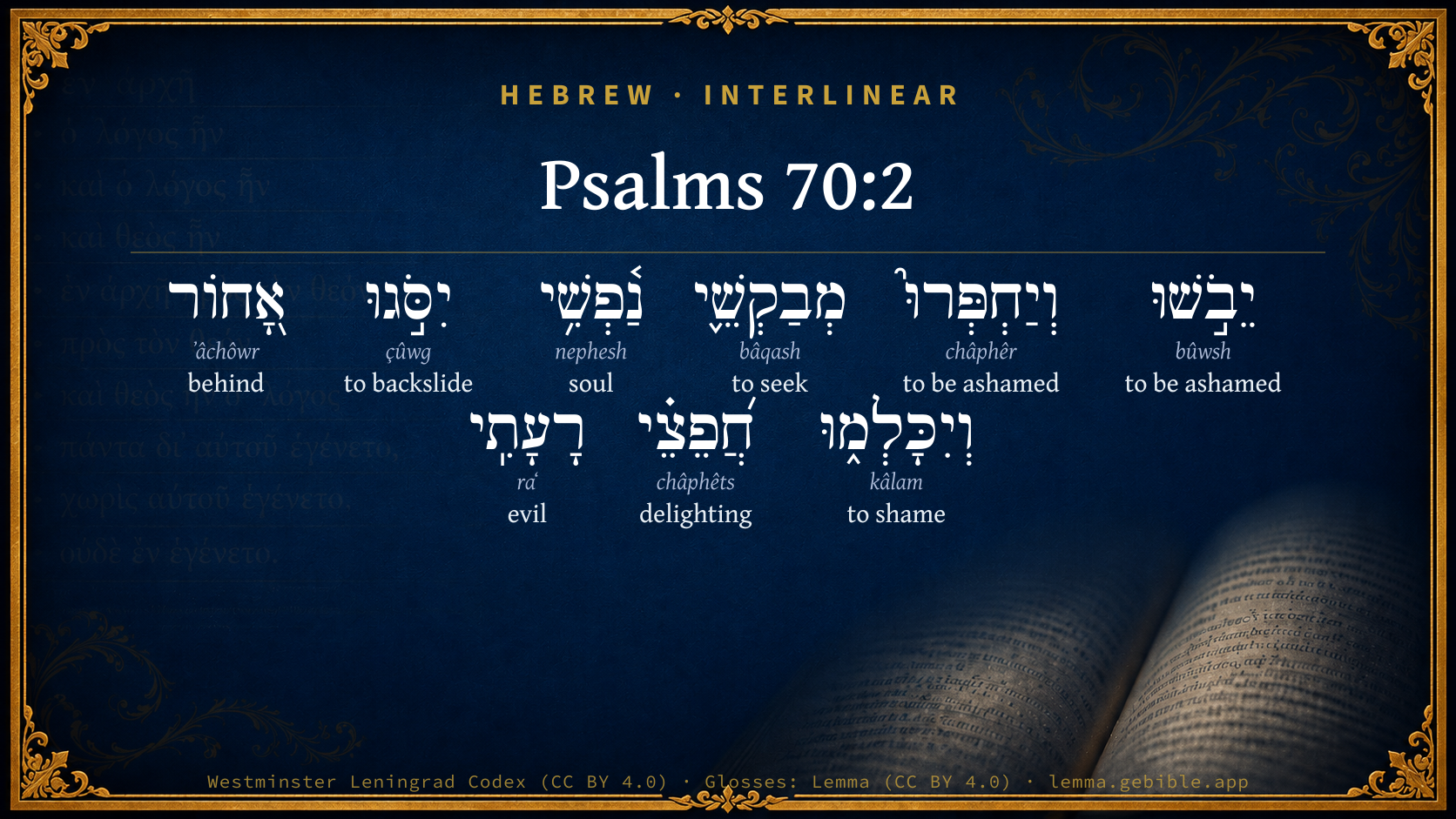
Hebrew (Westminster Leningrad Codex) Psalms 70:2 appears in the Hebrew Old Testament. The text above is from the Westminster Leningrad Codex. Each word links to its Strong’s number, a concise gloss, and parsing drawn from the Open Scriptures Hebrew Bible morphology. Click any word for its full Brown-Driver-Briggs (BDB) entry.
Download image
Cite this verse

Psalms 70:2 (World English Bible). Public Domain. Lemma interlinear Bible study tool, https://lemma.gebible.app/v/psalms/70/2.

Show BibTeX & RIS
BibTeX
RIS
English Translation
Let them be disappointed and confounded who seek my soul. Let those who desire my ruin be turned back in disgrace.
World English Bible · Public Domain
Download a study sheet

One document with this verse’s original text, its word-by-word gloss line, the meaning frame, cross-references with their text, attributed commentary, and full source and license credits — printable, and it pastes into notes with its structure intact.

This verse Autodidact and up

Study sheet (.html) Plain text (.txt)

A passage Seminary Student

Up to 50 verses in one chapter. A passage sheet keeps up to 6 commentary sources and 12 cross-references per verse, in the order this page ranks them, and says so on the sheet whenever that leaves anything out. Ask for a single verse and you get the Autodidact verse sheet above.

Everything on this page stays free to read, with no account — the sheet is a download of what is already on screen, not access to it.

Want to remove ads? Support Godless Engineer
Compare translations 3

The same verse in 3 English versions, stacked beneath the original-language interlinear above. Click any original word for its lexicon entry.

Each is an independent rendering of the whole verse — the interlinear is not word-aligned to these translations.

Highlighted words mark where these versions differ — a whole-verse word diff, not a word-by-word alignment.

  • World English Bible Public Domain
    Let them be disappointed and confounded who seek my soul. Let those who desire my ruin be turned back in disgrace.
  • King James Version Public Domain
    Let them be ashamed and confounded that seek after my soul: let them be turned backward, and put to confusion, that desire my hurt.
  • unfoldingWord Literal Text CC BY-SA 4.0
    Let the ones seeking my life have shame and have confusion; let the ones delighting in my harm be turned back and disgraced.

unfoldingWord Literal Text — © unfoldingWord, licensed CC BY-SA 4.0. Word-aligned USFM3 via Door43 (git.door43.org/unfoldingWord/en_ult).

Versions to compare (up to 4)

3 of 4 selected

Show all 18 translations

Every available English version of this verse, each an independent rendering of the whole verse.

  • World English Bible Public Domain
    Let them be disappointed and confounded who seek my soul. Let those who desire my ruin be turned back in disgrace.
  • Berean Standard Bible Public Domain
    May those who seek my life be ashamed and confounded; may those who wish me harm be repelled and humiliated.
  • Majority Standard Bible Public Domain
    May those who seek my life be ashamed and confounded; may those who wish me harm be repelled and humiliated.
  • King James Version Public Domain
    Let them be ashamed and confounded that seek after my soul: let them be turned backward, and put to confusion, that desire my hurt.
  • American Standard Version (1901) Public Domain
    Let them be put to shame and confounded That seek after my soul: Let them be turned backward and brought to dishonor That delight in my hurt.
  • Revised Version (1885) Public Domain
    Let them be ashamed and confounded that seek after my soul: let them be turned backward and brought to dishonour that delight in my hurt.
  • Geneva Bible (1599) Public Domain
    Let them be confounded and put to shame, that seeke my soule: let them bee turned backewarde and put to rebuke, that desire mine hurt.
  • Douay-Rheims (1899) Public Domain
    O God, come to my assistance; O Lord, make haste to help me.
  • Young's Literal Translation Public Domain
    Let them be ashamed and confounded Who are seeking my soul, Let them be turned backward and blush Who are desiring my evil.
  • Literal Standard Version CC BY-SA 4.0
    Let them be ashamed and confounded || Who are seeking my soul, || Let them be turned backward and blush || Who are desiring my evil.
  • Unlocked Literal Bible CC BY-SA 4.0
    Let those who try to take my life be ashamed and humiliated; let them be turned back and brought to dishonor, those who take pleasure in my pain.
  • unfoldingWord Literal Text CC BY-SA 4.0
    Let the ones seeking my life have shame and have confusion; let the ones delighting in my harm be turned back and disgraced.
  • Darby Bible Public Domain
    Let them be ashamed and brought to confusion that seek after my soul; let them be turned backward and confounded that take pleasure in mine adversity;
  • World Messianic Bible Public Domain
    Let them be disappointed and confounded who seek my soul. Let those who desire my ruin be turned back in disgrace.
  • Webster's Bible Public Domain
    \\70:1\\To the chief Musician, A Psalm of David to bring to remembrance. Make haste, O God, to deliver me; make haste to help me, O LORD.
  • Free Bible Version CC BY-SA 4.0
    Please defeat and humiliate the people who are trying to kill me; turn back in disgrace those who want to hurt me.
  • Bible in Basic English Public Domain
    Let those who go after my soul have shame and trouble; let those who have evil designs against me be turned back and made foolish.
  • JPS Tanakh (1917) Public Domain
    Let them be ashamed and abashed that seek after my soul; let them be turned backward and brought to confusion that delight in my hurt.

Literal Standard Version (2020), Covenant Press — licensed CC BY-SA 4.0. Text via the HelloAO Bible API (eBible.org). Unlocked Literal Bible (unfoldingWord) — licensed CC BY-SA 4.0. Text via the HelloAO Bible API (eBible.org). unfoldingWord Literal Text — © unfoldingWord, licensed CC BY-SA 4.0. Word-aligned USFM3 via Door43 (git.door43.org/unfoldingWord/en_ult). Free Bible Version, Dr. Jonathan Gallagher — licensed CC BY-SA 4.0. Text via the HelloAO Bible API (eBible.org).

Word by word

More ways to search: Search by grammar → Find every occurrence → Compare this word →

Practice this passage: Drill this verse → Learn its vocabulary →

חֲ֝פֵצֵ֗י
châphêts
H2655
“delighting of”
Adjective, Adjective, Masculine, Plural, Construct
Part of Speech
Adjective
Type
Adjective
Gender
Masculine
Number
Plural
State
Construct
Full BDB Definition

Origin: from H2654

TWOT: 712a

desiring, delighting in, having pleasure in
  1. יֵבֹ֣שׁוּ bûwsh H954 “to be ashamed” Verb, Qal, Imperfect, 3rd Person, Masculine, Plural
  2. וְיַחְפְּרוּ֮ châphêr H2659 “and · to be ashamed” Conjunction + Verb, Qal, Imperfect, 3rd Person, Masculine, Plural
  3. מְבַקְשֵׁ֪י bâqash H1245 “seeking” Verb, Piel, Participle Active, Masculine, Plural, Construct
  4. נַ֫פְשִׁ֥י nephesh H5315 “soul · my” Noun, Common, Both, Singular, Construct + Suffix, Personal, 1st Person, Common, Singular
  5. יִסֹּ֣גוּ çûwg H5472 “to backslide” Verb, Niphal, Imperfect, 3rd Person, Masculine, Plural
  6. אָ֭חוֹר ʼâchôwr H268 “behind” Noun, Common, Masculine, Singular, Absolute
  7. וְיִכָּלְמ֑וּ kâlam H3637 “and · to shame” Conjunction + Verb, Niphal, Imperfect, 3rd Person, Masculine, Plural
  8. רָעָתִֽי raʻ H7451 “evil · my” Noun, Common, Feminine, Singular, Construct + Suffix, Personal, 1st Person, Common, Singular

About this verse

These counts appear in no published source. They are computed here, from the morphology-tagged text and Lemma’s own curated glosses. What Lemma adds →

9
words
9
distinct lemmas
Wisdom
section

Notable vocabulary

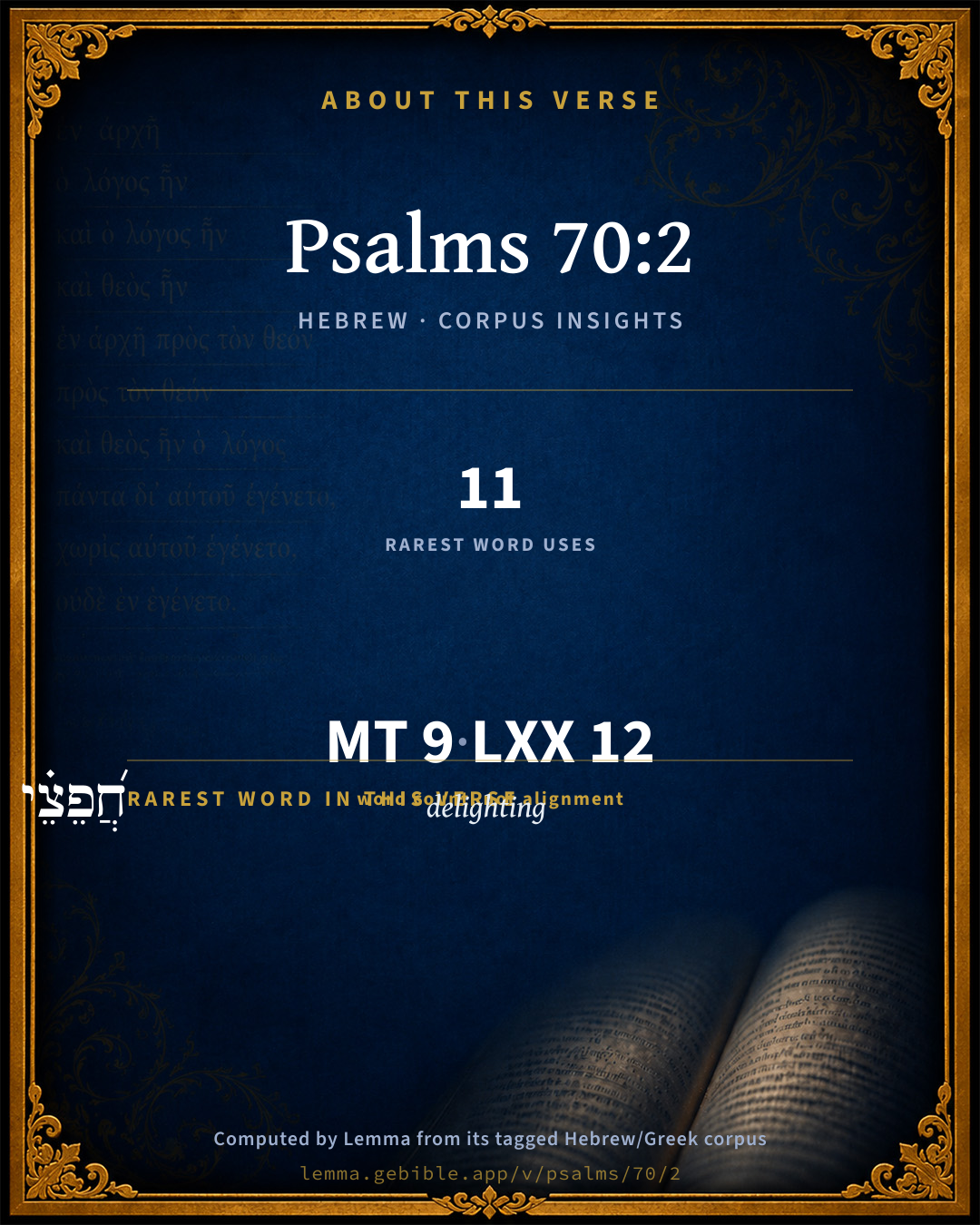
The rarest word here is חֲ֝פֵצֵ֗י delighting H2655 — appearing just 11 times in the whole Hebrew Bible.

Shared distinctive vocabulary

חֲ֝פֵצֵ֗י delighting H2655 occurs in 10 verses of the Hebrew Bible. Also found in:

Grammatical profile

  • 5 verbs
  • 3 nouns
  • 1 adjective

Verb forms

  • יֵבֹ֣שׁוּ Qal · Imperfect
  • וְיַחְפְּרוּ֮ Qal · Imperfect
  • מְבַקְשֵׁ֪י Piel · Participle Active
  • יִסֹּ֣גוּ Niphal · Imperfect
  • וְיִכָּלְמ֑וּ Niphal · Imperfect

Hebrew & Septuagint length

In English translation the verse runs 21 words from the Hebrew and 23 from the Septuagint (LXX English) — closely comparable.

A rough comparison of the two English renderings, which tokenize alike — not a word-level alignment.

Word counts can differ between the Hebrew and the Greek without any difference in meaning — e.g. the Hebrew direct-object marker אֵת has no separate Greek word, and Greek often adds the article ὁ.

In the original languages it is 9 Hebrew tokens and 12 Greek tokens — but the two are counted differently (Hebrew bundles its prefixes and suffixes into one token; the Greek is in lemma form), so that isn’t a like-for-like length.

Cross-references

8

Topical passages linked to Psalms 70:2 in the Treasury of Scripture Knowledge — connected by theme and wording, ordered by reader-vote popularity; previews shown in the World English Bible.

  • Psalms 35:4 Let those who seek after my soul be disappointed and brought to dishonor. Let those who plot my ruin be turned back and confounded.
  • Psalms 35:26 Let them be disappointed and confounded together who rejoice at my calamity. Let them be clothed with shame and dishonor who magnify themselves against me.
  • Isaiah 41:11 Behold, all those who are incensed against you shall be disappointed and confounded: those who strive with you shall be as nothing, and shall perish.
  • Psalms 71:13 Let my accusers be disappointed and consumed. Let them be covered with disgrace and scorn who want to harm me.
  • Psalms 109:29 Let my adversaries be clothed with dishonor. Let them cover themselves with their own shame as with a robe.
  • John 18:6 When therefore he said to them, "I AM," they went backward, and fell to the ground.
  • Psalms 6:10 May all my enemies be ashamed and dismayed. They shall turn back, they shall be disgraced suddenly.
  • Isaiah 28:13 Therefore shall the word of Yahweh be to them precept on precept, precept on precept; line on line, line on line; here a little, there a little; that they may go, and fall backward, and be broken, and snared, and taken.

Cross-references courtesy of OpenBible.info (CC BY 4.0).

Hebrew and Greek witnesses Masoretic Hebrew ↔ Greek Septuagint

The same verse in the two great witnesses to the Old Testament, shown verse-for-verse.

You’re reading Greek Psalm 69 (Hebrew Psalm 70). The Septuagint counts the superscription, so verse numbers can differ from the Hebrew — chapter-level alignment, not verse-by-verse. Numbering follows Rahlfs.

These are two independent witnesses, not word-aligned to each other, and the Septuagint is shown in lemma (dictionary) form.

Hebrew Psalms 70:2 Masoretic · Westminster Leningrad Codex

יֵבֹ֣שׁוּ וְיַחְפְּרוּ֮ מְבַקְשֵׁ֪י נַ֫פְשִׁ֥י יִסֹּ֣גוּ אָ֭חוֹר וְיִכָּלְמ֑וּ חֲ֝פֵצֵ֗י רָעָתִֽי

Let them be disappointed and confounded who seek my soul. Let those who desire my ruin be turned back in disgrace.

World English Bible · Public Domain

Greek LXX Greek Psalm 69:2 Septuagint · lemma form

εἰς ὁ σώζω ἐγώ κύριος ὁ θεός εἰς ὁ βοήθεια ἐγώ προςἔχω

Let them be ashamed and confounded that seek my soul: let them be turned backward and put to shame, that wish me evil.

LXX2012 (modern English Septuagint) · Public Domain

Hebrew: Westminster Leningrad Codex (CC BY 4.0). Greek: Septuagint (public domain); English from LXX2012 (modern English Septuagint) (Public Domain). How the Septuagint differs from the Hebrew →

Commentary

Notes on Psalms 70:2 from classic Christian and Jewish commentators (each source and its license shown beneath its notes). The classic Christian expositions comment on the surrounding passage and are grouped to its opening verse, so a note may address several verses; the Jewish commentaries on the Tanakh (Rashi and others) are per-verse, so they appear only where the commentator wrote on this verse.

Lemma curates 59 commentaries, every one of them public domain or Creative Commons licensed, each selected and text-cleaned for this edition rather than reprinted as found. About our sources →

Trapp's Complete Commentary

John Trapp

Psa 70:2 Let them be ashamed and confounded that seek after my soul: let them be turned backward, and put to confusion, that desire my hurt.

Ver. 2. Let them be ashamed] See Psa 40:14; Psa 35:26-27.

John Trapp, A Commentary or Exposition upon All the Books of the Old and New Testament (1647–1656) — public domain. Text from a community e-Sword module.

J. A. Alexander on Psalms

Joseph Addison Alexander

3. (Psa 70:2). Ashamed and confounded shall be (those) seeking my soul; turned back and disgraced shall be (those) desiring (or delighting in) my hurt. See above. on Psa 40:14. The only variation consists in the omission of the words together and to destroy it, in accordance with the obvious design of condensation and abridgment.

Joseph Addison Alexander, The Psalms Translated and Explained (1850) — public domain. Text from a community e-Sword module.

Geneva Bible (1599)

Geneva Bible translators

He was assured that the more they raged, the nearer they were to destruction, and he the nearer to his deliverance.

Geneva Bible (1599) marginal notes — public domain. Text via Bolls.life.

Adam Clarke's Commentary

Verse 2. Let them be turned backward] They are coming in a body against me. Lord, stop their progress!

Adam Clarke's Commentary on the Bible (1810–1826) — public domain. Text from a community e-Sword/MySword module.

Ellicott's Commentary for English Readers

(2) There are two omissions here from Psa_40:14, “together” and “to destroy it.”

A Bible Commentary for English Readers, edited by Charles John Ellicott (1878–1897) — public domain. Text from a community e-Sword module.

The Cambridge Bible for Schools and Colleges

gen. ed. J. J. S. Perowne

2. The whole verse is a repetition, with variations, of Psa_35:4; Psa_35:26 (cp. Psa_38:12); and Psa_35:3-5 recall Psa_35:21; Psa_35:25; Psa_35:27; Psa_35:10, of the same Psalm.

that seek after my soul] Or, that seek my life. The text of Psa_40:13 is fuller, ‘Let them be … confounded together … my life to destroy it.’

let them be turned backward &c.] Render with R.V.,

Let them be turned backward and brought to dishonour

That delight In my hurt.

With the last line contrast Psa_35:27.

The Cambridge Bible for Schools and Colleges (gen. ed. J. J. S. Perowne; Cambridge University Press, 1878–1918) — public domain. Text from a community e-Sword module.

John Gill's Exposition

Let them be ashamed and confounded,.... In Psa 40:14 it is added, "together"; See Gill on Psa 40:14;

that seek after my soul; or "life"; in Psa 40:14 it is added, "to destroy it"; for that was the end of their seeking after it;

let them be turned backward, &c. See Gill on Psa 40:14.

John Gill's Exposition of the Whole Bible (1746–1763) — public domain (CC PDM 1.0). Text via the HelloAO Bible API.

Albert Barnes' Notes on the Bible

Let them be ashamed and confounded that seek after my soul - The only change here from Psa 40:14, is the omission of the word “together” which occurs there, and the omission of the words “to destroy it.”

Let them be turned backward, and put to confusion, that desire my hurt - This corresponds in the Hebrew entirely with Psa 40:14.

Albert Barnes' Notes on the Bible (1834–1885) — public domain. Text from a community e-Sword/MySword module.

The Treasury of David

Charles H. Spurgeon

Ver. 2. Here the words, "together, "and, "to destroy it, "which occur in Psalm 40, are omitted: a man in haste uses no more words than are actually necessary. His enemies desired to put his faith to shame, and he eagerly entreats that they may be disappointed, and themselves covered with confusion. It shall certainly be so; if not sooner, yet at that dread day when the wicked shall awake to shame and everlasting contempt.

Let them be ashamed and confounded that seek after my soul: let them be turned backward, and put to confusion, that desire my hurt: turned back and driven back are merely the variations of the translators. When men labour to turn others back from the right road, it is God's retaliation to drive them back from the point they are aiming at.

Ver. 2. Let them be confounded; viz., among themselves, and in their own understandings: and put to shame; viz., in the sight and presence of men before whom they think to attain great glory, in banding themselves against me. Thomas Wilcocks.

Ver. 2.

I. There are those who seek our soul's hurt.

II. We must oppose them, not dally or yield.

III. Our best weapon is prayer to God.

IV. Their defeat is here described.

Psalms 70:3*

Charles H. Spurgeon's The Treasury of David (1869–1885) — public domain. Psalms only. Text from a community e-Sword/MySword module.

Whedon's Commentary on the Bible

Daniel D. Whedon

2. That seek after my soul— “To destroy it,” omitted.

Turned backward—As a military phrase the words denote a complete repulse and overthrow of the enemy.

Daniel D. Whedon (gen. ed.), Commentary on the Old and New Testaments (1874–1909) — public domain. Text from a community e-Sword module.

The Pulpit Commentary

Let them be ashamed and confounded. Psa_40:14 adds, "together." That seek after my soul. Ps 40 adds, "to destroy it." Let them be turned backward, and put to confusion, that desire my hurt. Identical with Psa_40:14, and translated more literally.

The Pulpit Commentary (1880–1919), ed. H.D.M. Spence-Jones & Joseph S. Exell — public domain. Text from a community e-Sword module.

Lesson kit

Teaching starters — assembled from the data on this page, not authored interpretation. Every prompt links to the verse data it draws on. Edit before teaching.

Psalms, in the Wisdom, opens this verse with 9 words (9 distinct Hebrew lemmas). Its most distinctive word is châphêts (“delighting”). A historical commentator’s framing appears above. Read the whole chapter for the surrounding context.

Discussion questions

  1. How does “delighting” (châphêts) shape what this verse is saying?
  2. How does 1 Kings 13:33, which shares the word «delighting», read alongside this verse?
  3. These translations render this verse differently. What is at stake in choosing one wording over another?
  4. «יֵבֹ֣שׁוּ» is a Qal Imperfect verb. How does that grammatical form shape the action described?
  5. Compare how Trapp's Complete Commentary and J. A. Alexander on Psalms read this verse. Where do they agree or differ?

Things to notice

Reading settings

Reading text

Shown beneath each verse's original-language words.

Old Testament
Old Testament edition

Read the OT as the Masoretic Hebrew (MT) or the Greek Septuagint (LXX).

English shown for the Greek Septuagint (in the Hebrew ↔ Greek comparison).

Comparing translations? Open the Compare panel on any verse page to stack up to four side by side.