
1 Samuel 23:10

Hebrew (Westminster Leningrad Codex) 1 Samuel 23:10 appears in the Hebrew Old Testament. The text above is from the Westminster Leningrad Codex. Each word links to its Strong’s number, a concise gloss, and parsing drawn from the Open Scriptures Hebrew Bible morphology. Click any word for its full Brown-Driver-Briggs (BDB) entry.
Download image
Cite this verse

1 Samuel 23:10 (World English Bible). Public Domain. Lemma interlinear Bible study tool, https://lemma.gebible.app/v/1-samuel/23/10.

Show BibTeX & RIS
BibTeX
RIS
English Translation
Then said David, O Yahweh, the God of Israel, your servant has surely heard that Saul seeks to come to Keilah, to destroy the city for my sake.
World English Bible · Public Domain
Download a study sheet

One document with this verse’s original text, its word-by-word gloss line, the meaning frame, cross-references with their text, attributed commentary, and full source and license credits — printable, and it pastes into notes with its structure intact.

This verse Autodidact and up

Study sheet (.html) Plain text (.txt)

A passage Seminary Student

Up to 50 verses in one chapter. A passage sheet keeps up to 6 commentary sources and 12 cross-references per verse, in the order this page ranks them, and says so on the sheet whenever that leaves anything out. Ask for a single verse and you get the Autodidact verse sheet above.

Everything on this page stays free to read, with no account — the sheet is a download of what is already on screen, not access to it.

Want to remove ads? Support Godless Engineer
Compare translations 3

The same verse in 3 English versions, stacked beneath the original-language interlinear above. Click any original word for its lexicon entry.

Each is an independent rendering of the whole verse — the interlinear is not word-aligned to these translations.

Highlighted words mark where these versions differ — a whole-verse word diff, not a word-by-word alignment.

  • World English Bible Public Domain
    Then said David, O Yahweh, the God of Israel, your servant has surely heard that Saul seeks to come to Keilah, to destroy the city for my sake.
  • King James Version Public Domain
    Then said David, O LORD God of Israel, thy servant hath certainly heard that Saul seeketh to come to Keilah, to destroy the city for my sake.
  • unfoldingWord Literal Text CC BY-SA 4.0
    And David said, “Yahweh, God of Israel, hearing, your servant has heard that Saul is seeking to come to Keilah, to destroy the city because of me.

unfoldingWord Literal Text — © unfoldingWord, licensed CC BY-SA 4.0. Word-aligned USFM3 via Door43 (git.door43.org/unfoldingWord/en_ult).

Versions to compare (up to 4)

3 of 4 selected

Show all 18 translations

Every available English version of this verse, each an independent rendering of the whole verse.

  • World English Bible Public Domain
    Then said David, O Yahweh, the God of Israel, your servant has surely heard that Saul seeks to come to Keilah, to destroy the city for my sake.
  • Berean Standard Bible Public Domain
    And David said, “O LORD, God of Israel, Your servant has heard that Saul intends to come to Keilah and destroy the city on my account.
  • Majority Standard Bible Public Domain
    And David said, “O LORD, God of Israel, Your servant has heard that Saul intends to come to Keilah and destroy the city on my account.
  • King James Version Public Domain
    Then said David, O LORD God of Israel, thy servant hath certainly heard that Saul seeketh to come to Keilah, to destroy the city for my sake.
  • American Standard Version (1901) Public Domain
    Then said David, O Jehovah, the God of Israel, thy servant hath surely heard that Saul seeketh to come to Keilah, to destroy the city for my sake.
  • Revised Version (1885) Public Domain
    Then said David, O LORD, the God of Israel, thy servant hath surely heard that Saul seeketh to come to Keilah, to destroy the city for my sake.
  • Geneva Bible (1599) Public Domain
    Then sayde Dauid, O Lord God of Israel, thy seruat hath heard, that Saul is about to come to Keilah to destroy the citie for my sake.
  • Douay-Rheims (1899) Public Domain
    And David said: O Lord God of Israel, thy servant hath heard a report, that Saul designeth to come to Ceila, to destroy the city for my sake:
  • Young's Literal Translation Public Domain
    And David saith, `Jehovah, God of Israel, Thy servant hath certainly heard that Saul is seeking to come in unto Keilah, to destroy the city on mine account.
  • Literal Standard Version CC BY-SA 4.0
    And David says, “YHWH, God of Israel, Your servant has certainly heard that Saul is seeking to come to Keilah, to destroy the city on my account.
  • Unlocked Literal Bible CC BY-SA 4.0
    Then David said, “Yahweh, the God of Israel, your servant has indeed heard that Saul seeks to come to Keilah, to destroy the city for my sake.
  • unfoldingWord Literal Text CC BY-SA 4.0
    And David said, “Yahweh, God of Israel, hearing, your servant has heard that Saul is seeking to come to Keilah, to destroy the city because of me.
  • Darby Bible Public Domain
    Then said David, Jehovah, God of Israel, thy servant hath heard for certain that Saul seeketh to come to Keilah, to destroy the city for my sake.
  • World Messianic Bible Public Domain
    Then David said, “O LORD, the God of Israel, your servant has surely heard that Saul seeks to come to Keilah to destroy the city for my sake.
  • Webster's Bible Public Domain
    Then said David, O LORD God of Israel, thy servant hath certainly heard that Saul seeketh to come to Keilah, to destroy the city for my sake.
  • Free Bible Version CC BY-SA 4.0
    David prayed, “Lord, God of Israel, I your servant have been clearly told that Saul plans to come to Keilah and destroy the town because of me.
  • Bible in Basic English Public Domain
    Then David said, O Lord, the God of Israel, news has been given to your servant that it is Saul's purpose to come to Keilah and send destruction on the town because of me.
  • JPS Tanakh (1917) Public Domain
    Then said David: 'O LORD, the God of Israel, Thy servant hath surely heard that Saul seeketh to come to Keilah, to destroy the city for my sake.

Literal Standard Version (2020), Covenant Press — licensed CC BY-SA 4.0. Text via the HelloAO Bible API (eBible.org). Unlocked Literal Bible (unfoldingWord) — licensed CC BY-SA 4.0. Text via the HelloAO Bible API (eBible.org). unfoldingWord Literal Text — © unfoldingWord, licensed CC BY-SA 4.0. Word-aligned USFM3 via Door43 (git.door43.org/unfoldingWord/en_ult). Free Bible Version, Dr. Jonathan Gallagher — licensed CC BY-SA 4.0. Text via the HelloAO Bible API (eBible.org).

Word by word

More ways to search: Search by grammar → Find every occurrence → Compare this word →

Practice this passage: Drill this verse → Learn its vocabulary →

קְעִילָ֑ה
Qᵉʻîylâh
H7084
“Keilah”
Noun, Proper
Part of Speech
Noun
Type
Proper
Full BDB Definition

Origin: perhaps from H7049 in the sense of inclosing

TWOT: None

Keilah = "fortress" - a city in the lowlands of Judah northwest of Hebron
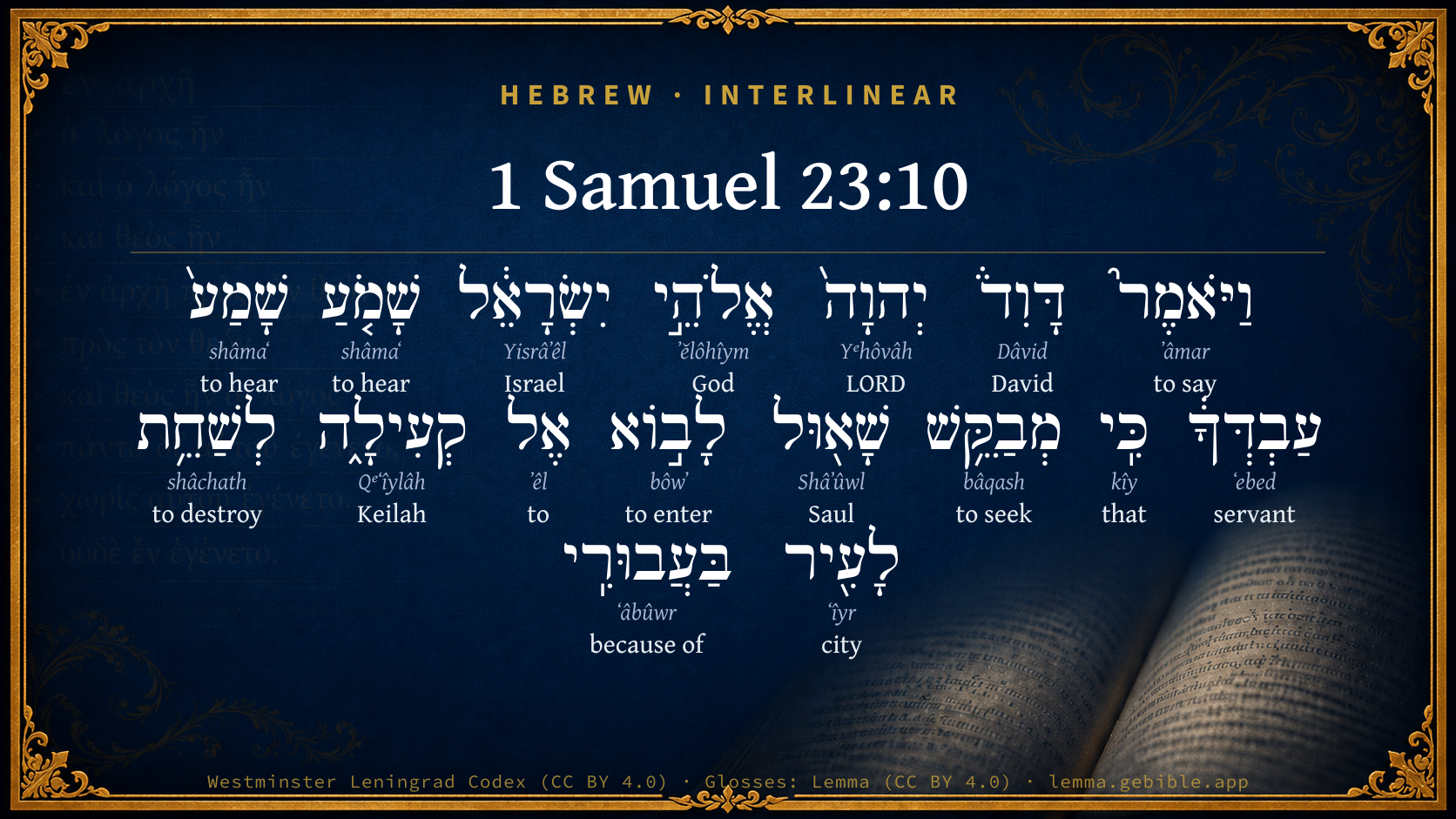
  1. וַיֹּאמֶר֮ ʼâmar H559 “and · to say” Conjunction + Verb, Qal, Sequential Imperfect, 3rd Person, Masculine, Singular
  2. דָּוִד֒ Dâvid H1732 “David” Noun, Proper
  3. יְהוָה֙ Yᵉhôvâh H3068 “LORD” Noun, Proper
  4. אֱלֹהֵ֣י ʼĕlôhîym H430 “God(s) of” Noun, Common, Masculine, Plural, Construct
  5. יִשְׂרָאֵ֔ל Yisrâʼêl H3478 “Israel” Noun, Proper
  6. שָׁמֹ֤עַ shâmaʻ H8085 “to hear” Verb, Qal, Infinitive Absolute
  7. שָׁמַע֙ shâmaʻ H8085 “to hear” Verb, Qal, Perfect, 3rd Person, Masculine, Singular
  8. עַבְדְּךָ֔ ʻebed H5650 “servant · your” Noun, Common, Masculine, Singular, Construct + Suffix, Personal, 2nd Person, Masculine, Singular
  9. כִּֽי kîy H3588 “that” Conjunction
  10. מְבַקֵּ֥שׁ bâqash H1245 “seeking” Verb, Piel, Participle Active, Masculine, Singular, Absolute
  11. שָׁא֖וּל Shâʼûwl H7586 “Saul” Noun, Proper
  12. לָב֣וֹא bôwʼ H935 “to enter” Preposition + Verb, Qal, Infinitive Construct
  13. אֶל ʼêl H413 “to” Preposition
  14. לְשַׁחֵ֥ת shâchath H7843 “to destroy” Preposition + Verb, Piel, Infinitive Construct
  15. לָעִ֖יר ʻîyr H5892 “to/for the · city” Preposition, Determined + Noun, Common, Feminine, Singular, Absolute
  16. בַּעֲבוּרִֽי ʻâbûwr H5668 “in/at · because of · my” Preposition + Noun, Common, Masculine, Singular, Construct + Suffix, Personal, 1st Person, Common, Singular

About this verse

These counts appear in no published source. They are computed here, from the morphology-tagged text and Lemma’s own curated glosses. What Lemma adds →

17
words
16
distinct lemmas
Historical
section

Notable vocabulary

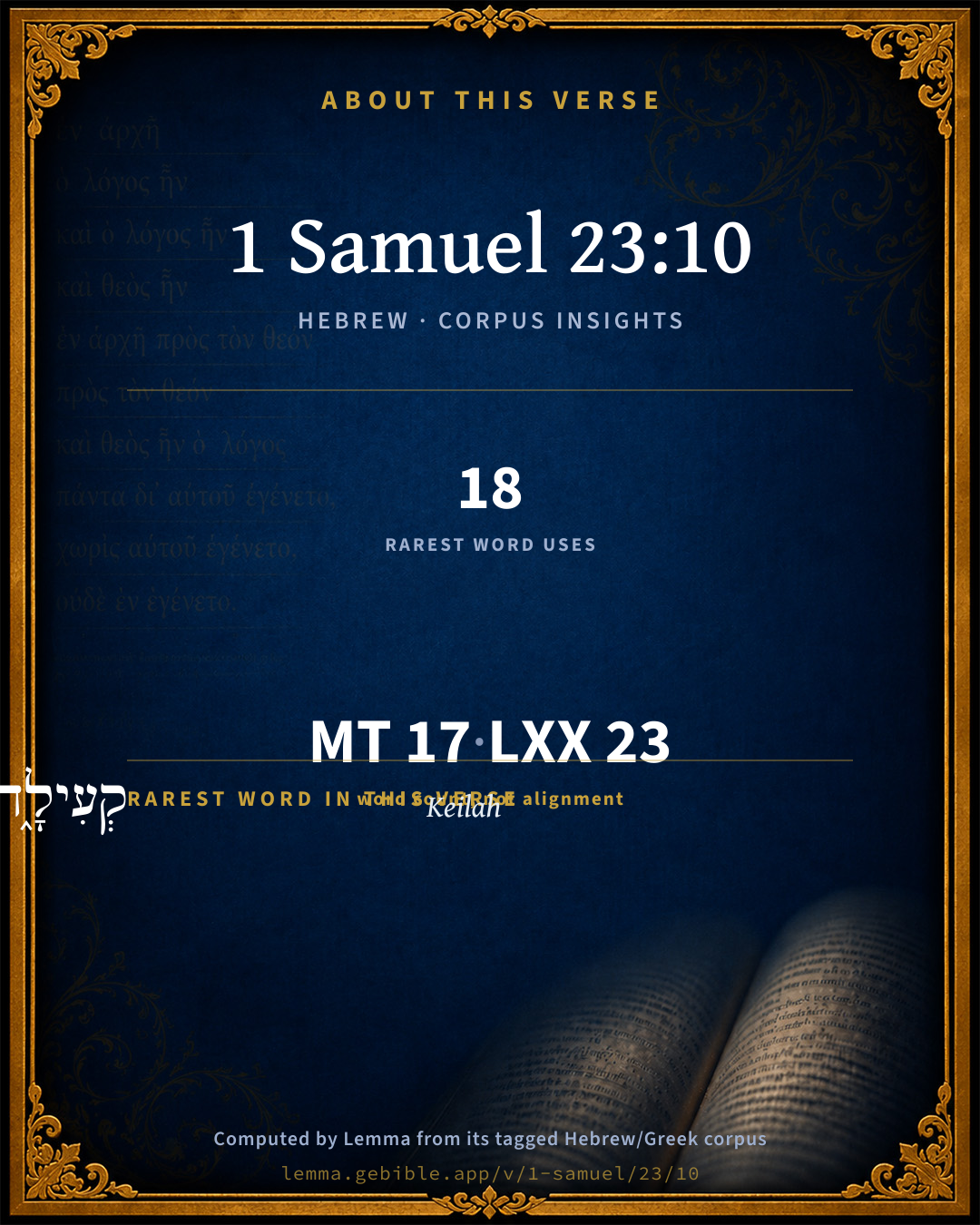
The rarest word here is קְעִילָ֑ה Keilah H7084 — appearing just 18 times in the whole Hebrew Bible.

Shared distinctive vocabulary

קְעִילָ֑ה Keilah H7084 occurs in 16 verses of the Hebrew Bible. Also found in:

Grammatical profile

  • 6 verbs
  • 9 nouns
  • 1 preposition
  • 1 conjunction

Verb forms

  • וַיֹּאמֶר֮ Qal · Sequential Imperfect
  • שָׁמֹ֤עַ Qal · Infinitive Absolute
  • שָׁמַע֙ Qal · Perfect
  • מְבַקֵּ֥שׁ Piel · Participle Active
  • לָב֣וֹא Qal · Infinitive Construct
  • לְשַׁחֵ֥ת Piel · Infinitive Construct

Repetition

A word recurs within this verse — often emphatic in Hebrew:

  • שָׁמֹ֤עַ to hear H8085 ×2

Hebrew & Septuagint length

In English translation the verse runs 28 words from the Hebrew and 26 from the Septuagint (LXX English) — closely comparable.

A rough comparison of the two English renderings, which tokenize alike — not a word-level alignment.

Word counts can differ between the Hebrew and the Greek without any difference in meaning — e.g. the Hebrew direct-object marker אֵת has no separate Greek word, and Greek often adds the article ὁ.

In the original languages it is 17 Hebrew tokens and 23 Greek tokens — but the two are counted differently (Hebrew bundles its prefixes and suffixes into one token; the Greek is in lemma form), so that isn’t a like-for-like length.

Cross-references

6

Topical passages linked to 1 Samuel 23:10 in the Treasury of Scripture Knowledge — connected by theme and wording, ordered by reader-vote popularity; previews shown in the World English Bible.

  • Genesis 18:24 What if there are fifty righteous within the city? Will you consume and not spare the place for the fifty righteous who are therein?
  • 1 Samuel 22:19 Nob, the city of the priests, struck he with the edge of the sword, both men and women, children and nursing babies, and oxen and donkeys and sheep, with the edge of the sword.
  • 1 Samuel 23:8 Saul summoned all the people to war, to go down to Keilah, to besiege David and his men.
  • Esther 3:6 But he scorned the thought of laying hands on Mordecai alone; for they had made known to him the people of Mordecai: therefore Haman sought to destroy all the Jews who were throughout the whole kingdom of Ahasuerus, even the people of Mordecai.
  • Proverbs 28:15 As a roaring lion or a charging bear, So is a wicked ruler over helpless people.
  • Romans 3:15–16 "Their feet are swift to shed blood.

Cross-references courtesy of OpenBible.info (CC BY 4.0).

Hebrew and Greek witnesses Masoretic Hebrew ↔ Greek Septuagint

The same verse in the two great witnesses to the Old Testament, shown verse-for-verse.

These are two independent witnesses, not word-aligned to each other, and the Septuagint is shown in lemma (dictionary) form.

Hebrew 1 Samuel 23:10 Masoretic · Westminster Leningrad Codex

וַיֹּאמֶר֮ דָּוִד֒ יְהוָה֙ אֱלֹהֵ֣י יִשְׂרָאֵ֔ל שָׁמֹ֤עַ שָׁמַע֙ עַבְדְּךָ֔ כִּֽי מְבַקֵּ֥שׁ שָׁא֖וּל לָב֣וֹא אֶל קְעִילָ֑ה לְשַׁחֵ֥ת לָעִ֖יר בַּעֲבוּרִֽי

Then said David, O Yahweh, the God of Israel, your servant has surely heard that Saul seeks to come to Keilah, to destroy the city for my sake.

World English Bible · Public Domain

Greek LXX 1 Samuel 23:10 Septuagint · lemma form

καί εἶπον δαυίδ κύριος ὁ θεός ἰσραήλ ἀκούω ἀκούω ὁ δοῦλος σύ ὅτι ζητέω σαούλ ἔρχομαι ἐπί κεϊλα διαφθείρω ὁ πόλις διά ἐγώ

And David said, Lord God of Israel, your servant has indeed heard, that Saul seeks to come against Keila to destroy the city on my account.

LXX2012 (modern English Septuagint) · Public Domain

Hebrew: Westminster Leningrad Codex (CC BY 4.0). Greek: Septuagint (public domain); English from LXX2012 (modern English Septuagint) (Public Domain). How the Septuagint differs from the Hebrew →

Targum (Aramaic paraphrase)

1

The Targum is the ancient Jewish Aramaic paraphrase of the Hebrew Scriptures — an interpretive translation, not the Hebrew text itself. Onkelos (literal) and Pseudo-Jonathan (expansive) render the Torah, and Jonathan the Prophets. Coverage is partial: where no permissively-licensed English translation exists for a verse, only the Aramaic is shown. This is verse-level text, not a word-by-word alignment to the Hebrew.

  1. Targum Jonathan Prophets (Joshua–Malachi)
    וַאֲמַר דָוִד יְיָ אֱלָהָא דְיִשְׂרָאֵל מִשְׁמַע שְׁמַע עַבְדָךְ אֲרֵי בָעֵי שָׁאוּל לְמֵיעַל לִקְעִילָה לְחַבָּלָא לְקַרְתָּא בְּדִילִי:

    (no public-domain English translation for this verse)

    Targum Jonathan — Aramaic: “Mikraot Gedolot” (public domain). English: “Sefaria Community Translation” (CC0 1.0 (public-domain dedication)); “London "Chaldee Paraphrase," 1871” (public domain). Text via Sefaria.

Commentary

Notes on 1 Samuel 23:10 from classic Christian and Jewish commentators (each source and its license shown beneath its notes). The classic Christian expositions comment on the surrounding passage and are grouped to its opening verse, so a note may address several verses; the Jewish commentaries on the Tanakh (Rashi and others) are per-verse, so they appear only where the commentator wrote on this verse.

Lemma curates 59 commentaries, every one of them public domain or Creative Commons licensed, each selected and text-cleaned for this edition rather than reprinted as found. About our sources →

Trapp's Complete Commentary

John Trapp

1Sa 23:10 Then said David, O LORD God of Israel, thy servant hath certainly heard that Saul seeketh to come to Keilah, to destroy the city for my sake.

Ver. 10. O Lord God of Israel.] He runneth to the Rock of Ages for help in this distress, as was his constant course when hardly bestead.

To destroy the city for my sake.] So in the holy war, as they called it, against the Waldenses in France, the Pope’s great army took one great populous city, and put to the sword sixty thousand: among whom were many of their own Catholics. {a}

{a} Caesar Heistorbachensis, Hist., lib. v. cap. 21.

John Trapp, A Commentary or Exposition upon All the Books of the Old and New Testament (1647–1656) — public domain. Text from a community e-Sword module.

John Gill's Exposition

Then said David,.... By the priest, for it was he that put the questions for and in the name of the inquirer:

O Lord God of Israel; the great Jehovah, the covenant God of his people, who always has a merciful regard unto them:

thy servant hath certainly heard; had good information of it, on which he could depend:

that Saul seeketh to come to Keilah; that was his intention and resolution:

to destroy the city for my sake; to besiege it, and demolish it, if that was necessary, in order to take him.

John Gill's Exposition of the Whole Bible (1746–1763) — public domain (CC PDM 1.0). Text via the HelloAO Bible API.

Matthew Poole's English Annotations

David said this by the priest, for he was to make the inquiry of God, Num 27:21, and David puts the words into his mouth.

Matthew Poole's English Annotations on the Holy Bible (1683–1685) — public domain. Text from a community e-Sword/MySword module.

unfoldingWord translationNotes

Door43 World Missions Community

David said

"David asked" or "David prayed"

your servant has indeed heard ... as your servant has heard ... tell your servant

David speaks as if he were someone else to show his respect for Yahweh. AT: "I have indeed heard ... as I have heard ... tell me" (See: Pronouns)

surrender me into his hand

Here "hand" represents power or control. AT: "give me over to Saul" (See: Metonymy)

destroy the city

make the city so no one could live in it and kill all the people who live there

translationWords

David

Yahweh

God

Israel

servant

hand

Saul (OT)

unfoldingWord translationNotes — © Distant Shores Media and the Door43 World Missions Community, licensed CC BY-SA 4.0. Source: git.door43.org/Door43/en_tn.

Lesson kit

Teaching starters — assembled from the data on this page, not authored interpretation. Every prompt links to the verse data it draws on. Edit before teaching.

1 Samuel, in the Historical, opens this verse with 17 words (16 distinct Hebrew lemmas). Its most distinctive word is Qᵉʻîylâh (“Keilah”). A historical commentator’s framing appears above. Read the whole chapter for the surrounding context.

Discussion questions

  1. The word Qᵉʻîylâh carries the sense “Keilah.” How does it shape the verse?
  2. Joshua 15:44 shares the word «Keilah» with this verse. How do the two illuminate each other?
  3. “to hear” occurs 2× in this one verse. What is the effect of the repetition?
  4. These translations render this verse differently. What is at stake in choosing one wording over another?
  5. The verb «וַיֹּאמֶר֮» is Qal Sequential Imperfect. How does its form color the action?
  6. Reading how Trapp's Complete Commentary and John Gill's Exposition read this verse, where do the two commentators agree and where do they part?

Things to notice

Reading settings

Reading text

Shown beneath each verse's original-language words.

Old Testament
Old Testament edition

Read the OT as the Masoretic Hebrew (MT) or the Greek Septuagint (LXX).

English shown for the Greek Septuagint (in the Hebrew ↔ Greek comparison).

Comparing translations? Open the Compare panel on any verse page to stack up to four side by side.