
Joshua 2:22

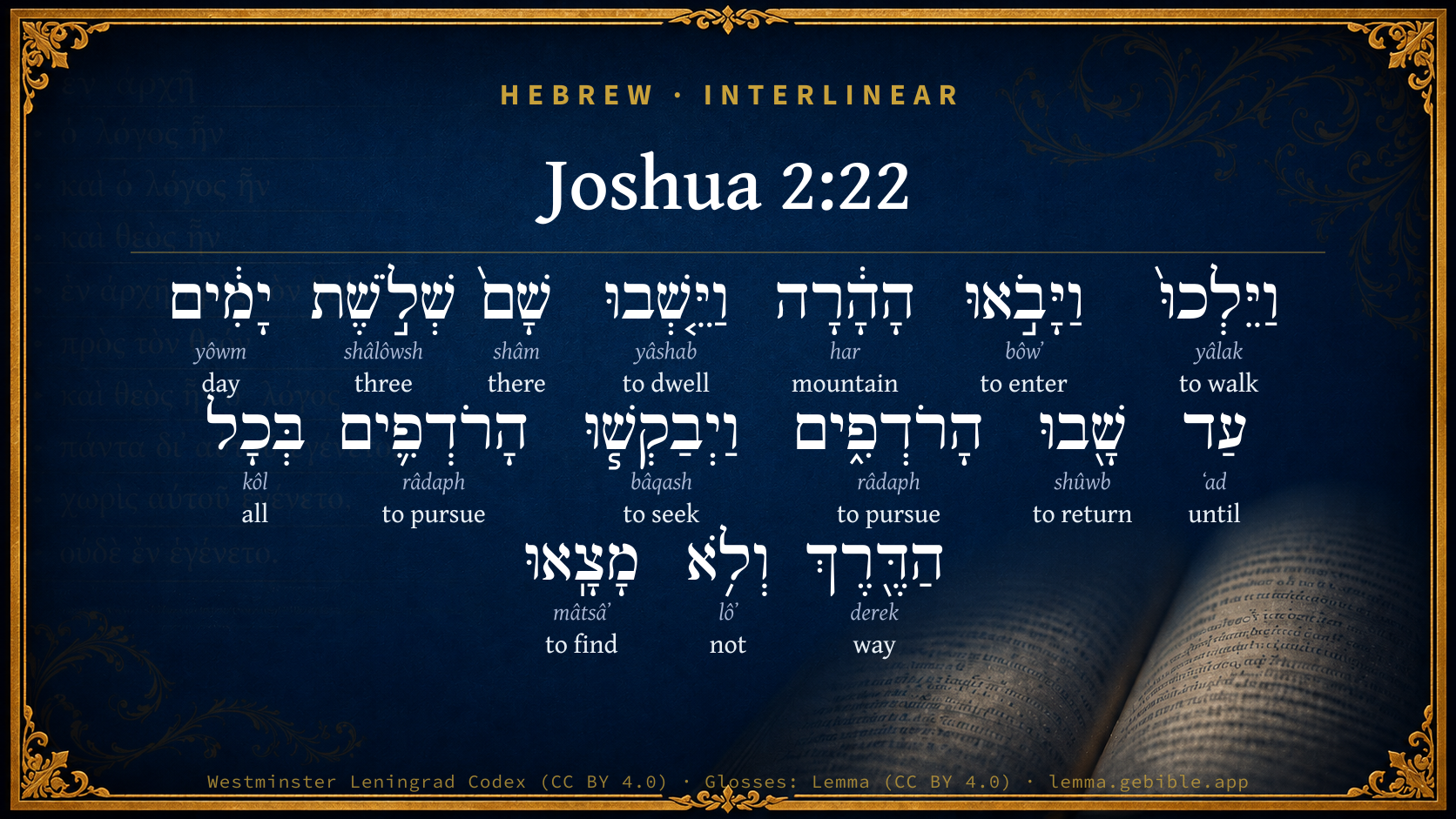
Hebrew (Westminster Leningrad Codex) Joshua 2:22 appears in the Hebrew Old Testament. The text above is from the Westminster Leningrad Codex. Each word links to its Strong’s number, a concise gloss, and parsing drawn from the Open Scriptures Hebrew Bible morphology. Click any word for its full Brown-Driver-Briggs (BDB) entry.
Download image
Cite this verse

Joshua 2:22 (World English Bible). Public Domain. Lemma interlinear Bible study tool, https://lemma.gebible.app/v/joshua/2/22.

Show BibTeX & RIS
BibTeX
RIS
English Translation
They went, and came to the mountain, and abode there three days, until the pursuers were returned: and the pursuers sought them throughout all the way, but didn't find them.
World English Bible · Public Domain
Download a study sheet

One document with this verse’s original text, its word-by-word gloss line, the meaning frame, cross-references with their text, attributed commentary, and full source and license credits — printable, and it pastes into notes with its structure intact.

This verse Autodidact and up

Study sheet (.html) Plain text (.txt)

A passage Seminary Student

Up to 50 verses in one chapter. A passage sheet keeps up to 6 commentary sources and 12 cross-references per verse, in the order this page ranks them, and says so on the sheet whenever that leaves anything out. Ask for a single verse and you get the Autodidact verse sheet above.

Everything on this page stays free to read, with no account — the sheet is a download of what is already on screen, not access to it.

Want to remove ads? Support Godless Engineer
Compare translations 3

The same verse in 3 English versions, stacked beneath the original-language interlinear above. Click any original word for its lexicon entry.

Each is an independent rendering of the whole verse — the interlinear is not word-aligned to these translations.

Highlighted words mark where these versions differ — a whole-verse word diff, not a word-by-word alignment.

  • World English Bible Public Domain
    They went, and came to the mountain, and abode there three days, until the pursuers were returned: and the pursuers sought them throughout all the way, but didn't find them.
  • King James Version Public Domain
    And they went, and came unto the mountain, and abode there three days, until the pursuers were returned: and the pursuers sought them throughout all the way, but found them not.
  • unfoldingWord Literal Text CC BY-SA 4.0
    And they went and came to the hill country, and they stayed there three days, until the pursuers had returned. And the pursuers searched along all of the road, but they did not find them.

unfoldingWord Literal Text — © unfoldingWord, licensed CC BY-SA 4.0. Word-aligned USFM3 via Door43 (git.door43.org/unfoldingWord/en_ult).

Versions to compare (up to 4)

3 of 4 selected

Show all 18 translations

Every available English version of this verse, each an independent rendering of the whole verse.

  • World English Bible Public Domain
    They went, and came to the mountain, and abode there three days, until the pursuers were returned: and the pursuers sought them throughout all the way, but didn't find them.
  • Berean Standard Bible Public Domain
    So the spies went out into the hill country and stayed there three days, until their pursuers had returned without finding them, having searched all along the road.
  • Majority Standard Bible Public Domain
    So the spies went out into the hill country and stayed there three days, until their pursuers had returned without finding them, having searched all along the road.
  • King James Version Public Domain
    And they went, and came unto the mountain, and abode there three days, until the pursuers were returned: and the pursuers sought them throughout all the way, but found them not.
  • American Standard Version (1901) Public Domain
    And they went, and came unto the mountain, and abode there three days, until the pursuers were returned: and the pursuers sought them throughout all the way, but found them not.
  • Revised Version (1885) Public Domain
    And they went, and came unto the mountain, and abode there three days, until the pursuers were returned: and the pursuers sought them throughout all the way, but found them not.
  • Geneva Bible (1599) Public Domain
    And they departed, and came into the mountaine, and there abode three dayes, vntil the pursuers were returned: and the pursuers sought them throughout all the way, but founde them not.
  • Douay-Rheims (1899) Public Domain
    But if thou wilt betray us, and utter this word abroad, we shall be quit of this oath which thou hast made us swear.
  • Young's Literal Translation Public Domain
    And they go, and come in to the mountain, and abide there three days until the pursuers have turned back; and the pursuers seek in all the way, and have not found.
  • Literal Standard Version CC BY-SA 4.0
    And they go, and come to the mountain, and abide there three days until the pursuers have turned back; and the pursuers seek in all the way, and have not found.
  • Unlocked Literal Bible CC BY-SA 4.0
    They left and went up into the hills and they stayed there three days until their pursuers returned. The pursuers searched all along the road and found nothing.
  • unfoldingWord Literal Text CC BY-SA 4.0
    And they went and came to the hill country, and they stayed there three days, until the pursuers had returned. And the pursuers searched along all of the road, but they did not find them.
  • Darby Bible Public Domain
    And they went, and came to the mountain, and remained there three days, until the pursuers had returned; and the pursuers sought them all the way, and found them not.
  • World Messianic Bible Public Domain
    They went and came to the mountain, and stayed there three days, until the pursuers had returned. The pursuers sought them all along the way, but didn’t find them.
  • Webster's Bible Public Domain
    And they went, and came to the mountain, and abode there three days, until the pursuers had returned: and the pursuers sought them throughout all the way, but found them not.
  • Free Bible Version CC BY-SA 4.0
    They went up into the hill country and stayed there three days. The men searching for them looked all along the road, but couldn't find them, so they returned home.
  • Bible in Basic English Public Domain
    And they went into the hill-country and were there three days, till the men who had gone after them had come back; and those who went after them were searching for them everywhere without coming across them.
  • JPS Tanakh (1917) Public Domain
    And they went, and came unto the mountain, and abode there three days, until the pursuers were returned; and the pursuers sought them throughout all the way, but found them not.

Literal Standard Version (2020), Covenant Press — licensed CC BY-SA 4.0. Text via the HelloAO Bible API (eBible.org). Unlocked Literal Bible (unfoldingWord) — licensed CC BY-SA 4.0. Text via the HelloAO Bible API (eBible.org). unfoldingWord Literal Text — © unfoldingWord, licensed CC BY-SA 4.0. Word-aligned USFM3 via Door43 (git.door43.org/unfoldingWord/en_ult). Free Bible Version, Dr. Jonathan Gallagher — licensed CC BY-SA 4.0. Text via the HelloAO Bible API (eBible.org).

Word by word

More ways to search: Search by grammar → Find every occurrence → Compare this word →

Practice this passage: Drill this verse → Learn its vocabulary →

הָרֹדְפִ֑ים
râdaph
H7291
“the · pursuing”
Particle, Definite Article + Verb, Qal, Participle Active, Masculine, Plural, Absolute
Part of Speech
Particle + Verb
Stem
Qal
Form
Participle Active
Gender
Masculine
Number
Plural
State
Absolute
Full BDB Definition

Origin: a primitive root

TWOT: 2124

to be behind, follow after, pursue, persecute, run after - (Qal) - to pursue, put to flight, chase, dog, attend closely upon - to persecute, harass (figuratively) - to follow after, aim to secure (figuratively) - to run after (a bribe) (figuratively) - (Niphal) - to be pursued - one pursued (participle) - (Piel) to pursue ardently, aim eagerly to secure, pursue - (Pual) to be pursued, be chased away - (Hiphil) to pursue, chase
  1. וַיֵּלְכוּ֙ yâlak H3212 “and · to walk” Conjunction + Verb, Qal, Sequential Imperfect, 3rd Person, Masculine, Plural
  2. וַיָּבֹ֣אוּ bôwʼ H935 “and · to enter” Conjunction + Verb, Qal, Sequential Imperfect, 3rd Person, Masculine, Plural
  3. הָהָ֔רָה har H2022 “the · mountain · toward” Particle, Definite Article + Noun, Common, Masculine, Singular, Absolute + Suffix, Demonstrative
  4. וַיֵּ֤שְׁבוּ yâshab H3427 “and · to dwell” Conjunction + Verb, Qal, Sequential Imperfect, 3rd Person, Masculine, Plural
  5. שָׁם֙ shâm H8033 “there” Adverb
  6. שְׁלֹ֣שֶׁת shâlôwsh H7969 “three” Adjective, Cardinal number, Masculine, Singular, Construct
  7. יָמִ֔ים yôwm H3117 “days” Noun, Common, Masculine, Plural, Absolute
  8. עַד ʻad H5704 “until” Preposition
  9. שָׁ֖בוּ shûwb H7725 “to return” Verb, Qal, Perfect, 3rd Person, Common, Plural
  10. וַיְבַקְשׁ֧וּ bâqash H1245 “and · to seek” Conjunction + Verb, Piel, Sequential Imperfect, 3rd Person, Masculine, Plural
  11. הָרֹדְפִ֛ים râdaph H7291 “the · pursuing” Particle, Definite Article + Verb, Qal, Participle Active, Masculine, Plural, Absolute
  12. בְּכָל kôl H3605 “in/at · all of” Preposition + Noun, Common, Masculine, Singular, Construct
  13. הַדֶּ֖רֶךְ derek H1870 “the · way” Particle, Definite Article + Noun, Common, Both, Singular, Absolute
  14. וְלֹ֥א lôʼ H3808 “and · not” Conjunction + Particle, Negative
  15. מָצָֽאוּ mâtsâʼ H4672 “to find” Verb, Qal, Perfect, 3rd Person, Common, Plural

About this verse

These counts appear in no published source. They are computed here, from the morphology-tagged text and Lemma’s own curated glosses. What Lemma adds →

16
words
15
distinct lemmas
Historical
section

Grammatical profile

  • 8 verbs
  • 4 nouns
  • 1 adjective
  • 1 preposition
  • 1 adverb
  • 1 particle

Verb forms

  • וַיֵּלְכוּ֙ Qal · Sequential Imperfect
  • וַיָּבֹ֣אוּ Qal · Sequential Imperfect
  • וַיֵּ֤שְׁבוּ Qal · Sequential Imperfect
  • שָׁ֖בוּ Qal · Perfect
  • הָרֹדְפִ֑ים Qal · Participle Active
  • וַיְבַקְשׁ֧וּ Piel · Sequential Imperfect
  • הָרֹדְפִ֛ים Qal · Participle Active
  • מָצָֽאוּ Qal · Perfect

Repetition

A word recurs within this verse — often emphatic in Hebrew:

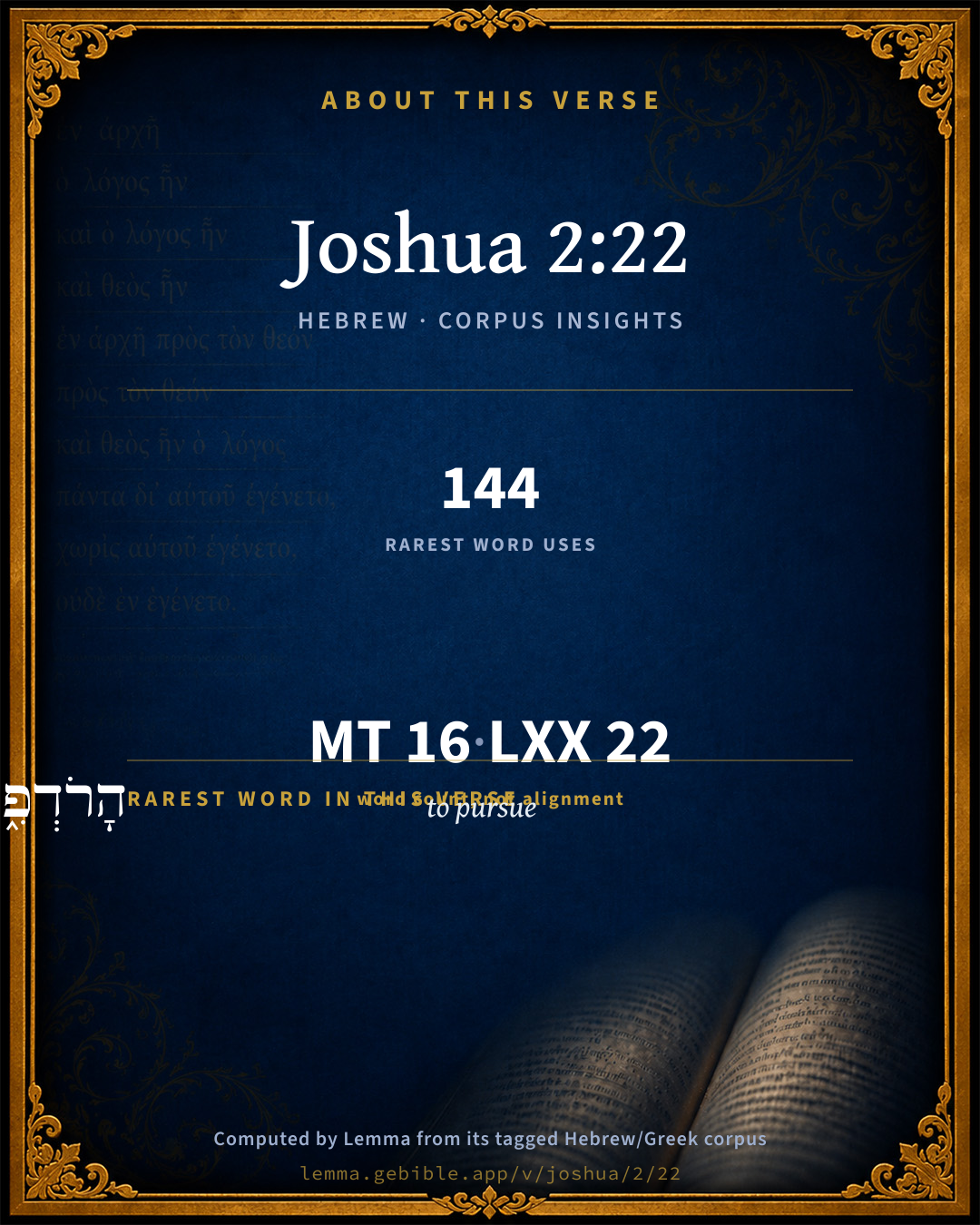
  • הָרֹדְפִ֑ים to pursue H7291 ×2

Hebrew & Septuagint length

In English translation the verse runs 30 words from the Hebrew and 22 from the Septuagint (LXX English) — closely comparable.

A rough comparison of the two English renderings, which tokenize alike — not a word-level alignment.

Word counts can differ between the Hebrew and the Greek without any difference in meaning — e.g. the Hebrew direct-object marker אֵת has no separate Greek word, and Greek often adds the article ὁ.

In the original languages it is 16 Hebrew tokens and 22 Greek tokens — but the two are counted differently (Hebrew bundles its prefixes and suffixes into one token; the Greek is in lemma form), so that isn’t a like-for-like length.

Cross-references

3

Topical passages linked to Joshua 2:22 in the Treasury of Scripture Knowledge — connected by theme and wording, ordered by reader-vote popularity; previews shown in the World English Bible.

  • 1 Samuel 19:10–12 Saul sought to strike David even to the wall with the spear; but he slipped away out of Saul's presence, and he struck the spear into the wall: and David fled, and escaped that night.
  • 2 Samuel 17:20 Absalom's servants came to the woman to the house; and they said, Where are Ahimaaz and Jonathan? The woman said to them, They have gone over the brook of water. When they had sought and could not find them, they returned to Jerusalem.
  • Psalms 32:6–7 For this, let everyone who is godly pray to you in a time when you may be found. Surely when the great waters overflow, they shall not reach to him.

Cross-references courtesy of OpenBible.info (CC BY 4.0).

Hebrew and Greek witnesses Masoretic Hebrew ↔ Greek Septuagint

The same verse in the two great witnesses to the Old Testament, shown verse-for-verse.

These are two independent witnesses, not word-aligned to each other, and the Septuagint is shown in lemma (dictionary) form.

Hebrew Joshua 2:22 Masoretic · Westminster Leningrad Codex

וַיֵּלְכוּ֙ וַיָּבֹ֣אוּ הָהָ֔רָה וַיֵּ֤שְׁבוּ שָׁם֙ שְׁלֹ֣שֶׁת יָמִ֔ים עַד שָׁ֖בוּ הָרֹדְפִ֑ים וַיְבַקְשׁ֧וּ הָרֹדְפִ֛ים בְּכָל הַדֶּ֖רֶךְ וְלֹ֥א מָצָֽאוּ

They went, and came to the mountain, and abode there three days, until the pursuers were returned: and the pursuers sought them throughout all the way, but didn't find them.

World English Bible · Public Domain

Greek LXX Joshua 2:22 Septuagint · lemma form

καί πορεύομαι καί ἔρχομαι εἰς ὁ ὀρεινή καί καταμένω ἐκεῖ τρεῖς ἡμέρα καί ἐκζητέω ὁ καταδιώκω πᾶς ὁ ὁδός καί οὐ εὑρίσκω

And they came to the hill-country, and remained there three days; and the pursuers searched all the roads, and found them not.

LXX2012 (modern English Septuagint) · Public Domain

Hebrew: Westminster Leningrad Codex (CC BY 4.0). Greek: Septuagint (public domain); English from LXX2012 (modern English Septuagint) (Public Domain). How the Septuagint differs from the Hebrew →

Targum (Aramaic paraphrase)

1

The Targum is the ancient Jewish Aramaic paraphrase of the Hebrew Scriptures — an interpretive translation, not the Hebrew text itself. Onkelos (literal) and Pseudo-Jonathan (expansive) render the Torah, and Jonathan the Prophets. Coverage is partial: where no permissively-licensed English translation exists for a verse, only the Aramaic is shown. This is verse-level text, not a word-by-word alignment to the Hebrew.

  1. Targum Jonathan Prophets (Joshua–Malachi)
    וַאֲזַלוּ וְעָלוּ לְטוֹרָא וִיתָבוּ תַמָן תְּלָתָא יוֹמִין עַד דְתָבוּ רָדְפַיָא וּבְעוֹ רָדְפַיָא בְּכָל אָרְחָא וְלָא אַשְׁכָּחוּ:

    (no public-domain English translation for this verse)

    Targum Jonathan — Aramaic: “Mikraot Gedolot” (public domain). English: “Sefaria Community Translation” (CC0 1.0 (public-domain dedication)); “London "Chaldee Paraphrase," 1871” (public domain). Text via Sefaria.

Commentary

Notes on Joshua 2:22 from classic Christian and Jewish commentators (each source and its license shown beneath its notes). The classic Christian expositions comment on the surrounding passage and are grouped to its opening verse, so a note may address several verses; the Jewish commentaries on the Tanakh (Rashi and others) are per-verse, so they appear only where the commentator wrote on this verse.

Lemma curates 59 commentaries, every one of them public domain or Creative Commons licensed, each selected and text-cleaned for this edition rather than reprinted as found. About our sources →

Joseph Benson's Commentary

Jos 2:22-23. Three days — Supporting themselves there with the provisions which Rahab had furnished them with. The way — That is, in the road to Jordan, and the places near it, but not in the mountains. Passed over — Jordan unto Joshua.

Joseph Benson's Commentary on the Old and New Testaments (1811–1818) — public domain. Text from a community e-Sword module.

The Preacher's Complete Homiletical Commentary

Joseph S. Exell (gen. ed.)

CRITICAL NOTES.—

Jos_2:22. Abode there three days] One clear day, and part of two others. The spies were probably sent out on the sixth of Abib; on the evening of the same day as that on which they arrived at Jericho they escaped to the mountain; they waited in hiding there throughout the next day, and through the night and the day and the greater part of the night following, when they returned to Joshua, and made their report.

MAIN HOMILETICS OF THE PARAGRAPH.—Jos_2:22-24

WITH AND “WITHOUT GOD IN THE WORLD”

I. He who watches and works without God, watches and works in vain. The king of Jericho had sent to take the spies, but they escaped out of his hand; “the pursuers sought them throughout all the way, but found them not.” “Except the Lord keep the city, the watchman waketh but in vain;” so, apparently, out of the rich experience of his life the aged David counselled his son and successor in “The Song of degrees for Solomon.” The children of God, when they are without the presence of their heavenly Father, labour as much in vain as the greatest idolater or infidel. The king of Jericho and his pursuers fail; equally do the Israelites themselves, when a week or two later they go up without God against Ai. Moses well said, “If Thy presence go not with us, carry us not up hence.”

II. He who goes out under the care of God is safe from the wrath of man. If Rebekah and Jacob had not lied, the younger son would still have inherited the blessing. The promise of God needed no falsehood of men to make it into a truth. If Rahab had said only the thing which was right, God could with equal ease have secured the safety of these His two servants. Even had it been otherwise, they had been no less safe; they fall well, who fall into their Father’s arms. Where God does not bless our righteous efforts to preserve ourselves, we need not seek safety in sin. Those were noble blushes which rose on the face of Ezra, when he said, “I was ashamed to require of the king a band of men and horsemen to help us against the enemy in the way” (cf. Ezr_8:21-23). Paul in his perils; Luther at Worms; Wesley preaching under threats of violence and falling stones.

III. He who reports the goodness and faithfulness of the Lord can never report too confidently or too cheerfully. The ten spies had given the report of fear; these give the report of faith. The giants and the Anakim were probably as huge as they were forty years before, the cities walled up as near to heaven, and the Israelites no larger than they were formerly; but where fear then saw grasshoppers in the presence of giants, faith said now, “Truly the Lord hath delivered into our hands all the land.” The message of these two men to Joshua was full of confidence, full of cheerfulness, and full of praise. They thanked God for victories yet to come.

1. He who makes the best of everything which concerns God, serves God and men much better than he who is timid and doubting and depressed. It is quite possible to make too much of the work of men; we cannot well over-report God. Too many modern servants are far more like the ten spies than the two.

2. A bad report of Divine things is not only injurious to others, but most harmful to ourselves. Good Bp. Hall well said, “Our success or discomfiture begins ever at the heart. A man’s inward disposition doth more than presage the event. If Satan sees us once faint, he gives himself the day. There is no way to safety, but that our hearts be the last that shall yield.” We have need to keep our heart with all diligence; for out of it, even in this sense, there are issues of life. The glad confidence in Christ which some constantly manifest carries its own reward; for “the joy of the Lord is their strength,” and hardly less strength to all who are sufficiently with them to catch the enthusiasm of their praise.

The Preacher's Complete Homiletical Commentary (gen. ed. Joseph S. Exell; Funk & Wagnalls, c. 1892) — public domain (pre-1929). A full-Bible homiletical/sermon-outline anthology covering 65 of 66 books (2 John is absent from the source module). Text from a community e-Sword module.

Matthew Henry's Commentary

We have here the safe return of the spies Joshua had sent, and the great encouragement they brought with them to Israel to proceed in their descent upon Canaan. Had they been disposed to discourage the people, as the evil spies did that Moses sent, they might have told them what they had observed of the height and strength of the walls of Jericho, and the extraordinary vigilance of the king of Jericho, and how narrowly they escaped out of his hands; but they were of another spirit, and, depending themselves upon the divine promise, they animated Joshua likewise. 1. Their return in safety was itself an encouragement to Joshua, and a token for good. that God provided for them so good a friend as Rahab was in an enemy's country, and that notwithstanding the rage of the king of Jericho and the eagerness of the pursuers they had come back in peace, was such an instance of God's great care concerning them for Israel's sake as might assure the people of the divine guidance and care they were under, which should undoubtedly make the progress of their arms glorious. He that so wonderfully protected their scouts would preserve their men of war, and cover their heads in the day of battle. 2. The report they brought was much more encouraging (v. 24): "All the inhabitants of the country, though resolved to stand it out, yet do faint because of us, they have neither wisdom to yield nor courage to fight," whence they conclude, "Truly the Lord has delivered into our hands all the land, it is all our own; we have nothing to do, in effect, but to take possession." Sinners' frights are sometimes sure presages of their fall. If we resist our spiritual enemies they will flee before us, which will encourage us to hope that in due time we shall be more than conquerors.

Matthew Henry's Commentary on the Whole Bible (1708–1710) — public domain (CC PDM 1.0). Text via the HelloAO Bible API.

Ellicott's Commentary for English Readers

(22) Three days—i.e., probably until the completion of three days from the commencement of their mission, according to the usual inclusive reckoning of the Old Testament.

A Bible Commentary for English Readers, edited by Charles John Ellicott (1878–1897) — public domain. Text from a community e-Sword module.

The Cambridge Bible for Schools and Colleges

gen. ed. J. J. S. Perowne

22–24. Return of the Spies to Joshua

22. the mountain] See above, Jos_2:16.

The Cambridge Bible for Schools and Colleges (gen. ed. J. J. S. Perowne; Cambridge University Press, 1878–1918) — public domain. Text from a community e-Sword module.

John Gill's Exposition

And they went, and came unto the mountain,.... Rahab had directed them to, the mountain Quarantania; see Gill on Jos 2:16,

and abode there three days; being, no doubt, supplied with food by Rahab; and it might not be three wholly, but one whole day and part of the other two:

until the pursuers were returned; to the city of Jericho, as might reasonably be supposed:

and the pursuers sought them throughout all the way; from Jericho to the fords of Jordan, searching every hedge, field, and village as they went and returned:

but found them not; Rahab having hid them in her house, and then sent them to the mountain, there to remain till the return of the pursuers.

John Gill's Exposition of the Whole Bible (1746–1763) — public domain (CC PDM 1.0). Text via the HelloAO Bible API.

Albert Barnes' Notes on the Bible

Unto the mountain - Probably the mountains to the west and north of Jericho, called afterward, from the belief that the 40 days of our Lord’s temptation were passed among them, the Quarantania. The spies avoided at the first the neighhourhood of the Jordan, where the pursuers sought them: and amidst the grottoes of the limestone rocks, which in later ages were the abode of numerous hermits, they could readily shelter themselves for three days.

Albert Barnes' Notes on the Bible (1834–1885) — public domain. Text from a community e-Sword/MySword module.

Matthew Poole's English Annotations

Abode there three days; supporting themselves there with the provisions, which after the manner of those times and places they carried with them, which Rahab furnished them with.

Throughout all the way, i.e. in the road to Jordan, and the places near it, but not in the mountains.

Matthew Poole's English Annotations on the Holy Bible (1683–1685) — public domain. Text from a community e-Sword/MySword module.

Whedon's Commentary on the Bible

Daniel D. Whedon

22. Abode there three days — In reckoning time, the Jews count as whole days the parts of days which may be included in a given period. Hence the body of Jesus was said to be in the tomb three days, though it was laid there on Friday evening and he came forth on Sunday morning — a space of thirty-six hours. See note on Mat_12:40. [So these spies may have remained in the caverns of the mountains only parts of three days, and the entire time of their absence from the camp at Shittim fell within the three days at the end of which, if not before, Joshua intended to be on his march across the Jordan. See note on Jos_1:11.] 23. Passed over — That is, Jordan. These scouts were probably expert in swimming, for the Jordan was then at its flood.

Came to Joshua — It is not necessary to suppose that they returned to the camp at Shittim. But the history most naturally implies this.

Daniel D. Whedon (gen. ed.), Commentary on the Old and New Testaments (1874–1909) — public domain. Text from a community e-Sword module.

John Wesley's Explanatory Notes

Three days - Supporting themselves there with the provisions, which Rahab had furnished them with. The ways - That is, in the road to Jordan, and the places near it, but not in the mountains.

John Wesley, Explanatory Notes Upon the Whole Bible (1754–1765) — public domain. Text via the GEBible commentary corpus.

Keil & Delitzsch

C. F. Keil & F. Delitzsch

The spies remained three days in the mountains, till the officers returned to the town, after searching for them the whole way in vain. The mountains referred to are probably the range on the northern side of Jericho, which afterwards received the name of Quarantana (Arab. Kuruntul), a wall of rock rising almost precipitously from the plain to the height of 1200 or 1500 feet, and full of grottoes and caves on the eastern side. These mountains were well adapted for a place of concealment; moreover, they were the nearest to Jericho, as the western range recedes considerably to the south of Wady Kelt (vid., Rob. ii. p. 289).

Keil & Delitzsch — Biblical Commentary on the Old Testament (1861–1891) — public domain (CC PDM 1.0). Text via the HelloAO Bible API. (Old Testament only.)

unfoldingWord translationNotes

Door43 World Missions Community

General Information:

The two Israelites spies leave Jericho.

their pursuers returned

It may be helpful to say they returned to Jericho. AT: "their pursuers returned to the city of Jericho" (See: Assumed Knowledge and Implicit Information)

found nothing

This refers to the men not finding the spies.

unfoldingWord translationNotes — © Distant Shores Media and the Door43 World Missions Community, licensed CC BY-SA 4.0. Source: git.door43.org/Door43/en_tn.

Lesson kit

Teaching starters — assembled from the data on this page, not authored interpretation. Every prompt links to the verse data it draws on. Edit before teaching.

Joshua, in the Historical, opens this verse with 16 words (15 distinct Hebrew lemmas). Its most distinctive word is râdaph (“to pursue”). A historical commentator’s framing appears above. Read the whole chapter for the surrounding context.

Discussion questions

  1. The word râdaph carries the sense “to pursue.” How does it shape the verse?
  2. 1 Samuel 19:10–12 shares this passage’s theme. How do the two illuminate each other?
  3. “to pursue” occurs 2× in this one verse. What is the effect of the repetition?
  4. These translations render this verse differently. What is at stake in choosing one wording over another?
  5. The verb «וַיֵּלְכוּ֙» is Qal Sequential Imperfect. How does its form color the action?
  6. Reading how Joseph Benson's Commentary and The Preacher's Complete Homiletical Commentary read this verse, where do the two commentators agree and where do they part?

Things to notice

Reading settings

Reading text

Shown beneath each verse's original-language words.

Old Testament
Old Testament edition

Read the OT as the Masoretic Hebrew (MT) or the Greek Septuagint (LXX).

English shown for the Greek Septuagint (in the Hebrew ↔ Greek comparison).

Comparing translations? Open the Compare panel on any verse page to stack up to four side by side.