2 Samuel 3:17

Hebrew (Westminster Leningrad Codex) 2 Samuel 3:17 appears in the Hebrew Old Testament. The text above is from the Westminster Leningrad Codex. Each word links to its Strong’s number, a concise gloss, and parsing drawn from the Open Scriptures Hebrew Bible morphology. Click any word for its full Brown-Driver-Briggs (BDB) entry.
Download image
Cite this verse

2 Samuel 3:17 (World English Bible). Public Domain. Lemma interlinear Bible study tool, https://lemma.gebible.app/v/2-samuel/3/17.

Show BibTeX & RIS
BibTeX
RIS
English Translation
Abner had communication with the elders of Israel, saying, In times past you sought for David to be king over you:
World English Bible · Public Domain
Download a study sheet

One document with this verse’s original text, its word-by-word gloss line, the meaning frame, cross-references with their text, attributed commentary, and full source and license credits — printable, and it pastes into notes with its structure intact.

This verse Autodidact and up

Study sheet (.html) Plain text (.txt)

A passage Seminary Student

Up to 50 verses in one chapter. A passage sheet keeps up to 6 commentary sources and 12 cross-references per verse, in the order this page ranks them, and says so on the sheet whenever that leaves anything out. Ask for a single verse and you get the Autodidact verse sheet above.

Everything on this page stays free to read, with no account — the sheet is a download of what is already on screen, not access to it.

Want to remove ads? Support Godless Engineer
Compare translations 3

The same verse in 3 English versions, stacked beneath the original-language interlinear above. Click any original word for its lexicon entry.

Each is an independent rendering of the whole verse — the interlinear is not word-aligned to these translations.

Highlighted words mark where these versions differ — a whole-verse word diff, not a word-by-word alignment.

  • World English Bible Public Domain
    Abner had communication with the elders of Israel, saying, In times past you sought for David to be king over you:
  • King James Version Public Domain
    And Abner had communication with the elders of Israel, saying, Ye sought for David in times past to be king over you:
  • unfoldingWord Literal Text CC BY-SA 4.0
    Now the word of Abner had been with the elders of Israel, saying, “Both yesterday and the third day you were seeking David as king over you.

unfoldingWord Literal Text — © unfoldingWord, licensed CC BY-SA 4.0. Word-aligned USFM3 via Door43 (git.door43.org/unfoldingWord/en_ult).

Versions to compare (up to 4)

3 of 4 selected

Show all 18 translations

Every available English version of this verse, each an independent rendering of the whole verse.

  • World English Bible Public Domain
    Abner had communication with the elders of Israel, saying, In times past you sought for David to be king over you:
  • Berean Standard Bible Public Domain
    Now Abner conferred with the elders of Israel and said, “In the past you sought David as your king.
  • Majority Standard Bible Public Domain
    Now Abner conferred with the elders of Israel and said, “In the past you sought David as your king.
  • King James Version Public Domain
    And Abner had communication with the elders of Israel, saying, Ye sought for David in times past to be king over you:
  • American Standard Version (1901) Public Domain
    And Abner had communication with the elders of Israel, saying, In times past ye sought for David to be king over you:
  • Revised Version (1885) Public Domain
    And Abner had communication with the elders of Israel, saying, In times past ye sought for David to be king over you:
  • Geneva Bible (1599) Public Domain
    And Abner had communication with the Elders of Israel, saying, Ye sought for Dauid in times past, that he might be your King.
  • Douay-Rheims (1899) Public Domain
    Abner also spoke to the ancients of Israel, saying: Both yesterday and the day before you sought for David that he might reign over you.
  • Young's Literal Translation Public Domain
    And the word of Abner was with the elders of Israel, saying, `Heretofore ye have been seeking David for king over you,
  • Literal Standard Version CC BY-SA 4.0
    And the word of Abner was with [the] elderly of Israel, saying, “Thus far you have been seeking David for king over you,
  • Unlocked Literal Bible CC BY-SA 4.0
    Abner spoke with the elders of Israel saying, “In the past you were trying to have David be king over you.
  • unfoldingWord Literal Text CC BY-SA 4.0
    Now the word of Abner had been with the elders of Israel, saying, “Both yesterday and the third day you were seeking David as king over you.
  • Darby Bible Public Domain
    Now Abner had communicated with the elders of Israel, saying, Ye sought for David aforetime to be king over you;
  • World Messianic Bible Public Domain
    Abner had communication with the elders of Israel, saying, “In times past, you sought for David to be king over you.
  • Webster's Bible Public Domain
    And Abner had communication with the elders of Israel, saying, Ye sought for David in times past to be king over you:
  • Free Bible Version CC BY-SA 4.0
    Abner spoke with the elders of Israel and said, “For a while now you have wanted to have David as your king.
  • Bible in Basic English Public Domain
    Then Abner had a talk with the chief men of Israel, saying, In the past it was your desire to make David your king: so now, do it:
  • JPS Tanakh (1917) Public Domain
    And Abner had communication with the elders of Israel, saying: 'In times past ye sought for David to be king over you;

Literal Standard Version (2020), Covenant Press — licensed CC BY-SA 4.0. Text via the HelloAO Bible API (eBible.org). Unlocked Literal Bible (unfoldingWord) — licensed CC BY-SA 4.0. Text via the HelloAO Bible API (eBible.org). unfoldingWord Literal Text — © unfoldingWord, licensed CC BY-SA 4.0. Word-aligned USFM3 via Door43 (git.door43.org/unfoldingWord/en_ult). Free Bible Version, Dr. Jonathan Gallagher — licensed CC BY-SA 4.0. Text via the HelloAO Bible API (eBible.org).

Word by word

More ways to search: Search by grammar → Find every occurrence → Compare this word →

Practice this passage: Drill this verse → Learn its vocabulary →

תְּמוֹל֙
tᵉmôwl
H8543
“formerly”
Adverb
Part of Speech
Adverb
Full BDB Definition

Origin: probably for H865

TWOT: 2521

before, before that time, beforetime, heretofore, of late, of old, these days, time(s) past, yesterday, day before yesterday, recently, formerly - yesterday - recently, formerly (usual usage) (figuratively) - as formerly, so more recently - from yesterday, already
  1. וּדְבַר dâbâr H1697 “and · word of” Conjunction + Noun, Common, Masculine, Singular, Construct
  2. אַבְנֵ֣ר ʼAbnêr H74 “Abner” Noun, Proper
  3. הָיָ֔ה hâyâh H1961 “to be” Verb, Qal, Perfect, 3rd Person, Masculine, Singular
  4. עִם ʻim H5973 “with” Preposition
  5. זִקְנֵ֥י zâqên H2205 “old of” Adjective, Adjective, Masculine, Plural, Construct
  6. יִשְׂרָאֵ֖ל Yisrâʼêl H3478 “Israel” Noun, Proper
  7. לֵאמֹ֑ר ʼâmar H559 “to say” Preposition + Verb, Qal, Infinitive Construct
  8. גַּם gam H1571 “also” Particle, Accusative
  9. גַּם gam H1571 “also” Particle, Accusative
  10. שִׁלְשֹׁ֔ם shilshôwm H8032 “heretofore” Noun, Common, Masculine, Singular, Absolute
  11. הֱיִיתֶ֞ם hâyâh H1961 “to be” Verb, Qal, Perfect, 2nd Person, Masculine, Plural
  12. מְבַקְשִׁ֧ים bâqash H1245 “seeking” Verb, Piel, Participle Active, Masculine, Plural, Absolute
  13. אֶת ʼêth H853 “-” Particle, Direct Object
  14. דָּוִ֛ד Dâvid H1732 “David” Noun, Proper
  15. לְמֶ֖לֶךְ melek H4428 “to/for · king” Preposition + Noun, Common, Masculine, Singular, Absolute
  16. עֲלֵיכֶֽם ʻal H5921 “upon · you” Preposition + Suffix, Personal, 2nd Person, Masculine, Plural

About this verse

These counts appear in no published source. They are computed here, from the morphology-tagged text and Lemma’s own curated glosses. What Lemma adds →

17
words
15
distinct lemmas
Historical
section

Notable vocabulary

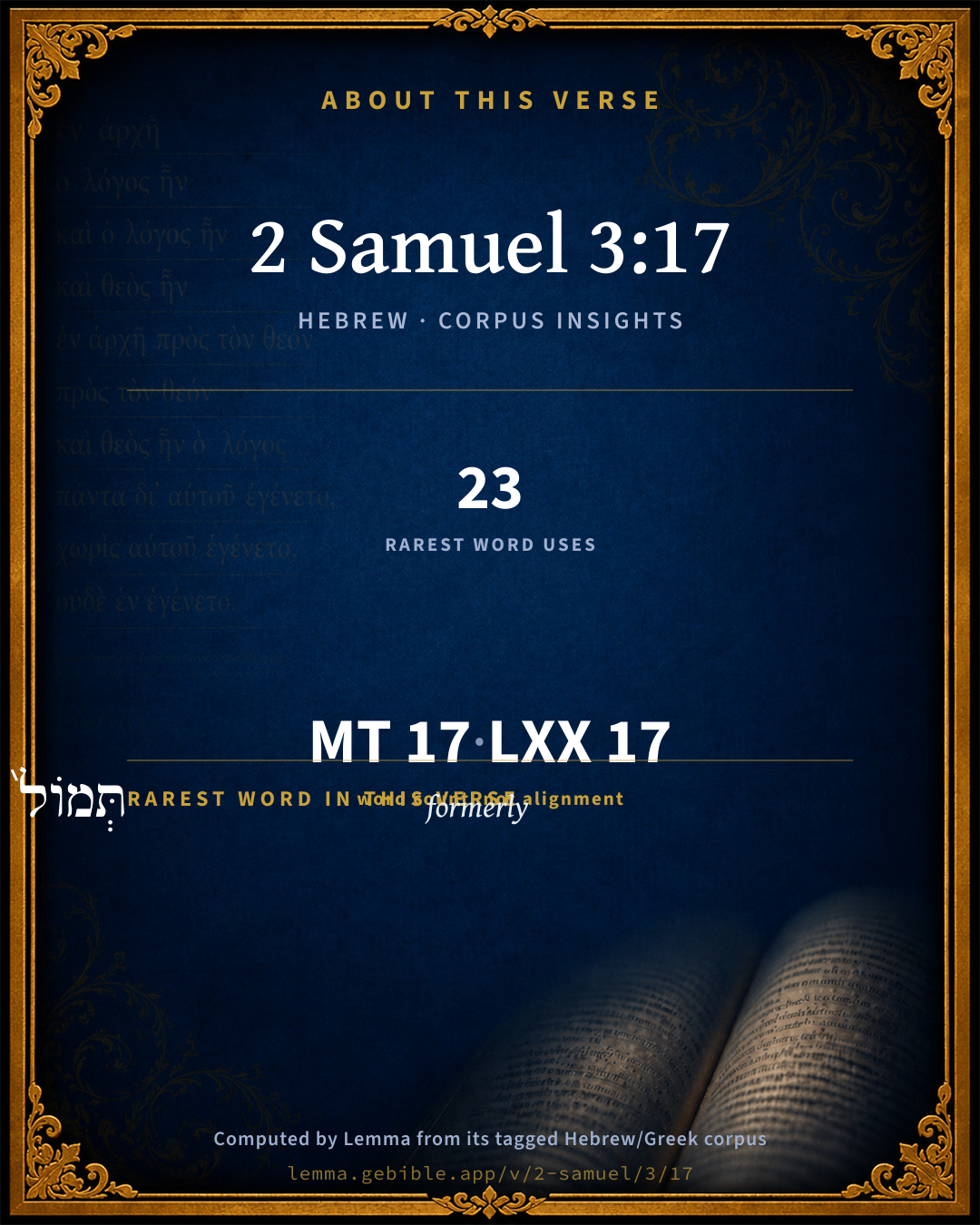
The rarest word here is תְּמוֹל֙ formerly H8543 — appearing just 23 times in the whole Hebrew Bible.

Shared distinctive vocabulary

תְּמוֹל֙ formerly H8543 occurs in 22 verses of the Hebrew Bible. Also found in:

Grammatical profile

  • 4 verbs
  • 6 nouns
  • 1 adjective
  • 2 prepositions
  • 1 adverb
  • 3 particles

Verb forms

  • הָיָ֔ה Qal · Perfect
  • לֵאמֹ֑ר Qal · Infinitive Construct
  • הֱיִיתֶ֞ם Qal · Perfect
  • מְבַקְשִׁ֧ים Piel · Participle Active

Repetition

Words recur within this verse — often emphatic in Hebrew:

  • הָיָ֔ה to be H1961 ×2
  • גַּם also H1571 ×2

Hebrew & Septuagint length

In English translation the verse runs 21 words from the Hebrew and 19 from the Septuagint (LXX English) — closely comparable.

A rough comparison of the two English renderings, which tokenize alike — not a word-level alignment.

Word counts can differ between the Hebrew and the Greek without any difference in meaning — e.g. the Hebrew direct-object marker אֵת has no separate Greek word, and Greek often adds the article ὁ.

In the original languages it is 17 Hebrew tokens and 17 Greek tokens — but the two are counted differently (Hebrew bundles its prefixes and suffixes into one token; the Greek is in lemma form), so that isn’t a like-for-like length.

Hebrew and Greek witnesses Masoretic Hebrew ↔ Greek Septuagint

The same verse in the two great witnesses to the Old Testament, shown verse-for-verse.

These are two independent witnesses, not word-aligned to each other, and the Septuagint is shown in lemma (dictionary) form.

Hebrew 2 Samuel 3:17 Masoretic · Westminster Leningrad Codex

וּדְבַר אַבְנֵ֣ר הָיָ֔ה עִם זִקְנֵ֥י יִשְׂרָאֵ֖ל לֵאמֹ֑ר גַּם תְּמוֹל֙ גַּם שִׁלְשֹׁ֔ם הֱיִיתֶ֞ם מְבַקְשִׁ֧ים אֶת דָּוִ֛ד לְמֶ֖לֶךְ עֲלֵיכֶֽם

Abner had communication with the elders of Israel, saying, In times past you sought for David to be king over you:

World English Bible · Public Domain

Greek LXX 2 Samuel 3:17 Septuagint · lemma form

καί εἶπον αβεννηρ πρός ὁ πρεσβύτερος ἰσραήλ λέγω ἐχθές καί τρίτος ζητέω ὁ δαυίδ βασιλεύω ἐπί σύ

And Abenner spoke to the elders of Israel, saying, In former days you⌃ sought David to reign over you;

LXX2012 (modern English Septuagint) · Public Domain

Hebrew: Westminster Leningrad Codex (CC BY 4.0). Greek: Septuagint (public domain); English from LXX2012 (modern English Septuagint) (Public Domain). How the Septuagint differs from the Hebrew →

Targum (Aramaic paraphrase)

1

The Targum is the ancient Jewish Aramaic paraphrase of the Hebrew Scriptures — an interpretive translation, not the Hebrew text itself. Onkelos (literal) and Pseudo-Jonathan (expansive) render the Torah, and Jonathan the Prophets. Coverage is partial: where no permissively-licensed English translation exists for a verse, only the Aramaic is shown. This is verse-level text, not a word-by-word alignment to the Hebrew.

  1. Targum Jonathan Prophets (Joshua–Malachi)
    וּפִתְגָם אַבְנֵר הֲוָה עִם סָבֵי יִשְׂרָאֵל לְמֵימָר אַף תְּמָלֵי אַף מִדְקָמוֹהִי הֲוֵיתוּן בָּעָן יַת דָוִד לְמֶהֱוֵי מַלְכָּא עֲלֵיכוֹן:

    (no public-domain English translation for this verse)

    Targum Jonathan — Aramaic: “Mikraot Gedolot” (public domain). English: “Sefaria Community Translation” (CC0 1.0 (public-domain dedication)); “London "Chaldee Paraphrase," 1871” (public domain). Text via Sefaria.

Commentary

Notes on 2 Samuel 3:17 from classic Christian and Jewish commentators (each source and its license shown beneath its notes). The classic Christian expositions comment on the surrounding passage and are grouped to its opening verse, so a note may address several verses; the Jewish commentaries on the Tanakh (Rashi and others) are per-verse, so they appear only where the commentator wrote on this verse.

Lemma curates 59 commentaries, every one of them public domain or Creative Commons licensed, each selected and text-cleaned for this edition rather than reprinted as found. About our sources →

Trapp's Complete Commentary

John Trapp

2Sa 3:17 And Abner had communication with the elders of Israel, saying, Ye sought for David in times past [to be] king over you:

Ver. 17. And Abner had communication,] i.e., He had had communication with them before that he went toward David with Michal.

Ye sought for David.] And David they had crowned ere this, but that Abner overruled them for Ishbosheth. All his care was to have a stake in store, howsoever the dice chanced to turn. Politicians are all for their own ends.

John Trapp, A Commentary or Exposition upon All the Books of the Old and New Testament (1647–1656) — public domain. Text from a community e-Sword module.

Joseph Benson's Commentary

2Sa 3:17. And Abner — Having seen David, and given him assurance of his fidelity, as David had him of his friendship; had communication with the elders of Israel — He went back to persuade all to do as he had done. And by bringing over the great men to David, he doubted not the multitude would follow. Saying, Ye sought for David in times past — For, after the slaughter of Goliath, he was much beloved by all the people. And when he was forced to flee, a great many of Israel came over to him while he dwelt at Ziklag. And it is highly probable that, as soon as Saul and Jonathan were dead, they all generally would have inclined to make David their king, if Abner, by his great authority, had not set up one of the family of Saul.

Joseph Benson's Commentary on the Old and New Testaments (1811–1818) — public domain. Text from a community e-Sword module.

Tyndale Open Study Notes

Tyndale Open Resources

3:17 Apparently, there had been growing momentum among the elders of Israel in the north to accept David as king, though the text has made no mention of it to this point.

Tyndale Open Study Notes — © Tyndale Open Resources, licensed CC BY-SA 4.0. Text via the HelloAO Bible API.

Geneva Bible (1599)

Geneva Bible translators

Rather for malice that he bare toward Ishbosheth, than for love he bare to David.

Geneva Bible (1599) marginal notes — public domain. Text via Bolls.life.

Jamieson, Fausset & Brown

Robert Jamieson, A. R. Fausset & David Brown

Abner had communication with the elders of Israel--He spoke the truth in impressing their minds with the well-known fact of David's divine designation to the kingdom. But he acted a base and hypocritical part in pretending that his present movement was prompted by religious motives, when it sprang entirely from malice and revenge against Ish-bosheth. The particular appeal of the Benjamites was a necessary policy; their tribe enjoyed the honor of giving birth to the royal dynasty of Saul; they would naturally be disinclined to lose that prestige. They were, besides, a determined people, whose contiguity to Judah might render them troublesome and dangerous. The enlistment of their interest, therefore, in the scheme, would smooth the way for the adhesion of the other tribes; and Abner enjoyed the most convenient opportunity of using his great influence in gaining over that tribe while escorting Michal to David with a suitable equipage. The mission enabled him to cover his treacherous designs against his master--to draw the attention of the elders and people to David as uniting in himself the double recommendation of being the nominee of Jehovah, no less than a connection of the royal house of Saul, and, without suspicion of any dishonorable motives, to advocate policy of terminating the civil discord, by bestowing the sovereignty on the husband of Michal. In the same character of public ambassador, he was received and feted by David; and while, ostensibly, the restoration of Michal was the sole object of his visit, he busily employed himself in making private overtures to David for bringing over to his cause those tribes which he had artfully seduced. Abner pursued a course unworthy of an honorable man and though his offer was accepted by David, the guilt and infamy of the transaction were exclusively his.

Jamieson, Fausset & Brown — Commentary Critical and Explanatory on the Whole Bible (1871) — public domain (CC PDM 1.0). Text via the HelloAO Bible API.

Ellicott's Commentary for English Readers

(17) Ye sought for David.—1Sa_18:6-7; 1Sa_18:16; 1Sa_18:30; 1Ch_11:1-3 (comp. 2Sa_3:36), sufficiently testify to the great popularity of David throughout the nation, and its confidence in his prowess and wisdom. It was the influence and activity of Abner that had hitherto prevented his general recognition as king.

A Bible Commentary for English Readers, edited by Charles John Ellicott (1878–1897) — public domain. Text from a community e-Sword module.

The Cambridge Bible for Schools and Colleges

gen. ed. J. J. S. Perowne

17. And Abner had communication] Better, Now Abner had had communication, previously to the occurrence related in 2Sa_3:15-16. The journey of 2Sa_3:16 to escort Michal terminates in the visit to Hebron of 2Sa_3:20.

with the elders of Israel] The authorities of the northern tribes as distinct from Judah. The elders were consulted as the representatives of the people. Cp. 1Sa_8:4, where see note on their various functions.

Ye sought for David, &c.] It appears from this that there had been from the first even among the northern tribes a party favourable to David, whose opposition had only been overcome by Abner’s strong will and vigorous efforts. This agrees with what we should naturally expect from the account of his popularity during Saul’s reign (1Sa_18:5).

The Cambridge Bible for Schools and Colleges (gen. ed. J. J. S. Perowne; Cambridge University Press, 1878–1918) — public domain. Text from a community e-Sword module.

John Gill's Exposition

And Abner had communication with the elders of Israel,.... Had a conference with the chiefs of the several tribes about the affairs of the kingdom:

saying, ye sought for David in time past to be king over you; that is, at the death of Saul, and not before; for it was pretty generally known throughout the kingdom that David was anointed by Samuel and Saul himself had declared that he knew the kingdom would come to him; so that upon his death it was the general expectation and desire of the people that the government would devolve upon him, as it doubtless would, if Abner had not set up one of Saul's house, and persuaded the Israelites to own him their king.

John Gill's Exposition of the Whole Bible (1746–1763) — public domain (CC PDM 1.0). Text via the HelloAO Bible API.

Albert Barnes' Notes on the Bible

Ye sought for David ... - Compare 1Sa 18:5. It was only by Abner’s great influence that the elders of Israel had been restrained hitherto from declaring for David, and this accounts for Ish-bosheth’s helpless submission to his uncle’s dictation.

Albert Barnes' Notes on the Bible (1834–1885) — public domain. Text from a community e-Sword/MySword module.

Matthew Poole's English Annotations

Even in Saul’s time you highly honoured him, and prized his conduct, and wished that the power were in his hands; and great numbers of you went to him when he was in the hold, 1Ch 12. And after Saul’s death you would gladly have advanced him to the crown, if your respect to Saul’s family, together with my authority and influence, had not diverted you.

Matthew Poole's English Annotations on the Holy Bible (1683–1685) — public domain. Text from a community e-Sword/MySword module.

Whedon's Commentary on the Bible

Daniel D. Whedon

17. Ye sought for David in times past — As was shown by the multitudes from all the tribes that revolted from Saul and went over to David while yet at Ziklag. See 1 Chronicles 12.

Daniel D. Whedon (gen. ed.), Commentary on the Old and New Testaments (1874–1909) — public domain. Text from a community e-Sword module.

The Pulpit Commentary

And Abner had communication with the elders of Israel. Most probably this had taken place before Abner escorted Michal to Hebron, and that he paid David but one visit that recorded in ver. 20. He would probably not take so decided a step as the surrender of Michal without sounding the elders, that is, the local sheikhs, and finding out how far they were inclined to support David as king of all Israel. When everything was ready he would take Michal to Hebron, and so have the opportunity of arranging with David for future action; and though Ishbosheth would dislike the matter and suspect Abner of ulterior purposes, yet he could not refuse so specious a plea as the escorting of his sister. His previous failure, too, had taught him that Abner was master. We may further be sure that David had everywhere many adherents. All Israel knew that he was marked out by prophecy to be their king, and, moreover, "all Israel and Judah loved him". (1Sa_18:16) But when Abner says, Ye sought for David in times past to be king over you, he makes it probable that, at some time after the defeat at Gilboa, the attempt had even been made to elect David king. But Abner had then opposed it, and his success in resisting the Philistines, and David"s unfortunate entanglement with.those inveterate enemies of Israel, had made the attempt fail. And now Abner"s attempt was to be equally unsuccessful.

Vers. 17, 18.

An urgent appeal: an evangelistic address.

then do it "(ver. 18). Having resolved to transfer his allegiance, Abner here persuades the elders of Israel to make David king over the whole land; as they afterwards did. (2Sa_5:1-3) A similar appeal may be addressed to others, urging them to submit to the royal authority of Christ, of whom David was a type. (1Sa_2:10) Translated into New Testament language, it is, "We beseech you, on behalf of Christ, be ye reconciled to God". (2Co_5:20) Consider

I WHAT YOU SHOULD DO. Jesus Christ is King, anointed and exalted to the right hand of God; he reigns in grace and righteousness in many hearts; but his kingdom is not yet fully revealed and universally extended on earth, and it cannot be set up "within you" except by your own consent. You must:

1. Receive him heartily as your King and Lord, your absolute Owner and supreme Ruler, as well as your Redeemer and Saviour; by a personal, inward, voluntary act; in the renunciation of whatever is opposed to his will, and the submission and surrender of your whole being to his direction and control. "Now be ye not stiff necked, as your fathers were, but yield yourselves unto the Lord" (2Ch_30:8; Rom_6:13)

Our wills are ours, we know not how;

Our wills are ours to make them thine.

1. Confess him openly, by uniting with his people, testifying your faith in him, and proclaiming his Name before men. "With the heart man believeth," etc. (Rom_10:10; 2Co_8:5) "Whosoever therefore shall confess me," etc.. (Mat_10:32)

2. Serve him loyally, by obeying his commandments, assisting his friends, resisting his foes, seeking his honour and the spread of his kingdom. "It is not enough that I should love the Lord myself alone; every heart must love him, and every tongue speak forth his praise.

II WHY YOU SHOULD DO IT. "NOW then do it: for Jehovah hath spoken," etc.

1. It is the purpose of God that he should reign over you. "He must reign," either in mercy or in judgment.

2. It is the promise of God that through him you may be saved from your enemies sin, Satan, death, and hell. "There is none other Name.

3. It has been your own desire in times past that he might be your King. "Ye sought for David both yesterday and the day before to be king over you: now then do it." Under the bitter oppression of the ruler chosen by yourselves, in view of the superior worth of "the man of God"s choice," in weakness, fear, and misery, you have often said. "Oh for one glorious hour of him who, in the Name of the Lord of hosts, smote Israel"s most formidable foe!" But your wishes led to no practical result. "Your goodness was as the morning cloud." And now your reason, conscience, and all that is best within you urge you to accept Christ as your King. Let your feelings be translated into definite and decisive action, without which they are worse than useless. "Now then do it." "Crown him Lord of all.

III WHEN YOU SHOULD DO IT. Whatever reason exists for doing it at all should induce you to do it now. There are not a few who are persuaded of their duty, yet break the force of every appeal by delay and the intention of doing it at a future time. But:

1. The present is a most favourable opportunity. The King "waits to be gracious," and sends you the message of reconciliation. "Men and brethren, to you is the word of this salvation sent." "Behold, now is the acceptable time; behold, now is the day of salvation". (2Co_2:1, 2Co_2:2)

2. If you do it today, tomorrow and all your future days will be days of peace and happiness.

3. If you wait till tomorrow, it is probable that you will never do it. Your susceptibility to Divine influences will be lessened, your indisposition, which is the real cause of delay, will be increased; life is uncertain, probation is brief, the end is nigh. "Our gracious Ahasuerus (Est_4:11) reacheth out the golden sceptre to all that have a hand of faith to lay hold of it; but then he shall take his iron mace or rod in his hand to bruise his enemies and break them in pieces like a potter"s vessel." Say not, with the procrastinator, "To morrow"; (Exo_8:10) "Go thy way for this; (Act_24:25) for "the Holy Ghost saith, Today". (Heb_3:7) cras!" (Tomorrow! tomorrow!) is the cry of the raven. This is the thing that destroys many; while they are saying, "Cras! cras!" suddenly the door is shut" (Augustine). "The man that procrastinates struggles ever with ruin" (Epictetus). "There is a circumscribed space of time appointed thee, which if thou dost not employ in making all calm and serene within, it will pass away and thou wilt pass away, and it never will return" (Marcus Antoninus, 2:4).

Defer not till tomorrow to be wise; Tomorrow"s sun to thee may never rise.

The Pulpit Commentary (1880–1919), ed. H.D.M. Spence-Jones & Joseph S. Exell — public domain. Text from a community e-Sword module.

unfoldingWord translationNotes

Door43 World Missions Community

Now do it

"So now make David your king"

By the hand of my servant David

Here "hand" refers to David's power to defeat the Philistines. AT: "I will empower my servant David and" (See: Metonymy)

the hand of the Philistines

Here "hand" refers to power over Israel. AT: "the power of the Philistines" (See: Metonymy)

the hand of all their enemies

Here "hand" refers to power over Israel. AT: "the power of all of their enemies" (See: Metonymy)

translationWords

elder

Israel

David

king

Yahweh

servant

save

people of God

power

unfoldingWord translationNotes — © Distant Shores Media and the Door43 World Missions Community, licensed CC BY-SA 4.0. Source: git.door43.org/Door43/en_tn.

Rashi

Rabbi Shlomo Yitzchaki (Rashi)

And the word of Avner was [sent] Before this [incident with Paltiel]

Rashi on the Tanakh — English translations: “The Judaica Press complete Tanach with Rashi, translated by A. J. Rosenberg” (CC BY 4.0); “Pentateuch with Rashi's commentary by M. Rosenbaum and A.M. Silbermann, 1929-1934” (public domain); “The Metsudah Tanach series, Lakewood, N.J” (CC BY 4.0); and “The Book of Joshua, Metsudah Publications, 1997” (CC BY 4.0). Text via Sefaria.

Lesson kit

Teaching starters — assembled from the data on this page, not authored interpretation. Every prompt links to the verse data it draws on. Edit before teaching.

2 Samuel, in the Historical, opens this verse with 17 words (15 distinct Hebrew lemmas). Its most distinctive word is tᵉmôwl (“formerly”). A historical commentator’s framing appears above. Read the whole chapter for the surrounding context.

Discussion questions

  1. What does “formerly” (tᵉmôwl) contribute to the verse as a whole?
  2. Genesis 31:2 shares the word «formerly» with this verse. How do the two illuminate each other?
  3. “to be” occurs 2× in this one verse. What is the effect of the repetition?
  4. These translations render this verse differently. What is at stake in choosing one wording over another?
  5. The verb «הָיָ֔ה» is Qal Perfect. How does its form color the action?
  6. Reading how Trapp's Complete Commentary and Joseph Benson's Commentary read this verse, where do the two commentators agree and where do they part?

Things to notice

Reading settings

Reading text

Shown beneath each verse's original-language words.

Old Testament
Old Testament edition

Read the OT as the Masoretic Hebrew (MT) or the Greek Septuagint (LXX).

English shown for the Greek Septuagint (in the Hebrew ↔ Greek comparison).

Comparing translations? Open the Compare panel on any verse page to stack up to four side by side.