Psalms 70:4

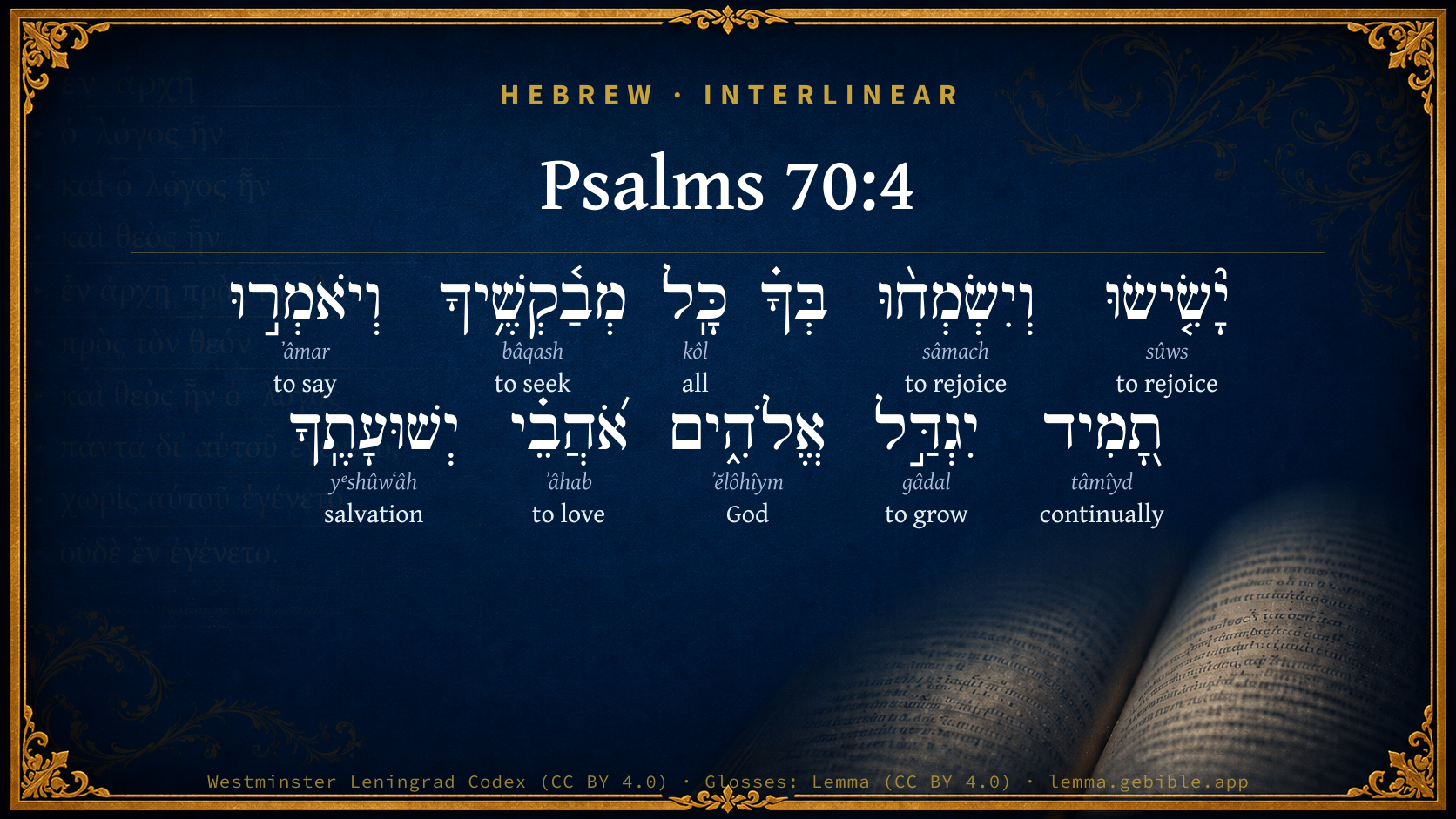
Hebrew (Westminster Leningrad Codex) Psalms 70:4 appears in the Hebrew Old Testament. The text above is from the Westminster Leningrad Codex. Each word links to its Strong’s number, a concise gloss, and parsing drawn from the Open Scriptures Hebrew Bible morphology. Click any word for its full Brown-Driver-Briggs (BDB) entry.
Download image
Cite this verse

Psalms 70:4 (World English Bible). Public Domain. Lemma interlinear Bible study tool, https://lemma.gebible.app/v/psalms/70/4.

Show BibTeX & RIS
BibTeX
RIS
English Translation
Let all those who seek you rejoice and be glad in you. Let those who love your salvation continually say, "Let God be exalted!"
World English Bible · Public Domain
Download a study sheet

One document with this verse’s original text, its word-by-word gloss line, the meaning frame, cross-references with their text, attributed commentary, and full source and license credits — printable, and it pastes into notes with its structure intact.

This verse Autodidact and up

Study sheet (.html) Plain text (.txt)

A passage Seminary Student

Up to 50 verses in one chapter. A passage sheet keeps up to 6 commentary sources and 12 cross-references per verse, in the order this page ranks them, and says so on the sheet whenever that leaves anything out. Ask for a single verse and you get the Autodidact verse sheet above.

Everything on this page stays free to read, with no account — the sheet is a download of what is already on screen, not access to it.

Want to remove ads? Support Godless Engineer
Compare translations 3

The same verse in 3 English versions, stacked beneath the original-language interlinear above. Click any original word for its lexicon entry.

Each is an independent rendering of the whole verse — the interlinear is not word-aligned to these translations.

Highlighted words mark where these versions differ — a whole-verse word diff, not a word-by-word alignment.

  • World English Bible Public Domain
    Let all those who seek you rejoice and be glad in you. Let those who love your salvation continually say, "Let God be exalted!"
  • King James Version Public Domain
    Let all those that seek thee rejoice and be glad in thee: and let such as love thy salvation say continually, Let God be magnified.
  • unfoldingWord Literal Text CC BY-SA 4.0
    Let all of the seekers of you rejoice and be glad in you, and let the lovers of your salvation say continually, “God is great!”

unfoldingWord Literal Text — © unfoldingWord, licensed CC BY-SA 4.0. Word-aligned USFM3 via Door43 (git.door43.org/unfoldingWord/en_ult).

Versions to compare (up to 4)

3 of 4 selected

Show all 18 translations

Every available English version of this verse, each an independent rendering of the whole verse.

  • World English Bible Public Domain
    Let all those who seek you rejoice and be glad in you. Let those who love your salvation continually say, "Let God be exalted!"
  • Berean Standard Bible Public Domain
    May all who seek You rejoice and be glad in You; may those who love Your salvation always say, “Let God be magnified!”
  • Majority Standard Bible Public Domain
    May all who seek You rejoice and be glad in You; may those who love Your salvation always say, “Let God be magnified!”
  • King James Version Public Domain
    Let all those that seek thee rejoice and be glad in thee: and let such as love thy salvation say continually, Let God be magnified.
  • American Standard Version (1901) Public Domain
    Let all those that seek thee rejoice and be glad in thee; And let such as love thy salvation say continually, Let God be magnified.
  • Revised Version (1885) Public Domain
    Let all those that seek thee rejoice and be glad in thee; and let such as love thy salvation say continually, Let God be magnified.
  • Geneva Bible (1599) Public Domain
    But let all those that seeke thee, be ioyfull and glad in thee, and let all that loue thy saluation, say alwaies, God be praised.
  • Douay-Rheims (1899) Public Domain
    Let them be turned backward, and blush for shame that desire evils to me: Let them be presently turned away blushing for shame that say to me: 'T is well, 't is well.
  • Young's Literal Translation Public Domain
    Let all those seeking Thee joy and be glad in Thee, And let those loving Thy salvation Say continually, `God is magnified.'
  • Literal Standard Version CC BY-SA 4.0
    Let all those seeking You rejoice and be glad in You, || And let those loving Your salvation || Continually say, “God is magnified.”
  • Unlocked Literal Bible CC BY-SA 4.0
    Let all those who seek you rejoice and be glad in you; let those who love your salvation always say, “May God be praised.”
  • unfoldingWord Literal Text CC BY-SA 4.0
    Let all of the seekers of you rejoice and be glad in you, and let the lovers of your salvation say continually, “God is great!”
  • Darby Bible Public Domain
    Let all those that seek thee be glad and rejoice in thee, and let such as love thy salvation say continually, Let God be magnified!
  • World Messianic Bible Public Domain
    Let all those who seek you rejoice and be glad in you. Let those who love your salvation continually say, “Let God be exalted!”
  • Webster's Bible Public Domain
    \\70:3\\Let them be turned back for a reward of their shame that say, Aha, aha.
  • Free Bible Version CC BY-SA 4.0
    But may everyone who comes to you be happy and glad; may those who love your salvation always say, “God is great!”
  • Bible in Basic English Public Domain
    Let all those who are looking for you be glad and have joy in you; let the lovers of your salvation ever say, May God be great.
  • JPS Tanakh (1917) Public Domain
    Let all those that seek Thee rejoice and be glad in Thee; and let such as love Thy salvation say continually: 'Let God be magnified.'

Literal Standard Version (2020), Covenant Press — licensed CC BY-SA 4.0. Text via the HelloAO Bible API (eBible.org). Unlocked Literal Bible (unfoldingWord) — licensed CC BY-SA 4.0. Text via the HelloAO Bible API (eBible.org). unfoldingWord Literal Text — © unfoldingWord, licensed CC BY-SA 4.0. Word-aligned USFM3 via Door43 (git.door43.org/unfoldingWord/en_ult). Free Bible Version, Dr. Jonathan Gallagher — licensed CC BY-SA 4.0. Text via the HelloAO Bible API (eBible.org).

Word by word

More ways to search: Search by grammar → Find every occurrence → Compare this word →

Practice this passage: Drill this verse → Learn its vocabulary →

יָ֘שִׂ֤ישׂוּ
sûws
H7797
“to rejoice”
Verb, Qal, Imperfect, 3rd Person, Masculine, Plural
Part of Speech
Verb
Stem
Qal
Form
Imperfect
Person
3rd Person
Gender
Masculine
Number
Plural
Full BDB Definition

Origin: a primitive root

TWOT: 2246

to exult, rejoice - (Qal) to exult, display joy
  1. וְיִשְׂמְח֨וּ sâmach H8055 “and · to rejoice” Conjunction + Verb, Qal, Imperfect, 3rd Person, Masculine, Plural
  2. כָּֽל kôl H3605 “all of” Noun, Common, Masculine, Singular, Construct
  3. מְבַ֫קְשֶׁ֥יךָ bâqash H1245 “seeking · you” Verb, Piel, Participle Active, Masculine, Plural, Construct + Suffix, Personal, 2nd Person, Masculine, Singular
  4. וְיֹאמְר֣וּ ʼâmar H559 “and · to say” Conjunction + Verb, Qal, Imperfect, 3rd Person, Masculine, Plural
  5. תָ֭מִיד tâmîyd H8548 “continually” Noun, Common, Masculine, Singular, Absolute
  6. יִגְדַּ֣ל gâdal H1431 “to grow” Verb, Qal, Imperfect, 3rd Person, Masculine, Singular
  7. אֱלֹהִ֑ים ʼĕlôhîym H430 “God(s)” Noun, Common, Masculine, Plural, Absolute
  8. אֹ֝הֲבֵ֗י ʼâhab H157 “loving” Verb, Qal, Participle Active, Masculine, Plural, Construct
  9. יְשׁוּעָתֶֽךָ yᵉshûwʻâh H3444 “salvation · your” Noun, Common, Feminine, Singular, Construct + Suffix, Personal, 2nd Person, Masculine, Singular

About this verse

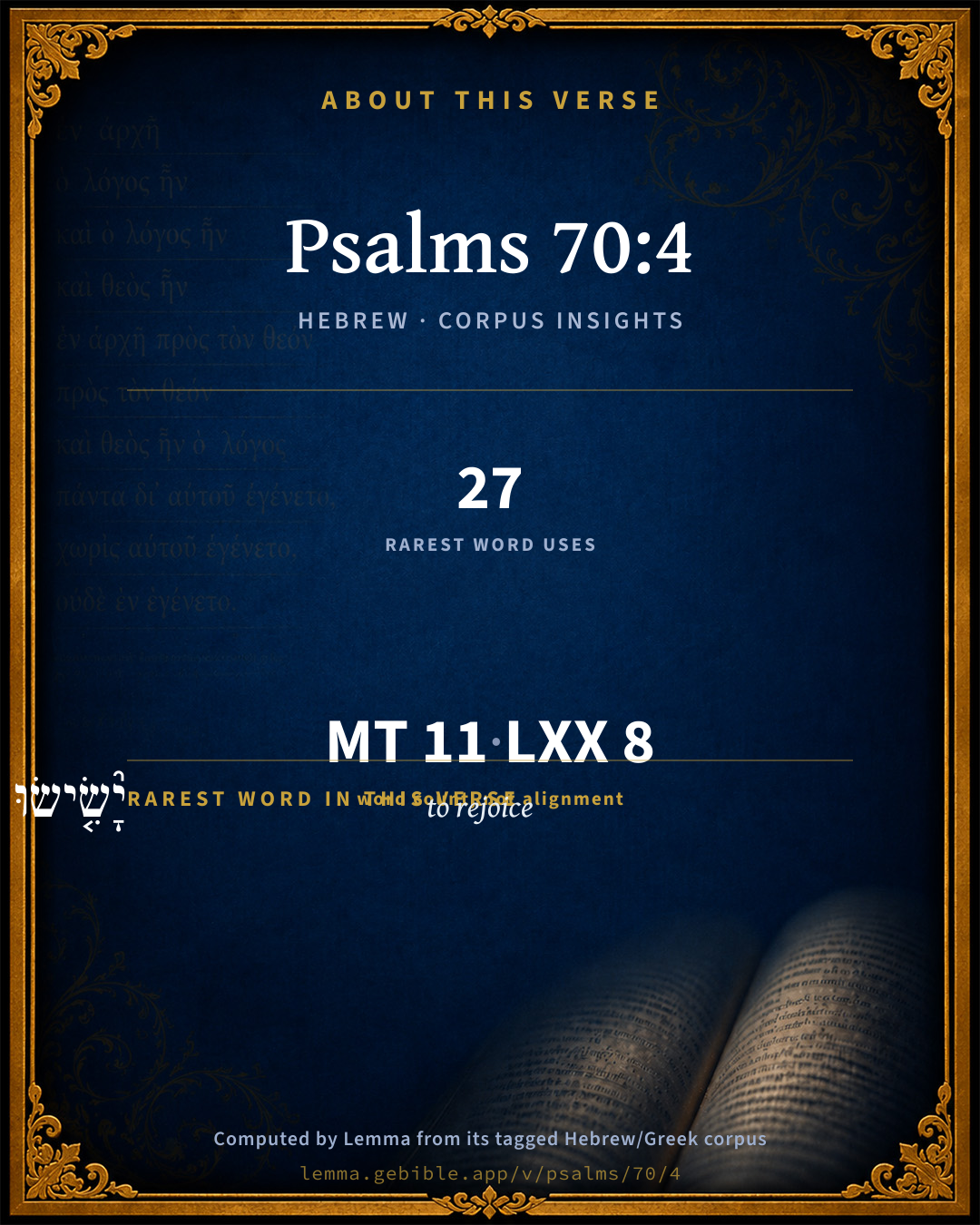
These counts appear in no published source. They are computed here, from the morphology-tagged text and Lemma’s own curated glosses. What Lemma adds →

11
words
10
distinct lemmas
Wisdom
section

Shared distinctive vocabulary

יָ֘שִׂ֤ישׂוּ to rejoice H7797 occurs in 24 verses of the Hebrew Bible. Also found in:

Grammatical profile

  • 6 verbs
  • 4 nouns
  • 1 preposition

Verb forms

  • יָ֘שִׂ֤ישׂוּ Qal · Imperfect
  • וְיִשְׂמְח֨וּ Qal · Imperfect
  • מְבַ֫קְשֶׁ֥יךָ Piel · Participle Active
  • וְיֹאמְר֣וּ Qal · Imperfect
  • יִגְדַּ֣ל Qal · Imperfect
  • אֹ֝הֲבֵ֗י Qal · Participle Active

Hebrew & Septuagint length

In English translation the verse runs 24 words from the Hebrew and 24 from the Septuagint (LXX English) — the same length.

A rough comparison of the two English renderings, which tokenize alike — not a word-level alignment.

Word counts can differ between the Hebrew and the Greek without any difference in meaning — e.g. the Hebrew direct-object marker אֵת has no separate Greek word, and Greek often adds the article ὁ.

In the original languages it is 11 Hebrew tokens and 8 Greek tokens — but the two are counted differently (Hebrew bundles its prefixes and suffixes into one token; the Greek is in lemma form), so that isn’t a like-for-like length.

Cross-references

8

Topical passages linked to Psalms 70:4 in the Treasury of Scripture Knowledge — connected by theme and wording, ordered by reader-vote popularity; previews shown in the World English Bible.

  • Psalms 40:16 Let all those who seek you rejoice and be glad in you. Let such as love your salvation say continually, "Let Yahweh be exalted!"
  • Lamentations 3:25 Yahweh is good to those who wait for him, to the soul that seeks him.
  • Psalms 35:27 Let them shout for joy and be glad, who favor my righteous cause. Yes, let them say continually, "Yahweh be magnified, Who has pleasure in the prosperity of his servant!"
  • Isaiah 61:10 I will greatly rejoice in Yahweh, my soul shall be joyful in my God; for he has clothed me with the garments of salvation, he has covered me with the robe of righteousness, as a bridegroom decks himself with a garland, and as a bride adorns herself with her jewels.
  • Isaiah 65:13–14 Therefore thus says the Lord Yahweh, Behold, my servants shall eat, but you shall be hungry; behold, my servants shall drink, but you shall be thirsty; behold, my servants shall rejoice, but you shall be disappointed;
  • Psalms 97:12 Be glad in Yahweh, you righteous people! Give thanks to his holy Name.
  • John 16:20 Most assuredly I tell you, that you will weep and lament, but the world will rejoice. You will be sorrowful, but your sorrow will be turned into joy.
  • Psalms 5:11 But let all those who take refuge in you rejoice, Let them always shout for joy, because you defend them. Let them also who love your name be joyful in you.

Cross-references courtesy of OpenBible.info (CC BY 4.0).

Hebrew and Greek witnesses Masoretic Hebrew ↔ Greek Septuagint

The same verse in the two great witnesses to the Old Testament, shown verse-for-verse.

You’re reading Greek Psalm 69 (Hebrew Psalm 70). The Septuagint counts the superscription, so verse numbers can differ from the Hebrew — chapter-level alignment, not verse-by-verse. Numbering follows Rahlfs.

These are two independent witnesses, not word-aligned to each other, and the Septuagint is shown in lemma (dictionary) form.

Hebrew Psalms 70:4 Masoretic · Westminster Leningrad Codex

יָ֘שִׂ֤ישׂוּ וְיִשְׂמְח֨וּ בְּךָ֗ כָּֽל מְבַ֫קְשֶׁ֥יךָ וְיֹאמְר֣וּ תָ֭מִיד יִגְדַּ֣ל אֱלֹהִ֑ים אֹ֝הֲבֵ֗י יְשׁוּעָתֶֽךָ

Let all those who seek you rejoice and be glad in you. Let those who love your salvation continually say, "Let God be exalted!"

World English Bible · Public Domain

Greek LXX Greek Psalm 69:4 Septuagint · lemma form

ἀποστρέφω παραυτίκα αἰσχύνω ὁ λέγω ἐγώ εὖγε εὖγε

Let all that seek you exult and be glad in you: and let those that love your salvation say continually, Let God be magnified.

LXX2012 (modern English Septuagint) · Public Domain

Hebrew: Westminster Leningrad Codex (CC BY 4.0). Greek: Septuagint (public domain); English from LXX2012 (modern English Septuagint) (Public Domain). How the Septuagint differs from the Hebrew →

Commentary

Notes on Psalms 70:4 from classic Christian and Jewish commentators (each source and its license shown beneath its notes). The classic Christian expositions comment on the surrounding passage and are grouped to its opening verse, so a note may address several verses; the Jewish commentaries on the Tanakh (Rashi and others) are per-verse, so they appear only where the commentator wrote on this verse.

Lemma curates 59 commentaries, every one of them public domain or Creative Commons licensed, each selected and text-cleaned for this edition rather than reprinted as found. About our sources →

Trapp's Complete Commentary

John Trapp

Psa 70:4 Let all those that seek thee rejoice and be glad in thee: and let such as love thy salvation say continually, Let God be magnified.

Ver. 4. Let all those that seek thee, &c.] Piorum characteres, saith one, a godly man characterized, by his search after God, his joy in him, his love to him, his praises of him.

Let God be magnified] In illo quicquid ego; ille, non ego, saith Augustine.

John Trapp, A Commentary or Exposition upon All the Books of the Old and New Testament (1647–1656) — public domain. Text from a community e-Sword module.

The Biblical Illustrator

Joseph S. Exell

Psa_70:4

Let such as love Thy salvation say continually, Let God be magnified.

Our watchword

These words occur at least three times in the Psalms, and therefore we may regard them as especially important.

I. Discriminate the character. The individuals here spoken of are those who love Gods salvation. Then it is implied that they are persons who are saved, because it is not according to nature to love a salvation in which we have no part. We may admire the salvation which is preached, but we shall only love the salvation which is experienced. But, more than this, to sustain and bring to perfection in the renewed heart an ardent affection towards the Divine salvation of a sort that will continue, and become practically fruitful, there must be an intelligent consideration, and an instructed apprehension as to the character of this salvation. Now, let me show you what it is in salvation that the thoughtful believer loves; and I may begin by saying that he loves, best of all, the Saviour Himself. Often our Lord is called Salvation, because He is the great worker of it, the author and finisher, the Alpha and the Omega of it. He who has Christ has salvation; and, as He is the essence of salvation, He is the centre of the saved ones affection. But you love not only the Saviours person, for I am sure you delight in the plan of salvation. What is that plan? It is summed up in a single word--substitution. Oh, then let us always say, Let God be magnified, since He devised, arranged, and carried out this Godlike method of blending justice with mercy. But we also love Gods salvation when we consider what was the object of it. The object of it towards us was to redeem unto Christ a people who should be zealous for good works. The sinner loves a salvation from hell; the saint loves a salvation from sin.

II. Meditate on the saying. Every nation has its idiom, every language has its shibboleth, almost every district has its proverb. Behold the idiom of gracious souls, listen to their household word, their common proverb--it is this, Let God be magnified! Let God be magnified! Observe that this is a saying which is founded upon truth and justice. Let God be magnified, for it is He that saved us, and not we ourselves. None can divide the honours of grace, for the Lord alone hath turned our captivity. From beginning to end salvation is of the Lord, therefore, let God be magnified. This saying is naturally suggested by love. It is because we love His salvation that we say, The Lord be magnified. You cannot love God without desiring to magnify Him, and I am sure that you cannot know that you are saved without loving Him. Moreover, this saying of our text is, deeply sincere and practical. I am sure David did not wish to see hypocrites multiplied; but such would be the case if men merely said, Let God be magnified, and did not mean it. Moreover, it must not only be sincere, but it must be paramount. I take it that there is nothing which a Christian man should say continually, except this, Let God be magnified. That which a man may say continually is assuredly the master-thought of his mind. Listen to the cherubim and seraphim; they continually do cry, Holy! Holy! Holy! Lord God of Hosts! And the text tells us this must be continual. How earnest you feel about the cause of Christ when you have heard an inspiriting sermon, but how long does it last?

III. The wish. Let God be magnified. This wish is promoted by an anxiety for Gods glory; it is a most holy wish, and it ought to be fulfilled. I shall ask your attention to the reasons of the wish. Why should it be wished?

1. First, because it always ought to be said, Let God be magnified. It is only right, and according to the fitness of things, that God should be magnified in the world which Ha Himself created. Such a handiwork deserves admiration from all who behold it. But when He new-made the world, and especially when He laid the foundation of His new palace in the fair colours of Jesus blood, and adorned it with the sapphires of grace and truth; He had a double claim upon our praise.

2. But, we wish it next, because it always needs saying. The word is dull and sleepy, and utterly indifferent to the glory of God in the work of redemption. We need to tell it over and over and over again, that God is great in the salvation of His people.

3. And, again, we desire this, because the saying of this continually does good to the sayers. He who blesses God blesses himself. We cannot serve God with the heart without serving ourselves most practically. Nothing, brethren, is more for your benefit than to spend and be spent for the promotion of the Divine honour.

4. Then, again, this promotes the welfare of Gods creatures. (C. H. Spurgeon.)

The Biblical Illustrator, edited by Joseph S. Exell (c. 1880s–1900s) — public domain. Text from a community e-Sword module.

J. A. Alexander on Psalms

Joseph Addison Alexander

5. (Psa 70:4). They shall rejoice and be glad in thee—all (those) seeking thee; and they shall say always, great be Jehovah—(those) loving thy salvation. See above, on Psa 40:16. The only variation here is the insertion of the copulative and at the beginning of the second clause.

Joseph Addison Alexander, The Psalms Translated and Explained (1850) — public domain. Text from a community e-Sword module.

Adam Clarke's Commentary

Verse 4. Let God be magnified.] Let his glory, mercy, and kindness, continually appear in the increase of his own work in the souls of his followers!

Adam Clarke's Commentary on the Bible (1810–1826) — public domain. Text from a community e-Sword/MySword module.

Ellicott's Commentary for English Readers

(4) For a reward of . . .—Psa_40:14, “and put to shame.” The change is probably a copyist’s error.

A Bible Commentary for English Readers, edited by Charles John Ellicott (1878–1897) — public domain. Text from a community e-Sword module.

The Cambridge Bible for Schools and Colleges

gen. ed. J. J. S. Perowne

4. Cp. Psa_35:27. The discomfiture of the wicked gives occasion for the righteous to rejoice in God, not only because they are set free from persecution, but because they see in it the proof of God’s righteous sovereignty and the unfolding of His purposes of salvation.

such as love thy salvation] Cp. “they that love his name” (Psa_69:36); and the corresponding N.T. thought in 2Ti_4:8.

The Cambridge Bible for Schools and Colleges (gen. ed. J. J. S. Perowne; Cambridge University Press, 1878–1918) — public domain. Text from a community e-Sword module.

John Gill's Exposition

Let all those that seek thee,.... The Targum is,

"that seek doctrine (or instruction) from thee.''

rejoice and be glad in thee; the Targum paraphrases it,

"rejoice and be glad in thy word.''

and let such as love thy salvation say continually, let God be magnified; the Targum is,

"let the glory of the Lord be increased;''

and in Psa 40:16, instead of "God", it is "the Lord", or "Jehovah": See Gill on Psa 40:16.

John Gill's Exposition of the Whole Bible (1746–1763) — public domain (CC PDM 1.0). Text via the HelloAO Bible API.

Albert Barnes' Notes on the Bible

Let all those that seek thee ... - The only change in this verse from Psa 40:16, is in the insertion of the word “and” in the beginning of the second clause - “and let such as love,” etc.

Albert Barnes' Notes on the Bible (1834–1885) — public domain. Text from a community e-Sword/MySword module.

The Treasury of David

Charles H. Spurgeon

Ver. 4. Anger against enemies must not make us forget our friends, for it is better to preserve a single citizen of Zion, than to kill a thousand enemies.

Let all those that seek thee rejoice and be glad in thee. All true worshippers, though as yet in the humble ranks of seekers, shall have cause for joy. Even though the seeking commence in darkness, it shall bring light with it.

And let such as love thy salvation say continually, Let God be magnified. Those who have tasted divine grace, and are, therefore, wedded to it, are a somewhat more advanced race, and these shall not only feel joy, but shall with holy constancy and perseverance tell abroad their joy, and call upon men to glorify God. The doxology, "Let the Lord's name be magnified, "is infinitely more manly and ennobling than the dog's bark of "Aha, aha."

Ver. 4. Such as love thy salvation. They love it for its own sake; they love it for the sake of him who procured it by his obedience until death; they love it for the sake of that Holy Spirit who moved them to seek it and accept it; and they love it for the sake of their own souls, which they cannot but love, and which, without it, would be the most miserable outcasts in the universe. No wonder that in the light of its intrinsic importance, and of its intrinsic relations, they should be "such as love God's salvation." All men are lovers as well as seekers; for all men love. Some love money more than God's salvation; others love pleasure, even the pleasures of sin, more than God's salvation; and others love bustle and business more than God's salvation. But, as the stamp of the material, the temporal and the evanescent, is on all these earthly objects of men's love, the friends of Jesus elevate above them all, as the worthier object of their regard and embrace, the salvation of God. James Frame.

Ver. 4. Let God be magnified. Not only The Lord be magnified, but also alway. Behold, when thou wast straying, and wast turned away from him; he recalled thee: Be the Lord magnified. Behold, he hath inspired thee with confession of sins; thou hast confessed, he hath given pardon: Be the Lord magnified.... Now, thou hast begun to advance, thou hast been justified, thou hast arrived at a sort of excellence of virtue; is it not a seemly thing that thou also sometime be magnified? No! Let them say, Be the Lord alway magnified. A sinner thou art, to be magnified in order that he may call; you confess, be he magnified in order that he may forgive: now thou livest justly, be he magnified in order that he may direct; you persevere even unto the end, be he magnified in order that he may glorify. Be the Lord, then, alway magnified. Let just men say this, let them say this that seek him. Whosoever doth not say this, doth not seek him... Be the Lord magnified. But, wilt thou thyself never be great? wilt thou be nowhere? In him was something, in me nothing; but if in him is whatsoever I am, be he magnified, not I. But, what of thee? But I am poor and needy: he is rich, he abounding, he needing nothing. Behold my light, behold whence I am illumined, for I cry, "Thou shalt illumine my candle, O Lord; my God, thou shalt illumine my darkness. The Lord doth loose men fettered, the Lord raiseth up men crushed, the Lord maketh wise the blind men, the Lord keepeth the proselytes." Ps 18:28 146:7. What, then, of thee? But I am needy and poor. I am like an orphan, my soul is like a widow destitute and desolate; help I seek, alway mine infirmity I confess. But I am poor and needy. There have been forgiven me my sins, now I have begun to follow the commandments of God; still, however, I am needy and poor. Why still needy and poor? Because I see another law in my members fighting against the law of my mind. Ro 7:23. Why needy and poor? Because, "Blessed are they that hunger and thirst after righteousness." Mt 5:6. Still I hunger, still I thirst. Augustine.

Ver. 4. Joy for seekers, and employment for finders.

Ver. 4. (last clause).

I. The character.

II. The saying.

III. The wish.

Psalms 70:5*

Charles H. Spurgeon's The Treasury of David (1869–1885) — public domain. Psalms only. Text from a community e-Sword/MySword module.

Whedon's Commentary on the Bible

Daniel D. Whedon

4. Let God be magnified—In Psalms 40, “Jehovah,” for Eloheem, (God,) here.

Daniel D. Whedon (gen. ed.), Commentary on the Old and New Testaments (1874–1909) — public domain. Text from a community e-Sword module.

The Pulpit Commentary

Let all those that seek thee rejoice and be glad in thee: and let such as love thy salvation say continually, Let God be magnified. Psa_40:16 has, "Let the Lord be magnified."

The Pulpit Commentary (1880–1919), ed. H.D.M. Spence-Jones & Joseph S. Exell — public domain. Text from a community e-Sword module.

Keil & Delitzsch

C. F. Keil & F. Delitzsch

ויאמרו instead of יאמרו is unimportant. But since the divine name Jahve is now for once chosen side by side with Elohim, it certainly had a strong claim to be retained in Psa 70:5. Instead of תּשׁועתך we have ישׁועתך here; instead of עזרתי, here עזרי. And instead of אדני יחשׁב לי we have here אלהים חוּשׁה־לּי - the hope is turned into petition: make haste unto me, is an innovation in expression that is caused by the taking over of the לי.

Keil & Delitzsch — Biblical Commentary on the Old Testament (1861–1891) — public domain (CC PDM 1.0). Text via the HelloAO Bible API. (Old Testament only.)

unfoldingWord translationNotes

Door43 World Missions Community

seek you

Seeking God represents either 1) asking God for help or 2) thinking about God and obeying him. AT: "ask you for help" or "think about you and obey you" (See: Metaphor)

rejoice and be glad

These two phrases mean basically the same thing and emphasize the intensity of gladness. AT: "rejoice greatly" or "be very glad" (See: Doublet)

love your salvation

The abstract noun "salvation" can be stated as an action. AT: "love you because you saved them" (See: Abstract Nouns)

always say

This exaggeration emphasizes that it is important to praise God often. (See: Hyperbole and Generalization)

May God be praised

This can be stated in active form. AT: "Let everyone praise God" (See: Active or Passive)

poor and needy

Here the words "poor" and "needy" mean basically the same thing and emphasize that he is unable to help himself. AT: "very needy" (See: Doublet)

hurry to me

The writer speaks of God as if he were running to the writer in order to help him. AT: "come quickly to help me" (See: Metaphor)

you are my help and you rescue me

Here the phrase "you rescue me" explains how God is his "help." AT: "you help me by rescuing me" (See: Parallelism)

do not delay

This can be stated in active form. AT: "please come quickly" (See: Litotes)

translationWords

joy

love

save

praise

unfoldingWord translationNotes — © Distant Shores Media and the Door43 World Missions Community, licensed CC BY-SA 4.0. Source: git.door43.org/Door43/en_tn.

Rashi

Rabbi Shlomo Yitzchaki (Rashi)

Let them return in the path of their shame Measure for measure, as they did to me.

in the path In that very same path, en ses trazes, on (their) its footsteps.

those who say about me.

“Aha” An expression of joy, when one sees that his wishes concerning his enemy have been fulfilled.

Rashi on the Tanakh — English translations: “The Judaica Press complete Tanach with Rashi, translated by A. J. Rosenberg” (CC BY 4.0); “Pentateuch with Rashi's commentary by M. Rosenbaum and A.M. Silbermann, 1929-1934” (public domain); “The Metsudah Tanach series, Lakewood, N.J” (CC BY 4.0); and “The Book of Joshua, Metsudah Publications, 1997” (CC BY 4.0). Text via Sefaria.

Lesson kit

Teaching starters — assembled from the data on this page, not authored interpretation. Every prompt links to the verse data it draws on. Edit before teaching.

Psalms, in the Wisdom, opens this verse with 11 words (10 distinct Hebrew lemmas). Its most distinctive word is sûws (“to rejoice”). A historical commentator’s framing appears above. Read the whole chapter for the surrounding context.

Discussion questions

  1. What does “to rejoice” (sûws) contribute to the verse as a whole?
  2. How does Deuteronomy 28:63, which shares the word «to rejoice», read alongside this verse?
  3. These translations render this verse differently. What is at stake in choosing one wording over another?
  4. «יָ֘שִׂ֤ישׂוּ» is a Qal Imperfect verb. How does that grammatical form shape the action described?
  5. Compare how Trapp's Complete Commentary and The Biblical Illustrator read this verse. Where do they agree or differ?

Things to notice

Reading settings

Reading text

Shown beneath each verse's original-language words.

Old Testament
Old Testament edition

Read the OT as the Masoretic Hebrew (MT) or the Greek Septuagint (LXX).

English shown for the Greek Septuagint (in the Hebrew ↔ Greek comparison).

Comparing translations? Open the Compare panel on any verse page to stack up to four side by side.