Psalms 40:16

Hebrew (Westminster Leningrad Codex) Psalms 40:16 appears in the Hebrew Old Testament. The text above is from the Westminster Leningrad Codex. Each word links to its Strong’s number, a concise gloss, and parsing drawn from the Open Scriptures Hebrew Bible morphology. Click any word for its full Brown-Driver-Briggs (BDB) entry.
Download image
Cite this verse

Psalms 40:16 (World English Bible). Public Domain. Lemma interlinear Bible study tool, https://lemma.gebible.app/v/psalms/40/16.

Show BibTeX & RIS
BibTeX
RIS
English Translation
Let all those who seek you rejoice and be glad in you. Let such as love your salvation say continually, "Let Yahweh be exalted!"
World English Bible · Public Domain
Download a study sheet

One document with this verse’s original text, its word-by-word gloss line, the meaning frame, cross-references with their text, attributed commentary, and full source and license credits — printable, and it pastes into notes with its structure intact.

This verse Autodidact and up

Study sheet (.html) Plain text (.txt)

A passage Seminary Student

Up to 50 verses in one chapter. A passage sheet keeps up to 6 commentary sources and 12 cross-references per verse, in the order this page ranks them, and says so on the sheet whenever that leaves anything out. Ask for a single verse and you get the Autodidact verse sheet above.

Everything on this page stays free to read, with no account — the sheet is a download of what is already on screen, not access to it.

Want to remove ads? Support Godless Engineer
Compare translations 3

The same verse in 3 English versions, stacked beneath the original-language interlinear above. Click any original word for its lexicon entry.

Each is an independent rendering of the whole verse — the interlinear is not word-aligned to these translations.

Highlighted words mark where these versions differ — a whole-verse word diff, not a word-by-word alignment.

  • World English Bible Public Domain
    Let all those who seek you rejoice and be glad in you. Let such as love your salvation say continually, "Let Yahweh be exalted!"
  • King James Version Public Domain
    Let all those that seek thee rejoice and be glad in thee: let such as love thy salvation say continually, The LORD be magnified.
  • unfoldingWord Literal Text CC BY-SA 4.0
    Let all the seekers of you rejoice and be glad in you; let the lovers of your salvation say continually, “May Yahweh be great!”

unfoldingWord Literal Text — © unfoldingWord, licensed CC BY-SA 4.0. Word-aligned USFM3 via Door43 (git.door43.org/unfoldingWord/en_ult).

Versions to compare (up to 4)

3 of 4 selected

Show all 18 translations

Every available English version of this verse, each an independent rendering of the whole verse.

  • World English Bible Public Domain
    Let all those who seek you rejoice and be glad in you. Let such as love your salvation say continually, "Let Yahweh be exalted!"
  • Berean Standard Bible Public Domain
    May all who seek You rejoice and be glad in You; may those who love Your salvation always say, “The LORD be magnified!”
  • Majority Standard Bible Public Domain
    May all who seek You rejoice and be glad in You; may those who love Your salvation always say, “The LORD be magnified!”
  • King James Version Public Domain
    Let all those that seek thee rejoice and be glad in thee: let such as love thy salvation say continually, The LORD be magnified.
  • American Standard Version (1901) Public Domain
    Let all those that seek thee rejoice and be glad in thee: Let such as love thy salvation say continually, Jehovah be magnified.
  • Revised Version (1885) Public Domain
    Let all those that seek thee rejoice and be glad in thee: let such as love thy salvation say continually, The LORD be magnified.
  • Geneva Bible (1599) Public Domain
    Let all them, that seeke thee, reioyce and be glad in thee: and let them, that loue thy saluation, say alway, The Lord be praysed.
  • Douay-Rheims (1899) Public Domain
    Let them immediately bear their confusion, that say to me: 'T is well, 't is well.
  • Young's Literal Translation Public Domain
    All seeking Thee rejoice and are glad in Thee, Those loving Thy salvation say continually, `Jehovah is magnified.'
  • Literal Standard Version CC BY-SA 4.0
    All seeking You rejoice and are glad in You, || Those loving Your salvation continually say, “YHWH is magnified.”
  • Unlocked Literal Bible CC BY-SA 4.0
    But may all those who seek you rejoice and be glad in you; let everyone who loves your salvation say continually, “May Yahweh be praised.”
  • unfoldingWord Literal Text CC BY-SA 4.0
    Let all the seekers of you rejoice and be glad in you; let the lovers of your salvation say continually, “May Yahweh be great!”
  • Darby Bible Public Domain
    Let all those that seek thee be glad and rejoice in thee; let such as love thy salvation say continually, Jehovah be magnified!
  • World Messianic Bible Public Domain
    Let all those who seek you rejoice and be glad in you. Let such as love your salvation say continually, “Let the LORD be exalted!”
  • Webster's Bible Public Domain
    \\40:15\\Let them be desolate for a reward of their shame that say to me, Aha, aha.
  • Free Bible Version CC BY-SA 4.0
    But may everyone who comes to you be happy and glad; may those who love your salvation always say, “The Lord is great!”
  • Bible in Basic English Public Domain
    Let all those who are looking for you be glad and have joy in you; let the lovers of your salvation ever say, May the Lord be great.
  • JPS Tanakh (1917) Public Domain
    (40-17) Let all those that seek Thee rejoice and be glad in Thee; let such as love Thy salvation say continually: 'The LORD be magnified.'

Literal Standard Version (2020), Covenant Press — licensed CC BY-SA 4.0. Text via the HelloAO Bible API (eBible.org). Unlocked Literal Bible (unfoldingWord) — licensed CC BY-SA 4.0. Text via the HelloAO Bible API (eBible.org). unfoldingWord Literal Text — © unfoldingWord, licensed CC BY-SA 4.0. Word-aligned USFM3 via Door43 (git.door43.org/unfoldingWord/en_ult). Free Bible Version, Dr. Jonathan Gallagher — licensed CC BY-SA 4.0. Text via the HelloAO Bible API (eBible.org).

Word by word

More ways to search: Search by grammar → Find every occurrence → Compare this word →

Practice this passage: Drill this verse → Learn its vocabulary →

יָ֘שִׂ֤ישׂוּ
sûws
H7797
“to rejoice”
Verb, Qal, Imperfect, 3rd Person, Masculine, Plural
Part of Speech
Verb
Stem
Qal
Form
Imperfect
Person
3rd Person
Gender
Masculine
Number
Plural
Full BDB Definition

Origin: a primitive root

TWOT: 2246

to exult, rejoice - (Qal) to exult, display joy
  1. וְיִשְׂמְח֨וּ sâmach H8055 “and · to rejoice” Conjunction + Verb, Qal, Imperfect, 3rd Person, Masculine, Plural
  2. כָּֽל kôl H3605 “all of” Noun, Common, Masculine, Singular, Construct
  3. מְבַ֫קְשֶׁ֥יךָ bâqash H1245 “seeking · you” Verb, Piel, Participle Active, Masculine, Plural, Construct + Suffix, Personal, 2nd Person, Masculine, Singular
  4. יֹאמְר֣וּ ʼâmar H559 “to say” Verb, Qal, Imperfect, 3rd Person, Masculine, Plural
  5. תָ֭מִיד tâmîyd H8548 “continually” Noun, Common, Masculine, Singular, Absolute
  6. יִגְדַּ֣ל gâdal H1431 “to grow” Verb, Qal, Imperfect, 3rd Person, Masculine, Singular
  7. יְהוָ֑ה Yᵉhôvâh H3068 “LORD” Noun, Proper
  8. אֹֽ֝הֲבֵ֗י ʼâhab H157 “loving” Verb, Qal, Participle Active, Masculine, Plural, Construct
  9. תְּשׁוּעָתֶֽךָ tᵉshûwʻâh H8668 “salvation · your” Noun, Common, Feminine, Singular, Construct + Suffix, Personal, 2nd Person, Masculine, Singular

About this verse

These counts appear in no published source. They are computed here, from the morphology-tagged text and Lemma’s own curated glosses. What Lemma adds →

11
words
10
distinct lemmas
Wisdom
section

Shared distinctive vocabulary

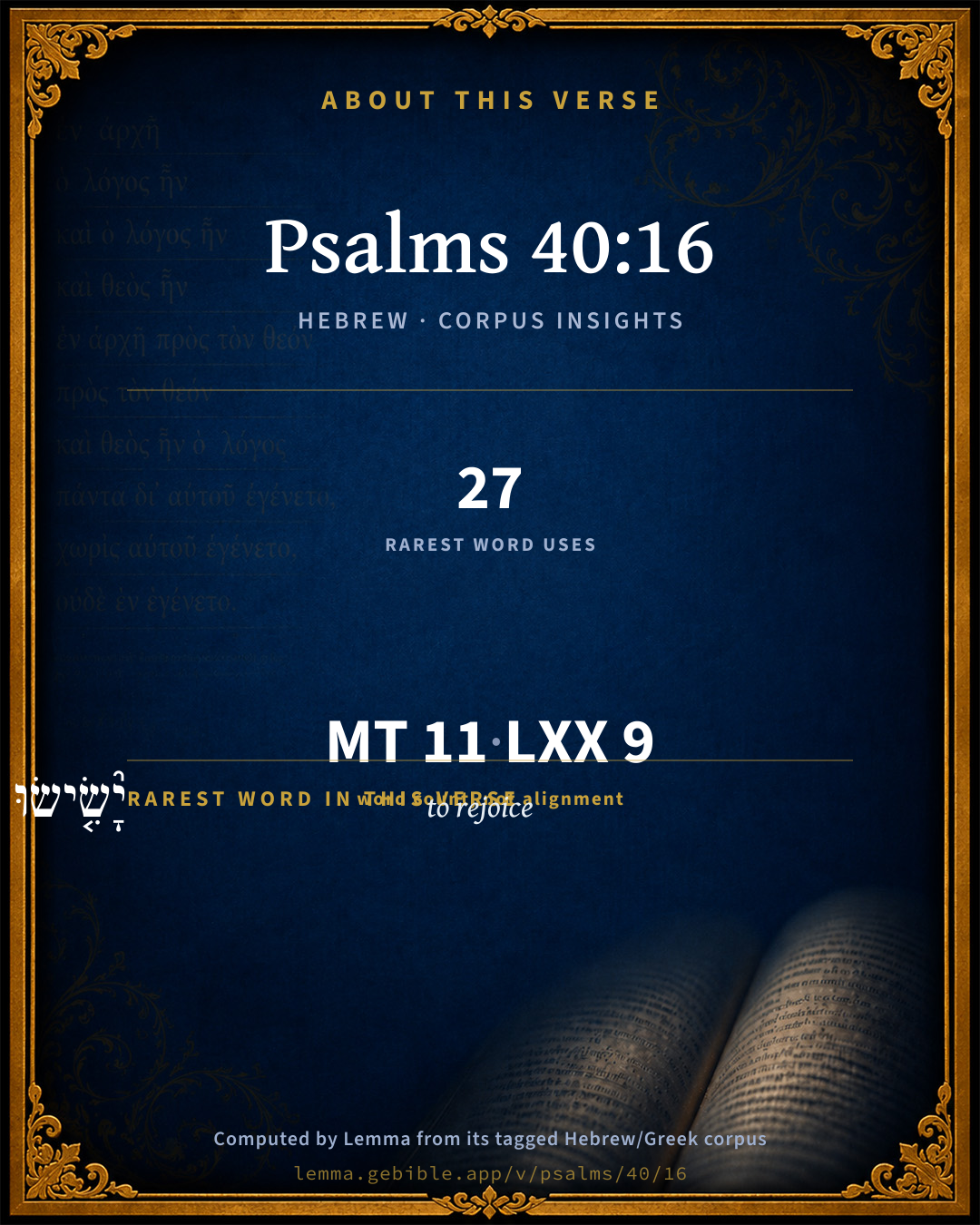
יָ֘שִׂ֤ישׂוּ to rejoice H7797 occurs in 24 verses of the Hebrew Bible. Also found in:

Grammatical profile

  • 6 verbs
  • 4 nouns
  • 1 preposition

Verb forms

  • יָ֘שִׂ֤ישׂוּ Qal · Imperfect
  • וְיִשְׂמְח֨וּ Qal · Imperfect
  • מְבַ֫קְשֶׁ֥יךָ Piel · Participle Active
  • יֹאמְר֣וּ Qal · Imperfect
  • יִגְדַּ֣ל Qal · Imperfect
  • אֹֽ֝הֲבֵ֗י Qal · Participle Active

Hebrew & Septuagint length

In English translation the verse runs 24 words from the Hebrew and 26 from the Septuagint (LXX English) — closely comparable.

A rough comparison of the two English renderings, which tokenize alike — not a word-level alignment.

Word counts can differ between the Hebrew and the Greek without any difference in meaning — e.g. the Hebrew direct-object marker אֵת has no separate Greek word, and Greek often adds the article ὁ.

In the original languages it is 11 Hebrew tokens and 9 Greek tokens — but the two are counted differently (Hebrew bundles its prefixes and suffixes into one token; the Greek is in lemma form), so that isn’t a like-for-like length.

Cross-references

13

Topical passages linked to Psalms 40:16 in the Treasury of Scripture Knowledge — connected by theme and wording, ordered by reader-vote popularity; previews shown in the World English Bible.

  • Psalms 35:27 Let them shout for joy and be glad, who favor my righteous cause. Yes, let them say continually, "Yahweh be magnified, Who has pleasure in the prosperity of his servant!"
  • Psalms 68:3 But let the righteous be glad. Let them rejoice before God. Yes, let them rejoice with gladness.
  • Psalms 119:123 My eyes fail looking for your salvation, For your righteous word.
  • Acts 19:17 This became known to all, both Jews and Greeks, who lived at Ephesus. Fear fell on them all, and the name of the Lord Jesus was magnified.
  • Psalms 22:26 The humble shall eat and be satisfied. They shall praise Yahweh who seek after him. Let your hearts live forever.
  • Psalms 105:3 Glory in his holy name. Let the heart of those who seek Yahweh rejoice.
  • Isaiah 65:13–14 Therefore thus says the Lord Yahweh, Behold, my servants shall eat, but you shall be hungry; behold, my servants shall drink, but you shall be thirsty; behold, my servants shall rejoice, but you shall be disappointed;
  • Luke 1:46–47 Mary said, "My soul magnifies the Lord.
  • Philippians 3:7–9 However, what things were gain to me, these have I counted loss for Christ.
  • Psalms 119:111 I have taken your testimonies as a heritage forever, For they are the joy of my heart.
  • Psalms 119:166–167 I have hoped for your salvation, Yahweh. I have done your commandments.
  • Matthew 13:45–46 "Again, the Kingdom of Heaven is like a man who is a merchant seeking fine pearls,
  • Psalms 119:81 My soul faints for your salvation. I hope in your word.

Cross-references courtesy of OpenBible.info (CC BY 4.0).

Hebrew and Greek witnesses Masoretic Hebrew ↔ Greek Septuagint

The same verse in the two great witnesses to the Old Testament, shown verse-for-verse.

You’re reading Greek Psalm 39 (Hebrew Psalm 40). The Septuagint counts the superscription, so verse numbers can differ from the Hebrew — chapter-level alignment, not verse-by-verse. Numbering follows Rahlfs.

These are two independent witnesses, not word-aligned to each other, and the Septuagint is shown in lemma (dictionary) form.

Hebrew Psalms 40:16 Masoretic · Westminster Leningrad Codex

יָ֘שִׂ֤ישׂוּ וְיִשְׂמְח֨וּ בְּךָ֗ כָּֽל מְבַ֫קְשֶׁ֥יךָ יֹאמְר֣וּ תָ֭מִיד יִגְדַּ֣ל יְהוָ֑ה אֹֽ֝הֲבֵ֗י תְּשׁוּעָתֶֽךָ

Let all those who seek you rejoice and be glad in you. Let such as love your salvation say continually, "Let Yahweh be exalted!"

World English Bible · Public Domain

Greek LXX Greek Psalm 39:16 Septuagint · lemma form

κομίζω παραχρῆμα αἰσχύνη αὐτός ὁ λέγω ἐγώ εὖγε εὖγε

Let all those that seek you, O Lord, exult and rejoice in you; and let them that love your salvation say continually, The Lord be magnified.

LXX2012 (modern English Septuagint) · Public Domain

Hebrew: Westminster Leningrad Codex (CC BY 4.0). Greek: Septuagint (public domain); English from LXX2012 (modern English Septuagint) (Public Domain). How the Septuagint differs from the Hebrew →

Commentary

Notes on Psalms 40:16 from classic Christian and Jewish commentators (each source and its license shown beneath its notes). The classic Christian expositions comment on the surrounding passage and are grouped to its opening verse, so a note may address several verses; the Jewish commentaries on the Tanakh (Rashi and others) are per-verse, so they appear only where the commentator wrote on this verse.

Lemma curates 59 commentaries, every one of them public domain or Creative Commons licensed, each selected and text-cleaned for this edition rather than reprinted as found. About our sources →

Trapp's Complete Commentary

John Trapp

Psa 40:16 Let all those that seek thee rejoice and be glad in thee: let such as love thy salvation say continually, The LORD be magnified.

Ver. 16. Let all those that seek thee rejoice] viz. When they hear of my deliverance. The saints have both their joys and griefs in common with their fellow members, as being in the body, Heb 13:3; both in the body of Christ and in the body of flesh and frailty.

John Trapp, A Commentary or Exposition upon All the Books of the Old and New Testament (1647–1656) — public domain. Text from a community e-Sword module.

The Biblical Illustrator

Joseph S. Exell

Psa_40:16

Let such as love Thy salvation say continually, The Lord be magnified.

Loving Gods salvation

All who are saved unto eternal life not only accept Gods salvation from a sense of their absolute and urgent need of it as the alone method that meets their case, but they fall in love with it, give it their best affections. Experiencing its benign, restorative influences, they delight themselves in its Divine Author--the God of their salvation; but they do not, cannot overlook the salvation itself. And the word of this salvation has been sent to us. One should have thought that all would have welcomed it. But the case is far otherwise. However, there are those who love Gods salvation and their number continually increases. But with these it was not always so. They, too, for a long while did not desire it, and they hid as it were their faces from it, despised it and esteemed it not. But now it is all their desire, for a great change has been wrought in them. And the reasons that rule both those who hate and those who love Gods salvation are the same. This may seem a paradox, but it is sober truth. For the reason why this salvation is loved is because it engages to deliver wholly from sin, in our love of it and in our living in it. No doubt others love salvation in the sense of deliverance from sins direful consequences hereafter. There is no need that a man should be born again in order to his loving Gods salvation in this vague, outward, selfish sense. Every man is deeply averse to pain and perdition, and cannot endure the thought of them. Self-love in the form of self-defence is a universal law relating to life of every sort, even the lowest in the vegetable creation, and particularly in sentient existences, both on land and in the sea. This is so well established that it has passed into a proverb that self-preservation is the first law of life. The sensitive plant is an instance in point. The sponge also may be adduced as another. Naturalists tell us that, in its native home in the deep, it will draw itself together of its own accord in order to escape destruction. Being often devoured by the fish for food, it quickly discovers their approach, and to protect itself against their marauding designs it contracts itself voluntarily into a much smaller space than it can be squeezed into forcibly; but the danger over, if it be fortunate enough to escape, it again expands itself into its usual size. It will not yield itself up to be devoured so long as it can help it. There is scarcely need to add that no creature will willingly suffer, especially what threatens life, without a hard struggle and a persistent resistance to the last. Hence we find mankind generally coveting earnestly to be saved in the sense o! escaping from misery and enjoying bliss. At least they choose heaven rather than hell, though they will not accept it in the only way in which it may be had, and the only way in which it is worth having. They are deeply in love with forgiveness of sins and immunity from suffering their penal consequences, but they utterly regret the way in which all this may be secured. Pardon and safety they will accept, and if they can be assured that they have nothing to fear, it will be a great relief to them; but when you speak about conversion, contrition, resisting sin, and mortifying and renouncing it, and doing the will of God, they will not listen, but prefer not to be saved titan to part with their sins. But those who love Gods salvation love it for these very reasons, that it parts them for ever from their sins, slaying them within them, and leading them on to purity of heart and life. For salvation is not merely deliverance from danger and distress. However indispensable this experience may be to the spiritual life, it ought by degrees to be comparatively lost; at least that another greater--yes, I advisedly say greater--should supersede it and occupy its place, namely, what to do to be healed, to be spiritually well. Strange to say, here men quarrel with the salvation of God instead of allowing it to do its proper work upon them by eradicating sin from their nature. But for this selfsame reason it is ardently loved by those whose hearts are in the right. Again, what has been sought to be proved will be seen still further by adverting to the freeness of the salvation. This will further illustrate and establish the truth of my statement, for it is a well-known fact that Gods salvation, by reason of its entire and absolute freeness, is at a discount on the one hand, and at a premium on the other. Next to the entire moral recovery it effects, its freeness alike stirs up hatred and produces love; and men fall out and fall in with it for the selfsame reason. Salvation by grace gives hope to the poor, needy and lost sinner, who is conscious of his great misery, unworthiness and ill-desert. How highly he prizes this graciousness! If its gratuitous freeness spoils it to blind, conceited unbelief, the selfsame peculiarity makes it doubly precious to the believer, and evolves his devoutest affection. And, blessed be God, it is a most convenient as well as a most profitable transaction for us. If we bring to this salvation our darkness, we shall have its light; our poverty, we shall have its riches: our guilt, we shall haw its pardon; our misery, we shall have its happiness. (Thomas Rees.)

The Biblical Illustrator, edited by Joseph S. Exell (c. 1880s–1900s) — public domain. Text from a community e-Sword module.

J. A. Alexander on Psalms

Joseph Addison Alexander

17. (Psa 40:16). They shall rejoice and be glad in thee—all (those) seeking thee. They shall say always, Great be Jehovah—(those) loving thy salvation. The structure of the classes is alike, each beginning with the action, and ending with a description of the agent. The joy and praise are represented as the fruit of the deliverence here prayed for. In thee, in communion with thee, in the enjoyment of thy favour. Seeking thee, seeking that communion and that favour. Great is Jehovah, or the Lord be magnified, i. e. recognised as great and glorious. Loving thy salvation, not merely desiring it for themselves, but rejoicing in it as bestowed on others. See above, Psa 35:27, and compare Psa 22:24 (23), Psa 69:33 (32).

Joseph Addison Alexander, The Psalms Translated and Explained (1850) — public domain. Text from a community e-Sword module.

Geneva Bible (1599)

Geneva Bible translators

As the faithful always praise God for his benefits, so the wicked mocked God’s children in their afflictions.

Geneva Bible (1599) marginal notes — public domain. Text via Bolls.life.

Jamieson, Fausset & Brown

Robert Jamieson, A. R. Fausset & David Brown

(Compare Psa 35:27).

love thy salvation--delight in its bestowal on others as well as themselves.

Jamieson, Fausset & Brown — Commentary Critical and Explanatory on the Whole Bible (1871) — public domain (CC PDM 1.0). Text via the HelloAO Bible API.

Adam Clarke's Commentary

Verse 16. Let all those that seek thee - be glad] In making prayer and supplication to thee, let them ever find thee, that they may magnify thee for the blessings they receive.

Love thy salvation] Who earnestly desire to be saved from sin: saved in thy own way, and on thy own terms.

The Lord be magnified.] Let God be praised continually for the continual blessings he pours down.

Adam Clarke's Commentary on the Bible (1810–1826) — public domain. Text from a community e-Sword/MySword module.

John Calvin's Commentaries

16. Let all those that seek thee be glad and rejoice in thee. David here uses another argument — one which he often adduces elsewhere — in order to obtain deliverance; not that it is necessary to allege reasons to persuade God, but because it is profitable to confirm our faith by such supports. As, then, it is the will of God that he should be known in his gracious character, not only of one or two, but generality of all men, whenever he vouchsafes deliverance to any of his children, it is a common benefit which all the faithful ought to apply to themselves when they see in the person of one man in what manner God, who is never inconsistent with himself, will act towards all his people. David, therefore, shows that he asks nothing for himself individually but what pertains to the whole Church. He prays that God would gladden the hearts of all the saints, or afford them all common cause of rejoicing: so that, assured of his readiness to help them, they may have recourse to him with greater alacrity. Hence we conclude, that, in the case of every individual, God gives a proof of his goodness towards us. What is added, those that love thy salvation, is also worthy of being observed by us. We may infer from this, that our faith is only proved to be genuine when we neither expect nor desire preservation otherwise than from God alone. Those who devise various ways and means of preservation for themselves in this world, despise and reject the salvation which God has taught us to expect from him alone. What had been said before, those who seek thee, is to the same purpose. If any individual would depend wholly upon God, and desire to be saved by his grace, he must renounce every vain hope, and employ all his thoughts towards the reception of his strength. Here, again, we must observe that two things are contrasted with each other. Formerly David had said that the wicked sought his life; now he ascribes to the faithful quite a contrary feeling, namely, that they seek God. In like manner he had related the reproaches and derision of the ungodly, while they said, Aha, aha! and now he introduces the godly speaking very differently, saying, The Lord be magnified!

John Calvin's Commentaries (1540-1563) — public domain. Text from the Calvin Translation Society English edition (1840s-50s) via the Christian Classics Ethereal Library (ccel.org). Calvin's coverage is partial (roughly two-thirds of the Bible); uncommented books and verses are honest gaps, never fabricated. The 19th-century editor's footnotes and remarks are omitted so the notes are faithfully Calvin's own voice.

The Cambridge Bible for Schools and Colleges

gen. ed. J. J. S. Perowne

16. Cp. Psa_35:27. The discomfiture of the wicked gives occasion for the righteous to rejoice in God, not merely because they are set free from persecution, but because they see in it the proof of God’s righteous sovereignty and the unfolding of His purposes of salvation.

such as love thy salvation] Cp. Psa_40:10 : and the corresponding N.T. thought in 2Ti_4:8.

The Cambridge Bible for Schools and Colleges (gen. ed. J. J. S. Perowne; Cambridge University Press, 1878–1918) — public domain. Text from a community e-Sword module.

John Gill's Exposition

Let all those that seek thee,.... In the first place, with their whole hearts, earnestly and diligently, in Christ, and under the influences of his Spirit, for pardon, righteousness, communion, larger measures of grace, and for honour, glory, immortality, and eternal life;

rejoice and be glad in thee: as their covenant God, the Father of their mercies, the God of all comfort and salvation, who pardons their sins, clothes them with the robes of righteousness and garments of salvation, and accepts their persons in Christ; all which is matter of joy and gladness: Christ is concerned for the joy of his people, Joh 15:11; the Targum is, "they shall", or "let them rejoice, and be glad in thy word": in himself, the essential Word, in whom there is always ground and reason of joy and gladness; because of his person, blood, righteousness, and sacrifice;

let such as love thy salvation; either Christ, who is God's salvation, Gen 49:18; and who is loved by his people, universally, superlatively, and sincerely; or the salvation of him, his deliverance from the grave, resurrection from the dead, and exaltation; the benefits of which believers share in, and so have reason to love it: or the salvation he is the author of, which is loved by those that know it; partly because agreeable to the divine perfections, the glory of God is great in it; and partly because it is so full and complete in itself, and so suitable to them;

say continually, the Lord be magnified; let this be their constant employment in this world, as it will be for ever in the next, to ascribe greatness to God; or greatly to praise him, because of the great salvation wrought out for them.

John Gill's Exposition of the Whole Bible (1746–1763) — public domain (CC PDM 1.0). Text via the HelloAO Bible API.

Albert Barnes' Notes on the Bible

Let all those that seek thee - All those who desire to know thee; to understand thy ways; to be thy friends. The phrase is used to denote the truly pious, because it is a characteristic of all such that they truly desire to be acquainted with God, and to find the way which leads to his favor.

Rejoice and be glad in thee -

(1) By finding thee, or securing the object which they sought;

(2) in thee, as the source of all true comfort and joy.

The prayer is that all such may be successful in their efforts, while those who have no such aim may be disappointed, Psa 40:14.

Let such as love thy salvation -

(a) Thy method of salvation, or the appointed way by which men may be saved; and

(b) the salvation itself - deliverance from the guilt and dominion of sin, and complete and eternal restoration to the favor of God.

Say continually, The Lord be magnified - See the notes at Psa 35:27, where the same expression occurs.

Albert Barnes' Notes on the Bible (1834–1885) — public domain. Text from a community e-Sword/MySword module.

Matthew Poole's English Annotations

Such as love thy salvation; either,

1. Such as desire and rejoice in the salvation and deliverance which thou givest to me and to others of thy people, which was a great eye-sore and grief to the wicked. Or,

2. Such as expect and seek for their salvation and happiness not from idols, nor from their wicked courses, nor from any creatures, as other men do, but from thee only, and gladly accept and embrace that salvation which thou hast promised, together with the conditions required to it, to wit, faith and repentance. Or,

3. Such as love thy Messias, upon whom both David’s and other holy prophets’ and saints’ thoughts and affections were much fixed, as is evident from many places of Scripture, as Joh 8:58; Act 2:30,31; 1Pe 1:10,11; who is called the desire of all nations, Hag 2:7, and the glory and consolation of Israel, Luk 2:25,32, yea, and by the very title here used, God’s salvation, Isa 62:11 Luk 2:30; whose appearance or coming the godly of all ages did love and long for; and of whom David had so lately and clearly spoken, Psa 40:6,7, &c.; all which considered, this cannot seem a forced or very far-fetched interpretation. The Lord be magnified: let them have continual occasion to magnify God for his mercies vouchsafed to them.

Matthew Poole's English Annotations on the Holy Bible (1683–1685) — public domain. Text from a community e-Sword/MySword module.

The Treasury of David

Charles H. Spurgeon

Ver. 16. Let all those that seek thee, rejoice and be glad in thee. We have done with Ebal and turn to Gerizim. Here our Lord pronounces benedictions on his people. Note who the blessed objects of his petition are: not all men, but some men, "I pray for them, I pray not for the world." He pleads for seekers: the lowest in the kingdom, the babes of the family; those who have true desires, longing prayers, and consistent endeavours after God. Let seeking souls pluck up heart when they hear of this. What riches of grace, that in his bitterest hour Jesus should remember the lambs of the flock! And what does he entreat for them? it is that they may be doubly glad, intensely happy, emphatically joyful, for such the repetition of terms implies. Jesus would have all seekers made happy, by finding what they seek after, and by winning peace through his grief. As deep as were his sorrows, so high would he have their joys. He groaned that we might sing, and was covered with a bloody sweat that we might be anointed with the oil of gladness. Let such as love thy salvation say continually, The Lord be magnified. Another result of the Redeemer's passion is the promotion of the glory of God by those who gratefully delight in his salvation. Our Lord's desire should be our directory; we love with all our hearts his great salvation, let us then, with all our tongues proclaim the glory of God which is resplendent therein. Never let his praises cease. As the heart is warm with gladness let it incite the tongue to perpetual praise. If we cannot do what we would for the spread of the kingdom, at least let us desire and pray for it. Be it ours to make God's glory the chief end of every breath and pulse. The suffering Redeemer regarded the consecration of his people to the service of heaven as a grand result of his atoning death; it is the joy which was set before him; that God is glorified as the reward of the Saviour's travail.

Ver. 16. Let all those that seek thee rejoice and be glad in thee. As every mercy to every believer giveth a proof of God's readiness to show the like mercy to all believers, when they stand in need; so should every mercy shown to any of the number, being known to the rest, be made the matter and occasion of magnifying the Lord. David Dickson.

Ver. 16. Such as love thy salvation. To love God's salvation is to love God himself, the Saviour, or Jesus. Martin Geier.

Ver. 16. Such as love thy salvation. One would think that self love alone should make us love salvation. Aye, but they love it because it is his, "that love thy salvation." It is the character of a holy saint to love salvation itself; not as his own only, but as God's, as God's that saves him. Thomas Goodwin.

Ver. 16. Let such as love thy salvation say continually, The Lord be magnified. Jesus who gave us our capacity of happiness and our capacity of speaking, realised the relation which he had established between them; and hence in praying for his friends, he prayed that in the joy and gladness of their souls they might say, "The Lord be magnified." He desired them to speak of their holy happiness; and it was his wish that when they did speak of it they should speak in terms of praise of Jehovah, for he was the source of it. He desired them to say continually, The Lord be magnified. James Frame.

Ver. 16. (last clause). An everyday saying. Who can use it? What does it mean? Why should they say it? Why say it continually?

Psalms 40:17*

Charles H. Spurgeon's The Treasury of David (1869–1885) — public domain. Psalms only. Text from a community e-Sword/MySword module.

Whedon's Commentary on the Bible

Daniel D. Whedon

16. Those that seek thee… such as love thy salvation—A description of character in marked contrast to that of his enemies. The Hebrew word rendered “salvation” is used to denote deliverance of any kind, temporal or spiritual, and the connexion must indicate its quality and extent. Here it is spiritual, alluding to Psa_40:1-3. It is often thus used, (Psa_69:13; Psa_79:1,) but never applied to the wicked as such. It stands in connexion with the divine attributes of righteousness and faithfulness, Psa_24:5; Psa_25:5, or with joy, spiritual gifts, etc., Psa_51:1; Psa_68:19-20. In the text, as in Isa_62:11, Zec_9:9, it refers to Christ and his method of redemption.

Daniel D. Whedon (gen. ed.), Commentary on the Old and New Testaments (1874–1909) — public domain. Text from a community e-Sword module.

The Pulpit Commentary

Let all those that seek thee rejoice and be glad in thee. The psalmist cannot long be satisfied with mere prayer for self. He must extend his supplication, and make it cover the whole body of the faithful, "all those that seek God". (comp. Psa_25:2, Psa_25:3, 20-22 28:1-9, etc.) Let such as love thy salvation say continually, The Lord be magnified; i.e. "Give them constant occasion to say, and give them the grateful heart to say, The Lord be praised for his mercies". (comp. Psa_35:27)

The Pulpit Commentary (1880–1919), ed. H.D.M. Spence-Jones & Joseph S. Exell — public domain. Text from a community e-Sword module.

unfoldingWord translationNotes

Door43 World Missions Community

rejoice and be glad

These two phrases mean the same thing and emphasize the intensity of joy. AT: "be very joyful" (See: Doublet)

loves your salvation

The abstract noun "salvation" can be stated as an action. AT: "love you because you saved them" (See: Abstract Nouns)

poor and needy

These words mean the same thing and emphasize how helpless the writer is. AT: "very needy" (See: Doublet)

the Lord thinks about me

"the Lord cares for me"

You are my help ... you come to my rescue

These phrases mean the same thing. (See: Parallelism)

You are my help

"You are the one who helps me"

you come to my rescue

"you come to save me"

do not delay

This can be stated in positive form. AT: "respond quickly" (See: Litotes)

translationWords

seek

joy

love

save

lord

unfoldingWord translationNotes — © Distant Shores Media and the Door43 World Missions Community, licensed CC BY-SA 4.0. Source: git.door43.org/Door43/en_tn.

Rashi

Rabbi Shlomo Yitzchaki (Rashi)

may they be bewildered [as translated,] may they be bewildered.

afterwards because of their shame Heb. על-עקב. When they receive their shame in the wake of everything [they have done], in the measure that they measured out and in the way they walked against Me. עקב is like (below 77: 20): “and your steps (ועקבותיך) were not known”; (Song 1:8), “go your way in the footsteps of (בעקבי) the flocks.” They are all an expression of footsteps, in French traces, footprints on the heel.

those who say about me, “Aha! Aha!” Those who say about me and for me, “Aha!” When trouble comes, they pray for our misfortune.

Rashi on the Tanakh — English translations: “The Judaica Press complete Tanach with Rashi, translated by A. J. Rosenberg” (CC BY 4.0); “Pentateuch with Rashi's commentary by M. Rosenbaum and A.M. Silbermann, 1929-1934” (public domain); “The Metsudah Tanach series, Lakewood, N.J” (CC BY 4.0); and “The Book of Joshua, Metsudah Publications, 1997” (CC BY 4.0). Text via Sefaria.

Lesson kit

Teaching starters — assembled from the data on this page, not authored interpretation. Every prompt links to the verse data it draws on. Edit before teaching.

Psalms, in the Wisdom, opens this verse with 11 words (10 distinct Hebrew lemmas). Its most distinctive word is sûws (“to rejoice”). A historical commentator’s framing appears above. Read the whole chapter for the surrounding context.

Discussion questions

  1. How does “to rejoice” (sûws) shape what this verse is saying?
  2. How does Deuteronomy 28:63, which shares the word «to rejoice», read alongside this verse?
  3. These translations render this verse differently. What is at stake in choosing one wording over another?
  4. «יָ֘שִׂ֤ישׂוּ» is a Qal Imperfect verb. How does that grammatical form shape the action described?
  5. Compare how Trapp's Complete Commentary and The Biblical Illustrator read this verse. Where do they agree or differ?

Things to notice

Reading settings

Reading text

Shown beneath each verse's original-language words.

Old Testament
Old Testament edition

Read the OT as the Masoretic Hebrew (MT) or the Greek Septuagint (LXX).

English shown for the Greek Septuagint (in the Hebrew ↔ Greek comparison).

Comparing translations? Open the Compare panel on any verse page to stack up to four side by side.