
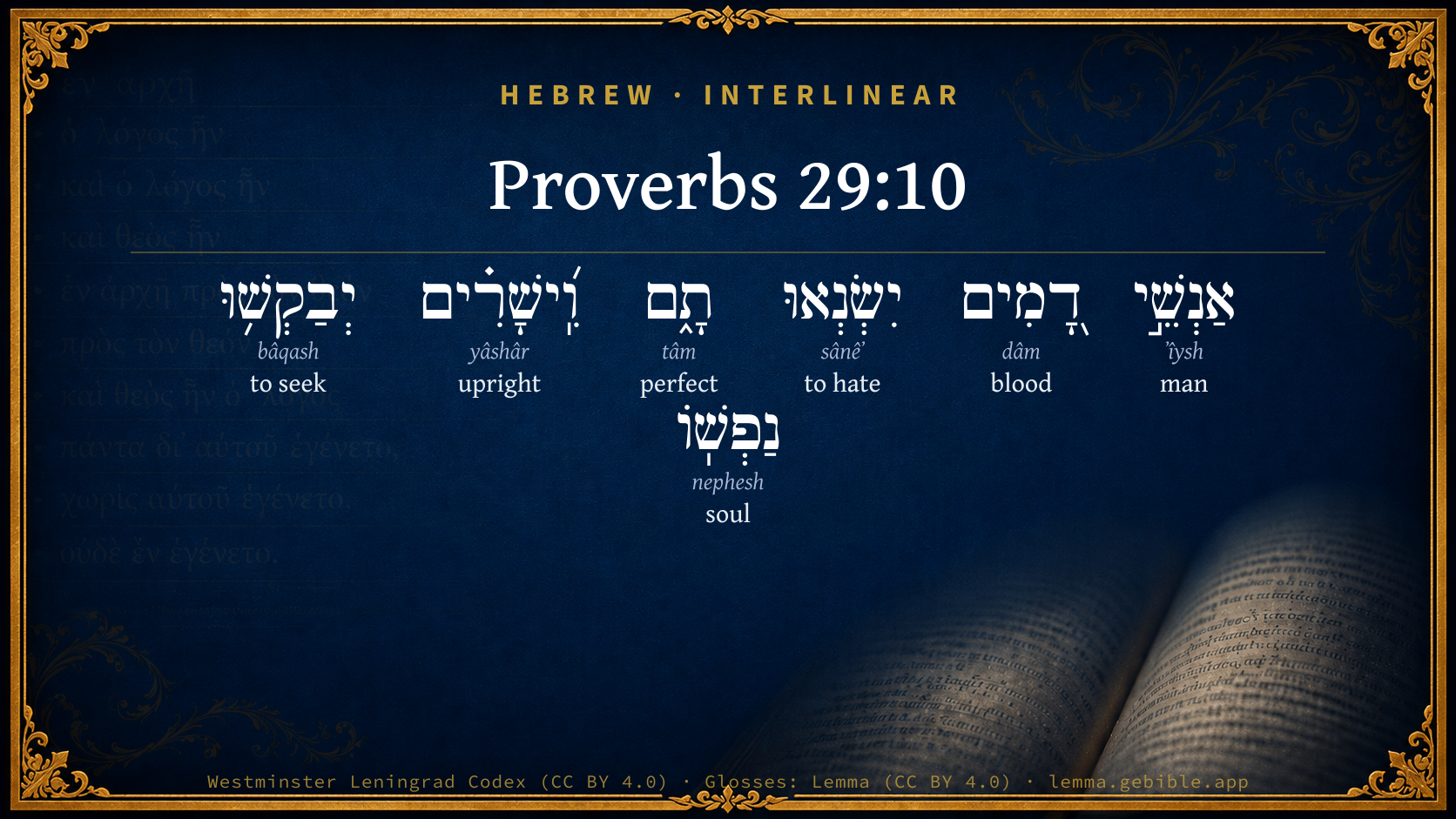
Proverbs 29:10

Hebrew (Westminster Leningrad Codex) Proverbs 29:10 appears in the Hebrew Old Testament. The text above is from the Westminster Leningrad Codex. Each word links to its Strong’s number, a concise gloss, and parsing drawn from the Open Scriptures Hebrew Bible morphology. Click any word for its full Brown-Driver-Briggs (BDB) entry.
Download image
Cite this verse

Proverbs 29:10 (World English Bible). Public Domain. Lemma interlinear Bible study tool, https://lemma.gebible.app/v/proverbs/29/10.

Show BibTeX & RIS
BibTeX
RIS
English Translation
The bloodthirsty hate a man of integrity; And they seek the life of the upright.
World English Bible · Public Domain
Download a study sheet

One document with this verse’s original text, its word-by-word gloss line, the meaning frame, cross-references with their text, attributed commentary, and full source and license credits — printable, and it pastes into notes with its structure intact.

This verse Autodidact and up

Study sheet (.html) Plain text (.txt)

A passage Seminary Student

Up to 50 verses in one chapter. A passage sheet keeps up to 6 commentary sources and 12 cross-references per verse, in the order this page ranks them, and says so on the sheet whenever that leaves anything out. Ask for a single verse and you get the Autodidact verse sheet above.

Everything on this page stays free to read, with no account — the sheet is a download of what is already on screen, not access to it.

Want to remove ads? Support Godless Engineer
Compare translations 3

The same verse in 3 English versions, stacked beneath the original-language interlinear above. Click any original word for its lexicon entry.

Each is an independent rendering of the whole verse — the interlinear is not word-aligned to these translations.

Highlighted words mark where these versions differ — a whole-verse word diff, not a word-by-word alignment.

  • World English Bible Public Domain
    The bloodthirsty hate a man of integrity; And they seek the life of the upright.
  • King James Version Public Domain
    The bloodthirsty hate the upright: but the just seek his soul.
  • unfoldingWord Literal Text CC BY-SA 4.0
    Men of bloodshed hate a blameless, but upright seek his life.

unfoldingWord Literal Text — © unfoldingWord, licensed CC BY-SA 4.0. Word-aligned USFM3 via Door43 (git.door43.org/unfoldingWord/en_ult).

Versions to compare (up to 4)

3 of 4 selected

Show all 18 translations

Every available English version of this verse, each an independent rendering of the whole verse.

  • World English Bible Public Domain
    The bloodthirsty hate a man of integrity; And they seek the life of the upright.
  • Berean Standard Bible Public Domain
    Men of bloodshed hate a blameless man, but the upright care for his life.
  • Majority Standard Bible Public Domain
    Men of bloodshed hate a blameless man, but the upright care for his life.
  • King James Version Public Domain
    The bloodthirsty hate the upright: but the just seek his soul.
  • American Standard Version (1901) Public Domain
    The bloodthirsty hate him that is perfect; And as for the upright, they seek his life.
  • Revised Version (1885) Public Domain
    The bloodthirsty hate him that is perfect: and as for the upright, they seek his life.
  • Geneva Bible (1599) Public Domain
    Bloodie men hate him that is vpright: but the iust haue care of his soule.
  • Douay-Rheims (1899) Public Domain
    Bloodthirsty men hate the upright: but just men seek his soul.
  • Young's Literal Translation Public Domain
    Men of blood hate the perfect, And the upright seek his soul.
  • Literal Standard Version CC BY-SA 4.0
    Men of blood hate the perfect, || And the upright seek his soul.
  • Unlocked Literal Bible CC BY-SA 4.0
    The bloodthirsty hate the one who is blameless and seek the life of the upright.
  • unfoldingWord Literal Text CC BY-SA 4.0
    Men of bloodshed hate a blameless, but upright seek his life.
  • Darby Bible Public Domain
    The bloodthirsty hate the perfect, but the upright care for his soul.
  • World Messianic Bible Public Domain
    The bloodthirsty hate a man of integrity; and they seek the life of the upright.
  • Webster's Bible Public Domain
    The blood-thirsty hate the upright: but the just seek his soul.
  • Free Bible Version CC BY-SA 4.0
    Murderers hate people of integrity, but those who live right try to help them.
  • Bible in Basic English Public Domain
    Men of blood are haters of the good man, and evil-doers go after his soul.
  • JPS Tanakh (1917) Public Domain
    The men of blood hate him that is sincere; and as for the upright, they seek his life.

Literal Standard Version (2020), Covenant Press — licensed CC BY-SA 4.0. Text via the HelloAO Bible API (eBible.org). Unlocked Literal Bible (unfoldingWord) — licensed CC BY-SA 4.0. Text via the HelloAO Bible API (eBible.org). unfoldingWord Literal Text — © unfoldingWord, licensed CC BY-SA 4.0. Word-aligned USFM3 via Door43 (git.door43.org/unfoldingWord/en_ult). Free Bible Version, Dr. Jonathan Gallagher — licensed CC BY-SA 4.0. Text via the HelloAO Bible API (eBible.org).

Word by word

More ways to search: Search by grammar → Find every occurrence → Compare this word →

Practice this passage: Drill this verse → Learn its vocabulary →

About this verse

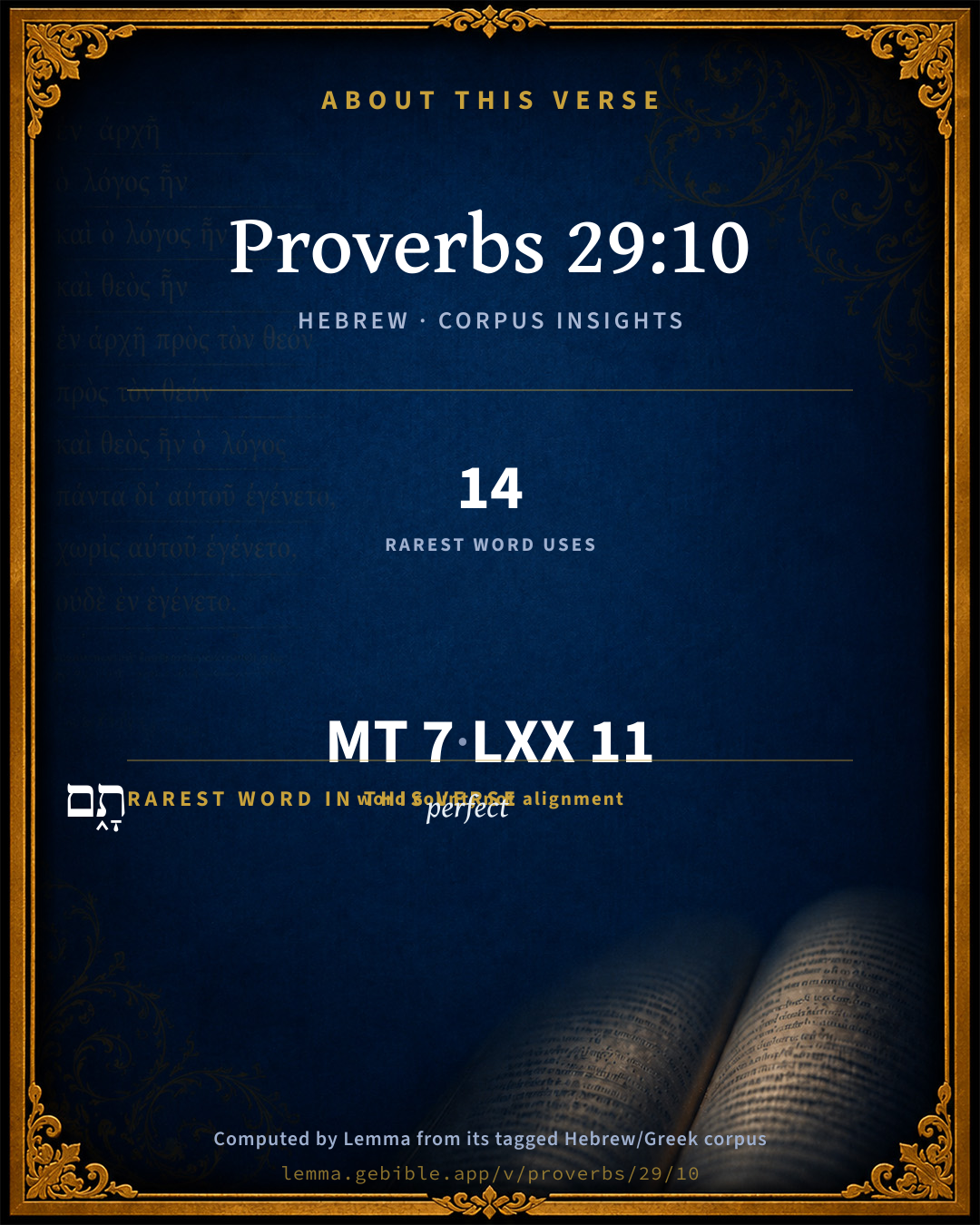
These counts appear in no published source. They are computed here, from the morphology-tagged text and Lemma’s own curated glosses. What Lemma adds →

7
words
7
distinct lemmas
Wisdom
section

Notable vocabulary

The rarest word here is תָ֑ם perfect H8535 — appearing just 14 times in the whole Hebrew Bible.

Shared distinctive vocabulary

תָ֑ם perfect H8535 occurs in 14 verses of the Hebrew Bible. Also found in:

Grammatical profile

  • 2 verbs
  • 3 nouns
  • 2 adjectives

Verb forms

  • יִשְׂנְאוּ Qal · Imperfect
  • יְבַקְשׁ֥וּ Piel · Imperfect

Hebrew & Septuagint length

In English translation the verse runs 15 words from the Hebrew and 13 from the Septuagint (LXX English) — closely comparable.

A rough comparison of the two English renderings, which tokenize alike — not a word-level alignment.

Word counts can differ between the Hebrew and the Greek without any difference in meaning — e.g. the Hebrew direct-object marker אֵת has no separate Greek word, and Greek often adds the article ὁ.

In the original languages it is 7 Hebrew tokens and 11 Greek tokens — but the two are counted differently (Hebrew bundles its prefixes and suffixes into one token; the Greek is in lemma form), so that isn’t a like-for-like length.

Cross-references

18

Topical passages linked to Proverbs 29:10 in the Treasury of Scripture Knowledge — connected by theme and wording, ordered by reader-vote popularity; previews shown in the World English Bible.

  • John 15:18–19 If the world hates you, you know that it has hated me before it hated you.
  • 1 John 3:12–13 unlike Cain, who was of the evil one, and killed his brother. Why did he kill him? Because his works were evil, and his brother's righteous.
  • Genesis 4:5–8 but he didn't respect Cain and his offering. Cain was very angry, and the expression on his face fell.
  • 1 Samuel 20:31–33 For as long as the son of Jesse lives on the earth, you shall not be established, nor your kingdom. Therefore now send and bring him to me, for he shall surely die.
  • 1 Samuel 22:11–23 Then the king sent to call Ahimelech the priest, the son of Ahitub, and all his father's house, the priests who were in Nob: and they came all of them to the king.
  • 1 Samuel 15:11 It repents me that I have set up Saul to be king; for he is turned back from following me, and has not performed my commandments. Samuel was angry; and he cried to Yahweh all night.
  • 1 Kings 21:20 Ahab said to Elijah, Have you found me, my enemy? He answered, I have found you, because you have sold yourself to do that which is evil in the sight of Yahweh.
  • 1 Kings 22:8 The king of Israel said to Jehoshaphat, there is yet one man by whom we may inquire of Yahweh, Micaiah the son of Imlah: but I hate him; for he does not prophesy good concerning me, but evil. Jehoshaphat said, "Don't let the king say so."
  • 2 Chronicles 18:7 The king of Israel said to Jehoshaphat, There is yet one man by whom we may inquire of Yahweh: but I hate him; for he never prophesies good concerning me, but always evil: the same is Micaiah the son of Imla. Jehoshaphat said, Don't let the king say so.
  • Jeremiah 13:15–17 Hear you, and give ear; don't be proud; for Yahweh has spoken.
  • Jeremiah 40:14–16 and said to him, Do you know that Baalis the king of the children of Ammon has sent Ishmael the son of Nethaniah to take your life? But Gedaliah the son of Ahikam didn't believe them.
  • Mark 6:18–19 For John said to Herod, "It is not lawful for you to have your brother's wife."
  • Mark 6:24–27 She went out, and said to her mother, "What shall I ask?" She said, "The head of John the Baptizer."
  • Luke 23:34 Jesus said, "Father, forgive them, for they don't know what they are doing." Dividing his garments among them, they cast lots.
  • John 5:34 But the testimony which I receive is not from man. However, I say these things that you may be saved.
  • Acts 7:60 He kneeled down, and cried with a loud voice, "Lord, don't hold this sin against them!" When he had said this, he fell asleep.
  • Romans 10:1 Brothers, my heart's desire and my prayer to God is for Israel, that they may be saved.
  • Jeremiah 18:20 Shall evil be recompensed for good? for they have dug a pit for my soul. Remember how I stood before you to speak good for them, to turn away your wrath from them.

Cross-references courtesy of OpenBible.info (CC BY 4.0).

Hebrew and Greek witnesses Masoretic Hebrew ↔ Greek Septuagint

The same verse in the two great witnesses to the Old Testament, shown verse-for-verse.

These are two independent witnesses, not word-aligned to each other, and the Septuagint is shown in lemma (dictionary) form.

Hebrew Proverbs 29:10 Masoretic · Westminster Leningrad Codex

אַנְשֵׁ֣י דָ֭מִים יִשְׂנְאוּ תָ֑ם וִֽ֝ישָׁרִ֗ים יְבַקְשׁ֥וּ נַפְשֽׁוֹ

The bloodthirsty hate a man of integrity; And they seek the life of the upright.

World English Bible · Public Domain

Greek LXX Proverbs 29:10 Septuagint · lemma form

ἀνήρ αἷμα μέτοχος μισέω ὅσιος ὁ δέ εὐθύς ἐκζητέω ψυχή αὐτός

Bloody men hate a holy person, but the upright will seek his soul.

LXX2012 (modern English Septuagint) · Public Domain

On this verse, Keil & Delitzsch discusses the Septuagint’s reading. Read the note in Commentary ↓

Hebrew: Westminster Leningrad Codex (CC BY 4.0). Greek: Septuagint (public domain); English from LXX2012 (modern English Septuagint) (Public Domain). How the Septuagint differs from the Hebrew →

Commentary

Notes on Proverbs 29:10 from classic Christian and Jewish commentators (each source and its license shown beneath its notes). The classic Christian expositions comment on the surrounding passage and are grouped to its opening verse, so a note may address several verses; the Jewish commentaries on the Tanakh (Rashi and others) are per-verse, so they appear only where the commentator wrote on this verse.

Lemma curates 59 commentaries, every one of them public domain or Creative Commons licensed, each selected and text-cleaned for this edition rather than reprinted as found. About our sources →

Trapp's Complete Commentary

John Trapp

Pro 29:10 The bloodthirsty hate the upright: but the just seek his soul.

Ver. 10. The bloodthirsty hate the upright.] As Cain did Abel for his goodness, {1Jn 3:12} and as many bloody villains still, who bear about, and, so far as they dare, make use of Cain’s club to knock on the head God’s righteous Abels. All hatred is bloody, but especially the habit of hatred. No sight pleased Hannibal better than a ditch running over with man’s blood. Nothing would satisfy Farnesius, the Pope’s champion, but to ride his horse up to the skirts in the blood of the Lutherans. Charles IX of France, author of the Parisian Massacre, looking upon the dead carcase of the admiral, that stank by being long kept unburied, uttered this most stinking speech: Quam suaviter olet cadaver inimiei! - How sweet is the smell of an enemy’s carcase! And the queen mother of Scotland, beholding the dead bodies of her Protestant subjects, whom she had slain in battle, said that she never saw a finer piece of tapestry in all her life.

But the just seek his soul.] In a good sense; {as Psa 142:4} seek the salvation of it - as Christ did of his deadliest enemies; as Paul did of his countrymen the Jews, of whom five times he received forty stripes save one; {2Co 11:24} as the disciples did of those spiteful Pharisees, that had causelessly accused them; {Mat 15:2; Mat 15:12} as that martyr Master Saunders did. ‘My lord,’ said he to Bishop Bonner, ‘you seek my blood, and you shall have it. I pray God you may be so baptized in it that you may hereafter loathe bloodsucking, and so become a better man.’ {a} And another time, when Steven Gardiner, being prettily nipped and touched by the same Saunders, said, ‘Carry away this frenzy fool to prison’; he answered, that ‘he did give God thanks, which had given him at the last a place of rest and quietness, where he might pray for the bishop’s conversion.’ ‘If ye will not hear me speak for myself,’ said another martyr, ‘then send me to my prison again among my toads and frogs, which will not interrupt me, while I pray to God for you.’ {b}

{a} Acts and Mon., fol. 1358.

{b} Ibid.

John Trapp, A Commentary or Exposition upon All the Books of the Old and New Testament (1647–1656) — public domain. Text from a community e-Sword module.

Joseph Benson's Commentary

Pro 29:10. The blood-thirsty hate the upright — And consequently seek their ruin, as may be inferred from the following clause; but the just seek his soul — To preserve it. Schultens renders this verse, Bloody men hate the upright, and seek the life of the just.

Joseph Benson's Commentary on the Old and New Testaments (1811–1818) — public domain. Text from a community e-Sword module.

The Preacher's Complete Homiletical Commentary

Joseph S. Exell (gen. ed.)

CRITICAL NOTES.—

Pro_29:10. Delitzsch translates this verse:—“Men of blood hate the guiltless and the upright; they seek his soul.”

Pro_29:11. His mind. Rather his wrath. Keepeth it till afterward. Rather restraineth it, keeps it in the background.

MAIN HOMILETICS OF Pro_29:10

SOUL-SEEKERS AND SOUL-HATERS

I. A proof of the unnatural condition of the human family. When we look at a human body we see that every limb and organism belonging to it ministers to the well-being of the whole frame, and thus to the comfort of the living soul that inhabits it. This we recognise to be a natural and fitting state of things—just what we should have expected to find before experience. If in any human body we at any time see the hand inflicting injury upon the head, or any one member causing discomfort to another, we conclude, and with reason, that some disturbance of the natural condition has taken place—that there is physical disease in some bodily organism, or moral disease in the spirit that animates the body. So our human instincts and our reason force us to the conclusion that the natural relation of the members of the great body of humanity is one in which “each for all and all for each” should be the rule of action. That it is not so, can but strike all thinking men and women as a terrible incongruity. That most men not merely regard their human brethren with indifference, but that many actually hate and seek to injure their fellow-creatures is surely an evidence that some fatal moral distemper has laid hold of the race. And the evidence becomes stronger when we consider the truth of the first assertion in the proverb—that not only do bloodthirsty men seek to injure other men in general, but that the objects of their especial malignity are the upright—those who have given them no provocation, but whose desire and aim is to bless their human brothers and sisters.

II. An example in renewed men of what human brotherhood ought to be. Notwithstanding the great amount of self-seeking and enmity that is found in the world, there always has been found a small minority who have been seekers of the good of others, and in whom love to their human brethren has been the keynote of existence. And this love has been felt, and this seeking has been active, in behalf of those who hated them, and sought to do them ill. All such members of the human family are doing their part towards restoring men to the condition of peace and goodwill in which their Creator intended them to live, and help us to form some idea of what earth would have been if sin had never entered it. It is true they would then have had no opportunity of loving their enemies, and of doing good to those who hate them, but the love which “seeketh not her own” would have found free scope for her activities in going out towards those animated by the same spirit of love and would never have had to sorrow over efforts to seek and save that have been apparently fruitless. All just men who are seekers of the well-being of others, and especially those who seek the good of their enemies, are followers of that Just One who was hated by the bloodthirsty of His day, and who sought their souls while they sought His life. The history of the martyr Church in all ages has been the history of the “bloodthirsty hating the upright,” and of the just treading in the footsteps of their Divine Master, and “seeking the souls” of their persecutors.

OUTLINES AND SUGGESTIVE COMMENTS

These words may mean—and probably do mean—that the upright, in opposition to the blood-thirsty by whom the just is hated, “seek his soul,”—that is, the soul or life of the object of the hatred—of the just or the upright. Of the Lord Himself it is said—“He loveth the righteous.” And in this all His people resemble Him. It is one of their characteristic distinctions. They pray for the upright, and endeavour, by all means in their power, to preserve them from the deadly machinations of their persecutors. The amount of love required of God’s people towards God’s people is that they be ready to “lay down their lives for the brethren.” And if “for the brethren”—how much more for THE JUST ONE. Wardlaw.

The just seek his soul. As Paul did of his countrymen the Jews, of whom five times he received forty stripes save one (2Co_11:24); as the disciples did of those spiteful Pharisees that had causelessly accused them (Mat_15:2-12); as that martyr Master Saunders did: “My lord,” said he to Bishop Bonner, “you seek my blood, and you shall have it. I pray God you may be so baptized in it as hereafter you may loathe blood-sucking, and so become a better man.”—Trapp.

On the subject of Pro_29:11 see on chap. Pro_10:19-21, page 168.

The Preacher's Complete Homiletical Commentary (gen. ed. Joseph S. Exell; Funk & Wagnalls, c. 1892) — public domain (pre-1929). A full-Bible homiletical/sermon-outline anthology covering 65 of 66 books (2 John is absent from the source module). Text from a community e-Sword module.

Keil & Delitzsch

C. F. Keil & F. Delitzsch

We now group together Pro 29:10-14. Of these, Pro 29:10 and Pro 29:11 are alike in respect of the tense used; Pro 29:12-14 have in common the pronoun pointing back to the first member.

10 Men of blood hate the guiltless

And the upright; they attempt the life of such

The nearest lying translation of the second line would certainly be: the upright seek his soul (that of the guiltless). In accordance with the contrasted ישׂנאו, the Aram. understand the seeking of earnest benevolent seeking, but disregarding the נפשׁ in לנפשׁו;

(Note: The Targum translates תם, guiltlessness, and the Venet. (μισοῦσι) γνῶσιν, turning to Pro 1:22.)

Symmachus (ἐπιζητήσουσι), Jerome (quaerunt), and Luther thus also understand the sentence; and Rashi remarks that the phrase is here לשׁון חבּה, for he rests; but mistrusting himself, refers to Sa1 21:1-15 :23. Ahron b. Josef glosses: to enter into friendship with him. Thus, on account of the contrast, most moderns, interpreting the phrase sensu bono, also Fleischer: probi autem vitam ejus conservare student. The thought is, as Pro 12:6 shows, correct; but the usus loq. protests against this rendering, which can rest only on Psa 142:5, where, however, the poet does not say אין דּורשׁ נפשׁי, but, as here also the usus loq. requires, לנפשׁי. There are only three possible explanations which Aben Ezra enumerates: (1) they seek his, the bloody man's, soul, i.e., they attempt his life, to take vengeance against him, according to the meaning of the expressions as generally elsewhere, used, e.g., at Psa 63:10; (2) they revenge his, the guiltless man's, life (lxx ἐκζητήσουσιν), which has fallen a victim, after the meaning in which elsewhere only בּקּשׁ דּם and דּרשׁ נפשׁ, Gen 9:5, occur. This second meaning also is thus not in accordance with the usage of the words, and against both meanings it is to be said that it is not in the spirit of the Book of Proverbs to think of the ישׁרים [the upright, righteous] as executors of the sentences of the penal judicature. There thus remains

(Note: For εὐθεῖς δὲ συνάξουσιν (will bring away?) τὴν ψυχὴν αὐτῶν, understood after Jer 45:5, lies linguistically yet further off.)

the interpretation (3): the upright - they (the bloody men) seek the soul of such an one. The transition from the plur. to the sing. is individualizing, and thus the arrangement of the words is like Gen 47:21 : "And the people (as regards them), he removed them to the cities," Gesen. 145. 2. This last explanation recommends itself by the consideration that תם and ישׁרים are cognate as to the ideas they represents-let one call to mind the common expression תּם וישׁר [perfect and upright, e.g., Job 1:1; Job 2:3], - that the same persons are meant thereby, and it is rendered necessary by this, that the thought, "bloody men hate the guiltless," is incomplete; for the same thing may also be said of the godless in general. One expects to hear that just against the guiltless, i.e., men walking in their innocence, the bloody-mindedness of such men is specially directed, and 10b says the same thing; this second clause first brings the contrast to the point aimed at. Lutz is right in seeking to confute Hitzig, but he does so on striking grounds.

Keil & Delitzsch — Biblical Commentary on the Old Testament (1861–1891) — public domain (CC PDM 1.0). Text via the HelloAO Bible API. (Old Testament only.)

Matthew Henry's Commentary

Note, 1. Bad men hate their best friends: The blood-thirsty, all the seed of the old serpent, who was a murderer from the beginning, all that inherit his enmity against the seed of the woman, hate the upright; they seek the ruin of good men because they condemn the wicked world and witness against it. Christ told his disciples that they should be hated of all men. Bloody men do especially hate upright magistrates, who would restrain and reform them, and put the laws in execution against them, and so really do them a kindness. 2. Good men love their worst enemies: The just, whom the bloody men hate, seek their soul, pray for their conversion, and would gladly do any thing for their salvation. This Christ taught us. Father, forgive them. The just seek his soul, that is, the soul of the upright, whom the bloody hate (so it is commonly understood), seek to protect it from violence, and save it from, or avenge it at, the hands of the blood-thirsty.

Matthew Henry's Commentary on the Whole Bible (1708–1710) — public domain (CC PDM 1.0). Text via the HelloAO Bible API.

Jamieson, Fausset & Brown

Robert Jamieson, A. R. Fausset & David Brown

bloodthirsty--(Compare Margin), murderers (Psa 5:6; Psa 26:9).

hate, &c.-- (Pro 1:11; Gen 3:4).

seek . . . soul--that is, to preserve it.

Jamieson, Fausset & Brown — Commentary Critical and Explanatory on the Whole Bible (1871) — public domain (CC PDM 1.0). Text via the HelloAO Bible API.

Ellicott's Commentary for English Readers

(10) The bloodthirsty hate the upright.—Or, perfect man. “for what fellowship hath righteousness with unrighteousness” (2Co_6:14); the life of the perfect man is a continual reproach to them.

But the just (or upright) seek his soul—i.e. care for the life of the perfect; their uprightness shows itself in active help-giving.

A Bible Commentary for English Readers, edited by Charles John Ellicott (1878–1897) — public domain. Text from a community e-Sword module.

The Cambridge Bible for Schools and Colleges

gen. ed. J. J. S. Perowne

10. seek] i.e. care for, as R.V. marg. Comp. Psa_142:4 [Hebrews 5], where however the Hebrew word, seek, is not the same as here. It is more in accordance with the use of the phrase to seek the life, to render, with R.V. text,

The bloodthirsty hate him that is perfect:

And as for the upright they seek his life.

The LXX. however has: οἱ δὲ εὐθεῖς εὐθεῖς ἐκζητήσουσι ψυχὴν αὐτοῦ; and the Vulg. justi autem quærunt animam ejus.

The Cambridge Bible for Schools and Colleges (gen. ed. J. J. S. Perowne; Cambridge University Press, 1878–1918) — public domain. Text from a community e-Sword module.

John Gill's Exposition

The bloodthirsty hate the upright,.... Cain did Abel; and as the wicked world hate all good men, and persecute them, even unto death;

but the just must seek his soul; either the soul of the bloodthirsty, and that either the good of their souls; seek their spiritual welfare, and pray for it, even though they are so cruel and inhuman: or just magistrates will seek after such persons, to punish them for shedding the blood of the upright. Or else the meaning is, that just persons seek the soul of the upright, and make inquisition for the blood of such, to punish for it; which comes to the same sense, as Aben Ezra observes: or rather, such seek to defend and preserve the soul or life of upright men from those that hate and persecute them. Jarchi illustrates it by Sa1 22:23; the Targum is,

"men that shed blood hate integrity; but the upright seek it.''

John Gill's Exposition of the Whole Bible (1746–1763) — public domain (CC PDM 1.0). Text via the HelloAO Bible API.

Albert Barnes' Notes on the Bible

Seek his soul - i. e., “Care for, watch over, his life” (compare Psa 142:4).

Albert Barnes' Notes on the Bible (1834–1885) — public domain. Text from a community e-Sword/MySword module.

Haydock's Catholic Bible Commentary

Soul. they wish to protect the upright, Psalm cxli. 5.

George Leo Haydock (1774–1849), Haydock's Catholic Family Bible and Commentary, 1859 edition — public domain. Excludes Psalms (Douay-Rheims chapter numbering differs from Protestant) and Deuterocanonical books (Catholic canon only).

Matthew Poole's English Annotations

Hate the upright, and consequently seek their ruin, as is implied from the following clause.

Seek his soul; either,

1. To require his soul or life at the hands of those who have taken it away. Or,

2. To preserve it from those who attempt to take it away, as this phrase is taken, Psa 142:4, though commonly it signify to seek to destroy it.

Matthew Poole's English Annotations on the Holy Bible (1683–1685) — public domain. Text from a community e-Sword/MySword module.

Whedon's Commentary on the Bible

Daniel D. Whedon

10. The bloodthirsty — Literally, men of blood.

Hate the upright — The perfect man, the man of integrity; or, they hate integrity itself.

Seek his soul — Or, his life. The phrase is ambiguous. To “seek life” is, ordinarily, to desire to destroy it. This, according to Gesenius, is the only place where the phrase is used in a good sense — to seek to preserve life. But some understand it, as seeking to avenge the life — requiring the life of the murderer, according to law.

Daniel D. Whedon (gen. ed.), Commentary on the Old and New Testaments (1874–1909) — public domain. Text from a community e-Sword module.

The Pulpit Commentary

The bloodthirsty hate the upright; him that is perfect, Revised Version; osion , Septuagint. His life is a tacit reproach to men of blood, robbers, murderers, and such like sinners, as is finely expressed in the Book of Wisdom RAPC Wis 2:12, etc. (comp. 2Co_6:14) But the just seek his soul. The explanation of this hemistich is doubtful. The following interpretations have been offered:

(1) The just seek the soul of the upright to deliver him from death temporal and spiritual. (comp. Pro_12:6 Psa_142:4)

(2) The just seek the murderer"s life, take vengeance on him. (comp. Psa_63:9, Psa_63:10)

(3) "As for the just, they (the murderers) attempt his life," where the change of subject, though by no means unparalleled, is awkward. (comp. Psa_37:14) The second explanation makes the righteous the executioners of vengeance on the delinquents, which does not seem to be the idea intended, and there is no confirmation of it in our book. The interpretation first given has against it the fact that the phrase, "to seek the soul," is used of attempts against the life, not of preserving it. But this is not fatal; and the above seems to be the most likely explanation offered, and gives a good antithesis. Men of blood hate a virtuous man, and try to destroy him; the righteous love him, and do their utmost to defend and keep him safe. If this interpretation is rejected, the third explanation is allowable, the casus pendens just, they seek his life may be compared with Gen_26:15 Deu_2:23. Septuagint, "But the upright will seek (ekzhthsousi ) his life."

The Pulpit Commentary (1880–1919), ed. H.D.M. Spence-Jones & Joseph S. Exell — public domain. Text from a community e-Sword module.

John Wesley's Explanatory Notes

Seek - To preserve it.

John Wesley, Explanatory Notes Upon the Whole Bible (1754–1765) — public domain. Text via the GEBible commentary corpus.

Bridges on Proverbs

Charles Bridges

This bloody hatred is the fulfillment of the first prophecy from the mouth of God. (Gen 3:15 .) The first history of the fallen world puts the seal to the prophecy — "Cain rose up against Abel his brother, and slew him." (Gen 4:5-8 .) Ever since has the same testimony been given.†1 "Which of the prophets have not your fathers persecuted?" (was the indignant remonstrance of Stephen to his countrymen) until they "filled up the measure of their fathers," by being "the betrayers and murderers" of the Son of God.†2 The noble army of martyrs stand before us. Such intensity of malice in the contrivance of the variety of their torture! The bloodthirsty hate the upright. (Heb 11:36-37 .) Their innocency was the only ground of hatred; and, on the threatened apprehension of any outbreak of evil, the swelling cry of the bloodthirsty multitude was — ’The Christians to the lions!’ The next picture downward in the annals of the Church is not less illustrative — "I saw the woman" — awful sight! — "drunken with the blood of the saints, and with the blood of the martyrs of Jesus." (Rev 17:6 .) We cannot doubt but the fierce elements of the cruelty still lie in slumbering concealment. Nothing but the Gospel can kill the principle. Everything short of this only chains down the violence. In a softer mold it still retains all its substance and power, and waits only for the removal of present restraints to develop the same bloodthirsty hatred as ever.

Scripture explains this murderous vindictiveness. "Wherefore slew Cain his brother? Because his own works were evil, and his brother’s righteous." (1Jn 3:12-13 .) Darkness cannot endure the light.†3 The condemning light†4 of godliness excites the enmity of the ungodly. They cannot bear the picture. Thus the bloodthirsty Ahab hated his upright prophets,†5 and the Jews the holy Savior.†6 Conformity to him is the great offense still. ’Such precise fools, contrary to every one beside, "turning the world upside down" — how can they be endured?’ Their removal is a rejoicing riddance from the earth. (Rev 11:9-10.)

And yet their God is not unmindful of their threatening troubles. The bloodthirsty hate the upright: but the just seek his soul. Saul sought to murder David; Jonathan covered him.†7 Jezebel was thirsting to destroy the prophets of the LORD; Obadiah "hid them in a cave, and fed them with bread and water."†8 The enemies of Jeremiah plotted against him; Ebedmelech saved his life.†9 Herod was proceeding against Peter’s life; the Church shielded him with their prayers.†10 The bloodthirsty Jews bound themselves to murder Paul; "Pricilla and Aquila" were ready to "lay down their own necks for his life."†11

What a life of conflict is this world of sin! Need we be dissuaded from loving it? Need we not rather patience to endure it? But while we are in it, let us be found decidedly on the Lord’s side,†12 "partakers," if needs be, "of the afflictions of the gospel." (2Ti 1:8 .) Never let us stand aloof from our brethren’s cause. (2Ti 1:16, 17.) To help them, is to be fellow-workers with God himself. If union is so effective against the Church, surely its influence would not be of less moment on the Church’s side; "strengthening her stakes," establishing her foundations, and enlarging her usefulness.

Footnotes:

†1 Pro 29:27. Psa 37:12-14, Psa 37:32 . Gal 4:29 . 2Ti 3:12 .

†2 Act 7:52. Mat 5:12 ; Mat 23:32 .

†3 Joh 3:19-20.

†4 Heb 11:7.

†5 1Ki 21:20 ; 1Ki 22:8 .

†6 Joh 7:7.

†7 1Sa 18:11, 1Sa 18:25, with 1Ki 18:1-4 .

†8 1Ki 18:1-4 .

†9 Jer 38:1-13.

†10 Act 12:5.

†11 Act 23:12. Rom 16:4 .

†12 Mat 12:30.

Charles Bridges, An Exposition of the Book of Proverbs (1846) — public domain. Text from a community e-Sword module.

Rashi

Rabbi Shlomo Yitzchaki (Rashi)

seek his soul [This is] an expression of love, and it appears that it is so, as David said to Abiathar (I Sam. 22:23): “for he who seeks my soul seeks your soul.” He who will deal kindly with me will deal kindly with you. The exegetes, however, do not agree with me.

Rashi on the Tanakh — English translations: “The Judaica Press complete Tanach with Rashi, translated by A. J. Rosenberg” (CC BY 4.0); “Pentateuch with Rashi's commentary by M. Rosenbaum and A.M. Silbermann, 1929-1934” (public domain); “The Metsudah Tanach series, Lakewood, N.J” (CC BY 4.0); and “The Book of Joshua, Metsudah Publications, 1997” (CC BY 4.0). Text via Sefaria.

Lesson kit

Teaching starters — assembled from the data on this page, not authored interpretation. Every prompt links to the verse data it draws on. Edit before teaching.

Proverbs, in the Wisdom, opens this verse with 7 words (7 distinct Hebrew lemmas). Its most distinctive word is tâm (“perfect”). A historical commentator’s framing appears above. Read the whole chapter for the surrounding context.

Discussion questions

  1. The word tâm carries the sense “perfect.” How does it shape the verse?
  2. How does Genesis 25:27, which shares the word «perfect», read alongside this verse?
  3. The translations on this page render this verse differently — a whole-verse word diff, not a word-by-word alignment. What might account for the different wordings?
  4. «יִשְׂנְאוּ» is a Qal Imperfect verb. How does that grammatical form shape the action described?
  5. Compare how Trapp's Complete Commentary and Joseph Benson's Commentary read this verse. Where do they agree or differ?

Things to notice

Reading settings

Reading text

Shown beneath each verse's original-language words.

Old Testament
Old Testament edition

Read the OT as the Masoretic Hebrew (MT) or the Greek Septuagint (LXX).

English shown for the Greek Septuagint (in the Hebrew ↔ Greek comparison).

Comparing translations? Open the Compare panel on any verse page to stack up to four side by side.