
Proverbs 18:15

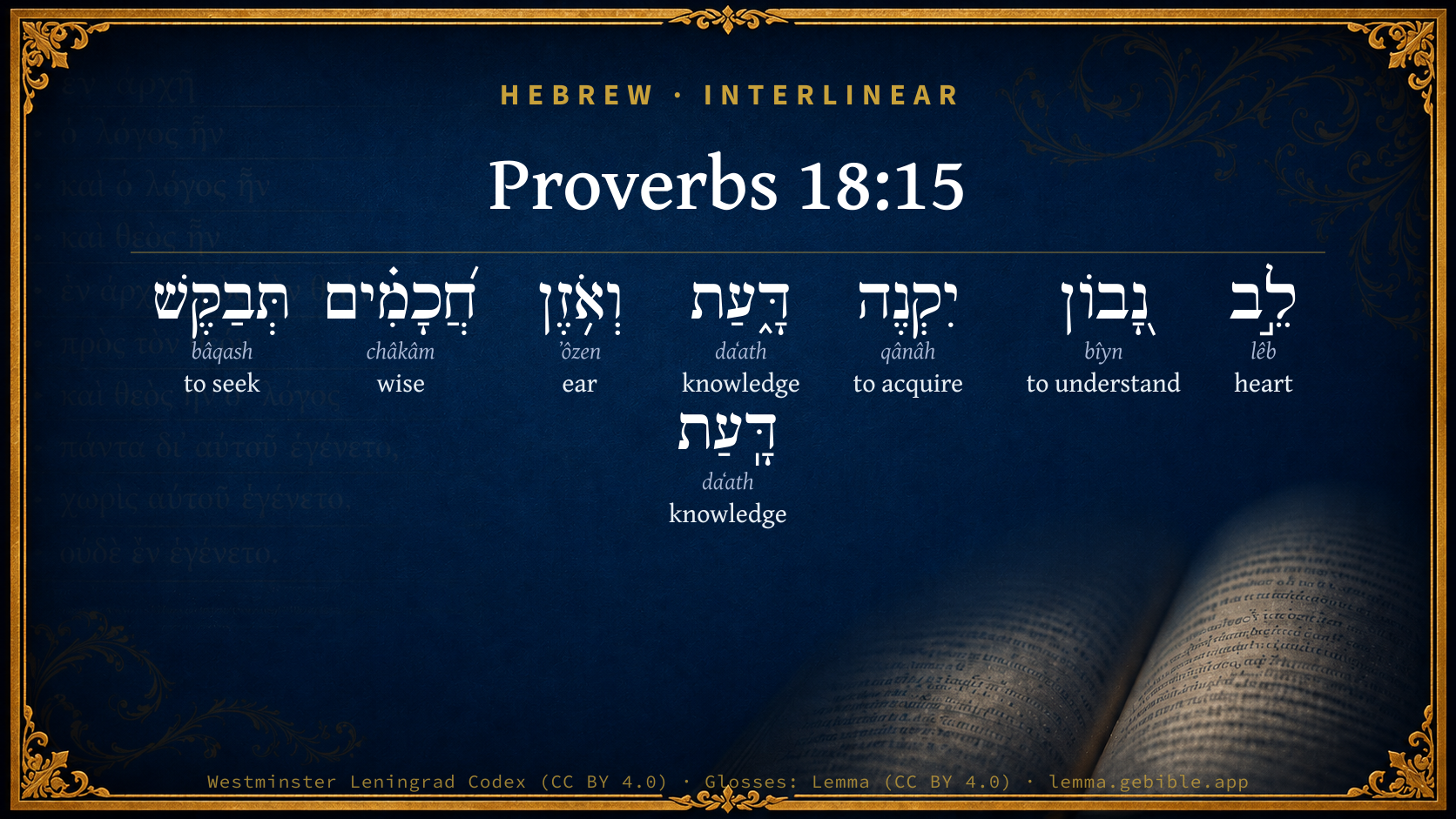
Hebrew (Westminster Leningrad Codex) Proverbs 18:15 appears in the Hebrew Old Testament. The text above is from the Westminster Leningrad Codex. Each word links to its Strong’s number, a concise gloss, and parsing drawn from the Open Scriptures Hebrew Bible morphology. Click any word for its full Brown-Driver-Briggs (BDB) entry.
Download image
Cite this verse

Proverbs 18:15 (World English Bible). Public Domain. Lemma interlinear Bible study tool, https://lemma.gebible.app/v/proverbs/18/15.

Show BibTeX & RIS
BibTeX
RIS
English Translation
The heart of the discerning gets knowledge. The ear of the wise seeks knowledge.
World English Bible · Public Domain
Download a study sheet

One document with this verse’s original text, its word-by-word gloss line, the meaning frame, cross-references with their text, attributed commentary, and full source and license credits — printable, and it pastes into notes with its structure intact.

This verse Autodidact and up

Study sheet (.html) Plain text (.txt)

A passage Seminary Student

Up to 50 verses in one chapter. A passage sheet keeps up to 6 commentary sources and 12 cross-references per verse, in the order this page ranks them, and says so on the sheet whenever that leaves anything out. Ask for a single verse and you get the Autodidact verse sheet above.

Everything on this page stays free to read, with no account — the sheet is a download of what is already on screen, not access to it.

Want to remove ads? Support Godless Engineer
Compare translations 3

The same verse in 3 English versions, stacked beneath the original-language interlinear above. Click any original word for its lexicon entry.

Each is an independent rendering of the whole verse — the interlinear is not word-aligned to these translations.

Highlighted words mark where these versions differ — a whole-verse word diff, not a word-by-word alignment.

  • World English Bible Public Domain
    The heart of the discerning gets knowledge. The ear of the wise seeks knowledge.
  • King James Version Public Domain
    The heart of the prudent getteth knowledge; and the ear of the wise seeketh knowledge.
  • unfoldingWord Literal Text CC BY-SA 4.0
    The heart of an understanding one acquires knowledge, and the ear of the wise seeks knowledge.

unfoldingWord Literal Text — © unfoldingWord, licensed CC BY-SA 4.0. Word-aligned USFM3 via Door43 (git.door43.org/unfoldingWord/en_ult).

Versions to compare (up to 4)

3 of 4 selected

Show all 18 translations

Every available English version of this verse, each an independent rendering of the whole verse.

  • World English Bible Public Domain
    The heart of the discerning gets knowledge. The ear of the wise seeks knowledge.
  • Berean Standard Bible Public Domain
    The heart of the discerning acquires knowledge, and the ear of the wise seeks it out.
  • Majority Standard Bible Public Domain
    The heart of the discerning acquires knowledge, and the ear of the wise seeks it out.
  • King James Version Public Domain
    The heart of the prudent getteth knowledge; and the ear of the wise seeketh knowledge.
  • American Standard Version (1901) Public Domain
    The heart of the prudent getteth knowledge; And the ear of the wise seeketh knowledge.
  • Revised Version (1885) Public Domain
    The heart of the prudent getteth knowledge; and the ear of the wise seeketh knowledge.
  • Geneva Bible (1599) Public Domain
    A wise heart getteth knowledge, and the eare of the wise seeketh learning.
  • Douay-Rheims (1899) Public Domain
    A wise heart shall acquire knowledge: and the ear of the wise seeketh instruction.
  • Young's Literal Translation Public Domain
    The heart of the intelligent getteth knowledge, And the ear of the wise seeketh knowledge.
  • Literal Standard Version CC BY-SA 4.0
    The heart of the intelligent gets knowledge, || And the ear of the wise seeks knowledge.
  • Unlocked Literal Bible CC BY-SA 4.0
    The heart of the intelligent acquires knowledge and the hearing of the wise seeks it out.
  • unfoldingWord Literal Text CC BY-SA 4.0
    The heart of an understanding one acquires knowledge, and the ear of the wise seeks knowledge.
  • Darby Bible Public Domain
    The heart of an intelligent [man] getteth knowledge, and the ear of the wise seeketh knowledge.
  • World Messianic Bible Public Domain
    The heart of the discerning gets knowledge. The ear of the wise seeks knowledge.
  • Webster's Bible Public Domain
    The heart of the prudent getteth knowledge; and the ear of the wise seeketh knowledge.
  • Free Bible Version CC BY-SA 4.0
    An intelligent mind acquires knowledge; the wise are ready to hear knowledge.
  • Bible in Basic English Public Domain
    The heart of the man of good sense gets knowledge; the ear of the wise is searching for knowledge.
  • JPS Tanakh (1917) Public Domain
    The heart of the prudent getteth knowledge; and the ear of the wise seeketh knowledge.

Literal Standard Version (2020), Covenant Press — licensed CC BY-SA 4.0. Text via the HelloAO Bible API (eBible.org). Unlocked Literal Bible (unfoldingWord) — licensed CC BY-SA 4.0. Text via the HelloAO Bible API (eBible.org). unfoldingWord Literal Text — © unfoldingWord, licensed CC BY-SA 4.0. Word-aligned USFM3 via Door43 (git.door43.org/unfoldingWord/en_ult). Free Bible Version, Dr. Jonathan Gallagher — licensed CC BY-SA 4.0. Text via the HelloAO Bible API (eBible.org).

Word by word

More ways to search: Search by grammar → Find every occurrence → Compare this word →

Practice this passage: Drill this verse → Learn its vocabulary →

About this verse

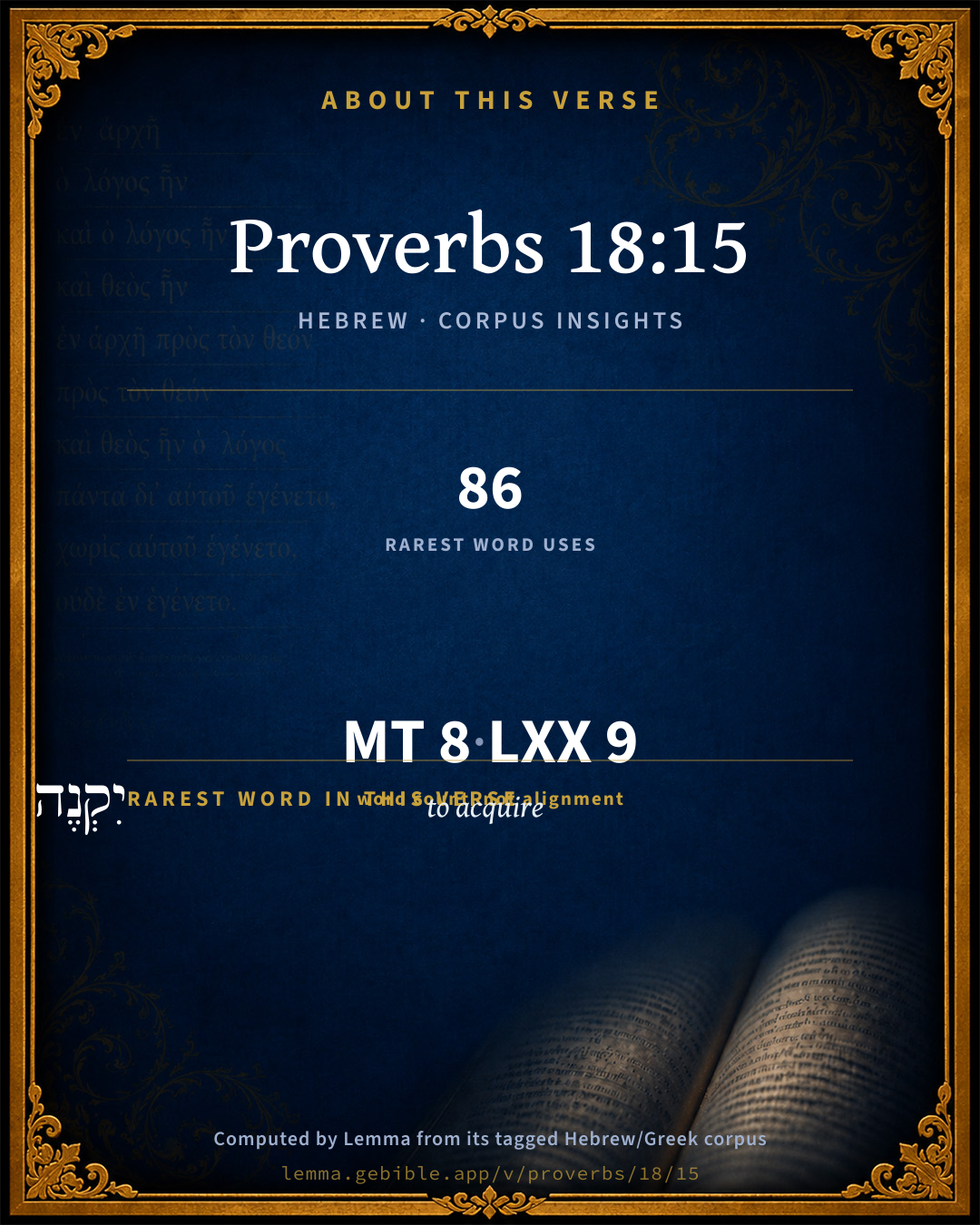
These counts appear in no published source. They are computed here, from the morphology-tagged text and Lemma’s own curated glosses. What Lemma adds →

8
words
7
distinct lemmas
Wisdom
section

Grammatical profile

  • 3 verbs
  • 4 nouns
  • 1 adjective

Verb forms

  • נָ֭בוֹן Niphal · Participle Active
  • יִקְנֶה Qal · Imperfect
  • תְּבַקֶּשׁ Piel · Imperfect

Repetition

A word recurs within this verse — often emphatic in Hebrew:

  • דָּ֑עַת knowledge H1847 ×2

Hebrew & Septuagint length

In English translation the verse runs 14 words from the Hebrew and 16 from the Septuagint (LXX English) — closely comparable.

A rough comparison of the two English renderings, which tokenize alike — not a word-level alignment.

Word counts can differ between the Hebrew and the Greek without any difference in meaning — e.g. the Hebrew direct-object marker אֵת has no separate Greek word, and Greek often adds the article ὁ.

In the original languages it is 8 Hebrew tokens and 9 Greek tokens — but the two are counted differently (Hebrew bundles its prefixes and suffixes into one token; the Greek is in lemma form), so that isn’t a like-for-like length.

Cross-references

13

Topical passages linked to Proverbs 18:15 in the Treasury of Scripture Knowledge — connected by theme and wording, ordered by reader-vote popularity; previews shown in the World English Bible.

  • James 1:5 But if any of you lacks wisdom, let him ask of God, who gives to all liberally and without reproach; and it will be given to him.
  • Proverbs 15:14 The heart of one who has understanding seeks knowledge, But the mouths of fools feed on folly.
  • Proverbs 1:5 That the wise man may hear, and increase in learning; That the man of understanding may attain to sound counsel:
  • Luke 10:39 She had a sister called Mary, who also sat at Jesus' feet, and heard his word.
  • 1 Kings 3:9 Give your servant therefore an understanding heart to judge your people, that I may discern between good and evil; for who is able to judge this your great people?
  • Psalms 119:97–104 How love I your law! It is my meditation all day.
  • Proverbs 4:7 Wisdom is supreme. Get wisdom. Yes, though it costs all your possessions, get understanding.
  • Proverbs 9:9 Instruct a wise man, and he will be still wiser. Teach a righteous man, and he will increase in learning.
  • Proverbs 23:23 Buy the truth, and don't sell it: Get wisdom, discipline, and understanding.
  • Proverbs 4:5 Get wisdom. Get understanding. Don't forget, neither swerve from the words of my mouth.
  • Proverbs 10:14 Wise men lay up knowledge, But the mouth of the foolish is near ruin.
  • Luke 8:8–10 Other fell into the good ground, and grew, and brought forth fruit one hundred times." As he said these things, he called out, "He who has ears to hear, let him hear!"
  • 2 Timothy 3:15–17 From infancy, you have known the sacred writings which are able to make you wise for salvation through faith, which is in Christ Jesus.

Cross-references courtesy of OpenBible.info (CC BY 4.0).

Hebrew and Greek witnesses Masoretic Hebrew ↔ Greek Septuagint

The same verse in the two great witnesses to the Old Testament, shown verse-for-verse.

These are two independent witnesses, not word-aligned to each other, and the Septuagint is shown in lemma (dictionary) form.

Hebrew Proverbs 18:15 Masoretic · Westminster Leningrad Codex

לֵ֣ב נָ֭בוֹן יִקְנֶה דָּ֑עַת וְאֹ֥זֶן חֲ֝כָמִ֗ים תְּבַקֶּשׁ דָּֽעַת

The heart of the discerning gets knowledge. The ear of the wise seeks knowledge.

World English Bible · Public Domain

Greek LXX Proverbs 18:15 Septuagint · lemma form

καρδία φρόνιμος κτάομαι αἴσθησις οὖς δέ σοφός ζητέω ἔννοια

The heart of the sensible man purchases discretion; and the ears of the wise seek understanding.

LXX2012 (modern English Septuagint) · Public Domain

On this verse, The Pulpit Commentary discusses the Septuagint’s reading. Read the note in Commentary ↓

Hebrew: Westminster Leningrad Codex (CC BY 4.0). Greek: Septuagint (public domain); English from LXX2012 (modern English Septuagint) (Public Domain). How the Septuagint differs from the Hebrew →

Commentary

Notes on Proverbs 18:15 from classic Christian and Jewish commentators (each source and its license shown beneath its notes). The classic Christian expositions comment on the surrounding passage and are grouped to its opening verse, so a note may address several verses; the Jewish commentaries on the Tanakh (Rashi and others) are per-verse, so they appear only where the commentator wrote on this verse.

Lemma curates 59 commentaries, every one of them public domain or Creative Commons licensed, each selected and text-cleaned for this edition rather than reprinted as found. About our sources →

Trapp's Complete Commentary

John Trapp

Pro 18:15 The heart of the prudent getteth knowledge; and the ear of the wise seeketh knowledge.

Ver. 15. The heart of the prudent getteth knowledge.] Such as can keep the bird singing in their bosom, and are free from inward perturbations, these by meditating on the good word of God, and by listening to the wholesome words of others, get and gather knowledge; that is, great store of all sorts of knowledge, that which is divine especially, and tends to the perfecting of the soul.

John Trapp, A Commentary or Exposition upon All the Books of the Old and New Testament (1647–1656) — public domain. Text from a community e-Sword module.

The Biblical Illustrator

Joseph S. Exell

Pro_18:15-16

The heart of the prudent getteth knowledge.

The attainment of knowledge and the power of kindness

I. The attainment of knowledge. The heart of the prudent getteth knowledge, etc. It is suggested by the words that the attainment of knowledge requires two things.

1. A heart for it. The heart of the prudent. There must, at least, be in every heart, a consciousness of its need. The opinionated, self-sufficient man, who is wise in his own conceit, will never get knowledge. Though the sun of knowledge shine around him, its beams cannot enter him. All the shutters of his mental house are so closed by self-sufficiency that no rays can enter. A sense of ignorance is the first step to the attainment of knowledge.

2. An effort for it. The ear of the wise seeketh knowledge. The ear is one of the great inlets. Wisdom does not come into the soul unless it is searched for as a hidden treasure. Whilst all this is true of general knowledge, it is especially true of Divine knowledge.

II. The power of kindness. A mans gift maketh room for him and bringeth him before great men. There are two kinds of gifts, the gift of selfishness and the gift of kindness. A man sometimes bestows a favour on another in order to get back something of a higher value. This gift is a bribe. The gift of kindness is the true gift and the real power. It makes room for the giver in the heart of the receiver, and it bringeth him before truly great men. Great men recognise and honour the generous.

1. Kindness is the mightiest power.

2. Kindness is the Divinest power. (D. Thomas, D. D.)

A mans gift maketh room for him.

Giving: a study in Oriental manners

In the East the custom of giving gifts affects all the relationships of life--domestic, social, commercial, political, and religious. It is difficult in lands of law-defended liberty, democratic representation, and freedom of the press to realise how much is awanting where these are absent, and how great an importance comes to be attached to the means and resources by which, when right cannot be legally enforced, promises may nevertheless obtain fulfilment, the indifferent be made interested, the alienated reconciled, and the powerful and rich become considerate and gracious. It is in this connection that the giving and receiving of gifts plays a prominent part. Amid much variety as to the occasions of giving, and the character of the things given, there are two principal uses. The first and fundamental meaning is affectionate and sincere, and owes its popularity to the warm and impulsive feelings of the people within a certain area. It is the expression and proof of the sincerity of love (2Co_8:8). The second is utilitarian. A mans gift maketh room for him. The abounding hypocrisy that surrounds this second meaning is a tribute to the reality and strength of the original affectionate meaning thus simulated. For illustration we must turn to the circumstances in Oriental life that make gift-giving popular and expedient. To the visitor to the East, beset on all hands by demands for backshish, a present, the principle of gift-giving seems to be the summary of Oriental life and all its institutions.

I. Family life. Here the giving of gifts is pleasant and unconstrained: the proof of the abundance rather than merely the sincerity of love. Special occasions are birth, betrothal, marriage, recovery from sickness, and return of a member of the family from a journey. Money is freely given and lent, the refusal of it being considered shameful, and causing alienation not easily forgotten. A favourite gift is that of jewellery or clothing taken from the person and given to a friend to be a constant memorial of the absent, and a proof that he will be treasured in the heart even as his body is now encased in the clothes of his friend.

II. Social life. Public life is conducted, as far as possible, on family lines. The family is not merely an inner circle of affectionate devotion; it is also a guild of common interests. A daughter is, if possible, married among her relatives. A father putting his son in a shop or office says to the manager, He is your son, implying complete authority over him and regard also for his welfare. The Oriental laws of neighbourhood teaching sympathy, toleration, and helpfulness spring from the family. The conditions of industrial life and the patriarchal form of government have further tended to develop the habit of giving gifts, making an affectionate act the means of attaining mercenary ends, and leading the way to bribery, intrigue, and dishonesty. The Oriental landowner has always paid his labourers in kind--giving them a certain portion of the produce. It is a gift out of what is his personal estate. The sheikh or emir of the leading family further protected the peasantry from the marauding Bedouin, the children of the East, and presents given to him were a grateful acknowledgment of protection and prosperity. Such gifts, putting the receiver in the position of a benefactor, easily took the form of blackmail, and the omission of them was a grave discourtesy. Thus David regarded Nabal after having protected his shepherds. Starting from the simple conditions of pastoral and industrial life, the habit became resorted to wherever dignity had to be flattered or favourable intervention was needed. To the Oriental litigant the chief thing is to obtain the judges personal favour, and a present to him seems a more direct and effective outlay than feeing counsel and collecting witnesses. Even when the judge is known to be intelligent and upright, Orientals pay respect and send presents to the personal friends of the judge in order that they may use their influence with him. Thus, even under the rule of David, Absalom could spread sedition and discontent by declaring how he would revolutionise the administration of the land. Absolute freedom from this taint was a chief item in Samuels testimony as to his own official life.

III. Religion. The claims of religion are much more intimately interwoven with common affairs in the East than they are in the West. There is nothing of Sunday segregation. All business prosperity is publicly declared to be from God, whatever may be the means taken to obtain it. Two sentences especially are often seen written over shop doors, Prosperity is in Gods hand, and This is also from the grace of my Lord. Street beggars recognise this, and pause for a gift when they see a purchase being effected. Something is due to them as a share of the profits from the same Lord. A beggar at the door does not plead his poverty or attempt to explain his circumstances, but pronounces the name of God, and says, I am a guest at your door! and if the door is not opened calls aloud, You are also servants! The beggar is seldom dismissed from the door with the declaration that there is nothing for him. He is told, God will give you. Similarly, the constant cry at the side of the street is, God will bless you; God will direct your path; God will repay it. The custom of giving gifts in its best and most sincere applications thus has its origin in duty to the family and indebtedness to God. Its adaptation to more social and public relationships is the result of these two. Indifference to family honour and the claims of religion makes the profane person or fool of the Bible. The unjust judge (Luk_18:1-8) is sharply silhouetted by the omission of these two principal regards. Orientally there was no third position such as that of an official acting justly for the sake of justice, although atheistical and immoral in personal life. (G. M. Mackie, M. A.)

The Biblical Illustrator, edited by Joseph S. Exell (c. 1880s–1900s) — public domain. Text from a community e-Sword module.

The Preacher's Complete Homiletical Commentary

Joseph S. Exell (gen. ed.)

MAIN HOMILETICS OF Pro_18:15

PRUDENCE AND KNOWLEDGE

We have before given a definition of prudence as wisdom applied to practice; a prudent man is likewise defined as one “cautious to avoid harm.” Taking in both definitions, the text suggests—

I. That ignorance exposes men to danger. This is true in relation to any and every kind of evil to which men are exposed. A man who is in the general sense of the term an ignorant man—who does not possess even the rudimentary knowledge of an ordinary schoolboy—is liable to be imposed upon and deceived by those who know more. Ignorance of physical and scientific truth often leads men to expose themselves to bodily danger without being aware of it, and ignorance of spiritual truth often causes men to become victims of great moral evil without realising their danger. If a man, therefore, desires to avoid harm to body, mind, and soul, he must set himself to acquire knowledge both in relation to things material and spiritual.

II. Prudence, i.e., wisdom applied to practice, is an indispensable qualification for obtaining knowledge. If a man possesses an estate beneath whose surface he knows there lies buried much precious mineral treasure, he must bring much wisdom and skill into play before he has the treasure in his hand. Wisdom must be reduced to practice in sinking the shaft and in working the mine before the hidden wealth is brought to light to enrich its owner. He must work, he must work in harmony with certain fixed laws if he is to become possessor of the treasure. So with obtaining knowledge. A man must exert himself—he must seek—and his exertions must be wisely directed if he is to possess that knowledge which is better than any material treasure because it enriches the better part of a man. It is not enough to be active, but he must see that his actions are wisely directed, that the means are adapted to the end in view. If there is effort without wisdom to guide it there may be seeking without getting.

OUTLINES AND SUGGESTIVE COMMENTS

A heart made discerning gains in knowledge, etc. This is a beautiful fact. Snow gathers snow as we roll it on the ground. A wood gathers wood, like all vegetable or vital growths. A sinner stands dead like a blasted oak, but a saint not only lives by growing, but grows by living.—Miller.

“The heart is here, as in many other instances, apparently used for the mind in general, including both the intellect and the affections. There is in “the wise” a love of knowledge, and an application of the mental powers for its attainment. And as “the ear” is one of the great inlets to instruction, it may here, with propriety, be considered as comprehending all the ways in which knowledge may be acquired.—Wardlaw.

The common course is that seeking goes before getting, but here getting is first, and seeking follows after. For surely they are the best seekers of knowledge, and are most earnest after it, who have already gotten it. They who have not gotten it do not know the worth of it, and so have no mind to look after it, or if they have the mind, they have no knowledge how to seek it. But they who have already found it are so affected with the worth of it, so directed by the light of it, as that they still seek more, still get more.—Jermin.

The Preacher's Complete Homiletical Commentary (gen. ed. Joseph S. Exell; Funk & Wagnalls, c. 1892) — public domain (pre-1929). A full-Bible homiletical/sermon-outline anthology covering 65 of 66 books (2 John is absent from the source module). Text from a community e-Sword module.

Matthew Henry's Commentary

Note, 1. Those that are prudent will seek knowledge, and apply their ear and heart to the pursuit of it, their ear to attend to the means of knowledge and their heart to mix faith with what they hear and make a good improvement of it. Those that are prudent do not think they have prudence enough, but still see they have need of more; and the more prudent a man is the more inquisitive will he be after knowledge, the knowledge of God and his duty, and the way to heaven, for that is the best knowledge. 2. Those that prudently seek knowledge shall certainly get knowledge, for God never said to such, Seek in vain, but, Seek and you shall find. If the ear seeks it, the heart gets it, and keeps it, and is enriched by it. We must get knowledge, not only into our heads, but into our hearts, get the savour and relish of it, apply what we know to ourselves and experience the power and influence of it.

Matthew Henry's Commentary on the Whole Bible (1708–1710) — public domain (CC PDM 1.0). Text via the HelloAO Bible API.

Jamieson, Fausset & Brown

Robert Jamieson, A. R. Fausset & David Brown

(Compare Pro 1:5, Pro 1:15, Pro 1:31).

Jamieson, Fausset & Brown — Commentary Critical and Explanatory on the Whole Bible (1871) — public domain (CC PDM 1.0). Text via the HelloAO Bible API.

The Cambridge Bible for Schools and Colleges

gen. ed. J. J. S. Perowne

15. the heart … the ear] While “the heart” within, like some busy workman in his chamber is acquiring knowledge, “the ear” without is no less on the alert in accumulating fresh materials to increase the store.

The Cambridge Bible for Schools and Colleges (gen. ed. J. J. S. Perowne; Cambridge University Press, 1878–1918) — public domain. Text from a community e-Sword module.

John Gill's Exposition

The heart of the prudent getteth knowledge,.... More knowledge; for he must have some, and a considerable share, to be denominated "prudent", whether in things natural, civil, or spiritual: and such will be heartily desirous of more, and make use of all means to attain it, by which they do come at a large share of it;

and the ear of the wise seeketh knowledge; a wise man seeks to get it by hearing; he listens to what others say, and especially such that are wiser and more knowing than himself: so such as are wise to salvation, as they desire to know more of Christ and of divine things, and make use of all means for that purpose; among the rest, hearken to what Christians, of a superior class to themselves, drop in private conversation; and particularly they constantly attend to the ministry of the word; and thus seeking it, they find an increase of it.

John Gill's Exposition of the Whole Bible (1746–1763) — public domain (CC PDM 1.0). Text via the HelloAO Bible API.

Albert Barnes' Notes on the Bible

With the wise and prudent there is no loss of time. “Heart” and “ear” - the mind working within, or gathering from without materials for its thought - are, through this channel or that, ever gaining knowledge.

Albert Barnes' Notes on the Bible (1834–1885) — public domain. Text from a community e-Sword/MySword module.

Matthew Poole's English Annotations

The heart of the prudent getteth knowledge, by employing his thoughts and studies upon it.

The ear of the wise getteth knowledge, by a greedy and diligent attention to those from whom he may learn it.

Matthew Poole's English Annotations on the Holy Bible (1683–1685) — public domain. Text from a community e-Sword/MySword module.

Whedon's Commentary on the Bible

Daniel D. Whedon

15. Getteth knowledge — Comp. Pro_14:33 to Pro_15:14. “Wisdom gathers wisdom… A wood gathers wood, like all vegetable growths. A sinner stands like a blasted oak; but a saint not only lives by growing, but grows by living.” — Miller.

Daniel D. Whedon (gen. ed.), Commentary on the Old and New Testaments (1874–1909) — public domain. Text from a community e-Sword module.

The Pulpit Commentary

The first clause is similar to Pro_15:14; the second gives a kind of explanation of the former the understanding of the wise man is always expanding and increasing its stores, because his ear is open to instruction, and his ability grows by wholesome exercise. (comp. Pro_1:5) Daath, "knowledge," which is used in both clauses, the LXX translates by two words, aisyhsin and ennoian .

The Pulpit Commentary (1880–1919), ed. H.D.M. Spence-Jones & Joseph S. Exell — public domain. Text from a community e-Sword module.

Bridges on Proverbs

Charles Bridges

Knowledge is gathering its rays on every side. But all that is intrinsically valuable centers in Divine knowledge. ’All arts’ — as Bishop Hall teaches — ’are Maids to Divinity. Therefore they both vail to her, and do her service.’†1 Indeed it is of the first moment that she should go before, to imbue and impregnate the mass. For while we readily admit the importance of intellectual knowledge; the grand object is the salvation of the soul. And all knowledge that is not grounded upon this primary conviction, or that does not directly or indirectly subserve this great end, is worse than valueless. It is power for evil. It is a weapon of mighty influence, that will ultimately turn against the man’s own self. Never let us forget that unsanctified knowledge is still, what it was at the beginning, gathering death, not life, and that, if "the tree seem to be good for food, pleasant to the eyes, and a tree to be desired to make one wise" (Gen 3:6 ), it is only the enticement to the unwary, flattering them, that they "shall be as gods," that, "being lifted up with pride, they may fall into the condemnation of the devil." (Gen 3:5 . 1Ti 3:6 .)

And yet in the sphere of Revelation the value of knowledge is estimated by its character. When it is speculative, not experimental; general, without practical influence, it is mere listening to a sound. It is not the sight, like that of the brazen serpent, that brings life from the dead, with its blessed accompaniment of transformation into the likeness of Christ. Lamentable is it to think of the mass of triflers in this heavenly knowledge; hearing without retaining; retaining without intelligence, or without personal application. So often "is the price in the hands of a fool, who hath no heart for it." (Pro 17:16 .)

But here is the prudent. He has pondered, and formed a just estimate of the blessing. His heart has fastened upon it (Pro 15:14 ), and, as the means are free, and success sure,†2 he has gotten it. As the proof of his possession, he seeks for more. For who that has a treasure, will be satisfied with his store; content with a lesser measure, while a larger is within his reach? His ear is now wakened to seek the ministry of the word, and the conversation of experienced Christians. (Pro 1:5 ; Pro 9:9 .) Every avenue of instruction is diligently improved.

A word to the young — Think how much important knowledge is to be gotten. Be up early in its pursuit. Let it have your most, your first, your best, time. Begin before your minds are corrupted with false principles; before you have learned too much, that must be unlearned as disciples of Christ. Enquire what is the tone of your prayers? Is it the concentration of the soul, filled with one desire, and carrying it, where it will be accepted and satisfied? The only saving knowledge cometh down from heaven, and is fetched thence upon our knees. What — again — is the pulse of your exertions? Does it shew the heart to be delighted in the object? Or is it only a start for a moment, and then a sinking back to the slumber of the sluggard? Knowledge from heaven leads thitherward. Clearer knowledge sweeps away many clouds. A better sight of your work will make it more easy. With a more intelligent knowledge of the road, you will walk more pleasantly. You will not only guide yourselves, but be "able to admonish one another." (Rom 15:14 .) "Grow in knowledge." (2Pe 3:18 .) Follow your convictions. Let nothing divert you. In particular — be considerate and prudent in your application of knowledge. Remember its valuable use to regulate the judgment. "Walk wisely" before God "in a perfect way." (Psa 101:2 .) Let "your love abound more and more in knowledge, and in all judgment." (Php 1:9 ) Hasten onwards then. Happiness and usefulness, light and glory, are before you; and while, sitting at your Master’s feet, at every step you will enter more fully into the spirit of the confession of Ignatius — ’I am now beginning to be a disciple.’†3

Footnotes:

†1 Works, viii. 107.

†2 Pro 2:3-6. Hos 6:3 . Jas 1:5 .

†3 Nun gar archn ecw tou sou maJhteuesJai. ().

Charles Bridges, An Exposition of the Book of Proverbs (1846) — public domain. Text from a community e-Sword module.

Kretzmann's Popular Commentary

Paul E. Kretzmann

v. 15. The heart of the prudent getteth knowledge, working for its possession, ready for its reception, and the ear of the wise seeketh knowledge, eager to serve the heart and the inner life in the acquisition of true wisdom.

Paul E. Kretzmann, Popular Commentary of the Bible (1921–1924) — public domain. Text from a community e-Sword module.

unfoldingWord translationNotes

Door43 World Missions Community

The heart of the intelligent acquires

Here the intelligent person is referred to by his heart to emphasize his desires. AT: "The intelligent desire to acquire" (See: Synecdoche)

the intelligent

This refers to people who are intelligent. AT: "those who are intelligent" or "intelligent people" (See: Nominal Adjectives)

acquires

"gains" or "obtains"

the hearing of the wise seeks it out

Here the wise person is referred to by his hearing to emphasize what he desires to listen to. AT: "the wise seeks to learn about it" (See: Metonymy)

the wise

This refers to people who are wise. AT: "those who are wise" or "wise people" (See: Nominal Adjectives)

seeks it out

Here the word "it" refers to "knowledge"

may open the way

Here to "open the way" means to create an opportunity. AT: "may create an opportunity for him" (See: Idiom)

bring him before

This means to be allowed to see someone. AT: "let him meet" or "let him be introduced to" (See: Idiom)

translationWords

heart

know

wise

gift

unfoldingWord translationNotes — © Distant Shores Media and the Door43 World Missions Community, licensed CC BY-SA 4.0. Source: git.door43.org/Door43/en_tn.

Lesson kit

Teaching starters — assembled from the data on this page, not authored interpretation. Every prompt links to the verse data it draws on. Edit before teaching.

Proverbs, in the Wisdom, opens this verse with 8 words (7 distinct Hebrew lemmas). Its most distinctive word is qânâh (“to acquire”). A historical commentator’s framing appears above. Read the whole chapter for the surrounding context.

Discussion questions

  1. What does “to acquire” (qânâh) contribute to the verse as a whole?
  2. James 1:5 shares this passage’s theme. How do the two illuminate each other?
  3. “knowledge” occurs 2× in this one verse. What is the effect of the repetition?
  4. These translations render this verse differently. What is at stake in choosing one wording over another?
  5. The verb «נָ֭בוֹן» is Niphal Participle Active. How does its form color the action?
  6. Reading how Trapp's Complete Commentary and The Biblical Illustrator read this verse, where do the two commentators agree and where do they part?

Things to notice

Reading settings

Reading text

Shown beneath each verse's original-language words.

Old Testament
Old Testament edition

Read the OT as the Masoretic Hebrew (MT) or the Greek Septuagint (LXX).

English shown for the Greek Septuagint (in the Hebrew ↔ Greek comparison).

Comparing translations? Open the Compare panel on any verse page to stack up to four side by side.