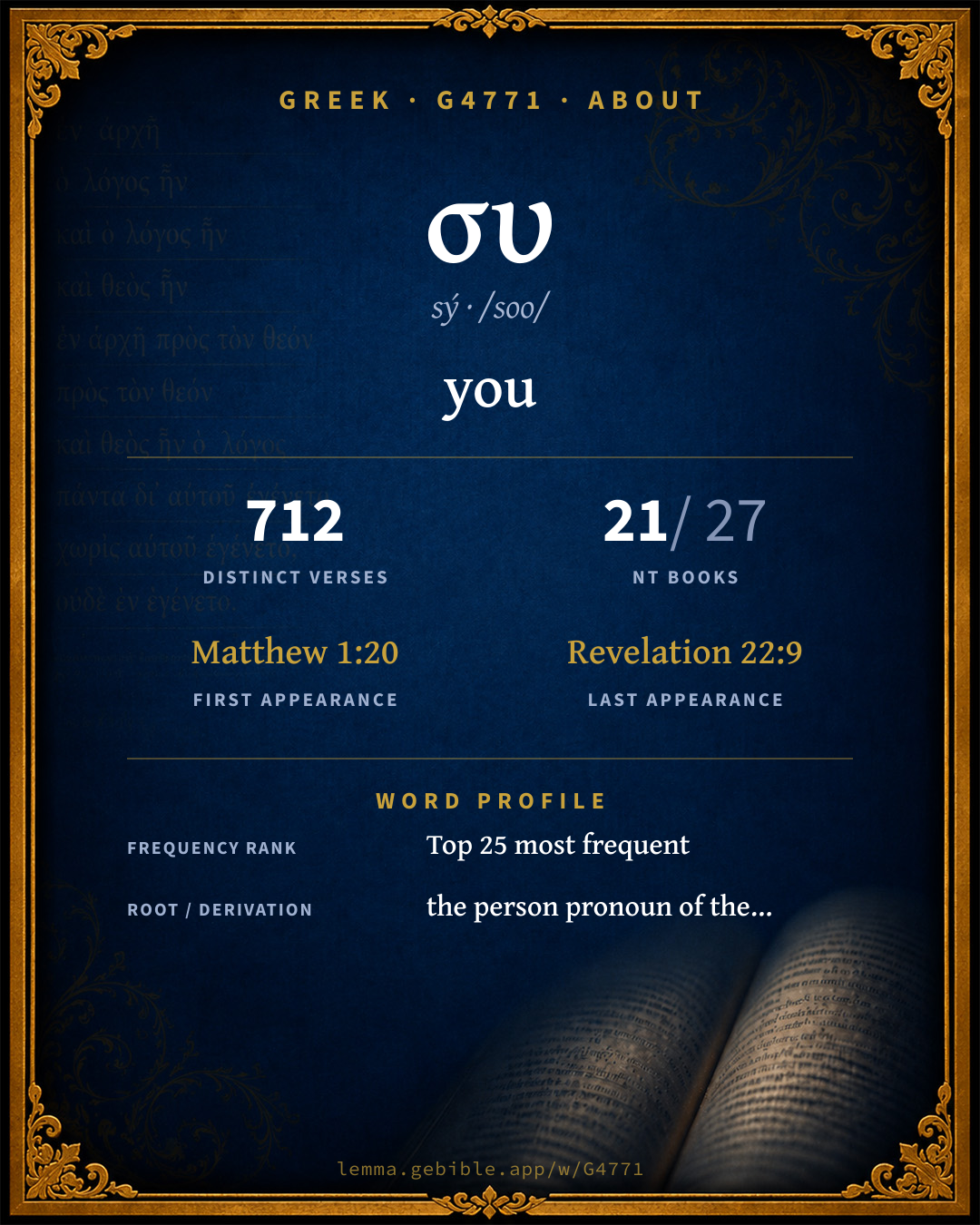
σύ
you
Full lexicon entry — Thayer's Greek Lexicon
From Thayer's Greek Lexicon
Where this word appears
See every Genitive-case word in the Greek New Testament →
Grammar key — what these labels mean
Part of speech
- Personal pronoun
- Stands in for a person already named (“I,” “you,” “he”).
Case
- Genitive
- The case of source, possession, or “of” — answers “whose / from what.”
- Dative
- The case of the indirect object, means, or location — “to / for / with / in.”
- Accusative
- The case of the direct object and of extent.
- Nominative
- The case of the subject (and the predicate nominative).
Person
- 2nd person
- The one addressed (“you”).
Number
- Singular
- One.
- Plural
- More than one.
Grammatical forms
- Personal pronoun, 2nd person, Genitive, Singular 482 times (45%)
- Personal pronoun, 2nd person, Dative, Singular 212 times (20%)
- Personal pronoun, 2nd person, Accusative, Singular 195 times (18%)
- Personal pronoun, 2nd person, Nominative, Singular 173 times (16%)
- Personal pronoun, 2nd person, Dative, Plural 4 times (0%)
- Personal pronoun, 2nd person, Accusative, Plural 3 times (0%)
- Personal pronoun, 2nd person, Nominative, Plural 1 time (0%)
Parsed forms decoded from the imported morphology (Robinson–Tischendorf, public domain), counted across 1,070 parsed occurrences — not distinct verses.
Page 1 of 4 — showing verses 1–200 of 712 distinct verses where G4771 appears, across 21 books. Click any verse to open its interlinear word-by-word view. Verse text shown in the World English Bible for context — . Each verse’s Greek form is shown with its reference; the English is not keyword-highlighted, since the data carries no word-level English alignment. Use “Compare translations” on any verse to read it across multiple English versions. This concordance covers the Greek New Testament; Septuagint (Greek Old Testament) occurrences of this word are not indexed here.
Matthew 123 verses
- Matthew 1:20 σου pron 2 gen sg But when he thought about these things, behold, an angel of the Lord appeared to him in a dream, saying, "Joseph, son of David, don't be afraid to take to yourself Mary, your wife, for that which is conceived in her is of the Holy Spirit.
- Matthew 2:6 σύ σοῦ pron 2 nom sg pron 2 gen sg 'You Bethlehem, land of Judah, Are in no way least among the princes of Judah: For out of you shall come forth a governor, Who shall shepherd my people, Israel.'"
- Matthew 2:13 σοι pron 2 dat sg Now when they had departed, behold, an angel of the Lord appeared to Joseph in a dream, saying, "Arise and take the young child and his mother, and flee into Egypt, and stay there until I tell you, for Herod will seek the young child to destroy him."
- Matthew 3:14 σοῦ σὺ pron 2 gen sg pron 2 nom sg But John would have hindered him, saying, "I need to be baptized by you, and you come to me?"
- Matthew 4:6 σοῦ σε σου pron 2 gen sg pron 2 acc sg pron 2 gen sg and said to him, "If you are the Son of God, throw yourself down, for it is written, 'He will give his angels charge concerning you.' and, 'On their hands they will bear you up, So that you don't dash your foot against a stone.'"
- Matthew 4:7 σου pron 2 gen sg Jesus said to him, "Again, it is written, 'You shall not test the Lord, your God.'"
- Matthew 4:9 σοι pron 2 dat sg He said to him, "I will give you all of these things, if you will fall down and worship me."
- Matthew 4:10 σου pron 2 gen sg Then Jesus said to him, "Get behind me, Satan! For it is written, 'You shall worship the Lord your God, and him only shall you serve.'"
- Matthew 5:23 σου σου σοῦ pron 2 gen sg pron 2 gen sg pron 2 gen sg "If therefore you are offering your gift at the altar, and there remember that your brother has anything against you,
- Matthew 5:24 σου σου σου pron 2 gen sg pron 2 gen sg pron 2 gen sg leave your gift there before the altar, and go your way. First be reconciled to your brother, and then come and offer your gift.
- Matthew 5:25 σου σε pron 2 gen sg pron 2 acc sg Agree with your adversary quickly, while you are with him in the way; lest perhaps the prosecutor deliver you to the judge, and the judge deliver you to the officer, and you be cast into prison.
- Matthew 5:26 σοι pron 2 dat sg Most assuredly I tell you, you shall by no means get out of there, until you have paid the last penny.
- Matthew 5:29 σου σε σοῦ σοι σου σου pron 2 gen sg pron 2 acc sg pron 2 gen sg pron 2 dat sg pron 2 gen sg pron 2 gen sg If your right eye causes you to stumble, pluck it out and throw it away from you. For it is more profitable for you that one of your members should perish, than for your whole body to be cast into Gehenna.
- Matthew 5:30 σου σε σοῦ σοι σου σου pron 2 gen sg pron 2 acc sg pron 2 gen sg pron 2 dat sg pron 2 gen sg pron 2 gen sg If your right hand causes you to stumble, cut it off, and throw it away from you: for it is profitable for you that one of your members should perish, and not your whole body be thrown into Gehenna.
- Matthew 5:33 σου pron 2 gen sg "Again you have heard that it was said to them of old time, 'You shall not make false vows, but shall perform to the Lord your vows,'
- Matthew 5:36 σου pron 2 gen sg Neither shall you swear by your head, for you can't make one hair white or black.
- Matthew 5:39 σε pron 2 acc sg But I tell you, don't resist him who is evil; but whoever strikes you on your right cheek, turn to him the other also.
- Matthew 5:40 σοι σου pron 2 dat sg pron 2 gen sg If anyone sues you to take away your coat, let him have your cloak also.
- Matthew 5:41 σε pron 2 acc sg Whoever compels you to go one mile, go with him two.
- Matthew 5:42 σε σοῦ pron 2 acc sg pron 2 gen sg Give to him who asks you, and don't turn away him who desires to borrow from you.
- Matthew 5:43 σου σου pron 2 gen sg pron 2 gen sg "You have heard that it was said, 'You shall love your neighbor, and hate your enemy.'
- Matthew 6:2 σου pron 2 gen sg Therefore when you do merciful deeds, don't sound a trumpet before yourself, as the hypocrites do in the synagogues and in the streets, that they may get glory from men. Most assuredly I tell you, they have received their reward.
- Matthew 6:3 σοῦ σου σου pron 2 gen sg pron 2 gen sg pron 2 gen sg But when you do merciful deeds, don't let your left hand know what your right hand does,
- Matthew 6:4 σοῦ σου σοι pron 2 gen sg pron 2 gen sg pron 2 dat sg so that your merciful deeds may be in secret, then your Father who sees in secret will reward you openly.
- Matthew 6:6 σὺ σου σου σου σου σοι pron 2 nom sg pron 2 gen sg pron 2 gen sg pron 2 gen sg pron 2 gen sg pron 2 dat sg But you, when you pray, enter into your inner chamber, and having shut your door, pray to your Father who is in secret, and your Father who sees in secret will reward you openly.
- Matthew 6:9 σου pron 2 gen sg Pray like this: 'Our Father in heaven, may your name be kept holy.
- Matthew 6:10 σου σου pron 2 gen sg pron 2 gen sg Let your Kingdom come. Let your will be done, as in heaven, so on earth.
- Matthew 6:17 σὺ σου σου pron 2 nom sg pron 2 gen sg pron 2 gen sg But you, when you fast, anoint your head, and wash your face;
- Matthew 6:18 σου σου σοι pron 2 gen sg pron 2 gen sg pron 2 dat sg so that you are not seen by men to be fasting, but by your Father who is in secret, and your Father, who sees in secret, will reward you.
- Matthew 6:21 σου σου pron 2 gen sg pron 2 gen sg for where your treasure is, there your heart will be also.
- Matthew 6:22 σου σου pron 2 gen sg pron 2 gen sg "The lamp of the body is the eye. If therefore your eye is sound, your whole body will be full of light.
- Matthew 6:23 σου σου σοὶ pron 2 gen sg pron 2 gen sg pron 2 dat sg But if your eye is evil, your whole body will be full of darkness. If therefore the light that is in you is darkness, how great is the darkness!
- Matthew 7:3 σου pron 2 gen sg Why do you see the speck that is in your brother's eye, but don't consider the beam that is in your own eye?
- Matthew 7:4 σου σου σοῦ pron 2 gen sg pron 2 gen sg pron 2 gen sg Or how will you tell your brother, 'Let me remove the speck from your eye;' and behold, the beam is in your own eye?
- Matthew 7:5 σοῦ σου pron 2 gen sg pron 2 gen sg You hypocrite! First remove the beam out of your own eye, and then you can see clearly to remove the speck out of your brother's eye.
- Matthew 8:13 σοι pron 2 dat sg Jesus said to the centurion, "Go your way. Let it be done for you as you have believed." His servant was healed in that hour.
- Matthew 8:19 σοι pron 2 dat sg A scribe came, and said to him, "Teacher, I will follow you wherever you go."
- Matthew 8:29 σοί pron 2 dat sg Behold, they cried out, saying, "What do we have to do with you, Jesus, Son of God? Have you come here to torment us before the time?"
- Matthew 9:2 σου pron 2 gen sg Behold, they brought to him a man who was paralyzed, lying on a bed. Jesus, seeing their faith, said to the paralytic, "Son, cheer up! Your sins are forgiven you."
- Matthew 9:5 σου pron 2 gen sg For which is easier, to say, 'Your sins are forgiven;' or to say, 'Get up, and walk?'
- Matthew 9:6 σου σου pron 2 gen sg pron 2 gen sg But that you may know that the Son of Man has authority on earth to forgive sins..." (then he said to the paralytic), "Get up, and take up your mat, and go up to your house."
- Matthew 9:14 σου pron 2 gen sg Then John's disciples came to him, saying, "Why do we and the Pharisees fast often, but your disciples don't fast?"
- Matthew 9:18 σου pron 2 gen sg While he told these things to them, behold, a ruler came and worshiped him, saying, "My daughter has just died, but come and lay your hand on her, and she will live."
- Matthew 9:22 σου σε pron 2 gen sg pron 2 acc sg But Jesus, turning around and seeing her, said, "Daughter, cheer up! Your faith has made you well." And the woman was made well from that hour.
- Matthew 11:3 σὺ pron 2 nom sg and said to him, "Are you he who comes, or should we look for another?"
- Matthew 11:10 σου σου σου pron 2 gen sg pron 2 gen sg pron 2 gen sg For this is he, of whom it is written, 'Behold, I send my messenger before your face, who will prepare your way before you.'
- Matthew 11:21 σοι σοι pron 2 dat sg pron 2 dat sg "Woe to you, Chorazin! Woe to you, Bethsaida! For if the mighty works had been done in Tyre and Sidon which were done in you, they would have repented long ago in sackcloth and ashes.
- Matthew 11:23 σύ σοί pron 2 nom sg pron 2 dat sg You, Capernaum, who are exalted to Heaven, you will go down to Hades. For if the mighty works had been done in Sodom which were done in you, it would have remained until this day.
- Matthew 11:24 σοί pron 2 dat sg But I tell you that it will be more tolerable for the land of Sodom, on the day of judgment, than for you."
- Matthew 11:25 σοι pron 2 dat sg At that time, Jesus answered, "I thank you, Father, Lord of heaven and earth, that you hid these things from the wise and understanding, and revealed them to infants.
- Matthew 11:26 σου pron 2 gen sg Yes, Father, for so it was well-pleasing in your sight.
- Matthew 12:2 σου pron 2 gen sg But the Pharisees, when they saw it, said to him, "Behold, your disciples do what is not lawful to do on the Sabbath."
- Matthew 12:13 σου pron 2 gen sg Then he told the man, "Stretch out your hand." He stretched it out; and it was restored whole, just like the other.
- Matthew 12:37 σου σου pron 2 gen sg pron 2 gen sg For by your words you will be justified, and by your words you will be condemned."
- Matthew 12:38 σοῦ pron 2 gen sg Then certain of the scribes and Pharisees answered, "Teacher, we want to see a sign from you."
- Matthew 12:47 σου σου σοι pron 2 gen sg pron 2 gen sg pron 2 dat sg One said to him, "Behold, your mother and your brothers stand outside, seeking to speak to you."
- Matthew 14:4 σοι pron 2 dat sg For John said to him, "It is not lawful for you to have her."
- Matthew 14:28 σὺ σὲ pron 2 nom sg pron 2 acc sg Peter answered him and said, "Lord, if it is you, command me to come to you on the waters."
- Matthew 15:2 σου pron 2 gen sg "Why do your disciples disobey the tradition of the elders? For they don't wash their hands when they eat bread."
- Matthew 15:28 σου σοι pron 2 gen sg pron 2 dat sg Then Jesus answered her, "Woman, great is your faith! Be it done to you even as you desire." And her daughter was healed from that hour.
- Matthew 16:16 σὺ pron 2 nom sg Simon Peter answered, "You are the Christ, the Son of the living God."
- Matthew 16:17 σοι pron 2 dat sg Jesus answered him, "Blessed are you, Simon Bar Jonah, for flesh and blood has not revealed this to you, but my Father who is in heaven.
- Matthew 16:18 σοι σὺ pron 2 dat sg pron 2 nom sg I also tell you that you are Peter, and on this rock I will build my assembly, and the gates of Hades will not prevail against it.
- Matthew 16:19 σοι pron 2 dat sg I will give to you the keys of the Kingdom of Heaven, and whatever you bind on earth will be bound in heaven; and whatever you release on earth will be released in heaven."
- Matthew 16:22 σοι σοι pron 2 dat sg pron 2 dat sg Peter took him aside, and began to rebuke him, saying, "Far be it from you, Lord! This will never be done to you."
- Matthew 17:4 σοὶ pron 2 dat sg Peter answered, and said to Jesus, "Lord, it is good for us to be here. If you want, let's make three tents here: one for you, one for Moses, and one for Elijah."
- Matthew 17:16 σου pron 2 gen sg So I brought him to your disciples, and they could not cure him."
- Matthew 17:25 σοι pron 2 dat sg He said, "Yes." When he came into the house, Jesus anticipated him, saying, "What do you think, Simon? From whom do the kings of the earth receive toll or tribute? From their children, or from strangers?"
- Matthew 17:27 σοῦ pron 2 gen sg But, lest we cause them to stumble, go to the sea, and cast a hook, and take up the first fish that comes up. When you have opened its mouth, you will find a stater coin. Take that, and give it to them for me and you."
- Matthew 18:8 σου σου σε σοῦ σοί pron 2 gen sg pron 2 gen sg pron 2 acc sg pron 2 gen sg pron 2 dat sg If your hand or your foot causes you to stumble, cut it off, and cast it from you. It is better for you to enter into life maimed or crippled, rather than having two hands or two feet to be cast into the eternal fire.
- Matthew 18:9 σου σε σοῦ σοί pron 2 gen sg pron 2 acc sg pron 2 gen sg pron 2 dat sg If your eye causes you to stumble, pluck it out, and cast it from you. It is better for you to enter into life with one eye, rather than having two eyes to be cast into the Gehenna of fire.
- Matthew 18:15 σου σοῦ σου σου pron 2 gen sg pron 2 gen sg pron 2 gen sg pron 2 gen sg "If your brother sins against you, go, show him his fault between you and him alone. If he listens to you, you have gained back your brother.
- Matthew 18:17 σοι pron 2 dat sg If he refuses to listen to them, tell it to the assembly. If he refuses to hear the assembly also, let him be to you as a Gentile or a tax collector.
- Matthew 18:22 σοι pron 2 dat sg Jesus said to him, "I don't tell you until seven times, but, until seventy times seven.
- Matthew 18:26 σοι pron 2 dat sg The servant therefore fell down and kneeled before him, saying, 'Lord, have patience with me, and I will repay you all!'
- Matthew 18:29 σοι pron 2 dat sg "So his fellow servant fell down at his feet and begged him, saying, 'Have patience with me, and I will repay you!'
- Matthew 18:32 σοι pron 2 dat sg Then his lord called him in, and said to him, 'You wicked servant! I forgave you all that debt, because you begged me.
- Matthew 18:33 σὲ σου σὲ pron 2 acc sg pron 2 gen sg pron 2 acc sg Shouldn't you also have had mercy on your fellow servant, even as I had mercy on you?'
- Matthew 19:19 σου pron 2 gen sg 'Honor your father and mother.' And, 'You shall love your neighbor as yourself.'"
- Matthew 19:21 σου pron 2 gen sg Jesus said to him, "If you want to be perfect, go, sell what you have, and give to the poor, and you will have treasure in heaven; and come, follow me."
- Matthew 19:27 σοι pron 2 dat sg Then Peter answered, "Behold, we have left everything, and followed you. What then will we have?"
- Matthew 20:13 σε pron 2 acc sg "But he answered one of them, 'Friend, I am doing you no wrong. Didn't you agree with me for a denarius?
- Matthew 20:14 σοί pron 2 dat sg Take that which is yours, and go your way. It is my desire to give to this last just as much as to you.
- Matthew 20:15 σου pron 2 gen sg Isn't it lawful for me to do what I want to with what I own? Or is your eye evil, because I am good?'
- Matthew 20:21 σου σου pron 2 gen sg pron 2 gen sg He said to her, "What do you want?" She said to him, "Command that these, my two sons, may sit, one on your right hand, and one on your left hand, in your Kingdom."
- Matthew 21:5 σου σοι pron 2 gen sg pron 2 dat sg "Tell the daughter of Zion, Behold, your King comes to you, Humble, and riding on a donkey, On a colt, the foal of a donkey."
- Matthew 21:19 σοῦ pron 2 gen sg Seeing a fig tree by the road, he came to it, and found nothing on it but leaves. He said to it, "Let there be no fruit from you forever!" Immediately the fig tree withered away.
- Matthew 21:23 σοι pron 2 dat sg When he had come into the temple, the chief priests and the elders of the people came to him as he was teaching, and said, "By what authority do you do these things? Who gave you this authority?"
- Matthew 22:16 σοι pron 2 dat sg They sent their disciples to him, along with the Herodians, saying, "Teacher, we know that you are honest, and teach the way of God in truth, no matter who you teach, for you aren't partial to anyone.
- Matthew 22:17 σοι pron 2 dat sg Tell us therefore, what do you think? Is it lawful to pay taxes to Caesar, or not?"
- Matthew 22:37 σου σου σου σου pron 2 gen sg pron 2 gen sg pron 2 gen sg pron 2 gen sg Jesus said to him, "'You shall love the Lord your God with all your heart, and with all your soul, and with all your mind.'
- Matthew 22:39 σου pron 2 gen sg A second likewise is this, 'You shall love your neighbor as yourself.'
- Matthew 22:44 σου σου pron 2 gen sg pron 2 gen sg 'The Lord said to my Lord, Sit on my right hand, Until I make your enemies a footstool for your feet?'
- Matthew 23:37 σου pron 2 gen sg "Jerusalem, Jerusalem, who kills the prophets, and stones those who are sent to her! How often would I have gathered your children together, even as a hen gathers her chickens under her wings, and you would not!
- Matthew 25:21 σε σου pron 2 acc sg pron 2 gen sg "His lord said to him, 'Well done, good and faithful servant. You have been faithful over a few things, I will set you over many things. Enter into the joy of your lord.'
- Matthew 25:23 σε σου pron 2 acc sg pron 2 gen sg "His lord said to him, 'Well done, good and faithful servant. You have been faithful over a few things, I will set you over many things. Enter into the joy of your lord.'
- Matthew 25:24 σε pron 2 acc sg "He also who had received the one talent came and said, 'Lord, I knew you that you are a hard man, reaping where you did not sow, and gathering where you did not scatter.
- Matthew 25:25 σου pron 2 gen sg I was afraid, and went away and hid your talent in the earth. Behold, you have what is yours.'
- Matthew 25:27 σε pron 2 acc sg You ought therefore to have deposited my money with the bankers, and at my coming I should have received back my own with interest.
- Matthew 25:37 σε pron 2 acc sg "Then the righteous will answer him, saying, 'Lord, when did we see you hungry, and feed you; or thirsty, and give you a drink?
- Matthew 25:38 σε pron 2 acc sg When did we see you as a stranger, and take you in; or naked, and clothe you?
- Matthew 25:39 σε σε pron 2 acc sg pron 2 acc sg When did we see you sick, or in prison, and come to you?'
- Matthew 25:44 σε σοι pron 2 acc sg pron 2 dat sg "Then they will also answer, saying, 'Lord, when did we see you hungry, or thirsty, or a stranger, or naked, or sick, or in prison, and didn't help you?'
- Matthew 26:15 ὑμῖν pron 2 dat pl and said, "What are you willing to give me, that I should deliver him to you?" They weighed out for him thirty pieces of silver.
- Matthew 26:17 σοι pron 2 dat sg Now on the first day of unleavened bread, the disciples came to Jesus, saying to him, "Where do you want us to prepare for you to eat the Passover?"
- Matthew 26:18 σὲ pron 2 acc sg He said, "Go into the city to a certain person, and tell him, 'The Teacher says, "My time is at hand. I will keep the Passover at your house with my disciples."'"
- Matthew 26:25 σὺ pron 2 nom sg Judas, who betrayed him, answered, "It isn't me, is it, Rabbi?" He said to him, "You said it."
- Matthew 26:33 σοί pron 2 dat sg But Peter answered him, "Even if all will be made to stumble because of you, I will never be made to stumble."
- Matthew 26:34 σοι pron 2 dat sg Jesus said to him, "Most assuredly I tell you that tonight, before the rooster crows, you will deny me three times."
- Matthew 26:35 σοὶ σε pron 2 dat sg pron 2 acc sg Peter said to him, "Even if I must die with you, I will not deny you." All of the disciples also said likewise.
- Matthew 26:39 σύ pron 2 nom sg He went forward a little, fell on his face, and prayed, saying, "My Father, if it is possible, let this cup pass away from me; nevertheless, not what I desire, but what you desire."
- Matthew 26:42 σου pron 2 gen sg Again, a second time he went away, and prayed, saying, "My Father, if this cup can't pass away from me unless I drink it, your desire be done."
- Matthew 26:52 σου pron 2 gen sg Then Jesus said to him, "Put your sword back into its place, for all those who take the sword will die by the sword.
- Matthew 26:62 σου pron 2 gen sg The high priest stood up, and said to him, "Have you no answer? What is this that these testify against you?"
- Matthew 26:63 σε σὺ pron 2 acc sg pron 2 nom sg But Jesus held his peace. The high priest answered him, "I adjure you by the living God, that you tell us whether you are the Christ, the Son of God."
- Matthew 26:64 σὺ pron 2 nom sg Jesus said to him, "You have said it. Nevertheless, I tell you, henceforth you will see the Son of Man sitting at the right hand of Power, and coming on the clouds of the sky."
- Matthew 26:68 σε pron 2 acc sg saying, "Prophesy to us, you Christ! Who hit you?"
- Matthew 26:69 σὺ pron 2 nom sg Now Peter was sitting outside in the court, and a maid came to him, saying, "You were also with Jesus, the Galilean!"
- Matthew 26:73 σὺ σου σε pron 2 nom sg pron 2 gen sg pron 2 acc sg After a little while those who stood by came and said to Peter, "Surely you are also one of them, for your speech makes you known."
- Matthew 27:4 σὺ pron 2 nom sg saying, "I have sinned in that I betrayed innocent blood." But they said, "What is that to us? You see to it."
- Matthew 27:11 σὺ σὺ pron 2 nom sg pron 2 nom sg Now Jesus stood before the governor: and the governor asked him, saying, "Are you the King of the Jews?" Jesus said to him, "So you say."
- Matthew 27:13 σου pron 2 gen sg Then Pilate said to him, "Don't you hear how many things they testify against you?"
- Matthew 27:19 σοὶ pron 2 dat sg While he was sitting on the judgment seat, his wife sent to him, saying, "Have nothing to do with that righteous man, for I have suffered many things this day in a dream because of him."
Mark 56 verses
- Mark 1:2 σου σου pron 2 gen sg pron 2 gen sg As it is written in the prophets, "Behold, I send my messenger before your face, Who will prepare your way before you.
- Mark 1:11 σὺ σοὶ pron 2 nom sg pron 2 dat sg A voice came out of the sky, "You are my beloved Son, in whom I am well pleased."
- Mark 1:24 σοί σε pron 2 dat sg pron 2 acc sg saying, "Ha! What do we have to do with you, Jesus, you Nazarene? Have you come to destroy us? I know you who you are: the Holy One of God!"
- Mark 1:37 σε pron 2 acc sg and they found him, and told him, "Everyone is looking for you."
- Mark 1:44 σου pron 2 gen sg and said to him, "See you say nothing to anybody, but go show yourself to the priest, and offer for your cleansing the things which Moses commanded, for a testimony to them."
- Mark 2:5 σου pron 2 gen sg Jesus, seeing their faith, said to the paralytic, "Son, your sins are forgiven you."
- Mark 2:9 σου σου pron 2 gen sg pron 2 gen sg Which is easier, to tell the paralytic, 'Your sins are forgiven;' or to say, 'Arise, and take up your bed, and walk?'
- Mark 2:11 σοὶ σου σου pron 2 dat sg pron 2 gen sg pron 2 gen sg "I tell you, arise, take up your mat, and go to your house."
- Mark 3:11 σὺ pron 2 nom sg The unclean spirits, whenever they saw him, fell down before him, and cried, "You are the Son of God!"
- Mark 3:32 σου σου σου σε pron 2 gen sg pron 2 gen sg pron 2 gen sg pron 2 acc sg A multitude was sitting around him, and they told him, "Behold, your mother, your brothers, and your sisters are outside looking for you."
- Mark 4:38 σοι pron 2 dat sg He himself was in the stern, asleep on the cushion, and they woke him up, and told him, "Teacher, don't you care that we are dying?"
- Mark 5:7 σοί σε pron 2 dat sg pron 2 acc sg and crying out with a loud voice, he said, "What have I to do with you, Jesus, you Son of the Most High God? I adjure you by God, don't torment me."
- Mark 5:9 σοι pron 2 dat sg He asked him, "What is your name?" He said to him, "My name is Legion, for we are many."
- Mark 5:19 σου σοι σε pron 2 gen sg pron 2 dat sg pron 2 acc sg He didn't allow him, but said to him, "Go to your house, to your friends, and tell them what great things the Lord has done for you, and how he had mercy on you."
- Mark 5:31 σε pron 2 acc sg His disciples said to him, "You see the multitude pressing against you, and you say, 'Who touched me?'"
- Mark 5:34 σου σε σου pron 2 gen sg pron 2 acc sg pron 2 gen sg He said to her, "Daughter, your faith has made you well. Go in peace, and be cured of your disease."
- Mark 5:35 σου pron 2 gen sg While he was still speaking, they came from the synagogue ruler's house saying, "Your daughter is dead. Why bother the Teacher any more?"
- Mark 5:41 σοὶ pron 2 dat sg Taking the child by the hand, he said to her, "Talitha cumi;" which means, being interpreted, "Girl, I tell you, get up."
- Mark 6:18 σοι σου pron 2 dat sg pron 2 gen sg For John said to Herod, "It is not lawful for you to have your brother's wife."
- Mark 6:22 σοι pron 2 dat sg When the daughter of Herodias herself came in and danced, she pleased Herod and those sitting with him. The king said to the young lady, "Ask me whatever you want, and I will give it to you."
- Mark 6:23 σοι pron 2 dat sg He swore to her, "Whatever you shall ask of me, I will give you, up to half of my kingdom."
- Mark 7:5 σου pron 2 gen sg The Pharisees and the scribes asked him, "Why don't your disciples walk according to the tradition of the elders, but eat their bread with unwashed hands?"
- Mark 7:10 σου σου pron 2 gen sg pron 2 gen sg For Moses said, 'Honor your father and your mother;' and, 'He who speaks evil of father or mother, let him be put to death.'
- Mark 7:29 σου pron 2 gen sg He said to her, "For this saying, go your way. The demon has gone out of your daughter."
- Mark 8:29 σὺ pron 2 nom sg He said to them, "But who do you say that I am?" Peter answered, "You are the Christ."
- Mark 9:5 σοὶ pron 2 dat sg Peter answered Jesus, "Rabbi, it is good for us to be here. Let's make three tents: one for you, one for Moses, and one for Elijah."
- Mark 9:17 σέ pron 2 acc sg One of the multitude answered, "Teacher, I brought to you my son, who has a mute spirit;
- Mark 9:18 σου pron 2 gen sg and wherever it seizes him, it throws him down, and he foams at the mouth, and grinds his teeth, and wastes away. I asked your disciples to cast it out, and they weren't able."
- Mark 9:25 σοι pron 2 dat sg When Jesus saw that a multitude came running together, he rebuked the unclean spirit, saying to him, "You mute and deaf spirit, I command you, come out of him, and never enter him again!"
- Mark 9:38 σου pron 2 gen sg John said to him, "Teacher, we saw someone who doesn't follow us casting out demons in your name; and we forbade him, because he doesn't follow us."
- Mark 9:43 σε σου σε pron 2 acc sg pron 2 gen sg pron 2 acc sg If your hand causes you to stumble, cut it off. It is better for you to enter into life maimed, rather than having your two hands to go into Gehenna, into the unquenchable fire,
- Mark 9:45 σου σε σε pron 2 gen sg pron 2 acc sg pron 2 acc sg If your foot causes you to stumble, cut it off. It is better for you to enter into life lame, rather than having your two feet to be cast into Gehenna, into the fire that will never be quenched--
- Mark 9:47 σου σε σέ pron 2 gen sg pron 2 acc sg pron 2 acc sg If your eye causes you to stumble, cast it out. It is better for you to enter into the Kingdom of God with one eye, rather than having two eyes to be cast into the Gehenna of fire,
- Mark 10:19 σου σου pron 2 gen sg pron 2 gen sg You know the commandments: 'Do not murder,' 'Do not commit adultery,' 'Do not steal,' 'Do not give false testimony,' 'Do not defraud,' 'Honor your father and mother.'"
- Mark 10:21 σε pron 2 acc sg Jesus looking at him loved him, and said to him, "One thing you lack. Go, sell whatever you have, and give to the poor, and you will have treasure in heaven; and come, follow me, taking up the cross."
- Mark 10:28 σοι pron 2 dat sg Peter began to tell him, "Behold, we have left all, and have followed you."
- Mark 10:35 σε pron 2 acc sg James and John, the sons of Zebedee, came near to him, saying, "Teacher, we want you to do for us whatever we will ask."
- Mark 10:37 σου σου σου pron 2 gen sg pron 2 gen sg pron 2 gen sg They said to him, "Grant to us that we may sit, one at your right hand, and one at your left hand, in your glory."
- Mark 10:49 σε pron 2 acc sg Jesus stood still, and said, "Call him." They called the blind man, saying to him, "Cheer up! Get up. He is calling you!"
- Mark 10:51 σοι pron 2 dat sg Jesus asked him, "What do you want me to do for you?" The blind man said to him, "Rhabboni, that I may see again."
- Mark 10:52 σου σε pron 2 gen sg pron 2 acc sg Jesus said to him, "Go your way. Your faith has made you well." Immediately he received his sight, and followed Jesus in the way.
- Mark 11:14 σοῦ pron 2 gen sg Jesus told it, "May no one ever eat fruit from you again!" and his disciples heard it.
- Mark 11:28 σοι pron 2 dat sg and they began saying to him, "By what authority do you do these things? Or who gave you this authority to do these things?"
- Mark 12:14 σοι pron 2 dat sg When they had come, they asked him, "Teacher, we know that you are honest, and don't defer to anyone; for you aren't partial to anyone, but truly teach the way of God. Is it lawful to pay taxes to Caesar, or not?
- Mark 12:30 σου σου σου σου σου pron 2 gen sg pron 2 gen sg pron 2 gen sg pron 2 gen sg pron 2 gen sg you shall love the Lord your God with all your heart, and with all your soul, and with all your mind, and with all your strength.' This is the first commandment.
- Mark 12:31 σου pron 2 gen sg The second is like this, 'You shall love your neighbor as yourself.' There is no other commandment greater than these."
- Mark 12:36 σου σου pron 2 gen sg pron 2 gen sg For David himself said in the Holy Spirit, 'The Lord said to my Lord, Sit at my right hand, Until I make your enemies the footstool of your feet.'
- Mark 14:30 σοι σὺ pron 2 dat sg pron 2 nom sg Jesus said to him, "Most assuredly I tell you, that you today, even this night, before the rooster crows twice, you will deny me three times."
- Mark 14:31 σοι σε pron 2 dat sg pron 2 acc sg But he spoke all the more, "If I must die with you, I will not deny you." They all said the same thing.
- Mark 14:36 σοι σύ pron 2 dat sg pron 2 nom sg He said, "Abba, Father, all things are possible to you. Please remove this cup from me. However, not what I desire, but what you desire."
- Mark 14:60 σου pron 2 gen sg The high priest stood up in the midst, and asked Jesus, "Have you no answer? What is it which these testify against you?"
- Mark 14:61 σὺ pron 2 nom sg But he stayed quiet, and answered nothing. Again the high priest asked him, "Are you the Christ, the Son of the Blessed?"
- Mark 14:67 σὺ pron 2 nom sg and seeing Peter warming himself, she looked at him, and said, "You were also with the Nazarene, Jesus!"
- Mark 14:68 σὺ pron 2 nom sg But he denied it, saying, "I neither know, nor understand what you are saying." He went out on the porch, and the rooster crowed.
- Mark 15:2 σὺ σὺ pron 2 nom sg pron 2 nom sg Pilate asked him, "Are you the King of the Jews?" He answered, "So you say."
- Mark 15:4 σου pron 2 gen sg Pilate again asked him, "Have you no answer? See how many things they testify against you!"
Luke 145 verses
- Luke 1:3 σοι pron 2 dat sg it seemed good to me also, having traced the course of all things accurately from the first, to write to you in order, most excellent Theophilus;
- Luke 1:13 σου σου σοι pron 2 gen sg pron 2 gen sg pron 2 dat sg But the angel said to him, "Don't be afraid, Zacharias, because your request has been heard, and your wife, Elizabeth, will bear you a son, and you shall call his name John.
- Luke 1:14 σοι pron 2 dat sg You will have joy and gladness; and many will rejoice at his birth.
- Luke 1:19 σὲ σοι pron 2 acc sg pron 2 dat sg The angel answered him, "I am Gabriel, who stands in the presence of God. I was sent to speak to you, and to bring you this good news.
- Luke 1:28 σοῦ pron 2 gen sg Having come in, the angel said to her, "Rejoice, you highly favored one! The Lord is with you. Blessed are you among women!"
- Luke 1:35 σέ σοι pron 2 acc sg pron 2 dat sg The angel answered her, "The Holy Spirit will come on you, and the power of the Most High will overshadow you. Therefore also the holy one who is born from you will be called the Son of God.
- Luke 1:36 σου pron 2 gen sg Behold, Elizabeth, your relative, also has conceived a son in her old age; and this is the sixth month with her who was called barren.
- Luke 1:38 σου pron 2 gen sg Mary said, "Behold, the handmaid of the Lord; be it to me according to your word." The angel departed from her.
- Luke 1:42 σὺ σου pron 2 nom sg pron 2 gen sg She called out with a loud voice, and said, "Blessed are you among women, and blessed is the fruit of your womb!
- Luke 1:44 σου pron 2 gen sg For behold, when the voice of your greeting came into my ears, the baby leaped in my womb for joy!
- Luke 1:61 σου pron 2 gen sg They said to her, "There is no one among your relatives who is called by this name."
- Luke 1:76 σὺ pron 2 nom sg And you, child, will be called a prophet of the Most High, For you will go before the face of the Lord to make ready his ways,
- Luke 2:29 σου σου pron 2 gen sg pron 2 gen sg "Now you are releasing your servant, Master, According to your word, in peace;
- Luke 2:30 σου pron 2 gen sg For my eyes have seen your salvation,
- Luke 2:32 σου pron 2 gen sg A light for revelation to the Gentiles, And the glory of your people Israel."
- Luke 2:35 σοῦ pron 2 gen sg Yes, a sword will pierce through your own soul, that the thoughts of many hearts may be revealed."
- Luke 2:48 σου σε pron 2 gen sg pron 2 acc sg When they saw him, they were astonished, and his mother said to him, "Son, why have you treated us this way? Behold, your father and I were anxiously looking for you."
- Luke 3:22 σὺ σοὶ pron 2 nom sg pron 2 dat sg and the Holy Spirit descended in a bodily form as a dove on him; and a voice came out of the sky, saying "You are my beloved Son. In you I am well pleased."
- Luke 4:6 σοὶ pron 2 dat sg The devil said to him, "I will give you all this authority, and their glory, for it has been delivered to me; and I give it to whomever I want.
- Luke 4:7 σὺ σοῦ pron 2 nom sg pron 2 gen sg If you therefore will worship before me, it will all be yours."
- Luke 4:8 σου pron 2 gen sg Jesus answered him, "Get behind me Satan! For it is written, 'You shall worship the Lord your God, and him only shall you serve.'"
About this entry
At a glance — auto-summarized from this page’s data, not written by a person. Every figure links to its source below. This summary describes the numbers; it doesn’t interpret them.
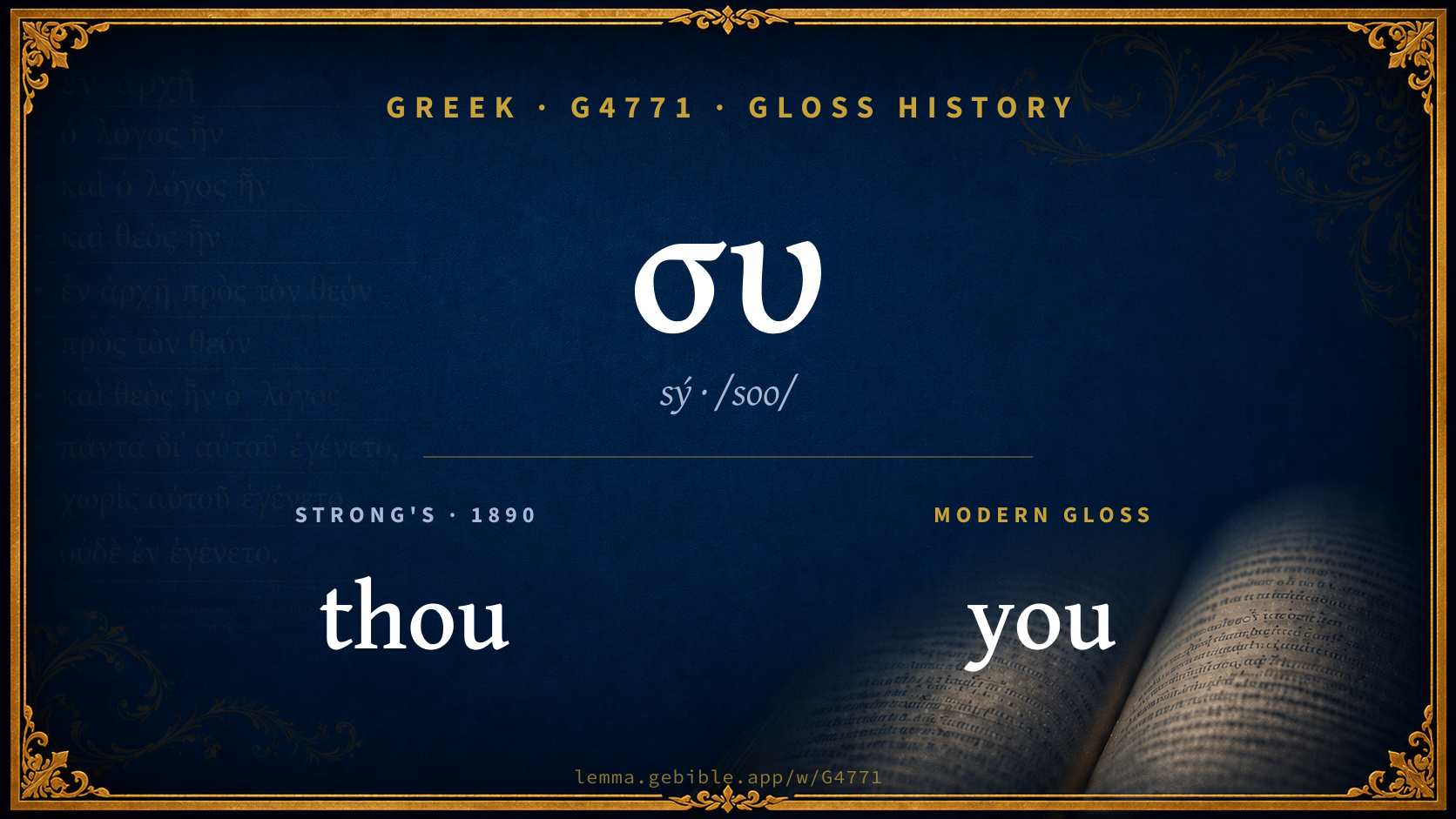
συ — transliterated sý — is a Greek word carrying the sense “you.” Its English rendering has broadened — “thou” classically, “you” (Berean Standard Bible) in modern versions; see the renderings breakdown. Spanning 712 verses in 21 books, it ranks among the most common words of the Greek New Testament. Its earliest occurrence is Matthew 1:20. Sharing its root, it stands alongside σε, σοι and σος. Dig into 712-verse concordance and the renderings breakdown below.
Gloss history
Strong's 1890 vs modern scholarship
About this word
Strong's G4771 catalogs a Greek word from the Greek New Testament.
These counts are not copied from any lexicon or concordance. They are computed here, from the morphology-tagged Greek New Testament. What Lemma adds →
- 712
- distinct verses
- The word appears in 712 distinct verses.
- 21 / 27
- NT books
- The word appears in 21 of 27 New Testament books.
- #17
- by frequency
- Top 25 most frequent Greek words (rank 17 of 5,347 Greek words by occurrence).
View all 712 occurrences in the concordance →
By section of the New Testament
By traditional corpus
Conventional, traditional groupings — biblical authorship is debated, so this is a traditional corpus grouping, not an authorship claim. Some books belong to more than one corpus (Luke is in both the Gospels and the Lukan corpus, and so on), so these shares overlap and need not total 100%. Each figure is a share of the word’s 712 distinct verses.
- Gospels 439 verses · 62%
- Lukan (Luke–Acts) 243 verses · 34%
- Johannine 167 verses · 23%
- Pauline corpus 99 verses · 14%
- Revelation 43 verses · 6%
- Hebrews 18 verses · 3%
- General (Catholic) Epistles 15 verses · 2%
How translations render this word
Counts come from each version’s own published word-to-Strong’s tagging or interlinear alignment — an approximate guide to how each version renders this word, not a word-level alignment the data otherwise carries. Because each total is that version’s own tagged count, the per-version totals vary from one another and need not match the appearance or distinct-verse counts above. These counts may also differ from a printed concordance because Lemma counts each distinctly tagged rendering and does not collapse phrase taggings into a single head-word total. This is a fixed set of word-tagged versions (KJV, ASV, BSB, ULT) and does not change with the reading translation you choose elsewhere. Each version’s license is shown beside its name below (and on Sources).
- King James Version: Thou 172×, Art thou 3×
- American Standard Version: Thou 155×, Art thou 4×, Thou wilt 2×
- Berean Standard Bible: You 1,826×, Your 694×, Do you 22×
- unfoldingWord Literal Text: You 2,082×, Your 769×, Yourselves 22×
King James Version Public Domain
Renders G4771 across 178 tagged occurrences — most commonly:
Plus 3 renderings that appear only once — usually multi-word phrases or single function words the recovered tagging swept in, not distinct renderings.
American Standard Version Public Domain
Renders G4771 across 174 tagged occurrences — most commonly:
Plus 13 renderings that appear only once — usually multi-word phrases or single function words the recovered tagging swept in, not distinct renderings.
Berean Standard Bible Public Domain
Renders G4771 across 2,656 tagged occurrences — most commonly:
Plus other, less common renderings. Plus 40 renderings that appear only once — usually multi-word phrases or single function words the recovered tagging swept in, not distinct renderings. Not rendered by a distinct English word in 215 further occurrences.
unfoldingWord Literal Text CC BY-SA 4.0
Renders G4771 across 2,920 tagged occurrences — most commonly:
Plus 10 renderings that appear only once — usually multi-word phrases or single function words the recovered tagging swept in, not distinct renderings.
Senses in Thayer's
The 1 sense Thayer's distinguishes for this word, in lexicon order (not ranked by frequency or importance). The full entry — with sub-senses — is in the Lexicon Entry tab.
- you
Word origin
Origin: the person pronoun of the second person singular
Forms in the corpus
The 15 distinct written forms G4771 takes in the Greek New Testament, most frequent first — each parse links to that case’s occurrences in the concordance.
Same root — word family
Other Thayer's entries built from the same root as G4771, grouped by Strong’s listed origin. These share a root / origin per the lexicon — not necessarily a shared meaning. Each links to that word’s own entry.
Derived from this word
Compare all same-root words → Showing 4 of 6 — not the complete family. They share a root, not necessarily a meaning.
Septuagint usage
The same Greek word συ appears 11,777 times in the Greek Old Testament (Septuagint), across 5,911 verses in 38 books.
- 11,777
- LXX occurrences
- Tagged occurrences of this Greek word in the Septuagint.
- 5,911
- verses
- Distinct Septuagint verses containing this word.
- 38 / 39
- OT books
- The word appears in 38 of the 39 Old Testament books.
Sample Septuagint occurrences
- Genesis 1:29 σύ
- Exodus 2:7 σύ
- Leviticus 1:2 σύ
- Numbers 1:3 σύ
- Deuteronomy 1:6 σύ
- Joshua 1:2 σύ
- Judges 1:3 σύ
- Ruth 1:8 σύ
- 1 Samuel 1:8 σύ
- 2 Samuel 1:3 σύ
- 1 Kings 1:6 σύ
- 2 Kings 1:3 σύ
Septuagint occurrences (same lexeme)
Every verse where the same Strong’s number (G4771) appears in the Greek Septuagint — showing the first 50 of 5,911. Verse text shown in the World English Bible for context; the Greek form is the matched word — the English is not keyword-highlighted.
- Genesis 1:29 σύ God said, "Behold, I have given you every herb yielding seed, which is on the surface of all the earth, and every tree, which bears fruit yielding seed. It will be your food.
- Genesis 3:5 σύ for God knows that in the day you eat it, your eyes will be opened, and you will be like God, knowing good and evil."
- Genesis 3:10 σύ The man said, "I heard your voice in the garden, and I was afraid, because I was naked; and I hid myself."
- Genesis 3:11 σύ God said, "Who told you that you were naked? Have you eaten from the tree that I commanded you not to eat from?"
- Genesis 3:14 σύ Yahweh God said to the serpent, "Because you have done this, cursed are you above all cattle, and above every animal of the field. On your belly shall you go, and you shall eat dust all the days of your life.
- Genesis 3:15 σύ I will put enmity between you and the woman, and between your offspring and her offspring. He will bruise your head, and you will bruise his heel."
- Genesis 3:16 σύ To the woman he said, "I will greatly multiply your pain in childbirth. In pain you will bring forth children. Your desire will be for your husband, and he will rule over you."
- Genesis 3:17 σύ To Adam he said, "Because you have listened to your wife's voice, and have eaten of the tree, of which I commanded you, saying, 'You shall not eat of it,' cursed is the ground for your sake. In toil you will eat of it all the days of your life.
- Genesis 3:18 σύ Thorns also and thistles will it bring forth to you; and you will eat the herb of the field.
- Genesis 3:19 σύ By the sweat of your face will you eat bread until you return to the ground, for out of it you were taken. For you are dust, and to dust you shall return."
- Genesis 4:6 σύ Yahweh said to Cain, "Why are you angry? Why has the expression of your face fallen?
- Genesis 4:7 σύ If you do well, will it not be lifted up? If you don't do well, sin crouches at the door. Its desire is for you, but you are to rule over it."
- Genesis 4:9 σύ Yahweh said to Cain, "Where is Abel, your brother?" He said, "I don't know. Am I my brother's keeper?"
- Genesis 4:10 σύ Yahweh said, "What have you done? The voice of your brother's blood cries to me from the ground.
- Genesis 4:11 σύ Now you are cursed because of the ground, which has opened its mouth to receive your brother's blood from your hand.
- Genesis 4:12 σύ From now on, when you till the ground, it won't yield its strength to you. You shall be a fugitive and a wanderer in the earth."
- Genesis 4:14 σύ Behold, you have driven me out this day from the surface of the ground. I will be hidden from your face, and I will be a fugitive and a wanderer in the earth. It will happen that whoever finds me will kill me."
- Genesis 6:18 σύ But I will establish my covenant with you. You shall come into the ark, you, your sons, your wife, and your sons' wives with you.
- Genesis 6:20 σύ Of the birds after their kind, of the cattle after their kind, of every creeping thing of the ground after its kind, two of every sort shall come to you, to keep them alive.
- Genesis 6:21 σύ Take with you of all food that is eaten, and gather it to you; and it will be for food for you, and for them."
- Genesis 7:1 σύ Yahweh said to Noah, "Come with all of your household into the ark, for I have seen your righteousness before me in this generation.
- Genesis 7:2 σύ You shall take seven pairs of every clean animal with you, the male and his female. Of the animals that are not clean, take two, the male and his female.
- Genesis 8:16 σύ "Go forth from the ark, you, and your wife, and your sons, and your sons' wives with you.
- Genesis 8:17 σύ Bring forth with you every living thing that is with you of all flesh, including birds, cattle, and every creeping thing that creeps on the earth; that they may breed abundantly in the earth, and be fruitful, and multiply on the earth."
- Genesis 9:2 σύ The fear of you and the dread of you will be on every animal of the earth, and on every bird of the sky. Everything that the ground teems with, and all the fish of the sea are delivered into your hand.
- Genesis 9:3 σύ Every moving thing that lives will be food for you. As the green herb, I have given everything to you.
- Genesis 9:5 σύ I will surely require your blood of your lives. At the hand of every animal I will require it. At the hand of man, even at the hand of every man's brother, I will require the life of man.
- Genesis 9:7 σύ Be fruitful, and multiply. Bring forth abundantly in the earth, and multiply in it."
- Genesis 9:9 σύ "As for me, behold, I establish my covenant with you, and with your offspring after you,
- Genesis 9:10 σύ and with every living creature that is with you: the birds, the cattle, and every animal of the earth with you. Of all that go out of the ark, even every animal of the earth.
- Genesis 9:11 σύ I will establish my covenant with you; neither will all flesh be cut off any more by the waters of the flood; neither will there any more be a flood to destroy the earth."
- Genesis 9:12 σύ God said, "This is the token of the covenant which I make between me and you and every living creature that is with you, for perpetual generations:
- Genesis 9:15 σύ and I will remember my covenant, which is between me and you and every living creature of all flesh, and the waters will no more become a flood to destroy all flesh.
- Genesis 12:1 σύ Now Yahweh said to Abram, "Get out of your country, and from your relatives, and from your father's house, to the land that I will show you.
- Genesis 12:2 σύ I will make of you a great nation. I will bless you, and make your name great. You will be a blessing.
- Genesis 12:3 σύ I will bless those who bless you, and I will curse him who curses you. In you will all of the families of the earth be blessed."
- Genesis 12:7 σύ Yahweh appeared to Abram, and said, "I will give this land to your seed." He built an altar there to Yahweh, who appeared to him.
- Genesis 12:12 σύ It will happen, when the Egyptians will see you, that they will say, 'This is his wife.' They will kill me, but they will save you alive.
- Genesis 12:13 σύ Please say that you are my sister, that it may be well with me for your sake, and that my soul may live because of you."
- Genesis 12:18 σύ Pharaoh called Abram, and said, "What is this that you have done to me? Why didn't you tell me that she was your wife?
- Genesis 12:19 σύ Why did you say, 'She is my sister,' so that I took her to be my wife? Now therefore, see your wife, take her, and go your way."
- Genesis 13:8 σύ Abram said to Lot, "Please, let there be no strife between me and you, and between my herdsmen and your herdsmen; for we are relatives.
- Genesis 13:9 σύ Isn't the whole land before you? Please separate yourself from me. If you go to the left hand, then I will go to the right. Or if you go to the right hand, then I will go to the left."
- Genesis 13:14 σύ Yahweh said to Abram, after Lot was separated from him, "Now, lift up your eyes, and look from the place where you are, northward and southward and eastward and westward,
- Genesis 13:15 σύ for all the land which you see, I will give to you, and to your offspring forever.
- Genesis 13:16 σύ I will make your offspring as the dust of the earth, so that if a man can number the dust of the earth, then your seed may also be numbered.
- Genesis 13:17 σύ Arise, walk through the land in the length of it and in the breadth of it; for I will give it to you."
- Genesis 14:20 σύ and blessed be God Most High, who has delivered your enemies into your hand." Abram gave him a tenth of all.
- Genesis 15:1 σύ After these things the word of Yahweh came to Abram in a vision, saying, "Don't be afraid, Abram. I am your shield, your exceedingly great reward."
- Genesis 15:4 σύ Behold, the word of Yahweh came to him, saying, "This man will not be your heir, but he who will come forth out of your own body will be your heir."
These are occurrences of the same Greek lexeme (G4771) in the Septuagint — not a translation of any one Hebrew word. The store carries no word-level Hebrew↔Greek alignment, so no Hebrew original is asserted here. Counts come from the recovered LXX Strong's tagging — high-frequency vocabulary is well covered, while rare or late forms may be untagged — so they reflect tagged occurrences and may slightly undercount.