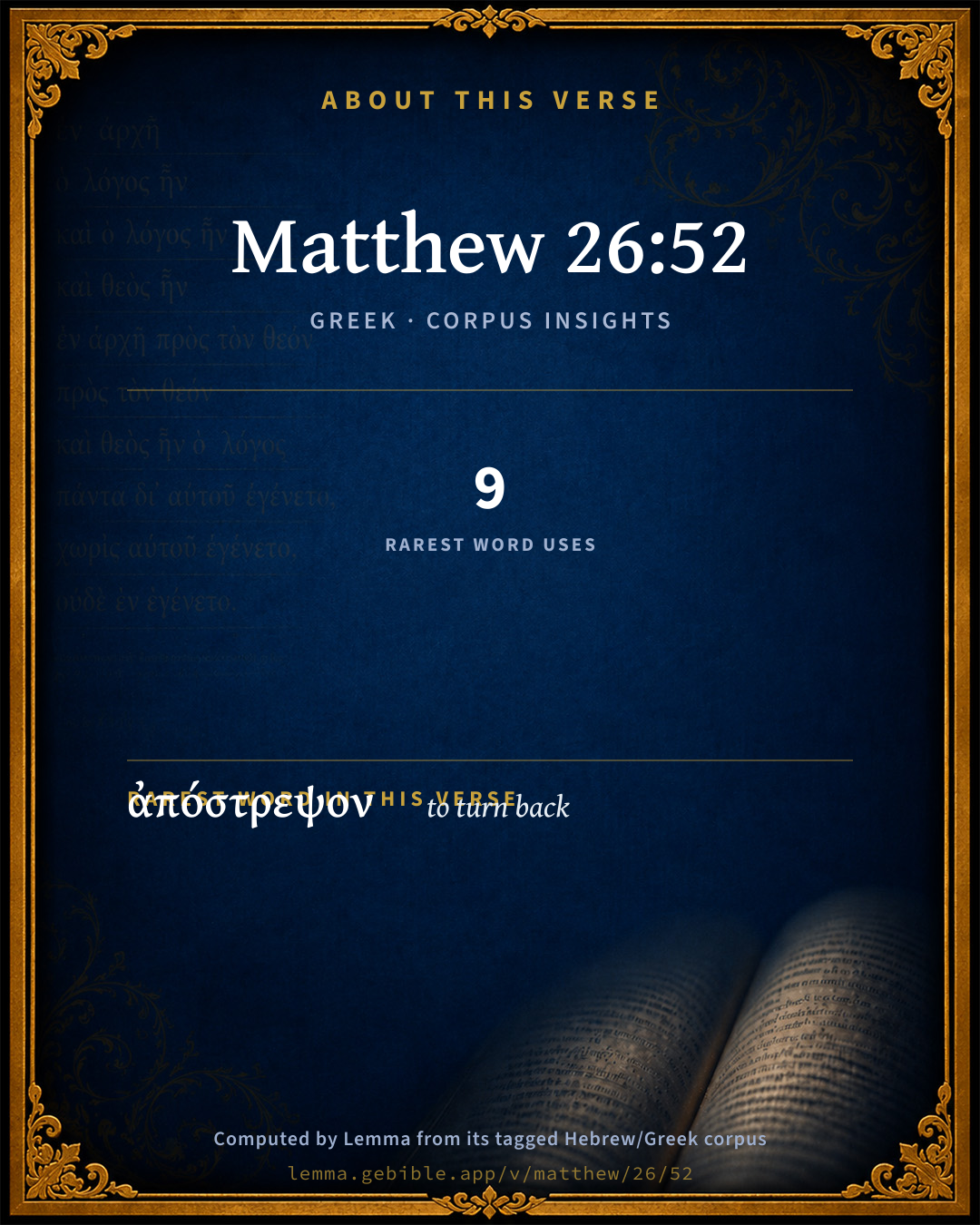
Matthew 26:52

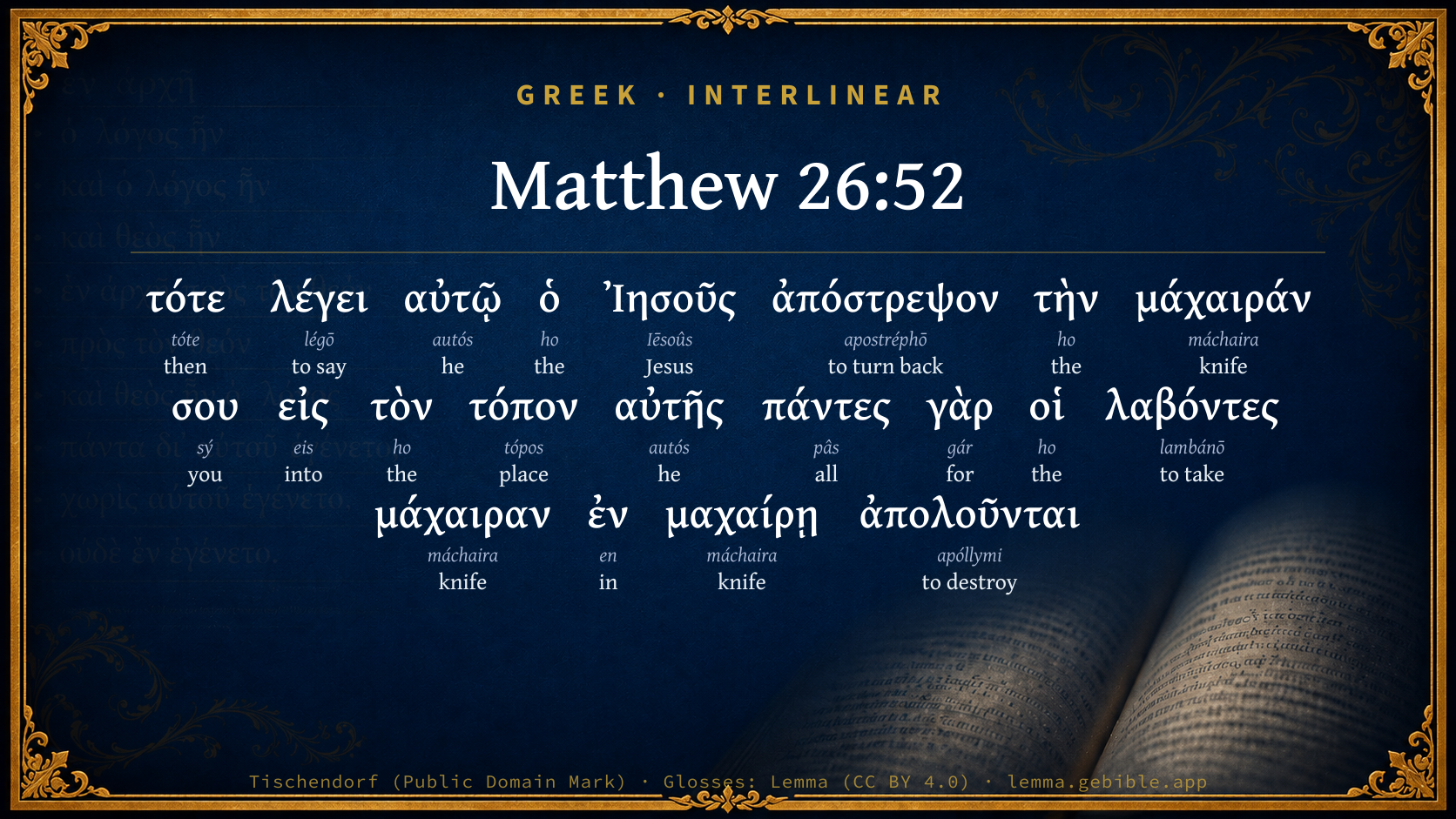
Greek (Tischendorf 8th ed.) Matthew 26:52 appears in the Greek New Testament. The text above is from the Tischendorf 8th edition. Each word links to its Strong’s number and a concise gloss. Click any word for its full Thayer’s Greek Lexicon entry.
Download image
Cite this verse

Matthew 26:52 (World English Bible). Public Domain. Lemma interlinear Bible study tool, https://lemma.gebible.app/v/matthew/26/52.

Show BibTeX & RIS
BibTeX
RIS
English Translation
Then Jesus said to him, "Put your sword back into its place, for all those who take the sword will die by the sword.
World English Bible · Public Domain
Download a study sheet

One document with this verse’s original text, its word-by-word gloss line, the meaning frame, cross-references with their text, attributed commentary, and full source and license credits — printable, and it pastes into notes with its structure intact.

This verse Autodidact and up

Study sheet (.html) Plain text (.txt)

A passage Seminary Student

Up to 50 verses in one chapter. A passage sheet keeps up to 6 commentary sources and 12 cross-references per verse, in the order this page ranks them, and says so on the sheet whenever that leaves anything out. Ask for a single verse and you get the Autodidact verse sheet above.

Everything on this page stays free to read, with no account — the sheet is a download of what is already on screen, not access to it.

Want to remove ads? Support Godless Engineer
Compare translations 3

The same verse in 3 English versions, stacked beneath the original-language interlinear above. Click any original word for its lexicon entry.

Each is an independent rendering of the whole verse — the interlinear is not word-aligned to these translations.

Highlighted words mark where these versions differ — a whole-verse word diff, not a word-by-word alignment.

  • World English Bible Public Domain
    Then Jesus said to him, "Put your sword back into its place, for all those who take the sword will die by the sword.
  • King James Version Public Domain
    Then said Jesus unto him, Put up again thy sword into his place: for all they that take the sword shall perish with the sword.
  • unfoldingWord Literal Text CC BY-SA 4.0
    Then Jesus says to him, “Return your sword to its place, for all the ones having taken a sword will perish by a sword.

unfoldingWord Literal Text — © unfoldingWord, licensed CC BY-SA 4.0. Word-aligned USFM3 via Door43 (git.door43.org/unfoldingWord/en_ult).

Versions to compare (up to 4)

3 of 4 selected

Show all 19 translations

Every available English version of this verse, each an independent rendering of the whole verse.

  • World English Bible Public Domain
    Then Jesus said to him, "Put your sword back into its place, for all those who take the sword will die by the sword.
  • Berean Standard Bible Public Domain
    “Put your sword back in its place,” Jesus said to him. “For all who draw the sword will die by the sword.
  • Majority Standard Bible Public Domain
    “Put your sword back in its place,” Jesus said to him. “For all who draw the sword will perish by the sword.
  • King James Version Public Domain
    Then said Jesus unto him, Put up again thy sword into his place: for all they that take the sword shall perish with the sword.
  • American Standard Version (1901) Public Domain
    Then saith Jesus unto him, Put up again thy sword into its place: for all they that take the sword shall perish with the sword.
  • Revised Version (1885) Public Domain
    Then saith Jesus unto him, Put up again thy sword into its place: for all they that take the sword shall perish with the sword.
  • Geneva Bible (1599) Public Domain
    Then sayde Iesus vnto him, Put vp thy sworde into his place: for all that take the sworde, shall perish with the sworde.
  • Douay-Rheims (1899) Public Domain
    Then Jesus saith to him: Put up again thy sword into its place: for all that take the sword shall perish with the sword.
  • Young's Literal Translation Public Domain
    Then saith Jesus to him, `Turn back thy sword to its place; for all who did take the sword, by the sword shall perish;
  • Literal Standard Version CC BY-SA 4.0
    Then Jesus says to him, “Turn back your sword to its place; for all who took the sword will perish by the sword;
  • Unlocked Literal Bible CC BY-SA 4.0
    Then Jesus said to him, “Put your sword back in its place, for all those who take up the sword will perish by the sword.
  • unfoldingWord Literal Text CC BY-SA 4.0
    Then Jesus says to him, “Return your sword to its place, for all the ones having taken a sword will perish by a sword.
  • Darby Bible Public Domain
    Then saith Jesus to him, Return thy sword to its place; for all who take the sword shall perish by the sword.
  • World Messianic Bible Public Domain
    Then Yeshua said to him, “Put your sword back into its place, for all those who take the sword will die by the sword.
  • Webster's Bible Public Domain
    Then said Jesus to him, Put up again thy sword into its place: for all they that take the sword, shall perish by the sword.
  • Free Bible Version CC BY-SA 4.0
    But Jesus told him, “Put your sword away. Everyone who fights with the sword will die by the sword.
  • Bible in Basic English Public Domain
    Then says Jesus to him, Put up your sword again into its place: for all those who take the sword will come to death by the sword.
  • Text-Critical English NT CC BY 4.0
    Then Jesus said to him, “Put yoʋr sword back in its place, for all who take the sword will die by the sword.
  • Tyndale New Testament (1534) Public Domain
    Then sayde Iesus vnto him: put vp thy swearde into his sheathe. For all that ley hond on the swearde shall perisshe with the swearde.

Literal Standard Version (2020), Covenant Press — licensed CC BY-SA 4.0. Text via the HelloAO Bible API (eBible.org). Unlocked Literal Bible (unfoldingWord) — licensed CC BY-SA 4.0. Text via the HelloAO Bible API (eBible.org). unfoldingWord Literal Text — © unfoldingWord, licensed CC BY-SA 4.0. Word-aligned USFM3 via Door43 (git.door43.org/unfoldingWord/en_ult). Free Bible Version, Dr. Jonathan Gallagher — licensed CC BY-SA 4.0. Text via the HelloAO Bible API (eBible.org).

Word by word

More ways to search: Search by grammar → Find every occurrence → Compare this word →

Practice this passage: Drill this verse → Learn its vocabulary →

ἀπόστρεψον
apostréphō
G654
“to turn back”
Verb, Aorist, Active, Imperative, 2nd person, Singular
Part of Speech
Verb
Tense
Aorist
Voice
Active
Mood
Imperative
Person
2nd person
Number
Singular
Full Thayer's Definition

Origin: from G575 and G4762

TDNT: 18:59,1

1. to turn away a. to remove anything from anyone b. to turn him away from allegiance to any one c. tempt to defect 2. to turn back, return, bring back a. of putting a sword back in its sheath b. of Judas returning money to temple 3. to turn one's self away, turn back, return 4. to turn one's self away from, deserting
  1. τότε tóte G5119 “then” Adverb
  2. λέγει légō G3004 “to say” Verb, Present, Active, Indicative, 3rd person, Singular
  3. αὐτῷ autós G846 “he” Personal pronoun, Dative, Singular, Masculine
  4. ὁ ho G3588 “the” Article, Nominative, Singular, Masculine
  5. Ἰησοῦς Iēsoûs G2424 “Jesus” Noun, Nominative, Singular, Masculine
  6. τὴν ho G3588 “the” Article, Accusative, Singular, Feminine
  7. μάχαιράν máchaira G3162 “knife” Noun, Accusative, Singular, Feminine
  8. σου sý G4771 “you” Personal pronoun, 2nd person, Genitive, Singular
  9. εἰς eis G1519 “into” Preposition
  10. τὸν ho G3588 “the” Article, Accusative, Singular, Masculine
  11. τόπον tópos G5117 “place” Noun, Accusative, Singular, Masculine
  12. αὐτῆς autós G846 “he” Personal pronoun, Genitive, Singular, Feminine
  13. πάντες pâs G3956 “all” Adjective, Nominative, Plural, Masculine
  14. γὰρ gár G1063 “for” Conjunction
  15. οἱ ho G3588 “the” Article, Nominative, Plural, Masculine
  16. λαβόντες lambánō G2983 “to take” Verb, Aorist, Active, Participle, Nominative, Plural, Masculine
  17. μάχαιραν máchaira G3162 “knife” Noun, Accusative, Singular, Feminine
  18. ἐν en G1722 “in” Preposition
  19. μαχαίρῃ máchaira G3162 “knife” Noun, Dative, Singular, Feminine
  20. ἀπολοῦνται apóllymi G622 “to destroy” Verb, Future, Middle, Indicative, 3rd person, Plural

About this verse

These counts appear in no published source. They are computed here, from the morphology-tagged text and Lemma’s own curated glosses. What Lemma adds →

21
words
15
distinct lemmas
Gospels
section

Notable vocabulary

The rarest word here is ἀπόστρεψον to turn back G654 — appearing just 9 times in the whole Greek New Testament.

Shared distinctive vocabulary

ἀπόστρεψον to turn back G654 occurs in 9 verses of the Greek New Testament. Also found in:

Repetition

Words recur within this verse:

  • μάχαιράν knife G3162 ×3
  • ὁ the G3588 ×4
  • αὐτῷ he G846 ×2

Cross-references

12

Topical passages linked to Matthew 26:52 in the Treasury of Scripture Knowledge — connected by theme and wording, ordered by reader-vote popularity; previews shown in the World English Bible.

  • Genesis 9:6 Whoever sheds man's blood, by man will his blood be shed, for in the image of God made he man.
  • Revelation 13:10 If anyone has captivity, he will go. If anyone is with the sword, he must be killed. Here is the endurance and the faith of the saints.
  • Romans 12:19 Don't seek revenge yourselves, beloved, but give place to God's wrath. For it is written, "Vengeance belongs to me; I will repay, says the Lord."
  • 1 Peter 2:21–23 For to this you were called, because Christ also suffered for us, leaving you an example, that you should follow his steps,
  • 1 Peter 3:9 not rendering evil for evil, or reviling for reviling; but instead blessing; knowing that to this were you called, that you may inherit a blessing.
  • Revelation 16:6 For they poured out the blood of the saints and the prophets, and you have given them blood to drink. They deserve this."
  • Psalms 55:23 But you, God, will bring them down into the pit of destruction. Bloodthirsty and deceitful men shall not live out half their days, But I will trust in you.
  • Ezekiel 35:5–6 Because you have had a perpetual enmity, and have given over the children of Israel to the power of the sword in the time of their calamity, in the time of the iniquity of the end;
  • Matthew 23:34–36 Therefore, behold, I send to you prophets, wise men, and scribes. Some of them you will kill and crucify; and some of them you will scourge in your synagogues, and persecute from city to city;
  • Matthew 5:39 But I tell you, don't resist him who is evil; but whoever strikes you on your right cheek, turn to him the other also.
  • 1 Corinthians 4:11–12 Even to this present hour we hunger, thirst, are naked, are beaten, and have no certain dwelling place.
  • 1 Thessalonians 5:15 See that no one returns evil for evil to anyone, but always follow after that which is good, for one another, and for all.

Cross-references courtesy of OpenBible.info (CC BY 4.0).

Commentary

Notes on Matthew 26:52 from classic Christian and Jewish commentators (each source and its license shown beneath its notes). The classic Christian expositions comment on the surrounding passage and are grouped to its opening verse, so a note may address several verses; the Jewish commentaries on the Tanakh (Rashi and others) are per-verse, so they appear only where the commentator wrote on this verse.

Lemma curates 59 commentaries, every one of them public domain or Creative Commons licensed, each selected and text-cleaned for this edition rather than reprinted as found. About our sources →

Bengel's Gnomon

Johann Albrecht Bengel

Mat 26:52. Σου τὴν μάχαιραν, THY sword) most foreign to MY cause.—τοπον, place) The sword, when out of the scabbard, is not in its place, except when it ministers to the wrath of God.—λαβόντες, they who take) When God does not give it them.—ἐν μαχαίρᾳ, by the sword) Thus the LXX. use ἐν μαχαίρᾳ ἀποθνήσκειν (to die by the sword); 2Ch 23:14, and Jer 21:9.—ἀποθανοῦνται, shall die) This word implies a punishment in kind.

Bengel's Gnomon of the New Testament — English translation (T&T Clark, Edinburgh, 1860) — public domain. Text from a community e-Sword module.

Meyer's Critical & Exegetical Commentary

Heinrich August Wilhelm Meyer

Mat_26:52. Put back thy sword into its place (θήκην, Joh_18:11; κολεόν, 1Ch_21:27). A pictorial representation; the sword was uplifted.

πάντες γὰρ, κ.τ.λ.] All, who have taken a sword, will perish by the sword,an ordinary axiom in law (Rev_13:10) adduced for the purpose of enforcing His disapproval of the unwarrantable conduct of Peter, not a προφητεία τῆς διαφθορᾶς τῶν ἐπελθόντων αὐτῷ Ἰουδαίων (Euthymius Zigabenus, comp. Grotius), nor an ideal sentence of death (Lange) pronounced upon Peterall such interpretations being foreign to our passage. Luther, however, fitly observes: Those take the sword who use it without proper authority.

Meyer — Critical and Exegetical Commentary on the New Testament — English translation by Peter Christie, edited by Frederick Crombie (T&T Clark, 1880) — public domain. Text from a community e-Sword module.

Expositor's Greek Testament

ed. W. Robertson Nicoll

Mat 26:52 . ἀπόστρεψον : Jesus could not encourage the use of arms by His disciples, and the order to sheathe the weapon He was sure to give. The accompanying word, containing a general legal maxim: draw the sword, perish with the sword (the subsequent history of the Jewish people a tragic exemplification of its truth), suitably enforces the order. Weiss thinks that this word recorded here was spoken by Jesus at some other time, if at all, for it appears to be only a free reproduction of Rev 13:10 (Meyer, ed. Weiss). This and the next two verses are wanting in Mk. and Lk.

The Expositor's Greek Testament, edited by W. Robertson Nicoll (1897–1910) — public domain. Text from a community e-Sword module.

Geneva Bible (1599)

Geneva Bible translators

They take the sword to whom the Lord hath not given it, that is to say, they which use the sword, and are not called to it.

Our vocation must be the rule of our zeal.

Geneva Bible (1599) marginal notes — public domain. Text via Bolls.life.

Adam Clarke's Commentary

Verse 52. Put up again thy sword into his place] Neither Christ nor his religion is to be defended by the secular arm. God is sufficiently able to support his ark: Uzzah need not stretch out his hand on the occasion. Even the shadow of public justice is not to be resisted by a private person, when coming from those in public authority. The cause of a Christian is the cause of God: sufferings belong to one, and vengeance to the other. Let the cause, therefore, rest in his hands, who will do it ample justice.

Shall perish with the sword] Instead of απολουνται, shall perish, many excellent MSS., versions, and fathers, have αποθανουνται, shall die. The general meaning of this verse is, they who contend in battle are likely, on both sides, to become the sacrifices of their mutual animosities. But it is probably a prophetic declaration of the Jewish and Roman states. The Jews put our Lord to death under the sanction of the Romans-both took the sword against Christ, and both perished by it. The Jews by the sword of the Romans, and the Romans by that of the Goths, Vandals, c. The event has verified the prediction-the Jewish government has been destroyed upwards of 1700 years, and the Roman upwards of 1000. Confer with this passage, Ps 2:4; Ps 2:9; Ps 110:1; Ps 110:5-6. But how came Peter to have a sword? Judea was at this time so infested with robbers and cut-throats that it was not deemed safe for any person to go unarmed. He probably carried one for his mere personal safety.

Adam Clarke's Commentary on the Bible (1810–1826) — public domain. Text from a community e-Sword/MySword module.

Ellicott's Commentary for English Readers

(52) All they that take the sword.—St. Matthew’s record is here the fullest. St. Mark reports none of the words; St. Luke (Luk_22:51) gives only the calming utterance, “Suffer ye thus far;” St. John (Joh_18:11) adds to the command to put the sword into its sheath the words, “The cup which My Father hath given Me, shall I not drink it?” a manifest echo of the prayer that had been uttered before in the hour of His agony. The words which St. Matthew gives are obviously not a general rule declaring the unlawfulness of all warfare, offensive or defensive, but are limited in their range by the occasion. Resistance at that time would have involved certain destruction. More than that, it would have been fighting not for God, but against Him, because against the fulfilment of His purpose. It is, however, a natural inference from the words to see in them a warning applicable to all analogous occasions. In whatever other cause it may be lawful to use carnal weapons, it is not wise or right to draw the sword for Christ and His Truth. (Comp. 2Co_10:4.)

A Bible Commentary for English Readers, edited by Charles John Ellicott (1878–1897) — public domain. Text from a community e-Sword module.

The Cambridge Bible for Schools and Colleges

gen. ed. J. J. S. Perowne

52. all they that take the sword shall perish with the sword] To this reason for non-resistance Christ added another, “The cup which my Father has given me shall I not drink it?” (John).

take the sword] i. e. against rightful authority. The truth of this saying was exemplified by the slaughter of nearly a million and a half of Jews, who “took the sword” against Rome a. d. 67–70.

52–54. These verses are peculiar to Matthew; each Evangelist has recorded sayings unnoticed by the others. It is easy to understand that in these exciting moments each bystander should perceive a part only of what was said or done.

The Cambridge Bible for Schools and Colleges (gen. ed. J. J. S. Perowne; Cambridge University Press, 1878–1918) — public domain. Text from a community e-Sword module.

John Gill's Exposition

Thinkest thou that I cannot now pray to my Father,.... Meaning, if he thought proper, or that there was any necessity for it, or that he was desirous of being rescued out of such hands he was falling into. This must be understood of him as man: for, as God, the angels were his creatures and ministering servants, whom he had the command of himself, and so had no need, as such, to pray to his Father to detach a number of them to his assistance, and which, as man, he could only want,

And he shall presently give me more than twelve legions of angels. A Roman legion consisted of about six thousand soldiers, or upwards; some add six hundred sixty six; and others make the number far greater. Twelve are mentioned, either with respect to the twelve apostles; or in allusion, as others think, to the Roman militia; a proper and full army with them consisting of such a number of legions: and that there is an innumerable company of angels, thousand thousands, and ten thousand times ten thousand, is certain; and the Persic version here reads; "twelve myriads" of legions; and that these are at the command of God, and he can dispatch them at once, on any emergent occasion, is very evident; and what is it that such a company of angels is not capable of, when a single angel slew in one night an hundred, fourscore, and five thousand men,

Kg2 19:35, wherefore had Christ had any inclination to have been rescued from the present danger, he stood in no need of Peter's sword.

John Gill's Exposition of the Whole Bible (1746–1763) — public domain (CC PDM 1.0). Text via the HelloAO Bible API.

Trapp's Complete Commentary

John Trapp

52 Then said Jesus unto him, Put up again thy sword into his place: for all they that take the sword shall perish with the sword.

Ver. 52. Put up again thy sword] {See Trapp on "Joh 18:11"}

For all they that take the sword] Without a just calling, as those sworn swordsmen of the devil, the Jesuits, whose faction (as one saith of them) is a most agile sharp sword; the blade whereof is sheathed at pleasure, in the bowels of every commonwealth, but the handle reacheth to Rome and Spain. Their design is to subdue all to the pope, and the pope to themselves.

John Trapp, A Commentary or Exposition upon All the Books of the Old and New Testament (1647–1656) — public domain. Text from a community e-Sword module.

Haydock's Catholic Bible Commentary

Shall perish by the sword. This was not to condemn the use of the sword, when employed on a just cause, or by lawful authority. Euthymius looks upon it as a prophecy that the Jews should perish by the sword of the Romans. (Witham) --- Our divine Saviour would not permit this apostle to continue in his pious zeal for the safety of his Master. He says to him: put up thy sword. For he could not be unwilling to die for the redemption of man, who chose to be born for that end alone. Now, therefore, he gives power to his implacable enemies to treat him in the most cruel manner, not willing that the triumph of the cross should be in the least deferred; the dominion of the devil and man’s captivity in the least prolonged. (St. Leo)

George Leo Haydock (1774–1849), Haydock's Catholic Family Bible and Commentary, 1859 edition — public domain. Excludes Psalms (Douay-Rheims chapter numbering differs from Protestant) and Deuterocanonical books (Catholic canon only).

Whedon's Commentary on the Bible

Daniel D. Whedon

52. Sword into its place — The sword has its place, but its place is not the hands of the apostles. Our Lord does not command the sword to be flung away. As a recognized instrument of governmental authority, the stern asserter of law and peace, it has its place. Take the sword… perish with the sword — It is plain that this was intended as stating the result of any attempt at resistance on the part of the disciples. But it is expressed with comprehensive wisdom, so as to be true as a general law. At least it states a law of contingency to which all who follow the profession of arms are to submit. We take the sword under the full chance of perishing by it.

Daniel D. Whedon (gen. ed.), Commentary on the Old and New Testaments (1874–1909) — public domain. Text from a community e-Sword module.

The Pulpit Commentary

Put up again thy sword into his (its) place. Christ orders Peter to sheathe his sword; but the wording is peculiar, Turn away (apostreqon) thy sword; as if Christ would say, "The sword is none of mine; the arm of flesh and the carnal weapon are thine; turn off thy sword from the use which thou art making of it to its proper destination, to be wielded only at God"s command." Then he gives a motive for this injunction. For all they that take (oi labontev) the sword shall perish with the sword. There is a stress on the word "take," and there is an imperative force in the future, "shall perish." The Lord is speaking of those who arbitrarily and presumptuously resort to violence; and he says, "Let them feel the sword." The word was of wide application, and contained a universal truth; it was, in fact, a re-enactment of the primaeval law touching the sacredness of human life, and the penalty that ensues on its infringement. (Gen_9:5, Gen_9:6) It enforced also the general lesson that violence and revenge effect no good end, and bring their own punishment. There is no prophecy here (as some suppose) of the destruction of the Jews at the hands of the Romans; nor is Christ intent on soothing Peter by the thought of the future retribution which awaited the enemies whom he was so eager to chastise. Such suggestions are arbitrary and unwarranted by the context.

The curse of the sword.

It was natural that the impetuous disciple should try to defend his beloved Master. But his action was a piece of madness, and, if persisted in, it must have led to a needless slaughter of the followers of Christ. It was not on this account only, however, that our Lord promptly checked it, although doubtless his keen perception and wise judgment detected the strategic weakness of the situation. A much deeper thought flashes out from his words, and sheds a light on the character of his kingdom and the method of his work.

I THE CAUSE OF CHRIST CANNOT BE ADVANCED BY THE SWORD. Mohammedanism is its very opposite in this respect. Charles the Great made a fatal blunder when he drove the Saxons into the water of baptism by a charge of his fierce warriors.

1. Christ aims at inward conviction. A religion of external observances may be imposed by force; but you cannot compel a man to believe as you wish. The persuasion of force may induce a particular course of action to be followed; it will never spread the idea it champions.

2. Christ desires to win love. He has not conquered a soul if he has only brought it to silent submission. He seeks much more. He would have the hearts of his people. But the use of force is directly opposed to any such results. You cannot make a man love you by half killing him with sword thrusts. This method might advance a superstition of fear; it could never aid a gospel of love.

II THE RIGHTS OF CHRIST CANNOT BE DEFENDED BY THE SWORD. At first sight it might seem to be reasonable to defend Christian truths and institutions by force, even although they could not be planted in this way. Constantine thought so, when he brought the whole machinery of the state to support the Nicene party in its opposition to the Arians. But the subsequent change of his own policy, and the long triumph and tyranny of Arianism, proved that he was mistaken. Here is the fatal error of the persecutor in all ages. Nothing is so injurious to a religious cause as the forcible suppression of its enemies. The religion that persecutes exchanges the love and devotion with which it may once have been regarded for horror and aversion. The dreadful Marian persecutions did more to destroy the power of the pope in England than all the assaults of the Protestants. The same fate would follow the same policy if it were pursued in defence of the purest form of the gospel of Christ.

III THE WORLD AT LARGE SUFFERS IMMENSELY FROM THE SWORD. Occasionally there is a righteous war, as that which resulted in the suppression of slavery in America. But in the vast majority of cases, a war is an almost unmitigated evil to all who are engaged in it. It causes immeasurable sufferings, and it encourages the worst passions. The words of Christ are true in a deeper sense than superficial readers discover. Not only is the fighting man liable to be killed in battle. His behaviour endangers his better nature. The spirit of hate and revenge is fatal to all that is good in him. Thus he perishes by the sword not alone by the sword of his antagonist, which he provokes, but by the sword which he wields in his own hand. He is a suicide. In defending his body, too often he kills his own soul. W.F.A.

The place for the sword.

"Put up again thy sword into his place." We need not suppose that our Lord intended to give any general directions concerning the use of the sword. The question of the lawfulness or unlawfulness of warfare cannot even be connected with our Lord"s expression to St. Peter. Our Lord"s words strictly fit the occasion. "Resistance at that time would have involved certain destruction. More than that, it would have been fighting, not for God, but against him, because against the fulfilment of his purpose." It is rather strange to find St. Peter with a sword. No doubt he had anticipated a conflict, and therefore provided the weapon. It is not likely that he knew how to use the sword, and he evidently slashed with it very dangerously.

I THE SHEATH IS NOT ALWAYS THE PLACE FOR THE SWORD. We may wish that it could be kept there, but while human nature is what it is; while society finds it needful to guard itself against itself; and while nations will press claims against other nations, the sword can neither be kept in its sheath nor turned into a ploughshare. We can see three types of persons who must still, on occasion, take the sword out of its sheath.

1. The executioner, who carries out the decisions of the law in relation to criminals, disturbers of the public peace, who have been fairly tried and honourably condemned.

2. The vindicator, who must take the sword out of its sheath to avenge public wrongs, ill treatment of ambassadors, etc., as lately at Manipur.

3. The defender, who meets the foe who would rifle his home or imperil hi nation"s liberty.

II THE SHEATH IS ALWAYS THE PLACE FOR THE CHRISTIAN SWORD. The "weapons of our warfare are not carnal." We triumph by submission, not by resistance. "In whatever other cause it may be lawful to use carnal weapons, it is not wise or right to draw the sword for Christ and his truth" (Plumptre). Christ"s law is "Resist not evil." Christianity has found a strange, but a triumphant, method of dealing with evil. It lets it do its worst. This was our Lord"s way. He yielded, gave himself up, endured, let evil show itself fully; and the consequence is, the whole world knows how utterly bad and base evil is. R.T.

The Pulpit Commentary (1880–1919), ed. H.D.M. Spence-Jones & Joseph S. Exell — public domain. Text from a community e-Sword module.

John Wesley's Explanatory Notes

All they that take the sword - Without God's giving it them: without sufficient authority.

John Wesley, Explanatory Notes Upon the Whole Bible (1754–1765) — public domain. Text via the GEBible commentary corpus.

The People's New Testament

B. W. Johnson

52. They that take the sword shall perish with the sword. A general law. The violent usually die violent deaths.

B. W. Johnson's The People's New Testament with Notes (1889–1891) — public domain. Electronic text from the Christian Classics Ethereal Library (CCEL) ThML edition.

Cambridge Greek Testament for Schools and Colleges

52–54. These verses are peculiar to Matthew; each Evangelist has recorded sayings unnoticed by the others. It is easy to understand that in these exciting moments each bystander should perceive a part only of what was said or done.

52. πάντες γὰρ κ.τ.λ. To this reason for non-resistance Christ added another, ‘The cup which my Father has given me shall I not drink it?’ (John.)

λαβόντες μάχαιραν, i.e. against rightful authority. There may be some force in λαβόντες, ‘take’ the sword, handle it of their own pleasure and impulse; λαβὴ is a sword-hilt. Cp. οὐ γὰρ εἰκῆ τὴν μάχαιραν φορεῖ, Rom 13:4, where φορεῖν the legitimate wearing of the sword may be contrasted with λαβεῖν. The truth of this saying was exemplified by the slaughter of nearly a million and a half of Jews, who ‘took the sword’ against Rome A.D. 67–70.

ἐν μαχαίρῃ. For instrumental ἐν see note, ch. Mat 3:11.

Cambridge Greek Testament for Schools and Colleges (Cambridge University Press, 1896; 21 vols, various authors incl. Carr, Maclear, Plummer, Farrar, Lumby, Moule, M. R. James, Simcox) — public domain. Text from a community e-Sword module.

Alford’s Greek Testament

Henry Alford

52. τὴν μάχ. σου] ‘tuum gladium: alienissimum a mea causa.’ Bengel.

τὸν τόπον αὐτῆς = τὴν θήκην John. The sheath is the place for the Christian’s sword—‘gladius extra vaginam non est in loco suo, nisi ubi subservit iræ divinæ,’ Bengel: see note on Luk 22:36. Our Lord does not say ‘Cast away thy sword;’ only in His willing self-sacrifice, and in that kingdom which is to be evolved from his work of redemption, is the sword altogether out of place.

πάντες γὰρ κ.τ.λ.] Peculiar to Matthew. There is no allusion, as Grotius and some of the ancients thought, to the Jews perishing by the Roman sword (‘crudeles istos et sanguinarios, etiam to quiescente, gravissimas Deo daturos pœnas suo sanguine,’ Grot., Euthym.): for the very persons who were now taking Him were Romans. The saying is general—and the stress is on λαβόντες—it was this that Peter was doing—‘taking up the sword’—of his own will; taking that vengeance which belongs to God, into his own hand.

ἐν μαχαίρῃ ἀπολ. is a command; not merely a future, but an imperative future; a repetition by the Lord in this solemn moment of Gen 9:6. This should be thought of by those well-meaning but shallow persons, who seek to abolish the punishment of death in Christian states.

John adds the words τὸ ποτήριον ὃ δέδωκέν μοι ὁ πατήρ, οὐ μὴ πίω αὐτό; on which see notes there. 53, 54 are peculiar to Matthew.

Henry Alford, The Greek Testament (1849–1861) — public domain. Text from a community e-Sword module.

Vincent's Word Studies in the New Testament

Marvin R. Vincent

Put up again. Peter was still brandishing his sword.

Marvin R. Vincent, Word Studies in the New Testament (1887–1900) — public domain. Text from a community e-Sword/MySword module.

Lesson kit

Teaching starters — assembled from the data on this page, not authored interpretation. Every prompt links to the verse data it draws on. Edit before teaching.

Matthew, in the Gospels, opens this verse with 21 words (15 distinct Greek lemmas). Its most distinctive word is apostréphō (“to turn back”). A historical commentator’s framing appears above. Read the whole chapter for the surrounding context.

Discussion questions

  1. What does “to turn back” (apostréphō) contribute to the verse as a whole?
  2. How does Matthew 5:42, which shares the word «to turn back», read alongside this verse?
  3. What does the repetition of “knife” (3× in this one verse) do in this verse?
  4. These translations render this verse differently; the difference is in the English rendering, not the original. What questions does that raise?
  5. Compare how Bengel's Gnomon and Meyer's Critical & Exegetical Commentary read this verse. Where do they agree or differ?

Things to notice

Reading settings

Reading text

Shown beneath each verse's original-language words.

Old Testament
Old Testament edition

Read the OT as the Masoretic Hebrew (MT) or the Greek Septuagint (LXX).

English shown for the Greek Septuagint (in the Hebrew ↔ Greek comparison).

Comparing translations? Open the Compare panel on any verse page to stack up to four side by side.