Numbers 1:3

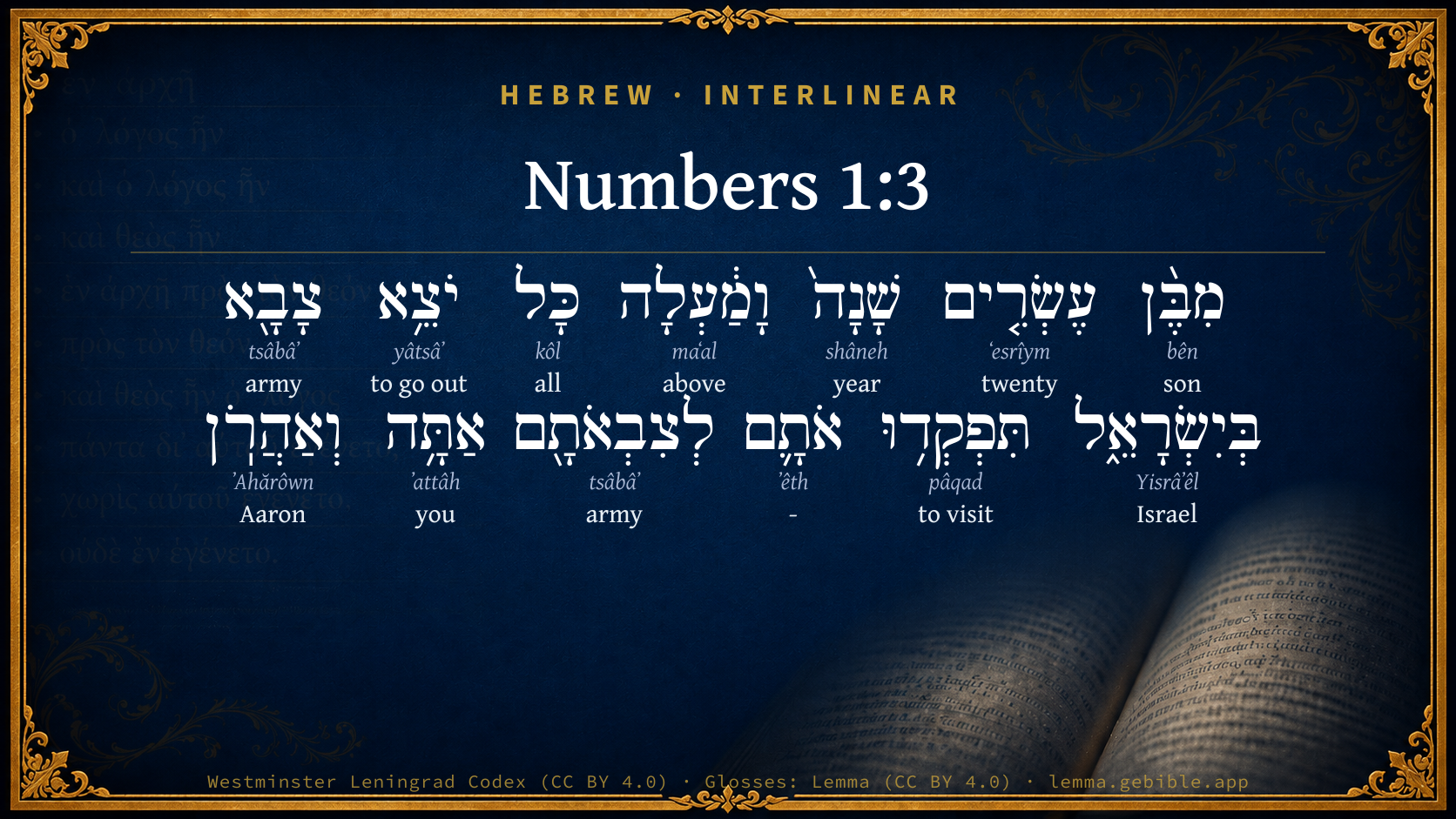
Hebrew (Westminster Leningrad Codex) Numbers 1:3 appears in the Hebrew Old Testament. The text above is from the Westminster Leningrad Codex. Each word links to its Strong’s number, a concise gloss, and parsing drawn from the Open Scriptures Hebrew Bible morphology. Click any word for its full Brown-Driver-Briggs (BDB) entry.
Download image
Cite this verse

Numbers 1:3 (World English Bible). Public Domain. Lemma interlinear Bible study tool, https://lemma.gebible.app/v/numbers/1/3.

Show BibTeX & RIS
BibTeX
RIS
English Translation
from twenty years old and upward, all who are able to go out to war in Israel. You and Aaron shall number them by their divisions.
World English Bible · Public Domain
Download a study sheet

One document with this verse’s original text, its word-by-word gloss line, the meaning frame, cross-references with their text, attributed commentary, and full source and license credits — printable, and it pastes into notes with its structure intact.

This verse Autodidact and up

Study sheet (.html) Plain text (.txt)

A passage Seminary Student

Up to 50 verses in one chapter. A passage sheet keeps up to 6 commentary sources and 12 cross-references per verse, in the order this page ranks them, and says so on the sheet whenever that leaves anything out. Ask for a single verse and you get the Autodidact verse sheet above.

Everything on this page stays free to read, with no account — the sheet is a download of what is already on screen, not access to it.

Want to remove ads? Support Godless Engineer
Compare translations 3

The same verse in 3 English versions, stacked beneath the original-language interlinear above. Click any original word for its lexicon entry.

Each is an independent rendering of the whole verse — the interlinear is not word-aligned to these translations.

Highlighted words mark where these versions differ — a whole-verse word diff, not a word-by-word alignment.

  • World English Bible Public Domain
    from twenty years old and upward, all who are able to go out to war in Israel. You and Aaron shall number them by their divisions.
  • King James Version Public Domain
    From twenty years old and upward, all that are able to go forth to war in Israel: thou and Aaron shall number them by their armies.
  • unfoldingWord Literal Text CC BY-SA 4.0
    from a son of 20 years and upward, everyone who goes out to war in Israel. Count them, you and Aaron, according to their armies.

unfoldingWord Literal Text — © unfoldingWord, licensed CC BY-SA 4.0. Word-aligned USFM3 via Door43 (git.door43.org/unfoldingWord/en_ult).

Versions to compare (up to 4)

3 of 4 selected

Show all 18 translations

Every available English version of this verse, each an independent rendering of the whole verse.

  • World English Bible Public Domain
    from twenty years old and upward, all who are able to go out to war in Israel. You and Aaron shall number them by their divisions.
  • Berean Standard Bible Public Domain
    You and Aaron are to number those who are twenty years of age or older by their divisions—everyone who can serve in Israel’s army.
  • Majority Standard Bible Public Domain
    You and Aaron are to number those who are twenty years of age or older by their divisions—everyone who can serve in Israel’s army.
  • King James Version Public Domain
    From twenty years old and upward, all that are able to go forth to war in Israel: thou and Aaron shall number them by their armies.
  • American Standard Version (1901) Public Domain
    from twenty years old and upward, all that are able to go forth to war in Israel, thou and Aaron shall number them by their hosts.
  • Revised Version (1885) Public Domain
    from twenty years old and upward, all that are able to go forth to war in Israel, thou and Aaron shall number them by their hosts.
  • Geneva Bible (1599) Public Domain
    From twentie yere olde and aboue, all that go forth to the warre in Israel, thou and Aaron shall number them, throughout their armies.
  • Douay-Rheims (1899) Public Domain
    From twenty years old and upwards, of all the men of Israel fit for war, and you shall number them by their troops, thou and Aaron.
  • Young's Literal Translation Public Domain
    from a son of twenty years and upward, every one going out to the host in Israel, ye do number them by their hosts, thou and Aaron;
  • Literal Standard Version CC BY-SA 4.0
    from a son of twenty years and upward, everyone going out to the host in Israel, you number them by their hosts, you and Aaron;
  • Unlocked Literal Bible CC BY-SA 4.0
    who is twenty years old or older. Count all who can fight as soldiers for Israel. You and Aaron must record the number of men in their armed groups.
  • unfoldingWord Literal Text CC BY-SA 4.0
    from a son of 20 years and upward, everyone who goes out to war in Israel. Count them, you and Aaron, according to their armies.
  • Darby Bible Public Domain
    from twenty years and upward, all that go forth to military service in Israel: ye shall number them according to their hosts, thou and Aaron.
  • World Messianic Bible Public Domain
    from twenty years old and upward, all who are able to go out to war in Israel. You and Aaron shall count them by their divisions.
  • Webster's Bible Public Domain
    From twenty years old and upward, all that are able to go forth to war in Israel; thou and Aaron shall number them by their armies.
  • Free Bible Version CC BY-SA 4.0
    Those aged twenty or older who can do military service are to be registered by you and Aaron in their Israelite army divisions.
  • Bible in Basic English Public Domain
    All those of twenty years old and over, who are able to go to war in Israel, are to be numbered by you and Aaron.
  • JPS Tanakh (1917) Public Domain
    from twenty years old and upward, all that are able to go forth to war in Israel: ye shall number them by their hosts, even thou and Aaron.

Literal Standard Version (2020), Covenant Press — licensed CC BY-SA 4.0. Text via the HelloAO Bible API (eBible.org). Unlocked Literal Bible (unfoldingWord) — licensed CC BY-SA 4.0. Text via the HelloAO Bible API (eBible.org). unfoldingWord Literal Text — © unfoldingWord, licensed CC BY-SA 4.0. Word-aligned USFM3 via Door43 (git.door43.org/unfoldingWord/en_ult). Free Bible Version, Dr. Jonathan Gallagher — licensed CC BY-SA 4.0. Text via the HelloAO Bible API (eBible.org).

Word by word

More ways to search: Search by grammar → Find every occurrence → Compare this word →

Practice this passage: Drill this verse → Learn its vocabulary →

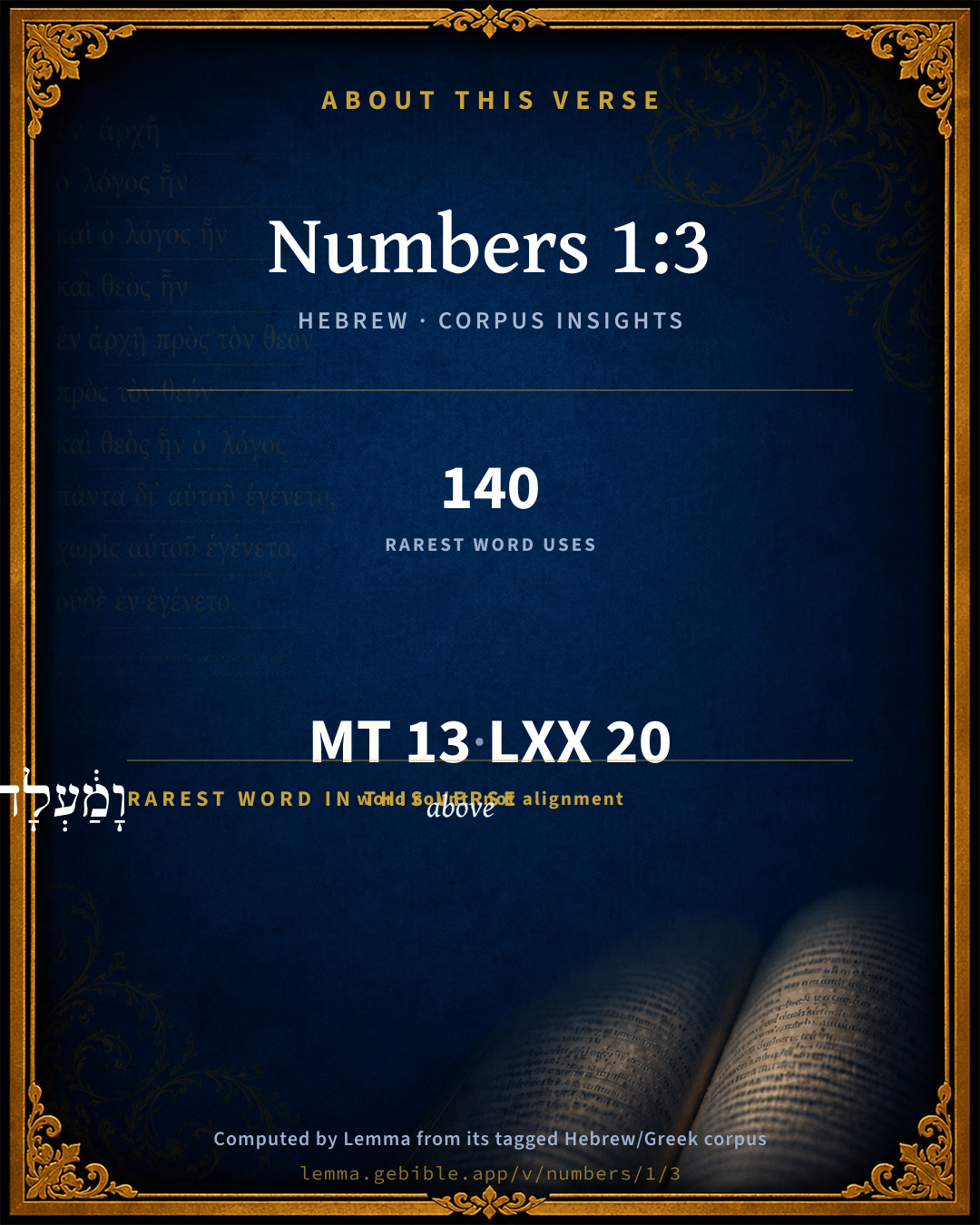
וָמַ֔עְלָה
maʻal
H4605
“and · above · toward”
Conjunction + Adverb + Suffix, Demonstrative
Part of Speech
Conjunction + Adverb
Full BDB Definition

Origin: from H5927

TWOT: 1624k

higher part, upper part (substantive) - above (adverb) - on the top of, above, on higher ground than (preposition) - upwards, higher, above (with locative)
  1. מִבֶּ֨ן bên H1121 “from · son of” Preposition + Noun, Common, Masculine, Singular, Construct
  2. עֶשְׂרִ֤ים ʻesrîym H6242 “twenty” Adjective, Cardinal number, Both, Plural, Absolute
  3. שָׁנָה֙ shâneh H8141 “year” Noun, Common, Feminine, Singular, Absolute
  4. כָּל kôl H3605 “all of” Noun, Common, Masculine, Singular, Construct
  5. יֹצֵ֥א yâtsâʼ H3318 “going out” Verb, Qal, Participle Active, Masculine, Singular, Absolute
  6. צָבָ֖א tsâbâʼ H6635 “army” Noun, Common, Both, Singular, Absolute
  7. בְּיִשְׂרָאֵ֑ל Yisrâʼêl H3478 “in/at · Israel” Preposition + Noun, Proper
  8. תִּפְקְד֥וּ pâqad H6485 “to visit” Verb, Qal, Imperfect, 2nd Person, Masculine, Plural
  9. אֹתָ֛ם ʼêth H853 “- · them” Particle, Direct Object + Suffix, Personal, 3rd Person, Masculine, Plural
  10. לְצִבְאֹתָ֖ם tsâbâʼ H6635 “to/for · armies · their” Preposition + Noun, Common, Both, Plural, Construct + Suffix, Personal, 3rd Person, Masculine, Plural
  11. אַתָּ֥ה ʼattâh H859 “you” Pronoun, Personal, 2nd Person, Masculine, Singular
  12. וְאַהֲרֹֽן ʼAhărôwn H175 “and · Aaron” Conjunction + Noun, Proper

About this verse

These counts appear in no published source. They are computed here, from the morphology-tagged text and Lemma’s own curated glosses. What Lemma adds →

13
words
12
distinct lemmas
Pentateuch
section

Grammatical profile

  • 2 verbs
  • 7 nouns
  • 1 adjective
  • 1 pronoun
  • 1 adverb
  • 1 particle

Verb forms

  • יֹצֵ֥א Qal · Participle Active
  • תִּפְקְד֥וּ Qal · Imperfect

Repetition

A word recurs within this verse — often emphatic in Hebrew:

  • צָבָ֖א army H6635 ×2

Hebrew & Septuagint length

In English translation the verse runs 26 words from the Hebrew and 30 from the Septuagint (LXX English) — closely comparable.

A rough comparison of the two English renderings, which tokenize alike — not a word-level alignment.

Word counts can differ between the Hebrew and the Greek without any difference in meaning — e.g. the Hebrew direct-object marker אֵת has no separate Greek word, and Greek often adds the article ὁ.

In the original languages it is 13 Hebrew tokens and 20 Greek tokens — but the two are counted differently (Hebrew bundles its prefixes and suffixes into one token; the Greek is in lemma form), so that isn’t a like-for-like length.

Cross-references

11

Topical passages linked to Numbers 1:3 in the Treasury of Scripture Knowledge — connected by theme and wording, ordered by reader-vote popularity; previews shown in the World English Bible.

  • Exodus 30:14 Everyone who passes over to those who are numbered, from twenty years old and upward, shall give the offering to Yahweh.
  • Numbers 14:29 your dead bodies shall fall in this wilderness; and all who were numbered of you, according to your whole number, from twenty years old and upward, who have murmured against me,
  • Exodus 12:17 You shall observe the feast of unleavened bread; for in this same day have I brought your hosts out of the land of Egypt: therefore shall you observe this day throughout your generations by an ordinance forever.
  • Numbers 26:2 Take the sum of all the congregation of the children of Israel, from twenty years old and upward, by their fathers' houses, all who are able to go forth to war in Israel.
  • Numbers 32:11 Surely none of the men who came up out of Egypt, from twenty years old and upward, shall see the land which I swore to Abraham, to Isaac, and to Jacob; because they have not wholly followed me:
  • Numbers 33:1 These are the journeys of the children of Israel, when they went forth out of the land of Egypt by their hosts under the hand of Moses and Aaron.
  • Deuteronomy 3:18 I commanded you at that time, saying, Yahweh your God has given you this land to possess it: you shall pass over armed before your brothers the children of Israel, all the men of valor.
  • Deuteronomy 24:5 When a man takes a new wife, he shall not go out in the host, neither shall he be charged with any business: he shall be free at home one year, and shall cheer his wife whom he has taken.
  • 2 Samuel 24:9 Joab gave up the sum of the numbering of the people to the king: and there were in Israel eight hundred thousand valiant men who drew the sword; and the men of Judah were five hundred thousand men.
  • 2 Chronicles 26:11–13 Moreover Uzziah had an army of fighting men, who went out to war by bands, according to the number of their reckoning made by Jeiel the scribe and Maaseiah the officer, under the hand of Hananiah, one of the king's captains.
  • 2 Chronicles 17:13–18 He had many works in the cities of Judah; and men of war, mighty men of valor, in Jerusalem.

Cross-references courtesy of OpenBible.info (CC BY 4.0).

Hebrew and Greek witnesses Masoretic Hebrew ↔ Greek Septuagint

The same verse in the two great witnesses to the Old Testament, shown verse-for-verse.

These are two independent witnesses, not word-aligned to each other, and the Septuagint is shown in lemma (dictionary) form.

Hebrew Numbers 1:3 Masoretic · Westminster Leningrad Codex

מִבֶּ֨ן עֶשְׂרִ֤ים שָׁנָה֙ וָמַ֔עְלָה כָּל יֹצֵ֥א צָבָ֖א בְּיִשְׂרָאֵ֑ל תִּפְקְד֥וּ אֹתָ֛ם לְצִבְאֹתָ֖ם אַתָּ֥ה וְאַהֲרֹֽן

from twenty years old and upward, all who are able to go out to war in Israel. You and Aaron shall number them by their divisions.

World English Bible · Public Domain

Greek LXX Numbers 1:3 Septuagint · lemma form

ἀπό εἰκοσαετής καί ἐπάνω πᾶς ὁ ἐκπορεύομαι ἐν δύναμις ἰσραήλ ἐπισκέπτω αὐτός σύν δύναμις αὐτός σύ καί ἀαρών ἐπισκέπτω αὐτός

from twenty years old and upwards, every one that goes forth in the forces of Israel, take account of them with their strength; you and Aaron take account of them.

LXX2012 (modern English Septuagint) · Public Domain

On this verse, Haydock's Catholic Bible Commentary discusses the Septuagint’s reading. Read the note in Commentary ↓

Hebrew: Westminster Leningrad Codex (CC BY 4.0). Greek: Septuagint (public domain); English from LXX2012 (modern English Septuagint) (Public Domain). How the Septuagint differs from the Hebrew →

Targum (Aramaic paraphrase)

2

The Targum is the ancient Jewish Aramaic paraphrase of the Hebrew Scriptures — an interpretive translation, not the Hebrew text itself. Onkelos (literal) and Pseudo-Jonathan (expansive) render the Torah, and Jonathan the Prophets. Coverage is partial: where no permissively-licensed English translation exists for a verse, only the Aramaic is shown. This is verse-level text, not a word-by-word alignment to the Hebrew.

  1. Targum Onkelos Torah (Genesis–Deuteronomy)
    מִבַּר עַשְׂרִין שְׁנִין וּלְעֵלָא כָּל נָפֵק חֵילָא בְּיִשְׂרָאֵל תִּמְנוּן יָתְהוֹן לְחֵילֵיהוֹן אַתְּ וְאַהֲרֹן

    (no public-domain English translation for this verse)

    Targum Onkelos — Aramaic: “Onkelos Genesis” (public domain); “Onkelos Exodus” (public domain); “Onkelos Leviticus” (public domain); “Onkelos Numbers” (public domain); “Onkelos Deuteronomy” (public domain). English: “Sefaria Community Translation” (CC0 1.0 (public-domain dedication)); “J.W. Etheridge. The Targums of Onkelos and Jonathan Ben Uzziel on the Pentateuch. London: Longmans, Green, 1862” (public domain). Text via Sefaria.

  2. Targum Pseudo-Jonathan Torah (Genesis–Deuteronomy)
    מִבַּר עַשְרִין שְׁנִין וּלְעֵילָא כָּל נָפִיק חֵילָא בְּיִשְרָאֵל תִּמְנוּן יַתְהוֹן לְחֵילֵיהוֹן אַנְתְּ וְאַהֲרן

    From each son twenty years and upwards, every one going out in the host in Israel; thou and Aharon number them by their hosts.

    Targum Pseudo-Jonathan — Aramaic: “Targum Jonathan on Genesis” (public domain); “Targum Jonathan on Exodus” (public domain); “Targum Jonathan on Leviticus” (public domain); “Targum Jonathan on Numbers” (public domain); “Targum Jonathan on Deuteronomy” (public domain). English: “The Targum of Jonathan ben Uzziel, trans. J. W. Etheridge, London, 1862” (public domain). Text via Sefaria.

Commentary

Notes on Numbers 1:3 from classic Christian and Jewish commentators (each source and its license shown beneath its notes). The classic Christian expositions comment on the surrounding passage and are grouped to its opening verse, so a note may address several verses; the Jewish commentaries on the Tanakh (Rashi and others) are per-verse, so they appear only where the commentator wrote on this verse.

Lemma curates 59 commentaries, every one of them public domain or Creative Commons licensed, each selected and text-cleaned for this edition rather than reprinted as found. About our sources →

Trapp's Complete Commentary

John Trapp

Num 1:3 From twenty years old and upward, all that are able to go forth to war in Israel: thou and Aaron shall number them by their armies.

Ver. 3. All that are able.] The people perceiving how many hundred thousand strong they were, might go on with more courage against their enemies. It is an ancient custom in Scotland, in cases of importance, to command the fire cross to be carried; that is, two fire brands to be set in fashion of a cross, and pitched upon the point of a spear, and proclamation is thereupon made, that all men, above sixteen years of age and under sixty, shall come into the field to advance against the common enemy. {a}

{a} Sir John Heywood, in the Life of King Edward VI.

John Trapp, A Commentary or Exposition upon All the Books of the Old and New Testament (1647–1656) — public domain. Text from a community e-Sword module.

Joseph Benson's Commentary

Num 1:3. That are able to go forth to war — It would seem from this that none of the aged and infirm were numbered, as being unable to go to war. Among several other nations as well as the Jews, particularly the Romans, all who were of age to bear arms were obliged, upon some occasions, to go forth to battle. And hence it is that we read of the kings of Israel bringing such numerous armies into the field as appear hardly credible to those who judge of their manners by ours.

Joseph Benson's Commentary on the Old and New Testaments (1811–1818) — public domain. Text from a community e-Sword module.

Jamieson, Fausset & Brown

Robert Jamieson, A. R. Fausset & David Brown

Aaron shall number them by their armies--or companies. In their departure from Egypt they were divided into five grand companies (Exo 13:18), but from the sojourn in the wilderness to the passage of the Jordan, they were formed into four great divisions. The latter is here referred to.

Jamieson, Fausset & Brown — Commentary Critical and Explanatory on the Whole Bible (1871) — public domain (CC PDM 1.0). Text via the HelloAO Bible API.

Adam Clarke's Commentary

Verse 3. From twenty years old and upward] In this census no women were reckoned, nor children, nor strangers, nor the Levites, nor old men, which, collectively, must have formed an immense multitude; the Levites alone amounted to 22,300. True-born Israelites only are reckoned; such as were able to carry arms, and were expert for war.

Adam Clarke's Commentary on the Bible (1810–1826) — public domain. Text from a community e-Sword/MySword module.

Ellicott's Commentary for English Readers

(3) From twenty years old and upward.—The result of the previous numbering (Exo_30:12; Exo_38:26), which was made about six months earlier, and which was probably obtained by counting the number of half-shekels which were paid, as Ithamar appears to have done (Exo_38:2), exactly corresponds with the result of the present census (Num_1:46). But the complete census, or numbering and enrolment of the persons according to tribes, families, and fathers’ houses, appears to have been deferred until after the erection of the tabernacle, towards the construction of which the atonement money had been paid. If the whole was done in obedience to the command contained in Exo_30:12, and was regarded as one transaction, those only would be numbered on the second occasion who had already paid their atonement money. There is nothing impossible in the supposition that the whole of those who had been numbered six months previously were still alive, but no allowance is made, on this supposition, for the number of those who were below twenty years of age at the earlier period, and who had exceeded that age at the later period. Inasmuch, however, as the sum-total in both cases is divisible by ten, and inasmuch as the separate items in this chapter are given in tens (the smallest subdivision of the people which was adopted by Moses, on the recommendation of Jethro, Exo_18:21), no objection to the historical accuracy of both records can be sustained if it be allowed that the number of those who had attained the age of twenty years since the earlier census corresponded nearly with the number of deaths during the same period. The whole of the objection, however, is removed in a far more satisfactory manner by the supposition that there was only one census. (See the Introduction.)

By their armies.—Better, their hosts or companies.

A Bible Commentary for English Readers, edited by Charles John Ellicott (1878–1897) — public domain. Text from a community e-Sword module.

John Gill's Exposition

From twenty years old and upwards,.... All that had entered into their twentieth year, or, as it should rather seem, who were full twenty years of age, and all that were above it without any limitation; though some limit it to fifty, and others to sixty years, when men may be reasonably excused going to war; for to know who were fit for it seems to be a principal design of this order, as follows:

all that are able to go forth to war in Israel; who being about to journey, might expect to meet with enemies, with whom they would be obliged to engage in battle; and therefore it was proper to know their strength, and whom to call out upon occasion: Aben Ezra observes, that the phrase "in Israel" excepts the mixed multitude; those were not of Israel, and so not numbered, and perhaps not to be trusted or depended upon in war; nor were they mustered and marshalled by the standards of the several tribes; in a mystical sense, those numbered may signify the valiant of Israel, the same as the young men in Jo1 2:14; see Sol 3:7,

thou and Aaron shall number them by their armies; each tribe making a considerable army; see Gill on Exo 7:4; these people were now typical of the church of God in its militant state in the wilderness, for which they are provided, and prepared, and accoutred.

John Gill's Exposition of the Whole Bible (1746–1763) — public domain (CC PDM 1.0). Text via the HelloAO Bible API.

Haydock's Catholic Bible Commentary

Arms, (fortium). "Strong or brave." The psalmist (civ. 37,) says, there was not one feeble. (Menochius) --- Troops. Hebrew, "army." Septuagint, "force." Their officers shall be at their head, and shall assist you in the work. Some might command 1000, others 100, and some only 50. See Exodus xiii. 18., and xviii. 21. --- [Ver. 4.] Princes; the first-born, or most ancient, (Lyranus,) the lineal descendants of the patriarchs; (Jansen) or, in fine, such as were chosen for their merit, as all were equally noble; and hence Nahasson, prince of Juda, is mentioned, though he was not a descendant of the eldest son of Juda, but of Phares; and those who were at the head of those who were numbered a little before the death of Moses, were not the descendants of these, chap. xxvi. 64. In effect, we find that Moses chose for his council, able men out of all Israel, Exodus xviii. 25. (Bonfrere) (Calmet)

George Leo Haydock (1774–1849), Haydock's Catholic Family Bible and Commentary, 1859 edition — public domain. Excludes Psalms (Douay-Rheims chapter numbering differs from Protestant) and Deuterocanonical books (Catholic canon only).

Whedon's Commentary on the Bible

Daniel D. Whedon

3. Twenty years — From the son of twenty years. This was the law ever afterwards. The word able does not occur in the Hebrew. If it had been written, the names of the sick and aged men would not have been enrolled, and the enumerators must have added to their functions those of surgical examiners. Exemptions from military service were established on Divine authority several years afterwards. See Deu_20:5-8. There is not the least hint in the text of an upper limit to the military age. Yet Josephus asserts that this census enrolled only the fighting men between twenty and fifty years of age. It is quite probable that subsequent legislation fixed the maximum age at fifty years, and that Josephus (Ant., Num_3:12; Num_3:4) has carried the law back too far. For if there had been such a maximum age it would have been expressed with the minimum. Moreover, since the grand total of this military muster-roll is exactly the same as that of the poll-offering in Exo_38:26, it would follow, according to Josephus’s statement, that all above fifty years must have been exempted from the offering. Of this immunity there is no hint, either in the original command (Exo_30:11-16) or in the report of its execution. Exo_38:26.

Thou and Aaron shall number — Number is not the idea of the Hebrew, but rather review, muster, arrange. Moses and Aaron were to constitute a board of superintendence, while the details of the census were to be attended to by a commission of twelve distinguished men, one from each tribe. These would be sufficient, for the chief labour of the census had already been performed. In arranging for the service of the newly-erected tabernacle, nine months before, it had been ordained that each person enumerated should pay half a shekel, about twenty-seven cents, atonement money, “a ransom for his soul unto the Lord.” See Exo_30:12. Since the atonement money had already been offered, (Exo_38:25-28,) we infer that a census had already been taken in the tribes, or in subdivisions of tribes, and records made of the results. The office of the census board, just appointed by God, was, probably, to collect and classify those registrations which had already been made, and draw out the people into military divisions.

Daniel D. Whedon (gen. ed.), Commentary on the Old and New Testaments (1874–1909) — public domain. Text from a community e-Sword module.

The Pulpit Commentary

By their armies. Every citizen was a soldier. The military monarchies of mediaeval or of modern days, with their universal obligation to service in the ranks, have (so far) but followed the example of ancient Israel.

"From twenty years old and upward.

By this census all the young men of Israel were urged to the consideration of a possible claim upon them. It is to the young men that a country looks when her integrity and liberties are in danger. Young men are wanted still to take a brave and intelligent part in the strife of the Church militant. "I have written unto you young men because ye are strong, and the word of God abideth in you, and ye have overcome the wicked one." So Paul to Timothy: "Endure hardness, as a good soldier of Jesus Christ." God"s people have to deal with the Canaanites, Amorites, and all the rest of the hostile nations. Many iniquities are in possession of the earth. Old men, who have struggled against them and done something to diminish them, ask who will take up the sword and shield and go forth against the mighty. The word comes to us. "You are fit to fight. Will you fight?" Young men dazzled with the visions of military glory, here is a campaign where not men are slaughtered, but the evils that ruin men. Our Lord, the Captain of our salvation, will richly equip us with weapons mighty for the pulling down of strongholds, the armour of righteousness on the right hand and the left. Y.

The Pulpit Commentary (1880–1919), ed. H.D.M. Spence-Jones & Joseph S. Exell — public domain. Text from a community e-Sword module.

Rashi

Rabbi Shlomo Yitzchaki (Rashi)

כל יצא צבא [FROM TWENTY YEARS OLD AND UPWARDS] ALL THAT GO FORTH TO THE HOST — This tells us that no one less than twenty years of age goes forth to the host (cf. Rashi on Exodus 30:14 and Note thereon).

Rashi on the Tanakh — English translations: “The Judaica Press complete Tanach with Rashi, translated by A. J. Rosenberg” (CC BY 4.0); “Pentateuch with Rashi's commentary by M. Rosenbaum and A.M. Silbermann, 1929-1934” (public domain); “The Metsudah Tanach series, Lakewood, N.J” (CC BY 4.0); and “The Book of Joshua, Metsudah Publications, 1997” (CC BY 4.0). Text via Sefaria.

Ramban (Nachmanides)

Rabbi Moshe ben Nachman (Ramban / Nachmanides)

FROM TWENTY YEARS OLD AND UPWARD, ‘KOL YOTZEI TZAVA’ (ALL THAT ARE ABLE TO GO FORTH TO THE HOST) IN ISRAEL. “This tells us that no one under the age of twenty goes forth to the host. ‘Se’u eth rosh’ [literally: ‘take the head’ and generally translated: take ye the sum] of all the congregation of Israel. This is as one says to an executioner: ‘take that man’s head’.” This is Rashi’s language.Perhaps the reason for this [law that a male under twenty years old was not liable to military service] is because he is not strong enough for war under the age of twenty, as the Rabbis have said: “Twenty is the age for pursuit.”, which is variously interpreted as: “for seeking a livelihood:” or “for seeking one’s life-pursuit.” Ramban here understands it in its literal sense — “to pursue [the enemy in battle].” But it may be that the meaning of the phrase kol yotzei tzava is “all who go forth to be assembled in the congregation,” because the young men do not take part in such an assembly of the people, and every gathering of the people is called tzava, as in ‘[litzvo] tzava’ (to be counted among the host) for the work of the Tent of Meeting; he shall return from the ‘tz’va’ of the work;, Verse 25. with the mirrors of the ‘tzov’oth’ that ‘tzav’u’ (women that congregated together); and similarly ‘tz’va’ (the host of) heaven; and all ‘tz’va’am’ (their host) I commanded. Therefore Scripture explains when speaking of men of war: ‘mi’tz’va’ (from the host of) the war; and the number of them reckoned ‘bi’tz’va’ (by the host) for the war. Scripture states here all that go forth to the host, similar to what it says, all that went out of the gate of the city. It states, ye shall number them by their ‘hosts’ [in the plural], because they consisted of many hosts, since each and every tribe was a great host.But as for Rashi’s expression when he wrote — “This is as one says to an executioner: ‘take that man’s head’” — it is not clear to me why the Sages should interpret the verse in this derogatory manner. If it is because [the people counted here] died in the desert [therefore He said, take the head …] whereas in the case of the tribe of Levi He said Number the children of Levi, since they were not included in the decree [that they die in the desert] — [this cannot be so], for in the second census [taken] of those who were to come into the Land it also uses the same [expression], take the head of all the congregation of the children of Israel!, 26:2. But in the Agadah (homiletic exposition) of Vayikra Rabbah the Rabbis explain it as an expression of praise [for the people]: “The term se’u always means ‘greatness’, as it is written, Pharaoh ‘yisa’ (shall lift up) thy head, and restore thee unto thy office. Said the Holy One, blessed be He, to Israel: ‘I have given you an exaltation of the head, and I have likened you to Myself. Just as I am exalted above all inhabitants of the world, as it is said, Thine is the kingdom, O Eternal, and Thou art exalted as head above all, so to you also I have given an elevation of the head, as it is said, Lift up the head of all the congregation of the children of Israel, thus fulfilling that which is said, And He hath lifted up a horn for His people, and similarly it is said, and the Eternal thy G-d will set thee on high above all the nations of the earth. ' ” I have found further in Bamidbar Sinai Rabbah that the Sages have stated: “Said Rabbi Pinchas in the name of Rabbi Idi: What is [the meaning of] that which is written at the beginning of this book, ‘se’u eth rosh’ (take the head)? It does not say: ‘lift up the head,’ ‘elevate the head,’ but it says se’u eth rosh, like a man who says to an executioner: ‘take this man’s head’. Here He gave a hint to Moses, se’u eth rosh, meaning that if the people are worthy they will become exalted, just as it is written, Pharaoh ‘yisa’ (shall lift up) thy head, and restore thee unto thy office; but if they are not worthy, they will all die, just as it is written, Pharaoh ‘yisa’ (shall lift up) thy head from off thee, and shall hang thee on a tree. ” Thus the expression [se’u eth rosh which, as Rashi explained, is used in connection with execution] is to be interpreted according to the intention [of the speaker] — in a good way for those who are good.. Thus Pharaoh said unto the chief executioner: “Take the chief butler and lift up his head and restore him to his office.” But as for such as turn aside unto their crooked ways, the Eternal will lead them away with the workers of iniquity (ibid., Verse 5). Thus in the case of the chief baker, the same expression signified his downfall. In short, the expression of the Midrash which Rashi quoted can be interpreted either for bad or for good. And since it is an expression of elevation etc. And since it is [also] an expression of elevation, and it is used [here] in the first census, He used the same expression in the second census., 26:2.

TIPHKEDU OTHAM.’ The term p’kidah is an expression meaning remembrance of and attention to a certain matter, as in the phrase, And the Eternal ‘pakad’ (remembered) Sarah as He had said, and this in my opinion is its interpretation in all places, without any exception. The expression pikadon [which means a bailment or deposit of goods] is also [from this root], because his guarding and supervision is on it [i.e., because the bailee must guard it]. And therefore when He commanded that Israel be counted He stated tiphkedu otham, in order to hint that he [Moses] was not to count them [by persons] but that they were each to give half a shekel as a ransom for their soul, and he should supervise them [the half-shekels] and thereby know the number of the people. In the case of David Scripture states: the sum of ‘miphkad’ (the numbering) of the people because he knew their numbers through the counting of [the half-shekel] ransom [that each one gave]. For it appears to me unlikely that David should not be careful about that which Scripture states, that there be no plague among them, when thou numberest them. And even if David did perhaps make a mistake, Ramban in fact does explain that David made a mistake and did indeed count them without half-shekels [a theory to which he reverts here briefly at the end of the verse]. For the reason for his mistake, see ibid., (Vol. II, p. 511). why did Joab [the captain of the host in charge of the census] not take [the census through] shekels, for the king’s word was abominable to Joab, and Joab [in fact] said to the king, Why doth my lord require this thing? Why will he be a cause of guilt unto Israel?, Verse 3. So why did he [Joab] not count them through the shekels, so that he should not sin?But in my opinion the [Divine] wrath was [aroused] against him [David] because he counted them unnecessarily, since he was not going forth to war, nor did he do anything with them [the men he counted, so that he would need to know their number] at that time, and [the census] was only to make him rejoice that he ruled over a large people. Therefore Joab said [to David], Now the Eternal thy G-d add unto the people, how many soever they may be, a hundredfold, and may the eyes of my lord the king see it; but why doth my lord the king delight in this thing? And I have seen in Bamidbar Sinai Rabbah: “Rabbi Eliezer in the name of Rabbi Yosei ben Zimra said: Whenever Israel was counted for a purpose, their numbers did not diminish; but when they were counted for no purpose, they became diminished. When were they counted for a purpose? In the days of Moses, and for the [setting up of the] standards and at the division of the Land., Verse 53. [When were they counted] for no purpose? In the days of David.”It is also possible to say by way of explanation that David commanded that every “man” in Israel be counted, meaning thereby to include everyone above the age of thirteen years old, who is regarded as “a man” [and not from the age of twenty years upwards], since it is nowhere mentioned in [describing] his counting: “from twenty years old and upwards”, but instead David said, Go, number Israel from Beer-sheba even to Dan … that I may know the sum of them. And this was [the reason for] his punishment, for Scripture only allowed counting to be done from twenty years old and upwards by means of the shekels. It was because this is not clearly expressed in Scripture [that even by means of the half-shekels the people are only to be counted from the age of twenty years and over] that David made this mistake, for he thought that when Scripture says that there be no plague among them it is because of the shekels, which are a ransom [of the soul] for them [and therefore he thought that as long as he counted them by means of the shekels and not by direct census there would be no plague even if he counted them from above the age of thirteen years old, instead of twenty], but Joab applied his heart [to understand the matter] and was concerned because of it.And Scripture [itself] stirs me to this thought by saying: But David took not the number of them from twenty years old and under, because the Eternal had said He would increase Israel like to the stars of heaven. Joab the son of Zeruiah began to number, but finished not; and there came wrath for this upon Israel. because Joab began … but finished not for the reason that he [Joab] applied his heart to understand the matter and was concerned about the breach of the law in taking the census from twenty years old and under. From this it appears that Joab’s census included those under twenty years old, and this was [the reason for] the “wrath”, because G-d does not want all Israel to be limited by numbers since He will multiply them like the stars of heaven, as He said [to Abraham], Look now toward heaven, and count the stars, if thou be able to count them. And when the verse says concerning that census [of Joab], And all they of Israel were a thousand thousand and a hundred thousand men that drew sword, it does not mean to say that they were all eligible for military service [since, as explained above, they included also thirteen-year olds who do not go to war], but its correct interpretation is that they were all sufficiently healthy and strong to be able to go to battle, thus stating that he did not count the sick, the weak, and the old, because the king’s word was abominable to him. This interpretation is very appropriate.But according to the opinion of the Midrash Agadah [a homiletic exposition, [from twenty years old and upwards], and not, as Ramban suggested above, because he included in the count [which was done with shekels] people under twenty but over thirteen years old. from which it would appear] that there was an actual census [i.e., that the people were counted without the use of shekels, we must say that] they all erred. This is why David said [to Joab], Go, ‘number’ Israel, and it is further written, after that he had ‘numbered’ the people, Verse 10. [expressions which indicate that there was an actual counting of persons without using half-shekels], for in the Torah the term “numbering” of people is not mentioned at all, and the meaning of the expression according to the number of names is that each one should tell his name when he is counted through bringing his ransom [of half a shekel].

Ramban (Nachmanides) on the Tanakh — English translation: “Commentary on the Torah by Ramban (Nachmanides). Translated and annotated by Charles B. Chavel. New York, Shilo Pub. House, 1971-1976” (CC BY 4.0). Text via Sefaria.

Lesson kit

Teaching starters — assembled from the data on this page, not authored interpretation. Every prompt links to the verse data it draws on. Edit before teaching.

Numbers, in the Pentateuch, opens this verse with 13 words (12 distinct Hebrew lemmas). Its most distinctive word is maʻal (“above”). A historical commentator’s framing appears above. Read the whole chapter for the surrounding context.

Discussion questions

  1. How does “above” (maʻal) shape what this verse is saying?
  2. Exodus 30:14 shares this passage’s theme. How do the two illuminate each other?
  3. “army” occurs 2× in this one verse. What is the effect of the repetition?
  4. The translations on this page render this verse differently — a whole-verse word diff, not a word-by-word alignment. What might account for the different wordings?
  5. The verb «יֹצֵ֥א» is Qal Participle Active. How does its form color the action?
  6. Reading how Trapp's Complete Commentary and Joseph Benson's Commentary read this verse, where do the two commentators agree and where do they part?

Things to notice

Reading settings

Reading text

Shown beneath each verse's original-language words.

Old Testament
Old Testament edition

Read the OT as the Masoretic Hebrew (MT) or the Greek Septuagint (LXX).

English shown for the Greek Septuagint (in the Hebrew ↔ Greek comparison).

Comparing translations? Open the Compare panel on any verse page to stack up to four side by side.