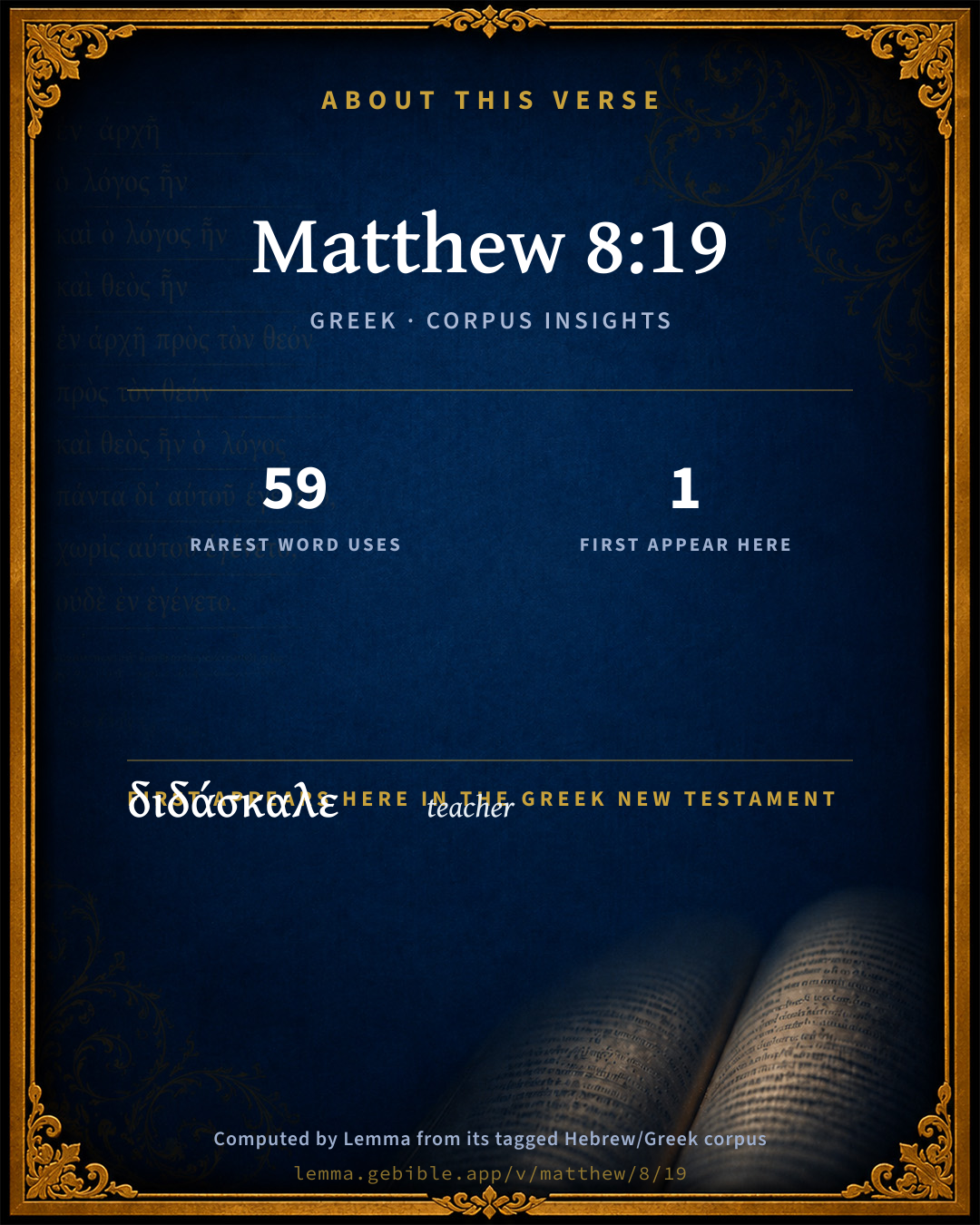
Matthew 8:19

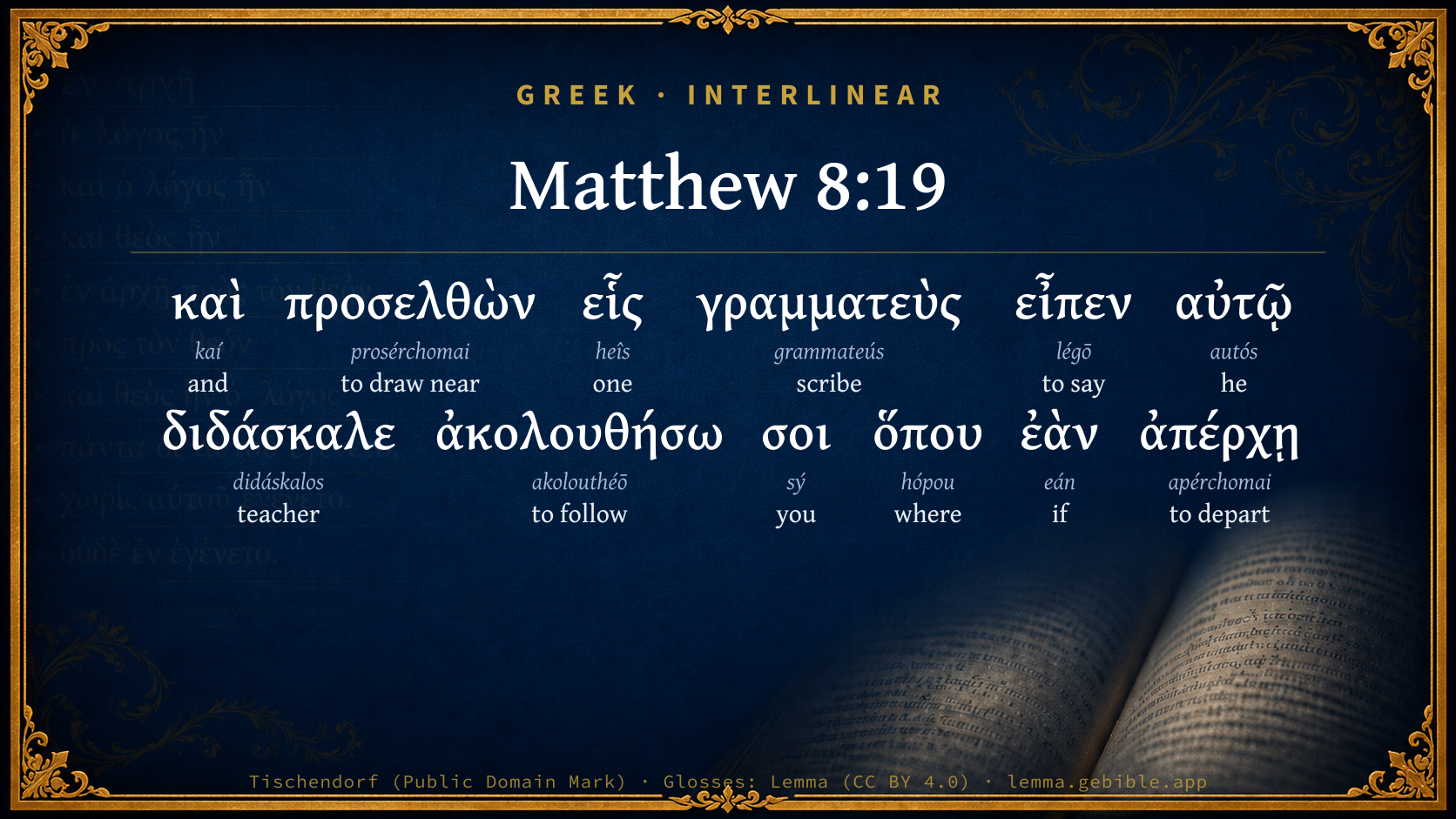
Greek (Tischendorf 8th ed.) Matthew 8:19 appears in the Greek New Testament. The text above is from the Tischendorf 8th edition. Each word links to its Strong’s number and a concise gloss. Click any word for its full Thayer’s Greek Lexicon entry.
Download image
Cite this verse

Matthew 8:19 (World English Bible). Public Domain. Lemma interlinear Bible study tool, https://lemma.gebible.app/v/matthew/8/19.

Show BibTeX & RIS
BibTeX
RIS
English Translation
A scribe came, and said to him, "Teacher, I will follow you wherever you go."
World English Bible · Public Domain
Highlights
  • 1 first appearance in the Greek New Testament
Full analysis ↓
Download a study sheet

One document with this verse’s original text, its word-by-word gloss line, the meaning frame, cross-references with their text, attributed commentary, and full source and license credits — printable, and it pastes into notes with its structure intact.

This verse Autodidact and up

Study sheet (.html) Plain text (.txt)

A passage Seminary Student

Up to 50 verses in one chapter. A passage sheet keeps up to 6 commentary sources and 12 cross-references per verse, in the order this page ranks them, and says so on the sheet whenever that leaves anything out. Ask for a single verse and you get the Autodidact verse sheet above.

Everything on this page stays free to read, with no account — the sheet is a download of what is already on screen, not access to it.

Want to remove ads? Support Godless Engineer
Compare translations 3

The same verse in 3 English versions, stacked beneath the original-language interlinear above. Click any original word for its lexicon entry.

Each is an independent rendering of the whole verse — the interlinear is not word-aligned to these translations.

Highlighted words mark where these versions differ — a whole-verse word diff, not a word-by-word alignment.

  • World English Bible Public Domain
    A scribe came, and said to him, "Teacher, I will follow you wherever you go."
  • King James Version Public Domain
    And a certain scribe came, and said unto him, Master, I will follow thee whithersoever thou goest.
  • unfoldingWord Literal Text CC BY-SA 4.0
    And having approached, a scribe said to him, “Teacher, I will follow you wherever you go.”

unfoldingWord Literal Text — © unfoldingWord, licensed CC BY-SA 4.0. Word-aligned USFM3 via Door43 (git.door43.org/unfoldingWord/en_ult).

Versions to compare (up to 4)

3 of 4 selected

Show all 19 translations

Every available English version of this verse, each an independent rendering of the whole verse.

  • World English Bible Public Domain
    A scribe came, and said to him, "Teacher, I will follow you wherever you go."
  • Berean Standard Bible Public Domain
    And one of the scribes came to Him and said, “Teacher, I will follow You wherever You go.”
  • Majority Standard Bible Public Domain
    And one of the scribes came to Him and said, “Teacher, I will follow You wherever You go.”
  • King James Version Public Domain
    And a certain scribe came, and said unto him, Master, I will follow thee whithersoever thou goest.
  • American Standard Version (1901) Public Domain
    And there came a scribe, and said unto him, Teacher, I will follow thee whithersoever thou goest.
  • Revised Version (1885) Public Domain
    And there came a scribe, and said unto him, Master, I will follow thee whithersoever thou goest.
  • Geneva Bible (1599) Public Domain
    Then came there a certaine Scribe, and said vnto him, Master, I will follow thee whithersoeuer thou goest.
  • Douay-Rheims (1899) Public Domain
    And a certain scribe came and said to him: Master, I will follow thee whithersoever thou shalt go.
  • Young's Literal Translation Public Domain
    and a certain scribe having come, said to him, `Teacher, I will follow thee wherever thou mayest go;'
  • Literal Standard Version CC BY-SA 4.0
    and a certain scribe having come, said to Him, “Teacher, I will follow You wherever You may go”;
  • Unlocked Literal Bible CC BY-SA 4.0
    Then a scribe came to him and said, “Teacher, I will follow you wherever you go.”
  • unfoldingWord Literal Text CC BY-SA 4.0
    And having approached, a scribe said to him, “Teacher, I will follow you wherever you go.”
  • Darby Bible Public Domain
    And a scribe came up and said to him, Teacher, I will follow thee whithersoever thou mayest go.
  • World Messianic Bible Public Domain
    A scribe came and said to him, “Rabbi, I will follow you wherever you go.”
  • Webster's Bible Public Domain
    And a certain scribe came, and said to him, Master, I will follow thee whithersoever thou goest.
  • Free Bible Version CC BY-SA 4.0
    One of the religious teachers approached him and said, “Teacher, I will follow you wherever you go!”
  • Bible in Basic English Public Domain
    And there came a scribe and said to him, Master, I will come after you wherever you go.
  • Text-Critical English NT CC BY 4.0
    Then a scribe came up and said to him, “Teacher, I will follow yoʋ wherever yoʋ go.”
  • Tyndale New Testament (1534) Public Domain
    And ther came a scribe and sayd vnto hym: master I wyll folowe the whyther so ever thou goest.

Literal Standard Version (2020), Covenant Press — licensed CC BY-SA 4.0. Text via the HelloAO Bible API (eBible.org). Unlocked Literal Bible (unfoldingWord) — licensed CC BY-SA 4.0. Text via the HelloAO Bible API (eBible.org). unfoldingWord Literal Text — © unfoldingWord, licensed CC BY-SA 4.0. Word-aligned USFM3 via Door43 (git.door43.org/unfoldingWord/en_ult). Free Bible Version, Dr. Jonathan Gallagher — licensed CC BY-SA 4.0. Text via the HelloAO Bible API (eBible.org).

Word by word

More ways to search: Search by grammar → Find every occurrence → Compare this word →

Practice this passage: Drill this verse → Learn its vocabulary →

διδάσκαλε
didáskalos
G1320
“teacher”
Noun, Vocative, Singular, Masculine
Part of Speech
Noun
Case
Vocative
Number
Singular
Gender
Masculine
Full Thayer's Definition

Origin: from G1321

TDNT: 04:28,2

1. a teacher 2. in the NT one who teaches concerning the things of God, and the duties of man a. one who is fitted to teach, or thinks himself so b. the teachers of the Jewish religion c. of those who by their great power as teachers draw crowds around them i.e. John the Baptist, Jesus d. by preeminence used of Jesus by himself, as one who showed men the way of salvation e. of the apostles, and of Paul f. of those who in the religious assemblies of the Christians, undertook the work of teaching, with the special assistance of the Holy Spirit g. of false teachers among Christians
  1. καὶ kaí G2532 “and” Conjunction
  2. προσελθὼν prosérchomai G4334 “to draw near” Verb, Aorist, Active, Participle, Nominative, Singular, Masculine
  3. εἷς heîs G1520 “one” Adjective, Nominative, Singular, Masculine
  4. γραμματεὺς grammateús G1122 “scribe” Noun, Nominative, Singular, Masculine
  5. εἶπεν légō G3004 “to say” Verb, Aorist, Active, Indicative, 3rd person, Singular
  6. αὐτῷ autós G846 “he” Personal pronoun, Dative, Singular, Masculine
  7. ἀκολουθήσω akolouthéō G190 “to follow” Verb, Future, Active, Indicative, 1st person, Singular
  8. σοι sý G4771 “you” Personal pronoun, 2nd person, Dative, Singular
  9. ὅπου hópou G3699 “where” Adverb
  10. ἐὰν eán G1437 “if” Conditional
  11. ἀπέρχῃ apérchomai G565 “to depart” Verb, Present, Middle or Passive deponent, Subjunctive, 2nd person, Singular

About this verse

These counts appear in no published source. They are computed here, from the morphology-tagged text and Lemma’s own curated glosses. What Lemma adds →

12
words
12
distinct lemmas
Gospels
section

First appearance in Scripture

This word makes its first canonical appearance in the Greek New Testament here:

  • διδάσκαλε teacher G1320

Shared distinctive vocabulary

διδάσκαλε teacher G1320 occurs in 58 verses of the Greek New Testament. Also found in:

Cross-references

7

Topical passages linked to Matthew 8:19 in the Treasury of Scripture Knowledge — connected by theme and wording, ordered by reader-vote popularity; previews shown in the World English Bible.

  • Luke 22:33–34 He said to him, "Lord, I am ready to go with you both to prison and to death!"
  • Luke 14:33 So therefore whoever of you who doesn't renounce all that he has, he can't be my disciple.
  • John 13:36–38 Simon Peter said to him, "Lord, where are you going?" Jesus answered, "Where I am going, you can't follow now, but you will follow afterwards."
  • Luke 14:25–27 Now great multitudes were going with him. He turned and said to them,
  • Mark 12:32–34 The scribe said to him, "Truly, teacher, you have said well that he is one, and there is none other but he,
  • Luke 9:57–60 As they went on the way, a certain man said to him, "I want to follow you wherever you go, Lord."
  • 1 Corinthians 1:20 Where is the wise? Where is the scribe? Where is the lawyer of this world? Hasn't God made foolish the wisdom of this world?

Cross-references courtesy of OpenBible.info (CC BY 4.0).

Commentary

Notes on Matthew 8:19 from classic Christian and Jewish commentators (each source and its license shown beneath its notes). The classic Christian expositions comment on the surrounding passage and are grouped to its opening verse, so a note may address several verses; the Jewish commentaries on the Tanakh (Rashi and others) are per-verse, so they appear only where the commentator wrote on this verse.

Lemma curates 59 commentaries, every one of them public domain or Creative Commons licensed, each selected and text-cleaned for this edition rather than reprinted as found. About our sources →

The Biblical Illustrator

Joseph S. Exell

Mat_8:19-22

Master, I will follow Thee.

Impetuous and hesitating discipleship

I. The significance of Christs treatment of the impetuous scribe. He declares his determination to follow Christ, lead where He may. Christ checks rather than encourages the man. We may regard the determination of the scribe as-the resolution of an unreflecting emotionalist, and an ambitious worldling. Our Lords words have important applications in our own day.

II. The suggestiveness of Christs treatment of the shrinking and hesitating disciple. Christ might have seen in this request a sensitive shrinking from the sacrifice and sufferings involved in following Him. The man had heard the words in Mat_8:20, or Christ might have foreseen that to grant it, would be attended with fatal results to his yet unripened discipleship. Immediate decision was the essential conditions of his salvation. (J. Taylor.)

Followers on the sea-shore

I. The followers on the sea-shore.

1. The hasty follower who is the first who presents himself, and he is sifted by Christ.

2. The tardy follower is hastened by Jesus. He is called not to bury the dead, but to preach the life-giving word.

3. The last of the three followers is halting with a divided heart, and is reproved. It is not the claims of family, but the clinging of His own unloosened attachment that divides and detains Him.

II. The passage across the lake. (A. M. Stuart.)

The corrective test

I. High-sounding words are not always a proof of deeply rooted faith.

II. Christ should be followed for what He is in Himself, as well as for what He has to bestow.

III. The omniscience of Christ enables Him to detect the most hidden motives of men.

IV. The poverty of Christ may well excite our wonder and gratitude. (H. G. Parrish, B. A.)

Following Christ

Every man has a Master; business, home, etc., command and we obey. Every person has a master passion, also every man is a master. Has the power of will; is a servant by consent. The resultant of these two facts, is necessitated relationship to something.

I. Christ is a valuable companion because He embodies a lofty and perfect moral ideal, the expression of the grandest conception of truth this world has ever known. He gives the idea and the grace to imitate it.

II. Christ is a pleasant companion. Imparts joy and sense of security-hope.

III. Christ is a safe guide. But if a man is to follow Christ there are some conditions which he must observe.

1. There must be a fixed purpose. I will must be will and not impulse only.

2. You will require courage.

3. You will have to take on the habits of the Lord Jesus. You cannot follow Him and be selfish and narrow. (J. R. Day, D. D.)

The lower duty hinders the higher

It is not that you desire wrong things; it is not that you desire to avoid right things; but you say, Suffer me first to do the inferior, and then I shall be ready for the superior. Suffer me first to take care of myself. Suffer me first to take care of my household. Suffer me first to take care of my business. Suffer me first to take care of my party. Suffer me first to look after this enterprise, and then-No! this constant habit of humbling the higher, and making it subordinate to the lower; this constant preference of the inferior to the superior, works demoralization. A man does not need to throw away his Bible, nor defy his God, nor sell his soul voluntarily. He only needs to say, Suffer me first to do this lesser thing. The moment that is done, there will be another Suffer me first in its place. And so we shall put the inferior duties in the place of higher duties, and go through life, and fail at last. (Beecher.)

Religion must surmount difficulty

A man fascinated with the idea of raising fruit, goes to the country and sets out his orchards with bright anticipations as to the result. But no sooner have his trees got well started than all nature becomes his tormentor. The frost blasts the blossoms. The worms gnaw the roots. The insects sting both blossom and roots. And when he has toiled year after year, and brought his trees into such a state that he thinks that he is going to have a profusion of delicious fruit, the black wart seizes his plum-trees, and the gum-canker attacks his cherry-trees, and the winterblight kills his pear-trees, and his apple-trees will not bear anyhow; and at last disgusted with raising fruit, he comes back to the city, and says, I prefer, after all, that other people should be my pomologists. I have had enough of gardening. (Beecher.)

Religion more than resolution

Oh! what pictures there would be, if I could only take the trouble to learn to paint the things that I dream about! Such frescoes I Such magnificent renderings of magnificent scenes! Such portraitures! The trouble is, that while my imagination is fruitful enough, it is a shiftless and careless fruitfulness, and it never comes down lower than that, and dies in the nest where it was born. I think of things, and turn them over, and turn them over, and make pictures, and forget them, and make pictures, and forget them; but I am not an artist. An artist is a man whose wishes get down through his shoulders to his fingers; and he makes what he wishes he was going to make. He does. He turns into account that which would otherwise die as smoke or cloud. Men of reverie are like clouds that never rain. Men of function shower down resolutions in the form of drops, and results spring up from them. (Beecher.)

Religious impressions not to be checked

I. The importance of a prompt and resolute devotedness of mind to the great concern of religion. This is to follow Christ, and includes:

1. The candid reception of His revelation.

2. It involves a surrender of ourselves to Christ as our Saviour and Governor.

3. It imparts an ardent solicitude for the prevalence of his religion.

II. The egregious folly of stifling religious impressions in favour of such devotedness, by worldly considerations. Let the dead bury their dead.

1. Some are prevented from an immediate compliance with their convictions, by the notion that their happiness is to be found in the world, which they would be required to abandon.

2. Some by the remonstrances of worldly relatives and friends.

3. Some by some particular worldly object of pursuit, upon which, for the moment, they are intent, and which promises soon to leave them at liberty. (J. Leifchild.)

I. The men of the world are but dead men. The sentence of death passed upon all men still abides: it is not repealed. As dead as men in their graves. You rotting above the ground, and they under (Rom_8:10). As there is in the sinner a seeming life, so is there in the righteous a seeming death. They may seek a new life.

1. They may become alive in their apprehensions of God.

2. They are alive in their devotions to God.

3. These awakened sinners are alive in their obedience to God.

II. As the men of the world are, so also are the things about which they are conversant. They are dead things, they have no real life in them. They perish in the using. (W. Gilpin, M.A.)

Jesus a homeless wanderer

I. The striking fact.

II. Reasons for this.

1. As the Son of Man He was the federal representative of our race, in certain important respects.

He showed:

(1) That man has forfeited all right to shelter upon earth.

(2) That we should seek shelter elsewhere, and not look for our portion on earth.

2. In the work of our redemption it was needful for Jesus to stoop thus low.

(1) It was part of the penalty lie bore.

(2) He went down to the lowest of men.

(3) It was to illustrate the unearthliness of His religion.

III. Some additional reflections:

1. Christian, adore the humiliation and condescension of your loving Lord.

2. Be willing if need be to suffer shame and poverty with Him.

3. If more happily circumstanced be amazed and overwhelmed with gratitude at your superior lot.

4. Yet set not your affections on earthly possessions.

5. Nor despise poorer brethren.

6. If offering to follow Christ, count the cost.

7. In another sphere, how this saying is reversed. (T. G. Horton.)

Not where to lay His head

A little boy, between four and five years old, was one day reading to his mother in the New Testament; and when he came to these words, The foxes have holes, and the birds of the air have nests; but the Son of man hath not where to lay His head, his eyes filled with tears, his tender breast heaved, and at last he sobbed aloud. His mother inquired what was the matter; but for some time he could not answer her. At length, as well as his sobs would let him, he said, I am sure, mamma, if I had been there, I would give Him my pillow.

The foxes and birds better accommodated than Christ

I. Christs remark on the provision made for the habitation of the inferior creatures. Men have reason, are able to contrive habitations for themselves; Providence hath furnished them with trees, stones, etc., for this end. Suitable provision also made for the inferior creatures. Tame animals are accommodated by the care of man; wild beasts directed by instinct to proper places (Job_39:27; Psa_104:17).

II. Christs representation of his own destitute circumstances.

1. How wise and faithful was Christ in this representation; how much instruction doth it convey to His followers. A test of sincerity.

2. The condecension of Christ in submitting to these hardships is truly admirable.

3. How reasonable is it that the disciples of Christ should be humble when they have, and contented when they have not, the comfortable accommodations of life!

4. With how much pleasure should we think of the exaltation and glory of Christ in heaven. (J. Orton.)

The Biblical Illustrator, edited by Joseph S. Exell (c. 1880s–1900s) — public domain. Text from a community e-Sword module.

Tyndale Open Study Notes

Tyndale Open Resources

8:19 The teachers of religious law had a prestigious vocation of preserving, learning, and interpreting the Scriptures for the good of society. The way to God was thought to be through them (15:13-14; 23:13).

Tyndale Open Study Notes — © Tyndale Open Resources, licensed CC BY-SA 4.0. Text via the HelloAO Bible API.

Bengel's Gnomon

Johann Albrecht Bengel

Mat 8:19. Εἷς γραμματεὺς, κ.τ.λ., one Scribe, etc.) Out of so great a multitude, this man alone exhibits such an emotion. Yet he seems to have been fond of comfort, a Scribe less hardy than the fishermen. The Scribes came often to tempt our Lord.

Mat 8:19-21. Εἶπεν, said) The doctrine of Jesus Christ is clearly opposed to the natural will of man. He wisely sent away those who endeavoured to follow him wrongly or unseasonably; see Mar 5:18. Those who showed a hesitation in following Him, He commanded to follow Him. He treated the Scribes in one way, the disciples in another; see Luk 9:57-62.—Διδάσκαλε, Teacher[377]) Jesus did not address those as Rabbi and Lord, who were called so by human law or custom, but he was deservedly addressed as such by them. See Mar 5:35; Joh 3:2; Joh 4:49; Mat 8:6. The apostles addressed their hearers as brethren and fathers: our Lord never did so.

[377] E. V. Master.

Bengel's Gnomon of the New Testament — English translation (T&T Clark, Edinburgh, 1860) — public domain. Text from a community e-Sword module.

Meyer's Critical & Exegetical Commentary

Heinrich August Wilhelm Meyer

Mat_8:19. Εἷς γραμματεύς] Never, not even in passages like Joh_6:9, Mat_21:19, Rev_8:13 (in answer to Winer, p. 111 [E. T. p. 145]; Buttmann, neut. Gr. p. 74 [E. T. 85]), is εἷς equivalent to the indefinite pronoun τίς, to which the well-known use of εἷς τίς is certainly opposed, but is always found, and that in the N. T. as well, with a certain numerical reference, such as is also to be seen (Blomfield, Gloss. in Persas, 333) in the passages referred to in classical writers (Jacobs, ad Achill. Tat. p. 398, ad Anthol. XII. p. 455). It is used (Mat_6:24) in the present instance in view of the ἕτερος about to be mentioned in Mat_8:21; for this γραμματείς, Mat_8:19, and the subsequent ἕτερος, were both of them disciples of Jesus. It is therefore to be interpreted thus: one, a scribe. It follows from Mat_8:21 that this γραμματεύς already belonged to the number of Jesus disciples in the more general sense of the word, but he now intimated his willingness to become one of His permanent and intimate followers.

The difference in time and place which, as regards the two incidents, Mat_8:19-22 (in Mark they are omitted), is found in Luk_9:57-60, is not to be removed. The question as to which evangelist the preference is to be assigned in point of the historical faithfulness of his narrative, falls to be decided in favour of Matthew (Rettig in d. Stud. u. Krit. 1838, p. 240 ff.), as compared with the loose and indefinite account in Luke (Schleiermacher, Schneckenburger, Gfrörer, Olshausen, Arnoldi, Holtzmann), who, moreover, adds Luk_9:61 f.) still a third, and doubtless no less historical an incident with which he had been made acquainted. Schleiermacher inaptly refers ὅπου ἂν ἀπέρχῃ to the various roads by which Jesus might travel to Jerusalem (Schleiermacher, Schrift. d. Luk. p. 169). It is clear, however, from the fact of this narrative occurring so far on in Luke, that he cannot have supposed that the γραμματεύς was Judas Iscariot, and that the ἕτερος was Thomas (Lange). As far was he from supposing that the one was Bartholomew and the other Philip (Hilgenfeld), according to the discovery already made by Clement of Alexandria.

Observe, further, how quite differently Jesus answers the scribe with his supposed claims as compared with the simple-minded ἕτερος (Ewald), and how in addressing the latter He merely says, ἀκολούθει μοι.

Meyer — Critical and Exegetical Commentary on the New Testament — English translation by Peter Christie, edited by Frederick Crombie (T&T Clark, 1880) — public domain. Text from a community e-Sword module.

Expositor's Greek Testament

ed. W. Robertson Nicoll

Mat 8:19 , εἶς , either “ one , a scribe” (Weiss and very decidedly Meyer, who says that εἶς never in N. T. = τὶς ), or “a certain scribe,” indefinite reference, so Fritzsche, falling back on Suicer, I., p. 1037, and more recently Bleek and others. Vide Winer, § xviii. 9, who defends the use of εἶς for τὶς as a feature of later Greek. γραμματεὺς , a scribe! even one of that most unimpressionable class, in spirit and tendency utterly opposed to the ways of Jesus. A Saul among the prophets. He has actually become warmed up to something like enthusiasm. A striking tribute to the magnetic influence of Jesus. ἀκολουθήσω : already more or less of a disciple perhaps he had been present during the teaching on the hill or at the encounter between Jesus and the scribes in re washing (Mat 15:1 f.), and been filled with admiration for His wisdom, moral earnestness and courage; and this is the result. Quite honestly meant, but.

The Expositor's Greek Testament, edited by W. Robertson Nicoll (1897–1910) — public domain. Text from a community e-Sword module.

Geneva Bible (1599)

Geneva Bible translators

The true disciples of Christ must prepare themselves to all kind of miseries.

Geneva Bible (1599) marginal notes — public domain. Text via Bolls.life.

Jamieson, Fausset & Brown

Robert Jamieson, A. R. Fausset & David Brown

INCIDENTS ILLUSTRATIVE OF DISCIPLESHIP. ( = Luk 9:57-62). (Mat 8:18-22)

And a certain scribe came, and said unto him, Master, I will follow thee whithersoever thou goest.

Jamieson, Fausset & Brown — Commentary Critical and Explanatory on the Whole Bible (1871) — public domain (CC PDM 1.0). Text via the HelloAO Bible API.

Adam Clarke's Commentary

Verse 19. A certain scribe] Though εις γραμματευς, ONE scribe, may be considered as a Hebraism, yet it is probable that the literal construction of it was intended, to show that few of this class came to the Lord Jesus for instruction or salvation.

Master] Rather, teacher, διδασκαλε from διδασκω, I teach, which itself seems to be derived from δεικω, I show, and means the person who shows or points out a particular way or science.

I will follow thee whithersoever thou goest.] A man who is not illuminated by the Spirit of God thinks himself capable of any thing: he alone who is divinely taught knows he can do nothing but through Christ strengthening him. Every teacher among the Jews had disciples, and some especially that followed or accompanied them wherever they went, that they might have some person at hand with whom they might converse concerning the Divine law.

Adam Clarke's Commentary on the Bible (1810–1826) — public domain. Text from a community e-Sword/MySword module.

Ellicott's Commentary for English Readers

(19) A certain scribe came.—The facts that follow are placed by St. Luke, as we have seen, in quite another stage of our Lord’s ministry. The fact that it was a scribe that came is striking, as showing that the impression made by our Lord’s teaching was not confined to the “common people” that “heard him gladly.” As Nicodemus had already come confessing that He was a “Teacher come from God,” so in Galilee there was one whom the Sermon on the Mount, or some like discourse, had led to volunteer at least the show of discipleship.

A Bible Commentary for English Readers, edited by Charles John Ellicott (1878–1897) — public domain. Text from a community e-Sword module.

The Cambridge Bible for Schools and Colleges

gen. ed. J. J. S. Perowne

19. We are not told whether this scribe, thus brought face to face with privation and hardship, was daunted like the young ruler (ch. Mat_19:16), or persevered like the sons of Zebedee (ch. Mat_20:22).

The Cambridge Bible for Schools and Colleges (gen. ed. J. J. S. Perowne; Cambridge University Press, 1878–1918) — public domain. Text from a community e-Sword module.

John Gill's Exposition

And Jesus saith unto him,.... Knowing his heart, and the carnal and worldly views with which he acted;

the foxes have holes in the earth, where they hide themselves from danger, take their rest, and secure their whelps;

and the birds of the air have nests, where they sit, lay, and hatch their eggs, and bring up their young;

but the son of man has not where to lay his head, when he is weary, and wants rest and sleep, as he did at this time. So that though he was Lord of all, as being the mighty God; yet as "the son of man", a phrase, expressive both of the truth and meanness of his human nature, the most despicable of creatures in the earth and air, were richer than he. This he said, to convince the Scribe of his mistake; who expected much worldly grandeur and wealth, by becoming his disciple. When Christ styles himself "the son of man", it is no contradiction to his being God; nor any objection to trust and confidence in him, as the Jew (z) suggests; for he is truly and properly God, as well as really man, having two natures, human and divine, united in his person; so that he is, as was prophesied of him, Emmanuel, God with us, in our nature, God manifested in the flesh: and since he is so, it cannot be unlawful to trust in him; which it would be indeed, was he a mere man. The Jews ought not to object to this name and title of the "Messiah, the son of man": since he is so called, as their own writers and commentators acknowledge, in (a) Psa 80:17 and (b) Dan 7:13. And whereas it is further urged against these words of Christ, that if he was God, why does he complain of want of place? Is not the whole world his, according to Psa 24:1? It may be replied, that it is very true, that the whole world is his, nor could he be in want of anything, as God; but yet, as man, for our sakes he became "poor", that we "might be rich": nor should this be any difficulty with a Jew, when they themselves say, as some have thought, if he (the Messiah) should come, , "there's no place in which he can sit down" (c). Unless it be understood of Nebuchadnezzar, as the gloss explains it; let the learned inspect the place, and judge: the coming of the Messiah is immediately spoken of.

(z) R. Isaac Chizzuk Emuna, par. 2. c. 12. p. 403. (a) Targum & Aben Ezra in loc, Abarbinel Mashmia Jeshua, fol. 81. 2. (b) R. Jeshua in Aben Ezra in loc. & Saadiah Gaon & Jarchi in loc. Zohar in Gen. fol. 85. 4. (c) T. Bab. Sanhedrim, fol. 96. 2.

John Gill's Exposition of the Whole Bible (1746–1763) — public domain (CC PDM 1.0). Text via the HelloAO Bible API.

Trapp's Complete Commentary

John Trapp

19 And a certain scribe came, and said unto him, Master, I will follow thee whithersoever thou goest.

Ver. 19. Master, I will follow thee, &c.] As Samson followed his parents till he met with a honeycomb; or as a dog follows his master till he come by a carrion. Vix diligitur Iesus, propter Iesum. But, as Isaac loved Esau, for venison was his meat, Gen 25:28, and as Judah’s rulers "loved with shame, Give ye," Hos 4:18; so do hypocrites; they serve not the Lord Jesus Christ, but their own bellies, Rom 16:18; they have his person in admiration only for advantage, Jdg 1:16; they can bear the cross with Judas, so they may bear the bag and lick their own fingers. Ephraim is a heifer that loveth to tread out the grain, because while it treads it feeds, Hos 10:11. But such delicate self-seekers are rejected, as here; when those that have honest aims and ends hear, "Come and see," Joh 1:46.

John Trapp, A Commentary or Exposition upon All the Books of the Old and New Testament (1647–1656) — public domain. Text from a community e-Sword module.

Albert Barnes' Notes on the Bible

And a certain scribe came ... - It is not improbable that this man had seen the miracles of Jesus, and had formed an expectation that by following him he would obtain some considerable worldly advantage. Christ, in reply to his professed purpose to follow him, proclaimed his own poverty, and dashed the hopes of the avaricious scribe. The very foxes and birds, says he, have places of repose and shelter, but the Son of man has no home and no pillow. He is a stranger in his own world - a wanderer and an outcast from the homes of people. Compare Joh 1:11.

Son of man - This means, evidently, Jesus himself. No title is more frequently given to the Saviour than this, and yet there is much difficulty in explaining it. The word “son” is used in a great variety of significations. See the notes at Mat 1:1. The name “Son of man” is given to Jesus only three times in the New Testament Act 7:56; Rev 1:13; Rev 14:14, except by himself. When he speaks of himself, this is the most common appellation by which he is known. The phrase “Son of God,” given to Christ, denotes a unique connection with God, Joh 10:36. The name “Son of man” probably denotes a corresponding unique connection with man. Perhaps the Saviour used it to signify the interest he felt in man; his special love and friendship for him; and his willingness to devote himself to the best interests of the race. It is sometimes, however, used as synonymous with “Messiah,” Mat 16:28; Joh 1:34; Act 8:37; Joh 12:34.

Albert Barnes' Notes on the Bible (1834–1885) — public domain. Text from a community e-Sword/MySword module.

Matthew Poole's English Annotations

We have the same story in Luk 9:57,58; only Luke saith it was as they went in the way; and saith, a certain man thus said unto him. Matthew more particularly describeth the man from his office, or ordinary employment. Both agree in what he said to our Saviour,

Master, ( so they usually called their teachers, to whose conduct they gave up themselves),

I will follow thee, that is, I am resolved or I am ready to follow thee,

whithersoever thou goest. Thus men often take up sudden resolutions to walk with God, and to be his servants, upon sinister accounts, and before they have well considered what they are like to meet withal who own themselves the disciples of Christ. Our Saviour, knowing his heart, and that this resolution was either bottomed in his curiosity to see his miracles, or in a hope of some livelihood from him, fits him with an answer, letting him know what difficulties those that followed him must look to meet with.

The foxes have holes, &c. Alas! thou dost not know what it is to follow me; my external condition is worse than that of the birds of the air, they have fixed nests, or the beasts of the earth, the worst of them have holes, but I have no fixed habitation on earth. He both here and in many other texts calls himself

the Son of man, ( a name never, that we read of, given to him but by himself), to declare the truth of his human nature, and that he had a natural compassion for men; that he was a child born, a son given to us, Isa 9:6; the person prophesied of as the Messias. Dan 7:13; the person mentioned who was to have all things put under his feet, Psa 8:6; 1Co 15:27; Heb 2:8.

Matthew Poole's English Annotations on the Holy Bible (1683–1685) — public domain. Text from a community e-Sword/MySword module.

Whedon's Commentary on the Bible

Daniel D. Whedon

19-22. Matthew here relates two incidents illustrating our Lord’s selection of disciples. Two contrasted cases are presented. In the first, a disciple of no ordinary qualifications offers himself, and is not accepted. In the other a chosen disciple presents a very strong plea for being excused, but is imperatively retained.

Luke adds a third instance of a man who was almost ready to follow our Lord, but had a small cause for postponement; our Lord rejects him.

The incident which Matthew here relates of the scribe, is placed by Luke in a very different part of the Lord’s history. Yet in Luke it stands isolated like a separate anecdote, whereas here in Matthew it has the air of being a proposition made by the scribe to our Lord as he was about to cross the lake.

19. A certain scribe — As a professional man, read in law, and probably of the tribe of Levi, he would appear to be a more eligible disciple than the fisherman or the toll-gatherer. Whithersoever — He seems prepared for trials. There is no proof of any ambitious motive. Yet our Lord sees that he has not the material for a true apostle. He neither accepts nor rejects him; he only gives a vivid picture of his own poor accommodations, and the scribe’s ardour seems to evaporate. It is very probable that the scribe acted more wisely in staying than in going. He would have spoiled perhaps a good scribe, and have made a poor apostle. Not every profound Christian scholar is bound to be a preacher of the Gospel. He does not seem to have even persisted to cross the Gennesaret. There are those who have an idea that there is something in the life of a missionary attractive and romantic. When such are the motives, a most miserable failure results.

Daniel D. Whedon (gen. ed.), Commentary on the Old and New Testaments (1874–1909) — public domain. Text from a community e-Sword module.

The Pulpit Commentary

Vers. 19-22. Parallel passage: Luk_9:57-62. The would-be followers. (On this section, cf. by all means Trench, "Studies in the Gospels," pp. 156-167: 1867) Notice that St. Luke

(1) places it almost at the beginning of the Great Episode, calling attention by it to the qualifications required of those who would follow the Lord Up to Jerusalem;

(2) adds a third example. So far as we have materials for deciding, the chronological position found in St. Matthew seems more probable.

And a certain scribe came; Revised Version, and there came a scribe. Contrast the order in ver. 2. There the leper was recognized as such before ever he came near, an emphasis being laid on him and his actions by the addition of "Behold;" here the official position is of but secondary importance. A certain; a (Revised Version); eiv . The Hebrew numeral not uncommonly stands for an indefinite article; (cf. Mat_9:18. Westcott and Hort) Mat_26:69). Trench"s "one scribe"... with, perhaps, an emphasis on the "one" to mark how unfrequent such offers were," is tempting, but improbable. Scribe. St. Matthew alone records his profession. Perhaps because the distinction of Jewish classes presented itself more vividly to his mind than to St. Luke"s. And said unto him; Master; better, with the Revised Version margin, teacher (didaskale). It may be that he recognized one who was superior in an important branch of his own occupation, or, less probably, that he willingly accorded to him a title due to his occupation. (cf. Joh_3:2; and infra, Mat_12:38) I will follow thee; akolouyhsw (not egw akolouyhsw soi). Self is placed in the background; he is wholly taken up with that which he proposes doing. Whithersoever thou goest. Though, as a scribe, he would naturally prefer quiet. Contrast Joh_6:66 (periepatoun). But the discomforts would be greater than he expected. Observe, however, that there is no sign. in him of that filarguria of which he has been accused (Cram. Cat.). Trench strangely favours the suggestion that he was Judas. Is Rev_14:4 a reminiscence of this offer?

Vers. 19-22. (see also Luk_9:57-62) Three human types one Divine type.

In introduction, note that the passage in St. Luke has by some been regarded, on account of its very different place and apparent connection, as not the parallel of the present passage. On the other hand, it can scarcely be a mere duplicate or even a replica. Under any circumstances, if not the parallel, it certainly is a parallel, and the very equivalent, when allowance is made for the addition supplied by St. Luke. In fact, the absence of the third position from St. Matthew"s account may possibly find explanation (explanation confessedly somewhat asked for) for any who hold, with some of the best of critics, that we may not improbably have here, in the three persons described, the anonymous biographies in so far as this incident goes of Judas Iscariot, St. Thomas, and St. Matthew himself. Notice

I JESUS CHRIST THE TYPE OF DISCRIMINATING FIDELITY; NOT DISGUISING, NOT FLATTERING, THE CHARACTER OF HIS OWN SERVICE, If any one, whether more or less savouring of the things that be of Judas Iscariot, seeks to enter the service of Christ and the kingdom of heaven, he shall not do so untaught as to the service, unwarned as to the conditions of it; he is plainly, faithfully, and most impressively told of these. Remark on the perfection for effectiveness of the warning here given, in its naturalness and simplicity (ver. 20), and of the touching, exquisite pathos of the last of the three clauses. Remark also on the inevitable dangers of times of apparent prosperity and popular impression, as well those that flourish in dispositions of the sanguine and enthusiastic type. Discriminate between the man who offers himself, as "moved by the Holy Ghost," and the way in which he offers himself, and the boastful volunteer, whether of the nature here Portrayed, or of that of the misguided zeal of Peter.

II JESUS CHRIST THE TYPE OF CLEAREST VISION IN THE MATTER OF THE RELATIVE WORTH OF THE HEAVENLY CALL, AND ANY AND EVERY EARTHLY CALL; THE HEAVENLY RELATIONSHIP, AND ANY AND EVERY EARTHLY RELATIONSHIP; AND OF UNBROKEN SINGLENESS OF DEVOTION, AND LOYALTY INCORRUPT TO THE HIGHER. Remark here OH the expression (ver. 21), "another of his disciples," as finding its explanation from St. Luke (9:59), where we learn that Jesus had just called him, and that he was therefore his disciple. Illustrate from other clear deliverances of Jesus Christ that there is not to be imagined here for a moment any depreciation of the sacredness and the worth of human affections, but rather exaltation of the Divine affection (which must be ever the one determinating and turning-point of human character and hope and eternal outlook). Show how, in this instance, all this was yet more illuminated by the grace and kindness and inspiriting nature of the further commission, "But go thou and preach the kingdom of God.

III JESUS CHRIST THE TYPE OF THE UN-LOOKING BACK, THE UN-MISGIVING, THE UN-TURNING, AND THE "WITHOUTREPENTANCE" WHEN HIGH DUTY, WHEN THE MORE THAN HEROIC HEIGHTS OF PRESENT SELF-SACRIFICE, WHEN HOLY EFFORT AND HEAVEN, ARE THE GOAL IN FRONT. Dwell lovingly on the undoubted dependence (equally extraordinary and glorious in its essential nature) of true Christian work, on an exact, a clear, a steadfast eye, and a heart thereupon perfect to follow its outlook. How much so-called Christian work withers like untimely birth itself by reason of carelessness, mixed motive, and lack of supremely dominating affection! B.

Vers. 23-27. The (Mar_4:35-41 Luk_8:22-25) novel call to faith.

In introduction, emphasize the little chain of events that led to the position of peril, as in every sense natural, as wearing that appearance, and justly wearing it, and resent the imputation that it was an artificial one. The suggestive parallel or contrast, so often pointed to by various students of the New Testament in many an age, may be recalled, viz. that of Jonah fleeing from duty in a ship, falling asleep through a callous heart and a stupefied conscience, and creating peril for all his fellow-voyagers. Allow respecting the disciples now that there was much natural in their fear, and right in a secondary degree, though secondary only in their repairing with anxious cry to Jesus Christ in their extremity, as they supposed, of danger. But show, on the other hand, that the time was one of deeper teaching; the opportunity one of getting a word, and. a powerful word, in for exercise of higher faith; and the crisis had arrived when, for the disciples at any rate, a step in advance was to be taken, and they are compelled to see it. For

I THE CALL TO FAITH IN JESUS CHRIST HIMSELF IS NOW PUBLISHED FOR THE DISCIPLES, AND NOT SIMPLY FAITH IN WHAT HE MAY DO.

1. He was asleep, but it was he.

2. He was asleep, but he was in the ship.

3. He was asleep, but it was certain he did "care" for his disciples, and did care that they should "not perish.

II THE CALL TO FAITH IN JESUS CHRIST WAS FOR SUCH FAITH TO OWN HIM OMNIPOTENT MASTER IN EVERY AND ALL DIRECTIONS OF GOD"S WIDE DOMAIN. It was g new surprise that "winds and sea obey him." But if it were this, a new surprise what did it mean, except that they knew it not before or doubted it before?

III THE CALL TO EXERCISE FAITH IN JESUS CHRIST WAS A CALL TO BELIEVE THAT THE ENEMIES TO BE SUBJUGATED BY HIM WERE NOT SUCH AS COULD BE CALLED ACCIDENT AND THINGS UNCONSCIOUS, BUT UNSEEN FOES IN DISASTROUS ALLIANCE WITH THESE. Christ "rebuked" the "winds and sea." The alliance of spirit with flesh and blood and matter of such kind (wonderful and mysterious as is the bridge from one to another, the subtle but powerful and, for long lasting, tyrannous link between them), is undenied; and is so familiar as a phenomenon and a fact with us that we think not, at all about it, except with special effort and on special occasion. Yet deeper things are betrayed to us in revelation and by revelation, viz. such a thing as this, that spirit may possess other matter and other forms of matter; and tyrannously dominate the ubiquitous "elements of nature" and their forces. The deeper and less recognized whisperings and suggestions of revelation are sometimes equivalent to authoritative pronouncements of what we had once named the superstitious figments of heathen minds. Let it be they were such; yet how cravingly, inquiringly, wearily, and not altogether vainly, did they roam round and beat at the bonds and environment of their ignorance; and sometimes they touched truth! The disciples were taught such truths, and we through them. B.

The Pulpit Commentary (1880–1919), ed. H.D.M. Spence-Jones & Joseph S. Exell — public domain. Text from a community e-Sword module.

John Wesley's Explanatory Notes

Luke ix, 57.

John Wesley, Explanatory Notes Upon the Whole Bible (1754–1765) — public domain. Text via the GEBible commentary corpus.

The People's New Testament

B. W. Johnson

19. A certain scribe said, … I will follow thee. Compare Luke 9:57–62. Though this scribe belonged to a class which, as a body, rejected Christ, he was disposed to be a disciple (see verse 21), but had not counted the cost. See note on Matt. 2:4.

B. W. Johnson's The People's New Testament with Notes (1889–1891) — public domain. Electronic text from the Christian Classics Ethereal Library (CCEL) ThML edition.

Cambridge Greek Testament for Schools and Colleges

19. εἷς. To be taken in connection with ἕτερος δέ, the first in the enumeration.

γραμματεύς. The accession of a Scribe to the cause of Christ must have appeared to the people as a great success. Language of the most extravagant adulation is used to express the dignity and influence of the Scribes. Yet Jesus discourages him. No secondary motives are named, but the Scribe may have expected a high position in the kingdom of a temporal Messiah. We are not told whether, thus brought face to face with privation and hardship, he was daunted like the young ruler (ch. Mat 19:16), or persevered like the sons of Zebedee (ch. Mat 20:22).

Cambridge Greek Testament for Schools and Colleges (Cambridge University Press, 1896; 21 vols, various authors incl. Carr, Maclear, Plummer, Farrar, Lumby, Moule, M. R. James, Simcox) — public domain. Text from a community e-Sword module.

Alford’s Greek Testament

Henry Alford

19.] Both the following incidents are placed by St. Luke long after, during our Lord’s last journey to Jerusalem. For it is quite impossible (with Greswell, Diss. iii. p. 155, sq.) in any common fairness of interpretation, to imagine that two such incidents should have twice happened, and both times have been related together. It is one of those cases where the attempts of the Harmonists do violence to every principle of sound historical criticism. Every such difficulty, instead of being a thing to be wiped out and buried up at all hazards (I am sorry to see, e.g., that Bp. Wordsw. takes no notice, either here or in St. Luke, of the recurrence of the two narratives), is a valuable index and guide to the humble searcher after truth, and is used by him as such (see Prolegomena, ch. i. § iv. 2 f.).

Henry Alford, The Greek Testament (1849–1861) — public domain. Text from a community e-Sword module.

International Critical Commentary

19-22.Luk 9:57-62 has the story of these two claimants to discipleship, with the addition of a third, at a later stage in the ministry. The substantial agreement in language is no reason for supposing that both drew from the same documentary source. Lk.’s addition and the difference of context is against this. But it is not easy to see why Mt. should have placed the section here in his series of miracles. Possibly the thought of the sickness bearer suggested to him the companion picture of the homeless Son of Man.

(X)

19. And there came a scribe, and said to Him, Teacher, I will follow Thee whithersoever Thou goest away.]

προσελθών] Cf. on 4:3.—εἷς γραμματεύς] For the Semitic use of εἷς = τις, cf. Blass, p. 144; Win.-Schm. p. 243. But contrast Moulton, p. 96; and for one= “a” in Aramaic, Dalm. Gram. 121. In Aramaic it is placed before the substantive, in Hebrew after it. Its use in Hebrew in this sense seems to be occasional and limited. Hatzidakis, Einl. 207, says that this use occurs in Greek writers since Polybius. Zahn refers to take εἷς γραμματεύς in apposition, “one, a scribe,” cf. 18:24 εἷς ὀφειλέτης, on the ground that when Mt. uses alt as εἷς as=τις, he places it after the substantive; cf. 9:18, 12:11, 18:5, 21:18. Lk. has simply τις.

διδάσκαλε] = ῥαββεί. See Dalman, Words, 336. What induced this scribe to wish to accompany Christ in His wanderings we cannot say. The next verse suggests that the Lord doubted his sincerity of purpose.

(X)

International Critical Commentary — older volumes (1896–1929), various authors — public domain. Text from a community e-Sword module.

Lesson kit

Teaching starters — assembled from the data on this page, not authored interpretation. Every prompt links to the verse data it draws on. Edit before teaching.

Matthew, in the Gospels, opens this verse with 12 words (12 distinct Greek lemmas). Its most distinctive word is didáskalos (“teacher”). A historical commentator’s framing appears above. Read the whole chapter for the surrounding context.

Discussion questions

  1. What does “teacher” (didáskalos) contribute to the verse as a whole?
  2. The word “teacher” first appears here in Scripture. What is being introduced at this debut?
  3. Matthew 9:11 shares the word «teacher» with this verse. How do the two illuminate each other?
  4. The translations on this page render this verse differently — a whole-verse word diff, not a word-by-word alignment. What might account for the different wordings?
  5. Reading how The Biblical Illustrator and Tyndale Open Study Notes read this verse, where do the two commentators agree and where do they part?

Things to notice

  • 1 word makes its first canonical appearance in Scripture here.
  • These translations choose different wording for 11 words in this verse.
  • 12 distinct Greek lemmas span 12 words in this verse.

Reading settings

Reading text

Shown beneath each verse's original-language words.

Old Testament
Old Testament edition

Read the OT as the Masoretic Hebrew (MT) or the Greek Septuagint (LXX).

English shown for the Greek Septuagint (in the Hebrew ↔ Greek comparison).

Comparing translations? Open the Compare panel on any verse page to stack up to four side by side.