Mark 3:11

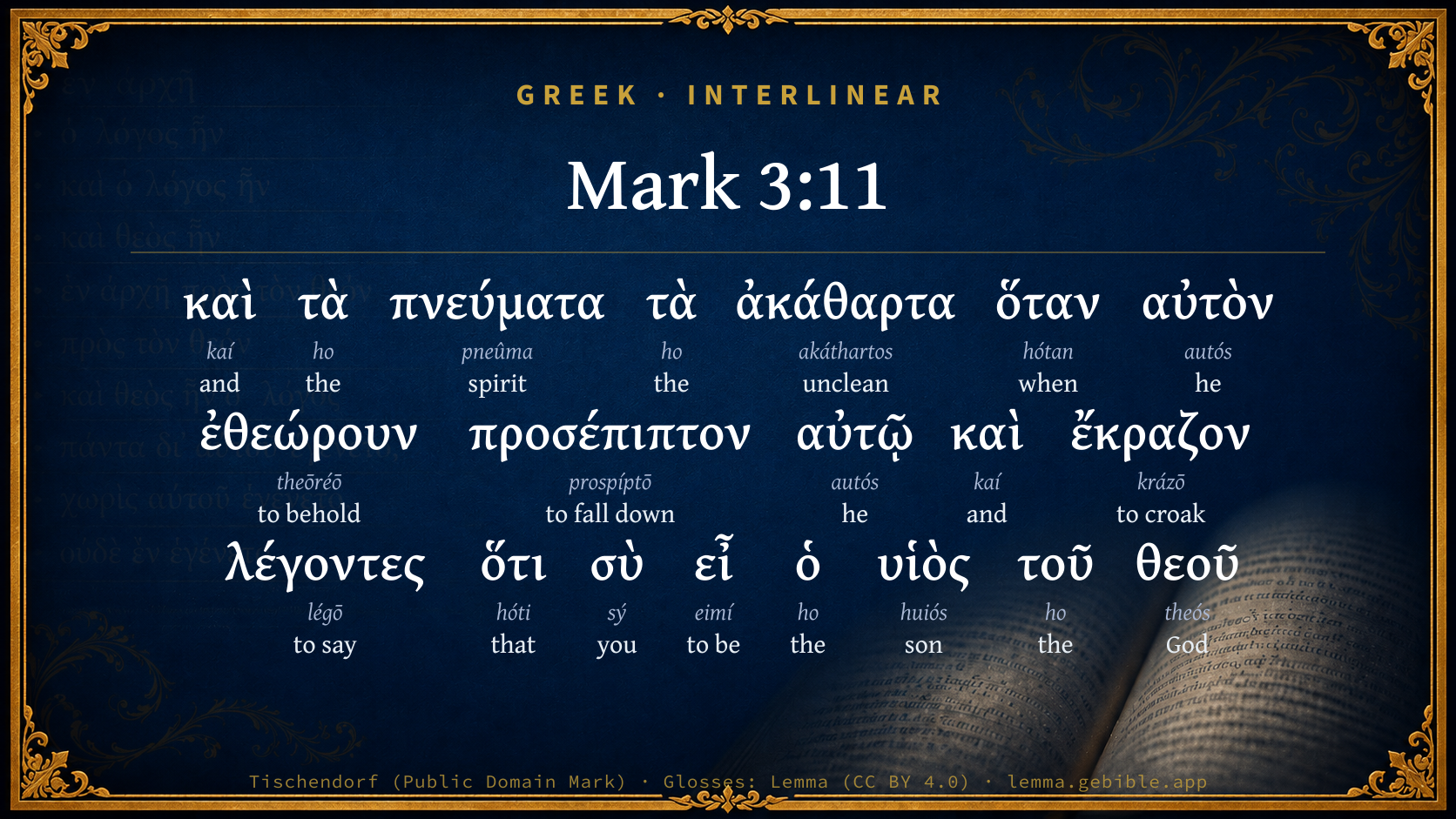
Greek (Tischendorf 8th ed.) Mark 3:11 appears in the Greek New Testament. The text above is from the Tischendorf 8th edition. Each word links to its Strong’s number and a concise gloss. Click any word for its full Thayer’s Greek Lexicon entry.
Download image
Cite this verse

Mark 3:11 (World English Bible). Public Domain. Lemma interlinear Bible study tool, https://lemma.gebible.app/v/mark/3/11.

Show BibTeX & RIS
BibTeX
RIS
English Translation
The unclean spirits, whenever they saw him, fell down before him, and cried, "You are the Son of God!"
World English Bible · Public Domain
Download a study sheet

One document with this verse’s original text, its word-by-word gloss line, the meaning frame, cross-references with their text, attributed commentary, and full source and license credits — printable, and it pastes into notes with its structure intact.

This verse Autodidact and up

Study sheet (.html) Plain text (.txt)

A passage Seminary Student

Up to 50 verses in one chapter. A passage sheet keeps up to 6 commentary sources and 12 cross-references per verse, in the order this page ranks them, and says so on the sheet whenever that leaves anything out. Ask for a single verse and you get the Autodidact verse sheet above.

Everything on this page stays free to read, with no account — the sheet is a download of what is already on screen, not access to it.

Want to remove ads? Support Godless Engineer
Compare translations 3

The same verse in 3 English versions, stacked beneath the original-language interlinear above. Click any original word for its lexicon entry.

Each is an independent rendering of the whole verse — the interlinear is not word-aligned to these translations.

Highlighted words mark where these versions differ — a whole-verse word diff, not a word-by-word alignment.

  • World English Bible Public Domain
    The unclean spirits, whenever they saw him, fell down before him, and cried, "You are the Son of God!"
  • King James Version Public Domain
    And unclean spirits, when they saw him, fell down before him, and cried, saying, Thou art the Son of God.
  • unfoldingWord Literal Text CC BY-SA 4.0
    And whenever the unclean spirits saw him, they were falling down before him and crying out, saying, “You are the Son of God.”

unfoldingWord Literal Text — © unfoldingWord, licensed CC BY-SA 4.0. Word-aligned USFM3 via Door43 (git.door43.org/unfoldingWord/en_ult).

Versions to compare (up to 4)

3 of 4 selected

Show all 19 translations

Every available English version of this verse, each an independent rendering of the whole verse.

  • World English Bible Public Domain
    The unclean spirits, whenever they saw him, fell down before him, and cried, "You are the Son of God!"
  • Berean Standard Bible Public Domain
    And when the unclean spirits saw Him, they fell down before Him and cried out, “You are the Son of God!”
  • Majority Standard Bible Public Domain
    And when the unclean spirits saw Him, they fell down before Him and cried out, “You are the Son of God!”
  • King James Version Public Domain
    And unclean spirits, when they saw him, fell down before him, and cried, saying, Thou art the Son of God.
  • American Standard Version (1901) Public Domain
    And the unclean spirits, whensoever they beheld him, fell down before him, and cried, saying, Thou art the Son of God.
  • Revised Version (1885) Public Domain
    And the unclean spirits, whensoever they beheld him, fell down before him, and cried, saying, Thou art the Son of God.
  • Geneva Bible (1599) Public Domain
    And when the vncleane spirits sawe him, they fel downe before him, and cried, saying, Thou art the Sonne of God.
  • Douay-Rheims (1899) Public Domain
    And the unclean spirits, when they saw him, fell down before him: and they cried, saying:
  • Young's Literal Translation Public Domain
    and the unclean spirits, when they were seeing him, were falling down before him, and were crying, saying -- `Thou art the Son of God;'
  • Literal Standard Version CC BY-SA 4.0
    and the unclean spirits, when they were seeing Him, were falling down before Him, and were crying, saying, “You are the Son of God”;
  • Unlocked Literal Bible CC BY-SA 4.0
    Whenever the unclean spirits saw him, they fell down before him and cried out, and they said, “You are the Son of God.”
  • unfoldingWord Literal Text CC BY-SA 4.0
    And whenever the unclean spirits saw him, they were falling down before him and crying out, saying, “You are the Son of God.”
  • Darby Bible Public Domain
    And the unclean spirits, when they beheld him, fell down before him, and cried saying, *Thou* art the Son of God.
  • World Messianic Bible Public Domain
    The unclean spirits, whenever they saw him, fell down before him and cried, “You are the Son of God!”
  • Webster's Bible Public Domain
    And unclean spirits, when they saw him, fell down before him, and cried, saying, Thou art the Son of God.
  • Free Bible Version CC BY-SA 4.0
    Whenever the evil spirits saw him they would fall down in front of him and shout out, “You are the Son of God!”
  • Bible in Basic English Public Domain
    And the unclean spirits, whenever they saw him, went down before him, crying out, and saying, You are the Son of God.
  • Text-Critical English NT CC BY 4.0
    Whenever the unclean spirits saw him, they would fall down before him and cry out, “Yoʋ are the Son of God.”
  • Tyndale New Testament (1534) Public Domain
    And when the vnclene sprites sawe him they fell doune before him and cryed sayinge: thou arte the sonne of God.

Literal Standard Version (2020), Covenant Press — licensed CC BY-SA 4.0. Text via the HelloAO Bible API (eBible.org). Unlocked Literal Bible (unfoldingWord) — licensed CC BY-SA 4.0. Text via the HelloAO Bible API (eBible.org). unfoldingWord Literal Text — © unfoldingWord, licensed CC BY-SA 4.0. Word-aligned USFM3 via Door43 (git.door43.org/unfoldingWord/en_ult). Free Bible Version, Dr. Jonathan Gallagher — licensed CC BY-SA 4.0. Text via the HelloAO Bible API (eBible.org).

Word by word

More ways to search: Search by grammar → Find every occurrence → Compare this word →

Practice this passage: Drill this verse → Learn its vocabulary →

προσέπιπτον
prospíptō
G4363
“to fall down”
Verb, Imperfect, Active, Indicative, 3rd person, Plural
Part of Speech
Verb
Tense
Imperfect
Voice
Active
Mood
Indicative
Person
3rd person
Number
Plural
Full Thayer's Definition

Origin: from G4314 and G4098

TDNT: None

1. to fall forwards, fall down, prostrate one's self before, in homage or supplication: at one's feet 2. to rush upon, beat against a. of winds beating upon a house
  1. καὶ kaí G2532 “and” Conjunction
  2. τὰ ho G3588 “the” Article, Nominative, Plural, Neuter
  3. πνεύματα pneûma G4151 “spirit” Noun, Nominative, Plural, Neuter
  4. τὰ ho G3588 “the” Article, Nominative, Plural, Neuter
  5. ἀκάθαρτα akáthartos G169 “unclean” Adjective, Nominative, Plural, Neuter
  6. ὅταν hótan G3752 “when” Conjunction
  7. αὐτὸν autós G846 “he” Personal pronoun, Accusative, Singular, Masculine
  8. ἐθεώρουν theōréō G2334 “to behold” Verb, Imperfect, Active, Indicative, 3rd person, Plural
  9. αὐτῷ autós G846 “he” Personal pronoun, Dative, Singular, Masculine
  10. καὶ kaí G2532 “and” Conjunction
  11. ἔκραζον krázō G2896 “to croak” Verb, Imperfect, Active, Indicative, 3rd person, Plural
  12. λέγοντες légō G3004 “to say” Verb, Present, Active, Participle, Nominative, Plural, Masculine
  13. ὅτι hóti G3754 “that” Conjunction
  14. σὺ sý G4771 “you” Personal pronoun, 2nd person, Nominative, Singular
  15. εἶ eimí G1510 “to be” Verb, Present, Active, Indicative, 2nd person, Singular
  16. ὁ ho G3588 “the” Article, Nominative, Singular, Masculine
  17. υἱὸς huiós G5207 “son” Noun, Nominative, Singular, Masculine
  18. τοῦ ho G3588 “the” Article, Genitive, Singular, Masculine
  19. θεοῦ theós G2316 “God” Noun, Genitive, Singular, Masculine

About this verse

These counts appear in no published source. They are computed here, from the morphology-tagged text and Lemma’s own curated glosses. What Lemma adds →

20
words
15
distinct lemmas
Gospels
section

Notable vocabulary

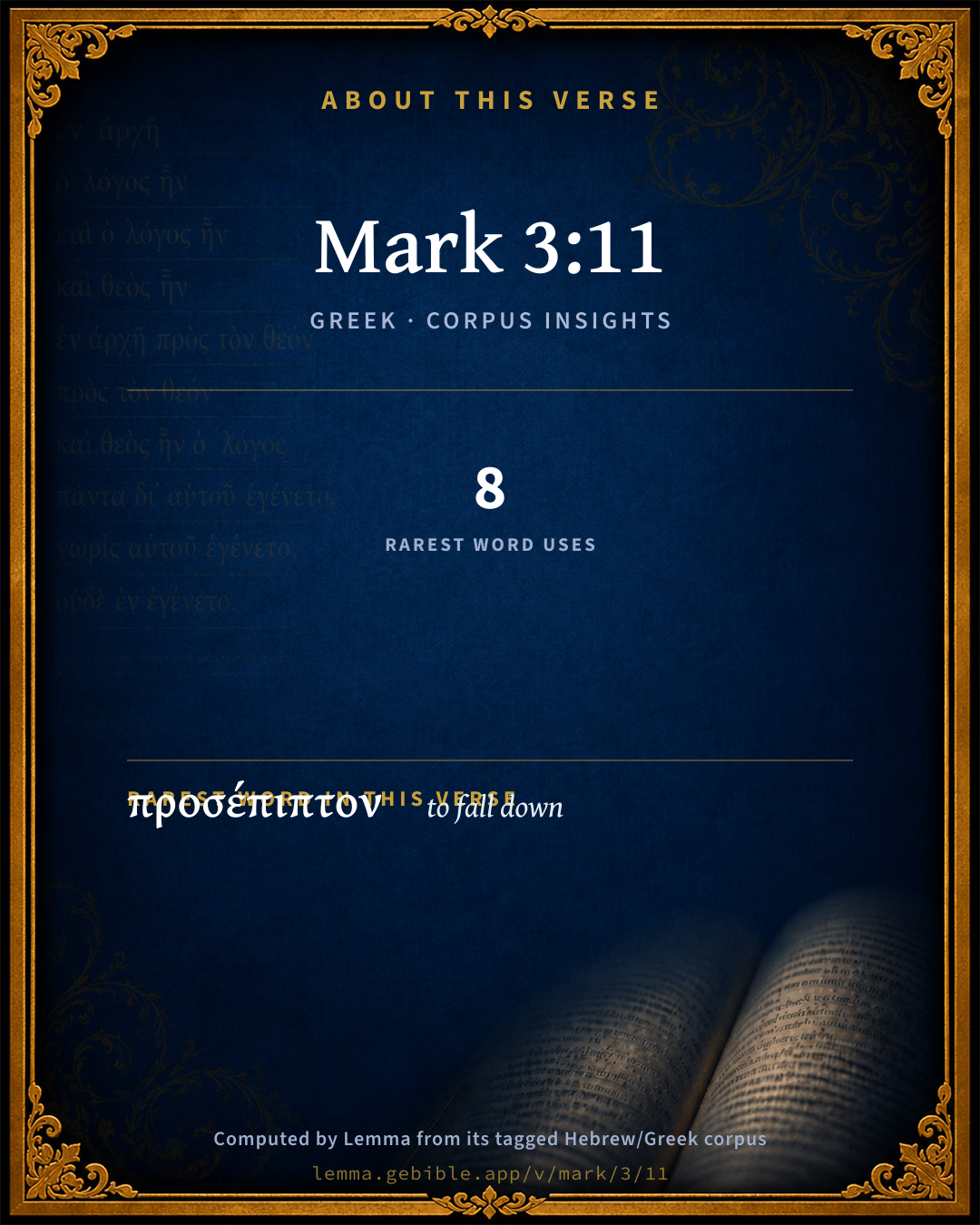
The rarest word here is προσέπιπτον to fall down G4363 — appearing just 8 times in the whole Greek New Testament.

Shared distinctive vocabulary

προσέπιπτον to fall down G4363 occurs in 8 verses of the Greek New Testament. Also found in:

Repetition

Words recur within this verse:

Cross-references

13

Topical passages linked to Mark 3:11 in the Treasury of Scripture Knowledge — connected by theme and wording, ordered by reader-vote popularity; previews shown in the World English Bible.

  • Luke 4:41 Demons also came out from many, crying out, and saying, "You are the Christ, the Son of God!" Rebuking them, he didn't allow them to speak, because they knew that he was the Christ.
  • Mark 1:23–24 Immediately there was in their synagogue a man with an unclean spirit, and he cried out,
  • Luke 8:28 When he saw Jesus, he cried out, and fell down before him, and with a loud voice said, "What do I have to do with you, Jesus, you Son of the Most High God? I beg you, don't torment me!"
  • Matthew 4:3 The tempter came and said to him, "If you are the Son of God, command that these stones become bread."
  • Matthew 8:29 Behold, they cried out, saying, "What do we have to do with you, Jesus, Son of God? Have you come here to torment us before the time?"
  • James 2:19 You believe that God is one. You do well. The demons also believe, and shudder.
  • Acts 16:17 Following Paul and us, she cried out, "These men are servants of the Most High God, who proclaim to us the way of salvation!"
  • Matthew 4:6 and said to him, "If you are the Son of God, throw yourself down, for it is written, 'He will give his angels charge concerning you.' and, 'On their hands they will bear you up, So that you don't dash your foot against a stone.'"
  • Matthew 8:31 The demons begged him, saying, "If you cast us out, permit us to go away into the herd of pigs."
  • Acts 19:13–17 But some of the itinerant Jews, exorcists, took on themselves to name over those who had the evil spirits the name of the Lord Jesus, saying, "We adjure you by Jesus whom Paul preaches."
  • Mark 5:5–6 Always, night and day, in the tombs and in the mountains, he was crying out, and cutting himself with stones.
  • Matthew 14:33 Those who were in the boat came and worshiped him, saying, "You are truly the Son of God!"
  • Mark 1:1 The beginning of the Gospel of Jesus Christ, the Son of God.

Cross-references courtesy of OpenBible.info (CC BY 4.0).

Commentary

Notes on Mark 3:11 from classic Christian and Jewish commentators (each source and its license shown beneath its notes). The classic Christian expositions comment on the surrounding passage and are grouped to its opening verse, so a note may address several verses; the Jewish commentaries on the Tanakh (Rashi and others) are per-verse, so they appear only where the commentator wrote on this verse.

Lemma curates 59 commentaries, every one of them public domain or Creative Commons licensed, each selected and text-cleaned for this edition rather than reprinted as found. About our sources →

The Biblical Illustrator

Joseph S. Exell

Mar_3:11

And unclean spirits, when they saw Him, fell down before Him.

Christs supremacy over evil spirits

Whence the commotion in the intelligent universe when the Saviour entered on His public ministry? The diseased crowded around Him to be healed; the teachable to hear the words of celestial wisdom; the curious to witness the stupendous miracles; and the captious that they might entangle Him in His talk. Nor was His audience composed exclusively of men. Heaven and hell waited on His steps. The Father spake of Him from the excellent glory; the Holy Ghost descended upon Him; sinless angels followed in His train; and the demons of the abyss pronounced His eulogium, and deprecated His wrath. Why this mighty congregation streaming from the remotest points of the universe to meet Him? On the principle, doubtless, that where the King is, there is the Court. Every type of moral being surrounded our Lord.

I. Impiety abashed in the presence of holiness. That devils are conscious of their own character, and that they are correct judges of the character of other beings, must be admitted on the simple ground of their intelligence. The consciousness of their awful degradation remains in unblunted keenness; and it cowers in the presence of moral purity. Why do Ananias and Sapphira fall dead beneath the calm questions of the apostle? It is falsehood slain by the glittering sword of truth. And why does Felix tremble when Paul, the prisoner, reasons of righteousness, temperance, and judgment to come? No external force is brought to bear upon the governor, no visible sword hangs over his head; and yet he trembles; why? He is shaken like a leaf in the hurricane, by an invisible host of memories more powerful far than a legion of visible foes. Evil confesses the superiority of good; vice crowns virtue with a lasting garland; sin declares holiness to be infinitely above it.

II. Divine truth may be intellectually recognized without the accompaniment of salvation. It is possible for a man to vindicate the truth against all opponents without embracing it; to contend earnestly for the faith delivered to the saints without adopting it; to construct an elaborate system of divinity without fellowship with the Saviour; and to preach the gospel in eloquent language without either part or lot in the matter.

III. Here are devils acknowledging the supremacy of the Son of God over them. The supremacy of the Son of God, as such, over all creatures, without respect to their moral character, or their position in the scale of being, must, of course, be freely admitted. But this is not the point here; for first, there is the acknowledgment of this supremacy; and second, it is the Son of God in His character of the Messiah, whose supremacy they acknowledge. They had the strongest reasons for not looking on the outward appearance but on the reality. They knew Him, and believed, and confessed, and trembled! They worshipped, but it was in demon fashion, the worship of terror. This confession of supremacy, as uttered by evil spirits, means this: We are intruders and impostors, having no right here. This is Thy world. By falsehood have we gained our position here, afflicting the bodies, maddening the minds, and ruining the souls of men. We know our doom, and that Thou wilt pronounce it; but surely not so soon. It was a confession of defeat. Lying lips speak sublime truth for once.

IV. He whose supremacy is acknowledged by evil spirits is your Friend and Saviour, if you will accept Him as such. Inferences:

1. In the kingdom of grace, love is a greater thing than knowledge. Fallen spirits believe and tremble; worldly men assent and are indifferent; Christians believe and love. Christ seeks our affection.

2. Laying hold on the Redeemers strength, you are stronger than evil spirits. They are conquered foes; conquered by your Saviour; on your account. In Christ you have not only righteousness, but strength.

3. Following the Redeemer, you will be shortly where evil spirits cannot follow you. (W. Leask, D. D.)

The Biblical Illustrator, edited by Joseph S. Exell (c. 1880s–1900s) — public domain. Text from a community e-Sword module.

Tyndale Open Study Notes

Tyndale Open Resources

3:11-12 The evil spirits knew who Jesus was (1:34; see also 1:22; 5:7), but Jesus did not want his identity revealed.

Tyndale Open Study Notes — © Tyndale Open Resources, licensed CC BY-SA 4.0. Text via the HelloAO Bible API.

Bengel's Gnomon

Johann Albrecht Bengel

Mar 3:11. Ὅταν) ὅτʼ ἂν is here joined with a past tense of the Indicative, as ὅπου ἂν, ch. Mar 6:56.

Bengel's Gnomon of the New Testament — English translation (T&T Clark, Edinburgh, 1860) — public domain. Text from a community e-Sword module.

Expositor's Greek Testament

ed. W. Robertson Nicoll

Mar 3:11 . ὅταν ἐθ . In a relative clause like this, containing a past general supposition, classical Greek has the optative without ἄν . Here we have the imperfect indicative with ἄν ( ὅτε ἄν ). Vide Klotz., ad Devar , p. 690, and Burton, M. and T. , § 315. Other examples in chap. Mar 6:56 , Mar 11:19 . προσέπιπτον , fell before ( ἐπιπίπτειν , above, to fall against ). Σὺ εἶ ὁ υ . τ . θ .: again an instance of spiritual clairvoyance in demoniacs. Vide at Mat 8:29 .

The Expositor's Greek Testament, edited by W. Robertson Nicoll (1897–1910) — public domain. Text from a community e-Sword module.

Geneva Bible (1599)

Geneva Bible translators

In them whom they had entered into: or by the figure called Metonymy, for them which were vexed with unclean spirits.

Geneva Bible (1599) marginal notes — public domain. Text via Bolls.life.

Adam Clarke's Commentary

Verse 11. Thou art the Son of God.] Two MSS., and the later Syriac, have, Thou art the Christ, the Son of God. One of Stephens's MSS. has, Thou art the Holy One of God. A MS. in the library of Leicester has, συ ει ὁ Θεος, υἱος, Thou art GOD, the Son. This is an uncommon reading, which is not confirmed by any MS. yet discovered.

Adam Clarke's Commentary on the Bible (1810–1826) — public domain. Text from a community e-Sword/MySword module.

Ellicott's Commentary for English Readers

(11) And unclean spirits.—The testimony which had been given in a single instance (Mar_1:24) now became more or less general. But it came in a form which our Lord could not receive. The wild cry of the frenzied demoniac had no place in the evidence to which He appealed (Joh_5:31-37), and tended, so far as it impressed men at all, to set them against the Teacher who was thus acknowledged.

A Bible Commentary for English Readers, edited by Charles John Ellicott (1878–1897) — public domain. Text from a community e-Sword module.

The Cambridge Bible for Schools and Colleges

gen. ed. J. J. S. Perowne

11. Thou art the Son of God] In the Synagogue of Capernaum they had called Him the “Holy One of God” (Mar_1:24), they now acknowledge Him as the “Son of God” (comp. Luk_4:41). The force of the imperfect tense in the original here is very striking, “whenever the demons saw Him, they kept falling down before Him and saying” … and as often as they did so, “He straitly charged them that they should not make Him known,” i. e. as the Messiah “the Son of God.”

The Cambridge Bible for Schools and Colleges (gen. ed. J. J. S. Perowne; Cambridge University Press, 1878–1918) — public domain. Text from a community e-Sword module.

John Gill's Exposition

And unclean spirits, when they saw him,.... That is, as the Syriac and Arabic versions read, "they who had unclean spirits": or, as the Ethiopic, "they that were possessed with unclean spirits"; as soon as ever they beheld Christ, though they had never seen him before, and he was an entire stranger to them, yet

fell down before him: the unclean spirits being said to do that, which they that were possessed with them did; and which, notwithstanding their possession of them, they could not prevent, but were obliged to admit of it, as a token of their subjection to Christ:

and even the devils themselves in the men,

cried, saying, thou art the Son of God; a divine person, equal with God; and such his power over them, and his healing all manner of diseases, by a word, or touch, showed him to be.

John Gill's Exposition of the Whole Bible (1746–1763) — public domain (CC PDM 1.0). Text via the HelloAO Bible API.

Trapp's Complete Commentary

John Trapp

11 And unclean spirits, when they saw him, fell down before him, and cried, saying, Thou art the Son of God.

Ver. 11. Thou art the Son, &c.] The matter is well amended since Satan’s first onset upon Christ. Then it was, If thou be the Son of God. The same power, when he listeth, can change the note of the tempter to us.

John Trapp, A Commentary or Exposition upon All the Books of the Old and New Testament (1647–1656) — public domain. Text from a community e-Sword module.

Albert Barnes' Notes on the Bible

Unclean spirits - Persons who were possessed of evil spirits.

Thou art the Son of God - The Son of God, by way of eminence. In this place it is equivalent to the Messiah, who was, among the Jews, called the Son of God. Hence, they were charged not to make him known, because he was not desirous that it should be blazoned abroad that he claimed to be the Messiah. He had not yet done what he wished in order to establish his claims to the Messiahship. He was poor and unhonored, and the claim would be treated as that of an impostor. “For the present,” therefore, he did not wish that it should be proclaimed abroad that he was the Messiah. The circumstance here referred to demonstrates the existence of evil spirits. If these were merely diseased or deranged persons, then it is strange that they should be endowed with knowledge so much superior to those in health. If they were under the influence of an order of spirits superior to man - whose appropriate habitation was in another world - then it is not strange that they should know him, even in the midst of his poverty, to be the Messiah, the Son of God.

Albert Barnes' Notes on the Bible (1834–1885) — public domain. Text from a community e-Sword/MySword module.

Haydock's Catholic Bible Commentary

The unclean spirits being obliged by the Divine Power, not only to come and worship, but also to declare his majesty, exclaimed: Thou art the Son of God. How astonishing then is the blindness of the Arians, who even after his resurrection denied him to be the Son of God, whom the devils confessed as such when clothed with human nature. But it is certain that not only the devils, but the infirm that were healed, and the apostles themselves were forbidden, as well as the unclean spirits, to proclaim his divinity; lest the passion and death of Christ might be on that account deferred. (Ven. Bede)

George Leo Haydock (1774–1849), Haydock's Catholic Family Bible and Commentary, 1859 edition — public domain. Excludes Psalms (Douay-Rheims chapter numbering differs from Protestant) and Deuterocanonical books (Catholic canon only).

Whedon's Commentary on the Bible

Daniel D. Whedon

11. Thou art the Son of God — See notes on Mar_1:24-26. Our Lord accepted not devils for preachers. They so mingled falsehood with their truth that he who listens to them for the truth’s sake will be led away by their lies. All the testimony Jesus would have from them was given by their disclosing their infernal presence and disappearing at his command.

Daniel D. Whedon (gen. ed.), Commentary on the Old and New Testaments (1874–1909) — public domain. Text from a community e-Sword module.

The Pulpit Commentary

And the unclean spirits, whensoever they beheld him, fell down before him, and cried, saying. It is worthy of notice that the afflicted people fell upon him (epipiptein autw); but the unclean spirits felt down before him (prosepipten autw), and this not out of love or devotion, but out of abject fear, dreading lest he should drive them out of the "possessed," and send them before their time to their destined torment. It is just possible that this homage paid to our Lord may have been an act of cunning a ruse, as it were, to lead the people to suppose that our Lord was in league with evil spirits. Thou art the Son of God. Did, then, the unclean spirits really know that Jesus was the Son of God? A voice from heaven at his baptism had proclaimed him to be the Son of God, and that voice must have vibrated through the spiritual world. Then, further, they must have known him to be the Son of God by the numerous and mighty miracles which he wrought, and which they must have seen o be real miracles, such as could only have been wrought by the supernatural power of God, and which were wrought by Christ for this very purpose, that they might prove him to be the promised Messiah, the only begotten Son of God. It may, however, be observed that they did not know this so clearly, but that, considering, on the other hand, the greatness of the mystery, they hesitated. It is probable that they were ignorant of the end and fruit of this great mystery, namely, that mankind were to be redeemed by the Incarnation, the Cross, and the Death of Christ; and so their own kingdom was to be overthrown, and the kingdom of God established. Blinded by their hatred of Jesus, whom they perceived to be a most holy Being, drawing multitudes to himself, they stirred up the passions of evil men against him, little dreaming that in promoting his destruction they were overthrowing their own kingdom.

The Pulpit Commentary (1880–1919), ed. H.D.M. Spence-Jones & Joseph S. Exell — public domain. Text from a community e-Sword module.

The People's New Testament

B. W. Johnson

11. Unclean spirits. See note on Matt. 8:28.

B. W. Johnson's The People's New Testament with Notes (1889–1891) — public domain. Electronic text from the Christian Classics Ethereal Library (CCEL) ThML edition.

unfoldingWord translationNotes

Door43 World Missions Community

saw him

"saw Jesus"

they fell down ... cried out, and they said

Here "they" refers to the unclean spirits. It is they who are causing the people they possess to do things. This can be made explicit. AT: "they caused the people they were possessing to fall down before him and to cry out to him" (See: Assumed Knowledge and Implicit Information)

they fell down before him

The unclean spirits did not fall down before Jesus because they loved him or wanted to worship him. They fell down before him because they were afraid of him.

You are the Son of God

Jesus has power over unclean spirits because he is the "Son of God."

Son of God

This is an important title for Jesus. (See: Translating Son and Father)

He strictly ordered them

"Jesus strictly ordered the unclean spirits"

not to make him known

"not to reveal who he was"

translationWords

demon

demon-possessed

Son of God

know

unfoldingWord translationNotes — © Distant Shores Media and the Door43 World Missions Community, licensed CC BY-SA 4.0. Source: git.door43.org/Door43/en_tn.

Cambridge Greek Testament for Schools and Colleges

11. ἐθεώρουν ([442][443][444][445][446][447] 33), προσέπιπτον ([448][449][450][451][452][453][454][455][456][457] and ἔκραζον ([458][459][460][461][462] rather than ἐθεώρει ([463][464] προσέπιπτεν ([465][466][467][468][469] and ἔκραζεν ([470][471][472][473][474] which are grammatical corrections. Syr-Sin. omits ὃταν αὐτὸν ἐθ.

[442] Codex Sinaiticus. 4th cent. Discovered by Tischendorf in 1859 at the Monastery of St Katharine on Mount Sinai. Now at St Petersburg. The whole Gospel, ending at Mar 16:8. Photographic facsimile, 1911.

[443] Codex Vaticanus. 4th cent., but perhaps a little later than א. In the Vatican Library almost since its foundation by Pope Nicolas V., and one of its greatest treasures. The whole Gospel, ending at Mar 16:8. Photographic facsimile, 1889.

[444] Codex Ephraemi. 5th cent. A palimpsest: the original writing has been partially rubbed out, and the works of Ephraem the Syrian have been written over it; but a great deal of the original writing has been recovered; of Mark we have Mar 1:17 to Mar 6:31, Mar 8:5 to Mar 12:29, Mar 13:19 to Mar 16:20. In the National Library at Paris.

[445] Codex Bezae. 6th cent. Has a Latin translation (d) side by side with the Greek text, and the two do not quite always agree. Presented by Beza to the University Library of Cambridge in 1581. Remarkable for its frequent divergences from other texts. Contains Mark, except Mar 16:15-20, which has been added by a later hand. Photographic facsimile, 1899.

[446] Codex Seidelianus I. 9th or 10th cent. Contains Mar 1:13 to Mar 14:18; Mar 14:25 to Mar 16:20.

[447] Codex Regius. 8th cent. An important witness. At Paris. Contains Mar 1:1 to Mar 10:15; Mar 10:30 to Mar 15:1; Mar 15:20 to Mar 16:20, but the shorter ending is inserted between Mar 16:8 and Mar 16:9, showing that the scribe preferred it to the longer one.

[448] Codex Sinaiticus. 4th cent. Discovered by Tischendorf in 1859 at the Monastery of St Katharine on Mount Sinai. Now at St Petersburg. The whole Gospel, ending at Mar 16:8. Photographic facsimile, 1911.

[449] Codex Alexandrinus. 5th cent. Brought by Cyril Lucar, Patriarch of Constantinople, from Alexandria, and afterwards presented by him to King Charles I. in 1628. In the British Museum. The whole Gospel. Photographic facsimile, 1879.

[450] Codex Ephraemi. 5th cent. A palimpsest: the original writing has been partially rubbed out, and the works of Ephraem the Syrian have been written over it; but a great deal of the original writing has been recovered; of Mark we have Mar 1:17 to Mar 6:31, Mar 8:5 to Mar 12:29, Mar 13:19 to Mar 16:20. In the National Library at Paris.

[451] Codex Bezae. 6th cent. Has a Latin translation (d) side by side with the Greek text, and the two do not quite always agree. Presented by Beza to the University Library of Cambridge in 1581. Remarkable for its frequent divergences from other texts. Contains Mark, except Mar 16:15-20, which has been added by a later hand. Photographic facsimile, 1899.

[452] Codex Boreelianus. Once in the possession of John Boreel. 9th cent. At Utrecht. Contains Mk 1–41; Mar 2:8-23; Mar 3:5 to Mar 11:6; Mar 11:27 to Mar 14:54; Mar 15:6-39; Mar 16:19-20.

[453] Codex Seidelianus I. 9th or 10th cent. Contains Mar 1:13 to Mar 14:18; Mar 14:25 to Mar 16:20.

[454] Codex Cyprius. 9th cent. One of the seven uncials which have the Gospels complete, the others being אBMSUΩ. At Paris.

[455] Codex Regius. 8th cent. An important witness. At Paris. Contains Mar 1:1 to Mar 10:15; Mar 10:30 to Mar 15:1; Mar 15:20 to Mar 16:20, but the shorter ending is inserted between Mar 16:8 and Mar 16:9, showing that the scribe preferred it to the longer one.

[456] Codex Campianus. 9th cent. At Paris. Gospels complete.

[457] odex Guelpherbytanus. 6th cent. Contains Mar 1:2-11; Mar 3:5-17; Mar 14:13-24; Mar 14:48-61; Mar 15:12-37.

[458] Codex Sinaiticus. 4th cent. Discovered by Tischendorf in 1859 at the Monastery of St Katharine on Mount Sinai. Now at St Petersburg. The whole Gospel, ending at Mar 16:8. Photographic facsimile, 1911.

[459] Codex Alexandrinus. 5th cent. Brought by Cyril Lucar, Patriarch of Constantinople, from Alexandria, and afterwards presented by him to King Charles I. in 1628. In the British Museum. The whole Gospel. Photographic facsimile, 1879.

[460] Codex Vaticanus. 4th cent., but perhaps a little later than א. In the Vatican Library almost since its foundation by Pope Nicolas V., and one of its greatest treasures. The whole Gospel, ending at Mar 16:8. Photographic facsimile, 1889.

[461] Codex Ephraemi. 5th cent. A palimpsest: the original writing has been partially rubbed out, and the works of Ephraem the Syrian have been written over it; but a great deal of the original writing has been recovered; of Mark we have Mar 1:17 to Mar 6:31, Mar 8:5 to Mar 12:29, Mar 13:19 to Mar 16:20. In the National Library at Paris.

[462] Codex Bezae. 6th cent. Has a Latin translation (d) side by side with the Greek text, and the two do not quite always agree. Presented by Beza to the University Library of Cambridge in 1581. Remarkable for its frequent divergences from other texts. Contains Mark, except Mar 16:15-20, which has been added by a later hand. Photographic facsimile, 1899.

[463] Codex Alexandrinus. 5th cent. Brought by Cyril Lucar, Patriarch of Constantinople, from Alexandria, and afterwards presented by him to King Charles I. in 1628. In the British Museum. The whole Gospel. Photographic facsimile, 1879.

[464] odex Guelpherbytanus. 6th cent. Contains Mar 1:2-11; Mar 3:5-17; Mar 14:13-24; Mar 14:48-61; Mar 15:12-37.

[465] Codex Basiliensis. 8th cent. At Basle.

[466] Codex Seidelianus II. 9th or 10th cent. Contains Mar 1:1-31; Mar 2:4 to Mar 15:43; Mar 16:14-20.

[467] Codex Vaticanus. 10th cent. Dated A.D. 949.

[468] Codex Nanianus. 9th or 10th cent. Gospels complete.

[469] odex Mosquensis. 9th cent.

[470] Codex Basiliensis. 8th cent. At Basle.

[471] Codex Seidelianus II. 9th or 10th cent. Contains Mar 1:1-31; Mar 2:4 to Mar 15:43; Mar 16:14-20.

[472] Codex Vaticanus. 10th cent. Dated A.D. 949.

[473] Codex Nanianus. 9th or 10th cent. Gospels complete.

[474] odex Mosquensis. 9th cent.

11. See crit. note. As often, the unclean spirits and those whom they obsess are spoken of interchangeably. It was the demoniacs who fell down before Him, whensoever they beheld Him (R.V.); it was the demons who recognized Him as the Son of God. Indefinite repetition in the past is expressed by ὅταν c. imperf. indic.; so also ὅπου ἄν (Mar 6:56): also with the less intelligible aor.; ὅσοι ἄν (Mar 6:56) and ὅταν (Mar 11:19). Blass, § 63. 7; Burton, § 290, 315. Syr-Sin. condenses; “and they who had plagues of unclean spirits upon them fell down before them.” The contrast between ἐπιπίπτειν and προσέπιπτον is perhaps accidental. Cf. the Philippian jailor (Act 16:29) and Cornelius (Act 10:25; also Psa 95:6).

ἔκραζον. The separate instances are thought of throughout, and hence the plurals: cf. Luk 24:11; Joh 19:31: and the separate instances are thought of because of the nature of the cry. “The earliest confession of the Sonship seems to have come from evil spirits, who knew Jesus better than He was known by His own disciples” (Swete).

Cambridge Greek Testament for Schools and Colleges (Cambridge University Press, 1896; 21 vols, various authors incl. Carr, Maclear, Plummer, Farrar, Lumby, Moule, M. R. James, Simcox) — public domain. Text from a community e-Sword module.

Alford’s Greek Testament

Henry Alford

11. ὅταν … ἐθεώρουν] See ref. The indic. is sometimes found with ὅταν in the N.T., see Rev 4:9, but generally amidst variety of readings: Mat 10:19: Mar 11:25: Luk 13:28: Rom 2:14. Meyer thus accounts for it—that in later Greek the ἅν became completely attached to the ὅτε, and the whenever was treated as merely an expression of time—so that in German it would not be menn sie Jhn irgend sahen, but menn irgend sie Jhn sahen.

The unclean spirits are here spoken of in the person of those possessed by them, and the two fused together: for as it was impossible that any but the spirits could have known that He was the Son of God, so it was the material body of the possessed which fell down before Him, and their voice which uttered the cry: see note on Mat 8:32. The notion of the semi-rationalists, that the sick identified themselves with the dæmons (Meyer), is at once refuted by the universal agreement of the testimony given on such occasions, that Jesus was the Son of God.

Henry Alford, The Greek Testament (1849–1861) — public domain. Text from a community e-Sword module.

International Critical Commentary

11. τὰ πνεύματα τὰ ἀκάθαρτα—The unclean spirits are here put by metonymy for the men possessed by them, because the action is directed by them. ὅταν ἐθεώρουν1—whenever they beheld him.

ἐθεώρουν, προσέπιπτον, … ἔκραζον, instead of the singular, Tisch. Treg. WH. א ABCDL etc. λέγοντες, instead of λέγοντα, Tisch. WH. marg. א DK 61, 69 etc.

προσέπιπτον καὶ ἔκραζον—would fall down before him and cry out. The impf. denotes repeated action. Ὅτι σὺ2—ὁ υἱὸς τοῦ Θεοῦ—the Son of God. This title was a Messianic title, denoting theocratic sonship, and there is nothing here to indicate that it is used in any other than this common sense. The onus probandi is not on those who deny the use of the term in the Synoptical Gospels, of metaphysical sonship, but on those who claim this use. Unless it was accompanied by language pointing out the metaphysical sonship, no Jew would have understood it.

APPOINTMENT OF THE TWELVE

International Critical Commentary — older volumes (1896–1929), various authors — public domain. Text from a community e-Sword module.

Vincent's Word Studies in the New Testament

Marvin R. Vincent

The unclean spirits [τα] . The article indicating those particular spirits which took part in that scene. Mark's precision is shown in the use of the two articles and in the arrangement of the noun and adjective : The spirits, the unclean ones.

When they saw [οταν εθεωρουν] . More accurately as Rev., whenever they beheld. The imperfect tense denotes a repeated act. The an in otan gives an indefinite force : as often as they might see him.

Marvin R. Vincent, Word Studies in the New Testament (1887–1900) — public domain. Text from a community e-Sword/MySword module.

Lesson kit

Teaching starters — assembled from the data on this page, not authored interpretation. Every prompt links to the verse data it draws on. Edit before teaching.

Mark, in the Gospels, opens this verse with 20 words (15 distinct Greek lemmas). Its most distinctive word is prospíptō (“to fall down”). A historical commentator’s framing appears above. Read the whole chapter for the surrounding context.

Discussion questions

  1. How does “to fall down” (prospíptō) shape what this verse is saying?
  2. Matthew 7:25 shares the word «to fall down» with this verse. How do the two illuminate each other?
  3. “the” occurs 4× in this one verse. What is the effect of the repetition?
  4. These translations render this verse differently; the difference is in the English rendering, not the original. What questions does that raise?
  5. Reading how The Biblical Illustrator and Tyndale Open Study Notes read this verse, where do the two commentators agree and where do they part?

Things to notice

Reading settings

Reading text

Shown beneath each verse's original-language words.

Old Testament
Old Testament edition

Read the OT as the Masoretic Hebrew (MT) or the Greek Septuagint (LXX).

English shown for the Greek Septuagint (in the Hebrew ↔ Greek comparison).

Comparing translations? Open the Compare panel on any verse page to stack up to four side by side.