

Matthew 5:24
Greek (Tischendorf 8th ed.) Matthew 5:24 appears in the Greek New Testament. The text above is from the Tischendorf 8th edition. Each word links to its Strong’s number and a concise gloss. Click any word for its full Thayer’s Greek Lexicon entry.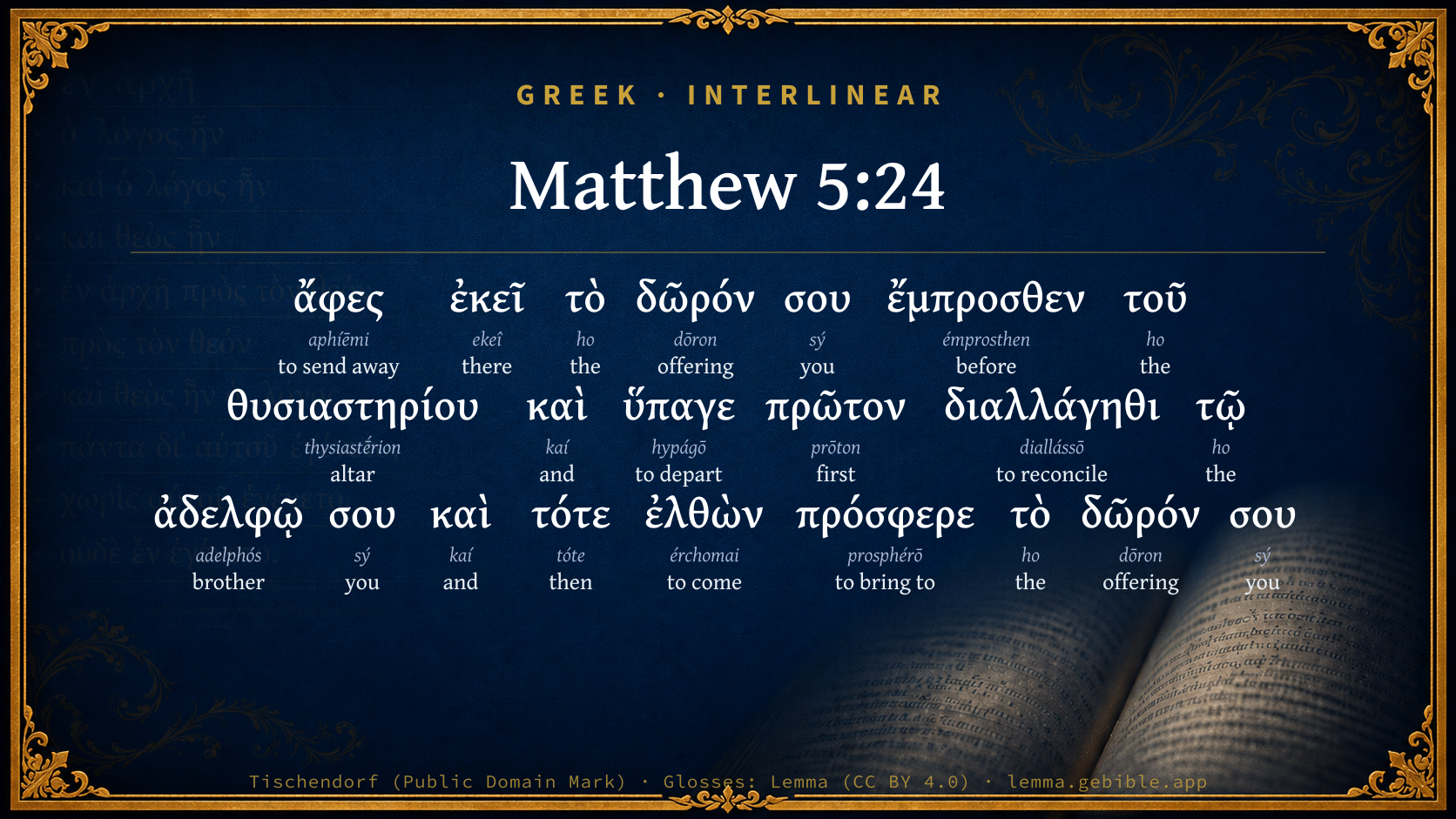
leave your gift there before the altar, and go your way. First be reconciled to your brother, and then come and offer your gift.
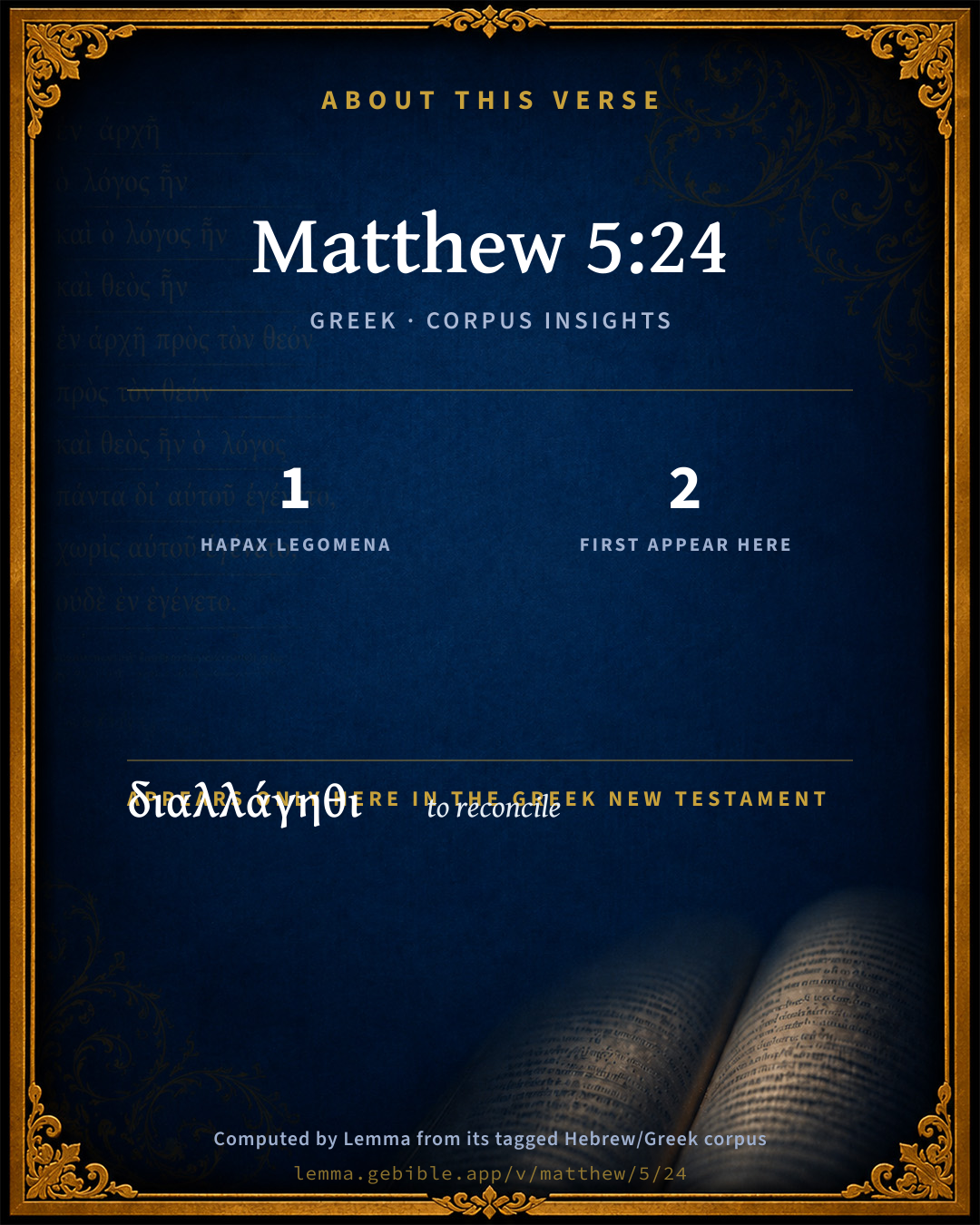
- 1 hapax legomenon — only here in the Greek New Testament
- 2 first appearances in the Greek New Testament
Download a study sheet
One document with this verse’s original text, its word-by-word gloss line, the meaning frame, cross-references with their text, attributed commentary, and full source and license credits — printable, and it pastes into notes with its structure intact.
This verse Autodidact and up
A passage Seminary Student
Up to 50 verses in one chapter. A passage sheet keeps up to 6 commentary sources and 12 cross-references per verse, in the order this page ranks them, and says so on the sheet whenever that leaves anything out. Ask for a single verse and you get the Autodidact verse sheet above.
Everything on this page stays free to read, with no account — the sheet is a download of what is already on screen, not access to it.
Compare translations 3
The same verse in 3 English versions, stacked beneath the original-language interlinear above. Click any original word for its lexicon entry.
Each is an independent rendering of the whole verse — the interlinear is not word-aligned to these translations.
Highlighted words mark where these versions differ — a whole-verse word diff, not a word-by-word alignment.
-
World English Bible Public Domain
leave your gift there before the altar, and go your way. First be reconciled to your brother, and then come and offer your gift.
-
King James Version Public Domain
Leave there thy gift before the altar, and go thy way; first be reconciled to thy brother, and then come and offer thy gift.
-
unfoldingWord Literal Text CC BY-SA 4.0
leave your gift there in front of the altar and go; first be reconciled with your brother, and then, having come, offer your gift.
unfoldingWord Literal Text — © unfoldingWord, licensed CC BY-SA 4.0. Word-aligned USFM3 via Door43 (git.door43.org/unfoldingWord/en_ult).
Show all 19 translations
Every available English version of this verse, each an independent rendering of the whole verse.
-
World English Bible Public Domain
leave your gift there before the altar, and go your way. First be reconciled to your brother, and then come and offer your gift.
-
Berean Standard Bible Public Domain
leave your gift there before the altar. First go and be reconciled to your brother; then come and offer your gift.
-
Majority Standard Bible Public Domain
leave your gift there before the altar. First go and be reconciled to your brother; then come and offer your gift.
-
King James Version Public Domain
Leave there thy gift before the altar, and go thy way; first be reconciled to thy brother, and then come and offer thy gift.
-
American Standard Version (1901) Public Domain
leave there thy gift before the altar, and go thy way, first be reconciled to thy brother, and then come and offer thy gift.
-
Revised Version (1885) Public Domain
leave there thy gift before the altar, and go thy way, first be reconciled to thy brother, and then come and offer thy gift.
-
Geneva Bible (1599) Public Domain
Leaue there thine offring before the altar, and goe thy way: first be reconciled to thy brother, and then come and offer thy gift.
-
Douay-Rheims (1899) Public Domain
Leave there thy offering before the altar, and go first to be reconciled to thy brother: and then coming thou shalt offer thy gift.
-
Young's Literal Translation Public Domain
leave there thy gift before the altar, and go -- first be reconciled to thy brother, and then having come bring thy gift.
-
Literal Standard Version CC BY-SA 4.0
leave there your gift before the altar, and go—first be reconciled to your brother, and then having come, bring your gift.
-
Unlocked Literal Bible CC BY-SA 4.0
leave your gift there in front of the altar, and go on your way. First be reconciled with your brother, and then come and offer your gift.
-
unfoldingWord Literal Text CC BY-SA 4.0
leave your gift there in front of the altar and go; first be reconciled with your brother, and then, having come, offer your gift.
-
Darby Bible Public Domain
leave there thy gift before the altar, and first go, be reconciled to thy brother, and then come and offer thy gift.
-
World Messianic Bible Public Domain
leave your gift there before the altar, and go your way. First be reconciled to your brother, and then come and offer your gift.
-
Webster's Bible Public Domain
Leave there thy gift before the altar, and go thy way; first be reconciled to thy brother, and then come and offer thy gift.
-
Free Bible Version CC BY-SA 4.0
leave your offering on the altar and go and make peace with him first, and afterwards come back and make your offering.
-
Bible in Basic English Public Domain
While your offering is still before the altar, first go and make peace with your brother, then come and make your offering.
-
Text-Critical English NT CC BY 4.0
leave yoʋr gift there before the altar and go. First be reconciled to yoʋr brother, and then come and offer yoʋr gift.
-
Tyndale New Testament (1534) Public Domain
leue there thyne offrynge before the altre and go thy waye first and be reconcyled to thy brother and then come and offre thy gyfte.
Literal Standard Version (2020), Covenant Press — licensed CC BY-SA 4.0. Text via the HelloAO Bible API (eBible.org). Unlocked Literal Bible (unfoldingWord) — licensed CC BY-SA 4.0. Text via the HelloAO Bible API (eBible.org). unfoldingWord Literal Text — © unfoldingWord, licensed CC BY-SA 4.0. Word-aligned USFM3 via Door43 (git.door43.org/unfoldingWord/en_ult). Free Bible Version, Dr. Jonathan Gallagher — licensed CC BY-SA 4.0. Text via the HelloAO Bible API (eBible.org).
Word by word
More ways to search: Search by grammar → Find every occurrence → Compare this word →
Practice this passage: Drill this verse → Learn its vocabulary →
- Appears 1× in the Greek New Testament
- First appears here
- Part of Speech
- Verb
- Tense
- Aorist
- Voice
- Passive
- Mood
- Imperative
- Person
- 2nd person
- Number
- Singular
Full Thayer's Definition
- ἄφες aphíēmi G863 “to send away” Verb, Aorist, Active, Imperative, 2nd person, Singular
- ἐκεῖ ekeî G1563 “there” Adverb
- τὸ ho G3588 “the” Article, Accusative, Singular, Neuter
- δῶρόν dōron G1435 “offering” Noun, Accusative, Singular, Neuter
- σου sý G4771 “you” Personal pronoun, 2nd person, Genitive, Singular
- ἔμπροσθεν émprosthen G1715 “before” Preposition
- τοῦ ho G3588 “the” Article, Genitive, Singular, Neuter
- θυσιαστηρίου thysiastḗrion G2379 “altar” Noun, Genitive, Singular, Neuter
- καὶ kaí G2532 “and” Conjunction
- ὕπαγε hypágō G5217 “to depart” Verb, Present, Active, Imperative, 2nd person, Singular
- πρῶτον prōton G4412 “first” Adverb, Superlative
- διαλλάγηθι diallássō G1259 “to reconcile” Verb, Aorist, Passive, Imperative, 2nd person, Singular
- τῷ ho G3588 “the” Article, Dative, Singular, Masculine
- ἀδελφῷ adelphós G80 “brother” Noun, Dative, Singular, Masculine
- σου sý G4771 “you” Personal pronoun, 2nd person, Genitive, Singular
- καὶ kaí G2532 “and” Conjunction
- τότε tóte G5119 “then” Adverb
- ἐλθὼν érchomai G2064 “to come” Verb, Aorist, Active, Participle, Nominative, Singular, Masculine
- πρόσφερε prosphérō G4374 “to bring to” Verb, Present, Active, Imperative, 2nd person, Singular
- τὸ ho G3588 “the” Article, Accusative, Singular, Neuter
- δῶρόν dōron G1435 “offering” Noun, Accusative, Singular, Neuter
- σου sý G4771 “you” Personal pronoun, 2nd person, Genitive, Singular
About this verse
These counts appear in no published source. They are computed here, from the morphology-tagged text and Lemma’s own curated glosses. What Lemma adds →
- 22
- words
- 15
- distinct lemmas
- Gospels
- section
Notable vocabulary
1 hapax legomenon — a word that appears only here in the entire Greek New Testament:
- διαλλάγηθι to reconcile G1259
First appearance in Scripture
These words make their first canonical appearance in the Greek New Testament here:
Shared distinctive vocabulary
δῶρόν offering G1435 occurs in 17 verses of the Greek New Testament. Also found in:
Cross-references
12Topical passages linked to Matthew 5:24 in the Treasury of Scripture Knowledge — connected by theme and wording, ordered by reader-vote popularity; previews shown in the World English Bible.
- James 5:16 Confess your offenses to one another, and pray one for another, that you may be healed. The effective, earnest prayer of a righteous man is powerfully effective.
- Romans 12:17–18 Repay no one evil for evil. Respect what is honorable in the sight of all men.
- Matthew 18:15–17 "If your brother sins against you, go, show him his fault between you and him alone. If he listens to you, you have gained back your brother.
- Job 42:8 Now therefore, take to yourselves seven bulls and seven rams, and go to my servant Job, and offer up for yourselves a burnt offering; and my servant Job shall pray for you, for I will accept him, that I not deal with you according to your folly. For you have not spoken of me the thing that is right, as my servant Job has."
- 1 Peter 3:7–8 You husbands, in like manner, live with your wives according to knowledge, giving honor to the woman, as to the weaker vessel, as being also joint heirs of the grace of life; that your prayers may not be hindered.
- Proverbs 25:9 Debate your case with your neighbor, And don't betray the confidence of another;
- 1 Corinthians 6:7–8 Therefore it is already altogether a defect in you, that you have lawsuits one with another. Why not rather be wronged? Why not rather be defrauded?
- 1 Timothy 2:8 I desire therefore that the men in every place pray, lifting up holy hands without wrath and doubting.
- Matthew 23:23 "Woe to you, scribes and Pharisees, hypocrites! For you tithe mint, dill, and cumin, and have left undone the weightier matters of the law: justice, mercy, and faith. But you ought to have done these, and not to have left the other undone.
- 1 Corinthians 11:28 But let a man examine himself, and so let him eat of the bread, and drink of the cup.
- James 3:13–18 Who is wise and understanding among you? Let him show by his good conduct that his deeds are done in gentleness of wisdom.
- Mark 9:50 Salt is good, but if the salt has lost its saltiness, with what will you season it? Have salt in yourselves, and be at peace with one another."
Cross-references courtesy of OpenBible.info (CC BY 4.0).
Lesson kit
Teaching starters — assembled from the data on this page, not authored interpretation. Every prompt links to the verse data it draws on. Edit before teaching.
Matthew, in the Gospels, opens this verse with 22 words (15 distinct Greek lemmas). Its most distinctive word is diallássō (“to reconcile”). A historical commentator’s framing appears above. Read the whole chapter for the surrounding context.
Discussion questions
- How does “to reconcile” (diallássō) shape what this verse is saying?
- 1 word here appears nowhere else in the Greek New Testament. Why might the author reach for such rare wording?
- 2 words make their first appearance in Scripture here. What does this debut establish?
- How does Matthew 2:11, which shares the word «offering», read alongside this verse?
- What does the repetition of “offering” (2× in this one verse) do in this verse?
- These translations render this verse differently; the difference is in the English rendering, not the original. What questions does that raise?
- Compare how Bengel's Gnomon and Jamieson, Fausset & Brown read this verse. Where do they agree or differ?
Things to notice
- 1 word in this verse appears nowhere else in the Greek New Testament.
- 2 words make their first canonical appearance in Scripture here.
- These translations choose different wording for 4 words in this verse.
- “offering” occurs 2× in this single verse.
- 15 distinct Greek lemmas span 22 words in this verse.
Commentary
Notes on Matthew 5:24 from classic Christian and Jewish commentators (each source and its license shown beneath its notes). The classic Christian expositions comment on the surrounding passage and are grouped to its opening verse, so a note may address several verses; the Jewish commentaries on the Tanakh (Rashi and others) are per-verse, so they appear only where the commentator wrote on this verse.
Lemma curates 59 commentaries, every one of them public domain or Creative Commons licensed, each selected and text-cleaned for this edition rather than reprinted as found. About our sources →
Bengel's Gnomon
Johann Albrecht Bengel
Bengel's Gnomon of the New Testament — English translation (T&T Clark, Edinburgh, 1860) — public domain. Text from a community e-Sword module.
Jamieson, Fausset & Brown
Robert Jamieson, A. R. Fausset & David Brown
Jamieson, Fausset & Brown — Commentary Critical and Explanatory on the Whole Bible (1871) — public domain (CC PDM 1.0). Text via the HelloAO Bible API.
Adam Clarke's Commentary
Adam Clarke's Commentary on the Bible (1810–1826) — public domain. Text from a community e-Sword/MySword module.
Ellicott's Commentary for English Readers
A Bible Commentary for English Readers, edited by Charles John Ellicott (1878–1897) — public domain. Text from a community e-Sword module.
The Cambridge Bible for Schools and Colleges
gen. ed. J. J. S. Perowne
The Cambridge Bible for Schools and Colleges (gen. ed. J. J. S. Perowne; Cambridge University Press, 1878–1918) — public domain. Text from a community e-Sword module.
John Gill's Exposition
John Gill's Exposition of the Whole Bible (1746–1763) — public domain (CC PDM 1.0). Text via the HelloAO Bible API.
Trapp's Complete Commentary
John Trapp
John Trapp, A Commentary or Exposition upon All the Books of the Old and New Testament (1647–1656) — public domain. Text from a community e-Sword module.
Haydock's Catholic Bible Commentary
George Leo Haydock (1774–1849), Haydock's Catholic Family Bible and Commentary, 1859 edition — public domain. Excludes Psalms (Douay-Rheims chapter numbering differs from Protestant) and Deuterocanonical books (Catholic canon only).
Whedon's Commentary on the Bible
Daniel D. Whedon
Daniel D. Whedon (gen. ed.), Commentary on the Old and New Testaments (1874–1909) — public domain. Text from a community e-Sword module.
The Pulpit Commentary
The Pulpit Commentary (1880–1919), ed. H.D.M. Spence-Jones & Joseph S. Exell — public domain. Text from a community e-Sword module.
John Wesley's Explanatory Notes
John Wesley, Explanatory Notes Upon the Whole Bible (1754–1765) — public domain. Text via the GEBible commentary corpus.
Cambridge Greek Testament for Schools and Colleges
Cambridge Greek Testament for Schools and Colleges (Cambridge University Press, 1896; 21 vols, various authors incl. Carr, Maclear, Plummer, Farrar, Lumby, Moule, M. R. James, Simcox) — public domain. Text from a community e-Sword module.