
Luke 2:32

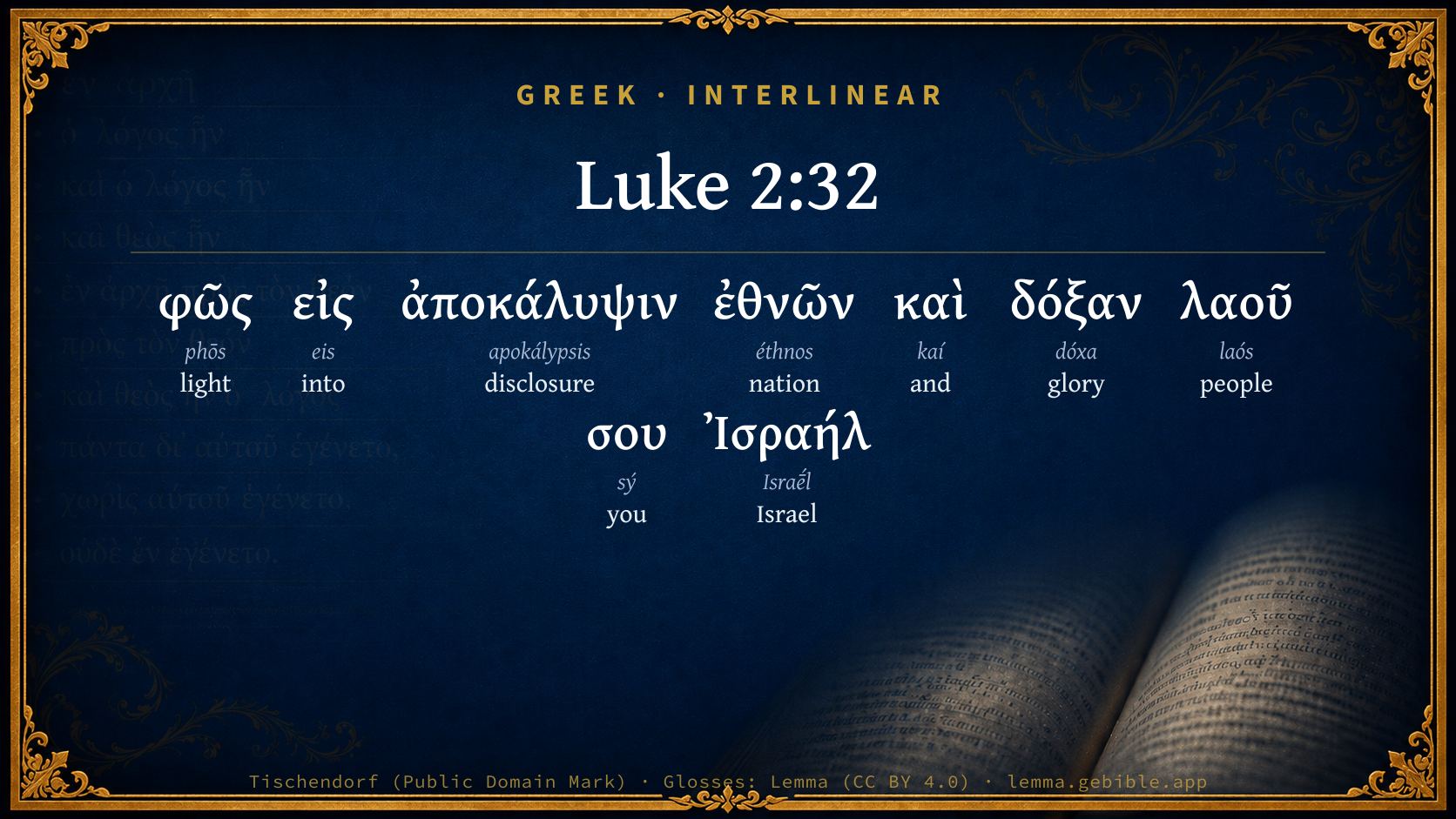
Greek (Tischendorf 8th ed.) Luke 2:32 appears in the Greek New Testament. The text above is from the Tischendorf 8th edition. Each word links to its Strong’s number and a concise gloss. Click any word for its full Thayer’s Greek Lexicon entry.
Download image
Cite this verse

Luke 2:32 (World English Bible). Public Domain. Lemma interlinear Bible study tool, https://lemma.gebible.app/v/luke/2/32.

Show BibTeX & RIS
BibTeX
RIS
English Translation
A light for revelation to the Gentiles, And the glory of your people Israel."
World English Bible · Public Domain
Highlights
  • 1 first appearance in the Greek New Testament
Full analysis ↓
Download a study sheet

One document with this verse’s original text, its word-by-word gloss line, the meaning frame, cross-references with their text, attributed commentary, and full source and license credits — printable, and it pastes into notes with its structure intact.

This verse Autodidact and up

Study sheet (.html) Plain text (.txt)

A passage Seminary Student

Up to 50 verses in one chapter. A passage sheet keeps up to 6 commentary sources and 12 cross-references per verse, in the order this page ranks them, and says so on the sheet whenever that leaves anything out. Ask for a single verse and you get the Autodidact verse sheet above.

Everything on this page stays free to read, with no account — the sheet is a download of what is already on screen, not access to it.

Want to remove ads? Support Godless Engineer
Compare translations 3

The same verse in 3 English versions, stacked beneath the original-language interlinear above. Click any original word for its lexicon entry.

Each is an independent rendering of the whole verse — the interlinear is not word-aligned to these translations.

Highlighted words mark where these versions differ — a whole-verse word diff, not a word-by-word alignment.

  • World English Bible Public Domain
    A light for revelation to the Gentiles, And the glory of your people Israel."
  • King James Version Public Domain
    A light to lighten the Gentiles, and the glory of thy people Israel.
  • unfoldingWord Literal Text CC BY-SA 4.0
    A light for revelation to the Gentiles and glory to your people Israel.”

unfoldingWord Literal Text — © unfoldingWord, licensed CC BY-SA 4.0. Word-aligned USFM3 via Door43 (git.door43.org/unfoldingWord/en_ult).

Versions to compare (up to 4)

3 of 4 selected

Show all 19 translations

Every available English version of this verse, each an independent rendering of the whole verse.

  • World English Bible Public Domain
    A light for revelation to the Gentiles, And the glory of your people Israel."
  • Berean Standard Bible Public Domain
    a light for revelation to the Gentiles, and for glory to Your people Israel.”
  • Majority Standard Bible Public Domain
    a light for revelation to the Gentiles, and for glory to Your people Israel.”
  • King James Version Public Domain
    A light to lighten the Gentiles, and the glory of thy people Israel.
  • American Standard Version (1901) Public Domain
    A light for revelation to the Gentiles, And the glory of thy people Israel.
  • Revised Version (1885) Public Domain
    A light for revelation to the Gentiles, And the glory of thy people Israel.
  • Geneva Bible (1599) Public Domain
    A light to be reueiled to the Gentiles, and the glory of thy people Israel.
  • Douay-Rheims (1899) Public Domain
    A light to the revelation of the Gentiles, and the glory of thy people Israel.
  • Young's Literal Translation Public Domain
    a light to the uncovering of nations, and the glory of Thy people Israel.'
  • Literal Standard Version CC BY-SA 4.0
    a light to the uncovering of nations, and the glory of Your people Israel.”
  • Unlocked Literal Bible CC BY-SA 4.0
    A light for revelation to the Gentiles and glory to your people Israel.”
  • unfoldingWord Literal Text CC BY-SA 4.0
    A light for revelation to the Gentiles and glory to your people Israel.”
  • Darby Bible Public Domain
    a light for revelation of [the] Gentiles and [the] glory of thy people Israel.
  • World Messianic Bible Public Domain
    a light for revelation to the nations, and the glory of your people Israel.”
  • Webster's Bible Public Domain
    A light to enlighten the Gentiles, and the glory of thy people Israel.
  • Free Bible Version CC BY-SA 4.0
    He is a light that will show you to the nations, the glory of your people Israel.”
  • Bible in Basic English Public Domain
    A light of revelation to the Gentiles, and the glory of your people Israel.
  • Text-Critical English NT CC BY 4.0
    a light for revelation to the Gentiles and for the glory of yoʋr people Israel.”
  • Tyndale New Testament (1534) Public Domain
    A light to lighten the gentyls and the glory of thy people Israel.

Literal Standard Version (2020), Covenant Press — licensed CC BY-SA 4.0. Text via the HelloAO Bible API (eBible.org). Unlocked Literal Bible (unfoldingWord) — licensed CC BY-SA 4.0. Text via the HelloAO Bible API (eBible.org). unfoldingWord Literal Text — © unfoldingWord, licensed CC BY-SA 4.0. Word-aligned USFM3 via Door43 (git.door43.org/unfoldingWord/en_ult). Free Bible Version, Dr. Jonathan Gallagher — licensed CC BY-SA 4.0. Text via the HelloAO Bible API (eBible.org).

Word by word

More ways to search: Search by grammar → Find every occurrence → Compare this word →

Practice this passage: Drill this verse → Learn its vocabulary →

About this verse

These counts appear in no published source. They are computed here, from the morphology-tagged text and Lemma’s own curated glosses. What Lemma adds →

9
words
9
distinct lemmas
Gospels
section

Notable vocabulary

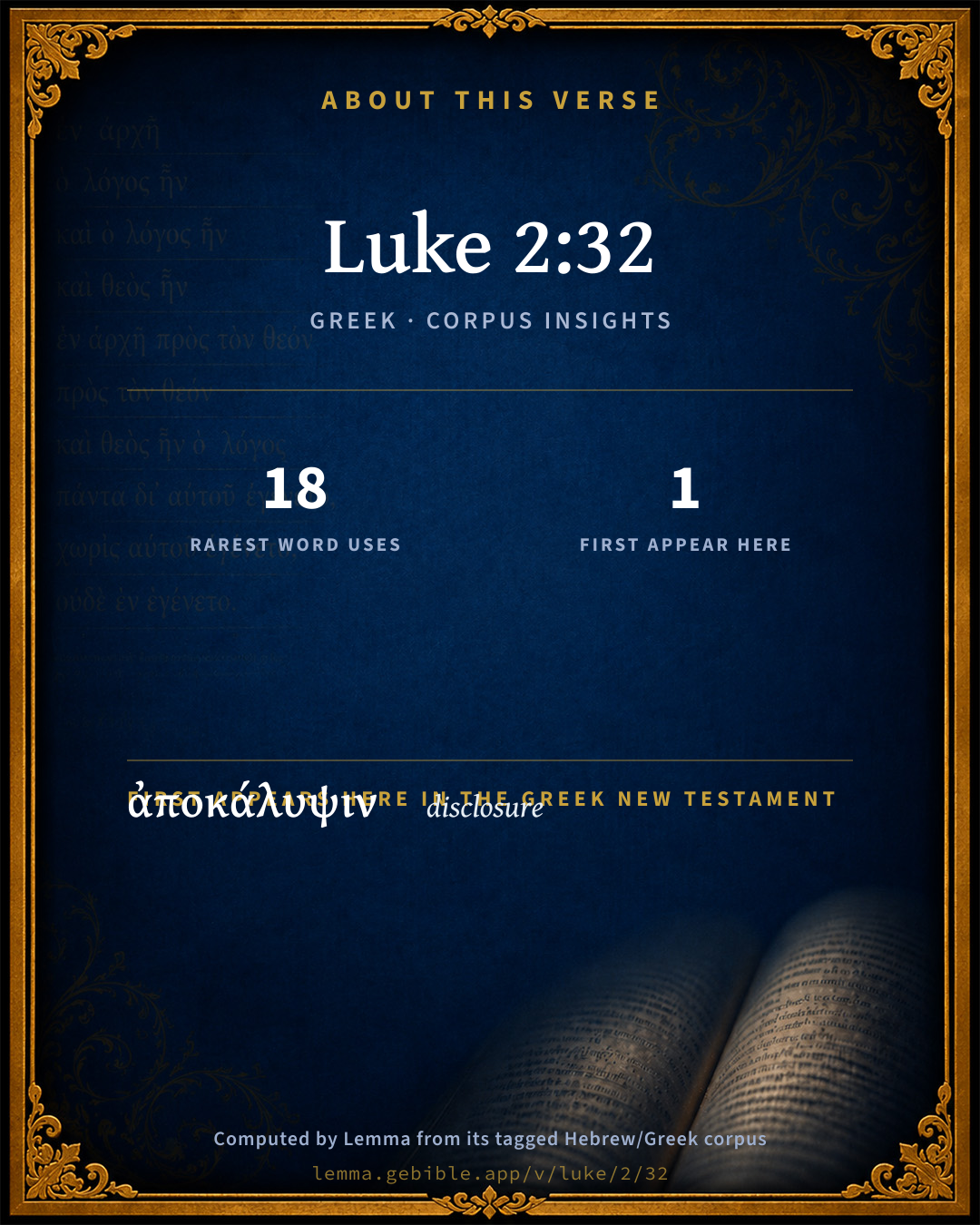
The rarest word here is ἀποκάλυψιν disclosure G602 — appearing just 18 times in the whole Greek New Testament.

First appearance in Scripture

This word makes its first canonical appearance in the Greek New Testament here:

  • ἀποκάλυψιν disclosure G602

Shared distinctive vocabulary

ἀποκάλυψιν disclosure G602 occurs in 18 verses of the Greek New Testament. Also found in:
Cross-references

18

Topical passages linked to Luke 2:32 in the Treasury of Scripture Knowledge — connected by theme and wording, ordered by reader-vote popularity; previews shown in the World English Bible.

  • Isaiah 60:1–3 Arise, shine; for your light is come, and the glory of Yahweh is risen on you.
  • Isaiah 49:6 yes, he says, It is too light a thing that you should be my servant to raise up the tribes of Jacob, and to restore the preserved of Israel: I will also give you for a light to the Gentiles, that you may be my salvation to the end of the earth.
  • Acts 26:23 how the Christ must suffer, and how, by the resurrection of the dead, he would be first to proclaim light both to these people and to the Gentiles."
  • Acts 13:47–48 For so has the Lord commanded us, saying, 'I have set you as a light for the Gentiles, That you should bring salvation to the uttermost parts of the earth.'"
  • Isaiah 42:6–7 I, Yahweh, have called you in righteousness, and will hold your hand, and will keep you, and give you for a covenant of the people, for a light of the Gentiles;
  • Isaiah 9:2 The people who walked in darkness have seen a great light: those who lived in the land of the shadow of death, on them has the light shined.
  • Revelation 21:23 The city has no need for the sun, neither of the moon, to shine, for the very glory of God illuminated it, and its lamp is the Lamb.
  • Isaiah 60:19 The sun shall be no more your light by day; neither for brightness shall the moon give light to you: but Yahweh will be to you an everlasting light, and your God your glory.
  • Matthew 4:16 The people who sat in darkness saw a great light, To those who sat in the region and shadow of death, To them light has dawned."
  • Acts 28:28 "Be it known therefore to you, that the salvation of God is sent to the Gentiles. They will also listen."
  • Isaiah 4:2 In that day, Yahweh's branch will be beautiful and glorious, and the fruit of the land will be the beauty and glory of the survivors of Israel.
  • Isaiah 45:25 In Yahweh shall all the seed of Israel be justified, and shall glory.
  • Zechariah 2:5 For I,' says Yahweh, 'will be to her a wall of fire around it, and I will be the glory in the midst of her.
  • Romans 15:8–9 Now I say that Christ has been made a minister of the circumcision for the truth of God, that he might confirm the promises given to the fathers,
  • Psalms 85:9 Surely his salvation is near those who fear him, That glory may dwell in our land.
  • Jeremiah 2:11 Has a nation changed [its] gods, which yet are no gods? but my people have changed their glory for that which does not profit.
  • Luke 2:10 The angel said to them, "Don't be afraid, for behold, I bring you good news of great joy which will be to all the people.
  • 1 Corinthians 1:31 that, according as it is written, "He who boasts, let him boast in the Lord."

Cross-references courtesy of OpenBible.info (CC BY 4.0).

Commentary

Notes on Luke 2:32 from classic Christian and Jewish commentators (each source and its license shown beneath its notes). The classic Christian expositions comment on the surrounding passage and are grouped to its opening verse, so a note may address several verses; the Jewish commentaries on the Tanakh (Rashi and others) are per-verse, so they appear only where the commentator wrote on this verse.

Lemma curates 59 commentaries, every one of them public domain or Creative Commons licensed, each selected and text-cleaned for this edition rather than reprinted as found. About our sources →

The Biblical Illustrator

Joseph S. Exell

Luk_2:32

A light to lighten the Gentiles

The light of the Gentiles

I.

EXPLAIN THE IMPORT OF THE TEXT.

1. The character of Jesus is exhibited under the image of light--the most glorious of all the creatures of God.

(1) Among the properties of light are penetration and universality. Light would have been an inappropriate image, in reference to Christ, had He not intended to illuminate the world. Not to a district, not to an empire, not to one quarter of the globe, does that glorious boon--light--confine its influences. It visits all in their turn. It burns within the torrid zone, it reaches the dark and distant poles; it proceeds with a gradual, yet inconceivable speed, in its restless career, till it has enlightened the whole.

(2) Light is a source of comfort (Ecc_11:7).

(3) Another quality of light is purity. It is this which renders it a fit emblem of Deity (1Jn_1:5).

2. The subjects of His influences--The Gentiles--i.e., all nations that have not yet heard the tidings of the gospel in Him.

3. The result of the manifestation of Christ to the world will be universal illumination. He rises upon the nations to lighten them.

II. APPLY ITS TESTIMONY TO MISSIONARY EXERTIONS.

1. Examine the principles on which they are founded.

(1) They are founded in nature. The same cause should produce the same effects. Whoever sincerely loves the Saviour will feel a proportionate attachment to His laws, His people, His interests. He cannot sit down indifferent to the last, any more than he can consent to break the first.

(2) They are founded on the purest principles of reason. Missionary effort must be used as a means, to bring about the end in view--the spread of the gospel. God employs in the meantime human instruments for the carrying out of His Divine purposes.

(3) They are founded on the purest principles of humanity. The gospel is the only effectual remedy of all this world s evil and misery.

(4) They are founded on the purest principles of patriotism. Religious lethargy precedes national ruin; patriotism, therefore, calls for the support of religious zeal.

(5) They are founded on the purest principles of religion.

2. The considerations by which we are encouraged.

(1) Revelation.

(2) Experience.

(3) Existing circumstances. Is there not crying need throughout the world of those consolations which the gospel alone can bring, and of the Saviour whom the gospel alone proclaims? (W. B. Collyer, D. D.)

Christ the light of all nations

He gives the light of truth, of spiritual sight, of knowledge, of holiness, of joy, of heaven. The natives of arctic regions put on their holiday attire, and enthusiastically welcome the returning sun, when after months of absence, he again revisits them with his rays. How much more should we rejoice in the light of the Sun of Righteousness? There was a light once on or near the Goodwin Sands, called The light of all nations, because it was supposed that some of all nations would see it. The light of the knowledge of the glory of God in the face of Jesus Christ will one day cover the earth. When Christ gives us light, we must reflect it (see Mat_5:14-16). The lighthouse, when its lights burn truly, will warn the mariner against danger, and enable him to pursue the right and safe way. So we may each guide some from the darkness and danger of sin, to the light and safety of Gods mercy in Christ. (Henry R. Burton.)

Light an emblem of Christ

There is no figure more common nor more beautiful in the Scriptures, than that by which Christ is compared to light. Incomprehensible in its nature, itself first visible, and that by which all else is so; light represents to us Christ, whose generation none can declare, but who must shine on us ere we can know aught aright whether of things Divine or human. Pure, uncontaminated, though visiting the lowest parts of the earth, and penetrating the most noisome recesses; what is light an image of, if not of that Divine Mediator, who contracted no stain, though born of a woman, in the likeness of sinful flesh? Instrumental in all the processes of vegetation, so that, without its vivifying power, the earth could not yield its kindly fruits, nor expose its verdant hues, what is light but the emblem of that source of illumination, of whom the Evangelist declares that He was the Light and Life of men? And without searching too narrowly into the particular sources by which this resemblance might be proved, we may say that Christ is to the material world what the sun is to the natural; and wherever the gospel has been published and received as a communication from God, the darkness has fled, as night flies before the day; and we know, that wherever the revelation made through Christ has been dispersed, wherever it has vouchsafed its cheering rays, the clouds of ignorance, and superstition, and irreligion have vanished, and holiness purity, and morality have illumined the horizon. It has done more. It has hung the very grave with bright lamps, and re-kindled the blazings of an almost quenched immortality. (H. Melvill, B. D.)

And the glory of Thy people Israel--

Christ the glory of His people

We shall now employ the natural Israel as a type of the Lords elect ones, and surely there is no straining of the text, when we say that Jesus Christ is the glory of the spiritual seed, the redeemed people. And why, with evident propriety, may the saints of God be compared to Israel?

1. Surely because God has made a covenant with them as He did with Jacob.

2. We may be compared with Israel, again, because if we be the children of God we have learned to wrestle with the angel and prevail.

3. It may be that you have another likeness to Israel in the fact that you are much tried. Faith must be tried. God had one Son without sin, but He never had a Son without the rod.

4. The true Israel, which are spiritually the Church of Christ, are said, according to the text, to be the Lords people.

(1) By His eternal choice.

(2) By redemption.

(3) By voluntary dedication of yourselves to Him.

I. When we say that Christ is our glory, we mean that WE GET ALL THE GLORY WE HAVE THROUGH HIM. Some men go to the schools for glory, others to the camps of war. In all kinds of places men have sought after honour, but the believer saith that Christ is the mine in which he digs for this gold, Christ is the sea in which he fishes for this pearl; he gives up all other searchings and looks for glory in Jesus, and nowhere else.

1. The glory of election.

2. The glory of redemption.

3. The glory of adoption.

4. The glory of justification.

5. The glory of sanctification.

Thus I might continue showing you that there is not a single treasure which a Christian possesses which does not come to him through Christ. He has nothing in which he can glory but what he is sweetly compelled to say of it, I gained this in the market of Calvary; I found this in the mines of a Saviours suffering; all this came to me through my bleeding, buried, risen, coming Lord, and He shall have the glory of it as long as I live.

II. WE SEE A GLORY IN CHRIST which swallows up all other glories, as the suns light conceals the light of the stars.

1. In Christs person.

2. In Christs sufferings.

3. In Christs resurrection.

4. In Christs ascension.

5. In Christs intercession.

6. In Christs second advent.

III. The text is true in the sense that WE GIVE GLORY TO HIM. There is life in a look at the Crucified One. There is life in simple confidence in Him, but there is life nowhere else. God send to His Church an undying passion to promote the Saviours glory, an invincible, unconquerable pang of desire, and longing that by any means King Jesus may have His own, and may reign throughout these realms! In this sense, then, Jesus is and must be the glory of His people.

IV. But there is another sense--namely, FROM JESUS IS REFLECTED ALL THE GLORY WHICH IS PUT UPON HIS PEOPLE. Whatever glory they have, and they have much in the eyes of angels, and much honour in the eyes of discerning men, it is always the reflection of the Saviours glory. I know some holy men and women for whom I cannot but feel the deepest and intensest respect, but the reason is because they have so much of my Master about them. I think I would travel many miles to talk with some of them, because their speech is always so full of Him, and they live so near to Him.

V. The text may be read in this sense: Christ is the glory of His people, that is to say, THEY EXPECT GLORY WHEN HE COMES. Our glory is laid up. When you follow Jesus in resurrection, what glory! But we must not begin to speak of that, for we should never leave off at all if we began to talk about that glory--the glory of perfection, the glory of being delivered from sin, the glory of conquest, having trodden Satan under our feet; the glory of eternal rest, the glory of infinite security, the glory of being like Christ, the glory of being in the light and brightness of God, standing, like Miltons angel, in the very sun itself. If you want to know what heaven is, you can spell it in five letters, and when you put the five letters together they sound like this: Jesus. That is heaven. It is all the heaven the angels round the throne desire to know. They want nothing better than this, to see His face, to behold His glory, and to dwell in it world with out end.

VI. THE PRACTICAL DRIFT OF THE SUBJECT.

1. We would give a word of warning to those of you who seek your glory anywhere else, because as surely aa you do so, even if you meet with honour for a time, you will have to lose it. It is always ill to put your treasure where it will be stolen from yon. Now, suppose you seek your glory in your learning. Well, well, well! Let the sexton take up your skull after you have been dead a little while, and what learning will there be in it, what show of wisdom will be found in it when it is resolved into a little impalpable brown powder? What will your science, and your mathematics, and your classics do for you in death and judgment? Suppose you seek your glory in fame, and become the favourite of the nation as a great soldier. When the grave-digger rattles your old bones about, what will that signify? You will have great fame, you say, and men will talk about you.

But he who hath his glory in Christ, when he openeth his eyes in the next world will see Christ, and so behold his glory safe, and firmly entailed upon him.

2. Another word, and that is a word of rebuke. There are some preachers we know of, and I suppose there will always be some of the genus, who preach, preach, preach, but they never preach what is Israels glory. They talk of anything but Christ.

3. There are some of you to whom I have a last word to say, and that is, some of you love Jesus Christ, but you are ashamed to say so. Now, since He is the glory of His people Israel, I shall be afraid of you and for you if you do not make Him your glory. (C. H. Spurgeon.)

Christ the glory of Israel

Christ was the glory of Israel.

1. Because He was a Jew by birth.

2. Because His history has vindicated all that was peculiar in the Jewish polity.

3. Because He confined His personal ministry to the Jews.

4. Because He has stamped the impress of Jewish thought on the mind of man.

5. Because He has invested the condition and prospects of the Jews with universal interest. (G. Brooks.)

The glory of Israel

There was salvation in this sight: there was light in it; and there was glory in it also. He will be--said Simeon--the glory of Thy people Israel. The prophet Isaiah was speaking of this same Saviour, when he said They shall hang on Him all the glory of His Fathers house Isa_22:24). The chief glory that a nation has is made up of the wise, and good, and great, and useful men who have belonged to it. We speak of Washington as the glory of America. We feel it an honour to belong to the nation which could claim Washington as one of its people. In Holland they call William, Prince of Orange, the glory of their nation. England, our grand old mother country, has had so many wise, and good, and great men, that it is hard to tell which to speak of as the best and greatest. They all help to make up the glory of the people of England. And any one who was born in England may feel it an honour to belong to a country which has produced so many good and great men. And in the same way it is the glory of the Jewish nation, or of Israel, as a people, that Jesus Christ, the Son of God, the Saviour of the world, belonged to their nation. Jesus was a Jew. And the Jewish people may well feel it an honour to belong to the nation among whom He was born. It is true in this sense that He is the glory of His people Israel. (Dr. Newton.)

The Biblical Illustrator, edited by Joseph S. Exell (c. 1880s–1900s) — public domain. Text from a community e-Sword module.

Tyndale Open Study Notes

Tyndale Open Resources

2:32 The prophet Isaiah predicted that the coming Kingdom of God would bring salvation to all the nations (Isa 42:6-7; 49:6). • the glory of your people Israel! This quote from Isa 46:13 says that God’s salvation will bring glory to Israel. Israel’s role in the Old Testament was to bring glory to God by revealing God’s light to the nations.

Tyndale Open Study Notes — © Tyndale Open Resources, licensed CC BY-SA 4.0. Text via the HelloAO Bible API.

Bengel's Gnomon

Johann Albrecht Bengel

Luk 2:32. Φῶς, a light) This stands in apposition with τὸ σωτήριόν σου, thy means of salvation, Luk 2:30.—εἰς ἀποκάλυψιν) that God and His Christ may be revealed to the Gentiles, and that they may be revealed to their own selves in His light.—ἐθνῶν, of the Gentiles) Construe with φῶς, a light [but Engl. Vers. with ἀποκάλυψιν, to lighten the Gentiles]: a light of the Gentiles, and one about to be revealed to them [the same]: see Rev 21:23-24.—καὶ δόξαν, and the glory) Construe with φῶς, a light [i.e. in apposition to τὸ σωτήριόν σου, Luk 2:30], there being no εἰς, in, understood. Light, and glory or splendour, are synonymous; but in such a way as that the glory expresses something greater than a light, and implies therefore the peculiar privilege of Israel, on account of its especial tie of connection with this [Him the] King of Glory.—Ἰσραὴλ, Israel) Even after the call of the Gentiles, Israel shall enjoy this glory.

Bengel's Gnomon of the New Testament — English translation (T&T Clark, Edinburgh, 1860) — public domain. Text from a community e-Sword module.

Expositor's Greek Testament

ed. W. Robertson Nicoll

Luk 2:32 . φῶς εἰς ἀ . ἐ .: the Gentiles are to be more than spectators, even sharers in the salvation, which is represented under the twofold aspect of a light and a glory. φῶς and δόξαν may be taken in apposition with ὃ as objects of ἡτοίμασας : salvation prepared or provided in the form of a light for the Gentiles, and a glory for Israel. Universalism here, but not of the pronounced type of Lk. (Holtz., H. C.), rather such as is found even in O. T. prophets.

The Expositor's Greek Testament, edited by W. Robertson Nicoll (1897–1910) — public domain. Text from a community e-Sword module.

Adam Clarke's Commentary

Verse 32. A light to lighten the Gentiles] φως εις αποκαλοψιν εθνων - A light of the Gentiles, for revelation. By Moses and the prophets, a light of revelation was given to the Jews, in the blessedness of which the Gentiles did not partake. By Christ and his apostles, a luminous revelation is about to be given unto the Gentiles, from the blessedness of which the Jews in general, by their obstinacy and unbelief, shall be long excluded. But to all true Israelites it shall be a glory, an evident fulfilment of all the predictions of the prophets, relative to the salvation of a lost world; and the first offers of it shall be made to the Jewish people, who may see in it the truth of their own Scriptures indisputably evinced.

Adam Clarke's Commentary on the Bible (1810–1826) — public domain. Text from a community e-Sword/MySword module.

Ellicott's Commentary for English Readers

(32) To lighten the Gentiles.—Literally, for a revelation to the Gentiles. The idea is strictly that of the withdrawal of the “veil spread over all nations” of Isa_25:7.

The glory of thy people Israel.—Here, again, the language is the natural utterance of the hope of the time, not the after-thought of later years. The Christ whom Israel had rejected was hardly “the glory of the people” when St. Luke wrote his Gospel.

A Bible Commentary for English Readers, edited by Charles John Ellicott (1878–1897) — public domain. Text from a community e-Sword module.

The Cambridge Bible for Schools and Colleges

gen. ed. J. J. S. Perowne

32. to lighten the Gentiles] Rather, for revelation to. A memorable prophecy, considering that even the Apostles found it hard to grasp the full admission of the Gentiles, clearly as it had been indicated in older prophecy, as in Psa_98:2-3. “All the ends of the earth have seen the salvation of our God,” Isa_52:10. “I will give thee for a covenant of the people, for a light of the Gentiles,” Isa_42:6; Isa_49:6.

The Cambridge Bible for Schools and Colleges (gen. ed. J. J. S. Perowne; Cambridge University Press, 1878–1918) — public domain. Text from a community e-Sword module.

John Gill's Exposition

And Joseph and his mother,.... The Vulgate Latin reads, "and his father and mother". The Ethiopic version retains both his name and his relation, and reads, "and Joseph his father, and his mother"; but all the ancient copies read only "Joseph", without the addition, his father; and so the Syriac, Arabic, and Persic versions: they

marvelled at those things which were spoken of him; the child Jesus: not that those things which Simeon said, were new and strange to them; for they not only knew that the same things were predicted of the Messiah, but they had heard and known, and believed the same concerning this child; but they wondered, that a stranger to them and the child, coming into the temple at this instant, should have such a revelation made to him, and be able to say the things he did. Moreover, there is no need to confine this passage to what were said by Simeon, but it may reach to, and include every thing; that as yet had been spoken concerning Jesus; either before, or since his birth; as by the angel to them both, to the one before his conception, to the other after; and by Zacharias and Elisabeth, and by the angel to the shepherds, who had reported the same to Joseph and Mary, and now by Simeon; and they were astonished, at the exact agreement there was between them.

John Gill's Exposition of the Whole Bible (1746–1763) — public domain (CC PDM 1.0). Text via the HelloAO Bible API.

Trapp's Complete Commentary

John Trapp

32 A light to lighten the Gentiles, and the glory of thy people Israel.

Ver. 32. The glory of thy people Israel] Oh! pity their perverseness, and pray their conversion, that the Jews may call God Abba, the Gentiles Father, Dan 12:11. There is a prophecy of the Jews’ final restoration (saith Mr Case, God’s waiting to be gracious), and the time is expressed, which is 1290 years after the ceasing of the daily sacrifice, and the setting up of the abomination of desolation; which is conceived to be about Julian’s time, who assayed to rebuild the temple of the Jews, but was hindered from heaven. This was anno Dom. 360, to which if you add 1290 years, it will pitch the calculation upon the year 1650.

John Trapp, A Commentary or Exposition upon All the Books of the Old and New Testament (1647–1656) — public domain. Text from a community e-Sword module.

Albert Barnes' Notes on the Bible

A light to lighten the Gentiles - This is in accordance with the prophecies in the Old Testament, Isa. 49; Isa 9:6-7; Psa 98:3; Mal 4:2. The Gentiles are represented as sitting in darkness that is, in ignorance and sin. Christ is a “light” to them, as by him they will be made acquainted with the character of the true God, his law, and the plan of redemption. As the darkness rolls away when the sun arises, so ignorance and error flee away when Jesus gives light to the mind. Nations shall come to his light, and kings to the brightness of his rising, Isa 60:3.

And the glory ... - The first offer of salvation was made to the Jews, Joh 4:22; Luk 24:47. Jesus was born among the Jews; to them had been given the prophecies respecting him, and his first ministry was among them. Hence, he was their glory, their honor, their light. But it is a subject of special gratitude to us that the Saviour was given also for the Gentiles; for:

We are Gentiles, and if he had not come we should have been shut out from the blessings of redemption. It is he only that now.

“Can make our dying bed.

Feel soft as downy pillows are,

While on his breast we lean our head,

And breathe our life out sweetly there.”

Thus our departure may be like that of Simeon. Thus we may die in peace. Thus it will be a blessing to die. But,

In order to do this, our life must be like that of Simeon. We must wait for the consolation of Israel. We must look for his coming. We must be holy, harmless, undefiled, “loving” the Saviour. Then death to us, like death to Simeon, will have no terror; we shall depart in peace, and in heaven see the salvation of God, 2Pe 3:11-12. But, Children, as well as the hoary-headed Simeon, may look for the coming of Christ. They too must die; and “their” death will be happy only as they depend on the Lord Jesus, and are prepared to meet him.

Albert Barnes' Notes on the Bible (1834–1885) — public domain. Text from a community e-Sword/MySword module.

Whedon's Commentary on the Bible

Daniel D. Whedon

32. To lighten the Gentiles—The secular and unspiritual masses of Jews fell into the fanatical and arrogant notion, that Christ was to be merely a circumscribed and exclusively Jewish Messiah; the twelve apostles could hardly be made to resign that notion. Even after the resurrection it took the independence of a martyred Stephen and all the powers of an inspired Paul to assert the full rights of the Gentiles in the Church of God. Scholars have said that in the work of opening the gates of Christianity to the Gentiles Stephen was the forerunner of Paul. Might it not be said that Simeon was the forerunner of Stephen, and the Gentile Luke the historian of both? Yet the true doctrine on the subject is explicitly and repeatedly declared not only here but in the prophecies of the Old Testament. Compare Isa_9:2; Isa_40:1; Isa_49:6. Those who understood the prophets, and caught their true spirit like Simeon, would not need the power of prophecy to understand those passages.

Daniel D. Whedon (gen. ed.), Commentary on the Old and New Testaments (1874–1909) — public domain. Text from a community e-Sword module.

John Wesley's Explanatory Notes

And the glory of thy people Israel - For after the Gentiles are enlightened, all Israel shall be saved.

John Wesley, Explanatory Notes Upon the Whole Bible (1754–1765) — public domain. Text via the GEBible commentary corpus.

The People's New Testament

B. W. Johnson

32. A light to lighten the Gentiles. Scholars have said that in the work of opening the gates of Christianity to the Gentiles, Stephen was the forerunner of Paul. Might it not be said that Simeon was the forerunner of Stephen, and the Gentile Luke the historian of both? Yet the true doctrine on the subject is explicitly and repeatedly declared not only here, but in the prophecies of the Old Testament. Compare Isa. 9:2; 40:1; 49:6.

B. W. Johnson's The People's New Testament with Notes (1889–1891) — public domain. Electronic text from the Christian Classics Ethereal Library (CCEL) ThML edition.

Cambridge Greek Testament for Schools and Colleges

32. εἰς ἀποκάλυψιν ἐθνῶν ‘for revelation to.’ A memorable prophecy, considering that even the Apostles found it hard to grasp the full admission of the Gentiles, clearly as it had been indicated in older prophecy, e.g. in Psa 98:2-3, “All the ends of the earth have seen the salvation of our God,” Isa 52:10. “I will give thee for a covenant of the people, for a light of the Gentiles,” Isa 42:6; Isa 49:6. Godet after pointing out the depth and energy of the Nunc Dimittis excellently remarks “La banalité légendaire n’a pas plus de part à la composition de ce joyau lyrique que la préoccupation dogmatique.”

Cambridge Greek Testament for Schools and Colleges (Cambridge University Press, 1896; 21 vols, various authors incl. Carr, Maclear, Plummer, Farrar, Lumby, Moule, M. R. James, Simcox) — public domain. Text from a community e-Sword module.

Alford’s Greek Testament

Henry Alford

32.] See Isa 49:6. The general term of the last verse (πάντ. τ. λαῶν) is here divided into two, the Gentiles, and Israel.

It is doubtful, whether δόξαν is to be taken as co-ordinate with φῶς (so Bengel, Meyer, De W., al.), or with ἀποκάλυψιν. The former seems more probable; and so E. V.

Henry Alford, The Greek Testament (1849–1861) — public domain. Text from a community e-Sword module.

International Critical Commentary

32. The σωτήριον is analysed into light and glory, and “the peoples” into heathen and Jews,—that “profound dualism which dominates the biblical history of humanity from Genesis to Revelation” (Godet). The passage is a combination of Psa 98:2, ἐναντίον τῶν ἐθνῶν ἀπεκάλυψε τὴν δικαιοσύνην αὐτοῦ, with Isa 49:6, δέδωκὰ σε εἰς φῶς ἐθνῶν, and φῶς and δόξαν are in apposition with τὸ σωτήριον. But some take both as depending on ἡτοίμασας, and others take δόξαν after εἰς co-ordinately with ἀποκάλυψιν. This last is Luther’s: ein Licht zu erleuchten die Heiden und zum Preis deines Volkes; but it is very improbable. Comp. Joh 1:7, Joh 1:12:35, Joh 1:46.

ἀποκάλυψιν ἐθνῶν. Either 1. “revelation to belong to the Gentiles”; or 2. “instruction of the Gentiles”; or 3. “unveiling of the Gentiles,” i.e. for removing the gross darkness which covers them (Isa 25:7, Isa 60:2); or 4. (taking ἐθνῶν after φῶς) “a light of the Gentiles unto revelation” (Isa 40:5). The first is best, “a light with a view to revelation which shall belong to the Gentiles,” making ἐθνῶν a poss. gen. Does ἀποκάλυψις ever mean “instruction”?1 And to represent the heathen as revealed by the light seems to be an inversion: revealed to whom? D. C. G. ii. p. 253.

Elsewhere in N.T. the gen. after ἁποκάλυψις is either the person who reveals (2Co_12; 2Co_1; Rev 1:1), or the thing revealed (Rom 2:5 ; 1Pe 4:13); but the poss. gen. is quite possible. The word is eminently Pauline (Crem. Lex. p. 343). It may be doubted whether the glory, of Israel (Rom 9:4) is mentioned after the enlightening of the Gentiles in order to indicate that Israel obtained its full glory after and through the enlightenment of the Gentiles; for the heathen accepted the salvation which the Jews refused, and from the heathen it came back to Israel (Bede, Beng.).

The strain of confidence and joy which pervades the canticle is strong evidence of the historical character of the narrative. The condition of the Jewish nation at the close of the first century or beginning of the second is certainly not reflected in it: c’est le pur accent primitif (Godet). And Schleiermacher remarks that “it is a circumstance too natural for a poetical fiction” that Symeon takes no notice of the parents until they show surprise, but is lost in an enthusiastic address to God. See small print on 1:56.

International Critical Commentary — older volumes (1896–1929), various authors — public domain. Text from a community e-Sword module.

Vincent's Word Studies in the New Testament

Marvin R. Vincent

A light [φως] . The light itself as distinguished from lucnov, a lamp, which the A. V. often unfortunately renders light. See on Mr 14:54. To lighten [εις αποκαλυψιν] . Wrong. Rev., correctly, for revelation. Wyc., to the shewing. It may be rendered the unveiling of the Gentiles. Gentiles [εθνων] . Assigned to the same root as eqw, to be accustomed, and hence of a people bound together by like habits or customs. According to biblical usage the term is understood of people who are not of Israel, and who therefore occupy a different position with reference to the plan of salvation. Hence the extension of the gospel salvation to them is treated as a remarkable fact. See Mt 12:18, 21; Mt 24:14; Mt 28:19; Act 10:45; Act 11:18; Act 18:6. Paul is called distinctively an apostle and teacher of the Gentiles, and a chosen vessel to bear Christ 's name among them. In Act 14:9; Eph 2:11, 18; Eph 3:6, we see this difference annihilated, and the expression at last is merely historical designation of the non - Israelitish nations which, as such, were formerly without God and salvation. See Act 14:23; Rom 16:4; Eph 3:1. Sometimes the word is used in a purely moral sense, to denote the heathen in opposition to Christians. See 1Co 5:1; 1Co 10:20; 1Pe 2:12. Light is promised here to the Gentiles and glory to Israel. The Gentiles are regarded as in darkness and ignorance. Some render the words eijv ajpokaluyin, above, for the unveiling of the Gentiles, instead of for revelation. Compare Isa 25:7. Israel, however, has already received light by the revelation of God through the law and the prophets, and that light will expand into glory through Christ. Through the Messiah, Israel will attain its true and highest glory.

Marvin R. Vincent, Word Studies in the New Testament (1887–1900) — public domain. Text from a community e-Sword/MySword module.

Lesson kit

Teaching starters — assembled from the data on this page, not authored interpretation. Every prompt links to the verse data it draws on. Edit before teaching.

Luke, in the Gospels, opens this verse with 9 words (9 distinct Greek lemmas). Its most distinctive word is apokálypsis (“disclosure”). A historical commentator’s framing appears above. Read the whole chapter for the surrounding context.

Discussion questions

  1. The word apokálypsis carries the sense “disclosure.” How does it shape the verse?
  2. The word “disclosure” first appears here in Scripture. What is being introduced at this debut?
  3. Romans 2:5 shares the word «disclosure» with this verse. How do the two illuminate each other?
  4. These translations render this verse differently. What is at stake in choosing one wording over another?
  5. Reading how The Biblical Illustrator and Tyndale Open Study Notes read this verse, where do the two commentators agree and where do they part?

Things to notice

  • 1 word makes its first canonical appearance in Scripture here.
  • These translations choose different wording for 2 words in this verse.
  • 9 distinct Greek lemmas span 9 words in this verse.

Reading settings

Reading text

Shown beneath each verse's original-language words.

Old Testament
Old Testament edition

Read the OT as the Masoretic Hebrew (MT) or the Greek Septuagint (LXX).

English shown for the Greek Septuagint (in the Hebrew ↔ Greek comparison).

Comparing translations? Open the Compare panel on any verse page to stack up to four side by side.