

Mark 9:43
Greek (Tischendorf 8th ed.) Mark 9:43 appears in the Greek New Testament. The text above is from the Tischendorf 8th edition. Each word links to its Strong’s number and a concise gloss. Click any word for its full Thayer’s Greek Lexicon entry.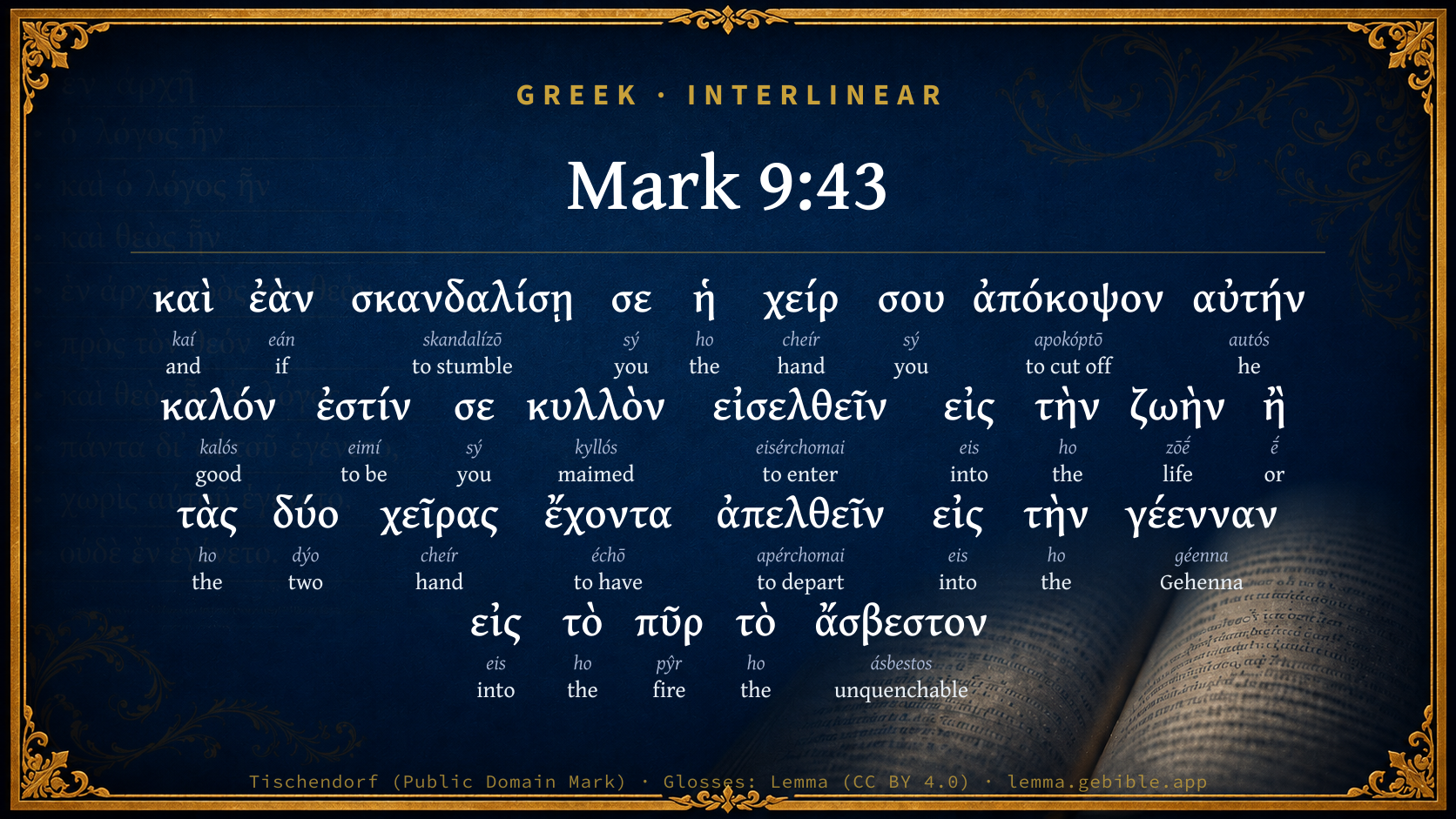
If your hand causes you to stumble, cut it off. It is better for you to enter into life maimed, rather than having your two hands to go into Gehenna, into the unquenchable fire,
Download a study sheet
One document with this verse’s original text, its word-by-word gloss line, the meaning frame, cross-references with their text, attributed commentary, and full source and license credits — printable, and it pastes into notes with its structure intact.
This verse Autodidact and up
A passage Seminary Student
Up to 50 verses in one chapter. A passage sheet keeps up to 6 commentary sources and 12 cross-references per verse, in the order this page ranks them, and says so on the sheet whenever that leaves anything out. Ask for a single verse and you get the Autodidact verse sheet above.
Everything on this page stays free to read, with no account — the sheet is a download of what is already on screen, not access to it.
Compare translations 3
The same verse in 3 English versions, stacked beneath the original-language interlinear above. Click any original word for its lexicon entry.
Each is an independent rendering of the whole verse — the interlinear is not word-aligned to these translations.
Highlighted words mark where these versions differ — a whole-verse word diff, not a word-by-word alignment.
-
World English Bible Public Domain
If your hand causes you to stumble, cut it off. It is better for you to enter into life maimed, rather than having your two hands to go into Gehenna, into the unquenchable fire,
-
King James Version Public Domain
And if thy hand offend thee, cut it off: it is better for thee to enter into life maimed, than having two hands to go into hell, into the fire that never shall be quenched:
-
unfoldingWord Literal Text CC BY-SA 4.0
And if your hand causes you to stumble, cut it off. It is better for you to enter into life crippled than, having two hands, to go away into Gehenna, into the unquenchable fire
unfoldingWord Literal Text — © unfoldingWord, licensed CC BY-SA 4.0. Word-aligned USFM3 via Door43 (git.door43.org/unfoldingWord/en_ult).
Show all 19 translations
Every available English version of this verse, each an independent rendering of the whole verse.
-
World English Bible Public Domain
If your hand causes you to stumble, cut it off. It is better for you to enter into life maimed, rather than having your two hands to go into Gehenna, into the unquenchable fire,
-
Berean Standard Bible Public Domain
If your hand causes you to sin, cut it off. It is better for you to enter life crippled than to have two hands and go into hell, into the unquenchable fire.
-
Majority Standard Bible Public Domain
If your hand causes you to sin, cut it off. It is better for you to enter life crippled than to have two hands and go into hell, into the unquenchable fire,
-
King James Version Public Domain
And if thy hand offend thee, cut it off: it is better for thee to enter into life maimed, than having two hands to go into hell, into the fire that never shall be quenched:
-
American Standard Version (1901) Public Domain
And if thy hand cause thee to stumble, cut it off: it is good for thee to enter into life maimed, rather than having thy two hands to go into hell, into the unquenchable fire.
-
Revised Version (1885) Public Domain
And if thy hand cause thee to stumble, cut it off: it is good for thee to enter into life maimed, rather than having thy two hands to go into hell, into the unquenchable fire.
-
Geneva Bible (1599) Public Domain
Wherefore, if thine hand cause thee to offend, cut it off: it is better for thee to enter into life, maimed, then hauing two hands, to goe into hell, into the fire that neuer shalbe quenched,
-
Douay-Rheims (1899) Public Domain
Where there worm dieth not, and the fire is not extinguished.
-
Young's Literal Translation Public Domain
`And if thy hand may cause thee to stumble, cut it off; it is better for thee maimed to enter into the life, than having the two hands, to go away to the gehenna, to the fire -- the unquenchable --
-
Literal Standard Version CC BY-SA 4.0
And if your hand may cause you to stumble, cut it off; it is better for you to enter into life maimed, than having the two hands, to go away into Gehenna, into the fire—the unquenchable—
-
Unlocked Literal Bible CC BY-SA 4.0
If your hand causes you to stumble, cut it off. It is better for you to enter into life maimed than to have two hands and to go into hell, into the unquenchable fire.
-
unfoldingWord Literal Text CC BY-SA 4.0
And if your hand causes you to stumble, cut it off. It is better for you to enter into life crippled than, having two hands, to go away into Gehenna, into the unquenchable fire
-
Darby Bible Public Domain
And if thy hand serve as a snare to thee, cut it off: it is better for thee to enter into life maimed, than having thy two hands to go away into hell, into the fire unquenchable;
-
World Messianic Bible Public Domain
If your hand causes you to stumble, cut it off. It is better for you to enter into life maimed, rather than having your two hands to go into Gehinnom, into the unquenchable fire,
-
Webster's Bible Public Domain
And if thy hand causeth thee to fall into sin, cut it off: it is better for thee to enter life maimed, than having two hands to go into hell, into the fire that never shall be quenched:
-
Free Bible Version CC BY-SA 4.0
If your hand leads you to sin, cut it off! It's better to enter eternal life as a cripple than to go with both hands into Gehenna, into the fire that can't be put out.
-
Bible in Basic English Public Domain
And if your hand is a cause of trouble to you, let it be cut off; it is better for you to go into life with one hand than to have two hands and go into hell, into the eternal fire.
-
Text-Critical English NT CC BY 4.0
If yoʋr hand causes yoʋ to stumble, cut it off. It is better for yoʋ to enter life crippled than to have two hands and go into hell, into the unquenchable fire,
-
Tyndale New Testament (1534) Public Domain
wherfore yf thy hande offende the cut him of. It is better for the to entre into lyffe maymed then havynge two hondes goo into hell into fire that never shalbe quenched
Literal Standard Version (2020), Covenant Press — licensed CC BY-SA 4.0. Text via the HelloAO Bible API (eBible.org). Unlocked Literal Bible (unfoldingWord) — licensed CC BY-SA 4.0. Text via the HelloAO Bible API (eBible.org). unfoldingWord Literal Text — © unfoldingWord, licensed CC BY-SA 4.0. Word-aligned USFM3 via Door43 (git.door43.org/unfoldingWord/en_ult). Free Bible Version, Dr. Jonathan Gallagher — licensed CC BY-SA 4.0. Text via the HelloAO Bible API (eBible.org).
Word by word
More ways to search: Search by grammar → Find every occurrence → Compare this word →
Practice this passage: Drill this verse → Learn its vocabulary →
- Appears 3× in the Greek New Testament
- First appears at Matthew 3:12
- Part of Speech
- Adjective
- Case
- Accusative
- Number
- Singular
- Gender
- Neuter
Full Thayer's Definition
- καὶ kaí G2532 “and” Conjunction
- ἐὰν eán G1437 “if” Conditional
- σκανδαλίσῃ skandalízō G4624 “to stumble” Verb, Aorist, Active, Subjunctive, 3rd person, Singular
- σε sý G4771 “you” Personal pronoun, 2nd person, Accusative, Singular
- ἡ ho G3588 “the” Article, Nominative, Singular, Feminine
- χείρ cheír G5495 “hand” Noun, Nominative, Singular, Feminine
- σου sý G4771 “you” Personal pronoun, 2nd person, Genitive, Singular
- ἀπόκοψον apokóptō G609 “to cut off” Verb, Aorist, Active, Imperative, 2nd person, Singular
- αὐτήν autós G846 “he” Personal pronoun, Accusative, Singular, Feminine
- καλόν kalós G2570 “good” Adjective, Nominative, Singular, Neuter
- ἐστίν eimí G1510 “to be” Verb, Present, Active, Indicative, 3rd person, Singular
- σε sý G4771 “you” Personal pronoun, 2nd person, Accusative, Singular
- κυλλὸν kyllós G2948 “maimed” Adjective, Accusative, Singular, Masculine
- εἰσελθεῖν eisérchomai G1525 “to enter” Verb, Aorist, Active, Infinitive
- εἰς eis G1519 “into” Preposition
- τὴν ho G3588 “the” Article, Accusative, Singular, Feminine
- ζωὴν zōḗ G2222 “life” Noun, Accusative, Singular, Feminine
- ἢ ḗ G2228 “or” Particle
- τὰς ho G3588 “the” Article, Accusative, Plural, Feminine
- δύο dýo G1417 “two” Adjective, Numeral (indeclinable)
- χεῖρας cheír G5495 “hand” Noun, Accusative, Plural, Feminine
- ἔχοντα échō G2192 “to have” Verb, Present, Active, Participle, Accusative, Singular, Masculine
- ἀπελθεῖν apérchomai G565 “to depart” Verb, Aorist, Active, Infinitive
- εἰς eis G1519 “into” Preposition
- τὴν ho G3588 “the” Article, Accusative, Singular, Feminine
- γέενναν géenna G1067 “Gehenna” Noun, Accusative, Singular, Feminine
- εἰς eis G1519 “into” Preposition
- τὸ ho G3588 “the” Article, Accusative, Singular, Neuter
- πῦρ pŷr G4442 “fire” Noun, Accusative, Singular, Neuter
- τὸ ho G3588 “the” Article, Accusative, Singular, Neuter
- ἄσβεστον ásbestos G762 “unquenchable” Adjective, Accusative, Singular, Neuter
About this verse
These counts appear in no published source. They are computed here, from the morphology-tagged text and Lemma’s own curated glosses. What Lemma adds →
- 31
- words
- 21
- distinct lemmas
- Gospels
- section
Notable vocabulary
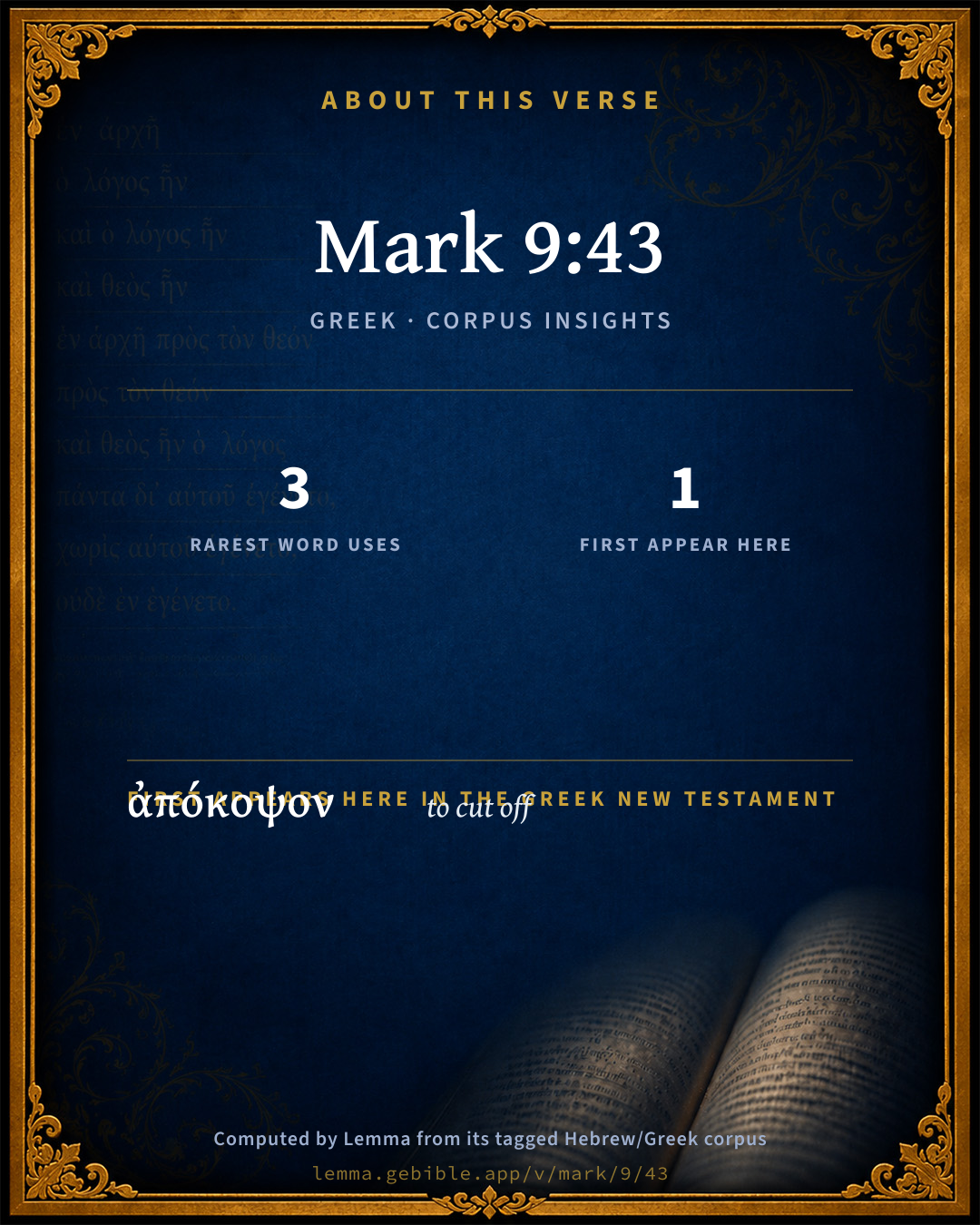
The rarest word here is ἄσβεστον unquenchable G762 — appearing just 3 times in the whole Greek New Testament.
First appearance in Scripture
This word makes its first canonical appearance in the Greek New Testament here:
- ἀπόκοψον to cut off G609
Shared distinctive vocabulary
ἄσβεστον unquenchable G762 occurs in 3 verses of the Greek New Testament. Also found in:
Cross-references
17Topical passages linked to Mark 9:43 in the Treasury of Scripture Knowledge — connected by theme and wording, ordered by reader-vote popularity; previews shown in the World English Bible.
- Matthew 5:29–30 If your right eye causes you to stumble, pluck it out and throw it away from you. For it is more profitable for you that one of your members should perish, than for your whole body to be cast into Gehenna.
- Matthew 18:8–9 If your hand or your foot causes you to stumble, cut it off, and cast it from you. It is better for you to enter into life maimed or crippled, rather than having two hands or two feet to be cast into the eternal fire.
- Matthew 25:41 Then he will say also to those on the left hand, 'Depart from me, you cursed, into the eternal fire which is prepared for the devil and his angels;
- Matthew 5:22 But I tell you, that everyone who is angry with his brother without a cause shall be in danger of the judgment; and whoever shall say to his brother, 'Raca!' shall be in danger of the council; and whoever shall say, 'You fool!' shall be in danger of the fire of Gehenna.
- Hebrews 12:1 Therefore let us also, seeing we are surrounded by so great a cloud of witnesses, lay aside every weight and the sin which so easily entangles us, and let us run with patience the race that is set before us,
- Matthew 3:12 His winnowing fork is in his hand, and he will thoroughly cleanse his threshing floor. He will gather his wheat into the barn, but the chaff he will burn up with unquenchable fire."
- Romans 8:13 For if you live after the flesh, you must die; but if by the Spirit you put to death the deeds of the body, you will live.
- Galatians 5:24 Those who belong to Christ have crucified the flesh with its passions and lusts.
- Colossians 3:5 Put to death therefore your members which are on the earth: sexual immorality, uncleanness, depraved passion, evil desire, and covetousness, which is idolatry;
- Titus 2:12 instructing us to the intent that, denying ungodliness and worldly lusts, we would live soberly, righteously, and godly in this present world;
- Mark 9:45–48 If your foot causes you to stumble, cut it off. It is better for you to enter into life lame, rather than having your two feet to be cast into Gehenna, into the fire that will never be quenched--
- Luke 14:13 But when you make a feast, ask the poor, the maimed, the lame, or the blind;
- 1 Corinthians 9:27 but I beat my body and bring it into submission, lest by any means, after I have preached to others, I myself should be rejected.
- 1 Peter 2:1 Putting away therefore all wickedness, all deceit, hypocrisies, envies, and all evil speaking,
- Deuteronomy 13:6–8 If your brother, the son of your mother, or your son, or your daughter, or the wife of your bosom, or your friend, who is as your own soul, entice you secretly, saying, Let us go and serve other gods, which you have not known, you, nor your fathers;
- Matthew 15:30–31 Great multitudes came to him, having with them the lame, blind, mute, maimed, and many others, and they put them down at his feet. He healed them,
- Luke 14:21 "That servant came, and told his lord these things. Then the master of the house, being angry, said to his servant, 'Go out quickly into the streets and lanes of the city, and bring in the poor, maimed, blind, and lame.'
Cross-references courtesy of OpenBible.info (CC BY 4.0).
Lesson kit
Teaching starters — assembled from the data on this page, not authored interpretation. Every prompt links to the verse data it draws on. Edit before teaching.
Mark, in the Gospels, opens this verse with 31 words (21 distinct Greek lemmas). Its most distinctive word is ásbestos (“unquenchable”). A historical commentator’s framing appears above. Read the whole chapter for the surrounding context.
Discussion questions
- What does “unquenchable” (ásbestos) contribute to the verse as a whole?
- This is the first place “to cut off” appears in Scripture (first appears here). What does its debut here establish?
- How does Matthew 3:12, which shares the word «unquenchable», read alongside this verse?
- What does the repetition of “into” (3× in this one verse) do in this verse?
- These translations render this verse differently. What is at stake in choosing one wording over another?
- Compare how The Biblical Illustrator and Joseph Benson's Commentary read this verse. Where do they agree or differ?
Things to notice
- 1 word makes its first canonical appearance in Scripture here.
- These translations choose different wording for 14 words in this verse.
- “into” occurs 3× in this single verse.
- 21 distinct Greek lemmas span 31 words in this verse.
Commentary
Notes on Mark 9:43 from classic Christian and Jewish commentators (each source and its license shown beneath its notes). The classic Christian expositions comment on the surrounding passage and are grouped to its opening verse, so a note may address several verses; the Jewish commentaries on the Tanakh (Rashi and others) are per-verse, so they appear only where the commentator wrote on this verse.
Lemma curates 59 commentaries, every one of them public domain or Creative Commons licensed, each selected and text-cleaned for this edition rather than reprinted as found. About our sources →
The Biblical Illustrator
Joseph S. Exell
The Biblical Illustrator, edited by Joseph S. Exell (c. 1880s–1900s) — public domain. Text from a community e-Sword module.
Joseph Benson's Commentary
Joseph Benson's Commentary on the Old and New Testaments (1811–1818) — public domain. Text from a community e-Sword module.
Tyndale Open Study Notes
Tyndale Open Resources
Tyndale Open Study Notes — © Tyndale Open Resources, licensed CC BY-SA 4.0. Text via the HelloAO Bible API.
Bengel's Gnomon
Johann Albrecht Bengel
Bengel's Gnomon of the New Testament — English translation (T&T Clark, Edinburgh, 1860) — public domain. Text from a community e-Sword module.
Expositor's Greek Testament
ed. W. Robertson Nicoll
The Expositor's Greek Testament, edited by W. Robertson Nicoll (1897–1910) — public domain. Text from a community e-Sword module.
Cambridge Greek Testament for Schools and Colleges
Cambridge Greek Testament for Schools and Colleges (Cambridge University Press, 1896; 21 vols, various authors incl. Carr, Maclear, Plummer, Farrar, Lumby, Moule, M. R. James, Simcox) — public domain. Text from a community e-Sword module.
Adam Clarke's Commentary
Adam Clarke's Commentary on the Bible (1810–1826) — public domain. Text from a community e-Sword/MySword module.
Ellicott's Commentary for English Readers
A Bible Commentary for English Readers, edited by Charles John Ellicott (1878–1897) — public domain. Text from a community e-Sword module.
The Cambridge Bible for Schools and Colleges
gen. ed. J. J. S. Perowne
The Cambridge Bible for Schools and Colleges (gen. ed. J. J. S. Perowne; Cambridge University Press, 1878–1918) — public domain. Text from a community e-Sword module.
John Gill's Exposition
John Gill's Exposition of the Whole Bible (1746–1763) — public domain (CC PDM 1.0). Text via the HelloAO Bible API.
Trapp's Complete Commentary
John Trapp
John Trapp, A Commentary or Exposition upon All the Books of the Old and New Testament (1647–1656) — public domain. Text from a community e-Sword module.
Haydock's Catholic Bible Commentary
George Leo Haydock (1774–1849), Haydock's Catholic Family Bible and Commentary, 1859 edition — public domain. Excludes Psalms (Douay-Rheims chapter numbering differs from Protestant) and Deuterocanonical books (Catholic canon only).
Matthew Poole's English Annotations
Matthew Poole's English Annotations on the Holy Bible (1683–1685) — public domain. Text from a community e-Sword/MySword module.
Whedon's Commentary on the Bible
Daniel D. Whedon
Daniel D. Whedon (gen. ed.), Commentary on the Old and New Testaments (1874–1909) — public domain. Text from a community e-Sword module.
The Pulpit Commentary
The Pulpit Commentary (1880–1919), ed. H.D.M. Spence-Jones & Joseph S. Exell — public domain. Text from a community e-Sword module.
John Wesley's Explanatory Notes
John Wesley, Explanatory Notes Upon the Whole Bible (1754–1765) — public domain. Text via the GEBible commentary corpus.
Scofield Reference Notes
C. I. Scofield
The Scofield Reference Bible (1917 edition), notes by C. I. Scofield — public domain. Text from a community e-Sword module.
Burkitt's Expository Notes on the New Testament
William Burkitt
William Burkitt's Expository Notes on the New Testament (1700–1703) — public domain. Text from a community e-Sword module.
The People's New Testament
B. W. Johnson
B. W. Johnson's The People's New Testament with Notes (1889–1891) — public domain. Electronic text from the Christian Classics Ethereal Library (CCEL) ThML edition.
Alford’s Greek Testament
Henry Alford
Henry Alford, The Greek Testament (1849–1861) — public domain. Text from a community e-Sword module.
International Critical Commentary
International Critical Commentary — older volumes (1896–1929), various authors — public domain. Text from a community e-Sword module.
Vincent's Word Studies in the New Testament
Marvin R. Vincent
Marvin R. Vincent, Word Studies in the New Testament (1887–1900) — public domain. Text from a community e-Sword/MySword module.