
Matthew 5:41

Greek (Tischendorf 8th ed.) Matthew 5:41 appears in the Greek New Testament. The text above is from the Tischendorf 8th edition. Each word links to its Strong’s number and a concise gloss. Click any word for its full Thayer’s Greek Lexicon entry.
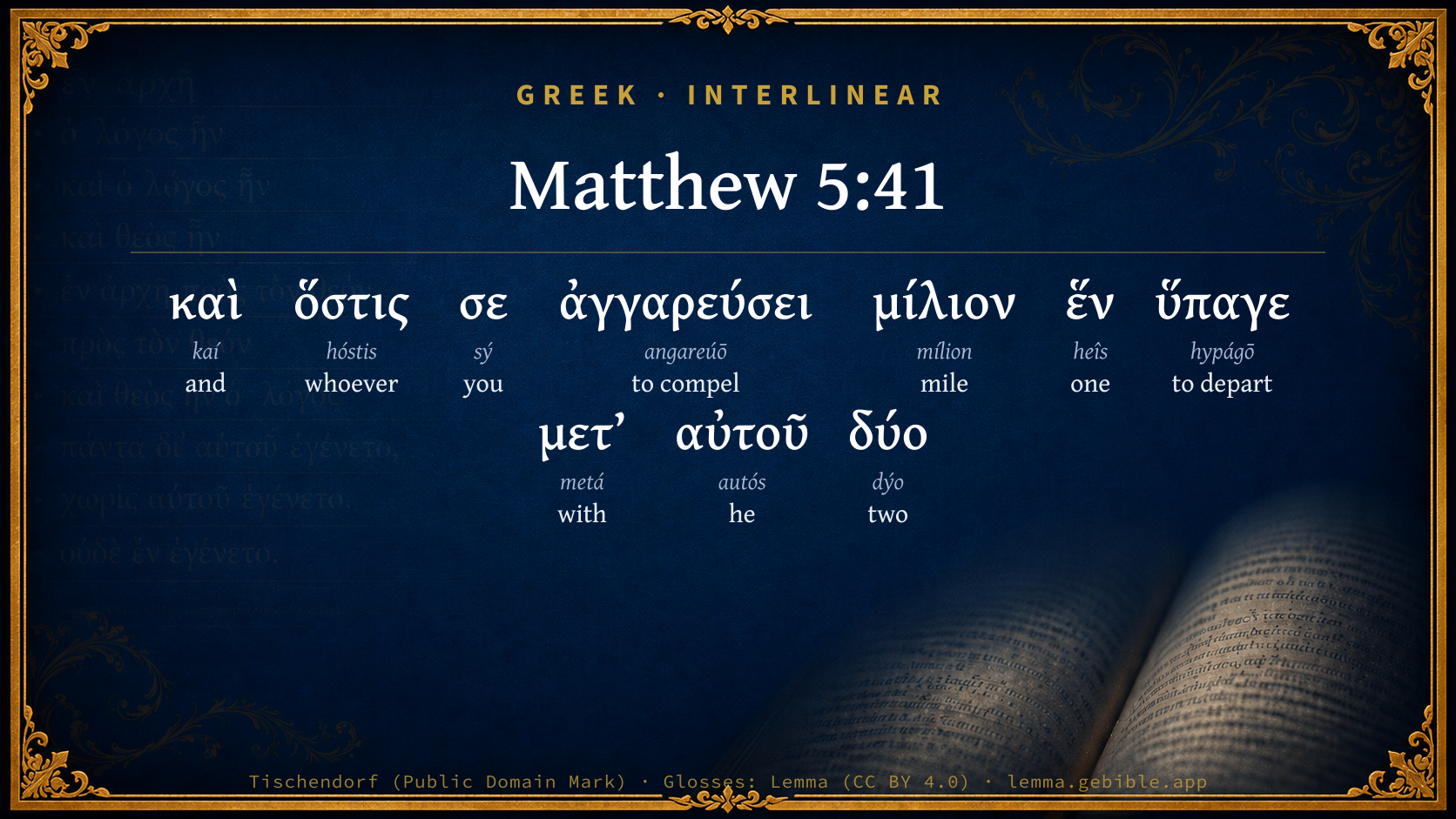
Download image
Cite this verse

Matthew 5:41 (World English Bible). Public Domain. Lemma interlinear Bible study tool, https://lemma.gebible.app/v/matthew/5/41.

Show BibTeX & RIS
BibTeX
RIS
English Translation
Whoever compels you to go one mile, go with him two.
World English Bible · Public Domain
Highlights
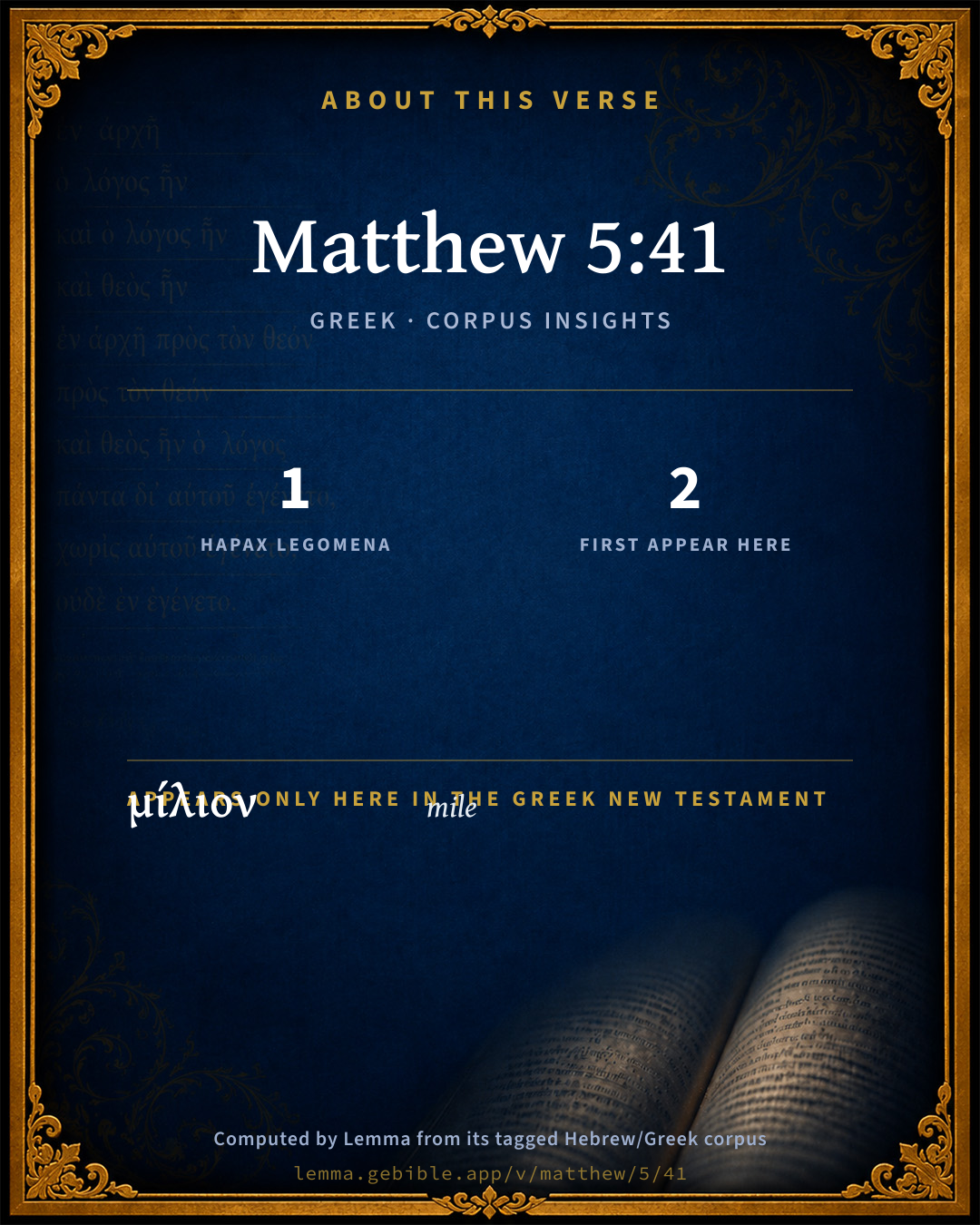
  • 1 hapax legomenon — only here in the Greek New Testament
  • 2 first appearances in the Greek New Testament
Full analysis ↓
Download a study sheet

One document with this verse’s original text, its word-by-word gloss line, the meaning frame, cross-references with their text, attributed commentary, and full source and license credits — printable, and it pastes into notes with its structure intact.

This verse Autodidact and up

Study sheet (.html) Plain text (.txt)

A passage Seminary Student

Up to 50 verses in one chapter. A passage sheet keeps up to 6 commentary sources and 12 cross-references per verse, in the order this page ranks them, and says so on the sheet whenever that leaves anything out. Ask for a single verse and you get the Autodidact verse sheet above.

Everything on this page stays free to read, with no account — the sheet is a download of what is already on screen, not access to it.

Want to remove ads? Support Godless Engineer
Compare translations 3

The same verse in 3 English versions, stacked beneath the original-language interlinear above. Click any original word for its lexicon entry.

Each is an independent rendering of the whole verse — the interlinear is not word-aligned to these translations.

Highlighted words mark where these versions differ — a whole-verse word diff, not a word-by-word alignment.

  • World English Bible Public Domain
    Whoever compels you to go one mile, go with him two.
  • King James Version Public Domain
    And whosoever shall compel thee to go a mile, go with him twain.
  • unfoldingWord Literal Text CC BY-SA 4.0
    And whoever will press you into service for one mile, go with him two.

unfoldingWord Literal Text — © unfoldingWord, licensed CC BY-SA 4.0. Word-aligned USFM3 via Door43 (git.door43.org/unfoldingWord/en_ult).

Versions to compare (up to 4)

3 of 4 selected

Show all 19 translations

Every available English version of this verse, each an independent rendering of the whole verse.

  • World English Bible Public Domain
    Whoever compels you to go one mile, go with him two.
  • Berean Standard Bible Public Domain
    and if someone forces you to go one mile, go with him two miles.
  • Majority Standard Bible Public Domain
    and if someone forces you to go one mile, go with him two miles.
  • King James Version Public Domain
    And whosoever shall compel thee to go a mile, go with him twain.
  • American Standard Version (1901) Public Domain
    And whosoever shall compel thee to go one mile, go with him two.
  • Revised Version (1885) Public Domain
    And whosoever shall compel thee to go one mile, go with him twain.
  • Geneva Bible (1599) Public Domain
    And whosoeuer will compell thee to goe a mile, goe with him twaine.
  • Douay-Rheims (1899) Public Domain
    And whosoever will force thee one mile, go with him other two,
  • Young's Literal Translation Public Domain
    `And whoever shall impress thee one mile, go with him two,
  • Literal Standard Version CC BY-SA 4.0
    And whoever will impress you one mile, go with him two;
  • Unlocked Literal Bible CC BY-SA 4.0
    Whoever compels you to go one mile, go with him two.
  • unfoldingWord Literal Text CC BY-SA 4.0
    And whoever will press you into service for one mile, go with him two.
  • Darby Bible Public Domain
    And whoever will compel thee to go one mile, go with him two.
  • World Messianic Bible Public Domain
    Whoever compels you to go one mile, go with him two.
  • Webster's Bible Public Domain
    And whoever shall constrain thee to go one mile, go with him two.
  • Free Bible Version CC BY-SA 4.0
    If someone demands that you go one mile, go with them two.
  • Bible in Basic English Public Domain
    And whoever makes you go one mile, go with him two.
  • Text-Critical English NT CC BY 4.0
    And if anyone presses yoʋ into service for one mile, go with him two.
  • Tyndale New Testament (1534) Public Domain
    And whosoever wyll compell the to goo a myle goo wyth him twayne.

Literal Standard Version (2020), Covenant Press — licensed CC BY-SA 4.0. Text via the HelloAO Bible API (eBible.org). Unlocked Literal Bible (unfoldingWord) — licensed CC BY-SA 4.0. Text via the HelloAO Bible API (eBible.org). unfoldingWord Literal Text — © unfoldingWord, licensed CC BY-SA 4.0. Word-aligned USFM3 via Door43 (git.door43.org/unfoldingWord/en_ult). Free Bible Version, Dr. Jonathan Gallagher — licensed CC BY-SA 4.0. Text via the HelloAO Bible API (eBible.org).

Word by word

More ways to search: Search by grammar → Find every occurrence → Compare this word →

Practice this passage: Drill this verse → Learn its vocabulary →

About this verse

These counts appear in no published source. They are computed here, from the morphology-tagged text and Lemma’s own curated glosses. What Lemma adds →

10
words
10
distinct lemmas
Gospels
section

Notable vocabulary

1 hapax legomenon — a word that appears only here in the entire Greek New Testament:

  • μίλιον mile G3400

First appearance in Scripture

These words make their first canonical appearance in the Greek New Testament here:

  • ἀγγαρεύσει to compel G29
  • μίλιον mile G3400

Shared distinctive vocabulary

ἀγγαρεύσει to compel G29 occurs in 3 verses of the Greek New Testament. Also found in:
Cross-references

1

Topical passages linked to Matthew 5:41 in the Treasury of Scripture Knowledge — connected by theme and wording, ordered by reader-vote popularity; previews shown in the World English Bible.

  • Luke 23:26 When they led him away, they grabbed one Simon of Cyrene, coming from the country, and laid on him the cross, to carry it after Jesus.

Cross-references courtesy of OpenBible.info (CC BY 4.0).

Commentary

Notes on Matthew 5:41 from classic Christian and Jewish commentators (each source and its license shown beneath its notes). The classic Christian expositions comment on the surrounding passage and are grouped to its opening verse, so a note may address several verses; the Jewish commentaries on the Tanakh (Rashi and others) are per-verse, so they appear only where the commentator wrote on this verse.

Lemma curates 59 commentaries, every one of them public domain or Creative Commons licensed, each selected and text-cleaned for this edition rather than reprinted as found. About our sources →

Adam Clarke's Commentary

Verse 41. Shall compel thee to go a mile, go with him twain.] αγγαρευσει. This word is said to be derived from the Persians, among whom the king's messengers, or posts, were called αγγαποι, or angari. This definition is given both by Hesychius and Suidas.

The Persian messengers had the royal authority for pressing horses, ships, and even men, to assist them in the business on which they were employed. These angari are now termed chappars, and serve to carry despatches between the court and the provinces. When a chappar sets out, the master of the horse furnishes him with a single horse; and, when that is weary, he dismounts the first man he meets, and takes his horse. There is no pardon for a traveller that refuses to let a chappar have his horse, nor for any other who should deny him the best horse in his stable. See Sir J. Chardin's and Hanway's Travels. For pressing post horses, c., the Persian term is [Persian] Sukhreh geriften. I find no Persian word exactly of the sound and signification of αγγαρος but the Arabic [Arabic] agharet signifies spurring a horse, attacking, plundering, c. The Greek word itself is preserved among the rabbins in Hebrew characters, אנגריא angaria, and it has precisely the same meaning: viz. to be compelled by violence to do any particular service, especially of the public kind, by the king's authority. Lightfoot gives several instances of this in his Horae Talmudicae.

We are here exhorted to patience and forgiveness:

First, When we receive in our persons all sorts of insults and affronts, Mt 5:39.

Secondly, When we are despoiled of our goods, Mt 5:40.

Thirdly, When our bodies are forced to undergo all kinds of toils, vexations, and torments, Mt 5:41. The way to improve the injustice of man to our own advantage, is to exercise under it meekness, gentleness, and long-suffering, without which disposition of mind, no man can either be happy here or hereafter for he that avenges himself must lose the mind of Christ, and thus suffer an injury ten thousand times greater than he can ever receive from man. Revenge, at such an expense, is dear indeed.

Adam Clarke's Commentary on the Bible (1810–1826) — public domain. Text from a community e-Sword/MySword module.

Tyndale Open Study Notes

Tyndale Open Resources

5:41 Forced labor was a humiliating fact of Roman occupation (see 27:32); Jesus turned it into an occasion for exuberant service to God. This saying shows Jesus’ opposition to Jewish revolutionaries, who advocated violent resistance (see 5:9).

Tyndale Open Study Notes — © Tyndale Open Resources, licensed CC BY-SA 4.0. Text via the HelloAO Bible API.

Bengel's Gnomon

Johann Albrecht Bengel

Mat 5:41. Ἀγγαρεύσει) A word of Persian origin.[225] They who travelled on the public business could press a person into service. See Vriemoet on this passage.[226]

[225] Ἄγγαρος, a Persian word for a royal courier, who had authority to press horses, etc. into his service in execution of his mission. The word אַנְגַרְיָא (angaria) (whence avania and avanie in Ital. and Fr.) is used in the Talmud for any forced work. Connected with this is the Hebrew אִגֶּרֶת (iggereth), a letter.”—Wordsworth in loc.—(I. B.)

[226] Emo-Lucius Vriemoet, born at Embden, in Friesland in 1699, became Professor of Oriental languages and Hebrew antiquities at Francker, and published many learned works on these subjects. He died in 1764.—(I. B.)

Bengel's Gnomon of the New Testament — English translation (T&T Clark, Edinburgh, 1860) — public domain. Text from a community e-Sword module.

Meyer's Critical & Exegetical Commentary

Heinrich August Wilhelm Meyer

Mat_5:41. Ἀγγαρεύειν, passed over from the Persian (see Gesenius, Thes. I. p. 23) into Greek, Latin (angariare, Vulgate, Augustine, Ephesians 5), and into the Rabbinical dialect (אַנְגַרְיָא, Buxtorf, Lex. Rabb. p. 131; Lightfoot on the passage), to force into transport service. The Persian arrangements respecting post messages, instituted by Cyrus, justified the couriers (ἄγγαροι) in making requisitions from station to station of men, or cattle, or carriages for the carrying on of their journey, Herodotus, viii. 98; Xenoph. Cyrop. viii. 6. 17; Josephus, Antt. xii. 2. 3. See Dougtius, Anal. II. p. 9 f. Here it refers to continuing a forced journey, comp. Mat_27:32.

μίλιον] One thousand steps, or eight stadia, one-fourth of a German mile. A late word found in Strabo.

REMARK.

The spirit of the ethics of Jesus, His own example (Joh_18:22 f.) and that of the apostles (Act_23:3; Act_16:35; Act_26:25; Act_25:9 f.), require us to recognise, in these manifestly typical representations, Mat_5:39-41, not precepts to be literally followed, but precepts which are certainly to be determined according to their idea. This idea, which is that of love, yielding and putting to shame in the spirit of self-denial, and overcoming evil with good, is concretely represented in those examples, but has, in the relations of external life and its individual cases, the measure and the limitation of its moral practice. Comp. on Mat_5:38. Luther appropriately lays emphasis here upon the distinction between what the Christian has to do as a Christian, and what as a worldly person (in so far as he is in a position or an office, and so on). The Lord leaves to the state its own jurisdiction, Mat_22:21.

Meyer — Critical and Exegetical Commentary on the New Testament — English translation by Peter Christie, edited by Frederick Crombie (T&T Clark, 1880) — public domain. Text from a community e-Sword module.

Expositor's Greek Testament

ed. W. Robertson Nicoll

Mat 5:41 . ἀλλαρεύσει : compel thee to go one mile in A. V [32] and R. V [33] Hatch ( Essays in Biblical Greek , p. 37) thinks it means compel thee to carry his baggage , a very probable rendering in view of the history of the word as he gives it. A Persian word, originally, introduced into the Greek, Latin, and Rabbinic languages, it denoted first to requisition men, beasts, or conveyances for the courier system described in Herod. viii. 98, Xen. Cyr. viii. 6, 17; next in post-classical use under the successors of the Persians in the East, and under the Roman Empire, it was applied to the forced transport of military baggage by the inhabitants of a country through which troops were passing. Hatch remarks: “The extent to which this system prevailed is seen in the elaborate provisions of the later Roman law: angariae came to be one of those modes of taxing property which, under the vicious system of the empire, ruined both individuals and communities”. An instance in N. T. of the use of the word in this later sense occurs in Mat 27:32 , Mar 15:21 , in reference to Simon compelled to carry Christ’s cross. We may conceive the compulsion in the present case to proceed from a military man. μίλιον , a Roman mile, about 1600 yards, a late word. δύο , in point of time, the additional mile = two, there and back, with proportional fatigue, a decided climax of hardship. But it is not merely a question of time, as Achelis thinks. The sense of oppression is involved, subjection to arbitrary military power. Christ’s counsel is: do not submit to the inevitable in a slavish, sullen spirit, harbouring thoughts of revolt. Do the service cheerfully, and more than you are asked. The counsel is far-reaching, covering the case of the Jewish people subject to the Roman yoke, and of slaves serving hard masters. The three cases of non-resistance are not meant to foster an abject spirit. They point out the higher way to victory. He that magnanimously bears overcomes.

[32] Authorised Version.

[33] Revised Version.

The Expositor's Greek Testament, edited by W. Robertson Nicoll (1897–1910) — public domain. Text from a community e-Sword module.

Jamieson, Fausset & Brown

Robert Jamieson, A. R. Fausset & David Brown

And whosoever shall compel thee to go a mile, go with him twain--an allusion, probably, to the practice of the Romans and some Eastern nations, who, when government despatches had to be forwarded, obliged the people not only to furnish horses and carriages, but to give personal attendance, often at great inconvenience, when required. But the thing here demanded is a readiness to submit to unreasonable demands of whatever kind, rather than raise quarrels, with all the evils resulting from them. What follows is a beautiful extension of this precept.

Jamieson, Fausset & Brown — Commentary Critical and Explanatory on the Whole Bible (1871) — public domain (CC PDM 1.0). Text via the HelloAO Bible API.

Ellicott's Commentary for English Readers

(41) Whosoever shall compel thee.—The Greek word implies the special compulsion of forced service as courier or messenger under Government, and was imported from the Persian postal system, organised on the plan of employing men thus impressed to convey Government dispatches from stage to stage (Herod. viii. 98). The use of the illustration here would seem to imply the adoption of the same system by the Roman Government under the empire. Roman soldiers and their horses were billeted on Jewish householders. Others were impressed for service of longer or shorter duration.

A mile.—The influence of Rome is shown by the use of the Latin word (slightly altered) for the mille passuum, the thousand paces which made up a Roman mile—about 142 yards short of an English statute mile. It is interesting to note a like illustration of the temper that yields to compulsion of this kind, rather than struggle or resist, in the teaching of the Stoic Epictetus—“Should there be a forced service, and a soldier should lay hold on thee, let him work his will; do not resist or murmur” (Diss. iv., i. 79).

A Bible Commentary for English Readers, edited by Charles John Ellicott (1878–1897) — public domain. Text from a community e-Sword module.

The Cambridge Bible for Schools and Colleges

gen. ed. J. J. S. Perowne

41. compel thee to go a mile] The Greek text has a Persian word here signifying “to press into service as a courier” for the royal post, then, generally, “to force to be a guide,” “to requisition,” men or cattle. This was one of the exactions which the Jews suffered under the Romans. Alford quotes Joseph. Ant. xiii. 2, 3, where Demetrius promises not to press into service the beasts of burden belonging to the Jews. For an instance of this forced service see ch. Mat_27:32.

The Cambridge Bible for Schools and Colleges (gen. ed. J. J. S. Perowne; Cambridge University Press, 1878–1918) — public domain. Text from a community e-Sword module.

John Gill's Exposition

And whosoever shall compel thee to go a mile,.... The word rendered "compel", is generally said to be of Persic original; the "Angari", among the Persians, were the king's messengers, or those who rode post, and were maintained at the king's expenses; and had power to take horses, and other carriages, and even men, into their service, by force, when they had occasion for them: hence the word is used to force, or compel persons to do this or the other thing; the word is often to be met with in the Jewish writings, and is in them expounded to be (k), the taking of anything for the service of the king. David de Pomis renders it by "a yoke" (l); meaning, any servile work, which such, who were pressed into the king's service, were obliged unto. And (m) is used to compel persons to go along with others, to do any service; in which sense it is here used: and Christ advises, rather than to contend and quarrel with such a person, that obliges to go with him a mile, to

go with him twain: his meaning is, not to dispute such a matter, though it may be somewhat laborious and disagreeable, but comply, for the sake of peace. The Jews (n), in their blasphemous book of the birth of Christ, own that he gave advice in such words as these, when they introduce Peter thus speaking of him.

"He, that is, Jesus, hath warned and commanded you to do no more evil to a Jew; but if a Jew should say to a Nazarene, go with me one mile, he shall go with him two miles; and if a Jew shall smite him on the left cheek, he shall turn to him also the right.''

Can a Jew find fault with this advice?

(k) Vid. Maimon. & Bartenora in Misn. Bava Metzia, c. 6. sect. 3. (l) Tzemach David, fol. 8. 4. (m) Vid. Buxtorf. Lex. Rabb. p. 131, 132. (n) Toldos Jesu, p 22.

John Gill's Exposition of the Whole Bible (1746–1763) — public domain (CC PDM 1.0). Text via the HelloAO Bible API.

Trapp's Complete Commentary

John Trapp

41 And whosoever shall compel thee to go a mile, go with him twain.

Ver. 41. And whosoever shall compel thee to go a mile] Under colour of the magistrate’s authority, which he abuseth; rather than by resisting thou shouldest revenge thyself, go with him two miles, yea, as far as the shoes of the preparation of the gospel of peace can carry thee. In the course of a man’s life many wrongs are to be put up, which whoso cannot frame to, let him make up his pack, and be gone out of the world; for here is no being for him. {a} Many pills are to be swallowed down whole, which if we should chew them would stick in our teeth and prove very bitter. Patience is of continual use to us at every turn; it is as bread or salt, which we cannot make one good meal without. It is a cloak, to keep off all storms; a helmet, to bear off all blows; a paring knife, that cuts the cross less and less, till it comes to nothing. As there be two kinds of antidotes against poison, viz. hot and cold, so against tribulation and temptation, prayer, and patience; the one, hot; the other, cold; the one, quenching; the other, quickening, Dan 6:20. The king cried unto Daniel with a lamentable voice, Mat 5:21. Then Daniel talked with the king, &c., with a voice not distressed, as that of the king was: for as by faith he stopped the mouths of the lions, Heb 11:33, so by patience he possessed his own soul, Luk 21:19; he became master of himself, which is the only true manhood. So patience had her perfect work in Joseph; therefore he became, as St James hath it, "perfect and entire, wanting nothing," Jas 1:4. Julius Caesar, beholding the picture of Alexander in Hercules’ temple at Gades, lamented that he had done no worthy exploit at those years, wherein Alexander had conquered the whole world. Joseph at thirty showed more true virtue, valour, piety, patience, purity, policy, knowledge of secrets, skill in government, &c., than either of them. Giles of Brussels, a Dutch martyr, when the friars at any time did miscall him, he ever held his peace at such private injuries, insomuch that those blasphemers would say abroad that he had a dumb devil in him. And Cassianus reporteth, that when a Christian was held captive by infidels, and tormented with various pains and ignominious taunts, being demanded by way of scorn, Tell us what miracle thy Christ hath done? he answered, He hath done what you see, that I am not moved at all by the cruelties and contumelies you cast upon me. Godly people can bear wrongs best of any; and although corrupt nature in them bustles again, and bestirs itself, yet they soon club it down, they reason themselves patient, as David, and pray down their distempers, as Paul, Psa 43:1; 2Co 12:9. And albeit, with those two sons of thunder, they could find in their hearts to call for fire from heaven upon their adversaries, yet they will do nothing without leave. As they came to Christ, and said, "Wilt thou that we command fire from heaven?" &c., which when Christ disliked and denied, they were soon satisfied, Luk 9:54. We must take up our crosses, and when God bids us yoke, he is the wisest man that yields his neck most willingly. Our Saviour gave Judas his mouth to be kissed when he came to betray him, leaving us a pattern of like equanimity and patience.

{a} Αγγαροι Persis dicebantur quos hodie postas vocamus. Eph 6:15. Qui nescit dissimulate, nescit vivere; ut Saul, 1Sa 10:27. Levius fit patientia quicquid corrigere est nefas. Cedamus, leve sit quod bene fertur onus. Pondus ipsa iactatione incommodius fit. Sen.

John Trapp, A Commentary or Exposition upon All the Books of the Old and New Testament (1647–1656) — public domain. Text from a community e-Sword module.

Haydock's Catholic Bible Commentary

Go with him other two.[7] I know many interpreters would have it to signify no more than two in all. But the literal sense of the Latin, and also of the best Greek manuscripts. (as Dr. Wells takes notice in his amendments to the Prot. translation) express two more, i.e. not only as far again, but twice as far. And thus it is expounded by St. Augustine, Serm. Domini in monte. t. iii. p. 193. Ed Ben. (Witham) --- Continue to be his guide sooner that lose patience, or be wanting in charity. (Haydock)

===============================

[BIBLIOGRAPHY]

Vade cum eo et alia duo. In the ordinary Greek copies, we only read Greek: upage met autou duo. But in other manuscripts Greek: upage met autou eti alla duo.

====================

George Leo Haydock (1774–1849), Haydock's Catholic Family Bible and Commentary, 1859 edition — public domain. Excludes Psalms (Douay-Rheims chapter numbering differs from Protestant) and Deuterocanonical books (Catholic canon only).

Whedon's Commentary on the Bible

Daniel D. Whedon

41. Compel thee to go a mile — The phrase was borrowed from the practice of the oppressive Eastern despotisms. The custom was introduced from the Persian into the Roman government. The royal officers in transmitting government dispatches, were empowered to impress any man into service, and compel him or his beast to perform a stage or two of the message. So Simon, the Cyrenian, was compelled to bear the cross. Now, says our Lord, if any one obliges you to perform some task for him like this, make him magnanimously ashamed, if possible, by doubling the favour.

Daniel D. Whedon (gen. ed.), Commentary on the Old and New Testaments (1874–1909) — public domain. Text from a community e-Sword module.

The Pulpit Commentary

Matthew only. Shall compel thee to go; Revised Version margin, "Gr. impress" (aggareusei). From the Persian. Hatch ("Essays," p. 37) shows that while the classical usage strictly refers to the Persiansystem or" mounted couriers (described in Herod., 8:98; Xen., "Cyr.," 8:6. 17), the post-classical usage refers to the later development of a system, not of postal service, but of the forced transport of military baggage. It thus indicates, not merely forced attendance, but forced carrying. Hence it is used in Mat_27:32 and Mar_15:21 of Simon the Cyrenian, "who was pressed by the Roman soldiers who were escorting our Lord not merely to accompany them but also to carry a load." Thus here also the thought is doubtless that of being compelled to carry baggage. There may also be a reference, as Hatch suggests, to the oppressive conduct of the Roman soldiers. (cf. Luk_3:14) (For the spirit of our Lord"s saying, vide also "Aboth," 3:18 (Taylor), where the probable translation is, "Rabbi Ishmael said, Be pliant of disposition and yielding to impressment. ") A mile; Revised Version, one mile; but see Mat_8:19, note. A Roman mile of a thousand paces.

The Pulpit Commentary (1880–1919), ed. H.D.M. Spence-Jones & Joseph S. Exell — public domain. Text from a community e-Sword module.

The People's New Testament

B. W. Johnson

41. Compel thee to go a mile. In those days, when there were no stages, railroad trains, postal lines, or regular means of conveyance, it was common for officers traveling to impress men to assist them on the route. It was a necessary, but oppressive, exaction. Christ directs to yield the service, and double it rather than refuse it. A mile. A Roman word from mille, a thousand. A Roman mile was a thousand paces, 1,520 yards.

B. W. Johnson's The People's New Testament with Notes (1889–1891) — public domain. Electronic text from the Christian Classics Ethereal Library (CCEL) ThML edition.

Cambridge Greek Testament for Schools and Colleges

41. ἀγγαρεύειν, from a Persian word which is probably a corruption of hakkáreh, ‘an express messenger’ (see Rawlinson, Herod. VIII. 98, note 1), signifies ‘to press into service as a courier’ for the royal post, then, generally, ‘to force to be a guide,’ ‘to requisition,’ men or cattle. This was one of the exactions which the Jews suffered under the Romans. Alford quotes Joseph. Ant. XIII. 2, 3, where Demetrius promises not to press into the service the beasts of burden belonging to the Jews. For an instance of this forced service see ch. Mat 27:32.

For the Greek word cp. ἄγγαρον πῦρ, ‘the courier fire,’ Æsch. Agam. 282. The verb is not classical.

μίλιον. Here only in N.T. Used by Strabo = Lat. miliare.

Cambridge Greek Testament for Schools and Colleges (Cambridge University Press, 1896; 21 vols, various authors incl. Carr, Maclear, Plummer, Farrar, Lumby, Moule, M. R. James, Simcox) — public domain. Text from a community e-Sword module.

Alford’s Greek Testament

Henry Alford

41.] See note on ver. 39. κριθῆναι imports legal contention only, and is thus distinguished from the violence in ver. 39. (Meyer, against Tholuck (but not in edn. 3) and De Wette.) λαβεῖν, i.e. in pledge for a debt: see Exo 22:26. χιτῶνα, the inner and less costly garment; ἱμάτιον, the outer and more valuable, used also by the poor as a coverlet by night (Exod. ubi supra). In Luk 6:29 the order is inverted, and appears to be that in which the two garments would be taken from the body, that verse referring to abstraction by violence. See the apostolic comment on this precept, 1Co 6:7.

ἀγγαρεύσει] Herod. viii. 98, after describing the Persian post-couriers, adds, τοῦτο τὸ δράμημα τῶν ἵππων καλέουσι Πέρσαι ἀγγαρήϊον. Æschylus, Agam. 285 (Dindorf), says of the beacons which brought the intelligence of the capture of Troy to Mycenæ, φρυκτὸς δὲ φρυκτὸν δεῦρʼ ἀπʼ ἀγγάρου πυρὸς ἔπεμπεν. ‘The Jews particularly objected to the duty of furnishing posts for the Roman government; and Demetrius, wishing to conciliate the Jews, promised, among other things, κελεύω δὲ μηδὲ ἀγγαρεύεσθαι τὰ Ἰουδαίων ὑποζύγια (Jos. Antt. xiii. 2. 3). Hence our Saviour represents this as a burden;—and in the same manner Epictetus says, ἂν δὲ ἀγγαρεία ᾖ καὶ στρατιώτης ἐπιλάβηται, ἄφες, μὴ ἀντίτεινε μηδὲ γόγγυζε.’ Dr. Burton. The ἐπισταθμία, or billeting of the Roman soldiers and their horses on the Jews, was one kind of this ἀγγαρεία.

Henry Alford, The Greek Testament (1849–1861) — public domain. Text from a community e-Sword module.

Vincent's Word Studies in the New Testament

Marvin R. Vincent

Shall compel thee to go [αγγαρευσει] . This word throws the whole injunction into a picture which is entirely lost to the English reader. A man is travelling, and about to pass a post - station, where horses and messengers are kept in order to forward royal missives as quickly as possible. An official rushes out, seizes him, and forces him to go back and carry a letter to the next station, perhaps to the great detriment of his business. The word is of Persian origin, and denotes the impressment into service, which officials were empowered to make of any available persons or beasts on the great lines of road where the royal mails were carried by relays of riders.

Marvin R. Vincent, Word Studies in the New Testament (1887–1900) — public domain. Text from a community e-Sword/MySword module.

Lesson kit

Teaching starters — assembled from the data on this page, not authored interpretation. Every prompt links to the verse data it draws on. Edit before teaching.

Matthew, in the Gospels, opens this verse with 10 words (10 distinct Greek lemmas). Its most distinctive word is mílion (“mile”). A historical commentator’s framing appears above. Read the whole chapter for the surrounding context.

Discussion questions

  1. How does “mile” (mílion) shape what this verse is saying?
  2. This verse holds 1 word here found nowhere else in the Greek New Testament. What might the rare word draw attention to?
  3. 2 words here appear for the first time in Scripture. What is being introduced at this debut?
  4. Matthew 27:32 shares the word «to compel» with this verse. How do the two illuminate each other?
  5. These translations render this verse differently. What is at stake in choosing one wording over another?
  6. Reading how Adam Clarke's Commentary and Tyndale Open Study Notes read this verse, where do the two commentators agree and where do they part?

Things to notice

  • 1 word in this verse appears nowhere else in the Greek New Testament.
  • 2 words make their first canonical appearance in Scripture here.
  • These translations choose different wording for 13 words in this verse.
  • 10 distinct Greek lemmas span 10 words in this verse.

Reading settings

Reading text

Shown beneath each verse's original-language words.

Old Testament
Old Testament edition

Read the OT as the Masoretic Hebrew (MT) or the Greek Septuagint (LXX).

English shown for the Greek Septuagint (in the Hebrew ↔ Greek comparison).

Comparing translations? Open the Compare panel on any verse page to stack up to four side by side.