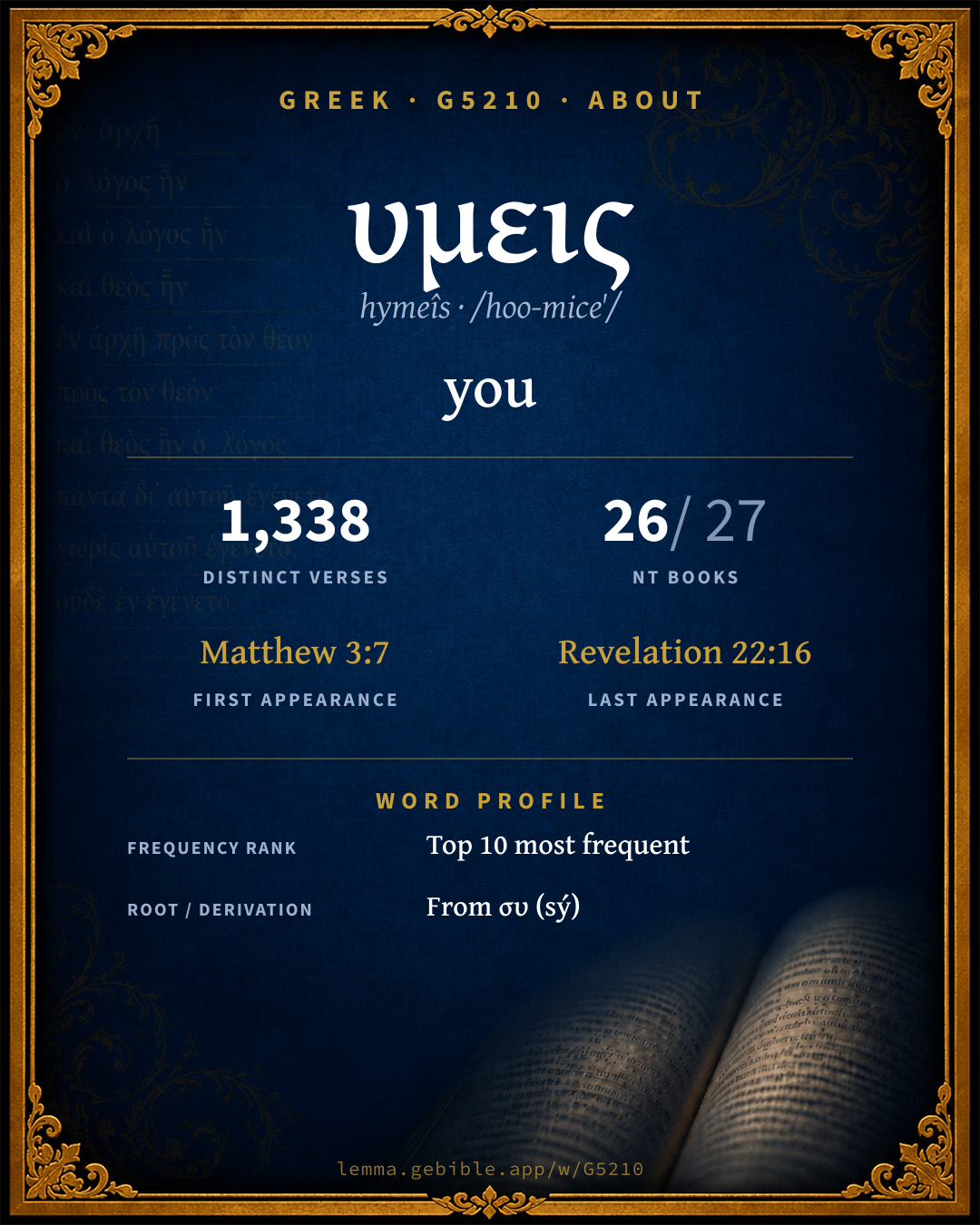
ὑμείς
you
Full lexicon entry — Thayer's Greek Lexicon
From Thayer's Greek Lexicon
Where this word appears
See every Dative-case word in the Greek New Testament →
Grammar key — what these labels mean
Part of speech
- Personal pronoun
- Stands in for a person already named (“I,” “you,” “he”).
Case
- Dative
- The case of the indirect object, means, or location — “to / for / with / in.”
- Genitive
- The case of source, possession, or “of” — answers “whose / from what.”
- Accusative
- The case of the direct object and of extent.
- Nominative
- The case of the subject (and the predicate nominative).
Person
- 2nd person
- The one addressed (“you”).
Number
- Plural
- More than one.
Grammatical forms
- Personal pronoun, 2nd person, Dative, Plural 601 times (33%)
- Personal pronoun, 2nd person, Genitive, Plural 560 times (31%)
- Personal pronoun, 2nd person, Accusative, Plural 432 times (24%)
- Personal pronoun, 2nd person, Nominative, Plural 235 times (13%)
Parsed forms decoded from the imported morphology (Robinson–Tischendorf, public domain), counted across 1,828 parsed occurrences — not distinct verses.
Page 1 of 7 — showing verses 1–200 of 1,338 distinct verses where G5210 appears, across 26 books. Click any verse to open its interlinear word-by-word view. Verse text shown in the World English Bible for context — . Each verse’s Greek form is shown with its reference; the English is not keyword-highlighted, since the data carries no word-level English alignment. Use “Compare translations” on any verse to read it across multiple English versions. This concordance covers the Greek New Testament; Septuagint (Greek Old Testament) occurrences of this word are not indexed here.
Matthew 179 verses
- Matthew 3:7 ὑμῖν pron 2 dat pl But when he saw many of the Pharisees and Sadducees coming for his baptism, he said to them, "You offspring of vipers, who warned you to flee from the wrath to come?
- Matthew 3:9 ὑμῖν pron 2 dat pl Don't think to yourselves, 'We have Abraham for our father,' for I tell you that God is able to raise up children to Abraham from these stones.
- Matthew 3:11 ὑμᾶς ὑμᾶς pron 2 acc pl pron 2 acc pl I indeed baptize you in water for repentance, but he who comes after me is mightier than I, whose shoes I am not worthy to carry. He will baptize you in the Holy Spirit.
- Matthew 4:19 ὑμᾶς pron 2 acc pl He said to them, "Come after me, and I will make you fishers for men."
- Matthew 5:11 ὑμᾶς ὑμῶν pron 2 acc pl pron 2 gen pl "Blessed are you when people reproach you, persecute you, and say all kinds of evil against you falsely, for my sake.
- Matthew 5:12 ὑμῶν ὑμῶν pron 2 gen pl pron 2 gen pl Rejoice, and be exceedingly glad, for great is your reward in heaven. For that is how they persecuted the prophets who were before you.
- Matthew 5:13 Ὑμεῖς pron 2 nom pl "You are the salt of the earth, but if the salt has lost its flavor, with what will it be salted? It is then good for nothing, but to be cast out and trodden under the feet of men.
- Matthew 5:14 Ὑμεῖς pron 2 nom pl You are the light of the world. A city located on a hill can't be hidden.
- Matthew 5:16 ὑμῶν ὑμῶν ὑμῶν pron 2 gen pl pron 2 gen pl pron 2 gen pl Even so, let your light shine before men; that they may see your good works, and glorify your Father who is in heaven.
- Matthew 5:18 ὑμῖν pron 2 dat pl For most assuredly, I tell you, until heaven and earth pass away, not even one smallest letter or one tiny pen stroke shall in any way pass away from the law, until all things are accomplished.
- Matthew 5:20 ὑμῖν ὑμῶν pron 2 dat pl pron 2 gen pl For I tell you that unless your righteousness exceeds that of the scribes and Pharisees, there is no way you will enter into the Kingdom of Heaven.
- Matthew 5:22 ὑμῖν pron 2 dat pl But I tell you, that everyone who is angry with his brother without a cause shall be in danger of the judgment; and whoever shall say to his brother, 'Raca!' shall be in danger of the council; and whoever shall say, 'You fool!' shall be in danger of the fire of Gehenna.
- Matthew 5:28 ὑμῖν pron 2 dat pl but I tell you that everyone who gazes at a woman to lust after her has committed adultery with her already in his heart.
- Matthew 5:32 ὑμῖν pron 2 dat pl but I tell you that whoever puts away his wife, except for the cause of sexual immorality, makes her an adulteress; and whoever marries her when she is put away commits adultery.
- Matthew 5:34 ὑμῖν pron 2 dat pl but I tell you, don't swear at all: neither by heaven, for it is the throne of God;
- Matthew 5:37 ὑμῶν pron 2 gen pl But let your 'Yes' be 'Yes' and your 'No' be 'no.' Whatever is more than these is of the evil one.
- Matthew 5:39 ὑμῖν pron 2 dat pl But I tell you, don't resist him who is evil; but whoever strikes you on your right cheek, turn to him the other also.
- Matthew 5:44 ὑμῖν ὑμῶν ὑμᾶς pron 2 dat pl pron 2 gen pl pron 2 acc pl But I tell you, love your enemies, bless those who curse you, do good to those who hate you, and pray for those who mistreat you and persecute you,
- Matthew 5:45 ὑμῶν pron 2 gen pl that you may be children of your Father who is in heaven. For he makes his sun to rise on the evil and the good, and sends rain on the just and the unjust.
- Matthew 5:46 ὑμᾶς pron 2 acc pl For if you love those who love you, what reward do you have? Don't even the tax collectors do the same?
- Matthew 5:47 ὑμῶν pron 2 gen pl If you only greet your friends, what more do you do than others? Don't even the tax collectors do the same?
- Matthew 5:48 ὑμεῖς ὑμῶν pron 2 nom pl pron 2 gen pl Therefore you shall be perfect, just as your Father in heaven is perfect.
- Matthew 6:1 ὑμῶν ὑμῶν pron 2 gen pl pron 2 gen pl "Be careful that you don't do your charitable giving before men, to be seen by them, or else you have no reward from your Father who is in heaven.
- Matthew 6:2 ὑμῖν pron 2 dat pl Therefore when you do merciful deeds, don't sound a trumpet before yourself, as the hypocrites do in the synagogues and in the streets, that they may get glory from men. Most assuredly I tell you, they have received their reward.
- Matthew 6:5 ὑμῖν pron 2 dat pl "When you pray, you shall not be as the hypocrites, for they love to stand and pray in the synagogues and in the corners of the streets, that they may be seen by men. Most assuredly, I tell you, they have received their reward.
- Matthew 6:8 ὑμῶν ὑμᾶς pron 2 gen pl pron 2 acc pl Therefore don't be like them, for your Father knows what things you need, before you ask him.
- Matthew 6:9 ὑμεῖς pron 2 nom pl Pray like this: 'Our Father in heaven, may your name be kept holy.
- Matthew 6:14 ὑμῖν ὑμῶν pron 2 dat pl pron 2 gen pl "For if you forgive men their trespasses, your heavenly Father will also forgive you.
- Matthew 6:15 ὑμῶν ὑμῶν pron 2 gen pl pron 2 gen pl But if you don't forgive men their trespasses, neither will your Father forgive your trespasses.
- Matthew 6:16 ὑμῖν pron 2 dat pl "Moreover when you fast, don't be like the hypocrites, with sad faces. For they disfigure their faces, that they may be seen by men to be fasting. Most assuredly I tell you, they have received their reward.
- Matthew 6:19 ὑμῖν pron 2 dat pl "Don't lay up treasures for yourselves on the earth, where moth and rust consume, and where thieves break through and steal;
- Matthew 6:20 ὑμῖν pron 2 dat pl but lay up for yourselves treasures in heaven, where neither moth nor rust consume, and where thieves don't break through and steal;
- Matthew 6:25 ὑμῖν ὑμῶν ὑμῶν pron 2 dat pl pron 2 gen pl pron 2 gen pl Therefore, I tell you, don't be anxious for your life: what you will eat, or what you will drink; nor yet for your body, what you will wear. Isn't life more than food, and the body more than clothing?
- Matthew 6:26 ὑμῶν ὑμεῖς pron 2 gen pl pron 2 nom pl See the birds of the sky, that they don't sow, neither do they reap, nor gather into barns. Your heavenly Father feeds them. Aren't you of much more value than they?
- Matthew 6:27 ὑμῶν pron 2 gen pl "Which of you, by being anxious, can add one cubit to the measure of his life?
- Matthew 6:29 ὑμῖν pron 2 dat pl yet I tell you that even Solomon in all his glory was not dressed like one of these.
- Matthew 6:30 ὑμᾶς pron 2 acc pl But if God so clothes the grass of the field, which today exists, and tomorrow is thrown into the oven, won't he much more clothe you, you of little faith?
- Matthew 6:32 ὑμῶν pron 2 gen pl For the Gentiles seek after all these things, for your heavenly Father knows that you need all these things.
- Matthew 6:33 ὑμῖν pron 2 dat pl But seek first God's Kingdom, and his righteousness; and all these things will be given to you as well.
- Matthew 7:2 ὑμῖν pron 2 dat pl For with whatever judgment you judge, you will be judged; and with whatever measure you measure, it will be measured to you.
- Matthew 7:6 ὑμῶν ὑμᾶς pron 2 gen pl pron 2 acc pl "Don't give that which is holy to the dogs, neither throw your pearls before the pigs, lest perhaps they trample them under their feet, and turn and tear you to pieces.
- Matthew 7:7 ὑμῖν ὑμῖν pron 2 dat pl pron 2 dat pl "Ask, and it will be given you. Seek, and you will find. Knock, and it will be opened for you.
- Matthew 7:9 ὑμῶν pron 2 gen pl Or who is there among you, who, if his son asks him for bread, will give him a stone?
- Matthew 7:11 ὑμεῖς ὑμῶν ὑμῶν pron 2 nom pl pron 2 gen pl pron 2 gen pl If you then, being evil, know how to give good gifts to your children, how much more will your Father who is in heaven give good things to those who ask him!
- Matthew 7:12 ὑμῖν ὑμεῖς pron 2 dat pl pron 2 nom pl Therefore whatever you desire for men to do to you, you shall also do to them; for this is the law and the prophets.
- Matthew 7:15 ὑμᾶς pron 2 acc pl "Beware of false prophets, who come to you in sheep's clothing, but inwardly are ravening wolves.
- Matthew 7:23 ὑμᾶς pron 2 acc pl Then I will tell them, 'I never knew you. Depart from me, you who work iniquity.'
- Matthew 8:10 ὑμῖν pron 2 dat pl When Jesus heard it, he marveled, and said to those who followed, "Most assuredly I tell you, I haven't found so great a faith, not even in Israel.
- Matthew 8:11 ὑμῖν pron 2 dat pl I tell you that many will come from the east and the west, and will sit down with Abraham, Isaac, and Jacob in the Kingdom of Heaven,
- Matthew 9:4 ὑμῶν pron 2 gen pl Jesus, knowing their thoughts, said, "Why do you think evil in your hearts?
- Matthew 9:11 ὑμῶν pron 2 gen pl When the Pharisees saw it, they said to his disciples, "Why does your teacher eat with tax collectors and sinners?"
- Matthew 9:29 ὑμῶν ὑμῖν pron 2 gen pl pron 2 dat pl Then he touched their eyes, saying, "According to your faith be it done to you."
- Matthew 10:9 ὑμῶν pron 2 gen pl Don't take any gold, nor silver, nor brass in your money belts.
- Matthew 10:13 ὑμῶν ὑμῶν ὑμᾶς pron 2 gen pl pron 2 gen pl pron 2 acc pl If the household is worthy, let your peace come on it, but if it isn't worthy, let your peace return to you.
- Matthew 10:14 ὑμᾶς ὑμῶν ὑμῶν pron 2 acc pl pron 2 gen pl pron 2 gen pl Whoever doesn't receive you, nor hear your words, as you go out of that house or that city, shake off the dust from your feet.
- Matthew 10:15 ὑμῖν pron 2 dat pl Most assuredly I tell you, it will be more tolerable for the land of Sodom and Gomorrah in the day of judgment than for that city.
- Matthew 10:16 ὑμᾶς pron 2 acc pl "Behold, I send you out as sheep in the midst of wolves. Therefore be wise as serpents, and harmless as doves.
- Matthew 10:17 ὑμᾶς ὑμᾶς pron 2 acc pl pron 2 acc pl But beware of men: for they will deliver you up to councils, and in their synagogues they will scourge you.
- Matthew 10:19 ὑμᾶς ὑμῖν pron 2 acc pl pron 2 dat pl But when they deliver you up, don't be anxious how or what you will say, for it will be given you in that hour what you will say.
- Matthew 10:20 ὑμεῖς ὑμῶν ὑμῖν pron 2 nom pl pron 2 gen pl pron 2 dat pl For it is not you who speak, but the Spirit of your Father who speaks in you.
- Matthew 10:23 ὑμᾶς ὑμῖν pron 2 acc pl pron 2 dat pl But when they persecute you in this city, flee into the next, for most assuredly I tell you, you will not have gone through the cities of Israel, until the Son of Man has come.
- Matthew 10:27 ὑμῖν pron 2 dat pl What I tell you in the darkness, speak in the light; and what you hear whispered in the ear, proclaim on the housetops.
- Matthew 10:29 ὑμῶν pron 2 gen pl "Aren't two sparrows sold for an assarion? Not one of them falls on the ground apart from your Father's will,
- Matthew 10:30 ὑμῶν pron 2 gen pl but the very hairs of your head are all numbered.
- Matthew 10:31 ὑμεῖς pron 2 nom pl Therefore don't be afraid. You are of more value than many sparrows.
- Matthew 10:40 ὑμᾶς pron 2 acc pl He who receives you receives me, and he who receives me receives him who sent me.
- Matthew 10:42 ὑμῖν pron 2 dat pl Whoever gives one of these little ones just a cup of cold water to drink in the name of a disciple, most assuredly I tell you he will in no way lose his reward."
- Matthew 11:9 ὑμῖν pron 2 dat pl But why did you go out? To see a prophet? Yes, I tell you, and much more than a prophet.
- Matthew 11:11 ὑμῖν pron 2 dat pl Most assuredly I tell you, among those who are born of women there has not arisen anyone greater than John the Baptizer; yet he who is least in the Kingdom of Heaven is greater than he.
- Matthew 11:17 ὑμῖν pron 2 dat pl and say, 'We played the flute for you, and you didn't dance. We mourned for you, and you didn't lament.'
- Matthew 11:21 ὑμῖν pron 2 dat pl "Woe to you, Chorazin! Woe to you, Bethsaida! For if the mighty works had been done in Tyre and Sidon which were done in you, they would have repented long ago in sackcloth and ashes.
- Matthew 11:22 ὑμῖν ὑμῖν pron 2 dat pl pron 2 dat pl But I tell you, it will be more tolerable for Tyre and Sidon on the day of judgment than for you.
- Matthew 11:24 ὑμῖν pron 2 dat pl But I tell you that it will be more tolerable for the land of Sodom, on the day of judgment, than for you."
- Matthew 11:28 ὑμᾶς pron 2 acc pl "Come to me, all you who labor and are heavily burdened, and I will give you rest.
- Matthew 11:29 ὑμᾶς ὑμῶν pron 2 acc pl pron 2 gen pl Take my yoke upon you, and learn from me, for I am gentle and lowly in heart; and you will find rest for your souls.
- Matthew 12:6 ὑμῖν pron 2 dat pl But I tell you that one greater than the temple is here.
- Matthew 12:11 ὑμῶν pron 2 gen pl He said to them, "What man is there among you, who has one sheep, and if this one falls into a pit on the Sabbath day, won't he grab on to it, and lift it out?
- Matthew 12:27 ὑμῶν ὑμῶν pron 2 gen pl pron 2 gen pl If I by Beelzebul cast out demons, by whom do your children cast them out? Therefore they will be your judges.
- Matthew 12:28 ὑμᾶς pron 2 acc pl But if I by the Spirit of God cast out demons, then the Kingdom of God has come upon you.
- Matthew 12:31 ὑμῖν pron 2 dat pl Therefore I tell you, every sin and blasphemy will be forgiven men, but the blasphemy against the Spirit will not be forgiven men.
- Matthew 12:36 ὑμῖν pron 2 dat pl I tell you that every idle word that men speak, they will give account of it in the day of judgment.
- Matthew 13:11 ὑμῖν pron 2 dat pl He answered them, "To you it is given to know the mysteries of the Kingdom of Heaven, but it is not given to them.
- Matthew 13:16 ὑμῶν ὑμῶν pron 2 gen pl pron 2 gen pl "But blessed are your eyes, for they see; and your ears, for they hear.
- Matthew 13:17 ὑμῖν pron 2 dat pl For most assuredly I tell you that many prophets and righteous men desired to see the things which you see, and didn't see them; and to hear the things which you hear, and didn't hear them.
- Matthew 13:18 ὑμεῖς pron 2 nom pl "Hear, then, the parable of the farmer.
- Matthew 14:16 ὑμεῖς pron 2 nom pl But Jesus said to them, "They don't need to go away. You give them something to eat."
- Matthew 15:3 ὑμεῖς ὑμῶν pron 2 nom pl pron 2 gen pl He answered them, "Why do you also disobey the commandment of God because of your tradition?
- Matthew 15:5 ὑμεῖς pron 2 nom pl But you say, 'Whoever may tell his father or his mother, "Whatever help you might otherwise have gotten from me is a gift devoted to God,"
- Matthew 15:6 ὑμῶν pron 2 gen pl he shall not honor his father or mother.' You have made the commandment of God void because of your tradition.
- Matthew 15:7 ὑμῶν pron 2 gen pl You hypocrites! Well did Isaiah prophesy of you, saying,
- Matthew 15:16 ὑμεῖς pron 2 nom pl So Jesus said, "Do you also still not understand?
- Matthew 16:11 ὑμῖν pron 2 dat pl How is it that you don't perceive that I didn't speak to you concerning bread? But beware of the yeast of the Pharisees and Sadducees."
- Matthew 16:15 ὑμεῖς pron 2 nom pl He said to them, "But who do you say that I am?"
- Matthew 16:28 ὑμῖν pron 2 dat pl Most assuredly I tell you, there are some standing here who will in no way taste of death, until they see the Son of Man coming in his Kingdom."
- Matthew 17:12 ὑμῖν pron 2 dat pl but I tell you that Elijah has come already, and they didn't recognize him, but did to him whatever they wanted to. Even so the Son of Man will also suffer by them."
- Matthew 17:17 ὑμῶν ὑμῶν pron 2 gen pl pron 2 gen pl Jesus answered, "Faithless and perverse generation! How long will I be with you? How long will I bear with you? Bring him here to me."
- Matthew 17:20 ὑμῶν ὑμῖν ὑμῖν pron 2 gen pl pron 2 dat pl pron 2 dat pl He said to them, "Because of your unbelief. For most assuredly I tell you, if you have faith as a grain of mustard seed, you will tell this mountain, 'Move from here to there,' and it will move; and nothing will be impossible for you.
- Matthew 17:24 ὑμῶν pron 2 gen pl When they had come to Capernaum, those who collected the didrachma coins came to Peter, and said, "Doesn't your teacher pay the didrachma?"
- Matthew 18:3 ὑμῖν pron 2 dat pl and said, "Most assuredly I tell you, unless you turn, and become as little children, you will in no way enter into the Kingdom of Heaven.
- Matthew 18:10 ὑμῖν pron 2 dat pl See that you don't despise one of these little ones, for I tell you that in heaven their angels always see the face of my Father who is in heaven.
- Matthew 18:12 ὑμῖν pron 2 dat pl "What do you think? If a man has one hundred sheep, and one of them goes astray, doesn't he leave the ninety-nine, go to the mountains, and seek that which has gone astray?
- Matthew 18:13 ὑμῖν pron 2 dat pl If he finds it, most assuredly I tell you, he rejoices over it more than over the ninety-nine which have not gone astray.
- Matthew 18:14 ὑμῶν pron 2 gen pl Even so it is not the will of your Father who is in heaven that one of these little ones should perish.
- Matthew 18:18 ὑμῖν pron 2 dat pl Most assuredly I tell you, whatever things you will bind on earth will be bound in heaven, and whatever things you will release on earth will be released in heaven.
- Matthew 18:19 ὑμῖν ὑμῶν pron 2 dat pl pron 2 gen pl Again, assuredly I tell you, that if two of you will agree on earth concerning anything that they will ask, it will be done for them by my Father who is in heaven.
- Matthew 18:35 ὑμῖν ὑμῶν pron 2 dat pl pron 2 gen pl So my heavenly Father will also do to you, if you don't each forgive your brother from your hearts for his misdeeds."
- Matthew 19:8 ὑμῶν ὑμῖν ὑμῶν pron 2 gen pl pron 2 dat pl pron 2 gen pl He said to them, "Moses, because of the hardness of your hearts, allowed you to divorce your wives, but from the beginning it has not been so.
- Matthew 19:9 ὑμῖν pron 2 dat pl I tell you that whoever divorces his wife, except for sexual immorality, and marries another, commits adultery; and he who marries her when she is divorced commits adultery."
- Matthew 19:23 ὑμῖν pron 2 dat pl Jesus said to his disciples, "Most assuredly I say to you, a rich man will enter into the Kingdom of Heaven with difficulty.
- Matthew 19:24 ὑμῖν pron 2 dat pl Again I tell you, it is easier for a camel to go through a needle's eye, than for a rich man to enter into the Kingdom of God."
- Matthew 19:28 ὑμῖν ὑμεῖς pron 2 dat pl pron 2 nom pl Jesus said to them, "Most assuredly I tell you that you who have followed me, in the regeneration when the Son of Man will sit on the throne of his glory, you also will sit on twelve thrones, judging the twelve tribes of Israel.
- Matthew 20:4 ὑμεῖς ὑμῖν pron 2 nom pl pron 2 dat pl To them he said, 'You also go into the vineyard, and whatever is right I will give you.' So they went their way.
- Matthew 20:7 ὑμεῖς pron 2 nom pl "They said to him, 'Because no one has hired us.' "He said to them, 'You also go into the vineyard, and you will receive whatever is right.'
- Matthew 20:26 ὑμῖν ὑμῖν ὑμῶν pron 2 dat pl pron 2 dat pl pron 2 gen pl It shall not be so among you, but whoever desires to become great among you shall be your servant.
- Matthew 20:27 ὑμῖν ὑμῶν pron 2 dat pl pron 2 gen pl Whoever desires to be first among you shall be your bondservant,
- Matthew 20:32 ὑμῖν pron 2 dat pl Jesus stood still, and called them, and asked, "What do you want me to do for you?"
- Matthew 21:2 ὑμῶν pron 2 gen pl saying to them, "Go into the village that is opposite you, and immediately you will find a donkey tied, and a colt with her. Untie them, and bring them to me.
- Matthew 21:3 ὑμῖν pron 2 dat pl If anyone says anything to you, you shall say, 'The Lord needs them,' and immediately he will send them."
- Matthew 21:13 ὑμεῖς pron 2 nom pl He said to them, "It is written, 'My house shall be called a house of prayer,' but you have made it a den of robbers!"
- Matthew 21:21 ὑμῖν pron 2 dat pl Jesus answered them, "Most assuredly I tell you, if you have faith, and don't doubt, you will not only do what is done to the fig tree, but even if you told this mountain, 'Be taken up and cast into the sea,' it would be done.
- Matthew 21:24 ὑμᾶς ὑμῖν pron 2 acc pl pron 2 dat pl Jesus answered them, "I also will ask you one question, which if you tell me, I likewise will tell you by what authority I do these things.
- Matthew 21:27 ὑμῖν pron 2 dat pl They answered Jesus, and said, "We don't know." He also said to them, "Neither will I tell you by what authority I do these things.
- Matthew 21:28 ὑμῖν pron 2 dat pl But what do you think? A man had two sons, and he came to the first, and said, 'Son, go work today in my vineyard.'
- Matthew 21:31 ὑμῖν ὑμᾶς pron 2 dat pl pron 2 acc pl Which of the two did the will of his father?" They said to him, "The first." Jesus said to them, "Most assuredly I tell you that the tax collectors and the prostitutes are entering into the Kingdom of God before you.
- Matthew 21:32 ὑμᾶς ὑμεῖς pron 2 acc pl pron 2 nom pl For John came to you in the way of righteousness, and you didn't believe him, but the tax collectors and the prostitutes believed him. When you saw it, you didn't even repent afterward, that you might believe him.
- Matthew 21:43 ὑμῖν ὑμῶν pron 2 dat pl pron 2 gen pl "Therefore I tell you, the Kingdom of God will be taken away from you, and will be given to a nation bringing forth its fruits.
- Matthew 22:31 ὑμῖν pron 2 dat pl But concerning the resurrection of the dead, haven't you read that which was spoken to you by God, saying,
- Matthew 22:42 ὑμῖν pron 2 dat pl saying, "What do you think of the Christ? Whose son is he?" They said to him, "Of David."
- Matthew 23:3 ὑμῖν pron 2 dat pl All things therefore whatever they tell you to observe, observe and do, but don't do their works; for they say, and don't do.
- Matthew 23:8 ὑμεῖς ὑμῶν ὑμεῖς pron 2 nom pl pron 2 gen pl pron 2 nom pl But don't you be called 'Rabbi,' for one is your teacher, the Christ, and all of you are brothers.
- Matthew 23:9 ὑμῶν ὑμῶν pron 2 gen pl pron 2 gen pl Call no man on the earth your father, for one is your Father, he who is in heaven.
- Matthew 23:10 ὑμῶν pron 2 gen pl Neither be called masters, for one is your master, the Christ.
- Matthew 23:11 ὑμῶν ὑμῶν pron 2 gen pl pron 2 gen pl But he who is greatest among you will be your servant.
- Matthew 23:13 ὑμῖν ὑμεῖς pron 2 dat pl pron 2 nom pl "Woe to you, scribes and Pharisees, hypocrites! For you devour widows' houses, and as a pretense you make long prayers. Therefore you will receive greater condemnation.
- Matthew 23:15 ὑμῖν ὑμῶν pron 2 dat pl pron 2 gen pl Woe to you, scribes and Pharisees, hypocrites! For you travel around by sea and land to make one proselyte; and when he becomes one, you make him twice as much of a son of Gehenna as yourselves.
- Matthew 23:16 ὑμῖν pron 2 dat pl "Woe to you, you blind guides, who say, 'Whoever swears by the temple, it is nothing; but whoever swears by the gold of the temple, he is obligated.'
- Matthew 23:23 ὑμῖν pron 2 dat pl "Woe to you, scribes and Pharisees, hypocrites! For you tithe mint, dill, and cumin, and have left undone the weightier matters of the law: justice, mercy, and faith. But you ought to have done these, and not to have left the other undone.
- Matthew 23:25 ὑμῖν pron 2 dat pl "Woe to you, scribes and Pharisees, hypocrites! For you clean the outside of the cup and of the platter, but within they are full of extortion and unrighteousness.
- Matthew 23:27 ὑμῖν pron 2 dat pl "Woe to you, scribes and Pharisees, hypocrites! For you are like whitened tombs, which outwardly appear beautiful, but inwardly are full of dead men's bones, and of all uncleanness.
- Matthew 23:28 ὑμεῖς pron 2 nom pl Even so you also outwardly appear righteous to men, but inwardly you are full of hypocrisy and iniquity.
- Matthew 23:29 ὑμῖν pron 2 dat pl "Woe to you, scribes and Pharisees, hypocrites! For you build the tombs of the prophets, and decorate the tombs of the righteous,
- Matthew 23:32 ὑμεῖς ὑμῶν pron 2 nom pl pron 2 gen pl Fill up, then, the measure of your fathers.
- Matthew 23:34 ὑμᾶς ὑμῶν pron 2 acc pl pron 2 gen pl Therefore, behold, I send to you prophets, wise men, and scribes. Some of them you will kill and crucify; and some of them you will scourge in your synagogues, and persecute from city to city;
- Matthew 23:35 ὑμᾶς pron 2 acc pl that on you may come all the righteous blood shed on the earth, from the blood of righteous Abel to the blood of Zachariah son of Barachiah, whom you killed between the sanctuary and the altar.
- Matthew 23:36 ὑμῖν pron 2 dat pl Most assuredly I tell you, all these things will come upon this generation.
- Matthew 23:38 ὑμῖν ὑμῶν pron 2 dat pl pron 2 gen pl Behold, your house is left to you desolate.
- Matthew 23:39 ὑμῖν pron 2 dat pl For I tell you, you will not see me from now on, until you say, 'Blessed is he who comes in the name of the Lord!'"
- Matthew 24:2 ὑμῖν pron 2 dat pl But he answered them, "Don't you see all of these things? Most assuredly I tell you, there will not be left here one stone on another, that will not be thrown down."
- Matthew 24:4 ὑμᾶς pron 2 acc pl Jesus answered them, "Be careful that no one leads you astray.
- Matthew 24:9 ὑμᾶς ὑμᾶς pron 2 acc pl pron 2 acc pl Then they will deliver you up to oppression, and will kill you. You will be hated by all of the nations for my name's sake.
- Matthew 24:20 ὑμῶν pron 2 gen pl Pray that your flight will not be in the winter, nor on a Sabbath,
- Matthew 24:23 ὑμῖν pron 2 dat pl "Then if any man tells you, 'Behold, here is the Christ,' or, 'There,' don't believe it.
- Matthew 24:25 ὑμῖν pron 2 dat pl "Behold, I have told you beforehand.
- Matthew 24:26 ὑμῖν pron 2 dat pl If therefore they tell you, 'Behold, he is in the wilderness,' don't go out; 'Behold, he is in the inner chambers,' don't believe it.
- Matthew 24:33 ὑμεῖς pron 2 nom pl Even so you also, when you see all these things, know that it is near, even at the doors.
- Matthew 24:34 ὑμῖν pron 2 dat pl Most assuredly I tell you, this generation will not pass away, until all these things are accomplished.
- Matthew 24:42 ὑμῶν pron 2 gen pl Watch therefore, for you don't know in what hour your Lord comes.
- Matthew 24:44 ὑμεῖς pron 2 nom pl Therefore also be ready, for in an hour that you don't expect, the Son of Man will come.
- Matthew 24:47 ὑμῖν pron 2 dat pl Most assuredly I tell you that he will set him over all that he has.
- Matthew 25:8 ὑμῶν pron 2 gen pl The foolish said to the wise, 'Give us some of your oil, for our lamps are going out.'
- Matthew 25:9 ὑμῖν pron 2 dat pl But the wise answered, saying, 'What if there isn't enough for us and you? You go rather to those who sell, and buy for yourselves.'
- Matthew 25:12 ὑμῖν ὑμᾶς pron 2 dat pl pron 2 acc pl But he answered, 'Most assuredly I tell you, I don't know you.'
- Matthew 25:34 ὑμῖν pron 2 dat pl Then the King will tell those on his right hand, 'Come, blessed of my Father, inherit the Kingdom prepared for you from the foundation of the world;
- Matthew 25:40 ὑμῖν pron 2 dat pl "The King will answer them, 'Most assuredly I tell you, inasmuch as you did it to one of the least of these my brothers, you did it to me.'
- Matthew 25:45 ὑμῖν pron 2 dat pl "Then he will answer them, saying, 'Most assuredly I tell you, inasmuch as you didn't do it to one of the least of these, you didn't do it to me.'
- Matthew 26:13 ὑμῖν pron 2 dat pl Most assuredly I tell you, wherever this Gospel is preached in the whole world, what this woman has done will also be spoken of as a memorial of her."
- Matthew 26:21 ὑμῖν ὑμῶν pron 2 dat pl pron 2 gen pl As they were eating, he said, "Most assuredly I tell you that one of you will betray me."
- Matthew 26:29 ὑμῖν ὑμῶν pron 2 dat pl pron 2 gen pl But I tell you that I will not drink of this fruit of the vine from now on, until that day when I drink it anew with you in my Father's Kingdom."
- Matthew 26:31 ὑμεῖς pron 2 nom pl Then Jesus said to them, "All of you will be made to stumble because of me tonight, for it is written, 'I will strike the shepherd, and the sheep of the flock will be scattered.'
- Matthew 26:32 ὑμᾶς pron 2 acc pl But after I am raised up, I will go before you into Galilee."
- Matthew 26:64 ὑμῖν pron 2 dat pl Jesus said to him, "You have said it. Nevertheless, I tell you, henceforth you will see the Son of Man sitting at the right hand of Power, and coming on the clouds of the sky."
- Matthew 26:66 ὑμῖν pron 2 dat pl What do you think?" They answered, "He is worthy of death!"
- Matthew 27:17 ὑμῖν pron 2 dat pl When therefore they were gathered together, Pilate said to them, "Whom do you want me to release to you? Barabbas, or Jesus, who is called Christ?"
- Matthew 27:21 ὑμῖν pron 2 dat pl But the governor answered them, "Which of the two do you want me to release to you?" They said, "Barabbas!"
- Matthew 27:24 ὑμεῖς pron 2 nom pl So when Pilate saw that nothing was being gained, but rather that a disturbance was starting, he took water, and washed his hands before the multitude, saying, "I am innocent of the blood of this righteous person. You see to it."
- Matthew 28:5 ὑμεῖς pron 2 nom pl The angel answered the women, "Don't be afraid, for I know that you seek Jesus, who has been crucified.
- Matthew 28:7 ὑμᾶς ὑμῖν pron 2 acc pl pron 2 dat pl Go quickly and tell his disciples, 'He has risen from the dead, and behold, he goes before you into Galilee; there you will see him.' Behold, I have told you."
- Matthew 28:14 ὑμᾶς pron 2 acc pl If this comes to the governor's ears, we will persuade him and make you free of worry."
- Matthew 28:20 ὑμῖν ὑμῶν pron 2 dat pl pron 2 gen pl teaching them to observe all things that I commanded you. Behold, I am with you always, even to the end of the age." Amen.
Mark 56 verses
- Mark 1:8 ὑμᾶς ὑμᾶς pron 2 acc pl pron 2 acc pl I baptized you in water, but he will baptize you in the Holy Spirit."
- Mark 1:17 ὑμᾶς pron 2 acc pl Jesus said to them, "Come after me, and I will make you into fishers for men."
- Mark 2:8 ὑμῶν pron 2 gen pl Immediately Jesus, perceiving in his spirit that they so reasoned within themselves, said to them, "Why do you reason these things in your hearts?
- Mark 3:28 ὑμῖν pron 2 dat pl Most assuredly I tell you, all of the children of men's sins will be forgiven them, including their blasphemies with which they may blaspheme;
- Mark 4:11 ὑμῖν pron 2 dat pl He said to them, "To you is given the mystery of the Kingdom of God, but to those who are outside, all things are done in parables,
- Mark 4:24 ὑμῖν ὑμῖν pron 2 dat pl pron 2 dat pl He said to them, "Take heed what you hear. With whatever measure you measure, it will be measured to you, and more will be given to you who hear.
- Mark 6:11 ὑμᾶς ὑμῶν ὑμῶν pron 2 acc pl pron 2 gen pl pron 2 gen pl Whoever will not receive you nor hear you, as you depart from there, shake off the dust that is under your feet for a testimony against them. Assuredly, I tell you, it will be more tolerable for Sodom and Gomorrah in the day of judgment than for that city!"
- Mark 6:31 ὑμεῖς pron 2 nom pl He said to them, "You come apart into a deserted place, and rest awhile." For there were many coming and going, and they had no leisure so much as to eat.
- Mark 6:37 ὑμεῖς pron 2 nom pl But he answered them, "You give them something to eat." They asked him, "Shall we go and buy two hundred denarii worth of bread, and give them something to eat?"
- Mark 7:6 ὑμῶν pron 2 gen pl He answered them, "Well did Isaiah prophesy of you hypocrites, as it is written, 'This people honors me with their lips, But their heart is far from me.
- Mark 7:9 ὑμῶν pron 2 gen pl He said to them, "Full well do you reject the commandment of God, that you may keep your tradition.
- Mark 7:11 ὑμεῖς pron 2 nom pl But you say, 'If a man tells his father or his mother, "Whatever profit you might have received from me is Corban, that is to say, given to God;"'
- Mark 7:13 ὑμῶν pron 2 gen pl making void the word of God by your tradition, which you have handed down. You do many things like this."
- Mark 7:18 ὑμεῖς pron 2 nom pl He said to them, "Are you thus without understanding also? Don't you perceive that whatever goes into the man from outside can't defile him,
- Mark 8:12 ὑμῖν pron 2 dat pl He sighed deeply in his spirit, and said, "Why does this generation seek a sign? Most assuredly I tell you, no sign will be given to this generation."
- Mark 8:17 ὑμῶν pron 2 gen pl Jesus, perceiving it, said to them, "Why do you reason that it's because you have no bread? Don't you perceive yet, neither understand? Is your heart still hardened?
- Mark 8:29 ὑμεῖς pron 2 nom pl He said to them, "But who do you say that I am?" Peter answered, "You are the Christ."
- Mark 9:1 ὑμῖν pron 2 dat pl He said to them, "Most assuredly I tell you, there are some standing here who will in no way taste death until they see the Kingdom of God come with power."
- Mark 9:13 ὑμῖν pron 2 dat pl But I tell you that Elijah has come, and they have also done to him whatever they wanted to, even as it is written about him."
- Mark 9:19 ὑμᾶς ὑμῶν pron 2 acc pl pron 2 gen pl He answered him, "Unbelieving generation, how long shall I be with you? How long shall I bear with you? Bring him to me."
- Mark 9:41 ὑμᾶς ὑμῖν pron 2 acc pl pron 2 dat pl For whoever will give you a cup of water to drink in my name, because you are Christ's, most assuredly I tell you, he will in no way lose his reward.
About this entry
At a glance — auto-summarized from this page’s data, not written by a person. Every figure links to its source below. This summary describes the numbers; it doesn’t interpret them.
υμεις (hymeîs) is a Greek word most often rendered “you.” It first appears in Matthew 3:7. It turns up in 1,338 verses across 26 books, one of the most common footprint. From the same root come συ, σε and σοι. For the data behind this summary, explore the sense tree and the renderings breakdown below.
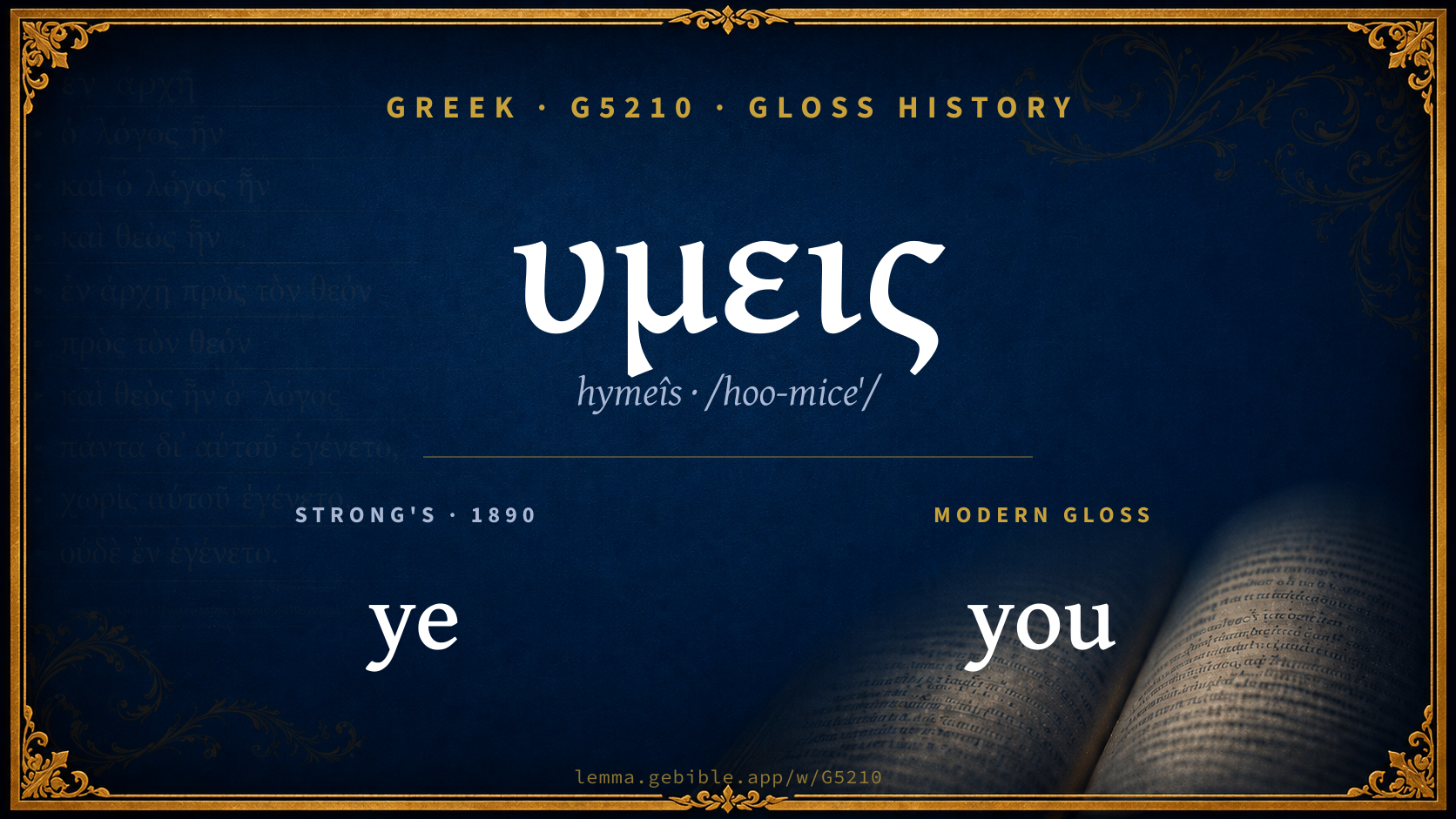
Gloss history
Strong's 1890 vs modern scholarship
About this word
Strong's G5210 catalogs a Greek word from the Greek New Testament.
These counts are not copied from any lexicon or concordance. They are computed here, from the morphology-tagged Greek New Testament. What Lemma adds →
- 1,338
- distinct verses
- The word appears in 1,338 distinct verses.
- 26 / 27
- NT books
- The word appears in 26 of 27 New Testament books.
- #8
- by frequency
- Top 10 most frequent Greek words (rank 8 of 5,347 Greek words by occurrence).
View all 1,338 occurrences in the concordance →
By section of the New Testament
By traditional corpus
Conventional, traditional groupings — biblical authorship is debated, so this is a traditional corpus grouping, not an authorship claim. Some books belong to more than one corpus (Luke is in both the Gospels and the Lukan corpus, and so on), so these shares overlap and need not total 100%. Each figure is a share of the word’s 1,338 distinct verses.
- Gospels 566 verses · 42%
- Pauline corpus 525 verses · 39%
- Lukan (Luke–Acts) 256 verses · 19%
- Johannine 194 verses · 14%
- General (Catholic) Epistles 121 verses · 9%
- Hebrews 28 verses · 2%
- Revelation 9 verses · 1%
How translations render this word
Counts come from each version’s own published word-to-Strong’s tagging or interlinear alignment — an approximate guide to how each version renders this word, not a word-level alignment the data otherwise carries. Because each total is that version’s own tagged count, the per-version totals vary from one another and need not match the appearance or distinct-verse counts above. These counts may also differ from a printed concordance because Lemma counts each distinctly tagged rendering and does not collapse phrase taggings into a single head-word total. This is a fixed set of word-tagged versions (KJV, ASV, BSB, ULT) and does not change with the reading translation you choose elsewhere. Each version’s license is shown beside its name below (and on Sources).
- King James Version: Ye 229×, Do ye 3×, Thither ye 2×
- American Standard Version: Ye 220×, Do ye 4×
King James Version Public Domain
Renders G5210 across 242 tagged occurrences — most commonly:
Plus 8 renderings that appear only once — usually multi-word phrases or single function words the recovered tagging swept in, not distinct renderings.
American Standard Version Public Domain
Renders G5210 across 237 tagged occurrences — most commonly:
Plus 13 renderings that appear only once — usually multi-word phrases or single function words the recovered tagging swept in, not distinct renderings.
Senses in Thayer's
The 1 sense Thayer's distinguishes for this word, in lexicon order (not ranked by frequency or importance). The full entry — with sub-senses — is in the Lexicon Entry tab.
- you
Word origin
Derived from συ (sý) (G4771) — you.
Irregular plural of G4771 ; you (as subject of verb): - ye (yourselves) you.
— Strong’s Exhaustive Concordance (1890), public domain.
Forms in the corpus
The 5 distinct written forms G5210 takes in the Greek New Testament, most frequent first — each parse links to that case’s occurrences in the concordance.
| Form | Parsing | Example | Uses |
|---|---|---|---|
| ὑμῖν hymîn | Personal pronoun, 2nd person, Dative, Plural | Matthew 3:7 | 601 |
| ὑμῶν hymō̂n | Personal pronoun, 2nd person, Genitive, Plural | Matthew 5:11 | 560 |
| ὑμᾶς hymâs | Personal pronoun, 2nd person, Accusative, Plural | Matthew 3:11 | 432 |
| ὑμεῖς hymeîs | Personal pronoun, 2nd person, Nominative, Plural | Matthew 5:48 | 230 |
| Ὑμεῖς Hymeîs | Personal pronoun, 2nd person, Nominative, Plural | Matthew 5:13 | 5 |
Same root — word family
Other Thayer's entries built from the same root as G5210, grouped by Strong’s listed origin. These share a root / origin per the lexicon — not necessarily a shared meaning. Each links to that word’s own entry.
Derives from
Shares the same root
Derived from this word
Compare all same-root words → Showing 4 of 10 — not the complete family. They share a root, not necessarily a meaning.
Septuagint usage
The same Greek word υμεις appears 3 times in the Greek Old Testament (Septuagint), across 3 verses in 1 book.
- 3
- LXX occurrences
- Tagged occurrences of this Greek word in the Septuagint.
- 3
- verses
- Distinct Septuagint verses containing this word.
- 1 / 39
- OT books
- The word appears in 1 of the 39 Old Testament books.
Sample Septuagint occurrences
- Jeremiah 41:17 ὑμεῖς
Septuagint occurrences (same lexeme)
Every verse where the same Strong’s number (G5210) appears in the Greek Septuagint. Verse text shown in the World English Bible for context; the Greek form is the matched word — the English is not keyword-highlighted.
- Jeremiah 41:17 ὑμεῖς and they departed, and lived in Geruth Chimham, which is by Bethlehem, to go to enter into Egypt,
- Jeremiah 51:2 ὑμεῖς I will send to Babylon strangers, who shall winnow her; and they shall empty her land: for in the day of trouble they shall be against her round about.
- Jeremiah 51:25 ὑμεῖς Behold, I am against you, destroying mountain, says Yahweh, which destroy all the earth; and I will stretch out my hand on you, and roll you down from the rocks, and will make you a burnt mountain.
These are occurrences of the same Greek lexeme (G5210) in the Septuagint — not a translation of any one Hebrew word. The store carries no word-level Hebrew↔Greek alignment, so no Hebrew original is asserted here. Counts come from the recovered LXX Strong's tagging — high-frequency vocabulary is well covered, while rare or late forms may be untagged — so they reflect tagged occurrences and may slightly undercount.