
Matthew 5:23

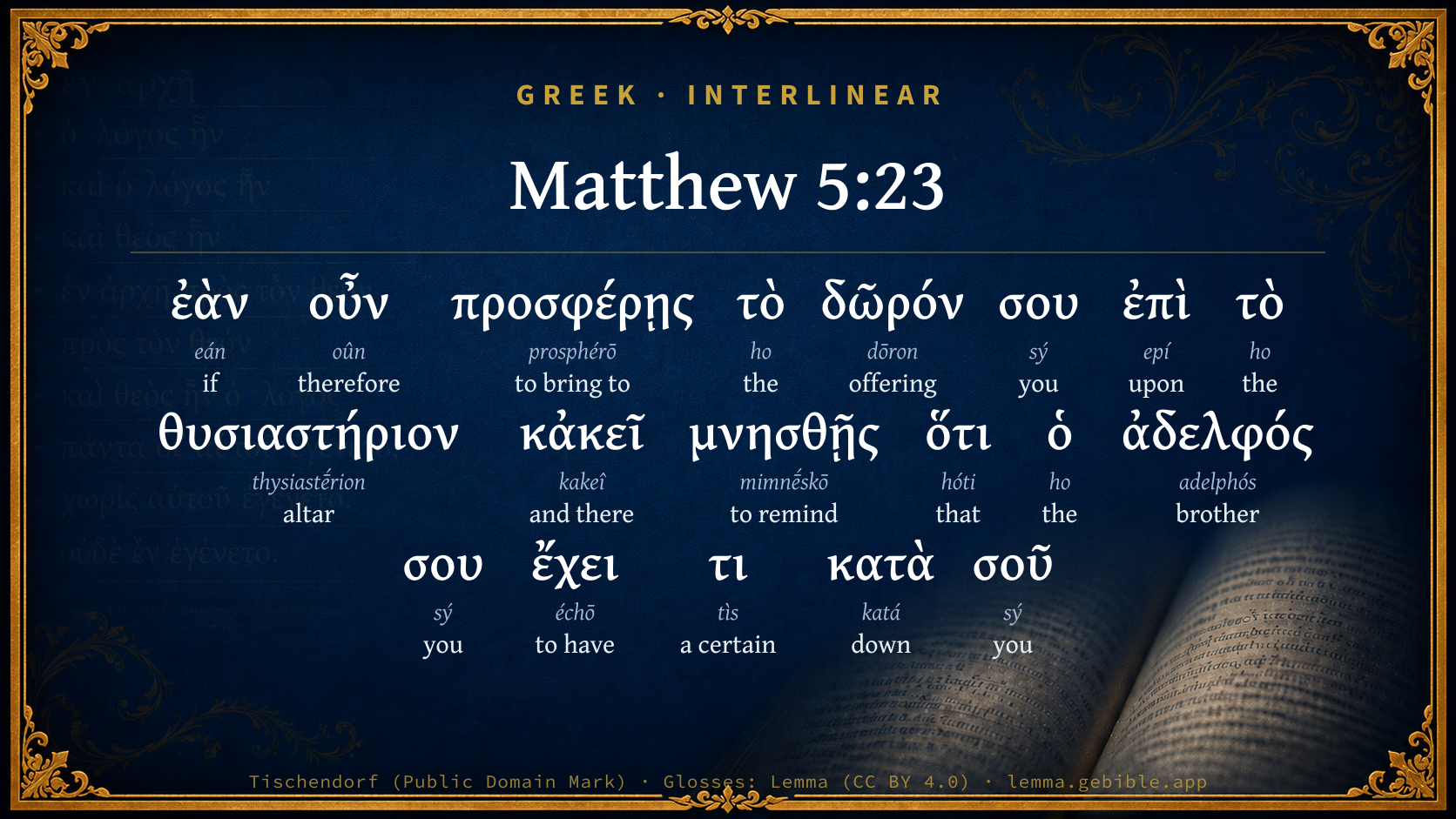
Greek (Tischendorf 8th ed.) Matthew 5:23 appears in the Greek New Testament. The text above is from the Tischendorf 8th edition. Each word links to its Strong’s number and a concise gloss. Click any word for its full Thayer’s Greek Lexicon entry.
Download image
Cite this verse

Matthew 5:23 (World English Bible). Public Domain. Lemma interlinear Bible study tool, https://lemma.gebible.app/v/matthew/5/23.

Show BibTeX & RIS
BibTeX
RIS
English Translation
"If therefore you are offering your gift at the altar, and there remember that your brother has anything against you,
World English Bible · Public Domain
Highlights
  • 4 first appearances in the Greek New Testament
Full analysis ↓
Download a study sheet

One document with this verse’s original text, its word-by-word gloss line, the meaning frame, cross-references with their text, attributed commentary, and full source and license credits — printable, and it pastes into notes with its structure intact.

This verse Autodidact and up

Study sheet (.html) Plain text (.txt)

A passage Seminary Student

Up to 50 verses in one chapter. A passage sheet keeps up to 6 commentary sources and 12 cross-references per verse, in the order this page ranks them, and says so on the sheet whenever that leaves anything out. Ask for a single verse and you get the Autodidact verse sheet above.

Everything on this page stays free to read, with no account — the sheet is a download of what is already on screen, not access to it.

Want to remove ads? Support Godless Engineer
Compare translations 3

The same verse in 3 English versions, stacked beneath the original-language interlinear above. Click any original word for its lexicon entry.

Each is an independent rendering of the whole verse — the interlinear is not word-aligned to these translations.

Highlighted words mark where these versions differ — a whole-verse word diff, not a word-by-word alignment.

  • World English Bible Public Domain
    "If therefore you are offering your gift at the altar, and there remember that your brother has anything against you,
  • King James Version Public Domain
    Therefore if thou bring thy gift to the altar, and there rememberest that thy brother hath ought against thee;
  • unfoldingWord Literal Text CC BY-SA 4.0
    Therefore, if you offer your gift at the altar and there you remember that your brother has something against you,

unfoldingWord Literal Text — © unfoldingWord, licensed CC BY-SA 4.0. Word-aligned USFM3 via Door43 (git.door43.org/unfoldingWord/en_ult).

Versions to compare (up to 4)

3 of 4 selected

Show all 19 translations

Every available English version of this verse, each an independent rendering of the whole verse.

  • World English Bible Public Domain
    "If therefore you are offering your gift at the altar, and there remember that your brother has anything against you,
  • Berean Standard Bible Public Domain
    So if you are offering your gift at the altar and there remember that your brother has something against you,
  • Majority Standard Bible Public Domain
    So if you are offering your gift at the altar and there remember that your brother has something against you,
  • King James Version Public Domain
    Therefore if thou bring thy gift to the altar, and there rememberest that thy brother hath ought against thee;
  • American Standard Version (1901) Public Domain
    If therefore thou art offering thy gift at the altar, and there rememberest that thy brother hath aught against thee,
  • Revised Version (1885) Public Domain
    If therefore thou art offering thy gift at the altar, and there rememberest that thy brother hath aught against thee,
  • Geneva Bible (1599) Public Domain
    If then thou bring thy gift to the altar, and there remembrest that thy brother hath ought against thee,
  • Douay-Rheims (1899) Public Domain
    If therefore thou offer thy gift at the altar, and there thou remember that thy brother hath any thing against thee;
  • Young's Literal Translation Public Domain
    `If, therefore, thou mayest bring thy gift to the altar, and there mayest remember that thy brother hath anything against thee,
  • Literal Standard Version CC BY-SA 4.0
    If, therefore, you may bring your gift to the altar, and there may remember that your brother has anything against you,
  • Unlocked Literal Bible CC BY-SA 4.0
    Therefore if you are offering your gift at the altar and there remember that your brother has anything against you,
  • unfoldingWord Literal Text CC BY-SA 4.0
    Therefore, if you offer your gift at the altar and there you remember that your brother has something against you,
  • Darby Bible Public Domain
    If therefore thou shouldest offer thy gift at the altar, and there shouldest remember that thy brother has something against thee,
  • World Messianic Bible Public Domain
    “If therefore you are offering your gift at the altar, and there remember that your brother has anything against you,
  • Webster's Bible Public Domain
    Therefore if thou shalt bring thy gift to the altar, and there remember that thy brother hath aught against thee;
  • Free Bible Version CC BY-SA 4.0
    If you're at the altar making an offering, and remember that your brother has something against you,
  • Bible in Basic English Public Domain
    If then you are making an offering at the altar and there it comes to your mind that your brother has something against you,
  • Text-Critical English NT CC BY 4.0
    So if yoʋ are offering yoʋr gift at the altar and there remember that yoʋr brother has something against yoʋ,
  • Tyndale New Testament (1534) Public Domain
    Therfore when thou offrest thy gifte at the altare and their remembrest that thy brother hath ought agaynst the:

Literal Standard Version (2020), Covenant Press — licensed CC BY-SA 4.0. Text via the HelloAO Bible API (eBible.org). Unlocked Literal Bible (unfoldingWord) — licensed CC BY-SA 4.0. Text via the HelloAO Bible API (eBible.org). unfoldingWord Literal Text — © unfoldingWord, licensed CC BY-SA 4.0. Word-aligned USFM3 via Door43 (git.door43.org/unfoldingWord/en_ult). Free Bible Version, Dr. Jonathan Gallagher — licensed CC BY-SA 4.0. Text via the HelloAO Bible API (eBible.org).

Word by word

More ways to search: Search by grammar → Find every occurrence → Compare this word →

Practice this passage: Drill this verse → Learn its vocabulary →

κἀκεῖ
kakeî
G2546
“and there”
Adverb, Aramaic form
Part of Speech
Adverb
Degree
Aramaic form
Full Thayer's Definition

Origin: from G2532 and G1563

TDNT: None

1. and there 2. there also
  1. ἐὰν eán G1437 “if” Conditional
  2. οὖν oûn G3767 “therefore” Conjunction
  3. προσφέρῃς prosphérō G4374 “to bring to” Verb, Present, Active, Subjunctive, 2nd person, Singular
  4. τὸ ho G3588 “the” Article, Accusative, Singular, Neuter
  5. δῶρόν dōron G1435 “offering” Noun, Accusative, Singular, Neuter
  6. σου sý G4771 “you” Personal pronoun, 2nd person, Genitive, Singular
  7. ἐπὶ epí G1909 “upon” Preposition
  8. τὸ ho G3588 “the” Article, Accusative, Singular, Neuter
  9. θυσιαστήριον thysiastḗrion G2379 “altar” Noun, Accusative, Singular, Neuter
  10. μνησθῇς mimnḗskō G3403 “to remind” Verb, Aorist, Passive, Subjunctive, 2nd person, Singular
  11. ὅτι hóti G3754 “that” Conjunction
  12. ὁ ho G3588 “the” Article, Nominative, Singular, Masculine
  13. ἀδελφός adelphós G80 “brother” Noun, Nominative, Singular, Masculine
  14. σου sý G4771 “you” Personal pronoun, 2nd person, Genitive, Singular
  15. ἔχει échō G2192 “to have” Verb, Present, Active, Indicative, 3rd person, Singular
  16. τι tìs G5100 “a certain” Indefinite pronoun, Accusative, Singular, Neuter
  17. κατὰ katá G2596 “down” Preposition
  18. σοῦ sý G4771 “you” Personal pronoun, 2nd person, Genitive, Singular

About this verse

These counts appear in no published source. They are computed here, from the morphology-tagged text and Lemma’s own curated glosses. What Lemma adds →

19
words
15
distinct lemmas
Gospels
section

Notable vocabulary

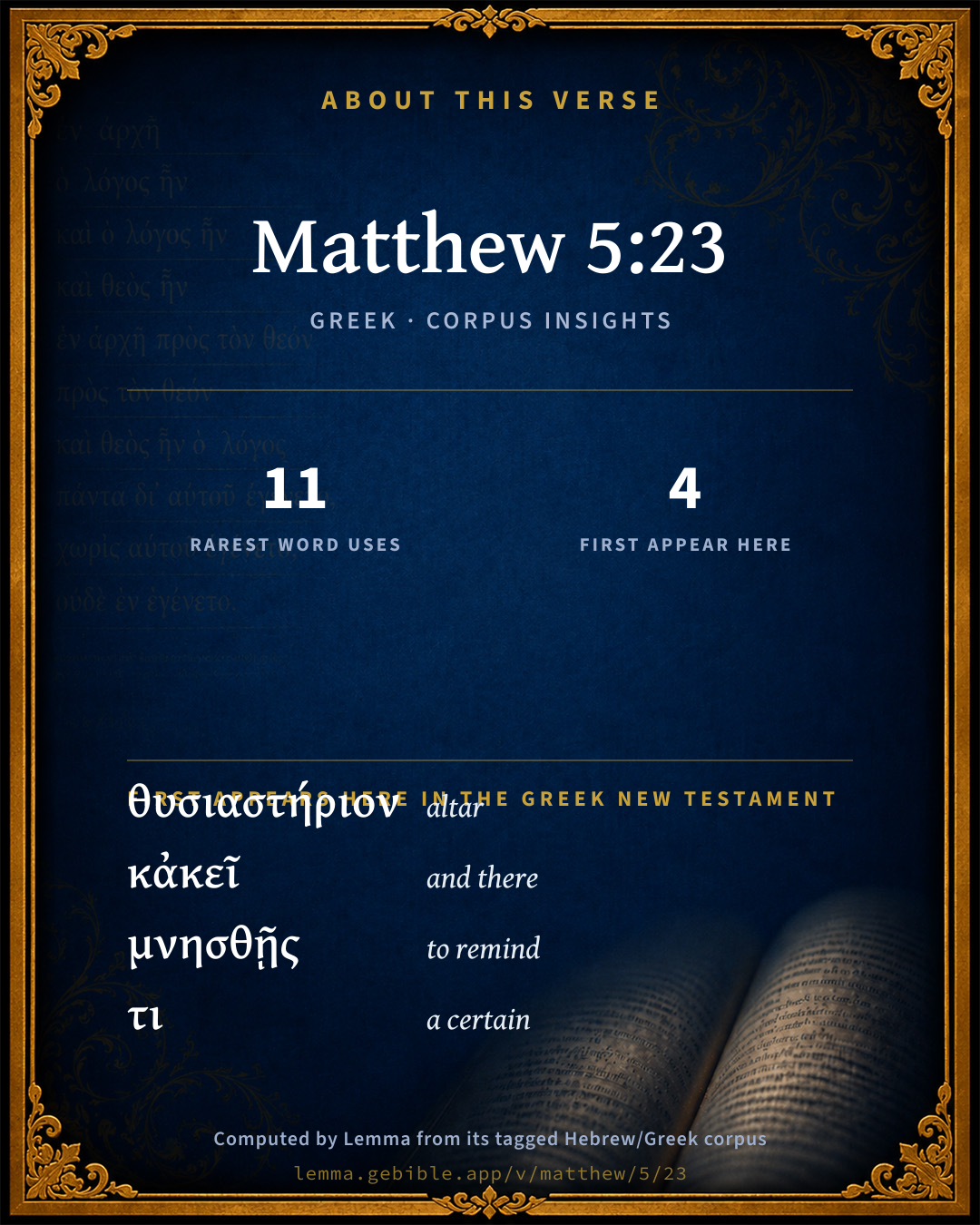
The rarest word here is κἀκεῖ and there G2546 — appearing just 11 times in the whole Greek New Testament.

First appearance in Scripture

These words make their first canonical appearance in the Greek New Testament here:

  • θυσιαστήριον altar G2379
  • κἀκεῖ and there G2546
  • μνησθῇς to remind G3403
  • τι a certain G5100

Shared distinctive vocabulary

κἀκεῖ and there G2546 occurs in 11 verses of the Greek New Testament. Also found in:
Repetition

Words recur within this verse:

Cross-references

14

Topical passages linked to Matthew 5:23 in the Treasury of Scripture Knowledge — connected by theme and wording, ordered by reader-vote popularity; previews shown in the World English Bible.

  • Mark 11:25 Whenever you stand praying, forgive, if you have anything against anyone; so that your Father, who is in heaven, may also forgive you your transgressions.
  • Leviticus 6:2–6 "If anyone sins, and commits a trespass against Yahweh, and deals falsely with his neighbor in a matter of deposit, or of bargain, or of robbery, or has oppressed his neighbor,
  • Matthew 5:24 leave your gift there before the altar, and go your way. First be reconciled to your brother, and then come and offer your gift.
  • Matthew 8:4 Jesus said to him, "See that you tell nobody, but go, show yourself to the priest, and offer the gift that Moses commanded, as a testimony to them."
  • Matthew 23:19 You blind fools! For which is greater, the gift, or the altar that sanctifies the gift?
  • Luke 19:8 Zacchaeus stood and said to the Lord, "Behold, Lord, half of my goods I give to the poor. If I have wrongfully exacted anything of anyone, I restore four times as much."
  • 1 Samuel 15:22 Samuel said, Has Yahweh as great delight in burnt offerings and sacrifices, as in obeying the voice of Yahweh? Behold, to obey is better than sacrifice, and to listen than the fat of rams.
  • Hosea 6:6 For I desire mercy, and not sacrifice; And the knowledge of God more than burnt offerings.
  • Isaiah 1:10–17 Hear the word of Yahweh, you rulers of Sodom! Listen to the law of our God, you people of Gomorrah!
  • Lamentations 3:20 My soul still remembers them, and is bowed down within me.
  • Amos 5:21–24 I hate, I despise your feasts, And I can't stand your solemn assemblies.
  • Genesis 50:15–17 When Joseph's brothers saw that their father was dead, they said, "It may be that Joseph will hate us, and will fully pay us back for all of the evil which we did to him.
  • 1 Kings 2:44 The king said moreover to Shimei, You know all the wickedness which your heart is privy to, that you did to David my father: therefore Yahweh shall return your wickedness on your own head.
  • Ezekiel 16:63 that you may remember, and be confounded, and never open your mouth any more, because of your shame, when I have forgiven you all that you have done, says the Lord Yahweh.

Cross-references courtesy of OpenBible.info (CC BY 4.0).

Commentary

Notes on Matthew 5:23 from classic Christian and Jewish commentators (each source and its license shown beneath its notes). The classic Christian expositions comment on the surrounding passage and are grouped to its opening verse, so a note may address several verses; the Jewish commentaries on the Tanakh (Rashi and others) are per-verse, so they appear only where the commentator wrote on this verse.

Lemma curates 59 commentaries, every one of them public domain or Creative Commons licensed, each selected and text-cleaned for this edition rather than reprinted as found. About our sources →

The Biblical Illustrator

Joseph S. Exell

Mat_5:23-24

Be reconciled to thy brother.

Mutual conciliation

I. That a worshipper of God may be in a state of discord in reference to his brother.

II. That public worship rightly used is one of the means to detect and remove this wrong affection. It leads to reflection.

III. Conciliation is of superior value even to public worship.

IV. That it is the duty of brethren to be immediately conciliated. (Caleb Morris.)

I. In order to worship God acceptably, we must do justice to our fellow-men. Our worship will not be acceptable, unless we do all we can to live peaceably with others.

II. It is our duty to seek reconciliation with others when we have injured them.

III. This should be done before we attempt to worship God. This is often the reason why God does not accept our offerings, and we go empty away from our devotions. We do not do what we ought to do to others; we cherish improper feelings, or refuse to make proper acknowledgments, and God will not accept such attempts to worship Him. (Dr. A. Barnes.)

I. Observe the word brother.

1. So God teaches thee to call every one.

2. Think with what tenderness and love thou oughtest, and perhaps wouldst behave to him, if he really were such.

II. Does not Christ Himself call the Scribes and Pharisees fools? Truly; but with Divine compassion, to rouse them to a consideration of their state.

(1) The sin is in the anger, the scorn,

(2) the pride of heart in one sinner towards another.

III. Nothing will be accepted from thee in this disposition.

1. Agree with thy brother.

2. The loss of an hour may be the loss of thy soul. (Thomas Adam.)

The Biblical Illustrator, edited by Joseph S. Exell (c. 1880s–1900s) — public domain. Text from a community e-Sword module.

Joseph Benson's Commentary

Mat 5:23. Therefore, &c. — “Because men are very apt to fall into rash anger, and to express their anger by contemptuous speeches and abusive names, fancying that there is no sin in these things, or but little, and that the compensation may easily be made for them by acts of devotion, Jesus declares that atonement is not to be made for these offences by any offerings, how costly soever, and therefore prescribes immediate repentance and reparation as the only remedies of them. He insisted particularly on reparation, assuring us that, unless it be made, God will not accept the worship of such offenders, being infinitely better pleased with repentance than with sacrifices, or external worship of any kind, how specious soever those duties may appear in the eye of vulgar understandings. Vain, therefore, is their presumption, who fancy they can make amends for yet more gross acts of injustice, by acts of devotion.” — Macknight. If thou bring thy gift to the altar — However costly and free; and there rememberest — What thou didst not recollect before; that thy brother hath aught against thee — On any of the preceding accounts, for any reproachful or unkind word, or injurious action: do not content thyself with a secret, and, it may be, a deceitful purpose that thou wilt hereafter accommodate the affair, but bring it to an immediate issue. Leave there thy gift before the altar — In the hands of those that are ministering there: for neither thy gift nor thy prayer will atone for thy want of love and injurious conduct, but these will make thy devotions and oblations an abomination before God. Go thy way — Do not lay aside thoughts of worshipping God, because thou art not in a proper state, but prepare thyself for his worship without delay. Be reconciled to thy brother, and then come and offer thy gift — Which thou mayest then cheerfully hope God will accept at thy hand. Philo, (de Sacrif., p. 844,) explaining the law of the trespass- offering, tells us, “That when a man had injured his brother, and, repenting of his fault, voluntarily acknowledged it, (in which case, both restitution and sacrifice were required,) he was first to make restitution, and then to come into the temple, presenting his sacrifice, and asking pardon.” This greatly illustrates the text, especially considering that our Lord supposes, in this case, not a trespass-offering, but a voluntary gift, presented before the altar; and yet declares that this will not be accepted while there is a consciousness of having wronged a brother, and not made him reparation.

Joseph Benson's Commentary on the Old and New Testaments (1811–1818) — public domain. Text from a community e-Sword module.

Tyndale Open Study Notes

Tyndale Open Resources

5:23-26 Jesus gives two illustrations of reconciliation in community and society.

Tyndale Open Study Notes — © Tyndale Open Resources, licensed CC BY-SA 4.0. Text via the HelloAO Bible API.

Bengel's Gnomon

Johann Albrecht Bengel

Mat 5:23. Ἐὰν οὖν, κ.τ.λ., if therefore, etc.) Reconciliation is not said to be only then necessary, for the word ἐκεῖ, there) indicates that you ought to have remembered it before; but the meaning is, Whatever you are doing, even if you have already undertaken the best and most holy and most necessary matter, leave everything until you have been reconciled to your brother: see Eph 4:26. They sin who do not make it up with their brother, until they are just about to receive the Holy Supper. Yet reconciliation is especially necessary, and an examination of the conscience especially imperative on those who are about to perform the most solemn act of devotion.—ἐπὶ, to) For it was the part of the priest to offer on the altar, and afterwards occurs the expression, ἔμπροσθεν τοῦ θυσιαστηρίου, before the altar.—καὶ ἐκεῖ μνησθῇς, and there rememberest) The word of God portrays the most hidden secrets of the human heart. In the performance of a sacred rite, the remembrance of offences arises more naturally, than in the noise of human affairs.—ἔχει, hath) as having been offended [by thee].

Bengel's Gnomon of the New Testament — English translation (T&T Clark, Edinburgh, 1860) — public domain. Text from a community e-Sword module.

Meyer's Critical & Exegetical Commentary

Heinrich August Wilhelm Meyer

Mat_5:23 f. Ἐὰν … προσφέρῃς] If thou, then, art about to present thy sacrifice (δῶρον, Mat_8:4, Mat_15:5, Mat_23:18, also in the LXX., Apocrypha, and Greek writers); consequently, art already occupied with the preparation of the same in the temple.[408] This explanation is required by the words ἔμπροσθεν τοῦ θυς. (ad aram), Mat_5:24.

ἐπὶ τὸ θυσιαστ.] to the altar, in order that the priests may offer it upon the same.

κἀκεῖ μνησθῇς, κ.τ.λ.] inter rem sacram magis subit recordatio offensarum, quam in strepitu negotiorum, Bengel. The injured part is the ἀδελφός; differently in Mar_11:25, where forgiveness is required.

ἔμπροσθ. τοῦ θυσιαστ.] A closer definition added to ἐκεῖ.

πρῶτον] in the first place (Mat_6:33), before everything else, what thou now hast to do. Compare τότε afterwards. It is to be connected with ὕπαγε (Luther, Erasmus, Castalio, Bengel, and many others; also Gersdorf, p. 107; de Wette, Ewald, Arnoldi, Bleek). Comp. Mat_7:5, Mat_13:30, Mat_23:26. The connection with διαλλάγ. (Beza, Calvin, Er. Schmidt, and many others; also Kuinoel, Fritzsche, Tholuck, and others) overlooks the essential moment which is contained in the connection precisely by the ὕπαγε, the unavoidable, surprising, nay, repellent removal of oneself from the temple. For that ὕπαγε is not here merely an appeal, age, is shown by the context through the words ἄφες ἐκεῖ, etc. In Mat_18:15, Mat_19:21, also, it means abi.

διαλλάγηθι] be reconciled, deal so that a reconciliation may begin with him who has been injured by thee. Comp. 1Sa_29:4, and on the passage 1Co_7:11. In this way the act of sacrifice receives the moral foundation of a disposition pleasing to God, by which it is no mere external work, but is at the same time λογικὴ λατρεία, Rom_12:1. Flacius well remarks, s.v. munus: Vult primam haberi rationem moralium, secundum ceremonialium. Moreover, the distinction asserted by Tittmann to exist between διαλλάσσειν and καταλλάσσειν, that the former denotes the removal of mutual hostility, the latter that of one-sided enmity (Synon. p. 102), is decidedly erroneous. Fritzsche, ad Rom. I. p. 276 ff.

[408] The severance of the Jewish believers from the temple service was only to begin at a later time, Joh_4:21. The Catholic exegesis knows, indeed, how to find here the permanent sacrifice of the Eucharist, regarding which Christ is said in the passage before us to have given a law which is for ever valid, Döllinger, Christenthum und Kirche, p. 250 f., ed. 2.

Meyer — Critical and Exegetical Commentary on the New Testament — English translation by Peter Christie, edited by Frederick Crombie (T&T Clark, 1880) — public domain. Text from a community e-Sword module.

Expositor's Greek Testament

ed. W. Robertson Nicoll

Mat 5:23-24 . Holtzmann (H. C.) regards these verses, as well as the two following, as an addition by the evangelist. But the passage is at least in thorough harmony with what goes before, as well as with the whole discourse. Ἐὰν οὖν προσφέρῃς , if thou art in the very act of presenting thine offering (present tense) at the altar. κἀκεῖ μνησθῇς … κατὰ σοῦ , and it suddenly flashes through thy mind there that thou hast done something to a brother man fitted to provoke angry feeling in him. What then? Get through with thy worship as fast as possible and go directly after and make peace with the offended? No, interrupt the religious action and go on that errand first. ἄφες ἐκεῖ . Lay it down on the spur of the moment before the altar without handing it to the priest to be offered by him in thy stead. καὶ ὕπαγε πρῶτον . The πρῶτον is to be joined to ὕπαγε , not to the following verb as in A. V [22] and R. V [23] ( πρῶτον stands after the verb also in chaps. Mat 6:33 , Mat 7:5 ). First go : remove thyself from the temple, break off thy worship, though it may seem profane to do so. διαλλάγηθι … καὶ τότε … πρόσφερε : no contempt for religious service expressed or implied. Holtzmann (H. C.) asks, did Jesus offer sacrifice? and answers, hardly. In any case He respected the practice. But, reconciliation before sacrifice: morality before religion. Significant utterance, first announcement of a great principle often repeated, systematically neglected by the religion of the time. Placability before sacrifice, mercy before sacrifice, filial affection and duty before sacrifice; so always in Christ’s teaching (Mat 9:13 ; Mat 15:5 ). πρόσφερε : present; set about offering: plenty of time now for the sacred action.

[22] Authorised Version.

[23] Revised Version.

The Expositor's Greek Testament, edited by W. Robertson Nicoll (1897–1910) — public domain. Text from a community e-Sword module.

Geneva Bible (1599)

Geneva Bible translators

He applieth all this speech to the state of his time, when as there was an altar standing in Jerusalem, and therefore they are very foolish, that gather hereupon, that we must build altars, and use sacrifices: but they are more fools, which draw that to purgatory, which is spoken of peacemaking and atonement one with another.

The covetous Pharisees taught that God was appeased by the sacrifices appointed in the Law, which they themselves devoured. But Christ on the contrary side denieth that God accepteth any man’s offering, unless he maketh satisfaction to his brother whom he hath offended: and saith moreover, that these stubborn and stiffnecked despisers of their brethren, shall never escape the wrath and curse of God, before they have made full satisfaction to their brethren.

Geneva Bible (1599) marginal notes — public domain. Text via Bolls.life.

Jamieson, Fausset & Brown

Robert Jamieson, A. R. Fausset & David Brown

Therefore--to apply the foregoing, and show its paramount importance.

if thou bring thy gift to the altar, and there rememberest that thy brother hath aught--of just complaint "against thee."

Jamieson, Fausset & Brown — Commentary Critical and Explanatory on the Whole Bible (1871) — public domain (CC PDM 1.0). Text via the HelloAO Bible API.

Adam Clarke's Commentary

Verse 23. Therefore if thou bring thy gift] Evil must be nipped in the bud. An unkind thought of another may be the foundation of that which leads to actual murder. A Christian, properly speaking, cannot be an enemy to any man; nor is he to consider any man his enemy, without the fullest evidence: for surmises to the prejudice of another can never rest in the bosom of him who has the love of God in his heart, for to him all men are brethren. He sees all men as children of God, and members of Christ, or at least capable of becoming such. If a tender forgiving spirit was required, even in a Jew, when he approached God's altar with a bullock or a lamb, how much more necessary is this in a man who professes to be a follower of the Lamb of God; especially when he receives the symbols of that Sacrifice which was offered for the life of the world, in what is commonly called the sacrament of the Lord's supper!

Adam Clarke's Commentary on the Bible (1810–1826) — public domain. Text from a community e-Sword/MySword module.

Ellicott's Commentary for English Readers

(23) If thou bring thy gift to the altar.—Literally, If thou shouldst be offering. Our Lord was speaking to Jews as such, and paints, therefore, as it were, a scene in the Jewish Temple. The worshipper is about to offer a “gift” (the most generic term seems intentionally used to represent any kind of offering), and stands at the altar with the priest waiting to do his work. That is the right time for recollection and self-scrutiny. The worshipper is to ask himself, not whether he has a ground of complaint against any one, but whether any one has cause of complaint against him. This, and not the other, is the right question at such a moment—has he injured his neighbour by act, or spoken bitter words of him?

A Bible Commentary for English Readers, edited by Charles John Ellicott (1878–1897) — public domain. Text from a community e-Sword module.

The Cambridge Bible for Schools and Colleges

gen. ed. J. J. S. Perowne

23. if thou bring thy gift to the altar] i. e. thy offering, such as a lamb or a pair of doves.

rememberest that thy brother hath ought against thee] that thy brother hath cause of complaint against thee, just or unjust, if the quarrel is still not made up.

The Cambridge Bible for Schools and Colleges (gen. ed. J. J. S. Perowne; Cambridge University Press, 1878–1918) — public domain. Text from a community e-Sword module.

John Gill's Exposition

Therefore, if thou bring thy gift to the altar,.... The Jews obliged such who had done any damage to their neighbours, by stealing from them, to make satisfaction before they brought their offering; concerning which they say (c),

"he that brings what he has stolen, before he brings his trespass offering, is right; he that brings his trespass offering, before he brings that which he has stolen, is not right.''

Again (d),

"they do not bring the trespass offering before the sum of what is stolen is returned, either to the owners, or to the priests.''

Some have thought Christ refers to this; only what they restrained to pecuniary damages, he extends to all sorts of offences. But not a trespass offering, but a freewill offering, seems to be designed by "the gift": which, when a man either intended to bring, or was going to bring, or had already brought, as a voluntary sacrifice to be offered unto God; and it came into his mind, that he had offended any man by showing any undue passion, or by any reproachful words, then he was to do what is advised in the following verse: "and there", whilst going, or when at the altar,

rememberest that thy brother hath ought against thee: hath anything to charge thee with; any just ground of complaint against thee; if thou hast done him any injury, or given him any offence: particularly, if he had at any time said Raca to him, or called him "fool" for those words have reference to what goes before, and are a corollary, or conclusion from them, as appears from the causal particle "therefore".

(c) Misn. Bava Kama, c. 9. sect. 12. (d) Maimon. Hilch. Gezela, c. 8. sect. 13.

John Gill's Exposition of the Whole Bible (1746–1763) — public domain (CC PDM 1.0). Text via the HelloAO Bible API.

Trapp's Complete Commentary

John Trapp

23 Therefore if thou bring thy gift to the altar, and there rememberest that thy brother hath ought against thee;

Ver. 23. Therefore if thou bring thy gift to the altar] To anger our Saviour here opposeth charity, which suffereth long and is kind. Charity envieth not, nor is rash, &c.; but beareth all things, believeth all things, hopeth all things, endureth all things. Strangers we must love as ourselves, Luk 10:27-28; but brethren, as Christ loved us, with a preventing constant love, Joh 15:15, notwithstanding provocations to the contrary.

That thy brother hath aught against thee] As justly offended by thee: see the like phrase, Luk 7:39; Rev 2:4. If either thou have given offence carelessly, or taken offence causelessly. And two flints may as soon smite together, and not fire come out, as people converse together, and not offences happen. Now, if it be a great offence, a considerable injury, to the just grief or disgrace of another, satisfaction must be given, and reconciliation sought (at least), ere the service can be accepted. For how can we look our Father in the face, or ask him blessing, when we know that he knows there is hatred or heart burning between us and our brethren?

John Trapp, A Commentary or Exposition upon All the Books of the Old and New Testament (1647–1656) — public domain. Text from a community e-Sword module.

Albert Barnes' Notes on the Bible

Therefore, if thou bring thy gift to the altar ... - The Pharisees were intent only on the external act in worship. They looked not at all to the internal state of the mind. If a man conformed to the external rites of religion, however much envy, and malice, and secret hatred he might have, they thought he was doing well. Our Saviour taught a different doctrine. It was of more consequence to have the heart right than to perform the outward act. If, therefore, says he, a man has gone so far as to bring his gift to the very altar, and should remember that anyone had anything against him, it was his duty there to leave his offering and go and be reconciled. While a difference of this nature existed, his offering could not be acceptable. He was not to wait until the offended brother should come to him; he was to go and seek him out, and be reconciled. So now the worship of God will not be acceptable, however well performed externally, until we are at peace with those that we have injured. “To obey is better than sacrifice,” 1Sa 15:22. He that comes to worship his Maker filled with malice, and hatred, and envy, and at war with his brethren, is a hypocritical worshipper, and must meet with God’s displeasure. God is not deceived, and he will not be mocked.

Thy gift - Thy sacrifice. What thou art about to devote to God as an offering.

To the altar - The altar was situated in front of the temple, and was the place on which sacrifices were made. See the notes on plan, Mat 21:12. To bring a gift to the altar was expressive of worshipping God, for this was the way in which he was formerly worshipped.

Thy brother - Any man, especially any fellow-worshipper. Anyone of the same religious society.

Hath aught - Is offended, or thinks he has been injured by you in any manner.

First be reconciled - This means to settle the difficulty; to make proper acknowledgment or satisfaction for the injury. If you have wronged him, make restitution. If you owe him a debt which ought to be paid, pay it. If you have injured his character, confess it and seek pardon. If he is under an erroneous impression, if your conduct has been such as to lead him to suspect that you have injured him, make an explanation. Do all in your power; and all you ought to do, to have the matter settled. From this we learn:

That, in order to worship God acceptably, we must do justice to our fellow-men. Our worship will not be acceptable unless we do all we can to live peaceably with others. It is our duty to seek reconciliation with others when we have injured them. This should be done before we attempt to worship God. This is often the reason why God does not accept our offerings, and we go empty away from our devotions. We do not do what we ought to others; we cherish improper feelings or refuse to make proper acknowledgments, and God will not accept such attempts to worship him.

Albert Barnes' Notes on the Bible (1834–1885) — public domain. Text from a community e-Sword/MySword module.

Haydock's Catholic Bible Commentary

He commands us to leave unfinished any work we may have begun, though in its own nature most acceptable to God, in order to go and be reconciled to our brother; because God will have mercy and not sacrifice. Thus he in a manner seems to prefer the love of our neighbour to the love of himself. (Menochius)

George Leo Haydock (1774–1849), Haydock's Catholic Family Bible and Commentary, 1859 edition — public domain. Excludes Psalms (Douay-Rheims chapter numbering differs from Protestant) and Deuterocanonical books (Catholic canon only).

Matthew Poole's English Annotations

The Jews were to offer gifts and sacrifices, Heb 5:1. Their gifts were their free will offerings, they were the most frequent oblations amongst the Jews, as may appear from Leviticus, and what the priests pressed with the greatest importunity, as may appear from Mar 7:11; therefore our Saviour instanceth in these, rather than in other parts of their worship. Bring unto God the best and most acceptable sacrifices (in your or, the teacher’s judgment) that you can, if there be found malice or rash anger in your hearts, God will not accept them. Therefore, how near soever you be come to a religious action, if you there remember that your brother hath a just reason to be offended with you, for any malice or rash anger showed or expressed by you, do not think this will discharge you of your obligation to pay your homage to God; but forbear a while,

leave your gift before the altar, and do what in you lies to be reconciled to your brother, to have a placable spirit to him, to purge your heart of wrath and malice, and any desire of revenge,

and then come and offer your gift, pay that homage which you owe, and it was in your heart to pay to God. It is a text usually applied with reference to communion with God in the Lord’s supper, but equally extensive to any other part of worship, hearing the word, Jam 1:21, and prayer, 1Ti 2:8. God accepteth no service, no homage, from an implacable, malicious heart.

Matthew Poole's English Annotations on the Holy Bible (1683–1685) — public domain. Text from a community e-Sword/MySword module.

Whedon's Commentary on the Bible

Daniel D. Whedon

23. Therefore — As an inference drawn from the severe penalties affixed in the last verse to all injuries, even in purpose, committed by us against another. If thou bring thy gift to the altar — The image is taken from the sacrifices of the Old Testament. It stands as a symbol for all drawing nigh to God under the new dispensation. Our bringing our gift is the presentation of any worship or service to God. Rememberest — In that state of recollectedness and self-examination which true worship implies. Hath aught against thee — Aught, or anything, that is, of any of the injuries specified in the last verse. Observe, our Lord is not referring to the case where we are angry, because some one hath injured us. It is the case in which we have injured another, and have made no proper reparation.

Daniel D. Whedon (gen. ed.), Commentary on the Old and New Testaments (1874–1909) — public domain. Text from a community e-Sword module.

The Pulpit Commentary

Therefore. Seeing that the consequences of an angry spirit are so terrible. For there is no thought here of an unforgiving spirit spoiling the acceptance of the gift (vide infra). Our Lord is insisting that it is so important to lose no time in seeking reconciliation with a person whom one has injured, that even the very holiest action must be put off for it. If thou bring; Revised Version, if... thou art offering; ean ... prosferhv (similarly, proshere , ver. 24), the technical word coming some sixty times in Leviticus alone. Christ implies that the action has already begun. Thy gift; a general word for any sacrifice. To the altar . Since those to whom he spoke were still Jews, Christ illustrates his meaning by Jewish practices. A perverse literalism has found here a direct reference to the Eucharist. For reasonable adaptations (cf. even in "Didache," of these two verses to this, see Waterland, "Doctrine of the Eucharist," ch. 13. (pp. 359-362, Oxford, 1868). And there rememberest, etc. For the spirit of recollection may well culminate with the culminating action. Lightfoot ("Hor. Hebr.") shows that even the Jews taught such a postponement of the sacrifice if theft was remembered. He therefore thinks that the stress is on "ought" (ti): "For that which the Jews restrained only to pecuniary damages, Christ extends to all offences against our brother." But he overlooks.the fact that, while the Jewish precept had reference to a sin (or even the neglect of some ceremonial rule, of. Mishna, "Pes.," 3:7) vitiating the offering, there is no thought of this hero (vide supra). Thy brother (ver. 22, note). Ought. So from Tyndale downwards. Revised Version, aught, here and apparently always, after the spelling now preferred as marking the difference from the verb.

The Pulpit Commentary (1880–1919), ed. H.D.M. Spence-Jones & Joseph S. Exell — public domain. Text from a community e-Sword module.

John Wesley's Explanatory Notes

Thy brother hath aught against thee - On any of the preceding accounts: for any unkind thought or word: any that did not spring from love.

John Wesley, Explanatory Notes Upon the Whole Bible (1754–1765) — public domain. Text via the GEBible commentary corpus.

Kretzmann's Popular Commentary

Paul E. Kretzmann

Jesus presents the positive side of His exposition:

v. 23. Therefore, if thou bring thy gift to the altar, and there rememberest that thy brother hath aught against thee,

v. 24. leave there thy gift before the altar, and go thy way, first be reconciled to thy brother, and then come and offer thy gift.

The forgiving attitude is pictured from a happening which was very frequent among the Jews, with which they were thoroughly familiar. A Jew might bring his Corban, his gift, used of every kind of bloody and unbloody sacrifice which was brought to the Temple, Mat 8:4; Mat 15:5; Mat 23:8. But in the very act of handing it to the officiating priest at the altar there comes the remembrance. It suddenly flashes into his mind that he has been guilty of an act or a word which might have provoked a brother. The natural way of dealing with the situation might seem to be to keep on with the worship, get through as quickly as possible, and then hurry to make peace with the offended. But Christ tells us to interrupt our worship and go on the errand of seeking forgiveness first, though it may seem profane to do so. It is more important that the heart be free from anxiety for a brother’s peace of mind than that an external rite be performed: mercy before sacrifice. There will be plenty of time for sacrificing afterward. See Isa 58:4-7.

Paul E. Kretzmann, Popular Commentary of the Bible (1921–1924) — public domain. Text from a community e-Sword module.

Burkitt's Expository Notes on the New Testament

William Burkitt

For preventing the sin of rash anger, which in our Savior’s account is a degree of murder, he exhorts all his disciples and followers to brotherly agreement, and to seek mutual reconciliation with each other. Agree with thine adversary, that is, thy offended or offending brother; agree with him, as becomes a man; quickly, as becomes a Christian; implying, that it is a necessary duty for every Christian to seek reconciliation sincerely and speedily with such as have offended him, or have been offended by him.

Observe, 2. The argument or motive with which Christ enforces his exhortation to brotherly reconciliation, drawn from the peril and danger of the neglect; and this is two-fold: The first respects our present duties and services, when we wait upon God at his altar, and attend upon him in holy offices. None of our performances will find malice and hatred, anger and ill-will, against our brother.

Learn, that no sacrifice we can offer will be acceptable to God, so long as we ourselves are implacable to men.

A second danger respects us, when we appear before God in judgement; then God will be our Adversary, Christ our Judge, Satan our accuser, hell our tormentor; If now from the heart we do not every one forgive our brother his trespasses.

Lord! how heinous then is this sin of inveterate anger, hatred, and malice, in our hearts, against any person! No gifts, though never so costly, no devotions, though never so specious, will prevail with God to pass it by, whilst we live: and if we die with hearts full of this rancour and bitterness, we can never expect to be encircled in the arms of Him who is all love, all mercy, all goodness and compassion: no reconciliation with God without an hearty good-will to all men.

Nay farther, the text here speaks of a prison, which is the dreadful dungeon of hell, into which the implacable and unreconciled person must be cast, and lie forever without mixture of pity; and it is not men’s scoffing at it that will secure them against the horror of it.

William Burkitt's Expository Notes on the New Testament (1700–1703) — public domain. Text from a community e-Sword module.

The People's New Testament

B. W. Johnson

23, 24. Therefore, if thou bring thy gift to the altar. This springs immediately out of the modification of the law, Thou shalt not kill, which required that there should be no anger with a brother. If about to offer a gift on the altar, and the remembrance comes that a brother hath aught against thee, leave the gift, go and make it right with him, and then offer thy gift. This shows that one guilty of wrongs to his fellow-man cannot offer acceptable worship of God.

B. W. Johnson's The People's New Testament with Notes (1889–1891) — public domain. Electronic text from the Christian Classics Ethereal Library (CCEL) ThML edition.

unfoldingWord translationNotes

Door43 World Missions Community

you

Jesus is talking to a group of people about what they as individuals should or should not do. All occurrences of "you" and "your" are singular, but in some languages they may need to be plural. (See: Forms of You)

offering your gift

"giving your gift" or "bringing your gift"

at the altar

It is implied that this is God's altar at the temple in Jerusalem. AT: "to God at the altar in the temple" (See: Assumed Knowledge and Implicit Information)

there remember

"while you are standing at the altar you remember"

your brother has anything against you

"another person is angry with you because of something you did"

First be reconciled with your brother

This can be stated in active form. AT: "First make peace with the person" (See: Active or Passive)

translationWords

sacrifice

gift

altar

brother

reconcile

unfoldingWord translationNotes — © Distant Shores Media and the Door43 World Missions Community, licensed CC BY-SA 4.0. Source: git.door43.org/Door43/en_tn.

Cambridge Greek Testament for Schools and Colleges

23. οὖν. In consequence of this truth that anger makes you liable to the extremity of punishment.

προσφέρῃς τὸ δῶρον, ‘make thy offering.’ Cp. Lev 2:1, ἐὰν δὲ ψυχὴ προσφέρῃ δῶρον θυσίαν τῷ κυρίῳ, where the Hebrew words are korban minchah; for korban see note ch. Mat 17:6. Minchah literally means ‘a gift,’ and technically denoted vegetable offerings as distinguished from the animal offerings. δῶρον is used to translate both korban and minchah. It is adopted in the Talmud as a Hebrew word. μνημόσυνον or ‘memorial,’ another translation for minchah, Lev 2:2, seems to form a link with the use of μνησθῇς in this connection. See Speaker’s Commentary, ad loc. cit.

μνησθῇς. The word itself reminds us that true observance of the law lies in thought not in act.

ὅτι ὁ ἀδελφός σου ἔχει τι κατὰ σοῦ. That thy brother hath cause of complaint against thee, just or unjust.

Cambridge Greek Testament for Schools and Colleges (Cambridge University Press, 1896; 21 vols, various authors incl. Carr, Maclear, Plummer, Farrar, Lumby, Moule, M. R. James, Simcox) — public domain. Text from a community e-Sword module.

Alford’s Greek Testament

Henry Alford

23 f. οὖν] an inference from the guilt and danger of all bitterness and hostility of mind towards another, declared in the preceding verse. Chrysostom remarks: καθάπερ σοφὸς ἰατρὸς οὐ μόνον τὰ προφυλακτικὰ τῶν νοσημάτων τίθησιν, ἀλλὰ καὶ τὰ διορθωτικά, οὕτω καὶ αὐτὸς ποιεῖ. τὸ μὲν γὰρ κωλύειν καλεῖν μωρόν, προφυλακτικόν ἐστι τῆς ἔχθρας· τὸ δὲ κελεύειν καταλλαγῆναι, τῶν μετὰ τήν ἔχθραν γενομένων νοσημάτων ἀναιρετικόν. Hom. xvi. 10, p. 218. The whole of his comment on this verse is excellent. The δῶρον is any kind of gift—sacrificial or eucharistic.

ἔχει τὶ κατὰ σοῦ is remarkable, as being purposely substituted for the converse. It is not what complaints we have against others that we are to consider at such a time, but what they have against us; not what ground we have given for complaint, but what complaints they, as matter of fact, make against us. See the other side dealt with, Mar 11:25.

Tholuck has shewn at length (p. 187, ff.) that the distinction attempted to be set up between διαλλάσσω as implying a mutual, and καταλλάσσω, a merely one-sided reconciliation, has no foundation in fact. Our διαλλάγηθι is simply become reconciled—thyself, without being influenced by the status of the other towards thee. Remove the offence, and make friendly overtures to thy brother. πρῶτον belongs to ὕπαγε, not to διαλλάγηθι, (1) because ὕπ. πρῶτον is opposed to τότε ἐλθών, the departure to the return, not διαλλάγηθι to πρόσφερε; (2) by the analogy of the usage of such adverbs with imperatives. Compare ch. 7:5 and the similar passage, Luk 6:42: ch. 6:33; 13:30: Mar 7:27. No conclusion whatever can be drawn from this verse as to the admissibility of the term altar as applied to the Lord’s Table under the Christian system. The whole language is Jewish, and can only be understood of Jewish rites. The command, of course, applies in full force as to reconciliation before the Christian offering of praise and thanksgiving in the Holy Communion; but further nothing can be inferred.

Henry Alford, The Greek Testament (1849–1861) — public domain. Text from a community e-Sword module.

International Critical Commentary

23, 24. First application of the preceding.

(L) If therefore thou art offering thy gift upon the altar, and there shouldest remember that thy brother hath aught against thee; leave there thy gift before the altar, and go; first be reconciled to thy brother, and then come and offer thy gift.]

ἔχει τι κατὰ σοῦ] Cf. Bab. Joma 87a הוה ליח מילתא ל = he had something against. This section deals with the necessity of reconciliation with one’s neighbour before the day of Atonement. “Rabbi Isaac said, If a man vexes his neighbour, even if it be only by what he has said, he must be reconciled to him.”

International Critical Commentary — older volumes (1896–1929), various authors — public domain. Text from a community e-Sword module.

Lesson kit

Teaching starters — assembled from the data on this page, not authored interpretation. Every prompt links to the verse data it draws on. Edit before teaching.

Matthew, in the Gospels, opens this verse with 19 words (15 distinct Greek lemmas). Its most distinctive word is kakeî (“and there”). A historical commentator’s framing appears above. Read the whole chapter for the surrounding context.

Discussion questions

  1. What does “and there” (kakeî) contribute to the verse as a whole?
  2. 4 words here appear for the first time in Scripture. What is being introduced at this debut?
  3. Matthew 10:11 shares the word «and there» with this verse. How do the two illuminate each other?
  4. “the” occurs 3× in this one verse. What is the effect of the repetition?
  5. These translations render this verse differently; the difference is in the English rendering, not the original. What questions does that raise?
  6. Reading how The Biblical Illustrator and Joseph Benson's Commentary read this verse, where do the two commentators agree and where do they part?

Things to notice

  • 4 words make their first canonical appearance in Scripture here.
  • These translations choose different wording for 10 words in this verse.
  • “the” occurs 3× in this single verse.
  • 15 distinct Greek lemmas span 19 words in this verse.

Reading settings

Reading text

Shown beneath each verse's original-language words.

Old Testament
Old Testament edition

Read the OT as the Masoretic Hebrew (MT) or the Greek Septuagint (LXX).

English shown for the Greek Septuagint (in the Hebrew ↔ Greek comparison).

Comparing translations? Open the Compare panel on any verse page to stack up to four side by side.