
Mark 14:30

Greek (Tischendorf 8th ed.) Mark 14:30 appears in the Greek New Testament. The text above is from the Tischendorf 8th edition. Each word links to its Strong’s number and a concise gloss. Click any word for its full Thayer’s Greek Lexicon entry.
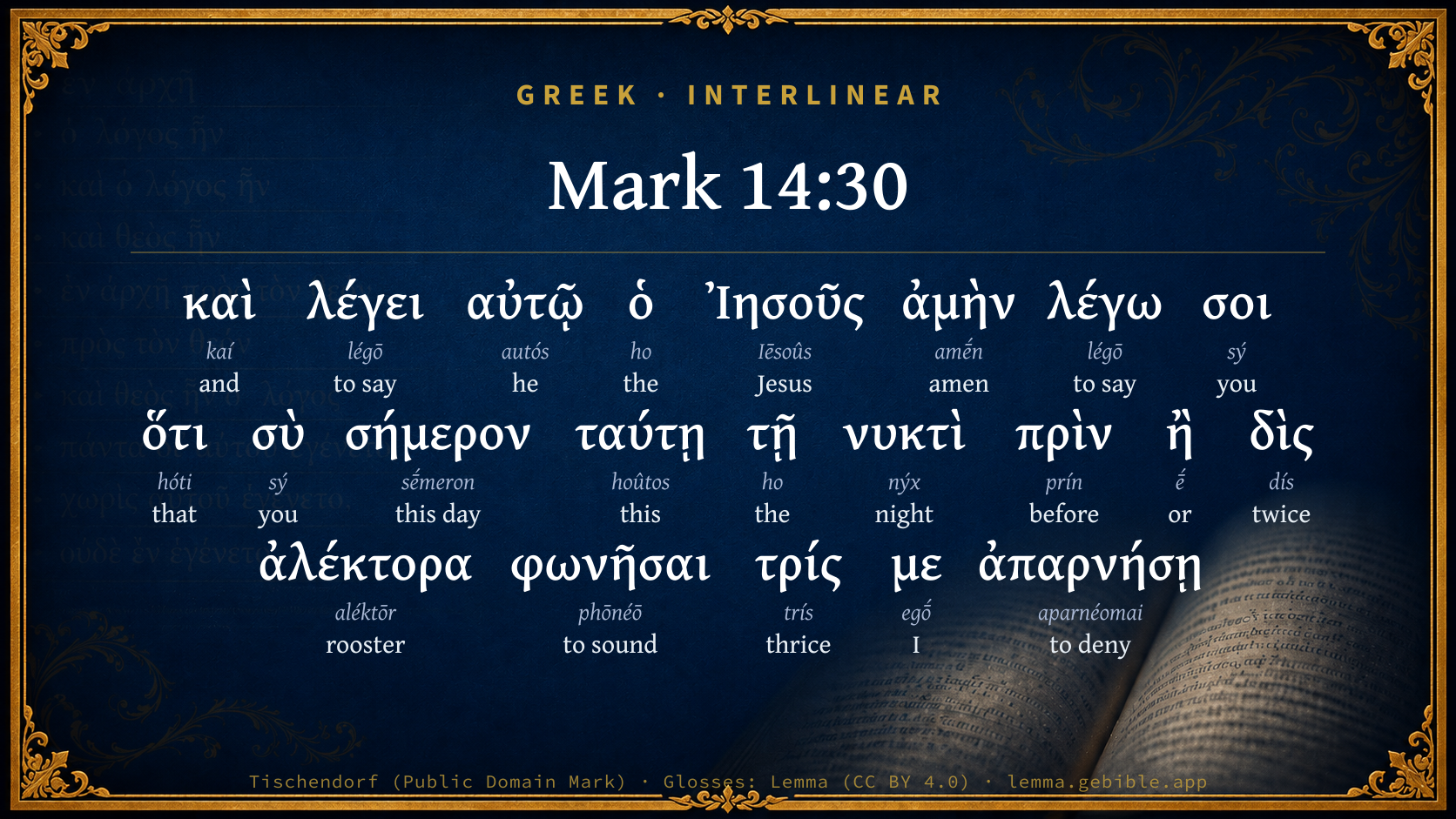
Download image
Cite this verse

Mark 14:30 (World English Bible). Public Domain. Lemma interlinear Bible study tool, https://lemma.gebible.app/v/mark/14/30.

Show BibTeX & RIS
BibTeX
RIS
English Translation
Jesus said to him, "Most assuredly I tell you, that you today, even this night, before the rooster crows twice, you will deny me three times."
World English Bible · Public Domain
Highlights
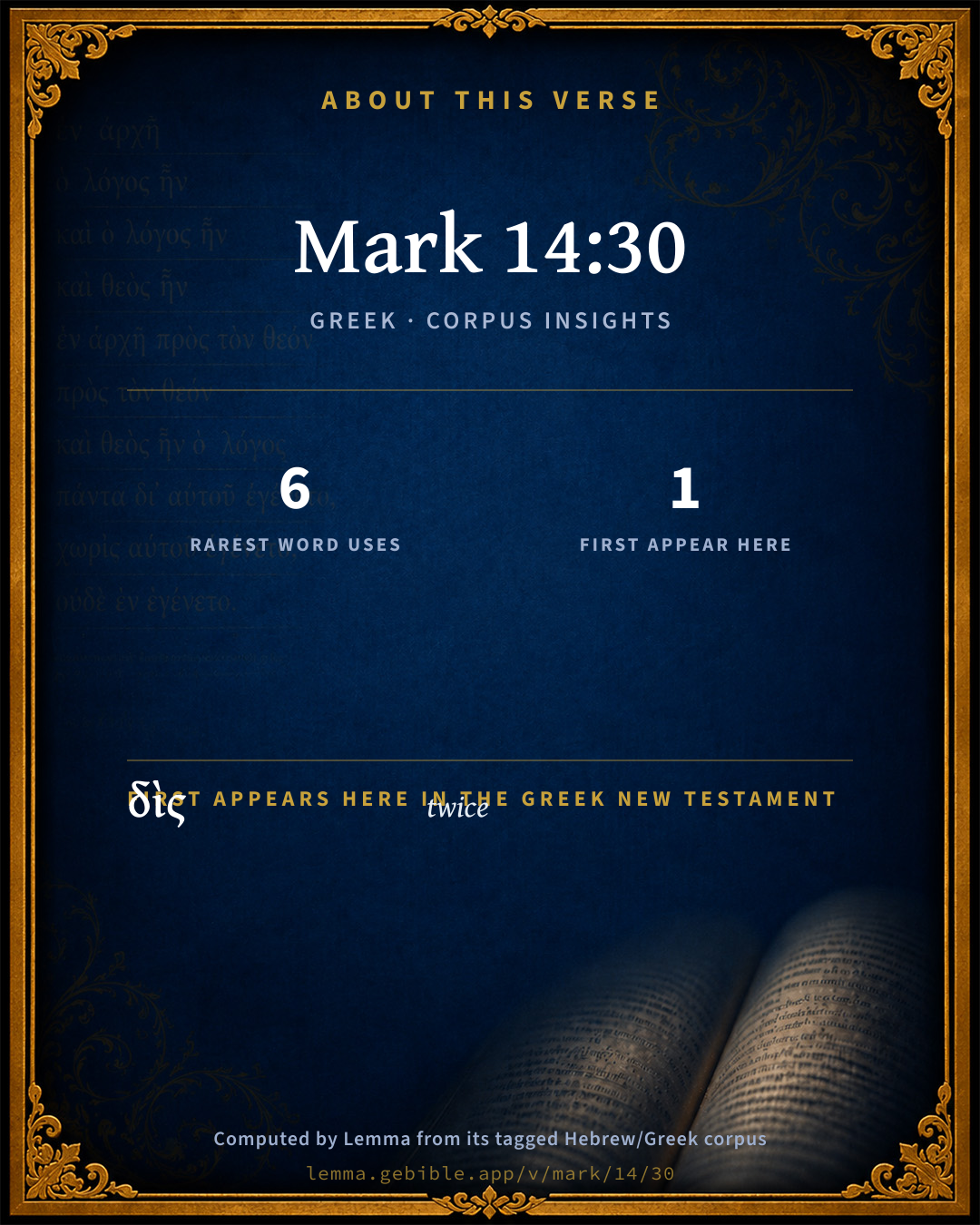
  • 1 first appearance in the Greek New Testament
Full analysis ↓
Download a study sheet

One document with this verse’s original text, its word-by-word gloss line, the meaning frame, cross-references with their text, attributed commentary, and full source and license credits — printable, and it pastes into notes with its structure intact.

This verse Autodidact and up

Study sheet (.html) Plain text (.txt)

A passage Seminary Student

Up to 50 verses in one chapter. A passage sheet keeps up to 6 commentary sources and 12 cross-references per verse, in the order this page ranks them, and says so on the sheet whenever that leaves anything out. Ask for a single verse and you get the Autodidact verse sheet above.

Everything on this page stays free to read, with no account — the sheet is a download of what is already on screen, not access to it.

Want to remove ads? Support Godless Engineer
Compare translations 3

The same verse in 3 English versions, stacked beneath the original-language interlinear above. Click any original word for its lexicon entry.

Each is an independent rendering of the whole verse — the interlinear is not word-aligned to these translations.

Highlighted words mark where these versions differ — a whole-verse word diff, not a word-by-word alignment.

  • World English Bible Public Domain
    Jesus said to him, "Most assuredly I tell you, that you today, even this night, before the rooster crows twice, you will deny me three times."
  • King James Version Public Domain
    And Jesus saith unto him, Verily I say unto thee, That this day, even in this night, before the cock crow twice, thou shalt deny me thrice.
  • unfoldingWord Literal Text CC BY-SA 4.0
    And Jesus says to him, “Truly I say to you that today—this night—before a rooster crows twice, you will deny me three times.”

unfoldingWord Literal Text — © unfoldingWord, licensed CC BY-SA 4.0. Word-aligned USFM3 via Door43 (git.door43.org/unfoldingWord/en_ult).

Versions to compare (up to 4)

3 of 4 selected

Show all 19 translations

Every available English version of this verse, each an independent rendering of the whole verse.

  • World English Bible Public Domain
    Jesus said to him, "Most assuredly I tell you, that you today, even this night, before the rooster crows twice, you will deny me three times."
  • Berean Standard Bible Public Domain
    “Truly I tell you,” Jesus replied, “this very night, before the rooster crows twice, you will deny Me three times.”
  • Majority Standard Bible Public Domain
    “Truly I tell you,” Jesus replied, “this very night, before the rooster crows twice, you will deny Me three times.”
  • King James Version Public Domain
    And Jesus saith unto him, Verily I say unto thee, That this day, even in this night, before the cock crow twice, thou shalt deny me thrice.
  • American Standard Version (1901) Public Domain
    And Jesus saith unto him, Verily I say unto thee, that thou to-day, `even' this night, before the cock crow twice, shalt deny me thrice.
  • Revised Version (1885) Public Domain
    And Jesus saith unto him, Verily I say unto thee, that thou today, even this night, before the cock crow twice, shalt deny me thrice.
  • Geneva Bible (1599) Public Domain
    Then Iesus saide vnto him, Verely I say vnto thee, this day, euen in this night, before the cocke crowe twise, thou shalt denie me thrise.
  • Douay-Rheims (1899) Public Domain
    And Jesus saith to him: Amen I say to thee, to day, even in this night, before the cock crow twice, thou shall deny me thrice.
  • Young's Literal Translation Public Domain
    And Jesus said to him, `Verily I say to thee, that to-day, this night, before a cock shall crow twice, thrice thou shalt deny me.'
  • Literal Standard Version CC BY-SA 4.0
    And Jesus said to him, “Truly I say to you that today, this night, before a rooster will crow twice, three times you will deny Me.”
  • Unlocked Literal Bible CC BY-SA 4.0
    Jesus said to him, “Truly I say to you, today—yes, this very night—before the rooster crows twice you will deny me three times.”
  • unfoldingWord Literal Text CC BY-SA 4.0
    And Jesus says to him, “Truly I say to you that today—this night—before a rooster crows twice, you will deny me three times.”
  • Darby Bible Public Domain
    And Jesus says to him, Verily I say to thee, that thou to-day, in this night, before [the] cock shall crow twice, thou shalt thrice deny me.
  • World Messianic Bible Public Domain
    Yeshua said to him, “Most certainly I tell you that you today, even this night, before the rooster crows twice, you will deny me three times.”
  • Webster's Bible Public Domain
    And Jesus saith to him, Verily I say to thee, that this day, even in this night, before the cock shall crow twice, thou wilt deny me thrice.
  • Free Bible Version CC BY-SA 4.0
    Jesus answered him, “I tell you the truth that today, this very night, before the rooster crows twice, you will deny that you even know me three times.”
  • Bible in Basic English Public Domain
    And Jesus said to him, Truly, I say to you that you, today, even this night, before the cock's second cry, will say three times that you have no knowledge of me.
  • Text-Critical English NT CC BY 4.0
    Jesus said to him, “Truly I say to yoʋ that today, on this night, before a rooster crows twice, yoʋ will deny me three times.”
  • Tyndale New Testament (1534) Public Domain
    And Iesus sayd vnto him: Verely I saye vnto the this daye even in this nyght before the cocke crowe twyse thou shalt denye me thryse.

Literal Standard Version (2020), Covenant Press — licensed CC BY-SA 4.0. Text via the HelloAO Bible API (eBible.org). Unlocked Literal Bible (unfoldingWord) — licensed CC BY-SA 4.0. Text via the HelloAO Bible API (eBible.org). unfoldingWord Literal Text — © unfoldingWord, licensed CC BY-SA 4.0. Word-aligned USFM3 via Door43 (git.door43.org/unfoldingWord/en_ult). Free Bible Version, Dr. Jonathan Gallagher — licensed CC BY-SA 4.0. Text via the HelloAO Bible API (eBible.org).

Word by word

More ways to search: Search by grammar → Find every occurrence → Compare this word →

Practice this passage: Drill this verse → Learn its vocabulary →

δὶς
dís
G1364
“twice”
Adverb
Part of Speech
Adverb
Full Thayer's Definition

Origin: from G1417

TDNT: None

1. twice
  1. καὶ kaí G2532 “and” Conjunction
  2. λέγει légō G3004 “to say” Verb, Present, Active, Indicative, 3rd person, Singular
  3. αὐτῷ autós G846 “he” Personal pronoun, Dative, Singular, Masculine
  4. ὁ ho G3588 “the” Article, Nominative, Singular, Masculine
  5. Ἰησοῦς Iēsoûs G2424 “Jesus” Noun, Nominative, Singular, Masculine
  6. ἀμὴν amḗn G281 “amen” Hebrew transliteration
  7. λέγω légō G3004 “to say” Verb, Present, Active, Indicative, 1st person, Singular
  8. σοι sý G4771 “you” Personal pronoun, 2nd person, Dative, Singular
  9. ὅτι hóti G3754 “that” Conjunction
  10. σὺ sý G4771 “you” Personal pronoun, 2nd person, Nominative, Singular
  11. σήμερον sḗmeron G4594 “this day” Adverb
  12. ταύτῃ hoûtos G3778 “this” Demonstrative pronoun, Dative, Singular, Feminine
  13. τῇ ho G3588 “the” Article, Dative, Singular, Feminine
  14. νυκτὶ nýx G3571 “night” Noun, Dative, Singular, Feminine
  15. πρὶν prín G4250 “before” Adverb
  16. ἢ ḗ G2228 “or” Particle
  17. ἀλέκτορα aléktōr G220 “rooster” Noun, Accusative, Singular, Masculine
  18. φωνῆσαι phōnéō G5455 “to sound” Verb, Aorist, Active, Infinitive
  19. τρίς trís G5151 “thrice” Adverb
  20. με egṓ G1473 “I” Personal pronoun, 1st person, Accusative, Singular
  21. ἀπαρνήσῃ aparnéomai G533 “to deny” Verb, Future, Middle deponent, Indicative, 2nd person, Singular

About this verse

These counts appear in no published source. They are computed here, from the morphology-tagged text and Lemma’s own curated glosses. What Lemma adds →

22
words
19
distinct lemmas
Gospels
section

Notable vocabulary

The rarest word here is δὶς twice G1364 — appearing just 6 times in the whole Greek New Testament.

First appearance in Scripture

This word makes its first canonical appearance in the Greek New Testament here:

Shared distinctive vocabulary

δὶς twice G1364 occurs in 6 verses of the Greek New Testament. Also found in:
Repetition

Words recur within this verse:

Cross-references

13

Topical passages linked to Mark 14:30 in the Treasury of Scripture Knowledge — connected by theme and wording, ordered by reader-vote popularity; previews shown in the World English Bible.

  • Mark 14:66–72 As Peter was in the courtyard below, one of the maids of the high priest came,
  • John 13:38 Jesus answered him, "Will you lay down your life for me? Most assuredly I tell you, the rooster won't crow until you have denied me three times.
  • Genesis 1:5 God called the light Day, and the darkness he called Night. There was evening and there was morning, one day.
  • Genesis 1:8 God called the expanse sky. There was evening and there was morning, a second day.
  • Matthew 26:69–75 Now Peter was sitting outside in the court, and a maid came to him, saying, "You were also with Jesus, the Galilean!"
  • Luke 22:34 He said, "I tell you, Peter, the rooster will by no means crow today until you deny that you know me three times."
  • Luke 22:54–62 They seized him, and led him away, and brought him into the high priest's house. But Peter followed from a distance.
  • John 18:17 Then the maid who kept the door said to Peter, "Are you also one of this man's disciples?" He said, "I am not."
  • John 18:25–27 Now Simon Peter was standing and warming himself. They said therefore to him, "You aren't also one of his disciples, are you?" He denied it, and said, "I am not."
  • 1 Corinthians 10:12 Therefore let him who thinks he stands be careful that he doesn't fall.
  • Genesis 1:13 There was evening and there was morning, a third day.
  • Genesis 1:19 There was evening and there was morning, a fourth day.
  • Genesis 1:23 There was evening and there was morning, a fifth day.

Cross-references courtesy of OpenBible.info (CC BY 4.0).

Commentary

Notes on Mark 14:30 from classic Christian and Jewish commentators (each source and its license shown beneath its notes). The classic Christian expositions comment on the surrounding passage and are grouped to its opening verse, so a note may address several verses; the Jewish commentaries on the Tanakh (Rashi and others) are per-verse, so they appear only where the commentator wrote on this verse.

Lemma curates 59 commentaries, every one of them public domain or Creative Commons licensed, each selected and text-cleaned for this edition rather than reprinted as found. About our sources →

The Biblical Illustrator

Joseph S. Exell

Mar_14:30

Thou shall deny Me thrice.

Danger of self-ignorance

The Dougal, an old line of battle ship, which has been lying in Portsmouth Harbour since her return from a cruise on the China station, in 1871, has been recently docked for the purpose of alterations, so as to fit her for taking the place of the Vernon, torpedo and depot ship. During an examination of her interior, one of the workmen came across a live shell in a disused corner of the ship. The projectile must have lain where it was found for over fourteen years. This was a startling discovery; but had no examination of the interior been required, the missile would not even now have been found. How forcibly the story illustrates the need we have for careful and frequent search into our own hearts! Possibly the projectile had been placed in the disused corner of the ship by an enemy; or, on the other hand, it may have been concealed ready to hurl at the foe. Anyhow, it was a dangerous thing to have stowed away, for at any moment it might have exploded, and destroyed the vessel. Self-examination is ever beneficial, and often leads to the startling discovery of some most dangerous evil that lay long concealed in the disused corners of the heart. That we may be fitted to take our right place in Gods service, and go forth to our work with His approval, let a thorough examination be made, and let all evil be removed. (Robert Spurgeon.)

Good resolutions soon forgotten

Note how suddenly even a good man is turned from good resolutions, if but a little left to himself, or if he remit but a little of his own watchfulness. In a few hours this confident disciple, who scorned to think of denying his Master, denies and forswears Him too.

1. We stand by grace, which, if not every moment renewed, we must needs fall; as in the case of a man supported by a crutch-remove the crutch, and he falls down; or set a staff upright, withdraw the hand, and you need not push it down, it goes of itself.

2. The suddenness of the temptation, which comes like lightning, and our proneness to be kindled with it.

3. The freedom of the Spirit, who comes and goes at His own pleasure.

(1) This should keep us humble, no matter how holy a state we get into. The gun may at any time suddenly disappear under a cloud.

(2) Let us watch our graces well, and forecast temptation.

(3) Let us depend on the Spirit of God to perfect and accomplish His own good motions, and leave us not to ourselves, who can quickly quench them.

4. No wonder if the righteousness of hypocrites be as the morning dew (Hos_6:4). (Dr. Thomas Taylor.)

The Biblical Illustrator, edited by Joseph S. Exell (c. 1880s–1900s) — public domain. Text from a community e-Sword module.

Bengel's Gnomon

Johann Albrecht Bengel

Mar 14:30. Σὺ, thou) In antithesis to “yet will not I,” Mar 14:29.—ἢ δὶς, before that twice) A very striking circumstance, that Peter would not collect [recover] himself at the first cock-crowing. [Comp. note on Mat 26:34.]

Bengel's Gnomon of the New Testament — English translation (T&T Clark, Edinburgh, 1860) — public domain. Text from a community e-Sword module.

Expositor's Greek Testament

ed. W. Robertson Nicoll

Mar 14:30 . To this over-confident ἀλλʼ οὐκ ἐγώ of the disciple, the Master returns a very pointed and peremptory reply: I tell thee that thou ( σὺ emphatic) to-day ( σήμερον ), on this night (more precise indication of time), before the cock crow twice (still more precise indication of time), shall deny me, not once, but again and again and again ( τρίς ).

The Expositor's Greek Testament, edited by W. Robertson Nicoll (1897–1910) — public domain. Text from a community e-Sword module.

Adam Clarke's Commentary

Verse 30. That THOU] συ is added by ABEGHKLMS-V, eighty-eight others, Syriac, Arabic, Persic, Coptic, AEthiopic, Armenian, Slavonic, Vulgate, Saxon, Theophylact, and Euthymsus. It adds much to the energy of the passage, every word of which is deeply emphatical. Verily, I say unto thee, that THOU, THIS DAY, in THIS VERY NIGHT, before the cock shall crow TWICE, THOU wilt deny ME.

Adam Clarke's Commentary on the Bible (1810–1826) — public domain. Text from a community e-Sword/MySword module.

Ellicott's Commentary for English Readers

(30) Before the cock crow twice.—The word “twice” is omitted in many MSS. It agrees, however, with the emphatic mention of the cock crowing a “second time” in Mar_14:72, and with the form of the prediction in the same verse, and may fairly be regarded as the true reading, the omission in some MSS. being accidental.

A Bible Commentary for English Readers, edited by Charles John Ellicott (1878–1897) — public domain. Text from a community e-Sword module.

The Cambridge Bible for Schools and Colleges

gen. ed. J. J. S. Perowne

30. in this night] Before the dawn of the morrow should streak the eastern sky, and in the darkness the cock should twice have crowed, he who had declared he would never be offended, would thrice deny that he had ever known his Lord. St Mark, as usual, records two points which enhance the force of the warning and the guilt of Peter, viz. (a) that the cock should crow twice, and (b) that after such warning he repeated his protestation with greater vehemence.

The Cambridge Bible for Schools and Colleges (gen. ed. J. J. S. Perowne; Cambridge University Press, 1878–1918) — public domain. Text from a community e-Sword module.

John Gill's Exposition

But he spake the more vehemently,.... With a louder voice; with more spirit and eagerness; in a more peremptory and self-confident way.

If I should die with thee, I will not deny thee in any wise. The Syriac version adds, "O my Lord", my dear Lord, I will never deny thee upon any consideration whatever; and the Persic version, O Lord:

likewise also said they all; as he said, so said "all the disciples", as the Syriac version reads it; See Gill on Mat 26:35.

John Gill's Exposition of the Whole Bible (1746–1763) — public domain (CC PDM 1.0). Text via the HelloAO Bible API.

The Pulpit Commentary

Verily I say unto thee, that thou to-day, even this night, before the cock crow twice, shalt deny me thrice. The day had begun. It began at six in the evening. It was already advanced. This second crowing of the cock is mentioned by St. Mark only; and it forms an additional aggravation of Peter"s sin. The "cockcrowing" was a term used for one of the divisions of the night. (see Mar_13:35) But it appears that there were three times at which the cock-crowing might be expected namely,

(1) early in the night, between eleven and twelve;

(2) between one and two; and

(3) between five and six.

The two cock crowings here referred to would be the two last of the three here mentioned. It would probably be about 2 a.m., when the first trial of our Lord took place in the house of Caiaphas.

The Pulpit Commentary (1880–1919), ed. H.D.M. Spence-Jones & Joseph S. Exell — public domain. Text from a community e-Sword module.

unfoldingWord translationNotes

Door43 World Missions Community

Truly I say to you

This indicates that the statement that follows is especially true and important. See how you translated this in Mark 3:28.

rooster crows

The rooster is a bird that calls out very early in the morning. The loud sound he makes is "crowing."

twice

two times

you will deny me

"you will say that you do not know me"

If I must die

"Even if I must die"

They all made the same promise

This means that all of the disciples said the same thing that Peter said.

translationWords

Jesus

amen

die

promise

unfoldingWord translationNotes — © Distant Shores Media and the Door43 World Missions Community, licensed CC BY-SA 4.0. Source: git.door43.org/Door43/en_tn.

Cambridge Greek Testament for Schools and Colleges

30. [3160][3161][3162][3163] omit δίς, but it may be retained ([3164][3165][3166]2[3167][3168][3169][3170][3171]).

[3160] Codex Sinaiticus. 4th cent. Discovered by Tischendorf in 1859 at the Monastery of St Katharine on Mount Sinai. Now at St Petersburg. The whole Gospel, ending at Mar 16:8. Photographic facsimile, 1911.

[3161] Codex Ephraemi. 5th cent. A palimpsest: the original writing has been partially rubbed out, and the works of Ephraem the Syrian have been written over it; but a great deal of the original writing has been recovered; of Mark we have Mar 1:17 to Mar 6:31, Mar 8:5 to Mar 12:29, Mar 13:19 to Mar 16:20. In the National Library at Paris.

[3162] An asterisk denotes that the word is not found elsewhere in N.T., and such words are included in the index, even if there is no note on them in the commentary.

[3163] Codex Bezae. 6th cent. Has a Latin translation (d) side by side with the Greek text, and the two do not quite always agree. Presented by Beza to the University Library of Cambridge in 1581. Remarkable for its frequent divergences from other texts. Contains Mark, except Mar 16:15-20, which has been added by a later hand. Photographic facsimile, 1899.

[3164] Codex Alexandrinus. 5th cent. Brought by Cyril Lucar, Patriarch of Constantinople, from Alexandria, and afterwards presented by him to King Charles I. in 1628. In the British Museum. The whole Gospel. Photographic facsimile, 1879.

[3165] Codex Vaticanus. 4th cent., but perhaps a little later than א. In the Vatican Library almost since its foundation by Pope Nicolas V., and one of its greatest treasures. The whole Gospel, ending at Mar 16:8. Photographic facsimile, 1889.

[3166] Codex Ephraemi. 5th cent. A palimpsest: the original writing has been partially rubbed out, and the works of Ephraem the Syrian have been written over it; but a great deal of the original writing has been recovered; of Mark we have Mar 1:17 to Mar 6:31, Mar 8:5 to Mar 12:29, Mar 13:19 to Mar 16:20. In the National Library at Paris.

[3167] Codex Regius. 8th cent. An important witness. At Paris. Contains Mar 1:1 to Mar 10:15; Mar 10:30 to Mar 15:1; Mar 15:20 to Mar 16:20, but the shorter ending is inserted between Mar 16:8 and Mar 16:9, showing that the scribe preferred it to the longer one.

[3168] Codex Monacensis. 10th cent. Contains Mar 6:47 to Mar 16:20. Many verses in 14, 15, 16 are defective.

[3169] Codex Oxoniensis. 9th cent. Contains Mark, except Mar 3:35 to Mar 6:20.

[3170] Codex Sangallensis. 9th or 10th cent. Contains the Gospels nearly complete, with an interlinear Latin translation. The text of Mark is specially good, agreeing often with CL. At St Gall.

[3171] Codex Petropolitanus. 9th cent. Gospels almost complete. Mar 16:18-20 is in a later hand.

30. Ἀμὴν λέγω σοι. The prediction of his almost immediate failure is made with great solemnity: λέγω σοι is in all four Gospels, and Lk. and Jn are quite independent of the other two and of one another. Lk. and Jn place the prediction in the supper-room, Mk and Mt. place it during the walk from the room to the Mount of Olives, and Lk.’s narrative differs considerably from Jn’s. Some suppose that there were three predictions, two in the room and one afterwards. It is unlikely that the prediction was repeated. These divergences about details are of little moment, and we have no means of determining which tradition is nearest to the actual facts. See on Joh 13:38.

σὺ σήμερον ταύτῃ τῇ νυκτί. The σύ, though omitted by [3327][3328][3329][3330] and Old Latin texts, is probably genuine; it answers to Peter’s confident ἐγώ. We have here another instance of Mk’s fulness, and of Mt. and Lk. each taking different parts of Mk’s full expression, Lk. having σήμερον and Mt. ταύτῃ τῇ νυκτί. See on Mar 1:32; Mar 1:42, Mar 15:26. According to Jewish reckoning the day had begun at sunset, and σήμερον would mean “before the next sunset.” “This night” therefore greatly abbreviates “to-day.” The denial will take place within a very few hours.

[3327] Codex Sinaiticus. 4th cent. Discovered by Tischendorf in 1859 at the Monastery of St Katharine on Mount Sinai. Now at St Petersburg. The whole Gospel, ending at Mar 16:8. Photographic facsimile, 1911.

[3328] Codex Ephraemi. 5th cent. A palimpsest: the original writing has been partially rubbed out, and the works of Ephraem the Syrian have been written over it; but a great deal of the original writing has been recovered; of Mark we have Mar 1:17 to Mar 6:31, Mar 8:5 to Mar 12:29, Mar 13:19 to Mar 16:20. In the National Library at Paris.

[3329] Codex Bezae. 6th cent. Has a Latin translation (d) side by side with the Greek text, and the two do not quite always agree. Presented by Beza to the University Library of Cambridge in 1581. Remarkable for its frequent divergences from other texts. Contains Mark, except Mar 16:15-20, which has been added by a later hand. Photographic facsimile, 1899.

[3330] Codex Sangallensis. 9th or 10th cent. Contains the Gospels nearly complete, with an interlinear Latin translation. The text of Mark is specially good, agreeing often with CL. At St Gall.

δίς. This may safely be regarded as original; see crit. note. It is confirmed by the Fayûm fragment, and the fact that Mt., Lk., and Jn mention only one cock-crowing makes omission more probable than interpolation. Travellers tell us that in the East cocks crow with extraordinary regularity at certain hours, about twelve, two, and five o’clock. Tristram, Nat. Hist. of the Bible, p. 221. But our Lord is not predicting the hours at which the denials will take place; nor is the obvious meaning, that before the cock crows a second time there will have been three denials, the only point. Our Lord foretells that the first cock-crowing will not stop the denials; in spite of this warning, Peter will still persist that he does not know Christ. The declaration, therefore, is pregnant with meaning, “Thou, who art so confident that thou at any rate wilt never be offended, within twenty hours, nay within six, wilt not only be offended, but wilt have denied Me, not once nor twice only, and that in spite of at least one warning signal.” Cf. ὅτε τὸ δεύτερον ὡ ἁλεκτρυὼν ἐφθέγγετο (Aristoph. Eccl. 390); Quod tamen ad cantum galli facit ille secundi (Juv. ix. 106). The form ἀλέκτωρ is more common in poetry, ἀλεκτρυών in prose, and the Fayûm fragment has ἀλεκτρυών here; it has also the more usual κοκκύζω of the crowing.

τρίς. In all four Gospels; and the Synoptics all have the strong compound ἀπαρνήοῃ, which occurs only in this connexion and in that of denying oneself (Mar 8:34 = Mat 16:24); ἀρνέομαι is much more common (Mar 14:68; Mar 14:70; etc.).

Cambridge Greek Testament for Schools and Colleges (Cambridge University Press, 1896; 21 vols, various authors incl. Carr, Maclear, Plummer, Farrar, Lumby, Moule, M. R. James, Simcox) — public domain. Text from a community e-Sword module.

Alford’s Greek Testament

Henry Alford

30.] Notice the climax: σήμερον, but not only this—ταύτῃ τῇ νυκτί, the part of it now present: nor only so, but πρὶν ἢ δὶς ἀλέκτορα φωνῆσαι, before a cock crow twice, i.e. long before the night is over.

Henry Alford, The Greek Testament (1849–1861) — public domain. Text from a community e-Sword module.

International Critical Commentary

30. ὅτι σὺ σήμερον ταύτῃ τῇ νυκτὶ, πρὶν ἢ δὶς ἀλέκτορα φωνῆσαι, τρίς με ἀπαρνήοῃ—that you to-day, this night, before the cock crows twice, will thrice deny me. Peter in his boast emphasizes the πάντες. Jesus in his rebuke emphasizes the σύ—you who feel so confident. Peter had singled himself out as the one to be faithful in the midst of general defection. Jesus singles him out as the one out of them all to deny him. σήμερον ταύτῃ τῇ νυκτὶ—to-day, this night, the very day in which you have shown such self-confidence. δὶς ἀλὲκτορα φωνῆσαι—This is the only gospel in which this δίς occurs, both in the prediction of Jesus, and in the account of the denials. Those two fatal cock-crowings had stuck in Peter’s memory, and so find their way into the Gospel which gets its inspiration from him. φωνῆσαι—this is a general word for sounds of all kinds. But the instances are rare in profane authors of its use for animal cries. ἀπαρνήοῃ—thou wilt deny. As applied to persons, it means denial of acquaintance or connection with them.

Insert σὺ before σήμερον, Tisch. Treg. WH. ABEFGHKLMNSUVWb X ΓΠ, two mss. Lat. Vet. Vulg. Egyptt. Syrr. ταύτῃ τῇ νυκτὶ, instead of ἐν τῇ νυκτὶ ταύτῃ, Tisch. Treg. WH. RV. א BCDL, mss. Lat. Vet.

International Critical Commentary — older volumes (1896–1929), various authors — public domain. Text from a community e-Sword module.

Vincent's Word Studies in the New Testament

Marvin R. Vincent

Cock crow. See on Mt 26:34. Mark alone adds twice. Deny [απαρνηση] . The compound verb signifies utterly deny.

Marvin R. Vincent, Word Studies in the New Testament (1887–1900) — public domain. Text from a community e-Sword/MySword module.

Lesson kit

Teaching starters — assembled from the data on this page, not authored interpretation. Every prompt links to the verse data it draws on. Edit before teaching.

Mark, in the Gospels, opens this verse with 22 words (19 distinct Greek lemmas). Its most distinctive word is dís (“twice”). A historical commentator’s framing appears above. Read the whole chapter for the surrounding context.

Discussion questions

  1. What does “twice” (dís) contribute to the verse as a whole?
  2. This is the first place “twice” appears in Scripture (first appears here). What does its debut here establish?
  3. How does Mark 14:72, which shares the word «twice», read alongside this verse?
  4. What does the repetition of “to say” (2× in this one verse) do in this verse?
  5. These translations render this verse differently; the difference is in the English rendering, not the original. What questions does that raise?
  6. Compare how The Biblical Illustrator and Bengel's Gnomon read this verse. Where do they agree or differ?

Things to notice

  • 1 word makes its first canonical appearance in Scripture here.
  • These translations choose different wording for 24 words in this verse.
  • “to say” occurs 2× in this single verse.
  • 19 distinct Greek lemmas span 22 words in this verse.

Reading settings

Reading text

Shown beneath each verse's original-language words.

Old Testament
Old Testament edition

Read the OT as the Masoretic Hebrew (MT) or the Greek Septuagint (LXX).

English shown for the Greek Septuagint (in the Hebrew ↔ Greek comparison).

Comparing translations? Open the Compare panel on any verse page to stack up to four side by side.