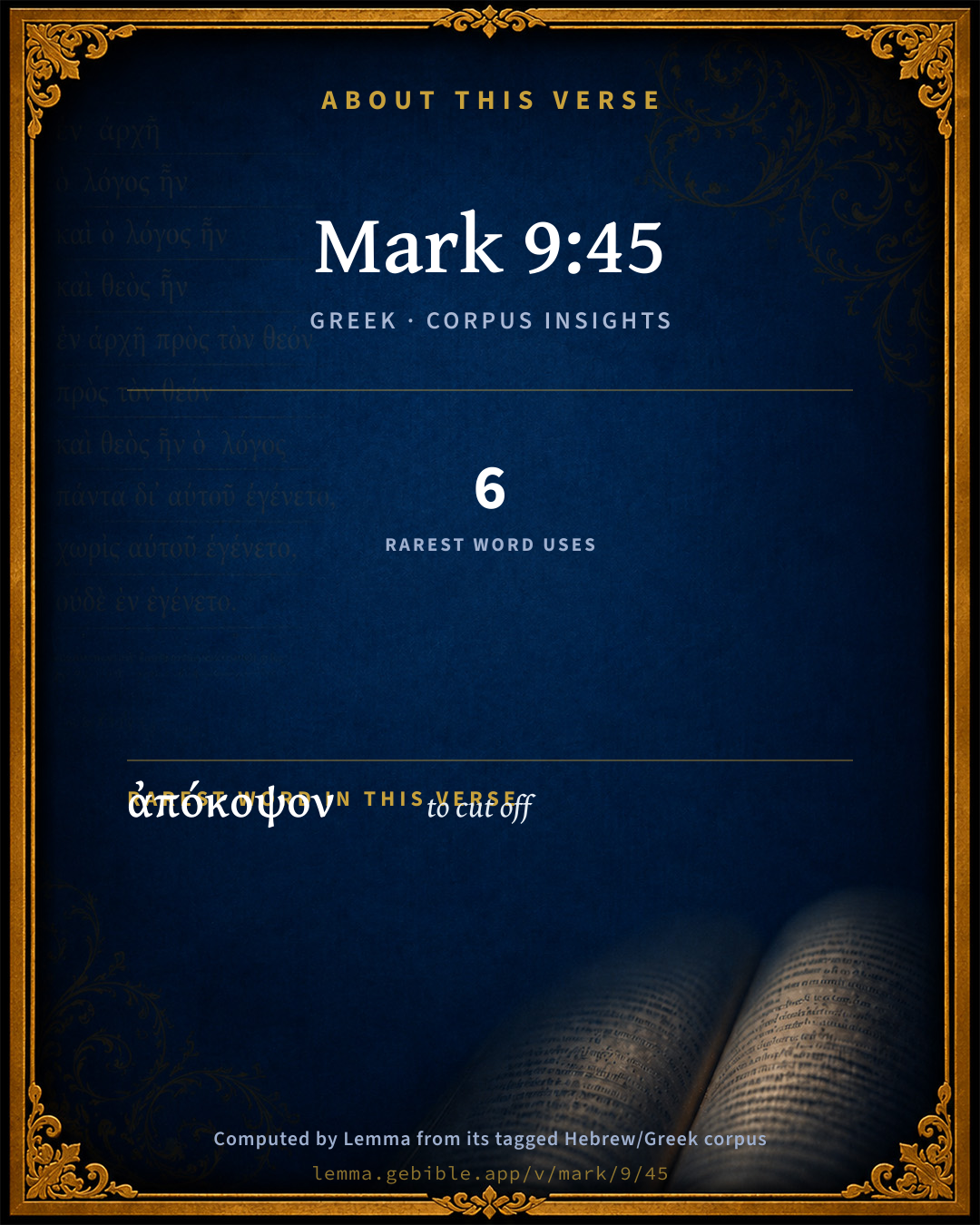
Mark 9:45

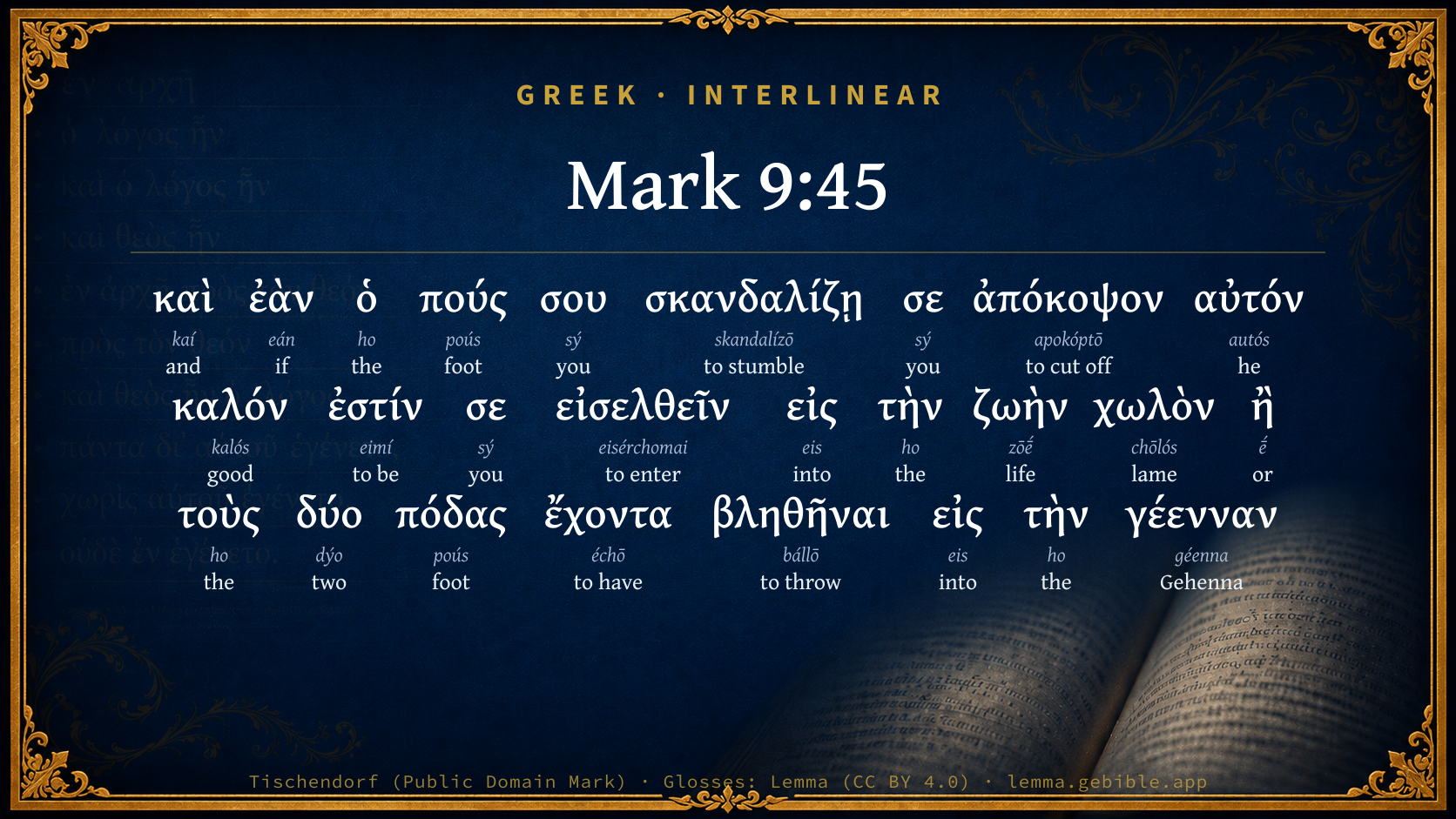
Greek (Tischendorf 8th ed.) Mark 9:45 appears in the Greek New Testament. The text above is from the Tischendorf 8th edition. Each word links to its Strong’s number and a concise gloss. Click any word for its full Thayer’s Greek Lexicon entry.
Download image
Cite this verse

Mark 9:45 (World English Bible). Public Domain. Lemma interlinear Bible study tool, https://lemma.gebible.app/v/mark/9/45.

Show BibTeX & RIS
BibTeX
RIS
English Translation
If your foot causes you to stumble, cut it off. It is better for you to enter into life lame, rather than having your two feet to be cast into Gehenna, into the fire that will never be quenched--
World English Bible · Public Domain
Download a study sheet

One document with this verse’s original text, its word-by-word gloss line, the meaning frame, cross-references with their text, attributed commentary, and full source and license credits — printable, and it pastes into notes with its structure intact.

This verse Autodidact and up

Study sheet (.html) Plain text (.txt)

A passage Seminary Student

Up to 50 verses in one chapter. A passage sheet keeps up to 6 commentary sources and 12 cross-references per verse, in the order this page ranks them, and says so on the sheet whenever that leaves anything out. Ask for a single verse and you get the Autodidact verse sheet above.

Everything on this page stays free to read, with no account — the sheet is a download of what is already on screen, not access to it.

Want to remove ads? Support Godless Engineer
Compare translations 3

The same verse in 3 English versions, stacked beneath the original-language interlinear above. Click any original word for its lexicon entry.

Each is an independent rendering of the whole verse — the interlinear is not word-aligned to these translations.

Highlighted words mark where these versions differ — a whole-verse word diff, not a word-by-word alignment.

  • World English Bible Public Domain
    If your foot causes you to stumble, cut it off. It is better for you to enter into life lame, rather than having your two feet to be cast into Gehenna, into the fire that will never be quenched--
  • King James Version Public Domain
    And if thy foot offend thee, cut it off: it is better for thee to enter halt into life, than having two feet to be cast into hell, into the fire that never shall be quenched:
  • unfoldingWord Literal Text CC BY-SA 4.0
    And if your foot causes you to stumble, cut it off. It is better for you to enter into life lame than, having two feet, to be thrown into Gehenna

unfoldingWord Literal Text — © unfoldingWord, licensed CC BY-SA 4.0. Word-aligned USFM3 via Door43 (git.door43.org/unfoldingWord/en_ult).

Versions to compare (up to 4)

3 of 4 selected

Show all 19 translations

Every available English version of this verse, each an independent rendering of the whole verse.

  • World English Bible Public Domain
    If your foot causes you to stumble, cut it off. It is better for you to enter into life lame, rather than having your two feet to be cast into Gehenna, into the fire that will never be quenched--
  • Berean Standard Bible Public Domain
    If your foot causes you to sin, cut it off. It is better for you to enter life lame than to have two feet and be thrown into hell.
  • Majority Standard Bible Public Domain
    If your foot causes you to sin, cut it off. It is better for you to enter life lame than to have two feet and be thrown into hell, into the unquenchable fire,
  • King James Version Public Domain
    And if thy foot offend thee, cut it off: it is better for thee to enter halt into life, than having two feet to be cast into hell, into the fire that never shall be quenched:
  • American Standard Version (1901) Public Domain
    And if thy foot cause thee to stumble, cut it off: it is good for thee to enter into life halt, rather than having thy two feet to be cast into hell.
  • Revised Version (1885) Public Domain
    And if thy foot cause thee to stumble, cut it off: it is good for thee to enter into life halt, rather than having thy two feet to be cast into hell.
  • Geneva Bible (1599) Public Domain
    Likewise, if thy foote cause thee to offend, cut it off: it is better for thee to go halt into life, then hauing two feete, to be cast into hell, into the fire that neuer shalbe quenched,
  • Douay-Rheims (1899) Public Domain
    Where their worm dieth not, and the fire is not extinguished.
  • Young's Literal Translation Public Domain
    `And if thy foot may cause thee to stumble, cut it off; it is better for thee to enter into the life lame, than having the two feet to be cast to the gehenna, to the fire -- the unquenchable --
  • Literal Standard Version CC BY-SA 4.0
    And if your foot may cause you to stumble, cut it off; it is better for you to enter into life lame, than having the two feet to be cast into Gehenna, into the fire—the unquenchable—
  • Unlocked Literal Bible CC BY-SA 4.0
    If your foot causes you to stumble, cut it off. It is better for you to enter into life lame than to have your two feet and be thrown into hell.
  • unfoldingWord Literal Text CC BY-SA 4.0
    And if your foot causes you to stumble, cut it off. It is better for you to enter into life lame than, having two feet, to be thrown into Gehenna
  • Darby Bible Public Domain
    And if thy foot serve as a snare to thee, cut it off: it is better for thee to enter into life lame, than having thy two feet to be cast into hell, into the fire unquenchable;
  • World Messianic Bible Public Domain
    If your foot causes you to stumble, cut it off. It is better for you to enter into life lame, rather than having your two feet to be cast into Gehinnom, into the fire that will never be quenched—
  • Webster's Bible Public Domain
    And if thy foot causeth thee to fall into sin, cut it off: it is better for thee to enter halt into life, than having two feet to be cast into hell, into the fire that never shall be quenched:
  • Free Bible Version CC BY-SA 4.0
    If your foot causes you to sin, cut it off! It's better to enter eternal life lame than to be thrown into Gehenna still having two feet.
  • Bible in Basic English Public Domain
    And if your foot is a cause of trouble to you, let it be cut off: it is better for you to go into life with one foot than to have two feet and go into hell.
  • Text-Critical English NT CC BY 4.0
    And if yoʋr foot causes yoʋ to stumble, cut it off. It is better for yoʋ to enter life lame than to have two feet and be thrown into hell, into the unquenchable fire,
  • Tyndale New Testament (1534) Public Domain
    Lykewyse yf thy fote offende the cut him of. For it is better for the to goo halt into lyfe then havynge two fete to be cast into hell into fyre that never shalbe quenched:

Literal Standard Version (2020), Covenant Press — licensed CC BY-SA 4.0. Text via the HelloAO Bible API (eBible.org). Unlocked Literal Bible (unfoldingWord) — licensed CC BY-SA 4.0. Text via the HelloAO Bible API (eBible.org). unfoldingWord Literal Text — © unfoldingWord, licensed CC BY-SA 4.0. Word-aligned USFM3 via Door43 (git.door43.org/unfoldingWord/en_ult). Free Bible Version, Dr. Jonathan Gallagher — licensed CC BY-SA 4.0. Text via the HelloAO Bible API (eBible.org).

Word by word

More ways to search: Search by grammar → Find every occurrence → Compare this word →

Practice this passage: Drill this verse → Learn its vocabulary →

ἀπόκοψον
apokóptō
G609
“to cut off”
Verb, Aorist, Active, Imperative, 2nd person, Singular
Part of Speech
Verb
Tense
Aorist
Voice
Active
Mood
Imperative
Person
2nd person
Number
Singular
Full Thayer's Definition

Origin: from G575 and G2875

TDNT: 17:12,5

1. to cut off, amputate
  1. καὶ kaí G2532 “and” Conjunction
  2. ἐὰν eán G1437 “if” Conditional
  3. ὁ ho G3588 “the” Article, Nominative, Singular, Masculine
  4. πούς poús G4228 “foot” Noun, Nominative, Singular, Masculine
  5. σου sý G4771 “you” Personal pronoun, 2nd person, Genitive, Singular
  6. σκανδαλίζῃ skandalízō G4624 “to stumble” Verb, Present, Active, Subjunctive, 3rd person, Singular
  7. σε sý G4771 “you” Personal pronoun, 2nd person, Accusative, Singular
  8. αὐτόν autós G846 “he” Personal pronoun, Accusative, Singular, Masculine
  9. καλόν kalós G2570 “good” Adjective, Nominative, Singular, Neuter
  10. ἐστίν eimí G1510 “to be” Verb, Present, Active, Indicative, 3rd person, Singular
  11. σε sý G4771 “you” Personal pronoun, 2nd person, Accusative, Singular
  12. εἰσελθεῖν eisérchomai G1525 “to enter” Verb, Aorist, Active, Infinitive
  13. εἰς eis G1519 “into” Preposition
  14. τὴν ho G3588 “the” Article, Accusative, Singular, Feminine
  15. ζωὴν zōḗ G2222 “life” Noun, Accusative, Singular, Feminine
  16. χωλὸν chōlós G5560 “lame” Adjective, Accusative, Singular, Masculine
  17. ἢ ḗ G2228 “or” Particle
  18. τοὺς ho G3588 “the” Article, Accusative, Plural, Masculine
  19. δύο dýo G1417 “two” Adjective, Numeral (indeclinable)
  20. πόδας poús G4228 “foot” Noun, Accusative, Plural, Masculine
  21. ἔχοντα échō G2192 “to have” Verb, Present, Active, Participle, Accusative, Singular, Masculine
  22. βληθῆναι bállō G906 “to throw” Verb, Aorist, Passive, Infinitive
  23. εἰς eis G1519 “into” Preposition
  24. τὴν ho G3588 “the” Article, Accusative, Singular, Feminine
  25. γέενναν géenna G1067 “Gehenna” Noun, Accusative, Singular, Feminine

About this verse

These counts appear in no published source. They are computed here, from the morphology-tagged text and Lemma’s own curated glosses. What Lemma adds →

26
words
19
distinct lemmas
Gospels
section

Notable vocabulary

The rarest word here is ἀπόκοψον to cut off G609 — appearing just 6 times in the whole Greek New Testament.

Shared distinctive vocabulary

ἀπόκοψον to cut off G609 occurs in 6 verses of the Greek New Testament. Also found in:

Repetition

Words recur within this verse:

Cross-references

3

Topical passages linked to Mark 9:45 in the Treasury of Scripture Knowledge — connected by theme and wording, ordered by reader-vote popularity; previews shown in the World English Bible.

  • Matthew 5:22 But I tell you, that everyone who is angry with his brother without a cause shall be in danger of the judgment; and whoever shall say to his brother, 'Raca!' shall be in danger of the council; and whoever shall say, 'You fool!' shall be in danger of the fire of Gehenna.
  • Matthew 18:8 If your hand or your foot causes you to stumble, cut it off, and cast it from you. It is better for you to enter into life maimed or crippled, rather than having two hands or two feet to be cast into the eternal fire.
  • Mark 9:43 If your hand causes you to stumble, cut it off. It is better for you to enter into life maimed, rather than having your two hands to go into Gehenna, into the unquenchable fire,

Cross-references courtesy of OpenBible.info (CC BY 4.0).

Where the printed editions differ

1 variant

Places in this verse where the major printed Greek editions disagree on the wording in a way that affects the translation — a comparison of editions, not a manuscript-by-manuscript collation. The editions are the modern critical texts (Nestlé-Aland 28/27, SBL, Westcott-Hort, Tregelles, Tyndale House) and the traditional texts behind the KJV (the Textus Receptus and the Byzantine/Majority text). It is not a claim about which reading is original.

  1. Extra text
    εἰς τὸ πῦρ τὸ ἄσβεστον.

    “into <the> fire <the> unquenchable.”

    In TregTRByz Not in NA28NA27TynSBLWH

    εἰς τὸ πῦρ τὸ ἄσβεστον. (eis to pur to asbeston) 'into fire unquenchable.' is only in traditional manuscripts (Treg+TR+Byz)

Textual data: Translators Amalgamated Greek New Testament (STEPBible TAGNT) · CC BY 4.0.

Commentary

Notes on Mark 9:45 from classic Christian and Jewish commentators (each source and its license shown beneath its notes). The classic Christian expositions comment on the surrounding passage and are grouped to its opening verse, so a note may address several verses; the Jewish commentaries on the Tanakh (Rashi and others) are per-verse, so they appear only where the commentator wrote on this verse.

Lemma curates 59 commentaries, every one of them public domain or Creative Commons licensed, each selected and text-cleaned for this edition rather than reprinted as found. About our sources →

Godbey's Commentary on the New Testament

William B. Godbey

DOOM OF THE WICKED

Mat 18:8-9; Mar 9:45-48. “And if thy foot may offend thee, cut it off; it is good for thee to go into life lame, rather than having two feet to be cast into hell, into the fire which can not be quenched, where the worm dieth not, and the fire is not quenched.” This awful deliverance of our Savior, relative to the doom of the wicked, follows as a normal sequence from the innumerable and egregious sins committed in giving offense to spiritual and natural infants. Consequently He goes out into a clear, straight, and unequivocal affirmation, relative to the endless punishment of the wicked, which is simply irrefutable by all the sophistry of Universalism, all the chicanery of infidelity, and all the diabolical effrontery of the Pandemonium. Here, Jesus says that the wicked “go into the fire which can not be quenched, where the worm [i.e., the conscious living] dieth not, and the fire is not quenched.” The word for “die” is teleutao, from telos, the “end;” consequently, it means never have an end, the strongest and most inevasible word in the Greek language. These words and phrases, uttered by the Savior, can never be modified, evaded, weakened, or explained away. The sophistry that would have the audacity to tinker with these plain and unmistakable words of Jesus, could upset every truth in the Bible, completely take God’s Book of Truth out of our hands, leaving us groping in the utter bewilderment of rayless night. O that the preachers would preach like Jesus! If they do not, they have no right to preach at all. You have no right to deliver a message for another, unless you deliver it as he gave it to you. The reason why so many preachers have lost their power, is because Jesus does not send them. The reason why He does not send them, is because they have failed to deliver His message as He gave it to them. If you were to send a man with a most important message, and he should materially change it, either by additions or subtractions, or both, you would never again trust your business in his hands. Preachers stand in the pulpit, empty as the shell of a dead oyster, because of the delinquency in the faithful deliverance of the Lord’s message. The wicked are going to hell by millions. The most successful method of stopping them is faithfully, persistently, importunately fearlessly, and tearfully telling them precisely what they are doing, without mollification or modification, but persistently warning them night and day. One of the saddest concomitants of the awful apostasy in the Churches is the elimination of endless punishment out of the pulpit. Just as heaven should be the constant theme preached to the Christian pilgrim for glory bound, so hell should be the incessant theme roaring from every pulpit in the ears of all the hellward bound. If this is not faithfully adhered to, conviction will not only go out of a Church, but evanesce from a community, leaving all the gospel timber-gum logs, which will neither rive nor split.

William B. Godbey, Commentary on the New Testament (1896–1900) — public domain. Text from a community e-Sword module.

Cambridge Greek Testament for Schools and Colleges

45. [2063][2064][2065][2066][2067][2068] omit εἰς τὸ πῦρ τὸ ἄσβεστον.

[2063] Codex Sinaiticus. 4th cent. Discovered by Tischendorf in 1859 at the Monastery of St Katharine on Mount Sinai. Now at St Petersburg. The whole Gospel, ending at Mar 16:8. Photographic facsimile, 1911.

[2064] Codex Vaticanus. 4th cent., but perhaps a little later than א. In the Vatican Library almost since its foundation by Pope Nicolas V., and one of its greatest treasures. The whole Gospel, ending at Mar 16:8. Photographic facsimile, 1889.

[2065] Codex Ephraemi. 5th cent. A palimpsest: the original writing has been partially rubbed out, and the works of Ephraem the Syrian have been written over it; but a great deal of the original writing has been recovered; of Mark we have Mar 1:17 to Mar 6:31, Mar 8:5 to Mar 12:29, Mar 13:19 to Mar 16:20. In the National Library at Paris.

[2066] Codex Regius. 8th cent. An important witness. At Paris. Contains Mar 1:1 to Mar 10:15; Mar 10:30 to Mar 15:1; Mar 15:20 to Mar 16:20, but the shorter ending is inserted between Mar 16:8 and Mar 16:9, showing that the scribe preferred it to the longer one.

[2067] Codex Sangallensis. 9th or 10th cent. Contains the Gospels nearly complete, with an interlinear Latin translation. The text of Mark is specially good, agreeing often with CL. At St Gall.

[2068] Codex Athous Laurae. 8th cent. Like N and Σ, it is written in silver letters on purple vellum. Contains Mar 9:5 to Mar 16:20, and, as in L, the shorter ending is inserted between Mar 16:8 and Mar 16:9. As in Δ, the text of Mark is specially good.

45. ὁ πούς σου. It is lawful, but not necessary, to find different meanings for “hand,” “foot,” and “eye.” The general sense is that even what is most useful and most dear may have to be sacrificed. Si quid est quo teneris, aut expedi, aut incide (Seneca, Ep. xvii. 1). The picturesque repetition of the same idea with a change of form is an impressive Orientalism. But all three cases are stated hypothetically; “if they cause thee to offend.” Precious things may be thankfully retained, if they have no evil effects. It is possible that the alliteration between καλόν and κυλλόν, and between καλόν and χωλόν (Mar 9:43; Mar 9:45), is intentional.

Cambridge Greek Testament for Schools and Colleges (Cambridge University Press, 1896; 21 vols, various authors incl. Carr, Maclear, Plummer, Farrar, Lumby, Moule, M. R. James, Simcox) — public domain. Text from a community e-Sword module.

Adam Clarke's Commentary

Verse 45. See Clarke on Mr 9:43.

Adam Clarke's Commentary on the Bible (1810–1826) — public domain. Text from a community e-Sword/MySword module.

John Gill's Exposition

Where their worm dieth not, and the fire is not quenched. The Persic version renders it, "because from thence there can be no deliverance": which is rather an interpretation of these figurative expressions, and is a good one; since they design the eternity of hell torments, as well as point at the anguish and misery of them.

Where their worm dieth not, and the fire is not quenched. The Persic version renders it, "because from thence there can be no deliverance": which is rather an interpretation of these figurative expressions, and is a good one; since they design the eternity of hell torments, as well as point at the anguish and misery of them.

Mark 9:47

mar 9:47

mar 9:47

mar 9:47And if thine eye offend thee, pluck it out,.... Than which, nothing is dearer to man, it being very tender, and exceeding useful: this metaphor the Lord sometimes makes use of, to show how dear his people are unto him, and what a tender concern he has for them, Deu 32:10. And here it may design such, as are most beloved by men, and are their most intimate acquaintance, and bosom friends; and yet these are to be parted with, when they prove snares and stumbling blocks, or give offence, by endeavouring to draw into sin, and from Christ:

it is better for thee to enter into the kingdom of God with one eye; that kingdom, which God has prepared for his people, from the foundation of the world, and of his rich grace, gives unto them, and in which they will enjoy him to all eternity;

than having two eyes, to be cast into hell fire. In the two instances before it is added, "that never shall be quenched".

John Gill's Exposition of the Whole Bible (1746–1763) — public domain (CC PDM 1.0). Text via the HelloAO Bible API.

Trapp's Complete Commentary

John Trapp

45 And if thy foot offend thee, cut it off: it is better for thee to enter halt into life, than having two feet to be cast into hell, into the fire that never shall be quenched:

Ver. 45. It is better for thee] καλον εστι. It is a goodly thing to go, though maimed, to heaven.

To be cast into hell, where the fire] About the year 1152, King Louis of France cast the pope’s bulls (whereby he required all fruits of vacancies of all cathedral churches in France) into the fire; saying, he had rather the pope’s bulls should rest in the fire, than his own soul should fry in hell. (Speed’s Hist.)

John Trapp, A Commentary or Exposition upon All the Books of the Old and New Testament (1647–1656) — public domain. Text from a community e-Sword module.

Scofield Reference Notes

C. I. Scofield

hell gehenna.

(See Scofield "Mat 5:22")

The Scofield Reference Bible (1917 edition), notes by C. I. Scofield — public domain. Text from a community e-Sword module.

Kretzmann's Popular Commentary

Paul E. Kretzmann

The conclusion of Christ’s discourse:

v. 45. And if thy foot offend thee, cut it off; it is better for thee to enter halt into life, than having two feet to be cast into hell, into the fire that never shall be quenched,

v. 46. where their worm dieth not, and the fire is not quenched.

v. 47. And if thine eye offend thee, pluck it out; it is better for thee to enter into the kingdom of God with one eye, than, having two eyes, to be cast into hell-fire,

v. 48. where their worm dieth not, and the fire is not quenched.

v. 49. For everyone shall be salted with fire, and every sacrifice shall be salted with salt.

v. 50. Salt is good; but if the salt have lost his saltness, wherewith will ye season it? Have salt in yourselves, and have peace one with another.

Christ here mentions some other members that are very apt to offend, to commit sin, to lead others into sin. The law of sin is always active in our members. Here it is necessary that a person keep these members in subjection. For the Lord speaks figuratively and does not want to be understood, as Luther says, that He here advocates physical mutilation or dismemberment, since that would obviously not take the sin and the desire to sin out of the heart. It is the heart which must be controlled by the spirit of love toward Christ and our neighbor, in order that the hand, the foot, the eye do not perform that which sin desires them to do. Whosoever places his members into the service of sin, of uncleanness, and unrighteousness here in this life, will hereafter pay the penalty for such transgression in all eternity. But whosoever, with the help of the Holy Ghost, brings his members into subjection, trains them, holds his desires in check, does not permit sin to reign in his body, he will retain faith and a good conscience, he will keep body and soul unto life eternal. Note: This passage makes such a deep impression on account of the earnestness of the Savior and because of His solemn reference to the fire of hell, and to the worm that will not die, and to the fire that will not be quenched. The fires of the Valley of Hinnom, near Jerusalem, where all the refuse of the city was burned, were commonly taken as a type of the fires of hell. As these fires burned without ceasing, day and night, so the fires of hell will offer no respite. And as the worms were continually feeding on the remains of carcasses and refuse that was dumped out into that valley, so some of the torments of hell will be like the ceaseless gnawing of worms. To try to crack jokes at the expense of the doctrine of hell, or to deny this doctrine outright, for the flimsiest reasons, is decidedly blasphemous in view of such passages as the present and Luk 16:28.

This sacrifice, this continual working and bringing into subjection one’s own members for the sake of Christ, is demanded by Christ in the interest of His purpose to make every Christian and the entire Christian Church a salt in this world. As every sacrifice of the Old Testament had to be salted, Lev 2:13, so every disciple, every believer, must be salted with fire. Jesus does not refer, in this instance, to the fire of hell, but to the purifying fire of His rule and leading. It is the discipline of the Word and the Spirit of God which gradually cleanses the believers of sin, and kills the works and desires of the flesh, and the fire of tribulation, which renders sin and its results unpleasant, 1Pe 1:4. This fire incidentally performs the work of a salt, it prevents moral rotting and a relapse into the service of sin. And the Christians that have been sanctified by the Word and the Spirit of God and whose sanctification is progressing continually should have this salt with them always, in doctrine and admonition. They shall freely, as occasion offers, rebuke the false works of the world, instead of permitting the world to lead them into sin. But among themselves, one with another, they should maintain peace and not boastingly seek self-glorification. The fact that the Gospel is a salt is brought out strongly by Luther in admonishing the Christians to be a true salt. "Where the salt loses its saltiness, and the Gospel is spoiled with doctrines of men, there the old Adam no longer can be spiced, there the worms will grow. But salt is sharp; therefore it is necessary to have patience and peace in the salt."

Summary.After the miracle of the transfiguration, Jesus heals a deaf-mute boy, gives His disciples information concerning their inability to cast this demon out, announces His Passion for the second time, and gives them a long discourse on service, humility, and on giving offense.

Paul E. Kretzmann, Popular Commentary of the Bible (1921–1924) — public domain. Text from a community e-Sword module.

unfoldingWord translationNotes

Door43 World Missions Community

If your foot causes you to stumble

Here the word "foot" is a metonym for desiring to do something sinful that you would do with your feet, such as going to a place you should not go to. AT: "If you want to do something sinful with one of your feet" (See: Metonymy)

to enter into life lame

"to be lame and then to enter into life" or "to be lame before entering into life"

to enter into life

Dying and then beginning to live eternally is spoken of as entering into life. AT: "to enter into eternal life" or "to die and begin to live forever" (See: Metaphor)

lame

"unable to walk easily." Here it refers not being able to walk well because of missing a foot. AT: "without a foot" or "missing a foot"

be thrown into hell

This can be stated in active form. AT: "for God to throw you into hell" (See: Active or Passive)

translationWords

stumble

eternity

life

hell

unfoldingWord translationNotes — © Distant Shores Media and the Door43 World Missions Community, licensed CC BY-SA 4.0. Source: git.door43.org/Door43/en_tn.

International Critical Commentary

45. καλόν ἐστίν σε—it is well for you.

ἐστίν σε, instead of ἐστί σοι, Tisch. Treg. WH. RV. א ABCEFGHKLVX ΔΠ Omit εἰς τὸ πῦρ τὸ ἄσβεστον, into the unquenchable fire, Tisch. Treg. WH. RV. א BCL Δ 1 28, 118, 251, two mss. Lat. Vet. Pesh.

Omit v. 46, same authorities as v. 44.

International Critical Commentary — older volumes (1896–1929), various authors — public domain. Text from a community e-Sword module.

Lesson kit

Teaching starters — assembled from the data on this page, not authored interpretation. Every prompt links to the verse data it draws on. Edit before teaching.

Mark, in the Gospels, opens this verse with 26 words (19 distinct Greek lemmas). Its most distinctive word is apokóptō (“to cut off”). A historical commentator’s framing appears above. Read the whole chapter for the surrounding context.

Discussion questions

  1. How does “to cut off” (apokóptō) shape what this verse is saying?
  2. How does Mark 9:43, which shares the word «to cut off», read alongside this verse?
  3. What does the repetition of “foot” (2× in this one verse) do in this verse?
  4. These translations render this verse differently; the difference is in the English rendering, not the original. What questions does that raise?
  5. Compare how Godbey's Commentary on the New Testament and Cambridge Greek Testament for Schools and Colleges read this verse. Where do they agree or differ?

Things to notice

Reading settings

Reading text

Shown beneath each verse's original-language words.

Old Testament
Old Testament edition

Read the OT as the Masoretic Hebrew (MT) or the Greek Septuagint (LXX).

English shown for the Greek Septuagint (in the Hebrew ↔ Greek comparison).

Comparing translations? Open the Compare panel on any verse page to stack up to four side by side.