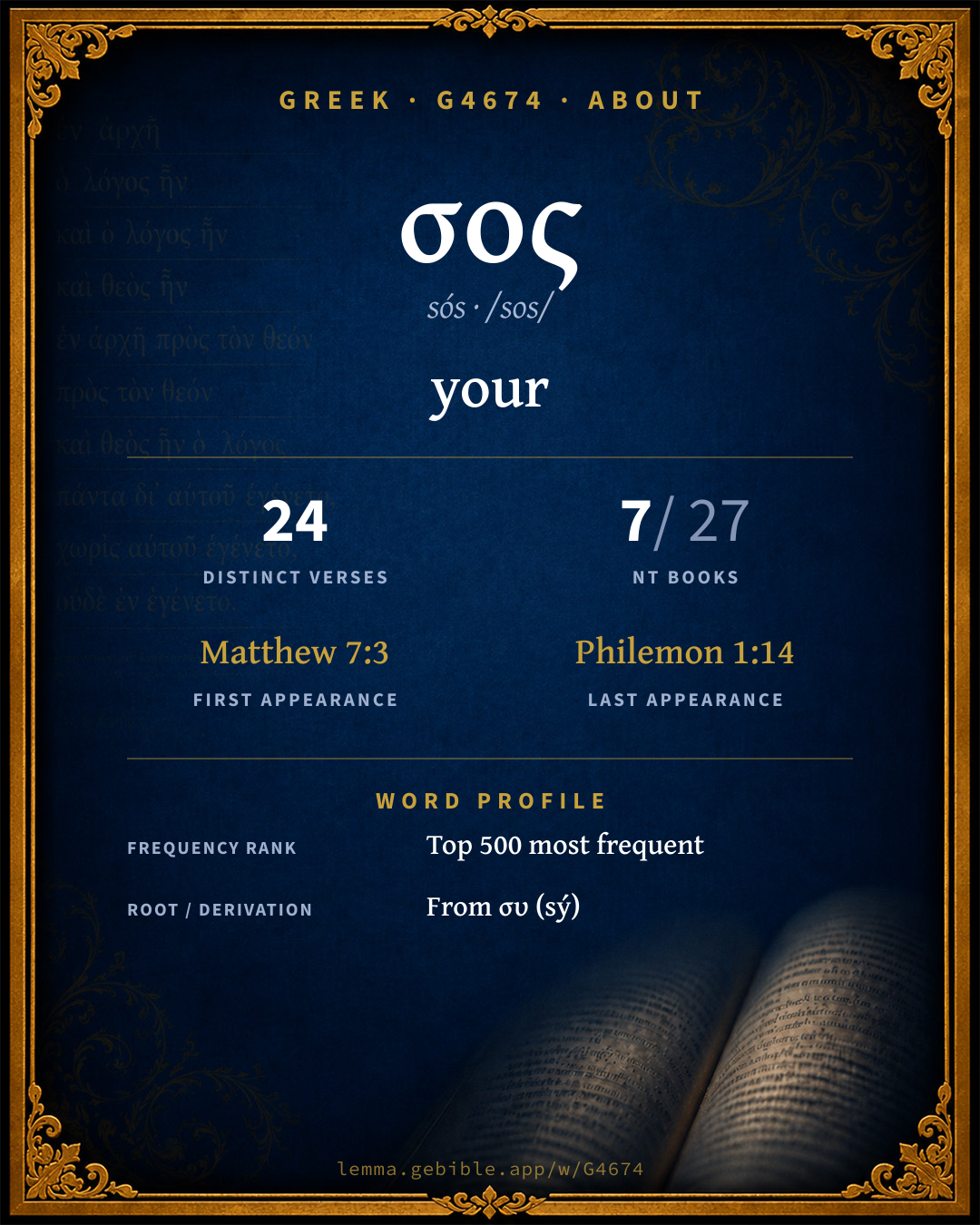
σός
your
Full lexicon entry — Thayer's Greek Lexicon
From Thayer's Greek Lexicon
Where this word appears
See every Dative-case word in the Greek New Testament →
Grammar key — what these labels mean
Part of speech
- Possessive pronoun
- Marks possession (“my,” “your,” “his”).
- Personal pronoun
- Stands in for a person already named (“I,” “you,” “he”).
Case
- Dative
- The case of the indirect object, means, or location — “to / for / with / in.”
- Genitive
- The case of source, possession, or “of” — answers “whose / from what.”
- Nominative
- The case of the subject (and the predicate nominative).
- Accusative
- The case of the direct object and of extent.
Person
- 2nd person
- The one addressed (“you”).
Gender
- Masculine
- Grammatically masculine.
- Feminine
- Grammatically feminine.
- Neuter
- Grammatically neuter.
Number
- Singular
- One.
- Plural
- More than one.
Grammatical forms 12 distinct
- Possessive pronoun, 2nd person, Dative, Singular, Masculine 5 times (19%)
- Possessive pronoun, 2nd person, Dative, Singular, Feminine 4 times (15%)
- Possessive pronoun, 2nd person, Genitive, Singular, Feminine 3 times (11%)
- Possessive pronoun, 2nd person, Nominative, Plural, Masculine 3 times (11%)
- Possessive pronoun, 2nd person, Nominative, Plural, Neuter 3 times (11%)
- Possessive pronoun, 2nd person, Accusative, Singular, Neuter 2 times (7%)
- Possessive pronoun, 2nd person, Nominative, Singular, Neuter 2 times (7%)
- Personal pronoun, 2nd person, Dative, Singular 1 time (4%)
+4 more forms (4 occurrences)
Parsed forms decoded from the imported morphology (Robinson–Tischendorf, public domain), counted across 27 parsed occurrences — not distinct verses.
Every verse where G4674 appears — 24 distinct verses across 7 books. Click any verse to open its interlinear word-by-word view. Verse text shown in the World English Bible for context — . Each verse’s Greek form is shown with its reference; the English is not keyword-highlighted, since the data carries no word-level English alignment. Use “Compare translations” on any verse to read it across multiple English versions. This concordance covers the Greek New Testament; Septuagint (Greek Old Testament) occurrences of this word are not indexed here.
Matthew 6 verses
- Matthew 7:3 σῷ poss.pron 2 dat sg masc Why do you see the speck that is in your brother's eye, but don't consider the beam that is in your own eye?
- Matthew 7:22 σῷ σῷ σῷ poss.pron 2 dat sg masc poss.pron 2 dat sg masc poss.pron 2 dat sg masc Many will tell me in that day, 'Lord, Lord, didn't we prophesy in your name, in your name cast out demons, and in your name do many mighty works?'
- Matthew 13:27 σῷ poss.pron 2 dat sg masc The servants of the householder came and said to him, 'Sir, didn't you sow good seed in your field? Where did this darnel come from?'
- Matthew 20:14 σὸν poss.pron 2 acc sg neut Take that which is yours, and go your way. It is my desire to give to this last just as much as to you.
- Matthew 24:3 σῆς poss.pron 2 gen sg fem As he sat on the Mount of Olives, the disciples came to him privately, saying, "Tell us, when will these things be? What is the sign of your coming, and of the end of the age?"
- Matthew 25:25 σόν poss.pron 2 acc sg neut I was afraid, and went away and hid your talent in the earth. Behold, you have what is yours.'
Mark 2 verses
- Mark 2:18 σοὶ poss.pron 2 nom pl masc John's disciples and the Pharisees were fasting, and they came and asked him, "Why do John's disciples and the disciples of the Pharisees fast, but your disciples don't fast?"
- Mark 5:19 σούς poss.pron 2 acc pl masc He didn't allow him, but said to him, "Go to your house, to your friends, and tell them what great things the Lord has done for you, and how he had mercy on you."
Luke 4 verses
- Luke 5:33 σοὶ poss.pron 2 nom pl masc They said to him, "Why do John's disciples often fast and pray, likewise also the disciples of the Pharisees, but yours eat and drink?"
- Luke 6:30 σὰ poss.pron 2 acc pl neut Give to everyone who asks you, and don't ask him who takes away your goods to give them back again.
- Luke 15:31 σά poss.pron 2 nom pl neut "He said to him, 'Son, you are always with me, and all that is mine is yours.
- Luke 22:42 σὸν poss.pron 2 nom sg neut saying, "Father, if you are willing, remove this cup from me. Nevertheless, not my will, but yours, be done."
John 6 verses
- John 4:42 σὴν poss.pron 2 acc sg fem They said to the woman, "Now we believe, not because of your speaking; for we have heard for ourselves, and know that this is indeed the Christ, the Savior of the world."
- John 17:6 σοὶ poss.pron 2 nom pl masc I revealed your name to the people whom you have given me out of the world. They were yours, and you have given them to me. They have kept your word.
- John 17:9 σοί pron 2 dat sg I pray for them. I don't pray for the world, but for those whom you have given me, for they are yours.
- John 17:10 σά σὰ poss.pron 2 nom pl neut poss.pron 2 nom pl neut All things that are mine are yours, and yours are mine, and I am glorified in them.
- John 17:17 σὸς poss.pron 2 nom sg masc Sanctify them in your truth. Your word is truth.
- John 18:35 σὸν poss.pron 2 nom sg neut Pilate answered, "I'm not a Jew, am I? Your own nation and the chief priests delivered you to me. What have you done?"
Acts 3 verses
- Acts 5:4 σῇ poss.pron 2 dat sg fem While you kept it, didn't it remain your own? After it was sold, wasn't it in your power? How is it that you have conceived this thing in your heart? You haven't lied to men, but to God."
- Acts 24:3 σῆς poss.pron 2 gen sg fem we accept it in all ways and in all places, most excellent Felix, with all thankfulness.
- Acts 24:4 σῇ poss.pron 2 dat sg fem But, that I don't delay you, I entreat you to bear with us and hear a few words.
1 Corinthians 2 verses
- 1 Corinthians 8:11 σῇ poss.pron 2 dat sg fem And through your knowledge, he who is weak perishes, the brother for whose sake Christ died.
- 1 Corinthians 14:16 σῇ poss.pron 2 dat sg fem Otherwise if you bless with the spirit, how will he who fills the place of the unlearned say the "Amen" at your giving of thanks, seeing he doesn't know what you say?
Philemon 1 verse
About this entry
At a glance — auto-summarized from this page’s data, not written by a person. Every figure links to its source below. This summary describes the numbers; it doesn’t interpret them.
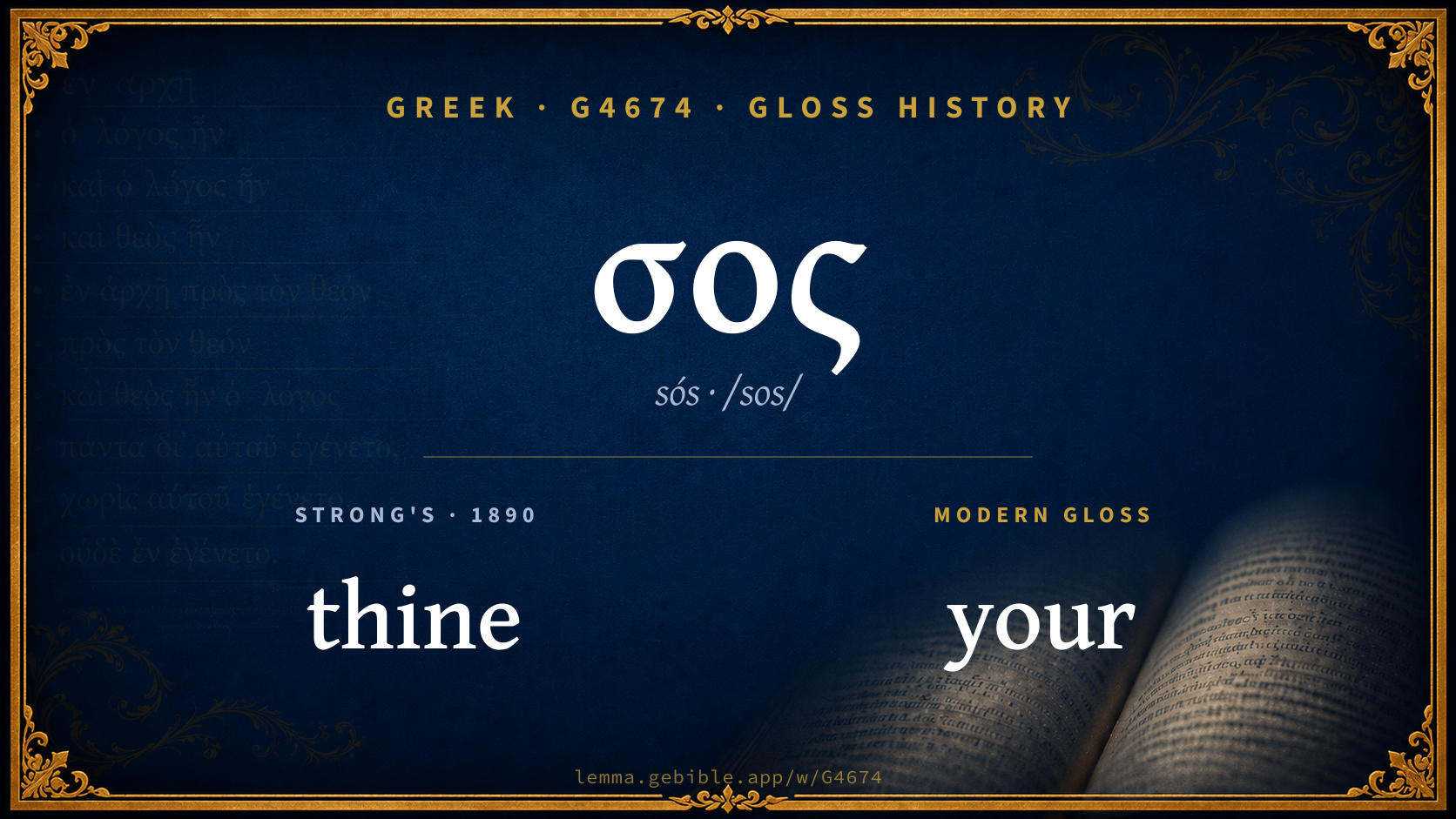
The Greek word σος centers on the idea of “your.” Its English rendering has broadened — “thy” classically, “your” (Berean Standard Bible) in modern versions; see the renderings breakdown. The Greek New Testament uses it across 24 verses — uncommon. Matthew dominates its distribution — 6 of 24 verses. Its earliest occurrence is Matthew 7:3. Dig into 24-verse concordance and the renderings breakdown below.
Gloss history
Strong's 1890 vs modern scholarship
About this word
Strong's G4674 catalogs a Greek word from the Greek New Testament.
These counts are not copied from any lexicon or concordance. They are computed here, from the morphology-tagged Greek New Testament. What Lemma adds →
- 24
- distinct verses
- The word appears in 24 distinct verses.
- 7 / 27
- NT books
- The word appears in 7 of 27 New Testament books.
- #500
- by frequency
- Top 500 most frequent Greek words (rank 500 of 5,347 Greek words by occurrence).
View all 24 occurrences in the concordance →
By section of the New Testament
By traditional corpus
Conventional, traditional groupings — biblical authorship is debated, so this is a traditional corpus grouping, not an authorship claim. Some books belong to more than one corpus (Luke is in both the Gospels and the Lukan corpus, and so on), so these shares overlap and need not total 100%. Each figure is a share of the word’s 24 distinct verses.
- Gospels 18 verses · 75%
- Lukan (Luke–Acts) 7 verses · 29%
- Johannine 6 verses · 25%
- Pauline corpus 3 verses · 13%
How translations render this word
Counts come from each version’s own published word-to-Strong’s tagging or interlinear alignment — an approximate guide to how each version renders this word, not a word-level alignment the data otherwise carries. Because each total is that version’s own tagged count, the per-version totals vary from one another and need not match the appearance or distinct-verse counts above. These counts may also differ from a printed concordance because Lemma counts each distinctly tagged rendering and does not collapse phrase taggings into a single head-word total. This is a fixed set of word-tagged versions (KJV, ASV, BSB, ULT) and does not change with the reading translation you choose elsewhere. Each version’s license is shown beside its name below (and on Sources).
- King James Version: Thy 13×, Thine 8×, Own 3×
- American Standard Version: Thy 13×, Thine 6×, Own 3×
- Berean Standard Bible: Your 15×, Yours 6×
- unfoldingWord Literal Text: Your 18×, Yours 7×
King James Version Public Domain
Renders G4674 across 27 tagged occurrences — most commonly:
Plus 3 renderings that appear only once — usually multi-word phrases or single function words the recovered tagging swept in, not distinct renderings.
American Standard Version Public Domain
Renders G4674 across 26 tagged occurrences — most commonly:
Plus 4 renderings that appear only once — usually multi-word phrases or single function words the recovered tagging swept in, not distinct renderings.
Berean Standard Bible Public Domain
Renders G4674 across 24 tagged occurrences — most commonly:
Plus 3 renderings that appear only once — usually multi-word phrases or single function words the recovered tagging swept in, not distinct renderings. Not rendered by a distinct English word in 2 further occurrences.
unfoldingWord Literal Text CC BY-SA 4.0
Renders G4674 across 25 tagged occurrences — most commonly:
Senses in Thayer's
The 1 sense Thayer's distinguishes for this word, in lexicon order (not ranked by frequency or importance). The full entry — with sub-senses — is in the Lexicon Entry tab.
- thy, thine
Word origin
Derived from συ (sý) (G4771) — you.
From G4771 ; thine : - thine (own) thy (friend).
— Strong’s Exhaustive Concordance (1890), public domain.
Forms in the corpus
The 12 distinct written forms G4674 takes in the Greek New Testament, most frequent first — each parse links to that case’s occurrences in the concordance.
Same root — word family
Other Thayer's entries built from the same root as G4674, grouped by Strong’s listed origin. These share a root / origin per the lexicon — not necessarily a shared meaning. Each links to that word’s own entry.
Derives from
Shares the same root
Compare all same-root words → Showing 4 of 6 — not the complete family. They share a root, not necessarily a meaning.
Septuagint usage
The same Greek word σος appears 110 times in the Greek Old Testament (Septuagint), across 92 verses in 16 books.
- 110
- LXX occurrences
- Tagged occurrences of this Greek word in the Septuagint.
- 92
- verses
- Distinct Septuagint verses containing this word.
- 16 / 39
- OT books
- The word appears in 16 of the 39 Old Testament books.
Sample Septuagint occurrences
- Genesis 14:23 σός
- Exodus 5:23 σός
- Leviticus 18:10 σός
- Deuteronomy 3:24 σός
- Joshua 5:14 σός
- 1 Samuel 22:15 σός
- 2 Samuel 9:2 σός
- 1 Kings 21:4 σός
- 1 Chronicles 29:14 σός
- Job 15:6 σός
- Psalms 73:16 σός
- Proverbs 1:9 σός
Septuagint occurrences (same lexeme)
Every verse where the same Strong’s number (G4674) appears in the Greek Septuagint — showing the first 50 of 92. Verse text shown in the World English Bible for context; the Greek form is the matched word — the English is not keyword-highlighted.
- Genesis 14:23 σός that I will not take a thread nor a shoe-latchet nor anything that is yours, lest you should say, 'I have made Abram rich.'
- Genesis 20:7 σός Now therefore, restore the man's wife. For he is a prophet, and he will pray for you, and you will live. If you don't restore her, know for sure that you will die, you, and all who are yours."
- Genesis 21:13 σός Also of the son of the handmaid will I make a nation, because he is your seed."
- Genesis 30:27 σός Laban said to him, "If now I have found favor in your eyes, stay here, for I have divined that Yahweh has blessed me for your sake."
- Genesis 31:32 σός With whoever you find your gods, he shall not live. Before our relatives, discern what is yours with me, and take it." For Jacob didn't know that Rachel had stolen them.
- Genesis 33:9 σός Esau said, "I have enough, my brother; let that which you have be yours."
- Exodus 5:23 σός For since I came to Pharaoh to speak in your name, he has brought trouble on this people; neither have you delivered your people at all."
- Exodus 32:13 σός Remember Abraham, Isaac, and Israel, your servants, to whom you swore by your own self, and said to them, 'I will multiply your seed as the stars of the sky, and all this land that I have spoken of I will give to your seed, and they shall inherit it forever.'"
- Leviticus 18:10 σός "'You shall not uncover the nakedness of your son's daughter, or of your daughter's daughter, even their nakedness: for theirs is your own nakedness.
- Deuteronomy 3:24 σός Lord Yahweh, you have begun to show your servant your greatness, and your strong hand: for what god is there in heaven or in earth, that can do according to your works, and according to your mighty acts?
- Joshua 5:14 σός He said, No; but [as] prince of the host of Yahweh am I now come. Joshua fell on his face to the earth, and did worship, and said to him, What says my lord to his servant?
- 1 Samuel 22:15 σός Have I today begun to inquire of God for him? be it far from me: don't let the king impute anything to his servant, nor to all the house of my father; for your servant knows nothing of all this, less or more.
- 1 Samuel 25:6 σός and thus shall you tell him who lives [in prosperity], Peace be to you, and peace be to your house, and peace be to all that you have.
- 2 Samuel 9:2 σός There was of the house of Saul a servant whose name was Ziba, and they called him to David; and the king said to him, Are you Ziba? He said, Your servant is he.
- 2 Samuel 15:34 σός but if you return to the city, and tell Absalom, I will be your servant, O king; as I have been your father's servant in time past, so will I now be your servant; then will you defeat for me the counsel of Ahithophel.
- 1 Kings 21:4 σός Ahab came into his house sullen and angry because of the word which Naboth the Jezreelite had spoken to him; for he had said, I will not give you the inheritance of my fathers. He laid him down on his bed, and turned away his face, and would eat no bread.
- 1 Kings 21:13 σός The two men, the base fellows, came in and sat before him: and the base fellows bore witness against him, even against Naboth, in the presence of the people, saying, Naboth did curse God and the king. Then they carried him forth out of the city, and stoned him to death with stones.
- 1 Kings 21:28 σός The word of Yahweh came to Elijah the Tishbite, saying,
- 1 Chronicles 29:14 σός But who am I, and what is my people, that we should be able to offer so willingly as this? For all things come of you, and of your own have we given you.
- Job 15:6 σός Your own mouth condemns you, and not I; Yes, your own lips testify against you.
- Job 39:26 σός "Is it by your wisdom that the hawk soars, And stretches her wings toward the south?
- Job 39:27 σός Is it at your command that the eagle mounts up, And makes his nest on high?
- Psalms 73:16 σός When I tried to understand this, It was too painful for me;
- Psalms 88:12 σός Are your wonders made known in the dark? Or your righteousness in the land of forgetfulness?
- Psalms 88:14 σός Yahweh, why do you reject my soul? Why do you hide your face from me?
- Psalms 115:7 σός They have hands, but they don't feel; They have feet, but they don't walk; Neither do they speak through their throat.
- Psalms 118:91 σός
- Psalms 118:94 σός
- Proverbs 1:9 σός For they will be a garland to grace your head, And chains around your neck.
- Proverbs 1:14 σός You shall cast your lot among us. We'll all have one purse."
- Proverbs 2:10 σός For wisdom will enter into your heart. Knowledge will be pleasant to your soul.
- Proverbs 3:1 σός My son, don't forget my teaching; But let your heart keep my commandments:
- Proverbs 3:3 σός Don't let kindness and truth forsake you. Bind them around your neck. Write them on the tablet of your heart.
- Proverbs 3:5 σός Trust in Yahweh with all your heart, And don't lean on your own understanding.
- Proverbs 3:9 σός Honor Yahweh with your substance, With the first fruits of all your increase:
- Proverbs 3:22 σός So they will be life to your soul, And grace for your neck.
- Proverbs 3:26 σός For Yahweh will be your confidence, And will keep your foot from being taken.
- Proverbs 3:29 σός Don't devise evil against your neighbor, Seeing he dwells securely by you.
- Proverbs 4:4 σός He taught me, and said to me: "Let your heart retain my words. Keep my commandments, and live.
- Proverbs 4:9 σός She will give to your head a garland of grace. She will deliver a crown of splendor to you."
- Proverbs 4:20 σός My son, attend to my words. Turn your ear to my sayings.
- Proverbs 4:21 σός Let them not depart from your eyes. Keep them in the midst of your heart.
- Proverbs 4:23 σός Keep your heart with all diligence, For out of it is the wellspring of life.
- Proverbs 4:26 σός Make the path of your feet level. Let all of your ways be established.
- Proverbs 4:27 σός Don't turn to the right hand nor to the left. Remove your foot from evil.
- Proverbs 5:1 σός My son, pay attention to my wisdom. Turn your ear to my understanding:
- Proverbs 5:3 σός For the lips of an adulteress drip honey. Her mouth is smoother than oil,
- Proverbs 5:8 σός Remove your way far from her. Don't come near the door of her house,
- Proverbs 5:9 σός Lest you give your honor to others, And your years to the cruel one;
- Proverbs 5:10 σός Lest strangers feast on your wealth, And your labors enrich another man's house.
These are occurrences of the same Greek lexeme (G4674) in the Septuagint — not a translation of any one Hebrew word. The store carries no word-level Hebrew↔Greek alignment, so no Hebrew original is asserted here. Counts come from the recovered LXX Strong's tagging — high-frequency vocabulary is well covered, while rare or late forms may be untagged — so they reflect tagged occurrences and may slightly undercount.