
Luke 1:42

Greek (Tischendorf 8th ed.) Luke 1:42 appears in the Greek New Testament. The text above is from the Tischendorf 8th edition. Each word links to its Strong’s number and a concise gloss. Click any word for its full Thayer’s Greek Lexicon entry.
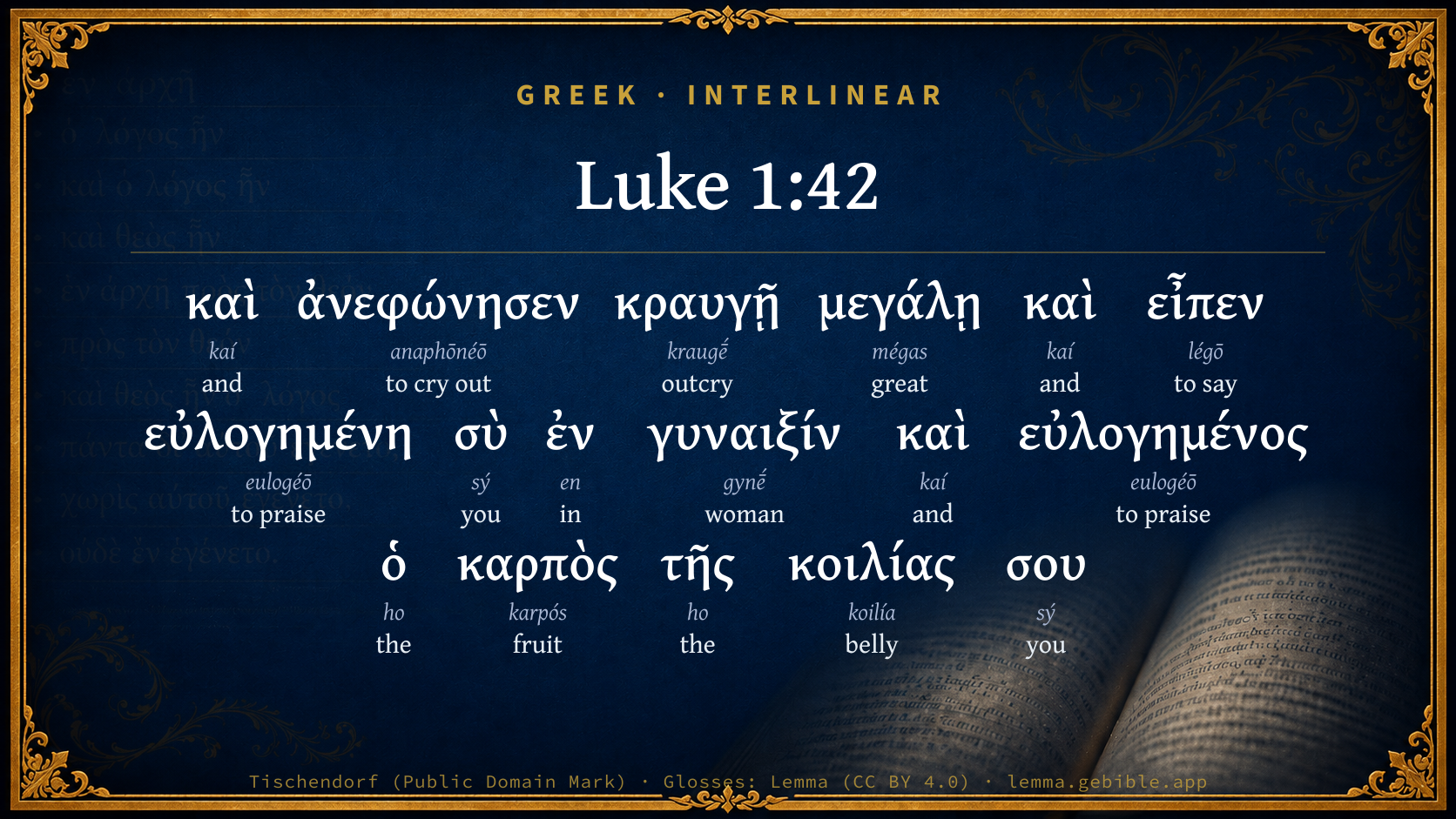
Download image
Cite this verse

Luke 1:42 (World English Bible). Public Domain. Lemma interlinear Bible study tool, https://lemma.gebible.app/v/luke/1/42.

Show BibTeX & RIS
BibTeX
RIS
English Translation
She called out with a loud voice, and said, "Blessed are you among women, and blessed is the fruit of your womb!
World English Bible · Public Domain
Highlights
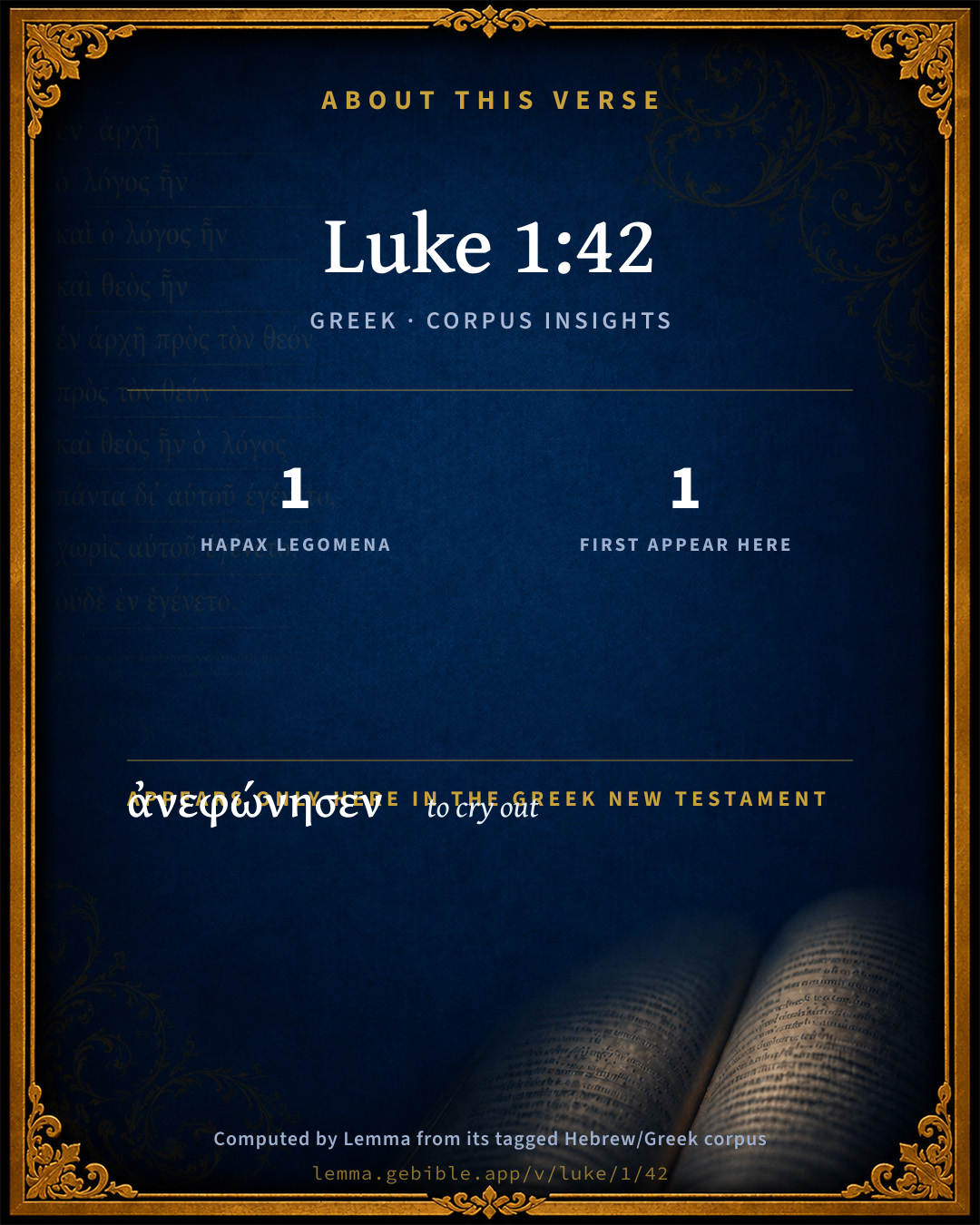
  • 1 hapax legomenon — only here in the Greek New Testament
  • 1 first appearance in the Greek New Testament
Full analysis ↓
Download a study sheet

One document with this verse’s original text, its word-by-word gloss line, the meaning frame, cross-references with their text, attributed commentary, and full source and license credits — printable, and it pastes into notes with its structure intact.

This verse Autodidact and up

Study sheet (.html) Plain text (.txt)

A passage Seminary Student

Up to 50 verses in one chapter. A passage sheet keeps up to 6 commentary sources and 12 cross-references per verse, in the order this page ranks them, and says so on the sheet whenever that leaves anything out. Ask for a single verse and you get the Autodidact verse sheet above.

Everything on this page stays free to read, with no account — the sheet is a download of what is already on screen, not access to it.

Want to remove ads? Support Godless Engineer
Compare translations 3

The same verse in 3 English versions, stacked beneath the original-language interlinear above. Click any original word for its lexicon entry.

Each is an independent rendering of the whole verse — the interlinear is not word-aligned to these translations.

Highlighted words mark where these versions differ — a whole-verse word diff, not a word-by-word alignment.

  • World English Bible Public Domain
    She called out with a loud voice, and said, "Blessed are you among women, and blessed is the fruit of your womb!
  • King James Version Public Domain
    And she spake out with a loud voice, and said, Blessed art thou among women, and blessed is the fruit of thy womb.
  • unfoldingWord Literal Text CC BY-SA 4.0
    And she exclaimed in a loud voice and said, “Blessed are you among women, and blessed is the fruit of your womb.

unfoldingWord Literal Text — © unfoldingWord, licensed CC BY-SA 4.0. Word-aligned USFM3 via Door43 (git.door43.org/unfoldingWord/en_ult).

Versions to compare (up to 4)

3 of 4 selected

Show all 19 translations

Every available English version of this verse, each an independent rendering of the whole verse.

  • World English Bible Public Domain
    She called out with a loud voice, and said, "Blessed are you among women, and blessed is the fruit of your womb!
  • Berean Standard Bible Public Domain
    In a loud voice she exclaimed, “Blessed are you among women, and blessed is the fruit of your womb!
  • Majority Standard Bible Public Domain
    In a loud voice she exclaimed, “Blessed are you among women, and blessed is the fruit of your womb!
  • King James Version Public Domain
    And she spake out with a loud voice, and said, Blessed art thou among women, and blessed is the fruit of thy womb.
  • American Standard Version (1901) Public Domain
    and she lifted up her voice with a loud cry, and said, Blessed `art' thou among women, and blessed `is' the fruit of thy womb.
  • Revised Version (1885) Public Domain
    and she lifted up her voice with a loud cry, and said, Blessed art thou among women, and blessed is the fruit of thy womb.
  • Geneva Bible (1599) Public Domain
    And she cried with a loud voice, and saide, Blessed art thou among women, because the fruit of thy wombe is blessed.
  • Douay-Rheims (1899) Public Domain
    And she cried out with a loud voice, and said: Blessed art thou among women, and blessed is the fruit of thy womb.
  • Young's Literal Translation Public Domain
    and spake out with a loud voice, and said, `Blessed `art' thou among women, and blessed `is' the fruit of thy womb;
  • Literal Standard Version CC BY-SA 4.0
    and spoke out with a loud voice and said, “Blessed [are] you among women, and blessed [is] the Fruit of your womb;
  • Unlocked Literal Bible CC BY-SA 4.0
    She raised her voice and said loudly, “Blessed are you among women, and blessed is the fruit of your womb.
  • unfoldingWord Literal Text CC BY-SA 4.0
    And she exclaimed in a loud voice and said, “Blessed are you among women, and blessed is the fruit of your womb.
  • Darby Bible Public Domain
    and cried out with a loud voice and said, Blessed [art] *thou* amongst women, and blessed the fruit of thy womb.
  • World Messianic Bible Public Domain
    She called out with a loud voice and said, “Blessed are you among women, and blessed is the fruit of your womb!
  • Webster's Bible Public Domain
    And she spoke with a loud voice, and said, Blessed art thou among women, and blessed is the fruit of thy womb.
  • Free Bible Version CC BY-SA 4.0
    and cried out in a loud voice: “How blessed you are among women, and how blessed will be the child born to you!
  • Bible in Basic English Public Domain
    And she said with a loud voice: May blessing be on you among women, and a blessing on the child of your body.
  • Text-Critical English NT CC BY 4.0
    Then she exclaimed with a loud voice, “Blessed are yoʋ among women, and blessed is the fruit of yoʋr womb!
  • Tyndale New Testament (1534) Public Domain
    and cryed with a loude voyce and sayde: Blessed arte thou amonge wemen and blessed is the frute of thy wombe.

Literal Standard Version (2020), Covenant Press — licensed CC BY-SA 4.0. Text via the HelloAO Bible API (eBible.org). Unlocked Literal Bible (unfoldingWord) — licensed CC BY-SA 4.0. Text via the HelloAO Bible API (eBible.org). unfoldingWord Literal Text — © unfoldingWord, licensed CC BY-SA 4.0. Word-aligned USFM3 via Door43 (git.door43.org/unfoldingWord/en_ult). Free Bible Version, Dr. Jonathan Gallagher — licensed CC BY-SA 4.0. Text via the HelloAO Bible API (eBible.org).

Word by word

More ways to search: Search by grammar → Find every occurrence → Compare this word →

Practice this passage: Drill this verse → Learn its vocabulary →

ἀνεφώνησεν
anaphōnéō
G400
“to cry out”
Verb, Aorist, Active, Indicative, 3rd person, Singular
Part of Speech
Verb
Tense
Aorist
Voice
Active
Mood
Indicative
Person
3rd person
Number
Singular
Full Thayer's Definition

Origin: from G303 and G5455

TDNT: None

1. to cry out with a loud voice, call aloud, exclaim
  1. καὶ kaí G2532 “and” Conjunction
  2. κραυγῇ kraugḗ G2906 “outcry” Noun, Dative, Singular, Feminine
  3. μεγάλῃ mégas G3173 “great” Adjective, Dative, Singular, Feminine
  4. καὶ kaí G2532 “and” Conjunction
  5. εἶπεν légō G3004 “to say” Verb, Aorist, Active, Indicative, 3rd person, Singular
  6. εὐλογημένη eulogéō G2127 “to praise” Verb, Perfect, Passive, Participle, Nominative, Singular, Feminine
  7. σὺ sý G4771 “you” Personal pronoun, 2nd person, Nominative, Singular
  8. ἐν en G1722 “in” Preposition
  9. γυναιξίν gynḗ G1135 “woman” Noun, Dative, Plural, Feminine
  10. καὶ kaí G2532 “and” Conjunction
  11. εὐλογημένος eulogéō G2127 “to praise” Verb, Perfect, Passive, Participle, Nominative, Singular, Masculine
  12. ὁ ho G3588 “the” Article, Nominative, Singular, Masculine
  13. καρπὸς karpós G2590 “fruit” Noun, Nominative, Singular, Masculine
  14. τῆς ho G3588 “the” Article, Genitive, Singular, Feminine
  15. κοιλίας koilía G2836 “belly” Noun, Genitive, Singular, Feminine
  16. σου sý G4771 “you” Personal pronoun, 2nd person, Genitive, Singular

About this verse

These counts appear in no published source. They are computed here, from the morphology-tagged text and Lemma’s own curated glosses. What Lemma adds →

17
words
12
distinct lemmas
Gospels
section

Notable vocabulary

1 hapax legomenon — a word that appears only here in the entire Greek New Testament:

  • ἀνεφώνησεν to cry out G400

First appearance in Scripture

This word makes its first canonical appearance in the Greek New Testament here:

  • ἀνεφώνησεν to cry out G400

Shared distinctive vocabulary

κραυγῇ outcry G2906 occurs in 6 verses of the Greek New Testament. Also found in:
Repetition

Words recur within this verse:

  • εὐλογημένη to praise G2127 ×2
  • καὶ and G2532 ×3
  • σὺ you G4771 ×2
  • ὁ the G3588 ×2

Cross-references

11

Topical passages linked to Luke 1:42 in the Treasury of Scripture Knowledge — connected by theme and wording, ordered by reader-vote popularity; previews shown in the World English Bible.

  • Genesis 22:18 In your seed will all the nations of the earth be blessed, because you have obeyed my voice."
  • Judges 5:24 Blessed above women shall Jael be, The wife of Heber the Kenite; Blessed shall she be above women in the tent.
  • Luke 1:28 Having come in, the angel said to her, "Rejoice, you highly favored one! The Lord is with you. Blessed are you among women!"
  • Luke 19:38 saying, "Blessed is the King who comes in the name of the Lord! Peace in heaven, and glory in the highest!"
  • Luke 1:48 For he has looked at the humble state of his handmaid. For behold, from now on, all generations will call me blessed.
  • Psalms 21:6 For you make him most blessed forever. You make him glad with joy in your presence.
  • Psalms 72:17–19 His name endures forever. His name continues as long as the sun. Men shall be blessed by him. All nations will call him blessed.
  • Acts 2:26–28 Therefore my heart was glad, and my tongue rejoiced. Moreover my flesh also will dwell in hope;
  • Psalms 45:2 You are the most excellent of the sons of men. Grace has anointed your lips, Therefore God has blessed you forever.
  • Romans 9:5 of whom are the fathers, and from whom is Christ as concerning the flesh, who is over all, God, blessed forever. Amen.
  • Hebrews 12:2 looking to Jesus, the author and perfecter of faith, who for the joy that was set before him endured the cross, despising shame, and has sat down at the right hand of the throne of God.

Cross-references courtesy of OpenBible.info (CC BY 4.0).

Commentary

Notes on Luke 1:42 from classic Christian and Jewish commentators (each source and its license shown beneath its notes). The classic Christian expositions comment on the surrounding passage and are grouped to its opening verse, so a note may address several verses; the Jewish commentaries on the Tanakh (Rashi and others) are per-verse, so they appear only where the commentator wrote on this verse.

Lemma curates 59 commentaries, every one of them public domain or Creative Commons licensed, each selected and text-cleaned for this edition rather than reprinted as found. About our sources →

Bengel's Gnomon

Johann Albrecht Bengel

Luk 1:42. Ἀνεφώνησε φωνῇ μεγάλῃ) So ἐφώνησε φωνῇ μεγάλῃ Act 16:28. Others read ἀνεβόησε[13] φωνῇ μεγάλῃ. And so Mat 27:46; LXX., Gen 27:38; 1Sa 28:12; Isa 36:13; Isa 11:13, etc. Also 3Ma 5:48 (51); Hist. of Sus. four times; Hist. of the Drag. Luk 1:40 (41). But ἀναφωνεῖν is employed in a very different sense; for instance, of the sounds heard in public worship, as it was duly ordered by David.—καὶ εἶπεν, and said) It was not until after these words which, coming from the Holy Spirit, followed immediately after the salutation of Mary, that Mary reported to Elisabeth what the angel had announced to her.—εὐλογημένη, Blessed) These words, which in the angel’s salutation were last in order, stand first in the salutation of Elisabeth.—καὶ εὐλογημένος, and blessed) This was not added in Luk 1:28.—ὁ καρπὸς, the fruit) Mary therefore was truly the mother of Jesus.

[13] C is the only good authority for ἀνεβόησε. ABD Origen expressly, 4,149ab, read ἀνεφώνησεν. The very strangeness of the use of the latter word is an argument for it not having come from transcribers: ἀνέβοησε was evidently a marginal explanation. Bengel’s own principle, “Præferatur ardua lectioni procliviori,” supports ἀνεφώνησε.—ED. and TRANSL.

Bengel's Gnomon of the New Testament — English translation (T&T Clark, Edinburgh, 1860) — public domain. Text from a community e-Sword module.

Meyer's Critical & Exegetical Commentary

Heinrich August Wilhelm Meyer

Luk_1:42 f. Ἀνεφώνησε] She cried out (only occurring here in the N. T.; comp. 1Ch_15:28; 1Ch_16:5; 2Ch_5:12; Polyb. iii. 33. 4; frequent in Plutarch), expressing the outburst of the being filled by the Spirit.

ὁ καρπὸς τ. κοιλ. σου] Designation of the embryo, that Mary bears in her womb. For the expression, comp. Gen_30:2; Lam_2:20.

καὶ πόθεν κ.τ.λ.] sc. γέγονεν. After the first outburst now follows a certain reflection, a humble pondering, from what cause (πόθεν, comp. on Mar_12:37) she was deemed worthy of this great happiness: ἀναξίαν ἑαυτὴν τῆς τοιαύτης ἐπιδημίας τῆς δεσποίνης ὁμολογεῖ, Euthymius Zigabenus.

ἵνα κ.τ.λ.] not equivalent to τὸ ἐλθεῖν τὴν μητ. κ.τ.λ., but telic: that the mother of my Lord (the Messiah, comp. Psa_110:1) should come to me,this is the τοῦτο, in reference to which she asks πόθεν μοι. Comp. on Joh_6:29; Joh_17:3.

Meyer — Critical and Exegetical Commentary on the New Testament — English translation by Peter Christie, edited by Frederick Crombie (T&T Clark, 1880) — public domain. Text from a community e-Sword module.

Expositor's Greek Testament

ed. W. Robertson Nicoll

Luk 1:42 . ἀνεφώνησεν : here only in N. T. The verb, with the following words, κραυγῇ μεγάλῃ , point to an unrestrained utterance under the influence of irrepressible feeling, thoroughly true to feminine nature: “blessed thou among women (a Hebrew superlative), and blessed the fruit of thy womb,” poetic parallelism again, answering to the exalted state of feeling. The reference to the Holy Spirit (in Luk 1:41 ) implies that Elizabeth spoke by prophetic inspiration.

The Expositor's Greek Testament, edited by W. Robertson Nicoll (1897–1910) — public domain. Text from a community e-Sword module.

Godet's Commentaries

Frédéric Louis Godet

2. The salutation of Elizabeth: Luk 1:42-45.—“And she spake out with a loud voice, and said, Blessed art thou among women, and blessed is the fruit of thy womb. 43. And whence is this to me, that the mother of my Lord should come to me? 44. For, lo, as soon as the voice of thy salutation sounded in mine ears, the babe leaped in my womb for joy. 45. And blessed is she that believed: for there shall be a performance of those things which were told her from the Lord.”

The course of Elizabeth’s thought is this: first of all, Mary and the Son of Mary (Luk 1:42); next, Elizabeth herself and her son (Luk 1:43-44); lastly, Mary and her happiness. The characteristic of all true action of the Holy Spirit is the annihilation of the proper individuality of the person who is the instrument of it, and the elevation of his personal feelings to the height of the divine word. This is precisely the character of Elizabeth’s salutation; we shall find it the same in the song of Zacharias. Thus the truth of this word, Elizabeth was filled with the Holy Ghost, is justified by this very fact. The reading of some Alexandrians, ἀνεβόησεν, would indicate a cry, instead of a simple breaking forth into speech. The reading κραυγῇ of three other Alex. would have the same meaning. They both savour of exaggeration. In any case, both could not be admitted together. We may translate, Blessed art thou, or Blessed be thou. The former translation is best; for exclamation is more in place here than a wish.

The superlative form, blessed among, is not unknown to classical Greek.

The expression, the fruit of thy womb, appears to imply that the fact of the incarnation was already accomplished; so also does the expression, the mother of my Lord (Luk 1:43).— ῞Ινα, in order that (Luk 1:43), may keep its ordinary meaning: “What have I done in order that this blessing might come to me?” This ἵνα is used from the standpoint of the divine intention.

From Mary and her Son, her thought glances to herself and her own child. In calling Mary the mother of my Lord, she declares herself the servant of the Messiah, and consequently of His mother also.

Everything of a sublime character springs from a deeper source than the understanding. The leaping of John, a prelude of the work of his life, belongs to the unfathomable depths of instinctive life. Elizabeth sees in it a sign of the truth of the presentiment she felt as soon as she saw Mary.

At Luk 1:45 she reverts to Mary. The expression blessed is doubtless inspired by the contemplation of the calm happiness that irradiates the figure of the young mother. ῞Οτι cannot be taken here in the sense of because; for the word πιστεύσασα, she that believed, in order that it may have its full force, must not govern anything. “Blessed is she that, at the critical moment, could exercise faith (the aorist)!” De Wette, Bleek, Meyer, think that the proposition which follows should depend on πιστεύσασα: “she who believed that the things...would have their accomplishment.” The two former, because σοί would be necessary in place of αὐτῇ; the third, because all that had been promised to Mary was already accomplished. But Elizabeth’s thought loses itself in a kind of meditation, and her words, ceasing to be an apostrophe to Mary, become a hymn of faith. This accounts for the use of a pronoun of the third person. As to Meyer, he forgets that the accomplishment is only just begun, and is far from being completed. The glorification of the Messiah and of Israel still remains to be accomplished. Τελείωσις denotes this complete accomplishment. But how could Elizabeth speak of the kind of things which had been promised to Mary? What had passed between the angel and Zacharias had enlightened her respecting the similar things that must have taken place between heaven and Mary.

Frédéric Louis Godet — Commentaries on Luke, John, Romans, and 1 Corinthians — English translation (T&T Clark, Edinburgh, 1870s–1890s) — public domain. Text from a community e-Sword module.

Geneva Bible (1599)

Geneva Bible translators

Christ is blessed in respect of his humanity.

Geneva Bible (1599) marginal notes — public domain. Text via Bolls.life.

Jamieson, Fausset & Brown

Robert Jamieson, A. R. Fausset & David Brown

What beautiful superiority to envy have we here! High as was the distinction conferred upon herself, Elisabeth loses sight of it altogether, in presence of one more honored still; upon whom, with her unborn Babe, in an ecstasy of inspiration, she pronounces a benediction, feeling it to be a wonder unaccountable that "the mother of her Lord should come to her." "Turn this as we will, we shall never be able to see the propriety of calling an unborn child "Lord," but by supposing Elisabeth, like the prophets of old, enlightened to perceive the Messiah's Divine nature" [OLSHAUSEN].

Jamieson, Fausset & Brown — Commentary Critical and Explanatory on the Whole Bible (1871) — public domain (CC PDM 1.0). Text via the HelloAO Bible API.

Adam Clarke's Commentary

Verse 42. Blessed art thou among women] Repeating the words of the angel, Lu 1:28, of which she had probably been informed by the holy virgin, in the present interview.

Adam Clarke's Commentary on the Bible (1810–1826) — public domain. Text from a community e-Sword/MySword module.

Ellicott's Commentary for English Readers

(42) Blessed art thou among women.—The language, like that of most of the utterances in these chapters, is taken from the poetry of the older Scriptures, but there is a singular contrast between its application there to the murderess Jael (Jdg_5:24), and here to the mother of the Lord.

A Bible Commentary for English Readers, edited by Charles John Ellicott (1878–1897) — public domain. Text from a community e-Sword module.

The Cambridge Bible for Schools and Colleges

gen. ed. J. J. S. Perowne

42. with a loud voice] For ‘phonç,’ voice, B has the stronger word ‘kraugç,’ cry.

Blessed art thou among women] i. e. preeminently blessed, as “fairest among women,” Son_1:8. Similar expressions are used of Ruth (Rth_3:10), and, on a far lower level of meaning, of Jael (Jdg_5:24), and of Judith. “All the women of Israel blessed her,” Jdg_15:12. In the latter instances the blessing is pronounced by women, but here the word means ‘blessed by God.’

The Cambridge Bible for Schools and Colleges (gen. ed. J. J. S. Perowne; Cambridge University Press, 1878–1918) — public domain. Text from a community e-Sword module.

John Gill's Exposition

And she spake out with a loud voice,.... So as that all in the house might hear; she spake with great vehemency of soul, and strength of affection, being under a very powerful impression of the Spirit of God: and said,

blessed art thou among women; the same words that the angel had said to her before, Luk 1:28.

and blessed is the fruit of thy womb: this is a reason why she is called blessed, because her child was blessed; being in union with a divine person, who is God over all, blessed for ever; and who has all spiritual blessings in him, and is that seed, in which all nations of the earth were to be blessed; and so is both blessed in himself, and the source of all blessedness to others. The Jews say (h), that the six measures of barley, Boaz gave to Ruth, Rut 3:15 signified, that six righteous men should spring from her, and among, them the Messiah; who should be blessed with six blessings, and they are these; the spirit of wisdom and understanding, of counsel and of might, the spirit of knowledge, and of the fear of the Lord; see Isa 11:2.

(h) Targum & R. Sol. Jarchi in loc.

John Gill's Exposition of the Whole Bible (1746–1763) — public domain (CC PDM 1.0). Text via the HelloAO Bible API.

Trapp's Complete Commentary

John Trapp

42 And she spake out with a loud voice, and said, Blessed art thou among women, and blessed is the fruit of thy womb.

Ver. 42. Blessed art thou among women] So is Jael, the wife of Heber, said to be, Jdg 5:24. Who yet perhaps was hardly so good a woman as Deborah, that called her so. But it was no small confirmation to the blessed Virgin, to hear the same words from Elisabeth that she heard before from the angel.

And blessed is the fruit, &c.] Or, because blessed is the fruit of thy womb, therefore blessed art thou, &c. Yet more blessed (as Austin saith) in receiving the faith than in conceiving the flesh of Christ. She conceived Christ when she yielded her assent to the angel, and said, Be it as thou hast said, let it even be so. We also conceive Christ in our hearts when we assent to the promises of pardon, of salvation by Christ: hoping perfectly for the grace that is to be brought unto us at the revelation of Jesus Christ, 1Pe 1:13. It is with us all, as it was with that captive woman, Deu 21:1-14. If she consented to marry, she saved her life by it.

John Trapp, A Commentary or Exposition upon All the Books of the Old and New Testament (1647–1656) — public domain. Text from a community e-Sword module.

Albert Barnes' Notes on the Bible

Blessed art thou among women - She here repeated nearly the words of the angel to Mary, esteeming it to be the highest honor among mothers to be the mother of the Messiah. See the notes at Luk 1:28.

Albert Barnes' Notes on the Bible (1834–1885) — public domain. Text from a community e-Sword/MySword module.

Haydock's Catholic Bible Commentary

In the same words she is pronounced blessed by Elizabeth, and by the angel Gabriel, both inspired by the Holy Ghost, and this not only to the praise of Jesus, but for his sake, to the praise of Mary, calling her blessed, and her fruit blessed; and thus, as Ven. Bede asserts, holding her up to the veneration of both men and angels.

George Leo Haydock (1774–1849), Haydock's Catholic Family Bible and Commentary, 1859 edition — public domain. Excludes Psalms (Douay-Rheims chapter numbering differs from Protestant) and Deuterocanonical books (Catholic canon only).

Matthew Poole's English Annotations

Elisabeth useth the same words to Mary which the angel had used for her, Luk 1:28; that is, thou art an exceedingly happy woman, not only renowned, but one whom God hath greatly favoured and exceedingly blessed and made happy.

And blessed is the fruit of thy womb. Though the same word be used, yet it is not to be understood of the same degree of blessing. Christ was anointed with the oil of gladness above his fellows, and blessed in another sense and after another manner, than any creature can be said to be blessed, for the fulness of the Godhead dwelt in him bodily.

Matthew Poole's English Annotations on the Holy Bible (1683–1685) — public domain. Text from a community e-Sword/MySword module.

The Pulpit Commentary

And she spake out with a loud voice, and said, Blessed art thou among women. (see Jud_1:5:24) The words which clothed the thoughts in these ecstatic expressions of intense joy and thankfulness on the part of the two favored women, Mary and Elisabeth, are in great measure drawn from hymn and song contained in the Old Testament Scriptures. The song of Hannah, the hymn of Deborah, many of the psalms, the songs of the Canticles, the more glorious of the prophetic utterances, had been ever familiar to both these true women of the people; and they could find no language so fitting as the words of these loved national songs to express the intense joy, the deep awe and gratitude of their hearts. Think what must have been the feeling of the two the one finding herself the chosen out of all the thousands of Israel, after so many centuries of weary waiting, to be the mother of the Messiah; the other, long after any reasonable hope of any offspring at all had faded away, to be the mother of Messiah"s chosen friend, his herald, and his preacher, the mighty forerunner of the King of whom the prophets had written!

The Pulpit Commentary (1880–1919), ed. H.D.M. Spence-Jones & Joseph S. Exell — public domain. Text from a community e-Sword module.

The People's New Testament

B. W. Johnson

42–45. Blessed art thou among women. The language of Elisabeth, Oriental poetry, is that of an inspired prophet. Mother of my Lord. Jesus, our Lord and Savior.

B. W. Johnson's The People's New Testament with Notes (1889–1891) — public domain. Electronic text from the Christian Classics Ethereal Library (CCEL) ThML edition.

unfoldingWord translationNotes

Door43 World Missions Community

raised her voice ... said loudly

These two phrases mean the same thing, and are used to emphasize how excited Elizabeth was. They could be combined into one phrase. AT: "exclaimed loudly" (See: Doublet)

raised her voice

This idiom means "increased the volume of her voice" (See: Idiom)

Blessed are you among women

The idiom "among women" means "more than any other woman" (See: Idiom)

the fruit of your womb

Mary's baby is spoken of as if it is the fruit that a plant produces. AT: "the baby in your womb" or "the baby you will bear" (See: Metaphor)

Why has it happened to me that the mother of my Lord should come to me?

Elizabeth is not asking for information. She was showing how surprised and happy she was that the mother of the Lord had come to her. AT: "How wonderful it is that the mother of my Lord has come to me!" (See: Rhetorical Question)

the mother of my Lord

It can be made clear that Elizabeth was calling Mary "the mother of my Lord" by adding the word "you." AT: "you, the mother of my Lord" (See: First, Second, or Third Person)

For see

This phrase alerts Mary to pay attention to Elizabeth's surprising statement that follows.

when the sound of your greeting came to my ears

Hearing a sound is spoken of as if the sound came to the ears. AT: "when I heard the sound of your greeting" (See: Metonymy)

jumped for joy

"moved suddenly with joy" or "turned forcefully because he was so happy"

Blessed is she who believed ... that were told her from the Lord

Elizabeth is talking about Mary to Mary. AT: "Blessed are you who believed ... that were told you from the Lord"(See: First, Second, or Third Person and Active or Passive)

Blessed is she who believed

The passive verb can be translated in active form. AT: "God will bless her because she believed" (See: Active or Passive)

there would be a fulfillment of the things

"the things would actually happen" or "the things would come true"

the things that were told her from the Lord

The word "from" is used here instead of "by" because it was the angel Gabriel whom Mary actually heard speak (see Luke 1:26), but the message ("the things") came ultimately from the Lord. This can be stated in active form. AT: "the message that she heard from the Lord" or "the Lord's message that the angel told her" (See: Active or Passive and Assumed Knowledge and Implicit Information)

translationWords

voice

bless

joy

believe

fulfill

unfoldingWord translationNotes — © Distant Shores Media and the Door43 World Missions Community, licensed CC BY-SA 4.0. Source: git.door43.org/Door43/en_tn.

Cambridge Greek Testament for Schools and Colleges

42. ἀνεφώνησεν. Vulg[37] exclamavit.

[37] Vulg. Vulgate.

κραυγῇ μεγάλῃ. ‘with a great cry.’ The reading φωνῇ, voice, ACD, &c. is a commoner but weaker phrase. Ἀνεφώνησεν is ἅπαξ λεγόμενον in the N. T.

Εὐλογημένη σὺ ἐν γυναιξίν. i.e. preeminently blessed. (Cf. “fairest among women,” Son 1:8.) Similar expressions are used of Ruth (Rth 3:10), and, on a far lower level of meaning, of Jael (Jdg 5:24), and of Judith. “All the women of Israel blessed her,” Jdg 15:12. In the latter instances the blessing is pronounced by women, but here the word means ‘blessed by God.’ It is in fact a sort of Hebrew superlative, but is not unparalleled in Greek. Comp. Eur. Alc. 473, ὦ φίλα γυναικῶν. Pind. Nem. iii. 80, αἰετὸς ὠκὺς ἐν πετανοῖς (Winer p. 308).

ὁ καρπὸς τῆς κοιλίας σου. Gen 30:2; Lam 2:20.

Cambridge Greek Testament for Schools and Colleges (Cambridge University Press, 1896; 21 vols, various authors incl. Carr, Maclear, Plummer, Farrar, Lumby, Moule, M. R. James, Simcox) — public domain. Text from a community e-Sword module.

Alford’s Greek Testament

Henry Alford

42.] εὐλογ. has a double meaning: that of blessed,—from above—blessed among women, i.e. beyond other women; and praised,—from below—i.e. called blessed by women. The former is the best rendering here: and then ἐν γ. will be the Hebrew superlative, as in Jer_29 (49) 15, and Son 1:8.

Henry Alford, The Greek Testament (1849–1861) — public domain. Text from a community e-Sword module.

International Critical Commentary

42. ἀνεφώνησεν. 1Ch 15:28, 1Ch 15:16:4, 1Ch 15:5, 42; 2Ch 5:13: here only in N.T. Lk. frequently records strong expressions of emotion, adding μεγάλη to κραυγή, φωνή, χαρά, etc. (2:10, 4:33, 8:28, 17:15, 19:37, 23:23, 46, 24:52). It is perhaps because κραυγή seemed less appropriate to express a cry of joy that it has been altered (A C D) to the more usual φωνή. But it is convincingly attested (א B L Ξ). It means any cry of strong feeling, whether surprise (Mat 25:6), anger (Eph 4:31), or distress (Heb 5:7). Comp. Apoc. Baruch, 54:10.

Εὐλογημένη σὺ ἐν γυναιξίν. A Hebraistic periphrasis for the superlative, “Among women thou art the one who is specially blessed.” Mary has a claim to this title κατʼ ἐξοχήν. Comp. 7:28. Somewhat similar expressions occur in class. Grk., esp. in poetry: ὦ φίλα γυναικῶν (Eur. Alc. 460); ὦ σχέτλιʼ ἀνδρῶν (Aristoph. Ran. 1048). In N.T. εὐλογημένος is used of men, εὐλογητός of God: see on ver. 68. With εὐλογημένος ὁ καρπὸς τῆς κοιλίας σου comp. εὐλογημένα τὰ ἔκγονα τῆς κ. σου (Deu 28:4) and καρπὸν κοιλίας (Gen 30:2; Lam 2:20). See small print on ver. 15.

International Critical Commentary — older volumes (1896–1929), various authors — public domain. Text from a community e-Sword module.

Vincent's Word Studies in the New Testament

Marvin R. Vincent

She spake out with a loud voice [ανεφωνησε φωνη μεγαλη] . For fwnh, voice, read kraugh, cry : inarticulate, though fwnh may also be used of inarticulate utterance. Rev., rightly, She lifted up her voice with a loud cry; thus rendering in the verb the force of ajna, up, besides picturing the fact more naturally. Elizabeth's sudden and violent emotion at the appearance of Mary, and the movement of the child, prompted an exclamation which was followed by words (eipen, said). The verb ajnafwnew occurs only here in the New Testament. It was a medical term for a certain exercise of the voice.

Marvin R. Vincent, Word Studies in the New Testament (1887–1900) — public domain. Text from a community e-Sword/MySword module.

Lesson kit

Teaching starters — assembled from the data on this page, not authored interpretation. Every prompt links to the verse data it draws on. Edit before teaching.

Luke, in the Gospels, opens this verse with 17 words (12 distinct Greek lemmas). Its most distinctive word is anaphōnéō (“to cry out”). A historical commentator’s framing appears above. Read the whole chapter for the surrounding context.

Discussion questions

  1. How does “to cry out” (anaphōnéō) shape what this verse is saying?
  2. This verse holds 1 word here found nowhere else in the Greek New Testament. What might the rare word draw attention to?
  3. The word “to cry out” first appears here in Scripture. What is being introduced at this debut?
  4. Matthew 25:6 shares the word «outcry» with this verse. How do the two illuminate each other?
  5. “to praise” occurs 2× in this one verse. What is the effect of the repetition?
  6. The translations on this page render this verse differently — a whole-verse word diff, not a word-by-word alignment. What might account for the different wordings?
  7. Reading how Bengel's Gnomon and Meyer's Critical & Exegetical Commentary read this verse, where do the two commentators agree and where do they part?

Things to notice

  • 1 word in this verse appears nowhere else in the Greek New Testament.
  • 1 word makes its first canonical appearance in Scripture here.
  • These translations choose different wording for 5 words in this verse.
  • “to praise” occurs 2× in this single verse.
  • 12 distinct Greek lemmas span 17 words in this verse.

Reading settings

Reading text

Shown beneath each verse's original-language words.

Old Testament
Old Testament edition

Read the OT as the Masoretic Hebrew (MT) or the Greek Septuagint (LXX).

English shown for the Greek Septuagint (in the Hebrew ↔ Greek comparison).

Comparing translations? Open the Compare panel on any verse page to stack up to four side by side.