
Genesis 9:10

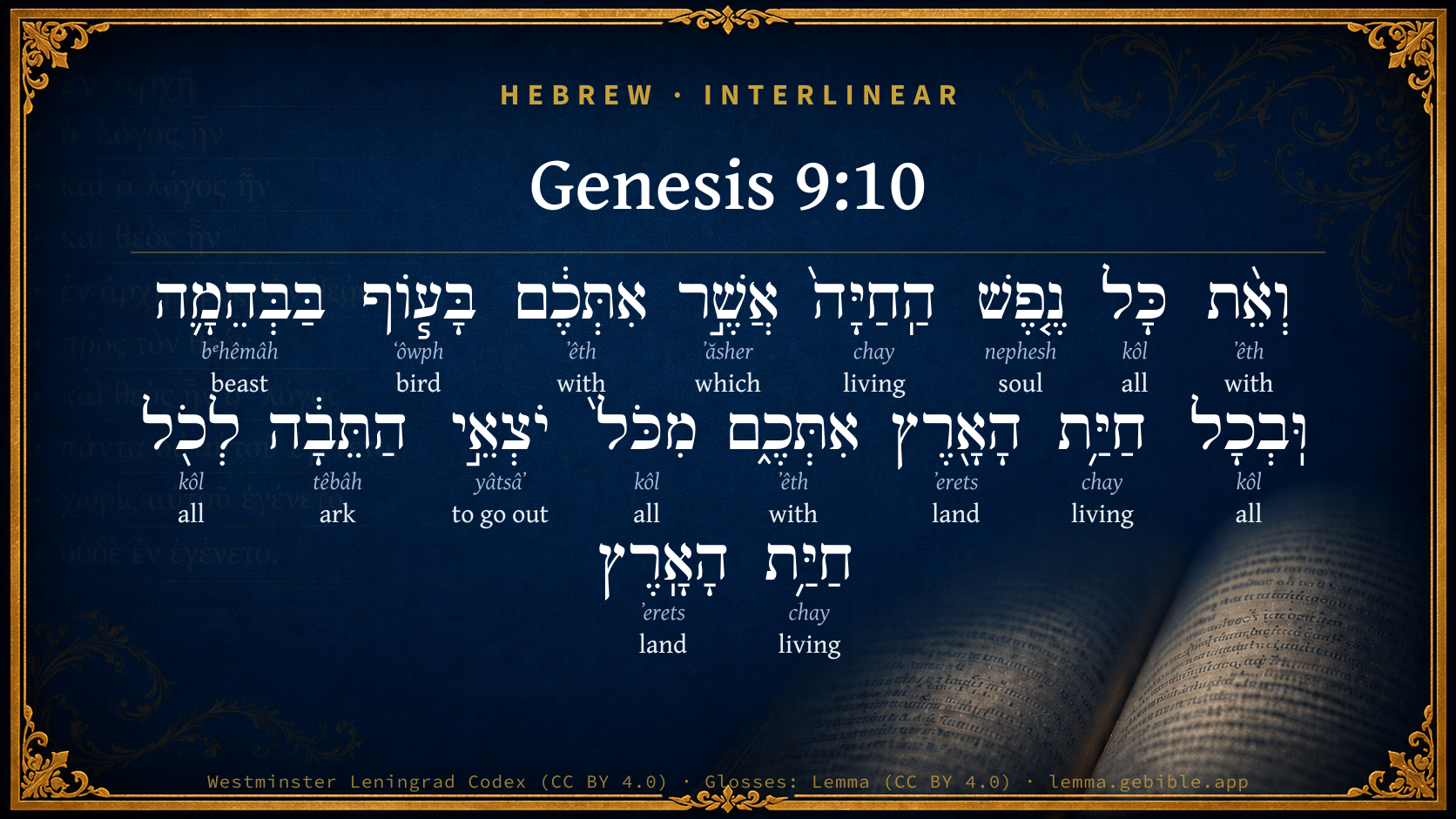
Hebrew (Westminster Leningrad Codex) Genesis 9:10 appears in the Hebrew Old Testament. The text above is from the Westminster Leningrad Codex. Each word links to its Strong’s number, a concise gloss, and parsing drawn from the Open Scriptures Hebrew Bible morphology. Click any word for its full Brown-Driver-Briggs (BDB) entry.
Download image
Cite this verse

Genesis 9:10 (World English Bible). Public Domain. Lemma interlinear Bible study tool, https://lemma.gebible.app/v/genesis/9/10.

Show BibTeX & RIS
BibTeX
RIS
English Translation
and with every living creature that is with you: the birds, the cattle, and every animal of the earth with you. Of all that go out of the ark, even every animal of the earth.
World English Bible · Public Domain
Download a study sheet

One document with this verse’s original text, its word-by-word gloss line, the meaning frame, cross-references with their text, attributed commentary, and full source and license credits — printable, and it pastes into notes with its structure intact.

This verse Autodidact and up

Study sheet (.html) Plain text (.txt)

A passage Seminary Student

Up to 50 verses in one chapter. A passage sheet keeps up to 6 commentary sources and 12 cross-references per verse, in the order this page ranks them, and says so on the sheet whenever that leaves anything out. Ask for a single verse and you get the Autodidact verse sheet above.

Everything on this page stays free to read, with no account — the sheet is a download of what is already on screen, not access to it.

Want to remove ads? Support Godless Engineer
Compare translations 3

The same verse in 3 English versions, stacked beneath the original-language interlinear above. Click any original word for its lexicon entry.

Each is an independent rendering of the whole verse — the interlinear is not word-aligned to these translations.

Highlighted words mark where these versions differ — a whole-verse word diff, not a word-by-word alignment.

  • World English Bible Public Domain
    and with every living creature that is with you: the birds, the cattle, and every animal of the earth with you. Of all that go out of the ark, even every animal of the earth.
  • King James Version Public Domain
    And with every living creature that is with you, of the fowl, of the cattle, and of every beast of the earth with you; from all that go out of the ark, to every beast of the earth.
  • unfoldingWord Literal Text CC BY-SA 4.0
    and with every living creature that with you: with the birds, with the livestock, and with every living thing of the earth with you, from all that came out of the ark to every living thing of the earth.

unfoldingWord Literal Text — © unfoldingWord, licensed CC BY-SA 4.0. Word-aligned USFM3 via Door43 (git.door43.org/unfoldingWord/en_ult).

Versions to compare (up to 4)

3 of 4 selected

Show all 18 translations

Every available English version of this verse, each an independent rendering of the whole verse.

  • World English Bible Public Domain
    and with every living creature that is with you: the birds, the cattle, and every animal of the earth with you. Of all that go out of the ark, even every animal of the earth.
  • Berean Standard Bible Public Domain
    and with every living creature that was with you—the birds, the livestock, and every beast of the earth—every living thing that came out of the ark.
  • Majority Standard Bible Public Domain
    and with every living creature that was with you—the birds, the livestock, and every beast of the earth—every living thing that came out of the ark.
  • King James Version Public Domain
    And with every living creature that is with you, of the fowl, of the cattle, and of every beast of the earth with you; from all that go out of the ark, to every beast of the earth.
  • American Standard Version (1901) Public Domain
    and with every living creature that is with you, the birds, the cattle, and every beast of the earth with you. Of all that go out of the ark, even every beast of the earth.
  • Revised Version (1885) Public Domain
    and with every living creature that is with you, the fowl, the cattle, and every beast of the earth with you; of all that go out of the ark, even every beast of the earth.
  • Geneva Bible (1599) Public Domain
    And with euery liuing creature that is with you, with the foule, with the cattell, and with euery beast of the earth with you, from all that goe out of the Arke, vnto euery beast of the earth.
  • Douay-Rheims (1899) Public Domain
    And with every living soul that is with you, as well in all birds as in cattle and beasts of the earth, that are come forth out of the ark, and in all the beasts of the earth.
  • Young's Literal Translation Public Domain
    and with every living creature which `is' with you, among fowl, among cattle, and among every beast of the earth with you, from all who are going out of the ark -- to every beast of the earth.
  • Literal Standard Version CC BY-SA 4.0
    and with every living creature which [is] with you, among bird, among livestock, and among every beast of the earth with you, from all who are going out of the Ark—to every beast of the earth.
  • Unlocked Literal Bible CC BY-SA 4.0
    and with every living creature that is with you, with the birds, the livestock, and every creature of the earth with you, from all that came out of the ark, to every living creature on the earth.
  • unfoldingWord Literal Text CC BY-SA 4.0
    and with every living creature that with you: with the birds, with the livestock, and with every living thing of the earth with you, from all that came out of the ark to every living thing of the earth.
  • Darby Bible Public Domain
    and with every living soul which is with you, fowl as well as cattle, and all the animals of the earth with you, of all that has gone out of the ark -- every animal of the earth.
  • World Messianic Bible Public Domain
    and with every living creature that is with you: the birds, the livestock, and every animal of the earth with you, of all that go out of the ship, even every animal of the earth.
  • Webster's Bible Public Domain
    And with every living creature that is with you, of the fowl, of the cattle, and of every beast of the earth with you, from all that go out of the ark, to every beast of the earth.
  • Free Bible Version CC BY-SA 4.0
    and with all the animals around you—the birds, the livestock, and all the wild animals of the earth—every animal that accompanied you on the ark.
  • Bible in Basic English Public Domain
    And with every living thing with you, all birds and cattle and every beast of the earth which comes out of the ark with you.
  • JPS Tanakh (1917) Public Domain
    and with every living creature that is with you, the fowl, the cattle, and every beast of the earth with you; of all that go out of the ark, even every beast of the earth.

Literal Standard Version (2020), Covenant Press — licensed CC BY-SA 4.0. Text via the HelloAO Bible API (eBible.org). Unlocked Literal Bible (unfoldingWord) — licensed CC BY-SA 4.0. Text via the HelloAO Bible API (eBible.org). unfoldingWord Literal Text — © unfoldingWord, licensed CC BY-SA 4.0. Word-aligned USFM3 via Door43 (git.door43.org/unfoldingWord/en_ult). Free Bible Version, Dr. Jonathan Gallagher — licensed CC BY-SA 4.0. Text via the HelloAO Bible API (eBible.org).

Word by word

More ways to search: Search by grammar → Find every occurrence → Compare this word →

Practice this passage: Drill this verse → Learn its vocabulary →

הַתֵּבָ֔ה
têbâh
H8392
“the · ark”
Particle, Definite Article + Noun, Common, Feminine, Singular, Absolute
Part of Speech
Particle + Noun
Type
Common
Gender
Feminine
Number
Singular
State
Absolute
Full BDB Definition

Origin: perhaps of foreign derivation

TWOT: 2492

ark - vessel which Noah built - basket vessel in which Moses was placed
  1. וְאֵ֨ת ʼêth H854 “and · with” Conjunction + Preposition
  2. כָּל kôl H3605 “all of” Noun, Common, Masculine, Singular, Construct
  3. נֶ֤פֶשׁ nephesh H5315 “soul of” Noun, Common, Both, Singular, Construct
  4. הַֽחַיָּה֙ chay H2416 “the · living” Particle, Definite Article + Adjective, Adjective, Feminine, Singular, Absolute
  5. אֲשֶׁ֣ר ʼăsher H834 “which” Particle, Relative
  6. אִתְּכֶ֔ם ʼêth H854 “with · you” Preposition + Suffix, Personal, 2nd Person, Masculine, Plural
  7. בָּע֧וֹף ʻôwph H5775 “in/at the · bird” Preposition, Determined + Noun, Common, Masculine, Singular, Absolute
  8. בַּבְּהֵמָ֛ה bᵉhêmâh H929 “in/at the · beast” Preposition, Determined + Noun, Common, Feminine, Singular, Absolute
  9. וּֽבְכָל kôl H3605 “and · in/at · all of” Conjunction + Preposition + Noun, Common, Masculine, Singular, Construct
  10. חַיַּ֥ת chay H2416 “living of” Noun, Common, Feminine, Singular, Construct
  11. הָאָ֖רֶץ ʼerets H776 “the · land” Particle, Definite Article + Noun, Common, Both, Singular, Absolute
  12. אִתְּכֶ֑ם ʼêth H854 “with · you” Preposition + Suffix, Personal, 2nd Person, Masculine, Plural
  13. מִכֹּל֙ kôl H3605 “from · all of” Preposition + Noun, Common, Masculine, Singular, Construct
  14. יֹצְאֵ֣י yâtsâʼ H3318 “going out” Verb, Qal, Participle Active, Masculine, Plural, Construct
  15. לְכֹ֖ל kôl H3605 “to/for · all of” Preposition + Noun, Common, Masculine, Singular, Construct
  16. חַיַּ֥ת chay H2416 “living of” Noun, Common, Feminine, Singular, Construct
  17. הָאָֽרֶץ ʼerets H776 “the · land” Particle, Definite Article + Noun, Common, Both, Singular, Absolute

About this verse

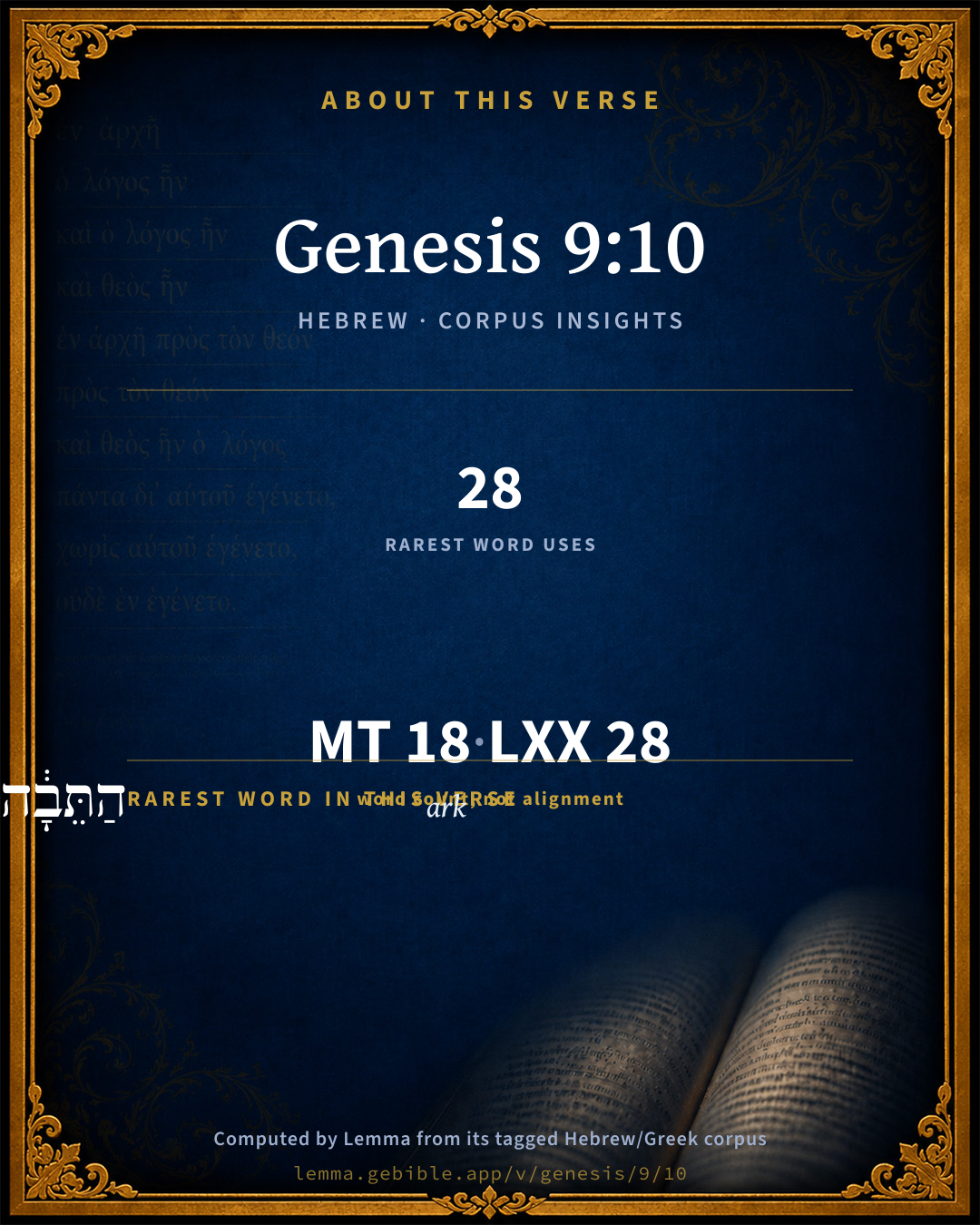
These counts appear in no published source. They are computed here, from the morphology-tagged text and Lemma’s own curated glosses. What Lemma adds →

18
words
10
distinct lemmas
Pentateuch
section

Shared distinctive vocabulary

הַתֵּבָ֔ה ark H8392 occurs in 25 verses of the Hebrew Bible. Also found in:

Grammatical profile

  • 1 verb
  • 12 nouns
  • 1 adjective
  • 3 prepositions
  • 1 particle

Verb forms

  • יֹצְאֵ֣י Qal · Participle Active

Repetition

Words recur within this verse — often emphatic in Hebrew:

  • כָּל all H3605 ×4
  • הַֽחַיָּה֙ living H2416 ×3
  • הָאָ֖רֶץ land H776 ×2
  • וְאֵ֨ת with H854 ×3

Hebrew & Septuagint length

In English translation the verse runs 35 words from the Hebrew and 35 from the Septuagint (LXX English) — the same length.

A rough comparison of the two English renderings, which tokenize alike — not a word-level alignment.

Word counts can differ between the Hebrew and the Greek without any difference in meaning — e.g. the Hebrew direct-object marker אֵת has no separate Greek word, and Greek often adds the article ὁ.

In the original languages it is 18 Hebrew tokens and 28 Greek tokens — but the two are counted differently (Hebrew bundles its prefixes and suffixes into one token; the Greek is in lemma form), so that isn’t a like-for-like length.

Cross-references

7

Topical passages linked to Genesis 9:10 in the Treasury of Scripture Knowledge — connected by theme and wording, ordered by reader-vote popularity; previews shown in the World English Bible.

  • Psalms 145:9 Yahweh is good to all. His tender mercies are over all his works.
  • Genesis 8:1 God remembered Noah, all the animals, and all the cattle that were with him in the ark; and God made a wind to pass over the earth. The waters subsided.
  • Genesis 9:15–16 and I will remember my covenant, which is between me and you and every living creature of all flesh, and the waters will no more become a flood to destroy all flesh.
  • Job 38:1–41 Then Yahweh answered Job out of the whirlwind,
  • Job 41:1–34 "Can you draw out Leviathan with a fishhook? Or press down his tongue with a cord?
  • Psalms 36:5–6 Your loving kindness, Yahweh, is in the heavens. Your faithfulness reaches to the skies.
  • Jonah 4:11 Shouldn't I be concerned for Nineveh, that great city, in which are more than one hundred twenty thousand persons who can't discern between their right hand and their left hand; and also much cattle?"

Cross-references courtesy of OpenBible.info (CC BY 4.0).

Hebrew and Greek witnesses Masoretic Hebrew ↔ Greek Septuagint

The same verse in the two great witnesses to the Old Testament, shown verse-for-verse.

These are two independent witnesses, not word-aligned to each other, and the Septuagint is shown in lemma (dictionary) form.

Hebrew Genesis 9:10 Masoretic · Westminster Leningrad Codex

וְאֵ֨ת כָּל נֶ֤פֶשׁ הַֽחַיָּה֙ אֲשֶׁ֣ר אִתְּכֶ֔ם בָּע֧וֹף בַּבְּהֵמָ֛ה וּֽבְכָל חַיַּ֥ת הָאָ֖רֶץ אִתְּכֶ֑ם מִכֹּל֙ יֹצְאֵ֣י הַתֵּבָ֔ה לְכֹ֖ל חַיַּ֥ת הָאָֽרֶץ

and with every living creature that is with you: the birds, the cattle, and every animal of the earth with you. Of all that go out of the ark, even every animal of the earth.

World English Bible · Public Domain

Greek LXX Genesis 9:10 Septuagint · lemma form

καί πᾶς ψυχή ὁ ζάω μετά σύ ἀπό ὄρνεον καί ἀπό κτῆνος καί πᾶς ὁ θηρίον ὁ γῆ ὅσος μετά σύ ἀπό πᾶς ὁ ἐκἔρχομαι ἐκ ὁ κιβωτός

and with every living creature with you, of birds and of beasts, and with all the wild beasts of the earth, as many as are with you, of all that come out of the ark.

LXX2012 (modern English Septuagint) · Public Domain

Hebrew: Westminster Leningrad Codex (CC BY 4.0). Greek: Septuagint (public domain); English from LXX2012 (modern English Septuagint) (Public Domain). How the Septuagint differs from the Hebrew →

Targum (Aramaic paraphrase)

2

The Targum is the ancient Jewish Aramaic paraphrase of the Hebrew Scriptures — an interpretive translation, not the Hebrew text itself. Onkelos (literal) and Pseudo-Jonathan (expansive) render the Torah, and Jonathan the Prophets. Coverage is partial: where no permissively-licensed English translation exists for a verse, only the Aramaic is shown. This is verse-level text, not a word-by-word alignment to the Hebrew.

  1. Targum Onkelos Torah (Genesis–Deuteronomy)
    וְעִם כָּל נַפְשָׁא חַיְתָא דְּעִמְּכוֹן בְּעוֹפָא בִבְעִירָא וּבְכָל חַיַת אַרְעָא דְּעִמְּכוֹן מִכֹּל נַפְקֵי תֵבוֹתָא לְכֹל חַיַת אַרְעָא

    and with every living thing which is with you, of fowl, of cattle, and of every beast of the field that is with you, of all going forth from the ark of every animal of the earth.

    Targum Onkelos — Aramaic: “Onkelos Genesis” (public domain); “Onkelos Exodus” (public domain); “Onkelos Leviticus” (public domain); “Onkelos Numbers” (public domain); “Onkelos Deuteronomy” (public domain). English: “Sefaria Community Translation” (CC0 1.0 (public-domain dedication)); “J.W. Etheridge. The Targums of Onkelos and Jonathan Ben Uzziel on the Pentateuch. London: Longmans, Green, 1862” (public domain). Text via Sefaria.

  2. Targum Pseudo-Jonathan Torah (Genesis–Deuteronomy)
    וְעִם כָּל נַפְשָׁא חַיְיתָא דְעִמְכוֹן בְּעוֹפָא וּבִבְעִירָא וּבְכָל חַיַת אַרְעָא דְעִמְכוֹן מִכָּל נַפְקֵי תֵיבוּתָא לְכָל חַיַת אַרְעָא

    and with every living soul that is with you, of birds, and of cattle, and of every beast of the earth that is with you, of all that go forth from the ark, of every beast of the earth.

    Targum Pseudo-Jonathan — Aramaic: “Targum Jonathan on Genesis” (public domain); “Targum Jonathan on Exodus” (public domain); “Targum Jonathan on Leviticus” (public domain); “Targum Jonathan on Numbers” (public domain); “Targum Jonathan on Deuteronomy” (public domain). English: “The Targum of Jonathan ben Uzziel, trans. J. W. Etheridge, London, 1862” (public domain). Text via Sefaria.

Commentary

Notes on Genesis 9:10 from classic Christian and Jewish commentators (each source and its license shown beneath its notes). The classic Christian expositions comment on the surrounding passage and are grouped to its opening verse, so a note may address several verses; the Jewish commentaries on the Tanakh (Rashi and others) are per-verse, so they appear only where the commentator wrote on this verse.

Lemma curates 59 commentaries, every one of them public domain or Creative Commons licensed, each selected and text-cleaned for this edition rather than reprinted as found. About our sources →

Trapp's Complete Commentary

John Trapp

Gen 9:10 And with every living creature that [is] with you, of the fowl, of the cattle, and of every beast of the earth with you; from all that go out of the ark, to every beast of the earth.

Ver. 10. And with every living creature, &c.] Note this against Anabaptists, who exclude infants, for that they want the use of reason. And yet that was but a foolish reason of the canonist, that infants are therefore to be baptized, because the disciples brought to our Saviour, not the ass only, but the foal also. {a}

{a} Sphinx Philos., p. 229.

John Trapp, A Commentary or Exposition upon All the Books of the Old and New Testament (1647–1656) — public domain. Text from a community e-Sword module.

John Calvin's Commentaries

10. And with every living creature. Although the favor which the Lord promises extends also to animals, yet it is not in vain that he addresses himself only to men, who, by the sense of faith, are able to perceive this benefit. We enjoy the heaven and the air in common with the beasts, and draw the same vital breath; but it is no common privilege, that God directs his word to us; whence we may learn with what paternal love he pursues us. And here three distinct steps are to be traced. First, God, as in a matter of present concern, makes a covenant with Noah and his family, lest they should be afraid of a deluge for themselves. Secondly, he transmits his covenant to posterity, not only that, as by continual succession, the effect may reach to other ages; but that they who should afterwards be born might also apprehend this testimony by faith, and might conclude that the same thing which had been promised to the sons of Noah, was promised unto them. Thirdly, he declares that he will be propitious also to brute animals, so that the effect of the covenant towards them, might be the preservation of their lives only, without imparting to them sense and intelligence. Hence the ignorance of the Anabaptists may be refuted, who deny that the covenant of God is common to infants, because they are destitute of present faith. As if, truly, when God promises salvation to a thousand generations, the fathers were not intermediate parties between God and their children, whose office it is to deliver to their children (so to speak) from hand to hand the promise received from God. But as many as withdraw their life from this protection of God (since the greater part of men either despise or ridicule this divine covenant) deserve, by this single act of ingratitude, to be immersed in eternal fire. For although this be an earthly promise, yet God designs the faith of his people to be exercised, in order that they may be assured that a certain abode will, by his special goodness, be provided for them on earth, until they shall be gathered together in heaven.

John Calvin's Commentaries (1540-1563) — public domain. Text from the Calvin Translation Society English edition (1840s-50s) via the Christian Classics Ethereal Library (ccel.org). Calvin's coverage is partial (roughly two-thirds of the Bible); uncommented books and verses are honest gaps, never fabricated. The 19th-century editor's footnotes and remarks are omitted so the notes are faithfully Calvin's own voice.

The Cambridge Bible for Schools and Colleges

gen. ed. J. J. S. Perowne

10. and with every living creature] The Heb. for “creature” is nephesh, cf. Gen_1:20. God’s covenant with the creatures, as well as with mankind, suggests the thought of the interdependence between the animal world and the human race. Goodness and kindness towards man involve a corresponding blessing upon the animal world. Love is all-pervasive.

The Cambridge Bible for Schools and Colleges (gen. ed. J. J. S. Perowne; Cambridge University Press, 1878–1918) — public domain. Text from a community e-Sword module.

John Gill's Exposition

And with every living creature that is with you,.... This is a further proof that this was not the covenant of grace, but of conservation, since it is made with irrational as well as rational creatures:

of the fowl, of the cattle, and of every beast of the earth with you; the birds of the air, the tame cattle, and the wild beasts:

from all that go out of the ark, to every beast of the earth; which take in the creeping things not mentioned, for these were in the ark, and came out of the ark with Noah; and this covenant not only included all the several kinds of creatures that came out of the ark with Noah, but it reached to all that should spring from them in future ages, to the end of the world.

John Gill's Exposition of the Whole Bible (1746–1763) — public domain (CC PDM 1.0). Text via the HelloAO Bible API.

Haydock's Catholic Bible Commentary

Soul...in birds, &c. The covenant of God is made with animals, only in as much as they are subservient to man. (Du Hamel) --- The Egyptians adored most of them; and many oriental nations, and even philosophers, pretended they had intelligent souls, and could speak a rational language, which some of them would have the people believe they could understand. (Calmet) --- This was the case of those great impostors Apollonius of Tyena, Mahomet, &c. (Haydock) --- Moses shews sufficiently that beasts were neither divinities nor rational. (Calmet)

George Leo Haydock (1774–1849), Haydock's Catholic Family Bible and Commentary, 1859 edition — public domain. Excludes Psalms (Douay-Rheims chapter numbering differs from Protestant) and Deuterocanonical books (Catholic canon only).

Matthew Poole's English Annotations

To wit, which shall hereafter be in the earth. So they are distinguished from those which were now with them.

Matthew Poole's English Annotations on the Holy Bible (1683–1685) — public domain. Text from a community e-Sword/MySword module.

Whedon's Commentary on the Bible

Daniel D. Whedon

10. With every living creature — The covenant is made, first, with all creatures which went forth from the ark, and then, with all flesh; “with every living creature… from all that go out of the ark, to every beast of the earth.” In the words which relate the establishment of the covenant with the animal creation, Keil remarks, “The prepositions are accumulated, first, ב, embracing the whole, then the partitive, מן, restricting the enumeration to those which went out of the ark, and, lastly, ל, with regard to extending it again to every individual.”

Daniel D. Whedon (gen. ed.), Commentary on the Old and New Testaments (1874–1909) — public domain. Text from a community e-Sword module.

The Pulpit Commentary

And with every living creature literally, every soul (or breathing thing) that liveth, a generic designation of which the particulars are now specifiedthat is with you, of the fowl, of the cattle, and of every beast of the earth literally, in fowl, &c.; i.e. belonging to these classes of animals (cf. Gen_1:25, 30 6:20 8:17) with you; from all that go out of the ark, not necessarily implying ("Speaker s Commentary," Murphy), though in all probability it was the case, that there were animals which had never been in the ark; but simply an idiomatic phrase expressive of the totality of the animal creation (Alford)to every beast of the earth. Ie. wild beast, (Gen_1:25) the chayyah of the land, which was not included among the animals that entered the ark (Murphy); or living creature, (Gen_2:19) referring here to the fishes of the sea, which were not included in the ark (Kalisch). That the entire brute creation was designed to be embraced in the Noachic covenant seems apparent from the use of the prepositions B describing the classes to which the animals belong, as in Gen_7:21; mi indicating one portion of the whole, the to minus aquo, and l the terminus ad quem in their enumeration (vide Furst, "Hebrew Lex.," sub l., p. 715; cf. Kell in loco). Kalisch thinks the language applies only to the animals of Noah"s time, and not to those of a later age, on the ground that "the destiny of the animals is everywhere connected with that of the human race;" but this is equivalent to their being included in the covenant.

The Pulpit Commentary (1880–1919), ed. H.D.M. Spence-Jones & Joseph S. Exell — public domain. Text from a community e-Sword module.

Rashi

Rabbi Shlomo Yitzchaki (Rashi)

חית הארץ אתכם AND EVERY ANIMAL OF THE EARTH WITH YOU or, THAT ARE WITH YOU — those which go about with human beings.

מכל יוצאי התבה OF ALL THAT GO OUT OF THE ARK — These words would include creeping things and reptiles.

חית הארץ [EVEN EVERY] BEAST OF THE EARTH — These words are intended to include dangerous animals which cannot be included in the above description, “every living creature that is with you” — for these do not go about with human beings.

Rashi on the Tanakh — English translations: “The Judaica Press complete Tanach with Rashi, translated by A. J. Rosenberg” (CC BY 4.0); “Pentateuch with Rashi's commentary by M. Rosenbaum and A.M. Silbermann, 1929-1934” (public domain); “The Metsudah Tanach series, Lakewood, N.J” (CC BY 4.0); and “The Book of Joshua, Metsudah Publications, 1997” (CC BY 4.0). Text via Sefaria.

Radak

Rabbi David Kimhi (Radak)

ואת כל הנפש אשר אתכם, the ones which had been in the ark with you; this is spelled out shortly by the words מכל יוצאי התבה, “I will make a covenant with all the species of creatures that came out of the ark. None of these species will again become subject to extinction.” G’d said further: לכל חית הארץ, in order to make the meaning of what had been written before perfectly clear. In Bereshit Rabbah it is pointed out that these words include all the subsequent generations of these animals, just as the subsequent generations of Noach’s sons and their wives were included in the blessing as we know from the words ואת זרעכם אחריכם, “and your offspring after you.”

Radak on the Tanakh — English translations: “Sefaria Community Translation” (CC0 1.0 (public-domain dedication)); “Eliyahu Munk, HaChut Hameshulash” (CC BY 4.0); “Rabbi Mike Feuer, Jerusalem Anthology” (CC BY 4.0); and “R. David Kimhi on the first book of Psalms, Translated by R.G. Finch, London, 1919” (public domain). Text via Sefaria.

Lesson kit

Teaching starters — assembled from the data on this page, not authored interpretation. Every prompt links to the verse data it draws on. Edit before teaching.

Genesis, in the Pentateuch, opens this verse with 18 words (10 distinct Hebrew lemmas). Its most distinctive word is têbâh (“ark”). A historical commentator’s framing appears above. Read the whole chapter for the surrounding context.

Discussion questions

  1. The word têbâh carries the sense “ark.” How does it shape the verse?
  2. Genesis 6:14 shares the word «ark» with this verse. How do the two illuminate each other?
  3. “all” occurs 4× in this one verse. What is the effect of the repetition?
  4. These translations render this verse differently; the difference is in the English rendering, not the original. What questions does that raise?
  5. The verb «יֹצְאֵ֣י» is Qal Participle Active. How does its form color the action?
  6. Reading how Trapp's Complete Commentary and John Calvin's Commentaries read this verse, where do the two commentators agree and where do they part?

Things to notice

Reading settings

Reading text

Shown beneath each verse's original-language words.

Old Testament
Old Testament edition

Read the OT as the Masoretic Hebrew (MT) or the Greek Septuagint (LXX).

English shown for the Greek Septuagint (in the Hebrew ↔ Greek comparison).

Comparing translations? Open the Compare panel on any verse page to stack up to four side by side.