
Acts 17:11

Greek (Tischendorf 8th ed.) Acts 17:11 appears in the Greek New Testament. The text above is from the Tischendorf 8th edition. Each word links to its Strong’s number and a concise gloss. Click any word for its full Thayer’s Greek Lexicon entry.

Download image
Cite this verse

Acts 17:11 (World English Bible). Public Domain. Lemma interlinear Bible study tool, https://lemma.gebible.app/v/acts/17/11.

Show BibTeX & RIS
BibTeX
RIS
English Translation
Now these were more noble than those in Thessalonica, in that they received the word with all readiness of the mind, examining the Scriptures daily to see whether these things were so.
World English Bible · Public Domain
Highlights
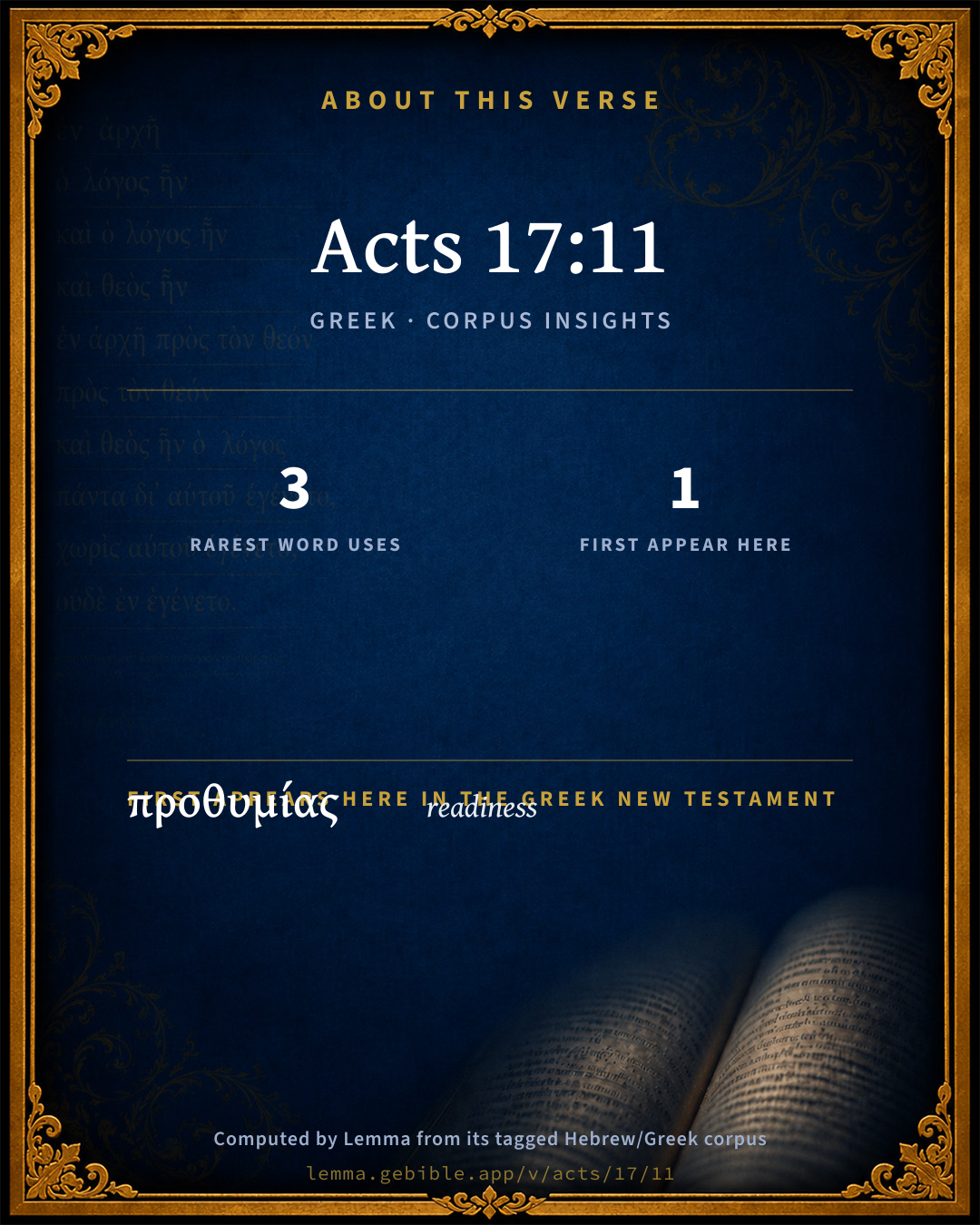
  • 1 first appearance in the Greek New Testament
Full analysis ↓
Download a study sheet

One document with this verse’s original text, its word-by-word gloss line, the meaning frame, cross-references with their text, attributed commentary, and full source and license credits — printable, and it pastes into notes with its structure intact.

This verse Autodidact and up

Study sheet (.html) Plain text (.txt)

A passage Seminary Student

Up to 50 verses in one chapter. A passage sheet keeps up to 6 commentary sources and 12 cross-references per verse, in the order this page ranks them, and says so on the sheet whenever that leaves anything out. Ask for a single verse and you get the Autodidact verse sheet above.

Everything on this page stays free to read, with no account — the sheet is a download of what is already on screen, not access to it.

Want to remove ads? Support Godless Engineer
Compare translations 3

The same verse in 3 English versions, stacked beneath the original-language interlinear above. Click any original word for its lexicon entry.

Each is an independent rendering of the whole verse — the interlinear is not word-aligned to these translations.

Highlighted words mark where these versions differ — a whole-verse word diff, not a word-by-word alignment.

  • World English Bible Public Domain
    Now these were more noble than those in Thessalonica, in that they received the word with all readiness of the mind, examining the Scriptures daily to see whether these things were so.
  • King James Version Public Domain
    These were more noble than those in Thessalonica, in that they received the word with all readiness of mind, and searched the scriptures daily, whether those things were so.
  • unfoldingWord Literal Text CC BY-SA 4.0
    Now these were more noble than in Thessalonica, who received the word with all readiness, examining the Scriptures each day, whether these things might be so.

unfoldingWord Literal Text — © unfoldingWord, licensed CC BY-SA 4.0. Word-aligned USFM3 via Door43 (git.door43.org/unfoldingWord/en_ult).

Versions to compare (up to 4)

3 of 4 selected

Show all 19 translations

Every available English version of this verse, each an independent rendering of the whole verse.

  • World English Bible Public Domain
    Now these were more noble than those in Thessalonica, in that they received the word with all readiness of the mind, examining the Scriptures daily to see whether these things were so.
  • Berean Standard Bible Public Domain
    Now the Bereans were more noble-minded than the Thessalonians, for they received the message with great eagerness and examined the Scriptures every day to see if these teachings were true.
  • Majority Standard Bible Public Domain
    Now the Bereans were more noble-minded than the Thessalonians, for they received the message with great eagerness and examined the Scriptures every day to see if these teachings were true.
  • King James Version Public Domain
    These were more noble than those in Thessalonica, in that they received the word with all readiness of mind, and searched the scriptures daily, whether those things were so.
  • American Standard Version (1901) Public Domain
    Now these were more noble than those in Thessalonica, in that they received the word with all readiness of the mind, examining the Scriptures daily, whether these things were so.
  • Revised Version (1885) Public Domain
    Now these were more noble than those in Thessalonica, in that they received the word with all readiness of mind, examining the scriptures daily, whether these things were so.
  • Geneva Bible (1599) Public Domain
    These were also more noble men then they which were at Thessalonica, which receiued the woorde with all readinesse, and searched the Scriptures daily, whether those things were so.
  • Douay-Rheims (1899) Public Domain
    Now these were more noble than those in Thessalonica, who received the word with all eagerness, daily searching the scriptures, whether these things were so.
  • Young's Literal Translation Public Domain
    and these were more noble than those in Thessalonica, they received the word with all readiness of mind, every day examining the Writings whether those things were so;
  • Literal Standard Version CC BY-SA 4.0
    and these were more noble than those in Thessalonica; they received the word with all readiness of mind, examining the Writings every day [to see] whether those things were so;
  • Unlocked Literal Bible CC BY-SA 4.0
    Now these people were more noble than those in Thessalonica, for they received the word with all readiness of mind, examining the scriptures daily to see whether these things were so.
  • unfoldingWord Literal Text CC BY-SA 4.0
    Now these were more noble than in Thessalonica, who received the word with all readiness, examining the Scriptures each day, whether these things might be so.
  • Darby Bible Public Domain
    And these were more noble than those in Thessalonica, receiving the word with all readiness of mind, daily searching the scriptures if these things were so.
  • World Messianic Bible Public Domain
    Now these were more noble than those in Thessalonica, in that they received the word with all readiness of mind, examining the Scriptures daily to see whether these things were so.
  • Webster's Bible Public Domain
    These were more noble than those in Thessalonica, in that they received the word with all readiness of mind, and searched the scriptures daily, whether those things were so.
  • Free Bible Version CC BY-SA 4.0
    The people there had a better attitude than those in Thessalonica in that they were very quick to accept the word, and every day they examined the Scriptures to make sure what they were told was right.
  • Bible in Basic English Public Domain
    Now these were more noble than the Jews of Thessalonica, for they gave serious attention to the word, searching in the holy Writings every day, to see if these things were so.
  • Text-Critical English NT CC BY 4.0
    Now these Jews were more noble than those in Thessalonica, and they received the word with great eagerness, examining the Scriptures every day to see if what Paul said was true.
  • Tyndale New Testament (1534) Public Domain
    These were the noblest of byrthe amonge the of Thessalonia which receaved the worde with all diligence of mynde and searched the scriptures dayly whether those thinges were even so.

Literal Standard Version (2020), Covenant Press — licensed CC BY-SA 4.0. Text via the HelloAO Bible API (eBible.org). Unlocked Literal Bible (unfoldingWord) — licensed CC BY-SA 4.0. Text via the HelloAO Bible API (eBible.org). unfoldingWord Literal Text — © unfoldingWord, licensed CC BY-SA 4.0. Word-aligned USFM3 via Door43 (git.door43.org/unfoldingWord/en_ult). Free Bible Version, Dr. Jonathan Gallagher — licensed CC BY-SA 4.0. Text via the HelloAO Bible API (eBible.org).

Word by word

More ways to search: Search by grammar → Find every occurrence → Compare this word →

Practice this passage: Drill this verse → Learn its vocabulary →

εὐγενέστεροι
eugenḗs
G2104
“noble”
Adjective, Nominative, Plural, Masculine, Comparative
Part of Speech
Adjective
Case
Nominative
Number
Plural
Gender
Masculine
Degree
Comparative
Full Thayer's Definition

Origin: from G2095 and G1096

TDNT: None

1. well born, of a noble family 2. noble minded
  1. οὗτοι hoûtos G3778 “this” Demonstrative pronoun, Nominative, Plural, Masculine
  2. δὲ dé G1161 “but” Conjunction
  3. ἦσαν eimí G1510 “to be” Verb, Imperfect, Active, Indicative, 3rd person, Plural
  4. τῶν ho G3588 “the” Article, Genitive, Plural, Masculine
  5. ἐν en G1722 “in” Preposition
  6. Θεσσαλονίκῃ Thessaloníkē G2332 “Thessalonica” Noun, Dative, Singular, Feminine
  7. οἵτινες hóstis G3748 “whoever” Relative pronoun, Nominative, Plural, Masculine
  8. ἐδέξαντο déchomai G1209 “to receive” Verb, Aorist, Middle deponent, Indicative, 3rd person, Plural
  9. τὸν ho G3588 “the” Article, Accusative, Singular, Masculine
  10. λόγον lógos G3056 “word” Noun, Accusative, Singular, Masculine
  11. μετὰ metá G3326 “with” Preposition
  12. πάσης pâs G3956 “all” Adjective, Genitive, Singular, Feminine
  13. προθυμίας prothymía G4288 “readiness” Noun, Genitive, Singular, Feminine
  14. καθ’ katá G2596 “down” Preposition
  15. ἡμέραν hēméra G2250 “day” Noun, Accusative, Singular, Feminine
  16. ἀνακρίνοντες anakrínō G350 “to examine” Verb, Present, Active, Participle, Nominative, Plural, Masculine
  17. τὰς ho G3588 “the” Article, Accusative, Plural, Feminine
  18. γραφὰς graphḗ G1124 “Scripture” Noun, Accusative, Plural, Feminine
  19. εἰ ei G1487 “if” Conditional
  20. ἔχοι échō G2192 “to have” Verb, Present, Active, Optative, 3rd person, Singular
  21. ταῦτα hoûtos G3778 “this” Demonstrative pronoun, Nominative, Plural, Neuter
  22. οὕτως hoútō G3779 “thus” Adverb

About this verse

These counts appear in no published source. They are computed here, from the morphology-tagged text and Lemma’s own curated glosses. What Lemma adds →

23
words
20
distinct lemmas
Acts
section

Notable vocabulary

The rarest word here is εὐγενέστεροι noble G2104 — appearing just 3 times in the whole Greek New Testament.

First appearance in Scripture

This word makes its first canonical appearance in the Greek New Testament here:

  • προθυμίας readiness G4288

Shared distinctive vocabulary

εὐγενέστεροι noble G2104 occurs in 3 verses of the Greek New Testament. Also found in:
Repetition

Words recur within this verse:

  • τῶν the G3588 ×3
  • οὗτοι this G3778 ×2

Cross-references

31

Topical passages linked to Acts 17:11 in the Treasury of Scripture Knowledge — connected by theme and wording, ordered by reader-vote popularity; previews shown in the World English Bible.

  • Isaiah 34:16 Seek you out of the book of Yahweh, and read: no one of these shall be missing, none shall want her mate; for my mouth, it has commanded, and his Spirit, it has gathered them.
  • Proverbs 2:1–5 My son, if you will receive my words, And store up my commandments within you;
  • John 5:39 "You search the Scriptures, because you think that in them you have eternal life; and these are they which testify about me.
  • 1 Thessalonians 2:13 For this cause we also thank God without ceasing, that, when you received from us the word of the message of God, you accepted it not as the word of men, but, as it is in truth, the word of God, which also works in you who believe.
  • Matthew 13:23 What was sown on the good ground, this is he who hears the word, and understands it, who most assuredly bears fruit, and brings forth, some one hundred times as much, some sixty, and some thirty."
  • 1 Peter 1:10–12 Concerning this salvation, the prophets sought and searched diligently, who prophesied of the grace that would come to you,
  • Proverbs 9:9 Instruct a wise man, and he will be still wiser. Teach a righteous man, and he will increase in learning.
  • 2 Peter 1:19–21 We have the more sure word of prophecy; whereunto you do well that you take heed, as to a lamp shining in a dark place, until the day dawns, and the day star arises in your hearts:
  • Proverbs 1:5 That the wise man may hear, and increase in learning; That the man of understanding may attain to sound counsel:
  • 2 Timothy 3:15–17 From infancy, you have known the sacred writings which are able to make you wise for salvation through faith, which is in Christ Jesus.
  • John 3:21 But he who does the truth comes to the light, that his works may be revealed, that they have been done in God."
  • 1 Thessalonians 1:6 You became imitators of us, and of the Lord, having received the word in much affliction, with joy of the Holy Spirit,
  • 2 Thessalonians 2:10 and with all deception of wickedness for those who are being lost, because they didn't receive the love of the truth, that they might be saved.
  • Psalms 1:2–3 But his delight is in Yahweh's law; On his law he meditates day and night.
  • Proverbs 8:10 Receive my instruction rather than silver; Knowledge rather than choice gold.
  • Isaiah 8:20 To the law and to the testimony! if they don't speak according to this word, surely there is no morning for them.
  • Luke 24:44 He said to them, "This is what I told you, while I was still with you, that all things which are written in the law of Moses, the prophets, and the psalms, concerning me must be fulfilled."
  • 1 Peter 2:2 as newborn babes, long for the pure milk of the Word, that you may grow thereby,
  • Psalms 119:97 How love I your law! It is my meditation all day.
  • Psalms 119:100 I understand more than the aged, Because I have kept your precepts.
  • Psalms 119:148 My eyes stay open through the night watches, That I might meditate on your word.
  • James 1:21 Therefore, putting away all filthiness and overflowing of wickedness, receive with humility the implanted word, which is able to save your souls.
  • Job 23:12 I haven't gone back from the commandment of his lips. I have treasured up the words of his mouth more than my necessary food.
  • Acts 2:41 Then those who gladly received his word were baptized. There were added that day about three thousand souls.
  • Acts 10:33 Therefore I sent to you at once, and it was good of you to come. Now therefore we are all here present in the sight of God to hear all things that have been commanded you by God."
  • 1 John 4:5–6 They are of the world. Therefore they speak of the world, and the world hears them.
  • Jeremiah 2:21 Yet I had planted you a noble vine, wholly a right seed: how then are you turned into the degenerate branches of a foreign vine to me?
  • Luke 16:29 "But Abraham said to him, 'They have Moses and the prophets. Let them listen to them.'
  • Acts 11:1 Now the apostles and the brothers who were in Judea heard that the Gentiles had also received the word of God.
  • Acts 17:1 Now when they had passed through Amphipolis and Apollonia, they came to Thessalonica, where there was a synagogue of the Jews.
  • John 1:45–49 Philip found Nathanael, and said to him, "We have found him, of whom Moses in the law, and the prophets, wrote: Jesus of Nazareth, the son of Joseph."

Cross-references courtesy of OpenBible.info (CC BY 4.0).

Commentary

Notes on Acts 17:11 from classic Christian and Jewish commentators (each source and its license shown beneath its notes). The classic Christian expositions comment on the surrounding passage and are grouped to its opening verse, so a note may address several verses; the Jewish commentaries on the Tanakh (Rashi and others) are per-verse, so they appear only where the commentator wrote on this verse.

Lemma curates 59 commentaries, every one of them public domain or Creative Commons licensed, each selected and text-cleaned for this edition rather than reprinted as found. About our sources →

Joseph Benson's Commentary

Act 17:11-14. These were more noble, &c. — Greek, ευγενεστεροι, more ingenuous, or generous; of a more excellent disposition, more open to conviction, as being less blinded by prejudice. To be teachable in the things of God, is true nobleness and generosity of soul. Than those in Thessalonica — The unbelieving Jews there; in that they received the word with all readiness of mind — When it was proved to them from the Scriptures to be the word of God. And searched the Scriptures daily — Using great candour and impartiality in the search; whether these things were so — Namely, the things which Paul preached concerning the sufferings and resurrection of the Messiah. Here we see that receiving the word with readiness, and the most accurate search into the truth, are things well consistent the one with the other. Therefore many of them believed — Finding how exact a correspondence there was between the words of these Christian preachers and those of their own prophets, to which they referred. Also of honourable women — Women of considerable rank; which were Greeks — That is, proselytes, as the word is frequently used by Luke; and of men not a few — Thus a numerous church was gathered in Berea likewise, consisting both of the Jews and of the Gentiles, but especially of the latter. But — An unhappy opposition soon arose, from the malice of their persecutors: for, when the Jews of Thessalonica understood that the word of God was preached at Berea — With such promising success, not content with what they had done to oppose it at home; they came thither also, and stirred up the people — Greek, σαλευοντες τους οχλους, agitating the multitudes, or, raising a storm among them; the expression properly signifying to agitate the sea violently. It admirably illustrates the rage and fury of a seditious multitude. They doubtless represented Paul and his associates as factious and turbulent persons, to whom it was dangerous to give any the least shelter or countenance. The brethren, therefore, anxious for Paul’s safety, sent him away to go as it were to the sea — Or by sea, to some of the southern cities of Greece. It seems they chose to direct him the road which led to the sea, that if he had not an opportunity of embarking, or did not think proper to do it, his malicious enemies might, at least, be discouraged from any further attempt to pursue him, which they might probably have done, if they had known he would have travelled by land. But Silas and Timotheus, whose characters were not so public, or their persons so obnoxious, did not go with him from Berea; but continued there a while longer, to settle the newly-planted church, and to instruct them more fully in the doctrine of the gospel.

Joseph Benson's Commentary on the Old and New Testaments (1811–1818) — public domain. Text from a community e-Sword module.

Bengel's Gnomon

Johann Albrecht Bengel

Act 17:11. Εὐγενέστεροι) more noble than the Jews of Thessalonica. They are truly noble souls, who are easily accessible in Divine things.—ἀνακρίνοντες, searching) A characteristic of the true religion is, that it suffers itself to be examined into, and its claims to be so decided upon. [How wretched are they who exclude others from such searching scrutiny! How happy they who legitimately exercise that very right!—V. g.] Προθυμία καὶ ἀνάκρισις, readiness of mind and accurate scrutiny, well correspond.—ταῦτα, these things) which are expressed in Act 17:3.

Bengel's Gnomon of the New Testament — English translation (T&T Clark, Edinburgh, 1860) — public domain. Text from a community e-Sword module.

Expositor's Greek Testament

ed. W. Robertson Nicoll

Act 17:11 . εὐγενέστεροι : only in Luke and Paul in the N.T., so in classics the word is used of noble birth, Luk 19:12 , 1Co 1:26 (Job 1:3 ), or of nobility of character as here, cf. also its use in 4MMal 3:5 ; 4Ma 9:23 ; 4Ma 9:27 (and εὐγενῶς in 2Ma 14:42 , and several times in 4 Macc.). We may compare the wide and varying use of the Latin ingenuus in accordance with the context, its meaning here is that the Berœans were far from the strife and envy of the Thessalonian Jews; see Ramsay, Church in the Roman Empire , pp. 154, 160, 163, on the less favourable attitude of Codex Bezæ to the Berœans than the T.R., and critical note; see also above on Act 13:50 . προθ .: another word only in Luke and Paul, cf. 2Co 8:11-12 ; 2Co 8:19 ; 2Co 9:2 ; not in LXX, but once in Sir 45:23 , frequent in classical Greek. τὸ καθʼ ἡμέραν : indicates that St. Paul made a lengthy stay at Berœa also, cf. Luk 11:3 ; Luk 19:47 , but elsewhere without the article, with the article peculiar to Luke (see Plummer’s note on Luk 11:3 ). On the frequency of καθʼ ἡμέραν in Luke’s writings see Friedrich, p. 9, and above on Hawkins, Horæ Synopticæ , p. 33. If τό is read, see critical note, it particularises the repetition or constancy of the act. ἀνακρ .: “examining,” R.V. (the word in St.Joh 5:39 , which A.V. also renders “search,” is ἐρευνάω ), cf. 1Co 10:25 ; 1Co 10:27 , used elsewhere by St. Luke of a judicial inquiry or investigation, Luk 23:14 , Act 4:9 ; Act 12:19 ; Act 24:8 ; Act 28:18 . The word is only found in Luke and Paul, once in LXX, 1Sa 20:12 , in a general sense, and in Susannah, ver 48, 51, where it is connected with a judicial inquiry, as elsewhere in Luke. In classical Greek used also in the general sense of examining closely, questioning, sifting. τὰς γραφάς : Blass explains “locos a Paulo allatos,” but although these were ipso facto included, the term can hardly be so limited, cf. Act 18:24 ; Act 18:28 , and Lightfoot on Gal 3:22 . “Character verae religionis, quod se dijudicari patitur,” Bengel. εἰ ἔχοι , Burton, p. 52, cf. Luk 1:29 ; Luk 3:15 . Wendt rightly points out that the positive praise bestowed on the Jews of Berœa tends in itself to contradict the theory that Acts was written to emphasise the unbelief of the Jews, and to contrast their unbelief with Gentile belief.

The Expositor's Greek Testament, edited by W. Robertson Nicoll (1897–1910) — public domain. Text from a community e-Sword module.

Geneva Bible (1599)

Geneva Bible translators

The Lord setteth out in one moment, and in one people, divers examples of his unsearchable wisdom, to cause them to fear him.

He compareth the Jews, with the Jews.

Geneva Bible (1599) marginal notes — public domain. Text via Bolls.life.

Jamieson, Fausset & Brown

Robert Jamieson, A. R. Fausset & David Brown

These were more noble than those in Thessalonica--The comparison is between the Jews of the two places; for the triumphs of the Gospel at Thessalonica were mostly among the Gentiles. See on Act 17:2-4.

in that they received the word with all readiness of mind--heard it not only without prejudice, but with eager interest, "in an honest and good heart" (Luk 8:17), with sincere desire to be taught aright (see Joh 7:17). Mark the "nobility" ascribed to this state of mind.

searched the scriptures daily whether those things were so--whether the Christian interpretation which the apostle put upon the Old Testament Scriptures was the true one.

Jamieson, Fausset & Brown — Commentary Critical and Explanatory on the Whole Bible (1871) — public domain (CC PDM 1.0). Text via the HelloAO Bible API.

Adam Clarke's Commentary

Verse 11. These were more noble than those in Thessalonica] ησαν ευγενεστεροι, Were of a better race, extraction, or birth, than those at Thessalonica; but the word refers more to their conduct, as a proof of their better disposition, than to their birth, or any peculiar lineal nobility. It was a maxim among the Jews, that "none was of a noble spirit who did not employ himself in the study of the law." It appears that the Bereans were a better educated and more polished people than those at Thessalonica; in consequence far from persecuting:

1. They heard the doctrine of the Gospel attentively.

2. They received this doctrine with readiness of mind: when the evidence of its truth appeared to them sufficiently convincing, they had too much dignity of mind to refuse their assent, and too much ingenuousness to conceal their approbation.

3. They searched the Scriptures, i.e. of the Old Testament, to see whether these thing were so: to see whether the promises and types corresponded with the alleged fulfilment in the person, works, and sufferings of Jesus Christ.

4. They continued in this work; they searched the Scriptures daily, whether those things were so.

Adam Clarke's Commentary on the Bible (1810–1826) — public domain. Text from a community e-Sword/MySword module.

John Calvin's Commentaries

11. Did excel in nobility. Luke returneth again unto the men of Thessalonica. The remembrance of Christ might have been thought to have been buried by the departure of Paul, and surely it is a wonder that that small light, which began to shine, was not quite put out, and that the seed of sound doctrine did not wither away, which had need continually to be watered that it might spring up. But after Paul’s departure, it appeareth how effectual and fruitful his preaching had been. For those who had only tasted of the first principles of godliness do nevertheless profit and go forward, though he be absent, and exercise themselves in the continual reading of the Scripture. And, first, Luke saith that they were of the chief families. For the nobility whereof he maketh mention is referred not unto the mind, but unto the nation. Some think that the men of Berea are compared with the men of Thessalonica, because he saith [ευγενεστερους], and not in the superlative degree [ευγενεστατους]. But I think that that manner of speech is usual and common among the Grecians, which the Latins could not so well digest. Moreover, he had said a little before, that certain principal women believed at Thessalonica, and it is not to be thought that the men of Berea were preferred before those of this city. And there is a threefold reason why Luke maketh mention of their excellency of birth. We know how hardly men came down from their high degress, what a rare matter it is for those who are great in the world to undertake the reproach of the cross, laying away their pride, and rejoice in humility, as James commandeth, (James 1:10.)

Therefore Luke commendeth the rare efficacy and working of the Spirit of God, when he saith that these noblemen were no whit hindered by the dignity of the flesh, but that embracing the gospel, they prepared themselves to bear the cross, and preferred the reproach of Christ before the glory of the world. Secondly, Luke meant to make known the glory of the world. Secondly, Luke meant to make known unto us, that the grace of Christ standeth open for all orders and degrees. In which sense Paul saith, that God would have all men saved, (1 Timothy 2:4;) lest the poor and those who are base do shut the gate against the rich, (though Christ did vouchsafe them the former place.) Therefore we see that noblemen, and those who are of the common sort, are gathered together, that those who are men of honor, and which are despised, grow together into one body of the Church, that all men, in general, may humble themselves, and extol the grace of God. Thirdly, Luke seemeth to note the cause why there were so many added, and the kingdom of Christ was, in such short time, so spread abroad and enlarged at Thessalonica; to wit, because that was no small help, that chief men, and men of honor, did show other men the way, because the common sort is for the most part moved by authority. And though this were no meet stay for faith and godliness, yet is it no strange thing for God to bring the unbelievers (who wander as yet in error) to himself, by crooked and byways.

Received the word. This is the first thing which he commendeth in the men of Thessalonica, that with a willing and ready desire they received the gospel. Secondly, that they confirmed their faith by diligent inquisition; so that their faith and godliness are commended in the beginning for forwardness, and in process they are praised for their constancy and fervent desire they had to profit. And surely this is the first entrance into faith that we be ready to follow, and that, abandoning the understanding and wisdom of the flesh, we submit ourselves to Christ, by him to be taught and to obey him. Also Paul himself, in adorning the Thessalonians with this title, doth agree with Saint Luke, (1 Thessalonians 2:13.)

As touching the second member, this diligence is no small virtue, whereunto Luke saith the faithful were much given for confirmation of their faith. For many who at the first break out give themselves straightway to idleness, while that they have no care to profit, and so lose that small seed which they had at the first.

But two inconveniences may be in this place objected; for it seemeth to be a point of arrogancy in that they inquire that they may judge; and it seemeth to be a thing altogether disagreeing with that readiness whereof he spake of late; secondly, forasmuch as inquisitions is a sign of doubtfulness, it followeth that they were before endued with no faith, which hath always assurance and certainty joined and linked with it. Unto the first objection I answer, that Luke’s words ought not so to be understood, as if the Thessalonians took upon them to judge, or as though they disputed whether the truth of God were to be received; they did only examine Paul’s doctrine by the rule and square of the Scripture, even as gold is tried in the fire; for the Scripture is the true touchstone whereby all doctrines must be tried. If any man say that this kind of trial is doubtful, forasmuch as the Scripture is oftentimes doubtful, and is interpreted divers ways, I say, that we must also add judgment of the Spirit, who is, not without cause, called the Spirit of discretion, [discernment.] But the faithful must judge of every doctrine no otherwise then out of, and according to, the Scriptures, having the Spirit for their leader and guide. And by this means is refuted that sacrilegious quip [quibble] of the Papists, Because there can be nothing gathered certainly out of the Scriptures, faith doth depend only upon the determination of the Church. For when the Spirit of God doth commend the men of Thessalonica, he prescribeth to us a rule in their example. And in vain should we search the Scriptures, unless they have in them light enough to teach us.

Therefore, let this remain as a most sure maxim, that no doctrine is worthy to be believed but that which we find to be grounded in the Scriptures. The Pope will have all that received without any more ado, whatsoever he doth blunder out at his pleasure; but shall he be preferred before Paul, concerning whose preaching it was lawful for the disciples to make inquisition? And let us not that this is not spoken of any visured [pretended] Council, but of a small assembly of men, whereby it doth better appear that every man is called to read the Scriptures. So likewise, making of search doth not disagree with the forwardness of faith; for so soon as any man doth hearken, and being desirous to learn, doth show himself attentive, he is now bent and apt to be taught, though he do not fully give his consent. For example’s sake, an unknown teacher shall profess that he doth bring true doctrine: I will come, being ready to hear, and my mind shall be framed unto the obedience of the truth. Nevertheless, I will weigh with myself what manner [of] doctrine it is which he bringeth; neither will I embrace anything but the certain truth, and that which I know to be the truth. And this is the best moderation, when, being fast bound with the reverence of God, we hear that willingly and quietly which is set before us, as proceeding from him. Nevertheless, we beware of the seducing subtilty of men; neither do our minds throw themselves headlong with a blind rage to believe every thing without advisement. Therefore, the searching mentioned by Luke doth not tend to that end that we may be slow and unwilling to believe, but rather readiness with judgment is made the mean between lightness and stubbornness.

Now must we answer the second objection. Faith is contrary to doubtfulness: he which inquireth doubteth; therefore it followeth, that forasmuch as the Thessalonians inquire and make search touching the doctrine of Paul, they were void of faith as yet. But the certainty of faith doth not hinder the confirmation thereof. I call that confirmation when the truth of God is more and more sealed up in our hearts, whereof, notwithstanding, we did not doubt before. For example’s sake, I hear out of the gospel that I am reconciled to God through the grace of Christ, and that my sins are purged [expiated] through his holy blood: there shall be some testimony uttered which shall make me believe this. If afterward I examine and search the Scriptures more thoroughly, I shall find other testimonies oftentimes which shall not only help my faith, but also increase it and establish it, that it may be more sure and settled. In like sort, as concerning understanding, faith is increased by reading the Scriptures. If any man object again, that those men do attribute but small authority to Paul’s doctrine, who search the Scriptures whether these things be so, I answer, that such are the proceedings of faith, that they sometimes seek for that in the Scripture whereof they are already persuaded by God, and have the inward testimony of the Spirit. And Luke doth not say that the faith of the Thessalonians was in all points perfect; but he doth only declare how they were brought to Christ, and how they did profit in faith, until the absolute building of godliness might be erected among them.

John Calvin's Commentaries (1540-1563) — public domain. Text from the Calvin Translation Society English edition (1840s-50s) via the Christian Classics Ethereal Library (ccel.org). Calvin's coverage is partial (roughly two-thirds of the Bible); uncommented books and verses are honest gaps, never fabricated. The 19th-century editor's footnotes and remarks are omitted so the notes are faithfully Calvin's own voice.

Ellicott's Commentary for English Readers

(11) These were more noble than those in Thessalonica.—The word for “noble” (literally, well-born, as in 1Co_1:26) had. like most words of like origin (such, e.g., as the Latin ingenuus), a wide latitude of meaning. Here it stands for the generous, loyal temper which was ideally supposed to characterise those of noble origin. This was the quality which the Apostle and the historian admired in the Berœans. They were not the slaves of prejudice. They were ready to believe in the gospel which St. Paul preached as meeting their spiritual wants; and so they came to the study of the proofs, which the preacher “opened and alleged,” with a temper predisposed to faith. On the other hand, they did not accept their own wishes, or the Apostle’s assertions, as in themselves sufficient grounds of faith. With a quick and clear intelligence they searched the Scriptures daily to see whether they really did speak of a Christ who should suffer and rise again. The Berœan converts have naturally been regarded, especially among those who urge the duty, or claim the right, of private judgment, as a representative instance of the right relations of Reason and Faith, occupying a middle position between credulity and scepticism, to be reproduced, mutatis mutandis, according to the different aspects which each presents in successive ages.

A Bible Commentary for English Readers, edited by Charles John Ellicott (1878–1897) — public domain. Text from a community e-Sword module.

The Cambridge Bible for Schools and Colleges

gen. ed. J. J. S. Perowne

11. more noble] Applied first to nobility of birth (which is the primary sense of nobilis), the word in its secondary sense implies, as here, nobility of character.

received the word] i.e. the word of God. It was the same teaching which had been given to the Jews in Thessalonica. This we see because the Berœans go to the O. T. Scriptures to examine into the truth of what they hear. Here we have a noteworthy instance of the right of private judgment. Even an Apostle’s word is not to be taken for granted. The noble Berœans were ready to listen, and then diligent to examine into the grounds of what was said.

and searched the scriptures] The word is not the same as in the well-known passage Joh_5:39. The present verb has more the sense of examining and sifting evidence. It was used in Attic law of the steps taken by the lawyers to see whether an action would lie.

The Cambridge Bible for Schools and Colleges (gen. ed. J. J. S. Perowne; Cambridge University Press, 1878–1918) — public domain. Text from a community e-Sword module.

John Gill's Exposition

These were more noble than those in Thessalonica,.... That is, the Jews at Berea were more noble than the Jews in Thessalonica, as the Syriac version expresses it; for the comparison is not between the native inhabitants of Berea and Thessalonica, but between the Jews that dwelt in these places: and the one being "more noble" than the other, does not refer to their birth, lineage, and descent, as in Co1 1:26 few such were called; and besides, both sorts were Jews, and of the same descent; and as for the proselytes in both places, there were some of the chief and honourable women converted in each: but to their minds, dispositions, and manners; the one were more candid, and ingenuous, and open to conviction and susceptive of the word, than the other; and used the apostles with better manners, with more mildness and gentleness, willing to hear what they had to say, without contradicting and blaspheming, and to examine with patience and candour what they delivered. Not that there is in any man, nor was there in those men naturally a disposition to attend to, and regard the Gospel of Christ; for there is a natural enmity in the minds of men to it, and with them it is folly and nonsense; nor are there any previous dispositions in the minds of men qualifying them for the grace of God; nor is anything of this kind a reason why some, and not others, are called by grace, for all are children of wrath, and none better than others; but this more noble disposition of mind and conduct was owing to the grace of God bestowed upon them; and which showed itself in the following instance:

in that they received the word with all readiness; or "who received", &c. which is a character, not of the Thessalonian Jews, as some think; though it is true of them that they received the word with joy of the Holy Ghost, and not as the word of man, but as the word of God, it coming to them not in word only, but in power, Th1 1:5 but of the Beran Jews, who exceeded them, who showed at once a readiness and eager desire to attend the Gospel, and embrace it. This is to be understood not of the essential word Christ; though as it is true of him, that he is the word, and he is said to be received, and that readily and willingly, so these Bereans did receive him by faith, they believed in him, and made a profession of him; nor of the written word, for that is designed by the Scriptures, which they searched daily, and by which they examined, tried, and judged of the word they received; but of the word spoken by the apostle, the word of truth, the Gospel of salvation: this they received into their understandings, not merely notionally, so as to give their assent to it; but spiritually and experimentally, so as to feel the power, and enjoy the comfort of it, their understandings being opened by the Spirit of God for this purpose; otherwise the Gospel is unknown unto, and rejected by the natural man: they received the love of the truth, or the word of truth into their affections, not with a mere carnal flashy affection, arising from a principle of self-love; but with a spiritual affection of the Holy Ghost, with real solid gladness, it bringing the good news of salvation by Christ to them who saw themselves miserable, and undone: they received it into their hearts, so that it had a place there, and worked effectually in them: they believed it, not with a mere historical faith, but from the heart obeyed this form of doctrine delivered to them; and this they did with all readiness, as an hungry man receives his food, and greedily feeds upon it, or as a man ready to perish receives and lays hold on anything that offers for his safety.

And searched the Scriptures daily whether those things were so: they did not dispute with, and cavil at the apostle, as the Thessalonian Jews first did, Act 17:2 nor did they receive the word, right or wrong, or with an implicit faith; but they immediately betook themselves to reading and searching the writings of the Old Testament, to see whether the things which the apostle preached, concerning the Messiah, his incarnation, obedience, sufferings, death, and resurrection from the dead, were agreeable to them, or no; determining, if they were not, to reject them, but if they were, to embrace them, as they did; see Joh 5:39 and this they did continually day after day. They were neither backward to hear and receive the word, nor slothful to examine it.

John Gill's Exposition of the Whole Bible (1746–1763) — public domain (CC PDM 1.0). Text via the HelloAO Bible API.

Trapp's Complete Commentary

John Trapp

11 These were more noble than those in Thessalonica, in that they received the word with all readiness of mind, and searched the scriptures daily, whether those things were so.

Ver. 11. Thee were more noble] Better gentlemen (ευγενεστεροι). Virtue is instead of a thousand escutcheons. {a} "Since thou hast been precious in my sight, thou hast been honourable," Isa 43:4. The nobles of Israel made their staves (the ensigns, haply, of their honour) instruments of the common good, Num 21:18; when the nobles of Tekoah are blemished in their blood for this, that they "put not their necks to the work of their Lord," Neh 3:5. The Biscanies vaunt of themselves among the Spaniards that they are the right Hidalgoes, that is, gentlemen, as the Welshmen do here. But Christian nobility is the best and truest where God himself is the top of the kin, and religion the root; in regard whereof all other things are but shadows and shapes of nobleness. The Jews of Berea were more neble, or of better descent, Non per civilem dignitatem, sed per spiritualem dignationem, as one saith: Not by civil descent, but by spiritual advancement.

{a} The shield or shield-shaped surface on which a coat of arms is depicted; also in wider sense, the shield with the armorial bearings; a sculptured or painted representation of this. ŒD

John Trapp, A Commentary or Exposition upon All the Books of the Old and New Testament (1647–1656) — public domain. Text from a community e-Sword module.

Albert Barnes' Notes on the Bible

These were more noble - εὐγενέστεροι eugenesteroi. This literally means more noble by birth; descended from more illustrious ancestors. But here the word is used to denote a quality of mind and heart. They were more generous, liberal, and noble in their feelings; more disposed to inquire candidly into the truth of the doctrines advanced by Paul and Silas. It is always proof of a noble, liberal, and ingenuous disposition to be willing to examine into the truth of any doctrine presented. The writer refers here particularly to the Jews.

In that - Because.

They received the word ... - They listened attentively and respectfully to the gospel. They did not reject and spurn it as unworthy of examination. This is the first particular in which they were more noble than those in Thessalonica.

And searched the scriptures - That is, the Old Testament. See the notes on Joh 5:39. The apostles always affirmed that the doctrines which they maintained respecting the Messiah were in accordance with the Jewish scriptures. The Bereans made diligent and earnest inquiry in respect to this, and were willing to ascertain the truth.

Daily - Not only on the Sabbath, and in the synagogue, but they made it a daily employment. It is evident from this that they had the Scriptures; and this is one proof that Jewish families would, if possible, obtain the oracles of God.

Whether those things were so - Whether the doctrines stated by Paul and Silas were in accordance with the Scriptures. The Old Testament they received as the standard of truth, and whatever could be shown to be in accordance with that, they received. On this verse we may remark:

(1) That it is proof of true nobleness and liberality of mind to be willing to examine the proofs of the truth of religion. What the friends of Christianity have had most cause to lament and regret is, that so many are unwilling to examine its claims; that they spurn it as unworthy of serious thought, and condemn it without hearing.

(2) The Scriptures should be examined daily. If we wish to arrive at the truth, they should be the object of constant study. That man has very little reason to expect that he will grow in knowledge and grace who does not peruse, with candor and with prayer, a portion of the Bible every day.

(3) The constant searching of the Scriptures is the best way to keep the mind from error. He who does not do it daily may expect to “be carried about with every wind of doctrine,” and to have no settled opinions.

(4) The preaching of ministers should be examined by the Scriptures. Their doctrines are of no value unless they accord with the Bible. Every preacher should expect his doctrines to be examined in this way, and to be rejected if they are not in accordance with the Word of God. The church, in proportion to its increase in purity and knowledge, will feel this more and more; and it is an indication of advance in piety when people are increasingly disposed to examine everything by the Bible. How immensely important, then, is it that the young should be trained up to diligent habits of searching the Word of God. And how momentous is the obligation of parents, and of Sunday school teachers, to inculcate just views of the interpretation of the Bible, and to form the habits of the rising generation, so that they shall be disposed and enabled to examine every doctrine by the sacred oracles. The purity of the church depends on the extension of the spirit of the nobleminded Bereans, and that spirit is to be extended in a very considerable degree by the instrumentality of Sunday schools.

Albert Barnes' Notes on the Bible (1834–1885) — public domain. Text from a community e-Sword/MySword module.

Haydock's Catholic Bible Commentary

These were more noble than those of Thessalonica. According to the common exposition, the sense is, that these of Berœa, were of a more noble and generous disposition of mind, not carried away with envy and malice, like those of Thessalonica. --- Searching the Scriptures, or those places of the prophets by which St. Paul proved that Jesus was the Messias, who was to suffer death, &c. (Witham) --- Daily searching the Scriptures, &c. The sheep are not hereby made judges of their pastors, the people of the priests, and lay men and women of St. Paul’s doctrine. The Berœans did not read the Old Testament (and the New was not then published) to dispute with the apostles, or to sanction his doctrines: but it was a great comfort and confirmation to the Jews that had the Scriptures, to find, even as St. Paul said, that Christ was God, crucified, risen, and ascended to heaven; which by his expounding they understood, and never before, though they read them, and heard them read every sabbath. So it is a great comfort to a Catholic to see in the Scriptures the clear passages that prove the truth of his tenets, and shew the grounds for his hopes. But this by no means authorizes him to be judge of the true pastors of the Church, whom he is commanded by Jesus Christ to hear and obey, and from whom they are to learn the genuine sense of the Scriptures.

George Leo Haydock (1774–1849), Haydock's Catholic Family Bible and Commentary, 1859 edition — public domain. Excludes Psalms (Douay-Rheims chapter numbering differs from Protestant) and Deuterocanonical books (Catholic canon only).

Matthew Poole's English Annotations

The Jews of Berea did excel those of Thessalonica, not so much in birth as in disposition: they were not so prejudiced and obstinate; they patiently heard Paul; they seriously thought upon what he had said, and compared it with the Scriptures. And thus God gave them the preparation of the heart; and they brought their empty vessels. No wonder then that the oil of grace ran into them, and filled them. The Jews call their learned men, the sons of nobles; and according to that expression, these Bereans, that had acted so ingenuously and wisely, were said to be more noble.

Searched the Scriptures daily, whether those things were so: truth dares abide the test; only false wares need a dark shop to put them off in. The Scriptures only are our infallible rule; for they come from God, 2Ti 3:16, who cannot lie, Tit 1:2.

Matthew Poole's English Annotations on the Holy Bible (1683–1685) — public domain. Text from a community e-Sword/MySword module.

Whedon's Commentary on the Bible

Daniel D. Whedon

11. More noble—The great body of Jews rejected Christ, not only from belief; but even from real examination. It was contempt by anticipation precluding investigation. The Bereans were more noble than this in character and conduct.

Daniel D. Whedon (gen. ed.), Commentary on the Old and New Testaments (1874–1909) — public domain. Text from a community e-Sword module.

The Pulpit Commentary

Now these for these, A.V.; examining for and searched, A.V.; these for those, A.V. Note the immense advantage which the preachers and the hearers had in the previous knowledge of the Scriptures gained by the Beraeans in the synagogue. Note also the mutual light shed by the Old and New Testaments the one upon the other.

Vers. 11, 12. A comparison justly invidious.

In harmony with the directions of Jesus Christ himself, and with the dictates of wisdom as against presumptuousness. Paul and Silas, when endangered by their ministrations in one place, sped on in all fidelity and zeal to another. It may also be not without its significant interest that, as we are told, they were "sent away," or "sent on," by the brethren. Had they gone away at any time and ceased from their work, they and their motives and their love might well have been objects of suspicion. But the continuity of their devotion, and the renewal again and again of work after disappointment upon disappointment, protect them from suspicion, and even add to their praise. It is one of the greater practical difficulties of life to resist successfully the distressing and disintegrating natural operation of perpetual disappointments, and it is one of the severer tests of an uplifted faith and enduring purpose that "often foiled" is not accepted as failure, and that cast down" does not mean "destroyed." On the other hand,

(1) had the apostles been enabled to hold their ground against every attack of the spirit of persecution, this would have been equivalent to an unceasing repetition of miracle; and the enmity of the human heart might have been silenced indeed, but long before it was destroyed, or had proved its own intrinsic collapse. And

(2) those apostles would not have covered anything like the same ground, nor secured anything like the same experience of human nature. The language of these verses is one result, simple enough and direct, of the experience that came from the comparison of one people with another. The contrast is brought sharply into prominence by the conduct of Beraea, in quick succession upon that of Thessalonica. The people of Berea are boldly pronounced "more noble than those of Thessalonica." Let us consider the ennobling reasons.

I READINESS TO RECEIVE THE WORD.

1. There is, indeed, a readiness to receive" which marks greed.

2. There is a readiness to receive which marks credulity.

3. There is a readiness to receive which marks the inertness of indifference.

4. There is a readiness to receive which marks a nature conscious of need, and responsive to the proper supply of that need, when proffered. The readiness to receive which now distinguished the Bereans marked thus a good and a healthy and a spiritual instinct. For their readiness was turned toward receiving a "word" that was true and pure and not flattering, but faithful to reprove and to teach, as well as to stimulate and uplift by promises. Such readiness as this is noble and ennobling. It saves souls pining. It saves wasted energies. It obviates vagrant pursuits. And for all such it substitutes a genuine education.

II DETERMINATION TO BE COMPETENT TO "GIVE A REASON OF THE HOPE" WHICH THERE HAD BEEN "READINESS TO RECEIVE.

1. The very attitude of the inquirer has something of the noble in it, when compared with the custom of the decrier.

2. The mastery of prejudice is in itself a sign of nobility, while the reign of prejudice means an obstructiveness which infers to none greater loss than to the subject of it.

3. The searcher into truth does in the very act ingratiate himself with truth. "Happy is the man" who seeks for it as for silver, and searches for it as for hid treasure. (Pro_2:2-5)

4. Openness to evidence comes inevitably of inquiring honestly, as surely as prejudice makes a shut heart and undiscerning mind. Many persons do not see because they never set themselves to look. They scarcely think it is given them to use their own natural powers.

5. Inquiringness has it in it to infer advantage

1. to individual happiness;

2. to social kindliness;

3. to public and general progress.

6. Inquiringness, when it is turned to things of higher and deeper significance, to things invisible and spiritual, to the great themes of the soul and its need of a Savior, to the grand themes of God and his pitying love to man this inquiringness carries its own praise in it. It is bound to enrich him who practices it and extorts conviction from the unwilling, while the spontaneous tribute of commendation is laid at its feet by the just and good. That kind of moral certainty that lies in strong conviction is the price won by all those who will take the trouble, in matters of Divine import, to "search" whether and how they agree and hold together. B.

The nobility of the inquiring spirit.

The people of Beraea are commended for their disposition to inquire and search into the truth of Christianity as it was taught to them by the apostolic missionaries. They were not the slaves of prejudice. "With a quick and clear intelligence they searched the Scriptures daily to see whether they really did speak of a Christ who should suffer anti rise again. The Berean converts have naturally been regarded, especially among those who urge the duty or claim the right of private judgment, as a representative instance of the right relations of reason and faith, occupying a middle position between credulity and skepticism. " The attitudes of men towards truth, as freshly revealed, or as revealed in fresh forms, are threefold:

(1) some are willfully antagonistic;

(2) some are weakly receptive;

(3) some are intelligently skeptic al.

The word "skepticism" may be used in a good as well as in a bad sense. It properly stands for that disposition to question and doubt which is one of the features of the thoughtful and inquiring mind.

I SKEPTICISM AS DEPENDENT ON NATURAL DISPOSITION. There are, in respect of this spirit, marked diversities in nations and in races. And there are answering differences in families and in individuals. Usually the skeptical spirit is found in men rather than in women, who are as remarkable for their receptivity as men for their tendency to criticism. The beginnings of what will afterwards appear as skepticism are found in children. Some will question the why and wherefore of everything that is told them, while others will open wide eyes, and take in as real, the strangest fairy tales that can be told them. A great part of the responsibility of parents and teachers lies in the need for culturing-cultivating or restraining the early signs of the skeptical spirit. Where the skeptical spirit is unduly developed the corrective spirit of faith must be nourished; and where credulity is excessive, the mind must he quickened to doubt. Ministers need to remember that both classes are found in their congregations, and that both classes have to be wisely led to intelligent faith.

II SKEPTICISM AS FOSTERED BY INTELLECTUAL PRIDE. This is one of the gravest difficulties of our age, in which remarkable advances, in knowledge have been made. Those advances have chiefly borne relation to the sphere of the physical sciences, and in that sphere pride is readily nourished, because, apparently, all depends on men"s own observation and research. It becomes easy for men to say What we observe and know is the truth; and there is no other truth than "truth of fact." So we find all around us much skepticism in relation to the moral, spiritual, revelational spheres: a disposition to unreasonable doubt; to doubting for doubting"s sake. This needs to be wisely but firmly rebuked, and its real source, in mere pride of intellect, should be pointed out. The physical is not the only sphere through which God has revealed himself to his creatures; and it never can be a sign of human wisdom that the best three parts of God"s revelation are set aside as the dreams of dreamers.

III SKEPTICISM AS A RESULT OF ASSOCIATIONS. As a disposition of mind, skepticism takes a place among infectious mental diseases, communicated very readily by association. A skeptical workman will infect his fellows. A skeptic al student will change the tone of his college. A skeptical member of a family will destroy the recipiency of a whole family. So we, who have any kind of trust of others, need to be watchful over the influence of such persons. A minister"s influence in a congregation may be seriously resisted by the power among the people of one unreasonably critical and skeptical member. He will look with high hope on every sign of the Berean spirit, the spirit of intelligent inquiry and research, but he has fewer things that call for his watchful care than the infection of the skeptical spirit, which will at once impair his influence as a Christian teacher. And the association of books of a prevailing critical and unbelieving character will be found quite as dangerous as that of skeptic al persons.

IV SKEPTICISM AS AN IMPULSE TO INQUIRY. This is its good side; and in this the example of the Beraeans is commended to us. It is the spirit that seeks for two things:

(1) comprehension, or the distinct, clear, and intelligent understanding of any teachings; and

(2) verification, or adequate and reasonable grounds for belief.

But it is characteristic of intelligent inquiry that it seeks its proofs within the spheres of its subjects. If it inquires concerning physical principles, it seeks for proof and illustration in physical facts. If its sphere be moral or spiritual, it asks for moral or spiritual reason and proof. So the Bereans did not confuse the spheres and domains of inquiry. The matter was one of prophetic revelation and of answering historical fact, and therefore their inquiries concerned

(1) the actual contents of the revelation, and

(2) the credibility of the witnesses to the historical facts. Conclude by showing the relations of skepticism to faith. The noble man, the intelligent believer, must have won faith out of skepticism in the sense of humble and earnest inquiry. Those who are simply receptive have their mission in the world, and we desire to institute no unworthy, no discouraging comparisons; but for the active forms of Christian work, and for the emergencies of the Christian conflict, those are needed who have won faith out of fight. The Bereans are commended because they doubted and inquired; and yet this is the very thing which many nowadays would have feared. But one thing made their inquiries so safe they led them to the Scriptures, and to the searching of God"s revealed Word. R.T.

The Pulpit Commentary (1880–1919), ed. H.D.M. Spence-Jones & Joseph S. Exell — public domain. Text from a community e-Sword module.

John Wesley's Explanatory Notes

These were more ingenuous - Or generous. To be teachable in the things of God is true generosity of soul. The receiving the word with all readiness of mind, and the most accurate search into the truth, are well consistent.

John Wesley, Explanatory Notes Upon the Whole Bible (1754–1765) — public domain. Text via the GEBible commentary corpus.

McGarvey & Pendleton's Commentaries

J. W. McGarvey

11. We have now, at last, the pleasure of seeing one Jewish community listen to the truth and examine it like rational beings. (11) " Now these were more noble-minded than those in Thessalonica, who received the word with all readiness of mind, searching the Scriptures daily to see if these things were so. " Their conduct can not be too highly commended, nor too closely imitated. The great sin of the Jews was a refusal to examine, candidly and patiently, the claims of the gospel. Having fallen into error by their traditions, they resisted, with passion and uproar, every effort that was made to give them additional light, or to expose their errors. Their folly has been constantly re-enacted by religious partisans of subsequent ages, so that the progress of truth, since the dark ages of papal superstition, has been hedged up, at every onward movement, by men who conceived that they were doing God service in keeping his truth from the people. If such men live and die in the neglect of any duty, their ignorance of it will be so far from excusing them that it will constitute one of their chief sins, and secure to them more certain and more severe condemnation. There is no greater insult to the majesty of heaven than to stop our ears when God speaks, or to close our eyes against the light which he causes to shine around us. The cause of Christ, as it stands professed in the world, will never cease to be disgraced by such exhibitions of sin and folly, until all who pretend to be disciples adopt the course pursued by these Jews of Berea; search the Scriptures, upon the presentation of every thing claiming to be God's truth, and "see whether these things are so." Unless the word of God can mislead us, to follow implicitly where it leads can never be unacceptable to its Author.

J. W. McGarvey (with Philip Y. Pendleton), Commentaries on the New Testament (The Fourfold Gospel, 1914; Acts; and the epistles) — public domain. Text from a community e-Sword/MySword module.

Cambridge Greek Testament for Schools and Colleges

11. εὐγενέστεροι, more noble, εὐγενής is applied first to nobility of birth; but its secondary sense is, as here, nobility of character. The latter ought to be a consequence of the former. Cf. 2Ma 14:42 εὐγενῶς θέλων ἀποθανεῖν, wishing to die nobly. Also see 2Ma 10:13.

ἐδέξαντο τὸν λόγον, they received the word, i.e. the word published to them as the word of God. It was the same teaching which had been given to the Jews in Thessalonica. This we see because the Berœans go to the O.T. Scriptures to examine into the truth of what they hear. Here we have a noteworthy instance of the right of private judgment. Even an Apostle’s word is not to be taken for granted. The noble Berœans were ready to listen, and then diligent to examine into the grounds of what was said.

ἀνακρίνοντες τὰς γραφάς, searching the Scriptures. This is a different verb from that so rendered in Joh 5:39, which is ἐρευνᾶν. ἀνακρίνειν has the sense of examining and sifting evidence. It was used in Attic law of the steps taken by the lawyers to see whether an action would lie. It is used by the LXX. 1Sa 20:12, where our A.V. renders ‘when I have sounded [Heb. searched] my father,’ also in Susanna 51 of Daniel’s examination of the elders.

εἰ ἔχοι ταῦτα οὕτως, whether those things were so. The optative mood implies that they had conceived the possibility in their minds, but still would examine before accepting what was said. Cf. Winer-Moulton, p. 364.

Cambridge Greek Testament for Schools and Colleges (Cambridge University Press, 1896; 21 vols, various authors incl. Carr, Maclear, Plummer, Farrar, Lumby, Moule, M. R. James, Simcox) — public domain. Text from a community e-Sword module.

Alford’s Greek Testament

Henry Alford

11. εὐγενέστεροι] Theophyl. and Œ explain it by ἐπιεικέστεροι, but this is rather its result, than its meaning:—more noble is our best word for it;—of nobler disposition;—stirred up, not to envy, but to enquiry.

ταῦτα] viz. the doctrine of ver. 3, which Paul and Silas preached here also.

Henry Alford, The Greek Testament (1849–1861) — public domain. Text from a community e-Sword module.

Vincent's Word Studies in the New Testament

Marvin R. Vincent

Searched. Or examined. See on Luk 23:14.

Marvin R. Vincent, Word Studies in the New Testament (1887–1900) — public domain. Text from a community e-Sword/MySword module.

Lesson kit

Teaching starters — assembled from the data on this page, not authored interpretation. Every prompt links to the verse data it draws on. Edit before teaching.

Acts, in the Acts, opens this verse with 23 words (20 distinct Greek lemmas). Its most distinctive word is eugenḗs (“noble”). A historical commentator’s framing appears above. Read the whole chapter for the surrounding context.

Discussion questions

  1. How does “noble” (eugenḗs) shape what this verse is saying?
  2. This is the first place “readiness” appears in Scripture (first appears here). What does its debut here establish?
  3. How does Luke 19:12, which shares the word «noble», read alongside this verse?
  4. What does the repetition of “the” (3× in this one verse) do in this verse?
  5. These translations render this verse differently. What is at stake in choosing one wording over another?
  6. Compare how Joseph Benson's Commentary and Bengel's Gnomon read this verse. Where do they agree or differ?

Things to notice

  • 1 word makes its first canonical appearance in Scripture here.
  • These translations choose different wording for 10 words in this verse.
  • “the” occurs 3× in this single verse.
  • 20 distinct Greek lemmas span 23 words in this verse.

Reading settings

Reading text

Shown beneath each verse's original-language words.

Old Testament
Old Testament edition

Read the OT as the Masoretic Hebrew (MT) or the Greek Septuagint (LXX).

English shown for the Greek Septuagint (in the Hebrew ↔ Greek comparison).

Comparing translations? Open the Compare panel on any verse page to stack up to four side by side.