
James 1:11

Greek (Tischendorf 8th ed.) James 1:11 appears in the Greek New Testament. The text above is from the Tischendorf 8th edition. Each word links to its Strong’s number and a concise gloss. Click any word for its full Thayer’s Greek Lexicon entry.
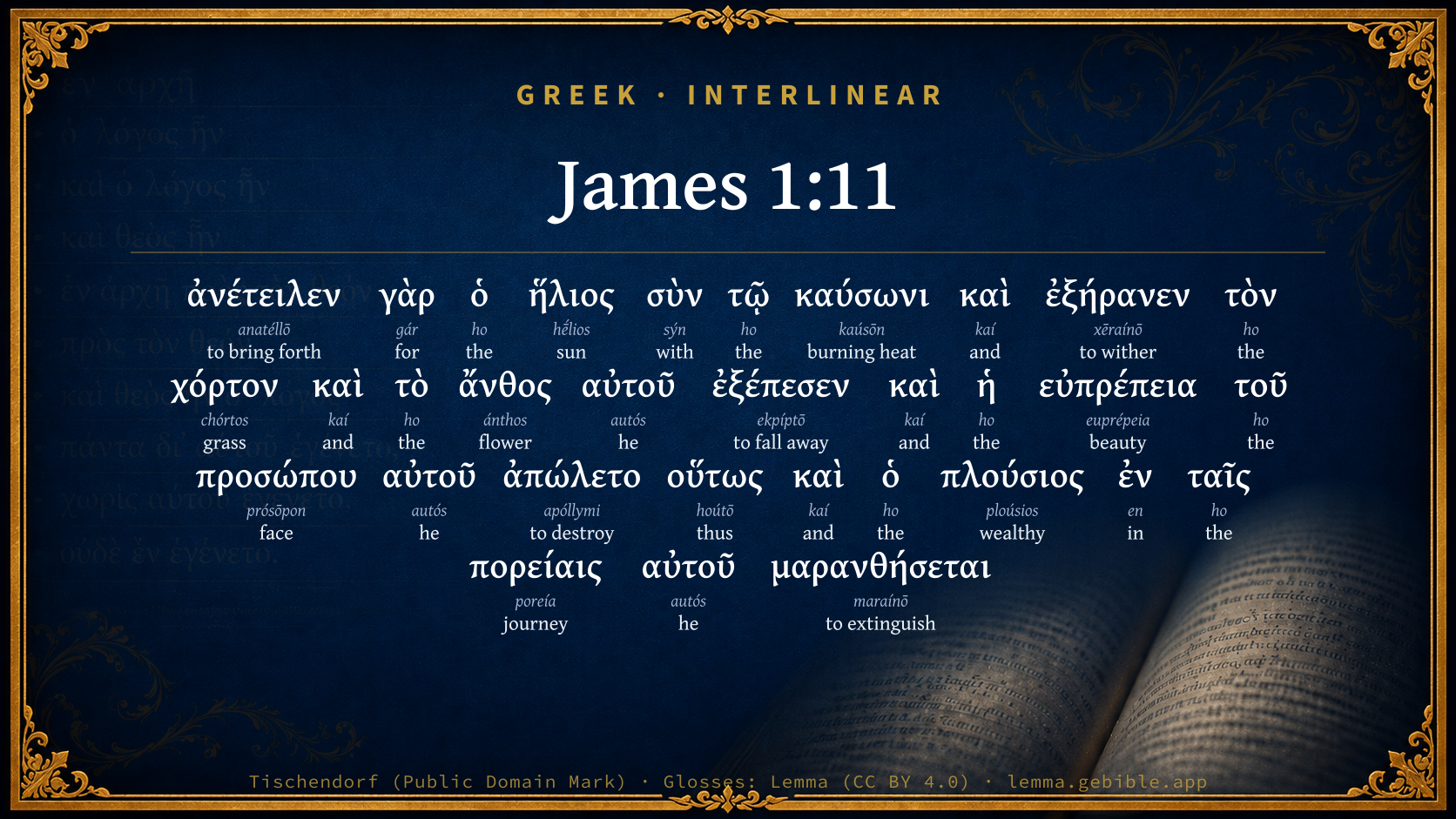
Download image
Cite this verse

James 1:11 (World English Bible). Public Domain. Lemma interlinear Bible study tool, https://lemma.gebible.app/v/james/1/11.

Show BibTeX & RIS
BibTeX
RIS
English Translation
For the sun arises with the scorching wind, and withers the grass, and the flower in it falls, and the beauty of its appearance perishes. So also will the rich man fade away in his pursuits.
World English Bible · Public Domain
Highlights
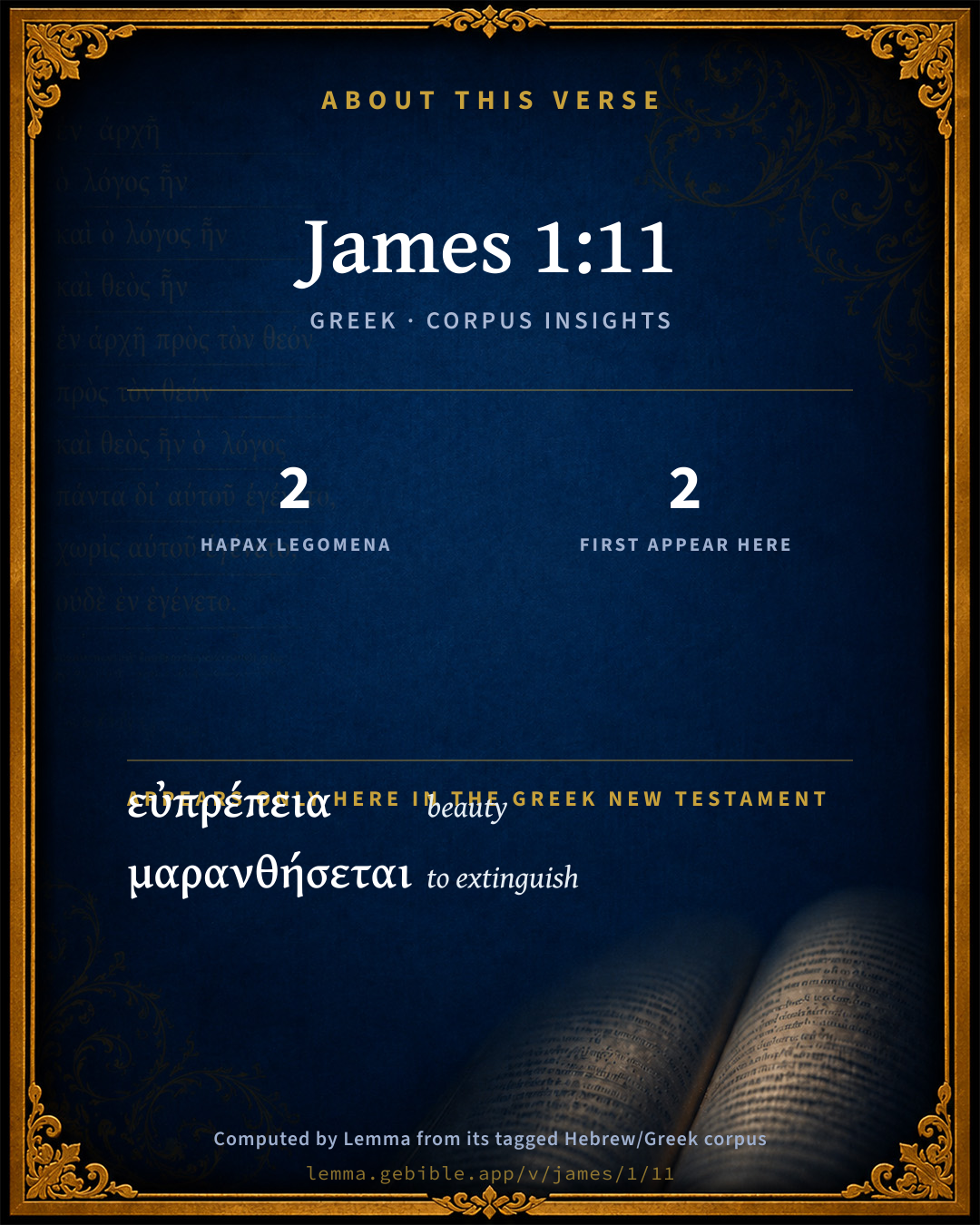
  • 2 hapax legomena — only here in the Greek New Testament
  • 2 first appearances in the Greek New Testament
Full analysis ↓
Download a study sheet

One document with this verse’s original text, its word-by-word gloss line, the meaning frame, cross-references with their text, attributed commentary, and full source and license credits — printable, and it pastes into notes with its structure intact.

This verse Autodidact and up

Study sheet (.html) Plain text (.txt)

A passage Seminary Student

Up to 50 verses in one chapter. A passage sheet keeps up to 6 commentary sources and 12 cross-references per verse, in the order this page ranks them, and says so on the sheet whenever that leaves anything out. Ask for a single verse and you get the Autodidact verse sheet above.

Everything on this page stays free to read, with no account — the sheet is a download of what is already on screen, not access to it.

Want to remove ads? Support Godless Engineer
Compare translations 3

The same verse in 3 English versions, stacked beneath the original-language interlinear above. Click any original word for its lexicon entry.

Each is an independent rendering of the whole verse — the interlinear is not word-aligned to these translations.

Highlighted words mark where these versions differ — a whole-verse word diff, not a word-by-word alignment.

  • World English Bible Public Domain
    For the sun arises with the scorching wind, and withers the grass, and the flower in it falls, and the beauty of its appearance perishes. So also will the rich man fade away in his pursuits.
  • King James Version Public Domain
    For the sun is no sooner risen with a burning heat, but it withereth the grass, and the flower thereof falleth, and the grace of the fashion of it perisheth: so also shall the rich man fade away in his ways.
  • unfoldingWord Literal Text CC BY-SA 4.0
    For the sun rose with the heat and dried up the grass, and its flower fell off and the beauty of its face perished. Thus also the rich will wither in his journeys.

unfoldingWord Literal Text — © unfoldingWord, licensed CC BY-SA 4.0. Word-aligned USFM3 via Door43 (git.door43.org/unfoldingWord/en_ult).

Versions to compare (up to 4)

3 of 4 selected

Show all 19 translations

Every available English version of this verse, each an independent rendering of the whole verse.

  • World English Bible Public Domain
    For the sun arises with the scorching wind, and withers the grass, and the flower in it falls, and the beauty of its appearance perishes. So also will the rich man fade away in his pursuits.
  • Berean Standard Bible Public Domain
    For the sun rises with scorching heat and withers the plant; its flower falls and its beauty is lost. So too, the rich man will fade away in the midst of his pursuits.
  • Majority Standard Bible Public Domain
    For the sun rises with scorching heat and withers the plant; its flower falls and its beauty is lost. So too, the rich man will fade away in the midst of his pursuits.
  • King James Version Public Domain
    For the sun is no sooner risen with a burning heat, but it withereth the grass, and the flower thereof falleth, and the grace of the fashion of it perisheth: so also shall the rich man fade away in his ways.
  • American Standard Version (1901) Public Domain
    For the sun ariseth with the scorching wind, and withereth the grass: and the flower thereof falleth, and the grace of the fashion of it perisheth: so also shall the rich man fade away in his goings.
  • Revised Version (1885) Public Domain
    For the sun ariseth with the scorching wind, and withereth the grass; and the flower thereof falleth, and the grace of the fashion of it perisheth: so also shall the rich man fade away in his goings.
  • Geneva Bible (1599) Public Domain
    For as when the sunne riseth with heate, then the grasse withereth, and his flower falleth away, and the goodly shape of it perisheth: euen so shall the rich man wither away in all his waies.
  • Douay-Rheims (1899) Public Domain
    For the sun rose with a burning heat, and parched the grass, and the flower thereof fell off, and the beauty of the shape thereof perished: so also shall the rich man fade away in his ways.
  • Young's Literal Translation Public Domain
    for the sun did rise with the burning heat, and did wither the grass, and the flower of it fell, and the grace of its appearance did perish, so also the rich in his way shall fade away!
  • Literal Standard Version CC BY-SA 4.0
    for the sun rose with the burning heat, and withered the grass, and the flower of it fell, and the beauty of its appearance perished, so also the rich in his way will fade away!
  • Unlocked Literal Bible CC BY-SA 4.0
    For the sun rises with burning heat and dries up the grass. The flower falls off, and its beauty perishes. In the same way, the rich man will fade away in the middle of his journey.
  • unfoldingWord Literal Text CC BY-SA 4.0
    For the sun rose with the heat and dried up the grass, and its flower fell off and the beauty of its face perished. Thus also the rich will wither in his journeys.
  • Darby Bible Public Domain
    For the sun has risen with its burning heat, and has withered the grass, and its flower has fallen, and the comeliness of its look has perished: thus the rich also shall wither in his goings.
  • World Messianic Bible Public Domain
    For the sun arises with the scorching wind and withers the grass; and the flower in it falls, and the beauty of its appearance perishes. So the rich man will also fade away in his pursuits.
  • Webster's Bible Public Domain
    For the sun hath no sooner risen with a burning heat, but it withereth the grass, and its flower falleth, and the grace of the fashion of it perisheth: so also shall the rich man fade away in his ways.
  • Free Bible Version CC BY-SA 4.0
    For the sun rises along with the blistering wind and scorches the grass. The flowers fall and their beauty is marred. Everything the rich achieve will fade in just the same way.
  • Bible in Basic English Public Domain
    For when the sun comes up with its burning heat, the grass gets dry and the grace of its form is gone with the falling flower; so the man of wealth comes to nothing in his ways.
  • Text-Critical English NT CC BY 4.0
    For the sun rises with its scorching heat and withers the grass, and its flower falls, and its beautiful appearance is lost. So also will the rich man fade away in his pursuits.
  • Tyndale New Testament (1534) Public Domain
    The sonne ryseth with heate and the grasse wydereth and his flower falleth awaye and the beautie of the fassion of it perissheth: even so shall the ryche man perisshe with his aboundance.

Literal Standard Version (2020), Covenant Press — licensed CC BY-SA 4.0. Text via the HelloAO Bible API (eBible.org). Unlocked Literal Bible (unfoldingWord) — licensed CC BY-SA 4.0. Text via the HelloAO Bible API (eBible.org). unfoldingWord Literal Text — © unfoldingWord, licensed CC BY-SA 4.0. Word-aligned USFM3 via Door43 (git.door43.org/unfoldingWord/en_ult). Free Bible Version, Dr. Jonathan Gallagher — licensed CC BY-SA 4.0. Text via the HelloAO Bible API (eBible.org).

Word by word

More ways to search: Search by grammar → Find every occurrence → Compare this word →

Practice this passage: Drill this verse → Learn its vocabulary →

εὐπρέπεια
euprépeia
G2143
“beauty”
Noun, Nominative, Singular, Feminine
Part of Speech
Noun
Case
Nominative
Number
Singular
Gender
Feminine
Full Thayer's Definition

Origin: from a compound of G2095 and G4241

TDNT: None

1. goodly appearance, shapeliness, beauty, comeliness
  1. ἀνέτειλεν anatéllō G393 “to bring forth” Verb, Aorist, Active, Indicative, 3rd person, Singular
  2. γὰρ gár G1063 “for” Conjunction
  3. ὁ ho G3588 “the” Article, Nominative, Singular, Masculine
  4. ἥλιος hḗlios G2246 “sun” Noun, Nominative, Singular, Masculine
  5. σὺν sýn G4862 “with” Preposition
  6. τῷ ho G3588 “the” Article, Dative, Singular, Masculine
  7. καύσωνι kaúsōn G2742 “burning heat” Noun, Dative, Singular, Masculine
  8. καὶ kaí G2532 “and” Conjunction
  9. ἐξήρανεν xēraínō G3583 “to wither” Verb, Aorist, Active, Indicative, 3rd person, Singular
  10. τὸν ho G3588 “the” Article, Accusative, Singular, Masculine
  11. χόρτον chórtos G5528 “grass” Noun, Accusative, Singular, Masculine
  12. καὶ kaí G2532 “and” Conjunction
  13. τὸ ho G3588 “the” Article, Nominative, Singular, Neuter
  14. ἄνθος ánthos G438 “flower” Noun, Nominative, Singular, Neuter
  15. αὐτοῦ autós G846 “he” Personal pronoun, Genitive, Singular, Masculine
  16. ἐξέπεσεν ekpíptō G1601 “to fall away” Verb, Aorist, Active, Indicative, 3rd person, Singular
  17. καὶ kaí G2532 “and” Conjunction
  18. ἡ ho G3588 “the” Article, Nominative, Singular, Feminine
  19. τοῦ ho G3588 “the” Article, Genitive, Singular, Neuter
  20. προσώπου prósōpon G4383 “face” Noun, Genitive, Singular, Neuter
  21. αὐτοῦ autós G846 “he” Personal pronoun, Genitive, Singular, Masculine
  22. ἀπώλετο apóllymi G622 “to destroy” Verb, Aorist, Middle, Indicative, 3rd person, Singular
  23. οὕτως hoútō G3779 “thus” Adverb
  24. καὶ kaí G2532 “and” Conjunction
  25. ὁ ho G3588 “the” Article, Nominative, Singular, Masculine
  26. πλούσιος ploúsios G4145 “wealthy” Adjective, Nominative, Singular, Masculine
  27. ἐν en G1722 “in” Preposition
  28. ταῖς ho G3588 “the” Article, Dative, Plural, Feminine
  29. πορείαις poreía G4197 “journey” Noun, Dative, Plural, Feminine
  30. αὐτοῦ autós G846 “he” Personal pronoun, Genitive, Singular, Masculine
  31. μαρανθήσεται maraínō G3133 “to extinguish” Verb, Future, Passive, Indicative, 3rd person, Singular

About this verse

These counts appear in no published source. They are computed here, from the morphology-tagged text and Lemma’s own curated glosses. What Lemma adds →

32
words
20
distinct lemmas
General Epistles
section

Notable vocabulary

2 hapax legomena — words that appear only here in the entire Greek New Testament:

  • εὐπρέπεια beauty G2143
  • μαρανθήσεται to extinguish G3133

First appearance in Scripture

These words make their first canonical appearance in the Greek New Testament here:

  • εὐπρέπεια beauty G2143
  • μαρανθήσεται to extinguish G3133

Shared distinctive vocabulary

πορείαις journey G4197 occurs in 2 verses of the Greek New Testament. Also found in:
Repetition

Words recur within this verse:

Cross-references

15

Topical passages linked to James 1:11 in the Treasury of Scripture Knowledge — connected by theme and wording, ordered by reader-vote popularity; previews shown in the World English Bible.

  • Isaiah 40:7–8 The grass withers, the flower fades, because the breath of Yahweh blows on it; surely the people is grass.
  • Psalms 37:35–36 I have seen the wicked in great power, Spreading himself like a green tree in its native soil.
  • Luke 16:19–25 "Now there was a certain rich man, and he was clothed in purple and fine linen, living in luxury every day.
  • Mark 4:6 When the sun had risen, it was scorched; and because it had no root, it withered away.
  • Psalms 49:6–14 Those who trust in their wealth, And boast in the multitude of their riches--
  • James 5:1–7 Come now, you rich, weep and howl for your miseries that are coming on you.
  • Matthew 13:6 When the sun had risen, they were scorched. Because they had no root, they withered away.
  • Luke 12:16–21 He spoke a parable to them, saying, "The ground of a certain rich man brought forth abundantly.
  • Job 21:24–30 His pails are full of milk. The marrow of his bones is moistened.
  • Psalms 73:18–20 Surely you set them in slippery places. You throw them down to destruction.
  • Psalms 102:4 My heart is blighted like grass, and withered, For I forget to eat my bread.
  • Ecclesiastes 5:15 As he came forth from his mother's womb, naked shall he go again as he came, and shall take nothing for his labor, which he may carry away in his hand.
  • 1 Corinthians 7:31 and those who use the world, as not using it to the fullest. For the mode of this world passes away.
  • 1 Peter 1:4 to an incorruptible and undefiled inheritance that doesn't fade away, reserved in heaven for you,
  • 1 Peter 5:4 When the chief Shepherd is revealed, you will receive the crown of glory that doesn't fade away.

Cross-references courtesy of OpenBible.info (CC BY 4.0).

Commentary

Notes on James 1:11 from classic Christian and Jewish commentators (each source and its license shown beneath its notes). The classic Christian expositions comment on the surrounding passage and are grouped to its opening verse, so a note may address several verses; the Jewish commentaries on the Tanakh (Rashi and others) are per-verse, so they appear only where the commentator wrote on this verse.

Lemma curates 59 commentaries, every one of them public domain or Creative Commons licensed, each selected and text-cleaned for this edition rather than reprinted as found. About our sources →

Bengel's Gnomon

Johann Albrecht Bengel

Jas 1:11. Ἀνέτειλε—ἀπώλετο, the sun is risen—it perisheth) Here are four circumstances (turning points): the first is the cause of the second, the third of the fourth.—καύσωνι) the mid-day “heat” and parching wind, which follows the “rising” of the sun. A gradation.—ἡ εὐπρέπεια, the comeliness) which is in the flower.—πορείαις, his goings) In other places εὐπορία, “abundance of resources” [success in one’s ways or goings], is attributed to the rich; but the apostle uses the simple word, and that too in the plural number, on account of the burdensome greatness (extent) of his undertakings. Πορεία, a journey, from πορεύομαι, “I go,” as βασιλεία from βασιλεύω. I attribute no weight to the reading πορίαις.[8]—μαρανθήσεται, shall fade away) in death.

[8] It was necessary to bring forward this reading in the Appar. p. 728, because Mill speaks obscurely respecting some Manuscripts which have this reading, and is silent respecting Estius quoting Gaignæus.

A reads πορίαις. But the weight of authorities is for πορείαις; Vulg. itineribus—E.

Bengel's Gnomon of the New Testament — English translation (T&T Clark, Edinburgh, 1860) — public domain. Text from a community e-Sword module.

Meyer's Critical & Exegetical Commentary

Heinrich August Wilhelm Meyer

Jam_1:11. A further expansion of the image. The aorists ἀνέτειλε, ἐξήρανε, etc., do not precisely stand for the present (Grotius, Piscator, Hottinger, and others), but represent the occurrence in a concrete manner as a fact which has taken place, by which the description gains in vividness (comp. Isa_40:7), which is still more vividly portrayed by the simple succession of finite verbs. See Winer, p. 248 [E. T. 346, 347] and p. 417 [E. T. 590]; A. Buttmann, p. 175. It is only confusing to convert ἀνέτειλε … ἐξήρανε into ἀνατείλας or ἐὰν ἀνατέλλῃ … ἐξήρανε.

By the word καύσων is often in the LXX. (comp. besides Eze_17:10; Eze_19:12, Hos_13:15 : Jer_18:17; Jon_4:8; where ἄνεμος or πνεῦμα is added, particularly Job_27:21; Hos_12:1) meant the hot east wind (קָדִים), which, blowing over the steppes of Arabia, is very dry and scorching to vegetation (see Winers Reallexicon: word, Wind); here, however, as in Isa_49:10 (שָׁדָב closely united with שֶׁמֶשׁ), Sir_18:16 (comp. also Sir_43:3, where it is said of the sun: καὶ ἐναντίον καύματος αὐτοῦ τίς ὑποστήσεται), Mat_20:12, Luk_12:55, it has the meaning heat, burning (against Grotius, Pott, Hottinger, Kern, Schneckenburger, Winer, Wahl, Lange, Bouman, and others), as the parching effect is attributed not to the καύσων as something different from the sun, but to the sun itself.[59] It is arbitrary to explain it as if it were written: ἨΓΈΡΘΗ ΓΆΡ, ἍΜΑ Τᾷ ἈΝΑΤΕῖΛΑΙ ΤῸΝ ἭΛΙΟΝ, Ὁ ΚΑΎΣΩΝ; as Gebser says: the burning wind rising with the sun is the image. Laurentius incorrectly understands by the sun Christ, and by the rising of the sun the day of the Lord; thus the whole is an image of the judgment destroying the rich, yet so that the individual parts are to be retained in their appropriate meaning.[60]

ΚΑῚ ἘΞΉΡΑΝΕ Κ.Τ.Λ.] The same expressions in Isa_40:7.

ἘΚΠΊΠΤΕΙΝ, i.e. not simply the withering (Isa_28:1; Isa_28:4, LXX.), but the actual falling off of the flower, is a consequence of the blighting of the plant.

ἡ εὐπρέπεια] the opposite of ἈΠΡΈΠΕΙΑ is used in the classics chiefly of external appearance; in the N. T. it is an ἍΠ. ΛΕΓ.

ΤῸ ΠΡΌΣΩΠΟΝ = פָּנִים, Psa_104:30; comp. Luk_12:56; Mat_16:3 : species externa. ΑὐΤΟῦ refers, not as the first ΑὐΤΟῦ, to ΤῸΝ ΧΌΡΤΟΝ, but ΤῸ ἌΝΘΟς, on which the emphasis rests (comp. Jam_1:10, de Wette, Wiesinger, Bouman).[61]

ΟὝΤΩ] thus quickly, thus entirely (Wiesinger); ΚΑΊ is not purely superfluous (Wiesinger), but, referring back to the image, heightens the comparison.

Ὁ ΠΛΟΎΣΙΟς … ΜΑΡΑΝΘΉΣΕΤΑΙ] It is to be observed that here also Ὁ ΠΛΟΎΣΙΟς and not Ὁ ΠΛΟῦΤΟς is the subject. ΜΑΡΑΊΝΕΣΘΑΙ, in the N. T. an ἍΠ. ΛΕΓ., is found in the LXX. as the translation of יָבֵשׁ, Job_15:30; in the same meaning in the Wisdom of Solomon Jam_2:8. The figurative expression is explained by what goes before.

ἘΝ ΤΑῖς ΠΟΡΕΊΑΙς ΑὙΤΟῦ] not on his journeys (Laurentius, Piscator, Herder), also not on his journeyings of fortune (Lange); but = ἘΝ ΤΑῖς ὍΔΟΙς ΑὐΤΟῦ, Jam_1:8 (comp. Pro_2:8, LXX.). The prominent idea is that the rich man, overtaken by judgment, perishes in the midst of his doings and pursuits, as the flower in the midst of its blossoming falleth a victim to the scorching heat of the sun. Luthers translation: in his possession, is explained from the false reading ΠΟΡΊΑΙς. See critical notes.

[59] Neither the article before καύσωνι, nor the observation that with the rising of the sun and the development of its heat the vegetation is not forthwith imperilled, forms a valid reason against this explanation (against Lange).

[60] That with the sun of a finished revelation was developing the hot wind of the law, which scorched the glory of Israel (Lange), is a remark which is here the more inappropriate, as according to it the sun and the hot wind are indicated as two different powers opposed to each other.

[61] Lange, on the other hand, observes that a fallen flower is still to lose its beauty cannot be imagined; but is it then to be imagined that the grass when it is withered and the flower has fallen from it is still to lose its beauty?

Meyer — Critical and Exegetical Commentary on the New Testament — English translation by Peter Christie, edited by Frederick Crombie (T&T Clark, 1880) — public domain. Text from a community e-Sword module.

Expositor's Greek Testament

ed. W. Robertson Nicoll

Jas 1:11 . ἀνέτειλεν : the “gnomic” aorist, i.e. , expressive of what always happens; it gives a “more vivid statement of general truths, by employing a distinct case or several distinct cases in the past to represent (as it were) all possible cases, and implying that what has occurred is likely to occur again under similar circumstances” (Moulton, p. 135, quoting Goodwin); he adds, “the gnomic aorist … need not have been denied by Winer for Jas 1:11 and 1Pe 1:24 ”. The R.V. gives the present, in accordance with the English idiom, but clearly the Greek way is the more exact; the same applies to Hebrew, though this particular verb does not occur in the corresponding passage in either the Septuagint or the Massoretic text; an example may, however, be seen in Nah 3:17 . ὁ ἥλιος ἀνέτειλεν , καὶ ἀφήλατο , καὶ οὐκ ἔγνω τὸν τόπον αὐτῆς (see R.V.). σὺν τῷ καύσωνι : the east wind which came from the Syrian desert, it was a hot wind which parched the vegetation and blighted the foliage of the trees; the Hebrew name רוּחַ הַקָּדִים “the wind of the east,” or simply קָדִים , expresses the quarter whence it comes, the Greek καύσων , “burner,” describes its character, see Hos 13:15 ; Eze 17:10 ; it became especially dangerous when it developed into a storm, on account of its great violence, see Isa 27:8 ; Jer 18:17 ; Eze 27:26 . ἐξέπεσεν : the equivalent Hebrew word is נָבֶל , which like the cognate root in other Semitic languages, contains the idea of dying, cf. Isa 24:4 ; Isa 26:19 . εὐπρέπεια τοῦ προσώπου αὐτοῦ : pleonastic; προσ . is used mostly in reference to persons, e.g. , in Sir. it occurs twenty-eight times, and only in two instances to things other than persons, viz. , Sir 38:8 , καὶ εἰρήνη παρʼ αὐτοῦ ἐστιν ἐπὶ προσώπου τῆς γῆς [Hebrew marg., however reads מפני אדם ]. Sir 40:6 … ἀπὸ προσώπου πολέμου [Hebrew text, however, מפני רודף ]. εὐπρέπεια does not occur elsewhere in the N.T.; see Sir 47:10 , its only occurrence in that book. ἐν ταῖς πορείαις αὐτοῦ : see above Jas 1:8 . μαρανθήσεται : only here in N.T.

The Expositor's Greek Testament, edited by W. Robertson Nicoll (1897–1910) — public domain. Text from a community e-Sword module.

Geneva Bible (1599)

Geneva Bible translators

Whatsoever he either purposeth in his mind, or doeth.

Geneva Bible (1599) marginal notes — public domain. Text via Bolls.life.

Jamieson, Fausset & Brown

Robert Jamieson, A. R. Fausset & David Brown

Taken from Isa 40:6-8.

heat--rather, "the hot wind" from the (east or) south, which scorches vegetation (Luk 12:55). The "burning heat" of the sun is not at its rising, but rather at noon; whereas the scorching Kadim wind is often at sunrise (Jon 4:8) [MIDDLETON, The Doctrine of the Greek Article]. Mat 20:12 uses the Greek word for "heat." Isa 40:7, "bloweth upon it," seems to answer to "the hot wind" here.

grace of the fashion--that is of the external appearance.

in his ways--referring to the burdensome extent of the rich man's devices [BENGEL]. Compare "his ways," that is, his course of life, Jam 1:8.

Jamieson, Fausset & Brown — Commentary Critical and Explanatory on the Whole Bible (1871) — public domain (CC PDM 1.0). Text via the HelloAO Bible API.

Adam Clarke's Commentary

Verse 11. For the sun is no sooner risen] We need not pursue this metaphor, as St. James' meaning is sufficiently clear: All human things are transitory; rise and fall, or increase and decay, belong to all the productions of the earth, and to all its inhabitants. This is unavoidable, for in many cases the very cause of their growth becomes the cause of their decay and destruction. The sun by its genial heat nourishes and supports all plants and animals; but when it arises with a burning heat, the atmosphere not being tempered with a sufficiency of moist vapours, the juices are exhaled from the plants; the earth, for lack of moisture, cannot afford a sufficient supply; vegetation becomes checked; and the plants soon wither and die. Earthly possessions are subject to similar mutations. God gives and resumes them at his pleasure, and for reasons which he seldom explains to man. He shows them to be uncertain, that they may never become an object of confidence to his followers, and that they may put their whole trust in God. If for righteousness' sake any of those who were in affluence suffer loss, or spoiling of their goods, they should consider that, while they have gained that of infinite worth, they have lost what is but of little value, and which in the nature of things they must soon part with, though they should suffer nothing on account of religion.

Adam Clarke's Commentary on the Bible (1810–1826) — public domain. Text from a community e-Sword/MySword module.

John Calvin's Commentaries

Though the received reading is ἐν ταῖς πορείαις, yet I agree with Erasmus, and read the last word, πορίαις, without the diphthong “in his riches,” or, with his riches; and the latter I prefer.

John Calvin's Commentaries (1540-1563) — public domain. Text from the Calvin Translation Society English edition (1840s-50s) via the Christian Classics Ethereal Library (ccel.org). Calvin's coverage is partial (roughly two-thirds of the Bible); uncommented books and verses are honest gaps, never fabricated. The 19th-century editor's footnotes and remarks are omitted so the notes are faithfully Calvin's own voice.

Ellicott's Commentary for English Readers

(11) For the sun is no sooner risen . . .—Translate, the sun arose with the burning heat, and dried up the grass; and the flower thereof fell away, and the grace of its fashion perished. The grace, the loveliness, the delicacy of its form and feature—literally, of its face—withered and died away. Often must the Apostle have seen such an effect of the fiery-Eastern sun, scorching with its pitiless glare the rich verdure of the wilderness; and in his ear, perchance, was the cry of Isaiah (Isa_40:6-8):—

“All flesh is grass:

And all the goodliness thereof is as the flower of the field.

The grass withereth;

The flower fadeth;

Because the Spirit of the Lord bloweth upon it:

—Surely the people is grass.

The grass withereth;

The flower fadeth;

But the Word of our God shall stand for ever.”

So also (or, thus) shall the rich man fade away (or, wither) in his ways.—Not the rich brother, observe, is to fade thus, though his wealth will so pass away. The warning is rather (as in Mar_10:24) “for them that trust in riches.” Even “the mammon of unrighteousness,” well used, will make for us “friends that may receive us into everlasting habitations” (Luk_16:9). And he who, out of the possessions wherewith God has blessed him, “deviseth liberal things, by liberal things shall stand” (Isa_32:8). There seems, moreover, looking closely at the text, a special fitness in its exact words: for they mean that the rich shall perish in their journeyings for the sake of gain; and to no people could the rebuke apply more sharply than to the Jews, the lenders unto “many nations” (Deu_15:6), the merchants and bankers of the world. Nor can “the sword of the Spirit,” unsheathed from this Word of God (Eph_6:17), be without an edge for those of us in these latter times who err in the former ways.

A Bible Commentary for English Readers, edited by Charles John Ellicott (1878–1897) — public domain. Text from a community e-Sword module.

The Cambridge Bible for Schools and Colleges

gen. ed. J. J. S. Perowne

11. For the sun is no sooner risen … but it withereth] Better, for the sun arose and withered. The Greek has nothing that answers to “no sooner,” and the verbs are throughout in the past tense as in a narrative. It is as though St James were using the form not of a similitude, but of a parable, apparently not without a reminiscence of some features of the Parable of the Sower (Mat_13:6) and of the Sermon on the Mount (Mat_6:30).

with a burning heat] Better, with the scorching heat, probably the Simoom, or hot wind that blows from the desert in the early morning, as in Luk_12:55. The whole description comes, as above, from Isa_40:6. Comp. also Jon_4:8.

falleth … perisheth] Better, as continuing the narrative, fell—perished.

fade away] Better, perhaps, as expressing the force of the Greek passive, be blighted. The Greek verb is not found elsewhere in the New Testament, but meets us in the Wisd. of Son_2:8, in a passage which may well have been present to the mind of the writer. An adjective derived from it is found in the “crown that fadeth not away,” literally, the amaranthine crown, of 1Pe_5:4. See also 1Pe_1:4. The idea of the “fading” of earthly riches, the “unfading” character of heavenly, was another thought common to the two writers.

the grace of the fashion of it] Better, the goodliness of its form, literally, of its face. The first substantive is not found elsewhere in the New Testament.

in his ways] Literally, in his goings or journeyings, as in Luk_13:22, perhaps with a special reference to the restlessness in trading which shewed itself in the money-making Jews of Palestine. “Going” and “getting” (poreuomai and emporeuomai) made up the sum total of their ideal of life. Comp. chap. Jas_4:13. A various reading gives “in his gettings” here, as a possible meaning, but the balance of evidence is in favour of “goings.”

The Cambridge Bible for Schools and Colleges (gen. ed. J. J. S. Perowne; Cambridge University Press, 1878–1918) — public domain. Text from a community e-Sword module.

John Gill's Exposition

For the sun is no sooner risen with a burning heat,.... As it is about the middle of the day, when it shines in its full strength, and its heat is very great and scorching, especially in the summer season, and in hot climates:

but it withereth the grass; strikes it with heat, causes it to shrivel, and dries it up;

and the flower thereof falleth; drops off from it to the ground:

and the grace of the fashion of it perisheth; its form and colour, its glory and beauty, which were pleasant to the eye, are lost, and no more to be recovered. This shows, that earthly riches, like the flower of the field, have an outward show and glory in them, which attract the mind, and fix an attention to them for a while; they are gay and glittering, and look lovely, are pleasant to behold, and desirable to enjoy; but when the sun of persecution, or any other outward calamity arises, they are quickly destroyed, and are no more.

So also shall the rich man fade away in his ways; riches are uncertain things now, they often make themselves wings and flee away; they are things that are not, that are not solid and substantial they are a vain show; they sometimes fade away in a man's lifetime, before he dies; and he fades away, and comes to decay, amidst all the ways and means, designs and schemes, he forms and pursues, and all the actions and business he does; and if not, when he fades away, and dies amidst all his riches, his glory does not descend after him, but falls off from him, as the flower of the field before the heat of the sun.

John Gill's Exposition of the Whole Bible (1746–1763) — public domain (CC PDM 1.0). Text via the HelloAO Bible API.

Trapp's Complete Commentary

John Trapp

11 For the sun is no sooner risen with a burning heat, but it withereth the grass, and the flower thereof falleth, and the grace of the fashion of it perisheth: so also shall the rich man fade away in his ways.

Ver. 11. Shall the rich man fade] Perish eternally, if he trust in uncertain riches, and not in the living God. See Jas 5:1. Thus that sapless fellow Nabal faded, when his heart died within him, nor could his riches any more relieve him than they did that rich and wretched cardinal, Henry Beaufort, Chancellor of England in the reign of Henry VI, who murmured at death, that his riches could not reprieve him till a further time. Fie (quoth he), will not death be hired? Will money do nothing? No; money here bears no mastery. (Acts and Mon.)

John Trapp, A Commentary or Exposition upon All the Books of the Old and New Testament (1647–1656) — public domain. Text from a community e-Sword module.

Albert Barnes' Notes on the Bible

For the sun is no sooner risen with a burning heat - Isaiah Isa 40:7 employs the word “wind,” referring to a burning wind that dries up the flowers. It is probable that the apostle also refers not so much to the sun itself, as to the hot and fiery wind called the simoom, which often rises with the sun, and which consumes the green herbage of the fields. So Rosenmuller and Bloomfield interpret it.

It withereth the grass - Isa 40:7. It withereth the stalk, or that which, when dried, produces hay or fodder - the word here used being commonly employed in the latter sense. The meaning is, that the effect of the hot wind is to wither the stalk or spire which supports the flower, and when that is dried up, the flower itself falls. This idea will give increased beauty and appropriateness to the figure - that man himself is blasted and withered, and then that all the external splendor which encircled him falls to the ground, like a flower whose support is gone.

And the grace of the fashion of it perisheth - Its beauty disappears.

So shall the rich man fade away in his ways - That is, his splendor, and all on which he prideth himself, shall vanish. The phrase “in his ways,” according to Rosenmuller, refers to his counsels, his plans, his purposes; and the meaning is, that the rich man, with all by which he is known, shall vanish. A man’s “ways,” that is, his mode of life, or those things by which he appears before the world, may have somewhat the same relation to him which the flower has to the stalk on which it grows, and by which it is sustained. The idea of James seems to be, that as it was indisputable that the rich man must soon disappear, with all that he had of pomp and splendor in the view of the world, it was well for him to be reminded of it by every change of condition; and that he should therefore rejoice in the providential dispensation by which his property would be taken away, and by which the reality of his religion would be tested. We should rejoice in anything by which it can be shown whether we are prepared for heaven or not.

Albert Barnes' Notes on the Bible (1834–1885) — public domain. Text from a community e-Sword/MySword module.

Haydock's Catholic Bible Commentary

===============================

[BIBLIOGRAPHY]

Decor vultus ejus, Greek: euprepeia tou prosopou; the Hebrew says, faciem, cœli, terræ, gladii, &c.

George Leo Haydock (1774–1849), Haydock's Catholic Family Bible and Commentary, 1859 edition — public domain. Excludes Psalms (Douay-Rheims chapter numbering differs from Protestant) and Deuterocanonical books (Catholic canon only).

Matthew Poole's English Annotations

With a burning heat; or, the scorching east wind, which in those countries was wont to rise with the sun, Jon 4:8.

So also shall the rich man fade away; either shall is here put for may, the future tense for the potential mood; and then the apostle doth not so much declare what always certainly stall be, as what easily may be, and frequently is, the prosperity of rich men not being always of so short continuance. Or, shall may be taken properly, as we read it; and then his is a general proposition, showing the mutable nature and short continuance of rich men and their riches, whose longest life is but short, and death, when it comes, strips them of their enjoyments: and though this frailty be common to all, yet he speaks of the rich especially, because they are so apt to hear themselves high upon their wealth, and put confidence in it, 1Ti 6:17.

In his ways; either in his journeyings and travels for his riches, or rather in his counsels, purposes, actions, Psa 146:4.

Matthew Poole's English Annotations on the Holy Bible (1683–1685) — public domain. Text from a community e-Sword/MySword module.

Whedon's Commentary on the Bible

Daniel D. Whedon

11. Now and then the rich man found this glorious lowliness and became a Christian; but the rich of St. James’s day and locality was generally a persecutor, (Jas_2:5,) and an oppressor, (note on Jas_5:1-6.) Hence in this verse, with a vividness akin to the last quoted passage, St. James paints the evanescence of the proud and oppressive millionaire. The imagery is borrowed mostly from Isa_40:6-8, where the fading character of our earthly humanity is described. Is—The Greek has all the verbs in this verse in the past tense, so as to make the description in fact a pictorial narrative. The sun no sooner rose… withered… fell… perished.

Burning heat—The Greek word for burning heat, καυσων, (from καιω, to burn,) often in the Septuagint designates the east wind, which, sweeping over the burning sands, brings a heat terribly scorching to all vegetation. Here it designates simply the burning power of the tropical or semi-tropical sun.

The grass—Pasturage, including all herbage, especially that supplying food for animals.

The flower—The bloom, the flourish.

Grace—Becomingness.

Fashion—Literally, face, aspect. Translate, the becomingness of its aspect.

Fade—Literally, wither; a word applicable to a flower, transferable to dying man.

Ways—Modes, plans, and purposes of life. It is to be noted that St. James here describes, not the vanishing of the riches from the man, but the vanishing of the man from his riches. Human wealth survives its possessor. Human things are often more permanent than human beings. Happy the rich man who passes from an earthly to a heavenly patrimony. He makes, perhaps, the best of both worlds. Such a man is described in the next verse.

Daniel D. Whedon (gen. ed.), Commentary on the Old and New Testaments (1874–1909) — public domain. Text from a community e-Sword module.

The Pulpit Commentary

jAneteile. ejxhrane ejxepese... ajpwleto. Observe the aorists here and in ver. 24. The illustration or case mentioned by way of example is taken as an actual fact, and the apostle falls into the tone of narration (see Wirier, "Grammar of New Testament Greek," 6. 1). Render, For the sun arose with the scorching wind, and withered the grass; and the flower thereof fell away, and the grace of the fashion of it perished. Kauswn may refer to

(1) the heat of the sun, or

(2) more probably, the hot Samum wind, the of the Old Testament (Job_27:21; Eze_17:10, etc.)

The Pulpit Commentary (1880–1919), ed. H.D.M. Spence-Jones & Joseph S. Exell — public domain. Text from a community e-Sword module.

John Wesley's Explanatory Notes

For the sun arose and withered the grass - There is an unspeakable beauty and elegance, both in the comparison itself, and in the very manner of expressing it, intimating both the certainty and the suddenness of the event. So shall the rich fade away in his ways - In the midst of his various pleasures and employments.

John Wesley, Explanatory Notes Upon the Whole Bible (1754–1765) — public domain. Text via the GEBible commentary corpus.

The People's New Testament

B. W. Johnson

11. For the sun. When the fierce sun of summer arises the grass in Palestine dies. Thus shall the glory of the rich man fade.

B. W. Johnson's The People's New Testament with Notes (1889–1891) — public domain. Electronic text from the Christian Classics Ethereal Library (CCEL) ThML edition.

Cambridge Greek Testament for Schools and Colleges

11. ἀνέτειλεν … ἐξήρανεν … ἐξέποσεν … ἀπώλετο. The use of the aorist here is to express the instantaneous effect produced by the καύσων. In English the present tense would be used to express this point of time; but the greater exactness of Greek thought and language places the events in the past. They are past in the very moment of describing them. See Winer P. III. § xl. 1, p. 346, and notes on St Matt. in this series, and compare 1Pe 1:24 ἐξηράνθη ὁ χόρτος καὶ τὸ ἄνθος ἐξέπεσεν. By some grammarians these are cited as instances of the gnomic aorist. See Mayor ad loc. and Burton, N.T. Moods and Tenses, p. 21. Winer however does not recognise this use of the aorist in N.T.

σὺν τῷ καύσωνι. The καύσων is the hot wind or sirocco blowing at sunrise from the Eastern desert. ἐπάξει καὺσωνα ἄνεμον (urentem ventum, V.; Hebr. קָדִים רוּחַ, east wind) ἐκ τῆς ἐρήμου, Hos 13:15. ἀναλήμψεται γὰρ αὐτὸν καύσων, Job 27:21. καὶ ἐγένετο ἄμα τῷ ἀνατεῖλαι τὸν ἥλιον καὶ προσέταξεν ὁ θεὸς πνεύματι καύσωνι συγκαίοντι, Jon 4:8. It was this wind that made the early morning hours so burdensome to the labourers, τοῖς βαστάσασι τὸ βάρος τῆς ἡμέρας καὶ τὸν καύσωνα, Mat 20:12, where see notes.

ἐξέπεσεν. A beautifully exact word to describe the dropping of the petals or corona out of the calyx, as an effect of drought, which would be more strikingly sudden under the hot eastern sun than in a temperate climate like ours.

εὐπρέπεια, here only in N.T. Comp. ἑκ Σιὼν ἡ εὐπρέπεια τῆς ὡραιότητος αὐτοῦ, Psa 50:2. For the general sense of this passage comp. πᾶς ὁ ὑψῶν ἑαυτὸν ταπεινωθήσεται, ὁ δὲ ταπεινῶν ἑαυτὸν ὑψωθήσεται, Luk 14:11. One of the notes of the Kingdom was the exaltation of the poor: 1Sa 2:8; Psa 9:12; Psa 9:18; Psa 72:2; Psa 72:4; Psa 72:12-13; Psa 107:41; Psa 113:7-8. In Isa 25:3 the LXX. version, εὐλογήσει σε ὁ λαὸς ὁ πτωχός, where the Hebr. is ‘the strong people shall glorify thee,’ is suggestive. See also Luk 1:52; Luk 6:20. The Gospel is especially a message to the poor, Mat 11:5. The rich are regarded as synonymous with the wicked, the poor with the righteous. See Isa 53:9; Sir 13:3; Luk 16:19-31. Comp. Psalms 10, 11.

This aspect of the rich and poor respectively is a vein of thought which runs through all the prophetic writings. It is a social result which has ensued in many epochs, when the wealthier class unrestrained by any unselfish principle gave themselves over to every indulgence of pride and passion. It is a view which finds support in some of the words of Christ: εἰ θέλεις τέλειος εἷναι ὕπαγε πώλησόν σου τὰ ὑπάρχοντα καὶ δὸς τοῖς πτωχοῖς καὶ ἕξεις θησαυρὸν ἐν οὐρανοῖς, Mat 19:21. See also Jas 1:23-24. It took effect in the earliest organisation of the Church. Act 2:44; Act 3:6. It was part of the religious thought of the day, as shewn in Essenism and Ebionism, the latter name being derived from a Hebr. word meaning ‘poor.’ One of the great lessons of Christianity has been to teach the responsibility of wealth and its place in the service of Christ, whether by noble use or self-sacrificing abandonment.

ἐν ταῖς πορείαις αὐτοῦ, in his ways, possibly in a literal sense (1) in his journeys for traffic or business, (2) but more probably in the ordinary figurative sense of way or path in the O. T. Comp. κατάρτισαι τὰ διαβήματά μου ἐν ταῖς τρίβοις σου ἴνα μὴ σαλευθῇ τὰ διαβήματά μου, Psa 17:5.

Cambridge Greek Testament for Schools and Colleges (Cambridge University Press, 1896; 21 vols, various authors incl. Carr, Maclear, Plummer, Farrar, Lumby, Moule, M. R. James, Simcox) — public domain. Text from a community e-Sword module.

Alford’s Greek Testament

Henry Alford

11.] For (justification of ὡς ἄνθος χόρτου παρελεύσεται) the sun arose (it is given in the form of a tale, a narration of what happened and ever does happen: see Isa 40:7, from which the whole is adapted) with the heat (or, the hot east wind, the קָדִים: this interpretation seems approved by ref. Jonah, καὶ ἐγένετο ἅμα τῷ ἀνατεῖλαι τὸν ἥλιον, καὶ προσέταξεν ὁ θεὸς (κύριος ὁ θ. Α) πνεύματι καύσωνι (-νος ΑΒ): see Winer, Realw. art. “Wind.” But καύσων in ref. Matt. and Isa 49:10, is evidently only heat: and considering, 1. the relation between that Gospel and St. James, and, 2. that the LXX, when the Kadim is intended, almost always add ὁ ἄνεμος or τὸ πνεῦμα, I prefer the other meaning, the arid scorching which accompanies the increasing power of the sun), and dried up the grass, and the flower thereof fell away (all from Isaiah), and the beauty of its appearance (so πρόσωπον in reff., the external appearance of any thing) perished: thus also shall the rich man (the same as was spoken of ver. 10: not ὁ πλοῦτος αὐτοῦ, but the πλούσιος himself) wither (reff.: the verb continues the similitude) in his ways (cf. ref. Psalm and Pro 2:8. Luther’s translation, in seiner Habe, rests on the reading πορίαις).

Henry Alford, The Greek Testament (1849–1861) — public domain. Text from a community e-Sword module.

International Critical Commentary

11. ἀνέτειλεν. The aorists are gnomic, as in v. 24; but cf. Isa 40:7 LXX. See Burton, Moods and Tenses, § 43, Blass, § 57, 9, Buttmann (Thayer’s translation), p. 202; Winer (Moulton’s translation), pp. 346 f.; J. H. Moulton, Prolegomena, p. 135.

Winer (Thayer’s translation), pp. 277 f., takes a different view, holding the aorists to be narrative, as in a parabolic story; cf. Mat 13:24 ff.

σὺν τῷ καύσωνι. καύσων means “burning heat,” Gen 31:40, Dan. 3:67 (Theod. Codd. AQ), Isa 25:5 (Theod.), Luk 12:55, Mat 20:12; or “sirocco,” Hebrew קָדִים (Job 27:21, Hos 13:15, Jon 4:8, Eze 17:10, Eze 19:12), the southeast wind common in Palestine in spring and destructive of young growth by reason of its extreme and withering dryness. See Benzinger, Hebr. Archäologie, pp. 29 f., DD.BB. art. “Wind.” It is often, as here, difficult to decide between the two possible meanings (e. g. Ecclus. 18:16, 43:3, Judith 8:3). For the A.V., “a burning heat,” R.V. has substituted “the scorching wind.”

ἐξέπεσεν, “faded,” “wilted,” from Isa 40:7, cf. Isa 28:1, Isa 28:4, Job 14:2, Job 14:15:30, 33.

The Greek word is used in the sense not only of “fall off,” but also of “fail,” “come to naught.” The specific meaning “fade” is contained in the Hebrew נָבֵל and so in translation became attached to ἐκπίπτειν.

ἡ εὐπρέπεια, “comeliness,” “goodly appearance.” Only here in N. T., cf. Ecclus. 24:14 (of olive-tree). The word is common in LXX as in classical writers, with a suggestion of fitness to the object and its relations, and so sometimes gains a notion of stateliness or majesty, which καλός, κάλλος, do not have. Cf. Psa 93:1 κύριος ἐβασίλευσεν, εὐπρέπειαν ἐνεδύσατο, Wisd. 7:29 εὐπρεπεστέρα ἡλίου, and other references given by Hort.

τοῦ προσώπου αὐτοῦ, “of its face,” i. e. “form and appearance.”

Under the influence of the extended meanings of the Hebrew פָּנִים the word πρόσωπον proceeded in translation to the sense “surface.” Cf. Job 41:13 (of stripping off the crocodile’s scales) τίς ἀποκαλύψει πρόσωπον ἐνδύσεως αὐτοῦ; 2Sa 14:20 τὸ πρόσωπον τοῦ ῥήματος τούτου, “the situation, attitude, appearance, of this affair”; Gen 2:6 τὸ πρόσωπον τῆς γῆς. From this to the meaning “outward form and appearance” is not a long step.

ἐν ταῖς πορείαις αὐτοῦ is figurative, like ὁδοῖς, v. 8, and refers to the experiences and fortunes of the rich, cf. Pro 2:7, Pro 4:27 τὰς δὲ πορείας σου ἐν εἰρήνῃ προάξει. To take it of literal journeys is wholly inappropriate to the context.

Hort’s interesting interpretation is probably oversubtle: “The common interpretation of ‘goings’ as a mere trope for ‘doings’ seems too weak here. The force probably lies in the idea that the rich man perishes while he is still on the move, before he has attained the state of restful enjoyment which is always expected and never arrives. Without some such hint of prematurity the parallel with the grass is lost.”

μαρανθήσεται, “wither,” “waste away.” So Wisd. 2:8, Job 24:24, but outside the Bible more often of the decay of other things than plants. The reference is to the loss of riches and earthly prosperity, not to eternal destiny.

International Critical Commentary — older volumes (1896–1929), various authors — public domain. Text from a community e-Sword module.

Vincent's Word Studies in the New Testament

Marvin R. Vincent

For the sun is no sooner risen, etc. [ανετειλεν γαρ ο ηλιος] . By the use of the aorist tense James graphically throws his illustration into the narrative form : "For the sun arose - and withered," etc.

With a burning heat [τω καυσωνι] . Rev., with the scorching wind. The article denotes something familiar; and the reference may be to the scorching east - wind (Job 1:19, Sept.; Eze 17:10), which withers vegetation. Some of the best authorities, however, prefer the rendering of the A. V.

Falleth [εξεπεσεν] . Aorist tense. Lit., fell off.

The grace of the fashion [ευπρεπεια του προσωπου] . Lit., the beauty of its face or appearance. Eujprepeia only here in New Testament.

Fade away [μαρανθησεται] . See on 1Pe 1:4.

Ways [πορειαις] . Rev., goings. Only here and Luk 13:22. His goings to and fro in acquiring riches.

Marvin R. Vincent, Word Studies in the New Testament (1887–1900) — public domain. Text from a community e-Sword/MySword module.

Lesson kit

Teaching starters — assembled from the data on this page, not authored interpretation. Every prompt links to the verse data it draws on. Edit before teaching.

James, in the General Epistles, opens this verse with 32 words (20 distinct Greek lemmas). Its most distinctive word is euprépeia (“beauty”). A historical commentator’s framing appears above. Read the whole chapter for the surrounding context.

Discussion questions

  1. The word euprépeia carries the sense “beauty.” How does it shape the verse?
  2. 2 words here appear nowhere else in the Greek New Testament. Why might the author reach for such rare wording?
  3. 2 words make their first appearance in Scripture here. What does this debut establish?
  4. How does Luke 13:22, which shares the word «journey», read alongside this verse?
  5. What does the repetition of “the” (8× in this one verse) do in this verse?
  6. These translations render this verse differently; the difference is in the English rendering, not the original. What questions does that raise?
  7. Compare how Bengel's Gnomon and Meyer's Critical & Exegetical Commentary read this verse. Where do they agree or differ?

Things to notice

  • 2 words in this verse appear nowhere else in the Greek New Testament.
  • 2 words make their first canonical appearance in Scripture here.
  • These translations choose different wording for 35 words in this verse.
  • “the” occurs 8× in this single verse.
  • 20 distinct Greek lemmas span 32 words in this verse.

Reading settings

Reading text

Shown beneath each verse's original-language words.

Old Testament
Old Testament edition

Read the OT as the Masoretic Hebrew (MT) or the Greek Septuagint (LXX).

English shown for the Greek Septuagint (in the Hebrew ↔ Greek comparison).

Comparing translations? Open the Compare panel on any verse page to stack up to four side by side.