
Hebrews 5:3

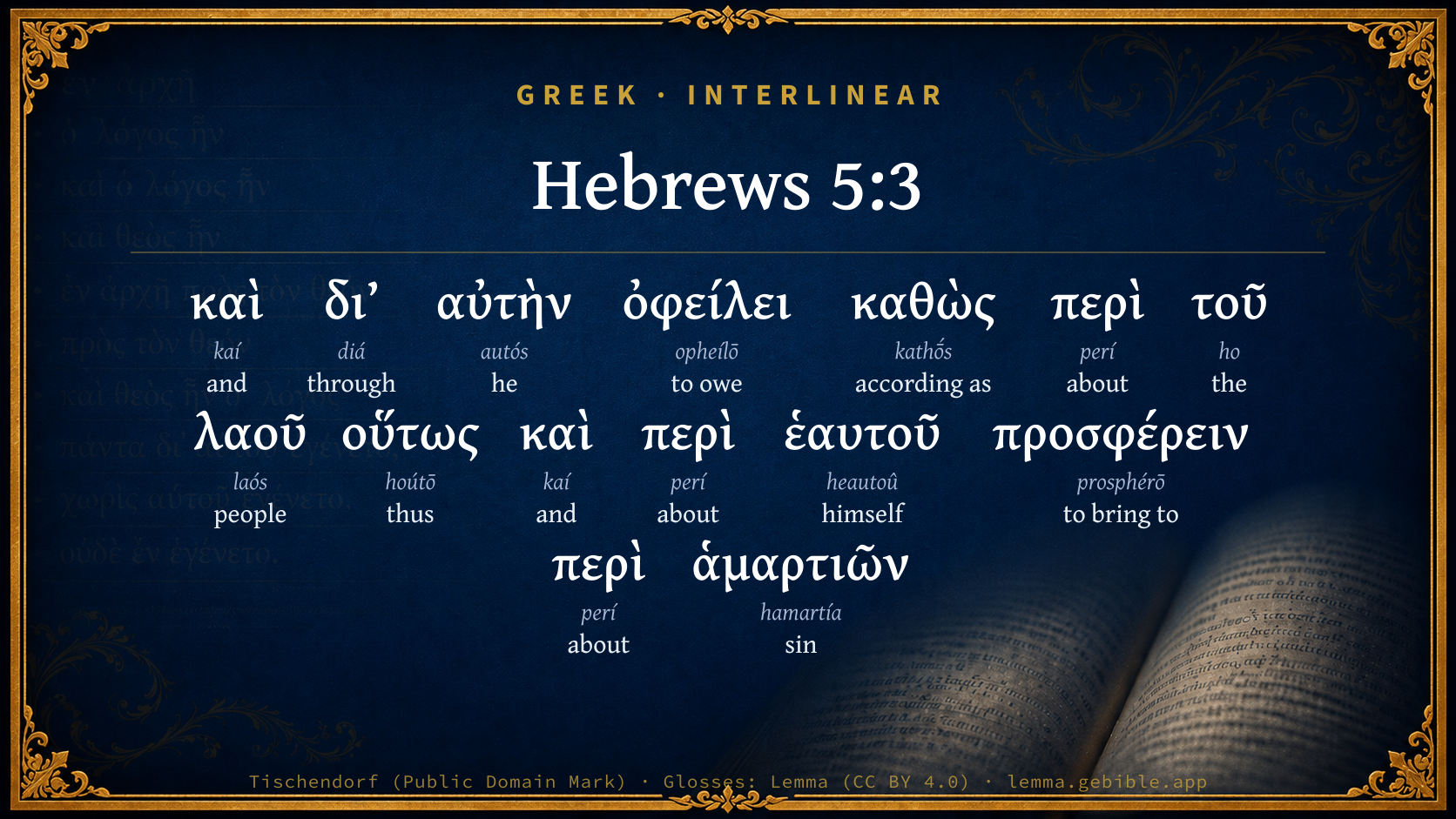
Greek (Tischendorf 8th ed.) Hebrews 5:3 appears in the Greek New Testament. The text above is from the Tischendorf 8th edition. Each word links to its Strong’s number and a concise gloss. Click any word for its full Thayer’s Greek Lexicon entry.
Download image
Cite this verse

Hebrews 5:3 (World English Bible). Public Domain. Lemma interlinear Bible study tool, https://lemma.gebible.app/v/hebrews/5/3.

Show BibTeX & RIS
BibTeX
RIS
English Translation
Because of this, he must offer sacrifices for sins for the people, as well as for himself.
World English Bible · Public Domain
Download a study sheet

One document with this verse’s original text, its word-by-word gloss line, the meaning frame, cross-references with their text, attributed commentary, and full source and license credits — printable, and it pastes into notes with its structure intact.

This verse Autodidact and up

Study sheet (.html) Plain text (.txt)

A passage Seminary Student

Up to 50 verses in one chapter. A passage sheet keeps up to 6 commentary sources and 12 cross-references per verse, in the order this page ranks them, and says so on the sheet whenever that leaves anything out. Ask for a single verse and you get the Autodidact verse sheet above.

Everything on this page stays free to read, with no account — the sheet is a download of what is already on screen, not access to it.

Want to remove ads? Support Godless Engineer
Compare translations 3

The same verse in 3 English versions, stacked beneath the original-language interlinear above. Click any original word for its lexicon entry.

Each is an independent rendering of the whole verse — the interlinear is not word-aligned to these translations.

Highlighted words mark where these versions differ — a whole-verse word diff, not a word-by-word alignment.

  • World English Bible Public Domain
    Because of this, he must offer sacrifices for sins for the people, as well as for himself.
  • King James Version Public Domain
    And by reason hereof he ought, as for the people, so also for himself, to offer for sins.
  • unfoldingWord Literal Text CC BY-SA 4.0
    And because of this, he is obligated, just as for the people, so also for himself, to offer for sins.

unfoldingWord Literal Text — © unfoldingWord, licensed CC BY-SA 4.0. Word-aligned USFM3 via Door43 (git.door43.org/unfoldingWord/en_ult).

Versions to compare (up to 4)

3 of 4 selected

Show all 19 translations

Every available English version of this verse, each an independent rendering of the whole verse.

  • World English Bible Public Domain
    Because of this, he must offer sacrifices for sins for the people, as well as for himself.
  • Berean Standard Bible Public Domain
    That is why he is obligated to offer sacrifices for his own sins, as well as for the sins of the people.
  • Majority Standard Bible Public Domain
    That is why he is obligated to offer sacrifices for his own sins, as well as for the sins of the people.
  • King James Version Public Domain
    And by reason hereof he ought, as for the people, so also for himself, to offer for sins.
  • American Standard Version (1901) Public Domain
    and by reason thereof is bound, as for the people, so also for himself, to offer for sins.
  • Revised Version (1885) Public Domain
    and by reason thereof is bound, as for the people, so also for himself, to offer for sins.
  • Geneva Bible (1599) Public Domain
    And for the sames sake he is bound to offer for sinnes, as well for his own part, as for ye peoples.
  • Douay-Rheims (1899) Public Domain
    And therefore he ought, as for the people, so also for himself, to offer for sins.
  • Young's Literal Translation Public Domain
    and because of this infirmity he ought, as for the people, so also for himself to offer for sins;
  • Literal Standard Version CC BY-SA 4.0
    and because of this [weakness] he ought, just as for the people, so also for himself, to bring forward [sacrifices] for sins;
  • Unlocked Literal Bible CC BY-SA 4.0
    Because of this, he also is required to offer sacrifices for his own sins, just as he does for the people's sins.
  • unfoldingWord Literal Text CC BY-SA 4.0
    And because of this, he is obligated, just as for the people, so also for himself, to offer for sins.
  • Darby Bible Public Domain
    and, on account of this [infirmity], he ought, even as for the people, so also for himself, to offer for sins.
  • World Messianic Bible Public Domain
    Because of this, he must offer sacrifices for sins for the people, as well as for himself.
  • Webster's Bible Public Domain
    And by reason of this he ought, as for the people, so also for himself, to offer for sins.
  • Free Bible Version CC BY-SA 4.0
    As a result he has to offer sacrifices for his sins as well as for those of the people.
  • Bible in Basic English Public Domain
    And being feeble, he has to make sin-offerings for himself as well as for the people.
  • Text-Critical English NT CC BY 4.0
    That is why he is obligated to offer sacrifices for his own sins, as well as for the sins of the people.
  • Tyndale New Testament (1534) Public Domain
    For the which infirmities sake he is bounde to offer for synnes as well for hys awne parte as for the peoples.

Literal Standard Version (2020), Covenant Press — licensed CC BY-SA 4.0. Text via the HelloAO Bible API (eBible.org). Unlocked Literal Bible (unfoldingWord) — licensed CC BY-SA 4.0. Text via the HelloAO Bible API (eBible.org). unfoldingWord Literal Text — © unfoldingWord, licensed CC BY-SA 4.0. Word-aligned USFM3 via Door43 (git.door43.org/unfoldingWord/en_ult). Free Bible Version, Dr. Jonathan Gallagher — licensed CC BY-SA 4.0. Text via the HelloAO Bible API (eBible.org).

Word by word

More ways to search: Search by grammar → Find every occurrence → Compare this word →

Practice this passage: Drill this verse → Learn its vocabulary →

ὀφείλει
opheílō
G3784
“to owe”
Verb, Present, Active, Indicative, 3rd person, Singular
Part of Speech
Verb
Tense
Present
Voice
Active
Mood
Indicative
Person
3rd person
Number
Singular
Full Thayer's Definition

Origin: "or (in certain tenses) its prolonged form opheileo of-i-leh'-o; probably from the base of G3786 (through the idea of accruing)"

TDNT: 14:19,7

1. to owe a. to owe money, be in debt for 1. that which is due, the debt 2. metaph. the goodwill due
  1. καὶ kaí G2532 “and” Conjunction
  2. δι’ diá G1223 “through” Preposition
  3. αὐτὴν autós G846 “he” Personal pronoun, Accusative, Singular, Feminine
  4. καθὼς kathṓs G2531 “according as” Adverb
  5. περὶ perí G4012 “about” Preposition
  6. τοῦ ho G3588 “the” Article, Genitive, Singular, Masculine
  7. λαοῦ laós G2992 “people” Noun, Genitive, Singular, Masculine
  8. οὕτως hoútō G3779 “thus” Adverb
  9. καὶ kaí G2532 “and” Conjunction
  10. περὶ perí G4012 “about” Preposition
  11. ἑαυτοῦ heautoû G1438 “himself” Reflexive pronoun, 3rd person, Genitive, Singular, Masculine
  12. προσφέρειν prosphérō G4374 “to bring to” Verb, Present, Active, Infinitive
  13. περὶ perí G4012 “about” Preposition
  14. ἁμαρτιῶν hamartía G266 “sin” Noun, Genitive, Plural, Feminine

About this verse

These counts appear in no published source. They are computed here, from the morphology-tagged text and Lemma’s own curated glosses. What Lemma adds →

15
words
12
distinct lemmas
General Epistles
section

Shared distinctive vocabulary

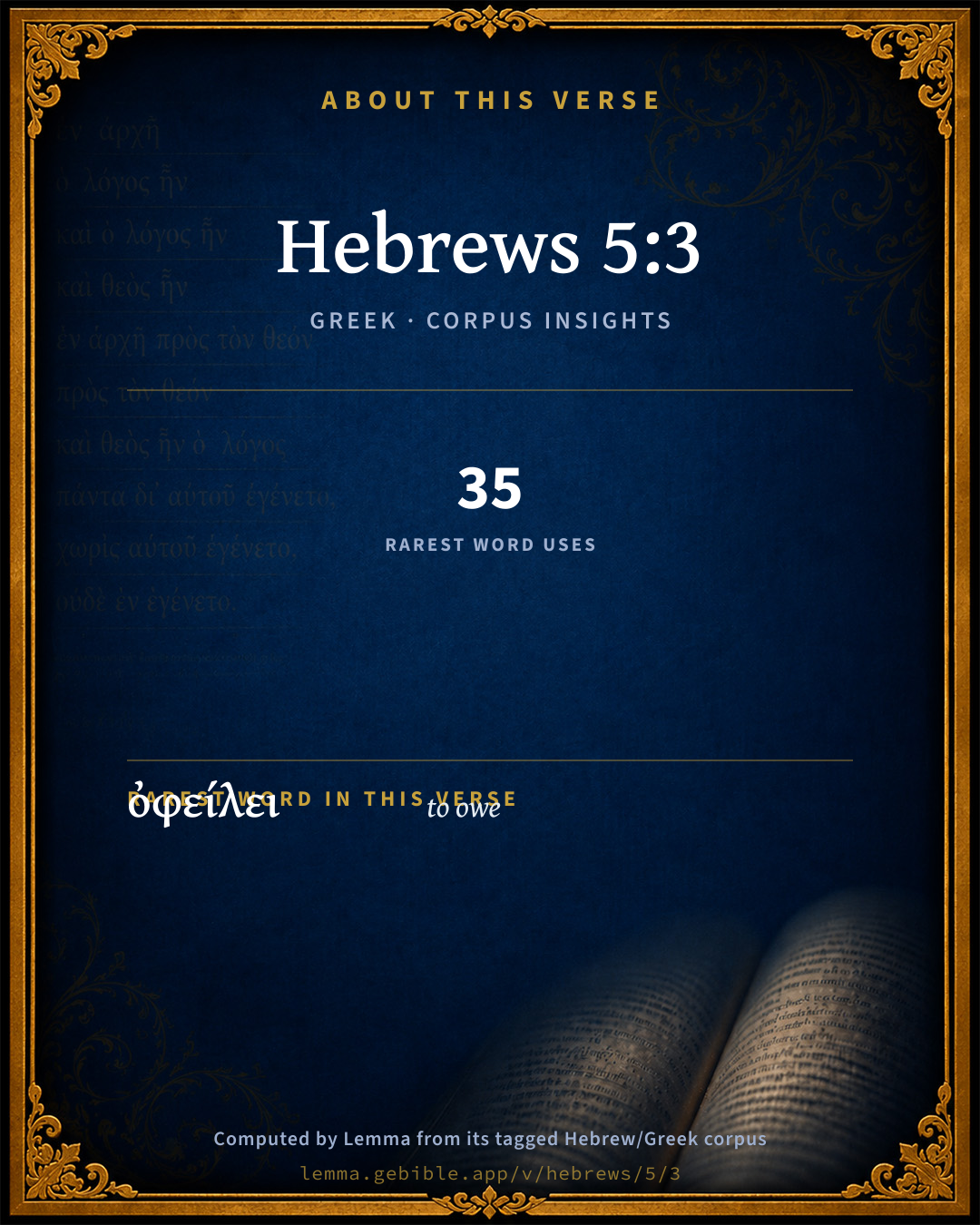
ὀφείλει to owe G3784 occurs in 34 verses of the Greek New Testament. Also found in:
Repetition

Words recur within this verse:

Cross-references

8

Topical passages linked to Hebrews 5:3 in the Treasury of Scripture Knowledge — connected by theme and wording, ordered by reader-vote popularity; previews shown in the World English Bible.

  • Leviticus 9:7 Moses said to Aaron, "Draw near to the altar, and offer your sin offering, and your burnt offering, and make atonement for yourself, and for the people; and offer the offering of the people, and make atonement for them; as Yahweh commanded."
  • Leviticus 16:6 "Aaron shall offer the bull of the sin offering, which is for himself, and make atonement for himself and for his house.
  • Hebrews 9:7 but into the second the high priest alone, once in the year, not without blood, which he offers for himself, and for the errors of the people.
  • Hebrews 7:27 who doesn't need, like those high priests, to daily offer up sacrifices, first for his own sins, and then for the sins of the people. For this he did once for all, when he offered up himself.
  • Leviticus 4:3–12 if the anointed priest sins so as to bring guilt on the people, then let him offer for his sin, which he has sinned, a young bull without blemish to Yahweh for a sin offering.
  • Leviticus 16:15 "Then he shall kill the goat of the sin offering, that is for the people, and bring his blood within the veil, and do with his blood as he did with the blood of the bull, and sprinkle it on the mercy seat, and before the mercy seat:
  • Exodus 29:12–19 You shall take of the blood of the bull, and put it on the horns of the altar with your finger; and you shall pour out all the blood at the base of the altar.
  • Leviticus 8:14–21 He brought the bull of the sin offering, and Aaron and his sons laid their hands on the head of the bull of the sin offering.

Cross-references courtesy of OpenBible.info (CC BY 4.0).

Commentary

Notes on Hebrews 5:3 from classic Christian and Jewish commentators (each source and its license shown beneath its notes). The classic Christian expositions comment on the surrounding passage and are grouped to its opening verse, so a note may address several verses; the Jewish commentaries on the Tanakh (Rashi and others) are per-verse, so they appear only where the commentator wrote on this verse.

Lemma curates 59 commentaries, every one of them public domain or Creative Commons licensed, each selected and text-cleaned for this edition rather than reprinted as found. About our sources →

Tyndale Open Study Notes

Tyndale Open Resources

5:3 On the Day of Atonement the high priest was required to offer sacrifices for himself and his household prior to offering sacrifices for the people (Lev 16:11).

Tyndale Open Study Notes — © Tyndale Open Resources, licensed CC BY-SA 4.0. Text via the HelloAO Bible API.

Bengel's Gnomon

Johann Albrecht Bengel

Heb 5:3. Διὰ ταύτην, on account of this) Supply infirmity: or ταύτην, this, is put for the neuter, as in Mat 21:42.

Bengel's Gnomon of the New Testament — English translation (T&T Clark, Edinburgh, 1860) — public domain. Text from a community e-Sword module.

Meyer's Critical & Exegetical Commentary

Heinrich August Wilhelm Meyer

Heb_5:3. Logical consequence from the second half of Heb_5:2 The words form a merely incidental observation. They would be on that account better regarded as an independent statement than, with de Wette, Delitzsch, Hofmann (Schriftbew, II. 1, 2 Aufl. p. 397), and Woerner, thought of as still dependent on ἐπεί, Heb_5:2.

διʼ αὐτήν] sc. ἀσθένειαν. Quite untrue is the assertion that the feminine is used Hebraistically instead of the neuter, which even Bengel and others, with a mistaken appeal to Mat_21:42 (see Meyer ad loc.), still hold to be possible.

ὀφείλει] Reference not, as is supposed by Böhme and Hofmann, l.c., to the precept in the law of Moses (Lev_4:3; Lev_9:7; Lev_16:6, al.), but, as Heb_2:17, to the inner necessity arising from the nature of the case. Non-natural the view of Delitzsch and Moll, that both alike are intended.

προσφέρειν] stands, as Luk_5:14, Num_7:18, absolutely. With Riehm (Lehrbegr. des Hebräerbr. p. 434), to look upon περὶ ἁμαρτιῶν as definition of object to προσφέρειν is inadmissible, inasmuch as only the singular form περὶ ἁμαρτίας is employed to indicate the notion of sin-offering with the LXX., as also in our epistle. Comp. Reiche, Commentarius Criticus ad loc. p. 35.

Meyer — Critical and Exegetical Commentary on the New Testament — English translation by Peter Christie, edited by Frederick Crombie (T&T Clark, 1880) — public domain. Text from a community e-Sword module.

Expositor's Greek Testament

ed. W. Robertson Nicoll

Heb 5:3 . καὶ διʼ αὐτὴν … ἀμαρτιῶν “and because of it is bound as for the people, so also for himself to offer for sins”. Vaughan recommends the deletion of the stop at the end of Heb 5:2 . The law which enjoined that the high priest should on the Day of Atonement sacrifice for himself and his house ( ἐξιλάσεται περὶ αὐτοῦ καὶ τοῦ οἴκου αὐτοῦ ) before he sacrificed περὶ τοῦ λαοῦ , is given in Lev 16:6 ; Lev 16:15 .

Heb 5:4 . καὶ οὐχ ἑαυτῷ τις λαμβάνει τὴν τιμήν “And no one taketh to himself this honourable office.” καί introduces a second qualification of the priest, implied in καθίσταται of Heb 5:1 , but now emphasised. An additional reason for trusting in the priest is that he has not assumed the office to gratify his own ambition but to serve God’s purpose of restoring men to His fellowship. All genuine priesthood is the carrying out of God’s will. The priest must above all else be obedient , in sympathy with God as well as in sympathy with man. God’s appointment also secures that the suitable qualifications will be found in the priest. The office is here called τιμή , best translated by the German “Ehrenamt” or “Ehrenstelle.” For τιμή meaning an office see Eurip., Helena , 15; Herodot., ii. 65, παῖς παρὰ πατρὸς ἐκδέκεται τὴν τιμήν ; and especially Aristotle, Pol. , iii. 10, τιμὰς γὰρ λέγομεν εἶναι τὰς ἀρχάς . Cf. Hor. i. 1, 8 “tergeminis honoribus”. Frequently in Josephus τιμή is used of the high priesthood, see Antiq. , xii. 2 5, Heb 4:1 , etc.; and the same writer should be consulted for the historical illustration of this verse ( Antiq. , iii. 8 1). In this remarkable passage he represents Moses as saying ἔγωγε … ἐμαυτὸν ἂν τῆς τιμῆς ἄξιον ἔκρινα … νῦν f1δʼ αὐτὸς ὁ Θεὸς Ἀαρῶνα τῆς τιμῆς ταύτης ἄξιον ἔκρινε . The nolo episcopari implied in the words is amply illustrated in the case of Augustine, of John Knox, and especially of Anselm who declared he would rather have been cast on a stack of blazing faggots than set on the archiepiscopal throne, and continued to head his letters “Brother Anselm monk of Bec by choice, Archbishop of Canterbury by violence”. On the other hand, see the account of the appointment by his own act ( αὐτόχειρ ) of the priest king in Aricia, in Strabo Heb 5:3-12 and elsewhere. ἀλλὰ καλούμενος … καθώσπερ καὶ Ἀαρών . “but when called by God as in point of fact even Aaron was”. If the article is retained before καλ . we must translate “but he that is called,” καλούμενος “in diesem amtlichen Sinne nur hier,” says Weiss, but see Mat 4:21 , Gal 1:15 . For Aaron’s call, see Exo 28:1 ff. Schöttgen and Wetstein appositely quote from the Bammidbar Rabbi “Moses said to Korah and his associates: If my brother Aaron took to himself the priesthood, then ye did well to rebel against him; but in truth God gave it to him, whose is the greatness and the power and the glory. Whosoever, then, rises against Aaron, does he not rise against God?” It is notorious that the contemporary priesthood did not fulfil the description here given.

The Expositor's Greek Testament, edited by W. Robertson Nicoll (1897–1910) — public domain. Text from a community e-Sword module.

Jamieson, Fausset & Brown

Robert Jamieson, A. R. Fausset & David Brown

by reason hereof--"on account of this" infirmity.

he ought . . . also for himself, to offer for sins--the Levitical priest ought; in this our High Priest is superior to the Levitical. The second "for" is a different Greek term from the first; "in behalf of the people . . . on account of sins."

Jamieson, Fausset & Brown — Commentary Critical and Explanatory on the Whole Bible (1871) — public domain (CC PDM 1.0). Text via the HelloAO Bible API.

Adam Clarke's Commentary

Verse 3. And by reason hereof] As he is also a transgressor of the commands of God, and unable to observe the law in its spirituality, he must offer sacrifices for sin, not only for the people, but for himself also: this must teach him to have a fellow feeling for others.

Adam Clarke's Commentary on the Bible (1810–1826) — public domain. Text from a community e-Sword/MySword module.

Ellicott's Commentary for English Readers

(3) To be closely joined with Heb_5:2 : “Is compassed with infirmity, and by reason thereof is bound . . .” The law of the Day of Atonement required a sin-offering of a bullock and a burnt-offering of a ram for the high priest himself, and for the congregation a sin-offering of two he-goats and a burnt-offering of a ram. Over his own sin-offering the high priest made confession of sins, first for himself and his household, then for the priests; over the goat sent into the wilderness the sins of the people were confessed.

A Bible Commentary for English Readers, edited by Charles John Ellicott (1878–1897) — public domain. Text from a community e-Sword module.

The Cambridge Bible for Schools and Colleges

gen. ed. J. J. S. Perowne

3. And by reason hereof] i.e. because of this moral weakness.

he ought] He is bound not merely as a legal duty, but as a moral necessity.

so also for himself] The Law assumed that this would be necessary for every High Priest (Lev_4:3-12). In the High Priest’s prayer of intercession he said, “Oh do thou expiate the misdeeds, the crimes, and the sins, wherewith I have done evil, and have sinned before Thee I and my house!” Until he had thus made atonement for himself, he was regarded as guilty, and so could not offer any atonement for others who were guilty (Lev_4:3; Lev_9:7; Lev_16:6, and comp. Heb_7:27).

to offer for sins] The word “offer” may be used absolutely for “to offer sacrifices” (Luk_5:14); but the words “for sins” are often an equivalent for “sin-offerings” (see Heb_10:6; Lev_6:23; Num_8:8, &c).

The Cambridge Bible for Schools and Colleges (gen. ed. J. J. S. Perowne; Cambridge University Press, 1878–1918) — public domain. Text from a community e-Sword module.

John Gill's Exposition

And by reason hereof,.... Because of his sinful infirmity:

he ought, as for the people, so also for himself to offer for sins; as he offered sacrifice for the sins of the people, so he was obliged to offer for his own sins; in this Christ differed from the high priest, for he had no sin of his own to offer for, Heb 7:27 but he had, and therefore offered for them, Lev 16:11 and made a confession of them: the form of which, as used on the day of atonement, was this;

"he put both his hands upon the bullock, and confessed, and thus he said: I beseech thee, O Lord, I have done wickedly, I have transgressed, I have sinned before thee, I and my house; I beseech thee, O Lord, pardon the iniquities, transgressions, and sins, which I have done wickedly, transgressed, and sinned before thee, I and my house.''

And this he did a second time on that day (z).

(z) Misna Yoma, c. 3. sect. 8. & c. 4. sect. 2.

John Gill's Exposition of the Whole Bible (1746–1763) — public domain (CC PDM 1.0). Text via the HelloAO Bible API.

Trapp's Complete Commentary

John Trapp

3 And by reason hereof he ought, as for the people, so also for himself, to offer for sins.

Ver. 3. He ought as for the people] A priest is a person by God’s apppointment taken from among men, and for men to offer gifts and sacrifices for sin in their and his own behalf.

John Trapp, A Commentary or Exposition upon All the Books of the Old and New Testament (1647–1656) — public domain. Text from a community e-Sword module.

Albert Barnes' Notes on the Bible

And by reason hereof - Because he is a sinner; an imperfect man. “As for the people, so also for himself, to offer for sins.” To make an expiation for sins. He needs the same atonement; he offers the sacrifice for himself which he does for others; Lev 9:7. The same thing is true of the ministers of religion now. They come before God feeling that they have need of the benefit of the same atonement which they preach to others; they plead the merits of the same blood for their own salvation which they show to be indispensable for the salvation of others.

Albert Barnes' Notes on the Bible (1834–1885) — public domain. Text from a community e-Sword/MySword module.

Matthew Poole's English Annotations

This connection demonstrates the infirmity of the legal high priest: for this their infirmity, sins of ignorance and error.

And by reason hereof he ought, as for the people; he was obliged to his work by the express law of God, Lev 1:1-17. It is a rule for what the priests ought to do, and so is the whole book, to which they are to be punctually obedient, even to sacrifice for particular sinners in the church, as they were guilty and brought their sacrifice, Lev 4:1-35, and for the whole church of Israel on the atonement day, Lev 16:15-34.

So also for himself, to offer for sins; he had also his proper sacrifice for his own sins commonly, Lev 4:3, extraordinarily on the day of atonement annually, Lev 16:6-14. It is not necessary to a priest to be a sinner, but it is to be merciful. Adam offered prayers and praises to his Creator for himself and Eve in innocency; but since the fall our Lord Jesus Christ is the only High Priest without sin, and yet most merciful, as well as most sensible of the sins and miseries of penitent believing sinners. He offers up the sacrifice to God truly propitiatory, as his types did the typical ones, and procured the pardon which God promised to give upon his so sacrificing to him.

Matthew Poole's English Annotations on the Holy Bible (1683–1685) — public domain. Text from a community e-Sword/MySword module.

Whedon's Commentary on the Bible

Daniel D. Whedon

3. By reason hereof—That, is, of this infirmity.

He ought… for himself to offer—Although these susceptibilities are not in themselves sins, yet so sure is the presumption that even the high priest has in course of the year incurred guilt that he needs to offer, also, for himself. Herein the true High Priest surpasses the Aaronic line, in that he is without sin, (Heb_4:15,) and needs not atonement.

Daniel D. Whedon (gen. ed.), Commentary on the Old and New Testaments (1874–1909) — public domain. Text from a community e-Sword module.

The Pulpit Commentary

And by reason hereof he ought (or, is bound, ofeilei), as for the people, so also for himself, to offer for sins. This obligation is evident in the ease of the high priests of the Law. Consequently, their sin offering for themselves, in the first place, was a prominent part of the ceremonial of the Day of Atonement, which the writer may be supposed to have especially in view. (Le 16) But can we suppose any corresponding necessity in the case of Christ? The argument does not absolutely require that we should, since the obligation of the Levitical high priest may be adduced only in proof of his own experience of asyeneia . Christ, though under no such obligation, might still fulfill the requisites of a high priest, expressed in the case of sinful high priests by the obligation to offer for themselves; and we may (as Ebrard says) leave it to the writer to show hew he does fulfill them. Whether, however, there was in Christ"s own experience anything corresponding to the high priest"s offering for himself will be considered under vers. 7, 8.

The Pulpit Commentary (1880–1919), ed. H.D.M. Spence-Jones & Joseph S. Exell — public domain. Text from a community e-Sword module.

Scofield Reference Notes

C. I. Scofield

sins

Sin. (See Scofield "Rom 3:23").

The Scofield Reference Bible (1917 edition), notes by C. I. Scofield — public domain. Text from a community e-Sword module.

Burkitt's Expository Notes on the New Testament

William Burkitt

That is, by reason of which infirmities he ought, both by God’s command, and also from the reason and nature of the thing, as for the people, so also for himself, to offer sacrifices for sins.

Note here, That this is a description of the high priest under the law, not of our Lord Jesus Christ our Great High Priest under the gospel, because Christ had actually no sin of his own to offer for, being holy, harmless, and undefiled, separate from sinners. This expression therefore of offering for his own sins, belongs to the weakness and imperfection of the legal high priest.

Learn hence, That it was a part of the darkness and bondage of the church under the Old Testament, that their high priests had need to offer sacrifices for themselves, and their own sins. This they did in the vies of the people. They first took care to offer for their own sins, and then for the sins of others; whosoever dealeth with God about the sins of others, ought to look well, in the first place, unto his own: it is a great evidence of hypocrisy for men to be severe towards the sins of others, and careless about their own sins.

Learn, 2. That such was the absolute holiness and spotless innocency of the Lord Jesus Christ our Great High Priest, that what he offered was not for himself, but for his people. Atonement for sinners was made by him who had no sin of his own to atone for.

William Burkitt's Expository Notes on the New Testament (1700–1703) — public domain. Text from a community e-Sword module.

The People's New Testament

B. W. Johnson

3. And by reason hereof. Of his own infirmity, in that he was of men. Ought, as for the people, so also for himself. As one of a sinful race he needed to approach God in his own behalf, as well as in behalf of men. He offered “atonement for his own sins and for the sins of the people.” This was shown forth in the very garments he wore when he offered the national atonement once a year. On the shoulder of the ephod (Exod. 28:10) were two onyx stones, on which were engraved the names of the twelve sons of Jacob, the representatives of all the tribes of Israel, of Levi the priestly tribe as well as the others. As he stood before the mercy-seat interceding, he bore all these names before the Lord.

B. W. Johnson's The People's New Testament with Notes (1889–1891) — public domain. Electronic text from the Christian Classics Ethereal Library (CCEL) ThML edition.

Cambridge Greek Testament for Schools and Colleges

3. περὶ ἁμαρτιῶν אABCD. The ὑπὲρ of the rec. (EKL) is probably due to its occurrence in Heb 5:1.

3. διʼ αὐτήν, i.e. because of this moral weakness.

ὀφείλει. He is bound not merely as a legal duty, but as a moral necessity.

καὶ περὶ ἑαυτοῦ. The Law assumed that this would be necessary for every High Priest (Lev 4:3-12); for “under the gorgeous robes of office there were still the galling chains of flesh.” Kay. In the High Priest’s prayer of intercession he said, “Oh do thou expiate the misdeeds, the crimes, and the sins, wherewith I have done evil, and have sinned before Thee, I and my house!” Until he had thus made atonement for himself, he was regarded as guilty, and so could not offer any atonement for others who were guilty (Lev 4:3; Lev 9:7; Lev 16:6, and comp. Heb 7:27).

προσφέρειν περὶ ἁμαρτιῶν. The word “offer” may be used absolutely for “to offer sacrifices” (Luk 5:14); but the words “for sins” are often an equivalent for “sin-offerings” (see Heb 10:6; Lev 6:23; Num 8:8, &c.).

Cambridge Greek Testament for Schools and Colleges (Cambridge University Press, 1896; 21 vols, various authors incl. Carr, Maclear, Plummer, Farrar, Lumby, Moule, M. R. James, Simcox) — public domain. Text from a community e-Sword module.

Alford’s Greek Testament

Henry Alford

3.] And on account of it (the infirmity wherewith he himself is encompassed; not fem. for neut., as Bengel, altern.: nor is αὕτη, Mat 21:42, which he alleges, the slightest justification for such a notion) he must (not meaning, it is his appointed duty according to the law: but, it is necessary for him, a priori, on higher ground than, and before, the ordinance of the law. See on ch. 2:17) even as for the people, so also for himself, offer (here only used absolutely in N. T., see Num 7:18) for (see on ch. 10:6) sins (and accordingly, such was the ordinance of the law: cf. Lev 4:3; Lev 9:7; Lev 16:6 al.

Much has been said as to the applicability or otherwise of these considerations to Christ. Some have considered all that has hitherto been said as spoken of human high priests in contradistinction to Him: but it is better to understand it all as spoken of high priests in general: and then, as Ebrard well says, leave it to the Writer himself, ver. 5 ff., to determine how far these requisites are satisfied in Christ. The progress of the argument itself will shew us, ver. 8 f., and further on, ch. 7:27, in how far Christ is unlike the O. T. high priest).

Henry Alford, The Greek Testament (1849–1861) — public domain. Text from a community e-Sword module.

Vincent's Word Studies in the New Testament

Marvin R. Vincent

He ought [οφειλει] . It is his duty, growing out of the fact of his own infirmity.

Marvin R. Vincent, Word Studies in the New Testament (1887–1900) — public domain. Text from a community e-Sword/MySword module.

Westcott on Hebrews & the Epistles of John

Brooke Foss Westcott

3. καὶ δὶ αὐτήν] and by reason thereof, i.e. of the weakness. This clause may be an independent statement, or depend upon ἐπεί, On the whole the form (καὶ δι᾽ αὐτήν instead of δι᾽ ἦν) is in favour of the former view; which is further supported by the fact that weakness does not absolutely involve sin, so that the weak-

“καὶ οὐχ ἑαντῷ Tis λαμβάνει τὴν τιμήν, ἀλλὰ

ness and the sin even in the case of man, as he is, are two separate elements, ‘

In the case of the human Highpriest weakness actually issued in sin. In this respoct the parallel with Christ fails. But it has been seon (iv. 15) that a sense of the power of the temptation and not the being overpowered by it is the true ground of sympathy. Comp. vii. 27.

ὀφείλει) he is bound in the very nature of things, in virtue of his constitution and of his office. He must obtain purity for himself before he can intercede for othera. Conip. 6. ii, 17 note.

περὶ ἑαυτοῦ] Tho ceremonies of the Day of Atonement are still foremost in the writers thoughts (Lev. xvi). Philo (Quis rer. div. har. § 36, i. 497 M.) regards the daily mealoffering as the offering for the pricst (Lev. vi. 20), as the lamb was the offering for the people.

προσφ. περὶ ἁμαρτιῶν] The constant use of the singular in the sense of ἁμαρτίας and Lxx.) seems to show that here περὶ ἀμ. is to be takon generally ‘for sins,” while προσφ. is absolute as in Luke v. 14, though not elsewhere in this Epistle. Boo also Num. vii. 18.

4. A scoond qualification for the High-priesthood lies in the divine call. He must bo man, and ho must be called by God. The fact of human sinfulness naturally leads to this complomentary thought. Of himself a man could not presume to take upon him such an office. Ho could not draw near to God being himself sinful: still leas could he draw near to God to intercede for others. At the

therefore rises against does he not rise against God? (Wansche, Ῥ. 441).

(2) Having characterised the office and qualifications of a High-pricet generally, the writer now goes on to shew that Christ satisfied tho quallfications (5—8), and fulfils tho office (9, 10).

The proof is given in an invertod form. The divine appointment of Christ is established first (5, 6); and then His power of sympathy (7, 8); and lastly His office is described (9, 10).

This inversion, in an elaborate parallelism, is perfectly natural, and removos the appearance of formality.

550 Christ aleo glorified not Himself to become High-priest, but He that spake unto Him,

Thou art My Son,

I have today begotten Thee :—

6‘ Keen as He saith also in another place

Thou art a priest for ever,

Afier the order of Melchiszedek:—

? Who, in His days of flesh (or in the days of Hie flesh) having offered up, with strong crying and tears, prayers and eupplicatione unto Him that was able to save Him ont of death, and having been heard for Hie godly fear, *though He was Son yet learned obedience by the things which He suffered; %and having been made perfect He became to all that obey Him the cause of eternal salvation, *being addressed by God as High-priest after the order of Melchizedek.

s—8. The qualifications of Christ for the High-priesthood are established by His divine appointment (5, 6), and by His human discipline which became the ground of perfect sympathy (7, 8).

first passage which has been already quoted (i. 5) refers the glory of the Risen Christ, the exalted Son of man, to the Father. This glory is not exactly defined, but the position of sonship includes every special honour, kingly or priestly. He to whom this had been given could not be said to ‘glorify himself.’ The second quotation (Ps. cx. 4) defines the particular application of the first. The kingly priesthood of Melchizodek was promised to Ohrist. Such a priesthood naturally belongs to the exalted Son.

Brooke Foss Westcott (1825–1901), The Epistle to the Hebrews (1889) and The Epistles of St John (1883) — public domain (pre-1929). Text recovered from Internet Archive / Google Books OCR scans. Westcott’s Gospel of John commentary is not included (its OCR lost the chapter running-heads required for reliable verse-keying). Some Greek quoted in the Hebrews volume is imperfectly rendered by the OCR.

Lesson kit

Teaching starters — assembled from the data on this page, not authored interpretation. Every prompt links to the verse data it draws on. Edit before teaching.

Hebrews, in the General Epistles, opens this verse with 15 words (12 distinct Greek lemmas). Its most distinctive word is opheílō (“to owe”). A historical commentator’s framing appears above. Read the whole chapter for the surrounding context.

Discussion questions

  1. How does “to owe” (opheílō) shape what this verse is saying?
  2. Matthew 18:28 shares the word «to owe» with this verse. How do the two illuminate each other?
  3. “about” occurs 3× in this one verse. What is the effect of the repetition?
  4. The translations on this page render this verse differently — a whole-verse word diff, not a word-by-word alignment. What might account for the different wordings?
  5. Reading how Tyndale Open Study Notes and Bengel's Gnomon read this verse, where do the two commentators agree and where do they part?

Things to notice

Reading settings

Reading text

Shown beneath each verse's original-language words.

Old Testament
Old Testament edition

Read the OT as the Masoretic Hebrew (MT) or the Greek Septuagint (LXX).

English shown for the Greek Septuagint (in the Hebrew ↔ Greek comparison).

Comparing translations? Open the Compare panel on any verse page to stack up to four side by side.