

Mark 9:3
Greek (Tischendorf 8th ed.) Mark 9:3 appears in the Greek New Testament. The text above is from the Tischendorf 8th edition. Each word links to its Strong’s number and a concise gloss. Click any word for its full Thayer’s Greek Lexicon entry.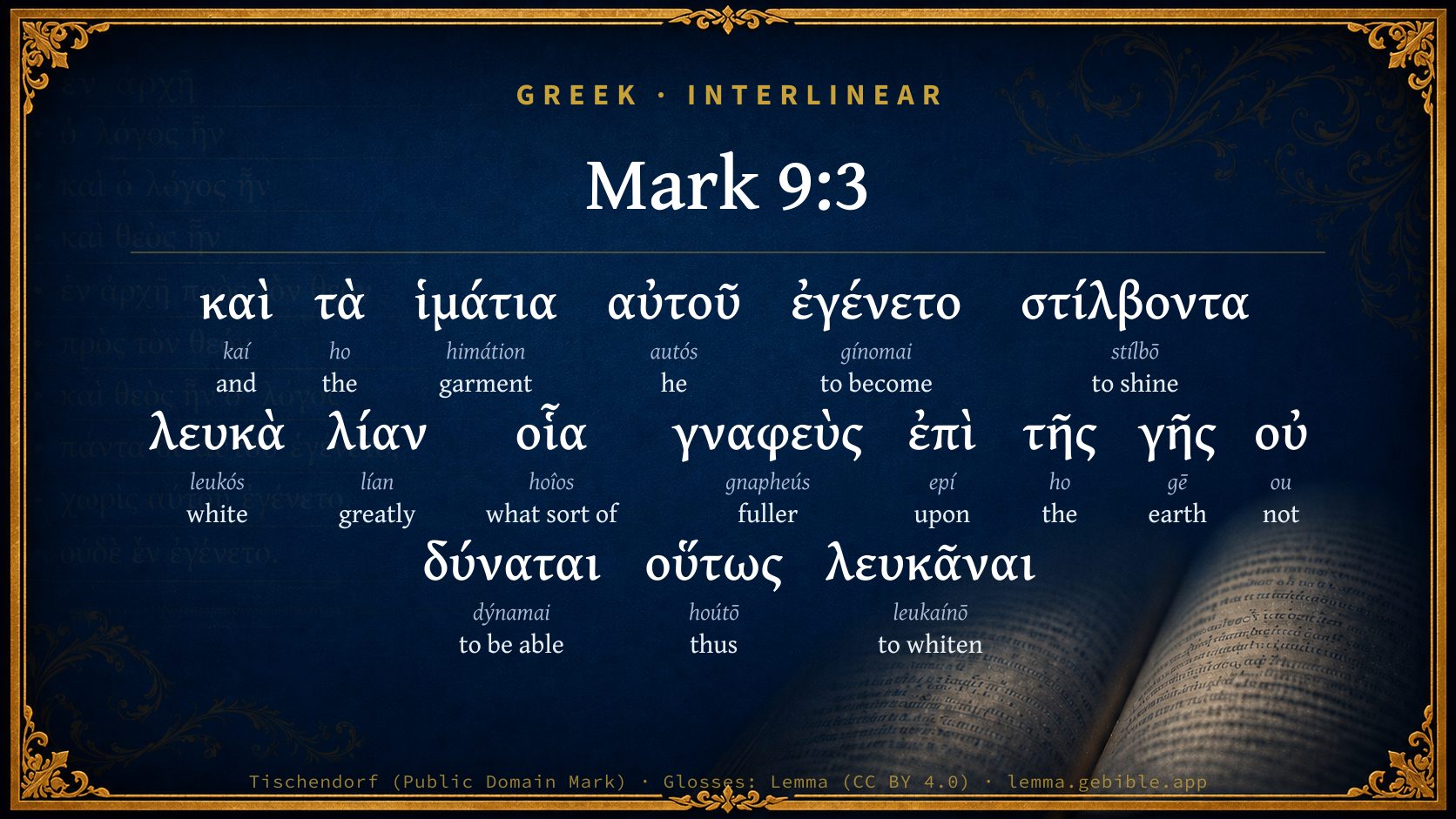
His clothing became glistening, exceedingly white, like snow, such as no launderer on earth can whiten them.
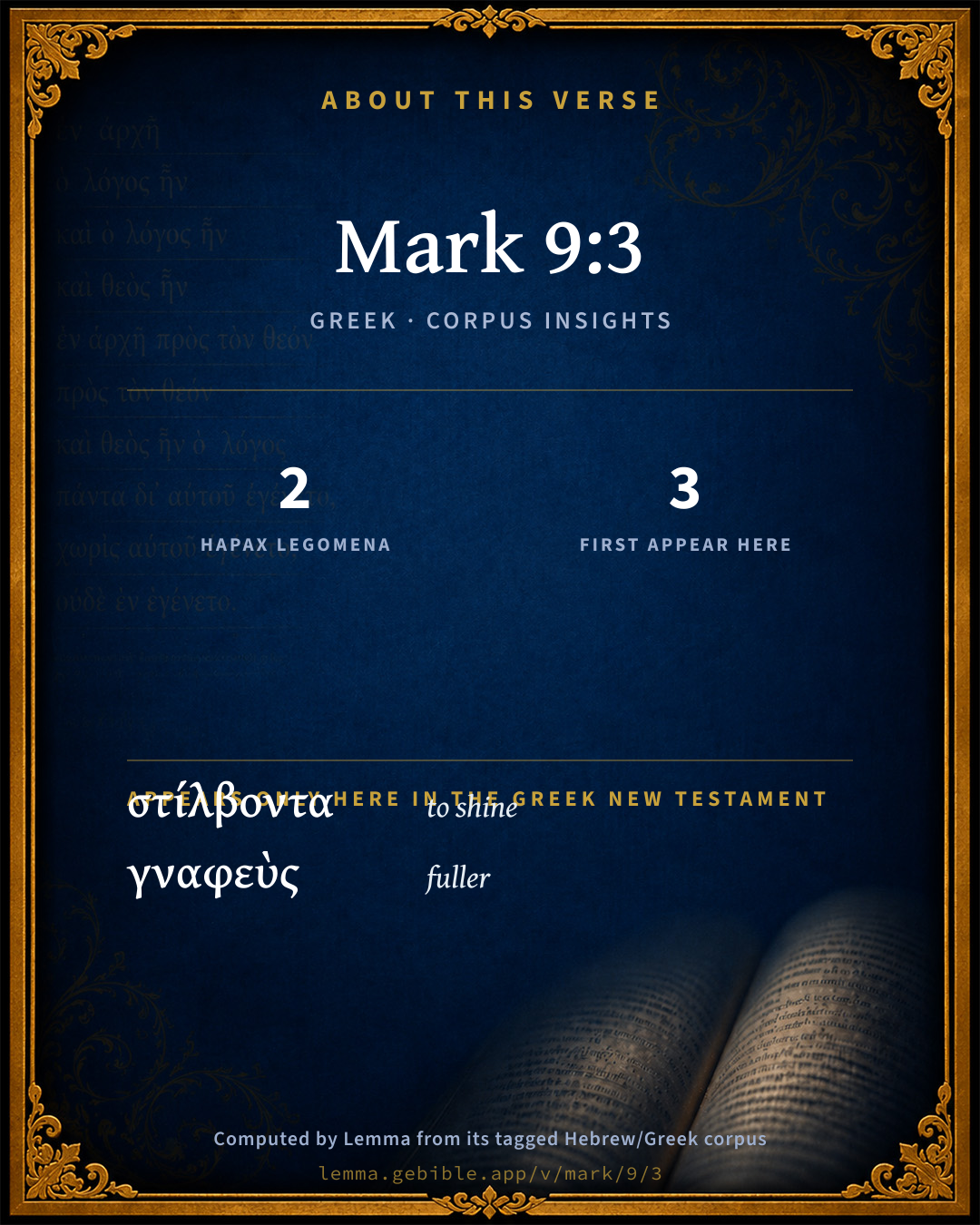
- 2 hapax legomena — only here in the Greek New Testament
- 3 first appearances in the Greek New Testament
Download a study sheet
One document with this verse’s original text, its word-by-word gloss line, the meaning frame, cross-references with their text, attributed commentary, and full source and license credits — printable, and it pastes into notes with its structure intact.
This verse Autodidact and up
A passage Seminary Student
Up to 50 verses in one chapter. A passage sheet keeps up to 6 commentary sources and 12 cross-references per verse, in the order this page ranks them, and says so on the sheet whenever that leaves anything out. Ask for a single verse and you get the Autodidact verse sheet above.
Everything on this page stays free to read, with no account — the sheet is a download of what is already on screen, not access to it.
Compare translations 3
The same verse in 3 English versions, stacked beneath the original-language interlinear above. Click any original word for its lexicon entry.
Each is an independent rendering of the whole verse — the interlinear is not word-aligned to these translations.
Highlighted words mark where these versions differ — a whole-verse word diff, not a word-by-word alignment.
-
World English Bible Public Domain
His clothing became glistening, exceedingly white, like snow, such as no launderer on earth can whiten them.
-
King James Version Public Domain
And his raiment became shining, exceeding white as snow; so as no fuller on earth can white them.
-
unfoldingWord Literal Text CC BY-SA 4.0
And his garments became radiantly, extremely white, such as no launderer on the earth is able thus to make them white.
unfoldingWord Literal Text — © unfoldingWord, licensed CC BY-SA 4.0. Word-aligned USFM3 via Door43 (git.door43.org/unfoldingWord/en_ult).
Show all 19 translations
Every available English version of this verse, each an independent rendering of the whole verse.
-
World English Bible Public Domain
His clothing became glistening, exceedingly white, like snow, such as no launderer on earth can whiten them.
-
Berean Standard Bible Public Domain
His clothes became radiantly white, brighter than any launderer on earth could bleach them.
-
Majority Standard Bible Public Domain
His clothes became radiantly white as snow, brighter than any launderer on earth could bleach them.
-
King James Version Public Domain
And his raiment became shining, exceeding white as snow; so as no fuller on earth can white them.
-
American Standard Version (1901) Public Domain
and his garments became glistering, exceeding white, so as no fuller on earth can whiten them.
-
Revised Version (1885) Public Domain
and his garments became glistering, exceeding white; so as no fuller on earth can whiten them.
-
Geneva Bible (1599) Public Domain
And his rayment did shine, and was very white, as snowe, so white as no fuller can make vpon the earth.
-
Douay-Rheims (1899) Public Domain
And there appeared to them Elias with Moses; and they were talking with Jesus.
-
Young's Literal Translation Public Domain
and his garments became glittering, white exceedingly, as snow, so as a fuller upon the earth is not able to whiten `them'.
-
Literal Standard Version CC BY-SA 4.0
and His garments became glittering, exceedingly white, as snow, so as a launderer on the earth is not able to whiten [them].
-
Unlocked Literal Bible CC BY-SA 4.0
His garments became radiantly brilliant, extremely white, whiter than any bleacher on earth could bleach them.
-
unfoldingWord Literal Text CC BY-SA 4.0
And his garments became radiantly, extremely white, such as no launderer on the earth is able thus to make them white.
-
Darby Bible Public Domain
and his garments became shining, exceeding white [as snow], such as fuller on earth could not whiten [them].
-
World Messianic Bible Public Domain
His clothing became glistening, exceedingly white, like snow, such as no launderer on earth can whiten them.
-
Webster's Bible Public Domain
And his raiment became shining, exceeding white as snow; so as no fuller on earth can whiten them.
-
Free Bible Version CC BY-SA 4.0
His clothes shone a brilliant white, whiter than anyone on earth could bleach them.
-
Bible in Basic English Public Domain
And his clothing became shining, very white, as no cleaner on earth would make it.
-
Text-Critical English NT CC BY 4.0
His garments became radiant and extremely white, like snow, such as no launderer on earth could whiten them.
-
Tyndale New Testament (1534) Public Domain
And his rayment dyd shyne and was made very whyte even as snowe: so whyte as noo fuller can make apon the erth.
Literal Standard Version (2020), Covenant Press — licensed CC BY-SA 4.0. Text via the HelloAO Bible API (eBible.org). Unlocked Literal Bible (unfoldingWord) — licensed CC BY-SA 4.0. Text via the HelloAO Bible API (eBible.org). unfoldingWord Literal Text — © unfoldingWord, licensed CC BY-SA 4.0. Word-aligned USFM3 via Door43 (git.door43.org/unfoldingWord/en_ult). Free Bible Version, Dr. Jonathan Gallagher — licensed CC BY-SA 4.0. Text via the HelloAO Bible API (eBible.org).
Word by word
More ways to search: Search by grammar → Find every occurrence → Compare this word →
Practice this passage: Drill this verse → Learn its vocabulary →
- Appears 1× in the Greek New Testament
- First appears here
- Part of Speech
- Verb
- Tense
- Present
- Voice
- Active
- Mood
- Participle
- Case
- Nominative
- Number
- Plural
- Gender
- Neuter
Full Thayer's Definition
- καὶ kaí G2532 “and” Conjunction
- τὰ ho G3588 “the” Article, Nominative, Plural, Neuter
- ἱμάτια himátion G2440 “garment” Noun, Nominative, Plural, Neuter
- αὐτοῦ autós G846 “he” Personal pronoun, Genitive, Singular, Masculine
- ἐγένετο gínomai G1096 “to become” Verb, Aorist, Middle deponent, Indicative, 3rd person, Singular
- στίλβοντα stílbō G4744 “to shine” Verb, Present, Active, Participle, Nominative, Plural, Neuter
- λευκὰ leukós G3022 “white” Adjective, Nominative, Plural, Neuter
- λίαν lían G3029 “greatly” Adverb
- οἷα hoîos G3634 “what sort of” Relative pronoun, Nominative, Plural, Neuter
- γναφεὺς gnapheús G1102 “fuller” Noun, Nominative, Singular, Masculine
- ἐπὶ epí G1909 “upon” Preposition
- τῆς ho G3588 “the” Article, Genitive, Singular, Feminine
- γῆς gē G1093 “earth” Noun, Genitive, Singular, Feminine
- οὐ ou G3756 “not” Particle, Negative
- δύναται dýnamai G1410 “to be able” Verb, Present, Middle or Passive deponent, Indicative, 3rd person, Singular
- οὕτως hoútō G3779 “thus” Adverb
- λευκᾶναι leukaínō G3021 “to whiten” Verb, Aorist, Active, Infinitive
About this verse
These counts appear in no published source. They are computed here, from the morphology-tagged text and Lemma’s own curated glosses. What Lemma adds →
- 17
- words
- 16
- distinct lemmas
- Gospels
- section
Notable vocabulary
2 hapax legomena — words that appear only here in the entire Greek New Testament:
First appearance in Scripture
These words make their first canonical appearance in the Greek New Testament here:
Shared distinctive vocabulary
λευκᾶναι to whiten G3021 occurs in 2 verses of the Greek New Testament. Also found in:
Repetition
A word recurs within this verse:
- τὰ the G3588 ×2
Cross-references
11Topical passages linked to Mark 9:3 in the Treasury of Scripture Knowledge — connected by theme and wording, ordered by reader-vote popularity; previews shown in the World English Bible.
- Matthew 28:3 His appearance was like lightning, and his clothing white as snow.
- Daniel 7:9 I saw until thrones were placed, and one who was ancient of days sat: his clothing was white as snow, and the hair of his head like pure wool; his throne was fiery flames, [and] the wheels of it burning fire.
- Psalms 51:7 Purify me with hyssop, and I will be clean. Wash me, and I will be whiter than snow.
- Psalms 68:14 When the Almighty scattered kings in her, It snowed on Zalmon.
- Psalms 104:1–2 Bless Yahweh, my soul. Yahweh, my God, you are very great. You are clothed with honor and majesty.
- Isaiah 1:18 "Come now, and let us reason together," says Yahweh: "Though your sins be as scarlet, they shall be as white as snow. Though they be red like crimson, they shall be as wool.
- Malachi 3:2–3 "But who can endure the day of his coming? And who will stand when he appears? For he is like a refiner's fire, and like launderer's soap;
- Revelation 7:9 After these things I looked, and behold, a great multitude, which no man could number, out of every nation and of all tribes, peoples, and languages, standing before the throne and before the Lamb, dressed in white robes, with palm branches in their hands.
- Revelation 7:14 I told him, "My lord, you know." He said to me, "These are those who came out of the great tribulation. They washed their robes, and made them white in the Lamb's blood.
- Acts 10:30 Cornelius said, "Four days ago, I was fasting until this hour, and at the ninth hour, I prayed in my house, and behold, a man stood before me in bright clothing,
- Revelation 19:18 that you may eat the flesh of kings, the flesh of captains, the flesh of mighty men, and the flesh of horses and of those who sit on them, and the flesh of all men, both free and slave, and small and great."
Cross-references courtesy of OpenBible.info (CC BY 4.0).
Where the printed editions differ
1 variantPlaces in this verse where the major printed Greek editions disagree on the wording in a way that affects the translation — a comparison of editions, not a manuscript-by-manuscript collation. The editions are the modern critical texts (Nestlé-Aland 28/27, SBL, Westcott-Hort, Tregelles, Tyndale House) and the traditional texts behind the KJV (the Textus Receptus and the Byzantine/Majority text). It is not a claim about which reading is original.
-
Extra text
ὡς χιών,
“as snow”
In TRByz Not in NA28NA27TynSBLWHTregὡς χιών, (hōs chiōn) 'as snow' is only in traditional manuscripts (TR+Byz)
Textual data: Translators Amalgamated Greek New Testament (STEPBible TAGNT) · CC BY 4.0.
Lesson kit
Teaching starters — assembled from the data on this page, not authored interpretation. Every prompt links to the verse data it draws on. Edit before teaching.
Mark, in the Gospels, opens this verse with 17 words (16 distinct Greek lemmas). Its most distinctive word is stílbō (“to shine”). A historical commentator’s framing appears above. Read the whole chapter for the surrounding context.
Discussion questions
- How does “to shine” (stílbō) shape what this verse is saying?
- 2 words here appear nowhere else in the Greek New Testament. Why might the author reach for such rare wording?
- 3 words make their first appearance in Scripture here. What does this debut establish?
- How does Revelation 7:14, which shares the word «to whiten», read alongside this verse?
- What does the repetition of “the” (2× in this one verse) do in this verse?
- These translations render this verse differently. What is at stake in choosing one wording over another?
- Compare how Bengel's Gnomon and Expositor's Greek Testament read this verse. Where do they agree or differ?
Things to notice
- 2 words in this verse appear nowhere else in the Greek New Testament.
- 3 words make their first canonical appearance in Scripture here.
- These translations choose different wording for 19 words in this verse.
- “the” occurs 2× in this single verse.
- 16 distinct Greek lemmas span 17 words in this verse.
Commentary
Notes on Mark 9:3 from classic Christian and Jewish commentators (each source and its license shown beneath its notes). The classic Christian expositions comment on the surrounding passage and are grouped to its opening verse, so a note may address several verses; the Jewish commentaries on the Tanakh (Rashi and others) are per-verse, so they appear only where the commentator wrote on this verse.
Lemma curates 59 commentaries, every one of them public domain or Creative Commons licensed, each selected and text-cleaned for this edition rather than reprinted as found. About our sources →
Bengel's Gnomon
Johann Albrecht Bengel
Bengel's Gnomon of the New Testament — English translation (T&T Clark, Edinburgh, 1860) — public domain. Text from a community e-Sword module.
Expositor's Greek Testament
ed. W. Robertson Nicoll
The Expositor's Greek Testament, edited by W. Robertson Nicoll (1897–1910) — public domain. Text from a community e-Sword module.
Geneva Bible (1599)
Geneva Bible translators
Geneva Bible (1599) marginal notes — public domain. Text via Bolls.life.
Ellicott's Commentary for English Readers
A Bible Commentary for English Readers, edited by Charles John Ellicott (1878–1897) — public domain. Text from a community e-Sword module.
John Gill's Exposition
John Gill's Exposition of the Whole Bible (1746–1763) — public domain (CC PDM 1.0). Text via the HelloAO Bible API.
Trapp's Complete Commentary
John Trapp
John Trapp, A Commentary or Exposition upon All the Books of the Old and New Testament (1647–1656) — public domain. Text from a community e-Sword module.
John Wesley's Explanatory Notes
John Wesley, Explanatory Notes Upon the Whole Bible (1754–1765) — public domain. Text via the GEBible commentary corpus.
Burkitt's Expository Notes on the New Testament
William Burkitt
William Burkitt's Expository Notes on the New Testament (1700–1703) — public domain. Text from a community e-Sword module.
Cambridge Greek Testament for Schools and Colleges
Cambridge Greek Testament for Schools and Colleges (Cambridge University Press, 1896; 21 vols, various authors incl. Carr, Maclear, Plummer, Farrar, Lumby, Moule, M. R. James, Simcox) — public domain. Text from a community e-Sword module.
Alford’s Greek Testament
Henry Alford
Henry Alford, The Greek Testament (1849–1861) — public domain. Text from a community e-Sword module.
International Critical Commentary
International Critical Commentary — older volumes (1896–1929), various authors — public domain. Text from a community e-Sword module.
Vincent's Word Studies in the New Testament
Marvin R. Vincent
Marvin R. Vincent, Word Studies in the New Testament (1887–1900) — public domain. Text from a community e-Sword/MySword module.