John 15:4

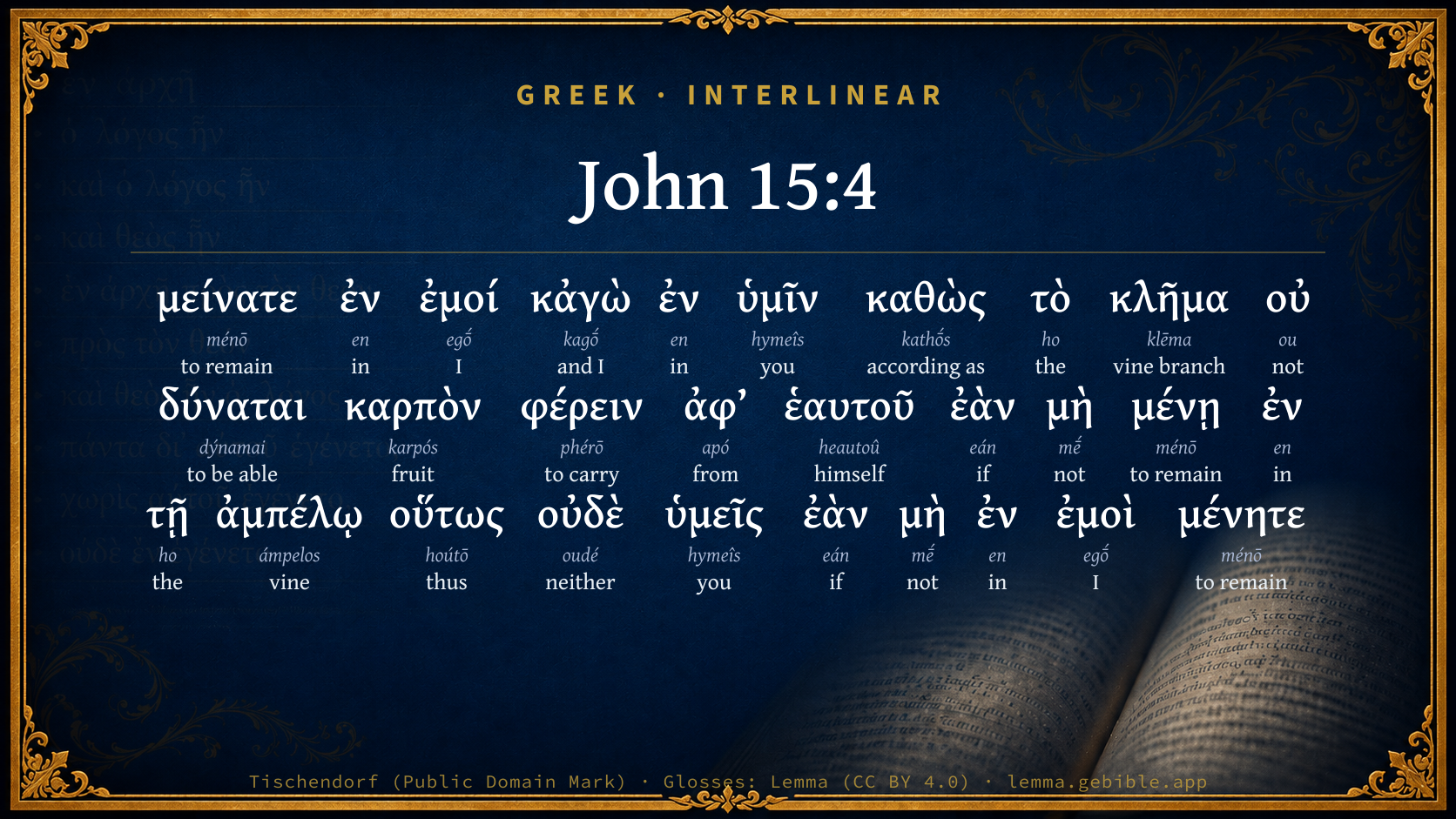
Greek (Tischendorf 8th ed.) John 15:4 appears in the Greek New Testament. The text above is from the Tischendorf 8th edition. Each word links to its Strong’s number and a concise gloss. Click any word for its full Thayer’s Greek Lexicon entry.
Download image
Cite this verse

John 15:4 (World English Bible). Public Domain. Lemma interlinear Bible study tool, https://lemma.gebible.app/v/john/15/4.

Show BibTeX & RIS
BibTeX
RIS
English Translation
Remain in me, and I in you. As the branch can't bear fruit by itself, unless it remains in the vine, so neither can you, unless you remain in me.
World English Bible · Public Domain
Download a study sheet

One document with this verse’s original text, its word-by-word gloss line, the meaning frame, cross-references with their text, attributed commentary, and full source and license credits — printable, and it pastes into notes with its structure intact.

This verse Autodidact and up

Study sheet (.html) Plain text (.txt)

A passage Seminary Student

Up to 50 verses in one chapter. A passage sheet keeps up to 6 commentary sources and 12 cross-references per verse, in the order this page ranks them, and says so on the sheet whenever that leaves anything out. Ask for a single verse and you get the Autodidact verse sheet above.

Everything on this page stays free to read, with no account — the sheet is a download of what is already on screen, not access to it.

Want to remove ads? Support Godless Engineer
Compare translations 3

The same verse in 3 English versions, stacked beneath the original-language interlinear above. Click any original word for its lexicon entry.

Each is an independent rendering of the whole verse — the interlinear is not word-aligned to these translations.

Highlighted words mark where these versions differ — a whole-verse word diff, not a word-by-word alignment.

  • World English Bible Public Domain
    Remain in me, and I in you. As the branch can't bear fruit by itself, unless it remains in the vine, so neither can you, unless you remain in me.
  • King James Version Public Domain
    Abide in me, and I in you. As the branch cannot bear fruit of itself, except it abide in the vine; no more can ye, except ye abide in me.
  • unfoldingWord Literal Text CC BY-SA 4.0
    Remain in me, and I in you. Just as a branch is not able to bear fruit from itself unless it remains in the vine, so neither can you, unless you remain in me.

unfoldingWord Literal Text — © unfoldingWord, licensed CC BY-SA 4.0. Word-aligned USFM3 via Door43 (git.door43.org/unfoldingWord/en_ult).

Versions to compare (up to 4)

3 of 4 selected

Show all 18 translations

Every available English version of this verse, each an independent rendering of the whole verse.

  • World English Bible Public Domain
    Remain in me, and I in you. As the branch can't bear fruit by itself, unless it remains in the vine, so neither can you, unless you remain in me.
  • Berean Standard Bible Public Domain
    Remain in Me, and I will remain in you. Just as no branch can bear fruit by itself unless it remains in the vine, neither can you bear fruit unless you remain in Me.
  • Majority Standard Bible Public Domain
    Remain in Me, and I will remain in you. Just as no branch can bear fruit by itself unless it remains in the vine, neither can you bear fruit unless you remain in Me.
  • King James Version Public Domain
    Abide in me, and I in you. As the branch cannot bear fruit of itself, except it abide in the vine; no more can ye, except ye abide in me.
  • American Standard Version (1901) Public Domain
    Abide in me, and I in you. As the branch cannot bear fruit of itself, except it abide in the vine; so neither can ye, except ye abide in me.
  • Revised Version (1885) Public Domain
    Abide in me, and I in you. As the branch cannot bear fruit of itself, except it abide in the vine; so neither can ye, except ye abide in me.
  • Geneva Bible (1599) Public Domain
    Abide in me, and I in you: as the branche cannot beare fruite of it selfe, except it abide in the vine, no more can ye, except ye abide in me.
  • Young's Literal Translation Public Domain
    remain in me, and I in you, as the branch is not able to bear fruit of itself, if it may not remain in the vine, so neither ye, if ye may not remain in me.
  • Literal Standard Version CC BY-SA 4.0
    remain in Me, and I in you, as the branch is not able to bear fruit of itself, if it may not remain in the vine, so neither you, if you may not remain in Me.
  • Unlocked Literal Bible CC BY-SA 4.0
    Remain in me, and I in you. Just as a branch cannot bear fruit by itself unless it remains in the vine, so neither can you, unless you remain in me.
  • unfoldingWord Literal Text CC BY-SA 4.0
    Remain in me, and I in you. Just as a branch is not able to bear fruit from itself unless it remains in the vine, so neither can you, unless you remain in me.
  • Darby Bible Public Domain
    Abide in me and I in you. As the branch cannot bear fruit of itself unless it abide in the vine, thus neither [can] ye unless ye abide in me.
  • World Messianic Bible Public Domain
    Remain in me, and I in you. As the branch can’t bear fruit by itself unless it remains in the vine, so neither can you, unless you remain in me.
  • Webster's Bible Public Domain
    Abide in me, and I in you. As the branch cannot bear fruit of itself, except it abide in the vine: no more can ye, except ye abide in me.
  • Free Bible Version CC BY-SA 4.0
    Remain in me, and I will remain in you. Just as a branch cannot produce fruit unless it remains part of the vine, so it is for you: you cannot bear fruit unless you remain in me.
  • Bible in Basic English Public Domain
    Be in me at all times as I am in you. As the branch is not able to give fruit of itself, if it is not still on the vine, so you are not able to do so if you are not in me.
  • Text-Critical English NT CC BY 4.0
    Abide in me, and I will abide in you. As the branch cannot bear fruit by itself unless it abides in the vine, neither can you bear fruit unless you abide in me.
  • Tyndale New Testament (1534) Public Domain
    Byde in me and let me byde in you. As the braunche cannot beare frute of it sylfe excepte it byde in the vyne: no more can ye excepte ye abyde in me.

Literal Standard Version (2020), Covenant Press — licensed CC BY-SA 4.0. Text via the HelloAO Bible API (eBible.org). Unlocked Literal Bible (unfoldingWord) — licensed CC BY-SA 4.0. Text via the HelloAO Bible API (eBible.org). unfoldingWord Literal Text — © unfoldingWord, licensed CC BY-SA 4.0. Word-aligned USFM3 via Door43 (git.door43.org/unfoldingWord/en_ult). Free Bible Version, Dr. Jonathan Gallagher — licensed CC BY-SA 4.0. Text via the HelloAO Bible API (eBible.org).

Word by word

More ways to search: Search by grammar → Find every occurrence → Compare this word →

Practice this passage: Drill this verse → Learn its vocabulary →

κλῆμα
klēma
G2814
“vine branch”
Noun, Nominative, Singular, Neuter
Part of Speech
Noun
Case
Nominative
Number
Singular
Gender
Neuter
Full Thayer's Definition

Origin: from G2806

TDNT: 15:37,4

1. a tender and flexible branch 2. spec. the shoot or branch of a vine, a vine sprout
  1. μείνατε ménō G3306 “to remain” Verb, Aorist, Active, Imperative, 2nd person, Plural
  2. ἐν en G1722 “in” Preposition
  3. ἐμοί egṓ G1473 “I” Personal pronoun, 1st person, Dative, Singular
  4. κἀγὼ kagṓ G2504 “and I” Personal pronoun, 1st person, Nominative, Singular, Aramaic form
  5. ἐν en G1722 “in” Preposition
  6. ὑμῖν hymeîs G5210 “you” Personal pronoun, 2nd person, Dative, Plural
  7. καθὼς kathṓs G2531 “according as” Adverb
  8. τὸ ho G3588 “the” Article, Nominative, Singular, Neuter
  9. οὐ ou G3756 “not” Particle, Negative
  10. δύναται dýnamai G1410 “to be able” Verb, Present, Middle or Passive deponent, Indicative, 3rd person, Singular
  11. καρπὸν karpós G2590 “fruit” Noun, Accusative, Singular, Masculine
  12. φέρειν phérō G5342 “to carry” Verb, Present, Active, Infinitive
  13. ἀφ’ apó G575 “from” Preposition
  14. ἑαυτοῦ heautoû G1438 “himself” Reflexive pronoun, 3rd person, Genitive, Singular, Neuter
  15. ἐὰν eán G1437 “if” Conditional
  16. μὴ mḗ G3361 “not” Particle, Negative
  17. μένῃ ménō G3306 “to remain” Verb, Present, Active, Subjunctive, 3rd person, Singular
  18. ἐν en G1722 “in” Preposition
  19. τῇ ho G3588 “the” Article, Dative, Singular, Feminine
  20. ἀμπέλῳ ámpelos G288 “vine” Noun, Dative, Singular, Feminine
  21. οὕτως hoútō G3779 “thus” Adverb
  22. οὐδὲ oudé G3761 “neither” Conjunction, Negative
  23. ὑμεῖς hymeîs G5210 “you” Personal pronoun, 2nd person, Nominative, Plural
  24. ἐὰν eán G1437 “if” Conditional
  25. μὴ mḗ G3361 “not” Particle, Negative
  26. ἐν en G1722 “in” Preposition
  27. ἐμοὶ egṓ G1473 “I” Personal pronoun, 1st person, Dative, Singular
  28. μένητε ménō G3306 “to remain” Verb, Present, Active, Subjunctive, 2nd person, Plural

About this verse

These counts appear in no published source. They are computed here, from the morphology-tagged text and Lemma’s own curated glosses. What Lemma adds →

29
words
19
distinct lemmas
Gospels
section

Notable vocabulary

The rarest word here is κλῆμα vine branch G2814 — appearing just 4 times in the whole Greek New Testament.

Shared distinctive vocabulary

κλῆμα vine branch G2814 occurs in 4 verses of the Greek New Testament. Also found in:

Repetition

Words recur within this verse:

Cross-references

28

Topical passages linked to John 15:4 in the Treasury of Scripture Knowledge — connected by theme and wording, ordered by reader-vote popularity; previews shown in the World English Bible.

  • 1 John 2:6 he who says he remains in him ought himself also to walk just like he walked.
  • Galatians 2:20 I have been crucified with Christ, and it is no longer I that live, but Christ living in me. That life which I now live in the flesh, I live by faith in the Son of God, who loved me, and gave himself up for me.
  • John 8:31 Jesus therefore said to those Jews who had believed him, "If you remain in my word, then you are truly my disciples.
  • 2 John 1:9 Whoever transgresses and doesn't remain in the teaching of Christ, doesn't have God. He who remains in the teaching, the same has both the Father and the Son.
  • John 6:56 He who eats my flesh and drinks my blood lives in me, and I in him.
  • John 15:5–7 I am the vine. You are the branches. He who remains in me, and I in him, the same bears much fruit, for apart from me you can do nothing.
  • Philippians 1:11 being filled with the fruits of righteousness, which are through Jesus Christ, to the glory and praise of God.
  • 1 John 2:24–28 Therefore, as for you, let that remain in you which you heard from the beginning. If that which you heard from the beginning remains in you, you also will remain in the Son, and in the Father.
  • John 14:20 In that day you will know that I am in my Father, and you in me, and I in you.
  • Luke 8:15 That in the good ground, these are such as in an honest and good heart, having heard the word, hold it tightly, and bring forth fruit with patience.
  • 2 Corinthians 13:5 Test your own selves, whether you are in the faith. Test your own selves. Or don't you know as to your own selves, that Jesus Christ is in you?--unless indeed you are disqualified.
  • Colossians 2:6 As therefore you received Christ Jesus, the Lord, walk in him,
  • Romans 8:9–10 But you are not in the flesh but in the Spirit, if it is so that the Spirit of God dwells in you. But if any man doesn't have the Spirit of Christ, he is not his.
  • Ezekiel 15:2–5 Son of man, what is the vine tree more than any tree, the vine-branch which is among the trees of the forest?
  • Acts 14:22 confirming the souls of the disciples, exhorting them to continue in the faith, and that through many afflictions we must enter into the Kingdom of God.
  • John 17:23 I in them, and you in me, that they may be perfected into one; that the world may know that you sent me, and loved them, even as you loved me.
  • Hosea 14:8 Ephraim, what have I to do any more with idols? I answer, and will take care of him. I am like a green fir tree; From me your fruit is found."
  • Colossians 1:27 to whom God was pleased to make known what are the riches of the glory of this mystery among the Gentiles, which is Christ in you, the hope of glory;
  • Ephesians 3:17 that Christ may dwell in your hearts through faith; to the end that you, being rooted and grounded in love,
  • Acts 11:23 who, when he had come, and had seen the grace of God, was glad. He exhorted them all, that with purpose of heart they should remain near to the Lord.
  • 2 Corinthians 12:8–10 Concerning this thing, I begged the Lord three times that it might depart from me.
  • Jude 1:20–21 But you, beloved, keep building up yourselves on your most holy faith, praying in the Holy Spirit.
  • Isaiah 27:10–11 For the fortified city is solitary, a habitation deserted and forsaken, like the wilderness: there shall the calf feed, and there shall he lie down, and consume the branches of it.
  • John 6:68–69 Simon Peter answered him, "Lord, to whom would we go? You have the words of eternal life.
  • Colossians 1:23 if it is so that you continue in the faith, grounded and steadfast, and not moved away from the hope of the Gospel which you heard, which is being proclaimed in all creation under heaven; of which I, Paul, was made a servant.
  • Song of Solomon 8:5 Who is this who comes up from the wilderness, Leaning on her beloved? Under the apple tree I aroused you. There your mother conceived you. There she was in labor and bore you.
  • Hebrews 10:39 But we are not of those who shrink back to destruction, but of those who have faith to the saving of the soul.
  • 1 Thessalonians 3:5 For this cause I also, when I couldn't stand it any longer, sent that I might know your faith, for fear that by any means the tempter had tempted you, and our labor would have been in vain.

Cross-references courtesy of OpenBible.info (CC BY 4.0).

Commentary

Notes on John 15:4 from classic Christian and Jewish commentators (each source and its license shown beneath its notes). The classic Christian expositions comment on the surrounding passage and are grouped to its opening verse, so a note may address several verses; the Jewish commentaries on the Tanakh (Rashi and others) are per-verse, so they appear only where the commentator wrote on this verse.

Lemma curates 59 commentaries, every one of them public domain or Creative Commons licensed, each selected and text-cleaned for this edition rather than reprinted as found. About our sources →

The Biblical Illustrator

Joseph S. Exell

Joh_15:4

Abide in Me, and I in you

Abiding in Christ

I.

TO WHOM THE COMMAND IS GIVEN. To those who are already in Him.

1. We are at first in nature, possessed merely of the powers of nature, as understanding, will, affections; but we must be in grace, which raises us above nature, purifies all our faculties, and directs them to a proper end.

2. We are naturally in the flesh influenced and governed by the body, its appetites, and senses (Gen_6:5; Joh_3:5-6). We must be in the Spirit under the influence and government of His motions and graces.

3. We are naturally in Belial (Eph_2:2; 1Jn_5:18); inspired, deceived, deluded, corrupted by him; but we must be in Christ.

4. How?

(1) By the knowledge of Him (Php_3:8);

(2) by faith in Him;

(3) love to Him;

(4) an interest in Him (Php_3:9).

II. WHAT THIS COMMAND IMPLIES.

1. It implies that we are to retain this knowledge, faith, love, interest, union with Christ; which may be lost (Col_1:23; Joh_15:9-10; Rom_11:22; Heb_10:38). Now, we retain these

(1) When we abide in Him in our thoughts; not only thinking highly of Him, but having our thoughts stayed upon Him.

(2) When our desires, our designs, our will, both in its choice and resolution, and our affections, are set upon these things.

(3) When we dwell upon them in our conversation, and manifest that we love Him, and cleave to Him in our behaviour.

2. To illustrate this: we must abide in Christ, as a branch in a tree, which is supported by it, adheres to it, grows in it, and becomes verdant and fruitful by the virtue derived from it; as a hand in a body, from which it receives its warmth, life, activity, and usefulness; as a man slayer in the city of refuge, for he would be safe only while abiding in the consecrated city; so we are in danger of being overtaken by the curse and wrath of God, unless we have fled to Christ and continue in Him; as a besieged citizen in a garrison, for we are surrounded and attacked by various enemies; as passengers in a ship, for we are on the sea of this world, tossed with the winds and waves, proceeding on our voyage for the port of eternal bliss, and our safety depends on being in the ship.

III. THE PROMISE MADE TO THOSE THAT KEEP IT; AND THE ADVANTAGES RESULTING THEREFROM.

1. Christ will abide in us

(1) By His word, teaching, instructing, directing, strengthening, supporting, encouraging, comforting us (Rom_15:4).

(2) By His Spirit, in His witness as a Spirit of adoption, and in His fruits, which are love, joy, peace, etc. (Rom_8:15; Gal_5:22-23).

(3) By the efficacy of His body and blood (Joh_6:56-57).

(4) By His indwelling presence, as our wisdom, righteousness, sanctification, and redemption (1Co_1:30).

(5) By permitting us to have followship with Him (Rev_3:20).

2. Hence we shall have pardon, acceptance, adoption, safety, access. All our prayers shall be heard (Joh_15:7; Mar_11:24). We shall abound in the fruits of righteousness (Joh_15:5-6; 2Co_9:8).

IV. HOW WE MAY BE ENABLED TO KEEP THE COMMAND.

1. By abiding in a belief of His word, and holding fast all the doctrines, precepts, promises, and threatenings of the Scripture. By continuing to attend the ordinances, public, domestic, social, and private.

2. By guarding against hypocrisy, formality, and lukewarmness, in the use of all ordinances, and maintaining sincerity, spirituality, and fervour therein.

3. By conscientiously keeping His commandments, carefully shunning sins of commission and omission, and whatever is calculated to grieve His Spirit.

4. By guarding against an evil heart of unbelief (Heb_3:12), and holding fast our confidence. By guarding against the love of this present world. (J. Benson.)

Christ the True Vine

I am the True Vine.

I. Christ sets forth the GENUINENESS of His union with His disciples.

II. In the REALITY AND COMPLETENESS of His life-giving power Christ infinitely excels all His forerunners and types.

III. This relationship is much NEARER than that of the shepherd with the sheep.

IV. This union is COMPREHENSIVE, embracing many besides those who are usually recognized as believers. Every branch in Me that beareth not fruit.

V. Our union with Christ should be CONSTANT. Twelve times in this allegory the word abide is used. They were in danger of unfaithfulness and apostasy. Christ sought to fortify them. He assured them that He would keep them if they would trust Him.

VI. This communion is one of LOVE (Joh_15:9-16). As the Father hath loved Me, even so have I loved you. Abide in My love. The believer lives in the love of Christ. Christ loves all men; but He manifests His love in a peculiar manner to those whose hearts are given to Him. If we love God, we will delight in His character, we will be drawn by those Divine attributes which Jesus reveals. Love of a holy Being implies hatred of sin. The Spirit convicts the loving heart of sin. Is my fruit recognized as Divine fruit, such fruit as Christ bore?

1. One of the fruits of union with Christ according to this lesson is patience under discipline (Joh_15:1-3). My Father is the Husbandman. He purgeth it, etc. Ye are clean through the Word, etc. The lot of Jesus was one of severe trial. He was made perfect through suffering. Those who become Christ-like must expect Christ-like trials. The believer can maintain his union with Christ only by uncompromising opposition to every form of evil.

2. Another result of this union is the spirit of dependence on Christ (Joh_15:4-5). Apart from Me ye can do nothing. This sense of dependence on Christ, instead of paralyzing human energy, becomes the source of its power. It enables the soul to look up and confidently exclaim with the apostle, I can do all things in Him that strengtheneth Me.

3. This suggest another fruit of union with Christ, namely, life (Joh_15:6-8). If a man abide not in Me, he is cast forth as a branch, and is withered. Christ came that we might have life. All the vital juices of the branch and its power to bear fruit come from the vine. So, for every good desire we ever formed, or good word we ever spoke, or good deed we ever did, evidencing a renewed life in us, we are indebted to Christ. He is our life. (G. H.Cheney.)

Abiding in Christ

Believe on Christ is the gospel to the world. Abide in Christ is the gospel to the Church. We cannot think too much of Christ for us, but we may think far too little of Christ in us; yet for perfect salvation we need both. Notice that this is

I. A CALL TO CONSCIOUS VITAL UNION WITH OUR LORD. This implies

1. A realization that of ourselves we can do nothing, that we are mere dead branches apart from Him! We live too much as though we were trees, as though by our own power we were to do Gods will, and we have striven, and then groaned over the inevitable failure. Now, says Christ, be satisfied to be a branch.

2. An assurance that the fulness of Christ is ours. That is involved in the figure, and is stated in the chapter. He goes on to say (as its consequence) that what He has, they share. They are to share

(1) His joy--that My joy might abide in you;

(2) His love--that ye love one another as I have loved you;

(3) His knowledge--all things that I have heard of My Father I have made known unto you;

(4) His rights--that whatsoever ye shall ask of the Father in My name, He may give it you;

(5) His persecutions--if they have persecuted Me, they will also persecute you;

(6) His work--the Spirit shall bear witness of Me, and ye also shall bear witness;

(7) His glory--the glory which Thou gavest Me, I have given them.

3. A surrender of ourselves to Christ for His purposes. For the branch exists for the tree.

II. THE FIGURE OF THE VINE SUGGESTS HOW THIS CALL MAY BE FULFILLED. The words show that the responsibility is with us. Christ can only bless according to our willingness; and willingness is proved by readiness to seek the blessing. Abide in Me, and I in you is a command; it is ours, therefore, to fulfil it. And we ask How? Remember there are degrees in this union; some are more closely joined to Christ than others, and receive more of His life; and this is due to their growth into Him, they have struck the fibres of their spiritual being deeper and yet deeper into His being, and thus are close knit to Him.

1. We need the cords of meditation and prayer to bind us to Him more firmly. The formal prayer, the ill-studied Bible, the almost deserted closet, are the destruction of the hopes held out in the text. The weather soon loosens the old cords, and through perpetual communion they must be perpetually renewed.

2. We need the putting away of whatever would come between Christ and us. Sin hinders Christ giving, for He will not give to sin. Sin weakens our desire and faith, that is, our power of receiving. So everything in any degree contrary to Christ must be put away.

3. We need the ceaseless drawing by faith on His fulness.

III. FROM THIS WOULD COME THAT SPIRITUAL FRUIT BEARING WHICH IS GODS WILL. There would be

1. The natural growth of personal holiness. It is a common thought that before Christ can enter into us we must put out evil. That is not the order. Let Christ in and He will put out the evil, as light puts out darkness.

2. A heart at rest. The poverty of our resources is our perpetual fear; loneliness and care are with some a perpetual grief. But would not that be altered if we consciously abode in Christ?

3. Christs power working through us. Think of being the channel for the will of Jesus. (C. New.)

Mutual abiding

I. THE DUTY ENJOINED.

1. Abide in Me. It has been justly said, that the command is not abide with Me--near Me--or under Me; but, in Me. The fruit-bearing branch is not only in the same place with the vine--near it, under its shadow--it is in it, and it abides in it. The ideas suggested are, residence and continuance. It is as if he had said, Think as I think; feel as I feel; will as I will; choose as I choose; and let My views of all objects and all events be yours, because they are Mine; let My feelings, My volitions, My choices, all be yours, and let them be yours because they are Mine. Prosecute My ends--use My means--rely on Me, entirely on Me. Let My wisdom be your wisdom--My righteousness your righteousness--My strength your strength. Come out of yourselves. Come out of the creature. Come into Me. It is faith that thus unites us to the Saviour, and it is continued faith which keeps us thus united to the Saviour.

2. Let Me abide in you. What is meant by Christs abiding in His people? The best answer is at the seventh verse, and 1Jn_3:24. Christ abides in His people, by continuously making them, through the agency of the Holy Spirit, and the instrumentality of His word, understood and believed under His influence, think along with Him--feel, choose, enjoy along with

Him. Christ is so formed in them that it is not so much they who live, as Christ who lives in them.

2. What is the import of the injunction, Let Me dwell in you? Christ never does come into any man, so as to dwell in him, against the mans will Were the thing possible, it would be to degrade man into a mere machine, and involve the incongruity, than which none can be greater, that He who of old inhabited His own eternity, and has heaven for His throne and earth for His footstool, should, as if in want of a house, force an entrance where He was not desired. But His language is, Behold, I stand at the door, etc.

3. The two parts of the injunction are closely connected. Christians will abide in Christ just in the degree in which they let Christ abide in them.

II. THE MOTIVES BY WHICH THE INJUNCTION IS ENFORCED.

1. Compliance with the injunction is necessary to prevent unfruitfulness and its fearful consequences. A vine branch by itself can bring forth nothing, not even blossoms or leaves. All men are naturally unholy and unprofitable. There is no way in which they can be made fruitful, except by being cut off from their original stock, the first Adam, and being grafted into Him who is the True Vine. When men are awakened to a sense of the dangers of a state of spiritual barrenness, they often endeavour to become fruitful of themselves. They go about to make themselves holy by the works of the law: but the thing is impossible. There is no good fruit but what is the product of Divine influence; and no channel for Divine influence to flow into the human heart, but the mediation of Jesus Christ. It is not, Without Me ye can do little; it is, Without Me ye can do nothing. It is not, Without Me ye will do nothing--that is true too--but it is, Without Me ye can do nothing. It is not, Without Me you can accomplish--finish--nothing; it is, Without Me ye can do nothing.

2. Compliance with this injunction alone can, and certainly will, secure fruitfulness, with all its blessed results. No stream without a fountain; no fountain, unless obstructed, without a stream. Three effects are mentioned by our Lord

(1) The answer of whatever prayers we present to God;

(2) The glorification of God;

(3) The clearly proving to ourselves and others that we are really the disciples of Christ. (J. Brown, D. D.)

Branches not mechanically in the vine

It is, of course, possible to attach a bough or branch either to the stem of a vine or the trunk of any other tree by artificial means, and so to secure a kind of external union therewith. A length of cord or iron wire may accomplish a poor and pitiful result like that; but the stem knows it not and the branch is withered, however painfully and skilfully art may struggle to endorse the lie. In the same way we may be mechanically and externally united to the visible Church of Christ. That is entirely an affair of contrivance, a mere matter of ligature or glue. It is altogether and at most a concern of nomination, register or ceremonial. But let it be remembered that this is in itself stark naught. Never a rotten branch on the floor of a forest, a branch that breaks and crackles beneath the foot of a passer-by, is more dead than we are, if the hasp and staple of Church membership, if the hook and eye of registration, if the glue of mere sectarian adhesion, if the paint of mere external profession are all that holds us on to the Christ of God. (J. J.Wray.)

Union with Christ the means of salvation

Of the precise origin of the late civil war in America I am not quite sure; but I am told it was a perverse misunderstanding on the subject of slavery. The North was against the slave trade, the South for it; and so both parties appealed to arms. But be that as it may, one thing is clear: not many months passed before the question of slavery was swallowed up in the most important question of the Union--the Union of the States. Who is for or against the slave? There the conflict began. Who is for or against the Union? There it finished. Neither am I quite certain of the first cause of the prolonged controversy between earth and heaven, man and God. A rumour was afloat in my native neighbourhood that it all began in a slight misunderstanding touching a certain apple tree in the garden of Eden. But be that as it may, the question of the apple tree has been long ago swallowed up in the more important question of the union--the union with the Son. Salvation hinges not on such questions as what was the first sin, or who is the greatest sinner? but upon the simple straightforward question--Who is for or against the union with Jesus Christ? Do you believe in the only-begotten Son? (J. C. Jones, D. D.)

Union with Christ and fruitfulness

The villages in Persia may be derided into two classes: those of the plains, treeless, sterile and poor; and those of the mountains, where the springs and torrents encourage the growth of plane, mulberry, poplar trees, and orchards, and allow channels for the nourishment of plantations. Elevation means fertility here. (H. O.Mackey.)

The reciprocities of personal salvation

I. CHRIST IN THE BELIEVER.

1. How.

2. When.

3. Why.

II. THE BELIEVER IN CHRIST.

1. How.

2. When.

3. Why. (S. S. Times.)

Union with Christ

1. A spiritual union (1Co_6:17; 1Co_12:13; 1Jn_3:24; 1Jn_4:13).

2. A vital union (Joh_14:19; Gal_2:20).

3. It embraces our entire persons, our bodies through our spirits (1Co_6:15; 1Co_6:19).

4. It is a legal or federal union, so that all of our legal or covenant responsibilities rest upon Christ, and all of His legal or covenant merits accrue to us …

5. This union is between the believer and the person of the God-man in His office as mediator (Joh_14:23; Joh_17:21; Joh_17:23). (A. A. Hodge.)

Abide in Christ

Be like Miltons angel, who lived in the sun. Abide in Christ, and let His words abide in you. Closer, closer, closer, this is the way to spiritual wealth. (C. H. Spurgeon.)

The entire dependence of sanctity on Christ

1. Without Me, in Joh_15:5, should rather be rendered, Apart from Me, separate from Me, in state of independence on Me. Without the assistance of a strong person, a weak one cannot lift a heavy weight; but the dependence of the weak on the strong in order to lift the weight, is not the dependence which the word here employed indicates. Apart from the soul the body is motionless, and cannot stir a finger. This is the sort of dependence indicated here.

2. The subject brought before us is, that the sanctification of the Christian, like his justification, is entirely dependent upon our Lord. As regards our justification, this is clearly seen (at least in the Reformed Churches) and generally admitted. But it is thought that, unlike justification (which is something that passes on the sinner externally to him, a sentence of acquittal in consideration of Our Lords merits), sanctification is an achievement mastered--much as a lesson is mastered--by a variety of exercises, prayers, almsdeeds, sacraments, etc., and when mastered, a sort of permanent acquisition, which goes on increasing as the stock of these spiritual exercises accumulates. It is not regarded in its true light as a momentary receiving out of Christs fulness grace for grace, as the result of His inworking in a heart, which finds the task of self-renewal hopeless, and makes itself over to Him, to be moulded by Him.

3. Let us take two illustrations

(1) His own. As the branch, etc. The circulating sap, which is the life of the tree, is indeed in the vine branch, so long as it holds of the stem; but in no sense whatever is it from the vine branch. Cut off the branch from the stem, and it ceases instantaneously to live, for it has no independent life. Even so the fruits of the Spirit, while of course our hearts are the sphere of their manifestation, are in no sense from our hearts; but a righteousness outflowing continually from the fulness of grace which is in Christ.

(2) When we walk abroad on a beautiful day, our eye catches a variety of colours lying on the surface of the landscape,--there is the yellow of the golden grain, the green of the pasture land, the dark brown of those thick-planted copses, the silver gleam of the stream which winds through them, the faint blue of distant hills seen in perspective, the more intense blue of the sky, the purple tinge of yonder sheet of water--but none of these colours reside in the landscape. Now, apart from the sunlight no object has any colour; as is shown by the fact that, as soon as light is withdrawn from the landscape, the colours fable from the robe of nature. The difference of colour is produced by some subtle difference of texture or superficies, which makes each object absorb certain rays, and reflect certain others in different proportions. Now Christ is the Sun of righteousness, in whom dwelleth all the fulness of the Godhead bodily, the fair colour of every grace and Christian virtue. When Christ is shining upon the heart, then these virtues are manifested there, by our Christian graces of one description, by another of another, according to their different receptivity and natural temperament. The great secret, then, of bringing forth much fruit, or of all advance in holiness, is a constant keeping open the avenues of the soul towards Him. If a vine branch is to sprout, the tube by which it communicates with the stock of the tree must adhere tightly to the stem, and be well open for the passage of the sap. If you desire to see the colours of furniture in this room, whose shutters are closed, throw open the shutters, and admit the full flood of sunlight. And if you desire to see the dead heart, put forth the energies of spiritual life, and the dark heart illumined by the fair colours of spiritual grace, throw wide open the passage of communication between Christ and it, and allow the Life which is in Him, and the Light which is in Him, to circulate freely through it.

I. Take heed, first, that YE ABIDE IN ME. This is done by faith. As we first consciously entered into fellowship with Christ by faith, so there is no other way to abide in Him, than by repeated exercises of the same faith. The faith which enables the soul to abide in Christ is nothing else than an assured trust and confidence that, as He has already wrought out for us our acceptance with God, so He will work in us every gracious disposition which is necessary to qualify us for glory. It is not enough to supplicate these graces; we must lean upon Him for them, and fix the eye of expectation upon the promise of His new covenant: I will put My laws into their mind, etc. And as without holiness no man shall (or can) see the Lord, must not Christ be much more earnestly anxious to make us holy, than we can be to be made so? If we do not believe in this earnest anxiety of His, do we believe in His love at all? Ah! what if these struggles to be holy should themselves be in a certain sense a token of unbelief? What if the poor bird imprisoned in the cage should be thinking that, if it is ever to gain its liberty, it must be by its own exertions, and by vigorous and frequent strokes of its wings against the bars? If it did so, it would ere long fall back breathless and exhausted, faint and sore, and despairing. And the soul will have a similar experience, which thinks that Christ has indeed won pardon and acceptance for her, but that sanctification she must win for herself, and under this delusion beats herself sore in vain efforts to correct the propensities of a heart which the Word of God pronounces to be desperately wicked. That heart,--you can make nothing of it yourself;--leave it to Christ, in quiet dependence upon His grace. Suffer Him toopen the prison doors for you, and then you shall fly out and hide yourself in your Lords bosom, and there find rest.

II. LET ME ABIDE IN YOU. Christ thus teaches us that ordinances, as well as faith, form part of His religion. In order to fruitfulness the sap must rise from the vine stock, and pass into the branch, this is the abiding of the vine in the branch. Similarly Christ must continually send up into our heart a current of holy inspirations, new loves, good impulses, devout hopes--i.e., communicate Himself to the soul by the continual influx of the Holy Ghost. And this is made specially in the Supper of the Lord. Of course the Divine allegory quite precludes the supposition that without faith in the recipient the Holy Supper will avail anything. The vine stock may push upwards its sap in strong current, at the first outburst of the genial spring; but what will that avail the branch, which does not hold closely to the tree, which is half broken off from the stem, and the fracture filled up with dust, or corroded by insects? Christ may offer Himself to us in the Lords Supper; but, if the soul cleaves not to Him, if the avenues of the heart are not open towards Him, how can He enter? (Dean Goulburn.)

The Biblical Illustrator, edited by Joseph S. Exell (c. 1880s–1900s) — public domain. Text from a community e-Sword module.

Tyndale Open Study Notes

Tyndale Open Resources

15:4 The term remain (Greek menō) is key to understanding 15:4-10. A growing disciple, in whom the Father and the Son live through the Spirit, must be continuously connected to Christ (see 14:16-25; 15:26).

Tyndale Open Study Notes — © Tyndale Open Resources, licensed CC BY-SA 4.0. Text via the HelloAO Bible API.

Bengel's Gnomon

Johann Albrecht Bengel

Joh 15:4. Κἀγὼ, and I) The first person here is to be supplied from the imperative, μείνατε, abide, by the following periphrasis (circumlocution or paraphrase): See that ye abide in Me, and that I abide in you.—καθὼς, even as) This passage admirably sets forth the distinction there is between nature and grace.—ἀφʼ ἑαυτοῦ, of itself) This is explained in the following clause, ἐὰν μὴ μείνῃ, κ.τ.λ., “except it abide in the vine; so χωρὶς ἐμοῦ, “without Me ye can do nothing.” Joh 15:5.

Bengel's Gnomon of the New Testament — English translation (T&T Clark, Edinburgh, 1860) — public domain. Text from a community e-Sword module.

Meyer's Critical & Exegetical Commentary

Heinrich August Wilhelm Meyer

Joh_15:4. To this purity, however, must be added the continuous faithful persistence in my living fellowship.

ἐν ἐμοί] here: on (not in) me, συμπεφυῶτες ἐμοί (Nonnus), as is required by what follows, hanging on me as the branches hang on the vine, Joh_15:2. Euth. Zigabenus aptly remarks: συγκολλώμενοί μοι βεβαιώτερον διὰ πίστεως ἀδιστάκτου καὶ σχέσεως ἀῤῥήκτου.

κἀγὼ ἐν ὑμῖν] to the fulfilment of the requirement[161] is attached the promise: and I will abide on you

συνὼν τῇ δυνάμει, Euth. Zigabenuswith the whole power of spiritual life, which I impart to my faithful ones; I will not separate myself from you, like the vine, which does not loosen itself from its branches. On ΜΕΝῶ as a supplement, see Bornemann in the Sächs. Stud. 1846, p. 56. The harsher mode of completing the sense: and cause that I abide on you (Grotius, Bengel), is not demanded by Joh_15:5, where ὁ μένων … αὐτῷ is the fulfilled μείνατε … ὑμῖν.

ἘᾺΝ ΜῊ ΜΕΊΝῌ, Κ.Τ.Λ.] If he shall not have abided, etc., refers merely to οὐ δύναται καρπὸν φέρειν (as in Joh_5:19), and is so far a more exact definition of the ἈΦʼ ἙΑΥΤΟῦ, vi aliqua propria, quam habeat extra vitem, Grotius.

οὕτως οὐδὲ ὑμεῖς] so neither you, namely δύνασθε καρπ. φέρειν ἀφʼ ἑαυτῶν, i.e. ποιεῖν τι χωρὶς ἐμοῦ, Joh_15:5. Bengel well remarks: Hic locus egregie declarat discrimen naturae et gratiae, but also the possibility of losing the latter.

[161] Comp. Weiss, Lehrbegr. p. 74.

Meyer — Critical and Exegetical Commentary on the New Testament — English translation by Peter Christie, edited by Frederick Crombie (T&T Clark, 1880) — public domain. Text from a community e-Sword module.

Expositor's Greek Testament

ed. W. Robertson Nicoll

Joh 15:4 . It is in and through you I live henceforth. καθὼς τὸ κλῆμα … μείνητε [or μένητε ]; illustrating by the figure the necessity of the foregoing injunction. A branch that falls to the ground, and no longer abides in the vine as a living part of it, cannot bear fruit, so neither can ye except ye abide in me. That is, ye cannot bear the fruit my Father, the vinedresser, looks for, and by which He will be glorified, Joh 15:8 .

The Expositor's Greek Testament, edited by W. Robertson Nicoll (1897–1910) — public domain. Text from a community e-Sword module.

Godet's Commentaries

Frédéric Louis Godet

Ver. 4. “Abide in me, and I in you; as the branch cannot bear fruit of itself, unless it abides in the vine, no more can you, unless you abide in me.

To continue in the vine is for a branch the condition of life, and consequently its only law. All the conditions of fruitfulness are included in this. The imperative proves that one abides in this relation, as one enters it, freely, by the faithful use of the divinely offered methods. Joh 15:7 will show that the fundamental means is the word of Jesus.— ᾿Εν ἐμοὶ μένειν, to abide in me, expresses the continual act by which the Christian sets aside everything which he might derive from his own wisdom, strength, merit, to draw all from Christ, in these different relations, through the deep longings of faith. This condition is so completely the only one laid down for the action of the force of Christ in him, that in the following clause Jesus omits the verb—although it would properly be necessary for another person and at another time (I will abide)—as if to make them feel that this act on His part is an immediate and necessary consequence of the act demanded of the believer; where the latter is accomplished, the former cannot fail to be realized. In this way, the action of Christ, no less than our own, is boldly placed under the control of our freedom. It is naturally on this second fact (I in you), of which the first: You in me, is only the condition, that the fruitfulness of the branch directly depends.

Hence the end of Joh 15:4; the duty imposed on the believer results from the immediate unfruitfulness with which his separation from the vine would affect him as a branch. Here, as in Joh 15:19, ἐὰν μή is an explanation of ἀφ᾿ ἑαυτοῦ, and not a limitation applied to the whole preceding idea: “by himself, that is to say, if he does not abide....”

The theme here formulated is not that of the moral powerlessness of the natural man for any good; it is that of the unfruitfulness of the believer left to his own strength, when the question is of producing or advancing the spiritual life, the life of God, in himself or in others.

After having described the new position and the law which it imposes, Jesus sets forth in the following verses, 5-8, the sanction of this law of life and death which He has just declared. And first, in Joh 15:5, the glorious results which the fruitful branch will obtain and the opposite result of unfaithfulness.

Frédéric Louis Godet — Commentaries on Luke, John, Romans, and 1 Corinthians — English translation (T&T Clark, Edinburgh, 1870s–1890s) — public domain. Text from a community e-Sword module.

Jamieson, Fausset & Brown

Robert Jamieson, A. R. Fausset & David Brown

Abide in me, and I in you; as the branch cannot bear fruit of itself, except it abide in the vine, &c.--As all spiritual fruitfulness had been ascribed to the mutual inhabitation, and living, active interpenetration (so to speak) of Christ and His disciples, so here the keeping up of this vital connection is made essential to continued fruitfulness.

Jamieson, Fausset & Brown — Commentary Critical and Explanatory on the Whole Bible (1871) — public domain (CC PDM 1.0). Text via the HelloAO Bible API.

Adam Clarke's Commentary

Verse 4. Abide in me] Hold fast faith and a good conscience; and let no trials turn you aside from the truth. And I will abide in you-ye shall receive every help and influence from me that your souls can require, in order to preserve and save them to eternal life.

These two things are absolutely necessary to our salvation:

1. That we continue closely united to Christ by faith and love, and live in and to him.

2. That we continually receive from him the power to do good; for as the branch, however good in itself, cannot bear fruit from itself, through its own juice, which it has already derived from the tree, and can be no longer supported than it continues in union with the parent stock, neither can ye, unless ye abide in me. As the branch partakes of the nature of the tree, is nourished by its juice, and lives by its life, so ye must be made partakers of my Divine nature, be wise in my wisdom, powerful in my might, and pure through my holiness.

Adam Clarke's Commentary on the Bible (1810–1826) — public domain. Text from a community e-Sword/MySword module.

John Calvin's Commentaries

4. Abide in me. He again exhorts them to be earnest and careful in keeping the grace which they had received, for the carelessness of the flesh can never be sufficiently aroused. And, indeed, Christ has no other object in view than to keep us

as a hen keepeth her chickens under her wings, (Matthew 23:37)

lest our indifference should carry us away, and make us fly to our destruction. In order to prove that he did not begin the work of our salvation for the purpose of leaving it imperfect in the middle of the course, he promises that his Spirit will always be efficacious in us, if we do not prevent him. Abide in me, says he; for I am ready to abide in you And again, He who abideth in me beareth much fruit. By these words he declares that all who have a living root in him are fruit-bearing branches

John Calvin's Commentaries (1540-1563) — public domain. Text from the Calvin Translation Society English edition (1840s-50s) via the Christian Classics Ethereal Library (ccel.org). Calvin's coverage is partial (roughly two-thirds of the Bible); uncommented books and verses are honest gaps, never fabricated. The 19th-century editor's footnotes and remarks are omitted so the notes are faithfully Calvin's own voice.

Ellicott's Commentary for English Readers

(4) Abide in me, and I in you.—The clauses are here connected as cause and effect. The second is the promise, which will not fail if the command of the first be observed. The union then, and all that follows from it, is placed within the power of the human will. All is contained in the words, “Abide in Me.” He who obeys this command has Christ abiding in him, and is a fruitful branch of the true vine.

As the branch cannot bear fruit of itself.—The branch regarded of itself, apart from (“except it abide in”) the vine, has no original source of life. The sap flows from the vine to branch and tendril and leaf and fruit. The branch of itself is a lifeless organ, and only fulfils its functions when it is connected with the vine. So in the spiritual life, men apart from Christ have no original source of life and fruitfulness. The true life flows from Him to every branch that abides in Him, quickening by its power the whole man, and making him fruitful in good. The man who lives without faith in God may be said to exist, rather than to live, and misses the true aim of his being.

A Bible Commentary for English Readers, edited by Charles John Ellicott (1878–1897) — public domain. Text from a community e-Sword module.

The Cambridge Bible for Schools and Colleges

gen. ed. J. J. S. Perowne

4. Abide in me, and I in you) See on Joh_6:56. ‘And I in you’ may be taken either as a promise (‘and then I will abide in you’) or as the other side of the command (‘take care that I abide in you’); the latter seems to be better.

except ye abide] There is this mysterious property in the branches of the spiritual Vine, that they can cut themselves off, as Judas had done. Nature does something, and grace does more; but grace may be rejected.

The Cambridge Bible for Schools and Colleges (gen. ed. J. J. S. Perowne; Cambridge University Press, 1878–1918) — public domain. Text from a community e-Sword module.

John Gill's Exposition

I am the vine, ye are the branches,.... Christ here repeats what he said of himself, "the vine", for the sake of the application of "the branches" to his disciples: which expresses their sameness of nature with Christ; their strict and close union to him; and the communication of life and grace, holiness and fruitfulness, of support and strength, and of perseverance in grace and holiness to the end from him:

he that abideth in me, and I in him; which is the case of all that are once in Christ, and he in them:

the same bringeth forth much fruit; in the exercise of grace, and performance of good works; and continues to do so as long as he lives, not by virtue of his own free will, power, and strength, but by grace continually received from Christ:

for without me ye can do nothing; nothing that is spiritually good; no, not anything at all, be it little or great, easy or difficult to be performed; cannot think a good thought, speak a good word, or do a good action; can neither begin one, nor, when it is begun, perfect it. Nothing is to be done "without Christ"; without his Spirit, grace, strength, and presence; or as "separate from" him. Were it possible for the branches that are truly in him, to be removed from him, they could bring forth no fruits of good works, any more than a branch separated from the vine can bring forth grapes; so that all the fruitfulness of a believer is to be ascribed to Christ, and his grace, and not to the free will and power of man.

John Gill's Exposition of the Whole Bible (1746–1763) — public domain (CC PDM 1.0). Text via the HelloAO Bible API.

Trapp's Complete Commentary

John Trapp

4 Abide in me, and I in you. As the branch cannot bear fruit of itself, except it abide in the vine; no more can ye, except ye abide in me.

Ver. 4. As the branch cannot bear fruit, &c.] All our sap and safety is from Christ. The bud of a good desire, the blossom of a good resolution, and the fruit of a good action, all come from him, Gratia praevenit nos ut velimus, et subsequitur ne frustra velimus. (Augustine.)

John Trapp, A Commentary or Exposition upon All the Books of the Old and New Testament (1647–1656) — public domain. Text from a community e-Sword module.

Albert Barnes' Notes on the Bible

Abide in me - Remain united to me by a living faith. Live a life of dependence on me, and obey my doctrines, imitate my example, and constantly exercise faith in me.

And I in you - That is, if you remain attached to me, I will remain with you, and will teach, guide, and comfort you. This he proceeds to illustrate by a reference to the vine. If the branch should be cut off an instant, it would die and be fruitless. As long as it is in the vine, “from the nature of the case,” the parent stock imparts its juices, and furnishes a constant circulation of sap adapted to the growth and fruitfulness of the branch. So our piety, if we should be separate from Christ, or if we cease to feel our union to him and dependence on him, withers and droops. While we are united to him by a living faith, from the nature of the case, strength flows from him to us, and we receive help as we need. Piety then, manifested in good works, in love, and self-denial, is as natural, as easy, as unconstrained. and as lovely as the vine covered with fruitful branches is at once useful and enticing.

Albert Barnes' Notes on the Bible (1834–1885) — public domain. Text from a community e-Sword/MySword module.

Matthew Poole's English Annotations

This our abiding in Christ is expounded, by an abiding in his words, Joh 15:7, by abiding in his love, Joh 15:10, an abiding in his Spirit, 1Jo 2:27, a walking as Christ walked, 1Jo 2:6, an abiding in the light, Joh 15:10, not sinning, 1Jo 3:6. The exhortation is, without doubt, to a holiness of life and conversation, by which our union and communion with Christ is upheld and maintained, and which is in itself an abiding in the love of Christ: nor is there a want of sufficient reason for this exhortation, though our union with Christ cannot be dissolved, nor our communion with him wholly interrupted; because,

1. It must be upheld and maintained on our part by the exercises of faith and holiness.

2. The sense of it in our souls may be eclipsed, and wholly fail, Psa 22:1.

3. We may fall away foully, though neither totally, (as Lutherans say), because the seed of God abideth in the believer; nor yet finally (as papists say).

We had need therefore of all exhortations and arguments imaginable, to persuade us to do what in us lieth that we may abide in him. We have a great encouragement to the use of all possible endeavours to abide in the love of God, from the promise annexed,

and I in you; that is, I will abide in you; do you strive, and I will help you to perfect; do you fight, and I will help you to overcome; I will continue to you such gradual influences of grace, as shall be sufficient for you; grace wherein and whereby you shall stand, Rom 5:2. You shall be kept by the power of God through faith to salvation, 1Pe 1:5. But look as it is with the branch, it cannot bear fruit of itself; but if it be once separated from the influences of the stock, it dies and withers; so it will be with you, you can bring forth no fruit unless you abide in me.

Matthew Poole's English Annotations on the Holy Bible (1683–1685) — public domain. Text from a community e-Sword/MySword module.

Whedon's Commentary on the Bible

Daniel D. Whedon

4. Abide in me—This is the great lesson of the apologue. In Christ you are, in Christ abide. To these apostles, surrounding him like the cluster upon the stem, as he was about to leave them, and they to separate from each other, he addresses this final admonition. Whatever your lot, wherever your place, do this one thing, abide in me, and all is safe. Their only danger is apostacy. And they can only abide in him by bearing fruit. And they can bear fruit only by abiding in him. Christian life is the source of Christian action; and Christian action is, back again, the source of Christian life.

Daniel D. Whedon (gen. ed.), Commentary on the Old and New Testaments (1874–1909) — public domain. Text from a community e-Sword module.

The Pulpit Commentary

But there is a continuance of most intimate relations to be sustained between Christ and his disciples. If the two clauses are "imperative," or rather concessive, as many suppose, the finest meaning is evolved. Let these be the reciprocal conditions, let it be that you abide in me, and I in you. (Meyer and Lange add to the second clause menw , "I will abide in you," making it into a promise following a command, and involving a very strong synergistic thought.) There is a mutual abiding or indwelling. The life-principle circulates through the branches, just as they perpetuate the living connection between the branch and the center of the life. The mutual relations show that human nature is in infinite need, and, apart from the new life-principle, will perish. The abiding of the branch in the vine suggests the continuance of vital connection" with the living stem, and supposes that connection kept up by constant faith, so that the believer is in a position to draw life from the legitimate source. The abiding of the vine in the branch in you is the perpetual inflow into the subordinate life, of the living grace which makes the believer"s life one with his Lord"s. As he said, (Joh_14:19) "Because I live, and ye shall live;" so now, As the branch cannot bear fruit from itself from its own inherent vitalityexcept it abide in the vine except this connection is maintainedin like manner no more (or, so neither) can ye, except ye abide in me. The affirmation does not cover, as Augustine implies (although it may suggest), the impotence of the natural man, but it asserts the unfruitfulness of the disciple in his own strength. Some have found here revindication of the place of the human will in the work of grace. Let it be seen, however, that it is the "good will," the new nature, which has been wakened into normal activity, and which wills the thing most pleasing to the Divine Source of the life.

The Pulpit Commentary (1880–1919), ed. H.D.M. Spence-Jones & Joseph S. Exell — public domain. Text from a community e-Sword module.

John Wesley's Explanatory Notes

Abide in me - Ye who are now pure by living faith, producing all holiness; by which alone ye can be in me.

John Wesley, Explanatory Notes Upon the Whole Bible (1754–1765) — public domain. Text via the GEBible commentary corpus.

Scofield Reference Notes

C. I. Scofield

abide

To abide in Christ is, on the one hand, to have no known sin unjudged and unconfessed, no interest into which He is not brought, no life which He cannot share. On the other hand, the abiding one takes all burdens to Him, and draws all wisdom, life and strength from Him. It is not unceasing consciousness of these things, and of Him, but that nothing is allowed in the life which separates from Him.

See "Fellowship," 1Jn 1:3. See "Communion," 1Co 10:16.

The Scofield Reference Bible (1917 edition), notes by C. I. Scofield — public domain. Text from a community e-Sword module.

The People's New Testament

B. W. Johnson

4. Abide in me, and I in you. The idea is, Abide in me that I may abide in you. Christ abiding in us is dependent on our abiding in him. We abide in him by keeping his words, or having his “word abide in us” (verse 7), and all who “keep his sayings” (14:23) will have Christ abide in their souls. No more can ye, except ye abide in me. We are dead, fruitless branches, without the Christ-life. The whole history of the world demonstrates that fruitfulness is only found in union with Christ.

B. W. Johnson's The People's New Testament with Notes (1889–1891) — public domain. Electronic text from the Christian Classics Ethereal Library (CCEL) ThML edition.

Cambridge Greek Testament for Schools and Colleges

4 and 6. μένῃ, μένητε, μένῃ for μείνῃ, μείνητε, μείνῃ.

4. κἀγὼ ἐν ὑμῖν. This may be taken either as a promise (‘and then I will abide in you’), or as the other side of the command (‘take care that I abide in you’). The latter is better. The freedom of man’s will is such that on his action depends that of Christ. The branches of the spiritual Vine have this mysterious power, that they can cut themselves off, as Judas had done. Nature does something and grace more; but grace may be rejected. The expression ἀφ’ ἑαυτοῦ, from itself, as the source of its own productiveness, is peculiar to S. John (Joh 5:19, Joh 7:18, Joh 11:51, Joh 16:13).

Cambridge Greek Testament for Schools and Colleges (Cambridge University Press, 1896; 21 vols, various authors incl. Carr, Maclear, Plummer, Farrar, Lumby, Moule, M. R. James, Simcox) — public domain. Text from a community e-Sword module.

Alford’s Greek Testament

Henry Alford

4.] κἀγὼ ἐν ὑμ. must not (with , Meyer, and Lücke) be taken as a promise, which (see on ἐν ἐμοί above) would be contrary to the sense: but (with , Tholuck, Bengel, Stier, who however modifies it by rendering “so abide in Me that I may abide in you”) as a clause dependent on μείνατε ἐν ἐμοί, ‘Take care that ye abide in Me and I in you:’ both these being necessary to the bringing forth fruit: see ver. 5, where the two are similarly bound together.

Here the natural strictness of the similitude is departed from. The branch cannot sever itself from the vine: but, such a case supposed, every one will see the inevitable consequence. Bengel says well, “Hic locus egregie declarat discrimen naturæ et gratiæ.” It is the permitted freewill of the creature which makes the difference between the branches in the two cases.

Henry Alford, The Greek Testament (1849–1861) — public domain. Text from a community e-Sword module.

International Critical Commentary

4. μείνατε ἐν ἐμοί, κἀγὼ ἐν ὑμῖν. This is an imperative sentence (for the aor. imper. see on 2:5). No doubt, the practical precept which was the issue of all the teaching of Jesus was just this; but we must not join the words to the preceding διὰ τὸν λόγον ὃν λελάληκα ὑμῖν, as if the precept itself were the λόγος. The words ἐν ἐμοὶ μένει, κἀγὼ ἐν αὐτῷ had been used before (6:56), but the promise of that passage has not heretofore been turned into an explicit precept (cf. 14:20). For λόγος as signifying not a single sentence, but the whole purport of the Divine revelation given by Christ, see on 5:38.

καθὼς τὸ κλῆμα κτλ. Even the fruitful branch does not bear fruit of itself (cf. for ἀφʼ ἑαυτοῦ, 5:19, 7:18, 11:51, 16:13), but only in so far as it assimilates and is nourished by the sap of the vine. So the disciple of Jesus cannot bear fruit, unless he abide (ἐὰν μὴ μένῃ) in the Vine. Here is the difference between the natural and the spiritual order. The vine shoot has not the power of choosing whether it will “abide” in the vine, or cut itself loose. But in the spiritual sphere this “abiding” is not maintained without the constant and conscious endeavour of the disciple’s own will. Hence the urgency of the precept μείνατε ἐν ἐμοί.

International Critical Commentary — older volumes (1896–1929), various authors — public domain. Text from a community e-Sword module.

Vincent's Word Studies in the New Testament

Marvin R. Vincent

Of itself [αφ εαυτου] . Properly, from itself. See on 7 17.

No more can ye [ουτως ουδε υμεις] . Literally, so neither can ye. So Rev.

Marvin R. Vincent, Word Studies in the New Testament (1887–1900) — public domain. Text from a community e-Sword/MySword module.

Lesson kit

Teaching starters — assembled from the data on this page, not authored interpretation. Every prompt links to the verse data it draws on. Edit before teaching.

John, in the Gospels, opens this verse with 29 words (19 distinct Greek lemmas). Its most distinctive word is klēma (“vine branch”). A historical commentator’s framing appears above. Read the whole chapter for the surrounding context.

Discussion questions

  1. The word klēma carries the sense “vine branch.” How does it shape the verse?
  2. How does John 15:2, which shares the word «vine branch», read alongside this verse?
  3. What does the repetition of “to remain” (3× in this one verse) do in this verse?
  4. The translations on this page render this verse differently — a whole-verse word diff, not a word-by-word alignment. What might account for the different wordings?
  5. Compare how The Biblical Illustrator and Tyndale Open Study Notes read this verse. Where do they agree or differ?

Things to notice

  • These translations choose different wording for 11 words in this verse.
  • “to remain” occurs 3× in this single verse.
  • 19 distinct Greek lemmas span 29 words in this verse.

Reading settings

Reading text

Shown beneath each verse's original-language words.

Old Testament
Old Testament edition

Read the OT as the Masoretic Hebrew (MT) or the Greek Septuagint (LXX).

English shown for the Greek Septuagint (in the Hebrew ↔ Greek comparison).

Comparing translations? Open the Compare panel on any verse page to stack up to four side by side.