1 Thessalonians 4:14

Greek (Tischendorf 8th ed.) 1 Thessalonians 4:14 appears in the Greek New Testament. The text above is from the Tischendorf 8th edition. Each word links to its Strong’s number and a concise gloss. Click any word for its full Thayer’s Greek Lexicon entry.
Download image
Cite this verse

1 Thessalonians 4:14 (World English Bible). Public Domain. Lemma interlinear Bible study tool, https://lemma.gebible.app/v/1-thessalonians/4/14.

Show BibTeX & RIS
BibTeX
RIS
English Translation
For if we believe that Jesus died and rose again, even so those who have fallen asleep in Jesus will God bring with him.
World English Bible · Public Domain
Download a study sheet

One document with this verse’s original text, its word-by-word gloss line, the meaning frame, cross-references with their text, attributed commentary, and full source and license credits — printable, and it pastes into notes with its structure intact.

This verse Autodidact and up

Study sheet (.html) Plain text (.txt)

A passage Seminary Student

Up to 50 verses in one chapter. A passage sheet keeps up to 6 commentary sources and 12 cross-references per verse, in the order this page ranks them, and says so on the sheet whenever that leaves anything out. Ask for a single verse and you get the Autodidact verse sheet above.

Everything on this page stays free to read, with no account — the sheet is a download of what is already on screen, not access to it.

Want to remove ads? Support Godless Engineer
Compare translations 3

The same verse in 3 English versions, stacked beneath the original-language interlinear above. Click any original word for its lexicon entry.

Each is an independent rendering of the whole verse — the interlinear is not word-aligned to these translations.

Highlighted words mark where these versions differ — a whole-verse word diff, not a word-by-word alignment.

  • World English Bible Public Domain
    For if we believe that Jesus died and rose again, even so those who have fallen asleep in Jesus will God bring with him.
  • King James Version Public Domain
    For if we believe that Jesus died and rose again, even so them also which sleep in Jesus will God bring with him.
  • unfoldingWord Literal Text CC BY-SA 4.0
    For if we believe that Jesus died and rose, thus also God will bring the ones having slept through Jesus with him.

unfoldingWord Literal Text — © unfoldingWord, licensed CC BY-SA 4.0. Word-aligned USFM3 via Door43 (git.door43.org/unfoldingWord/en_ult).

Versions to compare (up to 4)

3 of 4 selected

Show all 19 translations

Every available English version of this verse, each an independent rendering of the whole verse.

  • World English Bible Public Domain
    For if we believe that Jesus died and rose again, even so those who have fallen asleep in Jesus will God bring with him.
  • Berean Standard Bible Public Domain
    For since we believe that Jesus died and rose again, we also believe that God will bring with Jesus those who have fallen asleep in Him.
  • Majority Standard Bible Public Domain
    For since we believe that Jesus died and rose again, we also believe that God will bring with Jesus those who have fallen asleep in Him.
  • King James Version Public Domain
    For if we believe that Jesus died and rose again, even so them also which sleep in Jesus will God bring with him.
  • American Standard Version (1901) Public Domain
    For if we believe that Jesus died and rose again, even so them also that are fallen asleep in Jesus will God bring with him.
  • Revised Version (1885) Public Domain
    For if we believe that Jesus died and rose again, even so them also that are fallen asleep in Jesus will God bring with him.
  • Geneva Bible (1599) Public Domain
    For if we beleeue that Iesus is dead, and is risen, euen so them which sleepe in Iesus, will God bring with him.
  • Douay-Rheims (1899) Public Domain
    For this we say unto you in the word of the Lord, that we who are alive, who remain unto the coming of the Lord, shall not prevent them who have slept.
  • Young's Literal Translation Public Domain
    for if we believe that Jesus died and rose again, so also God those asleep through Jesus he will bring with him,
  • Literal Standard Version CC BY-SA 4.0
    for if we believe that Jesus died and rose again, so also God will bring with Him those asleep through Jesus,
  • Unlocked Literal Bible CC BY-SA 4.0
    For if we believe that Jesus died and rose again, even so God will bring with Jesus those who have fallen asleep in him.
  • unfoldingWord Literal Text CC BY-SA 4.0
    For if we believe that Jesus died and rose, thus also God will bring the ones having slept through Jesus with him.
  • Darby Bible Public Domain
    For if we believe that Jesus has died and has risen again, so also God will bring with him those who have fallen asleep through Jesus.
  • World Messianic Bible Public Domain
    For if we believe that Yeshua died and rose again, even so God will bring with him those who have fallen asleep in Yeshua.
  • Webster's Bible Public Domain
    For if we believe that Jesus died and rose again, even so them also who sleep in Jesus will God bring with him.
  • Free Bible Version CC BY-SA 4.0
    Since we're convinced that Jesus died and rose again, we're also sure that God will bring with Jesus those who have died trusting in him.
  • Bible in Basic English Public Domain
    For if we have faith that Jesus underwent death and came back again, even so those who are sleeping will come again with him by God's power.
  • Text-Critical English NT CC BY 4.0
    For since we believe that Jesus died and rose again, we also believe that God will bring with Jesus those who have fallen asleep in him.
  • Tyndale New Testament (1534) Public Domain
    For yf we beleve that Iesus dyed and rose agayne: even so them also which slepe by IeIesus will God brynge agayne with him.

Literal Standard Version (2020), Covenant Press — licensed CC BY-SA 4.0. Text via the HelloAO Bible API (eBible.org). Unlocked Literal Bible (unfoldingWord) — licensed CC BY-SA 4.0. Text via the HelloAO Bible API (eBible.org). unfoldingWord Literal Text — © unfoldingWord, licensed CC BY-SA 4.0. Word-aligned USFM3 via Door43 (git.door43.org/unfoldingWord/en_ult). Free Bible Version, Dr. Jonathan Gallagher — licensed CC BY-SA 4.0. Text via the HelloAO Bible API (eBible.org).

Word by word

More ways to search: Search by grammar → Find every occurrence → Compare this word →

Practice this passage: Drill this verse → Learn its vocabulary →

κοιμηθέντας
koimáō
G2837
“to sleep”
Verb, Aorist, Passive, Participle, Accusative, Plural, Masculine
Part of Speech
Verb
Tense
Aorist
Voice
Passive
Mood
Participle
Case
Accusative
Number
Plural
Gender
Masculine
Full Thayer's Definition

Origin: from G2749

TDNT: None

1. to cause to sleep, put to sleep 2. metaph. a. to still, calm, quiet b. to fall asleep, to sleep c. to die
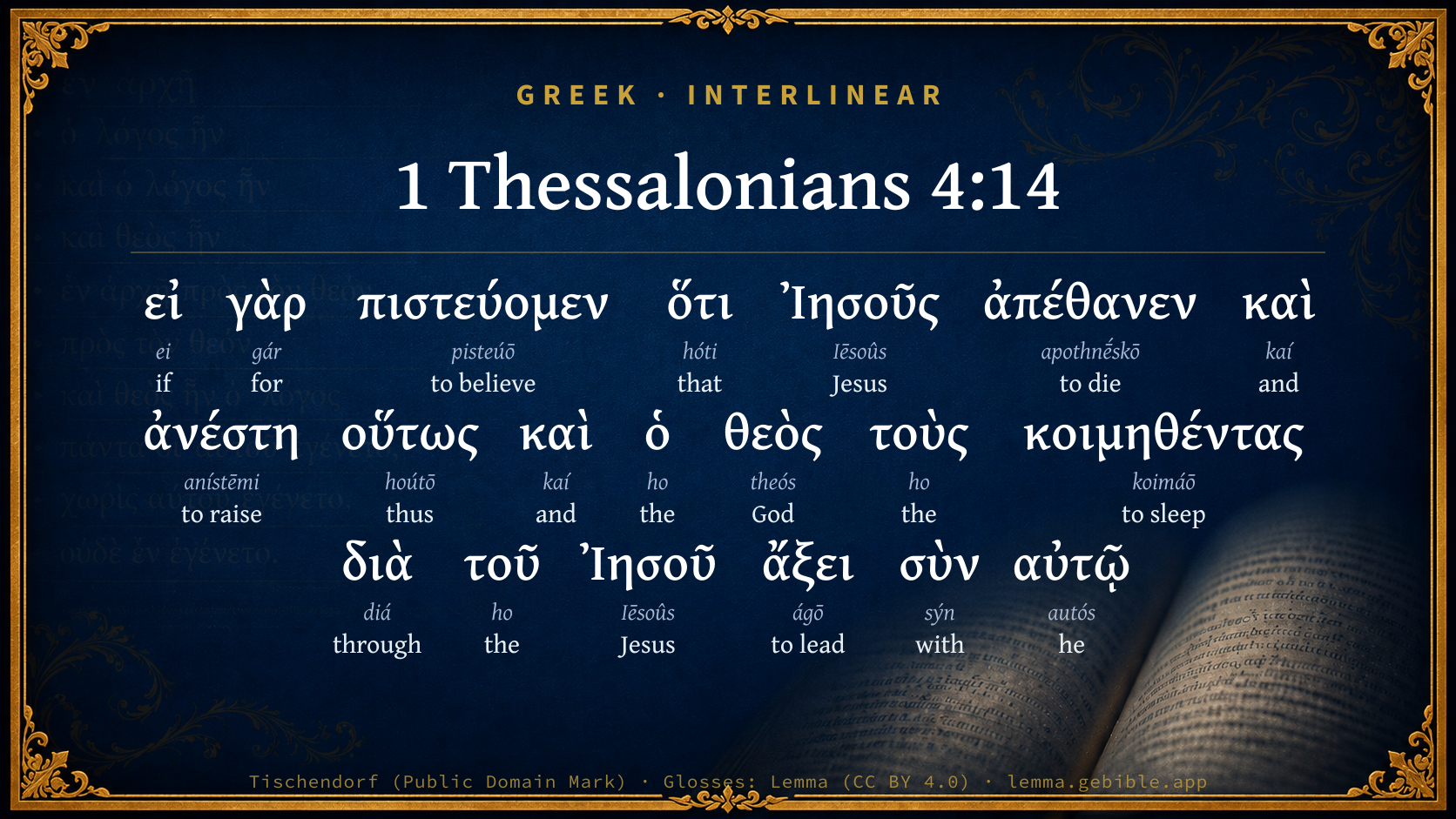
  1. εἰ ei G1487 “if” Conditional
  2. γὰρ gár G1063 “for” Conjunction
  3. πιστεύομεν pisteúō G4100 “to believe” Verb, Present, Active, Indicative, 1st person, Plural
  4. ὅτι hóti G3754 “that” Conjunction
  5. Ἰησοῦς Iēsoûs G2424 “Jesus” Noun, Nominative, Singular, Masculine
  6. ἀπέθανεν apothnḗskō G599 “to die” Verb, Aorist, Active, Indicative, 3rd person, Singular
  7. καὶ kaí G2532 “and” Conjunction
  8. ἀνέστη anístēmi G450 “to raise” Verb, Aorist, Active, Indicative, 3rd person, Singular
  9. οὕτως hoútō G3779 “thus” Adverb
  10. καὶ kaí G2532 “and” Conjunction
  11. ὁ ho G3588 “the” Article, Nominative, Singular, Masculine
  12. θεὸς theós G2316 “God” Noun, Nominative, Singular, Masculine
  13. τοὺς ho G3588 “the” Article, Accusative, Plural, Masculine
  14. διὰ diá G1223 “through” Preposition
  15. τοῦ ho G3588 “the” Article, Genitive, Singular, Masculine
  16. Ἰησοῦ Iēsoûs G2424 “Jesus” Noun, Genitive, Singular, Masculine
  17. ἄξει ágō G71 “to lead” Verb, Future, Active, Indicative, 3rd person, Singular
  18. σὺν sýn G4862 “with” Preposition
  19. αὐτῷ autós G846 “he” Personal pronoun, Dative, Singular, Masculine

About this verse

These counts appear in no published source. They are computed here, from the morphology-tagged text and Lemma’s own curated glosses. What Lemma adds →

20
words
16
distinct lemmas
Pauline Epistles
section

Notable vocabulary

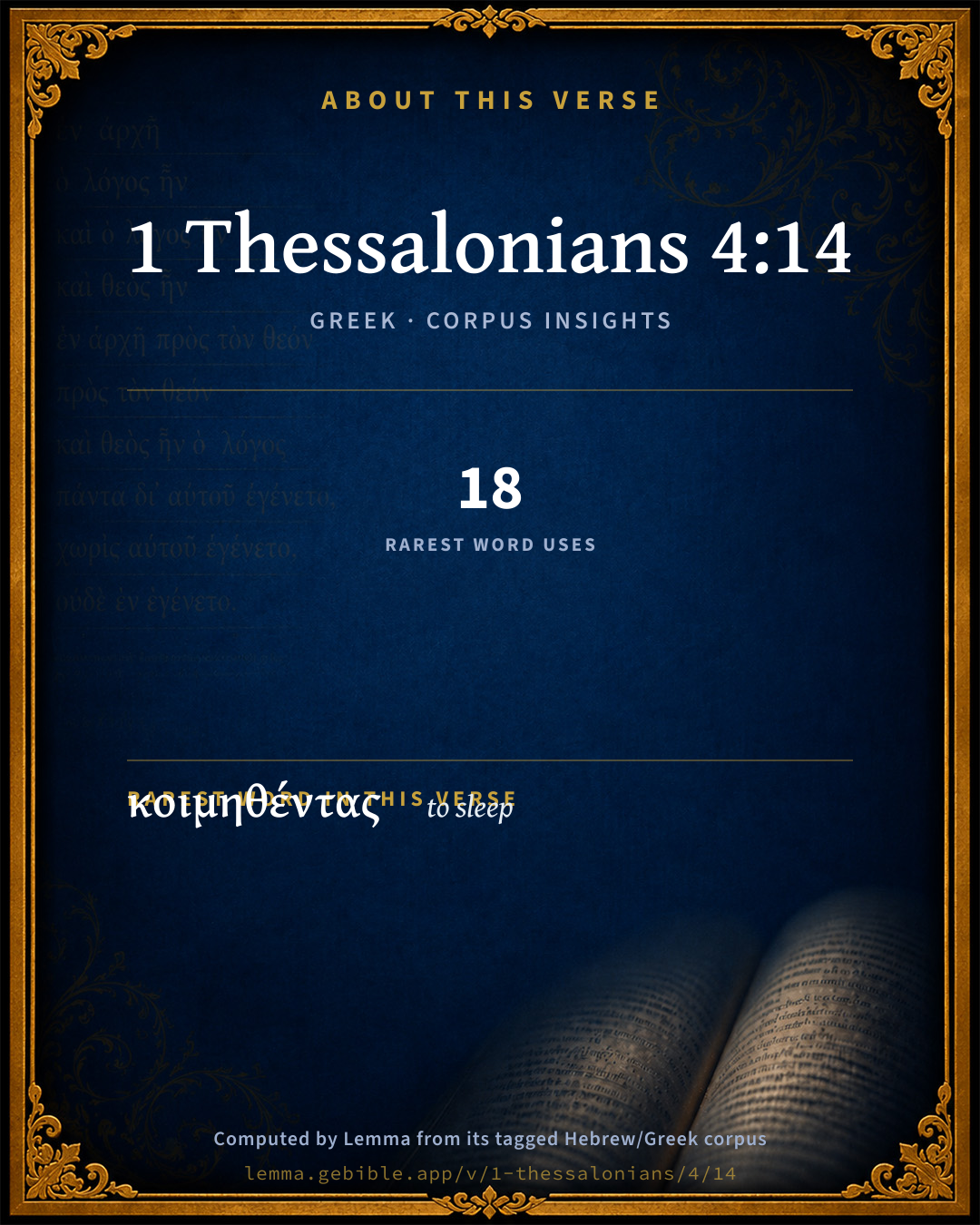
The rarest word here is κοιμηθέντας to sleep G2837 — appearing just 18 times in the whole Greek New Testament.

Shared distinctive vocabulary

κοιμηθέντας to sleep G2837 occurs in 18 verses of the Greek New Testament. Also found in:

Repetition

Words recur within this verse:

Cross-references

13

Topical passages linked to 1 Thessalonians 4:14 in the Treasury of Scripture Knowledge — connected by theme and wording, ordered by reader-vote popularity; previews shown in the World English Bible.

  • Romans 8:11 But if the Spirit of him who raised up Jesus from the dead dwells in you, he who raised up Christ Jesus from the dead will also give life to your mortal bodies through his Spirit who dwells in you.
  • Philippians 3:20–21 For our citizenship is in heaven, from where we also wait for a Savior, the Lord Jesus Christ;
  • Isaiah 26:19 Your dead shall live; my dead bodies shall arise. Awake and sing, you who dwell in the dust; for your dew is [as] the dew of herbs, and the earth shall cast forth the dead.
  • 2 Corinthians 4:13–14 But having the same spirit of faith, according to that which is written, "I believed, and therefore I spoke." We also believe, and therefore also we speak;
  • 1 Thessalonians 4:13 But we don't want you to be ignorant, brothers, concerning those who have fallen asleep, so that you don't grieve like the rest, who have no hope.
  • 1 Thessalonians 3:13 to the end he may establish your hearts blameless in holiness before our God and Father, at the coming of our Lord Jesus with all his saints.
  • 1 Thessalonians 4:17 then we who are alive, who are left, will be caught up together with them in the clouds, to meet the Lord in the air. So we will be with the Lord forever.
  • Revelation 1:18 and the Living one. I was dead, and behold, I am alive forevermore. Amen. I have the keys of Death and of Hades.
  • Revelation 14:13 I heard the voice from heaven saying, "Write, 'Blessed are the dead who die in the Lord from now on.'" "Yes," says the Spirit, "that they may rest from their labors; for their works follow with them."
  • Jude 1:14–15 About these also Enoch, the seventh from Adam, prophesied, saying, "Behold, the Lord came with ten thousands of his holy ones,
  • Matthew 24:31 He will send out his angels with a great sound of a trumpet, and they will gather together his chosen ones from the four winds, from one end of the sky to the other.
  • 1 Corinthians 15:12–23 Now if Christ is preached, that he has been raised from the dead, how do some among you say that there is no resurrection of the dead?
  • 2 Thessalonians 2:1 Now, brothers, concerning the coming of our Lord Jesus Christ, and our gathering together to him, we ask you

Cross-references courtesy of OpenBible.info (CC BY 4.0).

Commentary

Notes on 1 Thessalonians 4:14 from classic Christian and Jewish commentators (each source and its license shown beneath its notes). The classic Christian expositions comment on the surrounding passage and are grouped to its opening verse, so a note may address several verses; the Jewish commentaries on the Tanakh (Rashi and others) are per-verse, so they appear only where the commentator wrote on this verse.

Lemma curates 59 commentaries, every one of them public domain or Creative Commons licensed, each selected and text-cleaned for this edition rather than reprinted as found. About our sources →

The Cambridge Bible for Schools and Colleges

gen. ed. J. J. S. Perowne

14. For if we believe that Jesus died and rose again] The faith of a Christian man in its briefest and simplest form. So in Rom_10:9 the Apostle declares the faith that “saves” to be the belief of the heart that “God raised Jesus from the dead.” This involves everything else; it carries with it the conviction that Christ is Divine (Rom_1:4), and that His death brings “justification of life” for men (Rom_4:25). Such faith St Paul assumes, for himself and his readers, as a fundamental fact. He speaks of “Jesus,” thinking of Him in His human Person and in the analogy of His experience to our own. He is “Firstborn of many brethren, Firstborn out of the dead” (Rom_8:29; Col_1:18); and what we believe of Jesus, we may expect to see fulfilled in His brethren.

even so them also which sleep in Jesus] Rather, which fell asleep. The verb is past (historical) in tense. The Apostle is looking back with his readers to the sorrowful event of their friends’ decease, that he may give them comfort; comp. 1Th_4:15.

in Jesus is in the Greek through Jesus,—or more strictly, that fell asleep (possibly, were laid to sleep) through the Jesus just spoken of,—Him “Who died and rose again.” For the force of the preposition, comp. 1Th_4:2 and note. The departed Thessalonian Christians had “fallen asleep;” for them Death was robbed of his terrors and transformed to Sleep. “Through Jesus” this came to pass—the Jesus of their faith, the dying, risen Saviour! Trusting in His Name, remembering and realising what it meant, they had met the last enemy, and conquering their fears they “laid them down and slept.” Such is the power of this Name in the last conflict:

“Jesus! my only hope Thou art,

Strength of my failing flesh and heart!”

(Chas. Wesley’s Dying Hymn.)

them that fell asleep through Jesus, God will bring with Him. God (expressed with emphasis) is the Agent in their restoration, as in ch. 1Th_1:10 in the “raising” of “His Son from the dead.” He “Who raised up the Lord Jesus, will raise up us also with Jesus” (2Co_4:14; comp. Eph_1:19-20). But the Apostle does not say here “will raise them with Jesus,” it is not the resurrection of the dead that is in question, but their relation to the Parousia, their place in Christ’s approaching kingdom. Therefore he says: “God will bring them with Him,”—they will not be forgotten or left behind when Jesus comes in triumph.

The argument of this verse is condensed and somewhat subtle. When the Apostle begins, “If we believe” &c., we expect him to continue, “so we believe that those who died will, by the power of Christ’s resurrection, be raised to life, and will return to share His glory.” But in the eagerness of his inference St Paul passes from the certainty of conviction in the first member of the sentence (“If we believe”) to the certainty of the fact itself (“God will bring them”) in the second. In the same eagerness of anticipation he blends the final with the intermediate stage of restoration, making the resurrection of Jesus the pledge not of the believer’s resurrection simply (as in 2Co_4:14), but of his participation in Christ’s glorious advent, of which His resurrection is the prelude (comp. ch. 1Th_1:10, “to wait for His Son from the heavens, Whom He raised from the dead,” and note). The union between Christ and the Christian, as St Paul conceives it, is such that in whatever Christ the Head does or experiences, He carries the members of His body with Him. The Christian dead are “the dead in Christ” (1Th_4:16); they will therefore be in due course the risen and the glorified in Christ (2Th_1:12); comp. 2Ti_2:11, “If we died with Him, we shall also live with Him.” The point of the Apostle’s reasoning lies in the connection of the words “died and rose again.” Jesus has made a pathway through the grave, and by this passage His faithful, fallen asleep, still one with the dying, risen Jesus, will be conducted, to appear with Him at His return.

The Cambridge Bible for Schools and Colleges (gen. ed. J. J. S. Perowne; Cambridge University Press, 1878–1918) — public domain. Text from a community e-Sword module.

The Biblical Illustrator

Joseph S. Exell

1Th_4:14

For if we believe that Jesus died and rose again, even so them also which sleep in Jesus will God bring with Him

Christs resurrection and ours

I.

The event predicted. Will God bring with Him.

1. This is affirmed to meet the fear that God could not do so. The ground of their sorrow was that their departed friends would be deprived of the glories of Christs advent, which was thought to be near. Paul now assures them that the dead will share it as powerfully as the living.

2. The Thessalonians thus believed in Christs second coming. This was a subject often on our Lords lips, and is a prominent feature in this Epistle. It is kept in the background by many Christians to their disadvantage. Frequent thought about it is requisite to spirituality of mind. Paul says, Our conversation is in heaven, and his reason is from whence also we look for the Saviour. Heavenly mindedness is the drawing of self to Christ.

3. If God brings departed saints with Him, they are with Him now, otherwise He could not bring them. They are the general assembly of the first born; Spirits of just men made perfect; Absent from the body, present with the Lord. The New Testament again and again asserts that the saints after death go direct into Gods presence.

4. When departed spirits are brought by God they will know one another. It is amazing to suppose that we should know each other on earth and not in heaven; that we should have a less amount of perception as to each others character and identity there than here. If this be admitted the passage which was intended to comfort is a mockery. How could the Thessalonians be comforted by the coming of their deceased friends if they were not to know them? Read 1Th_2:19-20. How could Pauls converts be his crown of rejoicing if he was not to know them? The same doctrine is proved from the parable of the rich man and Lazarus and from the appearance of Moses and Elias at the Transfiguration.

II. Its certainty.

1. If we believe that Christ died and rose again it follows as a necessary consequence that those who sleep in Him He will bring with Him. Observe how everything is based on the death and resurrection of Christ; and in view of that it is no wonder that the first preachers were selected because they were witnesses of the resurrection.

(1) The object of Christs death was to redeem unto Himself a peculiar people. When God speaks of the results of that death as to its primary purpose, He says, He shall see His seed; He shall see of the travail of His soul and be satisfied.

(2) The object of the resurrection was to be the guarantee that the work of redemption was accomplished, and to be the first fruits of its accomplishment; to be followed by its proper results, a harvest. So that if we believe these two facts, i.e., that Christ finished the whole work that the Father gave Him to do, we must believe that the Father will fulfil His covenant part of the transaction and give to Christ the seed, and that the seed shall be perfected and glorified. To this it is necessary that He should bring the spirits of the saints to meet their bodies, which is the assertion of Paul here.

2. It follows, also, that the Church being thus perfected in herself must also be perfected in her circumstances. Father I will also that those whom Thou gavest Me be with Me, etc. (1Th_2:17).

III. Its object and purpose. The reunion of the saints--

1. With their bodies.

2. With their friends.

3. With Christ, body and soul.

Conclusion: The passage is full of comfort, but there is a tremendous limitation in it. It refers exclusively to those who sleep in Christ and those who are living in Him when He comes. Are you in Christ? (C. Molyneux, M. A.)

Christs resurrection the pledge of ours

At our birth our bodies became a battleground between life and death. During the first ten years death makes many conquests. At ten years death begins to fall back. At twenty, life is triumphant. At thirty, life foresees the future. At forty, the battle is hot. At fifty, death inflicts some wounds, and life begins an orderly retreat. At sixty, life feels her strength failing. At seventy, the retreat becomes a rout. At eighty, death waves the black flag and cries, No quarter! This is no fancy picture; it is no preachers dream; it is a fact undeniable, inevitable, universal! Indifference cannot affect its certainty, and scepticism cannot refute its truth. There is only one other fact with which we can confront this fact of death, and that is the resurrection of Jesus. Here fact meets fact. That is what we demand. We want a fact, a case, an instance, one single instance of resurrection. Once a sea captain found his crew on shore apparently dead. The surgeon took one of the men and applied remedies, and the poisoned man stood on his feet. The captain shouted with joy, for in that one risen man he saw the possibility to save them all. So Christ brings life and immortality to light. His resurrection is not metaphysics, but history. Not speculation for the future, but a fact of the past. Not a problem to be solved, but the solution of all problems. (R. S. Barrett.)

The certainty and blessedness of the resurrection of true Christians

I. What is meant by those that sleep in Jesus.

1. Sleep is a metaphor used by sacred and profane writers. The ancient Christians called their place of burial Koimetrion sleeping place. The figure is applied to the death of the wicked, but more frequently to that of the righteous (Isa_57:2). Fitly is death so called as signifying rest (Rev_14:13), and as preparatory to waking.

2. Death is called a sleeping in Jesus in conformity with 1Co_15:18; 1Co_15:23; 1Th_4:16; Heb_11:13. To sleep in Christ, to be Christs, to die in Christ, to die in the faith, all mean the same; to die in the state of true Christians as to be in Christ (Joh_15:4; Rom_13:1), means to be a Christian. And it is observable that we share all Christs acts--die, rise, ascend, etc. with Him.

3. Some think that this is the sleep of the soul, but, on the contrary, Scripture applies the figure invariably to the body (Dan_12:2; Mat_27:52; Act_13:36); and it is inconsistent with those passages which clearly affirm the soul to be awake (Luk_16:22-23; Luk_23:43; Php_1:23; 2Co_5:6).

II. What is meant by Gods bringing with Him them that sleep in Jesus.

1. The death and resurrection of Christ are an argument and proof of ours. Christs death is mentioned as part of the argument because the truth of the miracle of the resurrection depends upon it. If Christ did not die He could not have risen. The resurrection is shown in 1Co_15:20 to be the pledge and first fruits of ours. And that Christ intended to lay great stress upon this argument, appears in that He foretold it so often as the great sign He would give to the Jews to confute their infidelity (Joh_2:18-19; Mat_12:39-40). Christs resurrection gives us satisfaction in general of immortality, and then of His power to raise us because He raised Himself. And then it assures us of His truth and fidelity that He will perform what He promised. He could not have promised anything more improbable than His own resurrection; and, therefore, since He kept His word in this, there is no reason to distrust Him in anything else that He has promised (Rev_1:18; Rev_3:14).

2. Wherein the blessedness of the just shall consist.

(1) In the mighty change which shall be made in our bodies and the glorious qualities with which they shall be invested.

(a) Equal to the angels in immortal duration, and children of God in the perfect possession of His happiness (Luk_20:35-36).

(b) Fashioned like unto the glorious body of Christ (Php_4:20).

(c) 1Co_15:35, etc.).

(2) In the consequent happiness of the whole man, the body purified from frailty and corruption, and the soul from sin, and both admitted to the sight and enjoyment of the ever-blessed God (Rev_21:2-4; Rev_21:27; Rev_22:3-4). (Abp. Tillotson.)

The dead Christ and sleeping Christians

I. Jesus died that we might sleep. The thought is that He, though sinless, died like a sinner. He took the place of a sinner; was treated as a sinner as far as possible without sinning. He became what we sinners are, that we, the sinners, as far as possible, might become what He, the Righteous, is. Jesus died, then; His disciples sleep. Jesus spake of Lazarus sleeping, but never referred to His own death as sleep: that was not sleep, but death in its utter awfulness. The sting of death, He felt it; the victory of death, He yielded to it; the curse of death, He bore it; the desolation of death, He endured it; the darkness of death, He dreaded it. O death! where is thy sting? O grave! where is thy victory? were not words of our blessed Saviour, though they may be of the blessed dead.

II. If we believe that Jesus rose from the dead, we may also believe that those who sleep in Jesus, God will bring with Him. So far as we loved them, we may love them as ever, as we shall yet behold them perfect in Jesus, without a semblance of sin, pure as He is pure. When He died, His sorrows were over, His work was done. And observe a remarkable fact--the body of the Redeemer was preserved from every indignity after the spirit had departed. Up to the moment of His death, He was subjected to every outrage. He was like the sinner; He was acting for the sinner; He was suffering for the sinner; and, while He was a consenting party, every indignity was heaped upon Him. But from the moment His spirit left His body, every honour was done to Him. His body, after His resurrection, was very unlike His body previously--it was a spiritual body, invisible, and passing when and where it would and doing what it would. That body will be the model of our bodies; and the prime thought of St. Paul is--He will bring our friends to us again, and we shall know them, and be with them forever with the Lord. (A. Lind, D. D.)

Resting on Gods Word

A pastor in visiting a member of his church found her very sick, apparently dying. He said to her: Mrs. M., you seem to be very sick. Yes, said she, I am dying. And are you ready to die? She lifted her eyes upon him with a solemn and fixed gaze, and, speaking with great difficulty, she replied: Sir, God knows--I have taken Him--at His word--and--I am not afraid to die. It was a new definition of faith. I have taken Him at His word, What a triumph of faith! What else could she have said that would have expressed so much in so few words?

The Biblical Illustrator, edited by Joseph S. Exell (c. 1880s–1900s) — public domain. Text from a community e-Sword module.

Joseph Benson's Commentary

1Th 4:14. For if we believe that Jesus died and rose again — Namely, 1st, In attestation of the truth of his doctrine, in which he taught expressly the immortality of the soul, Mat 10:28; Luk 23:43; and the resurrection of the body, Joh 5:28-29. 2d, For the expiation of sin, and the procuring of justification and peace with God for the penitent that should believe in him, however guilty they had before been, Heb 9:26; Rom 4:24-25. 3d, That he might procure and receive for us the Holy Spirit, to work that repentance and faith in us, assure us of our justification and of our title to that future felicity, and to prepare us for it by inward holiness; and, 4th, That he might ascend, take possession of it in our name, receive our departing souls, and raise from the dust our fallen and corrupted bodies, and so exalt us to that immortal, glorious, and blessed state; even so them also which sleep in Jesus — Who die in the Lord, (Rev 14:13,) in union with him, and possessed of an interest in him; will God bring with him — They will be found in the train of his magnificent retinue at his final appearance, when he comes to judge the world, and reward his faithful servants.

Joseph Benson's Commentary on the Old and New Testaments (1811–1818) — public domain. Text from a community e-Sword module.

The Pulpit Commentary

For if we believe that Jesus died and rose again. The apostle"s argument proceeds on the supposition that Christ and believers are one body, of which Christ is the Head and believers are the members; and that consequently what happens to the Head must happen to the members. Our knowledge and belief of a future state, and especially of the resurrection, is founded on the resurrection of Christ. (comp. 1Co_15:12-20) Even so them also which sleep in Jesus; or more literally, through Jesus. Will God bring with him; namely, with Jesus. These words are differently construed. Some read them thus: "Even so them also which sleep will God through Jesus bring with him" (De Wette, Lunemann); but this appears to be an awkward construction; as we must then render the clause, "will God through Jesus bring with Jesus." It is, therefore, better to refer the words, "through Jesus," to the first clause. It is through Jesus that believers fall asleep; it is he who changes the nature of death, for all his people, from being the king of terrors into a quiet and gentle sleep, from which they will awaken to eternal life. Resurrection of believers.

The ground of their resurrection rests on their union to Christ and on his resurrection. Not only are their souls immortal, but their bodies shall be redeemed from the grave. The voice of the archangel and the trump of God will call them from their graves, and, endowed with spiritual bodies, they shall be caught up in the clouds to meet the Lord in the air. The resurrection is purely a doctrine of revelation; it formed no part of the religion of nature; the natural analogies which are adduced are defective in essential points.

Vers. 14, 15.

Reasons against sorrow for the dead.

The apostle gives several reasons why the Thessalonians ought not to sorrow for their dead.

I THE FUNDAMENTAL REASON IS THE DEATH AND RESURRECTION OF CHRIST. "If we believe that Jesus died and rose again." These are the primary facts of Christianity. They are inseparably linked together, for the resurrection was the crown of the redeeming sacrifice; for if he was delivered for our offences, he was raised again for our justification. Deny either or both, we "are yet in our sins.

II THE SECOND REASON IS, WHEN CHRIST COMES AGAIN FROM THE FATHER"S RIGHT HAND, HE WILL BRING WITH HIM THE SLEEPING SAINTS. "Even so them also who sleep in Jesus will God bring with him.

1. The dead saints sleep in Jesus. They arc associated with him both in life and in death. They "die in the Lord;" "they are present with the Lord.

2. They will accompany Jesus at his second coming. This includes

(1) their resurrection from the dead, for "he who raised up the Lord Jesus shall raise up us also by Jesus"; (2Co_4:14)

(2) their joining the retinue of Jesus to share his triumph. As risen from the dead, he becomes the Firstfruits of them that slept.

III THE THIRD REASON IS THAT THE LIVING SAINTS WILL NOT PRECEDE THE DEAD SAINTS AT THE COMING OF CHRIST. "For this we say unto you by the word of the Lord, that we which are alive and remain unto the coming of the Lord shall not precede them which are asleep." This fact would effectively dissipate their sorrow for their departed friends.

1. It is a fact wade known by special revelation. Such revelations were frequently made to the apostle, as in the case of his special mission field, (Act_22:18-21) the position of Gentile saints, (Eph_3:3) the Lord"s Supper, (1Co_11:23) and the reality and proofs of Christ"s resurrection. (1Co_15:3)

2. It is a fact that does not imply either the nearness of the second advent, or the apostles own share as a living man in its glories. He says, "We which are alive and remain to the coming of Christ;" he merely identifies the living believers of the last age with himself, as if he said, "Those of us Christians who may be alive at the advent." He could not have believed that he would not die before the advent, for

(1) that would imply that "the word of the Lord" had misled him;

(2) he actually preferred to be absent from the body, and toward the end of his life spoke of death as "gain," and of his desiring "to depart and be with Christ," words quite inconsistent with this theory;

(3) he virtually declares in the Second Epistle that the advent could not happen in his lifetime; (2Th 2)

(4) he knew that no man, not even the Son of man, knew the time of the advent. (Mar_13:4)

3. It is a fact that the living saints will not get the start of the dead saints in the coming of the Lord. This is his express revelation from the Lord. "The dead in Christ shall rise first," or before the living are changed. (1Co 15) The Thessalonians need not, therefore, sorrow for their departed friends, neither be afraid themselves to die. T.C.

The Pulpit Commentary (1880–1919), ed. H.D.M. Spence-Jones & Joseph S. Exell — public domain. Text from a community e-Sword module.

MacLaren's Expositions of Holy Scripture

Alexander MacLaren

1 Thessalonians

SLEEPING THROUGH JESUS

1Th 4:14.

That expression is not unusual, in various forms, in the Apostle’s writings. It suggests a very tender and wonderful thought of closeness and union between our Lord and the living dead, so close as that He is, as it were, the atmosphere in which they move, or the house in which they dwell. But, tender and wonderful as the thought is, it is not exactly the Apostle’s idea here. For, accurately rendered--and accuracy in regard to Scripture language is not pedantry--the words run, ‘Them which sleep through Jesus.’

Now, that is a strange phrase, and, I suppose, its strangeness is the reason why our translators have softened it down to the more familiar and obvious ‘in Jesus.’ We can understand living through Christ, on being sacred through Christ, but what can sleeping through Christ mean? I shall hope to answer the question presently, but, in the meantime, I only wish to point out what the Apostle does say, and to plead for letting him say it, strange though it sounds. For the strange and the difficult phrases of Scripture are like the hard quartz reefs in which gold is, and if we slur them over we are likely to loose the treasure. Let us try if we can find what the gold here may be.

Now, there are only two thoughts that I wish to dwell upon as suggested by these words. One is the softened aspect of death, and of the state of the Christian dead; and the other is the ground or cause of that softened aspect.

I. First, then, the softened aspect of death, and of the state of the Christian dead.

It is to Jesus primarily that the New Testament writers owe their use of this gracious emblem of sleep. For, as you remember, the word was twice upon our Lord’s lips; once when, over the twelve-years-old maid from whom life had barely ebbed away, He said, ‘She is not dead, but sleepeth’; and once when in regard of the man Lazarus, from whom life had removed further, He said, ‘Our friend sleepeth, but I go that I may awake him out of sleep.’ But Jesus was not the originator of the expression. You find it in the Old Testament, where the prophet Daniel, speaking of the end of the days and the bodily Resurrection, designates those who share in it as ‘them that sleep in the dust of the earth.’ And the Old Testament was not the sole origin of the phrase. For it is too natural, too much in accordance with the visibilities of death, not to have suggested itself to many hearts, and been shrined in many languages. Many an inscription of Greek and Roman date speaks of death under this figure; but almost always it is with the added, deepened note of despair, that it is a sleep which knows no waking, but lasts through eternal night.

Now, the Christian thought associated with this emblem is the precise opposite of the pagan one. The pagan heart shrank from naming the ugly thing because it was so ugly. So dark and deep a dread coiled round the man, as he contemplated it, that he sought to drape the dreadfulness in some kind of thin, transparent veil, and to put the buffer of a word between him and its hideousness. But the Christian’s motive for the use of the word is the precise opposite. He uses the gentler expression because the thing has become gentler.

It is profoundly significant that throughout the whole of the New Testament the plain, naked word ‘death’ is usually applied, not to the physical fact which we ordinarily designate by the name, but to the grim thing of which that physical fact is only the emblem and the parable, viz., the true death which lies in the separation of the soul from God; whilst predominately the New Testament usage calls the physical fact by some other gentler form of expression, because, as I say, the gentleness has enfolded the thing to be designated.

For instance, you find one class of representations which speak of death as being a departing and a being with Christ; or which call it, as one of the apostles does, an ‘exodus,’ where it is softened down to be merely a change of environment, a change of locality. Then another class of representations speak of it as ‘putting off this my tabernacle,’ or, the dissolution of the ‘earthly house’--where there is a broad, firm line of demarcation drawn between the inhabitant and the habitation, and the thing is softened down to be a mere change of dwelling. Again, another class of expressions speak of it as being an ‘offering,’ where the main idea is that of a voluntary surrender, a sacrifice or libation of myself, and my life poured out upon the altar of God. But sweetest, deepest, most appealing to all our hearts, is that emblem of my text, ‘them that sleep.’ It is used, if I count rightly, some fourteen times in the New Testament, and it carries with it large and plain lessons, on which I touch but for a moment. What, then, does this metaphor say to us?

Well, it speaks first of rest. That is not altogether an attractive conception to some of us. If it be taken exclusively it is by no means wholesome. I suppose that the young, and the strong, and the eager, and the ambitious, and the prosperous rather shrink from the notion of their activities being stiffened into slumber. But, dear friends, there are some of us like tired children in a fair, who would fain have done with the weariness, who have made experience of the distractions and bewildering changes, whose backs are stiffened with toil, whose hearts are heavy with loss. And to all of us, in some moods, the prospect of shuffling off this weary coil of responsibilities and duties and tasks and sorrows, and of passing into indisturbance and repose, appeals. I believe, for my part, that, after all, the deepest longing of men--though they search for it through toil and effort--is for repose. As the poet has taught us, ‘there is no joy but calm.’ Every heart is weary enough, and heavy laden, and labouring enough, to feel the sweetness of a promise of rest:--

‘Sleep, full of rest from head to foot, Lie still, dry dust, secure of change.’

Yes! but the rest of which our emblem speaks is, as I believe, only applicable to the bodily frame. The word ‘sleep’ is a transcript of what sense enlightened by faith sees in that still form, with the folded hands and the quiet face and the closed eyes. But let us remember that this repose, deep and blessed as it is, is not, as some would say, the repose of unconsciousness. I do not believe, and I would have you not believe, that this emblem refers to the vigorous, spiritual life, or that the passage from out of the toil and moil of earth into the calm of the darkness beyond has any power in limiting or suspending the vital force of the man.

Why, the very metaphor itself tells us that the sleeper is not unconscious. He is parted from the outer world, he is unaware of externals. When Stephen knelt below the old wall, and was surrounded by howling fanatics that slew him, one moment he was gashed with stones and tortured, and the next ‘he fell on sleep.’ They might howl, and the stones fly as they would, and he was all unaware of it. Like Jonah sleeping in the hold, what mattered the roaring of the storm to him? But separation from externals does not mean suspense of life or of consciousness, and the slumberer often dreams, and is aware of himself persistently throughout his slumber. Nay! some of his faculties are set at liberty to work more energetically, because his connection with the outer world is for the time suspended.

And so I say that what on the hither side is sleep, on the further side is awaking, and that the complex whole of the condition of the sainted dead may be described with equal truth by either metaphor; ‘they sleep in Jesus’; or, ‘when I awake I shall be satisfied with Thy likeness.’

Scripture, as it seems to me, distinctly carries this limitation of the emblem. For what does it mean when the Apostle says that to depart and to be with Christ is far better? Surely he who thus spoke conceived that these two things were contemporaneous, the departing and the being with Him. And surely he who thus spoke could not have conceived that a millennium-long parenthesis of slumberous unconsciousness was to intervene between the moment of his decease and the moment of his fellowship with Jesus. How could a man prefer that dormant state to the state here, of working for and living with the Lord? Surely, being with Him must mean that we know where we are, and who is our companion.

And what does that text mean: ‘Ye are come unto the spirits of just men made perfect,’ unless it means that of these two classes of persons who are thus regarded as brought into living fellowship, each is aware of the other? Does perfecting of the spirit mean the smiting of the spirit into unconsciousness? Surely not, and surely in view of such words as these, we must recognise the fact that, however limited and imperfect may be the present connection of the disembodied dead, who sleep in Christ, with external things, they know themselves, they know their home and their companion, and they know the blessedness in which they are lapped.

But another thought which is suggested by this emblem is, as I have already said, most certainly the idea of awaking. The pagans said, as indeed one of their poets has it, ‘Suns can sink and return, but for us, when our brief light sinks, there is but one perpetual night of slumber.’ The Christian idea of death is, that it is transitory as a sleep in the morning, and sure to end. As St. Augustine says somewhere, ‘Wherefore are they called sleepers, but because in the day of the Lord they will be reawakened?’

And so these are the thoughts, very imperfectly spoken, I know, which spring like flowers from this gracious metaphor ‘them that sleep’--rest and awaking; rest and consciousness.

II. Note the ground of this softened aspect.

They ‘sleep through Him.’ It is by reason of Christ and His work, and by reason of that alone, that death’s darkness is made beautiful, and death’s grimness is softened down to this. Now, in order to grasp the full meaning of such words as these of the Apostle, we must draw a broad distinction between the physical fact of the ending of corporeal life and the mental condition which is associated with it by us. What we call death, if I may so say, is a complex thing--a bodily phenomenon plus conscience, the sense of sin, the certainty of retribution in the dim beyond. And you have to take these elements apart. The former remains, but if the others are removed, the whole has changed its character and is become another thing, and a very little thing.

The mere physical fact is a trifle. Look at it as you see it in the animals; look at it as you see it in men when they actually come to it. In ninety-nine cases out of a hundred it is painless and easy, and men sink into slumber. Strange, is it not, that so small a reality should have power to cast over human life so immense and obscuring a shadow! Why? Because, as the Apostle says, ‘the sting of death is sin,’ and if you can take the sting out of it, then there is very little to fear, and it comes down to be an insignificant and transient element in our experience.

Now, the death of Jesus Christ takes away, if I may so say, the nimbus of apprehension and dread arising from conscience and sin, and the forecast of retribution. There is nothing left for us to face except the physical fact, and any rough soldier, with a coarse, red coat upon him, will face that for eighteenpence a day, and think himself well paid. Jesus Christ has abolished death, leaving the mere shell, but taking all the substance out of it. It has become a different thing to men, because in that death of His He has exhausted the bitterness, and has made it possible that we should pass into the shadow, and not fear either conscience or sin or judgment.

In this connection I cannot but notice with what a profound meaning the Apostle, in this very verse, uses the bare, naked word in reference to Him, and the softened one in reference to us. ‘If we believe that Jesus Christ died and rose again, even so them also which sleep.’ Ah! yes! He died indeed, bearing all that terror with which men’s consciences have invested death. He died indeed, bearing on Himself the sins of the world. He died that no man henceforward need ever die in that same fashion. His death makes our deaths sleep, and His Resurrection makes our sleep calmly certain of a waking.

So, dear ‘brethren, I would not have you ignorant concerning them which are asleep, that ye sorrow not even as others which have no hope.’ And I would have you to remember that, whilst Christ by His work has made it possible that the terror may pass away, and death may be softened and minimised into slumber, it will not be so with you--unless you are joined to Him, and by trust in the power of His death and the overflowing might of His Resurrection, have made sure that what He has passed through, you will pass through, and where He is, and what He is, you will be also.

Two men die by one railway accident, sitting side by side upon one seat, smashed in one collision. But though the outward fact is the same about each, the reality of their deaths is infinitely different. The one falls asleep through Jesus, in Jesus; the other dies indeed, and the death of his body is only a feeble shadow of the death of his spirit. Do you knit yourself to the Life, which is Christ, and then ‘he that believeth on Me shall never die.’

Alexander MacLaren, Expositions of Holy Scripture (1904–1910) — public domain. Text from a community e-Sword module.

Tyndale Open Study Notes

Tyndale Open Resources

4:14 The central Christian creed, that Jesus died and was raised to life again, is the foundation for hope in the face of death, guaranteed by the resurrection of Christ (1 Cor 15). • God will bring back refers to the resurrection of believers (1 Thes 4:16).

Tyndale Open Study Notes — © Tyndale Open Resources, licensed CC BY-SA 4.0. Text via the HelloAO Bible API.

Bengel's Gnomon

Johann Albrecht Bengel

1Th 4:14. Γὰρ, for) The Scripture, from among so many topics of consolation in regard to death, generally brings forward this one concerning the resurrection, as principal and pre-eminent.—ἀπέθανε, died) This word is usually applied to Christ; whereas to fall asleep is applied to believers, 1Co 15:3; 1Co 15:6; 1Co 15:18; 1Co 15:20; 1Co 15:51.—οὕτω) in like manner, as Jesus Himself rose, so we believe that we shall be conducted alive by the path of death.—διὰ τοῦ Ἰησοῦ, in Jesus) This is construed with κοιμηθέντας,[19] who have fallen asleep. For the verb, will lead [bring], which follows, has accordingly the with Him standing in apposition, and answering to the words, διὰ τοῦ Ἰησοῦ, in Jesus.

[19] Lit. Those lulled to sleep by Jesus.—ED.

Bengel's Gnomon of the New Testament — English translation (T&T Clark, Edinburgh, 1860) — public domain. Text from a community e-Sword module.

Meyer's Critical & Exegetical Commentary

Heinrich August Wilhelm Meyer

1Th_4:14. Reason not of οὐ θέλομεν ὑμᾶς ἀγνοεῖν, but of ἵνα μὴ λυπῆσθε. The Thessalonians were not to mourn, for Christ has risen from the dead; but if this fact be certain, then it follows that they also who are fallen asleep, about whom the Thessalonians were so troubled, will be raised. There lies at the foundation of this proof, which Paul uses as a supposition, the idea that Christ and believers form together an organism of indissoluble unity, of which Christ is the Head and Christians are the members; consequently what happens to the Head must likewise happen to the members; where that is, there these must also be. Comp. already Pelagius: Qui caput suscitavit, etiam caetera membra suscitaturum se promittit. From the nature of this argument it is evident (1) that those who are asleep, about whom the Thessalonians grieved, must already have been Christians; (2) that their complete exclusion from the blessed fellowship with Christ was dreaded.[54]

εἰ γὰρ πιστεύομεν] for if we believe. εἰ is not so much as quum, since, because (Flatt), also not equivalent to quodsi: for as we believe (Baumgarten-Crusius), but is here, as always, hypothetical. But since Paul from the hypothetical protasis, without further demonstrating it, immediately draws the inference in question, it is clear that he supposes the fact of the death and resurrection of Christ as an absolute recognised truth, as, indeed, among the early Christians generally no doubt was raised concerning the reality of this fact. For even in reference to the Corinthian church, among whom doubts prevailed concerning the resurrection of the dead, Paul, in combating this view, could appeal to the resurrection of Christ as an actual recognised truth; comp. 1Co_15:12-23.

The apodosis, 1Th_4:14, does not exactly correspond with the protasis. Instead of οὕτως κ.τ.λ. we should expect ΚΑῚ ΠΙΣΤΕΎΕΙΝ ΔΕῖ, ὍΤΙ ὩΣΑΎΤΩς ΟἹ ἘΝ ΧΡΙΣΤῷ ΚΟΙΜΗΘΈΝΤΕς ἈΝΑΣΤΉΣΟΝΤΑΙ, or ὍΤΙ ΟὝΤΩς Ὁ ΘΕῸς ΚΑῚ ΤΟῪς ΚΟΙΜΗΘΈΝΤΑς ΔΙᾺ ΤΟῦ ΧΡΙΣΤΟῦ ἘΓΕΡΕῖ.

ΟὝΤΩς] is not pleonastic as the mere sign of the apodosis (Schott, Olshausen); also not, with Flatt, to be referred to ἈΝΈΣΤΗ, and then to be translated in such a condition, i.e. raised, revived; or to be interpreted as then under these circumstances, i.e. in case we have faith (Koch, Hofmann), but denotes even so, and, strengthened by the following καί, is designed to bring forward the agreement of the fate of Christians with Christ; comp. Winer, p. 478 [E. T. 679].

ΔΙᾺ ΤΟῦ ἸΗΣΟῦ] is (by Chry sostom, Ambrosiaster, Calvin, Hemming, Zanchius, Estius, Balduin, Vorstius, Cornelius a Lapide, Beza, Grotius, Calixt, Calov, Wolf, Whitby, Benson, Bengel, Macknight, Koppe, Jowett, Hilgenfeld (Zeitschr. f. wissenschaftl. Theolog., Halle 1862, p. 239), Riggenbach, and others) connected with τοὺς κοιμηθέντας, and then the sense is given: those who have fallen asleep, in Christ.[55] But this would be expressed by ἐν τῷ Ἰησοῦ, as ΟἹ ΔΙᾺ ΤΟῦ ἸΗΣΟῦ ΚΟΙΜΗΘΈΝΤΕς would at most contain a designation of those whom Christ had brought to death, consequently of the Christian martyrs. Salmeron, Hammond, Joseph Mede, Opp. p. 519, and Thiersch (die Kirche im apostol. Zeitalter, Frankf. u. Erlang. 1852, p. 138) actually interpret the words in this sense. Yet how contrary to the apostles design such a mention of the martyrs would be is evident, as according to it the resurrection and participation in the glory of the returning Christ would be most inappropriately limited to a very small portion of Christians; not to mention that, first, the indications in both Epistles do not afford the slightest justification of the idea of persecutions, which ended in bloody death; and, secondly, the formula κοιμηθῆναι διὰ τινός would be much too weak to express the idea of martyrdom. Also in the fact that Paul does not speak of the dead in general, but specially of the Christian dead, there is no reason to unite ΤΟῪς ΚΟΙΜΗΘΈΝΤΑς with ΔΙᾺ ΤΟῦ ἸΗΣΟῦ; for the extent of the idea of ΟἹ ΚΟΙΜΗΘΈΝΤΕς in our passage is understood from the relation of the apodosis, 1Th_4:14, to the protasis ΕἸ ΠΙΣΤΕΎΟΜΕΝ Κ.Τ.Λ. We are accordingly constrained to unite ΔΙᾺ ΤΟῦ ἸΗΣΟῦ with ἌΞΕΙ.

Christ is elsewhere by Paul and in the New Testament generally considered as the instrument by which the almighty act of God, the resurrection of the dead, is effected; comp. 1Co_15:21; Joh_5:28; Joh_6:39; Joh_6:44; Joh_6:54.

ἌΞΕΙ] will bring with Him, is a pregnant expression, whilst, instead of the act of resuscitation, that which follows the act in time is given. And, indeed, the further clause σὺν αὐτῷ, i.e. σὺν Ἰησοῦ (incorrectly Zacharius and Koppe = Ὡς ΑὐΤΌΝ), is united in a pregnant form with ἌΞΕΙ. God will through Christ bring with Him those who are asleep, that is, so that they are then united with Christ, and have a complete share in the benefits of His appearance. Hofmann arbitrarily transforms the words into the thought: that Jesus will not appear, God will not introduce Him again into the world, without their deceased brethren coming with Him. For the words instruct us not concerning Jesus, but concerning the κοιμηθέντες; it is not expressed in what manner the return of Christ will take place, but what will be the final fate of those who have fallen asleep. The apostle selects this pregnant form of expression instead of the simple ἘΓΕΡΕῖ, because the thought of a separation of deceased Christians from Christ was that which so greatly troubled the Thessalonians, and therefore it was his endeavour to remove this anxiety, this doubting uncertainty, as soon as possible.[56]

[54] Hofmanns views are very distorted and perverted. He will not acknowledge that from the fact of the resurrection of Christ, the resurrection of those fallen asleep in Thessalonica is deduced; andagainst which the οὕτως καί of the apodosis should have guarded himhe deduces the aimless platitude, that the apostle with the words: ὁ Θεὸς τοὺς κοιμηθέντας διὰ τοῦ Ἰησοῦ ἄξει σὺν αὐτῷ, gives an assurance which avails us in the case of our death, if we believe on the death and resurrection of Jesus. As Hofmann misinterprets the words, so also does Luthardt, supra, p. 140 f.

[55] Also Alford connects διὰ τοῦ Ἰησοῦ with κοιμηθέντας; but then arbitrarily (comp. οἱ νεκροὶ ἐν Χριστῷ, ver. 16) pressing the expression κοιμηθέντας (οἱ κοιμηθέντες are distinguished from the merely θανόντες. What makes this distinction? Why are they asleep and not dead? By whom have they been thus privileged? Certainly διὰ τοῦ Ἰησοῦ), and inappropriately regarding the constructions εὐχαριστεῖν διὰ Ἰησοῦ Χριστοῦ, Rom_1:8; εἰρήνην ἔχειν διὰ Ἰησοῦ, Rom_5:1, καυχᾶσθαι διὰ Ἰησοῦ, Rom_5:11, as analogous expressions, he brings out the following grammatically impossible meaning: If we believe that Jesus died and rose again, then even thus also those, of whom we say that they sleep just because of Jesus, will God, etc.

[56] The idea of a general ascension of all Christians, which Schrader finds in this verse, and in which he perceives a mark of un-Pauline composition, because Paul thought only on a kingdom of God on earth, is, according to the above, introduced by him into the passage.

Meyer — Critical and Exegetical Commentary on the New Testament — English translation by Peter Christie, edited by Frederick Crombie (T&T Clark, 1880) — public domain. Text from a community e-Sword module.

Expositor's Greek Testament

ed. W. Robertson Nicoll

1Th 4:14 . Unlike some of the Corinthians (1Co 15:17-18 ), the Thessalonians did not doubt the fact of Christ’s resurrection ( εἰ of course implies no uncertainty). Paul assumes their faith in it and argues from it. Their vivid and naïve belief in Christ’s advent within their own lifetime was the very source of their distress. Paul still shares that belief (17). διὰ τοῦ Ἰησοῦ is an unusual expression which might, so far as grammar is concerned, go either with τ . κ . (so. e.g. , Ellic., Alford, Kabisch, Lightfoot, Findlay, Milligan) or ἄξει . The latter is the preferable construction (so most editors). The phrase is not needed ( cf. 15) to limit τ . κ . to Christians (so Chrys., Calvin), for the unbelieving dead are not before the writer’s mind, and, even so, ἐν would have been the natural preposition ( cf. 16), nor does it mean martyrdom. In the light of 1Th 5:9 ( cf. Rom 5:9 ; 1Co 15:21 ), it seems to connect less awkwardly with ἄξει , though not = “at the intercession of Jesus” (Rutherford). Jesus is God’s agent in the final act, commissioned to raise and muster the dead ( cf. Stähelin, Jahrb. f. deut. Theol. , 1874, 189 f., and Schettler, Die paul. Formel, “Durch Christus,” 1997, 57 f.). The divine mission of the Christ, which is to form the climax of things, involves the resurrection of the dead who are His (1Th 5:10 ). Any general resurrection is out of the question (so Did., xvi. 6: ἀνάστασις νεκρῶν · οὐ πάντων δὲ , ἀλλʼ ὡς ἐρρέθη , ἥξει ὁ Κύριος καὶ πάντες οἱ ἅγιοι μετʼ αὐτοῦ ).

The Expositor's Greek Testament, edited by W. Robertson Nicoll (1897–1910) — public domain. Text from a community e-Sword module.

Cambridge Greek Testament for Schools and Colleges

14. εἰ γὰρ πιστεύομεν ὅτι Ἰησοῦς ἀπέθανεν καὶ ἀνέστη. For if we believe that Jesus died and rose again: the faith of a Christian in its briefest statement (cf. 1Co 15:3 f.); the form of supposition, εἰ with pres. indicative, assumes the fact,—for writers and readers alike (we believe: cf. 1Co 15:11). In Rom 10:9 St Paul declares the faith that “saves” to be the heart-belief that “God raised Jesus our Lord from the dead”; in 1Co 15:13-19 he argues that “if Christ hath not been raised” the whole Gospel is false, affording no salvation from sin, and no assurance that dying Christians do not perish in the grave. Granted this one certainty, and these consequences are reversed. See 1Co 6:14-15 at large; 2Co 4:14; Rom 4:24; Rom 5:10; Rom 8:11; Rom 14:7-9; Php 3:10 f., for other teaching of St Paul bearing on the momentous and manifold effects of the resurrection of Jesus. In this connexion the Redeemer is “Jesus,” being thought of in His human person and in the analogy of His experience to our own; hence οὔτως καί in the apodosis. What we believe of this “firstborn amongst many brethren, firstborn out of the dead” (Rom 8:29; Col 1:18), we trust to see fulfilled in His brethren: ἀπαρχὴ χριστός, ἔπειτα οἱ τοῦ χριστοῦ ἐν τῇ παρουσίᾳ αὐτοῦ (1Co 15:20-23).

οὕτως καὶ ὁ θεὸς τοὺς κοιμηθέντας διὰ τοῦ Ἰησοῦ ἄξει σὺν αὐτῷ. So also will God, (in the case of) those who fell asleep through Jesus, bring (them) along with Him: this awkward rendering reproduces the order of the Greek words, which throw emphasis on the action of God, who is conceived as the Raiser-up of the Lord Jesus, and associate Christ’s people with Him in this restoration (cf. 1Th 1:10; 1Co 6:14; 2Co 4:14; Gal 1:1; Eph 1:19 f.). The aorist participle, τοὺς κοιμηθέντας, looks back to the “falling asleep” from the standpoint of the Parousia (ἄξει σὺν αὐτῷ).

The διά clause may belong grammatically either to the participle or to the principal verb ἄξει (note the article, τοῦ Ἰησοῦ, “the Jesus” who “died and rose again,” &c.): two considerations make for its association with κοιμηθέντας—the occurrence of the like combination in 1Th 4:16, οἱ νεκροὶ ἐν Χριστῷ; and the fitness of the adjunct as an explanation of the emphatically reaffirmed κοιμᾶσθαι. “Through Jesus” (per Jesum, Vulg.; not in Jesu, as in Beza) the Thessalonian Christians had “fallen asleep”: death in their case was robbed of its terrors, as the survivors would remember, and transformed into sleep; clinging to the name of Jesus, they defied death (cf. Rom 8:38 f.). Such faith in Him whom He raised from the dead, God will not disown; He “will bring them (back from the unseen world) with Him.”

“Jesus! my only hope Thou art,

Strength of my failing flesh and heart!”

(Charles Wesley’s Dying Hymn.)

The argument of this verse is elliptical, its compression being due to the vivacity and eagerness of the Apostle’s mind, especially manifest under strong emotion. More completely expressed, his syllogism would read thus: “If we believe that Jesus died and rose again on our behalf, we are bound to believe that He will raise up those who fell asleep in death trusting in Him, and will restore them to us at His return.” St Paul leaps over two steps in drawing out his conclusion: (1) he argues from belief in the fact in his protasis to the fact itself in the apodosis; (2) he tacitly assumes the immediate consequence, viz. the resurrection of the κοιμηθέντες guaranteed by the resurrection of Jesus, in his haste to anticipate the ultimate consequence, their return along with Jesus; for it was about the share of their beloved dead in the Advent that the readers were anxious. Underlying this assurance we trace St Paul’s deep and characteristic doctrine of the union between Christ and Christians. This unity becomes clearer as we proceed: see 1Th 4:16 f. (οἱ νεκροὶ ἐν Χριστῷ, πάντοτε σὺν κυρίῳ ἐσόμεθα); 1Th 5:10; 2Th 1:12; 2Th 2:14; cf. 1Co 15:23; 2Co 4:10; Rom 6:5; Col 3:1-4; 2Ti 2:11, &c. The nerve of the Apostle’s reasoning lies in the connexion of the words “died and rose again”: Jesus has made a pathway through the grave; by this passage His faithful, fallen asleep but still one with Him, are conducted to appear with Him at His return. Ἄξει, “ducet, suave verbum: dicitur de viventibus” (Bengel). Cf. Heb 2:10, πολλοὺς υἱοὺς εἰς δόξαν ἀγαγόντα; but the thought here is that of reunion with the living saints, rather than of guidance to heavenly glory (see 2Th 2:1).

Cambridge Greek Testament for Schools and Colleges (Cambridge University Press, 1896; 21 vols, various authors incl. Carr, Maclear, Plummer, Farrar, Lumby, Moule, M. R. James, Simcox) — public domain. Text from a community e-Sword module.

International Critical Commentary

14. εἰ γὰρ πιστεύομεν κτλ. The γά introduces the reason for ἵνα μὴ λυπῆσθ, already hinted at in ἔχοντες ἐλπίδ (v. 13): “for if we believe that Jesus died and rose, so also God will lead on those who fell asleep through Jesus along with him.” The Greek sentence runs smoothly (cf. 1:8), but there is an obvious compression of thought. Since οὕτως και in the apodosis suggests a comparison, Paul might have said: “As we are convinced that Jesus died and that God raised him from the dead, so also must we believe, since the indwelling Christ is the guarantee of the resurrection of the believer, that God will raise from the dead those who died through Jesus and will lead them on along with him.” There are, however, compensations in the compactness, for from a subjective conviction based on experience and stated conditionally, “if we believe, as we do, that Jesus died and rose,” Paul is able to draw directly an objective inference, “so also God will,” etc.

The fact of fulfilment lies not in the form of the condition but in the context (BMT 242). The context here indicates that the Thessalonians are perplexed by doubts not as to the fact of the resurrection of the dead but as to whether the dead will have equal advantage with the survivors at the Parousia. By the insertion of ὁ θεό in the protasis, Paul makes clear that it is God who raised Jesus from the dead (1:10, 1Co 6:14, 2Co 4:14, Rom 8:11, Rom 10:9, etc.). On πιστεύει in the sense of conviction, cf. πιστεύειν ὅτ in Rom 6:8, Rom 10:9.

ἀπέθανεν καὶ ἀνέστ. The death and resurrection of Jesus are inseparable in Paul’s thought about salvation. As Christ died and rose actually, so does the believer die and rise with him mystically (Gal 2:19, Rom 6:3 ff. Col 2:20, Col 3:1 ff.). The presence of Christ or the Spirit in the Christian guarantees that when he actually dies ἐν Χριστῷ (1Co 15:18) or διὰ Χριστου (here), he will continue ἐν Χριστῷ (v. 16) during the interval between death and resurrection, and will at the Parousia be raised from the dead by God through the power of the same indwelling Christ or Spirit (Rom 8:11), and will attain the ultimate goal of Christian hope, εἶναι σὺν Χριστῷ. This characteristically Pauline idea is the probable link that unites the protasis and apodosis of our verse.

Paul regularly uses ἐγείρειν (ἐξεγείρει 1Co 6:14) for the resurrection; he uses ἀνιστάνα elsewhere only in Eph 5:14, a quotation, and below v. 16 in an utterance distinctly traditional in flavour. On the other hand, he uses ἀνάστασις (ἐξανάστασι Php 3:11), but not ἔγερσι (Mat 27:53). On the name Ἰησοῦ, see 1:10 and cf. Rom 8:11, 2Co 4:14. For οὕτως και without an expressed correlative, cf. Gal 4:3, Rom 6:11, 1Co 2:11, 1Co 2:9:14, 1Co 2:14:9, 1Co 2:12, 1Co 2:15:42, 45. The reading of B, et al., οὕτως ὁ θεὸς και brings out the point that as God raised Jesus, so also he will raise the believers; cf. 1Co 15:18: ἄρα καὶ οἱ κοιμηθέντες ἐν Χριστῷ, where not only the dead but also (και) the living (ὑμεῖς) ἀπώλοντ Though οὕτω without an expressed correlative is frequent in Paul (cf. v. 17, II 3:17, Gal 1:6), yet the και is placed here (cf. v. 10) by B to mark the connection with τοὺς κοιμηθέντα (Weiss, 136).

τοὺς κοιμηθέντας διὰ τοῦ Ἰησου. “Those who fell asleep through Jesus,” that is, through the indwelling power of that Jesus who died and rose again, the causal energy which operates in the believers from baptism to actual resurrection from the dead (v. supra on ἀπέθανε). Though the union of δια with κοιμηθέντα is striking, yet it is consonant with Paul’s thinking, is demanded by the parallelism of the sentence (Ell., Dob.), and is the logical though not the grammatical equivalent of οἱ κοιμηθέντες ἐν Χριστῷ in 1Co 15:18 (cf. v. 1 ἐν κυρίῳ with v. 3 διὰ κυρίο).

Those who join διὰ τοῦ Ἰησου with the participle (e. g. Ephr., Chrys., Calv., Grot., Ell., Lft., Mill., Dob., Dibelius) do so on various grounds. Calvin (apud Lillie) says: “dormire per Christum is to retain in death the union (coniunctionem) which we have with Christ; for they who by faith are engrafted into Christ have their death in common with him. that they may be partners in his life.” Lake (The Earlier Epistles of St. Paul, 1911, 88) thinks it probable “that it means martyrdom rather than a natural death”; so before him Musculus (apud Lillie): “The faithful die through Christ, when on his account they are slain by the impious tyrants of the world.” Lake further conjectures that the reference to the death “of the Lord Jesus and of the prophets” (2:15) certainly suggests that persecution in Thessalonica “had already led to the martyrdom of some Christians” (loc. cit). Dob. contents himself with a general statement: “Sie sind gestorben, indem ein Verhältniss zu Jesus dabei war.” For Dibelius, the Pauline conception revealed in v. 14 “wurzelt in den Mysterien.”—On the other hand, many expositors (e. g. Th. Mops., De W., Lü., Lillie, Schmiedel, Born, Wohl., Schettler, Moff.) join διὰ τοῦ Ἰησου with ἄξε The reasons adduced are (1) that it is unnecessary to designate the dead as Christian and (2) that δια is made equivalent to ἐ In reply it is urged that we have οἱ νεκροὶ ἐν Χριστῷ (v. 16) and that the equivalence between δια and ἐ is not grammatical but conceptual. In this alternative view, Jesus is God’s agent in both resurrection and ἄγει (Th. Mops. and finally Schettler (op. cit. 57): “Gott wind sick bedienen, um die Toten zu erwecken und die Erweckten zu sammeln).”—The view that joins διὰ τοῦ Ἰησου with κοιμηθέντα is preferable not simply because it gives a distinctively Pauline turn to the passage but also because it is grammatically better. On the latter point, Ell. remarks vigorously: “The two contrasted subjects Ἰησοῦ and κοιμηθέντας διὰ τοῦ Ἰησου thus stand in clear and illustrative antithesis, and the fundamental declaration of the sentence ἄξει σὺν αὐτῷ remains distinct and prominent, undiluted by any addititious clause.”

ἄξει σὺν αὐτῷ In these words, the “fundamental declaration” of Paul’s reply (vv. 11-18), just supported by an appeal to the internal evidence of the believer’s experience of the indwelling Christ, is succinctly stated. The believers are not to sorrow; for the departed saints, as well as the survivors, will at the Parousia be in the company of Christ and follow his lead. What is added in v. 15 confirms the same declaration on the external evidence of a summarised word of the Lord. How it is that the survivors will not anticipate the dead (v. 15) is then further explained in vv. 16-17 where Paul selects from a traditional description of the Parousia such points as bring into prominence his central contention, εἶναι σὺν αὐτῷ

Since σὺν αὐτῷ (v. 17, 5:10, 2Co 13:4, Php 1:23) is the goal of ἐν Χριστῷ (Deiss. Neutestamentliche Formel “in Christo Jesu,” 126), ἄγει refers to the final act when Jesus the victor over enemies (II 2:8, 1Co 15:24 ff.), accompanied by his saints, leads the way heavenward to hand over the kingdom to God the Father. The resurrection and ἐπισυναγωγη (II 2:1), the redemption, change, or transformation of the body (Rom 8:23, 1Co 15:51, Php 3:21), and the judgment are all presupposed. Paul is not here concerned with the details; even in the description vv. 16-17 only such pertinent features are sketched as prepare the readers for the conclusion which he draws: καὶ οὕτως πάντοτε σὺν κυρίῳ ἐσόμεθ It is thus unnecessary to take σὺν αὐτῷ = εἰς τὸ εἶναι αὐτοὺς σὺν αὐτῷ, as Th. Mops. does: “quoniam et illos suscitabit per Jesum ita ut et sint cum eo”; for σὺν αὐτῷ begins both for living and for dead immediately at the Parousia and continues forever (πάντοτ v. 17).

International Critical Commentary — older volumes (1896–1929), various authors — public domain. Text from a community e-Sword module.

Geneva Bible (1599)

Geneva Bible translators

A reason of the confirmation, for seeing that the head is risen, the members also shall rise, and that by the virtue of God.

They die in Christ, which continue in faith, whereby they are grafted into Christ, even to the last gasp.

Will call their bodies out of their graves, and join their souls to them again.

Geneva Bible (1599) marginal notes — public domain. Text via Bolls.life.

Jamieson, Fausset & Brown

Robert Jamieson, A. R. Fausset & David Brown

For if--confirmation of his statement, Th1 4:13, that the removal of ignorance as to the sleeping believers would remove undue grief respecting them. See Th1 4:13, "hope." Hence it appears our hope rests on our faith ("if we believe"). "As surely as we all believe that Christ died and rose again (the very doctrine specified as taught at Thessalonica, Act 17:3), so also will God bring those laid to sleep by Jesus with Him (Jesus)." (So the order and balance of the members of the Greek sentence require us to translate). Believers are laid in sleep by Jesus, and so will be brought back from sleep with Jesus in His train when He comes. The disembodied souls are not here spoken of; the reference is to the sleeping bodies. The facts of Christ's experience are repeated in the believer's. He died and then rose: so believers shall die and then rise with Him. But in His case death is the term used, Co1 15:3, Co1 15:6, &c.; in theirs, sleep; because His death has taken for them the sting from death. The same Hand that shall raise them is that which laid them to sleep. "Laid to sleep by Jesus," answers to "dead in Christ" (Th1 4:16).

Jamieson, Fausset & Brown — Commentary Critical and Explanatory on the Whole Bible (1871) — public domain (CC PDM 1.0). Text via the HelloAO Bible API.

Adam Clarke's Commentary

Verse 14. For if we believe that Jesus died and rose again] ει γαρ. Seeing that we believe; knowing that the resurrection of Christ is as fully authenticated as his death.

Even so them] It necessarily follows that them who sleep-die, in him-in the faith of the Gospel, will God bring with him-he will raise them up as Jesus was raised from the dead, in the same manner, i.e. by his own eternal power and energy; and he will bring them with him-with Christ, for he is the head of the Church, which is his body.

Adam Clarke's Commentary on the Bible (1810–1826) — public domain. Text from a community e-Sword/MySword module.

John Calvin's Commentaries

14 For if we believe. He assumes this axiom of our faith, that Christ was raised up from the dead, that we might be partakers of the same resurrection: from this he infers, that we shall live with him eternally. This doctrine, however, as has been stated in 1 Corinthians 15:13, depends on another principle — that it was not for himself, but for us that Christ died and rose again. Hence those who have doubts as to the resurrection, do great injury to Christ: nay more, they do in a manner draw him down from heaven, as is said in Romans 10:6

To sleep in Christ, is to retain in death the connection that we have with Christ, for those that are by faith ingrafted into Christ, have death in common with him, that they may be partakers with him of life. It is asked, however, whether unbelievers will not also rise again, for Paul does not affirm that there will be a resurrection, except in the case of Christ’s members. I answer, that Paul does not here touch upon anything but what suited his present design. For he did not design to terrify the wicked, but to correct the immoderate grief of the pious, and to cure it, as he does, by the medicine of consolation.

John Calvin's Commentaries (1540-1563) — public domain. Text from the Calvin Translation Society English edition (1840s-50s) via the Christian Classics Ethereal Library (ccel.org). Calvin's coverage is partial (roughly two-thirds of the Bible); uncommented books and verses are honest gaps, never fabricated. The 19th-century editor's footnotes and remarks are omitted so the notes are faithfully Calvin's own voice.

Ellicott's Commentary for English Readers

(14) For if . . .—A reason for thinking that if the Thessalonians knew and believed the truth, they ought not to be so miserable. The “if” implies no doubt: “if we believe (as we do), then,” &c.—merely clearing the ground for a logical deduction. The writer does not care to prove so well-known a fact as the resurrection of Christ; he only argues from the clear faith of the Thessalonians with regard to it.

Jesus died and rose again.—Notice the human name; for though it is true that as God He raised Himself (Joh_10:18), as man He was no less dependent upon the Father than we are (Act_17:31): therefore His resurrection is a real argument for ours. And the two verbs are put together because of their contrariety—“really died a human death, and yet rose again.”

Even so.—The structure of the clauses is not quite regular. We should have expected either the omission of “we believe that” in the first, or the insertion of it in the second: it makes the statement of the second, however, more direct or authoritative.

Which sleep in Jesus.—Rather, which were laid to sleep through Jesus. The meaning of the preposition, however, is not widely different from “in.” The simpler words in Rev_14:13 mean “dying in full communion still with Him.” Our present phrase makes Him, as it were, the way, or door, by which they journeyed to death: He surrounded them as they sank to rest (Comp. Joh_10:9.) Additional sweetness is imparted to the phrase by the use of the metaphor of sleep; but it is, perhaps, too much to say, as Dean Alford does, that “falling asleep” is here contrasted with “dying,” in this sense:—“Who through the power of Jesus fell asleep instead of dying”—for the word is even used of a judicial punishment of death in 1Co_11:30.

Will God bring with him—i.e., with Jesus. In the Greek the word God stands in an unemphatic position—“Even so will God bring,” implying that it was God also who had raised Jesus from the dead. But St. Paul is not content with saying, “Even so will God raise those who passed through Christ to death.” The thought of the Advent is so supreme with him that he passes at once to a moment beyond resurrection. If the question be asked from whence God will bring the dead along with Christ, it must be answered, from Paradise, and the persons brought must be the disembodied spirits; for in 1Th_4:16 this coming of the Lord with the saints is the signal for the dead—i.e., the bodies—to rise. It must be owned, however, that this manner of speaking is unusual. Jesus is no longer in Paradise, for the spirits to be brought thence with Him; and one would have expected something more like “bringing up” (Heb_13:20), as it is always considered a descent into “hell” or Paradise. Because of this difficulty (which however is more in form than reality), some take the words to mean, “God will lead them by the same path with Christ”—i.e., will make their whole career (including resurrection) conform with His, comparing the same verb in Rom_8:14; Heb_2:10.

A Bible Commentary for English Readers, edited by Charles John Ellicott (1878–1897) — public domain. Text from a community e-Sword module.

John Gill's Exposition

For if we believe that Jesus died, and rose again,.... As every Christian does, for both the death and resurrection of Christ are fundamental articles of faith; nothing is more certain or more comfortable, and more firmly to be believed, than that Christ died for the sins of his people, and rose again for their justification; on these depend the present peace, joy, and comfort of the saints, and their everlasting salvation and happiness: and no less certain and comfortable, and as surely to be believed, is what follows,

even so them also which sleep in Jesus will God bring with him. The saints that are dead are not only represented as asleep, as before, but as "asleep in Jesus"; to distinguish them from the other dead, the wicked; for the phrase of sleeping in death is promiscuously used of good and bad, though most commonly applied to good men: and so say the Jews (c),

"we used to speak of just men, not as dead, but as sleeping; saying, afterwards such an one fell asleep, signifying that the death of the righteous is nothing else than a sleep.''

To represent death as a sleep makes it very easy and familiar; but it is more so, when it is considered as sleeping in Jesus, in the arms of Jesus; and such as are asleep in him must needs be at rest, and in safety: some join the phrase "in", or "by Jesus", with the word bring, and read the passage thus, "them that are asleep, by Jesus will God bring with him"; intimating, that God will raise up the dead bodies of the saints by Christ, as God-man and Mediator; and through him will bring them to eternal glory, and save them by him, as he has determined: others render the words, "them which sleep through", or "by Jesus"; or die for his sake, and so restrain them to the martyrs; who they suppose only will have part in the first resurrection, and whom God will bring with Jesus at his second coming; but the coming of Christ will be "with all his saints"; see Th1 3:13 wherefore they are best rendered, "them that sleep in Jesus"; that is, "in the faith of Jesus", as the Arabic version renders it: not in the lively exercise of faith on Christ, for this is not the case of all the saints at death; some of them are in the dark, and go from hence under a cloud, and yet go safe, and may be said to die, or sleep, in Jesus, and will be brought with him; but who have the principle, and hold the doctrine of faith, are, and live and die, true believers; who die interested in Christ, in union with him, being chosen and blessed, and preserved in him from everlasting, and effectually called by his grace in time, and brought to believe in him; these, both their souls and bodies, are united to Christ, and are his care and charge; and which union remains in death, and by virtue of it the bodies of the saints will be raised at the last day: so that there may be the strongest assurance, that such will God bring with him; either God the Father will bring them with his Son, or Jehovah the Son will bring them with himself; he will raise them from the dead, and unite them to their souls, or spirits, he will bring with him; the consideration of which may serve greatly to mitigate and abate sorrow for deceased friends.

(c) Shebet Juda, p. 294. Ed. Gent.

John Gill's Exposition of the Whole Bible (1746–1763) — public domain (CC PDM 1.0). Text via the HelloAO Bible API.

Trapp's Complete Commentary

John Trapp

14 For if we believe that Jesus died and rose again, even so them also which sleep in Jesus will God bring with him.

Ver. 14. Sleep in Jesus] Dead in Christ. The union then is not dissolved by death. But as by sleep the body is refreshed, so by death it is refined. Let our care be to cleave close to Christ in the instant of death; so shall he be to us, both in life and death, advantage.

John Trapp, A Commentary or Exposition upon All the Books of the Old and New Testament (1647–1656) — public domain. Text from a community e-Sword module.

Albert Barnes' Notes on the Bible

For if we believe that Jesus died and rose again - That is, if we believe this, we ought also to believe that those who have died in. the faith of Jesus will be raised from the dead. The meaning is not that the fact of the resurrection depends on our believing that Jesus rose, but that the death and resurrection of the Saviour were connected with the resurrection of the saints; that the one followed from the other, and that the one was as certain as the other. The doctrine of the resurrection of the saints so certainly follows from that of the resurrection of Christ, that, if the one is believed, the other ought to be also; see the notes on 1Co 15:12-14.

Which sleep in Jesus - A most beautiful expression. It is not merely that they have calm repose - like a gentle slumber - in the hope of awaking again, but that this is “in Jesus” - or “through” (διὰ dia) him; that is, his death and resurrection are the cause of their quiet and calm repose. They do not “sleep” in paganism, or in infidelity, or in the gloom of atheism - but in the blessed hope which Jesus has imparted. They lie, as he did, in the tomb - free from pain and sorrow, and with the certainty of being raised up again.

They sleep in Jesus, and are bless’d,

How kind their slumbers are;

From sufferings and from sin released,

And freed from every snare.

When, therefore, we think of the death of saints, let us think of what Jesus was in the tomb of Joseph of Arimathea. Such is the sleep of our pious friends now in the grave; such will be our own when we die.

Will God bring with him - This does not mean that God will bring them with him from heaven when the Saviour comes - though it will be true that their spirits will descend with the Saviour; but it means that he will bring them from their graves, and will conduct them with him to glory, to be with him; compare notes, Joh 14:3. The declaration, as it seems to me, is designed to teach the general truth that the redeemed are so united with Christ that they shall share the same destiny as he does. As the head was raised, so will all the members be. As God brought Christ from the grave, so will he bring them; that is, his resurrection made it certain that they would rise. It is a great and universal truth that God will bring all from their graves who “sleep in Jesus;” or that they shall all rise. The apostle does not, therefore, refer so much to the time when this would occur - meaning that it would happen when the Lord Jesus should return - as to the fact that there was an established connection between him and his people, which made it certain that if they died united with him by faith, they would be as certainly brought from the grave as he was.

If, however, it means, as Prof. Bush (Anastasis, pp. 266, 267) supposes, that they will be brought with him from heaven, or will accompany him down, it does not prove that there must have been a previous resurrection, for the full force of the language would be met by the supposition that their spirits had ascended to heaven, and would be brought with him to be united to their bodies when raised. If this be the correct interpretation, then there is probably an allusion to such passages as the following, representing the coming of the Lord accompanied by his saints. “The Lord my God shall come, and all the saints with thee.” Zec 14:5. “And Enoch, the seventh from Adam, prophesied of these, saying, Behold, the Lord cometh, with thousand of his saints;” Jud 1:14. “Who,” says President Dwight (Serm. 164), “are those whom God will bring with Him at this time? Certainly not the bodies of his saints ... The only answer is, he will bring with him ‘the spirits of just men made perfect.’”

Albert Barnes' Notes on the Bible (1834–1885) — public domain. Text from a community e-Sword/MySword module.

Matthew Poole's English Annotations

As in the former verse the apostle made use of the hope of the resurrection, as an argument against immoderate sorrow, so here he proves the resurrection by Christ’s rising again, &c.

For if we believe that Jesus died and rose again; he supposeth they did believe that Christ died and rose again; it was that which he had taught them, and which they had received, as being the two first and fundamental points of the Christian faith, without which they could not have been a church of Christ.

Question. But how doth Christ’s resurrection prove the resurrection of the saints? He being the eternal Son of God, might have a privilege above all.

Answer. This first shows the thing is possible, God hath already done it in Christ.

2. Christ rose for our justification, Rom 4:25; and in justification sin is pardoned which brought in death, and which alone by its guilt can keep under the dominion of death.

3. Christ rose not as a private person, but as the Head of the body, his church, Eph 1:4,20, &c., and so loosed the bands of death, and conquered the grave, for his people.

4. As the first-fruits, 1Co 15:20, which was a pledge and assurance of the whole harvest to follow.

5. God hath predestinated the elect, whom he foreknew, to be conformed to the image of his Son, Rom 8:29.

6. He is not complete without them, Eph 1:23.

Lastly: They sleep in Jesus, as the text speaks; not only live but die in him, Rev 14:13, their union remains with Christ even in death.

Even so them also which sleep in Jesus; by which words also the apostle distinguisheth believers from all others; it is only they shall have the privilege of this blessed resurrection who sleep in Jesus. And perseverance in Christ to the end is here also intimated.

Will God bring with him; and though their resurrection is not expressed in the text, yet it is implied in this saying. By God is meant, as some understand here, the Son of God, who is to come from heaven, 1Th 1:10, and who will bring the spirits of just men, made perfect in heaven, with him, and unite them to their bodies, which cannot be done without their resurrection: whereby the apostle gives another argument against excessive sorrow for the saints departed, they shall return from heaven again with Christ at his coming. Others understand it of God the Father, who will raise the dead, and then bring them to his Son, and bring them with him to heaven. Those that read the text, those that sleep, or die, for Jesus, and so confine it only to martyrs, restrain it to too narrow a sense.

Matthew Poole's English Annotations on the Holy Bible (1683–1685) — public domain. Text from a community e-Sword/MySword module.

Whedon's Commentary on the Bible

Daniel D. Whedon

14. Jesus died—Both here and in 1Co_15:3, Paul says died of Christ; but sleep of the saints. An indication that in accordance with the spirit of Christianity he sees in sleep a thought of the waking. Even with hopeful pagans this emblem was used. A Greek epitaph says, “He sleeps; say not the good can die.” Our Lord in Joh_11:11, and other places, naturalized this language in Christianity. The Catacombs, those cities of the dead saints of the first centuries, cut beneath the surface of the earth in the soft rock, are made morally luminous by the spirit of purity and hopefulness pervading the epitaphs. The image of hopeful sleep is predominant. “Zoticus hic ad dormiendum—Zoticus here laid to sleep; Dormitio Elpidis—The sleeping place of Elpis; Dormivit et Requiescit— He has slept and is at rest.”—Catacombs, p. 430. The true life and glory of the spirit above, as contrasted with the corpse and sepulchre, are thus indicated: “She departed, desiring to ascend to the ethereal light of heaven.” “Here sleeps in the sleep of peace the sweet and innocent Severianus, whose spirit is received into the light of the Lord.” “Here rests in the sleep of peace Mala.… Received into the presence of God.”— Catacombs, pp. 427, 8. These passages record the testimony of the early Church. 1. To the essential distinction of body and soul; the duality of man’s constituted nature: 2. To the supernal existence of the soul above, while the body lies in the tomb below; a denial of the sleep of the soul: 3.

To the resurrection of the same body; as the body that wakes is the same body that sleeps.

Sleep in—Or rather, through Jesus. But how can the saints be said to be dead through Christ. Most commentators seem to think it to be too refined to make Paul say that their death is made to be a sleep through Jesus. They, therefore, connect through with bring, and read, God will, through Jesus, bring them with him; bring them, that is, from the grave into resurrection. But Alford argues, that inasmuch as sleep is spoken of Christian death alone, Paul truly means that so blessed a distinction is through Christ. Wordsworth plausibly renders it, “those who have been laid asleep, sommo compositos, through Jesus.”

Will… bring— That is, from their graves, back to us, which are alive.

Daniel D. Whedon (gen. ed.), Commentary on the Old and New Testaments (1874–1909) — public domain. Text from a community e-Sword module.

John Wesley's Explanatory Notes

So - As God raised him. With him - With their living head.

John Wesley, Explanatory Notes Upon the Whole Bible (1754–1765) — public domain. Text via the GEBible commentary corpus.

Burkitt's Expository Notes on the New Testament

William Burkitt

St. Paul having, in the foregoing verse, dissuaded from immoderate grief and sorrow for the death of relations, comes now to lay down several considerations or consolatory arguments in order to it.

The first word of comfort is this, that our relations over whom we mourn, are but fallen asleep; the grave is a bed, in which the saint is laid to rest, his body rests in a bed of dust, as in a safe and consecrated dormitory, till the morning of the resurrection: and, if the night be long, the morning will be the more joyous.

The second comfort is, they sleep in Jesus, that is, in union with Jesus, as members of his body; in the faith of Jesus, that is, in such a belief of the doctrine of Christ, as is accompanied with a holy obedience to the commands of Christ.

The third consolatory word is this, God will come, that is, to judgment, and when he cometh, will bring his sleeping saints with him, that is, he will bring their souls from heaven, their bodies from the grave. Body and soul united he shall take up to himself into the clouds, and then carry all his saints back with him into heaven.

A fourth, is this, our relations are not alone in death; Jesus died; the Captain of our salvation marched before us through the black regions of death and the grave, and has perfumed the bed of the grave, by his own lying in it.

Note here, the apostle says Jesus died, the saints sleep; a believer’s death is called a sleep. I do not find that Christ’s death is called a sleep; no, his death was death indeed, death with a curse in it: but the believers’ death is turned by Christ into a sweet and silent sleep.

Again, Jesus died and rose again, that is a comforting consideration, he was laid, but not lost in the grave: he rose by his own power, he rose as our Head and representative, and accordingly, all his saints are risen in him, and shall rise after him. Because I live, says Christ, you shall live also.

William Burkitt's Expository Notes on the New Testament (1700–1703) — public domain. Text from a community e-Sword module.

McGarvey & Pendleton's Commentaries

J. W. McGarvey

For if we believe that Jesus died and rose again, even so them also that are fallen asleep in Jesus will God bring with him . [Paul here founds an affirmation on the intimate relation which exists between Christ and his people; a relation which he elsewhere likens to the union between the head and the body ( Eph_4:15-16 ); the argument being that if the head enjoys a resurrection, the body must likewise share in it. "With him" does not here mean that Jesus will bring the disembodied spirits from heaven to the resurrection, but that God, who brought Jesus from the grave, will also bring from the grave, in conjunction with Jesus, all those who entered it with their lives spiritually united with Jesus. But the bringing from heaven is taught at 1Th_3:13 ]

J. W. McGarvey (with Philip Y. Pendleton), Commentaries on the New Testament (The Fourfold Gospel, 1914; Acts; and the epistles) — public domain. Text from a community e-Sword/MySword module.

The People's New Testament

B. W. Johnson

14. If we believe, etc. If we believe in the death and resurrection of Christ, we must believe also that all who sleep in him will be raised with him.

B. W. Johnson's The People's New Testament with Notes (1889–1891) — public domain. Electronic text from the Christian Classics Ethereal Library (CCEL) ThML edition.

Alford’s Greek Testament

Henry Alford

14.] Substantiation (γάρ) of that implied in last verse, that further knowledge will remove this their grief: and that knowledge, grounded on the resurrection of our Lord.

εἰ] not ‘seeing that:’ but hypothetical: ‘posito, that we, &c.’

ἀπέθ. κ. ἀνέστη go together,—forming the same process through which οἱ κοιμώμενοι are passing. “The Apostle here, as always, uses the direct term ἀπέθανε in reference to our Lord, to obviate all possible misconception: in reference to the faithful he appropriately uses the consolatory term κοιμᾶσθαι: see Thdrt. in loc.” Ellicott.

οὕτως] The two clauses do not accurately correspond. We should expect καὶ πιστεύομεν ὅτι οὕτως καὶ οἱ ἐν Ἰησοῦ κοιμηθέντες ἀναστήσονται, or the like. Still the οὕτως betokens identity of lot for the two parties concerned, viz., death, and resurrection. In this they resemble: but in the expressed particulars here, they differ. Christ’s was simply ἀνέστη: theirs shall be a resurrection through Him, at His coming.

διὰ τ. Ἰησοῦ] I feel compelled to differ from the majority of modern scholars (not Ellicott), in adhering to the old connexion of these words with τ. κοιμηθέντας. I am quite aware of the grammatical difficulty: but as I hope to shew, it is not insuperable. But if we join διὰ τ. Ἰησ. with ἄξει, we obtain a clause which I am persuaded the Apostle could never have written,—flat and dragging in the extreme—διὰ τοῦ Ἰησοῦ ἄξει σὺν αὐτῷ—αὐτῷ referring to Ἰησοῦ already mentioned in the same clause. Whereas, on the other connexion, we have Ἰησοῦς and οἱ κοιμηθέντες διὰ τοῦ Ἰησοῦ set over against one another, the very article, and the unemphatic position of the words, shewing the reference back,—and we have αὐτῷ naturally and forcibly referring back to Ἰησοῦς and διὰ τοῦ Ἰησοῦ, in the preceding clauses. In other words, the logical construction of the sentence seems to me so plainly to require the connexion of διὰ τοῦ Ἰησοῦ with κοιμηθέντας, that it must be a grammatical impossibility only, which can break that connexion. But let us see whether there be such an impossibility present. οἱ κοιμηθέντες are confessedly the Christian dead, and none else. They are distinguished by the Apostle’s use of and adhesion to the word, from the merely θανόντες. What makes this distinction? Why are they asleep, and not dead? By whom have they been thus privileged? Certainly, διὰ τοῦ Ἰησοῦ. We are said πιστεύειν διʼ αὐτοῦ (Act 3:16),—εὐχαριστεῖν διʼ αὐτοῦ (Rom 1:8), εἰρήνην ἔχειν διʼ αὐτοῦ (ib. 5:1), καυχᾶσθαι διʼ αὐτοῦ (ib. 11), παρακαλεῖσθαι διʼ αὐτοῦ (2Co 1:5), &c. &c.: why not also κοιμᾶσθαι διʼ αὐτοῦ? And when Lünem. objects, that the extent of the idea οἱ κοιμηθέντες is understood from the former part of the sentence, εἰ πιστεύομεν κ.τ.λ.,—this very reason seems to me the most natural one for the specification—If we believe that Jesus died and rose again, then even thus also those, of whom we say that they sleep, just because of Jesus, will God, &c.: the emphasis being on the διὰ. Jowett keeps this connexion, merely saying however, “nor will the order of the words allow us to connect them with ἄξει;” a reason surely insufficient for it. He is certainly in error when he continues, “The only remaining mode is to take διὰ for ἐν (?), ‘those that are asleep in Christ.’ ”

ἄξει σὺν αὐτῷ] will bring (back to us) with Him (Jesus): i.e. when Jesus shall appear, they also shall appear with Him, being (as below) raised at His coming. Of their disembodied souls there is here no mention: nor is the meaning, as often understood, that God will bring them (their disembodied souls, to be joined to their raised bodies) with Him: but the bringing them with Jesus = their being raised when Jesus appears.

Henry Alford, The Greek Testament (1849–1861) — public domain. Text from a community e-Sword module.

Vincent's Word Studies in the New Testament

Marvin R. Vincent

Them also which sleep in Jesus will God bring with him [και ο θεος τους κοιμηθεντας δια του ιησου αξει συν αυτω] .

(1) Which sleep should be, which have been laid asleep or have fallen asleep, giving the force of the passive.

(2) Dia tou Ihsou can by no possibility be rendered in Jesus, which would be ejn Ihsou : see 1Co 14:18; 1Th 4:16. It must mean through or by means of Jesus.

(3) The attempt to construe dia tou Ihsou with touv koimhqentav those who have fallen asleep by means of Jesus, gives an awkward and forced interpretation. It has been explained by supposing a reference to martyrs who have died by Jesus; because of their faith in him. In that case we should expect the accusative, dia ton Ihsoun on account of or for the sake of Jesus. Moreover Paul is not accentuating that idea. Koimhqentav would be universally understood by the church as referring to the death of Christians, so that by Jesus would be superfluous.

(4) Dia tou Ihsou should be construed with axei will bring. Rend. the whole : them also that are fallen asleep will God through Jesus bring with him. Jesus is thus represented as the agent of the resurrection. See 1Co 14:21; Joh 5:28; Joh 6:39, 44, 54. Bring [αξει] is used instead of ejgeirei shall raise up, because the thought of separation was prominent in the minds of the Thessalonians.

Marvin R. Vincent, Word Studies in the New Testament (1887–1900) — public domain. Text from a community e-Sword/MySword module.

Lesson kit

Teaching starters — assembled from the data on this page, not authored interpretation. Every prompt links to the verse data it draws on. Edit before teaching.

1 Thessalonians, in the Pauline Epistles, opens this verse with 20 words (16 distinct Greek lemmas). Its most distinctive word is koimáō (“to sleep”). A historical commentator’s framing appears above. Read the whole chapter for the surrounding context.

Discussion questions

  1. The word koimáō carries the sense “to sleep.” How does it shape the verse?
  2. Matthew 27:52 shares the word «to sleep» with this verse. How do the two illuminate each other?
  3. “Jesus” occurs 2× in this one verse. What is the effect of the repetition?
  4. These translations render this verse differently; the difference is in the English rendering, not the original. What questions does that raise?
  5. Reading how The Cambridge Bible for Schools and Colleges and The Biblical Illustrator read this verse, where do the two commentators agree and where do they part?

Things to notice

Reading settings

Reading text

Shown beneath each verse's original-language words.

Old Testament
Old Testament edition

Read the OT as the Masoretic Hebrew (MT) or the Greek Septuagint (LXX).

English shown for the Greek Septuagint (in the Hebrew ↔ Greek comparison).

Comparing translations? Open the Compare panel on any verse page to stack up to four side by side.